Cambridge A Level Accounting 9706 — 2013 Oct/Nov Paper 2 · Variant 1
9706/21/O/N/13 · 90 marks · ≈101 min
The question paper and its mark scheme, free to read here and free to download. This is Cambridge’s own paper, exactly as it was sat.
Question paper12 pages
Mark scheme6 pages
Answers below. Sit the paper first if you are practising.
Paper as text
Question paper, page 1
This document consists of 11 printed pages and 1 blank page. IB13 11_9706_21/4RP © UCLES 2013 [Turn over *6483509957* UNIVERSITY OF CAMBRIDGE INTERNATIONAL EXAMINATIONS General Certificate of Education Advanced Subsidiary Level and Advanced Level ACCOUNTING 9706/21 Paper 2 Structured Questions October/November 2013 1 hour 30 minutes Candidates answer on the Question Paper. No Additional Materials are required. READ THESE INSTRUCTIONS FIRST Write your Centre number, candidate number and name on all the work you hand in. Write in dark blue or black pen. You may use a soft pencil for rough working. Do not use staples, paper clips, highlighters, glue or correction fluid. DO NOT WRITE IN ANY BARCODES. Answer all questions. All accounting statements are to be presented in good style. International accounting terms and formats should be used as appropriate. Workings must be shown. You may use a calculator. At the end of the examination, fasten all your work securely together. The number of marks is given in brackets [ ] at the end of each question or part question.
Question paper, page 2
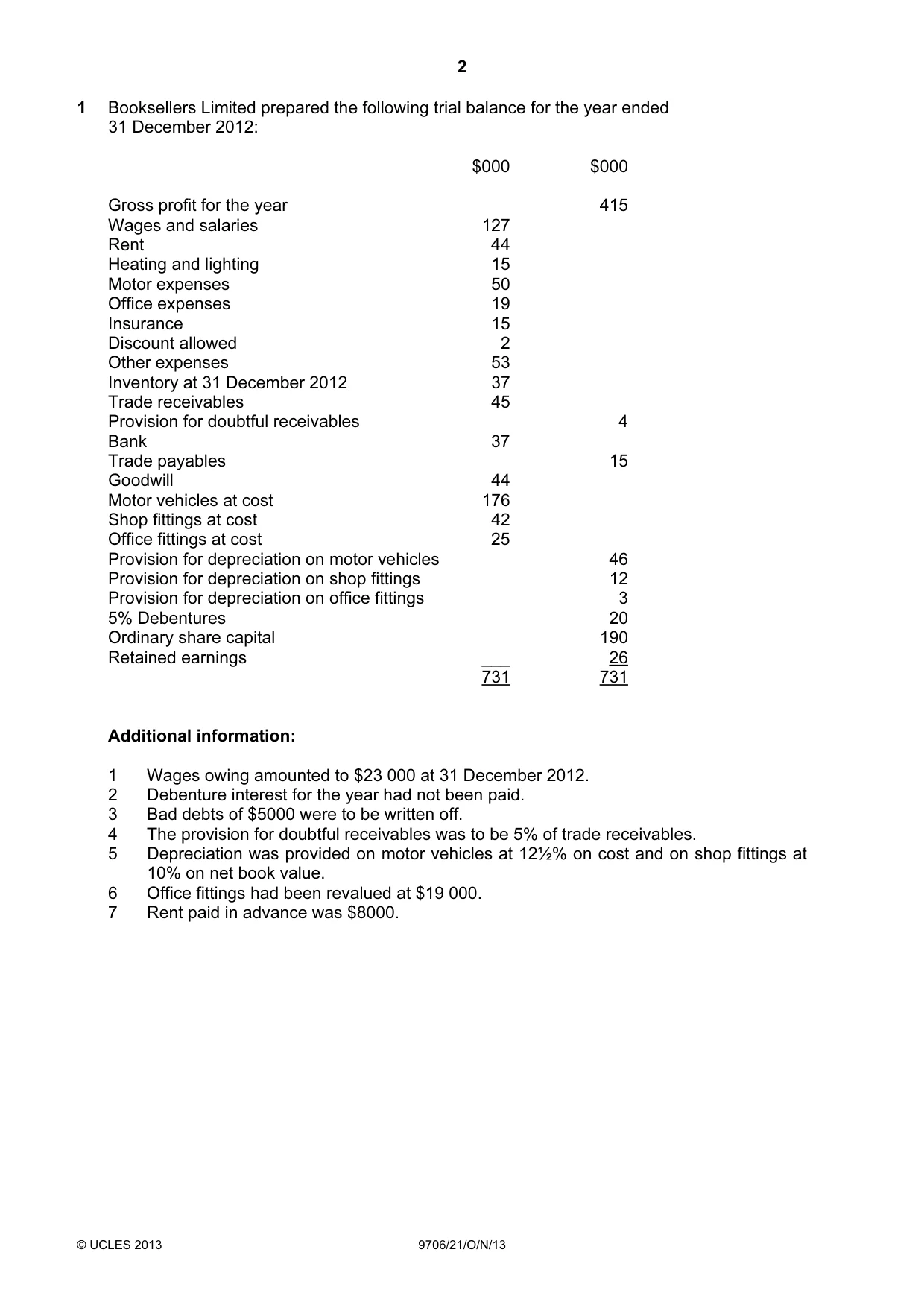
2 © UCLES 2013 9706/21/O/N/13 1 Booksellers Limited prepared the following trial balance for the year ended 31 December 2012: $000 $000 Gross profit for the year 415 Wages and salaries 127 Rent 44 Heating and lighting 15 Motor expenses 50 Office expenses 19 Insurance 15 Discount allowed 2 Other expenses 53 Inventory at 31 December 2012 37 Trade receivables 45 Provision for doubtful receivables 4 Bank 37 Trade payables 15 Goodwill 44 Motor vehicles at cost 176 Shop fittings at cost 42 Office fittings at cost 25 Provision for depreciation on motor vehicles 46 Provision for depreciation on shop fittings 12 Provision for depreciation on office fittings 3 5% Debentures 20 Ordinary share capital 190 Retained earnings ___ 26 731 731 Additional information: 1 Wages owing amounted to $23 000 at 31 December 2012. 2 Debenture interest for the year had not been paid. 3 Bad debts of $5000 were to be written off. 4 The provision for doubtful receivables was to be 5% of trade receivables. 5 Depreciation was provided on motor vehicles at 12½% on cost and on shop fittings at 10% on net book value. 6 Office fittings had been revalued at $19 000. 7 Rent paid in advance was $8000.
Question paper, page 3
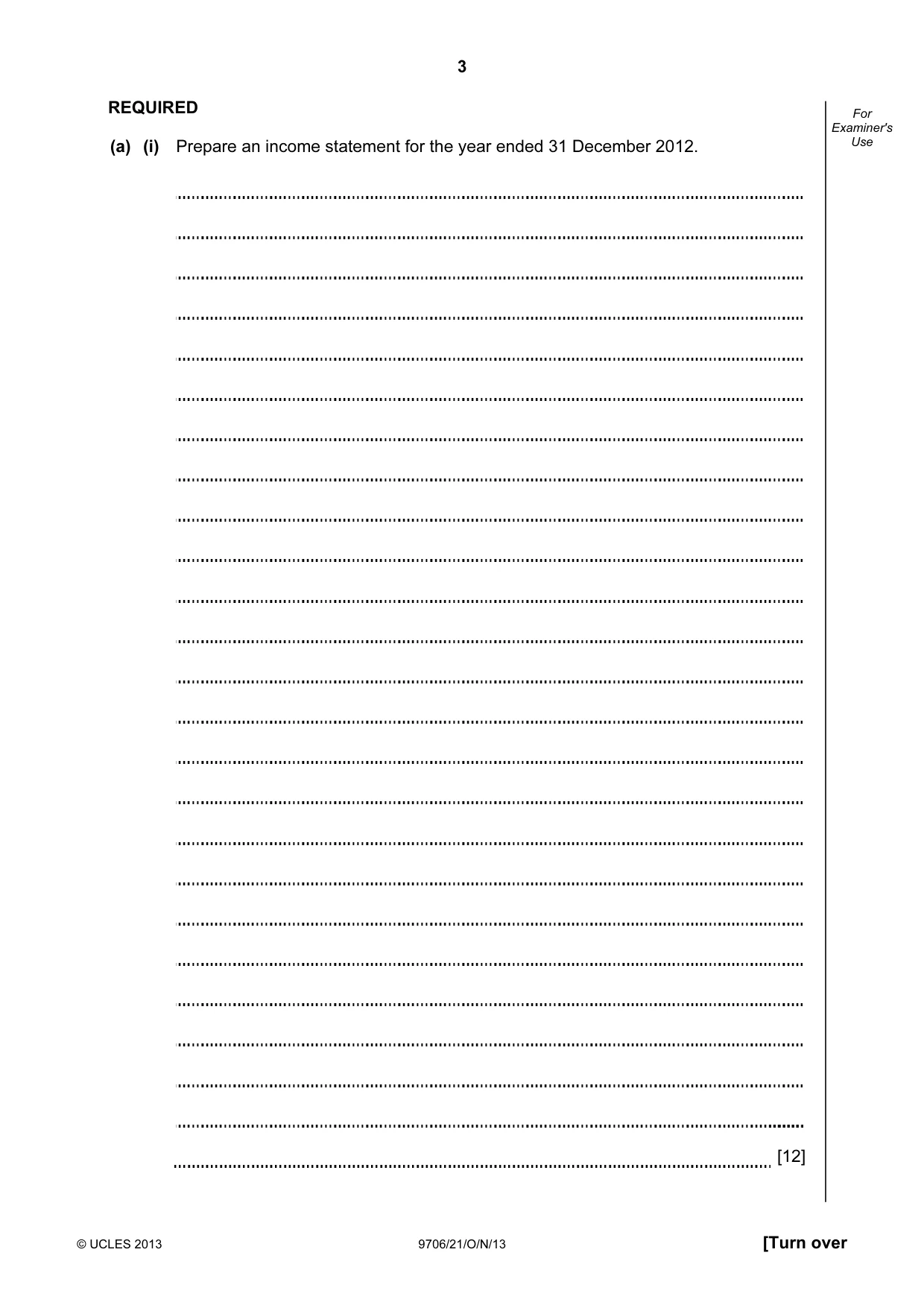
3 © UCLES 2013 9706/21/O/N/13 [Turn over For Examiner's Use REQUIRED (a) (i) Prepare an income statement for the year ended 31 December 2012. [12]
Question paper, page 4
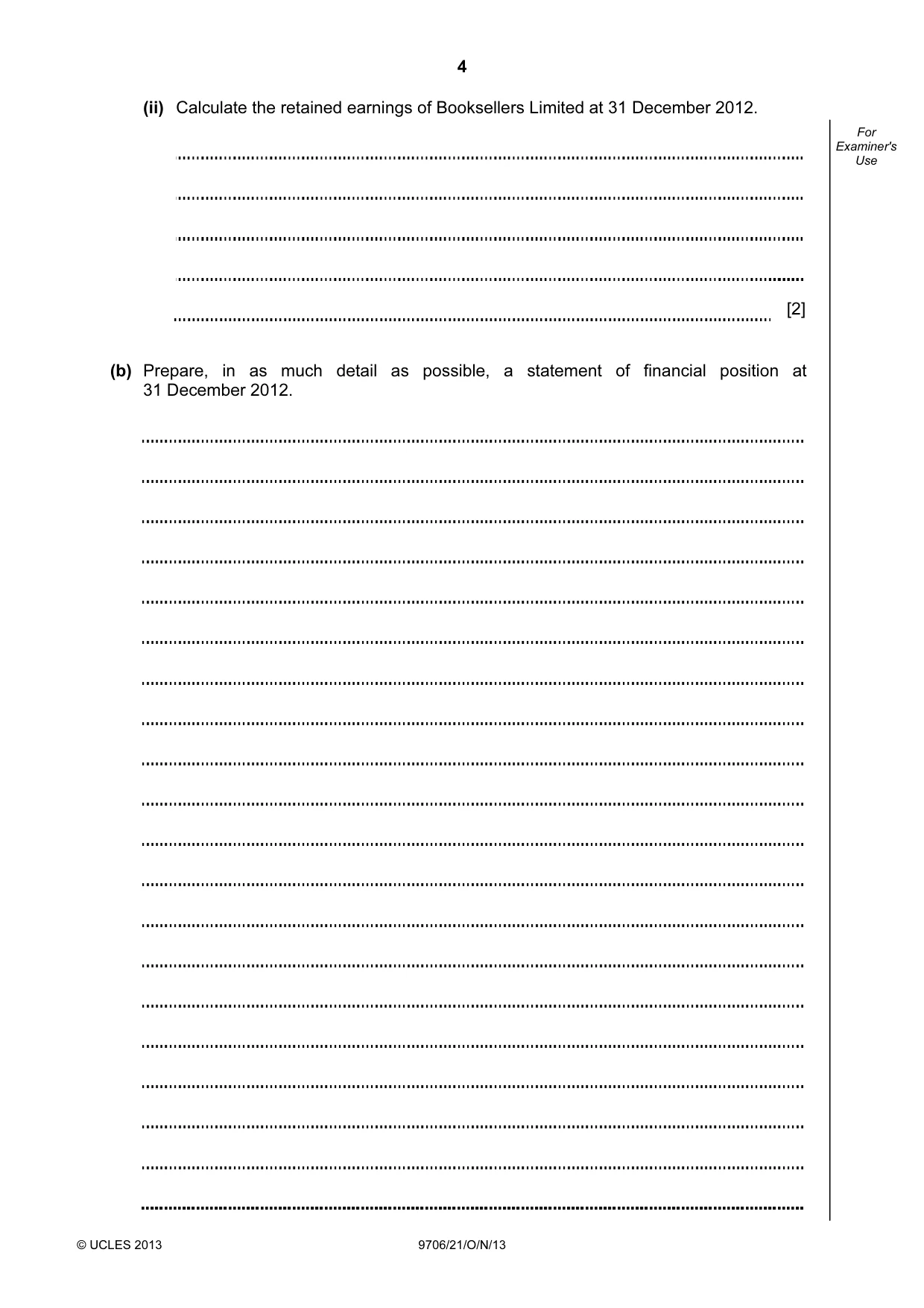
4 © UCLES 2013 9706/21/O/N/13 For Examiner's Use (ii) Calculate the retained earnings of Booksellers Limited at 31 December 2012. [2] (b) Prepare, in as much detail as possible, a statement of financial position at 31 December 2012.
Question paper, page 5
5 © UCLES 2013 9706/21/O/N/13 [Turn over For Examiner's Use [8] (c) (i) The directors wish to raise funds to expand the business. State two sources of finance they could use. [2] (ii) State the advantages and disadvantages to the company of the two sources of finance you have chosen. [6] [Total: 30]
Question paper, page 6
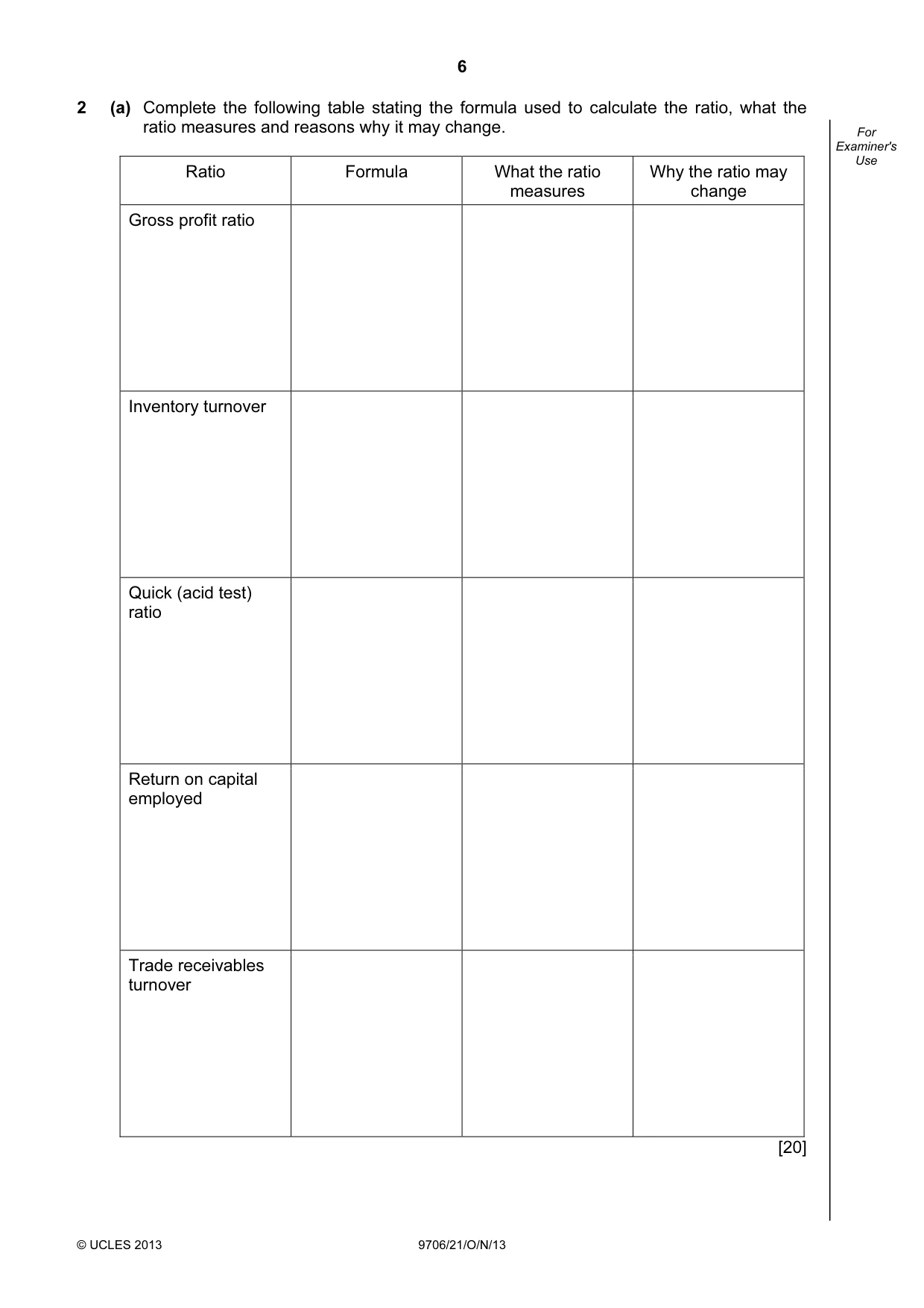
6 © UCLES 2013 9706/21/O/N/13 For Examiner's Use 2 (a) Complete the following table stating the formula used to calculate the ratio, what the ratio measures and reasons why it may change. Ratio Formula What the ratio measures Why the ratio may change Gross profit ratio Inventory turnover Quick (acid test) ratio Return on capital employed Trade receivables turnover [20]
Question paper, page 7
7 © UCLES 2013 9706/21/O/N/13 [Turn over For Examiner's Use (b) State and explain five limitations of using ratio analysis as an indicator of business performance. 1 2 3 4 5 [10] [Total: 30]
Question paper, page 8
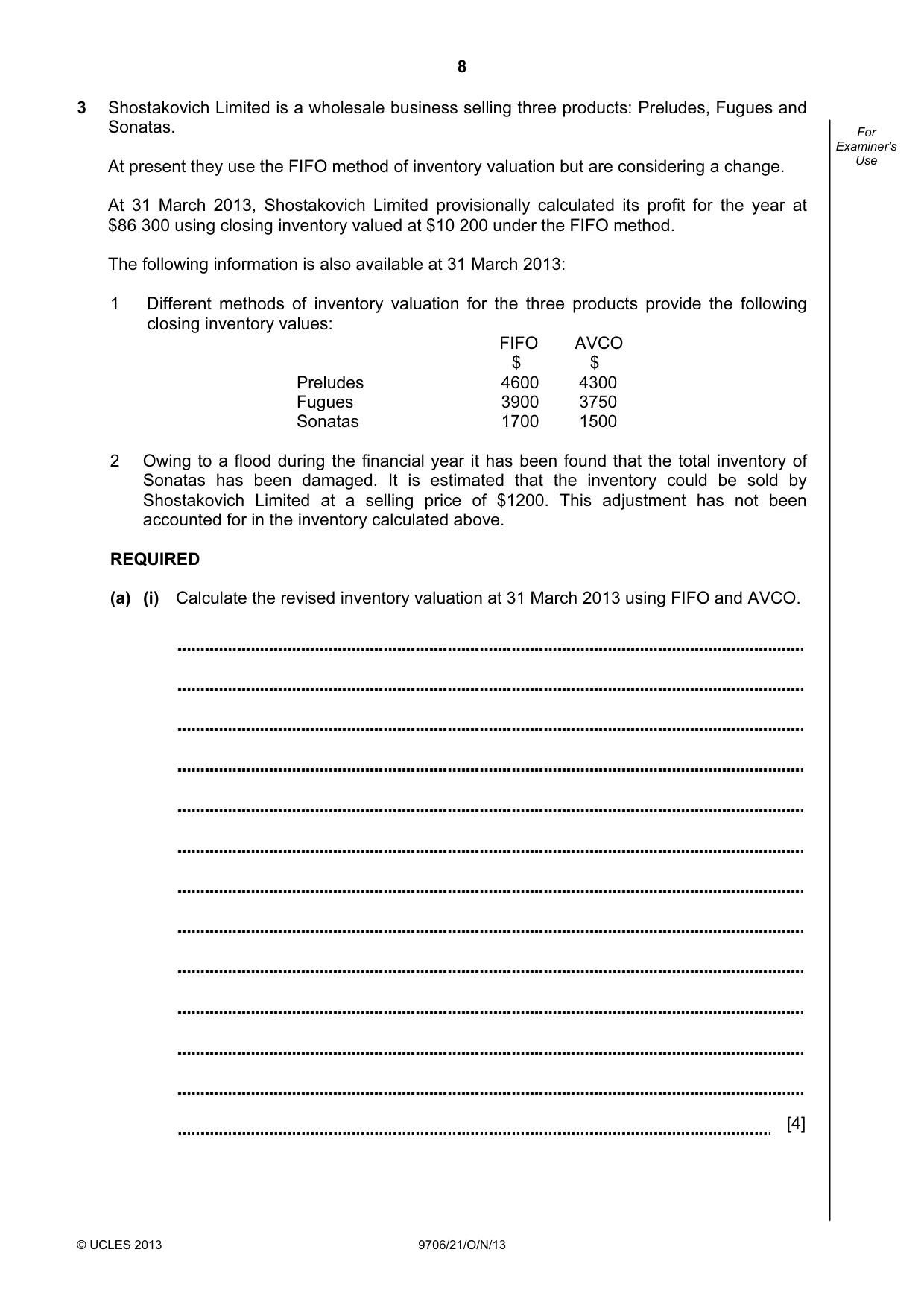
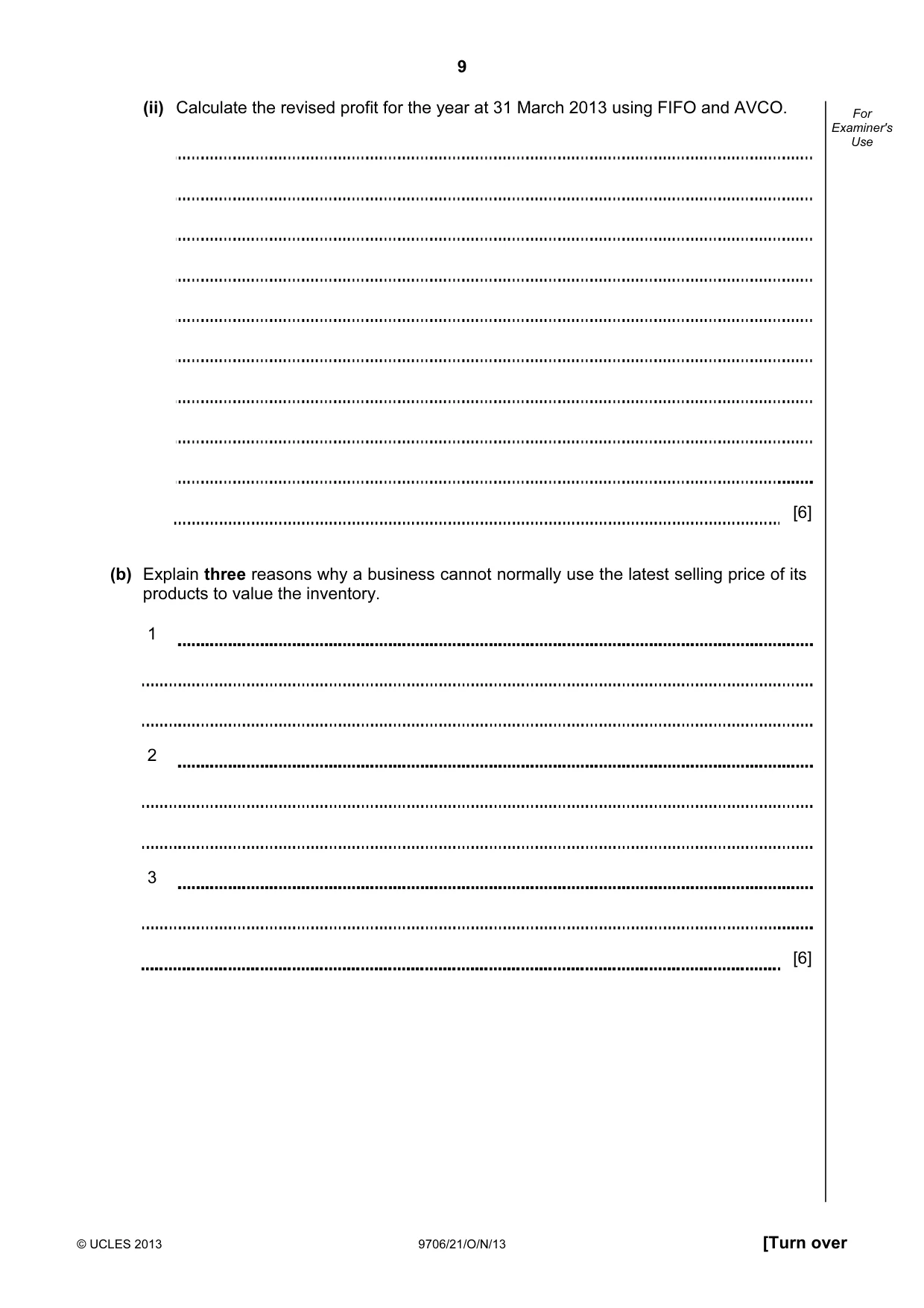
8 © UCLES 2013 9706/21/O/N/13 For Examiner's Use 3 Shostakovich Limited is a wholesale business selling three products: Preludes, Fugues and Sonatas. At present they use the FIFO method of inventory valuation but are considering a change. At 31 March 2013, Shostakovich Limited provisionally calculated its profit for the year at $86 300 using closing inventory valued at $10 200 under the FIFO method. The following information is also available at 31 March 2013: 1 Different methods of inventory valuation for the three products provide the following closing inventory values: FIFO AVCO $ $ Preludes 4600 4300 Fugues 3900 3750 Sonatas 1700 1500 2 Owing to a flood during the financial year it has been found that the total inventory of Sonatas has been damaged. It is estimated that the inventory could be sold by Shostakovich Limited at a selling price of $1200. This adjustment has not been accounted for in the inventory calculated above. REQUIRED (a) (i) Calculate the revised inventory valuation at 31 March 2013 using FIFO and AVCO. [4]
Question paper, page 9
9 © UCLES 2013 9706/21/O/N/13 [Turn over For Examiner's Use (ii) Calculate the revised profit for the year at 31 March 2013 using FIFO and AVCO. [6] (b) Explain three reasons why a business cannot normally use the latest selling price of its products to value the inventory. 1 2 3 [6]
Question paper, page 10
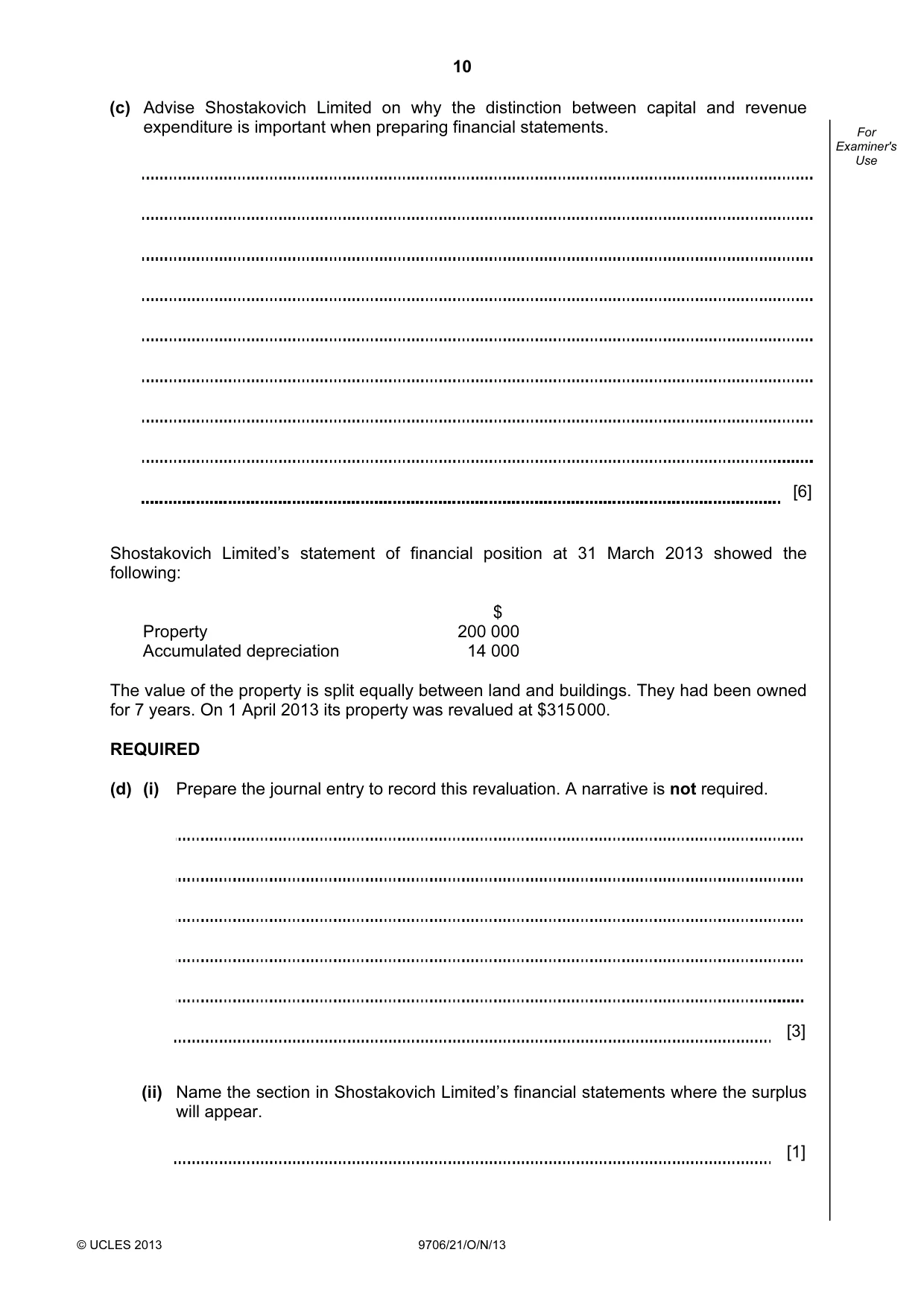
10 © UCLES 2013 9706/21/O/N/13 For Examiner's Use (c) Advise Shostakovich Limited on why the distinction between capital and revenue expenditure is important when preparing financial statements. [6] Shostakovich Limited’s statement of financial position at 31 March 2013 showed the following: $ Property 200 000 Accumulated depreciation 14 000 The value of the property is split equally between land and buildings. They had been owned for 7 years. On 1 April 2013 its property was revalued at $315 000. REQUIRED (d) (i) Prepare the journal entry to record this revaluation. A narrative is not required. [3] (ii) Name the section in Shostakovich Limited’s financial statements where the surplus will appear. [1]
Question paper, page 11
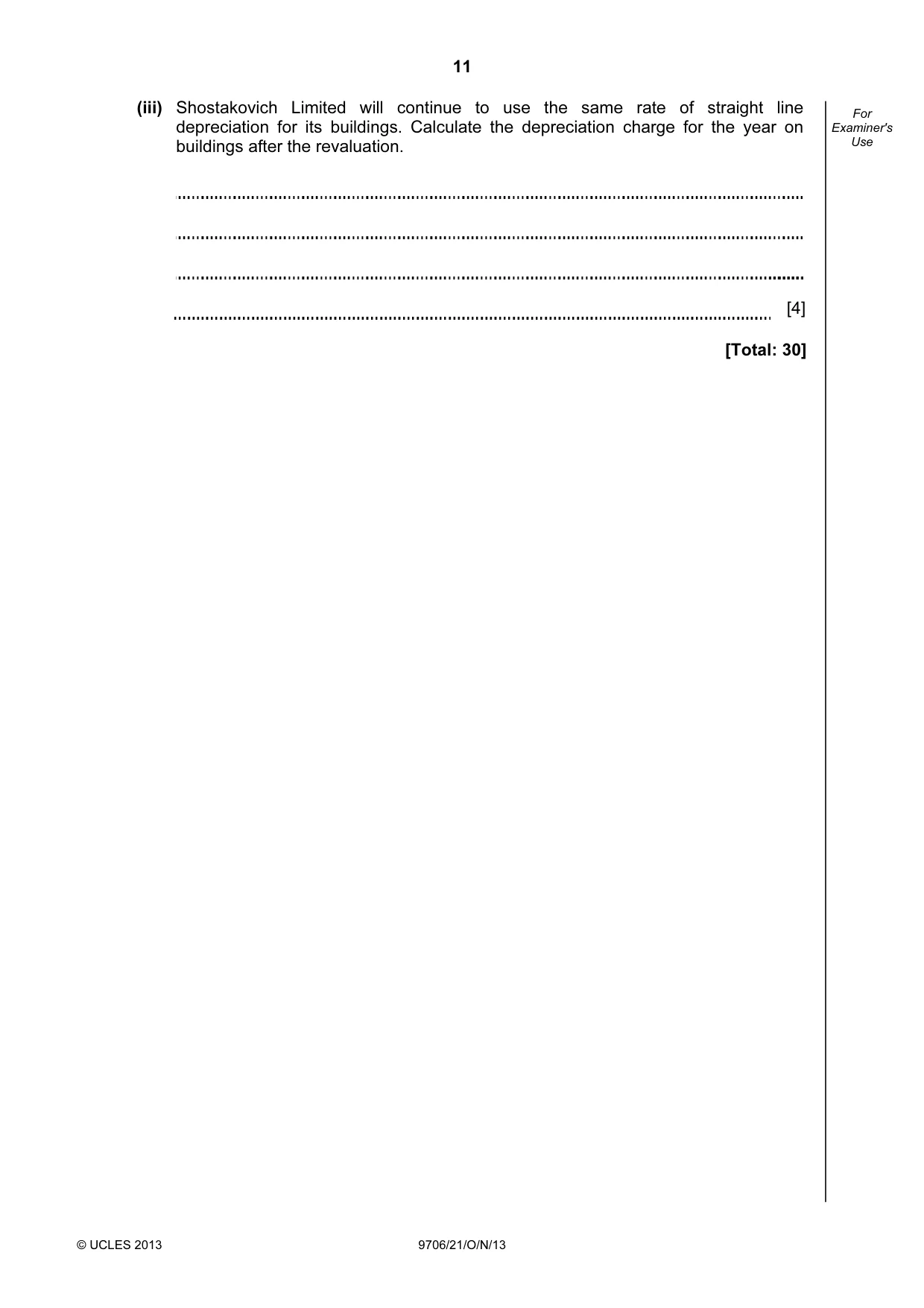
11 © UCLES 2013 9706/21/O/N/13 For Examiner's Use (iii) Shostakovich Limited will continue to use the same rate of straight line depreciation for its buildings. Calculate the depreciation charge for the year on buildings after the revaluation. [4] [Total: 30]
Question paper, page 12
12 Permission to reproduce items where third-party owned material protected by copyright is included has been sought and cleared where possible. Every reasonable effort has been made by the publisher (UCLES) to trace copyright holders, but if any items requiring clearance have unwittingly been included, the publisher will be pleased to make amends at the earliest possible opportunity. University of Cambridge International Examinations is part of the Cambridge Assessment Group. Cambridge Assessment is the brand name of University of Cambridge Local Examinations Syndicate (UCLES), which is itself a department of the University of Cambridge. © UCLES 2013 9706/21/O/N/13 BLANK PAGE
Mark scheme, page 1
CAMBRIDGE INTERNATIONAL EXAMINATIONS GCE Advanced Subsidiary Level and GCE Advanced Level MARK SCHEME for the October/November 2013 series 9706 ACCOUNTING 9706/21 Paper 2 (Structured Questions – Core), maximum raw mark 90 This mark scheme is published as an aid to teachers and candidates, to indicate the requirements of the examination. It shows the basis on which Examiners were instructed to award marks. It does not indicate the details of the discussions that took place at an Examiners’ meeting before marking began, which would have considered the acceptability of alternative answers. Mark schemes should be read in conjunction with the question paper and the Principal Examiner Report for Teachers. Cambridge will not enter into discussions about these mark schemes. Cambridge is publishing the mark schemes for the October/November 2013 series for most IGCSE, GCE Advanced Level and Advanced Subsidiary Level components and some Ordinary Level components.
Mark scheme, page 2
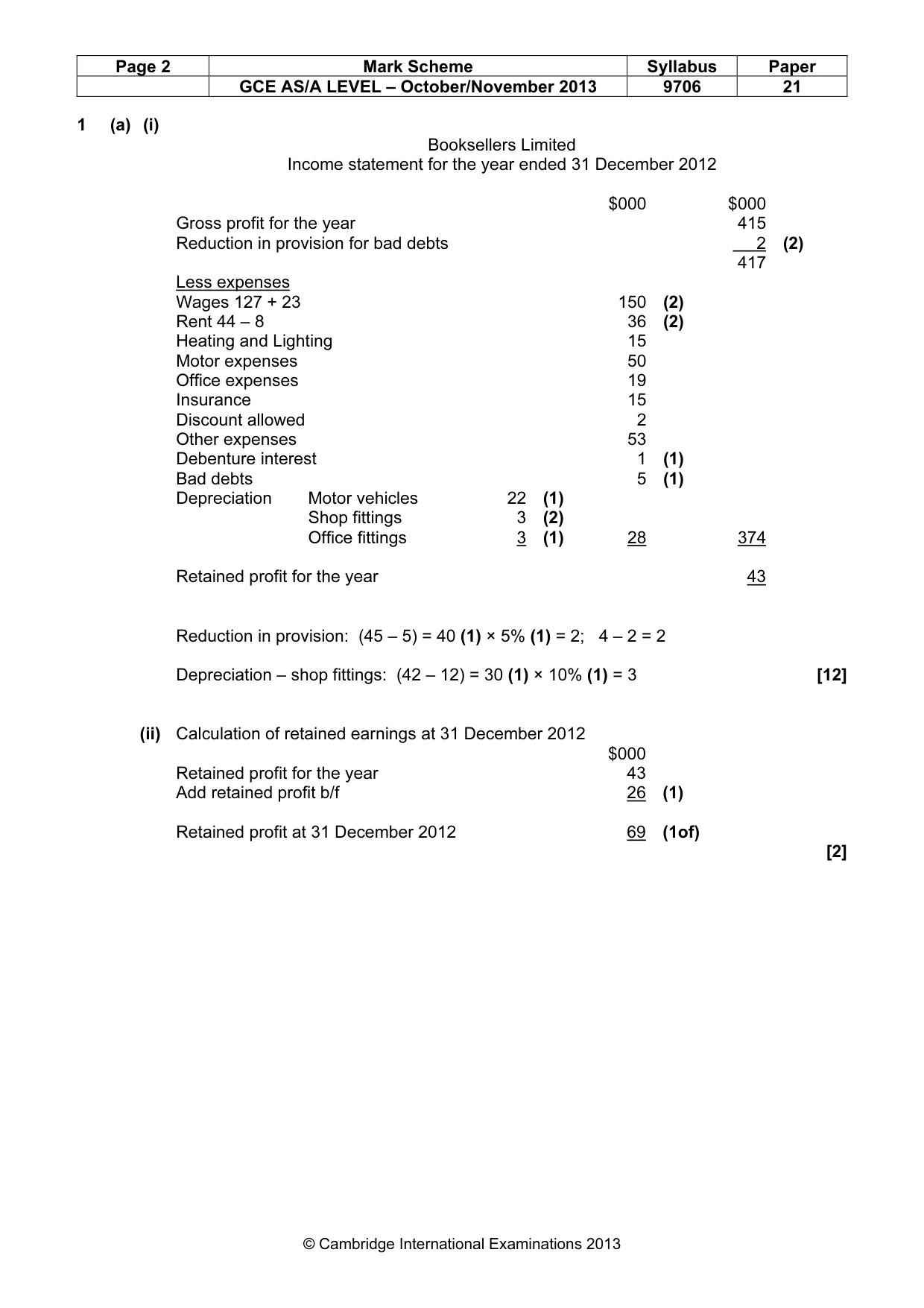
Page 2 Mark Scheme Syllabus Paper GCE AS/A LEVEL – October/November 2013 9706 21 © Cambridge International Examinations 2013 1 (a) (i) Booksellers Limited Income statement for the year ended 31 December 2012 $000 $000 Gross profit for the year 415 Reduction in provision for bad debts 2 (2) 417 Less expenses Wages 127 + 23 150 (2) Rent 44 – 8 36 (2) Heating and Lighting 15 Motor expenses 50 Office expenses 19 Insurance 15 Discount allowed 2 Other expenses 53 Debenture interest 1 (1) Bad debts 5 (1) Depreciation Motor vehicles 22 (1) Shop fittings 3 (2) Office fittings 3 (1) 28 374 Retained profit for the year 43 Reduction in provision: (45 – 5) = 40 (1) × 5% (1) = 2; 4 – 2 = 2 Depreciation – shop fittings: (42 – 12) = 30 (1) × 10% (1) = 3 [12] (ii) Calculation of retained earnings at 31 December 2012 $000 Retained profit for the year 43 Add retained profit b/f 26 (1) Retained profit at 31 December 2012 69 (1of) [2]
Mark scheme, page 3
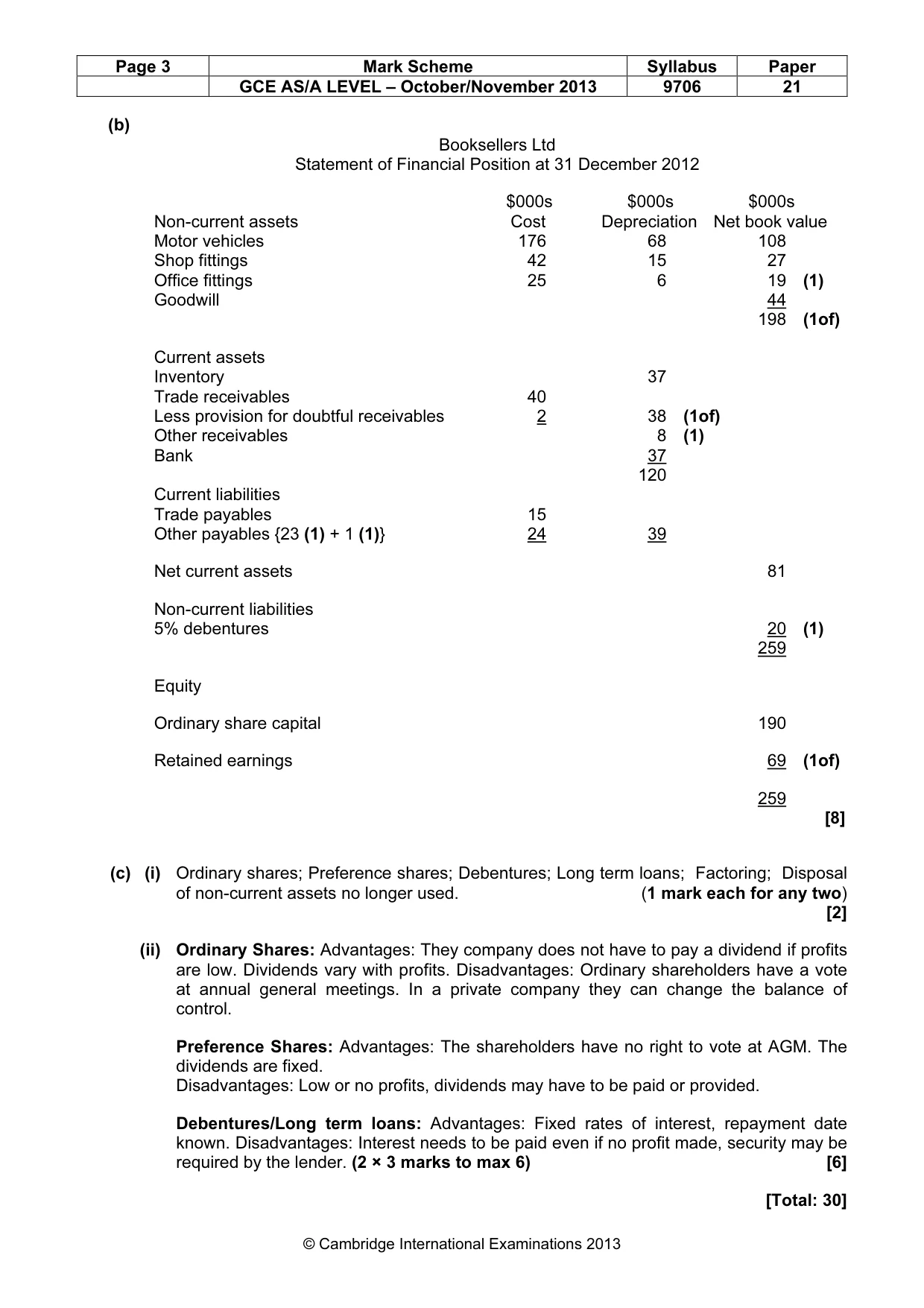
Page 3 Mark Scheme Syllabus Paper GCE AS/A LEVEL – October/November 2013 9706 21 © Cambridge International Examinations 2013 (b) Booksellers Ltd Statement of Financial Position at 31 December 2012 $000s $000s $000s Non-current assets Cost Depreciation Net book value Motor vehicles 176 68 108 Shop fittings 42 15 27 Office fittings 25 6 19 (1) Goodwill 44 198 (1of) Current assets Inventory 37 Trade receivables 40 Less provision for doubtful receivables 2 38 (1of) Other receivables 8 (1) Bank 37 120 Current liabilities Trade payables 15 Other payables {23 (1) + 1 (1)} 24 39 Net current assets 81 Non-current liabilities 5% debentures 20 (1) 259 Equity Ordinary share capital 190 Retained earnings 69 (1of) 259 [8] (c) (i) Ordinary shares; Preference shares; Debentures; Long term loans; Factoring; Disposal of non-current assets no longer used. (1 mark each for any two) [2] (ii) Ordinary Shares: Advantages: They company does not have to pay a dividend if profits are low. Dividends vary with profits. Disadvantages: Ordinary shareholders have a vote at annual general meetings. In a private company they can change the balance of control. Preference Shares: Advantages: The shareholders have no right to vote at AGM. The dividends are fixed. Disadvantages: Low or no profits, dividends may have to be paid or provided. Debentures/Long term loans: Advantages: Fixed rates of interest, repayment date known. Disadvantages: Interest needs to be paid even if no profit made, security may be required by the lender. (2 × 3 marks to max 6) [6] [Total: 30]
Mark scheme, page 4
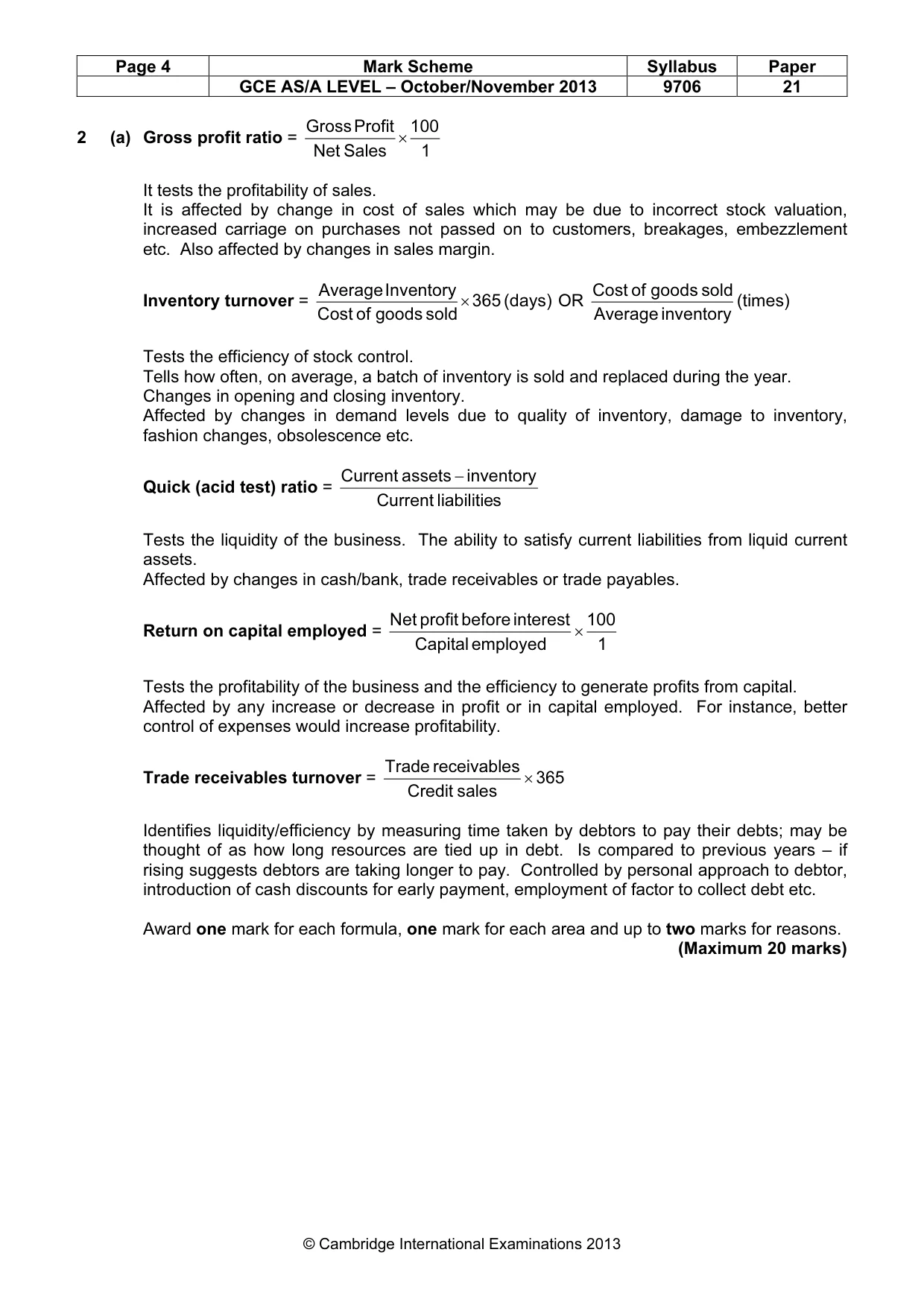
Page 4 Mark Scheme Syllabus Paper GCE AS/A LEVEL – October/November 2013 9706 21 © Cambridge International Examinations 2013 2 (a) Gross profit ratio = 1 100 Sales Net Profit Gross × It tests the profitability of sales. It is affected by change in cost of sales which may be due to incorrect stock valuation, increased carriage on purchases not passed on to customers, breakages, embezzlement etc. Also affected by changes in sales margin. Inventory turnover = (days) 365 sold goods of Cost Inventory Average × OR (times) inventory Average sold goods of Cost Tests the efficiency of stock control. Tells how often, on average, a batch of inventory is sold and replaced during the year. Changes in opening and closing inventory. Affected by changes in demand levels due to quality of inventory, damage to inventory, fashion changes, obsolescence etc. Quick (acid test) ratio = s liabilitie Current inventory assets Current − Tests the liquidity of the business. The ability to satisfy current liabilities from liquid current assets. Affected by changes in cash/bank, trade receivables or trade payables. Return on capital employed = 1 100 employed Capital interest before profit Net × Tests the profitability of the business and the efficiency to generate profits from capital. Affected by any increase or decrease in profit or in capital employed. For instance, better control of expenses would increase profitability. Trade receivables turnover = 365 sales Credit s receivable Trade × Identifies liquidity/efficiency by measuring time taken by debtors to pay their debts; may be thought of as how long resources are tied up in debt. Is compared to previous years – if rising suggests debtors are taking longer to pay. Controlled by personal approach to debtor, introduction of cash discounts for early payment, employment of factor to collect debt etc. Award one mark for each formula, one mark for each area and up to two marks for reasons. (Maximum 20 marks)
Mark scheme, page 5
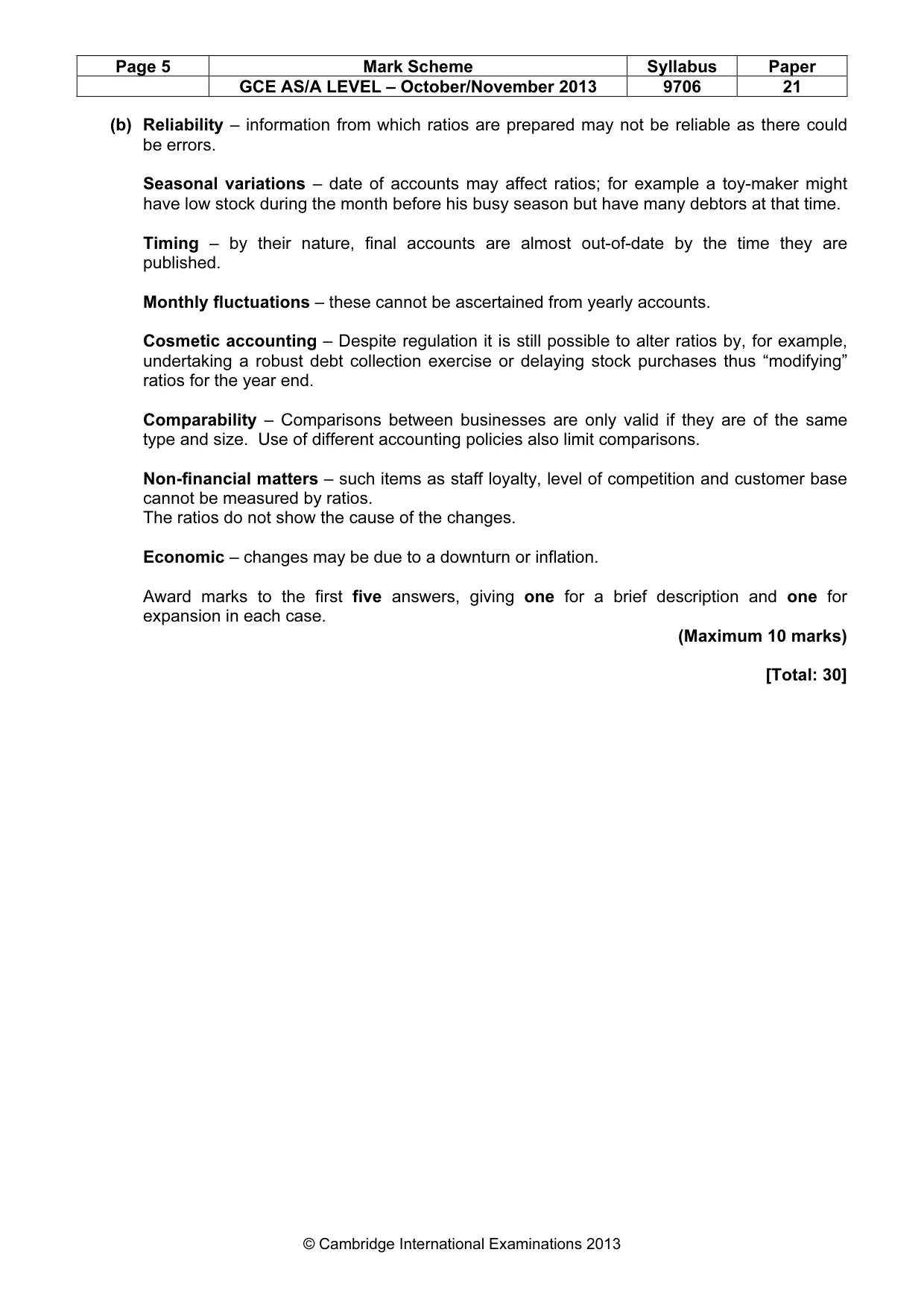
Page 5 Mark Scheme Syllabus Paper GCE AS/A LEVEL – October/November 2013 9706 21 © Cambridge International Examinations 2013 (b) Reliability – information from which ratios are prepared may not be reliable as there could be errors. Seasonal variations – date of accounts may affect ratios; for example a toy-maker might have low stock during the month before his busy season but have many debtors at that time. Timing – by their nature, final accounts are almost out-of-date by the time they are published. Monthly fluctuations – these cannot be ascertained from yearly accounts. Cosmetic accounting – Despite regulation it is still possible to alter ratios by, for example, undertaking a robust debt collection exercise or delaying stock purchases thus “modifying” ratios for the year end. Comparability – Comparisons between businesses are only valid if they are of the same type and size. Use of different accounting policies also limit comparisons. Non-financial matters – such items as staff loyalty, level of competition and customer base cannot be measured by ratios. The ratios do not show the cause of the changes. Economic – changes may be due to a downturn or inflation. Award marks to the first five answers, giving one for a brief description and one for expansion in each case. (Maximum 10 marks) [Total: 30]
Mark scheme, page 6
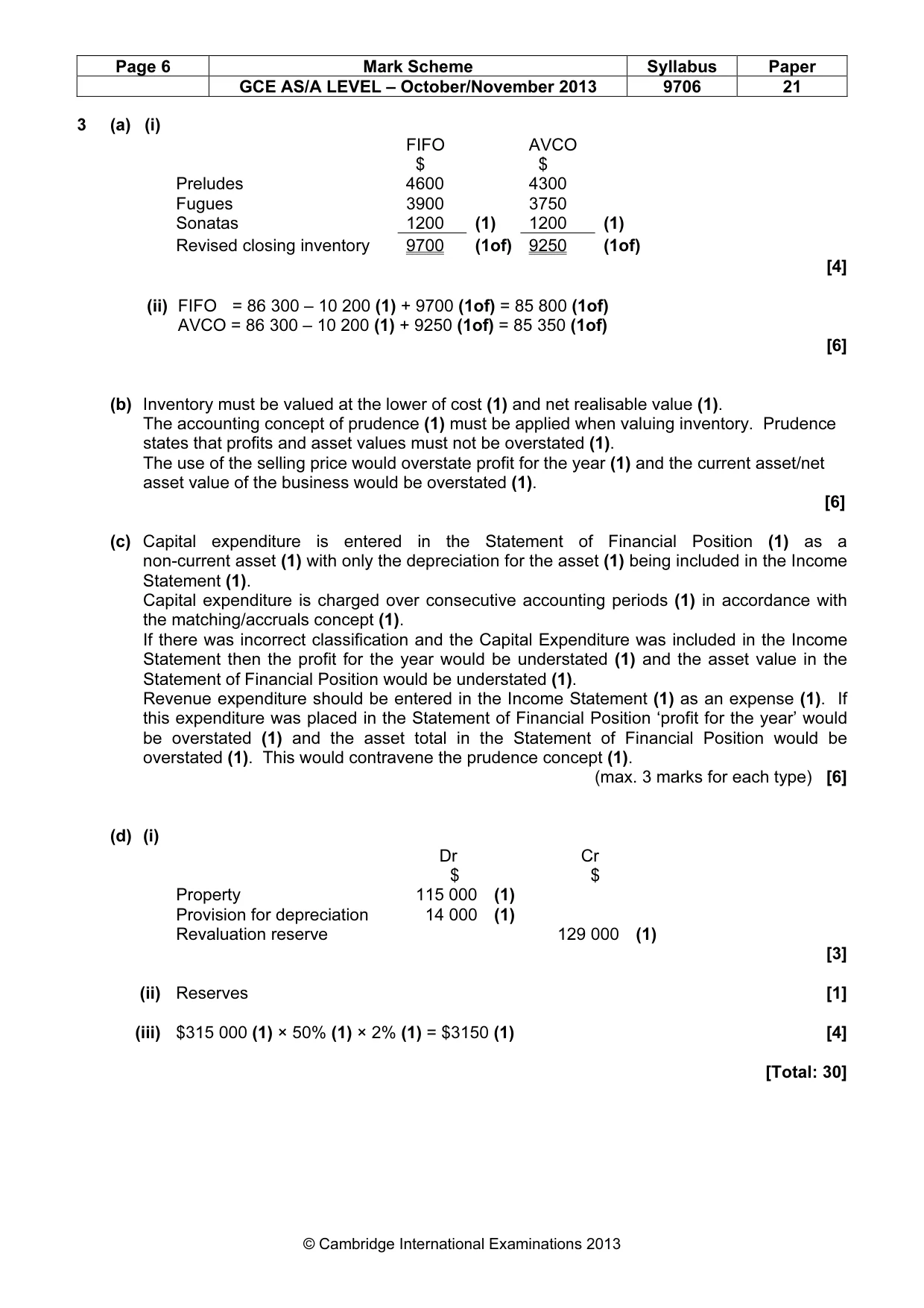
Page 6 Mark Scheme Syllabus Paper GCE AS/A LEVEL – October/November 2013 9706 21 © Cambridge International Examinations 2013 3 (a) (i) FIFO AVCO $ $ Preludes 4600 4300 Fugues 3900 3750 Sonatas 1200 (1) 1200 (1) Revised closing inventory 9700 (1of) 9250 (1of) [4] (ii) FIFO = 86 300 – 10 200 (1) + 9700 (1of) = 85 800 (1of) AVCO = 86 300 – 10 200 (1) + 9250 (1of) = 85 350 (1of) [6] (b) Inventory must be valued at the lower of cost (1) and net realisable value (1). The accounting concept of prudence (1) must be applied when valuing inventory. Prudence states that profits and asset values must not be overstated (1). The use of the selling price would overstate profit for the year (1) and the current asset/net asset value of the business would be overstated (1). [6] (c) Capital expenditure is entered in the Statement of Financial Position (1) as a non-current asset (1) with only the depreciation for the asset (1) being included in the Income Statement (1). Capital expenditure is charged over consecutive accounting periods (1) in accordance with the matching/accruals concept (1). If there was incorrect classification and the Capital Expenditure was included in the Income Statement then the profit for the year would be understated (1) and the asset value in the Statement of Financial Position would be understated (1). Revenue expenditure should be entered in the Income Statement (1) as an expense (1). If this expenditure was placed in the Statement of Financial Position ‘profit for the year’ would be overstated (1) and the asset total in the Statement of Financial Position would be overstated (1). This would contravene the prudence concept (1). (max. 3 marks for each type) [6] (d) (i) Dr Cr $ $ Property 115 000 (1) Provision for depreciation 14 000 (1) Revaluation reserve 129 000 (1) [3] (ii) Reserves [1] (iii) $315 000 (1) × 50% (1) × 2% (1) = $3150 (1) [4] [Total: 30]
What you needed in this session
Cambridge’s own grade thresholds for 2013 Oct/Nov, Paper 2 · Variant 1. A higher threshold means an easier paper — the bar moves with how the cohort did.