Cambridge A Level Accounting 9706 — 2013 Oct/Nov Paper 2 · Variant 3
9706/23/O/N/13 · 90 marks · ≈101 min
The question paper and its mark scheme, free to read here and free to download. This is Cambridge’s own paper, exactly as it was sat.
Question paper12 pages
Mark scheme6 pages
Answers below. Sit the paper first if you are practising.
Paper as text
Question paper, page 1
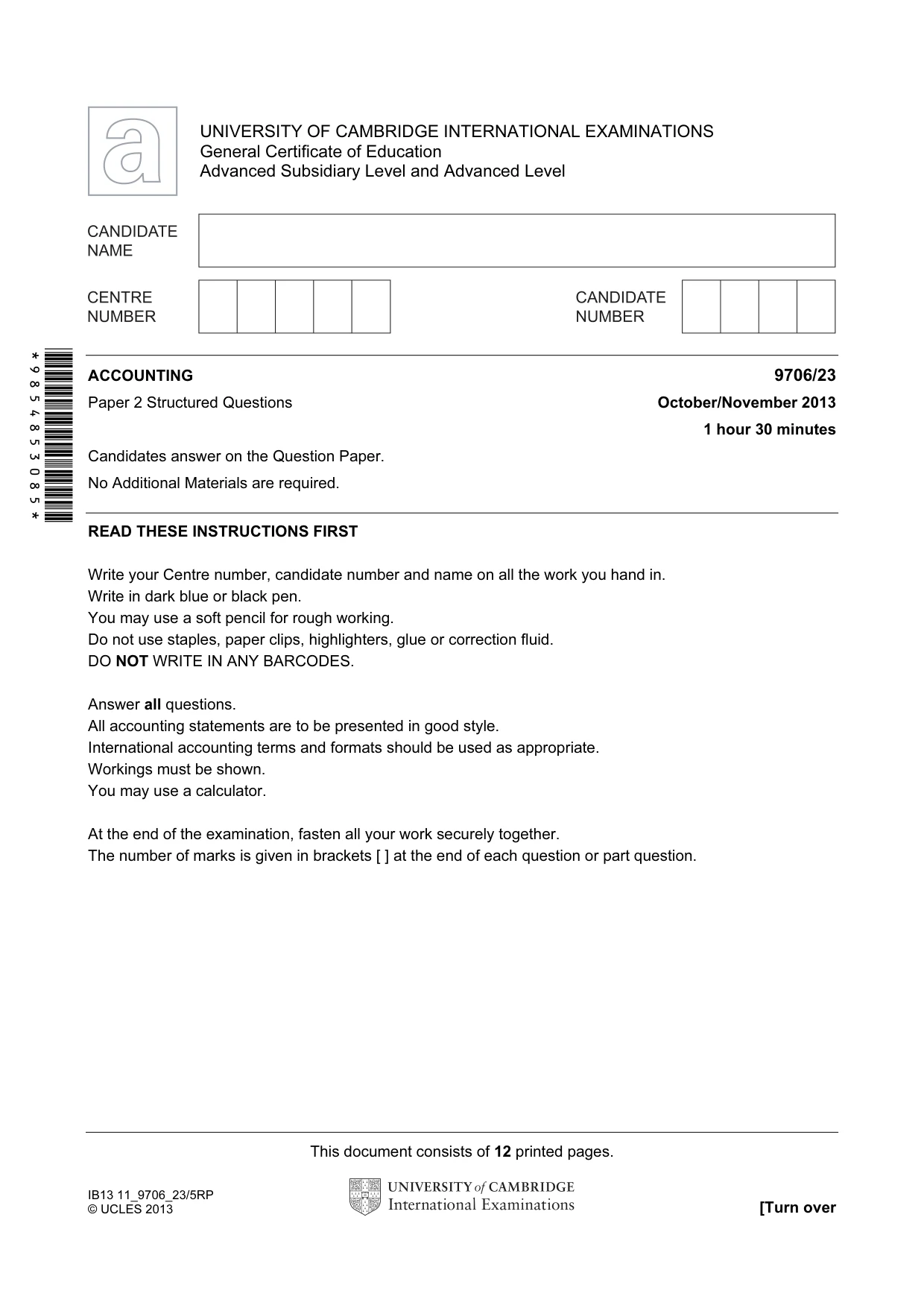
This document consists of 12 printed pages. IB13 11_9706_23/5RP © UCLES 2013 [Turn over *9854853085* UNIVERSITY OF CAMBRIDGE INTERNATIONAL EXAMINATIONS General Certificate of Education Advanced Subsidiary Level and Advanced Level ACCOUNTING 9706/23 Paper 2 Structured Questions October/November 2013 1 hour 30 minutes Candidates answer on the Question Paper. No Additional Materials are required. READ THESE INSTRUCTIONS FIRST Write your Centre number, candidate number and name on all the work you hand in. Write in dark blue or black pen. You may use a soft pencil for rough working. Do not use staples, paper clips, highlighters, glue or correction fluid. DO NOT WRITE IN ANY BARCODES. Answer all questions. All accounting statements are to be presented in good style. International accounting terms and formats should be used as appropriate. Workings must be shown. You may use a calculator. At the end of the examination, fasten all your work securely together. The number of marks is given in brackets [ ] at the end of each question or part question.
Question paper, page 2
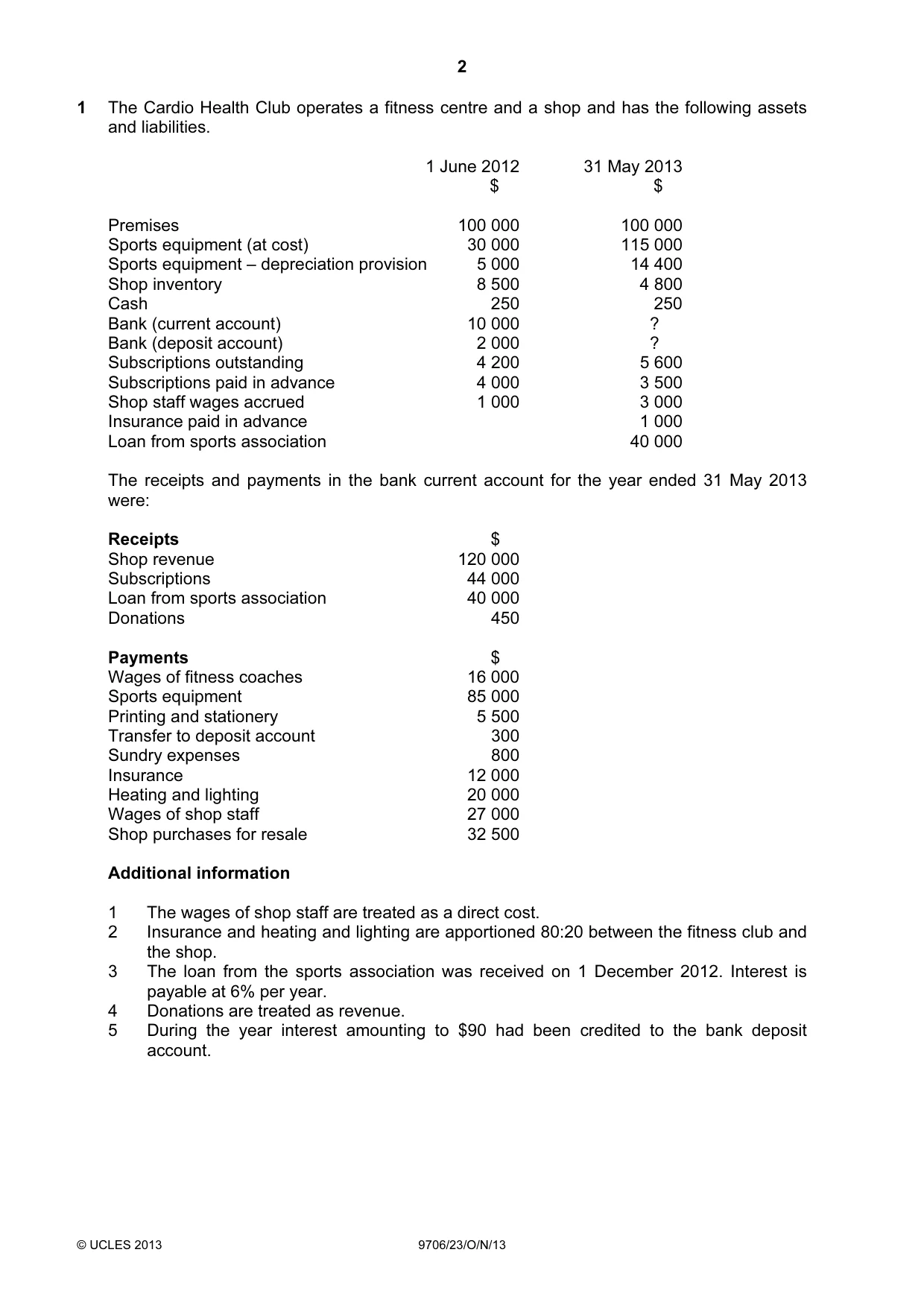
2 © UCLES 2013 9706/23/O/N/13 1 The Cardio Health Club operates a fitness centre and a shop and has the following assets and liabilities. 1 June 2012 31 May 2013 $ $ Premises 100 000 100 000 Sports equipment (at cost) 30 000 115 000 Sports equipment – depreciation provision 5 000 14 400 Shop inventory 8 500 4 800 Cash 250 250 Bank (current account) 10 000 ? Bank (deposit account) 2 000 ? Subscriptions outstanding 4 200 5 600 Subscriptions paid in advance 4 000 3 500 Shop staff wages accrued 1 000 3 000 Insurance paid in advance 1 000 Loan from sports association 40 000 The receipts and payments in the bank current account for the year ended 31 May 2013 were: Receipts $ Shop revenue 120 000 Subscriptions 44 000 Loan from sports association 40 000 Donations 450 Payments $ Wages of fitness coaches 16 000 Sports equipment 85 000 Printing and stationery 5 500 Transfer to deposit account 300 Sundry expenses 800 Insurance 12 000 Heating and lighting 20 000 Wages of shop staff 27 000 Shop purchases for resale 32 500 Additional information 1 The wages of shop staff are treated as a direct cost. 2 Insurance and heating and lighting are apportioned 80:20 between the fitness club and the shop. 3 The loan from the sports association was received on 1 December 2012. Interest is payable at 6% per year. 4 Donations are treated as revenue. 5 During the year interest amounting to $90 had been credited to the bank deposit account.
Question paper, page 3
3 © UCLES 2013 9706/23/O/N/13 [Turn over For Examiner's Use REQUIRED (a) Prepare the shop income statement for the year ended 31 May 2013. [8]
Question paper, page 4
4 © UCLES 2013 9706/23/O/N/13 For Examiner's Use (b) Prepare the income and expenditure account of the Cardio Health Club for year ended 31 May 2013. [14]
Question paper, page 5
5 © UCLES 2013 9706/23/O/N/13 [Turn over For Examiner's Use (c) Prepare the statement of financial position of the Cardio Health Club at 31 May 2013. [8] [Total: 30]
Question paper, page 6
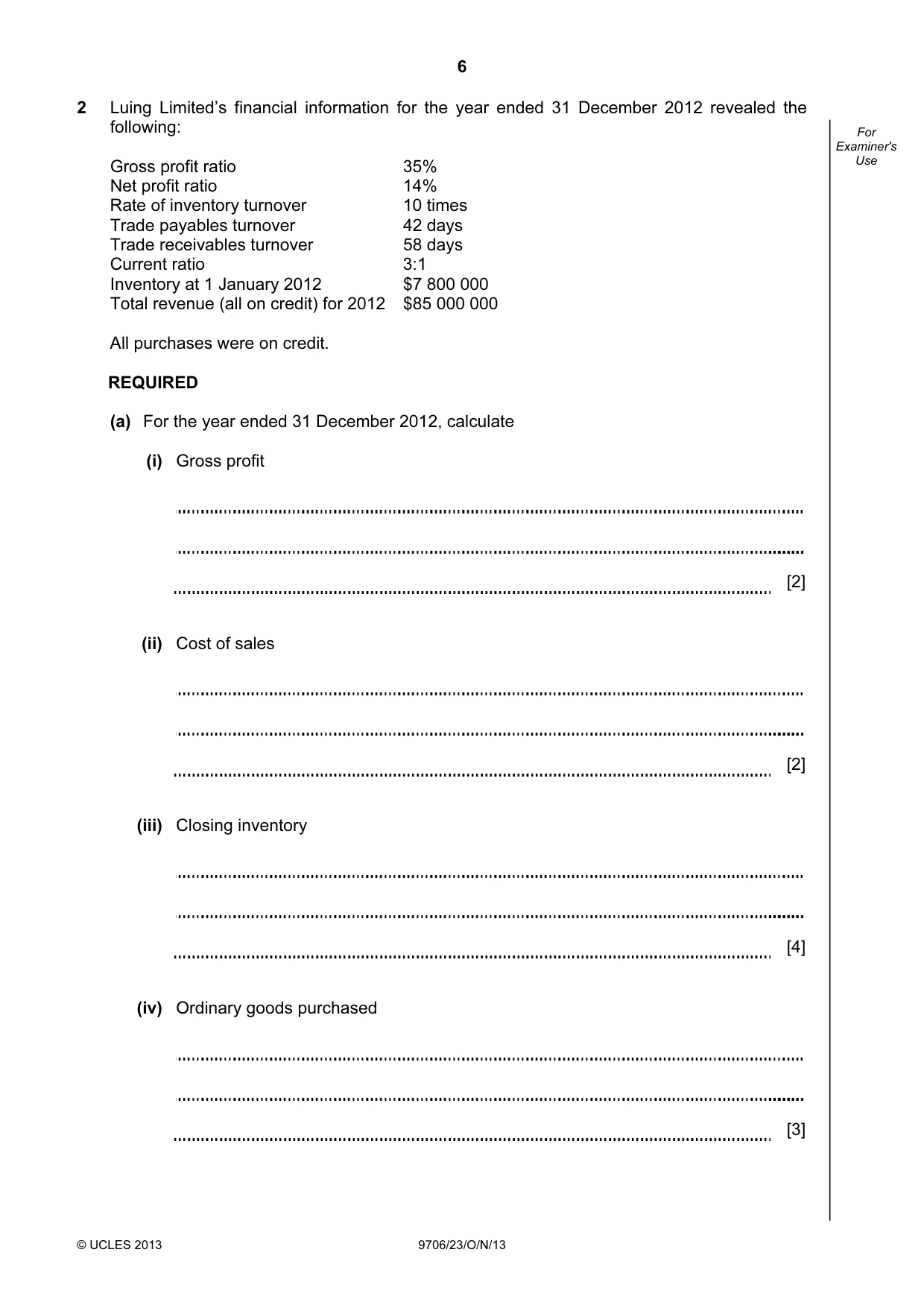
6 © UCLES 2013 9706/23/O/N/13 For Examiner's Use 2 Luing Limited’s financial information for the year ended 31 December 2012 revealed the following: Gross profit ratio 35% Net profit ratio 14% Rate of inventory turnover 10 times Trade payables turnover 42 days Trade receivables turnover 58 days Current ratio 3:1 Inventory at 1 January 2012 $7 800 000 Total revenue (all on credit) for 2012 $85 000 000 All purchases were on credit. REQUIRED (a) For the year ended 31 December 2012, calculate (i) Gross profit [2] (ii) Cost of sales [2] (iii) Closing inventory [4] (iv) Ordinary goods purchased [3]
Question paper, page 7
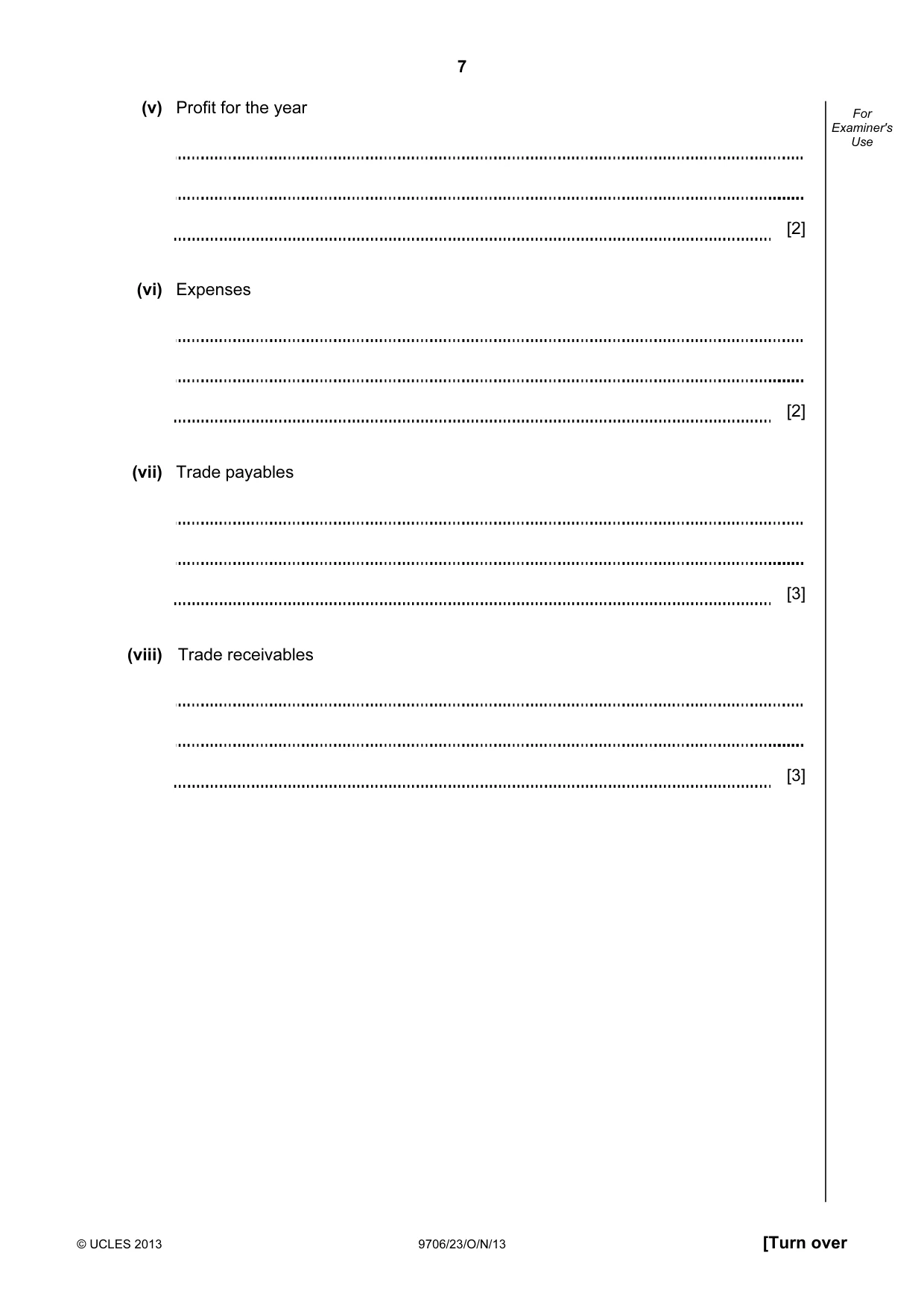
7 © UCLES 2013 9706/23/O/N/13 [Turn over For Examiner's Use (v) Profit for the year [2] (vi) Expenses [2] (vii) Trade payables [3] (viii) Trade receivables [3]
Question paper, page 8
8 © UCLES 2013 9706/23/O/N/13 For Examiner's Use (b) Identify three possible users of accounting ratios other than the directors of the company. State what information the users would obtain from the ratios. 1 2 3 [9] [Total: 30]
Question paper, page 9
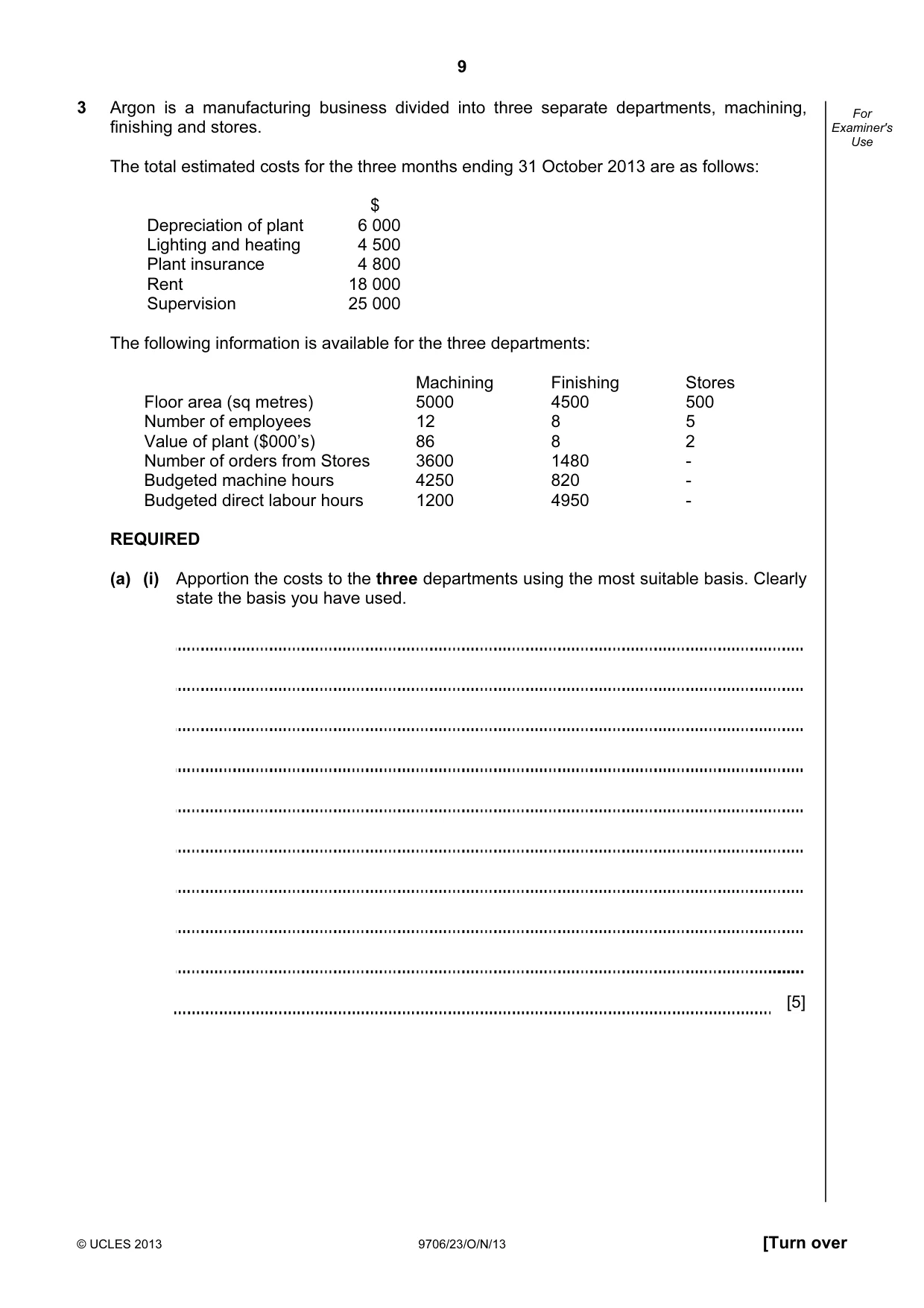
9 © UCLES 2013 9706/23/O/N/13 [Turn over For Examiner's Use 3 Argon is a manufacturing business divided into three separate departments, machining, finishing and stores. The total estimated costs for the three months ending 31 October 2013 are as follows: $ Depreciation of plant 6 000 Lighting and heating 4 500 Plant insurance 4 800 Rent 18 000 Supervision 25 000 The following information is available for the three departments: Machining Finishing Stores Floor area (sq metres) 5000 4500 500 Number of employees 12 8 5 Value of plant ($000’s) 86 8 2 Number of orders from Stores 3600 1480 - Budgeted machine hours 4250 820 - Budgeted direct labour hours 1200 4950 - REQUIRED (a) (i) Apportion the costs to the three departments using the most suitable basis. Clearly state the basis you have used. [5]
Question paper, page 10
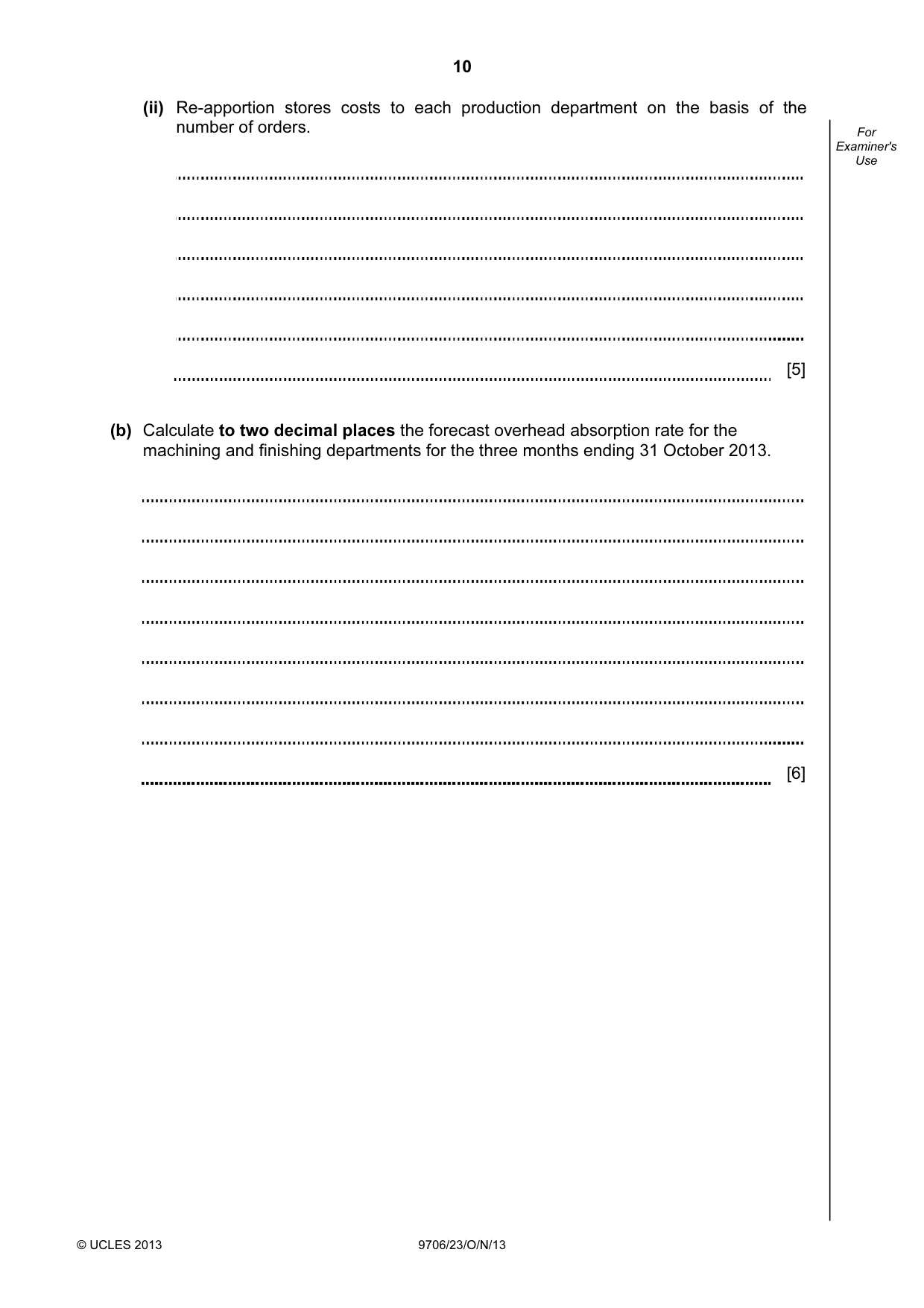
10 © UCLES 2013 9706/23/O/N/13 For Examiner's Use (ii) Re-apportion stores costs to each production department on the basis of the number of orders. [5] (b) Calculate to two decimal places the forecast overhead absorption rate for the machining and finishing departments for the three months ending 31 October 2013. [6]
Question paper, page 11
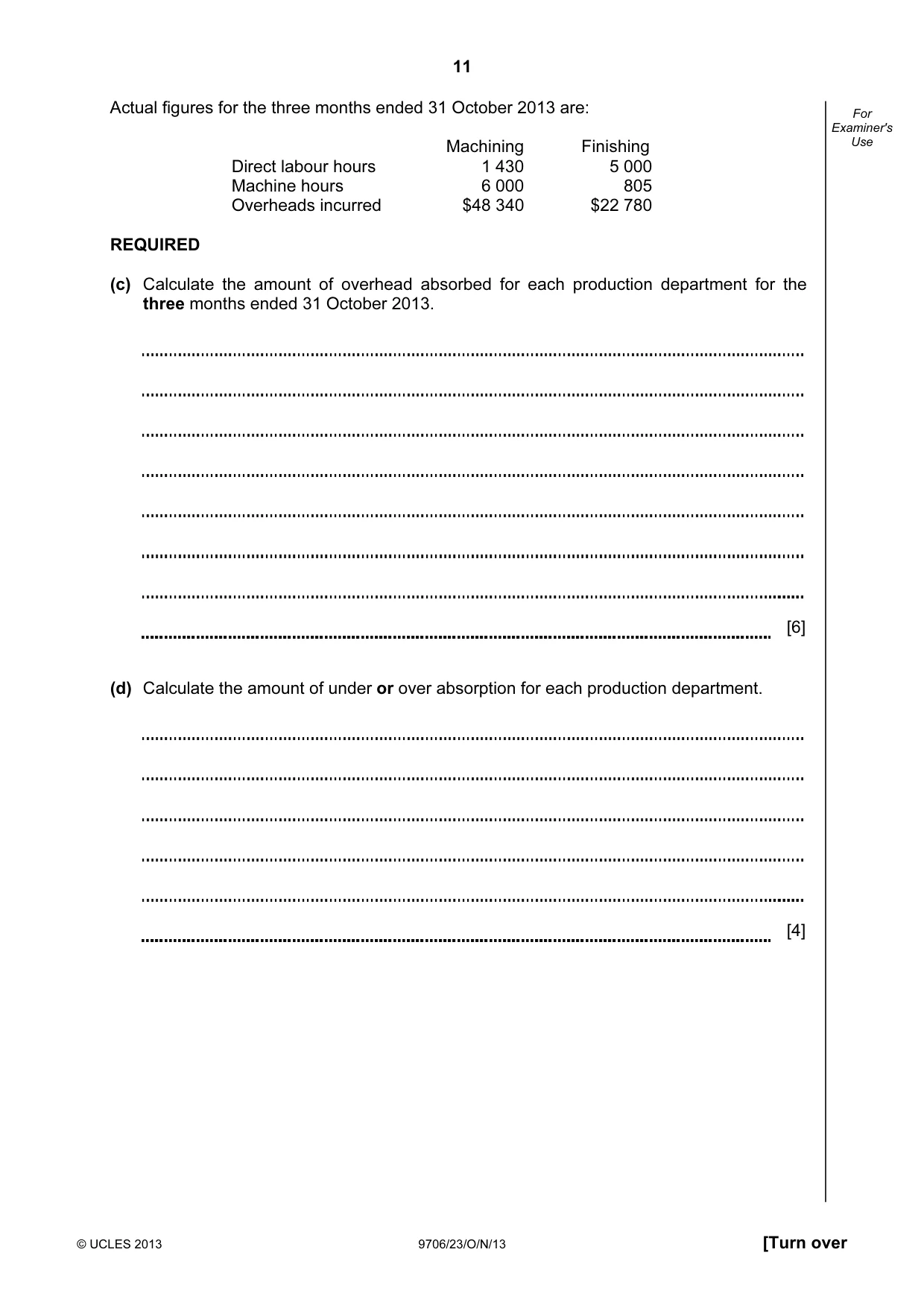
11 © UCLES 2013 9706/23/O/N/13 [Turn over For Examiner's Use Actual figures for the three months ended 31 October 2013 are: Machining Finishing Direct labour hours 1 430 5 000 Machine hours 6 000 805 Overheads incurred $48 340 $22 780 REQUIRED (c) Calculate the amount of overhead absorbed for each production department for the three months ended 31 October 2013. [6] (d) Calculate the amount of under or over absorption for each production department. [4]
Question paper, page 12
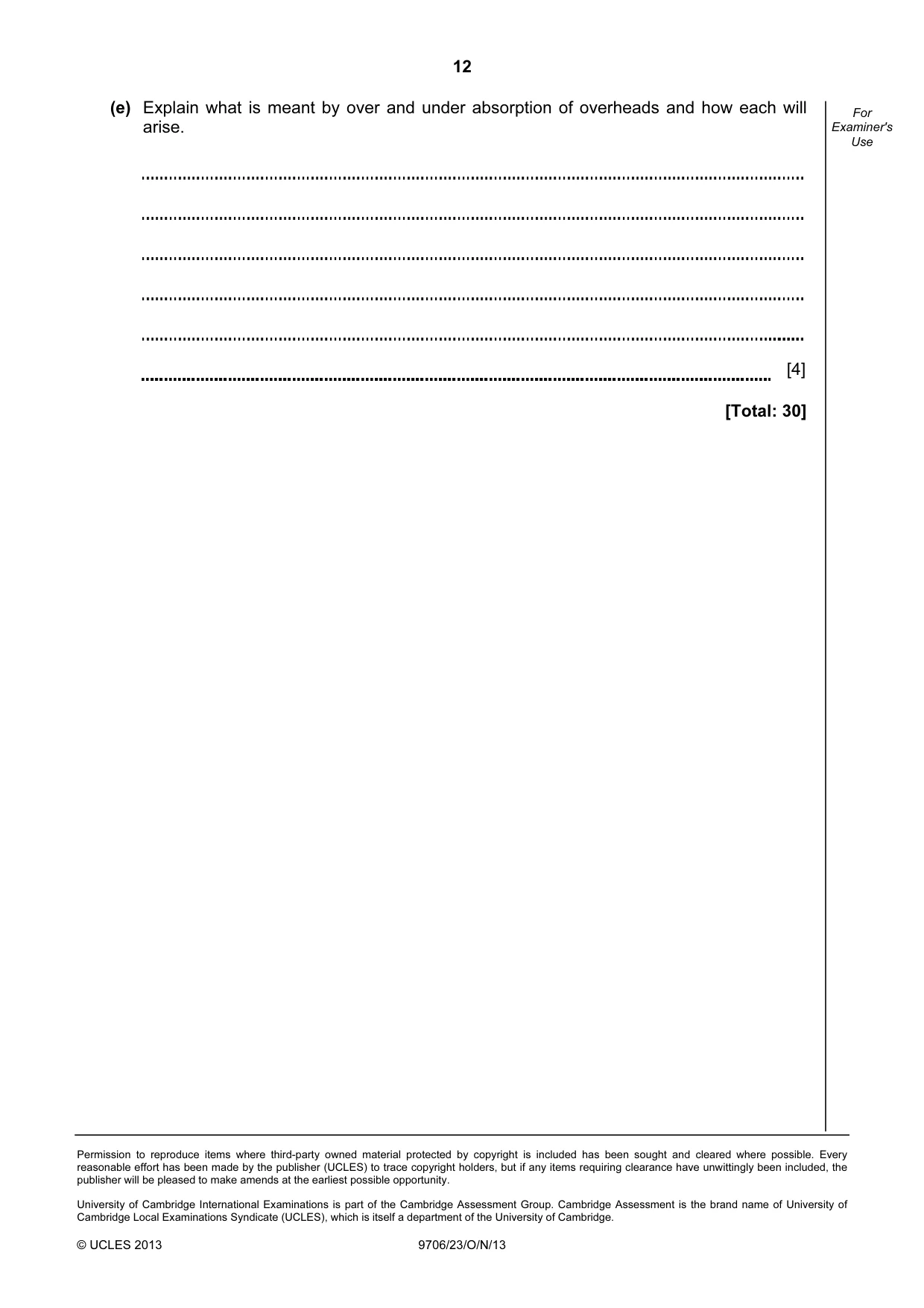
12 Permission to reproduce items where third-party owned material protected by copyright is included has been sought and cleared where possible. Every reasonable effort has been made by the publisher (UCLES) to trace copyright holders, but if any items requiring clearance have unwittingly been included, the publisher will be pleased to make amends at the earliest possible opportunity. University of Cambridge International Examinations is part of the Cambridge Assessment Group. Cambridge Assessment is the brand name of University of Cambridge Local Examinations Syndicate (UCLES), which is itself a department of the University of Cambridge. © UCLES 2013 9706/23/O/N/13 For Examiner's Use (e) Explain what is meant by over and under absorption of overheads and how each will arise. [4] [Total: 30]
Mark scheme, page 1
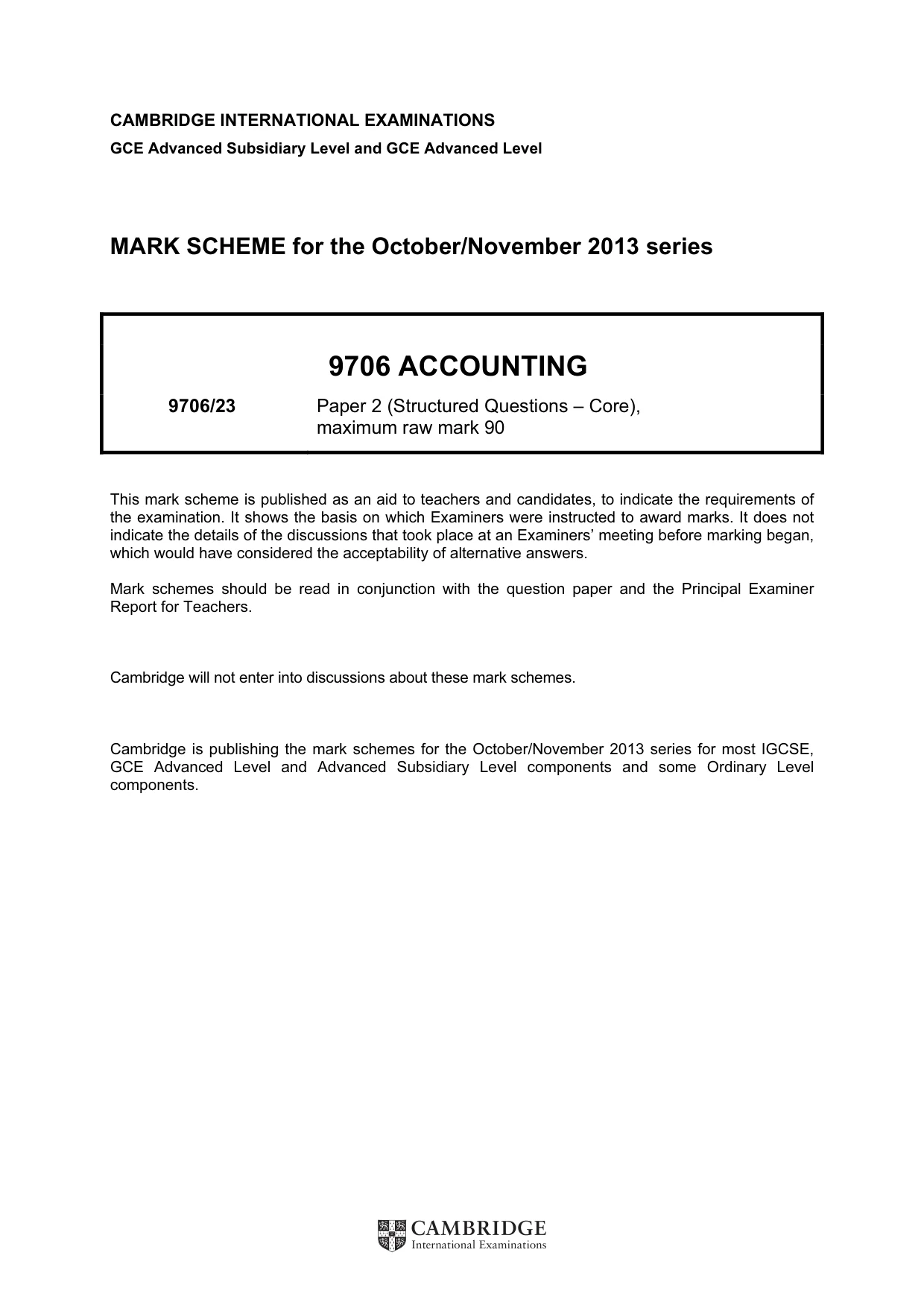
CAMBRIDGE INTERNATIONAL EXAMINATIONS GCE Advanced Subsidiary Level and GCE Advanced Level MARK SCHEME for the October/November 2013 series 9706 ACCOUNTING 9706/23 Paper 2 (Structured Questions – Core), maximum raw mark 90 This mark scheme is published as an aid to teachers and candidates, to indicate the requirements of the examination. It shows the basis on which Examiners were instructed to award marks. It does not indicate the details of the discussions that took place at an Examiners’ meeting before marking began, which would have considered the acceptability of alternative answers. Mark schemes should be read in conjunction with the question paper and the Principal Examiner Report for Teachers. Cambridge will not enter into discussions about these mark schemes. Cambridge is publishing the mark schemes for the October/November 2013 series for most IGCSE, GCE Advanced Level and Advanced Subsidiary Level components and some Ordinary Level components.
Mark scheme, page 2
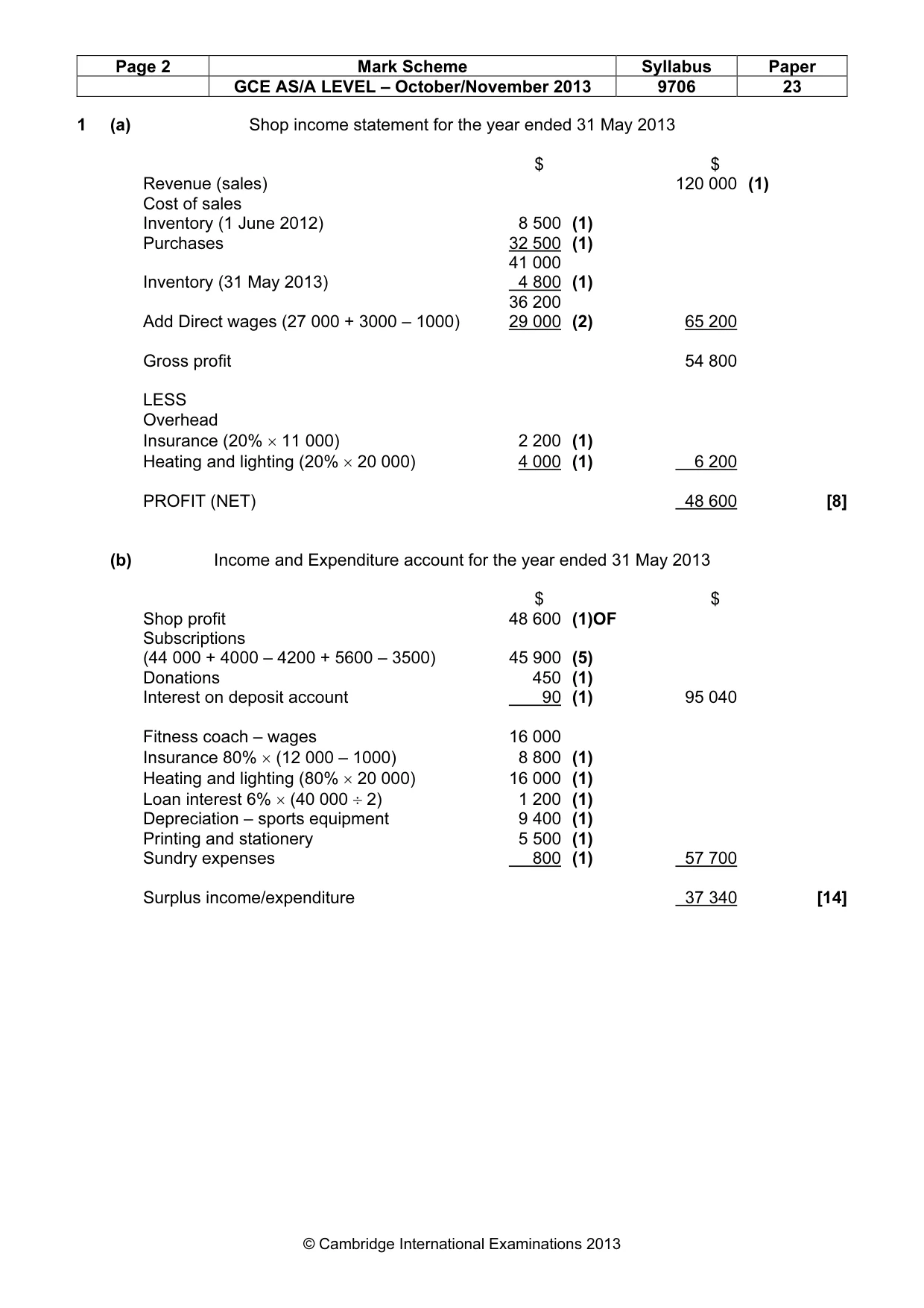
Page 2 Mark Scheme Syllabus Paper GCE AS/A LEVEL – October/November 2013 9706 23 © Cambridge International Examinations 2013 1 (a) Shop income statement for the year ended 31 May 2013 $ $ Revenue (sales) 120 000 (1) Cost of sales Inventory (1 June 2012) 8 500 (1) Purchases 32 500 (1) 41 000 Inventory (31 May 2013) 4 800 (1) 36 200 Add Direct wages (27 000 + 3000 – 1000) 29 000 (2) 65 200 Gross profit 54 800 LESS Overhead Insurance (20% × 11 000) 2 200 (1) Heating and lighting (20% × 20 000) 4 000 (1) 6 200 PROFIT (NET) 48 600 [8] (b) Income and Expenditure account for the year ended 31 May 2013 $ $ Shop profit 48 600 (1)OF Subscriptions (44 000 + 4000 – 4200 + 5600 – 3500) 45 900 (5) Donations 450 (1) Interest on deposit account 90 (1) 95 040 Fitness coach – wages 16 000 Insurance 80% × (12 000 – 1000) 8 800 (1) Heating and lighting (80% × 20 000) 16 000 (1) Loan interest 6% × (40 000 ÷ 2) 1 200 (1) Depreciation – sports equipment 9 400 (1) Printing and stationery 5 500 (1) Sundry expenses 800 (1) 57 700 Surplus income/expenditure 37 340 [14]
Mark scheme, page 3
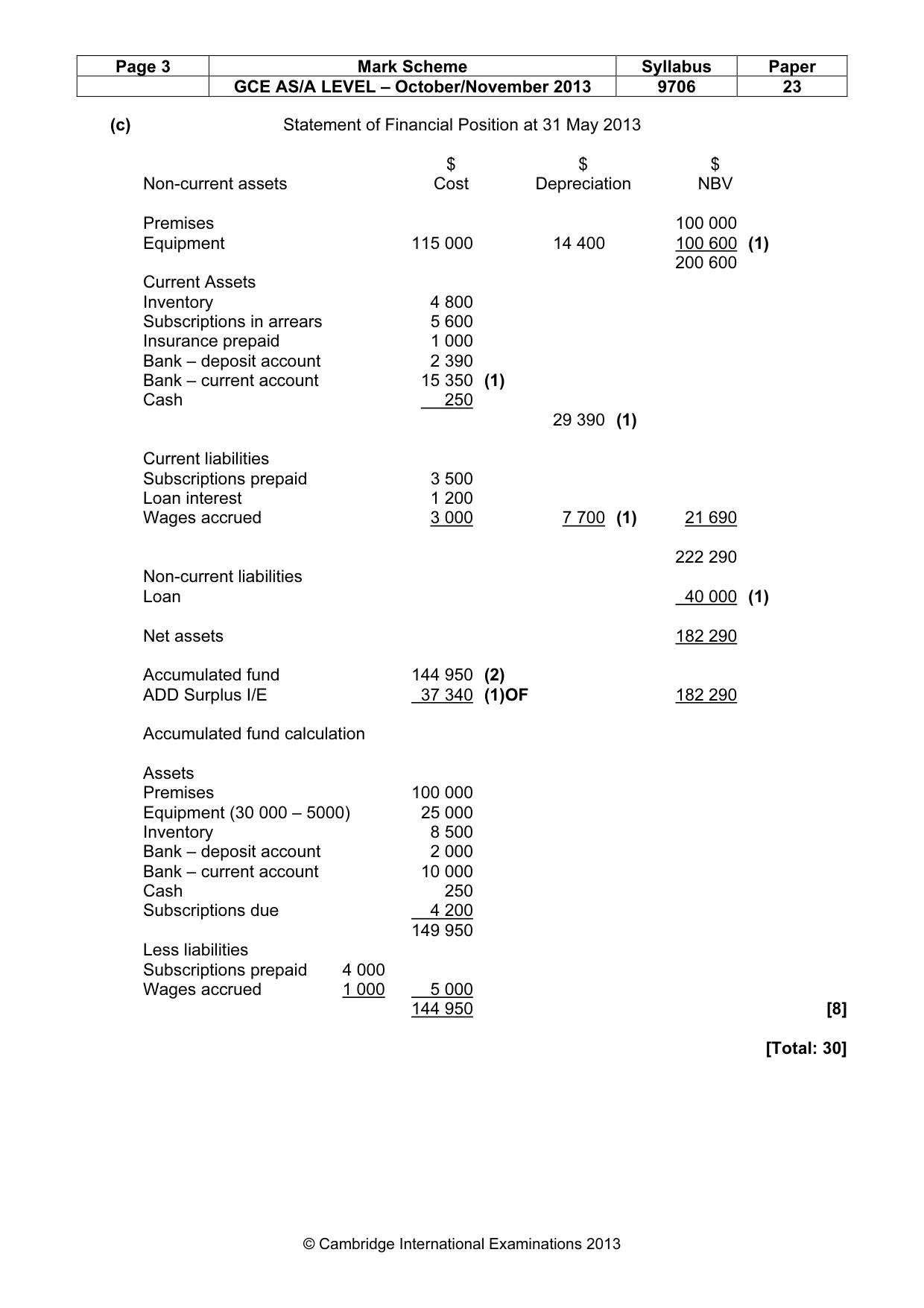
Page 3 Mark Scheme Syllabus Paper GCE AS/A LEVEL – October/November 2013 9706 23 © Cambridge International Examinations 2013 (c) Statement of Financial Position at 31 May 2013 $ $ $ Non-current assets Cost Depreciation NBV Premises 100 000 Equipment 115 000 14 400 100 600 (1) 200 600 Current Assets Inventory 4 800 Subscriptions in arrears 5 600 Insurance prepaid 1 000 Bank – deposit account 2 390 Bank – current account 15 350 (1) Cash 250 29 390 (1) Current liabilities Subscriptions prepaid 3 500 Loan interest 1 200 Wages accrued 3 000 7 700 (1) 21 690 222 290 Non-current liabilities Loan 40 000 (1) Net assets 182 290 Accumulated fund 144 950 (2) ADD Surplus I/E 37 340 (1)OF 182 290 Accumulated fund calculation Assets Premises 100 000 Equipment (30 000 – 5000) 25 000 Inventory 8 500 Bank – deposit account 2 000 Bank – current account 10 000 Cash 250 Subscriptions due 4 200 149 950 Less liabilities Subscriptions prepaid 4 000 Wages accrued 1 000 5 000 144 950 [8] [Total: 30]
Mark scheme, page 4
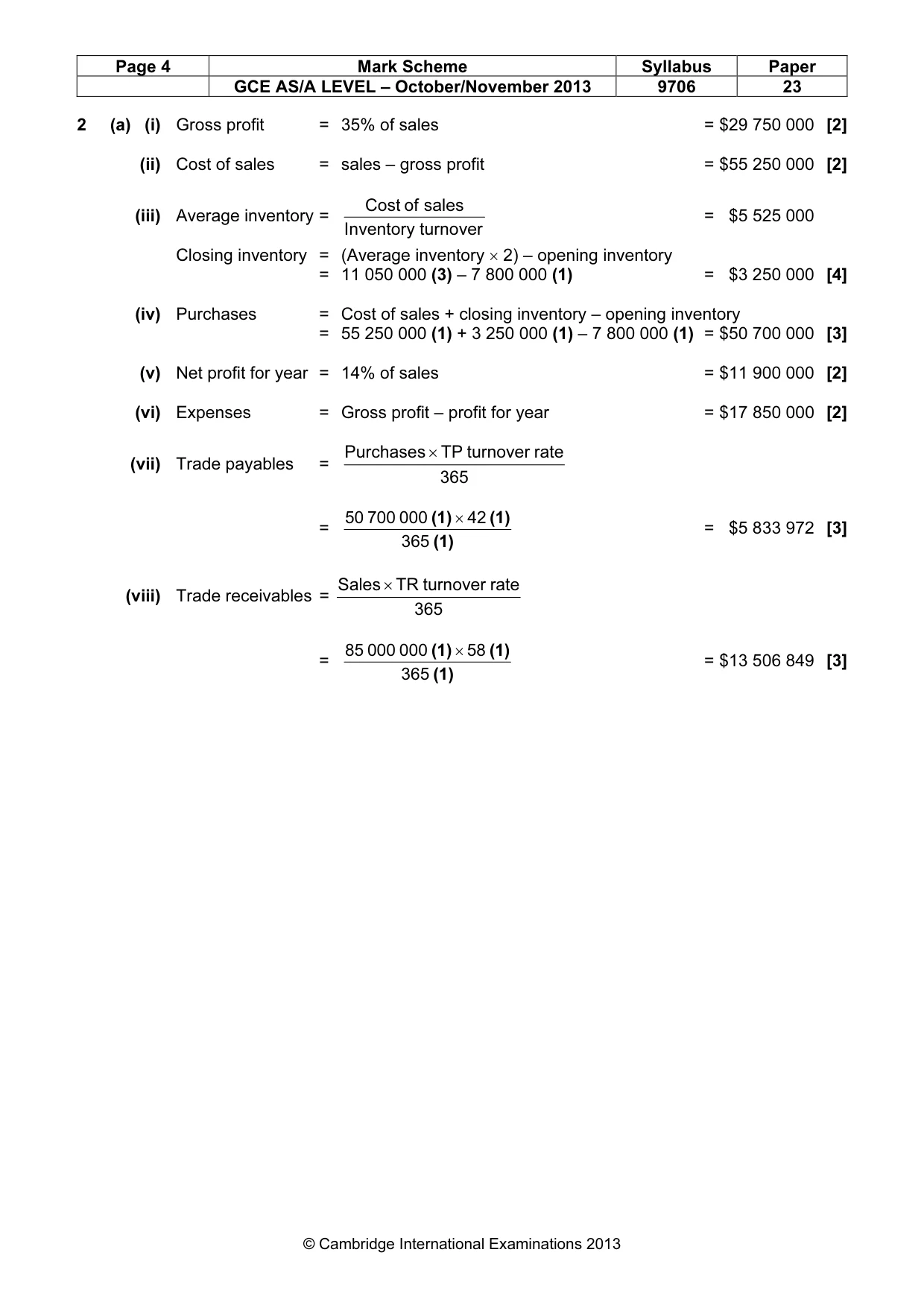
Page 4 Mark Scheme Syllabus Paper GCE AS/A LEVEL – October/November 2013 9706 23 © Cambridge International Examinations 2013 2 (a) (i) Gross profit = 35% of sales = $29 750 000 [2] (ii) Cost of sales = sales – gross profit = $55 250 000 [2] (iii) Average inventory = turnover Inventory sales of Cost = $5 525 000 Closing inventory = (Average inventory × 2) – opening inventory = 11 050 000 (3) – 7 800 000 (1) = $3 250 000 [4] (iv) Purchases = Cost of sales + closing inventory – opening inventory = 55 250 000 (1) + 3 250 000 (1) – 7 800 000 (1) = $50 700 000 [3] (v) Net profit for year = 14% of sales = $11 900 000 [2] (vi) Expenses = Gross profit – profit for year = $17 850 000 [2] (vii) Trade payables = 365 rate turnover TP Purchases × = (1) (1) (1) 365 42 000 700 50 × = $5 833 972 [3] (viii) Trade receivables = 365 rate turnover TR Sales× = (1) (1) (1) 365 58 000 000 85 × = $13 506 849 [3]
Mark scheme, page 5
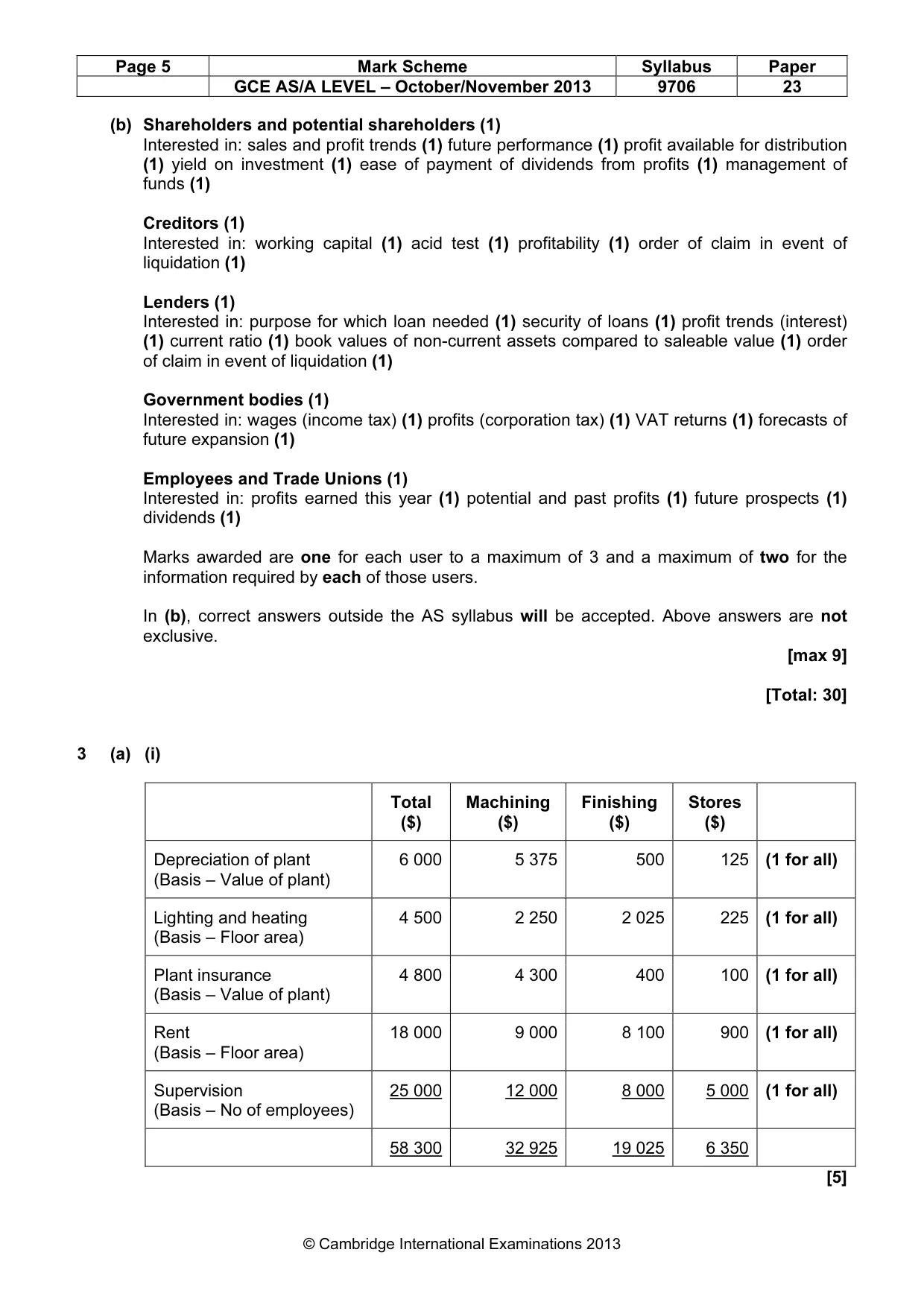
Page 5 Mark Scheme Syllabus Paper GCE AS/A LEVEL – October/November 2013 9706 23 © Cambridge International Examinations 2013 (b) Shareholders and potential shareholders (1) Interested in: sales and profit trends (1) future performance (1) profit available for distribution (1) yield on investment (1) ease of payment of dividends from profits (1) management of funds (1) Creditors (1) Interested in: working capital (1) acid test (1) profitability (1) order of claim in event of liquidation (1) Lenders (1) Interested in: purpose for which loan needed (1) security of loans (1) profit trends (interest) (1) current ratio (1) book values of non-current assets compared to saleable value (1) order of claim in event of liquidation (1) Government bodies (1) Interested in: wages (income tax) (1) profits (corporation tax) (1) VAT returns (1) forecasts of future expansion (1) Employees and Trade Unions (1) Interested in: profits earned this year (1) potential and past profits (1) future prospects (1) dividends (1) Marks awarded are one for each user to a maximum of 3 and a maximum of two for the information required by each of those users. In (b), correct answers outside the AS syllabus will be accepted. Above answers are not exclusive. [max 9] [Total: 30] 3 (a) (i) Total ($) Machining ($) Finishing ($) Stores ($) Depreciation of plant (Basis – Value of plant) 6 000 5 375 500 125 (1 for all) Lighting and heating (Basis – Floor area) 4 500 2 250 2 025 225 (1 for all) Plant insurance (Basis – Value of plant) 4 800 4 300 400 100 (1 for all) Rent (Basis – Floor area) 18 000 9 000 8 100 900 (1 for all) Supervision (Basis – No of employees) 25 000 12 000 8 000 5 000 (1 for all) 58 300 32 925 19 025 6 350 [5]
Mark scheme, page 6
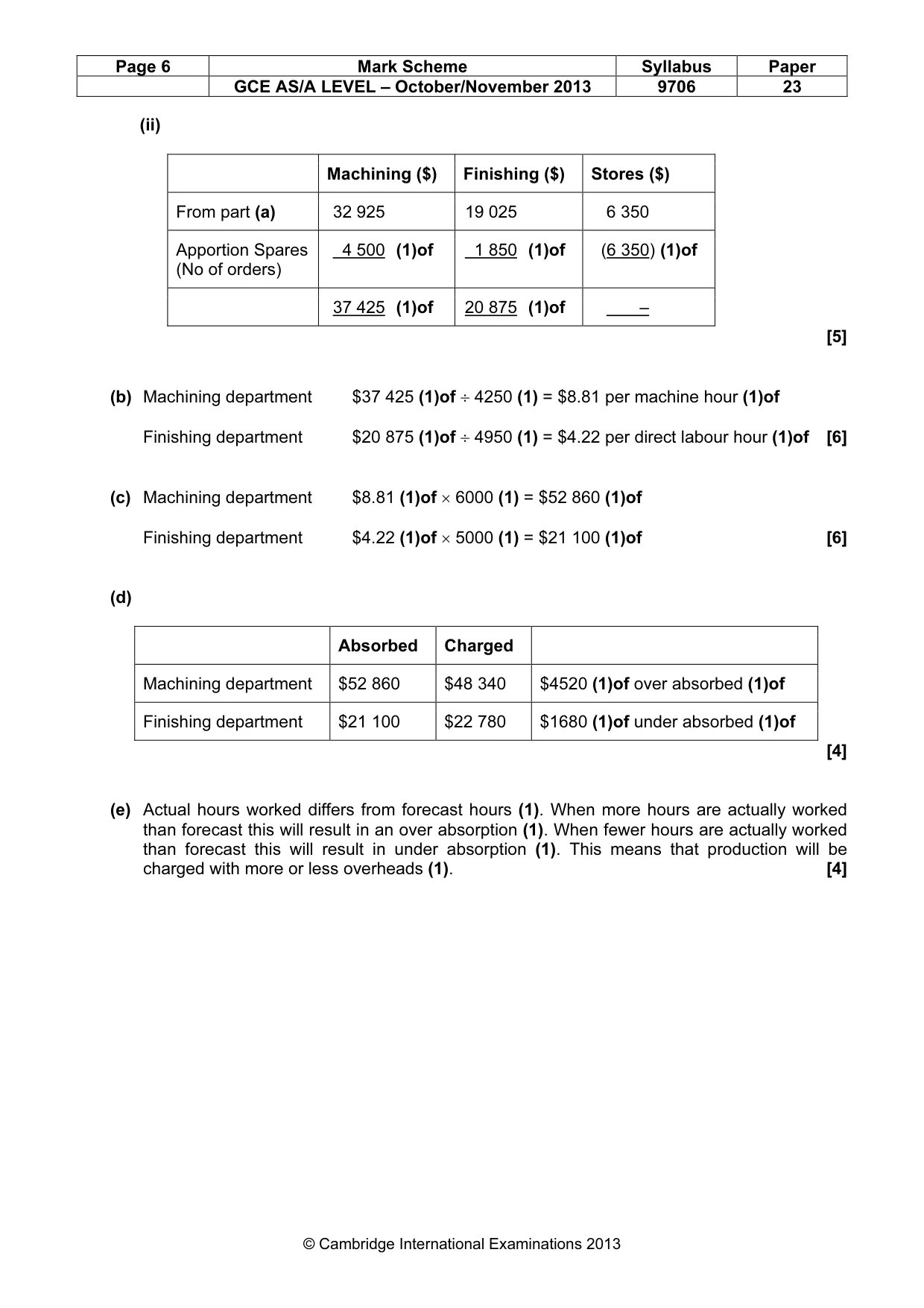
Page 6 Mark Scheme Syllabus Paper GCE AS/A LEVEL – October/November 2013 9706 23 © Cambridge International Examinations 2013 (ii) Machining ($) Finishing ($) Stores ($) From part (a) 32 925 19 025 6 350 Apportion Spares (No of orders) 4 500 (1)of 1 850 (1)of (6 350) (1)of 37 425 (1)of 20 875 (1)of – [5] (b) Machining department $37 425 (1)of ÷ 4250 (1) = $8.81 per machine hour (1)of Finishing department $20 875 (1)of ÷ 4950 (1) = $4.22 per direct labour hour (1)of [6] (c) Machining department $8.81 (1)of × 6000 (1) = $52 860 (1)of Finishing department $4.22 (1)of × 5000 (1) = $21 100 (1)of [6] (d) Absorbed Charged Machining department $52 860 $48 340 $4520 (1)of over absorbed (1)of Finishing department $21 100 $22 780 $1680 (1)of under absorbed (1)of [4] (e) Actual hours worked differs from forecast hours (1). When more hours are actually worked than forecast this will result in an over absorption (1). When fewer hours are actually worked than forecast this will result in under absorption (1). This means that production will be charged with more or less overheads (1). [4]
What you needed in this session
Cambridge’s own grade thresholds for 2013 Oct/Nov, Paper 2 · Variant 3. A higher threshold means an easier paper — the bar moves with how the cohort did.