Cambridge A Level Accounting 9706 — 2013 May/June Paper 2 · Variant 2
9706/22/M/J/13 · 90 marks · ≈101 min
The question paper and its mark scheme, free to read here and free to download. This is Cambridge’s own paper, exactly as it was sat.
Question paper12 pages

Mark scheme7 pages
Answers below. Sit the paper first if you are practising.
Paper as text
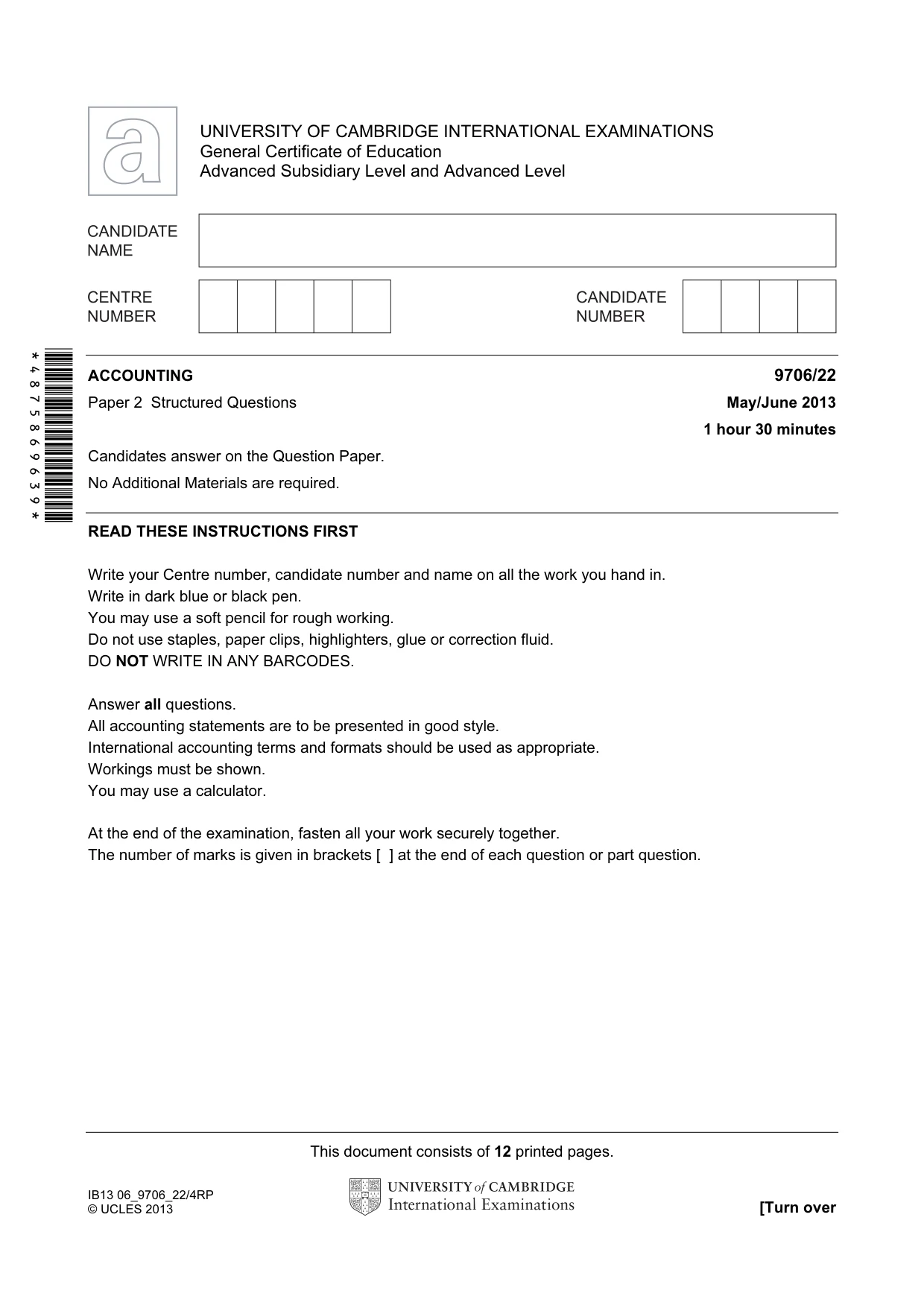
Question paper, page 1
This document consists of 12 printed pages. IB13 06_9706_22/4RP © UCLES 2013 [Turn over *4875869639* UNIVERSITY OF CAMBRIDGE INTERNATIONAL EXAMINATIONS General Certificate of Education Advanced Subsidiary Level and Advanced Level ACCOUNTING 9706/22 Paper 2 Structured Questions May/June 2013 1 hour 30 minutes Candidates answer on the Question Paper. No Additional Materials are required. READ THESE INSTRUCTIONS FIRST Write your Centre number, candidate number and name on all the work you hand in. Write in dark blue or black pen. You may use a soft pencil for rough working. Do not use staples, paper clips, highlighters, glue or correction fluid. DO NOT WRITE IN ANY BARCODES. Answer all questions. All accounting statements are to be presented in good style. International accounting terms and formats should be used as appropriate. Workings must be shown. You may use a calculator. At the end of the examination, fasten all your work securely together. The number of marks is given in brackets [ ] at the end of each question or part question.
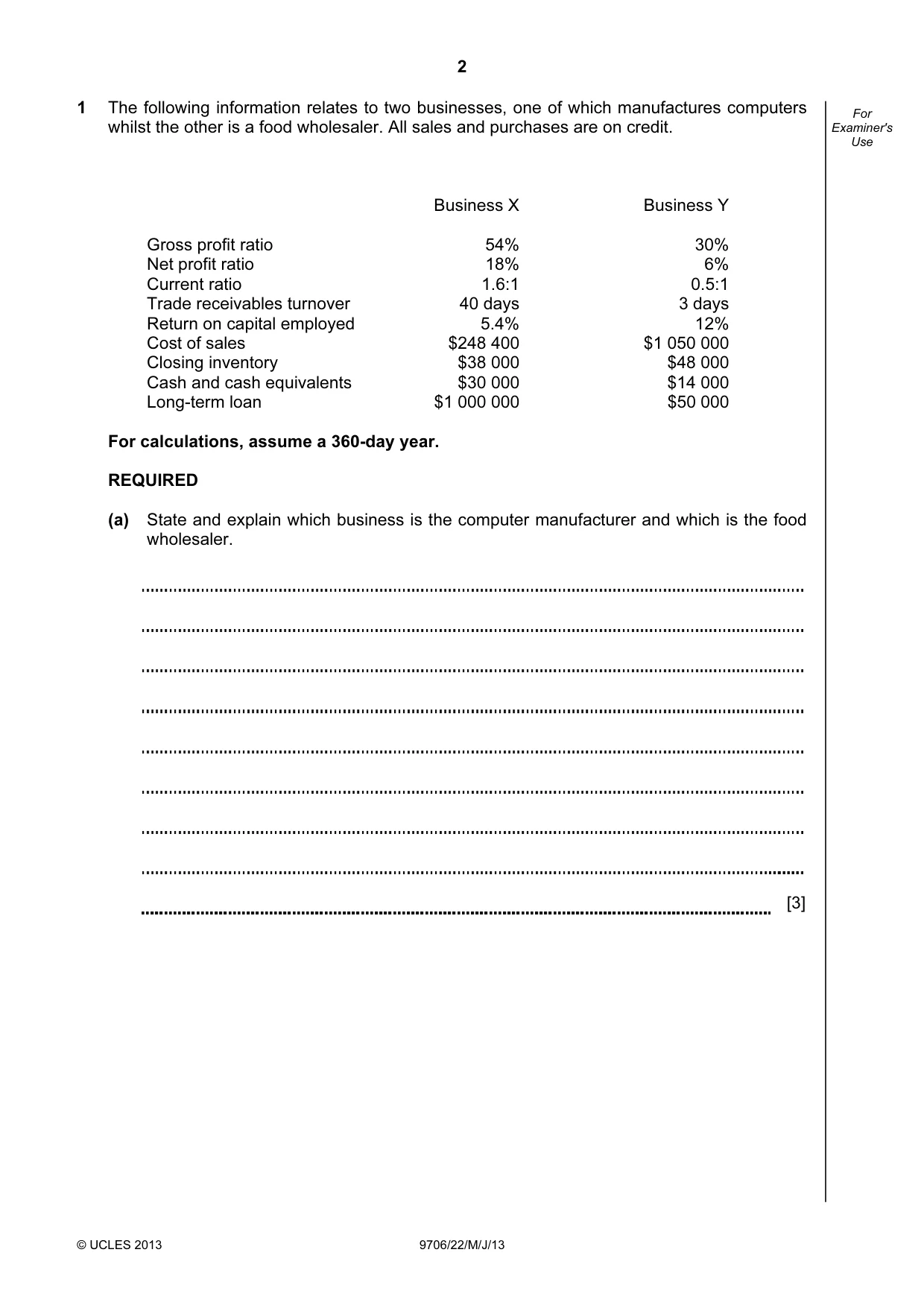
Question paper, page 2
2 © UCLES 2013 9706/22/M/J/13 For Examiner's Use 1 The following information relates to two businesses, one of which manufactures computers whilst the other is a food wholesaler. All sales and purchases are on credit. Business X Business Y Gross profit ratio 54% 30% Net profit ratio 18% 6% Current ratio 1.6:1 0.5:1 Trade receivables turnover 40 days 3 days Return on capital employed 5.4% 12% Cost of sales $248 400 $1 050 000 Closing inventory $38 000 $48 000 Cash and cash equivalents $30 000 $14 000 Long-term loan $1 000 000 $50 000 For calculations, assume a 360-day year. REQUIRED (a) State and explain which business is the computer manufacturer and which is the food wholesaler. [3]
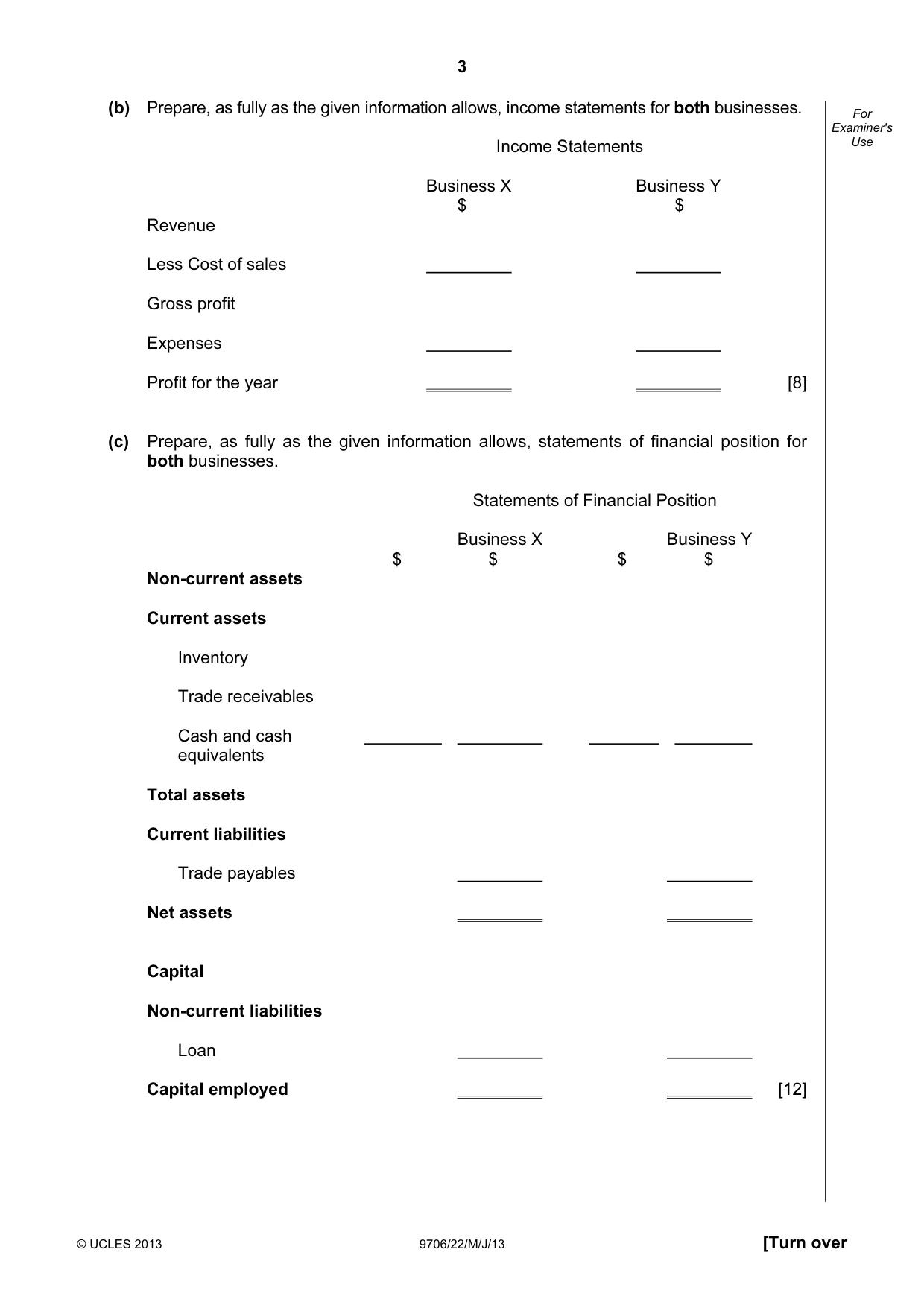
Question paper, page 3
3 © UCLES 2013 9706/22/M/J/13 [Turn over For Examiner's Use (b) Prepare, as fully as the given information allows, income statements for both businesses. Income Statements Business X Business Y $ $ Revenue Less Cost of sales Gross profit Expenses Profit for the year [8] (c) Prepare, as fully as the given information allows, statements of financial position for both businesses. Statements of Financial Position Business X Business Y $ $ $ $ Non-current assets Current assets Inventory Trade receivables Cash and cash equivalents Total assets Current liabilities Trade payables Net assets Capital Non-current liabilities Loan Capital employed [12]
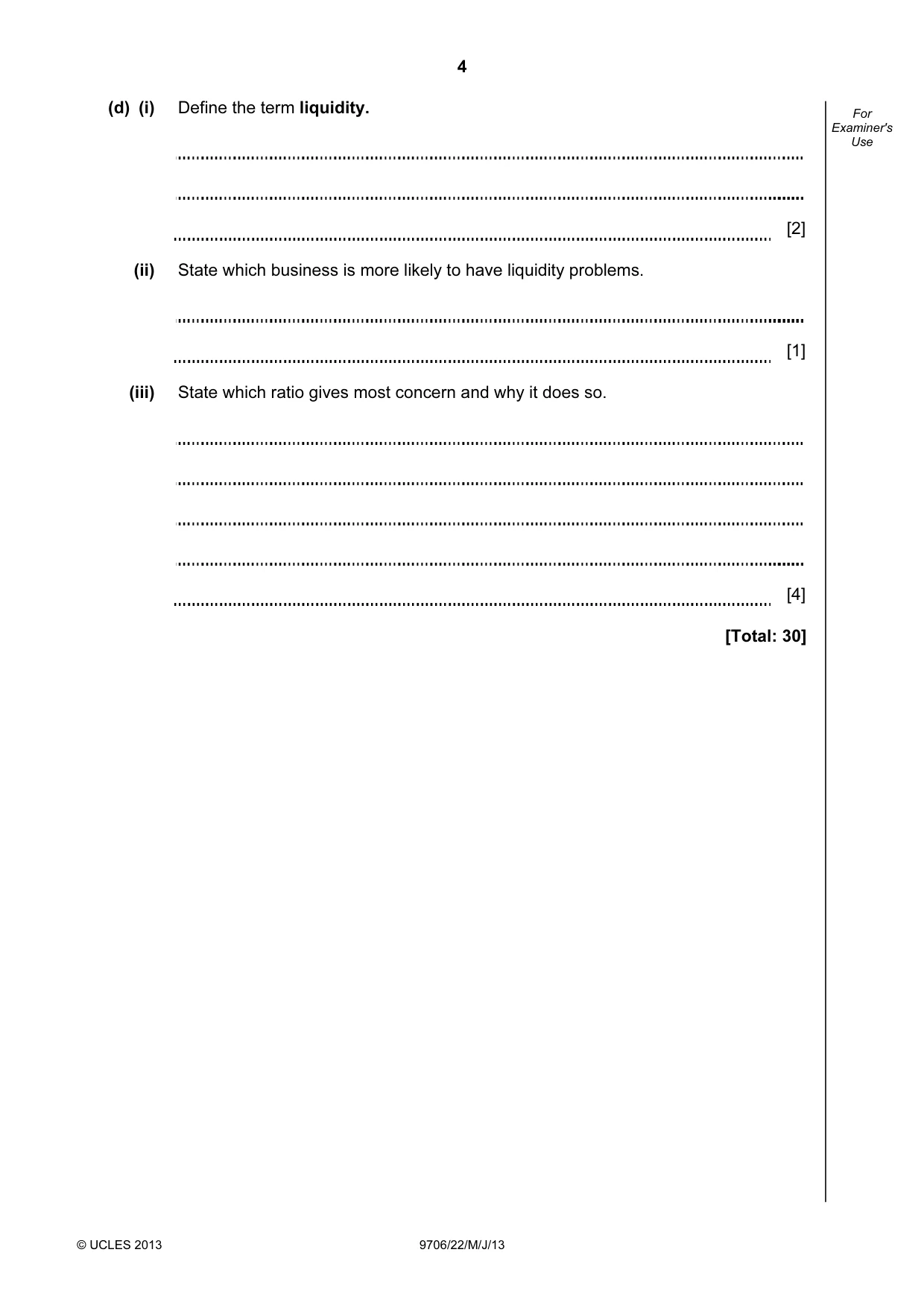
Question paper, page 4
4 © UCLES 2013 9706/22/M/J/13 For Examiner's Use (d) (i) Define the term liquidity. [2] (ii) State which business is more likely to have liquidity problems. [1] (iii) State which ratio gives most concern and why it does so. [4] [Total: 30]
Question paper, page 5
5 © UCLES 2013 9706/22/M/J/13 [Turn over Question 2 is on the next page.
Question paper, page 6
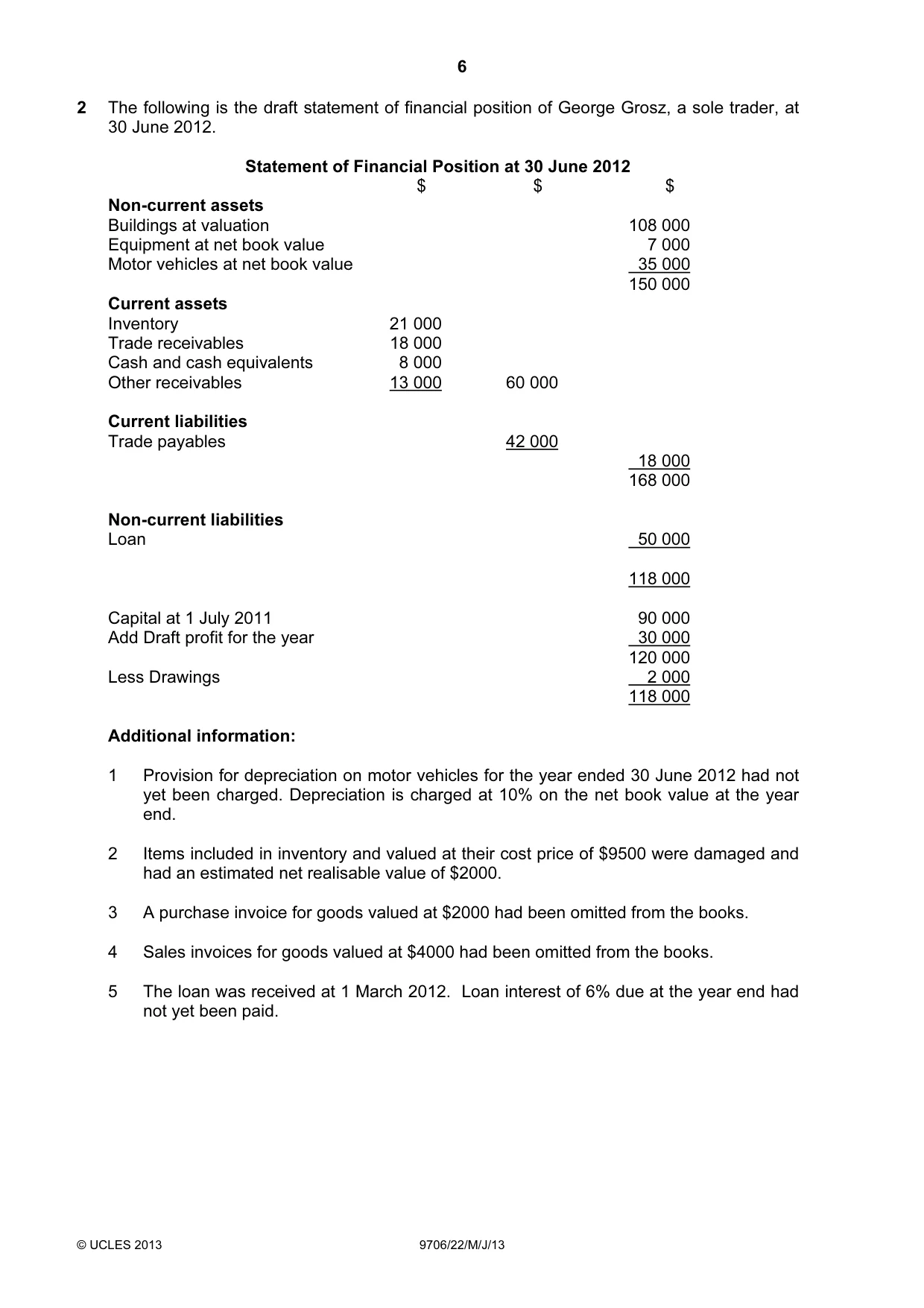
6 © UCLES 2013 9706/22/M/J/13 2 The following is the draft statement of financial position of George Grosz, a sole trader, at 30 June 2012. Statement of Financial Position at 30 June 2012 $ $ $ Non-current assets Buildings at valuation 108 000 Equipment at net book value 7 000 Motor vehicles at net book value 35 000 150 000 Current assets Inventory 21 000 Trade receivables 18 000 Cash and cash equivalents 8 000 Other receivables 13 000 60 000 Current liabilities Trade payables 42 000 18 000 168 000 Non-current liabilities Loan 50 000 118 000 Capital at 1 July 2011 90 000 Add Draft profit for the year 30 000 120 000 Less Drawings 2 000 118 000 Additional information: 1 Provision for depreciation on motor vehicles for the year ended 30 June 2012 had not yet been charged. Depreciation is charged at 10% on the net book value at the year end. 2 Items included in inventory and valued at their cost price of $9500 were damaged and had an estimated net realisable value of $2000. 3 A purchase invoice for goods valued at $2000 had been omitted from the books. 4 Sales invoices for goods valued at $4000 had been omitted from the books. 5 The loan was received at 1 March 2012. Loan interest of 6% due at the year end had not yet been paid.
Question paper, page 7
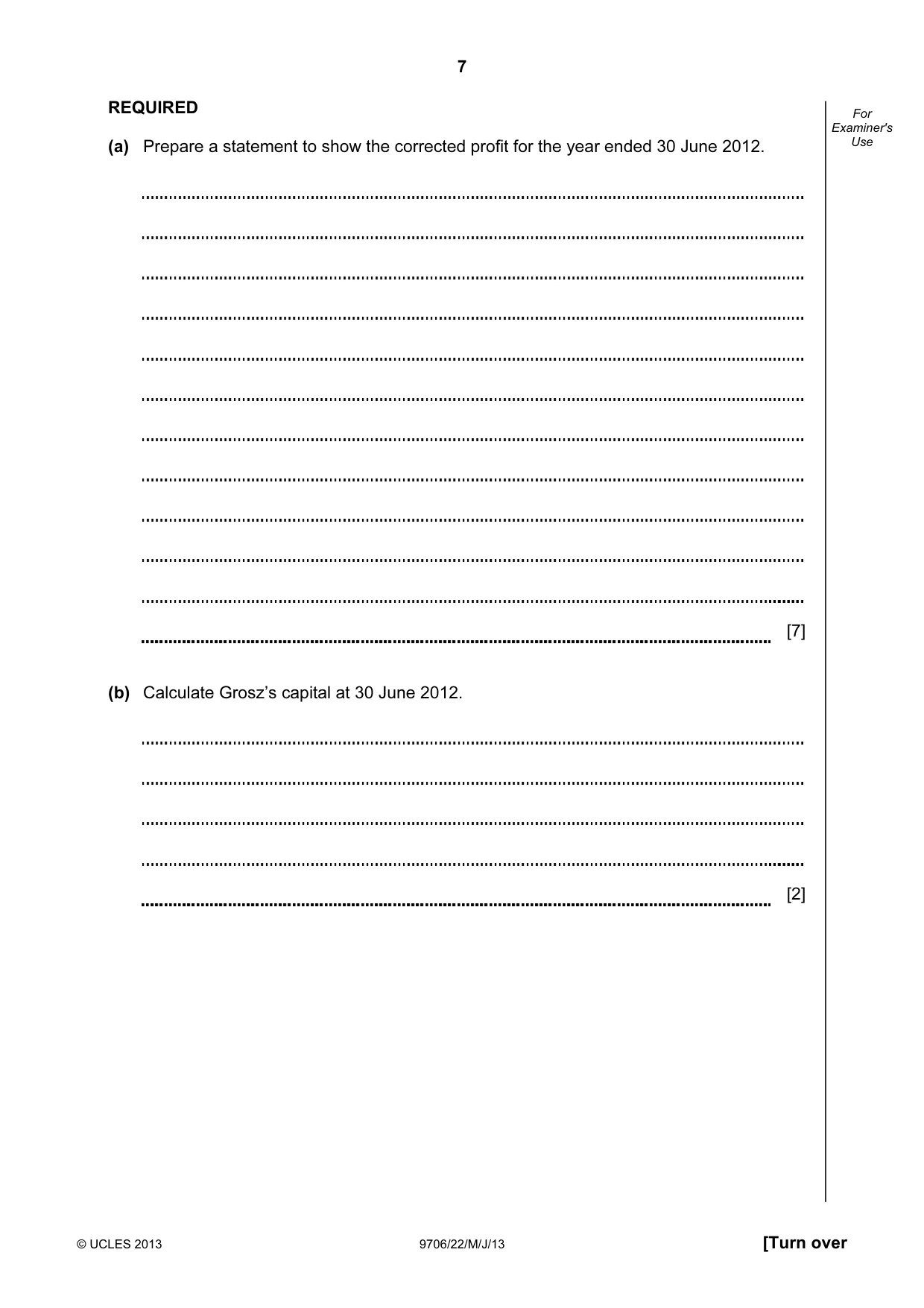
7 © UCLES 2013 9706/22/M/J/13 [Turn over For Examiner's Use REQUIRED (a) Prepare a statement to show the corrected profit for the year ended 30 June 2012. [7] (b) Calculate Grosz’s capital at 30 June 2012. [2]
Question paper, page 8
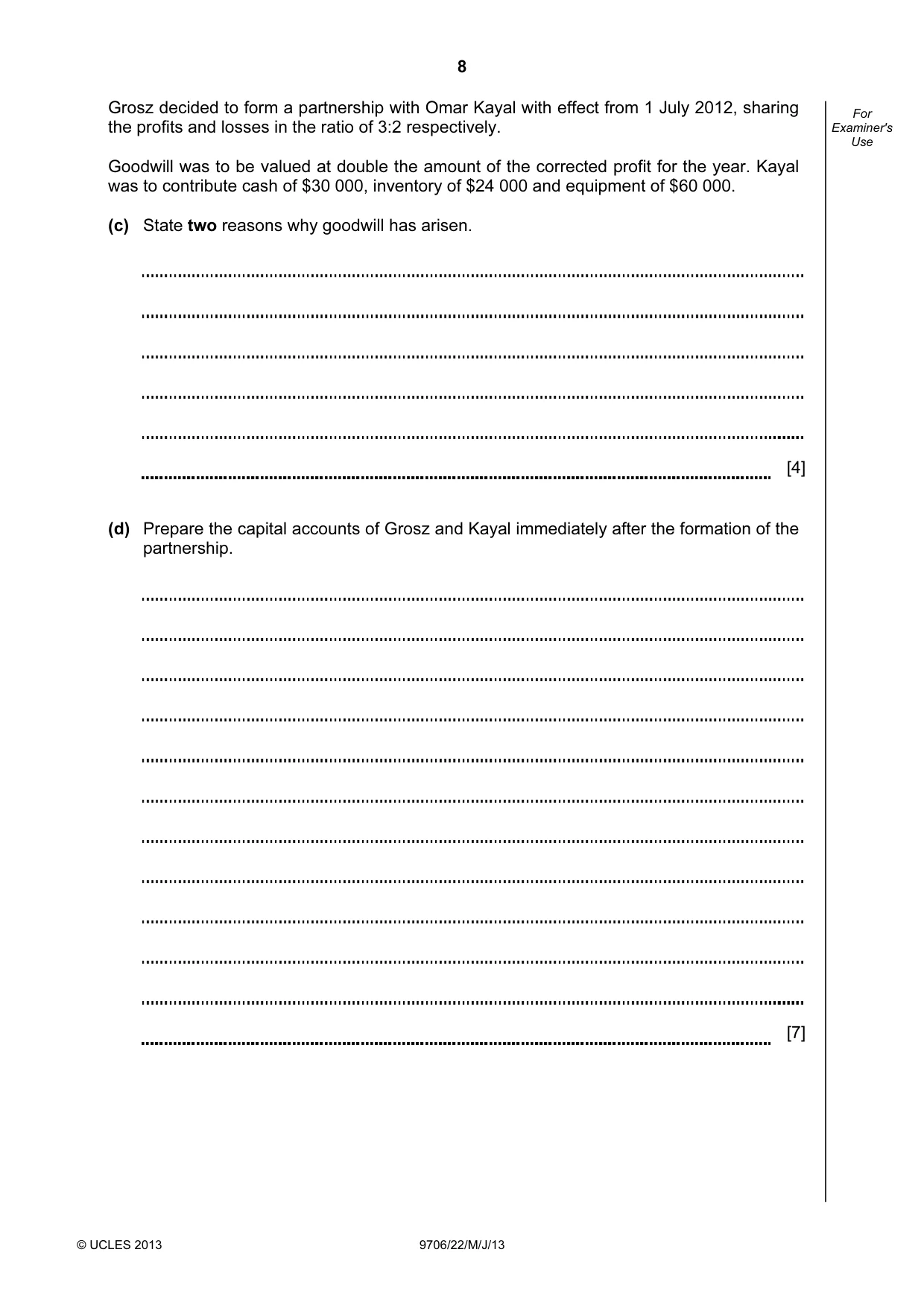
8 © UCLES 2013 9706/22/M/J/13 For Examiner's Use Grosz decided to form a partnership with Omar Kayal with effect from 1 July 2012, sharing the profits and losses in the ratio of 3:2 respectively. Goodwill was to be valued at double the amount of the corrected profit for the year. Kayal was to contribute cash of $30 000, inventory of $24 000 and equipment of $60 000. (c) State two reasons why goodwill has arisen. [4] (d) Prepare the capital accounts of Grosz and Kayal immediately after the formation of the partnership. [7]
Question paper, page 9
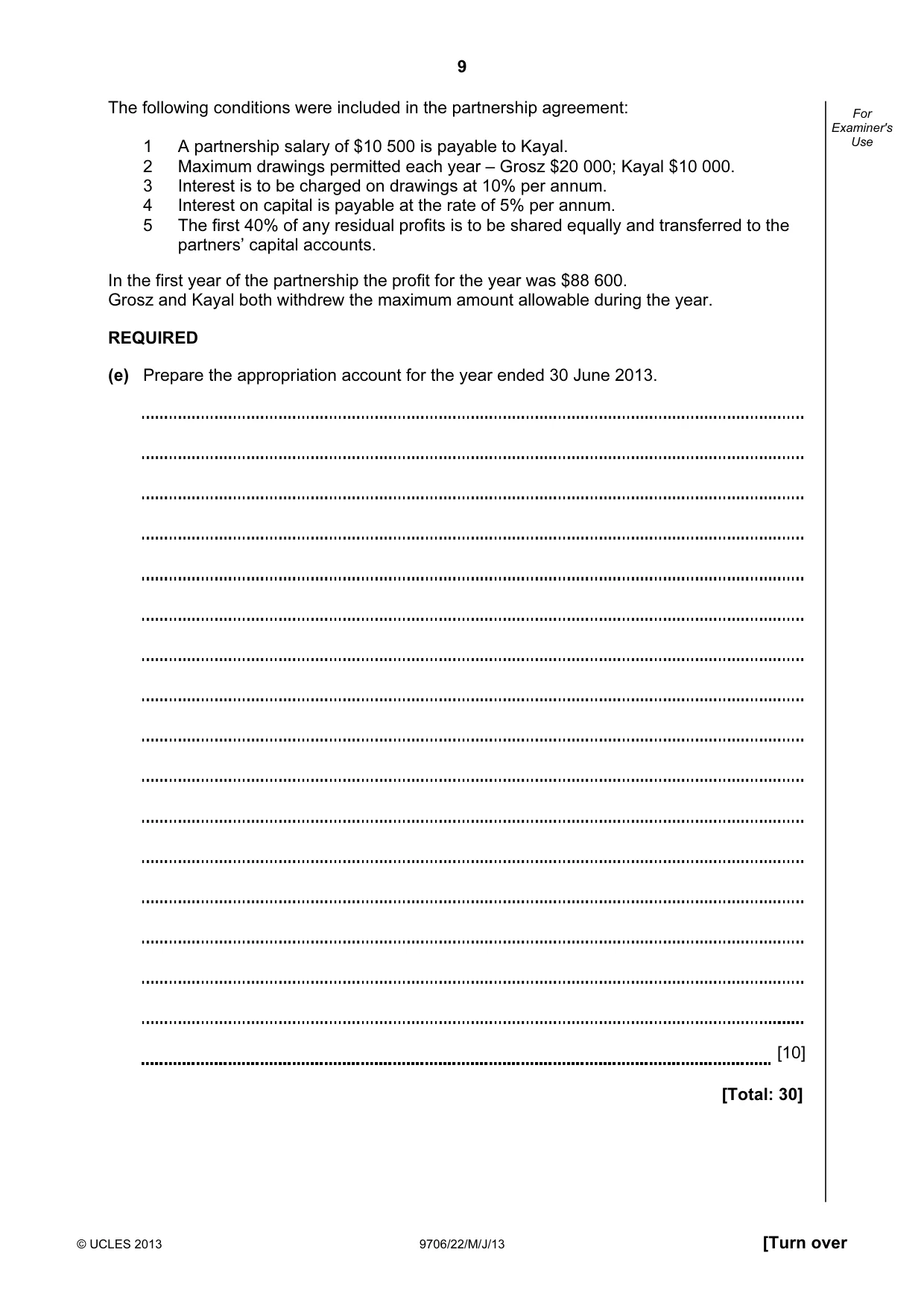
9 © UCLES 2013 9706/22/M/J/13 [Turn over For Examiner's Use The following conditions were included in the partnership agreement: 1 A partnership salary of $10 500 is payable to Kayal. 2 Maximum drawings permitted each year – Grosz $20 000; Kayal $10 000. 3 Interest is to be charged on drawings at 10% per annum. 4 Interest on capital is payable at the rate of 5% per annum. 5 The first 40% of any residual profits is to be shared equally and transferred to the partners’ capital accounts. In the first year of the partnership the profit for the year was $88 600. Grosz and Kayal both withdrew the maximum amount allowable during the year. REQUIRED (e) Prepare the appropriation account for the year ended 30 June 2013. [10] [Total: 30]
Question paper, page 10
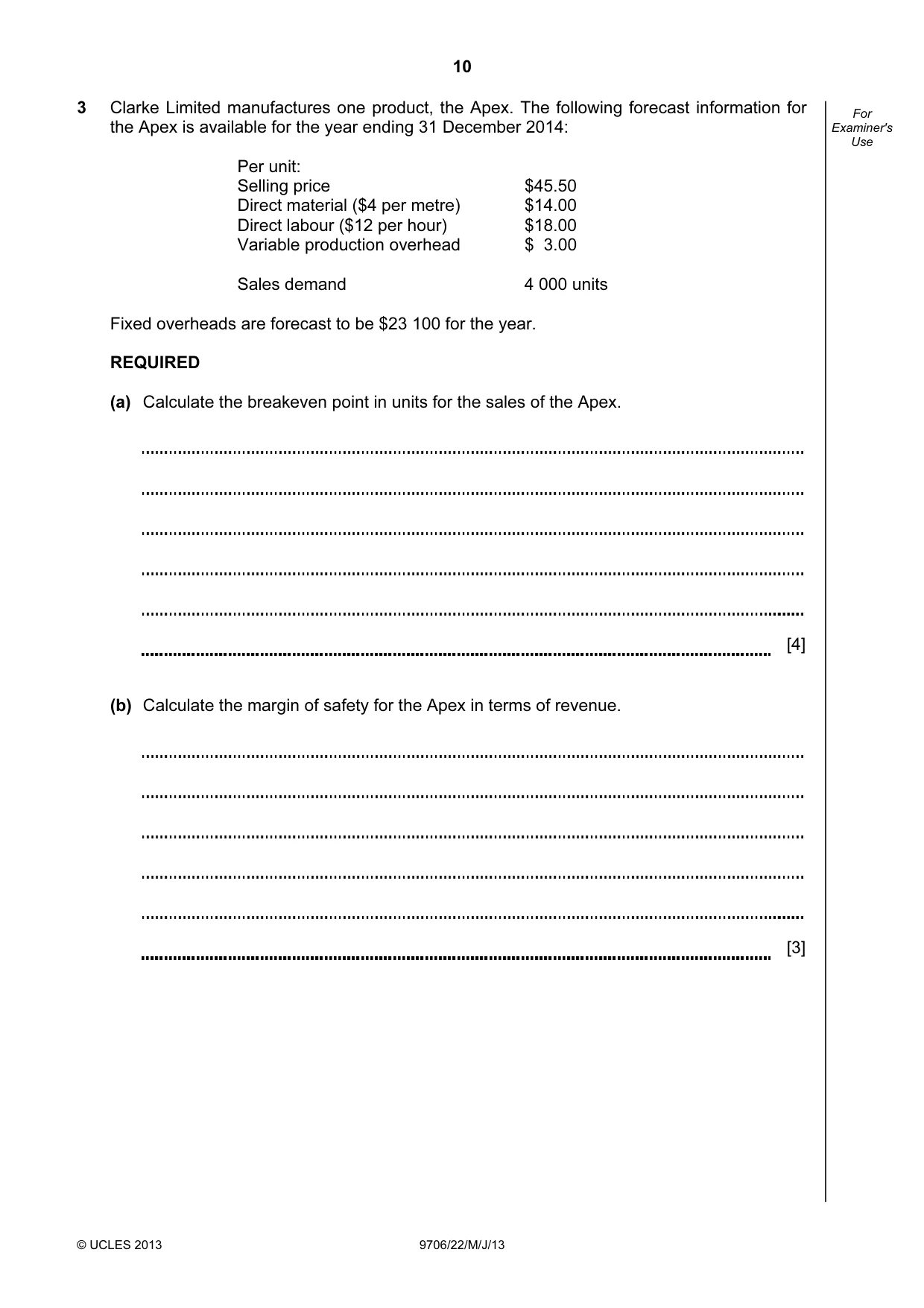
10 © UCLES 2013 9706/22/M/J/13 For Examiner's Use 3 Clarke Limited manufactures one product, the Apex. The following forecast information for the Apex is available for the year ending 31 December 2014: Per unit: Selling price $45.50 Direct material ($4 per metre) $14.00 Direct labour ($12 per hour) $18.00 Variable production overhead $ 3.00 Sales demand 4 000 units Fixed overheads are forecast to be $23 100 for the year. REQUIRED (a) Calculate the breakeven point in units for the sales of the Apex. [4] (b) Calculate the margin of safety for the Apex in terms of revenue. [3]
Question paper, page 11
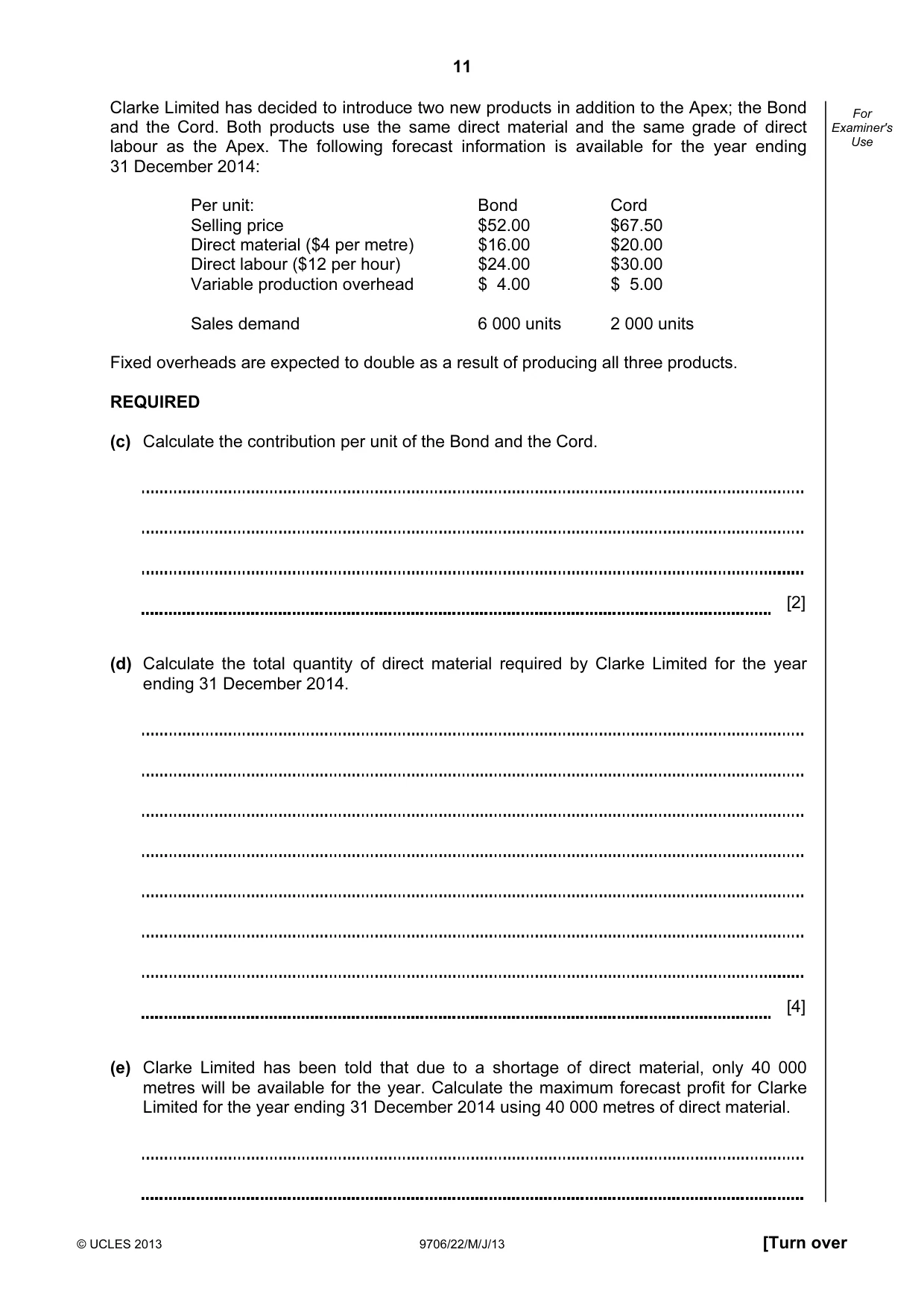
11 © UCLES 2013 9706/22/M/J/13 [Turn over For Examiner's Use Clarke Limited has decided to introduce two new products in addition to the Apex; the Bond and the Cord. Both products use the same direct material and the same grade of direct labour as the Apex. The following forecast information is available for the year ending 31 December 2014: Per unit: Bond Cord Selling price $52.00 $67.50 Direct material ($4 per metre) $16.00 $20.00 Direct labour ($12 per hour) $24.00 $30.00 Variable production overhead $ 4.00 $ 5.00 Sales demand 6 000 units 2 000 units Fixed overheads are expected to double as a result of producing all three products. REQUIRED (c) Calculate the contribution per unit of the Bond and the Cord. [2] (d) Calculate the total quantity of direct material required by Clarke Limited for the year ending 31 December 2014. [4] (e) Clarke Limited has been told that due to a shortage of direct material, only 40 000 metres will be available for the year. Calculate the maximum forecast profit for Clarke Limited for the year ending 31 December 2014 using 40 000 metres of direct material.
Question paper, page 12
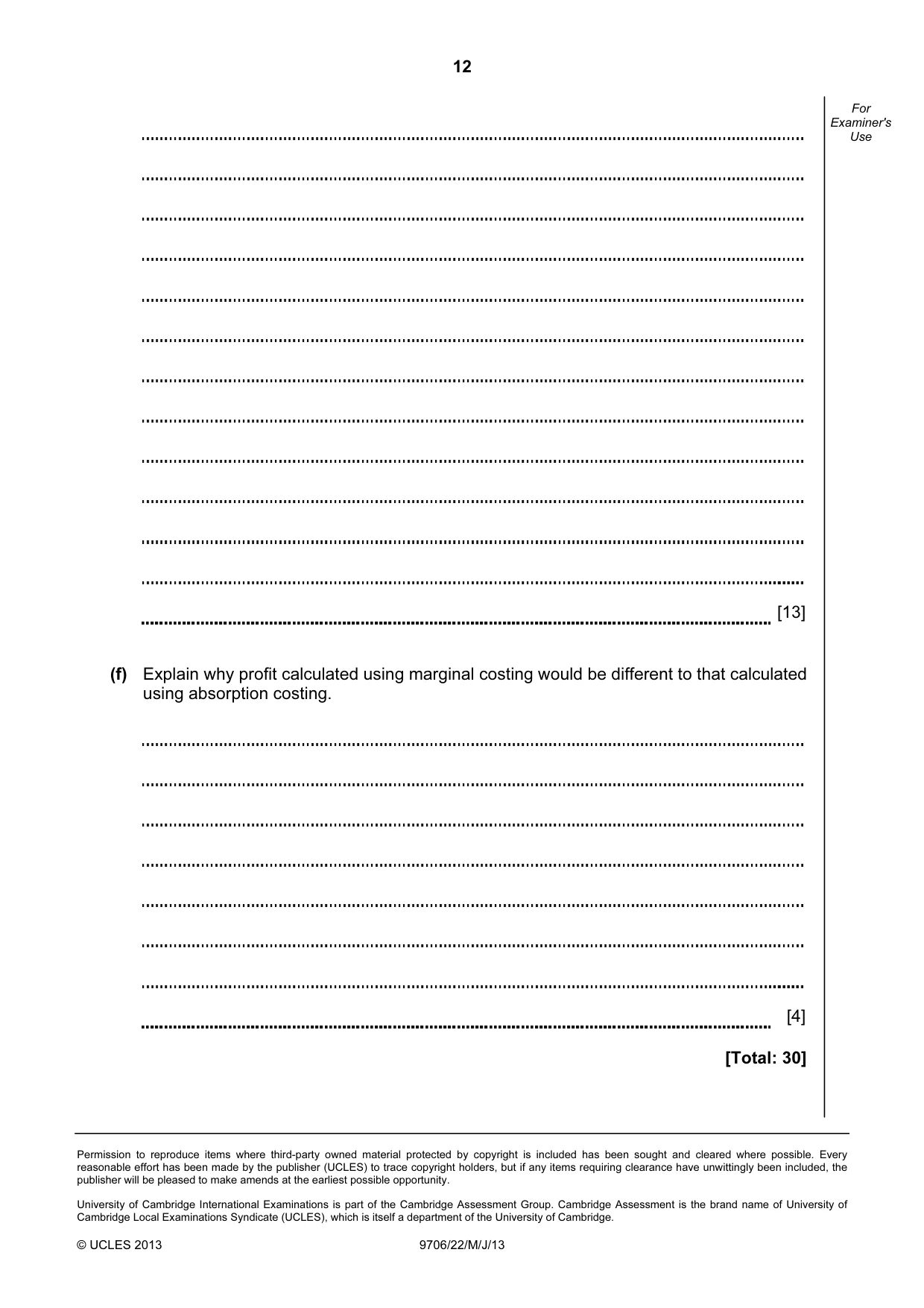
12 Permission to reproduce items where third-party owned material protected by copyright is included has been sought and cleared where possible. Every reasonable effort has been made by the publisher (UCLES) to trace copyright holders, but if any items requiring clearance have unwittingly been included, the publisher will be pleased to make amends at the earliest possible opportunity. University of Cambridge International Examinations is part of the Cambridge Assessment Group. Cambridge Assessment is the brand name of University of Cambridge Local Examinations Syndicate (UCLES), which is itself a department of the University of Cambridge. © UCLES 2013 9706/22/M/J/13 For Examiner's Use [13] (f) Explain why profit calculated using marginal costing would be different to that calculated using absorption costing. [4] [Total: 30]
Mark scheme, page 1
CAMBRIDGE INTERNATIONAL EXAMINATIONS GCE Advanced Subsidiary Level and GCE Advanced Level MARK SCHEME for the May/June 2013 series 9706 ACCOUNTING 9706/22 Paper 2 (Structured Questions – Core), maximum raw mark 90 This mark scheme is published as an aid to teachers and candidates, to indicate the requirements of the examination. It shows the basis on which Examiners were instructed to award marks. It does not indicate the details of the discussions that took place at an Examiners’ meeting before marking began, which would have considered the acceptability of alternative answers. Mark schemes should be read in conjunction with the question paper and the Principal Examiner Report for Teachers. Cambridge will not enter into discussions about these mark schemes. Cambridge is publishing the mark schemes for the May/June 2013 series for most IGCSE, GCE Advanced Level and Advanced Subsidiary Level components and some Ordinary Level components.
Mark scheme, page 2
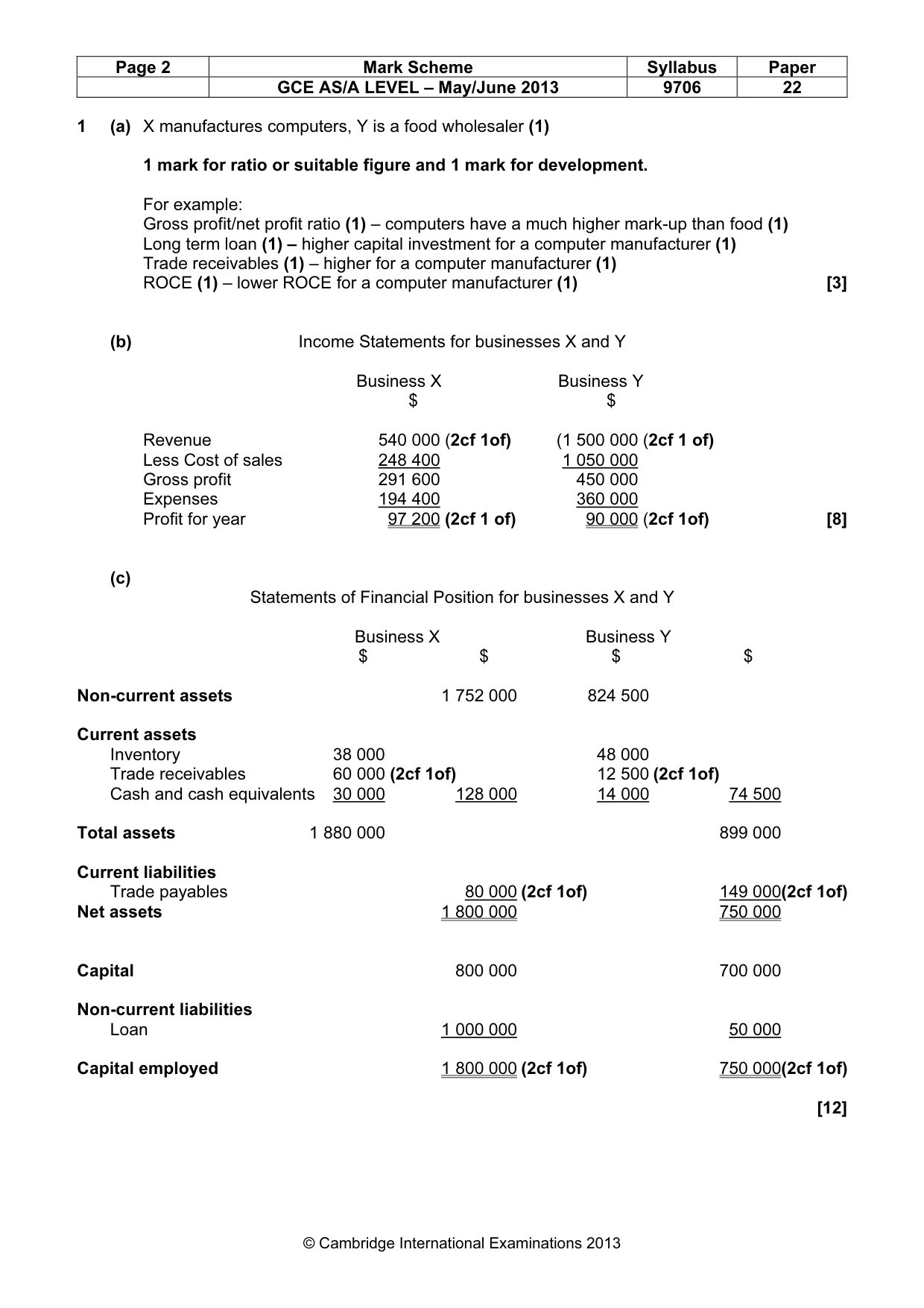
Page 2 Mark Scheme Syllabus Paper GCE AS/A LEVEL – May/June 2013 9706 22 © Cambridge International Examinations 2013 1 (a) X manufactures computers, Y is a food wholesaler (1) 1 mark for ratio or suitable figure and 1 mark for development. For example: Gross profit/net profit ratio (1) – computers have a much higher mark-up than food (1) Long term loan (1) – higher capital investment for a computer manufacturer (1) Trade receivables (1) – higher for a computer manufacturer (1) ROCE (1) – lower ROCE for a computer manufacturer (1) [3] (b) Income Statements for businesses X and Y Business X Business Y $ $ Revenue 540 000 (2cf 1of) (1 500 000 (2cf 1 of) Less Cost of sales 248 400 1 050 000 Gross profit 291 600 450 000 Expenses 194 400 360 000 Profit for year 97 200 (2cf 1 of) 90 000 (2cf 1of) [8] (c) Statements of Financial Position for businesses X and Y Business X Business Y $ $ $ $ Non-current assets 1 752 000 824 500 Current assets Inventory 38 000 48 000 Trade receivables 60 000 (2cf 1of) 12 500 (2cf 1of) Cash and cash equivalents 30 000 128 000 14 000 74 500 Total assets 1 880 000 899 000 Current liabilities Trade payables 80 000 (2cf 1of) 149 000(2cf 1of) Net assets 1 800 000 750 000 Capital 800 000 700 000 Non-current liabilities Loan 1 000 000 50 000 Capital employed 1 800 000 (2cf 1of) 750 000(2cf 1of) [12]
Mark scheme, page 3
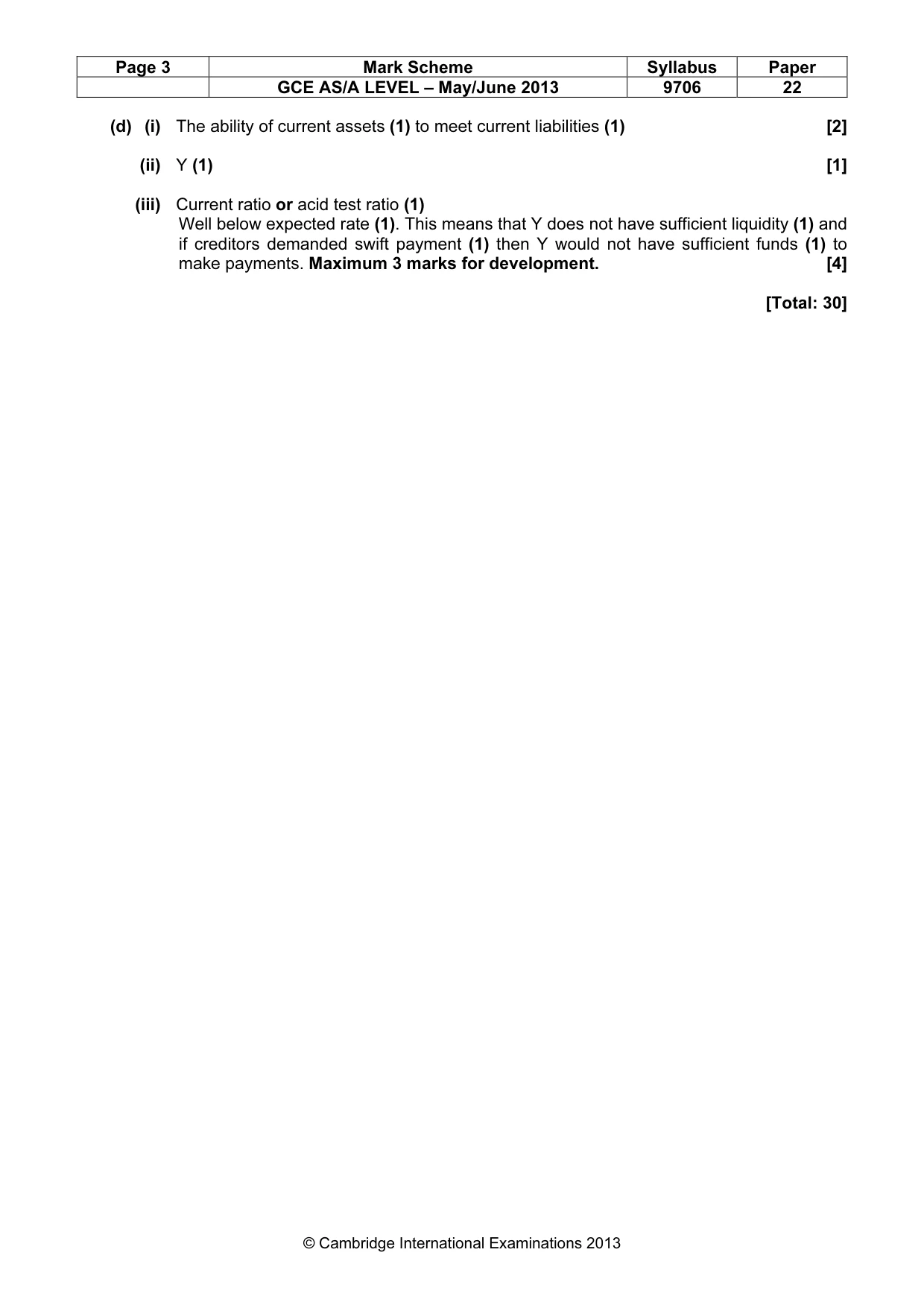
Page 3 Mark Scheme Syllabus Paper GCE AS/A LEVEL – May/June 2013 9706 22 © Cambridge International Examinations 2013 (d) (i) The ability of current assets (1) to meet current liabilities (1) [2] (ii) Y (1) [1] (iii) Current ratio or acid test ratio (1) Well below expected rate (1). This means that Y does not have sufficient liquidity (1) and if creditors demanded swift payment (1) then Y would not have sufficient funds (1) to make payments. Maximum 3 marks for development. [4] [Total: 30]
Mark scheme, page 4
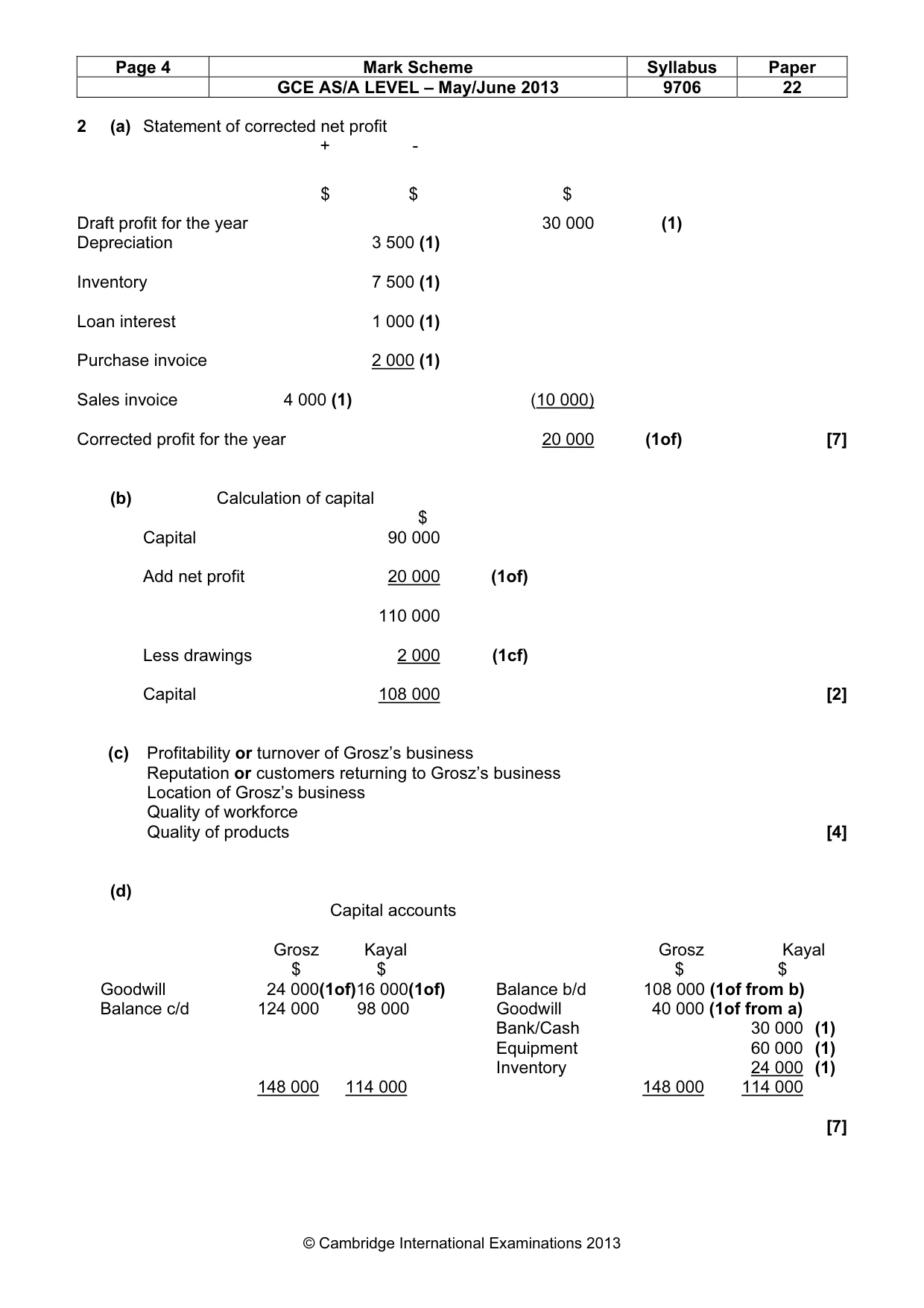
Page 4 Mark Scheme Syllabus Paper GCE AS/A LEVEL – May/June 2013 9706 22 © Cambridge International Examinations 2013 2 (a) Statement of corrected net profit + - $ $ $ Draft profit for the year 30 000 (1) Depreciation 3 500 (1) Inventory 7 500 (1) Loan interest 1 000 (1) Purchase invoice 2 000 (1) Sales invoice 4 000 (1) (10 000) Corrected profit for the year 20 000 (1of) [7] (b) Calculation of capital $ Capital 90 000 Add net profit 20 000 (1of) 110 000 Less drawings 2 000 (1cf) Capital 108 000 [2] (c) Profitability or turnover of Grosz’s business Reputation or customers returning to Grosz’s business Location of Grosz’s business Quality of workforce Quality of products [4] (d) Capital accounts Grosz Kayal Grosz Kayal $ $ $ $ Goodwill 24 000(1of)16 000(1of) Balance b/d 108 000 (1of from b) Balance c/d 124 000 98 000 Goodwill 40 000 (1of from a) Bank/Cash 30 000 (1) Equipment 60 000 (1) Inventory 24 000 (1) 148 000 114 000 148 000 114 000 [7]
Mark scheme, page 5
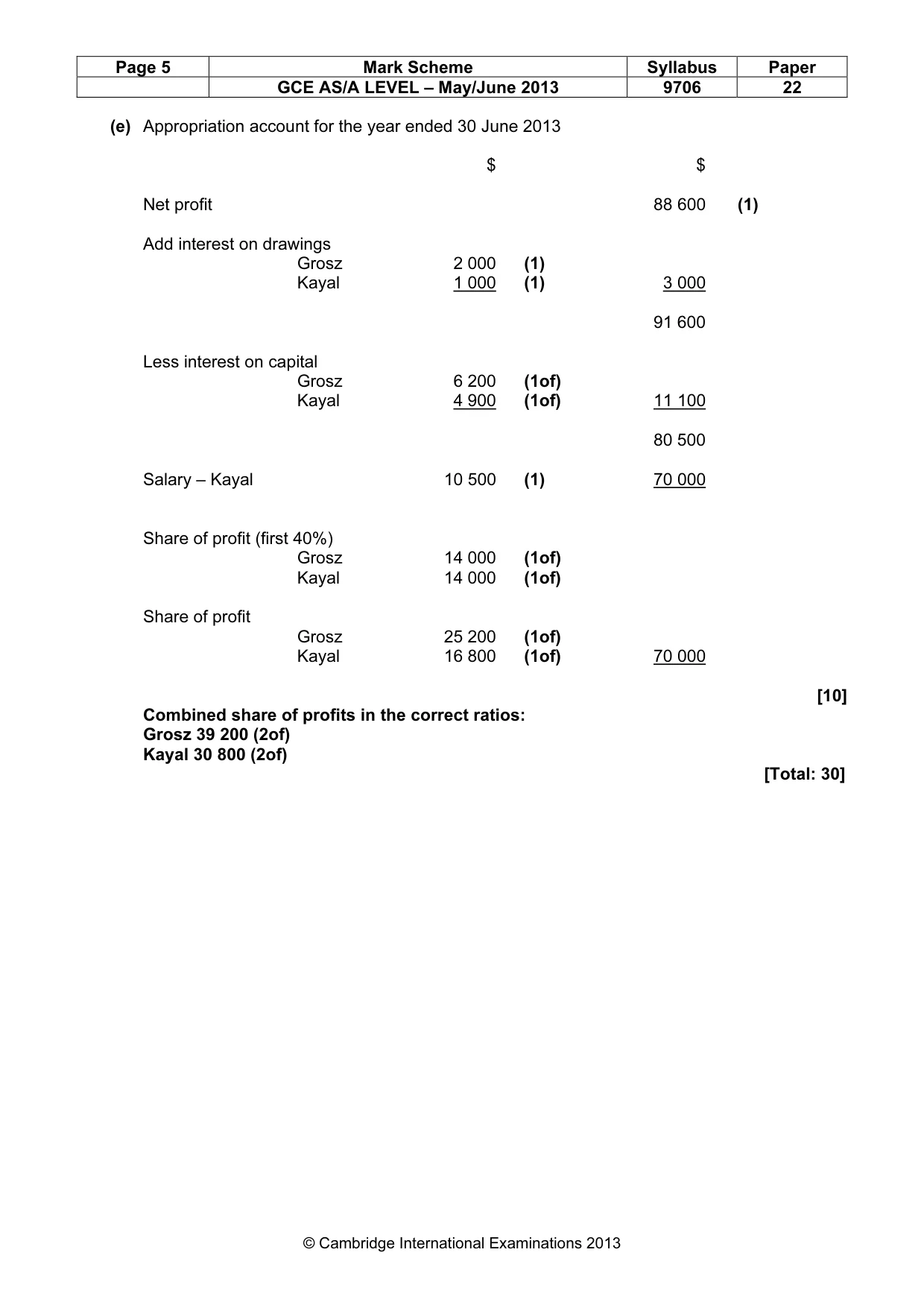
Page 5 Mark Scheme Syllabus Paper GCE AS/A LEVEL – May/June 2013 9706 22 © Cambridge International Examinations 2013 (e) Appropriation account for the year ended 30 June 2013 $ $ Net profit 88 600 (1) Add interest on drawings Grosz 2 000 (1) Kayal 1 000 (1) 3 000 91 600 Less interest on capital Grosz 6 200 (1of) Kayal 4 900 (1of) 11 100 80 500 Salary – Kayal 10 500 (1) 70 000 Share of profit (first 40%) Grosz 14 000 (1of) Kayal 14 000 (1of) Share of profit Grosz 25 200 (1of) Kayal 16 800 (1of) 70 000 [10] Combined share of profits in the correct ratios: Grosz 39 200 (2of) Kayal 30 800 (2of) [Total: 30]
Mark scheme, page 6
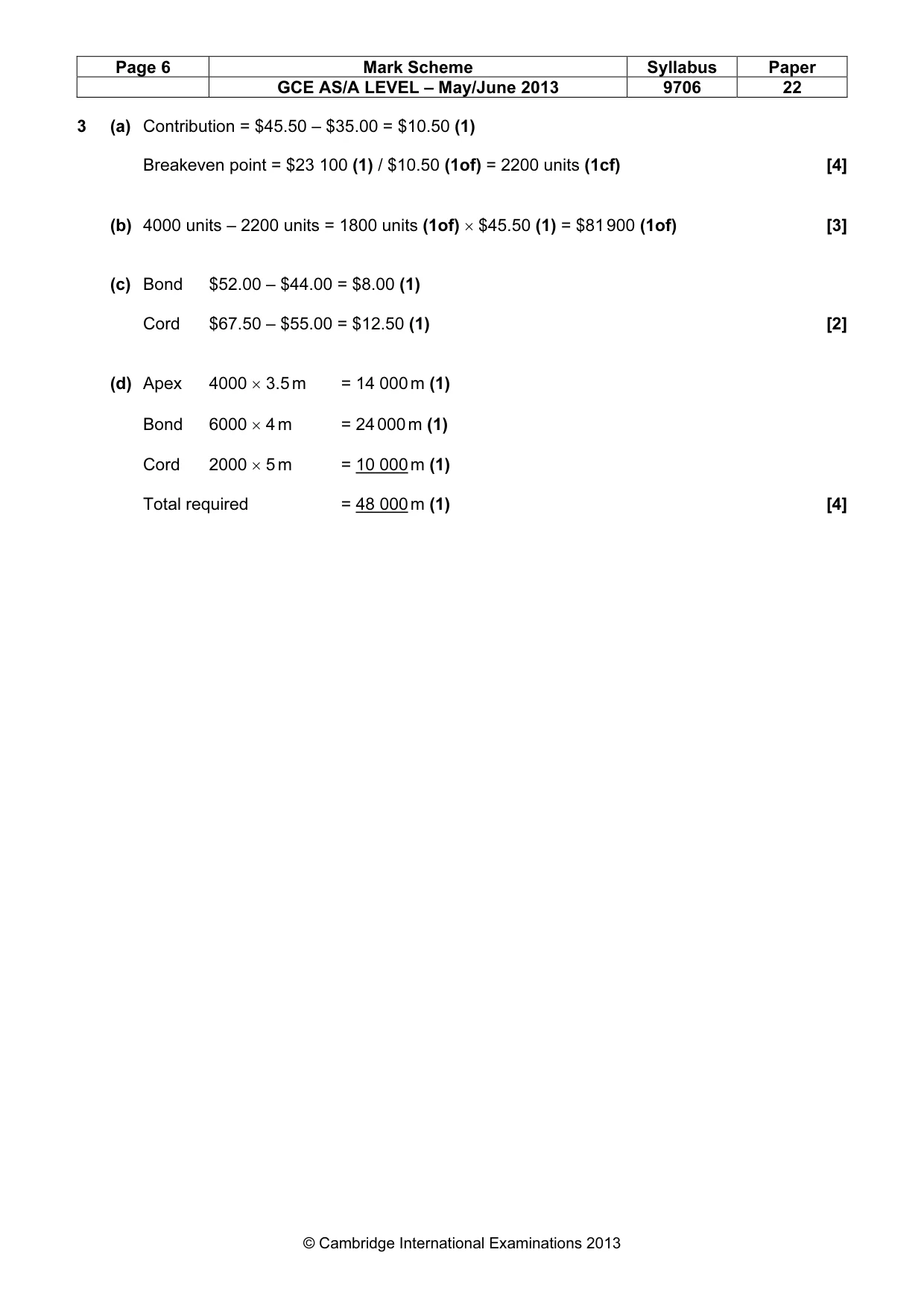
Page 6 Mark Scheme Syllabus Paper GCE AS/A LEVEL – May/June 2013 9706 22 © Cambridge International Examinations 2013 3 (a) Contribution = $45.50 – $35.00 = $10.50 (1) Breakeven point = $23 100 (1) / $10.50 (1of) = 2200 units (1cf) [4] (b) 4000 units – 2200 units = 1800 units (1of) × $45.50 (1) = $81 900 (1of) [3] (c) Bond $52.00 – $44.00 = $8.00 (1) Cord $67.50 – $55.00 = $12.50 (1) [2] (d) Apex 4000 × 3.5 m = 14 000 m (1) Bond 6000 × 4 m = 24 000 m (1) Cord 2000 × 5 m = 10 000 m (1) Total required = 48 000 m (1) [4]
Mark scheme, page 7
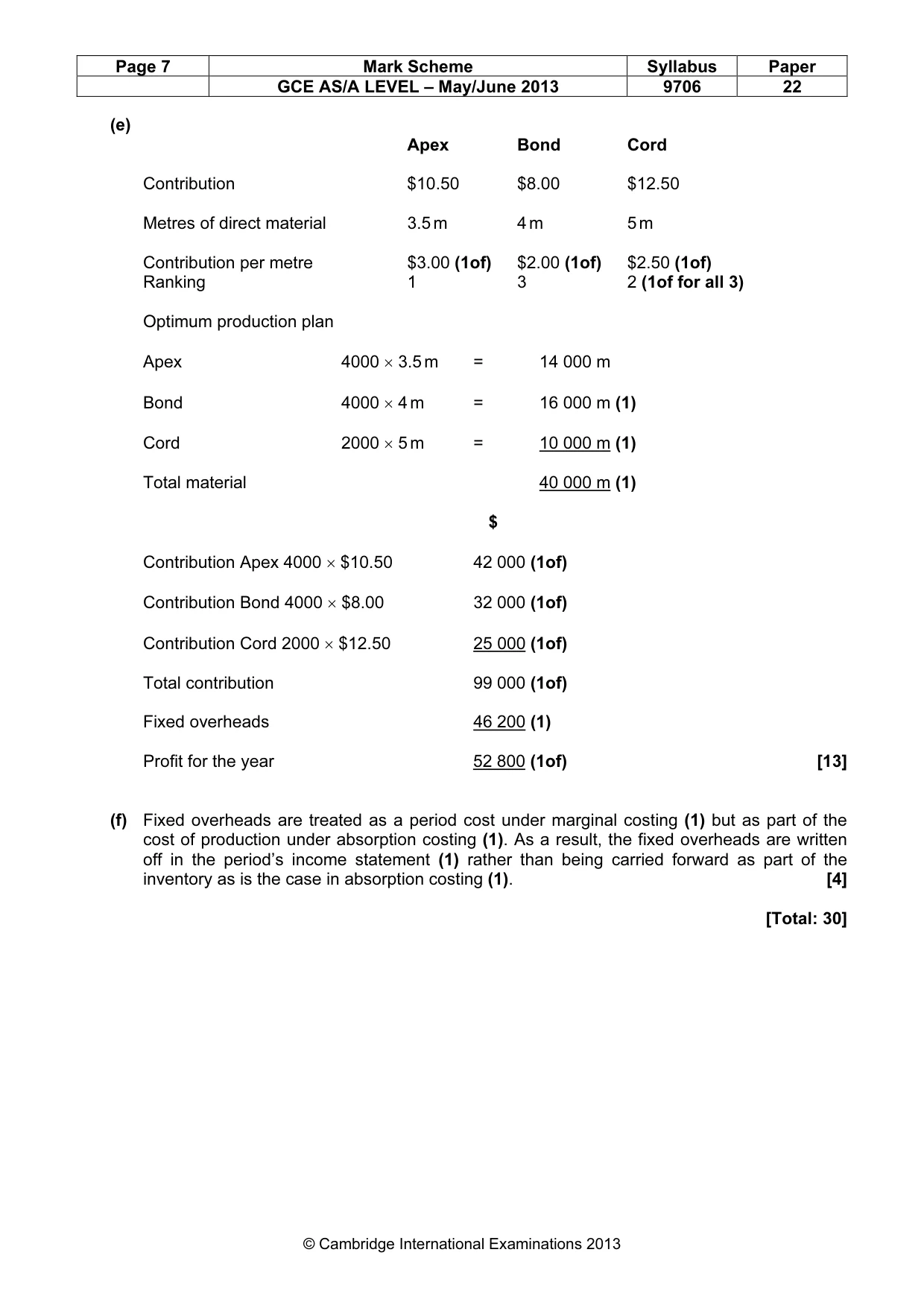
Page 7 Mark Scheme Syllabus Paper GCE AS/A LEVEL – May/June 2013 9706 22 © Cambridge International Examinations 2013 (e) Apex Bond Cord Contribution $10.50 $8.00 $12.50 Metres of direct material 3.5 m 4 m 5 m Contribution per metre $3.00 (1of) $2.00 (1of) $2.50 (1of) Ranking 1 3 2 (1of for all 3) Optimum production plan Apex 4000 × 3.5 m = 14 000 m Bond 4000 × 4 m = 16 000 m (1) Cord 2000 × 5 m = 10 000 m (1) Total material 40 000 m (1) $ Contribution Apex 4000 × $10.50 42 000 (1of) Contribution Bond 4000 × $8.00 32 000 (1of) Contribution Cord 2000 × $12.50 25 000 (1of) Total contribution 99 000 (1of) Fixed overheads 46 200 (1) Profit for the year 52 800 (1of) [13] (f) Fixed overheads are treated as a period cost under marginal costing (1) but as part of the cost of production under absorption costing (1). As a result, the fixed overheads are written off in the period’s income statement (1) rather than being carried forward as part of the inventory as is the case in absorption costing (1). [4] [Total: 30]
What you needed in this session
Cambridge’s own grade thresholds for 2013 May/June, Paper 2 · Variant 2. A higher threshold means an easier paper — the bar moves with how the cohort did.