Cambridge A Level Accounting 9706 — 2013 May/June Paper 2 · Variant 3
9706/23/M/J/13 · 90 marks · ≈101 min
The question paper and its mark scheme, free to read here and free to download. This is Cambridge’s own paper, exactly as it was sat.
Question paper12 pages
Mark scheme6 pages
Answers below. Sit the paper first if you are practising.
Paper as text
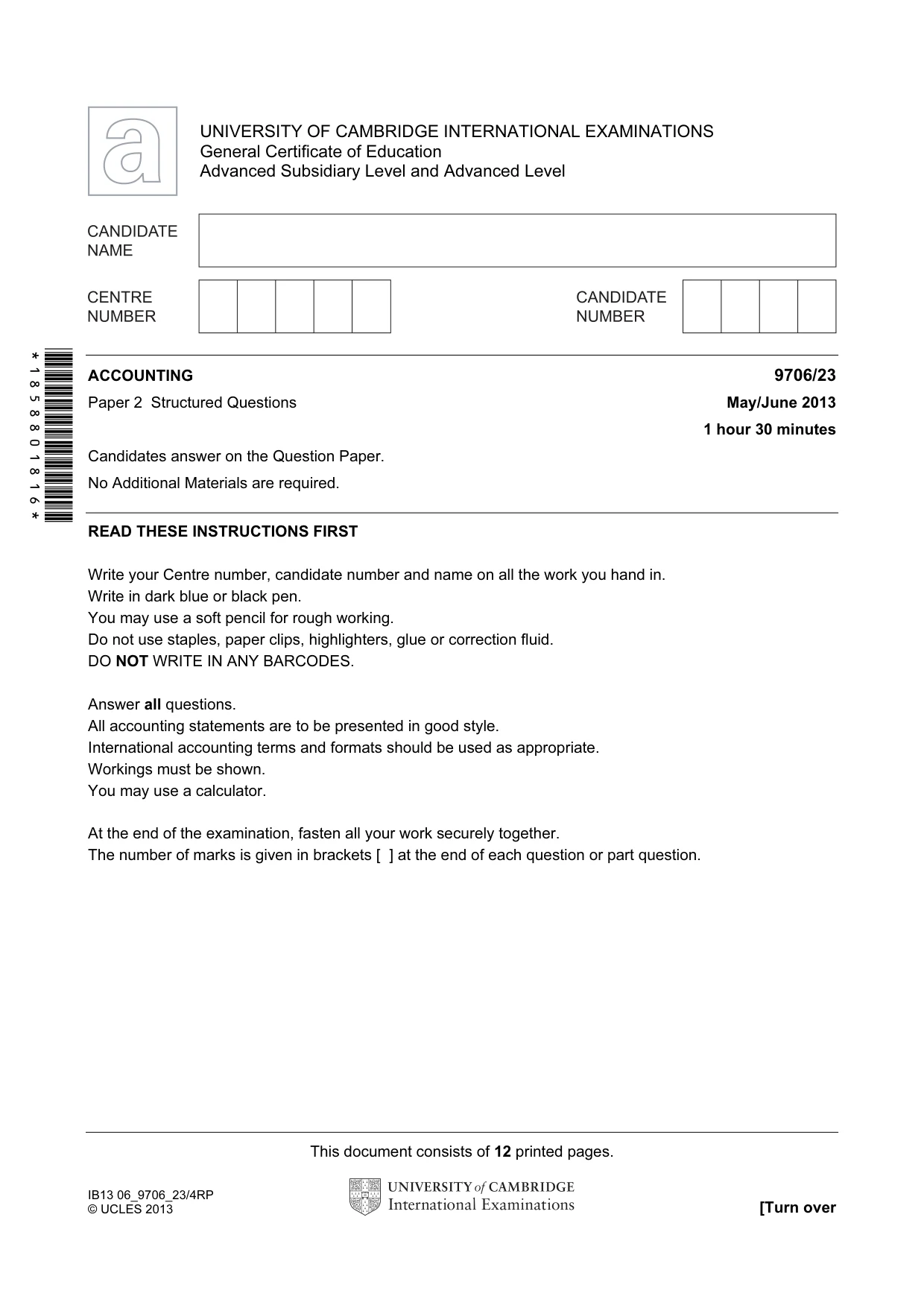
Question paper, page 1
This document consists of 12 printed pages. IB13 06_9706_23/4RP © UCLES 2013 [Turn over *1858801816* UNIVERSITY OF CAMBRIDGE INTERNATIONAL EXAMINATIONS General Certificate of Education Advanced Subsidiary Level and Advanced Level ACCOUNTING 9706/23 Paper 2 Structured Questions May/June 2013 1 hour 30 minutes Candidates answer on the Question Paper. No Additional Materials are required. READ THESE INSTRUCTIONS FIRST Write your Centre number, candidate number and name on all the work you hand in. Write in dark blue or black pen. You may use a soft pencil for rough working. Do not use staples, paper clips, highlighters, glue or correction fluid. DO NOT WRITE IN ANY BARCODES. Answer all questions. All accounting statements are to be presented in good style. International accounting terms and formats should be used as appropriate. Workings must be shown. You may use a calculator. At the end of the examination, fasten all your work securely together. The number of marks is given in brackets [ ] at the end of each question or part question.
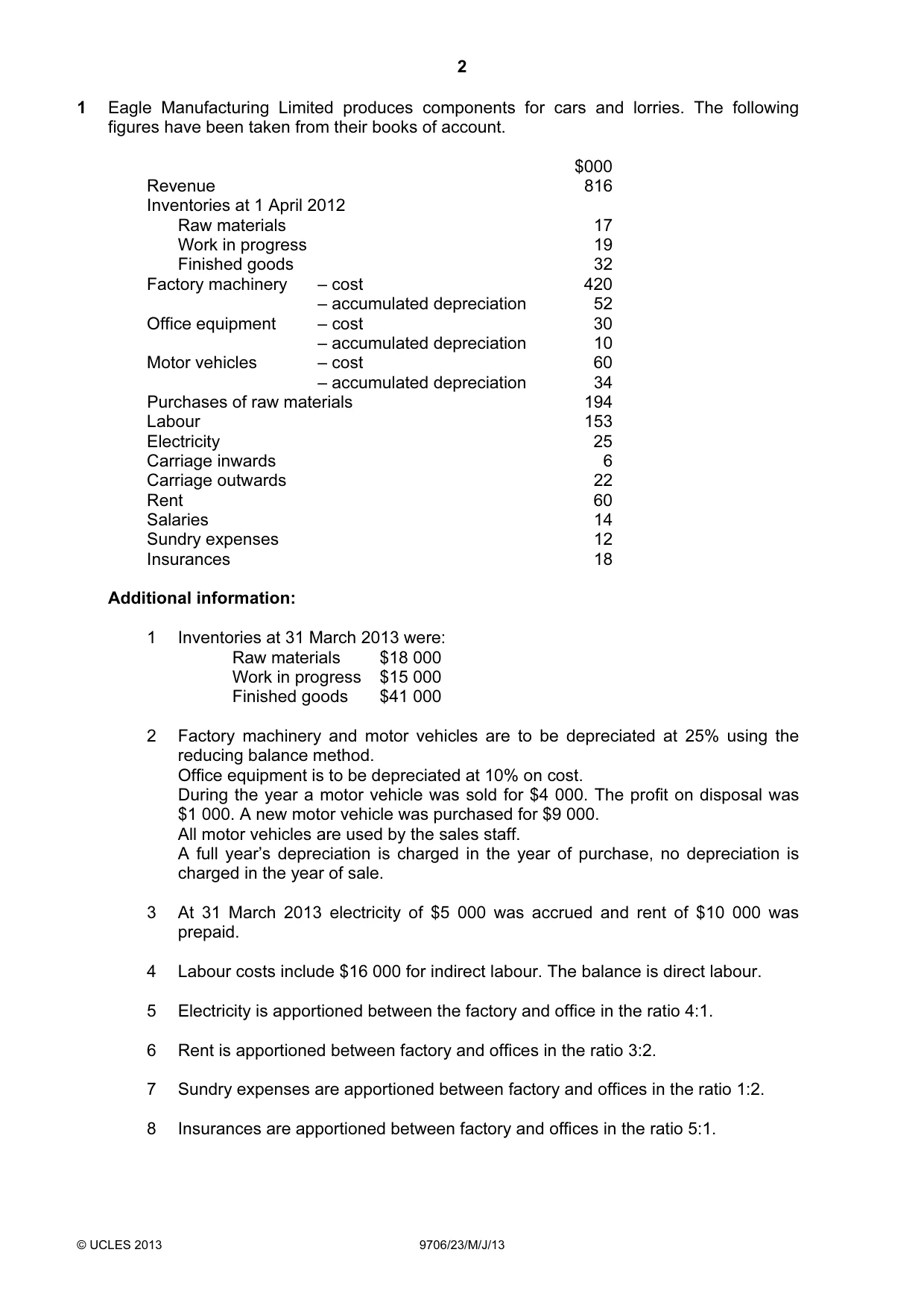
Question paper, page 2
2 © UCLES 2013 9706/23/M/J/13 1 Eagle Manufacturing Limited produces components for cars and lorries. The following figures have been taken from their books of account. $000 Revenue 816 Inventories at 1 April 2012 Raw materials 17 Work in progress 19 Finished goods 32 Factory machinery – cost 420 – accumulated depreciation 52 Office equipment – cost 30 – accumulated depreciation 10 Motor vehicles – cost 60 – accumulated depreciation 34 Purchases of raw materials 194 Labour 153 Electricity 25 Carriage inwards 6 Carriage outwards 22 Rent 60 Salaries 14 Sundry expenses 12 Insurances 18 Additional information: 1 Inventories at 31 March 2013 were: Raw materials $18 000 Work in progress $15 000 Finished goods $41 000 2 Factory machinery and motor vehicles are to be depreciated at 25% using the reducing balance method. Office equipment is to be depreciated at 10% on cost. During the year a motor vehicle was sold for $4 000. The profit on disposal was $1 000. A new motor vehicle was purchased for $9 000. All motor vehicles are used by the sales staff. A full year’s depreciation is charged in the year of purchase, no depreciation is charged in the year of sale. 3 At 31 March 2013 electricity of $5 000 was accrued and rent of $10 000 was prepaid. 4 Labour costs include $16 000 for indirect labour. The balance is direct labour. 5 Electricity is apportioned between the factory and office in the ratio 4:1. 6 Rent is apportioned between factory and offices in the ratio 3:2. 7 Sundry expenses are apportioned between factory and offices in the ratio 1:2. 8 Insurances are apportioned between factory and offices in the ratio 5:1.
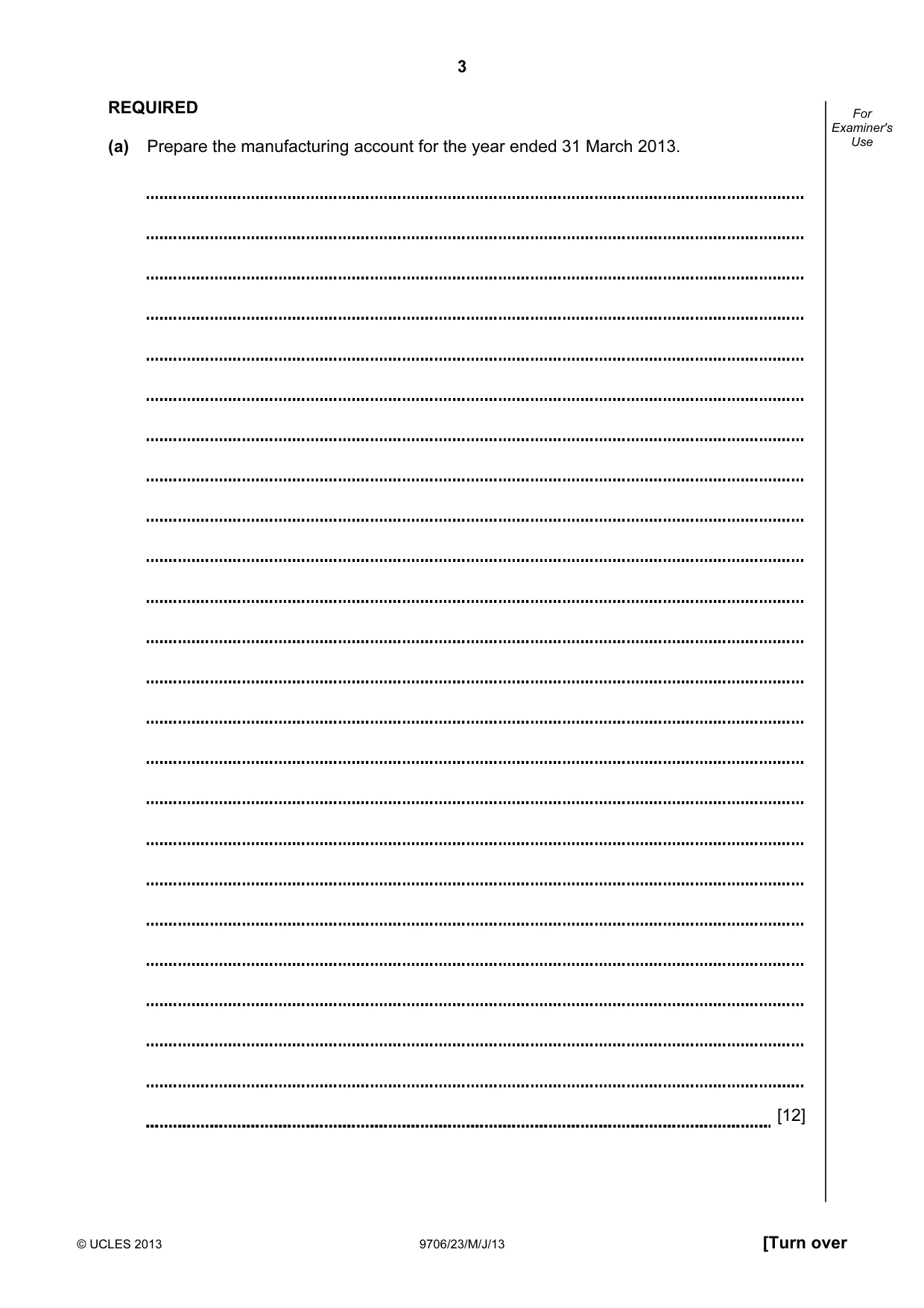
Question paper, page 3
3 © UCLES 2013 9706/23/M/J/13 [Turn over For Examiner's Use REQUIRED (a) Prepare the manufacturing account for the year ended 31 March 2013. [12]
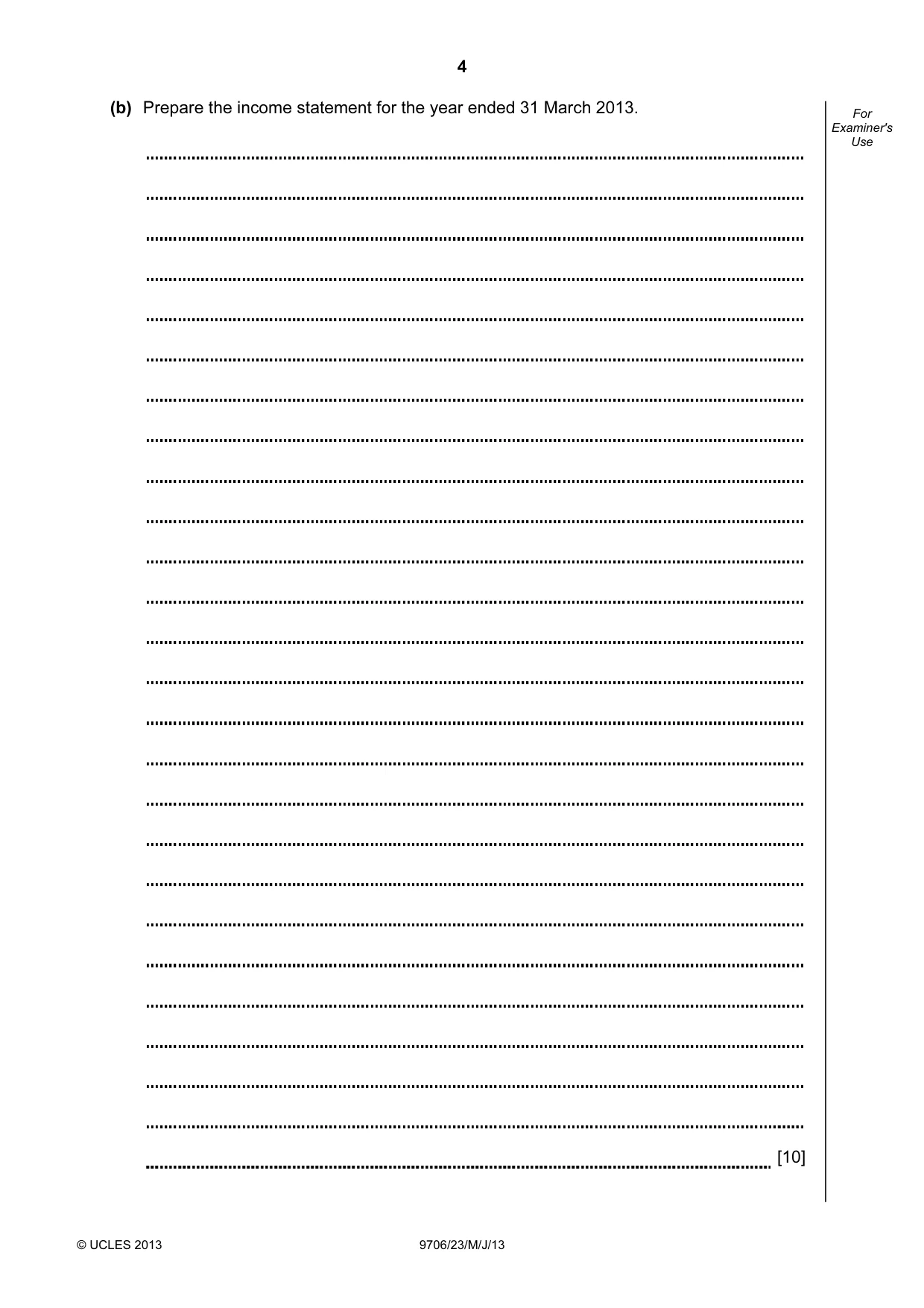
Question paper, page 4
4 © UCLES 2013 9706/23/M/J/13 For Examiner's Use (b) Prepare the income statement for the year ended 31 March 2013. [10]
Question paper, page 5
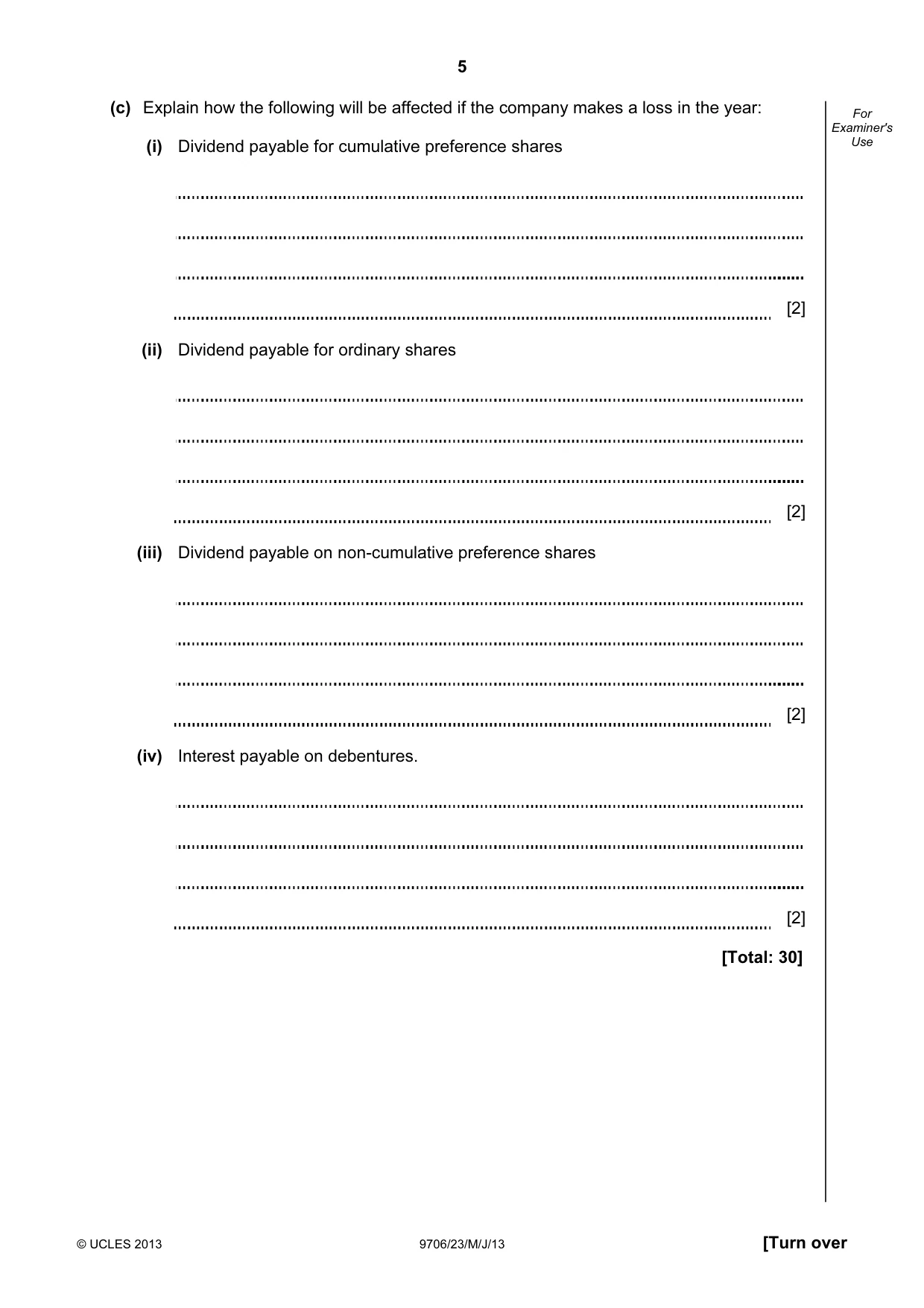
5 © UCLES 2013 9706/23/M/J/13 [Turn over For Examiner's Use (c) Explain how the following will be affected if the company makes a loss in the year: (i) Dividend payable for cumulative preference shares [2] (ii) Dividend payable for ordinary shares [2] (iii) Dividend payable on non-cumulative preference shares [2] (iv) Interest payable on debentures. [2] [Total: 30]
Question paper, page 6
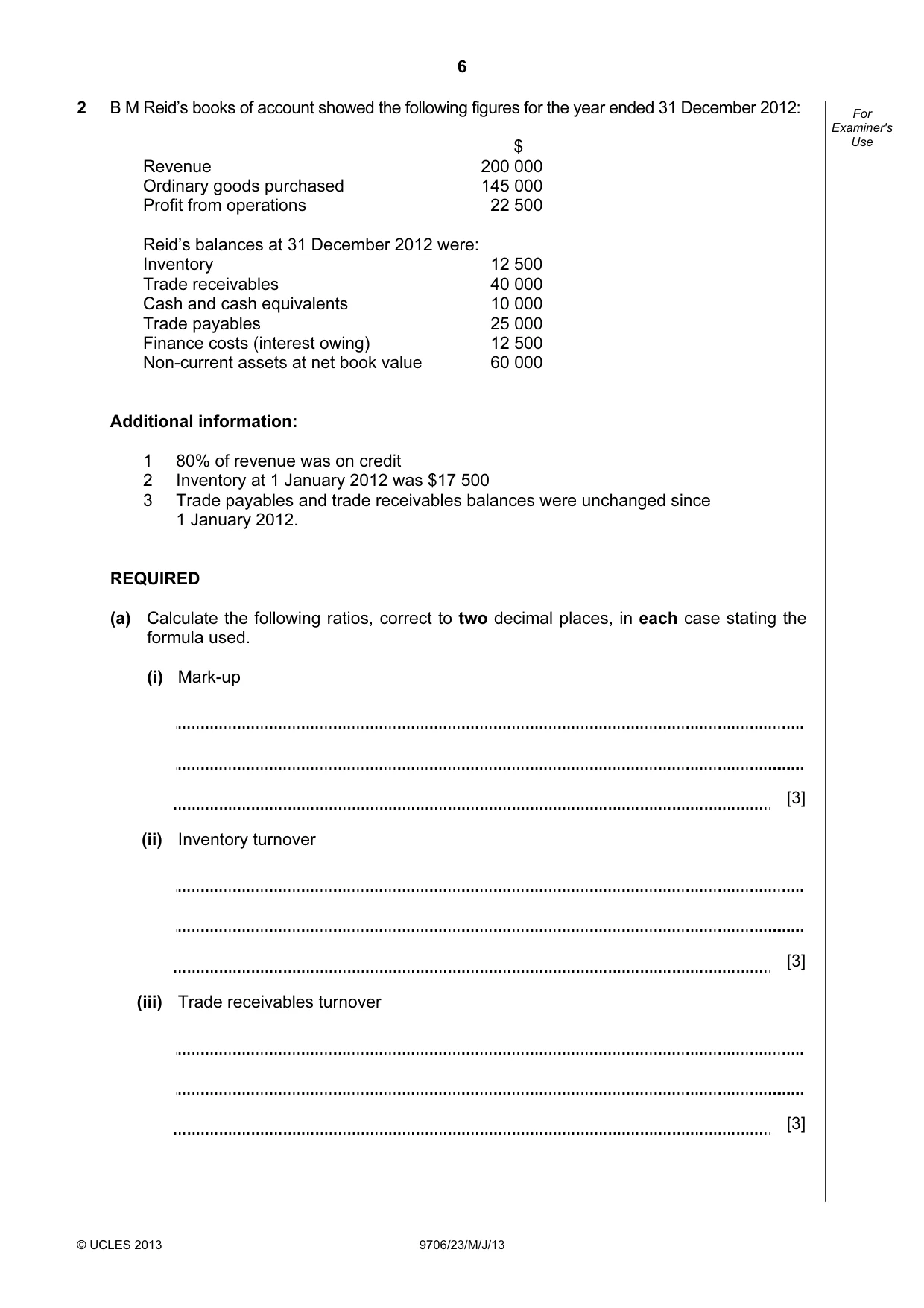
6 © UCLES 2013 9706/23/M/J/13 For Examiner's Use 2 B M Reid’s books of account showed the following figures for the year ended 31 December 2012: $ Revenue 200 000 Ordinary goods purchased 145 000 Profit from operations 22 500 Reid’s balances at 31 December 2012 were: Inventory 12 500 Trade receivables 40 000 Cash and cash equivalents 10 000 Trade payables 25 000 Finance costs (interest owing) 12 500 Non-current assets at net book value 60 000 Additional information: 1 80% of revenue was on credit 2 Inventory at 1 January 2012 was $17 500 3 Trade payables and trade receivables balances were unchanged since 1 January 2012. REQUIRED (a) Calculate the following ratios, correct to two decimal places, in each case stating the formula used. (i) Mark-up [3] (ii) Inventory turnover [3] (iii) Trade receivables turnover [3]
Question paper, page 7
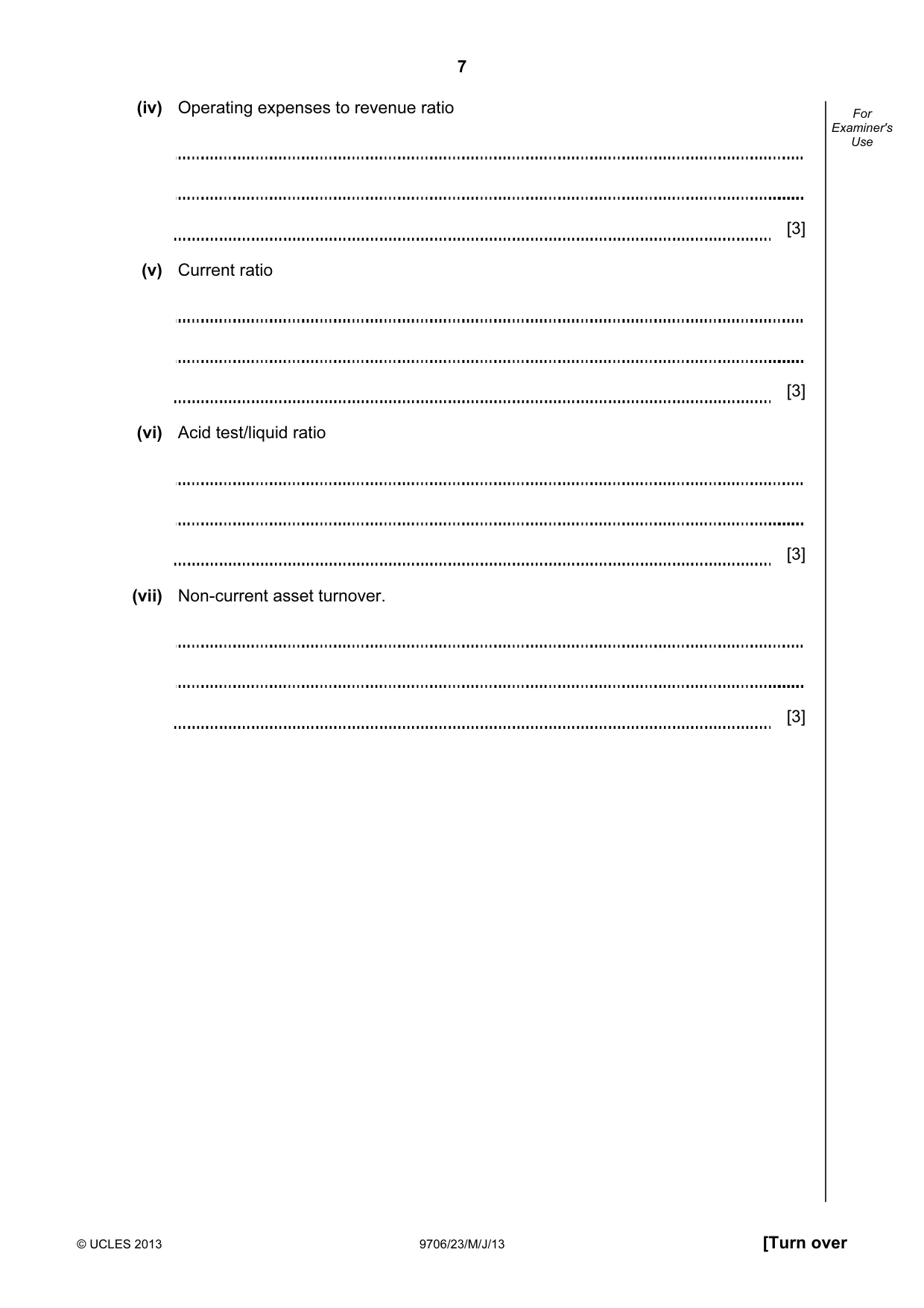
7 © UCLES 2013 9706/23/M/J/13 [Turn over For Examiner's Use (iv) Operating expenses to revenue ratio [3] (v) Current ratio [3] (vi) Acid test/liquid ratio [3] (vii) Non-current asset turnover. [3]
Question paper, page 8
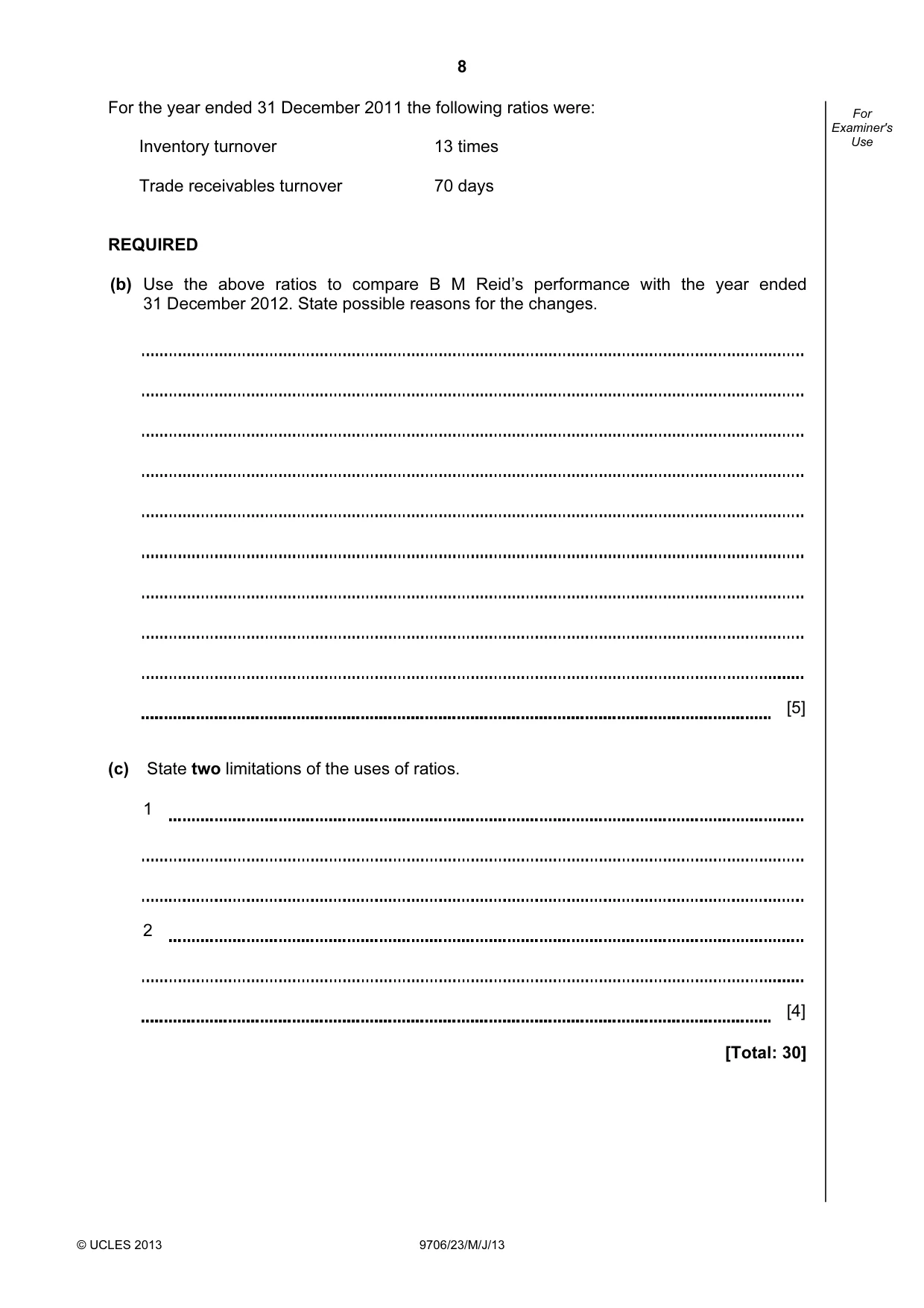
8 © UCLES 2013 9706/23/M/J/13 For Examiner's Use For the year ended 31 December 2011 the following ratios were: Inventory turnover 13 times Trade receivables turnover 70 days REQUIRED (b) Use the above ratios to compare B M Reid’s performance with the year ended 31 December 2012. State possible reasons for the changes. [5] (c) State two limitations of the uses of ratios. 1 2 [4] [Total: 30]
Question paper, page 9
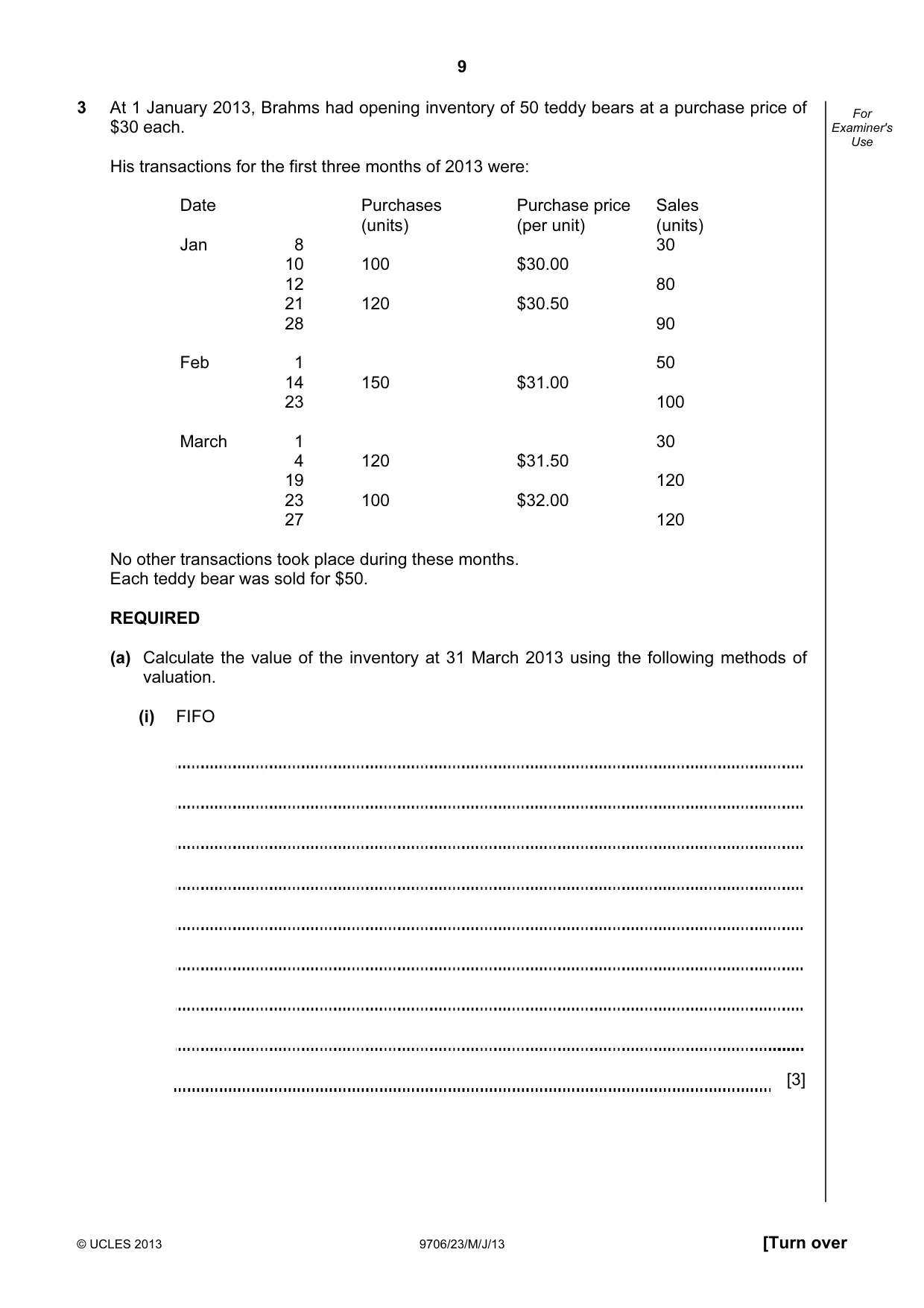
9 © UCLES 2013 9706/23/M/J/13 [Turn over For Examiner's Use 3 At 1 January 2013, Brahms had opening inventory of 50 teddy bears at a purchase price of $30 each. His transactions for the first three months of 2013 were: Date Purchases (units) Purchase price (per unit) Sales (units) Jan 8 30 10 100 $30.00 12 80 21 120 $30.50 28 90 Feb 1 50 14 150 $31.00 23 100 March 1 30 4 120 $31.50 19 120 23 100 $32.00 27 120 No other transactions took place during these months. Each teddy bear was sold for $50. REQUIRED (a) Calculate the value of the inventory at 31 March 2013 using the following methods of valuation. (i) FIFO [3]
Question paper, page 10
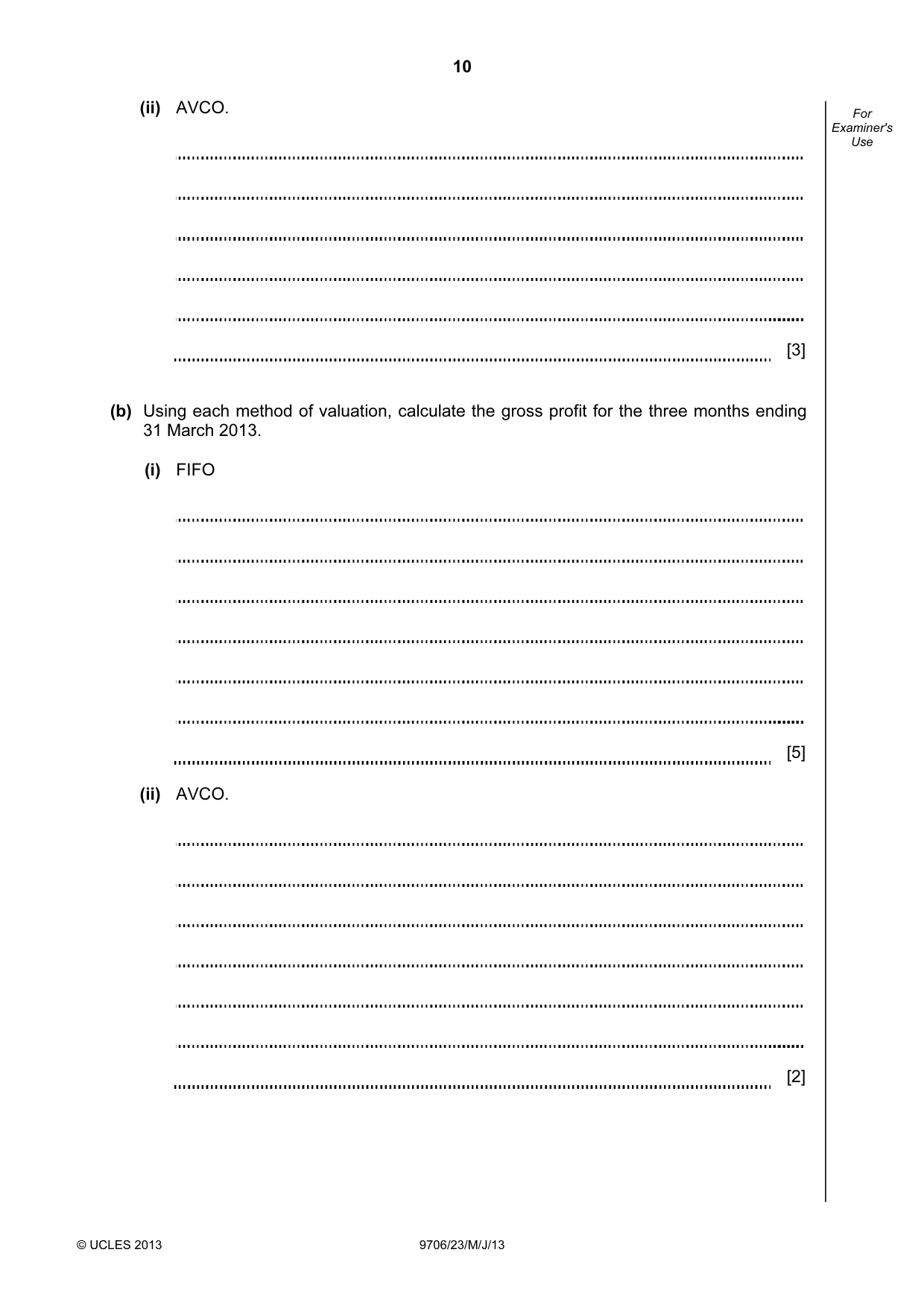
10 © UCLES 2013 9706/23/M/J/13 For Examiner's Use (ii) AVCO. [3] (b) Using each method of valuation, calculate the gross profit for the three months ending 31 March 2013. (i) FIFO [5] (ii) AVCO. [2]
Question paper, page 11
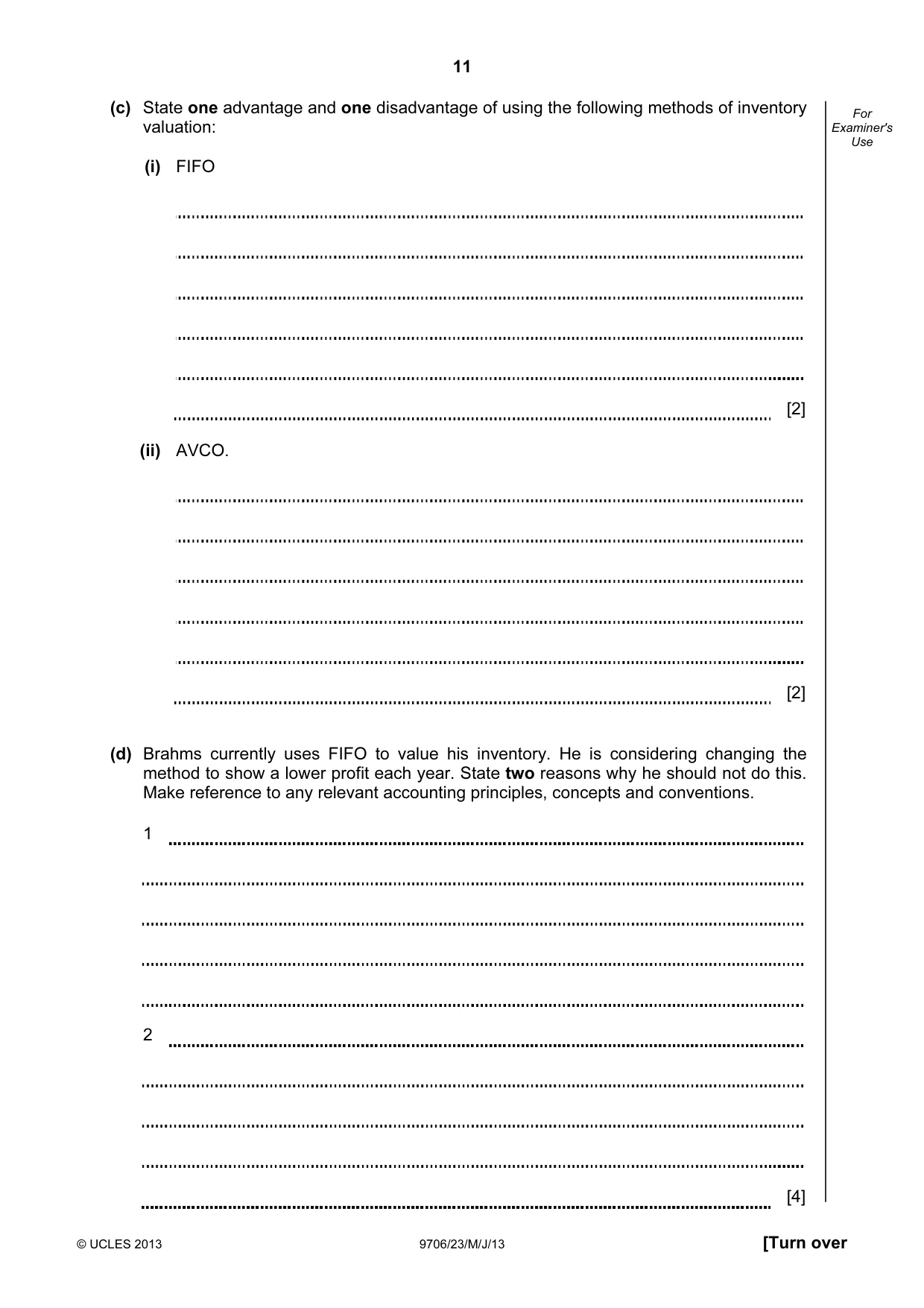
11 © UCLES 2013 9706/23/M/J/13 [Turn over For Examiner's Use (c) State one advantage and one disadvantage of using the following methods of inventory valuation: (i) FIFO [2] (ii) AVCO. [2] (d) Brahms currently uses FIFO to value his inventory. He is considering changing the method to show a lower profit each year. State two reasons why he should not do this. Make reference to any relevant accounting principles, concepts and conventions. 1 2 [4]
Question paper, page 12
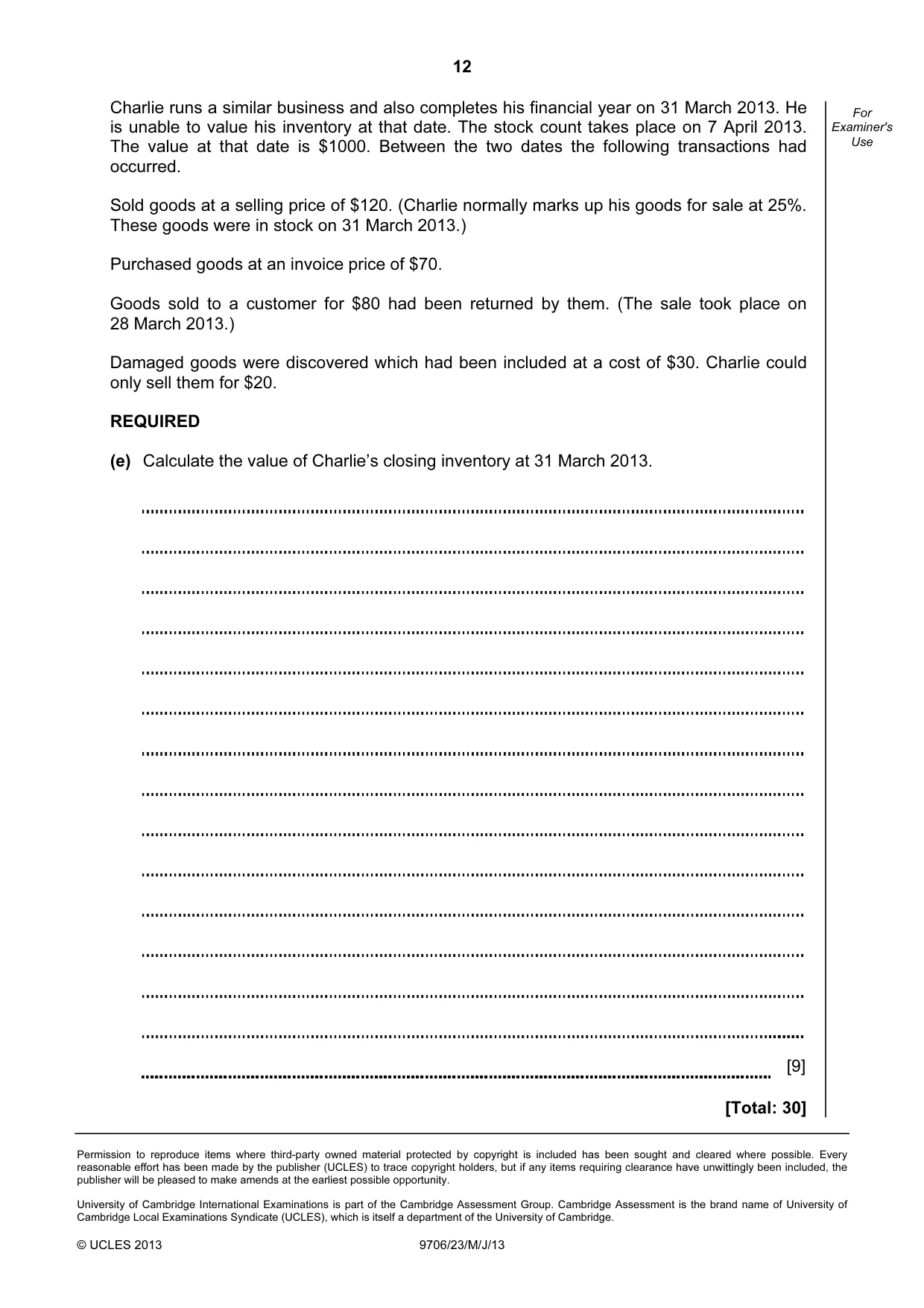
12 Permission to reproduce items where third-party owned material protected by copyright is included has been sought and cleared where possible. Every reasonable effort has been made by the publisher (UCLES) to trace copyright holders, but if any items requiring clearance have unwittingly been included, the publisher will be pleased to make amends at the earliest possible opportunity. University of Cambridge International Examinations is part of the Cambridge Assessment Group. Cambridge Assessment is the brand name of University of Cambridge Local Examinations Syndicate (UCLES), which is itself a department of the University of Cambridge. © UCLES 2013 9706/23/M/J/13 For Examiner's Use Charlie runs a similar business and also completes his financial year on 31 March 2013. He is unable to value his inventory at that date. The stock count takes place on 7 April 2013. The value at that date is $1000. Between the two dates the following transactions had occurred. Sold goods at a selling price of $120. (Charlie normally marks up his goods for sale at 25%. These goods were in stock on 31 March 2013.) Purchased goods at an invoice price of $70. Goods sold to a customer for $80 had been returned by them. (The sale took place on 28 March 2013.) Damaged goods were discovered which had been included at a cost of $30. Charlie could only sell them for $20. REQUIRED (e) Calculate the value of Charlie’s closing inventory at 31 March 2013. [9] [Total: 30]
Mark scheme, page 1
CAMBRIDGE INTERNATIONAL EXAMINATIONS GCE Advanced Subsidiary Level and GCE Advanced Level MARK SCHEME for the May/June 2013 series 9706 ACCOUNTING 9706/23 Paper 2 (Structured Questions – Core), maximum raw mark 90 This mark scheme is published as an aid to teachers and candidates, to indicate the requirements of the examination. It shows the basis on which Examiners were instructed to award marks. It does not indicate the details of the discussions that took place at an Examiners’ meeting before marking began, which would have considered the acceptability of alternative answers. Mark schemes should be read in conjunction with the question paper and the Principal Examiner Report for Teachers. Cambridge will not enter into discussions about these mark schemes. Cambridge is publishing the mark schemes for the May/June 2013 series for most IGCSE, GCE Advanced Level and Advanced Subsidiary Level components and some Ordinary Level components.
Mark scheme, page 2
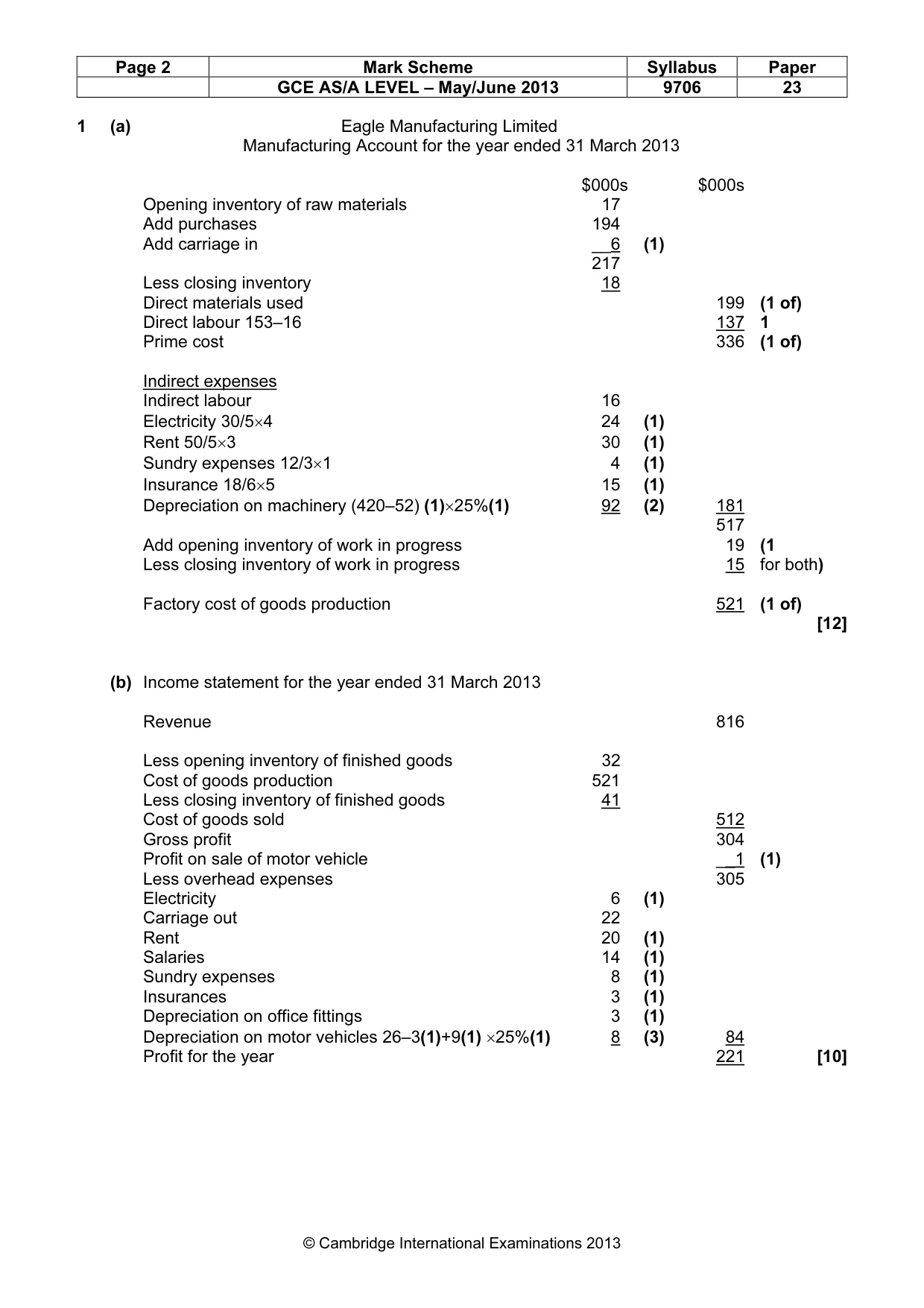
Page 2 Mark Scheme Syllabus Paper GCE AS/A LEVEL – May/June 2013 9706 23 © Cambridge International Examinations 2013 1 (a) Eagle Manufacturing Limited Manufacturing Account for the year ended 31 March 2013 $000s $000s Opening inventory of raw materials 17 Add purchases 194 Add carriage in __6 (1) 217 Less closing inventory 18 Direct materials used 199 (1 of) Direct labour 153–16 137 1 Prime cost 336 (1 of) Indirect expenses Indirect labour 16 Electricity 30/5×4 24 (1) Rent 50/5×3 30 (1) Sundry expenses 12/3×1 4 (1) Insurance 18/6×5 15 (1) Depreciation on machinery (420–52) (1)×25%(1) 92 (2) 181 517 Add opening inventory of work in progress 19 (1 Less closing inventory of work in progress 15 for both) Factory cost of goods production 521 (1 of) [12] (b) Income statement for the year ended 31 March 2013 Revenue 816 Less opening inventory of finished goods 32 Cost of goods production 521 Less closing inventory of finished goods 41 Cost of goods sold 512 Gross profit 304 Profit on sale of motor vehicle __1 (1) Less overhead expenses 305 Electricity 6 (1) Carriage out 22 Rent 20 (1) Salaries 14 (1) Sundry expenses 8 (1) Insurances 3 (1) Depreciation on office fittings 3 (1) Depreciation on motor vehicles 26–3(1)+9(1) ×25%(1) 8 (3) 84 Profit for the year 221 [10]
Mark scheme, page 3
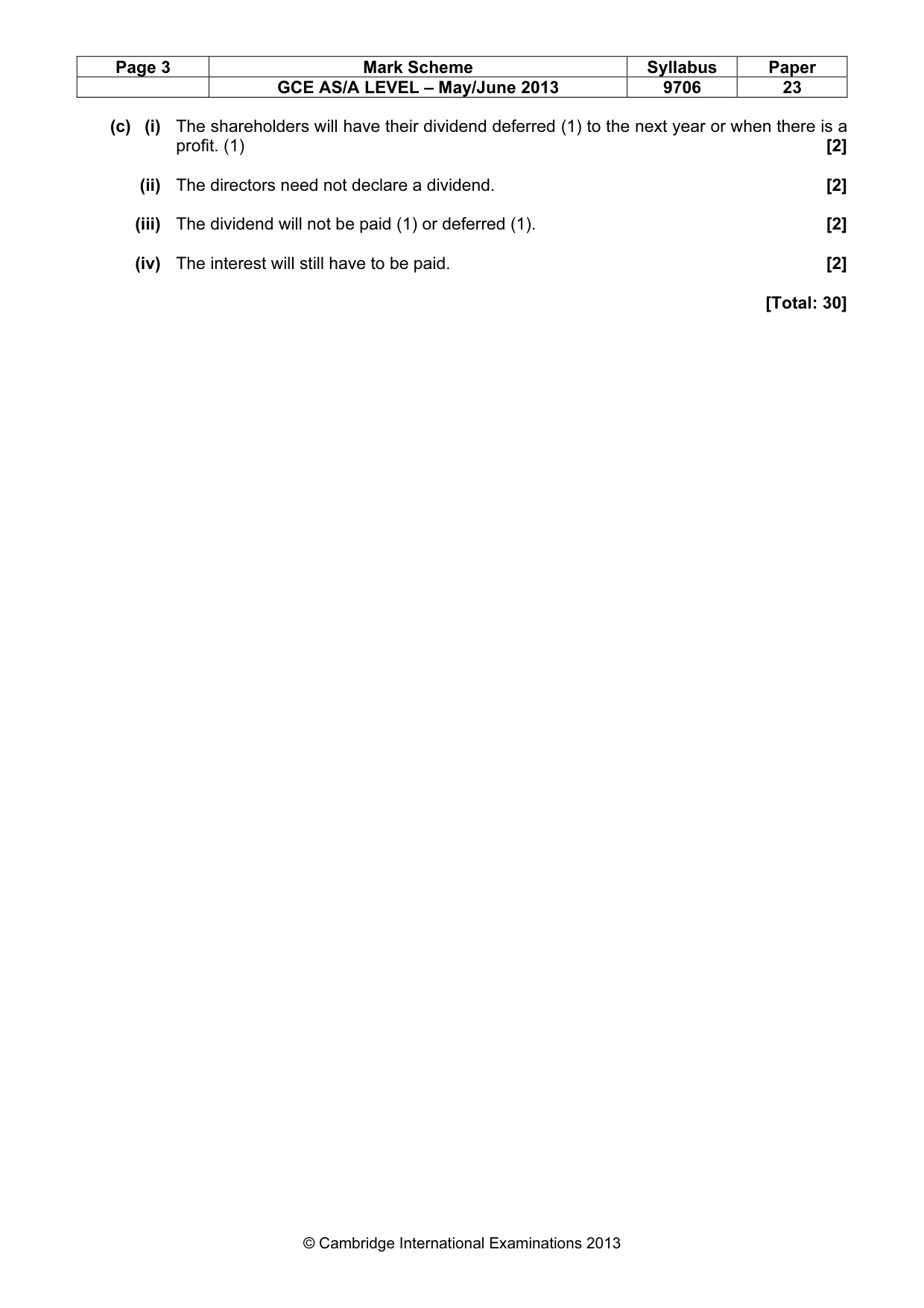
Page 3 Mark Scheme Syllabus Paper GCE AS/A LEVEL – May/June 2013 9706 23 © Cambridge International Examinations 2013 (c) (i) The shareholders will have their dividend deferred (1) to the next year or when there is a profit. (1) [2] (ii) The directors need not declare a dividend. [2] (iii) The dividend will not be paid (1) or deferred (1). [2] (iv) The interest will still have to be paid. [2] [Total: 30]
Mark scheme, page 4
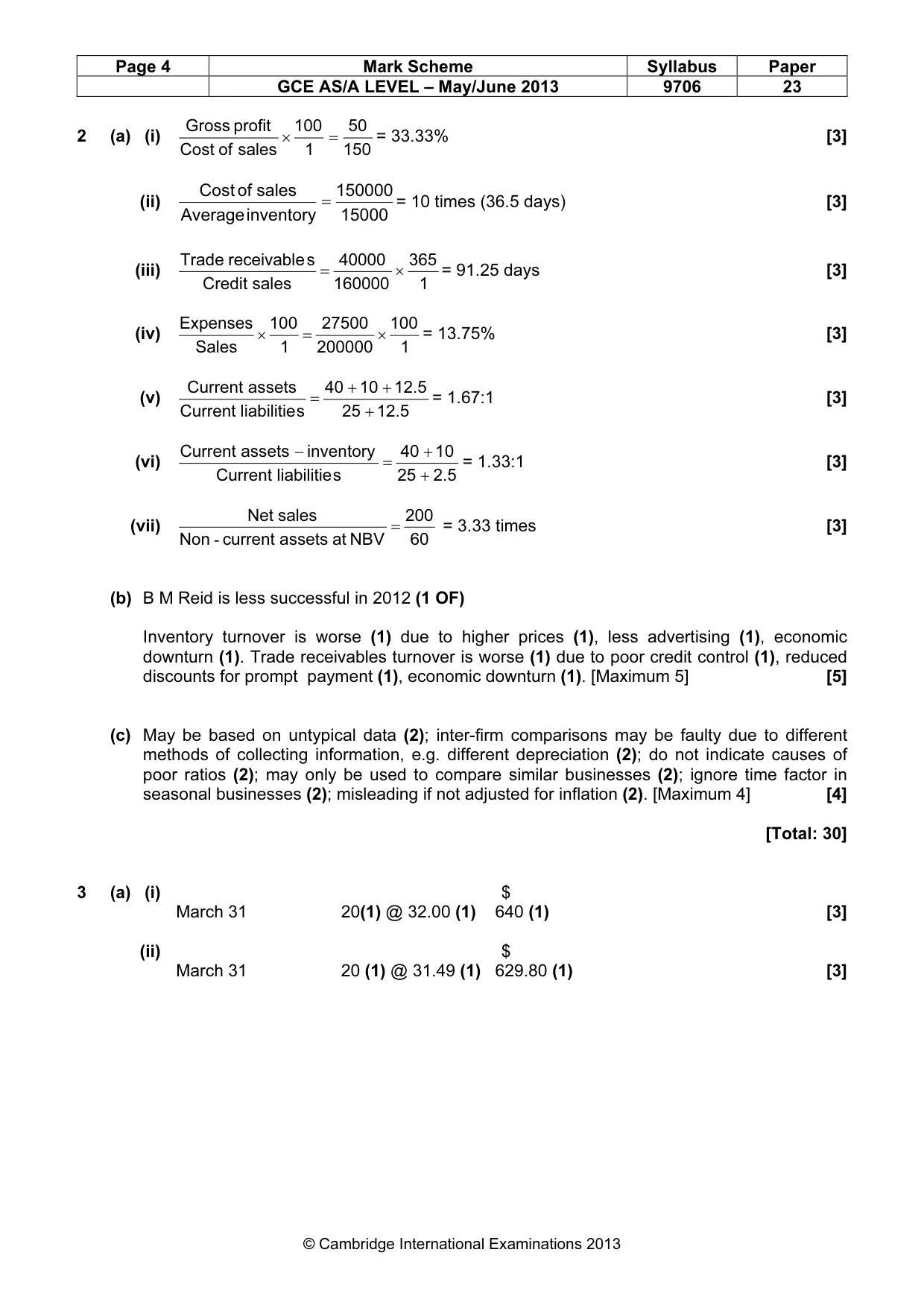
Page 4 Mark Scheme Syllabus Paper GCE AS/A LEVEL – May/June 2013 9706 23 © Cambridge International Examinations 2013 2 (a) (i) 150 50 1 100 sales of Cost profit Gross = × = 33.33% [3] (ii) 15000 150000 inventory Average sales of Cost = = 10 times (36.5 days) [3] (iii) 1 365 160000 40000 sales Credit s receivable Trade × = = 91.25 days [3] (iv) 1 100 200000 27500 1 100 Sales Expenses × = × = 13.75% [3] (v) 12.5 25 12.5 10 40 s liabilitie Current assets Current + + + = = 1.67:1 [3] (vi) 2.5 25 10 40 s liabilitie Current inventory assets Current + + = − = 1.33:1 [3] (vii) 60 200 NBV at assets current Non sales Net = - = 3.33 times [3] (b) B M Reid is less successful in 2012 (1 OF) Inventory turnover is worse (1) due to higher prices (1), less advertising (1), economic downturn (1). Trade receivables turnover is worse (1) due to poor credit control (1), reduced discounts for prompt payment (1), economic downturn (1). [Maximum 5] [5] (c) May be based on untypical data (2); inter-firm comparisons may be faulty due to different methods of collecting information, e.g. different depreciation (2); do not indicate causes of poor ratios (2); may only be used to compare similar businesses (2); ignore time factor in seasonal businesses (2); misleading if not adjusted for inflation (2). [Maximum 4] [4] [Total: 30] 3 (a) (i) $ March 31 20(1) @ 32.00 (1) 640 (1) [3] (ii) $ March 31 20 (1) @ 31.49 (1) 629.80 (1) [3]
Mark scheme, page 5
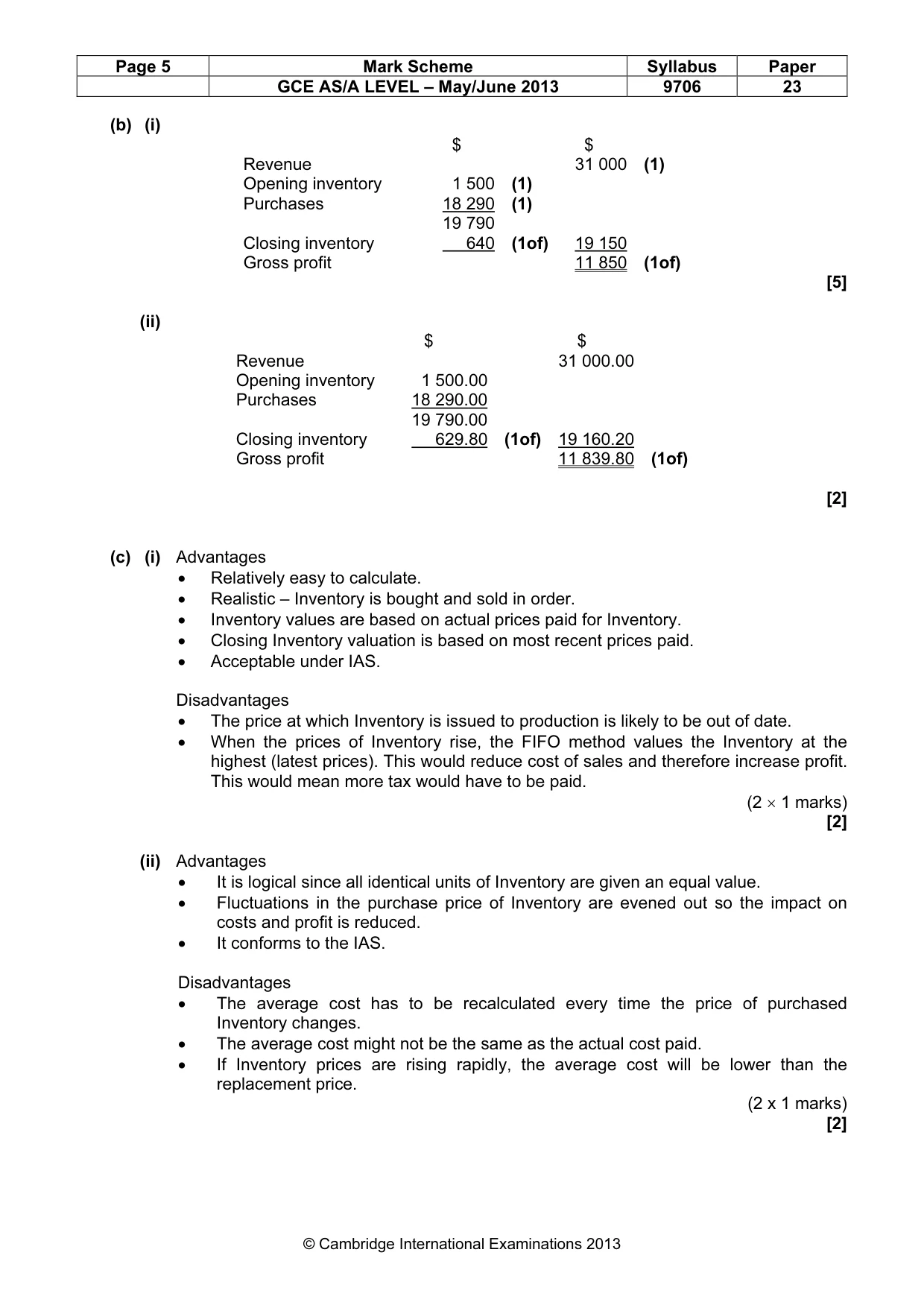
Page 5 Mark Scheme Syllabus Paper GCE AS/A LEVEL – May/June 2013 9706 23 © Cambridge International Examinations 2013 (b) (i) $ $ Revenue 31 000 (1) Opening inventory 1 500 (1) Purchases 18 290 (1) 19 790 Closing inventory 640 (1of) 19 150 Gross profit 11 850 (1of) [5] (ii) $ $ Revenue 31 000.00 Opening inventory 1 500.00 Purchases 18 290.00 19 790.00 Closing inventory 629.80 (1of) 19 160.20 Gross profit 11 839.80 (1of) [2] (c) (i) Advantages • Relatively easy to calculate. • Realistic – Inventory is bought and sold in order. • Inventory values are based on actual prices paid for Inventory. • Closing Inventory valuation is based on most recent prices paid. • Acceptable under IAS. Disadvantages • The price at which Inventory is issued to production is likely to be out of date. • When the prices of Inventory rise, the FIFO method values the Inventory at the highest (latest prices). This would reduce cost of sales and therefore increase profit. This would mean more tax would have to be paid. (2 × 1 marks) [2] (ii) Advantages • It is logical since all identical units of Inventory are given an equal value. • Fluctuations in the purchase price of Inventory are evened out so the impact on costs and profit is reduced. • It conforms to the IAS. Disadvantages • The average cost has to be recalculated every time the price of purchased Inventory changes. • The average cost might not be the same as the actual cost paid. • If Inventory prices are rising rapidly, the average cost will be lower than the replacement price. (2 x 1 marks) [2]
Mark scheme, page 6
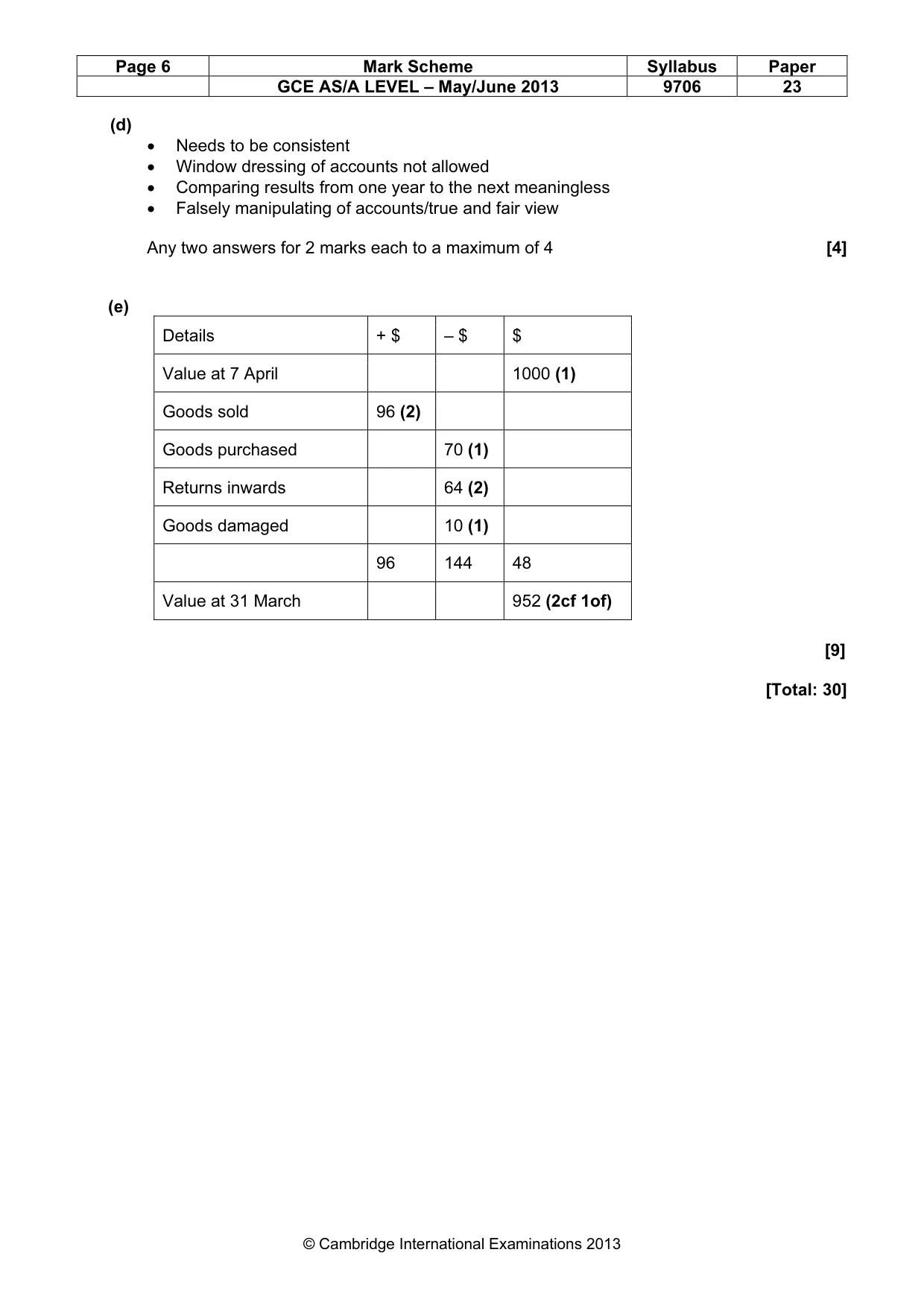
Page 6 Mark Scheme Syllabus Paper GCE AS/A LEVEL – May/June 2013 9706 23 © Cambridge International Examinations 2013 (d) • Needs to be consistent • Window dressing of accounts not allowed • Comparing results from one year to the next meaningless • Falsely manipulating of accounts/true and fair view Any two answers for 2 marks each to a maximum of 4 [4] (e) Details + $ – $ $ Value at 7 April 1000 (1) Goods sold 96 (2) Goods purchased 70 (1) Returns inwards 64 (2) Goods damaged 10 (1) 96 144 48 Value at 31 March 952 (2cf 1of) [9] [Total: 30]
What you needed in this session
Cambridge’s own grade thresholds for 2013 May/June, Paper 2 · Variant 3. A higher threshold means an easier paper — the bar moves with how the cohort did.