Cambridge A Level Accounting 9706 — 2013 May/June Paper 2 · Variant 1
9706/21/M/J/13 · 90 marks · ≈101 min
The question paper and its mark scheme, free to read here and free to download. This is Cambridge’s own paper, exactly as it was sat.
Question paper16 pages


Mark scheme6 pages
Answers below. Sit the paper first if you are practising.
Paper as text
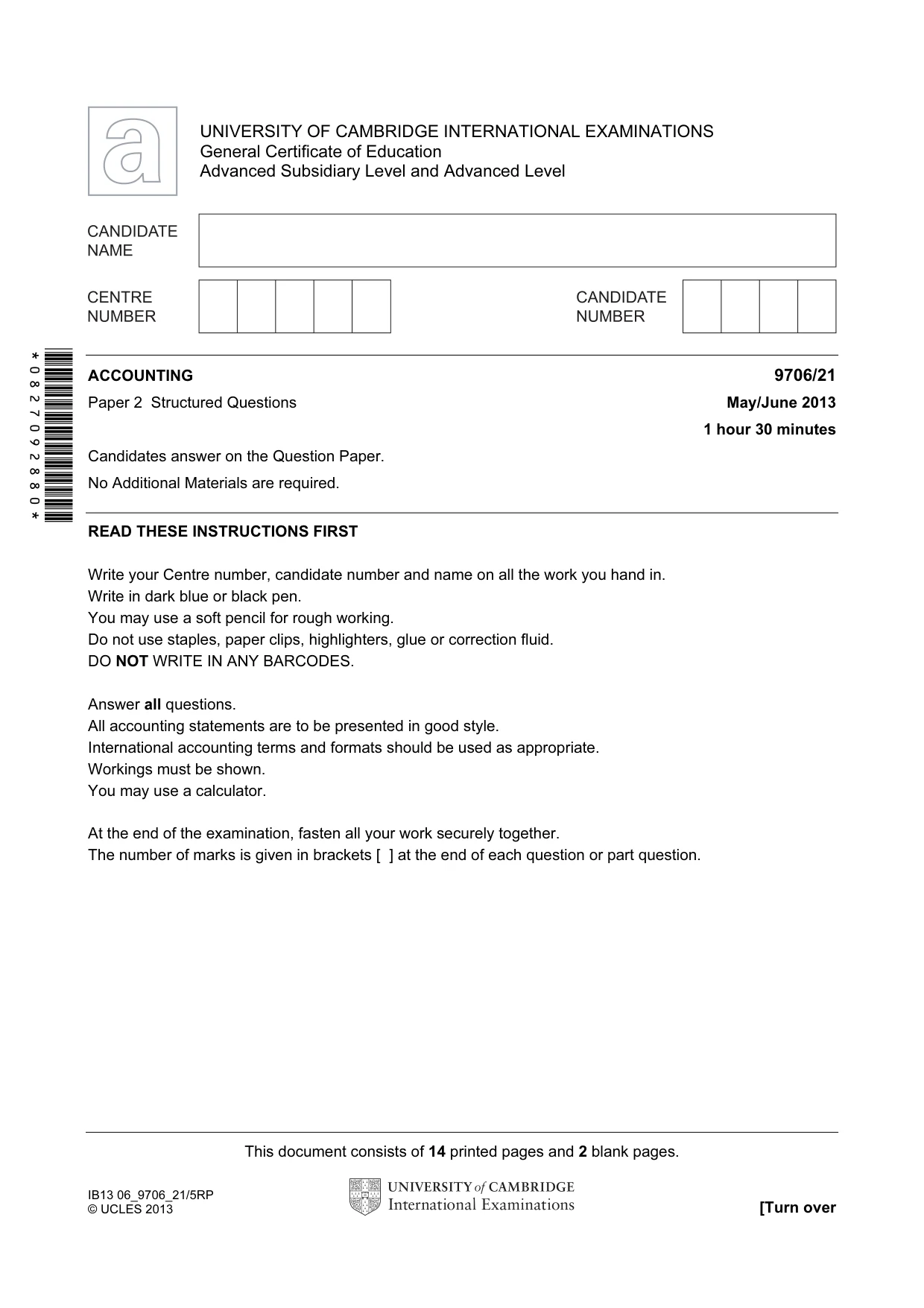
Question paper, page 1
This document consists of 14 printed pages and 2 blank pages. IB13 06_9706_21/5RP © UCLES 2013 [Turn over *0827092880* UNIVERSITY OF CAMBRIDGE INTERNATIONAL EXAMINATIONS General Certificate of Education Advanced Subsidiary Level and Advanced Level ACCOUNTING 9706/21 Paper 2 Structured Questions May/June 2013 1 hour 30 minutes Candidates answer on the Question Paper. No Additional Materials are required. READ THESE INSTRUCTIONS FIRST Write your Centre number, candidate number and name on all the work you hand in. Write in dark blue or black pen. You may use a soft pencil for rough working. Do not use staples, paper clips, highlighters, glue or correction fluid. DO NOT WRITE IN ANY BARCODES. Answer all questions. All accounting statements are to be presented in good style. International accounting terms and formats should be used as appropriate. Workings must be shown. You may use a calculator. At the end of the examination, fasten all your work securely together. The number of marks is given in brackets [ ] at the end of each question or part question.
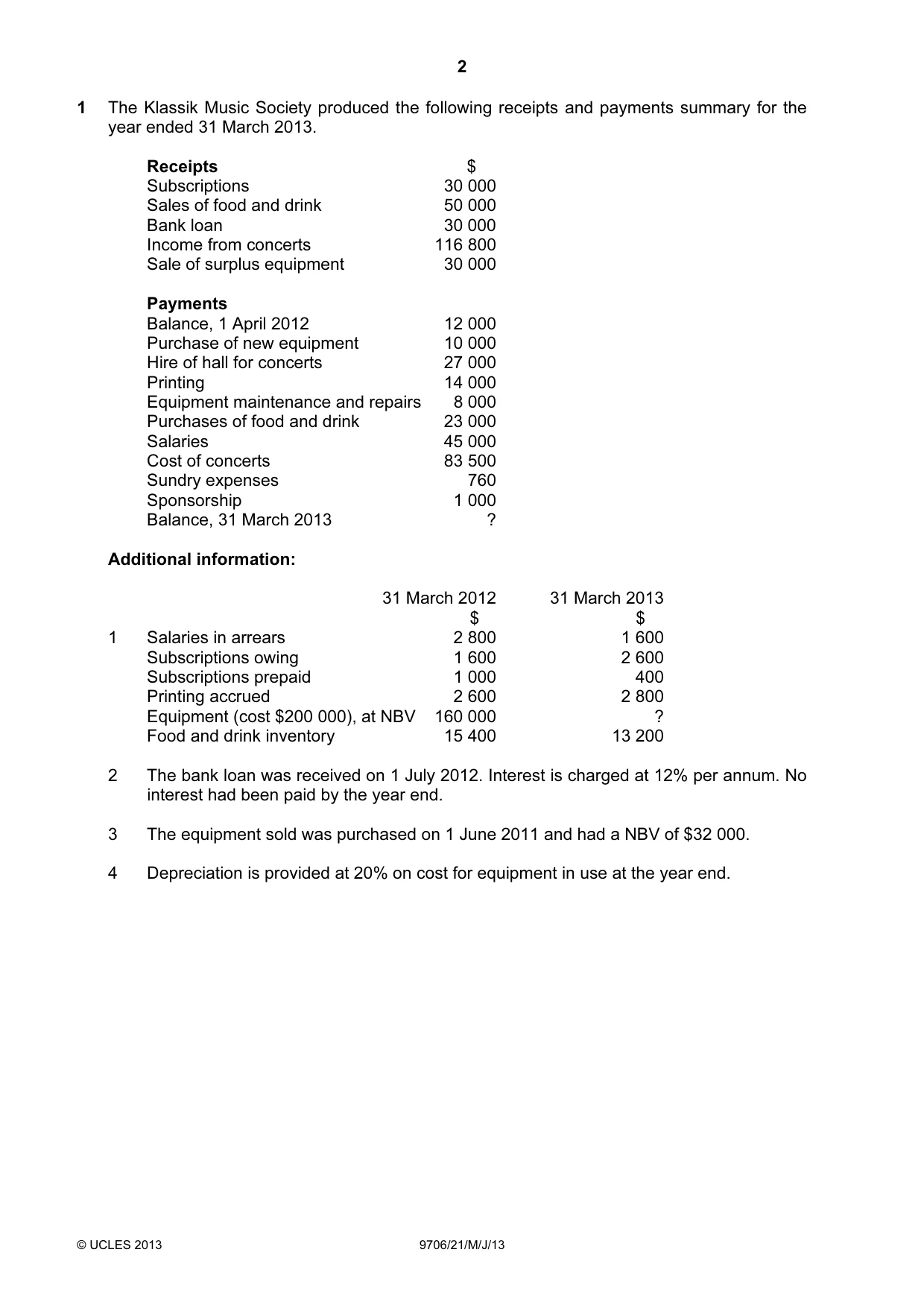
Question paper, page 2
2 © UCLES 2013 9706/21/M/J/13 1 The Klassik Music Society produced the following receipts and payments summary for the year ended 31 March 2013. Receipts $ Subscriptions 30 000 Sales of food and drink 50 000 Bank loan 30 000 Income from concerts 116 800 Sale of surplus equipment 30 000 Payments Balance, 1 April 2012 12 000 Purchase of new equipment 10 000 Hire of hall for concerts 27 000 Printing 14 000 Equipment maintenance and repairs 8 000 Purchases of food and drink 23 000 Salaries 45 000 Cost of concerts 83 500 Sundry expenses 760 Sponsorship 1 000 Balance, 31 March 2013 ? Additional information: 31 March 2012 31 March 2013 $ $ 1 Salaries in arrears 2 800 1 600 Subscriptions owing 1 600 2 600 Subscriptions prepaid 1 000 400 Printing accrued 2 600 2 800 Equipment (cost $200 000), at NBV 160 000 ? Food and drink inventory 15 400 13 200 2 The bank loan was received on 1 July 2012. Interest is charged at 12% per annum. No interest had been paid by the year end. 3 The equipment sold was purchased on 1 June 2011 and had a NBV of $32 000. 4 Depreciation is provided at 20% on cost for equipment in use at the year end.
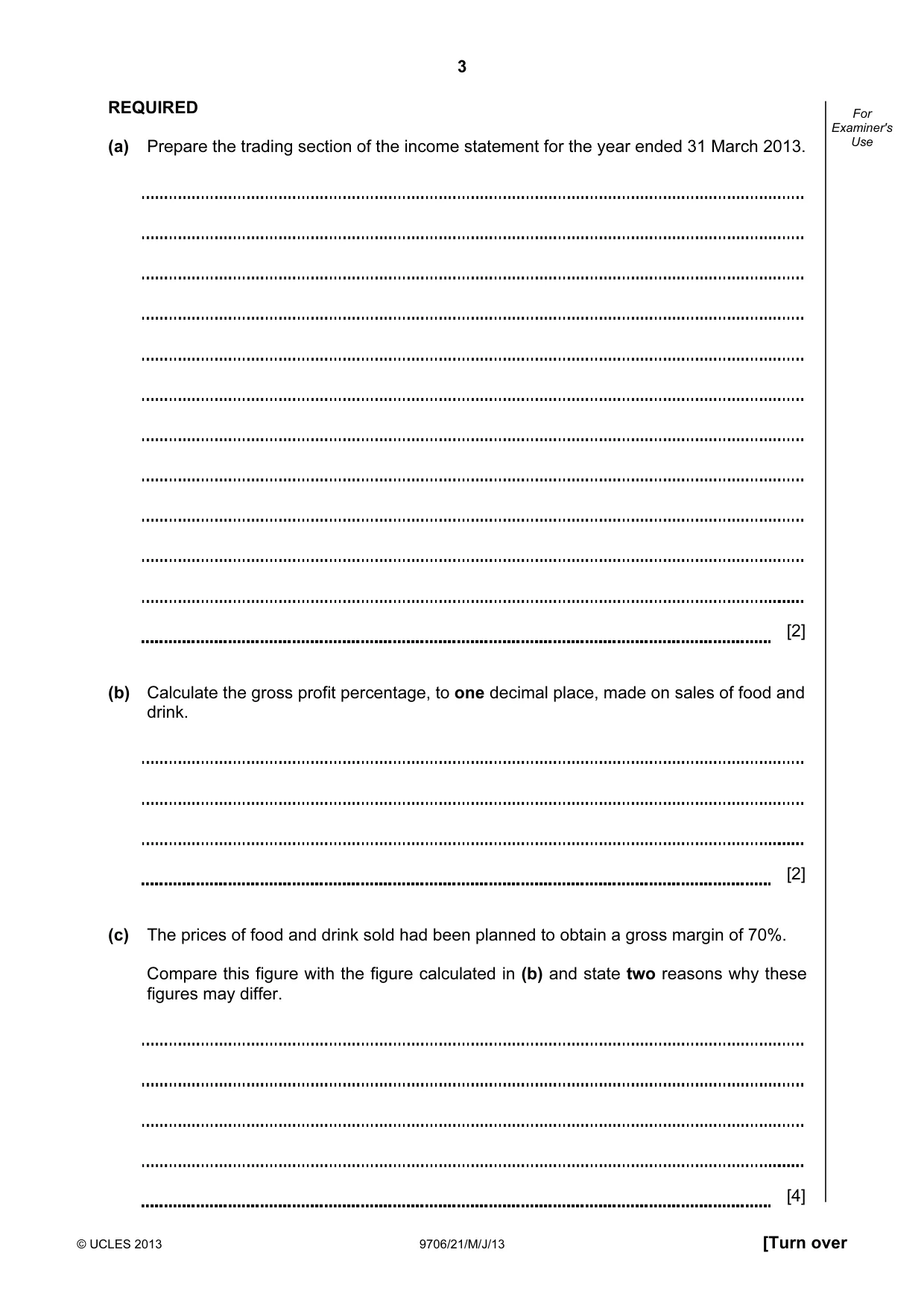
Question paper, page 3
3 © UCLES 2013 9706/21/M/J/13 [Turn over For Examiner's Use REQUIRED (a) Prepare the trading section of the income statement for the year ended 31 March 2013. [2] (b) Calculate the gross profit percentage, to one decimal place, made on sales of food and drink. [2] (c) The prices of food and drink sold had been planned to obtain a gross margin of 70%. Compare this figure with the figure calculated in (b) and state two reasons why these figures may differ. [4]
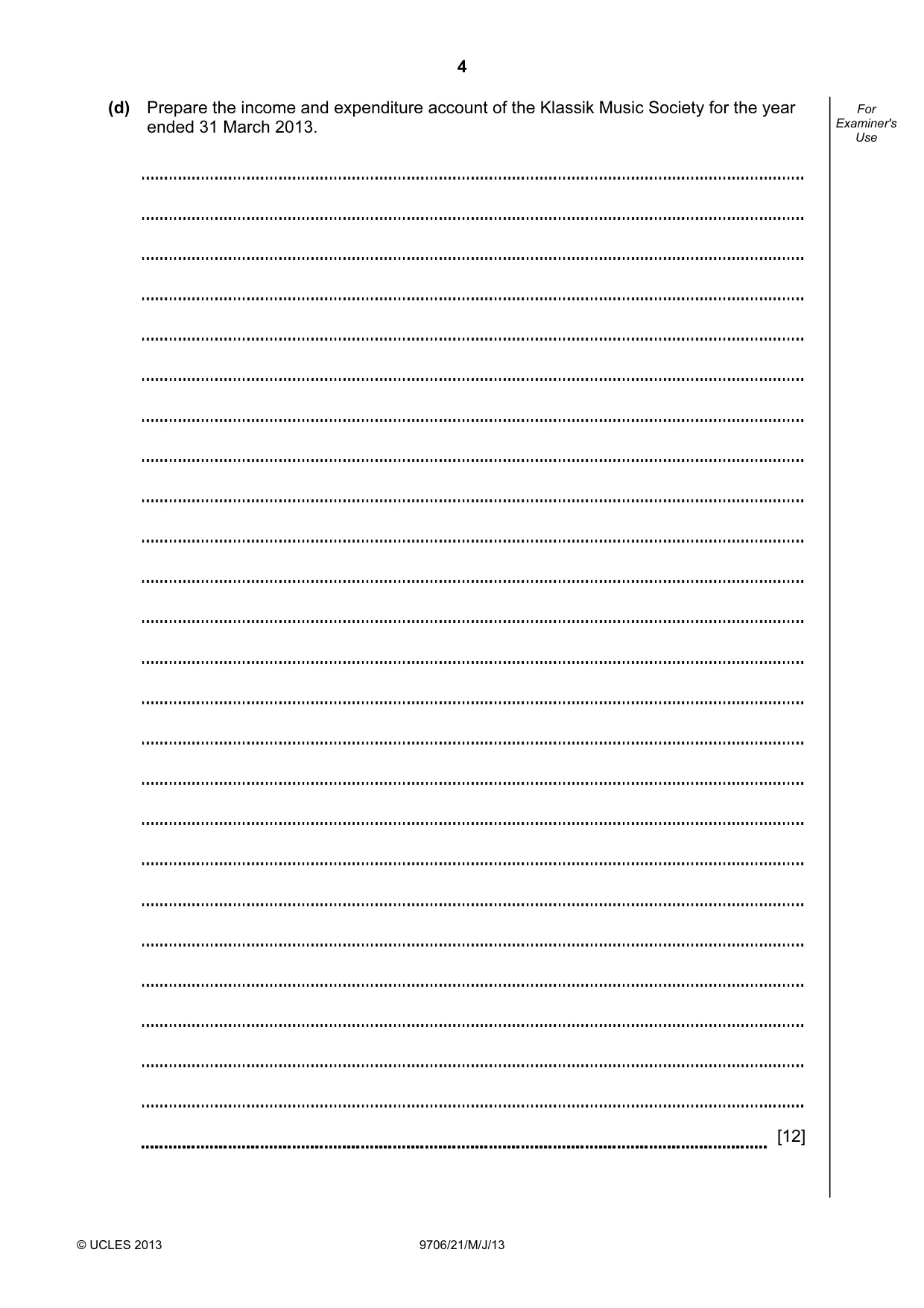
Question paper, page 4
4 © UCLES 2013 9706/21/M/J/13 For Examiner's Use (d) Prepare the income and expenditure account of the Klassik Music Society for the year ended 31 March 2013. [12]
Question paper, page 5
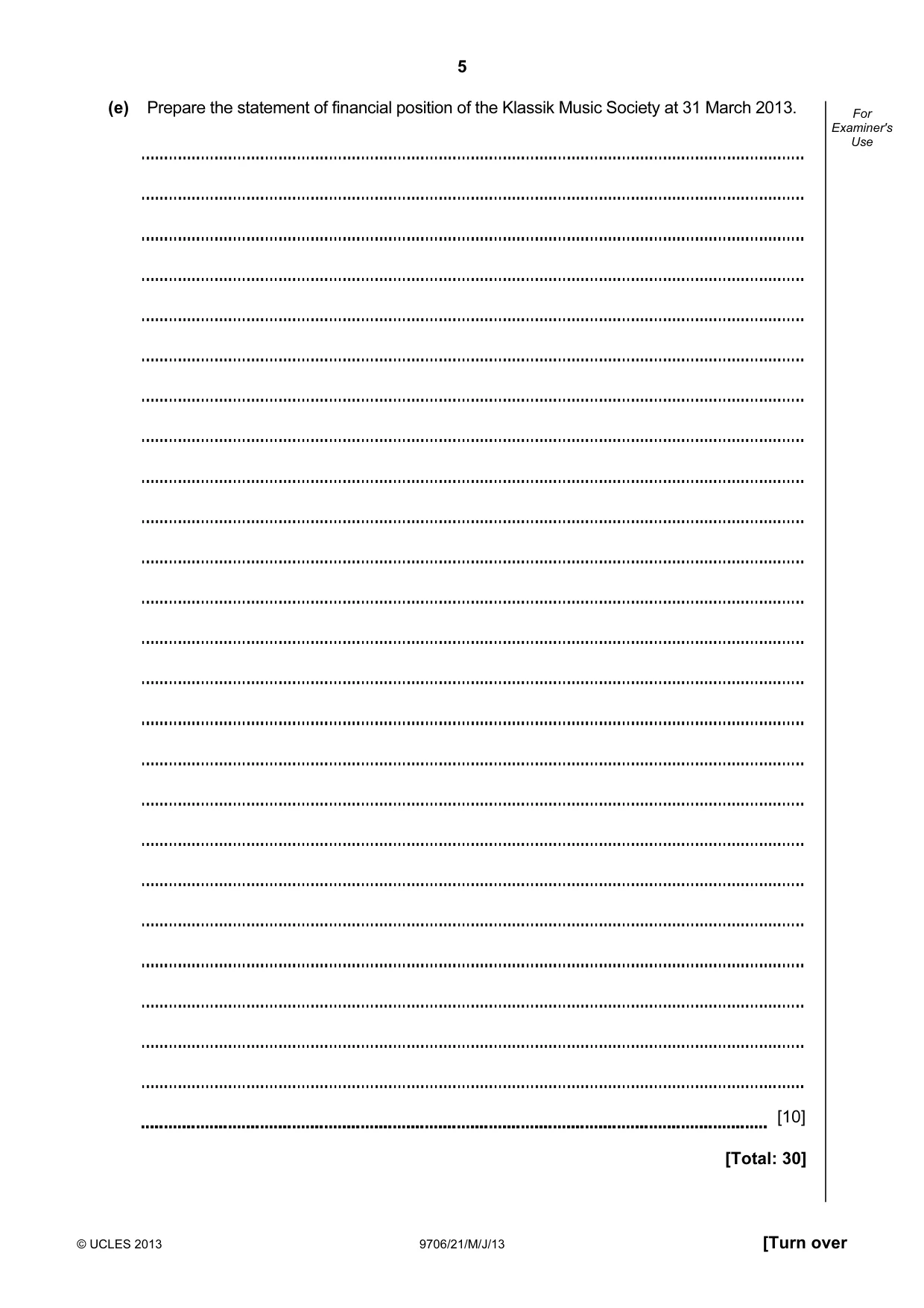
5 © UCLES 2013 9706/21/M/J/13 [Turn over For Examiner's Use (e) Prepare the statement of financial position of the Klassik Music Society at 31 March 2013. [10] [Total: 30]
Question paper, page 6
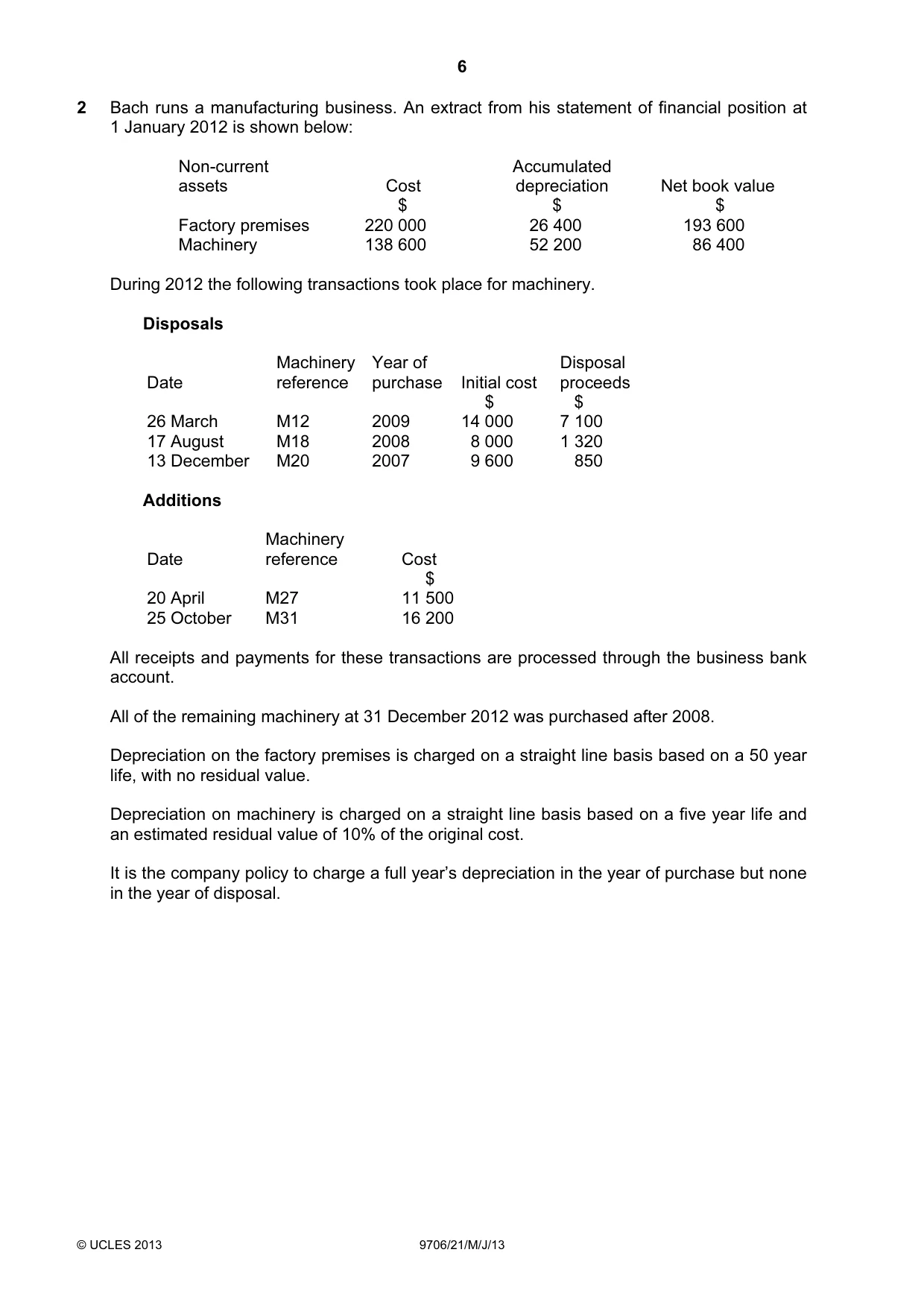
6 © UCLES 2013 9706/21/M/J/13 2 Bach runs a manufacturing business. An extract from his statement of financial position at 1 January 2012 is shown below: Non-current assets Cost Accumulated depreciation Net book value $ $ $ Factory premises 220 000 26 400 193 600 Machinery 138 600 52 200 86 400 During 2012 the following transactions took place for machinery. Disposals Date Machinery reference Year of purchase Initial cost Disposal proceeds $ $ 26 March M12 2009 14 000 7 100 17 August M18 2008 8 000 1 320 13 December M20 2007 9 600 850 Additions Date Machinery reference Cost $ 20 April M27 11 500 25 October M31 16 200 All receipts and payments for these transactions are processed through the business bank account. All of the remaining machinery at 31 December 2012 was purchased after 2008. Depreciation on the factory premises is charged on a straight line basis based on a 50 year life, with no residual value. Depreciation on machinery is charged on a straight line basis based on a five year life and an estimated residual value of 10% of the original cost. It is the company policy to charge a full year’s depreciation in the year of purchase but none in the year of disposal.
Question paper, page 7
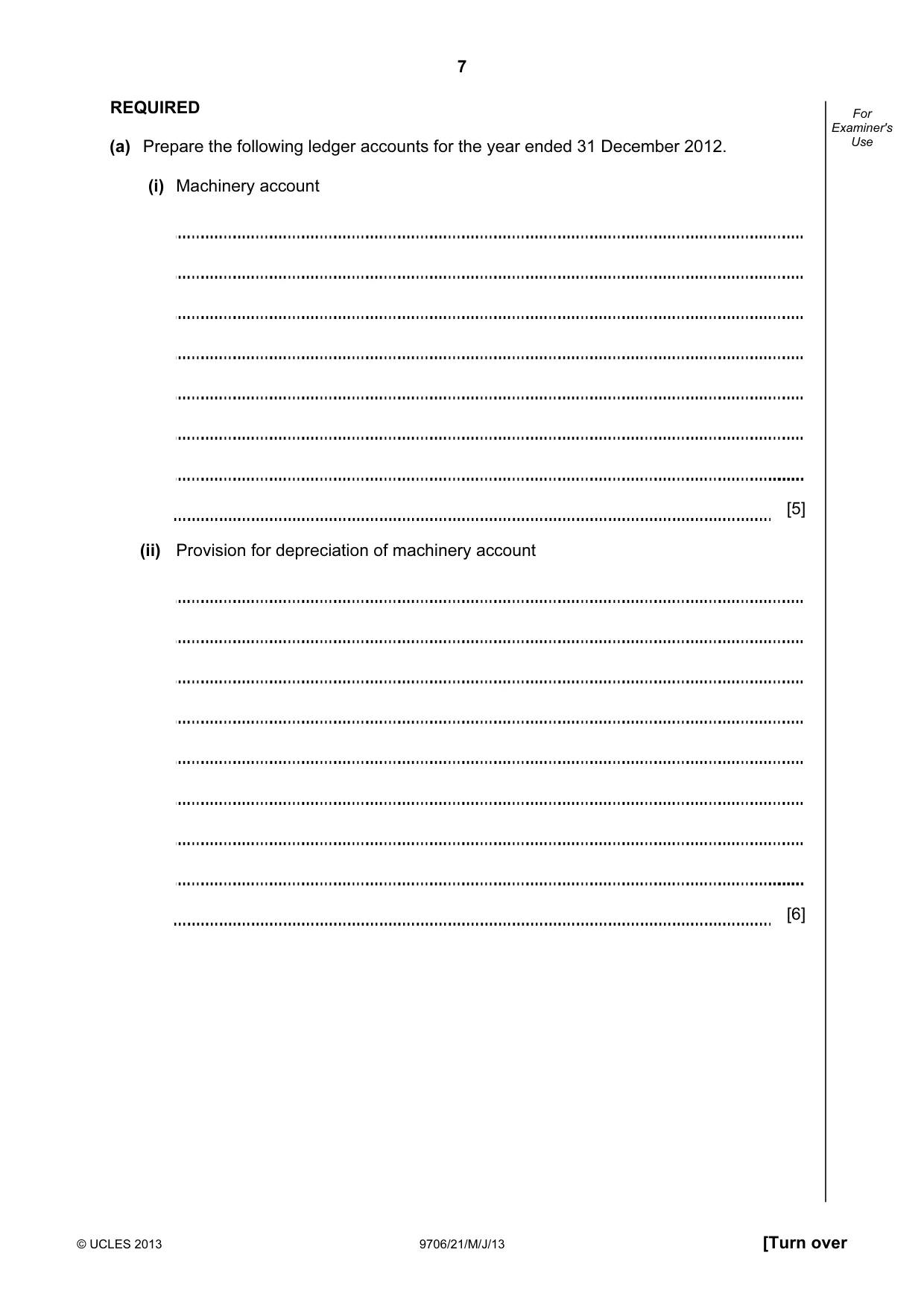
7 © UCLES 2013 9706/21/M/J/13 [Turn over For Examiner's Use REQUIRED (a) Prepare the following ledger accounts for the year ended 31 December 2012. (i) Machinery account [5] (ii) Provision for depreciation of machinery account [6]
Question paper, page 8
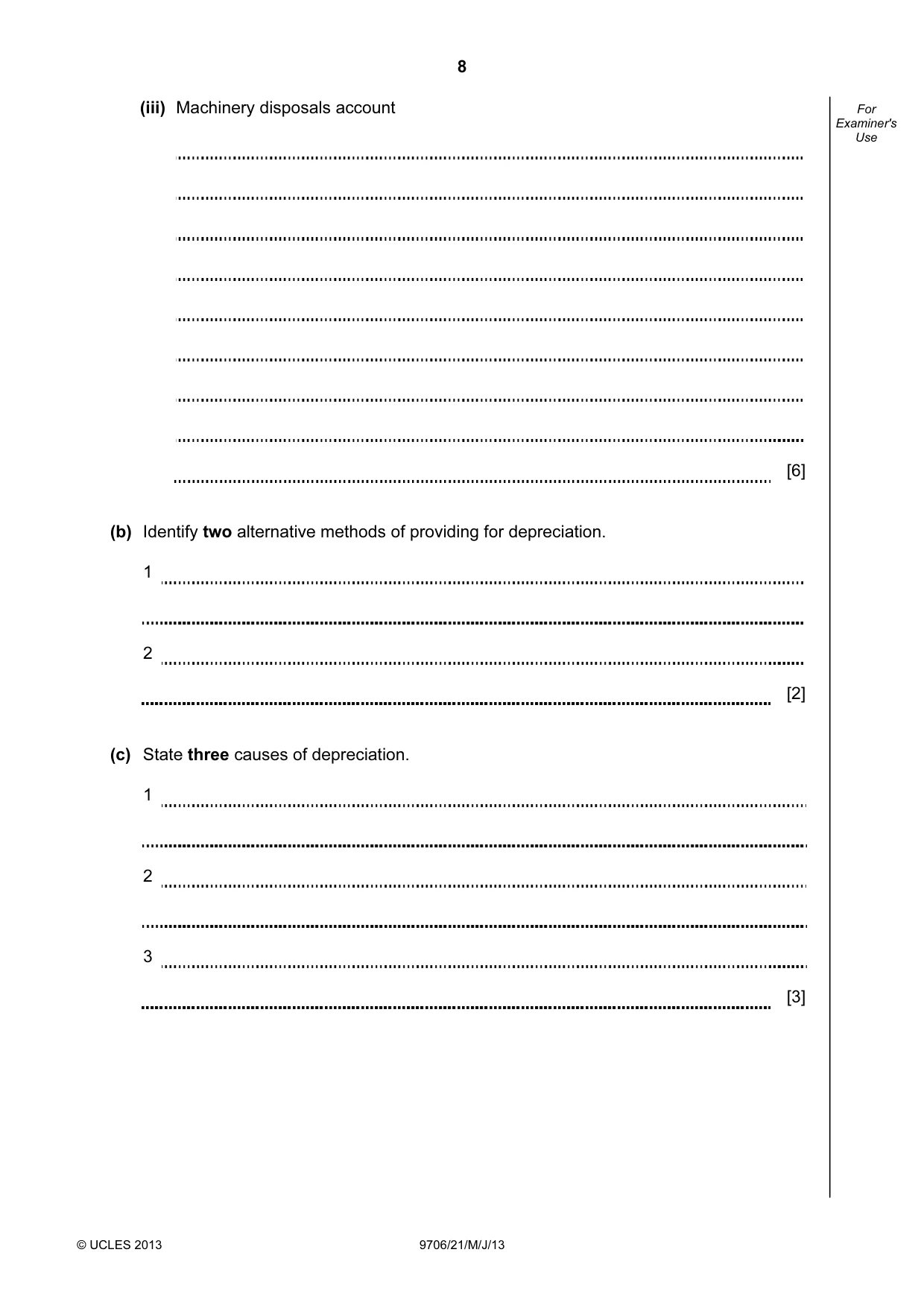
8 © UCLES 2013 9706/21/M/J/13 For Examiner's Use (iii) Machinery disposals account [6] (b) Identify two alternative methods of providing for depreciation. 1 2 [2] (c) State three causes of depreciation. 1 2 3 [3]
Question paper, page 9
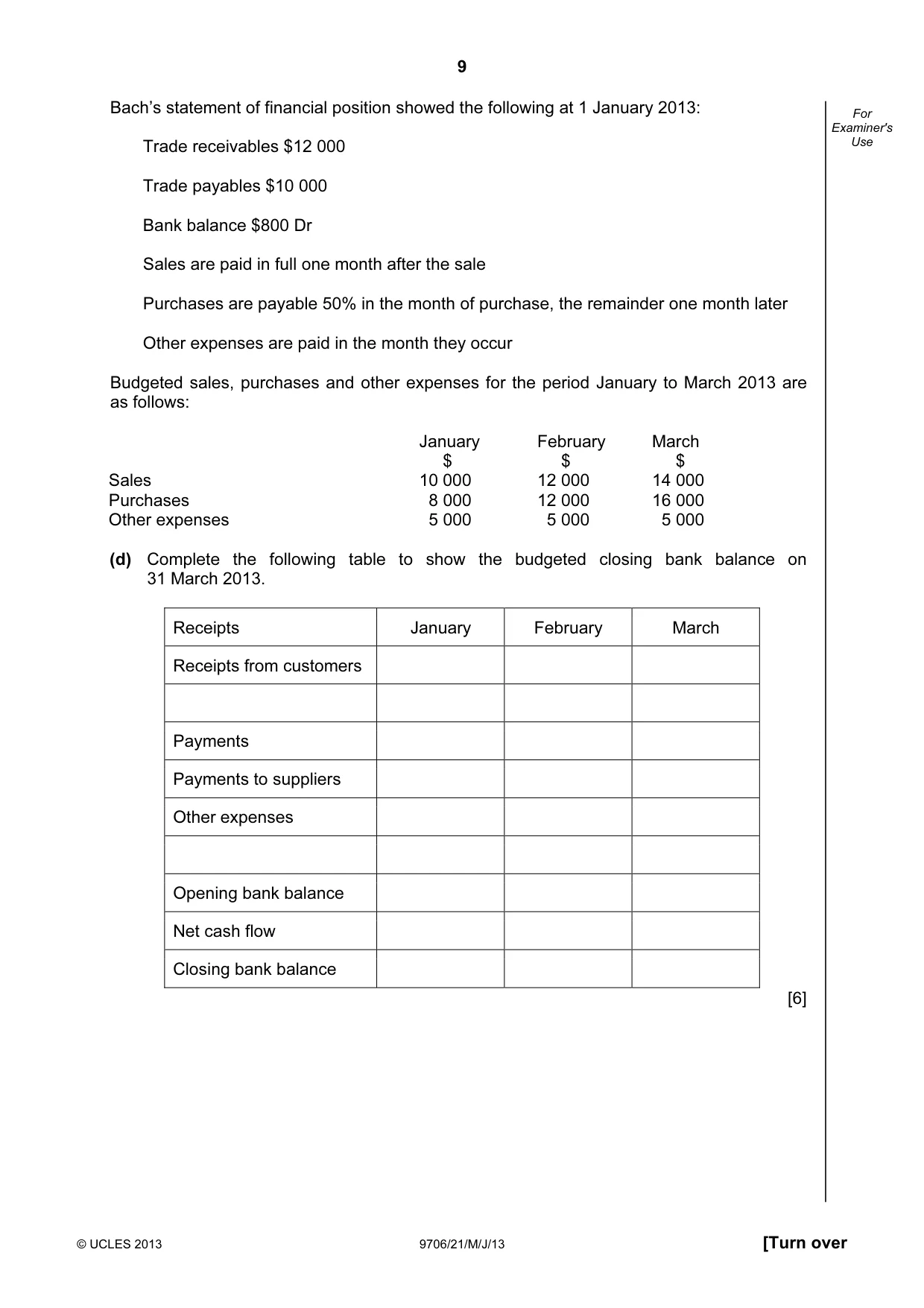
9 © UCLES 2013 9706/21/M/J/13 [Turn over For Examiner's Use Bach’s statement of financial position showed the following at 1 January 2013: Trade receivables $12 000 Trade payables $10 000 Bank balance $800 Dr Sales are paid in full one month after the sale Purchases are payable 50% in the month of purchase, the remainder one month later Other expenses are paid in the month they occur Budgeted sales, purchases and other expenses for the period January to March 2013 are as follows: January $ February $ March $ Sales 10 000 12 000 14 000 Purchases 8 000 12 000 16 000 Other expenses 5 000 5 000 5 000 (d) Complete the following table to show the budgeted closing bank balance on 31 March 2013. Receipts January February March Receipts from customers Payments Payments to suppliers Other expenses Opening bank balance Net cash flow Closing bank balance [6]
Question paper, page 10
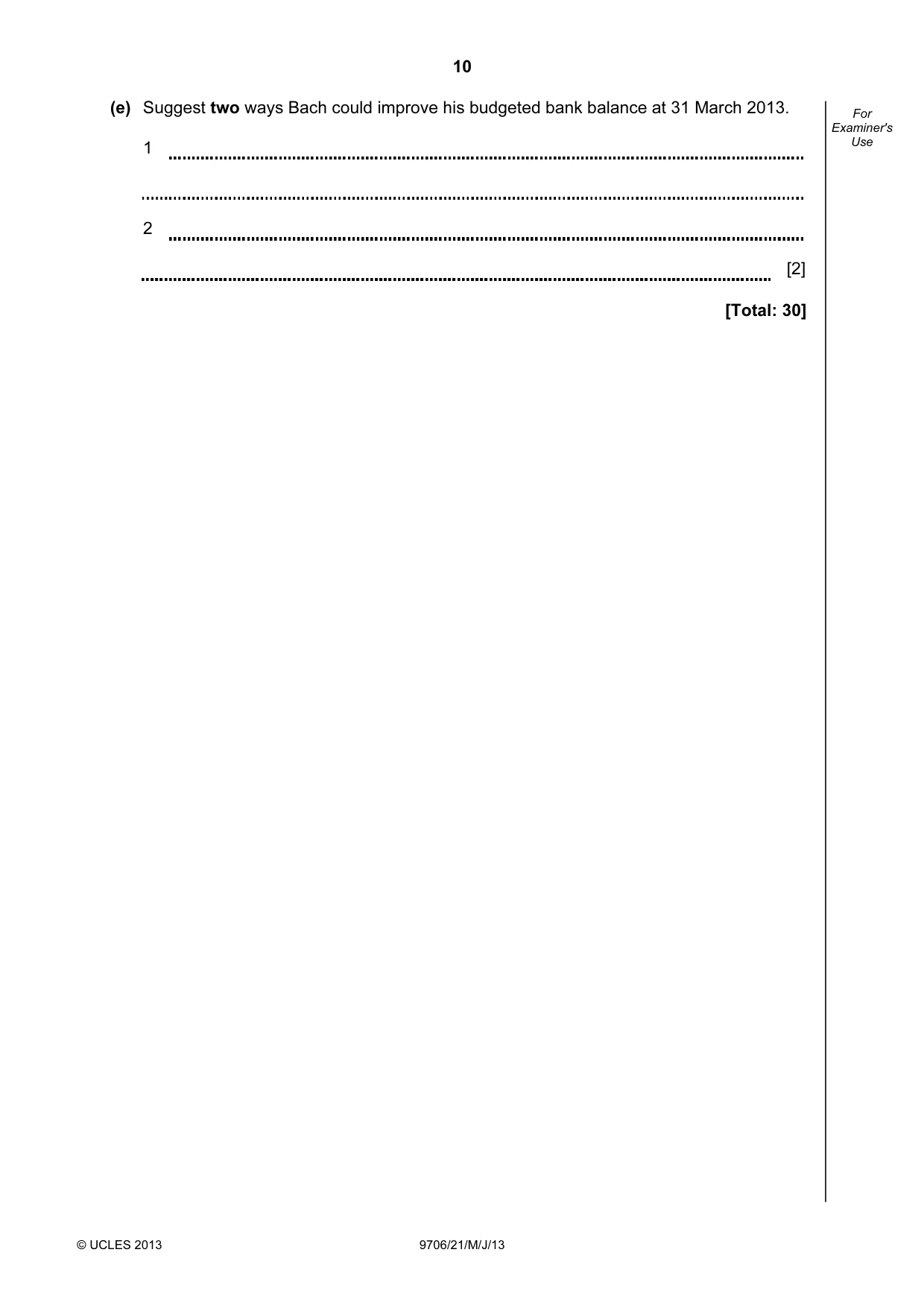
10 © UCLES 2013 9706/21/M/J/13 For Examiner's Use (e) Suggest two ways Bach could improve his budgeted bank balance at 31 March 2013. 1 2 [2] [Total: 30]
Question paper, page 11
11 © UCLES 2013 9706/21/M/J/13 [Turn over Question 3 is on the next page.
Question paper, page 12
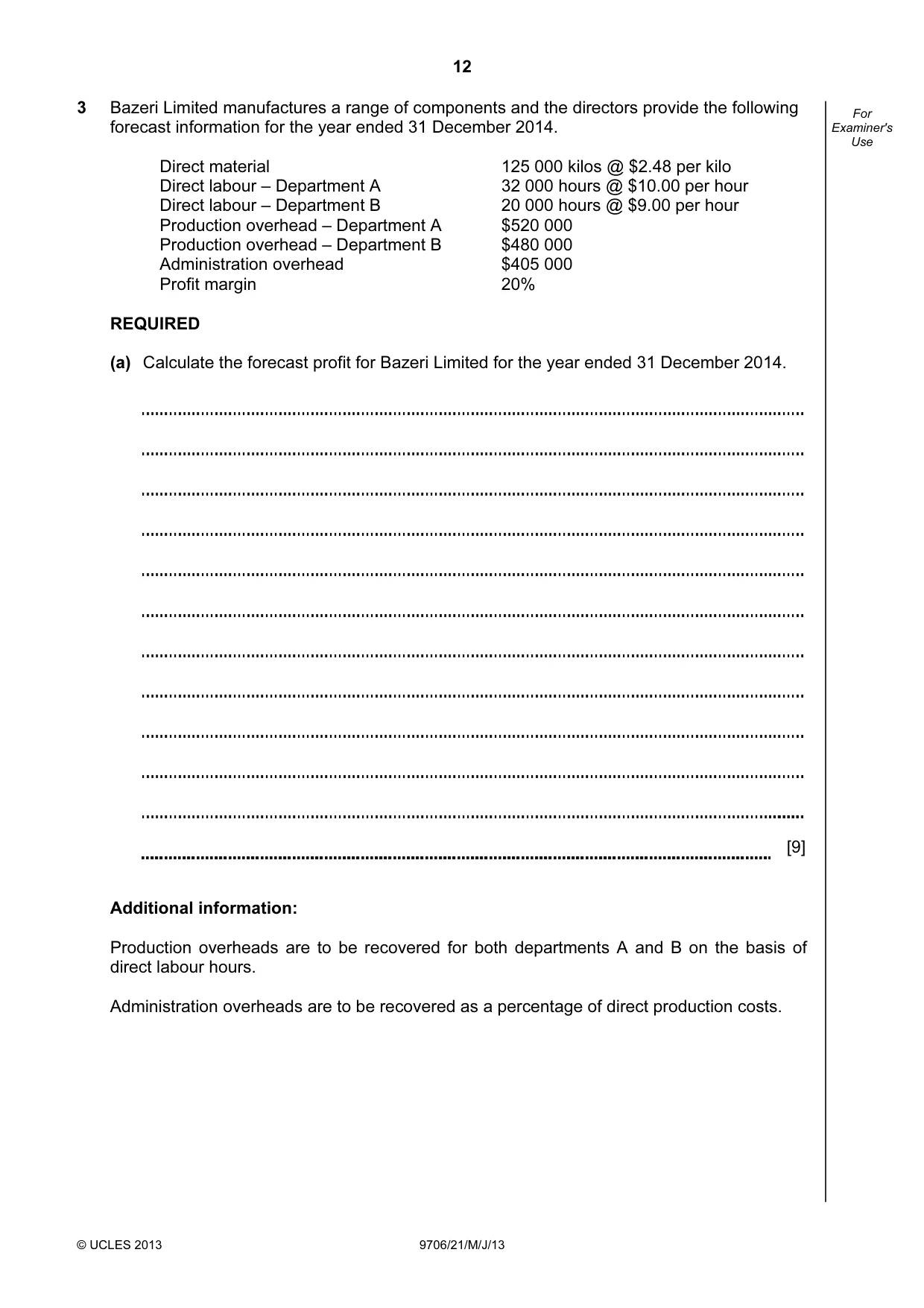
12 © UCLES 2013 9706/21/M/J/13 For Examiner's Use 3 Bazeri Limited manufactures a range of components and the directors provide the following forecast information for the year ended 31 December 2014. Direct material 125 000 kilos @ $2.48 per kilo Direct labour – Department A 32 000 hours @ $10.00 per hour Direct labour – Department B 20 000 hours @ $9.00 per hour Production overhead – Department A $520 000 Production overhead – Department B $480 000 Administration overhead $405 000 Profit margin 20% REQUIRED (a) Calculate the forecast profit for Bazeri Limited for the year ended 31 December 2014. [9] Additional information: Production overheads are to be recovered for both departments A and B on the basis of direct labour hours. Administration overheads are to be recovered as a percentage of direct production costs.
Question paper, page 13
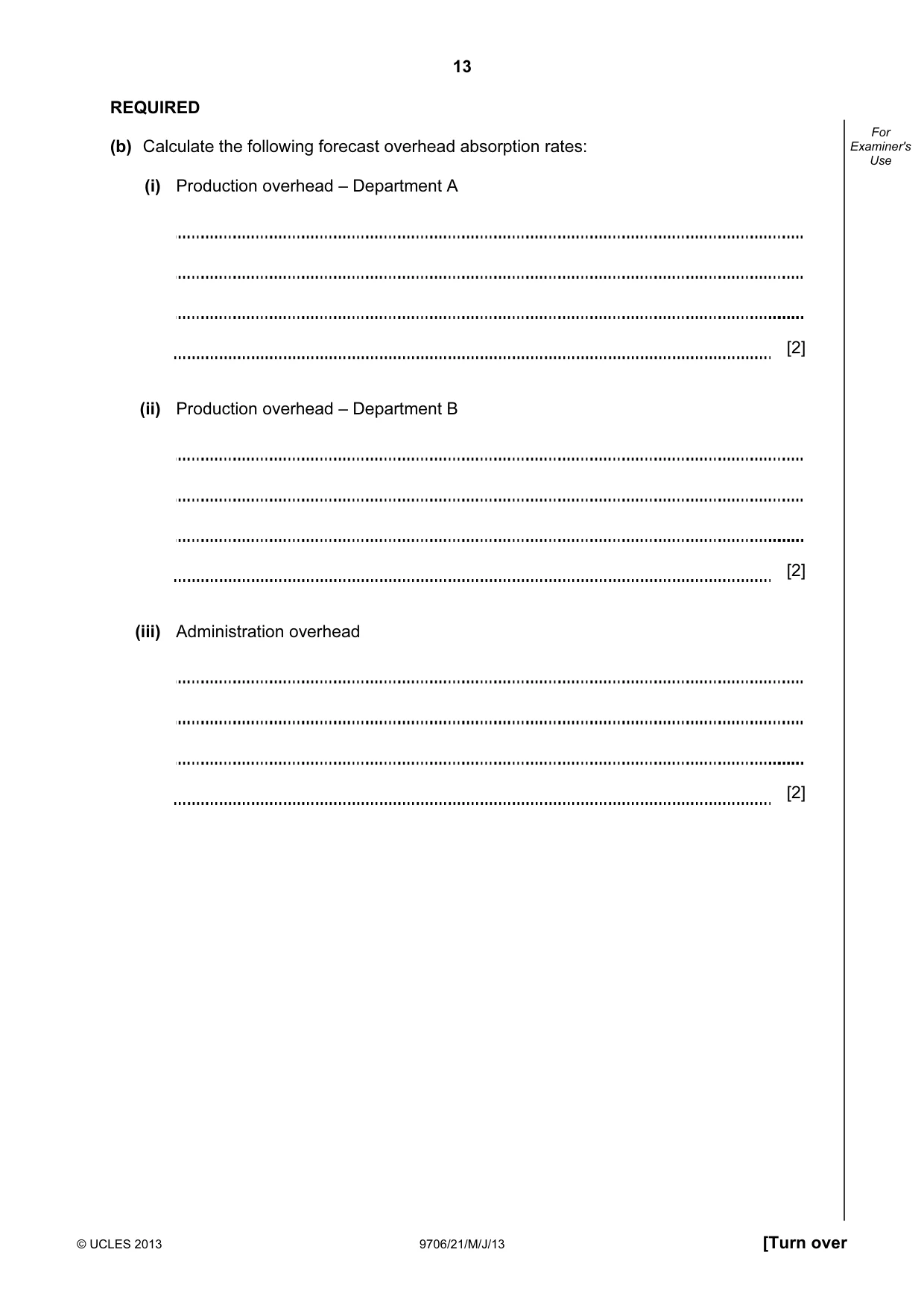
13 © UCLES 2013 9706/21/M/J/13 [Turn over For Examiner's Use REQUIRED (b) Calculate the following forecast overhead absorption rates: (i) Production overhead – Department A [2] (ii) Production overhead – Department B [2] (iii) Administration overhead [2]
Question paper, page 14
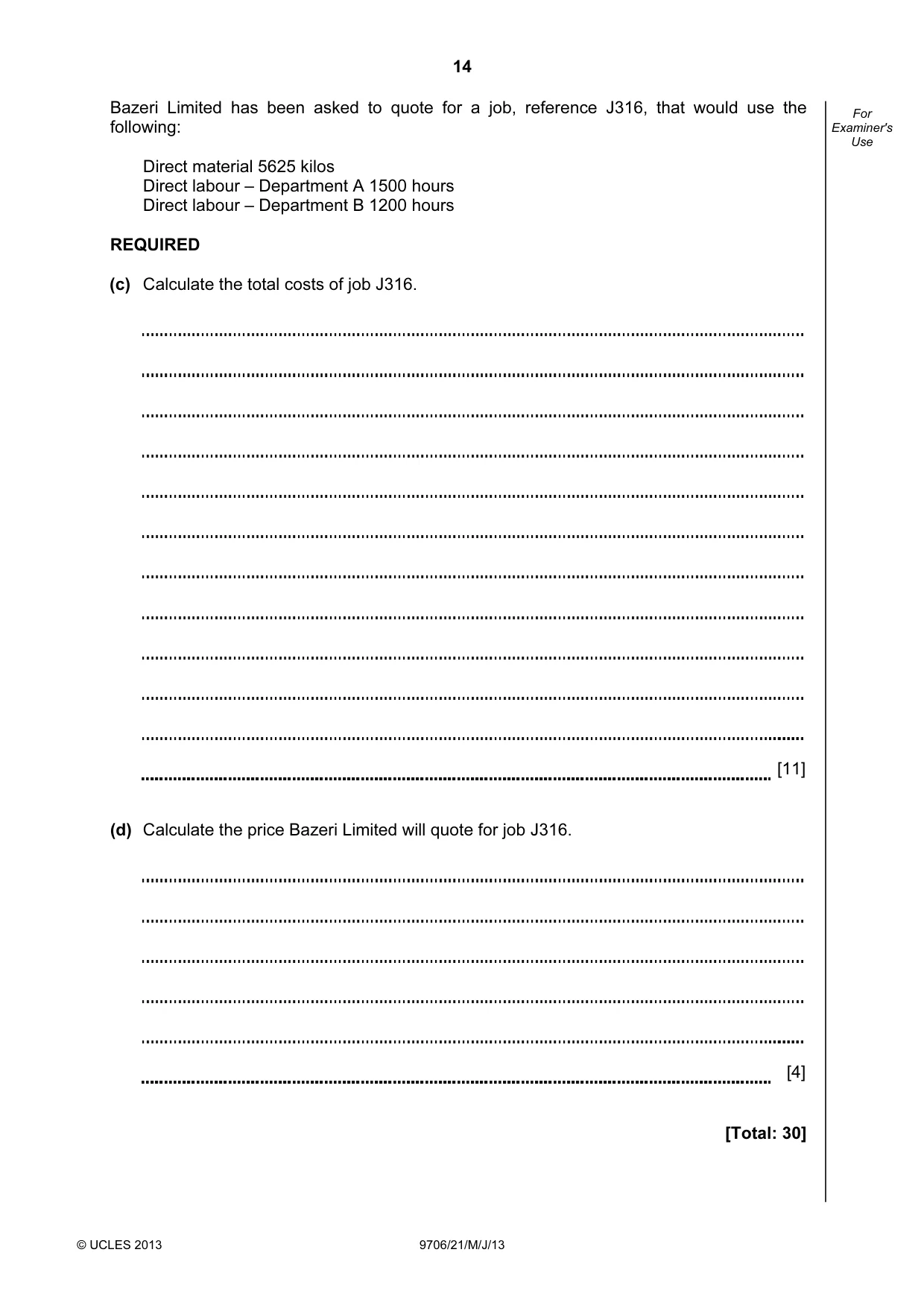
14 © UCLES 2013 9706/21/M/J/13 For Examiner's Use Bazeri Limited has been asked to quote for a job, reference J316, that would use the following: Direct material 5625 kilos Direct labour – Department A 1500 hours Direct labour – Department B 1200 hours REQUIRED (c) Calculate the total costs of job J316. [11] (d) Calculate the price Bazeri Limited will quote for job J316. [4] [Total: 30]
Question paper, page 15
15 © UCLES 2013 9706/21/M/J/13 BLANK PAGE
Question paper, page 16
16 Permission to reproduce items where third-party owned material protected by copyright is included has been sought and cleared where possible. Every reasonable effort has been made by the publisher (UCLES) to trace copyright holders, but if any items requiring clearance have unwittingly been included, the publisher will be pleased to make amends at the earliest possible opportunity. University of Cambridge International Examinations is part of the Cambridge Assessment Group. Cambridge Assessment is the brand name of University of Cambridge Local Examinations Syndicate (UCLES), which is itself a department of the University of Cambridge. © UCLES 2013 9706/21/M/J/13 BLANK PAGE
Mark scheme, page 1
CAMBRIDGE INTERNATIONAL EXAMINATIONS GCE Advanced Subsidiary Level and GCE Advanced Level MARK SCHEME for the May/June 2013 series 9706 ACCOUNTING 9706/21 Paper 2 (Structured Questions – Core), maximum raw mark 90 This mark scheme is published as an aid to teachers and candidates, to indicate the requirements of the examination. It shows the basis on which Examiners were instructed to award marks. It does not indicate the details of the discussions that took place at an Examiners’ meeting before marking began, which would have considered the acceptability of alternative answers. Mark schemes should be read in conjunction with the question paper and the Principal Examiner Report for Teachers. Cambridge will not enter into discussions about these mark schemes. Cambridge is publishing the mark schemes for the May/June 2013 series for most IGCSE, GCE Advanced Level and Advanced Subsidiary Level components and some Ordinary Level components.
Mark scheme, page 2
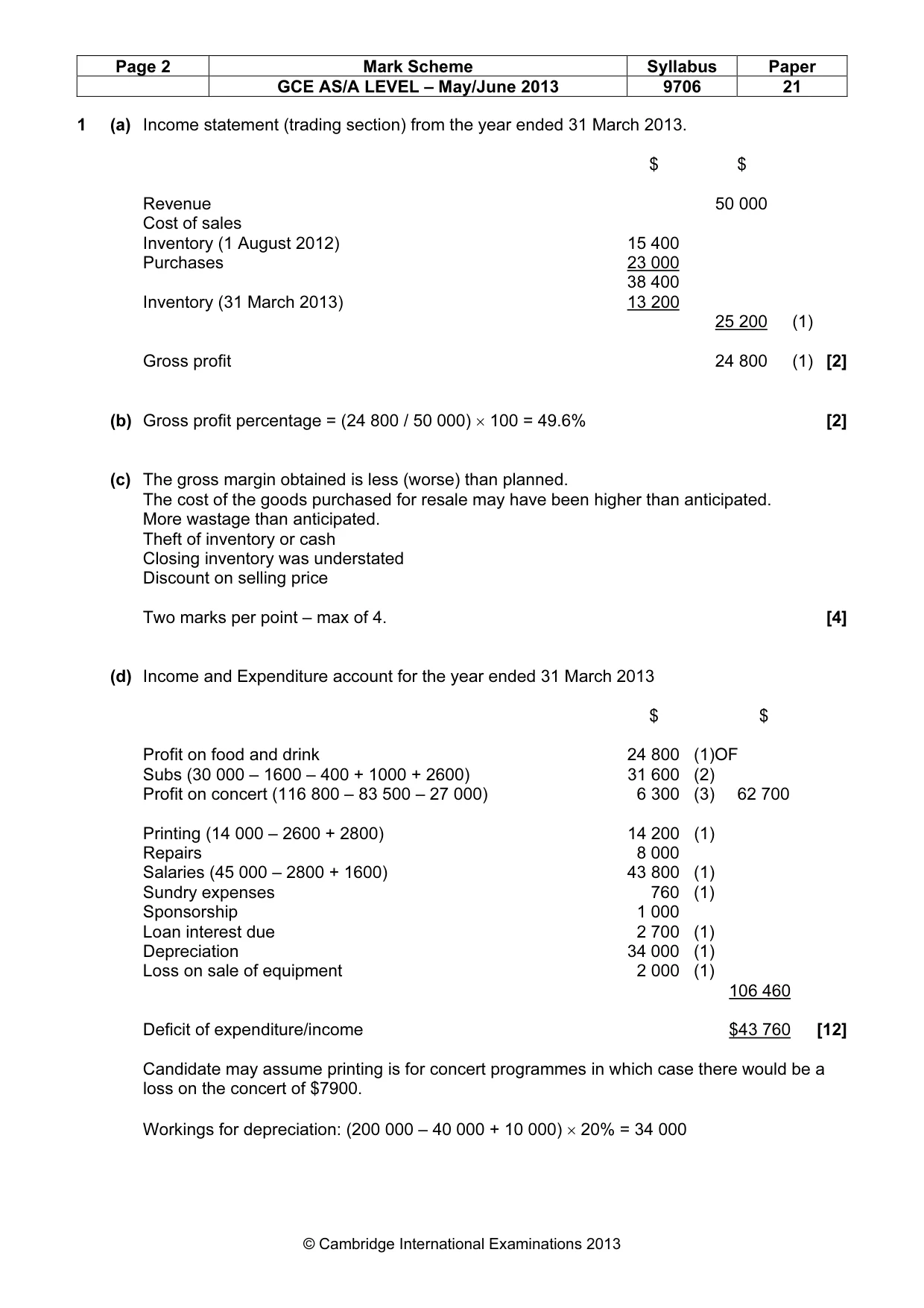
Page 2 Mark Scheme Syllabus Paper GCE AS/A LEVEL – May/June 2013 9706 21 © Cambridge International Examinations 2013 1 (a) Income statement (trading section) from the year ended 31 March 2013. $ $ Revenue 50 000 Cost of sales Inventory (1 August 2012) 15 400 Purchases 23 000 38 400 Inventory (31 March 2013) 13 200 25 200 (1) Gross profit 24 800 (1) [2] (b) Gross profit percentage = (24 800 / 50 000) × 100 = 49.6% [2] (c) The gross margin obtained is less (worse) than planned. The cost of the goods purchased for resale may have been higher than anticipated. More wastage than anticipated. Theft of inventory or cash Closing inventory was understated Discount on selling price Two marks per point – max of 4. [4] (d) Income and Expenditure account for the year ended 31 March 2013 $ $ Profit on food and drink 24 800 (1)OF Subs (30 000 – 1600 – 400 + 1000 + 2600) 31 600 (2) Profit on concert (116 800 – 83 500 – 27 000) 6 300 (3) 62 700 Printing (14 000 – 2600 + 2800) 14 200 (1) Repairs 8 000 Salaries (45 000 – 2800 + 1600) 43 800 (1) Sundry expenses 760 (1) Sponsorship 1 000 Loan interest due 2 700 (1) Depreciation 34 000 (1) Loss on sale of equipment 2 000 (1) 106 460 Deficit of expenditure/income $43 760 [12] Candidate may assume printing is for concert programmes in which case there would be a loss on the concert of $7900. Workings for depreciation: (200 000 – 40 000 + 10 000) × 20% = 34 000
Mark scheme, page 3
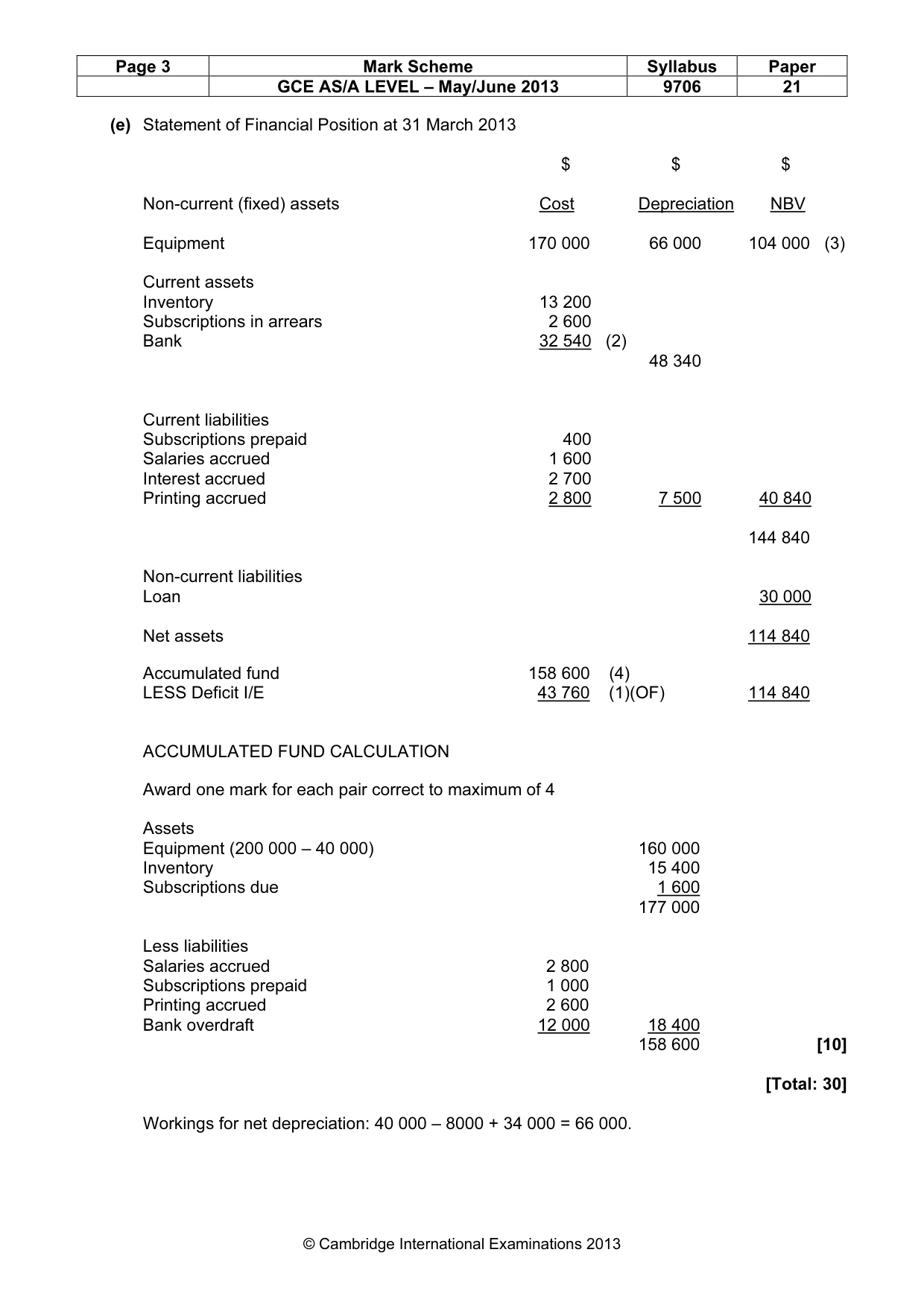
Page 3 Mark Scheme Syllabus Paper GCE AS/A LEVEL – May/June 2013 9706 21 © Cambridge International Examinations 2013 (e) Statement of Financial Position at 31 March 2013 $ $ $ Non-current (fixed) assets Cost Depreciation NBV Equipment 170 000 66 000 104 000 (3) Current assets Inventory 13 200 Subscriptions in arrears 2 600 Bank 32 540 (2) 48 340 Current liabilities Subscriptions prepaid 400 Salaries accrued 1 600 Interest accrued 2 700 Printing accrued 2 800 7 500 40 840 144 840 Non-current liabilities Loan 30 000 Net assets 114 840 Accumulated fund 158 600 (4) LESS Deficit I/E 43 760 (1)(OF) 114 840 ACCUMULATED FUND CALCULATION Award one mark for each pair correct to maximum of 4 Assets Equipment (200 000 – 40 000) 160 000 Inventory 15 400 Subscriptions due 1 600 177 000 Less liabilities Salaries accrued 2 800 Subscriptions prepaid 1 000 Printing accrued 2 600 Bank overdraft 12 000 18 400 158 600 [10] [Total: 30] Workings for net depreciation: 40 000 – 8000 + 34 000 = 66 000.
Mark scheme, page 4
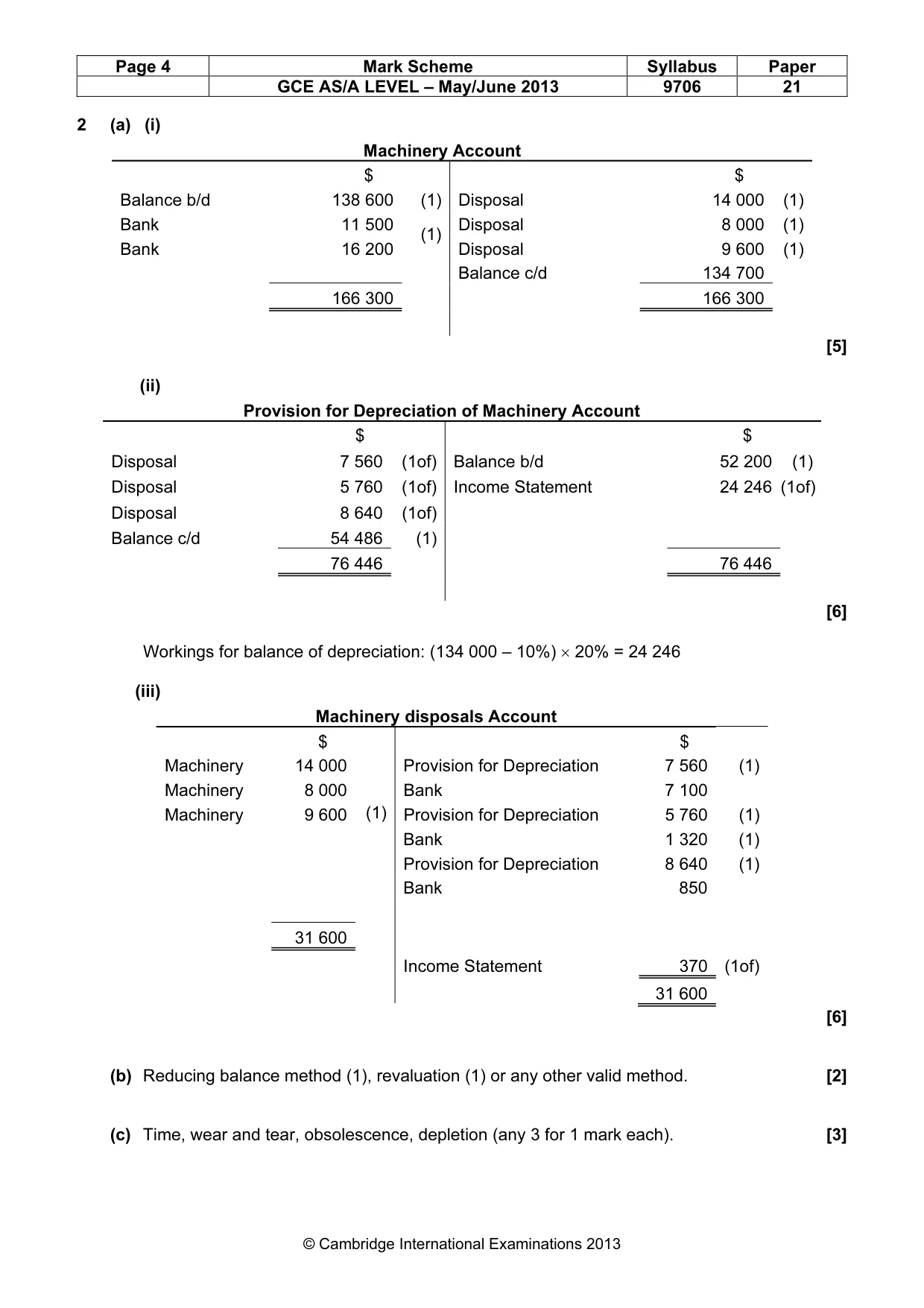
Page 4 Mark Scheme Syllabus Paper GCE AS/A LEVEL – May/June 2013 9706 21 © Cambridge International Examinations 2013 2 (a) (i) Machinery Account $ $ Balance b/d 138 600 (1) Disposal 14 000 (1) Bank 11 500 (1) Disposal 8 000 (1) Bank 16 200 Disposal 9 600 (1) Balance c/d 134 700 166 300 166 300 [5] (ii) Provision for Depreciation of Machinery Account $ $ Disposal 7 560 (1of) Balance b/d 52 200 (1) Disposal 5 760 (1of) Income Statement 24 246 (1of) Disposal 8 640 (1of) Balance c/d 54 486 (1) 76 446 76 446 [6] Workings for balance of depreciation: (134 000 – 10%) × 20% = 24 246 (iii) Machinery disposals Account $ $ Machinery 14 000 (1) Provision for Depreciation 7 560 (1) Machinery 8 000 Bank 7 100 Machinery 9 600 Provision for Depreciation 5 760 (1) Bank 1 320 (1) Provision for Depreciation 8 640 (1) Bank 850 31 600 Income Statement 370 (1of) 31 600 [6] (b) Reducing balance method (1), revaluation (1) or any other valid method. [2] (c) Time, wear and tear, obsolescence, depletion (any 3 for 1 mark each). [3]
Mark scheme, page 5
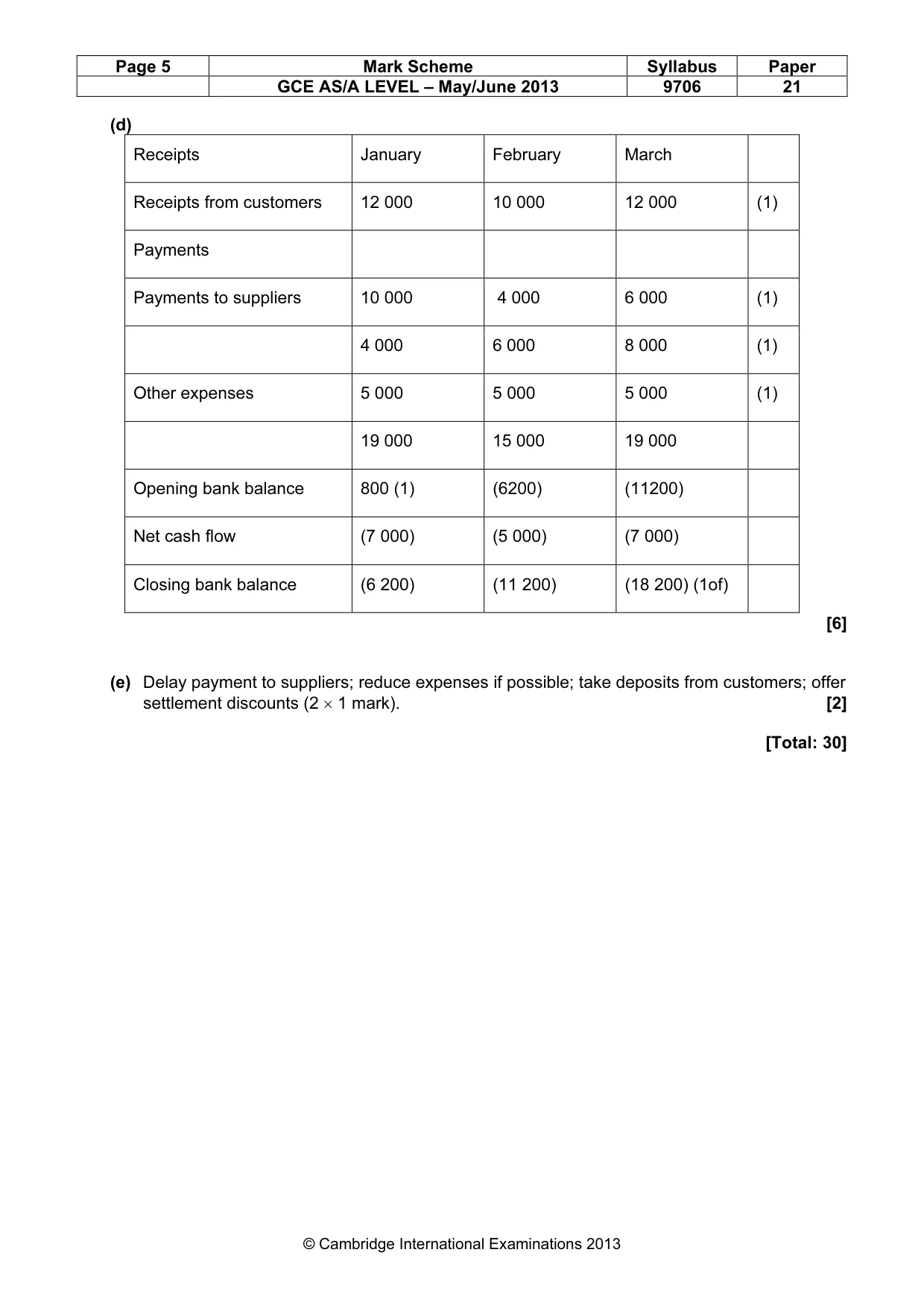
Page 5 Mark Scheme Syllabus Paper GCE AS/A LEVEL – May/June 2013 9706 21 © Cambridge International Examinations 2013 (d) Receipts January February March Receipts from customers 12 000 10 000 12 000 (1) Payments Payments to suppliers 10 000 4 000 6 000 (1) 4 000 6 000 8 000 (1) Other expenses 5 000 5 000 5 000 (1) 19 000 15 000 19 000 Opening bank balance 800 (1) (6200) (11200) Net cash flow (7 000) (5 000) (7 000) Closing bank balance (6 200) (11 200) (18 200) (1of) [6] (e) Delay payment to suppliers; reduce expenses if possible; take deposits from customers; offer settlement discounts (2 × 1 mark). [2] [Total: 30]
Mark scheme, page 6
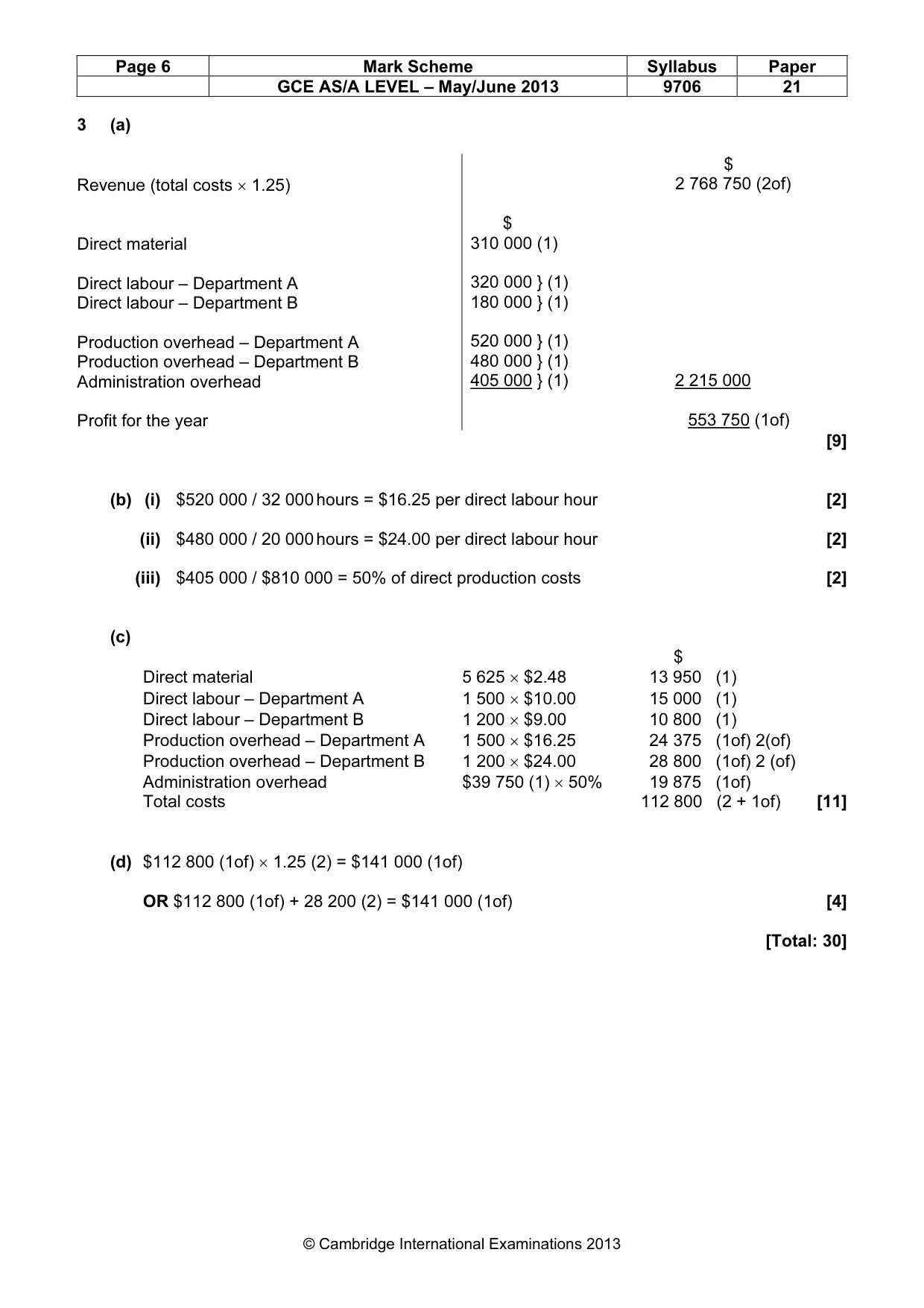
Page 6 Mark Scheme Syllabus Paper GCE AS/A LEVEL – May/June 2013 9706 21 © Cambridge International Examinations 2013 3 (a) Revenue (total costs × 1.25) Direct material Direct labour – Department A Direct labour – Department B Production overhead – Department A Production overhead – Department B Administration overhead Profit for the year $ 2 768 750 (2of) $ 310 000 (1) 320 000 } (1) 180 000 } (1) 520 000 } (1) 480 000 } (1) 405 000 } (1) 2 215 000 553 750 (1of) [9] (b) (i) $520 000 / 32 000 hours = $16.25 per direct labour hour [2] (ii) $480 000 / 20 000 hours = $24.00 per direct labour hour [2] (iii) $405 000 / $810 000 = 50% of direct production costs [2] (c) $ Direct material 5 625 × $2.48 13 950 (1) Direct labour – Department A 1 500 × $10.00 15 000 (1) Direct labour – Department B 1 200 × $9.00 10 800 (1) Production overhead – Department A 1 500 × $16.25 24 375 (1of) 2(of) Production overhead – Department B 1 200 × $24.00 28 800 (1of) 2 (of) Administration overhead $39 750 (1) × 50% 19 875 (1of) Total costs 112 800 (2 + 1of) [11] (d) $112 800 (1of) × 1.25 (2) = $141 000 (1of) OR $112 800 (1of) + 28 200 (2) = $141 000 (1of) [4] [Total: 30]
What you needed in this session
Cambridge’s own grade thresholds for 2013 May/June, Paper 2 · Variant 1. A higher threshold means an easier paper — the bar moves with how the cohort did.