Cambridge A Level Accounting 9706 — 2012 Oct/Nov Paper 4 · Variant 2
9706/42/O/N/12 · 120 marks · ≈135 min
The question paper and its mark scheme, free to read here and free to download. This is Cambridge’s own paper, exactly as it was sat.
Question paper8 pages
Mark scheme6 pages
Answers below. Sit the paper first if you are practising.
Paper as text
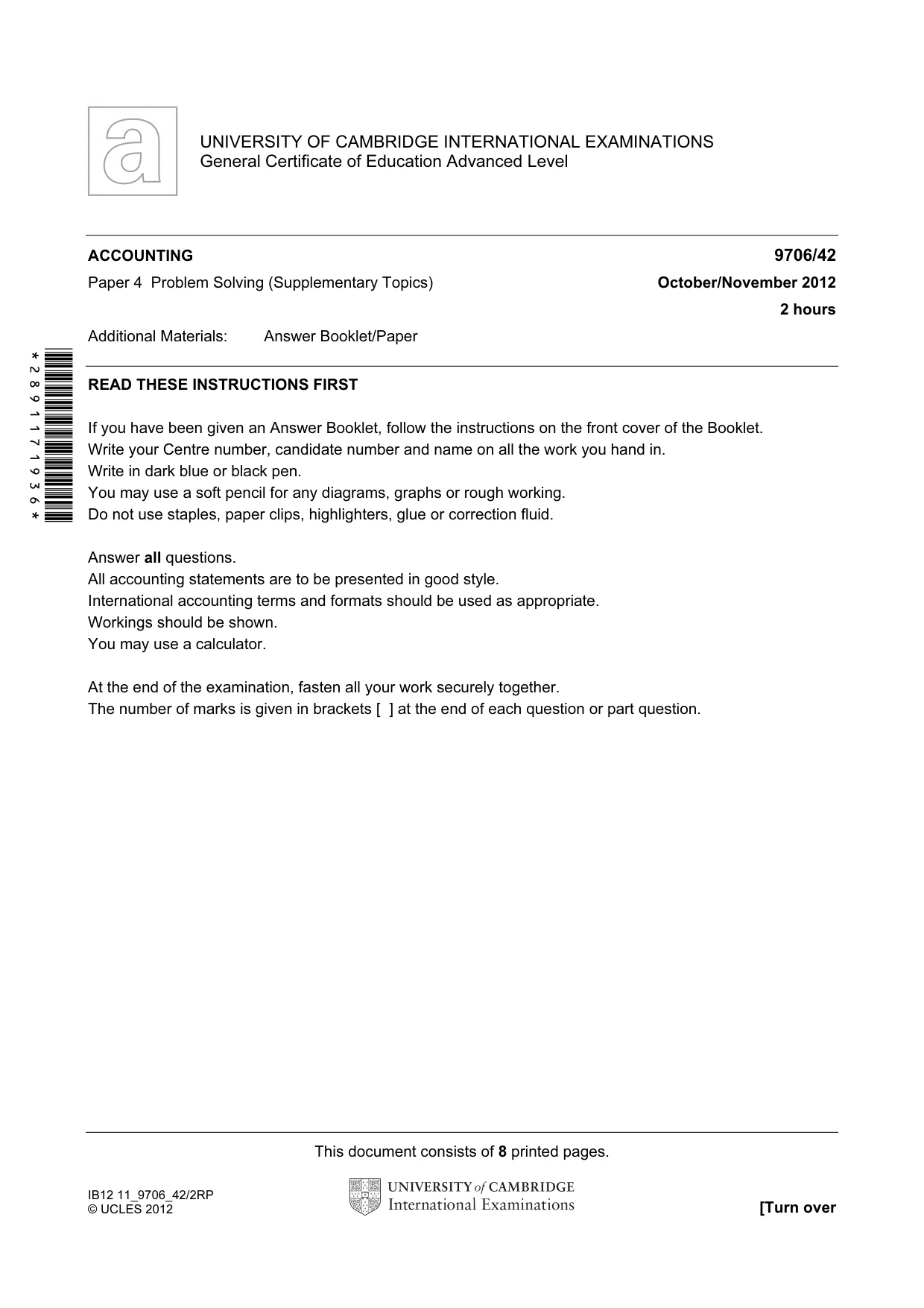
Question paper, page 1
This document consists of 8 printed pages. IB12 11_9706_42/2RP © UCLES 2012 [Turn over *2891171936* UNIVERSITY OF CAMBRIDGE INTERNATIONAL EXAMINATIONS General Certificate of Education Advanced Level ACCOUNTING 9706/42 Paper 4 Problem Solving (Supplementary Topics) October/November 2012 2 hours Additional Materials: Answer Booklet/Paper READ THESE INSTRUCTIONS FIRST If you have been given an Answer Booklet, follow the instructions on the front cover of the Booklet. Write your Centre number, candidate number and name on all the work you hand in. Write in dark blue or black pen. You may use a soft pencil for any diagrams, graphs or rough working. Do not use staples, paper clips, highlighters, glue or correction fluid. Answer all questions. All accounting statements are to be presented in good style. International accounting terms and formats should be used as appropriate. Workings should be shown. You may use a calculator. At the end of the examination, fasten all your work securely together. The number of marks is given in brackets [ ] at the end of each question or part question.
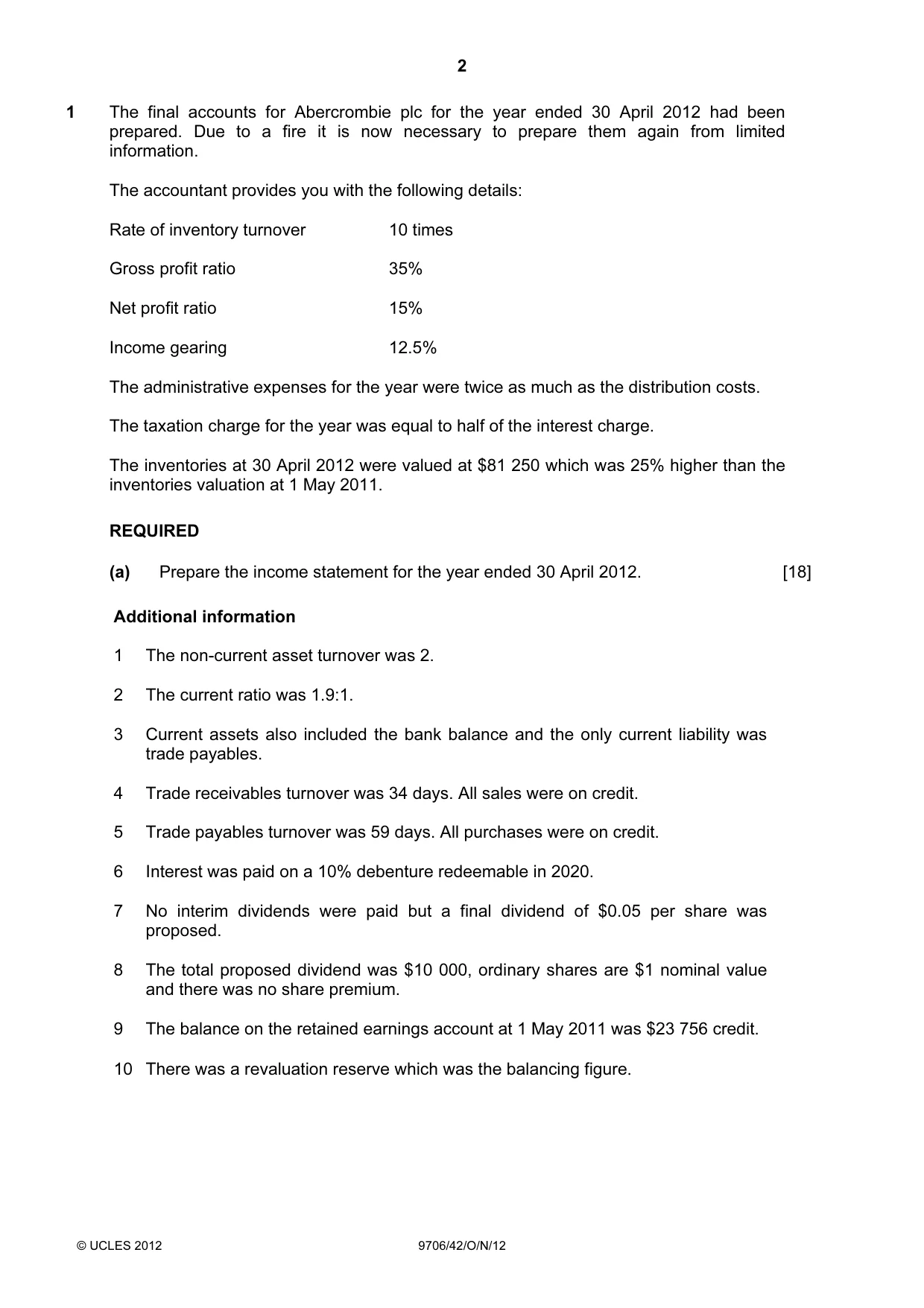
Question paper, page 2
2 © UCLES 2012 9706/42/O/N/12 1 The final accounts for Abercrombie plc for the year ended 30 April 2012 had been prepared. Due to a fire it is now necessary to prepare them again from limited information. The accountant provides you with the following details: Rate of inventory turnover 10 times Gross profit ratio 35% Net profit ratio 15% Income gearing 12.5% The administrative expenses for the year were twice as much as the distribution costs. The taxation charge for the year was equal to half of the interest charge. The inventories at 30 April 2012 were valued at $81 250 which was 25% higher than the inventories valuation at 1 May 2011. REQUIRED (a) Prepare the income statement for the year ended 30 April 2012. [18] Additional information 1 The non-current asset turnover was 2. 2 The current ratio was 1.9:1. 3 Current assets also included the bank balance and the only current liability was trade payables. 4 Trade receivables turnover was 34 days. All sales were on credit. 5 Trade payables turnover was 59 days. All purchases were on credit. 6 Interest was paid on a 10% debenture redeemable in 2020. 7 No interim dividends were paid but a final dividend of $0.05 per share was proposed. 8 The total proposed dividend was $10 000, ordinary shares are $1 nominal value and there was no share premium. 9 The balance on the retained earnings account at 1 May 2011 was $23 756 credit. 10 There was a revaluation reserve which was the balancing figure.
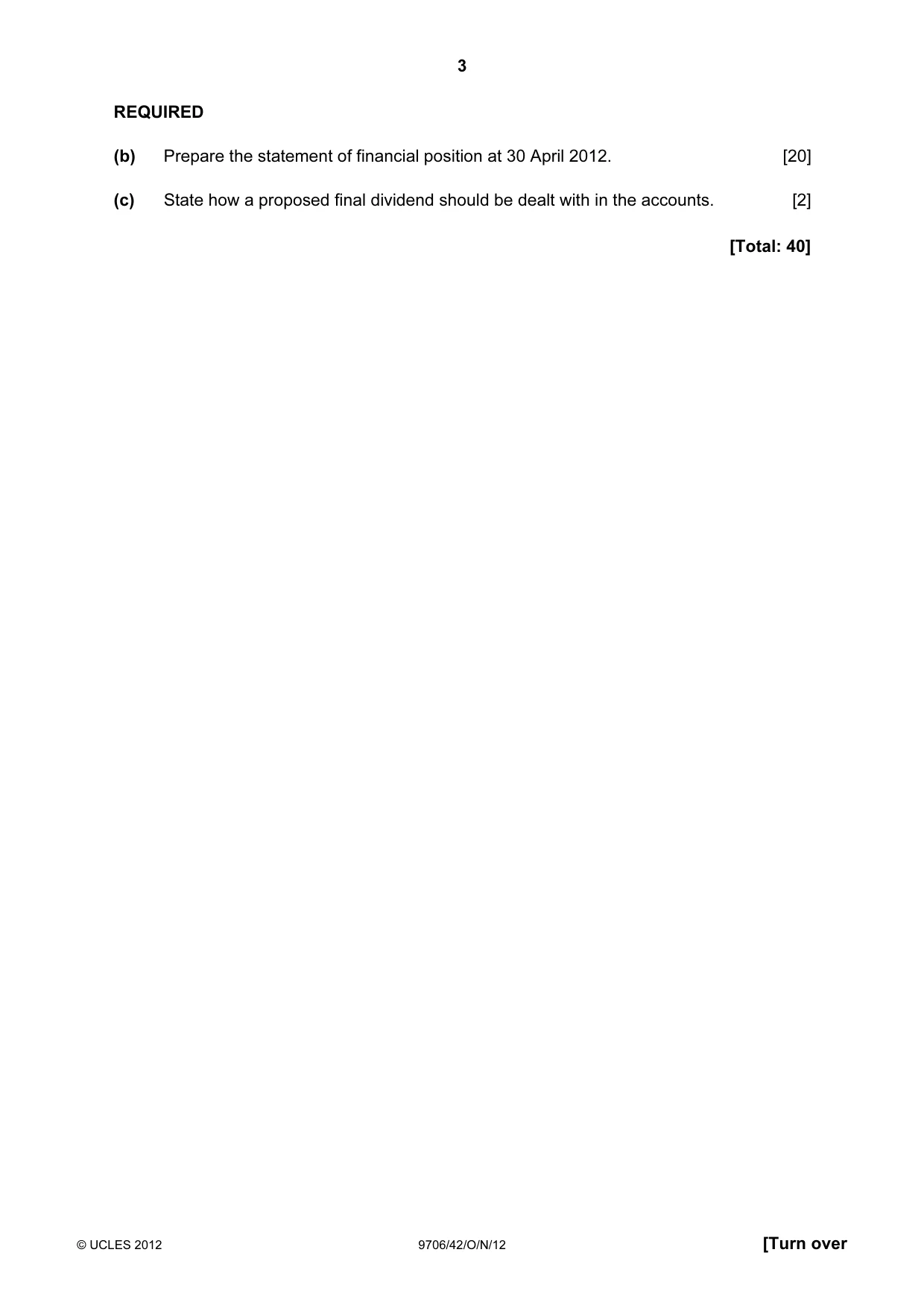
Question paper, page 3
3 © UCLES 2012 9706/42/O/N/12 [Turn over REQUIRED (b) Prepare the statement of financial position at 30 April 2012. [20] (c) State how a proposed final dividend should be dealt with in the accounts. [2] [Total: 40]
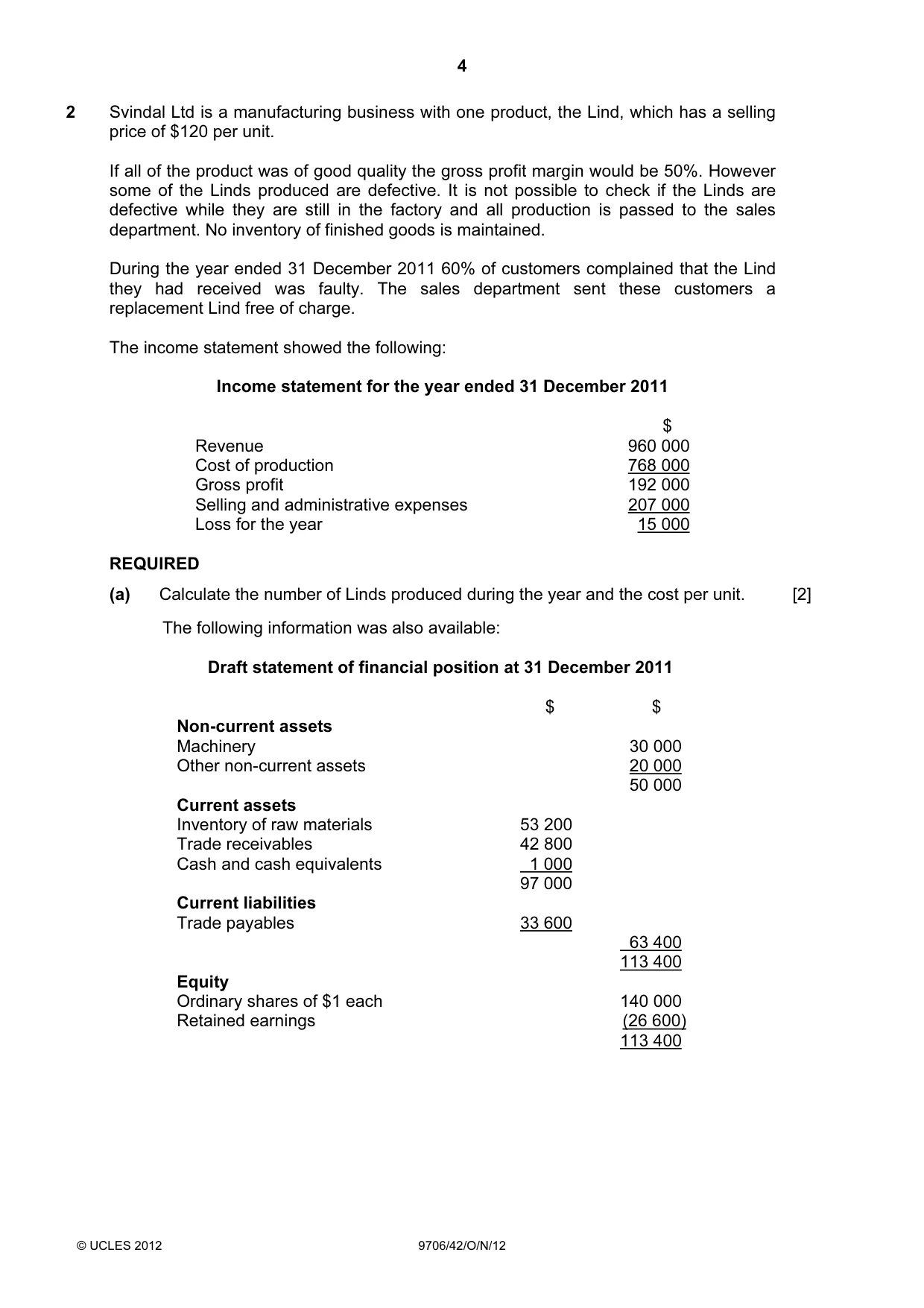
Question paper, page 4
4 © UCLES 2012 9706/42/O/N/12 2 Svindal Ltd is a manufacturing business with one product, the Lind, which has a selling price of $120 per unit. If all of the product was of good quality the gross profit margin would be 50%. However some of the Linds produced are defective. It is not possible to check if the Linds are defective while they are still in the factory and all production is passed to the sales department. No inventory of finished goods is maintained. During the year ended 31 December 2011 60% of customers complained that the Lind they had received was faulty. The sales department sent these customers a replacement Lind free of charge. The income statement showed the following: Income statement for the year ended 31 December 2011 $ Revenue 960 000 Cost of production 768 000 Gross profit 192 000 Selling and administrative expenses 207 000 Loss for the year 15 000 REQUIRED (a) Calculate the number of Linds produced during the year and the cost per unit. [2] The following information was also available: Draft statement of financial position at 31 December 2011 $ $ Non-current assets Machinery 30 000 Other non-current assets 20 000 50 000 Current assets Inventory of raw materials 53 200 Trade receivables 42 800 Cash and cash equivalents 1 000 97 000 Current liabilities Trade payables 33 600 63 400 113 400 Equity Ordinary shares of $1 each 140 000 Retained earnings (26 600) 113 400
Question paper, page 5
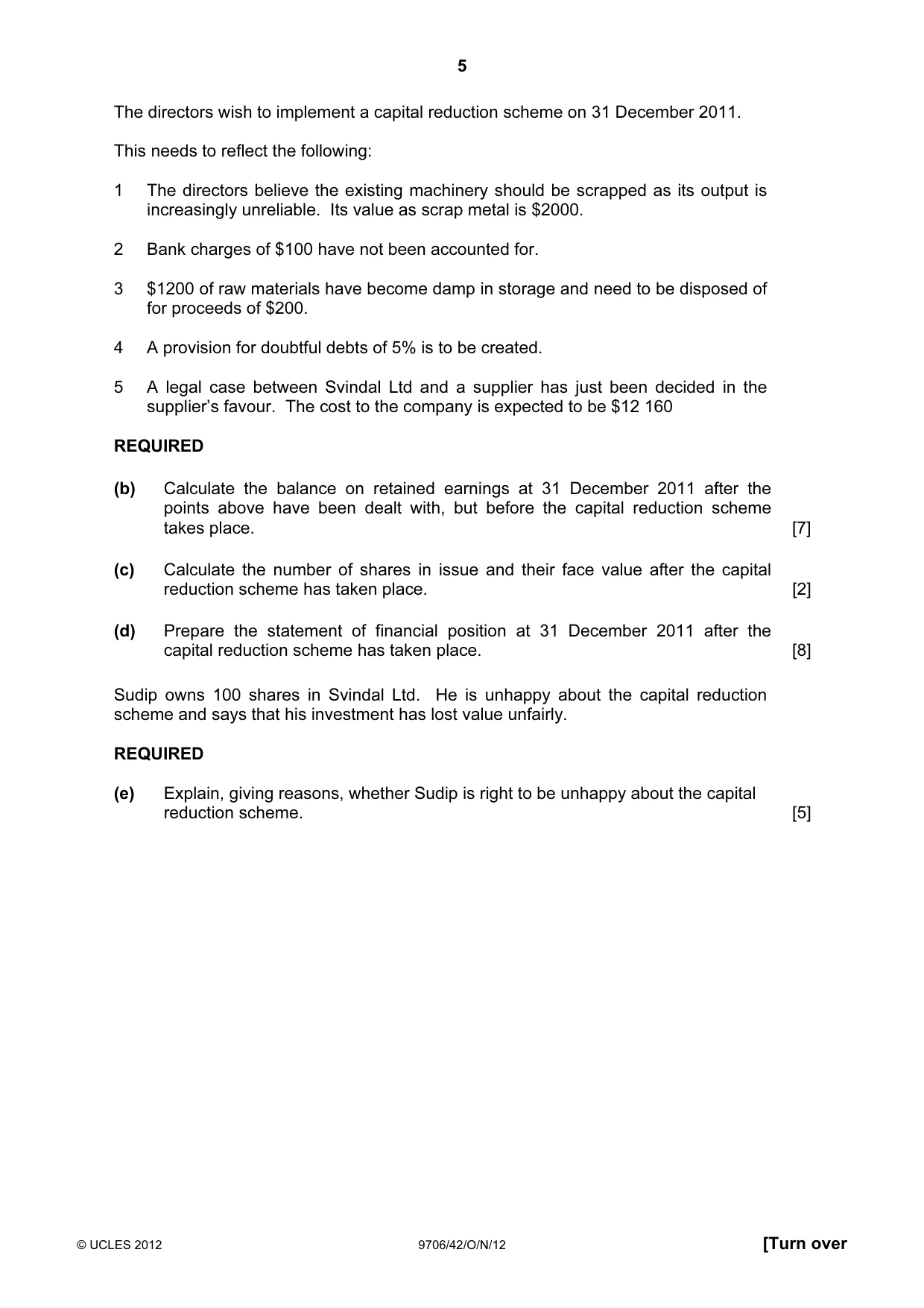
5 © UCLES 2012 9706/42/O/N/12 [Turn over The directors wish to implement a capital reduction scheme on 31 December 2011. This needs to reflect the following: 1 The directors believe the existing machinery should be scrapped as its output is increasingly unreliable. Its value as scrap metal is $2000. 2 Bank charges of $100 have not been accounted for. 3 $1200 of raw materials have become damp in storage and need to be disposed of for proceeds of $200. 4 A provision for doubtful debts of 5% is to be created. 5 A legal case between Svindal Ltd and a supplier has just been decided in the supplier’s favour. The cost to the company is expected to be $12 160 REQUIRED (b) Calculate the balance on retained earnings at 31 December 2011 after the points above have been dealt with, but before the capital reduction scheme takes place. [7] (c) Calculate the number of shares in issue and their face value after the capital reduction scheme has taken place. [2] (d) Prepare the statement of financial position at 31 December 2011 after the capital reduction scheme has taken place. [8] Sudip owns 100 shares in Svindal Ltd. He is unhappy about the capital reduction scheme and says that his investment has lost value unfairly. REQUIRED (e) Explain, giving reasons, whether Sudip is right to be unhappy about the capital reduction scheme. [5]
Question paper, page 6
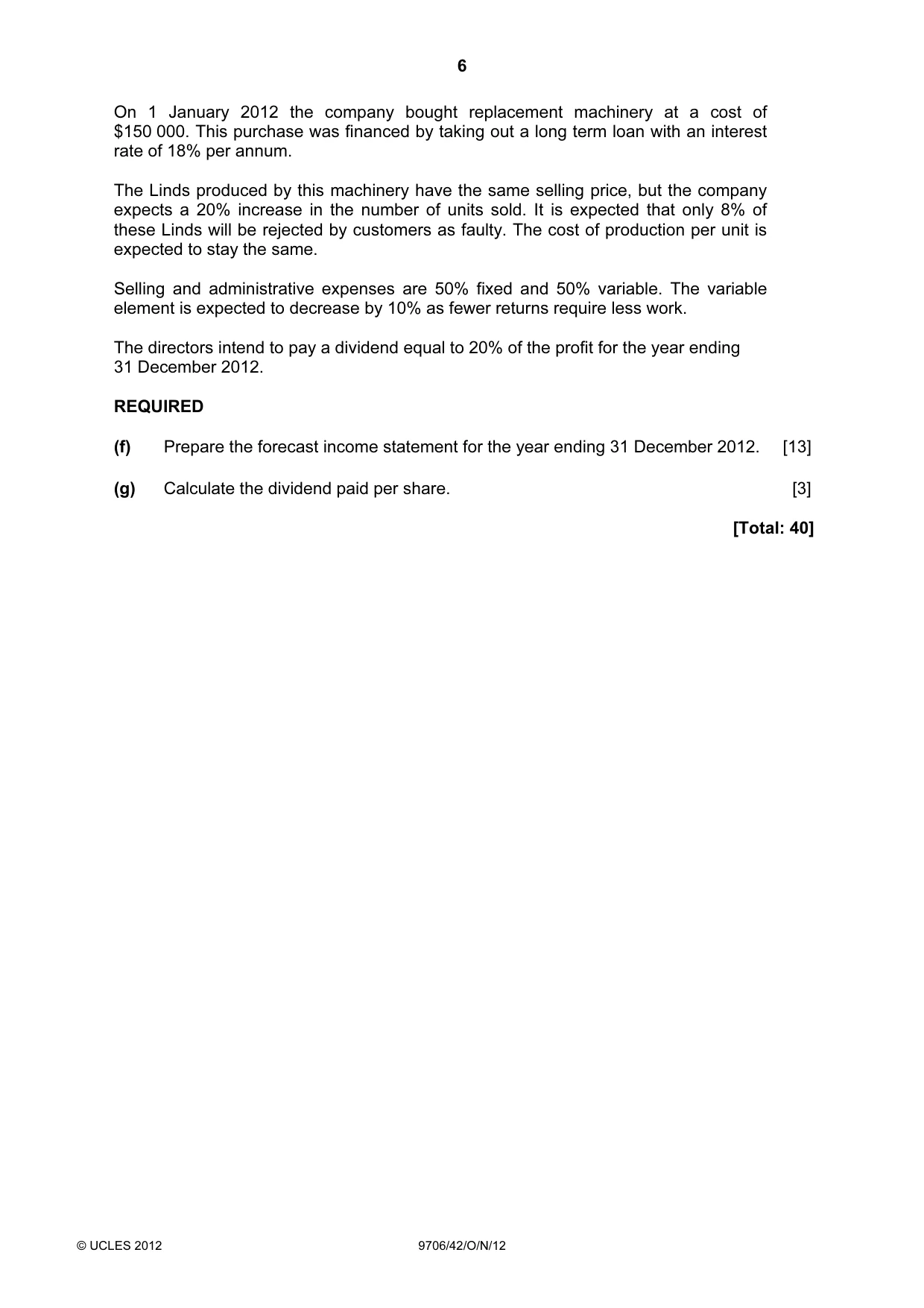
6 © UCLES 2012 9706/42/O/N/12 On 1 January 2012 the company bought replacement machinery at a cost of $150 000. This purchase was financed by taking out a long term loan with an interest rate of 18% per annum. The Linds produced by this machinery have the same selling price, but the company expects a 20% increase in the number of units sold. It is expected that only 8% of these Linds will be rejected by customers as faulty. The cost of production per unit is expected to stay the same. Selling and administrative expenses are 50% fixed and 50% variable. The variable element is expected to decrease by 10% as fewer returns require less work. The directors intend to pay a dividend equal to 20% of the profit for the year ending 31 December 2012. REQUIRED (f) Prepare the forecast income statement for the year ending 31 December 2012. [13] (g) Calculate the dividend paid per share. [3] [Total: 40]
Question paper, page 7
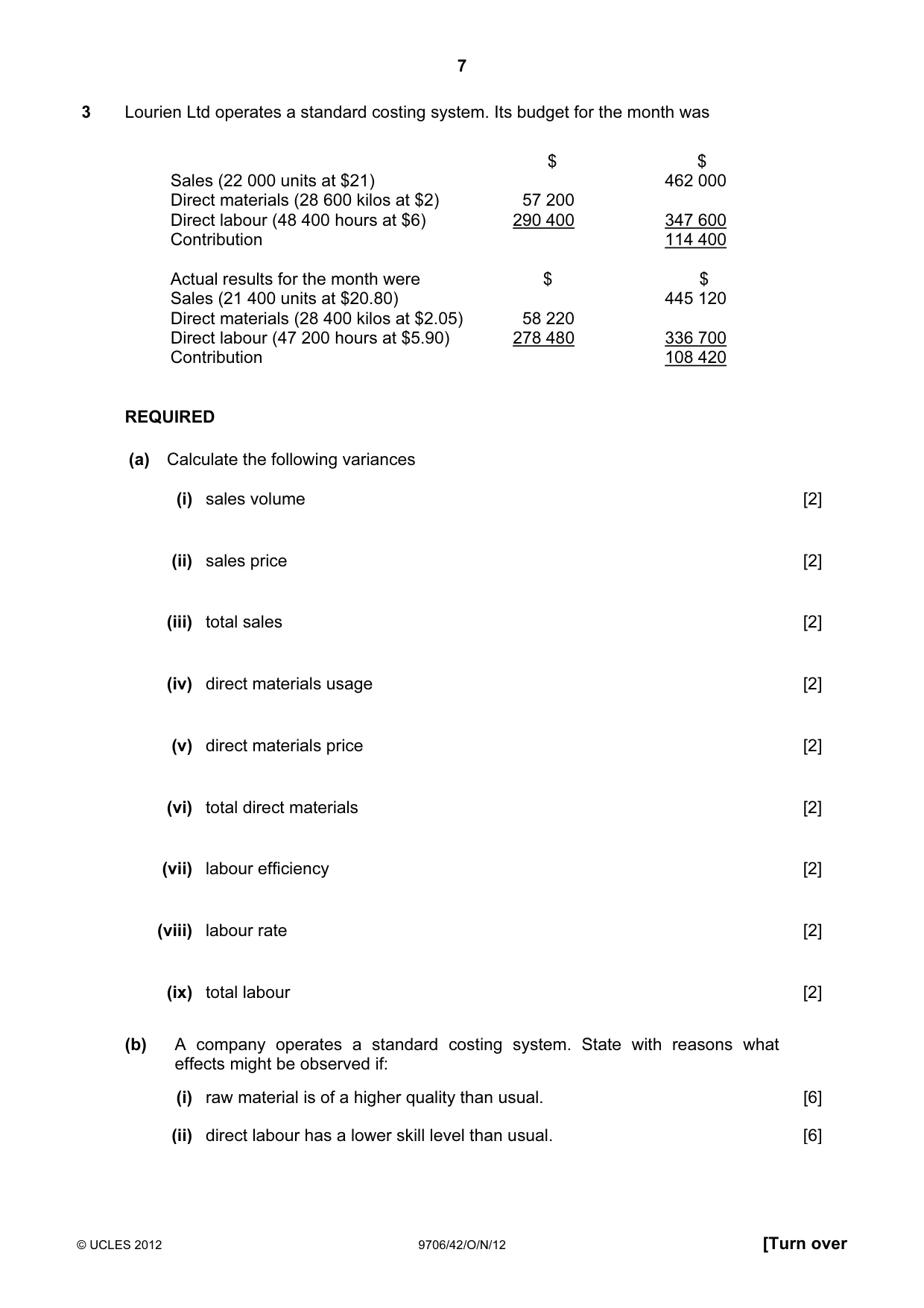
7 © UCLES 2012 9706/42/O/N/12 [Turn over 3 Lourien Ltd operates a standard costing system. Its budget for the month was $ $ Sales (22 000 units at $21) 462 000 Direct materials (28 600 kilos at $2) 57 200 Direct labour (48 400 hours at $6) 290 400 347 600 Contribution 114 400 Actual results for the month were $ $ Sales (21 400 units at $20.80) 445 120 Direct materials (28 400 kilos at $2.05) 58 220 Direct labour (47 200 hours at $5.90) 278 480 336 700 Contribution 108 420 REQUIRED (a) Calculate the following variances (i) sales volume [2] (ii) sales price [2] (iii) total sales [2] (iv) direct materials usage [2] (v) direct materials price [2] (vi) total direct materials [2] (vii) labour efficiency [2] (viii) labour rate [2] (ix) total labour [2] (b) A company operates a standard costing system. State with reasons what effects might be observed if: (i) raw material is of a higher quality than usual. [6] (ii) direct labour has a lower skill level than usual. [6]
Question paper, page 8
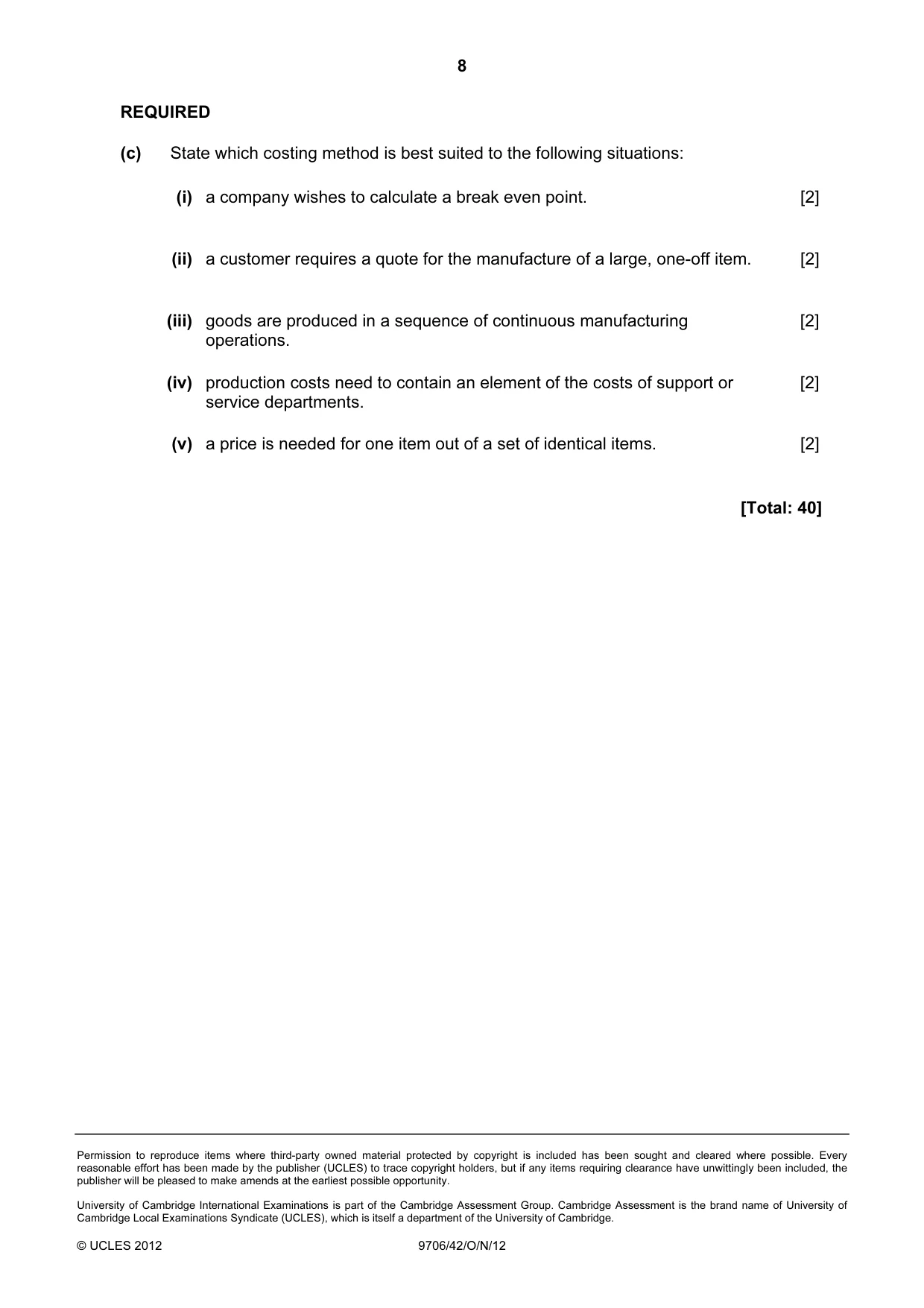
8 Permission to reproduce items where third-party owned material protected by copyright is included has been sought and cleared where possible. Every reasonable effort has been made by the publisher (UCLES) to trace copyright holders, but if any items requiring clearance have unwittingly been included, the publisher will be pleased to make amends at the earliest possible opportunity. University of Cambridge International Examinations is part of the Cambridge Assessment Group. Cambridge Assessment is the brand name of University of Cambridge Local Examinations Syndicate (UCLES), which is itself a department of the University of Cambridge. © UCLES 2012 9706/42/O/N/12 REQUIRED (c) State which costing method is best suited to the following situations: (i) a company wishes to calculate a break even point. [2] (ii) a customer requires a quote for the manufacture of a large, one-off item. [2] (iii) goods are produced in a sequence of continuous manufacturing operations. [2] (iv) production costs need to contain an element of the costs of support or service departments. [2] (v) a price is needed for one item out of a set of identical items. [2] [Total: 40]
Mark scheme, page 1
CAMBRIDGE INTERNATIONAL EXAMINATIONS GCE Advanced Level MARK SCHEME for the October/November 2012 series 9706 ACCOUNTING 9706/42 Paper 4 (Problem Solving – Supplement), maximum raw mark 120 This mark scheme is published as an aid to teachers and candidates, to indicate the requirements of the examination. It shows the basis on which Examiners were instructed to award marks. It does not indicate the details of the discussions that took place at an Examiners’ meeting before marking began, which would have considered the acceptability of alternative answers. Mark schemes should be read in conjunction with the question paper and the Principal Examiner Report for Teachers. Cambridge will not enter into discussions about these mark schemes. Cambridge is publishing the mark schemes for the October/November 2012 series for most IGCSE, GCE Advanced Level and Advanced Subsidiary Level components and some Ordinary Level components.
Mark scheme, page 2
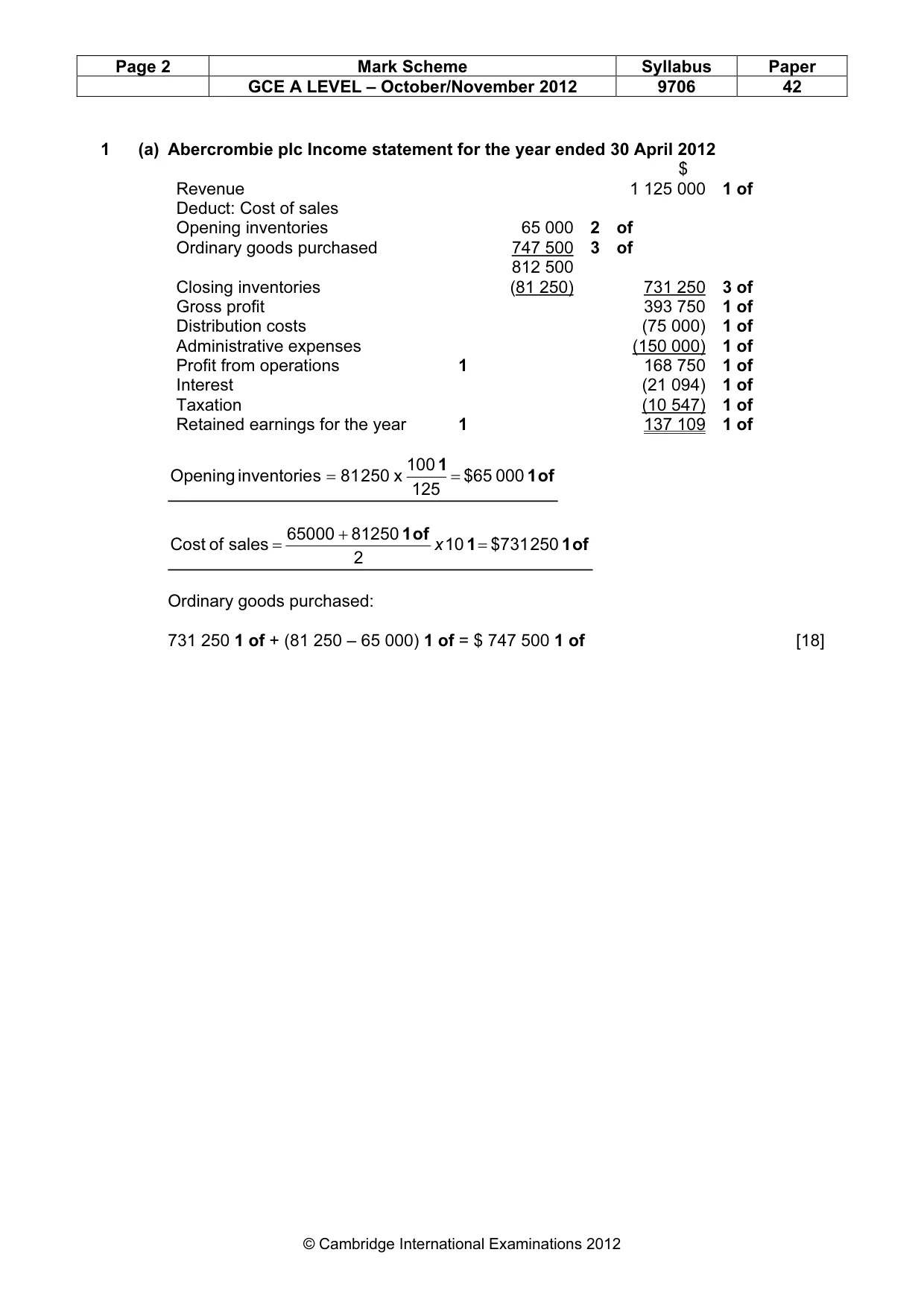
Page 2 Mark Scheme Syllabus Paper GCE A LEVEL – October/November 2012 9706 42 © Cambridge International Examinations 2012 1 (a) Abercrombie plc Income statement for the year ended 30 April 2012 $ Revenue 1 125 000 1 of Deduct: Cost of sales Opening inventories 65 000 2 of Ordinary goods purchased 747 500 3 of 812 500 Closing inventories (81 250) 731 250 3 of Gross profit 393 750 1 of Distribution costs (75 000) 1 of Administrative expenses (150 000) 1 of Profit from operations 1 168 750 1 of Interest (21 094) 1 of Taxation (10 547) 1 of Retained earnings for the year 1 137 109 1 of of 1 1 000 $65 125 100 x 250 81 s inventorie Opening = = of 1 1 of 1 250 $731 10 2 81250 65000 sales of Cost = + = x Ordinary goods purchased: 731 250 1 of + (81 250 – 65 000) 1 of = $ 747 500 1 of [18]
Mark scheme, page 3
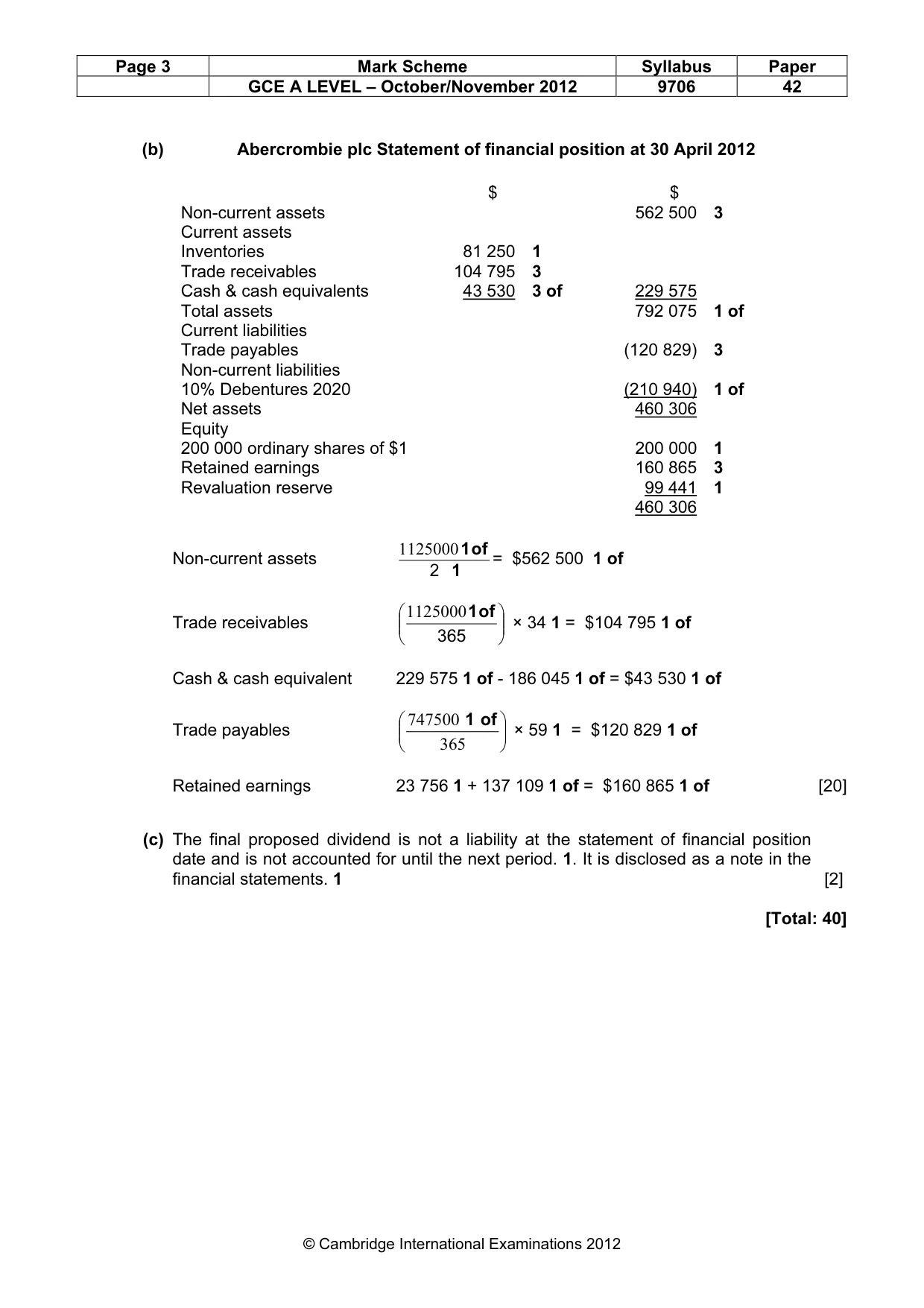
Page 3 Mark Scheme Syllabus Paper GCE A LEVEL – October/November 2012 9706 42 © Cambridge International Examinations 2012 (b) Abercrombie plc Statement of financial position at 30 April 2012 $ $ Non-current assets 562 500 3 Current assets Inventories 81 250 1 Trade receivables 104 795 3 Cash & cash equivalents 43 530 3 of 229 575 Total assets 792 075 1 of Current liabilities Trade payables (120 829) 3 Non-current liabilities 10% Debentures 2020 (210 940) 1 of Net assets 460 306 Equity 200 000 ordinary shares of $1 200 000 1 Retained earnings 160 865 3 Revaluation reserve 99 441 1 460 306 Non-current assets 1 of 1 2 1125000 = $562 500 1 of Trade receivables 365 of 1 1125000 × 34 1 = $104 795 1 of Cash & cash equivalent 229 575 1 of - 186 045 1 of = $43 530 1 of Trade payables 365 747500 of 1 × 59 1 = $120 829 1 of Retained earnings 23 756 1 + 137 109 1 of = $160 865 1 of [20] (c) The final proposed dividend is not a liability at the statement of financial position date and is not accounted for until the next period. 1. It is disclosed as a note in the financial statements. 1 [2] [Total: 40]
Mark scheme, page 4
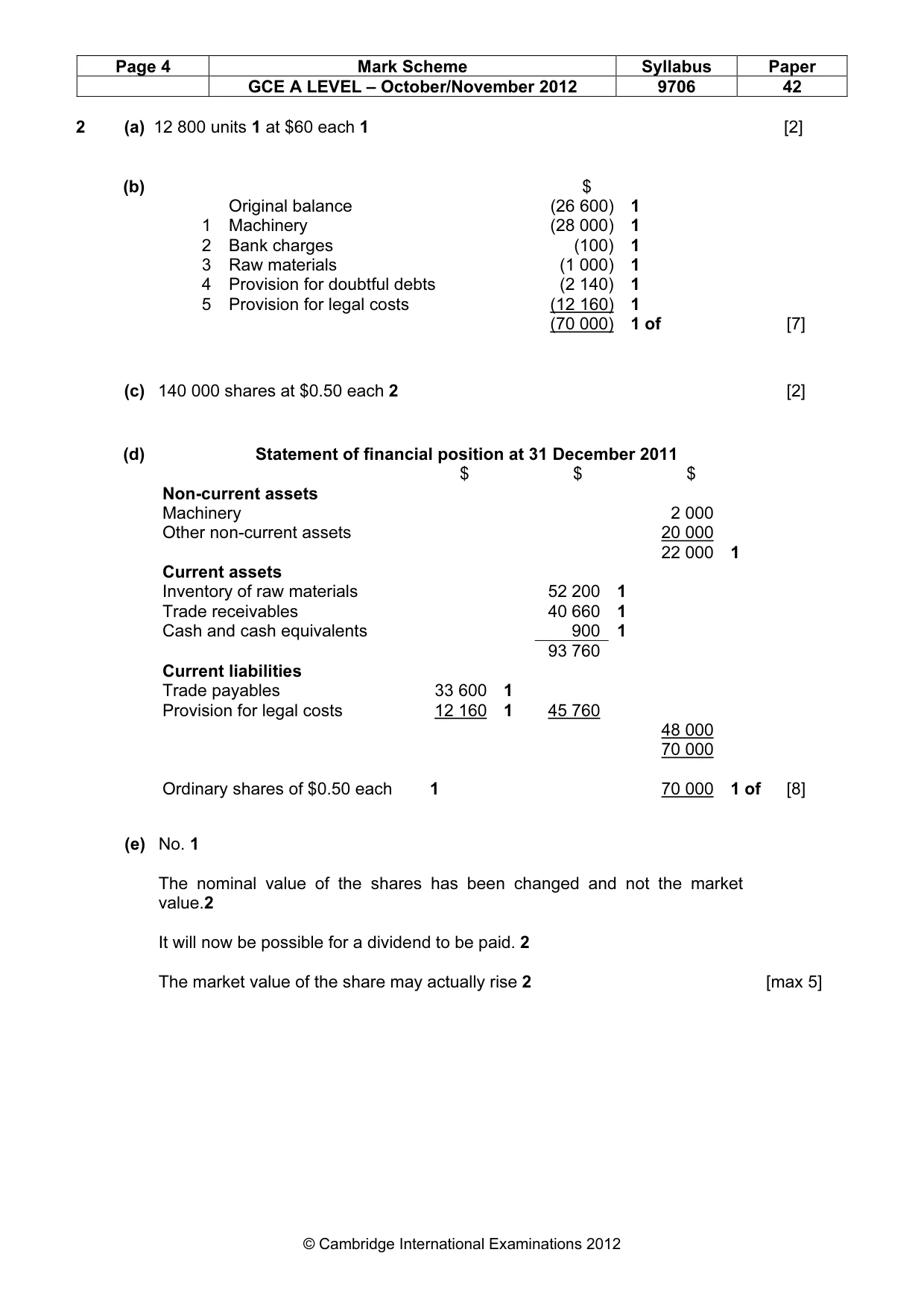
Page 4 Mark Scheme Syllabus Paper GCE A LEVEL – October/November 2012 9706 42 © Cambridge International Examinations 2012 2 (a) 12 800 units 1 at $60 each 1 [2] (b) $ Original balance (26 600) 1 1 Machinery (28 000) 1 2 Bank charges (100) 1 3 Raw materials (1 000) 1 4 Provision for doubtful debts (2 140) 1 5 Provision for legal costs (12 160) 1 (70 000) 1 of [7] (c) 140 000 shares at $0.50 each 2 [2] (d) Statement of financial position at 31 December 2011 $ $ $ Non-current assets Machinery 2 000 Other non-current assets 20 000 22 000 1 Current assets Inventory of raw materials 52 200 1 Trade receivables 40 660 1 Cash and cash equivalents 900 1 93 760 Current liabilities Trade payables 33 600 1 Provision for legal costs 12 160 1 45 760 48 000 70 000 Ordinary shares of $0.50 each 1 70 000 1 of [8] (e) No. 1 The nominal value of the shares has been changed and not the market value.2 It will now be possible for a dividend to be paid. 2 The market value of the share may actually rise 2 [max 5]
Mark scheme, page 5
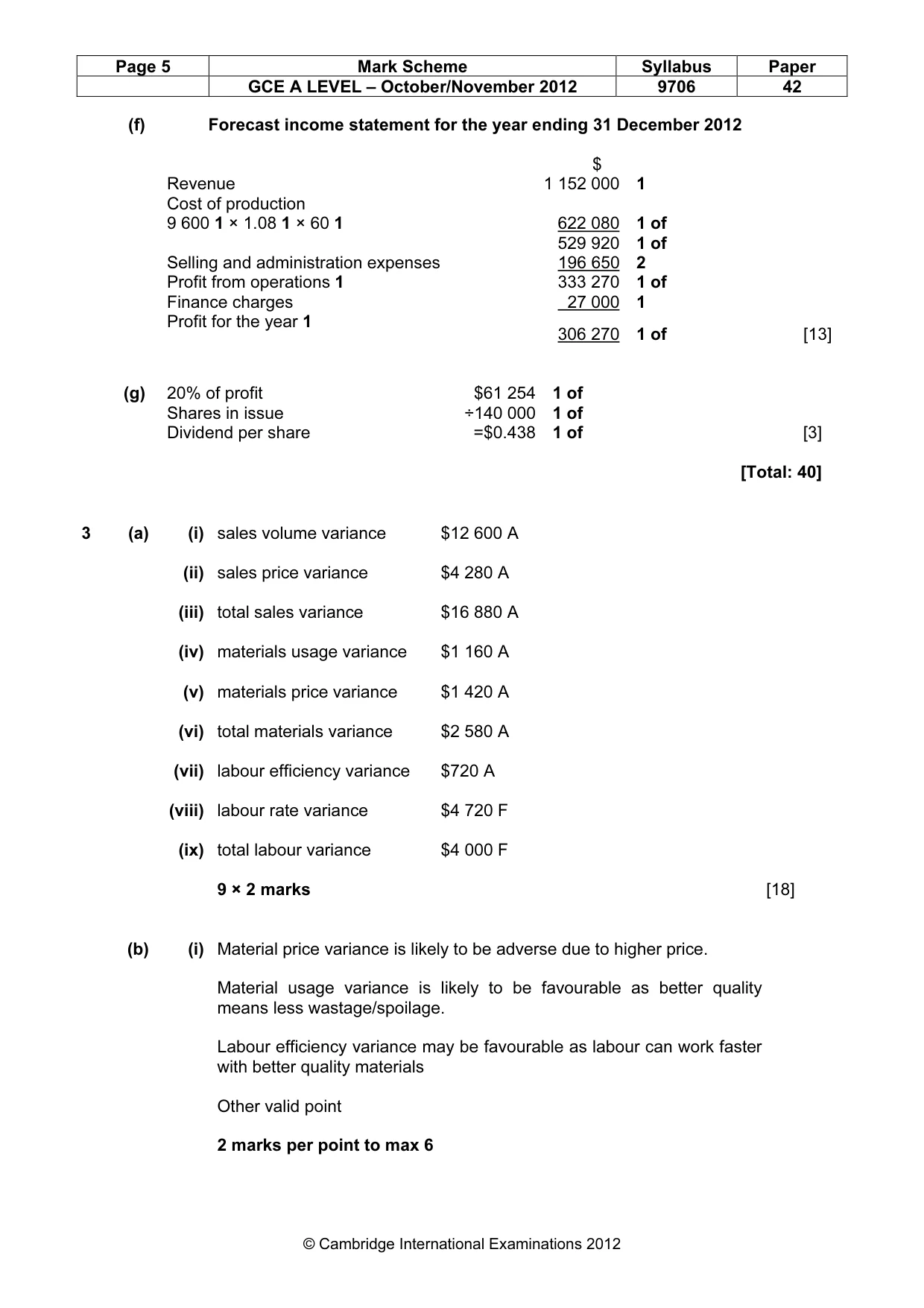
Page 5 Mark Scheme Syllabus Paper GCE A LEVEL – October/November 2012 9706 42 © Cambridge International Examinations 2012 (f) Forecast income statement for the year ending 31 December 2012 $ Revenue 1 152 000 1 Cost of production 9 600 1 × 1.08 1 × 60 1 622 080 1 of 529 920 1 of Selling and administration expenses 196 650 2 Profit from operations 1 333 270 1 of Finance charges 27 000 1 Profit for the year 1 306 270 1 of [13] (g) 20% of profit $61 254 1 of Shares in issue ÷140 000 1 of Dividend per share =$0.438 1 of [3] [Total: 40] 3 (a) (i) sales volume variance $12 600 A (ii) sales price variance $4 280 A (iii) total sales variance $16 880 A (iv) materials usage variance $1 160 A (v) materials price variance $1 420 A (vi) total materials variance $2 580 A (vii) labour efficiency variance $720 A (viii) labour rate variance $4 720 F (ix) total labour variance $4 000 F 9 × 2 marks [18] (b) (i) Material price variance is likely to be adverse due to higher price. Material usage variance is likely to be favourable as better quality means less wastage/spoilage. Labour efficiency variance may be favourable as labour can work faster with better quality materials Other valid point 2 marks per point to max 6
Mark scheme, page 6
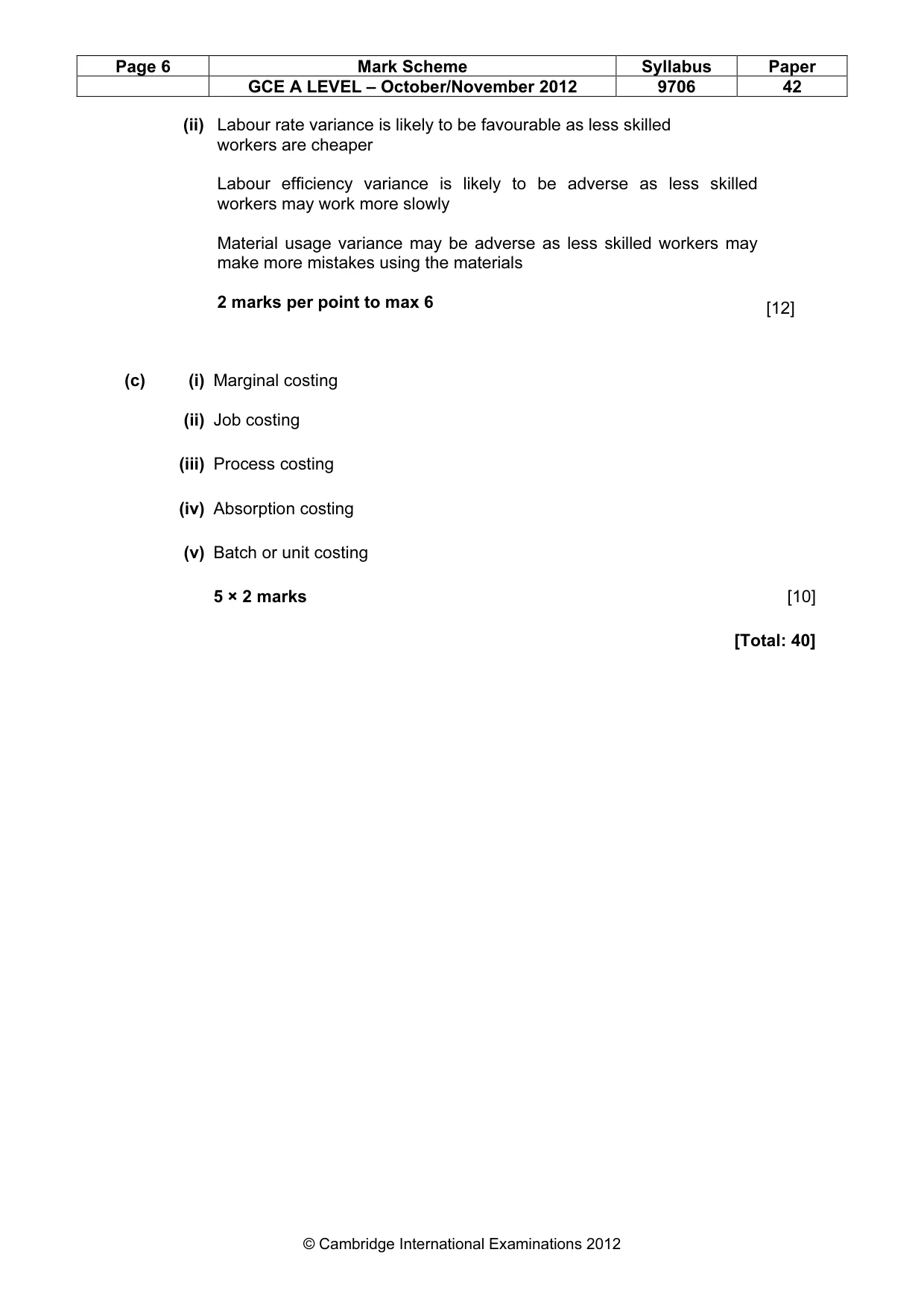
Page 6 Mark Scheme Syllabus Paper GCE A LEVEL – October/November 2012 9706 42 © Cambridge International Examinations 2012 (ii) Labour rate variance is likely to be favourable as less skilled workers are cheaper Labour efficiency variance is likely to be adverse as less skilled workers may work more slowly Material usage variance may be adverse as less skilled workers may make more mistakes using the materials 2 marks per point to max 6 [12] (c) (i) Marginal costing (ii) Job costing (iii) Process costing (iv) Absorption costing (v) Batch or unit costing 5 × 2 marks [10] [Total: 40]
What you needed in this session
Cambridge’s own grade thresholds for 2012 Oct/Nov, Paper 4 · Variant 2. A higher threshold means an easier paper — the bar moves with how the cohort did.