Cambridge A Level Accounting 9706 — 2012 Oct/Nov Paper 4 · Variant 3
9706/43/O/N/12 · 120 marks · ≈135 min
The question paper and its mark scheme, free to read here and free to download. This is Cambridge’s own paper, exactly as it was sat.
Question paper8 pages
Mark scheme6 pages
Answers below. Sit the paper first if you are practising.
Paper as text
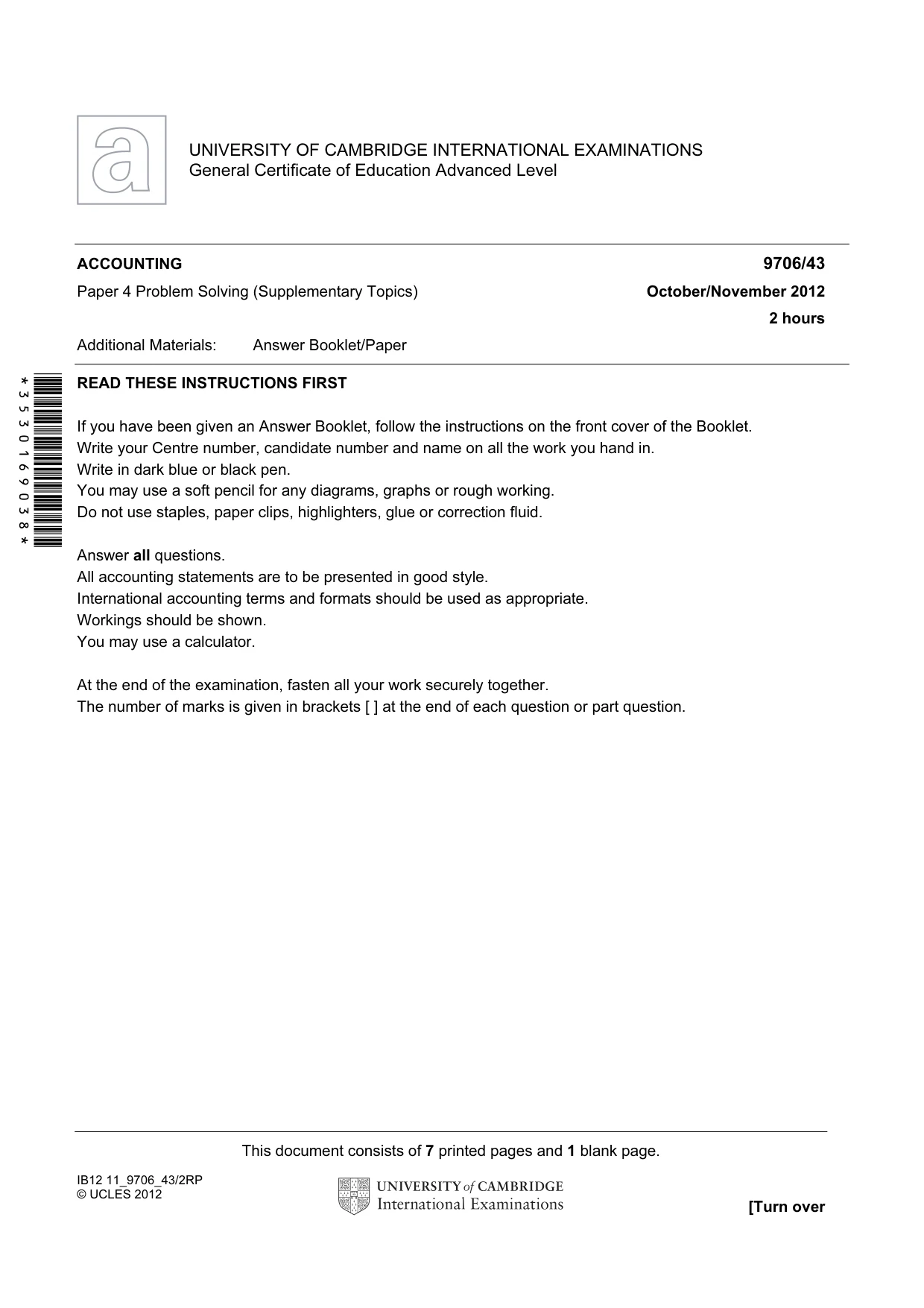
Question paper, page 1
This document consists of 7 printed pages and 1 blank page. IB12 11_9706_43/2RP © UCLES 2012 [Turn over *3530169038* UNIVERSITY OF CAMBRIDGE INTERNATIONAL EXAMINATIONS General Certificate of Education Advanced Level ACCOUNTING 9706/43 Paper 4 Problem Solving (Supplementary Topics) October/November 2012 2 hours Additional Materials: Answer Booklet/Paper READ THESE INSTRUCTIONS FIRST If you have been given an Answer Booklet, follow the instructions on the front cover of the Booklet. Write your Centre number, candidate number and name on all the work you hand in. Write in dark blue or black pen. You may use a soft pencil for any diagrams, graphs or rough working. Do not use staples, paper clips, highlighters, glue or correction fluid. Answer all questions. All accounting statements are to be presented in good style. International accounting terms and formats should be used as appropriate. Workings should be shown. You may use a calculator. At the end of the examination, fasten all your work securely together. The number of marks is given in brackets [ ] at the end of each question or part question.
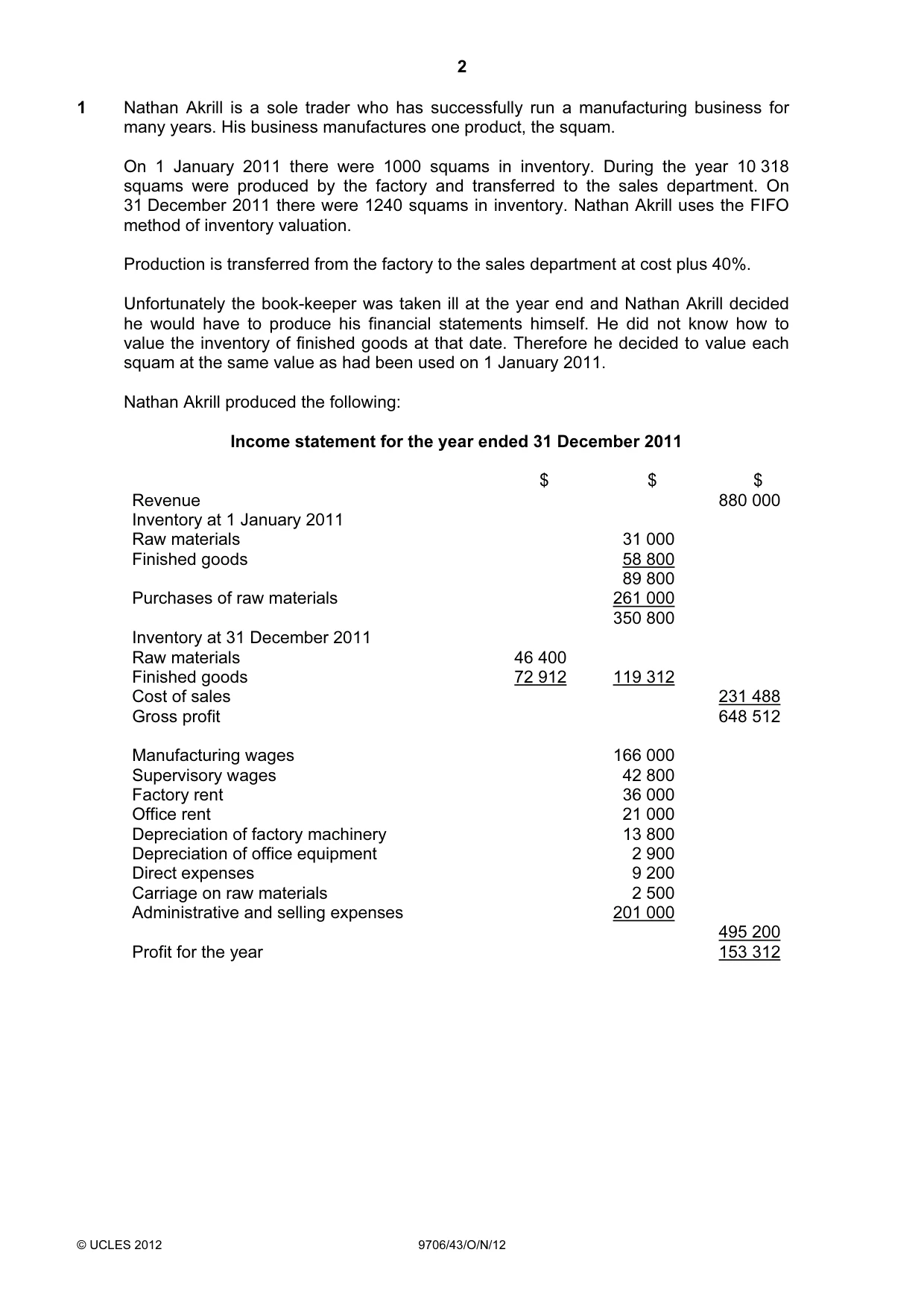
Question paper, page 2
2 © UCLES 2012 9706/43/O/N/12 1 Nathan Akrill is a sole trader who has successfully run a manufacturing business for many years. His business manufactures one product, the squam. On 1 January 2011 there were 1000 squams in inventory. During the year 10 318 squams were produced by the factory and transferred to the sales department. On 31 December 2011 there were 1240 squams in inventory. Nathan Akrill uses the FIFO method of inventory valuation. Production is transferred from the factory to the sales department at cost plus 40%. Unfortunately the book-keeper was taken ill at the year end and Nathan Akrill decided he would have to produce his financial statements himself. He did not know how to value the inventory of finished goods at that date. Therefore he decided to value each squam at the same value as had been used on 1 January 2011. Nathan Akrill produced the following: Income statement for the year ended 31 December 2011 $ $ $ Revenue 880 000 Inventory at 1 January 2011 Raw materials 31 000 Finished goods 58 800 89 800 Purchases of raw materials 261 000 350 800 Inventory at 31 December 2011 Raw materials 46 400 Finished goods 72 912 119 312 Cost of sales 231 488 Gross profit 648 512 Manufacturing wages 166 000 Supervisory wages 42 800 Factory rent 36 000 Office rent 21 000 Depreciation of factory machinery 13 800 Depreciation of office equipment 2 900 Direct expenses 9 200 Carriage on raw materials 2 500 Administrative and selling expenses 201 000 495 200 Profit for the year 153 312 .
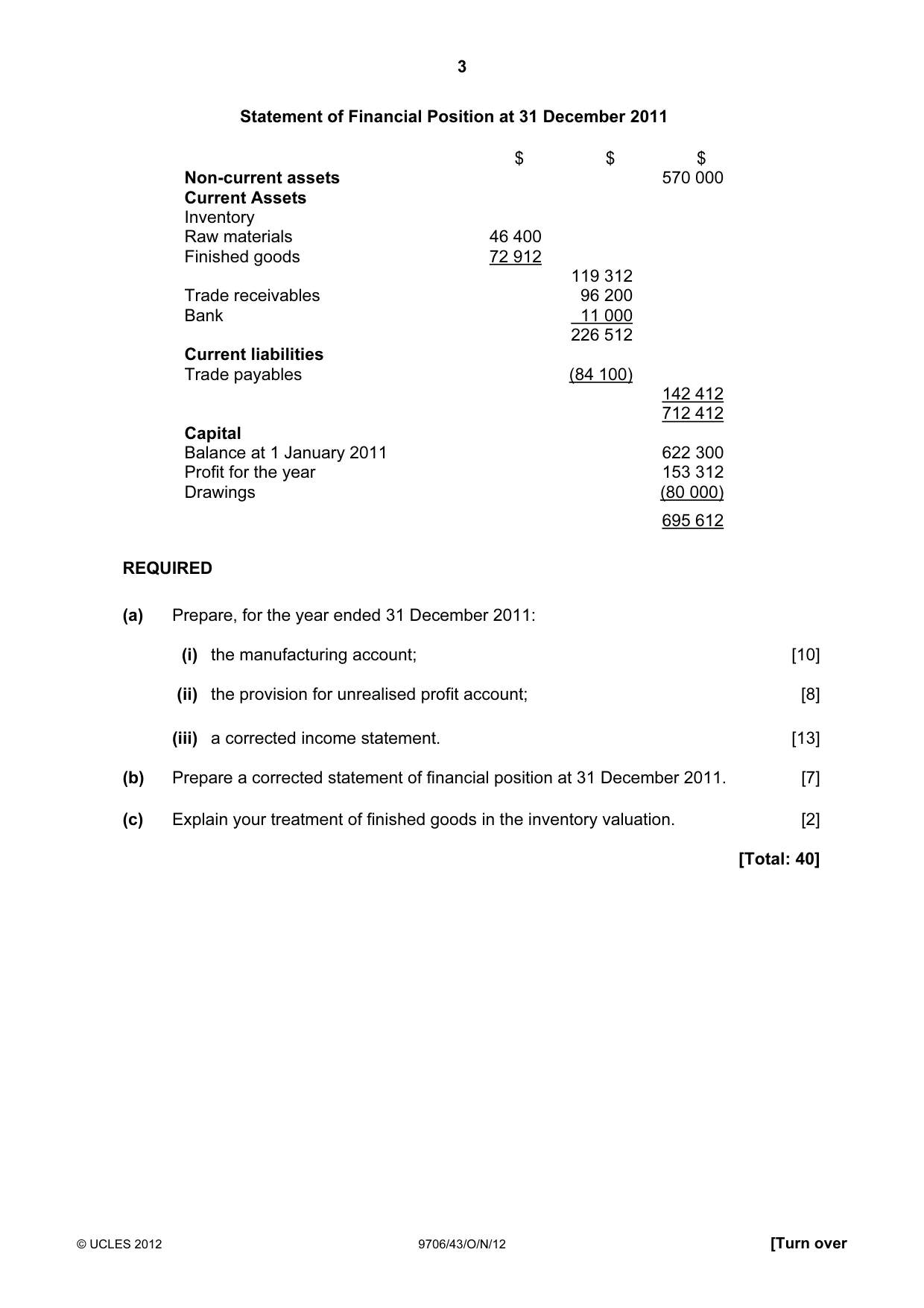
Question paper, page 3
3 © UCLES 2012 9706/43/O/N/12 [Turn over Statement of Financial Position at 31 December 2011 $ $ $ Non-current assets 570 000 Current Assets Inventory Raw materials 46 400 Finished goods 72 912 119 312 Trade receivables 96 200 Bank 11 000 226 512 Current liabilities Trade payables (84 100) 142 412 712 412 Capital Balance at 1 January 2011 622 300 Profit for the year 153 312 Drawings (80 000) 695 612 REQUIRED (a) Prepare, for the year ended 31 December 2011: (i) the manufacturing account; [10] (ii) the provision for unrealised profit account; [8] (iii) a corrected income statement. [13] (b) Prepare a corrected statement of financial position at 31 December 2011. [7] (c) Explain your treatment of finished goods in the inventory valuation. [2] [Total: 40]
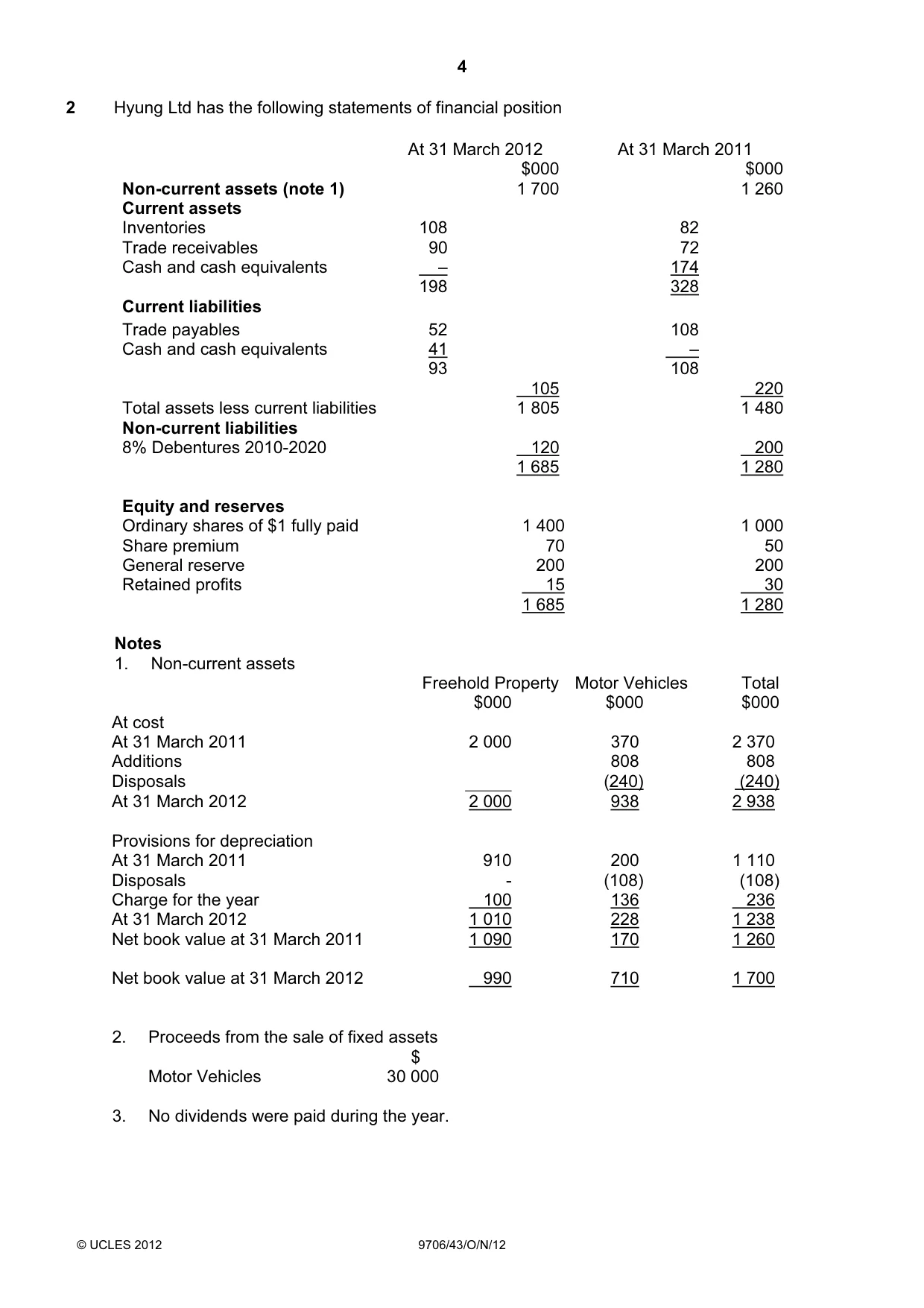
Question paper, page 4
4 © UCLES 2012 9706/43/O/N/12 2 Hyung Ltd has the following statements of financial position At 31 March 2012 At 31 March 2011 $000 $000 Non-current assets (note 1) 1 700 1 260 Current assets Inventories 108 82 Trade receivables 90 72 Cash and cash equivalents – 174 Current liabilities 198 328 Trade payables 52 108 Cash and cash equivalents 41 – 93 108 105 220 Total assets less current liabilities 1 805 1 480 Non-current liabilities 8% Debentures 2010-2020 120 200 1 685 1 280 . Equity and reserves Ordinary shares of $1 fully paid 1 400 1 000 Share premium 70 50 General reserve 200 200 Retained profits 15 30 1 685 1 280 Notes 1. Non-current assets Freehold Property Motor Vehicles Total $000 $000 $000 At cost At 31 March 2011 2 000 370 2 370 Additions 808 808 Disposals (240) (240) At 31 March 2012 2 000 938 2 938 Provisions for depreciation At 31 March 2011 910 200 1 110 Disposals - (108) (108) Charge for the year 0 l 100 136 236 At 31 March 2012 1 010 228 1 238 Net book value at 31 March 2011 1 090 170 1 260 Net book value at 31 March 2012 990 710 1 700 2. Proceeds from the sale of fixed assets $ Motor Vehicles 30 000 3. No dividends were paid during the year.
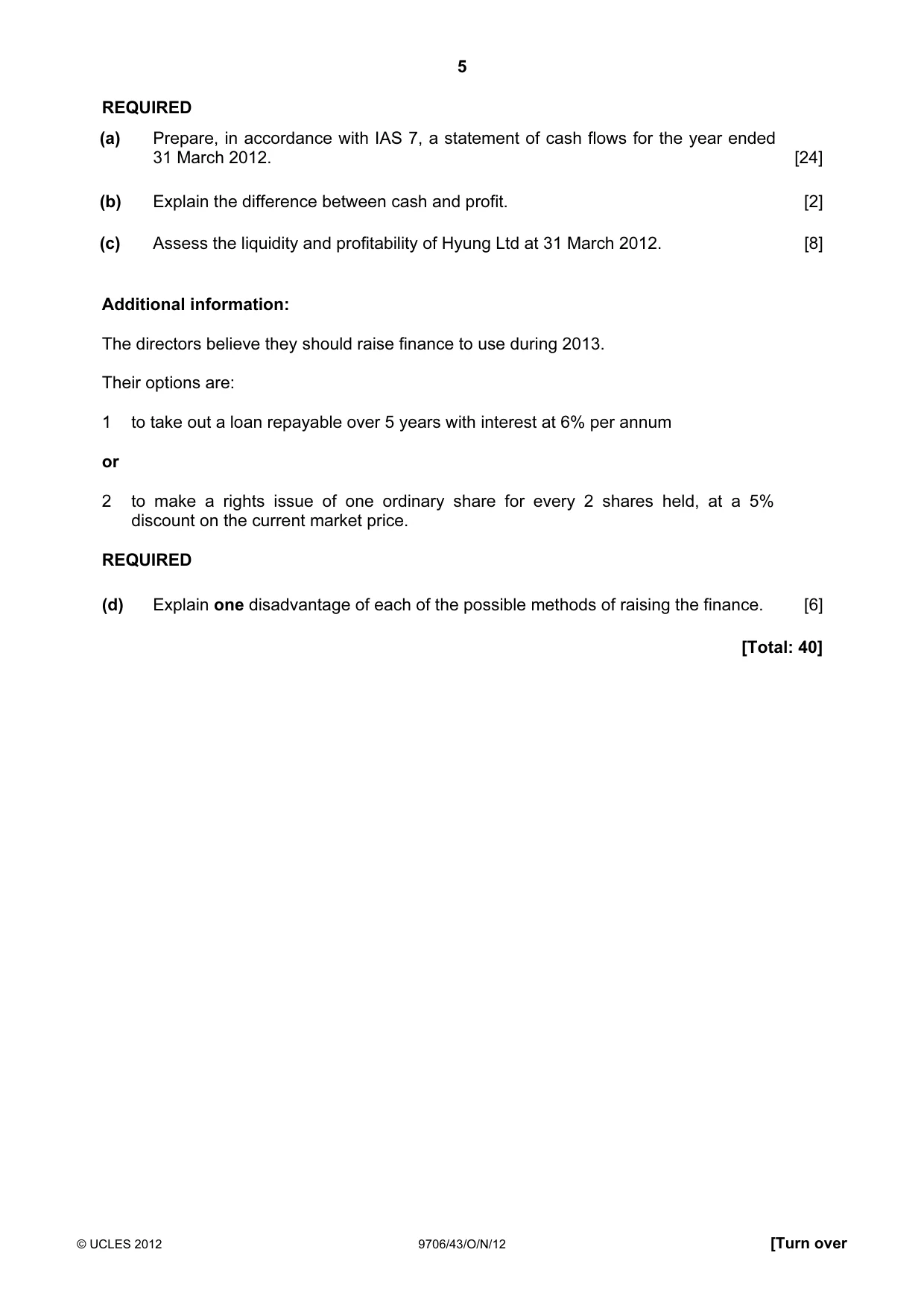
Question paper, page 5
5 © UCLES 2012 9706/43/O/N/12 [Turn over REQUIRED (a) Prepare, in accordance with IAS 7, a statement of cash flows for the year ended 31 March 2012. [24] (b) Explain the difference between cash and profit. [2] (c) Assess the liquidity and profitability of Hyung Ltd at 31 March 2012. [8] Additional information: The directors believe they should raise finance to use during 2013. Their options are: 1 to take out a loan repayable over 5 years with interest at 6% per annum or 2 to make a rights issue of one ordinary share for every 2 shares held, at a 5% discount on the current market price. REQUIRED (d) Explain one disadvantage of each of the possible methods of raising the finance. [6] [Total: 40]
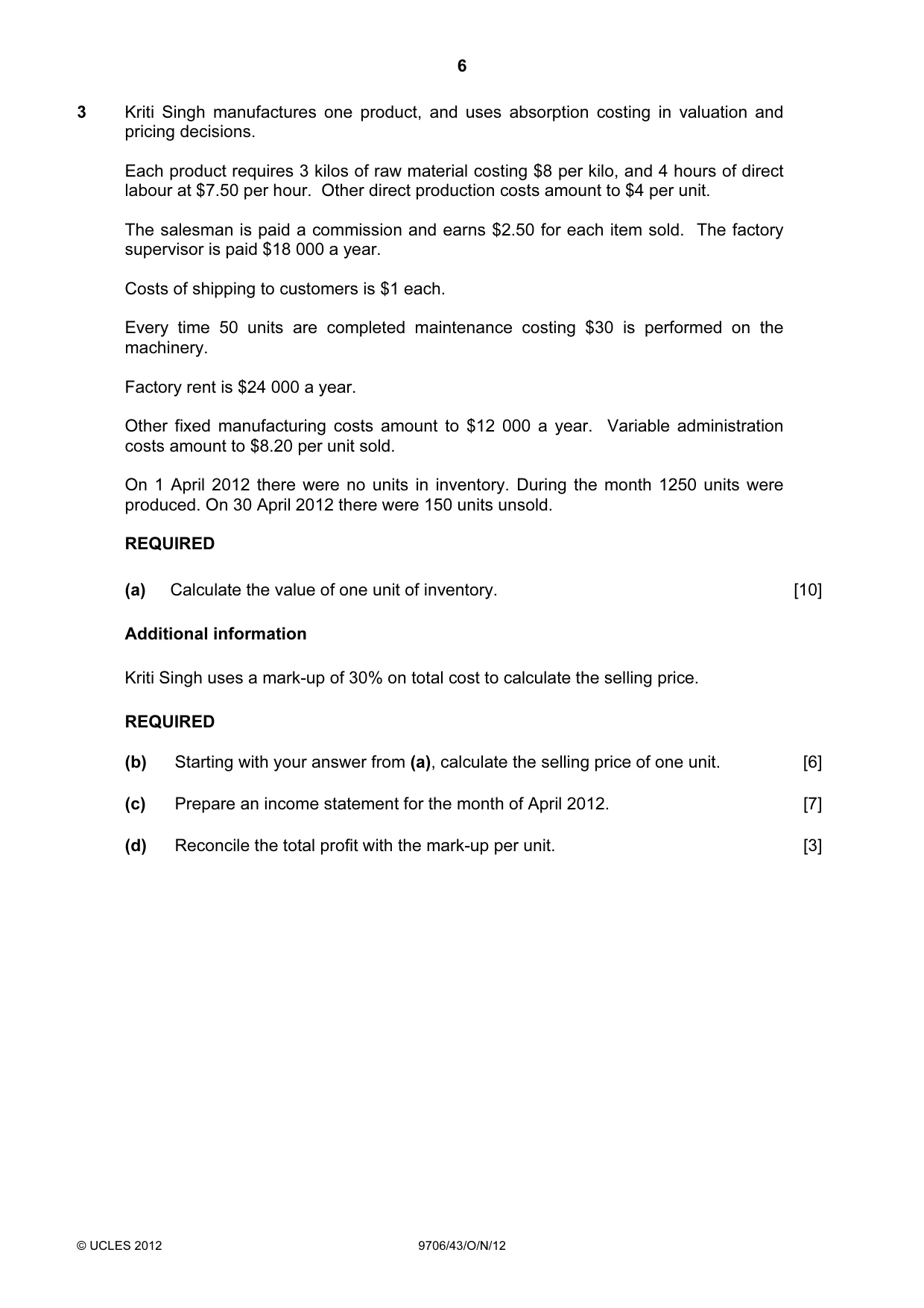
Question paper, page 6
6 © UCLES 2012 9706/43/O/N/12 3 Kriti Singh manufactures one product, and uses absorption costing in valuation and pricing decisions. Each product requires 3 kilos of raw material costing $8 per kilo, and 4 hours of direct labour at $7.50 per hour. Other direct production costs amount to $4 per unit. The salesman is paid a commission and earns $2.50 for each item sold. The factory supervisor is paid $18 000 a year. Costs of shipping to customers is $1 each. Every time 50 units are completed maintenance costing $30 is performed on the machinery. Factory rent is $24 000 a year. Other fixed manufacturing costs amount to $12 000 a year. Variable administration costs amount to $8.20 per unit sold. On 1 April 2012 there were no units in inventory. During the month 1250 units were produced. On 30 April 2012 there were 150 units unsold. REQUIRED . (a) Calculate the value of one unit of inventory. [10] Additional information Kriti Singh uses a mark-up of 30% on total cost to calculate the selling price. REQUIRED (b) Starting with your answer from (a), calculate the selling price of one unit. [6] (c) Prepare an income statement for the month of April 2012. [7] (d) Reconcile the total profit with the mark-up per unit. [3]
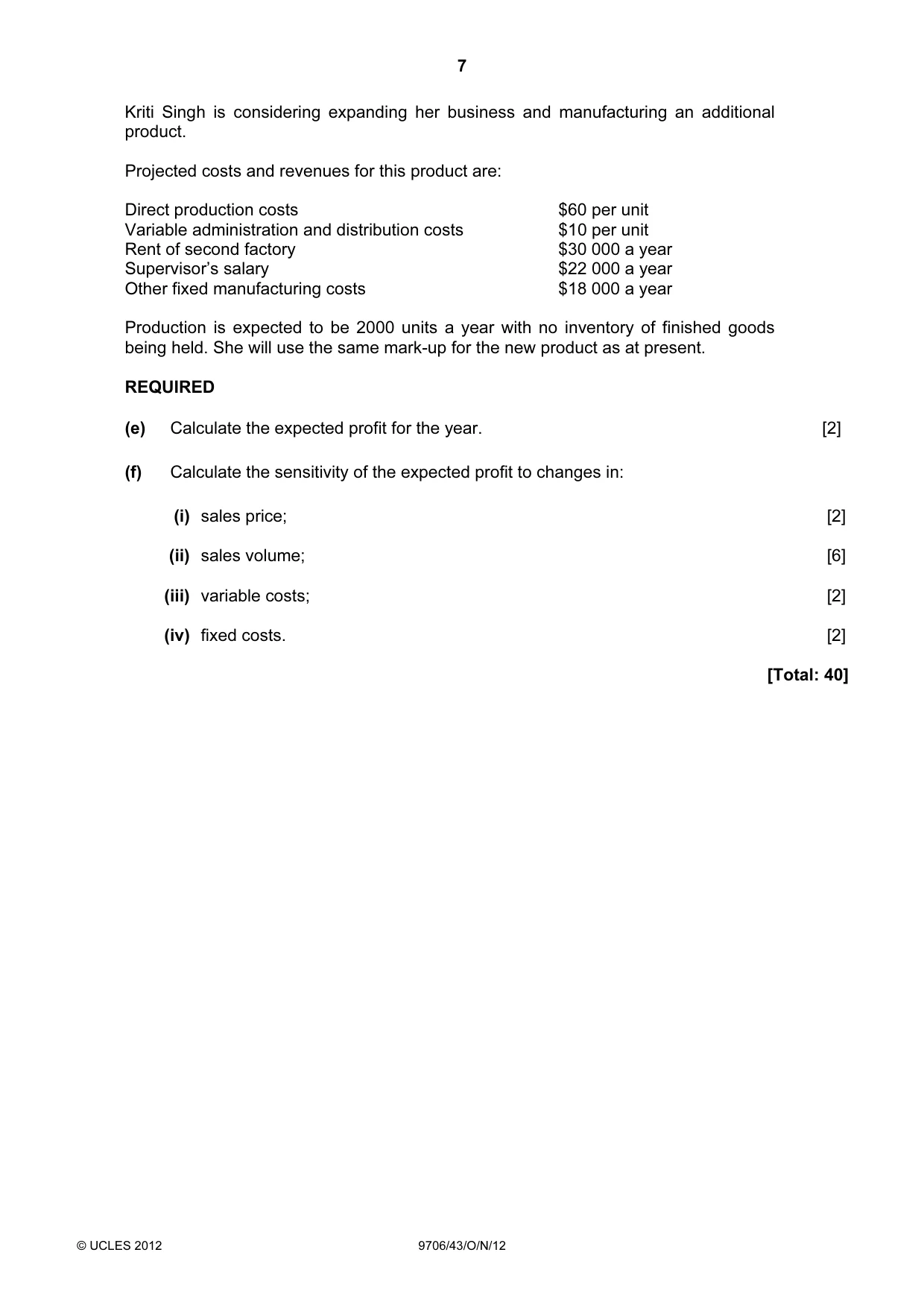
Question paper, page 7
7 © UCLES 2012 9706/43/O/N/12 Kriti Singh is considering expanding her business and manufacturing an additional product. Projected costs and revenues for this product are: Direct production costs $60 per unit Variable administration and distribution costs $10 per unit Rent of second factory $30 000 a year Supervisor’s salary $22 000 a year Other fixed manufacturing costs $18 000 a year Production is expected to be 2000 units a year with no inventory of finished goods being held. She will use the same mark-up for the new product as at present. REQUIRED (e) Calculate the expected profit for the year. [2] (f) Calculate the sensitivity of the expected profit to changes in: (i) sales price; [2] (ii) sales volume; [6] (iii) variable costs; [2] (iv) fixed costs. [2] [Total: 40]
Question paper, page 8
8 Permission to reproduce items where third-party owned material protected by copyright is included has been sought and cleared where possible. Every reasonable effort has been made by the publisher (UCLES) to trace copyright holders, but if any items requiring clearance have unwittingly been included, the publisher will be pleased to make amends at the earliest possible opportunity. University of Cambridge International Examinations is part of the Cambridge Assessment Group. Cambridge Assessment is the brand name of University of Cambridge Local Examinations Syndicate (UCLES), which is itself a department of the University of Cambridge. © UCLES 2012 9706/43/O/N/12 BLANK PAGE
Mark scheme, page 1
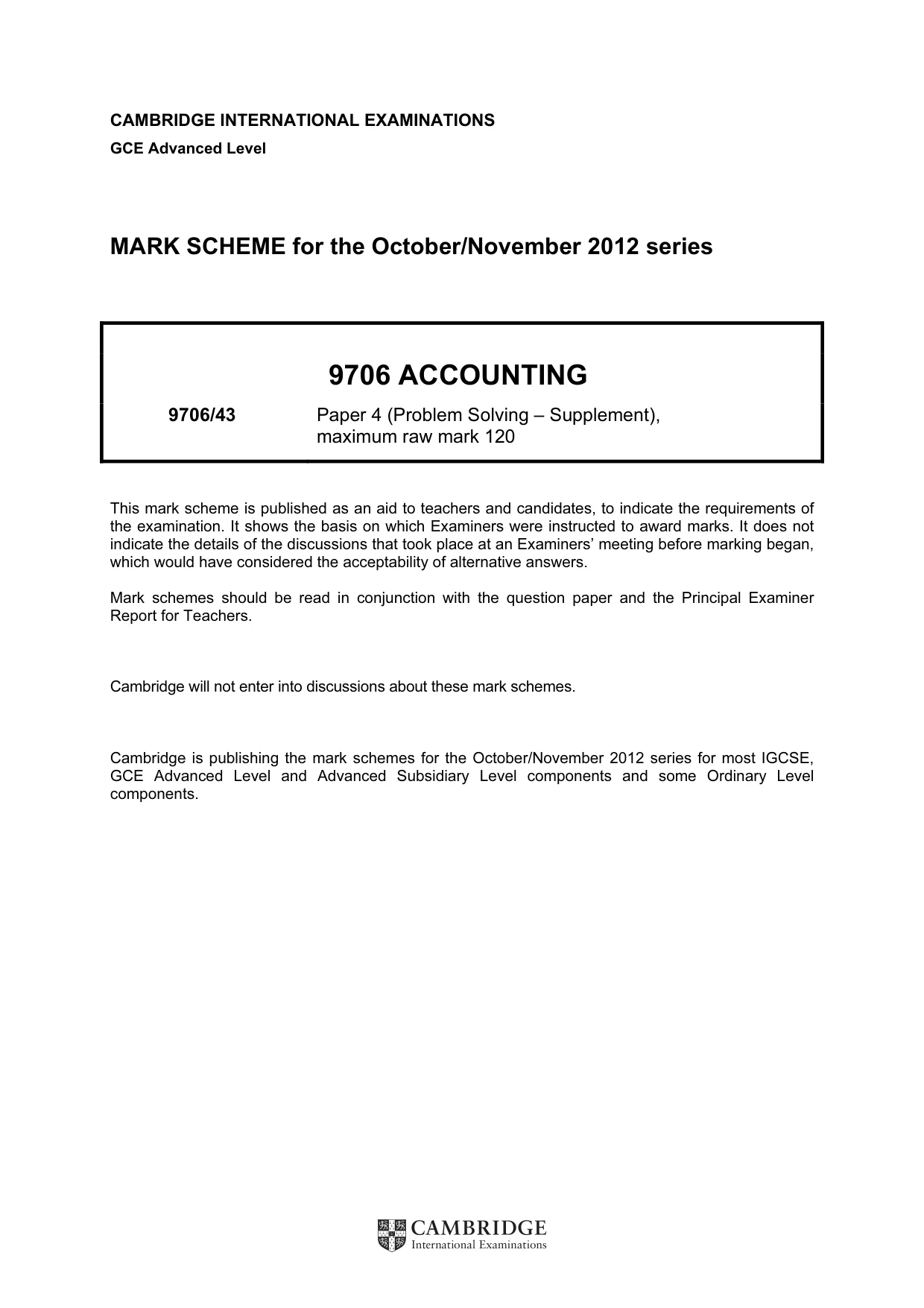
CAMBRIDGE INTERNATIONAL EXAMINATIONS GCE Advanced Level MARK SCHEME for the October/November 2012 series 9706 ACCOUNTING 9706/43 Paper 4 (Problem Solving – Supplement), maximum raw mark 120 This mark scheme is published as an aid to teachers and candidates, to indicate the requirements of the examination. It shows the basis on which Examiners were instructed to award marks. It does not indicate the details of the discussions that took place at an Examiners’ meeting before marking began, which would have considered the acceptability of alternative answers. Mark schemes should be read in conjunction with the question paper and the Principal Examiner Report for Teachers. Cambridge will not enter into discussions about these mark schemes. Cambridge is publishing the mark schemes for the October/November 2012 series for most IGCSE, GCE Advanced Level and Advanced Subsidiary Level components and some Ordinary Level components.
Mark scheme, page 2
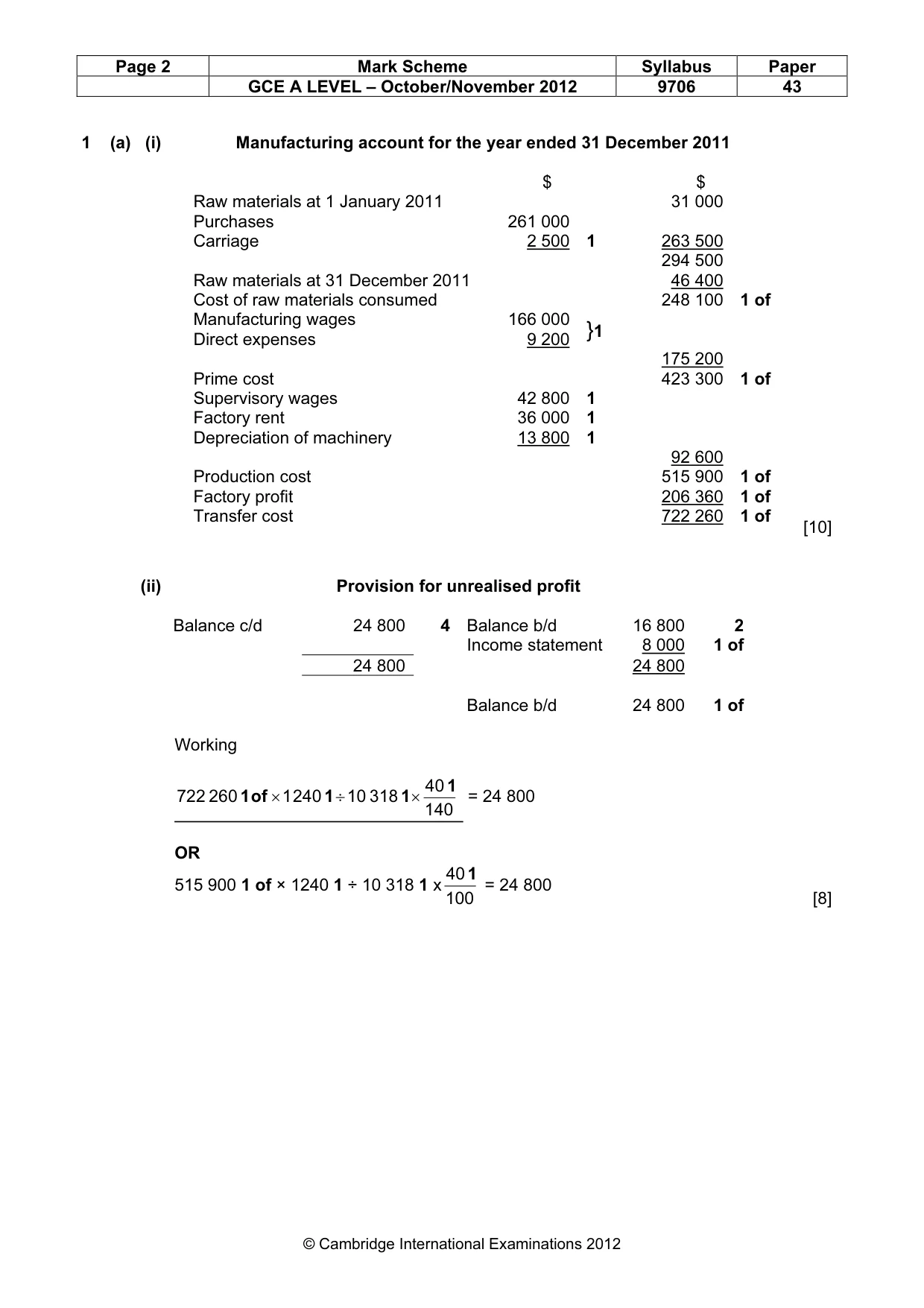
Page 2 Mark Scheme Syllabus Paper GCE A LEVEL – October/November 2012 9706 43 © Cambridge International Examinations 2012 1 (a) (i) Manufacturing account for the year ended 31 December 2011 $ $ Raw materials at 1 January 2011 31 000 Purchases 261 000 Carriage 2 500 1 263 500 294 500 Raw materials at 31 December 2011 46 400 Cost of raw materials consumed 248 100 1 of Manufacturing wages 166 000 9 200 }1 Direct expenses 175 200 Prime cost 423 300 1 of Supervisory wages 42 800 1 Factory rent 36 000 1 Depreciation of machinery 13 800 1 92 600 Production cost 515 900 1 of Factory profit 206 360 1 of Transfer cost 722 260 1 of [10] (ii) Provision for unrealised profit Balance c/d 24 800 4 Balance b/d 16 800 2 Income statement 8 000 1 of 24 800 24 800 Balance b/d 24 800 1 of Working 140 40 318 10 240 1 260 722 1 1 1 of 1 × ÷ × = 24 800 OR 515 900 1 of × 1240 1 ÷ 10 318 1 x 100 401 = 24 800 [8]
Mark scheme, page 3
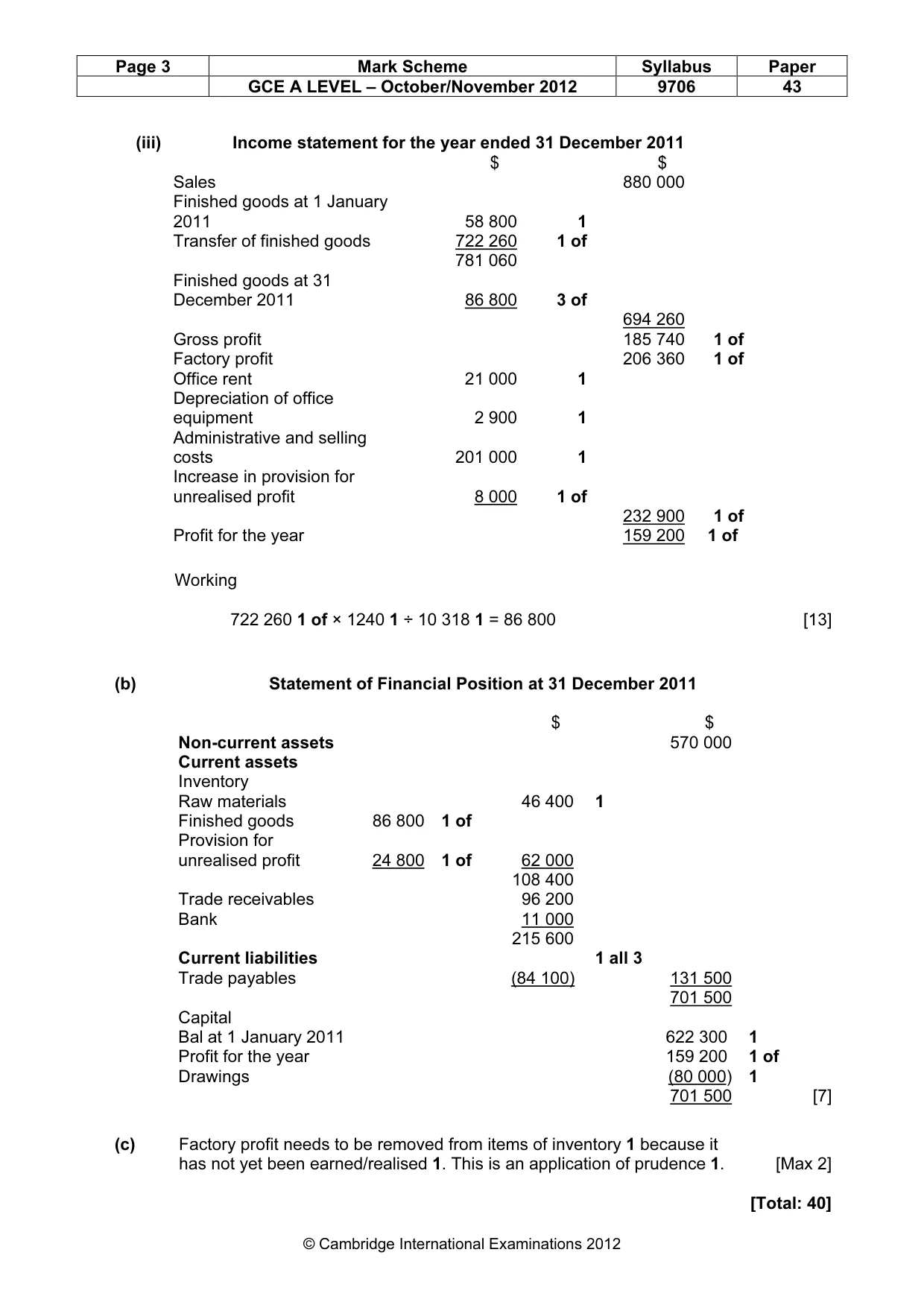
Page 3 Mark Scheme Syllabus Paper GCE A LEVEL – October/November 2012 9706 43 © Cambridge International Examinations 2012 (iii) Income statement for the year ended 31 December 2011 $ $ Sales 880 000 Finished goods at 1 January 2011 58 800 1 Transfer of finished goods 722 260 1 of 781 060 Finished goods at 31 December 2011 86 800 3 of 694 260 Gross profit 185 740 1 of Factory profit 206 360 1 of Office rent 21 000 1 Depreciation of office equipment 2 900 1 Administrative and selling costs 201 000 1 Increase in provision for unrealised profit 8 000 1 of 232 900 1 of Profit for the year 159 200 1 of Working 722 260 1 of × 1240 1 ÷ 10 318 1 = 86 800 [13] (b) Statement of Financial Position at 31 December 2011 $ $ Non-current assets 570 000 Current assets Inventory Raw materials 46 400 1 Finished goods 86 800 1 of Provision for unrealised profit 24 800 1 of 62 000 108 400 Trade receivables 96 200 Bank 11 000 215 600 Current liabilities 1 all 3 Trade payables (84 100) 131 500 701 500 Capital Bal at 1 January 2011 622 300 1 Profit for the year 159 200 1 of Drawings (80 000) 1 701 500 [7] (c) Factory profit needs to be removed from items of inventory 1 because it has not yet been earned/realised 1. This is an application of prudence 1. [Max 2] [Total: 40]
Mark scheme, page 4
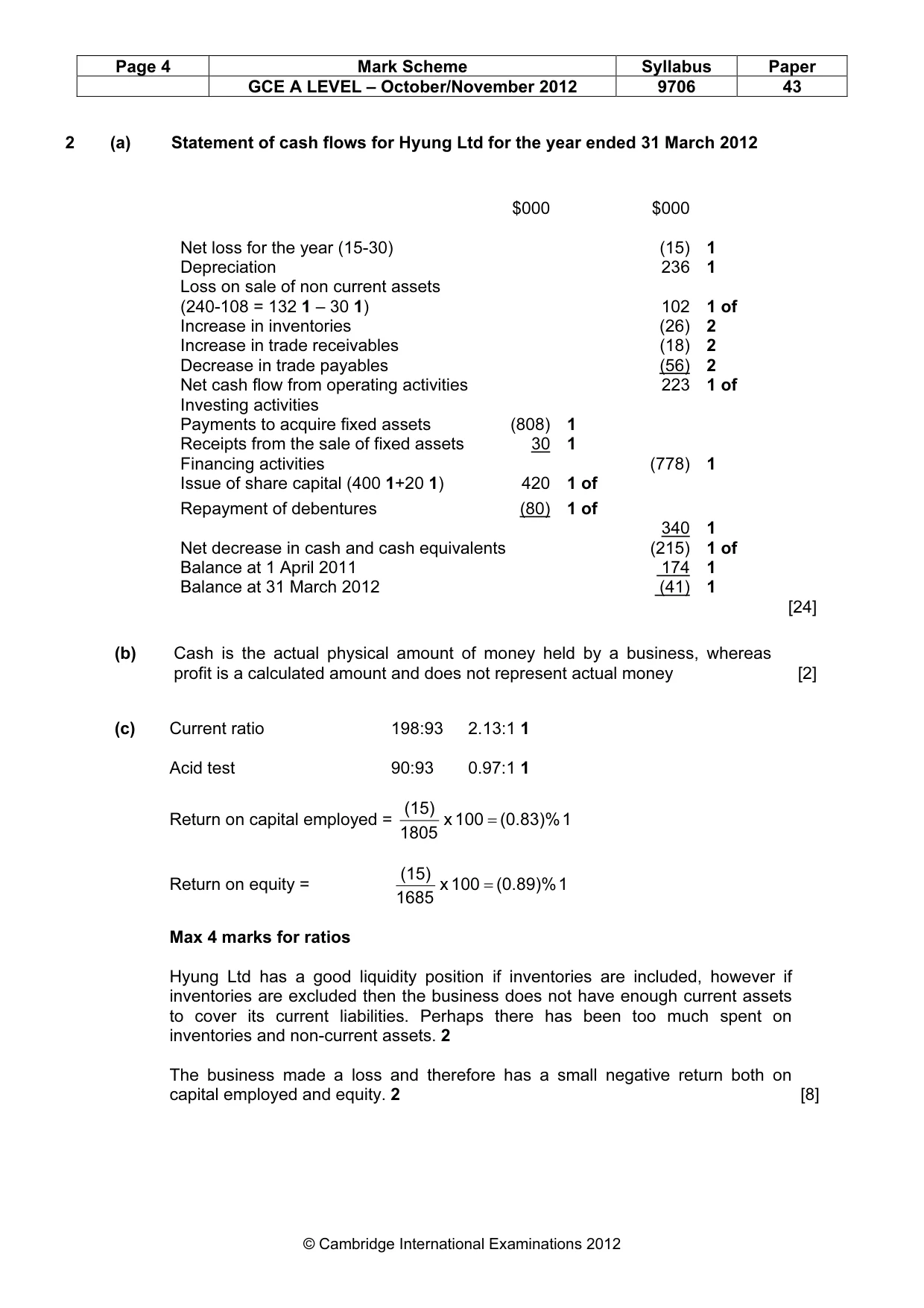
Page 4 Mark Scheme Syllabus Paper GCE A LEVEL – October/November 2012 9706 43 © Cambridge International Examinations 2012 2 (a) Statement of cash flows for Hyung Ltd for the year ended 31 March 2012 $000 $000 Net loss for the year (15-30) (15) 1 Depreciation 236 1 Loss on sale of non current assets (240-108 = 132 1 – 30 1) 102 1 of Increase in inventories (26) 2 Increase in trade receivables (18) 2 Decrease in trade payables (56) 2 Net cash flow from operating activities 223 1 of Investing activities Payments to acquire fixed assets (808) 1 Receipts from the sale of fixed assets 30 1 Financing activities (778) 1 Issue of share capital (400 1+20 1) 420 1 of Repayment of debentures (80) 1 of 340 1 Net decrease in cash and cash equivalents (215) 1 of Balance at 1 April 2011 174 1 Balance at 31 March 2012 (41) 1 [24] (b) Cash is the actual physical amount of money held by a business, whereas profit is a calculated amount and does not represent actual money [2] (c) Current ratio 198:93 2.13:1 1 Acid test 90:93 0.97:1 1 Return on capital employed = 1 (0.83)% 100 x 1805 (15) = Return on equity = 1 (0.89)% 100 x 1685 (15) = Max 4 marks for ratios Hyung Ltd has a good liquidity position if inventories are included, however if inventories are excluded then the business does not have enough current assets to cover its current liabilities. Perhaps there has been too much spent on inventories and non-current assets. 2 The business made a loss and therefore has a small negative return both on capital employed and equity. 2 [8]
Mark scheme, page 5
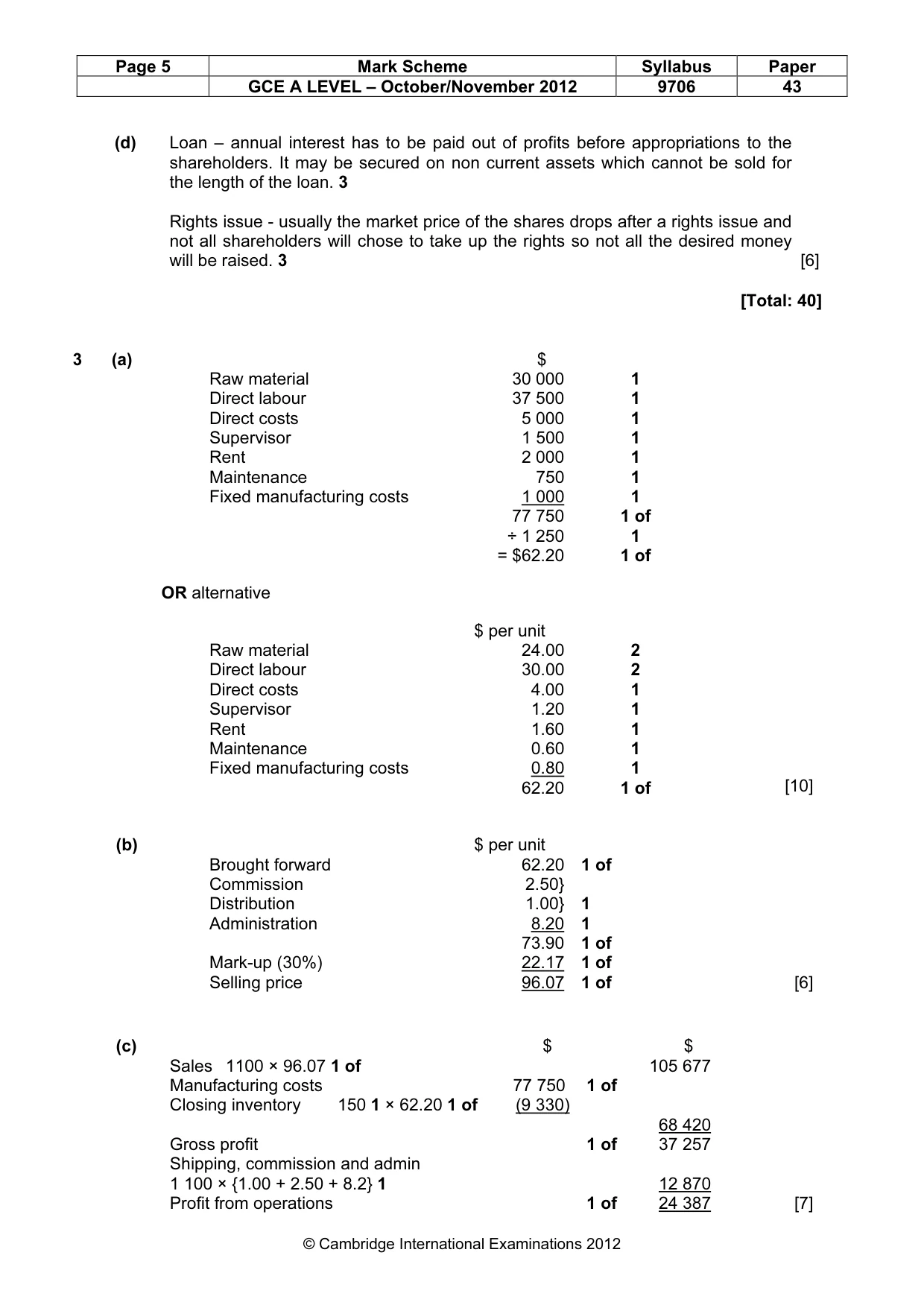
Page 5 Mark Scheme Syllabus Paper GCE A LEVEL – October/November 2012 9706 43 © Cambridge International Examinations 2012 (d) Loan – annual interest has to be paid out of profits before appropriations to the shareholders. It may be secured on non current assets which cannot be sold for the length of the loan. 3 Rights issue - usually the market price of the shares drops after a rights issue and not all shareholders will chose to take up the rights so not all the desired money will be raised. 3 [6] [Total: 40] 3 (a) $ Raw material 30 000 1 Direct labour 37 500 1 Direct costs 5 000 1 Supervisor 1 500 1 Rent 2 000 1 Maintenance 750 1 Fixed manufacturing costs 1 000 1 77 750 1 of ÷ 1 250 1 = $62.20 1 of OR alternative $ per unit Raw material 24.00 2 Direct labour 30.00 2 Direct costs 4.00 1 Supervisor 1.20 1 Rent 1.60 1 Maintenance 0.60 1 Fixed manufacturing costs 0.80 1 62.20 1 of [10] (b) $ per unit Brought forward 62.20 1 of Commission 2.50} Distribution 1.00} 1 Administration 8.20 1 73.90 1 of Mark-up (30%) 22.17 1 of Selling price 96.07 1 of [6] (c) $ $ Sales 1100 × 96.07 1 of 105 677 Manufacturing costs 77 750 1 of Closing inventory 150 1 × 62.20 1 of (9 330) 68 420 Gross profit 1 of 37 257 Shipping, commission and admin 1 100 × {1.00 + 2.50 + 8.2} 1 12 870 Profit from operations 1 of 24 387 [7]
Mark scheme, page 6
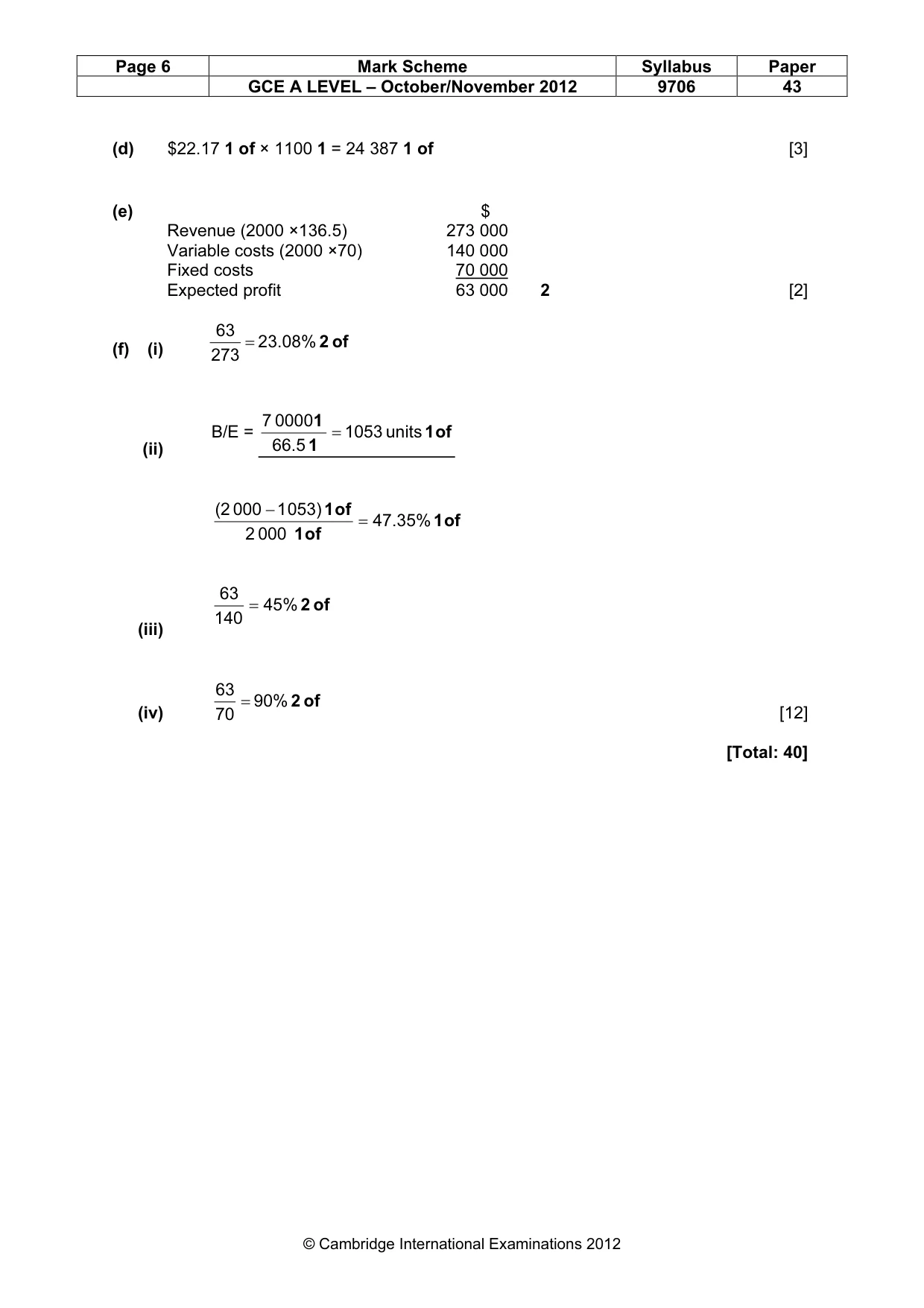
Page 6 Mark Scheme Syllabus Paper GCE A LEVEL – October/November 2012 9706 43 © Cambridge International Examinations 2012 (d) $22.17 1 of × 1100 1 = 24 387 1 of [3] (e) $ Revenue (2000 ×136.5) 273 000 Variable costs (2000 ×70) 140 000 Fixed costs 70 000 Expected profit 63 000 2 [2] (f) (i) of 2 23.08% 273 63 = (ii) B/E = of 1 1 1 units 1053 66.5 0000 7 = of 1 of 1 of 1 % 35 . 47 000 2 053) 1 000 (2 = − (iii) of 2 45% 140 63 = (iv) of 2 90% 70 63 = [12] [Total: 40]
What you needed in this session
Cambridge’s own grade thresholds for 2012 Oct/Nov, Paper 4 · Variant 3. A higher threshold means an easier paper — the bar moves with how the cohort did.