Cambridge A Level Accounting 9706 — 2012 Oct/Nov Paper 4 · Variant 1
9706/41/O/N/12 · 120 marks · ≈135 min
The question paper and its mark scheme, free to read here and free to download. This is Cambridge’s own paper, exactly as it was sat.
Question paper8 pages
Mark scheme5 pages
Answers below. Sit the paper first if you are practising.
Paper as text
Question paper, page 1
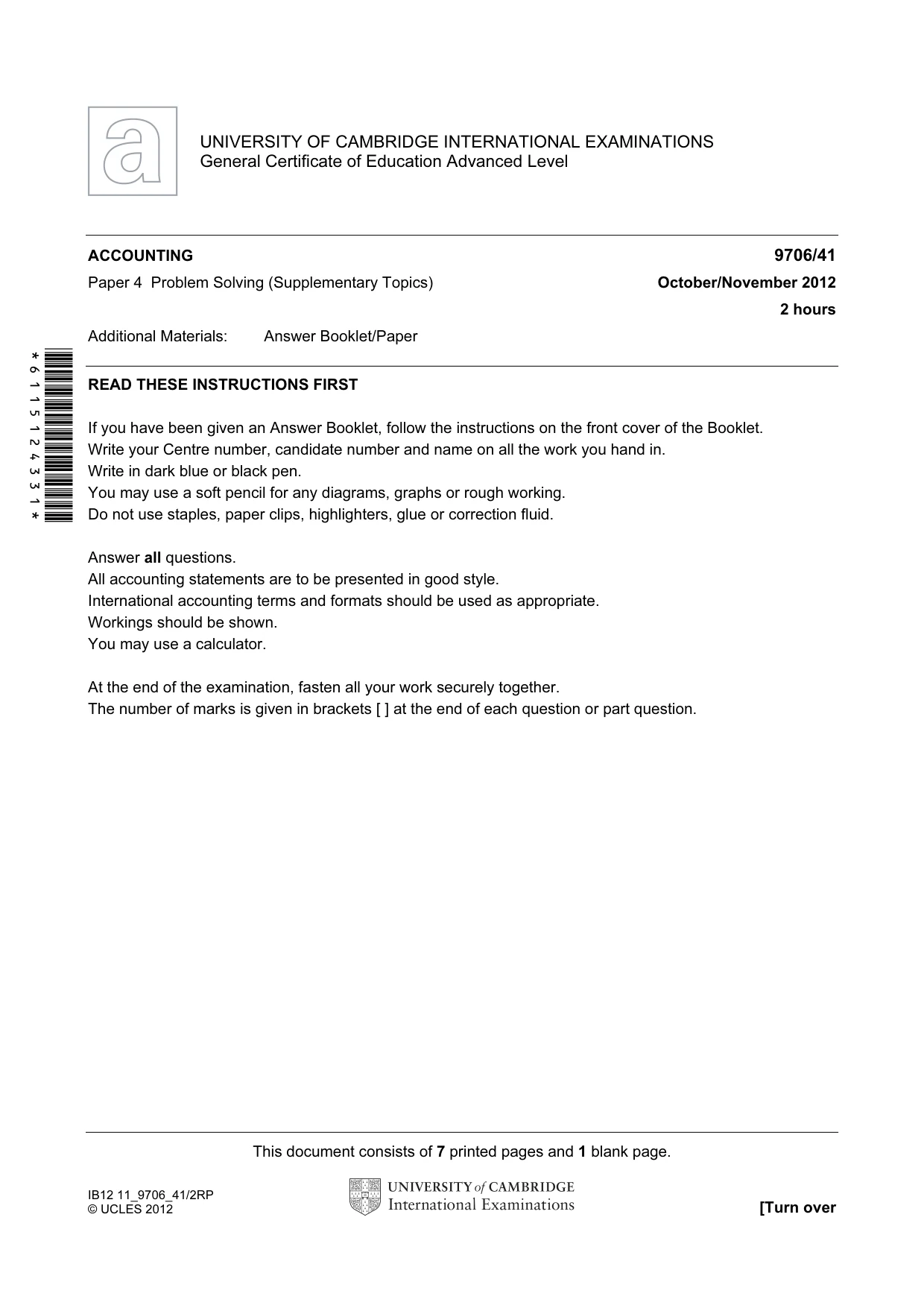
This document consists of 7 printed pages and 1 blank page. IB12 11_9706_41/2RP © UCLES 2012 [Turn over *6115124331* UNIVERSITY OF CAMBRIDGE INTERNATIONAL EXAMINATIONS General Certificate of Education Advanced Level ACCOUNTING 9706/41 Paper 4 Problem Solving (Supplementary Topics) October/November 2012 2 hours Additional Materials: Answer Booklet/Paper READ THESE INSTRUCTIONS FIRST If you have been given an Answer Booklet, follow the instructions on the front cover of the Booklet. Write your Centre number, candidate number and name on all the work you hand in. Write in dark blue or black pen. You may use a soft pencil for any diagrams, graphs or rough working. Do not use staples, paper clips, highlighters, glue or correction fluid. Answer all questions. All accounting statements are to be presented in good style. International accounting terms and formats should be used as appropriate. Workings should be shown. You may use a calculator. At the end of the examination, fasten all your work securely together. The number of marks is given in brackets [ ] at the end of each question or part question.
Question paper, page 2
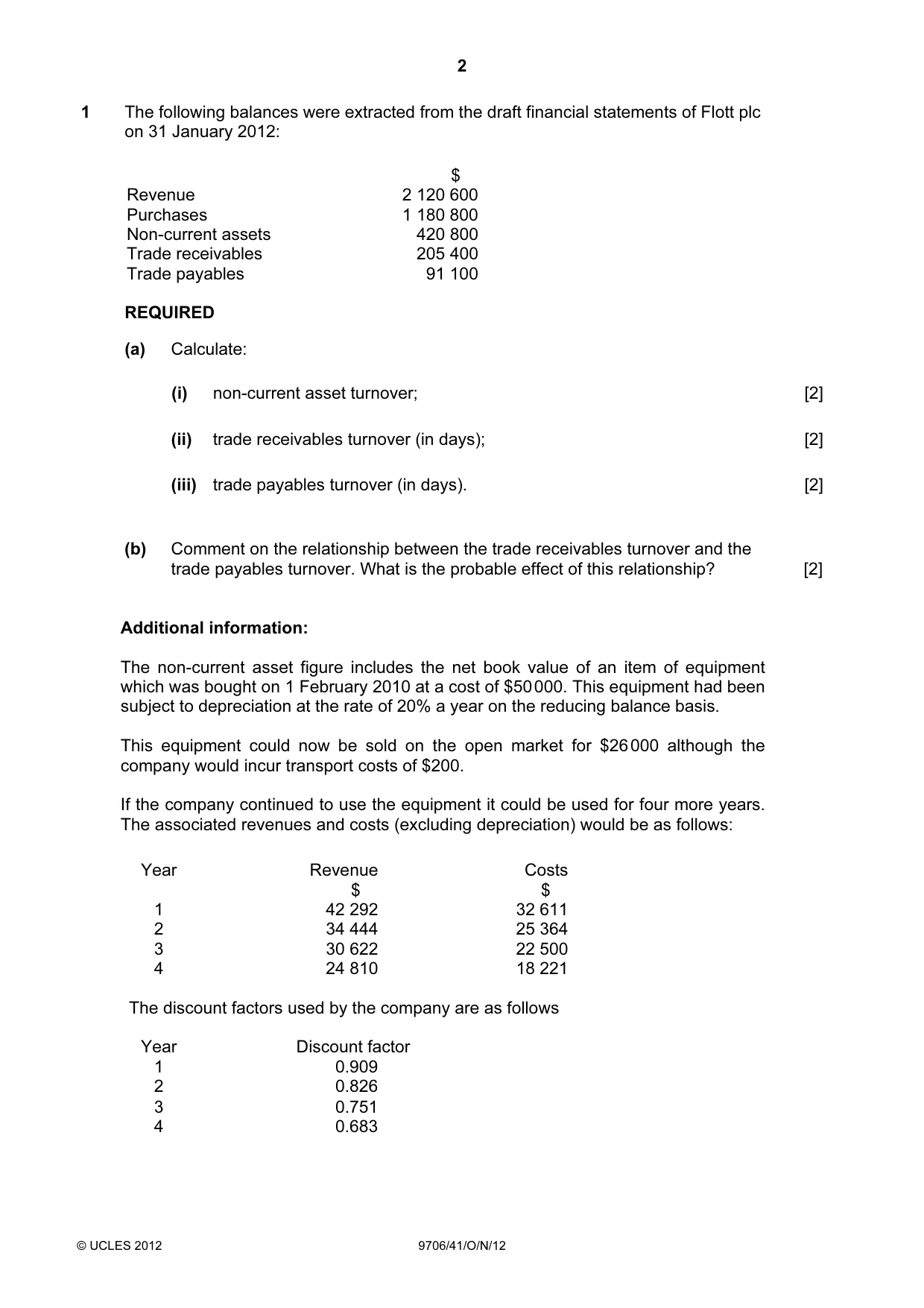
2 © UCLES 2012 9706/41/O/N/12 1 The following balances were extracted from the draft financial statements of Flott plc on 31 January 2012: $ Revenue 2 120 600 Purchases 1 180 800 Non-current assets 420 800 Trade receivables 205 400 Trade payables 91 100 . REQUIRED (a) Calculate: (i) non-current asset turnover; [2] (ii) trade receivables turnover (in days); [2] (iii) trade payables turnover (in days). [2] (b) Comment on the relationship between the trade receivables turnover and the trade payables turnover. What is the probable effect of this relationship? [2] Additional information: The non-current asset figure includes the net book value of an item of equipment which was bought on 1 February 2010 at a cost of $50 000. This equipment had been subject to depreciation at the rate of 20% a year on the reducing balance basis. This equipment could now be sold on the open market for $26 000 although the company would incur transport costs of $200. If the company continued to use the equipment it could be used for four more years. The associated revenues and costs (excluding depreciation) would be as follows: Year Revenue Costs $ $ 1 42 292 32 611 2 34 444 25 364 3 30 622 22 500 4 24 810 18 221 The discount factors used by the company are as follows Year Discount factor 1 0.909 2 0.826 3 0.751 4 0.683
Question paper, page 3
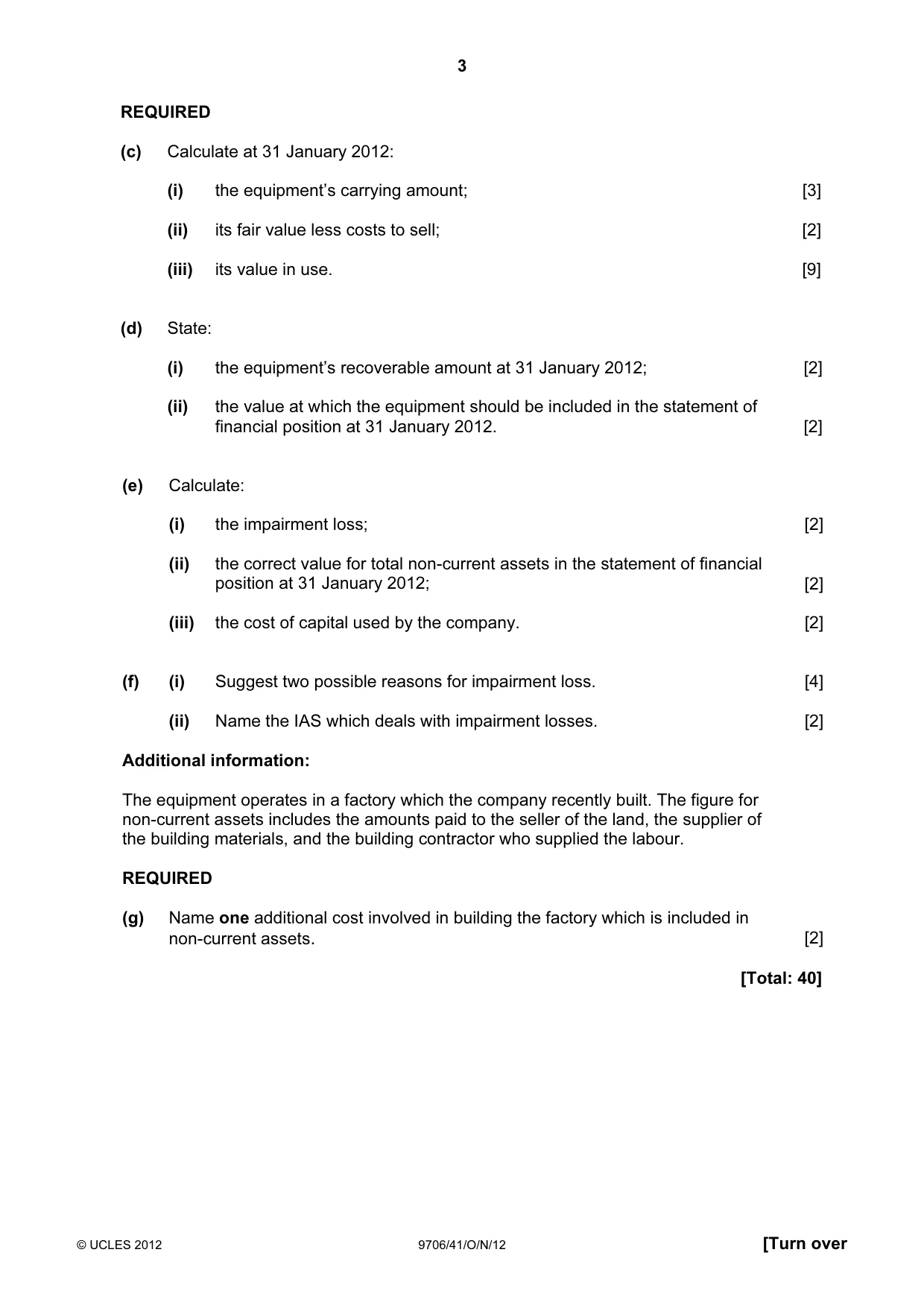
3 © UCLES 2012 9706/41/O/N/12 [Turn over REQUIRED (c) Calculate at 31 January 2012: (i) the equipment’s carrying amount; [3] (ii) its fair value less costs to sell; [2] (iii) its value in use. [9] (d) State: (i) the equipment’s recoverable amount at 31 January 2012; [2] (ii) the value at which the equipment should be included in the statement of financial position at 31 January 2012. [2] (e) Calculate: (i) the impairment loss; [2] (ii) the correct value for total non-current assets in the statement of financial position at 31 January 2012; [2] (iii) the cost of capital used by the company. [2] (f) (i) Suggest two possible reasons for impairment loss. [4] (ii) Name the IAS which deals with impairment losses. [2] Additional information: The equipment operates in a factory which the company recently built. The figure for non-current assets includes the amounts paid to the seller of the land, the supplier of the building materials, and the building contractor who supplied the labour. REQUIRED (g) Name one additional cost involved in building the factory which is included in non-current assets. [2] [Total: 40]
Question paper, page 4
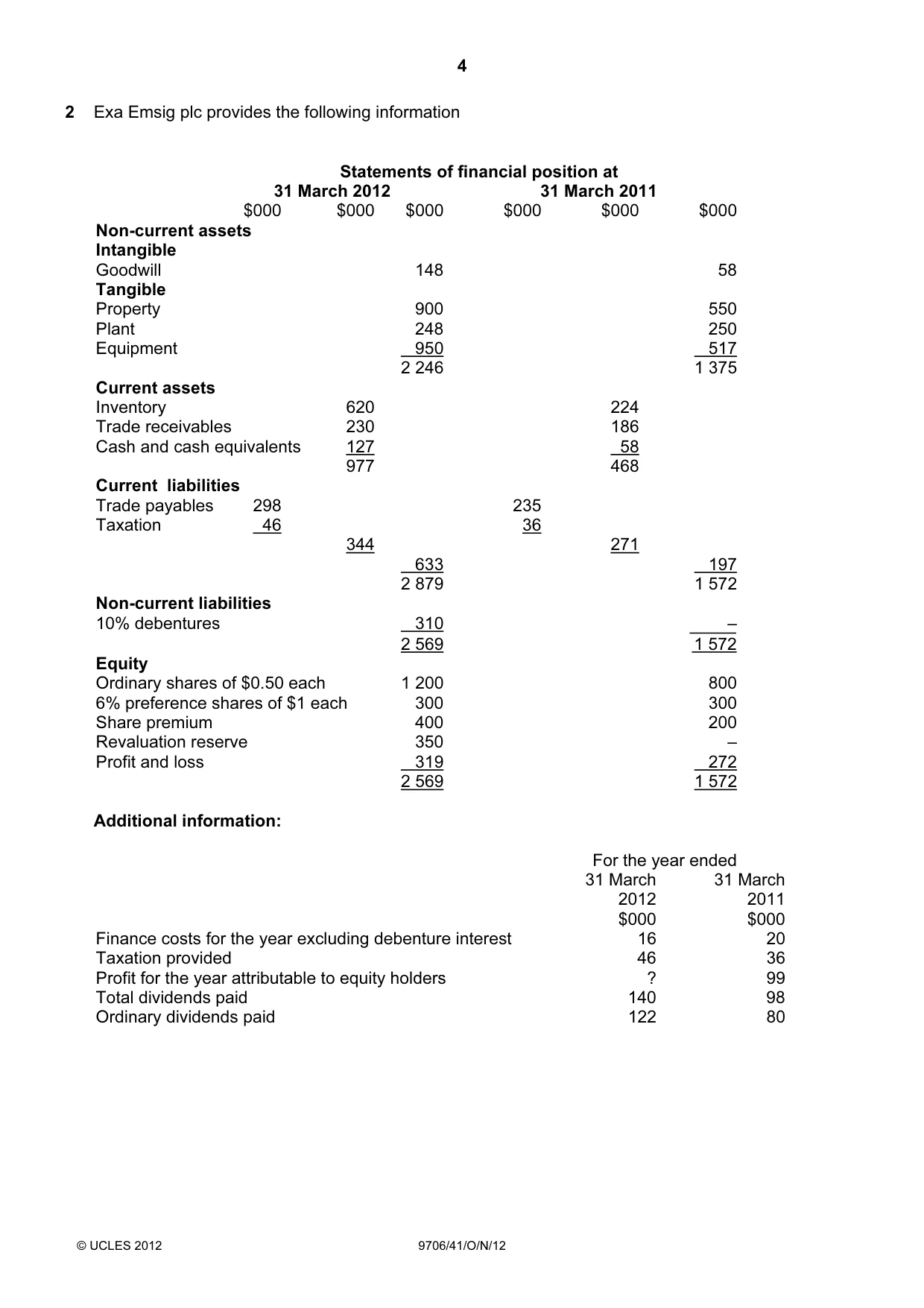
4 © UCLES 2012 9706/41/O/N/12 2 Exa Emsig plc provides the following information Statements of financial position at 31 March 2012 31 March 2011 $000 $000 $000 $000 $000 $000 Non-current assets Intangible Goodwill 148 58 Tangible Property 900 550 Plant 248 250 Equipment 950 517 2 246 1 375 Current assets Inventory 620 224 Trade receivables 230 186 Cash and cash equivalents 127 58 9977 468 Current liabilities Trade payables 298 235 Taxation 46 36 344 271 633 197 2 879 1 572 Non-current liabilities 10% debentures 310 – 2 569 1 572 Equity Ordinary shares of $0.50 each 1 200 800 6% preference shares of $1 each 300 300 Share premium 400 200 Revaluation reserve 350 – Profit and loss 319 272 2 569 1 572 . Additional information: For the year ended 31 March 2012 31 March 2011 $000 $000 Finance costs for the year excluding debenture interest 16 20 Taxation provided 46 36 Profit for the year attributable to equity holders ? 99 Total dividends paid 140 98 Ordinary dividends paid 122 80
Question paper, page 5
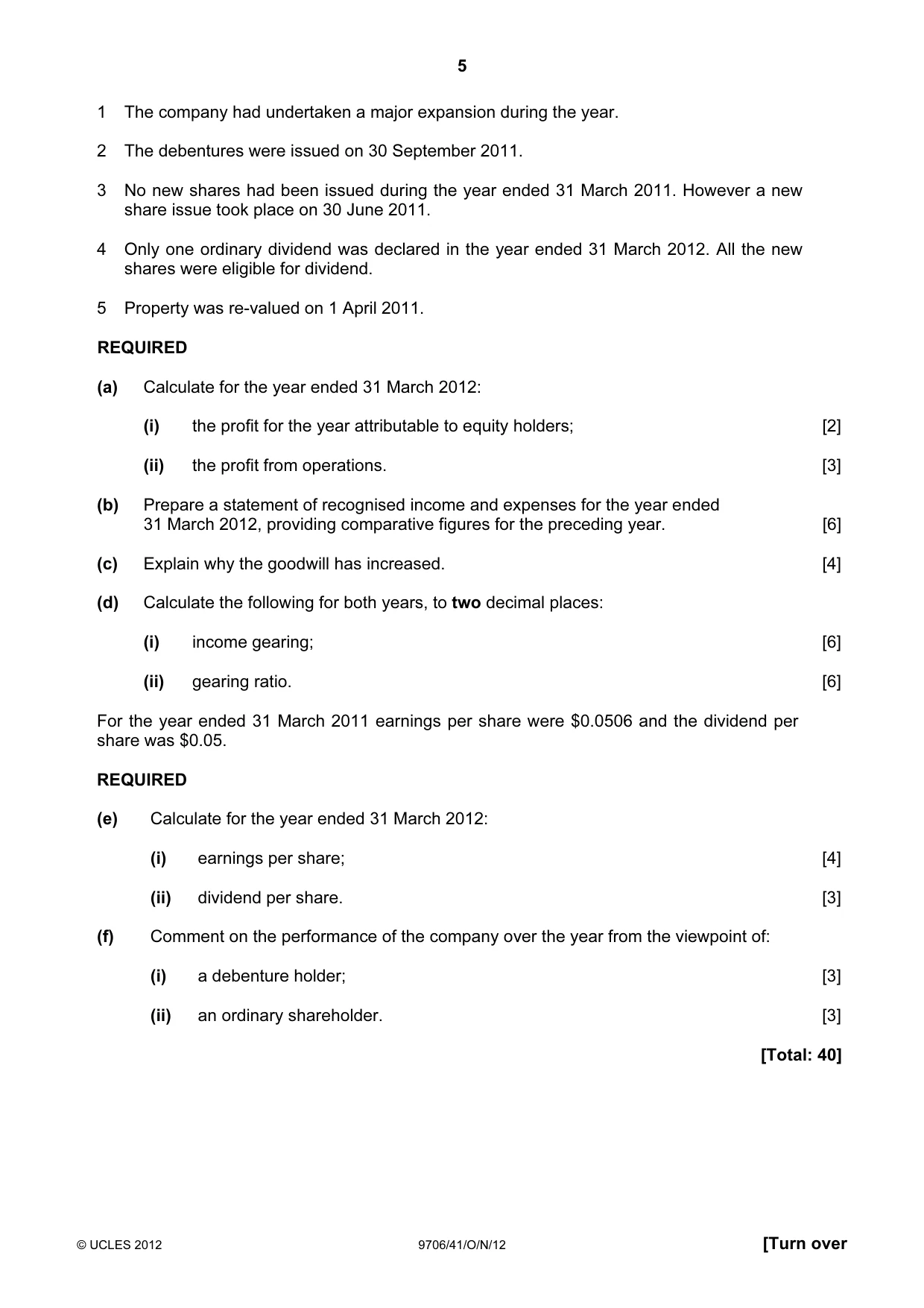
5 © UCLES 2012 9706/41/O/N/12 [Turn over 1 The company had undertaken a major expansion during the year. 2 The debentures were issued on 30 September 2011. 3 No new shares had been issued during the year ended 31 March 2011. However a new share issue took place on 30 June 2011. 4 Only one ordinary dividend was declared in the year ended 31 March 2012. All the new shares were eligible for dividend. 5 Property was re-valued on 1 April 2011. REQUIRED (a) Calculate for the year ended 31 March 2012: (i) the profit for the year attributable to equity holders; [2] (ii) the profit from operations. [3] (b) Prepare a statement of recognised income and expenses for the year ended 31 March 2012, providing comparative figures for the preceding year. [6] (c) Explain why the goodwill has increased. [4] (d) Calculate the following for both years, to two decimal places: (i) income gearing; [6] (ii) gearing ratio. [6] For the year ended 31 March 2011 earnings per share were $0.0506 and the dividend per share was $0.05. REQUIRED (e) Calculate for the year ended 31 March 2012: (i) earnings per share; [4] (ii) dividend per share. [3] (f) Comment on the performance of the company over the year from the viewpoint of: (i) a debenture holder; [3] (ii) an ordinary shareholder. [3] [Total: 40]
Question paper, page 6
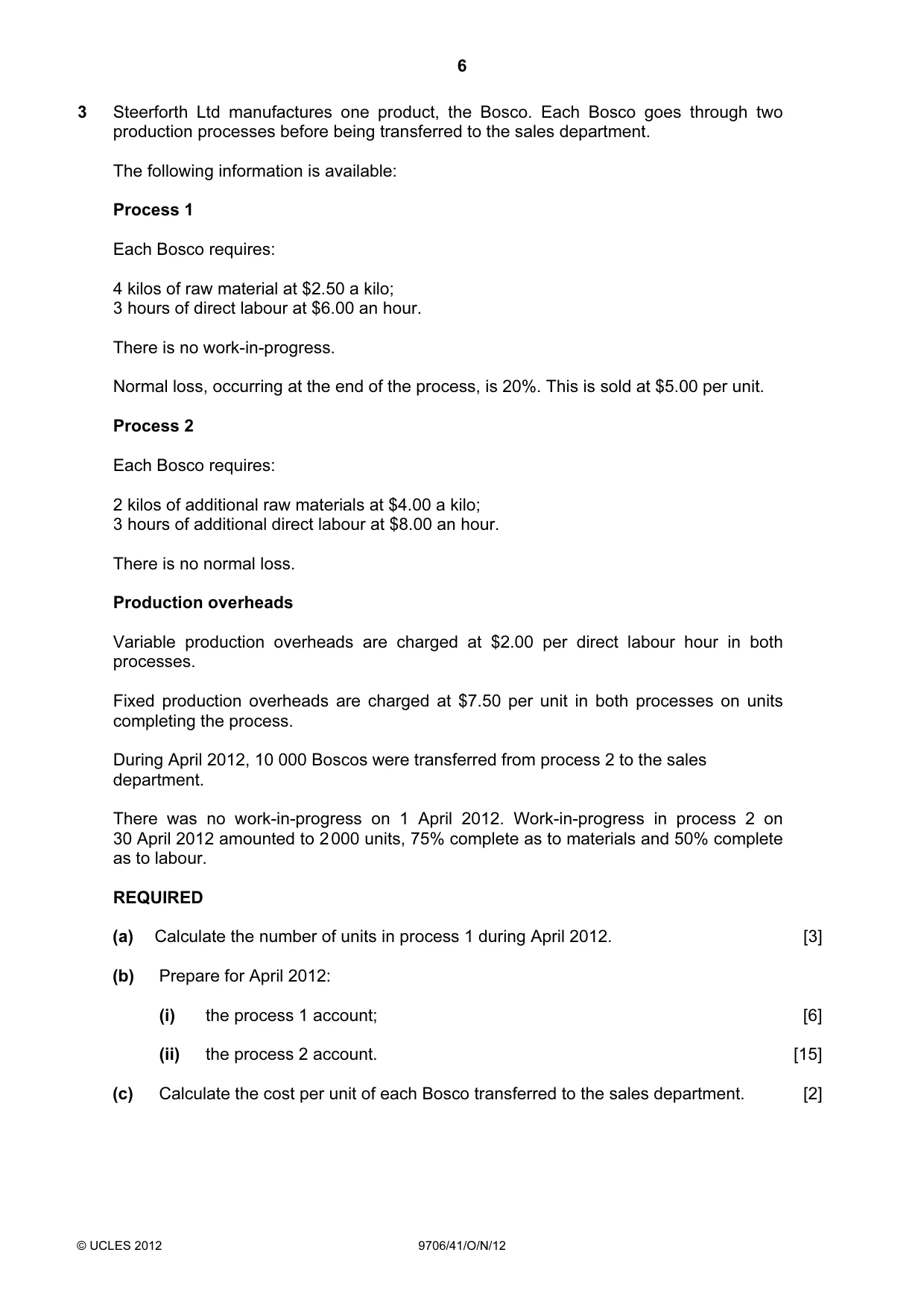
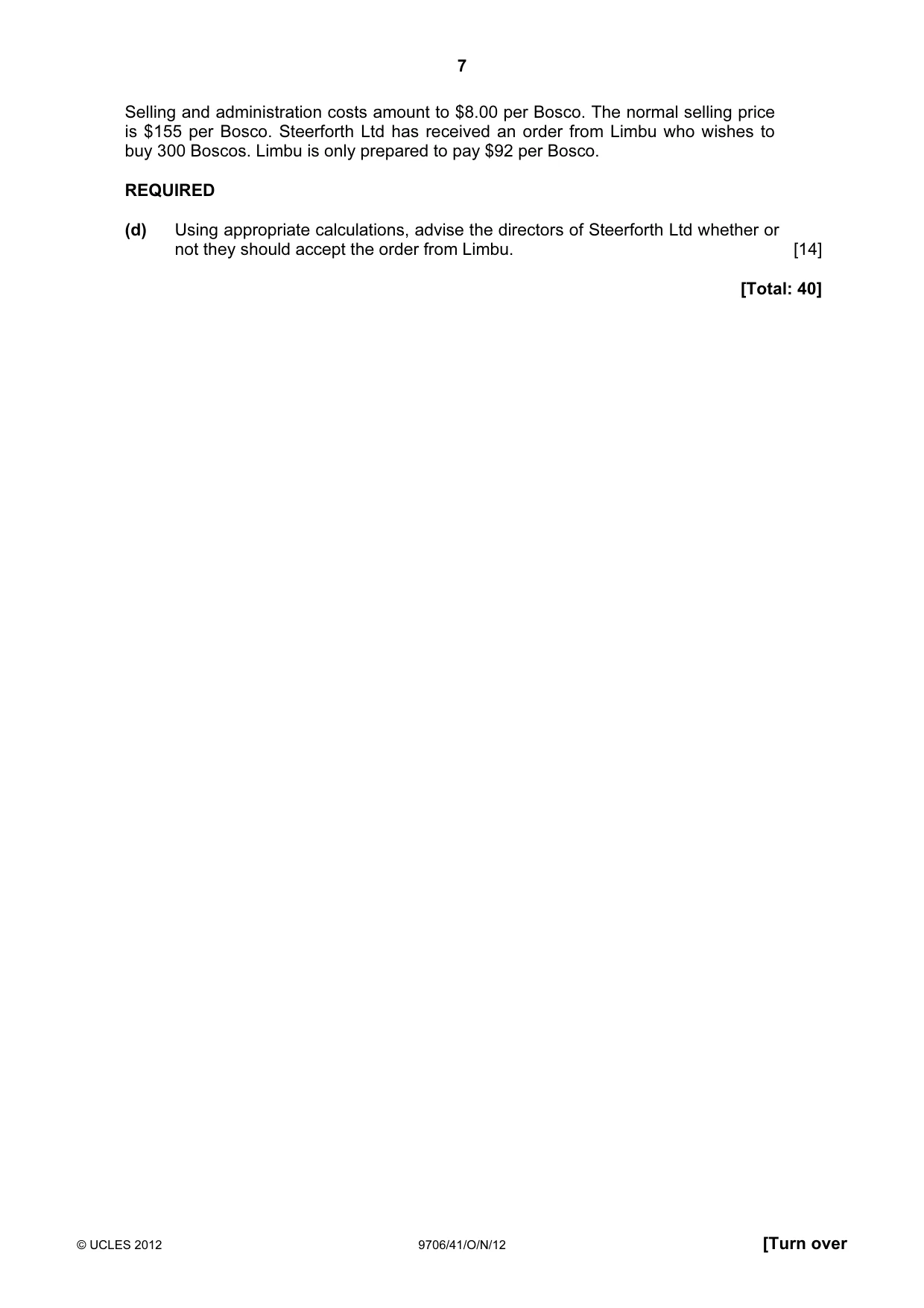
6 © UCLES 2012 9706/41/O/N/12 3 Steerforth Ltd manufactures one product, the Bosco. Each Bosco goes through two production processes before being transferred to the sales department. The following information is available: Process 1 Each Bosco requires: 4 kilos of raw material at $2.50 a kilo; 3 hours of direct labour at $6.00 an hour. There is no work-in-progress. Normal loss, occurring at the end of the process, is 20%. This is sold at $5.00 per unit. Process 2 Each Bosco requires: 2 kilos of additional raw materials at $4.00 a kilo; 3 hours of additional direct labour at $8.00 an hour. There is no normal loss. Production overheads Variable production overheads are charged at $2.00 per direct labour hour in both processes. Fixed production overheads are charged at $7.50 per unit in both processes on units completing the process. During April 2012, 10 000 Boscos were transferred from process 2 to the sales department. There was no work-in-progress on 1 April 2012. Work-in-progress in process 2 on 30 April 2012 amounted to 2 000 units, 75% complete as to materials and 50% complete as to labour. REQUIRED. (a) Calculate the number of units in process 1 during April 2012. [3] (b) Prepare for April 2012: (i) the process 1 account; [6] (ii) the process 2 account. [15] (c) Calculate the cost per unit of each Bosco transferred to the sales department. [2]
Question paper, page 7
7 © UCLES 2012 9706/41/O/N/12 [Turn over Selling and administration costs amount to $8.00 per Bosco. The normal selling price is $155 per Bosco. Steerforth Ltd has received an order from Limbu who wishes to buy 300 Boscos. Limbu is only prepared to pay $92 per Bosco. REQUIRED (d) Using appropriate calculations, advise the directors of Steerforth Ltd whether or not they should accept the order from Limbu. [14] [Total: 40]
Question paper, page 8
8 Permission to reproduce items where third-party owned material protected by copyright is included has been sought and cleared where possible. Every reasonable effort has been made by the publisher (UCLES) to trace copyright holders, but if any items requiring clearance have unwittingly been included, the publisher will be pleased to make amends at the earliest possible opportunity. University of Cambridge International Examinations is part of the Cambridge Assessment Group. Cambridge Assessment is the brand name of University of Cambridge Local Examinations Syndicate (UCLES), which is itself a department of the University of Cambridge. © UCLES 2012 9706/41/O/N/12 BLANK PAGE
Mark scheme, page 1
CAMBRIDGE INTERNATIONAL EXAMINATIONS GCE Advanced Level MARK SCHEME for the October/November 2012 series 9706 ACCOUNTING 9706/41 Paper 4(Problem Solving – Supplement), maximum raw mark 120 This mark scheme is published as an aid to teachers and candidates, to indicate the requirements of the examination. It shows the basis on which Examiners were instructed to award marks. It does not indicate the details of the discussions that took place at an Examiners’ meeting before marking began, which would have considered the acceptability of alternative answers. Mark schemes should be read in conjunction with the question paper and the Principal Examiner Report for Teachers. Cambridge will not enter into discussions about these mark schemes. Cambridge is publishing the mark schemes for the October/November 2012 series for most IGCSE, GCE Advanced Level and Advanced Subsidiary Level components and some Ordinary Level components.
Mark scheme, page 2
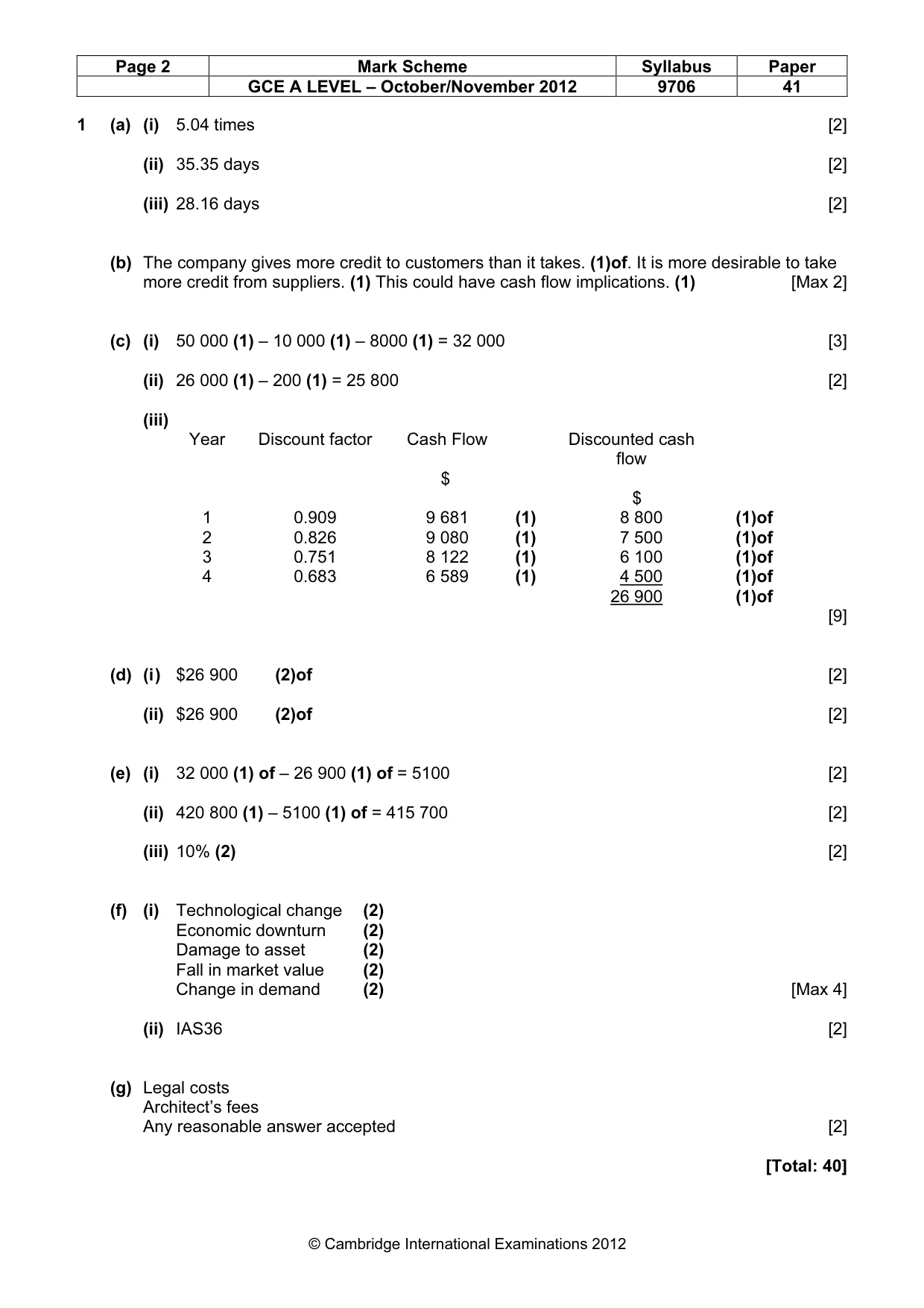
Page 2 Mark Scheme Syllabus Paper GCE A LEVEL – October/November 2012 9706 41 © Cambridge International Examinations 2012 1 (a) (i) 5.04 times [2] (ii) 35.35 days [2] (iii) 28.16 days [2] (b) The company gives more credit to customers than it takes. (1)of. It is more desirable to take more credit from suppliers. (1) This could have cash flow implications. (1) [Max 2] (c) (i) 50 000 (1) – 10 000 (1) – 8000 (1) = 32 000 [3] (ii) 26 000 (1) – 200 (1) = 25 800 [2] (iii) Year Discount factor Cash Flow Discounted cash flow $ $ 1 0.909 9 681 (1) 8 800 (1)of 2 0.826 9 080 (1) 7 500 (1)of 3 0.751 8 122 (1) 6 100 (1)of 4 0.683 6 589 (1) 4 500 (1)of 26 900 (1)of [9] (d) (i ) $26 900 (2)of [2] (ii) $26 900 (2)of [2] (e) (i) 32 000 (1) of – 26 900 (1) of = 5100 [2] (ii) 420 800 (1) – 5100 (1) of = 415 700 [2] (iii) 10% (2) [2] (f) (i) Technological change (2) Economic downturn (2) Damage to asset (2) Fall in market value (2) Change in demand (2) [Max 4] (ii) IAS36 [2] (g) Legal costs Architect’s fees Any reasonable answer accepted [2] [Total: 40]
Mark scheme, page 3
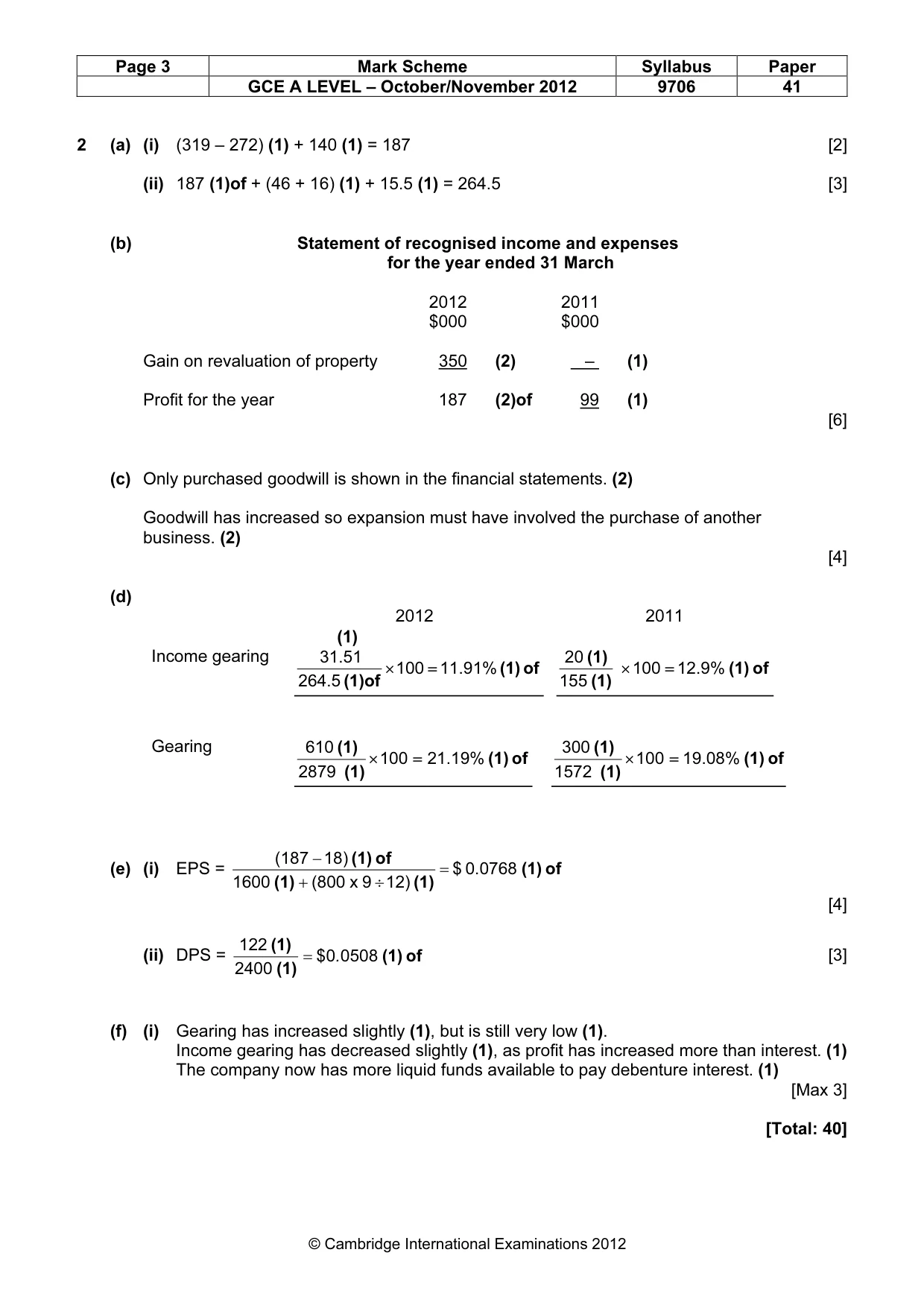
Page 3 Mark Scheme Syllabus Paper GCE A LEVEL – October/November 2012 9706 41 © Cambridge International Examinations 2012 2 (a) (i) (319 – 272) (1) + 140 (1) = 187 [2] (ii) 187 (1)of + (46 + 16) (1) + 15.5 (1) = 264.5 [3] (b) Statement of recognised income and expenses for the year ended 31 March 2012 2011 $000 $000 Gain on revaluation of property 350 (2) – (1) Profit for the year 187 (2)of 99 (1) [6] (c) Only purchased goodwill is shown in the financial statements. (2) Goodwill has increased so expansion must have involved the purchase of another business. (2) [4] (d) 2012 2011 Income gearing (1) of (1) (1)of 11.91% 100 264.5 31.51 = × of (1) (1) (1) 12.9% 100 155 20 = × Gearing of (1) (1) (1) 21.19% 100 2879 610 = × of (1) (1) (1) 19.08% 100 1572 300 = × (e) (i) EPS = of (1) (1) (1) of (1) 0.0768 $ 12) 9 x (800 1600 18) (187 = ÷ + − [4] (ii) DPS = of (1) (1) (1) . 0508 0 $ 2400 122 = [3] (f) (i) Gearing has increased slightly (1), but is still very low (1). Income gearing has decreased slightly (1), as profit has increased more than interest. (1) The company now has more liquid funds available to pay debenture interest. (1) [Max 3] [Total: 40]
Mark scheme, page 4
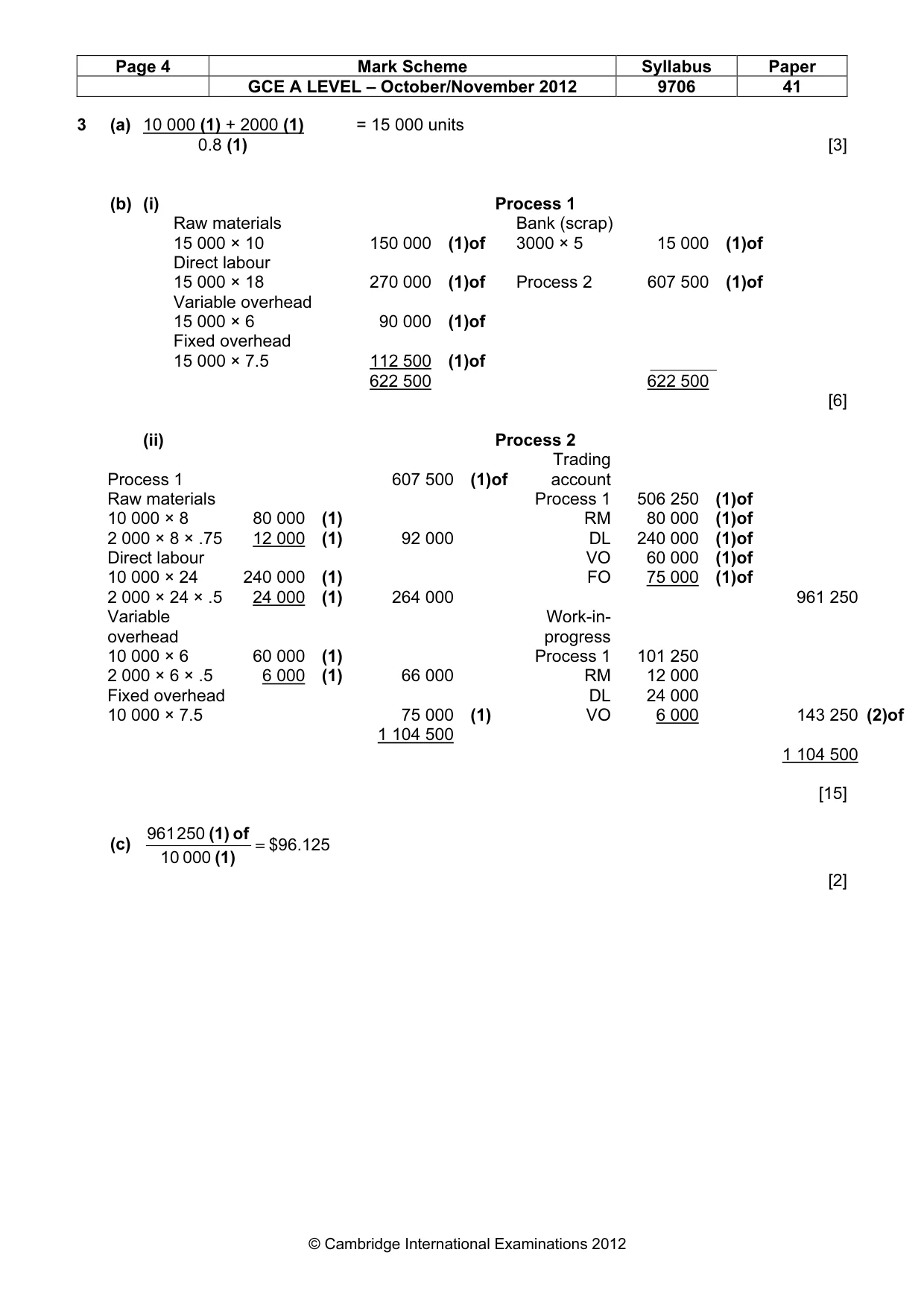
Page 4 Mark Scheme Syllabus Paper GCE A LEVEL – October/November 2012 9706 41 © Cambridge International Examinations 2012 3 (a) 10 000 (1) + 2000 (1) = 15 000 units 0.8 (1) [3] (b) (i) Process 1 Raw materials 15 000 × 10 150 000 (1)of Bank (scrap) 3000 × 5 15 000 (1)of Direct labour 15 000 × 18 270 000 (1)of Process 2 607 500 (1)of Variable overhead 15 000 × 6 90 000 (1)of Fixed overhead 15 000 × 7.5 112 500 (1)of 622 500 622 500 [6] (ii) Process 2 Process 1 607 500 (1)of Trading account Raw materials Process 1 506 250 (1)of 10 000 × 8 80 000 (1) RM 80 000 (1)of 2 000 × 8 × .75 12 000 (1) 92 000 DL 240 000 (1)of Direct labour VO 60 000 (1)of 10 000 × 24 240 000 (1) FO 75 000 (1)of 2 000 × 24 × .5 24 000 (1) 264 000 961 250 Variable overhead Work-in- progress 10 000 × 6 60 000 (1) Process 1 101 250 2 000 × 6 × .5 6 000 (1) 66 000 RM 12 000 Fixed overhead DL 24 000 10 000 × 7.5 75 000 (1) VO 6 000 143 250 (2)of 1 104 500 1 104 500 [15] (c) $96.125 000 10 250 961 = (1) of (1) [2]
Mark scheme, page 5
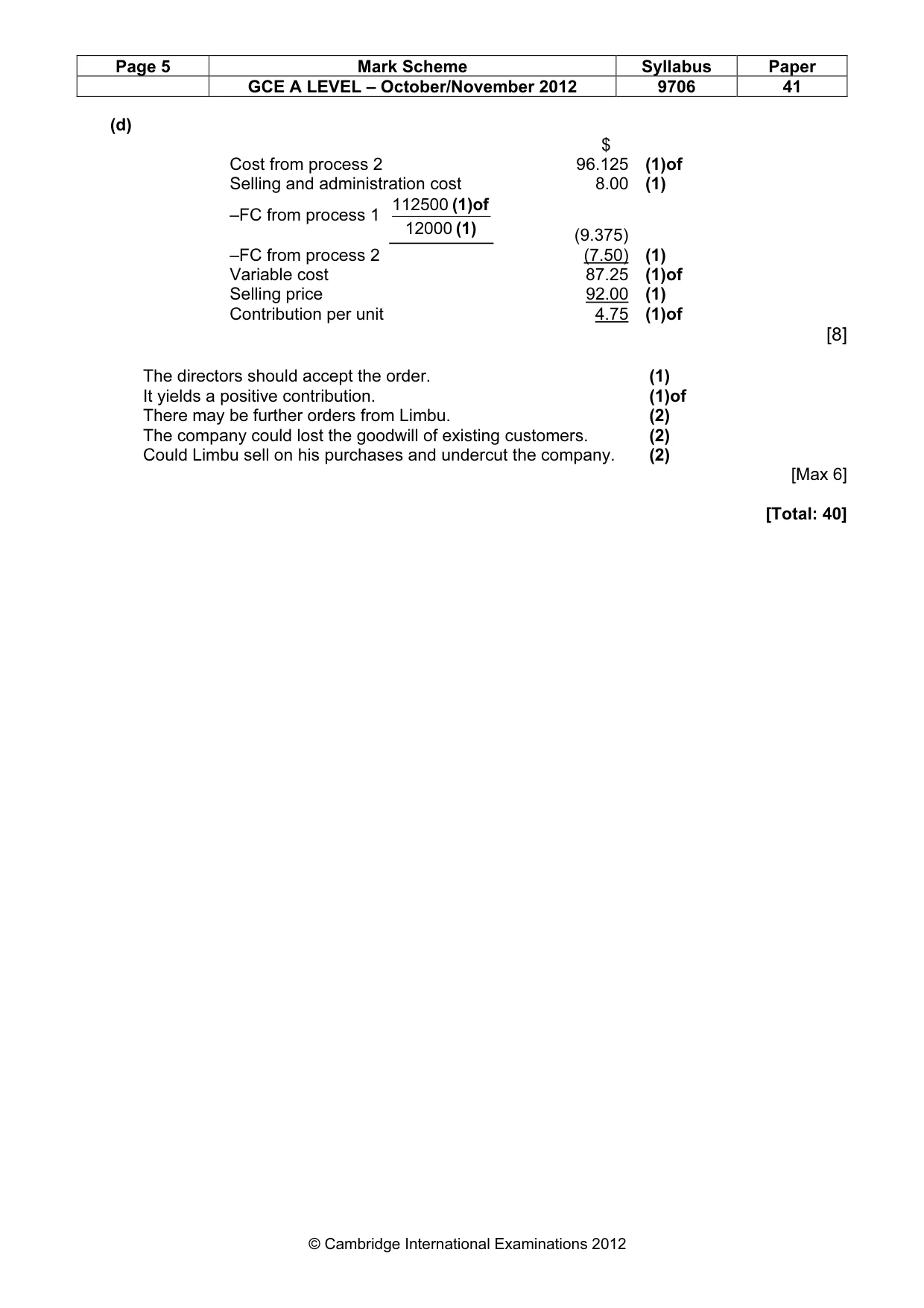
Page 5 Mark Scheme Syllabus Paper GCE A LEVEL – October/November 2012 9706 41 © Cambridge International Examinations 2012 (d) $ Cost from process 2 96.125 (1)of Selling and administration cost 8.00 (1) –FC from process 1 (1) (1)of 12000 112500 (9.375) –FC from process 2 (7.50) (1) Variable cost 87.25 (1)of Selling price 92.00 (1) Contribution per unit 4.75 (1)of [8] The directors should accept the order. (1) It yields a positive contribution. (1)of There may be further orders from Limbu. (2) The company could lost the goodwill of existing customers. (2) Could Limbu sell on his purchases and undercut the company. (2) [Max 6] [Total: 40]
What you needed in this session
Cambridge’s own grade thresholds for 2012 Oct/Nov, Paper 4 · Variant 1. A higher threshold means an easier paper — the bar moves with how the cohort did.