Cambridge A Level Accounting 9706 — 2012 May/June Paper 4 · Variant 2
9706/42/M/J/12 · 120 marks · ≈135 min
The question paper and its mark scheme, free to read here and free to download. This is Cambridge’s own paper, exactly as it was sat.
Question paper8 pages
Mark scheme7 pages
Answers below. Sit the paper first if you are practising.
Paper as text
Question paper, page 1
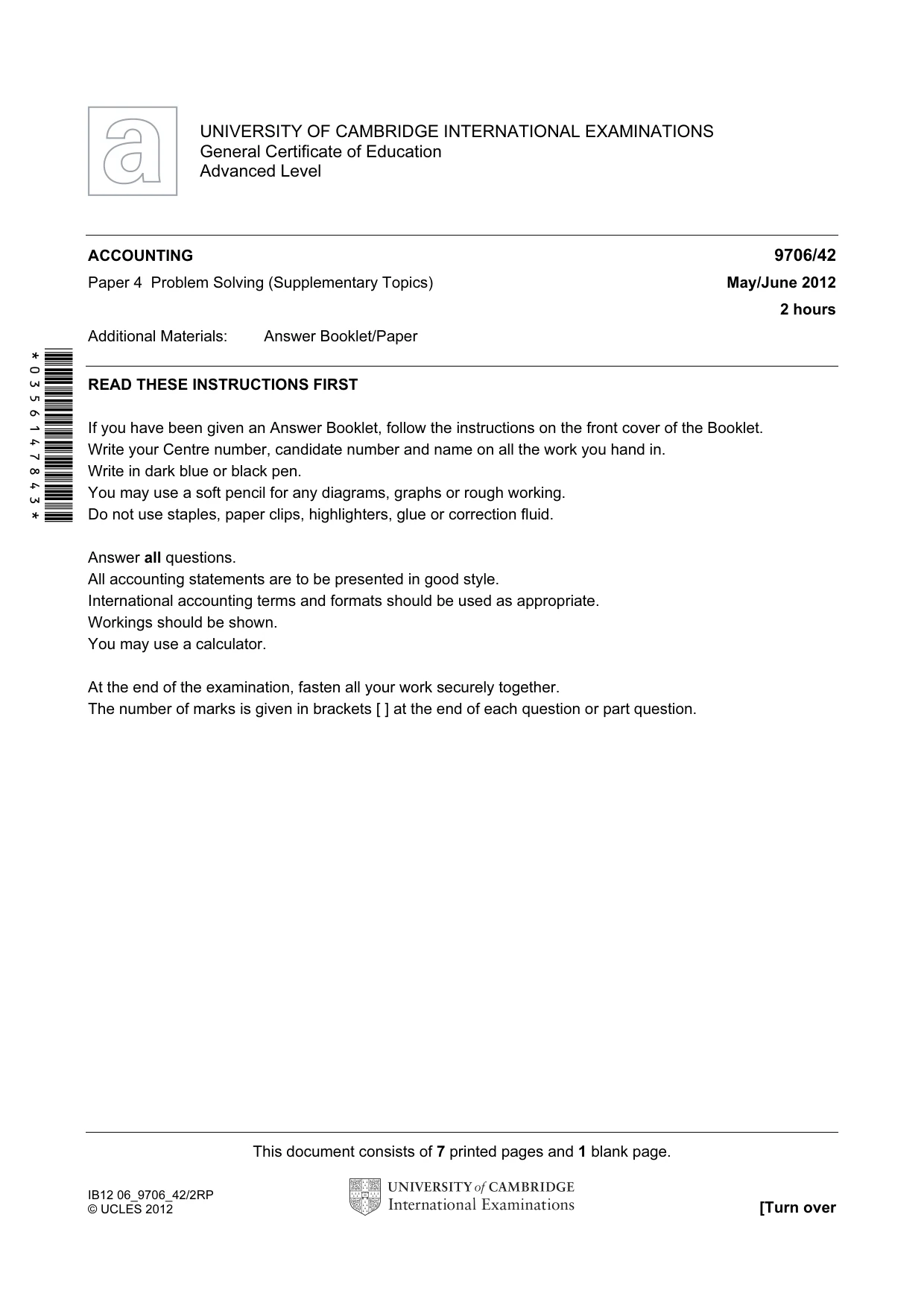
This document consists of 7 printed pages and 1 blank page. IB12 06_9706_42/2RP © UCLES 2012 [Turn over *0356147843* UNIVERSITY OF CAMBRIDGE INTERNATIONAL EXAMINATIONS General Certificate of Education Advanced Level ACCOUNTING 9706/42 Paper 4 Problem Solving (Supplementary Topics) May/June 2012 2 hours Additional Materials: Answer Booklet/Paper READ THESE INSTRUCTIONS FIRST If you have been given an Answer Booklet, follow the instructions on the front cover of the Booklet. Write your Centre number, candidate number and name on all the work you hand in. Write in dark blue or black pen. You may use a soft pencil for any diagrams, graphs or rough working. Do not use staples, paper clips, highlighters, glue or correction fluid. Answer all questions. All accounting statements are to be presented in good style. International accounting terms and formats should be used as appropriate. Workings should be shown. You may use a calculator. At the end of the examination, fasten all your work securely together. The number of marks is given in brackets [ ] at the end of each question or part question.
Question paper, page 2
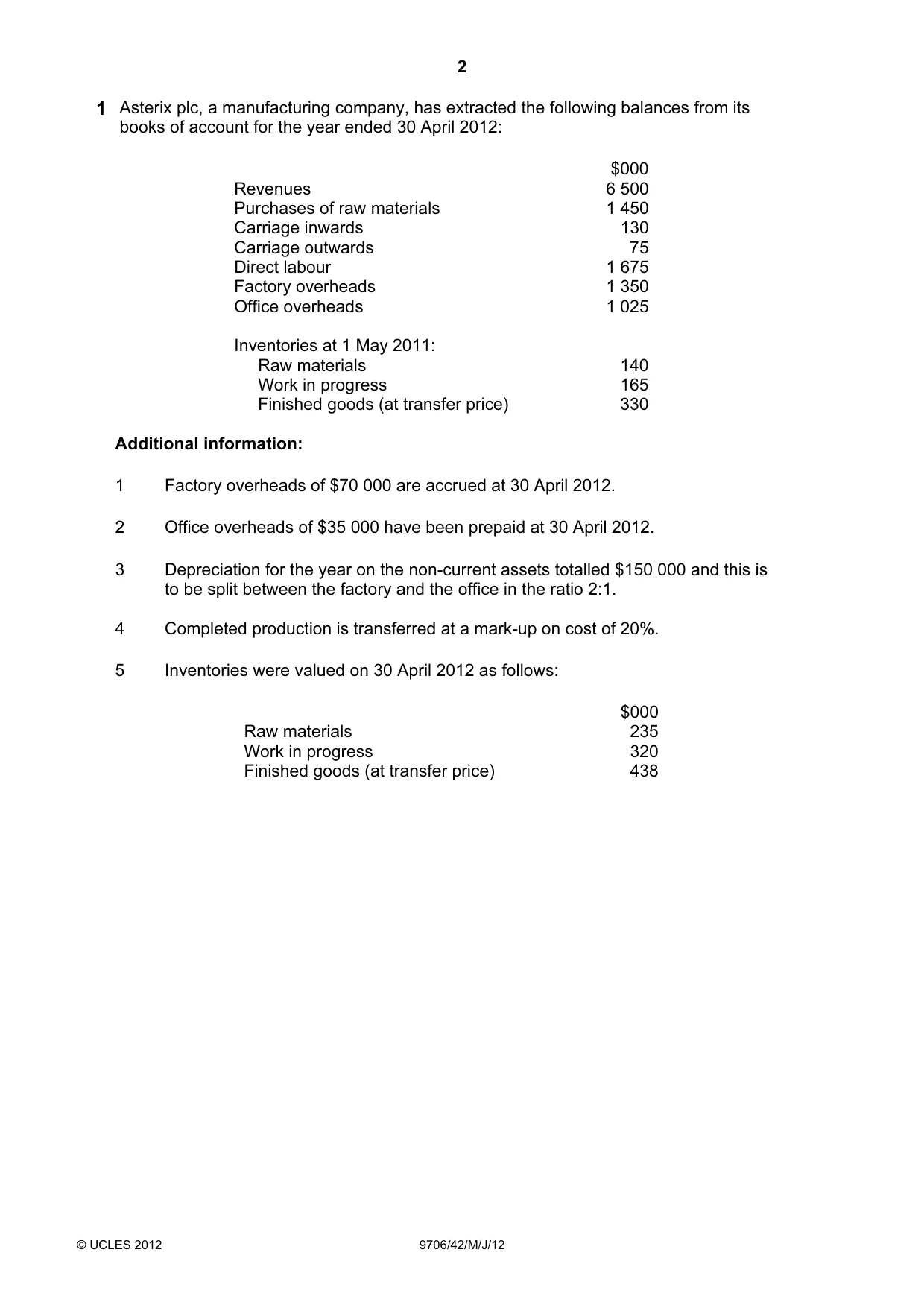
2 © UCLES 2012 9706/42/M/J/12 1 Asterix plc, a manufacturing company, has extracted the following balances from its books of account for the year ended 30 April 2012: $000 Revenues 6 500 Purchases of raw materials 1 450 Carriage inwards 130 Carriage outwards 75 Direct labour 1 675 Factory overheads 1 350 Office overheads 1 025 Inventories at 1 May 2011: Raw materials 140 Work in progress 165 Finished goods (at transfer price) 330 Additional information: 1 Factory overheads of $70 000 are accrued at 30 April 2012. 2 Office overheads of $35 000 have been prepaid at 30 April 2012. 3 Depreciation for the year on the non-current assets totalled $150 000 and this is to be split between the factory and the office in the ratio 2:1. 4 Completed production is transferred at a mark-up on cost of 20%. 5 Inventories were valued on 30 April 2012 as follows: $000 Raw materials 235 Work in progress 320 Finished goods (at transfer price) 438
Question paper, page 3
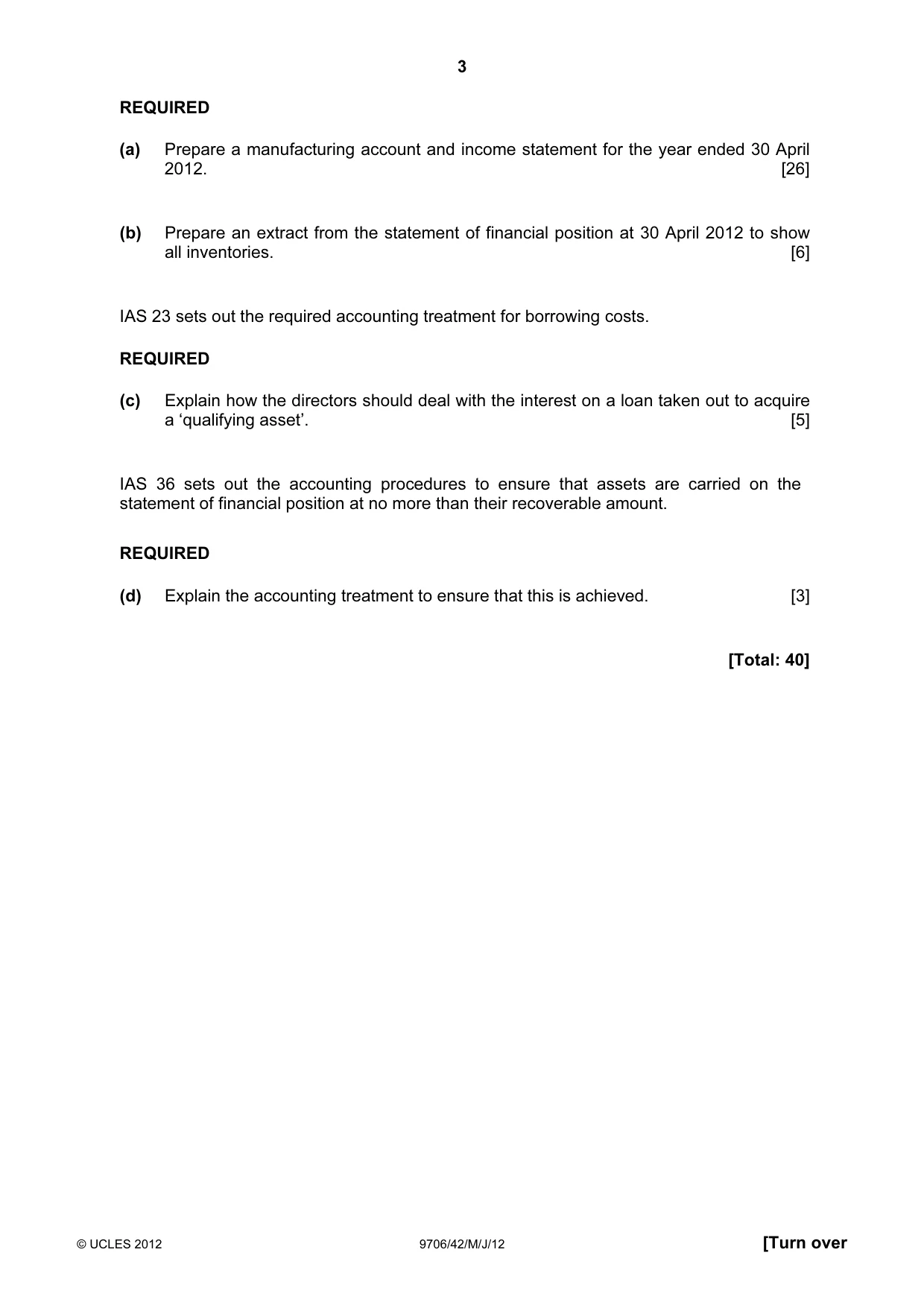
3 © UCLES 2012 9706/42/M/J/12 [Turn over REQUIRED (a) Prepare a manufacturing account and income statement for the year ended 30 April 2012. [26] (b) Prepare an extract from the statement of financial position at 30 April 2012 to show all inventories. [6] IAS 23 sets out the required accounting treatment for borrowing costs. REQUIRED (c) Explain how the directors should deal with the interest on a loan taken out to acquire a ‘qualifying asset’. [5] IAS 36 sets out the accounting procedures to ensure that assets are carried on the statement of financial position at no more than their recoverable amount. REQUIRED (d) Explain the accounting treatment to ensure that this is achieved. [3] [Total: 40]
Question paper, page 4
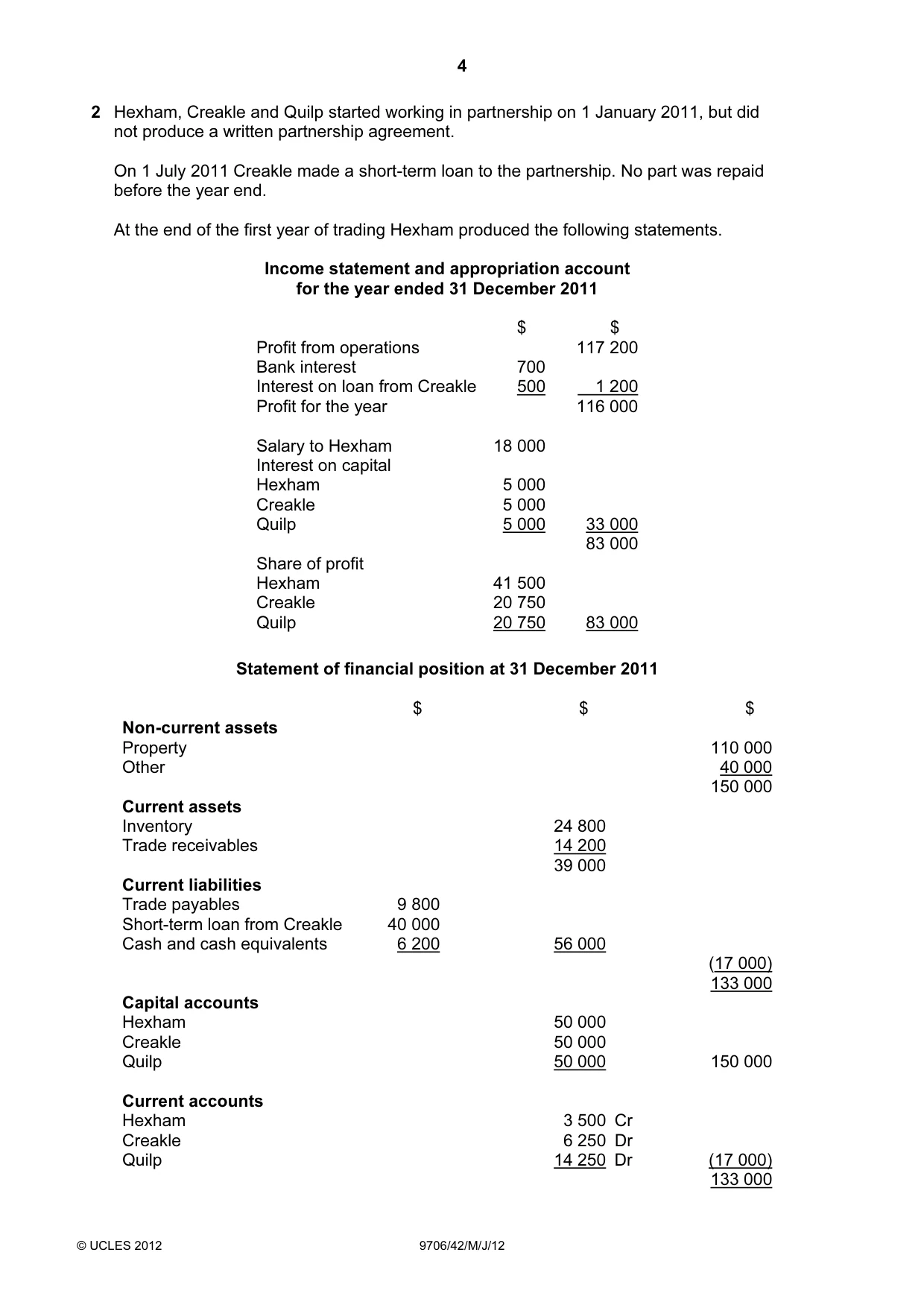
4 © UCLES 2012 9706/42/M/J/12 2 Hexham, Creakle and Quilp started working in partnership on 1 January 2011, but did not produce a written partnership agreement. On 1 July 2011 Creakle made a short-term loan to the partnership. No part was repaid before the year end. At the end of the first year of trading Hexham produced the following statements. Income statement and appropriation account for the year ended 31 December 2011 $ $ Profit from operations 117 200 Bank interest 700 Interest on loan from Creakle 500 1 200 Profit for the year 116 000 Salary to Hexham 18 000 Interest on capital Hexham 5 000 Creakle 5 000 Quilp 5 000 33 000 83 000 Share of profit Hexham 41 500 Creakle 20 750 Quilp 20 750 83 000 Statement of financial position at 31 December 2011 $ $ $ Non-current assets Property 110 000 Other 40 000 150 000 Current assets Inventory 24 800 Trade receivables 14 200 39 000 Current liabilities Trade payables 9 800 Short-term loan from Creakle 40 000 Cash and cash equivalents 6 200 56 000 (17 000) 133 000 Capital accounts Hexham 50 000 Creakle 50 000 Quilp 50 000 150 000 Current accounts Hexham 3 500 Cr Creakle 6 250 Dr Quilp 14 250 Dr (17 000) 133 000
Question paper, page 5
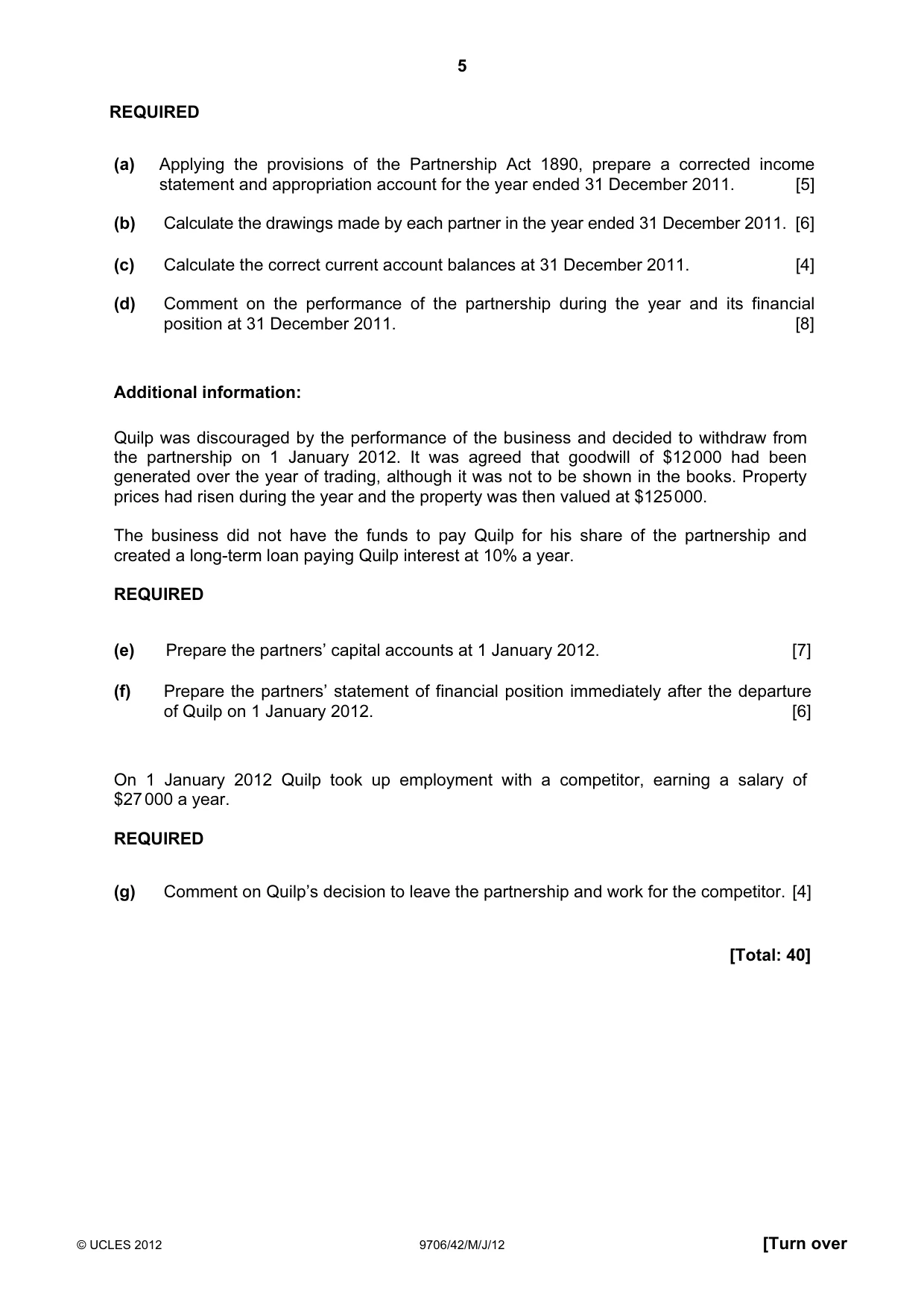
5 © UCLES 2012 9706/42/M/J/12 [Turn over REQUIRED (a) Applying the provisions of the Partnership Act 1890, prepare a corrected income statement and appropriation account for the year ended 31 December 2011. [5] (b) Calculate the drawings made by each partner in the year ended 31 December 2011. [6] (c) Calculate the correct current account balances at 31 December 2011. [4] (d) Comment on the performance of the partnership during the year and its financial position at 31 December 2011. [8] Additional information: Quilp was discouraged by the performance of the business and decided to withdraw from the partnership on 1 January 2012. It was agreed that goodwill of $12 000 had been generated over the year of trading, although it was not to be shown in the books. Property prices had risen during the year and the property was then valued at $125 000. The business did not have the funds to pay Quilp for his share of the partnership and created a long-term loan paying Quilp interest at 10% a year. REQUIRED (e) Prepare the partners’ capital accounts at 1 January 2012. [7] (f) Prepare the partners’ statement of financial position immediately after the departure of Quilp on 1 January 2012. [6] On 1 January 2012 Quilp took up employment with a competitor, earning a salary of $27 000 a year. REQUIRED (g) Comment on Quilp’s decision to leave the partnership and work for the competitor. [4] [Total: 40]
Question paper, page 6
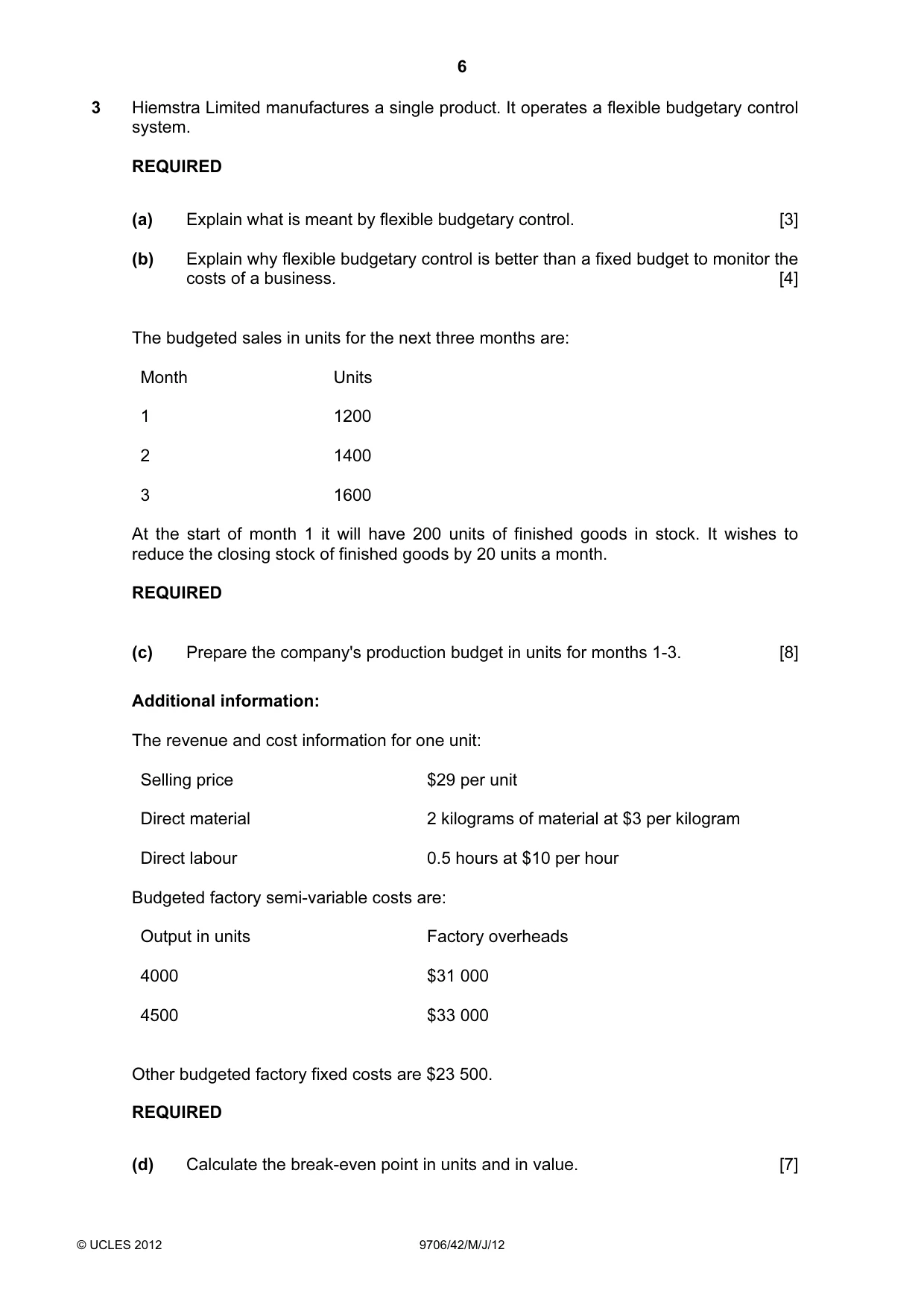
6 © UCLES 2012 9706/42/M/J/12 3 Hiemstra Limited manufactures a single product. It operates a flexible budgetary control system. REQUIRED (a) Explain what is meant by flexible budgetary control. [3] (b) Explain why flexible budgetary control is better than a fixed budget to monitor the costs of a business. [4] The budgeted sales in units for the next three months are: Month Units 1 1200 2 1400 3 1600 At the start of month 1 it will have 200 units of finished goods in stock. It wishes to reduce the closing stock of finished goods by 20 units a month. REQUIRED (c) Prepare the company's production budget in units for months 1-3. [8] Additional information: The revenue and cost information for one unit: Selling price $29 per unit Direct material 2 kilograms of material at $3 per kilogram Direct labour 0.5 hours at $10 per hour Budgeted factory semi-variable costs are: Output in units Factory overheads 4000 $31 000 4500 $33 000 Other budgeted factory fixed costs are $23 500. REQUIRED (d) Calculate the break-even point in units and in value. [7]
Question paper, page 7
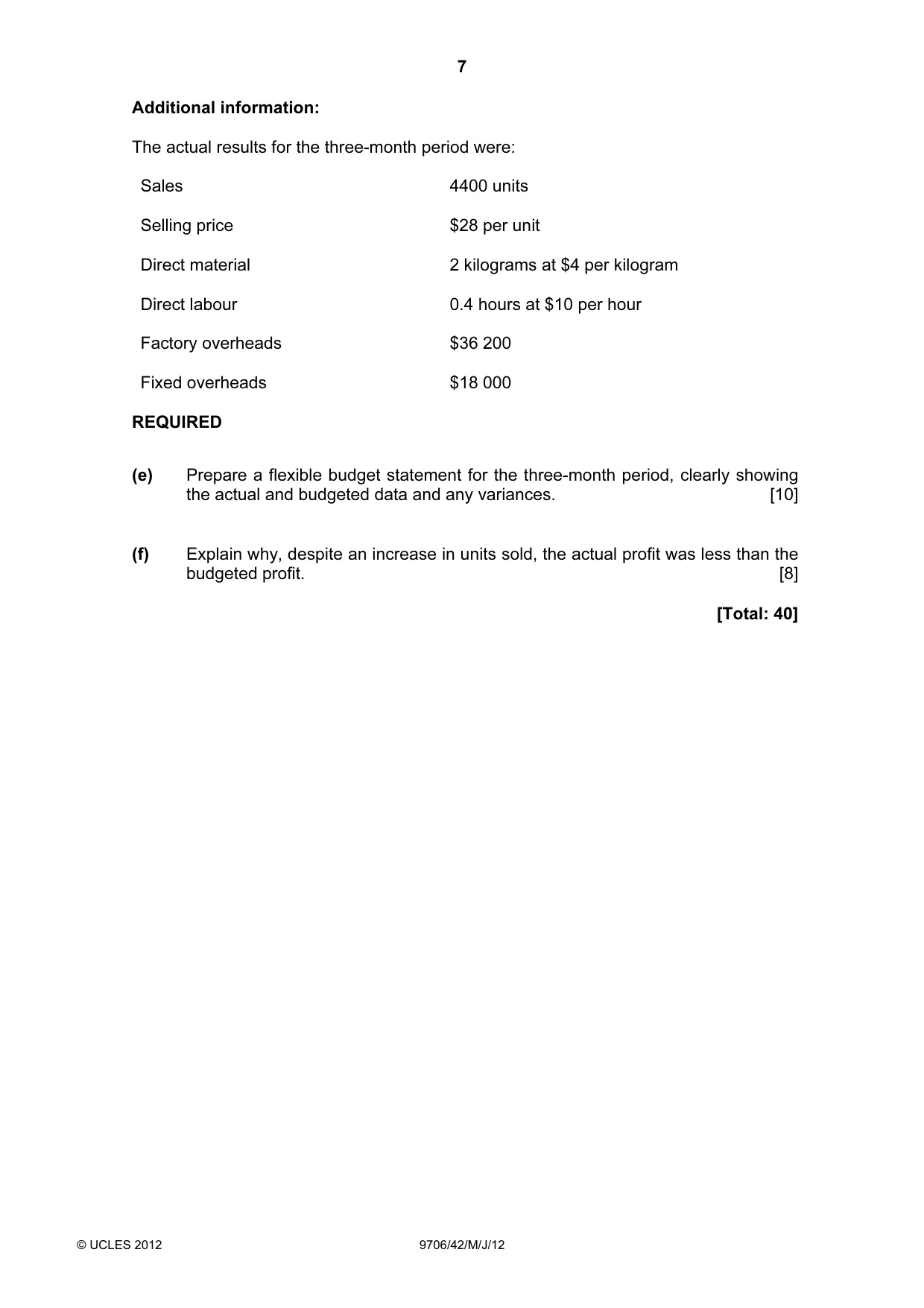
7 © UCLES 2012 9706/42/M/J/12 Additional information: The actual results for the three-month period were: Sales 4400 units Selling price $28 per unit Direct material 2 kilograms at $4 per kilogram Direct labour 0.4 hours at $10 per hour Factory overheads $36 200 Fixed overheads $18 000 REQUIRED (e) Prepare a flexible budget statement for the three-month period, clearly showing the actual and budgeted data and any variances. [10] (f) Explain why, despite an increase in units sold, the actual profit was less than the budgeted profit. [8] [Total: 40]
Question paper, page 8
8 Permission to reproduce items where third-party owned material protected by copyright is included has been sought and cleared where possible. Every reasonable effort has been made by the publisher (UCLES) to trace copyright holders, but if any items requiring clearance have unwittingly been included, the publisher will be pleased to make amends at the earliest possible opportunity. University of Cambridge International Examinations is part of the Cambridge Assessment Group. Cambridge Assessment is the brand name of University of Cambridge Local Examinations Syndicate (UCLES), which is itself a department of the University of Cambridge. © UCLES 2012 9706/42/M/J/12 BLANK PAGE
Mark scheme, page 1
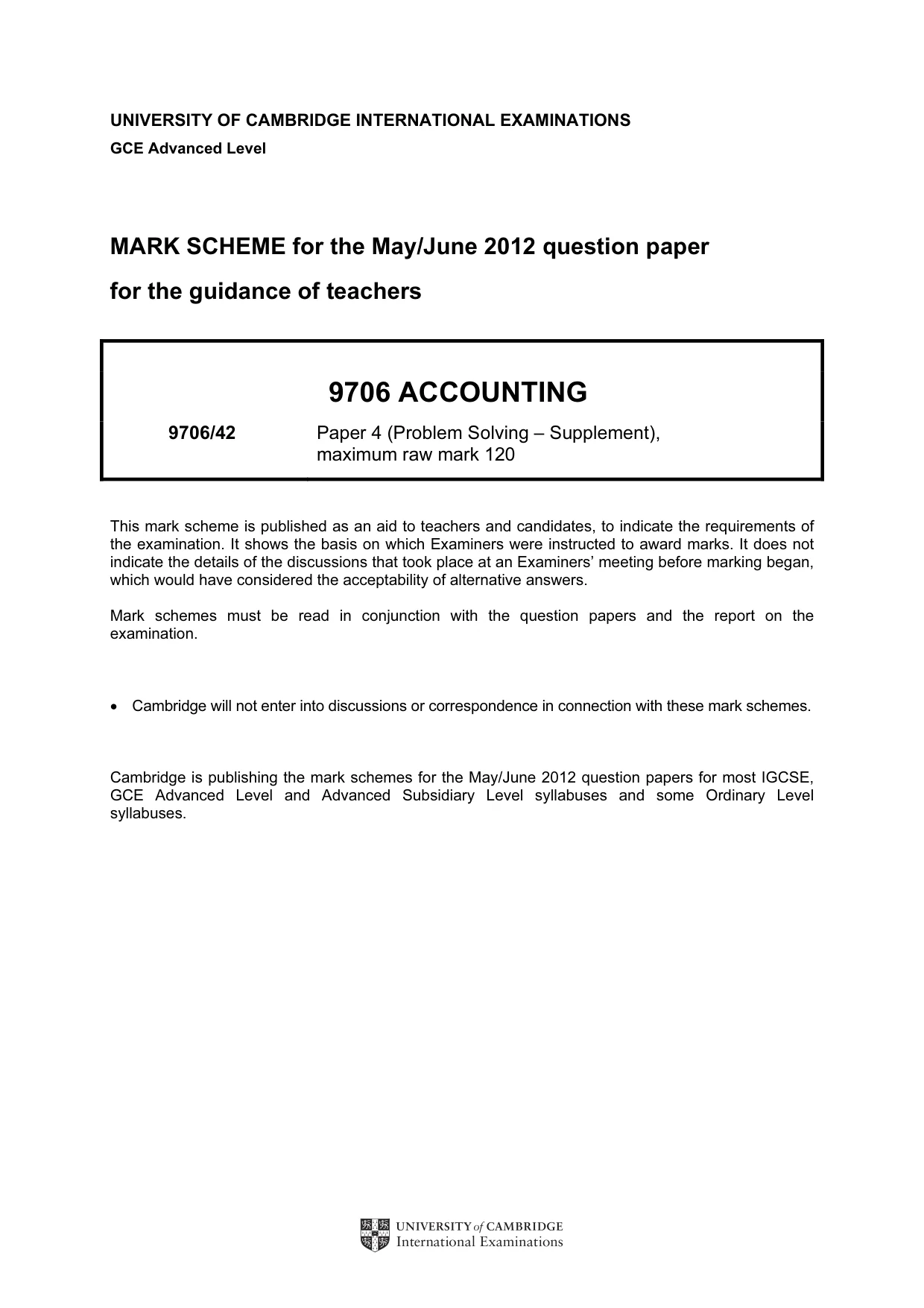
UNIVERSITY OF CAMBRIDGE INTERNATIONAL EXAMINATIONS GCE Advanced Level MARK SCHEME for the May/June 2012 question paper for the guidance of teachers 9706 ACCOUNTING 9706/42 Paper 4 (Problem Solving – Supplement), maximum raw mark 120 This mark scheme is published as an aid to teachers and candidates, to indicate the requirements of the examination. It shows the basis on which Examiners were instructed to award marks. It does not indicate the details of the discussions that took place at an Examiners’ meeting before marking began, which would have considered the acceptability of alternative answers. Mark schemes must be read in conjunction with the question papers and the report on the examination. • Cambridge will not enter into discussions or correspondence in connection with these mark schemes. Cambridge is publishing the mark schemes for the May/June 2012 question papers for most IGCSE, GCE Advanced Level and Advanced Subsidiary Level syllabuses and some Ordinary Level syllabuses.
Mark scheme, page 2
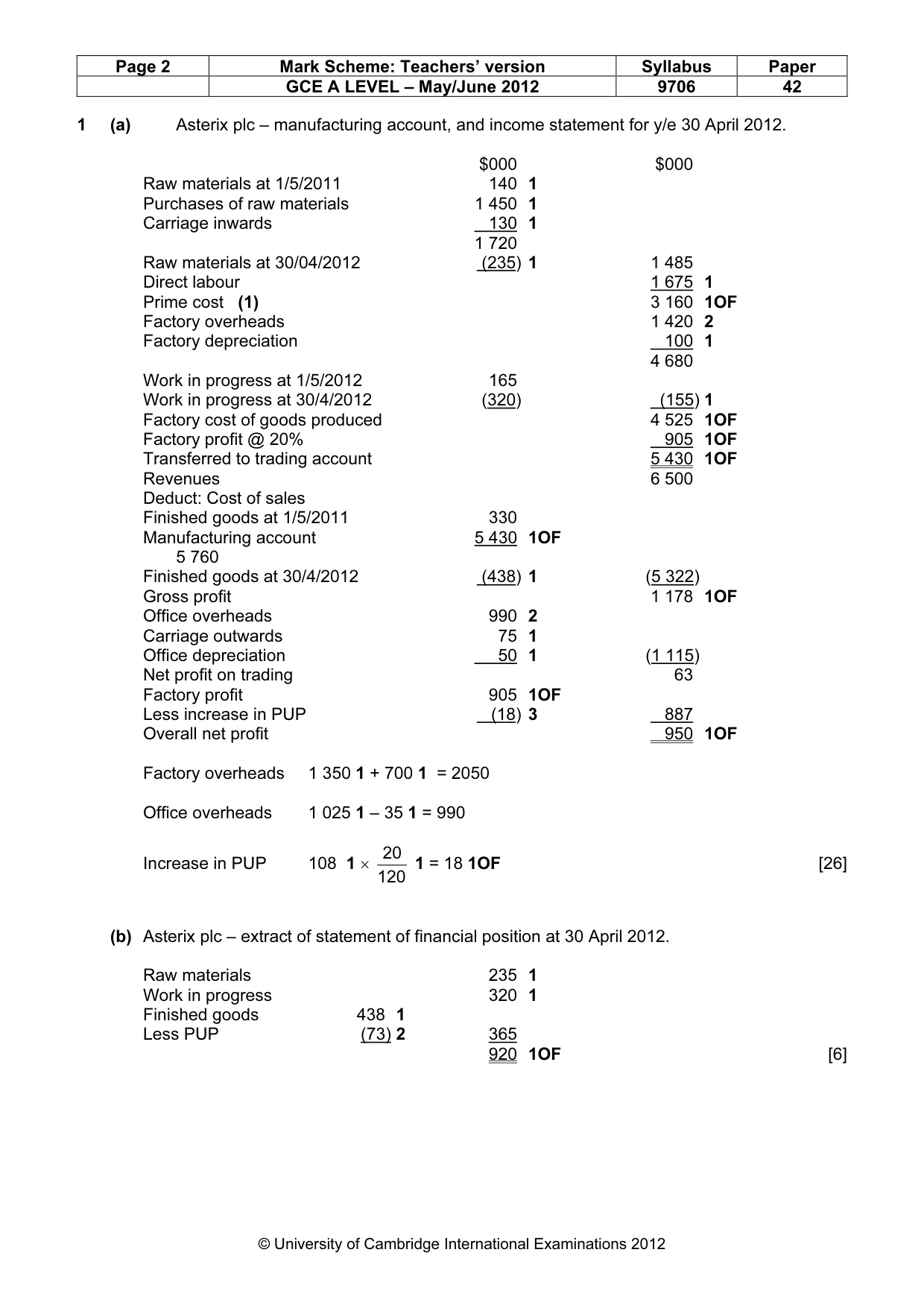
Page 2 Mark Scheme: Teachers’ version Syllabus Paper GCE A LEVEL – May/June 2012 9706 42 © University of Cambridge International Examinations 2012 1 (a) Asterix plc – manufacturing account, and income statement for y/e 30 April 2012. $000 $000 Raw materials at 1/5/2011 140 1 Purchases of raw materials 1 450 1 Carriage inwards 130 1 1 720 Raw materials at 30/04/2012 (235) 1 1 485 Direct labour 1 675 1 Prime cost (1) 3 160 1OF Factory overheads 1 420 2 Factory depreciation 100 1 4 680 Work in progress at 1/5/2012 165 Work in progress at 30/4/2012 (320) (155) 1 Factory cost of goods produced 4 525 1OF Factory profit @ 20% 905 1OF Transferred to trading account 5 430 1OF Revenues 6 500 Deduct: Cost of sales Finished goods at 1/5/2011 330 Manufacturing account 5 430 1OF 5 760 Finished goods at 30/4/2012 (438) 1 (5 322) Gross profit 1 178 1OF Office overheads 990 2 Carriage outwards 75 1 Office depreciation 50 1 (1 115) Net profit on trading 63 Factory profit 905 1OF Less increase in PUP (18) 3 887 Overall net profit 950 1OF Factory overheads 1 350 1 + 700 1 = 2050 Office overheads 1 025 1 – 35 1 = 990 Increase in PUP 108 1 × 120 20 1 = 18 1OF [26] (b) Asterix plc – extract of statement of financial position at 30 April 2012. Raw materials 235 1 Work in progress 320 1 Finished goods 438 1 Less PUP (73) 2 365 920 1OF [6]
Mark scheme, page 3
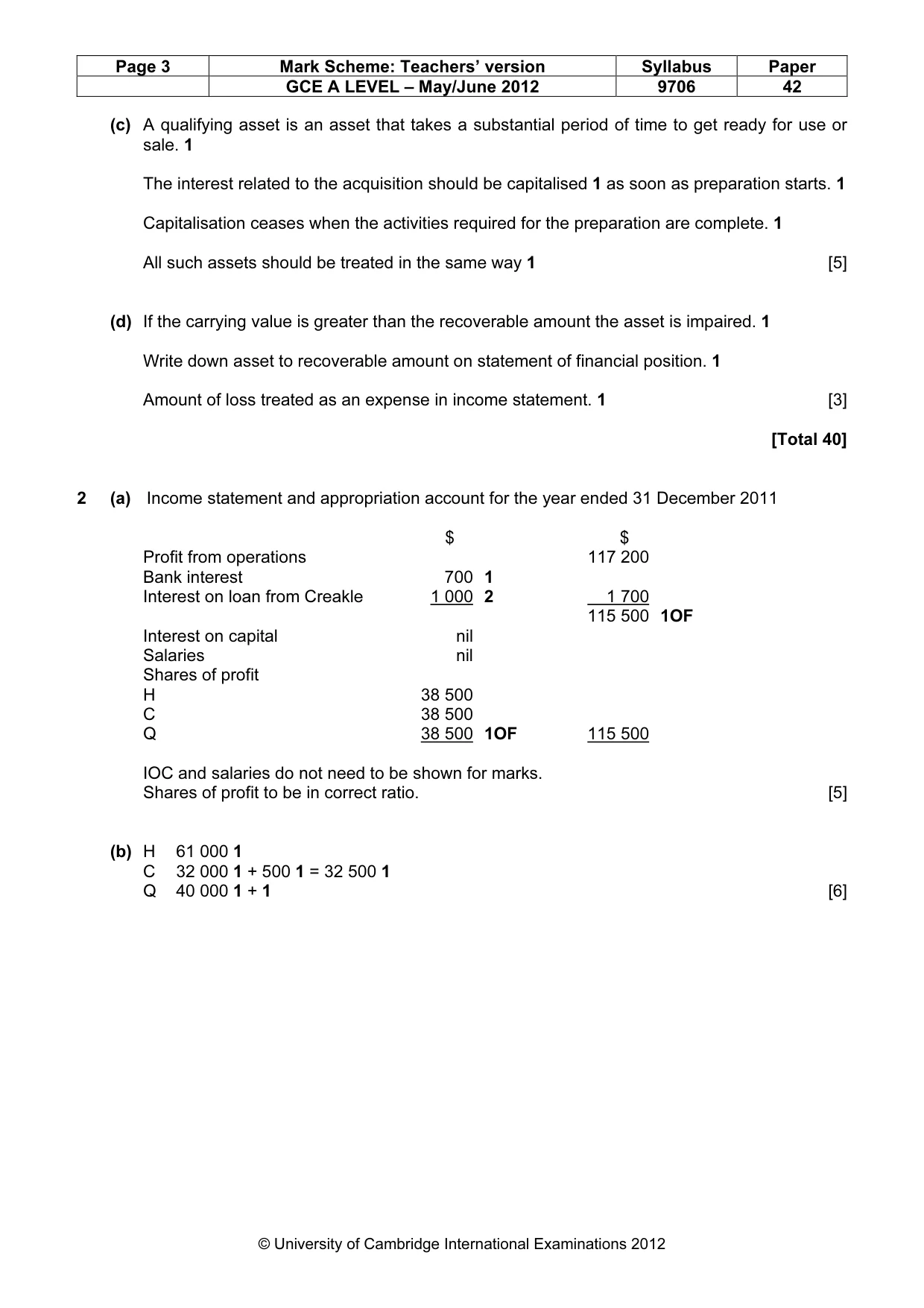
Page 3 Mark Scheme: Teachers’ version Syllabus Paper GCE A LEVEL – May/June 2012 9706 42 © University of Cambridge International Examinations 2012 (c) A qualifying asset is an asset that takes a substantial period of time to get ready for use or sale. 1 The interest related to the acquisition should be capitalised 1 as soon as preparation starts. 1 Capitalisation ceases when the activities required for the preparation are complete. 1 All such assets should be treated in the same way 1 [5] (d) If the carrying value is greater than the recoverable amount the asset is impaired. 1 Write down asset to recoverable amount on statement of financial position. 1 Amount of loss treated as an expense in income statement. 1 [3] [Total 40] 2 (a) Income statement and appropriation account for the year ended 31 December 2011 $ $ Profit from operations 117 200 Bank interest 700 1 Interest on loan from Creakle 1 000 2 1 700 115 500 1OF Interest on capital nil Salaries nil Shares of profit H 38 500 C 38 500 Q 38 500 1OF 115 500 IOC and salaries do not need to be shown for marks. Shares of profit to be in correct ratio. [5] (b) H 61 000 1 C 32 000 1 + 500 1 = 32 500 1 Q 40 000 1 + 1 [6]
Mark scheme, page 4
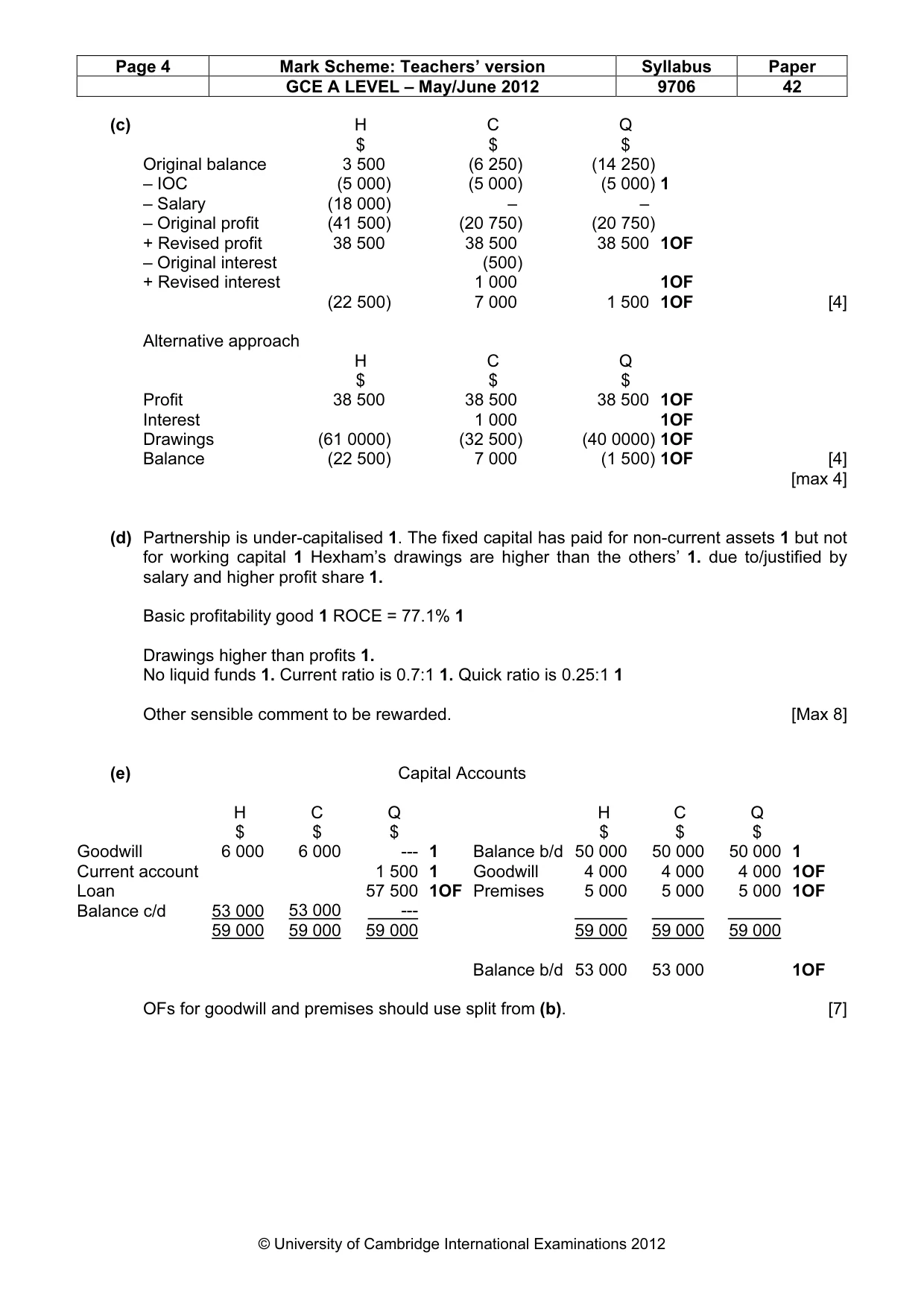
Page 4 Mark Scheme: Teachers’ version Syllabus Paper GCE A LEVEL – May/June 2012 9706 42 © University of Cambridge International Examinations 2012 (c) H C Q $ $ $ Original balance 3 500 (6 250) (14 250) – IOC (5 000) (5 000) (5 000) 1 – Salary (18 000) – – – Original profit (41 500) (20 750) (20 750) + Revised profit 38 500 38 500 38 500 1OF – Original interest (500) + Revised interest 1 000 1OF (22 500) 7 000 1 500 1OF [4] Alternative approach H C Q $ $ $ Profit 38 500 38 500 38 500 1OF Interest 1 000 1OF Drawings (61 0000) (32 500) (40 0000) 1OF Balance (22 500) 7 000 (1 500) 1OF [4] [max 4] (d) Partnership is under-capitalised 1. The fixed capital has paid for non-current assets 1 but not for working capital 1 Hexham’s drawings are higher than the others’ 1. due to/justified by salary and higher profit share 1. Basic profitability good 1 ROCE = 77.1% 1 Drawings higher than profits 1. No liquid funds 1. Current ratio is 0.7:1 1. Quick ratio is 0.25:1 1 Other sensible comment to be rewarded. [Max 8] (e) Capital Accounts H C Q H C Q $ $ $ $ $ $ Goodwill 6 000 6 000 --- 1 Balance b/d 50 000 50 000 50 000 1 Current account 1 500 1 Goodwill 4 000 4 000 4 000 1OF Loan 57 500 1OF Premises 5 000 5 000 5 000 1OF Balance c/d 53 000 53 000 --- 59 000 59 000 59 000 59 000 59 000 59 000 Balance b/d 53 000 53 000 1OF OFs for goodwill and premises should use split from (b). [7]
Mark scheme, page 5
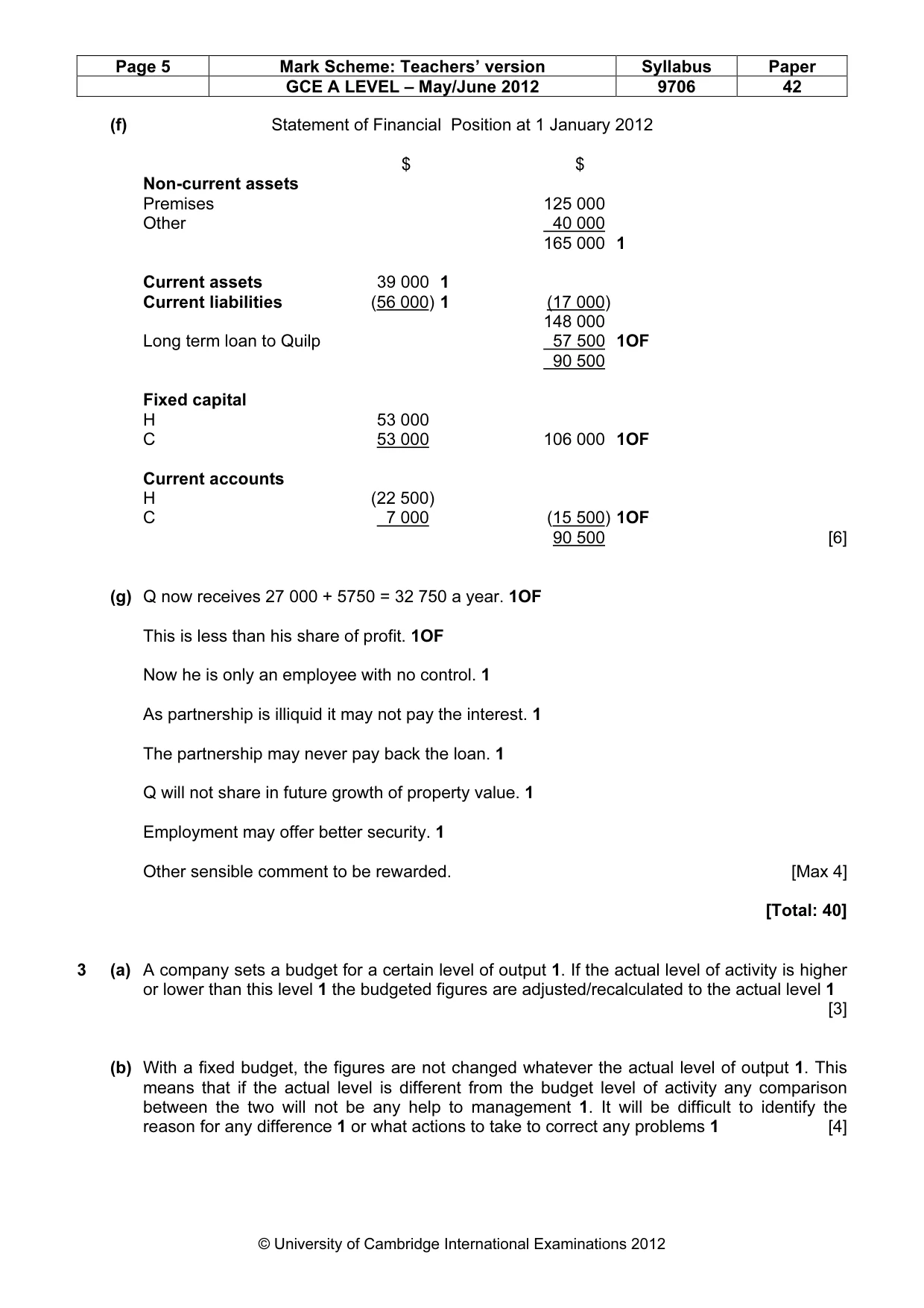
Page 5 Mark Scheme: Teachers’ version Syllabus Paper GCE A LEVEL – May/June 2012 9706 42 © University of Cambridge International Examinations 2012 (f) Statement of Financial Position at 1 January 2012 $ $ Non-current assets Premises 125 000 Other 40 000 165 000 1 Current assets 39 000 1 Current liabilities (56 000) 1 (17 000) 148 000 Long term loan to Quilp 57 500 1OF 90 500 Fixed capital H 53 000 C 53 000 106 000 1OF Current accounts H (22 500) C 7 000 (15 500) 1OF 90 500 [6] (g) Q now receives 27 000 + 5750 = 32 750 a year. 1OF This is less than his share of profit. 1OF Now he is only an employee with no control. 1 As partnership is illiquid it may not pay the interest. 1 The partnership may never pay back the loan. 1 Q will not share in future growth of property value. 1 Employment may offer better security. 1 Other sensible comment to be rewarded. [Max 4] [Total: 40] 3 (a) A company sets a budget for a certain level of output 1. If the actual level of activity is higher or lower than this level 1 the budgeted figures are adjusted/recalculated to the actual level 1 [3] (b) With a fixed budget, the figures are not changed whatever the actual level of output 1. This means that if the actual level is different from the budget level of activity any comparison between the two will not be any help to management 1. It will be difficult to identify the reason for any difference 1 or what actions to take to correct any problems 1 [4]
Mark scheme, page 6
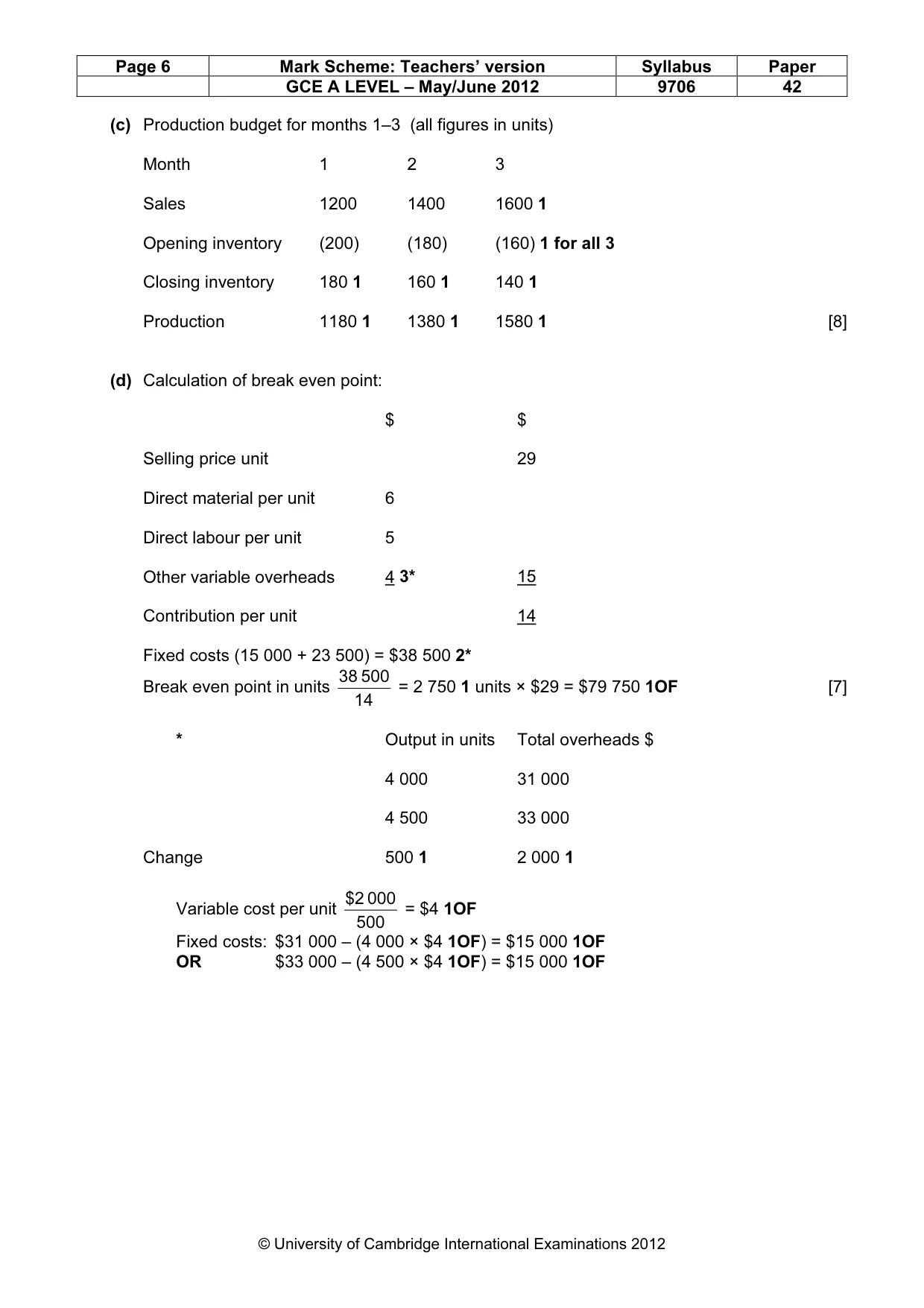
Page 6 Mark Scheme: Teachers’ version Syllabus Paper GCE A LEVEL – May/June 2012 9706 42 © University of Cambridge International Examinations 2012 (c) Production budget for months 1–3 (all figures in units) Month 1 2 3 Sales 1200 1400 1600 1 Opening inventory (200) (180) (160) 1 for all 3 Closing inventory 180 1 160 1 140 1 Production 1180 1 1380 1 1580 1 [8] (d) Calculation of break even point: $ $ Selling price unit 29 Direct material per unit 6 Direct labour per unit 5 Other variable overheads 4 3* 15 Contribution per unit 14 Fixed costs (15 000 + 23 500) = $38 500 2* Break even point in units 14 500 38 = 2 750 1 units × $29 = $79 750 1OF [7] * Output in units Total overheads $ 4 000 31 000 4 500 33 000 Change 500 1 2 000 1 Variable cost per unit 500 000 $2 = $4 1OF Fixed costs: $31 000 – (4 000 × $4 1OF) = $15 000 1OF OR $33 000 – (4 500 × $4 1OF) = $15 000 1OF
Mark scheme, page 7
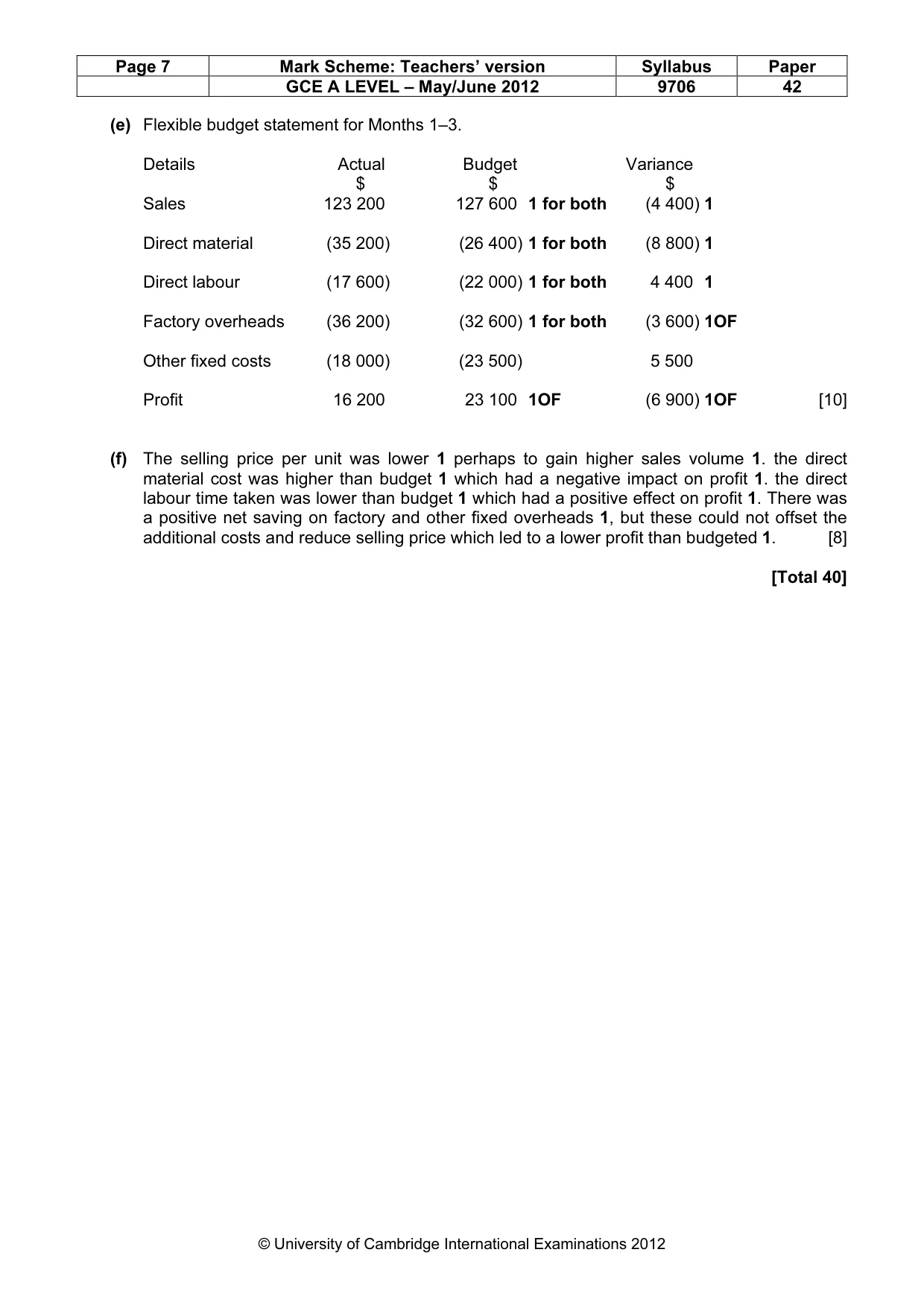
Page 7 Mark Scheme: Teachers’ version Syllabus Paper GCE A LEVEL – May/June 2012 9706 42 © University of Cambridge International Examinations 2012 (e) Flexible budget statement for Months 1–3. Details Actual Budget Variance $ $ $ Sales 123 200 127 600 1 for both (4 400) 1 Direct material (35 200) (26 400) 1 for both (8 800) 1 Direct labour (17 600) (22 000) 1 for both 4 400 1 Factory overheads (36 200) (32 600) 1 for both (3 600) 1OF Other fixed costs (18 000) (23 500) 5 500 Profit 16 200 23 100 1OF (6 900) 1OF [10] (f) The selling price per unit was lower 1 perhaps to gain higher sales volume 1. the direct material cost was higher than budget 1 which had a negative impact on profit 1. the direct labour time taken was lower than budget 1 which had a positive effect on profit 1. There was a positive net saving on factory and other fixed overheads 1, but these could not offset the additional costs and reduce selling price which led to a lower profit than budgeted 1. [8] [Total 40]
What you needed in this session
Cambridge’s own grade thresholds for 2012 May/June, Paper 4 · Variant 2. A higher threshold means an easier paper — the bar moves with how the cohort did.