Cambridge A Level Accounting 9706 — 2012 May/June Paper 4 · Variant 1
9706/41/M/J/12 · 120 marks · ≈135 min
The question paper and its mark scheme, free to read here and free to download. This is Cambridge’s own paper, exactly as it was sat.
Question paper8 pages
Mark scheme5 pages
Answers below. Sit the paper first if you are practising.
Paper as text
Question paper, page 1
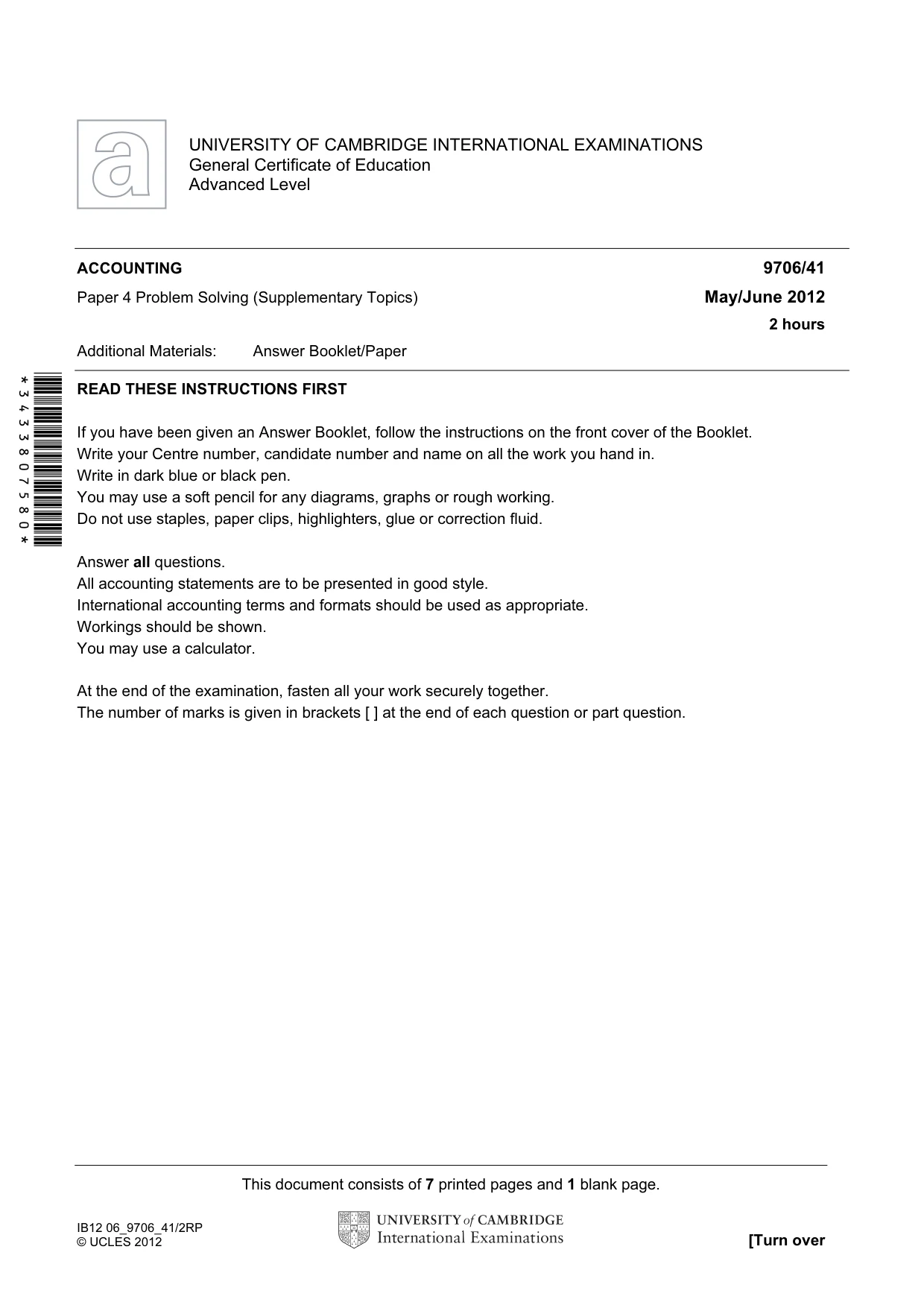
This document consists of 7 printed pages and 1 blank page. IB12 06_9706_41/2RP © UCLES 2012 [Turn over *3433807580* UNIVERSITY OF CAMBRIDGE INTERNATIONAL EXAMINATIONS General Certificate of Education Advanced Level ACCOUNTING 9706/41 Paper 4 Problem Solving (Supplementary Topics) May/June 2012 2 hours Additional Materials: Answer Booklet/Paper READ THESE INSTRUCTIONS FIRST If you have been given an Answer Booklet, follow the instructions on the front cover of the Booklet. Write your Centre number, candidate number and name on all the work you hand in. Write in dark blue or black pen. You may use a soft pencil for any diagrams, graphs or rough working. Do not use staples, paper clips, highlighters, glue or correction fluid. Answer all questions. All accounting statements are to be presented in good style. International accounting terms and formats should be used as appropriate. Workings should be shown. You may use a calculator. At the end of the examination, fasten all your work securely together. The number of marks is given in brackets [ ] at the end of each question or part question.
Question paper, page 2
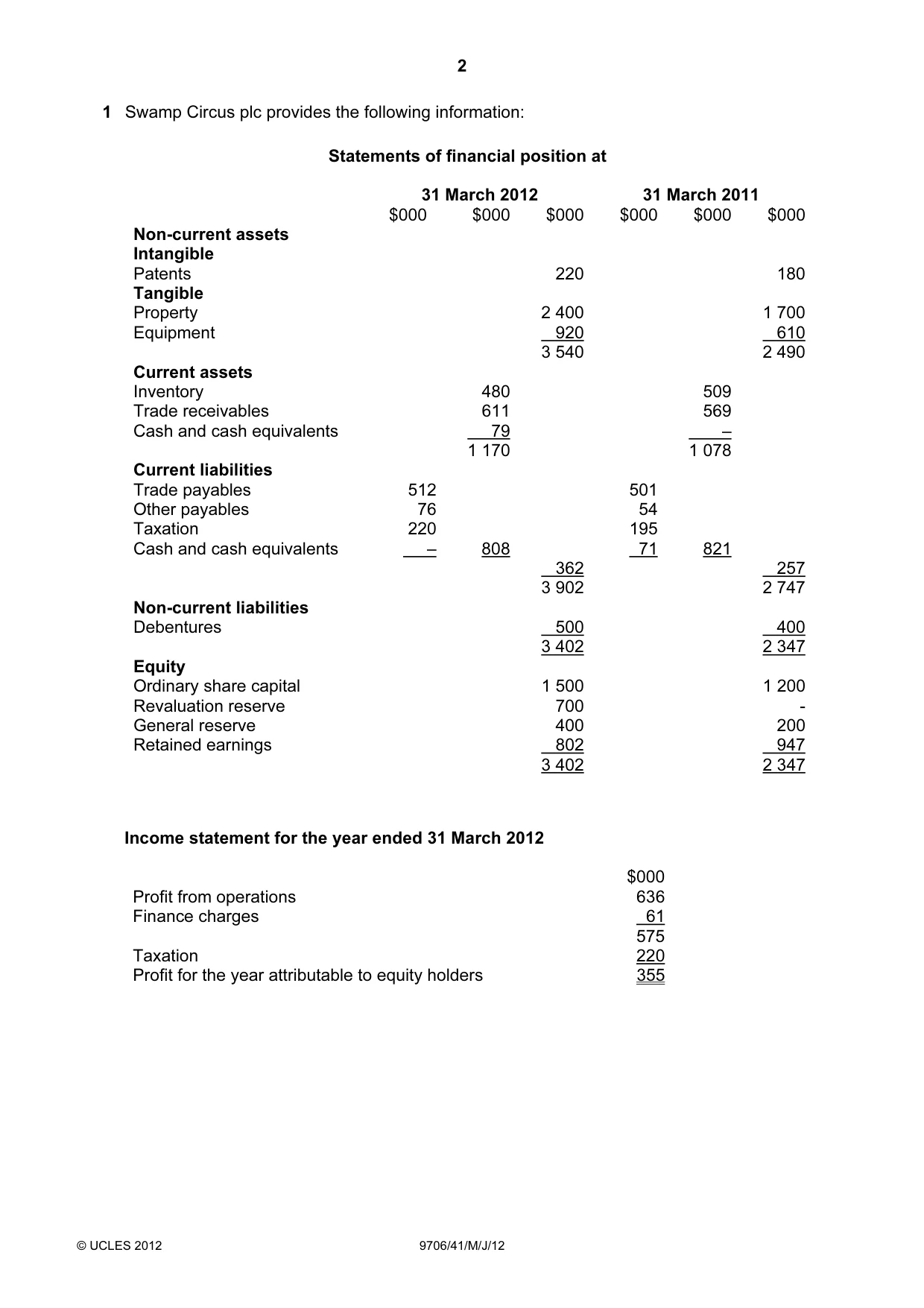
2 © UCLES 2012 9706/41/M/J/12 1 Swamp Circus plc provides the following information: Statements of financial position at 31 March 2012 31 March 2011 $000 $000 $000 $000 $000 $000 Non-current assets Intangible Patents 220 180 Tangible Property 2 400 1 700 Equipment 920 610 3 540 2 490 Current assets Inventory 480 509 Trade receivables 611 569 Cash and cash equivalents 79 – 1 170 1 078 Current liabilities Trade payables 512 501 Other payables 76 54 Taxation 220 195 Cash and cash equivalents – 808 71 821 362 257 3 902 2 747 Non-current liabilities Debentures 500 400 3 402 2 347 Equity Ordinary share capital 1 500 1 200 Revaluation reserve 700 - General reserve 400 200 Retained earnings 802 947 3 402 2 347 Income statement for the year ended 31 March 2012 $000 Profit from operations 636 Finance charges 61 575 Taxation 220 Profit for the year attributable to equity holders 355
Question paper, page 3
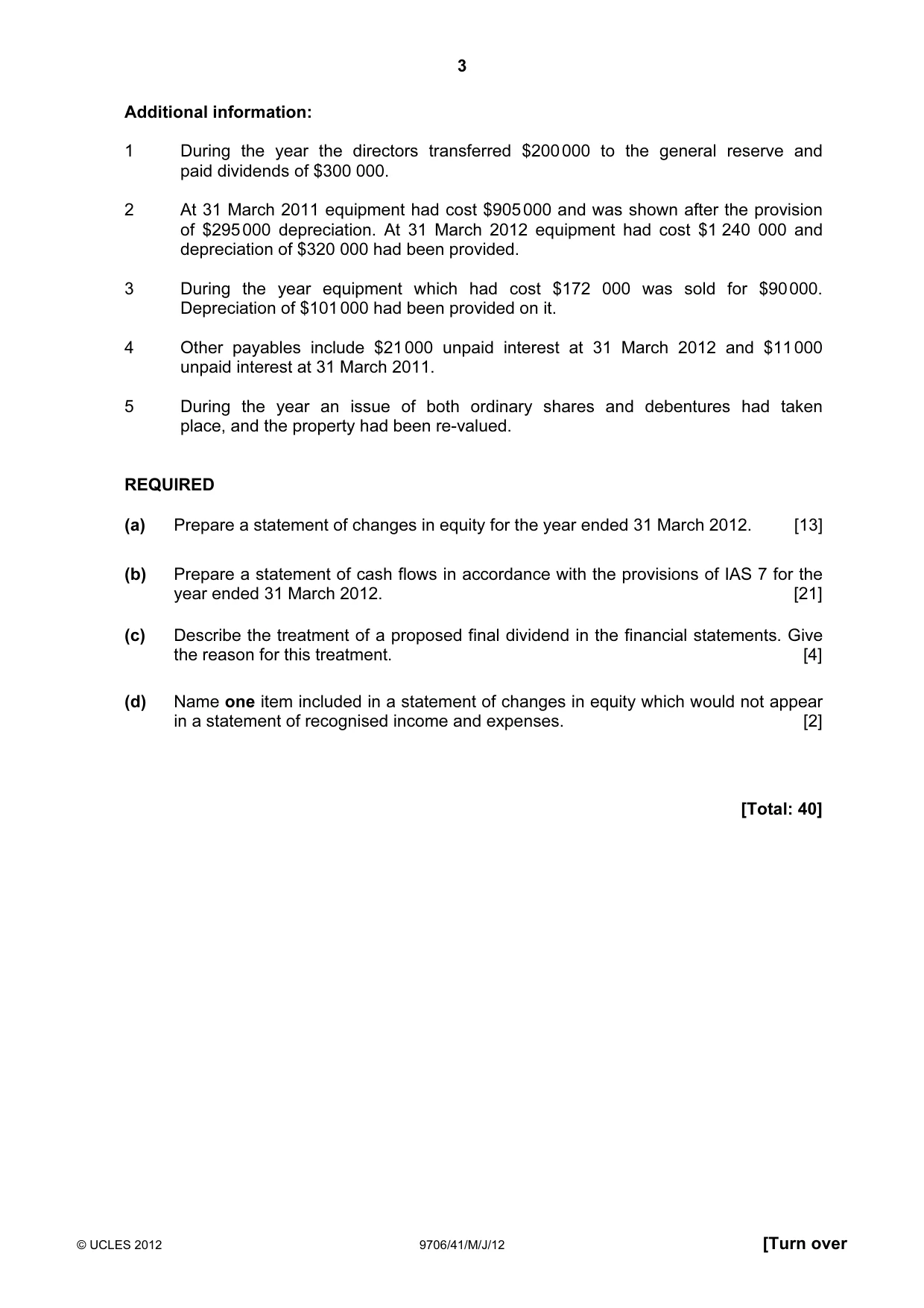
3 © UCLES 2012 9706/41/M/J/12 [Turn over Additional information: 1 During the year the directors transferred $200 000 to the general reserve and paid dividends of $300 000. 2 At 31 March 2011 equipment had cost $905 000 and was shown after the provision of $295 000 depreciation. At 31 March 2012 equipment had cost $1 240 000 and depreciation of $320 000 had been provided. 3 During the year equipment which had cost $172 000 was sold for $90 000. Depreciation of $101 000 had been provided on it. 4 Other payables include $21 000 unpaid interest at 31 March 2012 and $11 000 unpaid interest at 31 March 2011. 5 During the year an issue of both ordinary shares and debentures had taken place, and the property had been re-valued. REQUIRED (a) Prepare a statement of changes in equity for the year ended 31 March 2012. [13] (b) Prepare a statement of cash flows in accordance with the provisions of IAS 7 for the year ended 31 March 2012. [21] (c) Describe the treatment of a proposed final dividend in the financial statements. Give the reason for this treatment. [4] (d) Name one item included in a statement of changes in equity which would not appear in a statement of recognised income and expenses. [2] [Total: 40]
Question paper, page 4
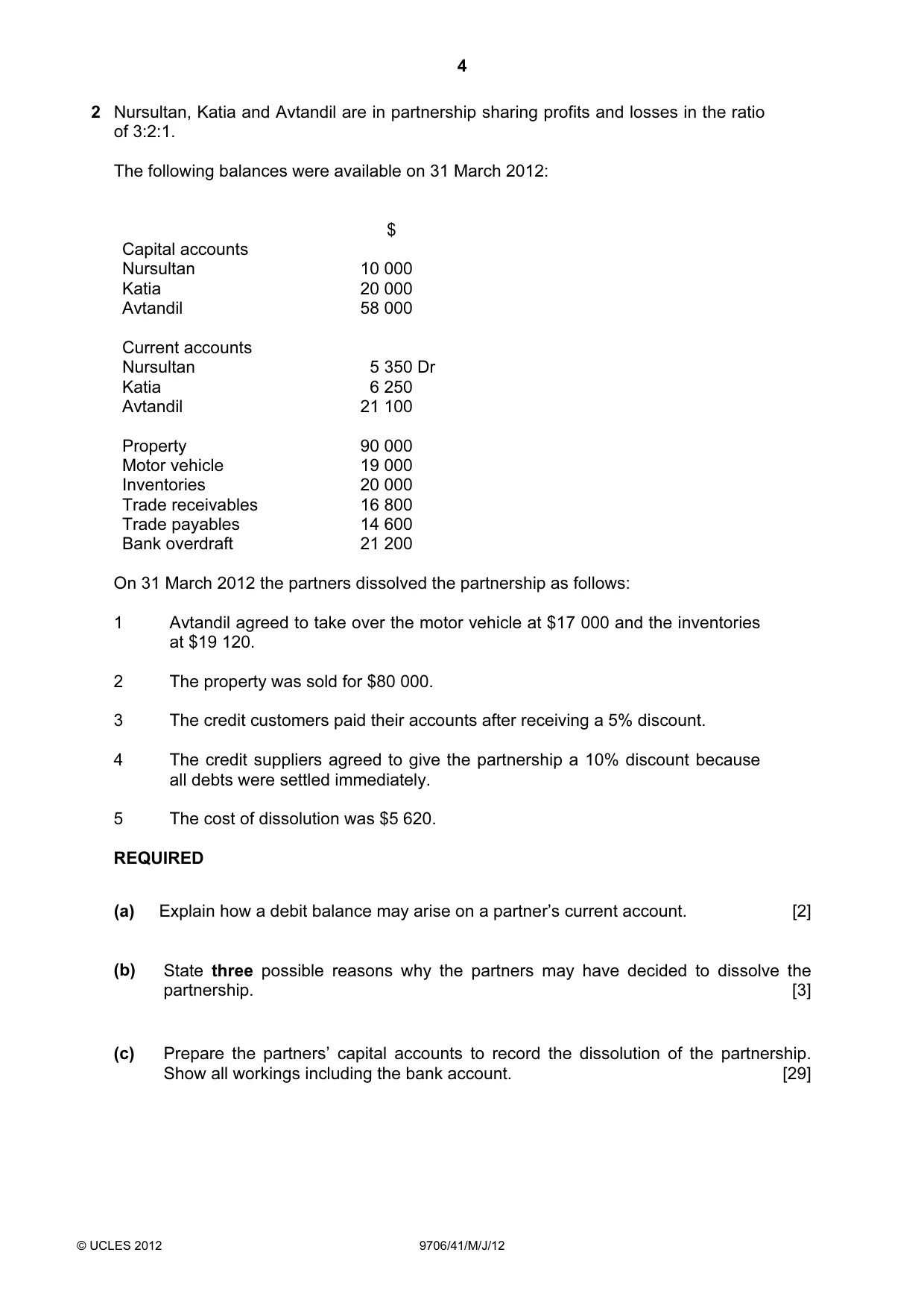
4 © UCLES 2012 9706/41/M/J/12 2 Nursultan, Katia and Avtandil are in partnership sharing profits and losses in the ratio of 3:2:1. The following balances were available on 31 March 2012: $ Capital accounts Nursultan 10 000 Katia 20 000 Avtandil 58 000 Current accounts Nursultan 5 350 Dr Katia 6 250 Avtandil 21 100 Property 90 000 Motor vehicle 19 000 Inventories 20 000 Trade receivables 16 800 Trade payables 14 600 Bank overdraft 21 200 On 31 March 2012 the partners dissolved the partnership as follows: 1 Avtandil agreed to take over the motor vehicle at $17 000 and the inventories at $19 120. 2 The property was sold for $80 000. 3 The credit customers paid their accounts after receiving a 5% discount. 4 The credit suppliers agreed to give the partnership a 10% discount because all debts were settled immediately. 5 The cost of dissolution was $5 620. REQUIRED. (a) Explain how a debit balance may arise on a partner’s current account. [2] (b) State three possible reasons why the partners may have decided to dissolve the partnership. [3] (c) Prepare the partners’ capital accounts to record the dissolution of the partnership. Show all workings including the bank account. [29]
Question paper, page 5
5 © UCLES 2012 9706/41/M/J/12 [Turn over On 1 April 2012 Avtandil set up a new limited company with Damir. Avtandil will bring into the company the inventories and motor vehicle from the dissolved partnership. Damir will invest enough cash so the split of shares between the two is 3:2 to Avtandil and Damir respectively. The issued share capital is to be ordinary shares of $0.50 each. REQUIRED (d) Calculate the number of ordinary shares which Avtandil and Damir will each own. [6] [Total: 40]
Question paper, page 6
6 © UCLES 2012 9706/41/M/J/12 3 Aston Manufacturing Company has recently implemented a new standard costing system. (a) Explain the purpose of standard costing. [4] Budgeted data for the month of April 2012 was: Sales and production 5000 units Materials per unit 8 kilograms Materials cost per kilogram $6 Labour per unit 3 hours Labour cost per hour $7.50 Overheads per unit 3 hours at $3.50 per hour The standard selling price gives a standard profit margin of 19%. REQUIRED (b) Calculate the standard selling price per unit. [7] Additional information: The actual results for April 2012 were: Production 5300 units Sales 5100 units Sales revenue $522 750 Materials used 43 460 kilograms Materials cost $271 625 Labour hours 15 500 hours Labour cost $120 125
Question paper, page 7
7 © UCLES 2012 9706/41/M/J/12 REQUIRED (c) Calculate the following variances, stating clearly whether the variance is adverse or favourable. (i) Sales price [4] (ii) Sales volume [2] (iii) Material price [2] (iv) Material usage [2] (v) Labour rate [2] (vi) Labour efficiency [2] (d) Suggest a possible reason for each of the variances. [6] Additional information: During May the company had the opportunity to produce a further three products, Alphas, Betas and Deltas. There were insufficient labour hours to meet the production requirements in full. The details were as follows: Alphas Betas Deltas Contribution per unit $15 $10 $12 Labour hours per unit 5 4 3 The maximum demand for each product is 4000 units and there are 40 000 labour hours available. The associated fixed costs are $75 000. REQUIRED (e) Determine the optimum production plan and calculate the associated net profit. [9] [Total: 40]
Question paper, page 8
8 Permission to reproduce items where third-party owned material protected by copyright is included has been sought and cleared where possible. Every reasonable effort has been made by the publisher (UCLES) to trace copyright holders, but if any items requiring clearance have unwittingly been included, the publisher will be pleased to make amends at the earliest possible opportunity. University of Cambridge International Examinations is part of the Cambridge Assessment Group. Cambridge Assessment is the brand name of University of Cambridge Local Examinations Syndicate (UCLES), which is itself a department of the University of Cambridge. © UCLES 2012 9706/41/M/J/12 BLANK PAGE
Mark scheme, page 1
UNIVERSITY OF CAMBRIDGE INTERNATIONAL EXAMINATIONS GCE Advanced Level MARK SCHEME for the May/June 2012 question paper for the guidance of teachers 9706 ACCOUNTING 9706/41 Paper 4 (Problem Solving – Supplement), maximum raw mark 120 This mark scheme is published as an aid to teachers and candidates, to indicate the requirements of the examination. It shows the basis on which Examiners were instructed to award marks. It does not indicate the details of the discussions that took place at an Examiners’ meeting before marking began, which would have considered the acceptability of alternative answers. Mark schemes must be read in conjunction with the question papers and the report on the examination. • Cambridge will not enter into discussions or correspondence in connection with these mark schemes. Cambridge is publishing the mark schemes for the May/June 2012 question papers for most IGCSE, GCE Advanced Level and Advanced Subsidiary Level syllabuses and some Ordinary Level syllabuses.
Mark scheme, page 2
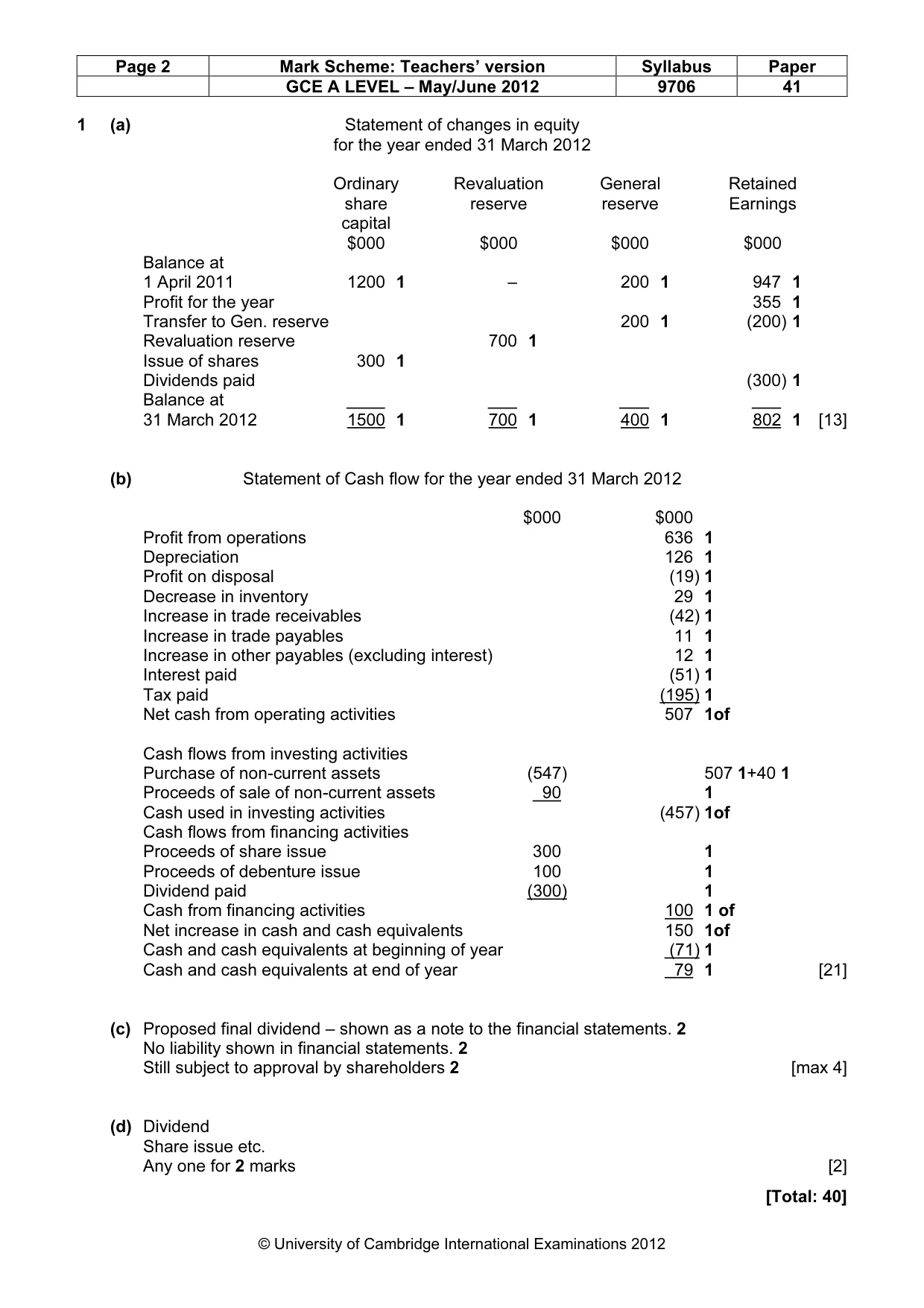
Page 2 Mark Scheme: Teachers’ version Syllabus Paper GCE A LEVEL – May/June 2012 9706 41 © University of Cambridge International Examinations 2012 1 (a) Statement of changes in equity for the year ended 31 March 2012 Ordinary Revaluation General Retained share reserve reserve Earnings capital $000 $000 $000 $000 Balance at 1 April 2011 1200 1 – 200 1 947 1 Profit for the year 355 1 Transfer to Gen. reserve 200 1 (200) 1 Revaluation reserve 700 1 Issue of shares 300 1 Dividends paid (300) 1 Balance at 31 March 2012 1500 1 700 1 400 1 802 1 [13] (b) Statement of Cash flow for the year ended 31 March 2012 $000 $000 Profit from operations 636 1 Depreciation 126 1 Profit on disposal (19) 1 Decrease in inventory 29 1 Increase in trade receivables (42) 1 Increase in trade payables 11 1 Increase in other payables (excluding interest) 12 1 Interest paid (51) 1 Tax paid (195) 1 Net cash from operating activities 507 1of Cash flows from investing activities Purchase of non-current assets (547) 507 1+40 1 Proceeds of sale of non-current assets 90 1 Cash used in investing activities (457) 1of Cash flows from financing activities Proceeds of share issue 300 1 Proceeds of debenture issue 100 1 Dividend paid (300) 1 Cash from financing activities 100 1 of Net increase in cash and cash equivalents 150 1of Cash and cash equivalents at beginning of year (71) 1 Cash and cash equivalents at end of year 79 1 [21] (c) Proposed final dividend – shown as a note to the financial statements. 2 No liability shown in financial statements. 2 Still subject to approval by shareholders 2 [max 4] (d) Dividend Share issue etc. Any one for 2 marks [2] [Total: 40]
Mark scheme, page 3
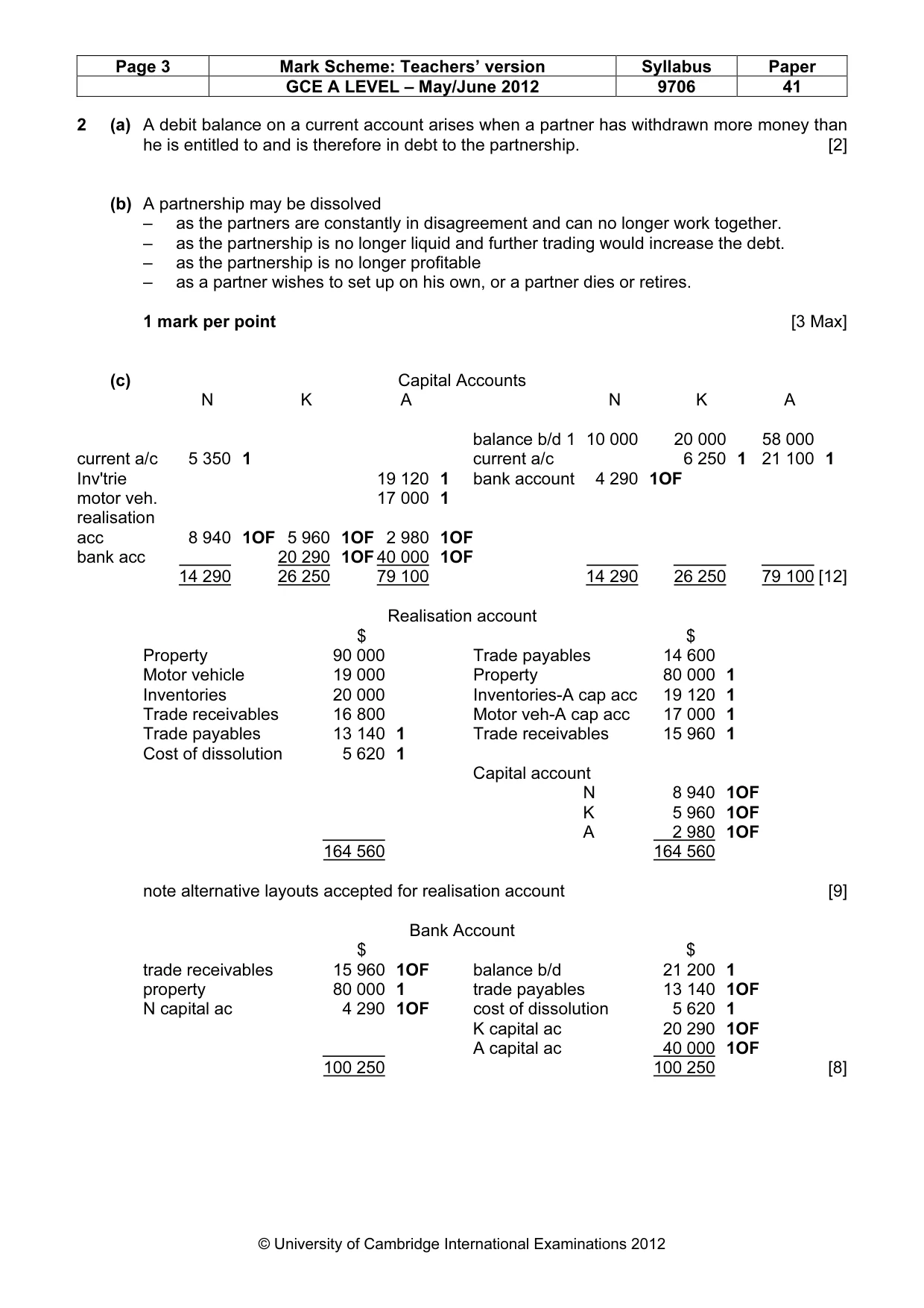
Page 3 Mark Scheme: Teachers’ version Syllabus Paper GCE A LEVEL – May/June 2012 9706 41 © University of Cambridge International Examinations 2012 2 (a) A debit balance on a current account arises when a partner has withdrawn more money than he is entitled to and is therefore in debt to the partnership. [2] (b) A partnership may be dissolved – as the partners are constantly in disagreement and can no longer work together. – as the partnership is no longer liquid and further trading would increase the debt. – as the partnership is no longer profitable – as a partner wishes to set up on his own, or a partner dies or retires. 1 mark per point [3 Max] (c) Capital Accounts N K A N K A balance b/d 1 10 000 20 000 58 000 current a/c 5 350 1 current a/c 6 250 1 21 100 1 Inv'trie 19 120 1 bank account 4 290 1OF motor veh. 17 000 1 realisation acc 8 940 1OF 5 960 1OF 2 980 1OF bank acc 20 290 1OF 40 000 1OF 14 290 26 250 79 100 14 290 26 250 79 100 [12] Realisation account $ $ Property 90 000 Trade payables 14 600 Motor vehicle 19 000 Property 80 000 1 Inventories 20 000 Inventories-A cap acc 19 120 1 Trade receivables 16 800 Motor veh-A cap acc 17 000 1 Trade payables 13 140 1 Trade receivables 15 960 1 Cost of dissolution 5 620 1 Capital account N 8 940 1OF K 5 960 1OF A 2 980 1OF 164 560 164 560 note alternative layouts accepted for realisation account [9] Bank Account $ $ trade receivables 15 960 1OF balance b/d 21 200 1 property 80 000 1 trade payables 13 140 1OF N capital ac 4 290 1OF cost of dissolution 5 620 1 K capital ac 20 290 1OF A capital ac 40 000 1OF 100 250 100 250 [8]
Mark scheme, page 4
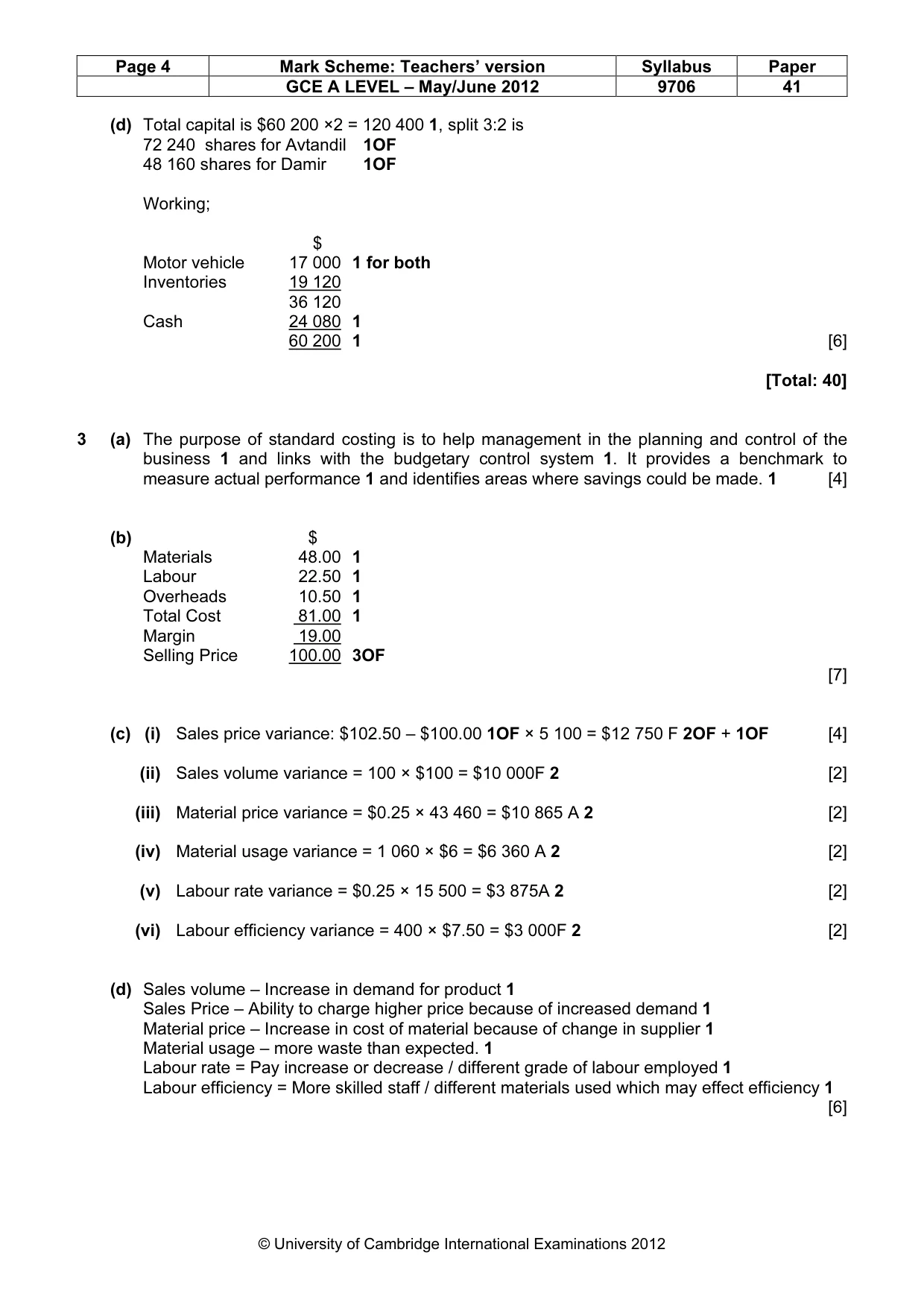
Page 4 Mark Scheme: Teachers’ version Syllabus Paper GCE A LEVEL – May/June 2012 9706 41 © University of Cambridge International Examinations 2012 (d) Total capital is $60 200 ×2 = 120 400 1, split 3:2 is 72 240 shares for Avtandil 1OF 48 160 shares for Damir 1OF Working; $ Motor vehicle 17 000 1 for both Inventories 19 120 36 120 Cash 24 080 1 60 200 1 [6] [Total: 40] 3 (a) The purpose of standard costing is to help management in the planning and control of the business 1 and links with the budgetary control system 1. It provides a benchmark to measure actual performance 1 and identifies areas where savings could be made. 1 [4] (b) $ Materials 48.00 1 Labour 22.50 1 Overheads 10.50 1 Total Cost 81.00 1 Margin 19.00 Selling Price 100.00 3OF [7] (c) (i) Sales price variance: $102.50 – $100.00 1OF × 5 100 = $12 750 F 2OF + 1OF [4] (ii) Sales volume variance = 100 × $100 = $10 000F 2 [2] (iii) Material price variance = $0.25 × 43 460 = $10 865 A 2 [2] (iv) Material usage variance = 1 060 × $6 = $6 360 A 2 [2] (v) Labour rate variance = $0.25 × 15 500 = $3 875A 2 [2] (vi) Labour efficiency variance = 400 × $7.50 = $3 000F 2 [2] (d) Sales volume – Increase in demand for product 1 Sales Price – Ability to charge higher price because of increased demand 1 Material price – Increase in cost of material because of change in supplier 1 Material usage – more waste than expected. 1 Labour rate = Pay increase or decrease / different grade of labour employed 1 Labour efficiency = More skilled staff / different materials used which may effect efficiency 1 [6]
Mark scheme, page 5
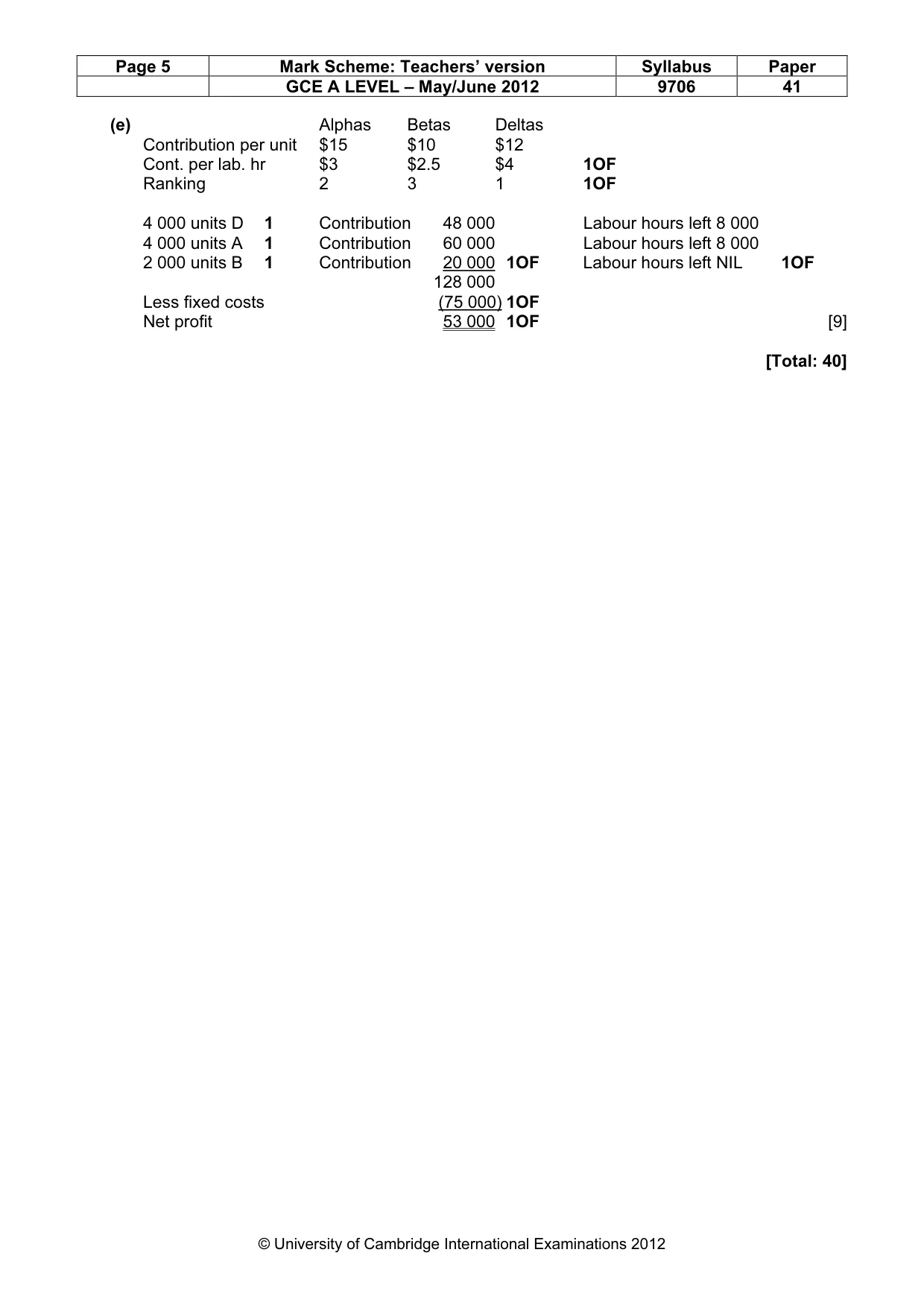
Page 5 Mark Scheme: Teachers’ version Syllabus Paper GCE A LEVEL – May/June 2012 9706 41 © University of Cambridge International Examinations 2012 (e) Alphas Betas Deltas Contribution per unit $15 $10 $12 Cont. per lab. hr $3 $2.5 $4 1OF Ranking 2 3 1 1OF 4 000 units D 1 Contribution 48 000 Labour hours left 8 000 4 000 units A 1 Contribution 60 000 Labour hours left 8 000 2 000 units B 1 Contribution 20 000 1OF Labour hours left NIL 1OF 128 000 Less fixed costs (75 000) 1OF Net profit 53 000 1OF [9] [Total: 40]
What you needed in this session
Cambridge’s own grade thresholds for 2012 May/June, Paper 4 · Variant 1. A higher threshold means an easier paper — the bar moves with how the cohort did.