Cambridge A Level Accounting 9706 — 2012 May/June Paper 4 · Variant 3
9706/43/M/J/12 · 120 marks · ≈135 min
The question paper and its mark scheme, free to read here and free to download. This is Cambridge’s own paper, exactly as it was sat.
Question paper8 pages
Mark scheme5 pages
Answers below. Sit the paper first if you are practising.
Paper as text
Question paper, page 1
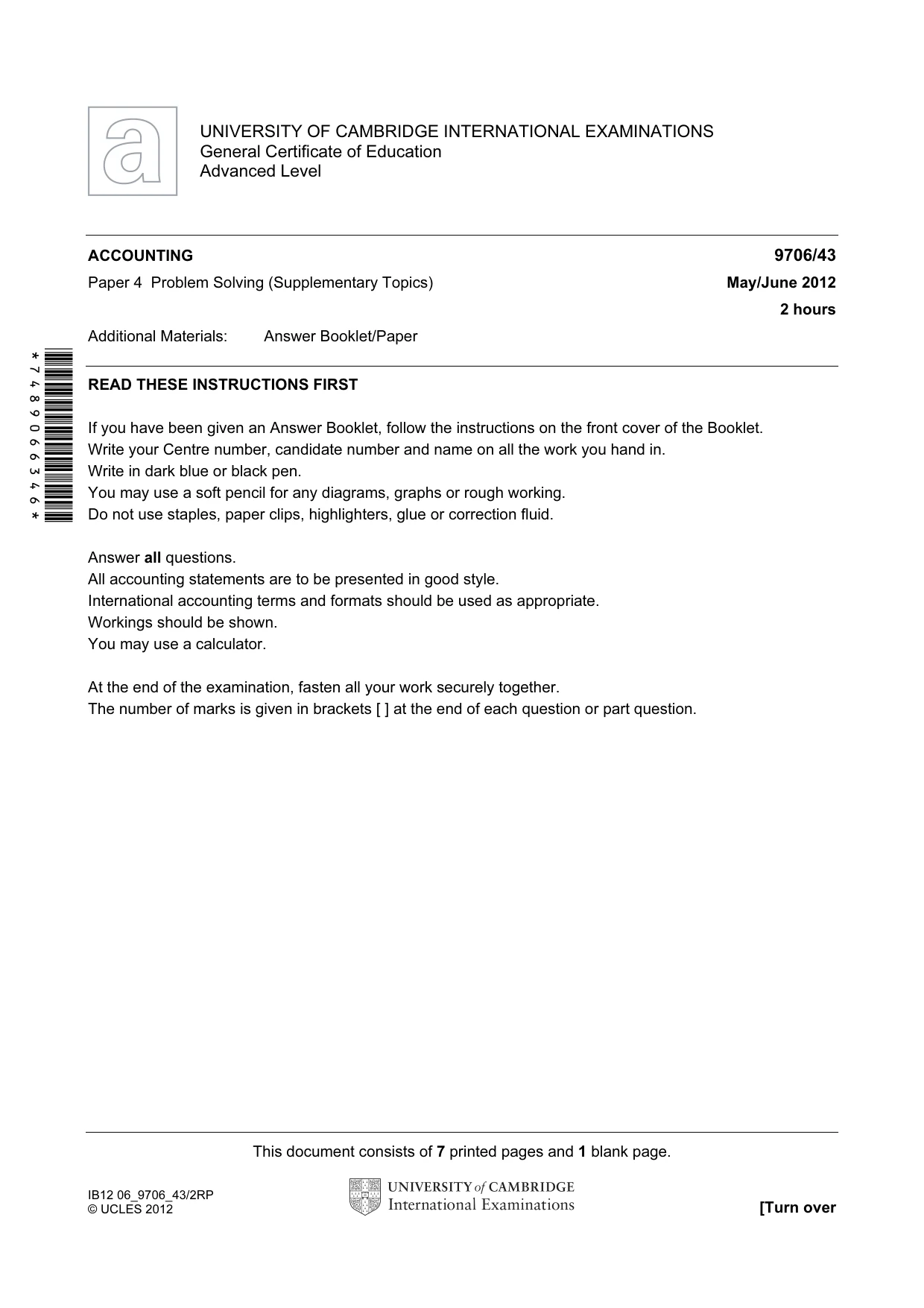
This document consists of 7 printed pages and 1 blank page. IB12 06_9706_43/2RP © UCLES 2012 [Turn over *7489066346* UNIVERSITY OF CAMBRIDGE INTERNATIONAL EXAMINATIONS General Certificate of Education Advanced Level ACCOUNTING 9706/43 Paper 4 Problem Solving (Supplementary Topics) May/June 2012 2 hours Additional Materials: Answer Booklet/Paper READ THESE INSTRUCTIONS FIRST If you have been given an Answer Booklet, follow the instructions on the front cover of the Booklet. Write your Centre number, candidate number and name on all the work you hand in. Write in dark blue or black pen. You may use a soft pencil for any diagrams, graphs or rough working. Do not use staples, paper clips, highlighters, glue or correction fluid. Answer all questions. All accounting statements are to be presented in good style. International accounting terms and formats should be used as appropriate. Workings should be shown. You may use a calculator. At the end of the examination, fasten all your work securely together. The number of marks is given in brackets [ ] at the end of each question or part question.
Question paper, page 2
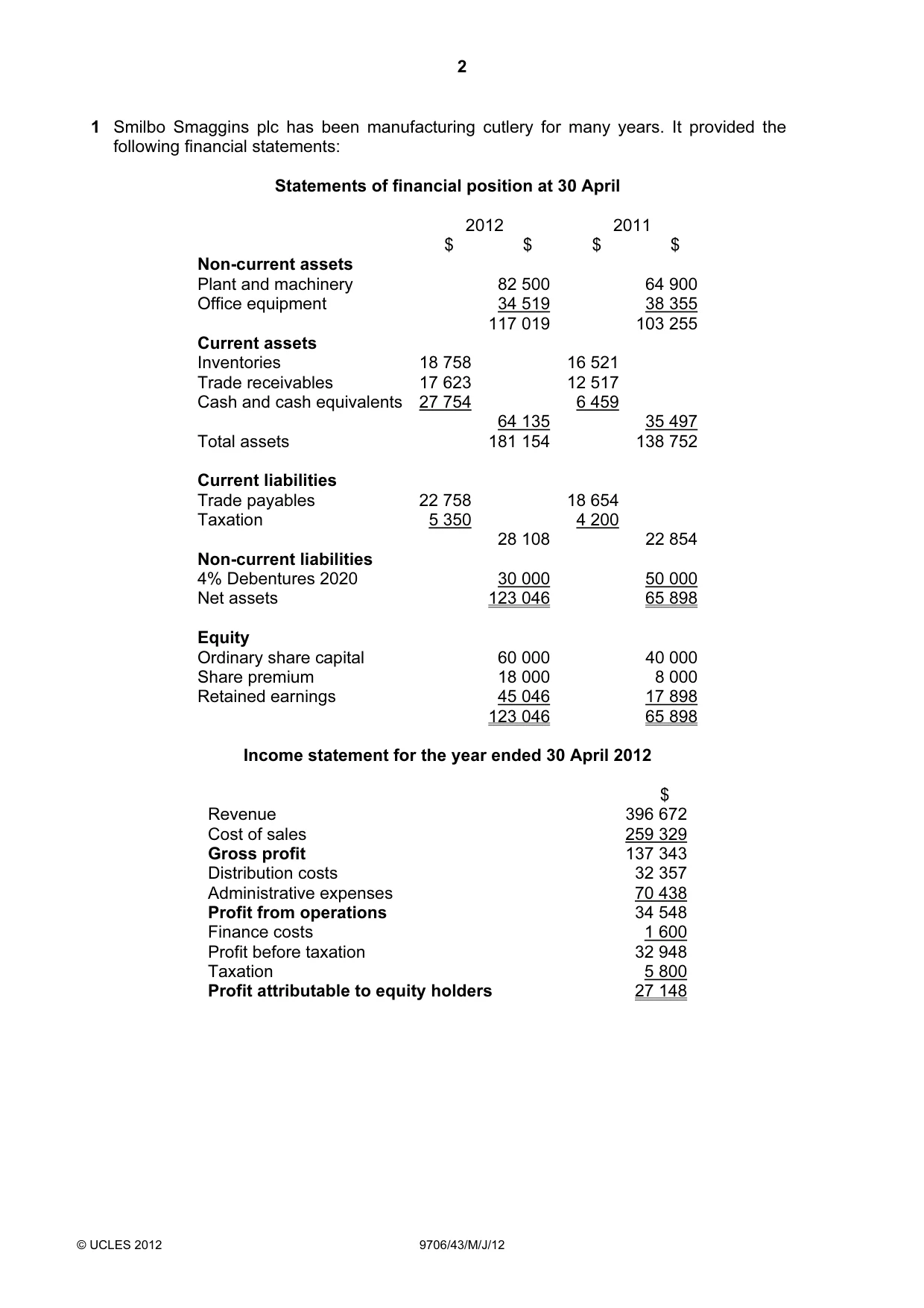
2 © UCLES 2012 9706/43/M/J/12 1 Smilbo Smaggins plc has been manufacturing cutlery for many years. It provided the following financial statements: Statements of financial position at 30 April 2012 2011 $ $ $ $ Non-current assets Plant and machinery 82 500 64 900 Office equipment 34 519 38 355 117 019 103 255 Current assets Inventories 18 758 16 521 Trade receivables 17 623 12 517 Cash and cash equivalents 27 754 6 459 64 135 35 497 Total assets 181 154 138 752 Current liabilities Trade payables 22 758 18 654 Taxation 5 350 4 200 28 108 22 854 Non-current liabilities 4% Debentures 2020 30 000 50 000 Net assets 123 046 65 898 Equity Ordinary share capital 60 000 40 000 Share premium 18 000 8 000 Retained earnings 45 046 17 898 123 046 65 898 . Income statement for the year ended 30 April 2012 $ Revenue 396 672 Cost of sales 259 329 Gross profit 137 343 Distribution costs 32 357 Administrative expenses 70 438 Profit from operations 34 548 Finance costs 1 600 Profit before taxation 32 948 Taxation 5 800 Profit attributable to equity holders 27 148
Question paper, page 3
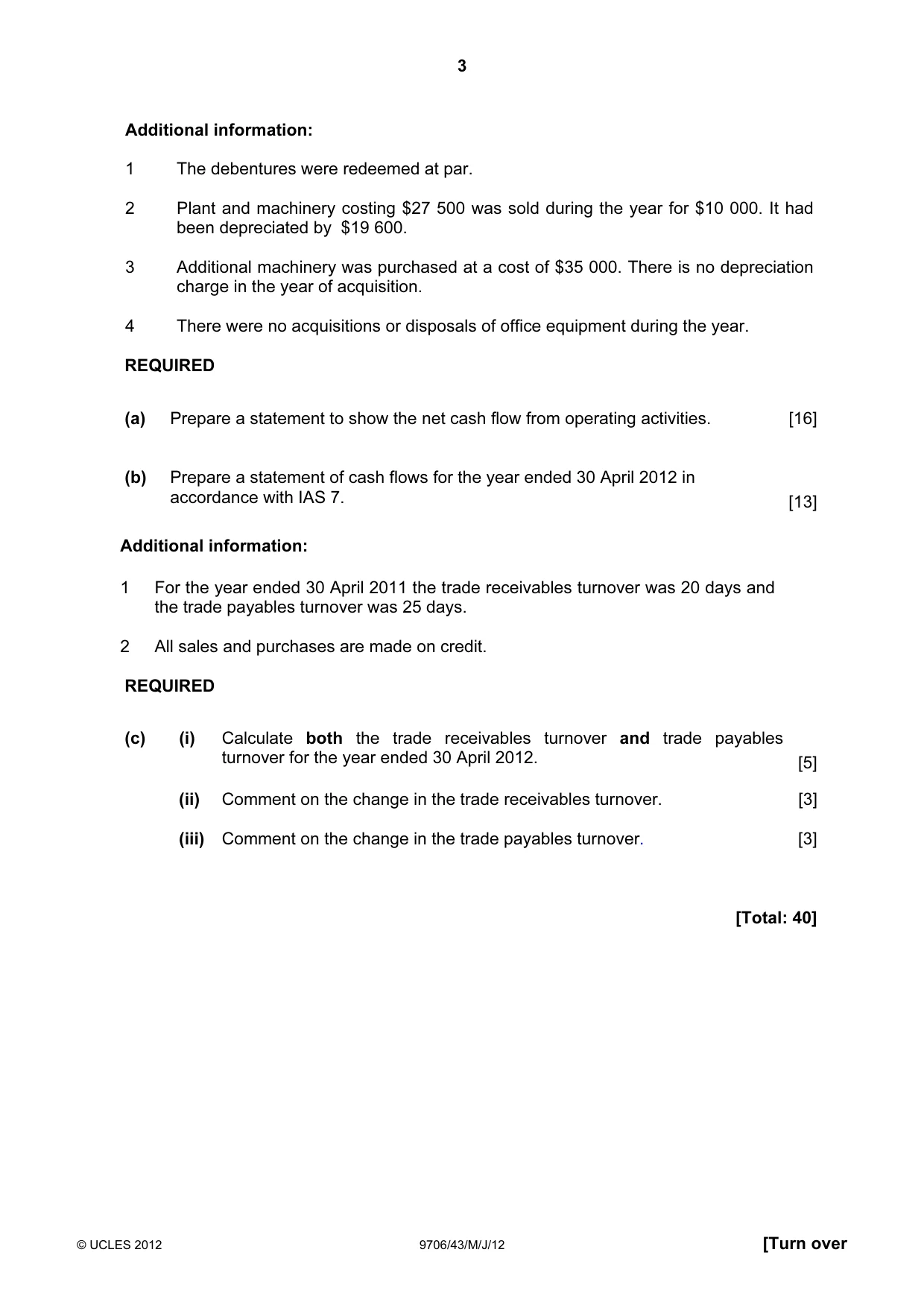
3 © UCLES 2012 9706/43/M/J/12 [Turn over Additional information: 1 The debentures were redeemed at par. 2 Plant and machinery costing $27 500 was sold during the year for $10 000. It had been depreciated by $19 600. 3 Additional machinery was purchased at a cost of $35 000. There is no depreciation charge in the year of acquisition. 4 There were no acquisitions or disposals of office equipment during the year. REQUIRED (a) Prepare a statement to show the net cash flow from operating activities. [16] (b) Prepare a statement of cash flows for the year ended 30 April 2012 in accordance with IAS 7. [13] Additional information: 1 For the year ended 30 April 2011 the trade receivables turnover was 20 days and the trade payables turnover was 25 days. 2 All sales and purchases are made on credit. REQUIRED (c) (i) Calculate both the trade receivables turnover and trade payables turnover for the year ended 30 April 2012. [5] (ii) Comment on the change in the trade receivables turnover. [3] (iii) Comment on the change in the trade payables turnover. [3] [Total: 40]
Question paper, page 4
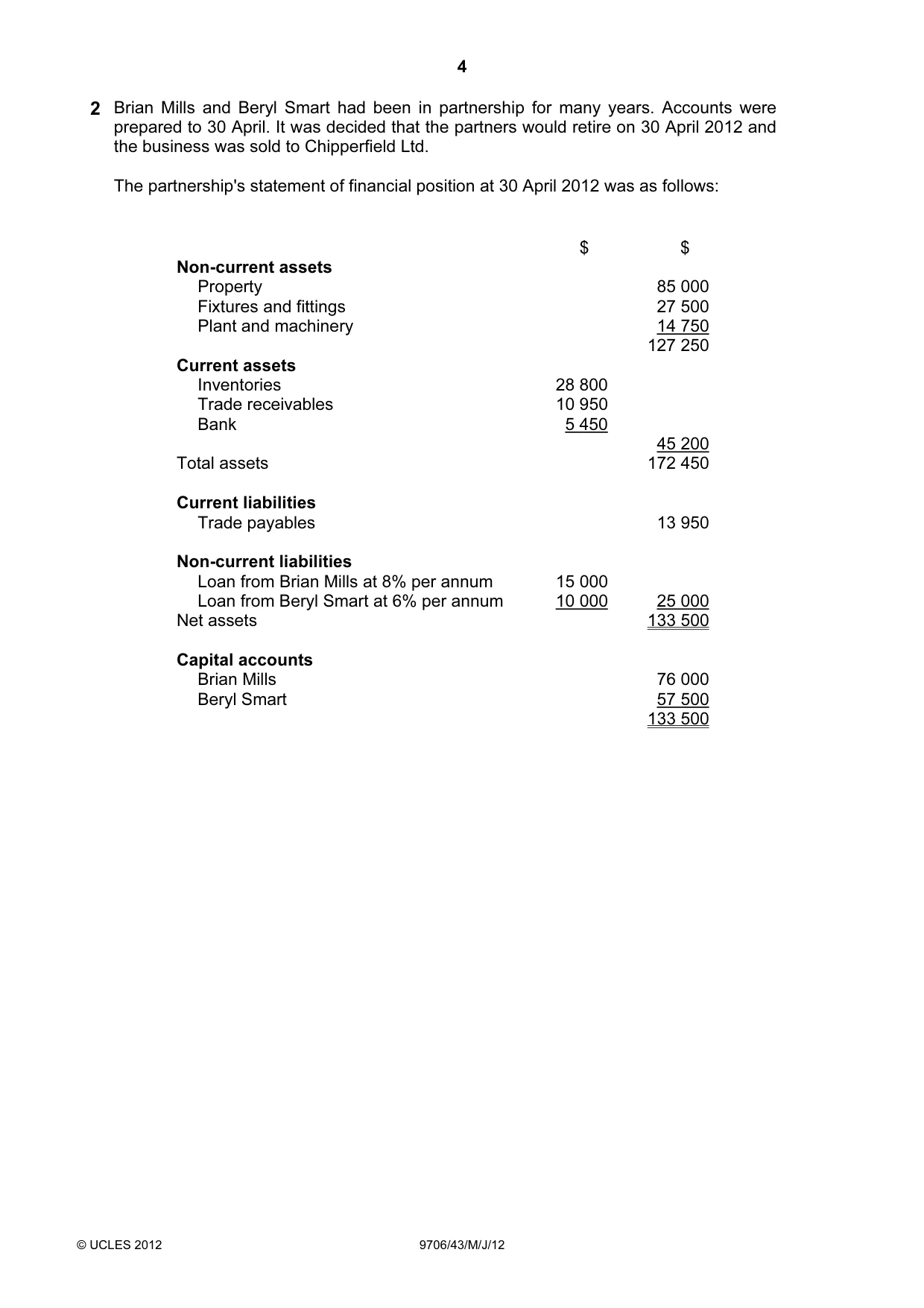
4 © UCLES 2012 9706/43/M/J/12 2 Brian Mills and Beryl Smart had been in partnership for many years. Accounts were prepared to 30 April. It was decided that the partners would retire on 30 April 2012 and the business was sold to Chipperfield Ltd. The partnership's statement of financial position at 30 April 2012 was as follows: $ $ Non-current assets Property 85 000 Fixtures and fittings 27 500 Plant and machinery 14 750 127 250 Current assets Inventories 28 800 Trade receivables 10 950 Bank 5 450 45 200 Total assets 172 450 Current liabilities Trade payables 13 950 Non-current liabilities Loan from Brian Mills at 8% per annum 15 000 Loan from Beryl Smart at 6% per annum 10 000 25 000 Net assets 133 500 Capital accounts Brian Mills 76 000 Beryl Smart 57 500 133 500
Question paper, page 5
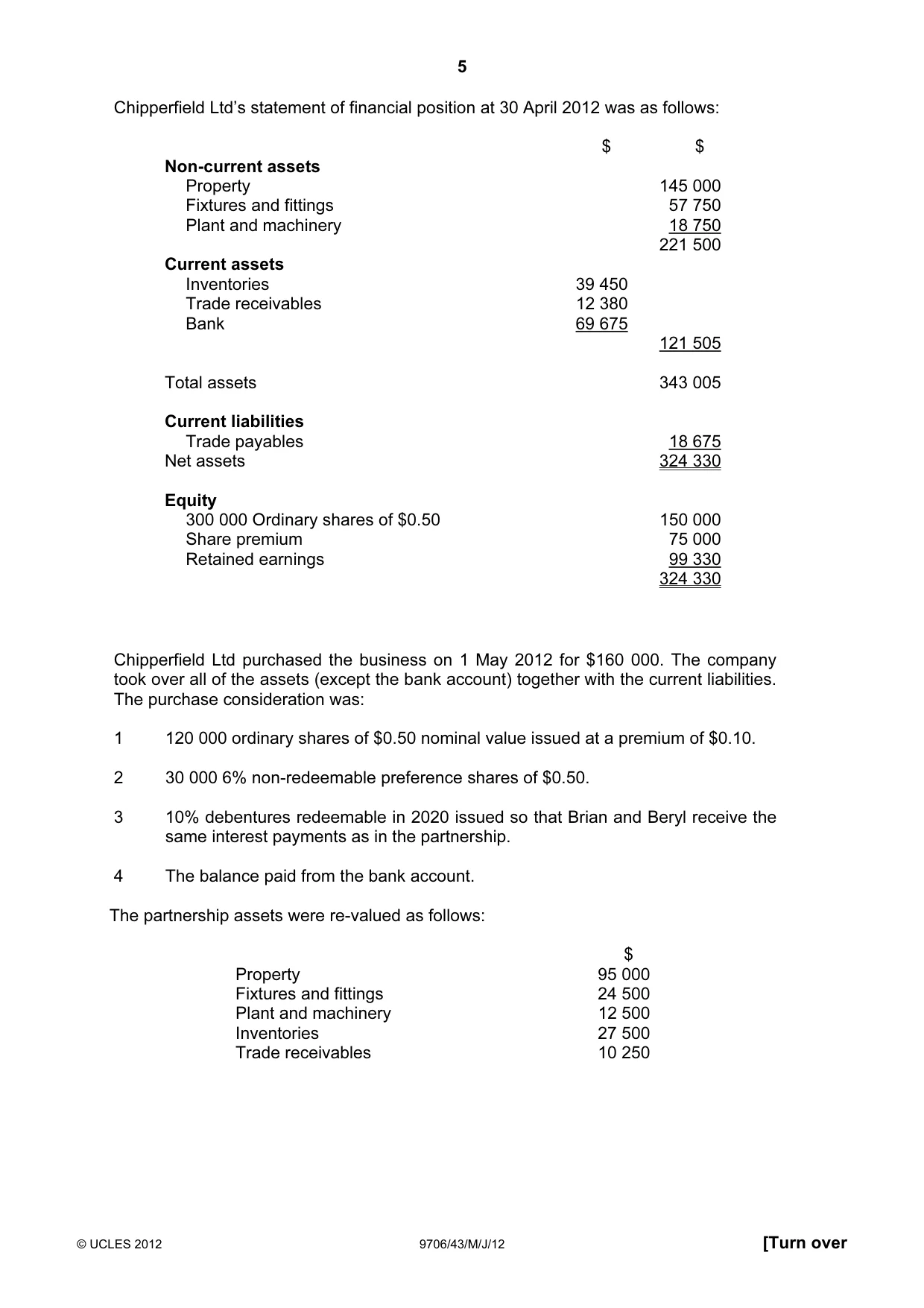
5 © UCLES 2012 9706/43/M/J/12 [Turn over Chipperfield Ltd’s statement of financial position at 30 April 2012 was as follows: $ $ Non-current assets Property 145 000 Fixtures and fittings 57 750 Plant and machinery 18 750 221 500 Current assets Inventories 39 450 Trade receivables 12 380 Bank 69 675 121 505 Total assets 343 005 Current liabilities Trade payables 18 675 Net assets 324 330 Equity 300 000 Ordinary shares of $0.50 150 000 Share premium 75 000 Retained earnings 99 330 324 330 Chipperfield Ltd purchased the business on 1 May 2012 for $160 000. The company took over all of the assets (except the bank account) together with the current liabilities. The purchase consideration was: 1 120 000 ordinary shares of $0.50 nominal value issued at a premium of $0.10. 2 30 000 6% non-redeemable preference shares of $0.50. 3 10% debentures redeemable in 2020 issued so that Brian and Beryl receive the same interest payments as in the partnership. 4 The balance paid from the bank account. The partnership assets were re-valued as follows: $ Property 95 000 Fixtures and fittings 24 500 Plant and machinery 12 500 Inventories 27 500 Trade receivables 10 250
Question paper, page 6
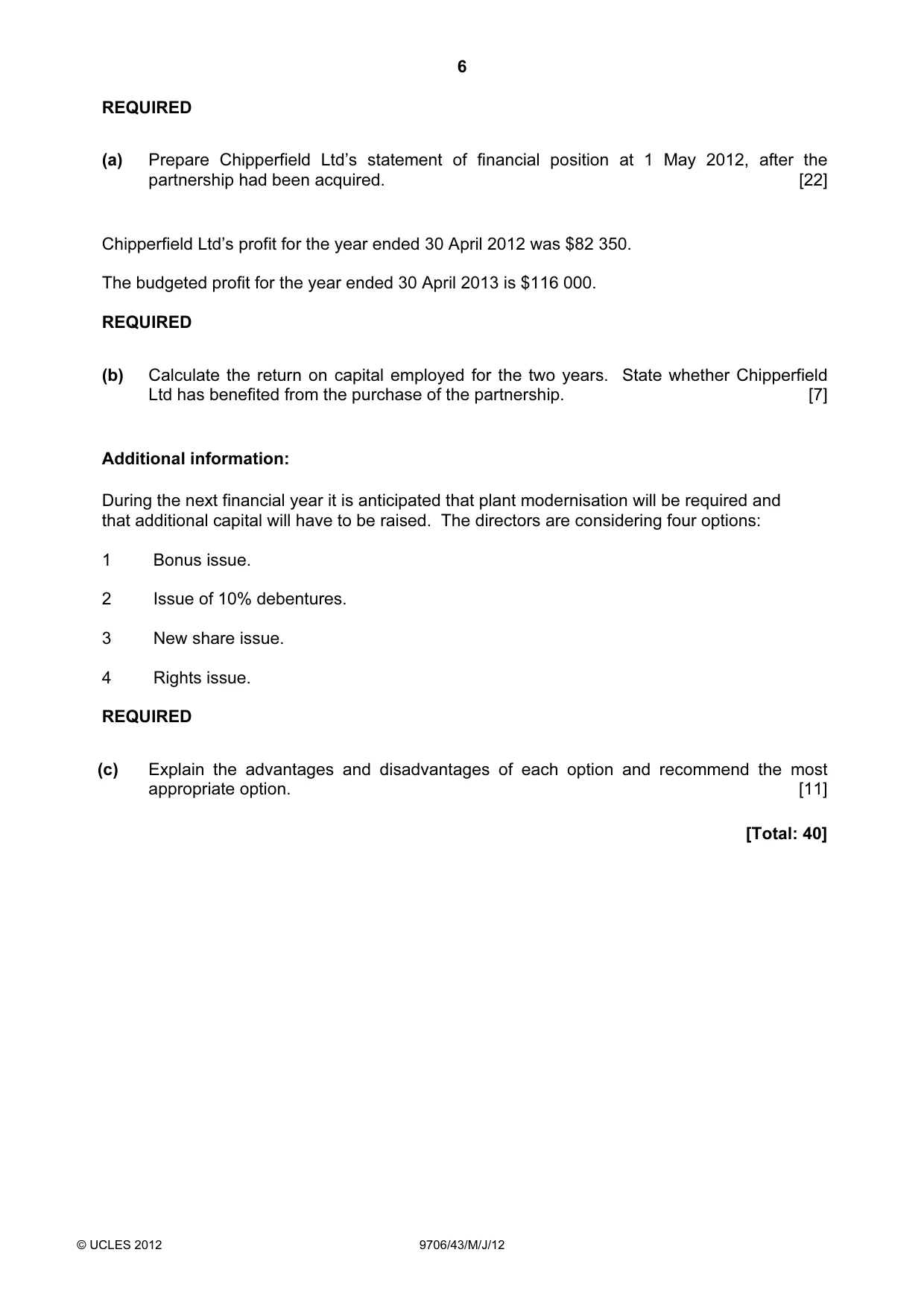
6 © UCLES 2012 9706/43/M/J/12 REQUIRED (a) Prepare Chipperfield Ltd’s statement of financial position at 1 May 2012, after the partnership had been acquired. [22] Chipperfield Ltd’s profit for the year ended 30 April 2012 was $82 350. The budgeted profit for the year ended 30 April 2013 is $116 000. REQUIRED (b) Calculate the return on capital employed for the two years. State whether Chipperfield Ltd has benefited from the purchase of the partnership. [7] Additional information: During the next financial year it is anticipated that plant modernisation will be required and that additional capital will have to be raised. The directors are considering four options: 1 Bonus issue. 2 Issue of 10% debentures. 3 New share issue. 4 Rights issue. REQUIRED (c) Explain the advantages and disadvantages of each option and recommend the most appropriate option. [11] [Total: 40]
Question paper, page 7
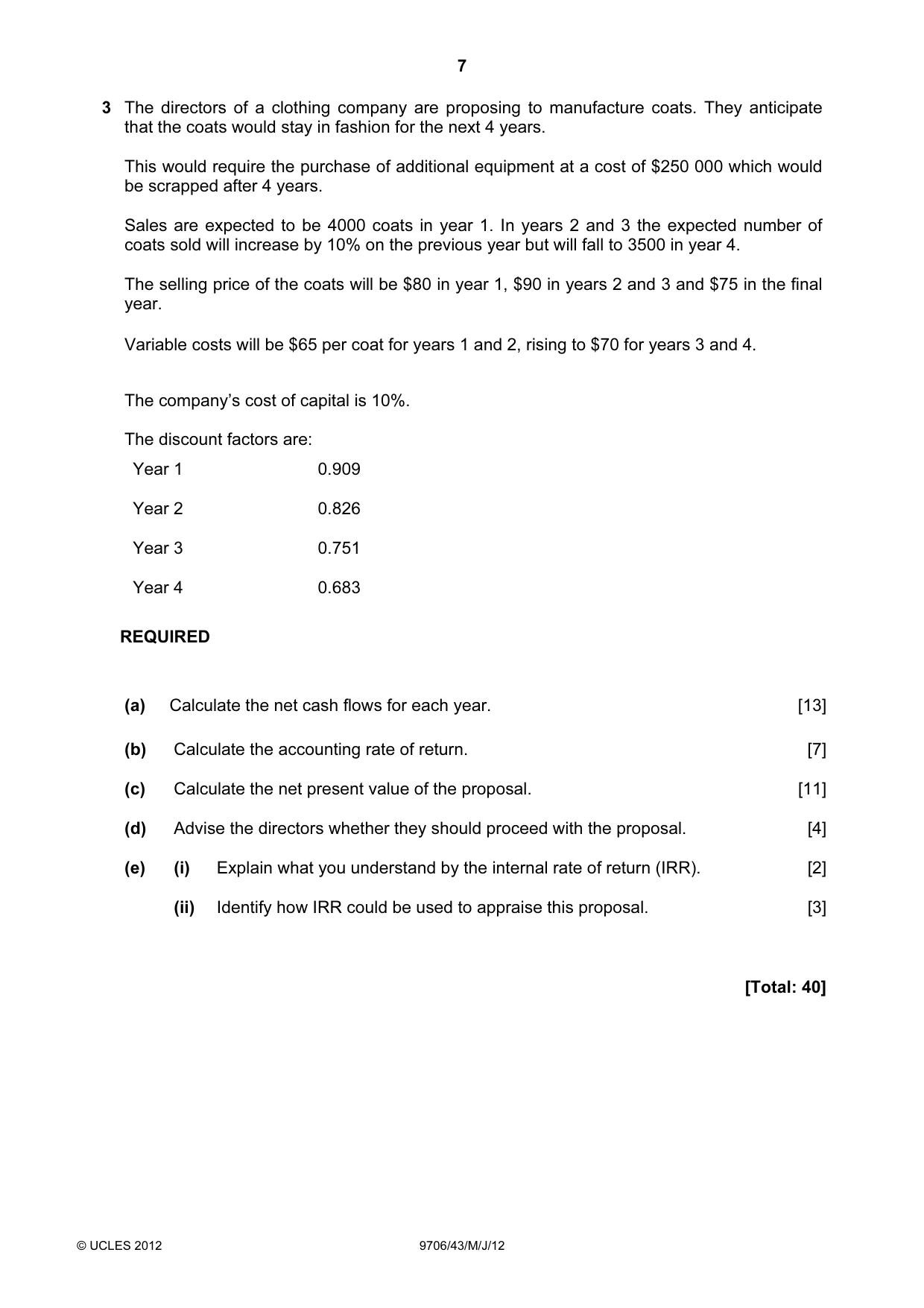
7 © UCLES 2012 9706/43/M/J/12 3 The directors of a clothing company are proposing to manufacture coats. They anticipate that the coats would stay in fashion for the next 4 years. This would require the purchase of additional equipment at a cost of $250 000 which would be scrapped after 4 years. Sales are expected to be 4000 coats in year 1. In years 2 and 3 the expected number of coats sold will increase by 10% on the previous year but will fall to 3500 in year 4. The selling price of the coats will be $80 in year 1, $90 in years 2 and 3 and $75 in the final year. Variable costs will be $65 per coat for years 1 and 2, rising to $70 for years 3 and 4. The company’s cost of capital is 10%. The discount factors are: Year 1 0.909 Year 2 0.826 Year 3 0.751 Year 4 0.683 REQUIRED (a) Calculate the net cash flows for each year. [13] (b) Calculate the accounting rate of return. [7] (c) Calculate the net present value of the proposal. [11] (d) Advise the directors whether they should proceed with the proposal. [4] (e) (i) Explain what you understand by the internal rate of return (IRR). [2] (ii) Identify how IRR could be used to appraise this proposal. [3] [Total: 40]
Question paper, page 8
8 Permission to reproduce items where third-party owned material protected by copyright is included has been sought and cleared where possible. Every reasonable effort has been made by the publisher (UCLES) to trace copyright holders, but if any items requiring clearance have unwittingly been included, the publisher will be pleased to make amends at the earliest possible opportunity. University of Cambridge International Examinations is part of the Cambridge Assessment Group. Cambridge Assessment is the brand name of University of Cambridge Local Examinations Syndicate (UCLES), which is itself a department of the University of Cambridge. © UCLES 2012 9706/43/M/J/12 BLANK PAGE
Mark scheme, page 1
UNIVERSITY OF CAMBRIDGE INTERNATIONAL EXAMINATIONS GCE Advanced Level MARK SCHEME for the May/June 2012 question paper for the guidance of teachers 9706 ACCOUNTING 9706/43 Paper 4 (Problem Solving – Supplement), maximum raw mark 120 This mark scheme is published as an aid to teachers and candidates, to indicate the requirements of the examination. It shows the basis on which Examiners were instructed to award marks. It does not indicate the details of the discussions that took place at an Examiners’ meeting before marking began, which would have considered the acceptability of alternative answers. Mark schemes must be read in conjunction with the question papers and the report on the examination. • Cambridge will not enter into discussions or correspondence in connection with these mark schemes. Cambridge is publishing the mark schemes for the May/June 2012 question papers for most IGCSE, GCE Advanced Level and Advanced Subsidiary Level syllabuses and some Ordinary Level syllabuses.
Mark scheme, page 2
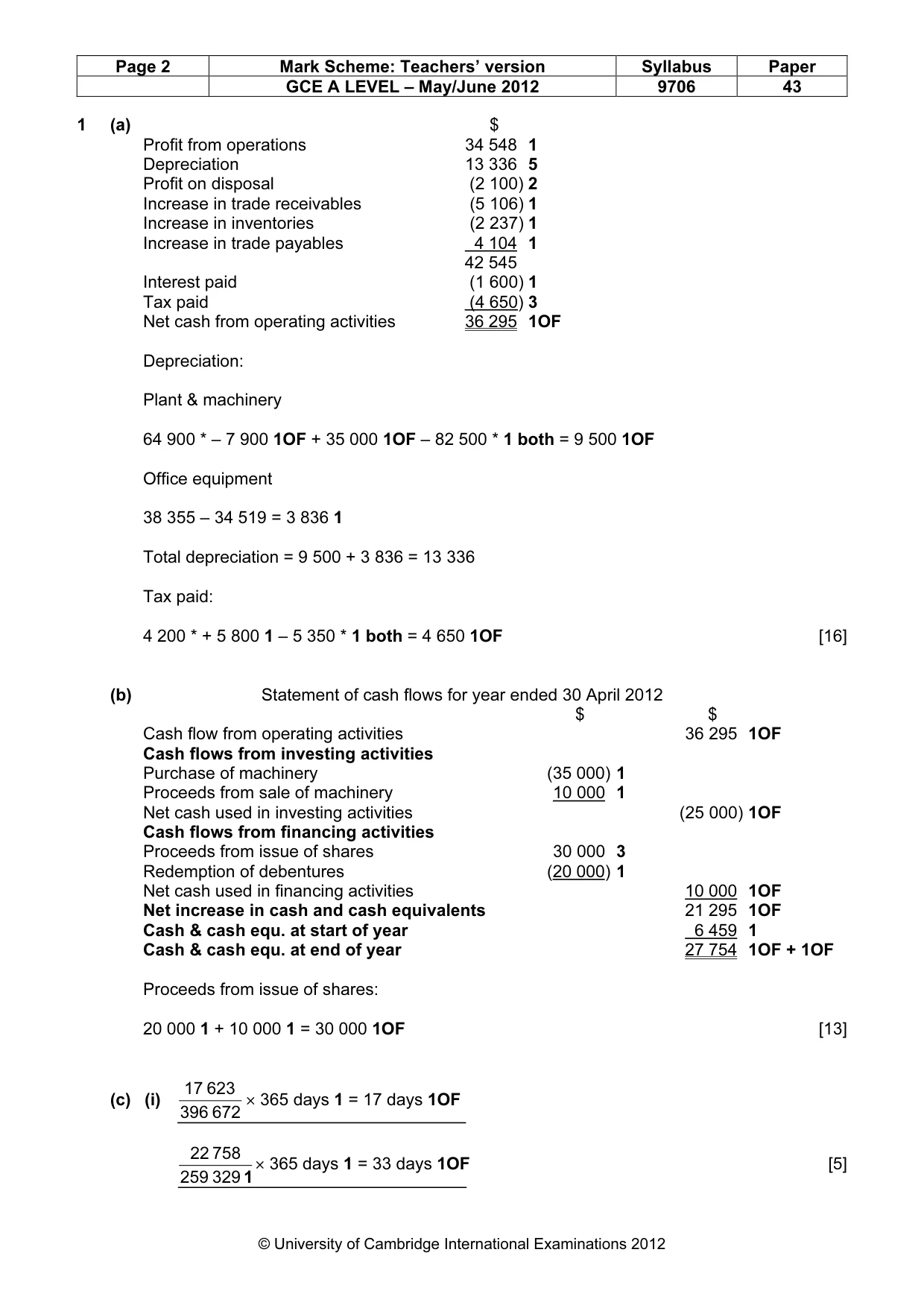
Page 2 Mark Scheme: Teachers’ version Syllabus Paper GCE A LEVEL – May/June 2012 9706 43 © University of Cambridge International Examinations 2012 1 (a) $ Profit from operations 34 548 1 Depreciation 13 336 5 Profit on disposal (2 100) 2 Increase in trade receivables (5 106) 1 Increase in inventories (2 237) 1 Increase in trade payables 4 104 1 42 545 Interest paid (1 600) 1 Tax paid (4 650) 3 Net cash from operating activities 36 295 1OF Depreciation: Plant & machinery 64 900 * – 7 900 1OF + 35 000 1OF – 82 500 * 1 both = 9 500 1OF Office equipment 38 355 – 34 519 = 3 836 1 Total depreciation = 9 500 + 3 836 = 13 336 Tax paid: 4 200 * + 5 800 1 – 5 350 * 1 both = 4 650 1OF [16] (b) Statement of cash flows for year ended 30 April 2012 $ $ Cash flow from operating activities 36 295 1OF Cash flows from investing activities Purchase of machinery (35 000) 1 Proceeds from sale of machinery 10 000 1 Net cash used in investing activities (25 000) 1OF Cash flows from financing activities Proceeds from issue of shares 30 000 3 Redemption of debentures (20 000) 1 Net cash used in financing activities 10 000 1OF Net increase in cash and cash equivalents 21 295 1OF Cash & cash equ. at start of year 6 459 1 Cash & cash equ. at end of year 27 754 1OF + 1OF Proceeds from issue of shares: 20 000 1 + 10 000 1 = 30 000 1OF [13] (c) (i) 672 396 623 17 × 365 days 1 = 17 days 1OF 1 329 259 758 22 × 365 days 1 = 33 days 1OF [5]
Mark scheme, page 3
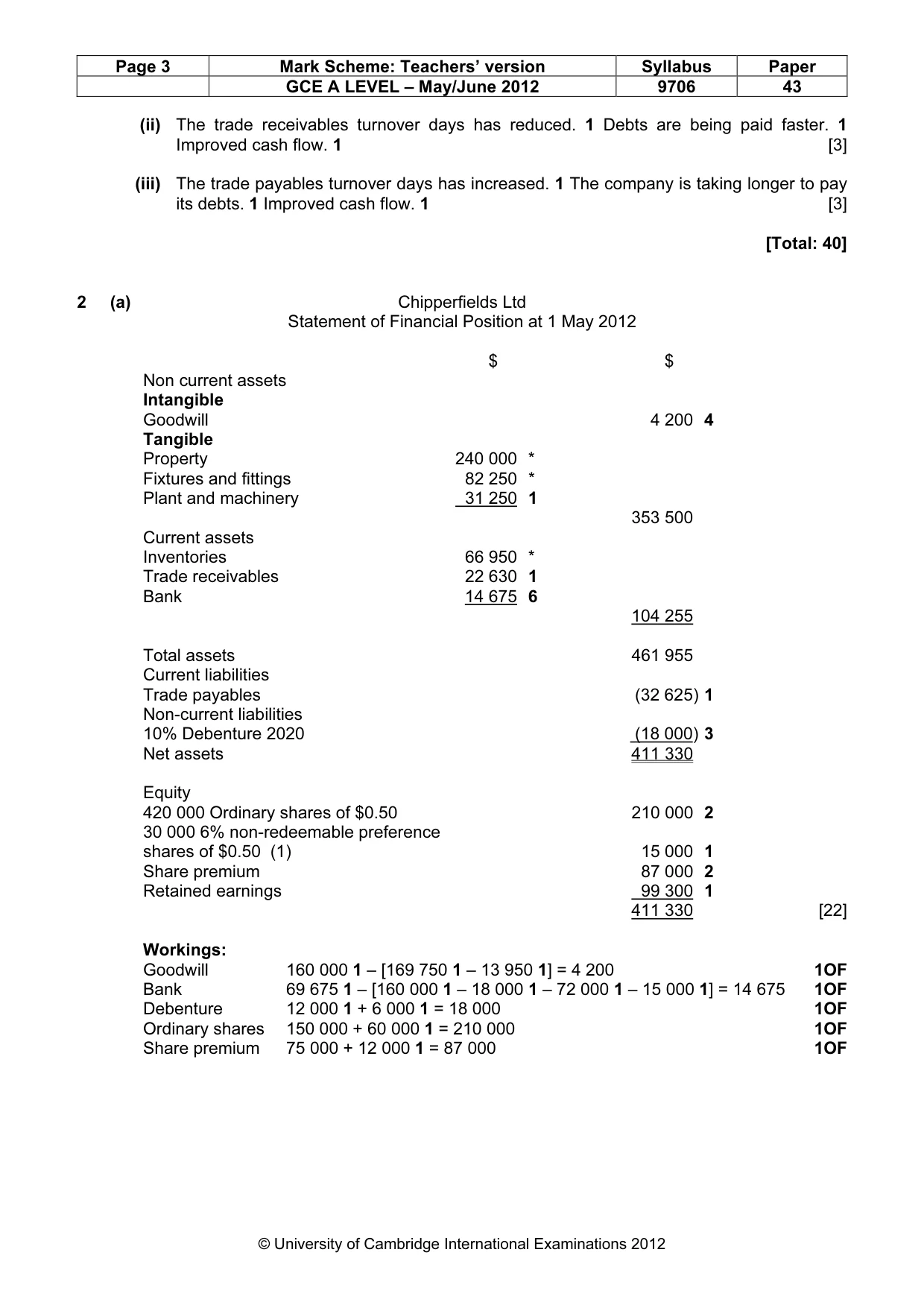
Page 3 Mark Scheme: Teachers’ version Syllabus Paper GCE A LEVEL – May/June 2012 9706 43 © University of Cambridge International Examinations 2012 (ii) The trade receivables turnover days has reduced. 1 Debts are being paid faster. 1 Improved cash flow. 1 [3] (iii) The trade payables turnover days has increased. 1 The company is taking longer to pay its debts. 1 Improved cash flow. 1 [3] [Total: 40] 2 (a) Chipperfields Ltd Statement of Financial Position at 1 May 2012 $ $ Non current assets Intangible Goodwill 4 200 4 Tangible Property 240 000 * Fixtures and fittings 82 250 * Plant and machinery 31 250 1 353 500 Current assets Inventories 66 950 * Trade receivables 22 630 1 Bank 14 675 6 104 255 Total assets 461 955 Current liabilities Trade payables (32 625) 1 Non-current liabilities 10% Debenture 2020 (18 000) 3 Net assets 411 330 Equity 420 000 Ordinary shares of $0.50 210 000 2 30 000 6% non-redeemable preference shares of $0.50 (1) 15 000 1 Share premium 87 000 2 Retained earnings 99 300 1 411 330 [22] Workings: Goodwill 160 000 1 – [169 750 1 – 13 950 1] = 4 200 1OF Bank 69 675 1 – [160 000 1 – 18 000 1 – 72 000 1 – 15 000 1] = 14 675 1OF Debenture 12 000 1 + 6 000 1 = 18 000 1OF Ordinary shares 150 000 + 60 000 1 = 210 000 1OF Share premium 75 000 + 12 000 1 = 87 000 1OF
Mark scheme, page 4
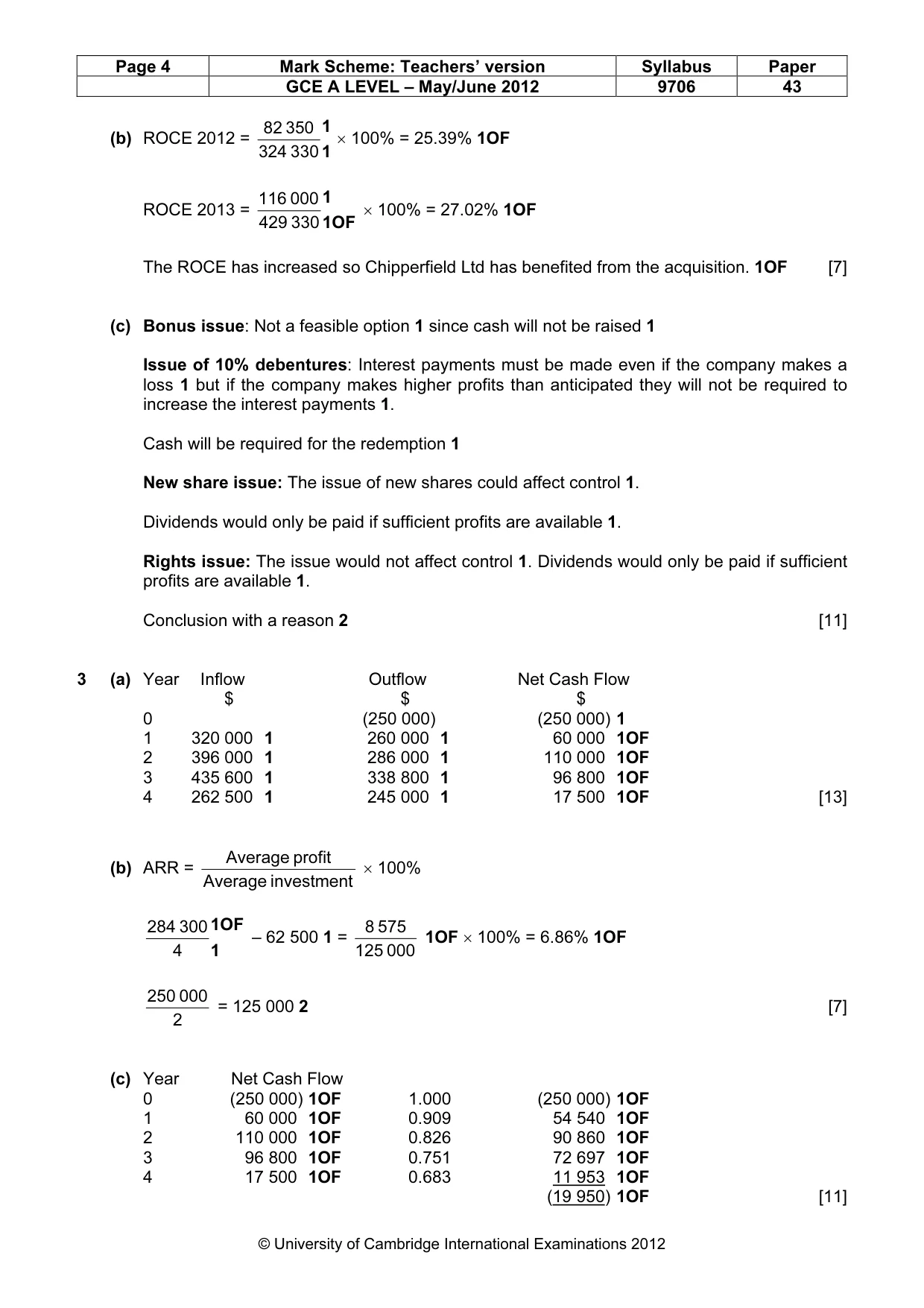
Page 4 Mark Scheme: Teachers’ version Syllabus Paper GCE A LEVEL – May/June 2012 9706 43 © University of Cambridge International Examinations 2012 (b) ROCE 2012 = 1 1 330 324 350 82 × 100% = 25.39% 1OF ROCE 2013 = 1OF 1 330 429 000 116 × 100% = 27.02% 1OF The ROCE has increased so Chipperfield Ltd has benefited from the acquisition. 1OF [7] (c) Bonus issue: Not a feasible option 1 since cash will not be raised 1 Issue of 10% debentures: Interest payments must be made even if the company makes a loss 1 but if the company makes higher profits than anticipated they will not be required to increase the interest payments 1. Cash will be required for the redemption 1 New share issue: The issue of new shares could affect control 1. Dividends would only be paid if sufficient profits are available 1. Rights issue: The issue would not affect control 1. Dividends would only be paid if sufficient profits are available 1. Conclusion with a reason 2 [11] 3 (a) Year Inflow Outflow Net Cash Flow $ $ $ 0 (250 000) (250 000) 1 1 320 000 1 260 000 1 60 000 1OF 2 396 000 1 286 000 1 110 000 1OF 3 435 600 1 338 800 1 96 800 1OF 4 262 500 1 245 000 1 17 500 1OF [13] (b) ARR = investment Average profit Average × 100% 1 1OF 4 300 284 – 62 500 1 = 000 125 575 8 1OF × 100% = 6.86% 1OF 2 000 250 = 125 000 2 [7] (c) Year Net Cash Flow 0 (250 000) 1OF 1.000 (250 000) 1OF 1 60 000 1OF 0.909 54 540 1OF 2 110 000 1OF 0.826 90 860 1OF 3 96 800 1OF 0.751 72 697 1OF 4 17 500 1OF 0.683 11 953 1OF (19 950) 1OF [11]
Mark scheme, page 5
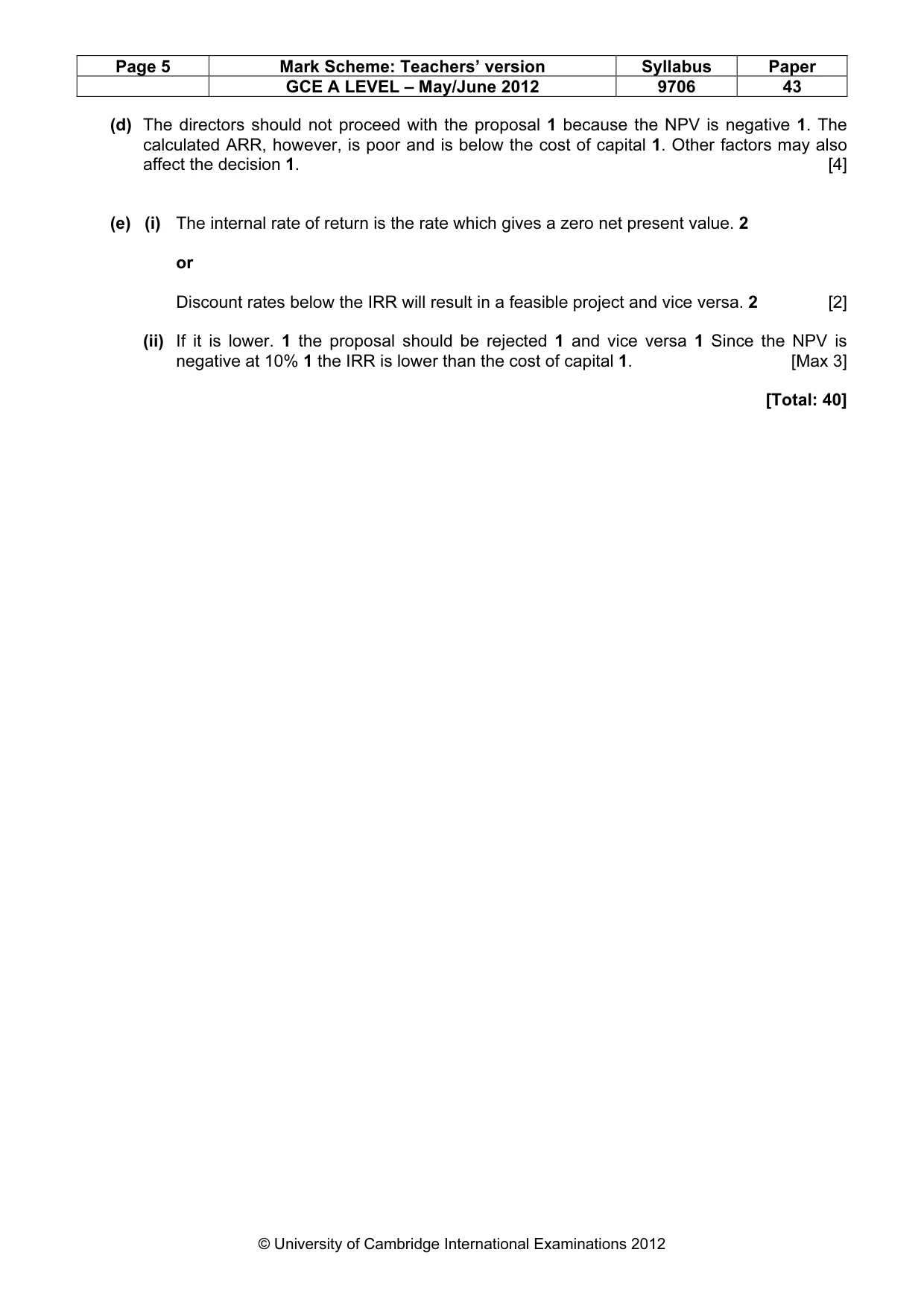
Page 5 Mark Scheme: Teachers’ version Syllabus Paper GCE A LEVEL – May/June 2012 9706 43 © University of Cambridge International Examinations 2012 (d) The directors should not proceed with the proposal 1 because the NPV is negative 1. The calculated ARR, however, is poor and is below the cost of capital 1. Other factors may also affect the decision 1. [4] (e) (i) The internal rate of return is the rate which gives a zero net present value. 2 or Discount rates below the IRR will result in a feasible project and vice versa. 2 [2] (ii) If it is lower. 1 the proposal should be rejected 1 and vice versa 1 Since the NPV is negative at 10% 1 the IRR is lower than the cost of capital 1. [Max 3] [Total: 40]
What you needed in this session
Cambridge’s own grade thresholds for 2012 May/June, Paper 4 · Variant 3. A higher threshold means an easier paper — the bar moves with how the cohort did.