Cambridge A Level Accounting 9706 — 2011 Oct/Nov Paper 4 · Variant 2
9706/42/O/N/11 · 120 marks · ≈135 min
The question paper and its mark scheme, free to read here and free to download. This is Cambridge’s own paper, exactly as it was sat.
Question paper8 pages

Mark scheme5 pages
Answers below. Sit the paper first if you are practising.
Paper as text
Question paper, page 1
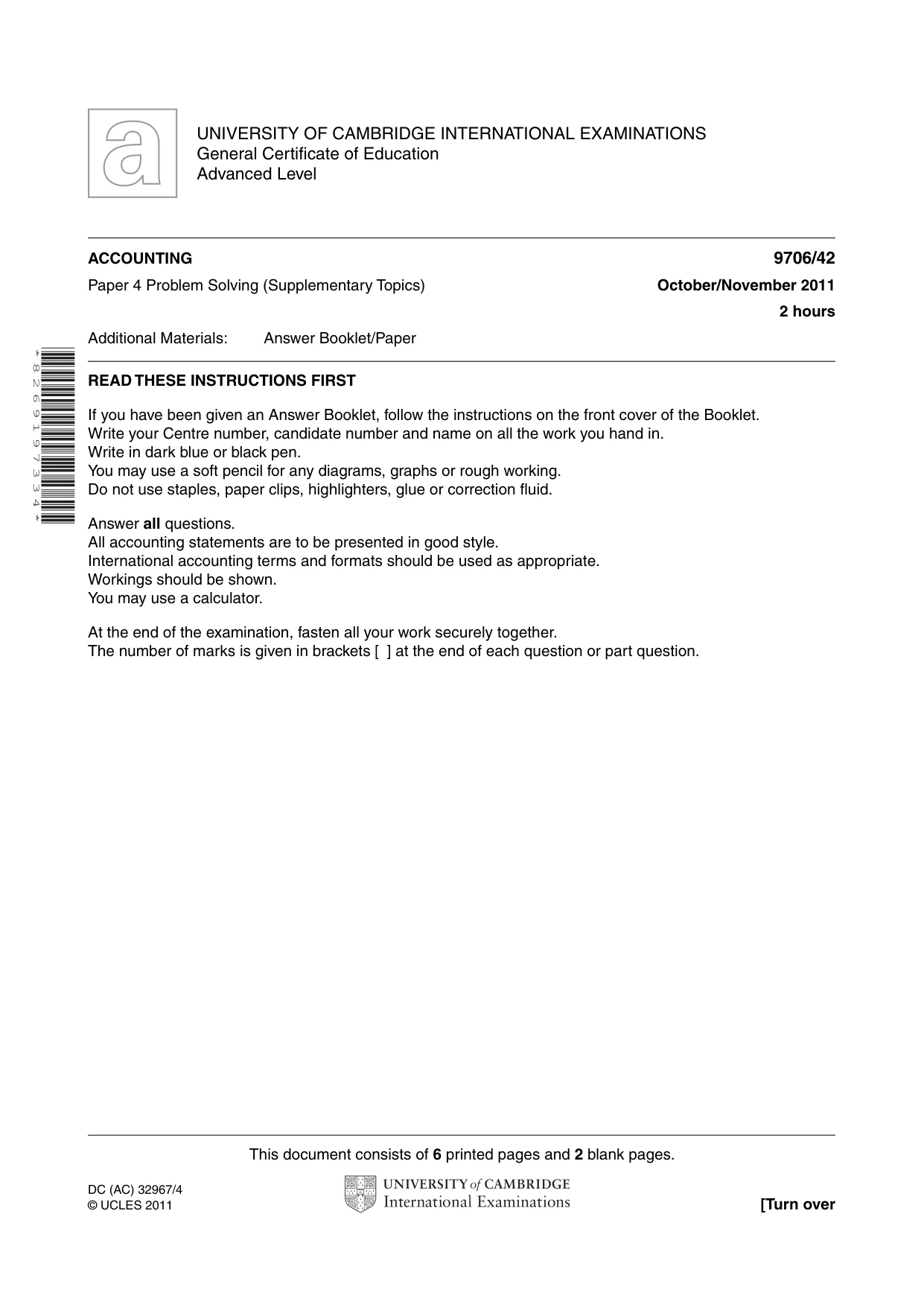
This document consists of 6 printed pages and 2 blank pages. DC (AC) 32967/4 © UCLES 2011 [Turn over UNIVERSITY OF CAMBRIDGE INTERNATIONAL EXAMINATIONS General Certificate of Education Advanced Level * 8 2 6 9 1 9 7 3 3 4 * ACCOUNTING 9706/42 Paper 4 Problem Solving (Supplementary Topics) October/November 2011 2 hours Additional Materials: Answer Booklet/Paper READ THESE INSTRUCTIONS FIRST If you have been given an Answer Booklet, follow the instructions on the front cover of the Booklet. Write your Centre number, candidate number and name on all the work you hand in. Write in dark blue or black pen. You may use a soft pencil for any diagrams, graphs or rough working. Do not use staples, paper clips, highlighters, glue or correction fluid. Answer all questions. All accounting statements are to be presented in good style. International accounting terms and formats should be used as appropriate. Workings should be shown. You may use a calculator. At the end of the examination, fasten all your work securely together. The number of marks is given in brackets [ ] at the end of each question or part question.
Question paper, page 2
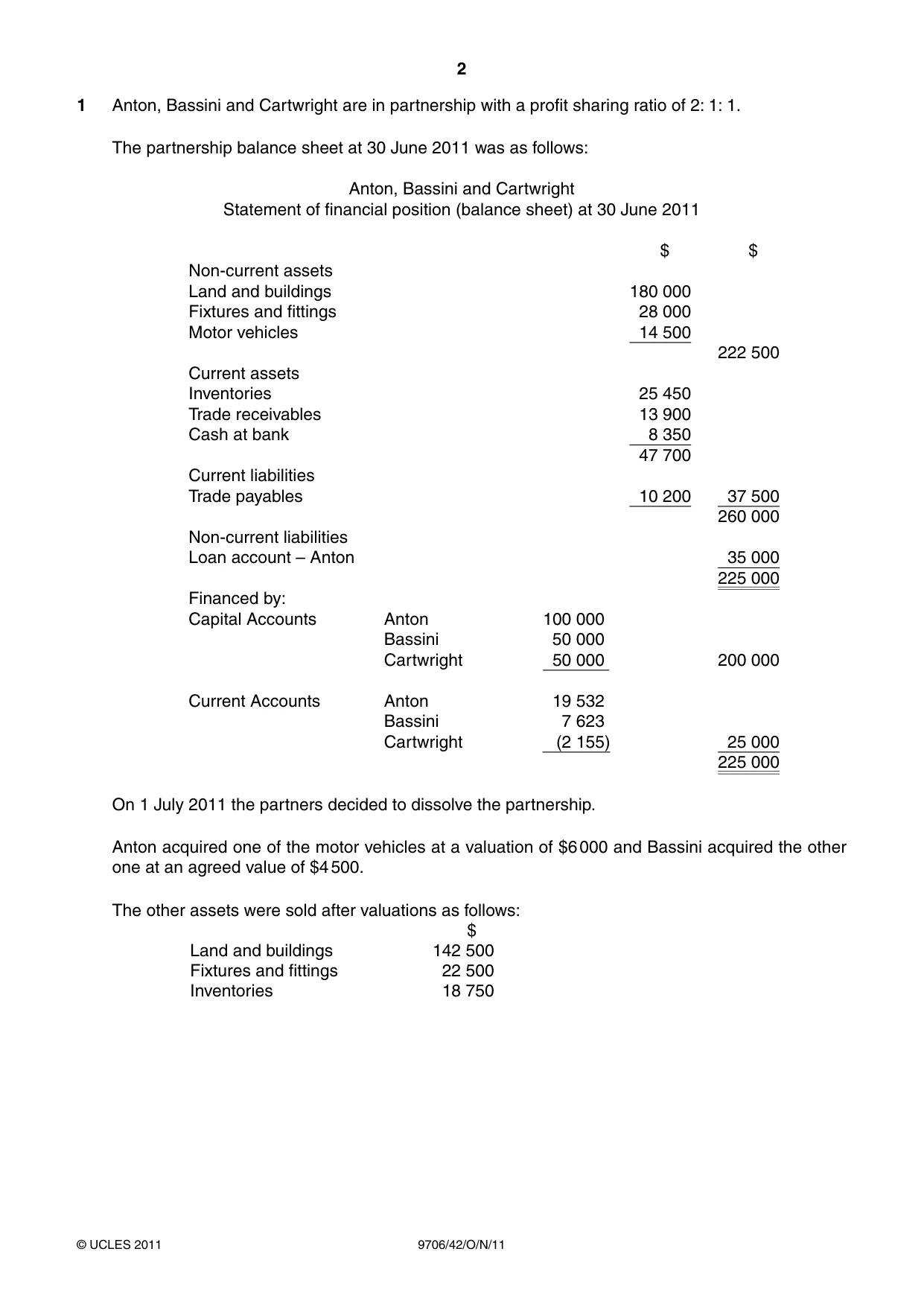
2 9706/42/O/N/11 © UCLES 2011 1 Anton, Bassini and Cartwright are in partnership with a profit sharing ratio of 2: 1: 1. The partnership balance sheet at 30 June 2011 was as follows: Anton, Bassini and Cartwright Statement of fi nancial position (balance sheet) at 30 June 2011 $ $ Non-current assets Land and buildings 180 000 Fixtures and fi ttings 28 000 Motor vehicles 14 500 222 500 Current assets Inventories 25 450 Trade receivables 13 900 Cash at bank 8 350 47 700 Current liabilities Trade payables 10 200 37 500 260 000 Non-current liabilities Loan account – Anton 35 000 225 000 Financed by: Capital Accounts Anton 100 000 Bassini 50 000 Cartwright 50 000 200 000 Current Accounts Anton 19 532 Bassini 7 623 Cartwright (2 155) 25 000 225 000 On 1 July 2011 the partners decided to dissolve the partnership. Anton acquired one of the motor vehicles at a valuation of $6 000 and Bassini acquired the other one at an agreed value of $4 500. The other assets were sold after valuations as follows: $ Land and buildings 142 500 Fixtures and fittings 22 500 Inventories 18 750
Question paper, page 3
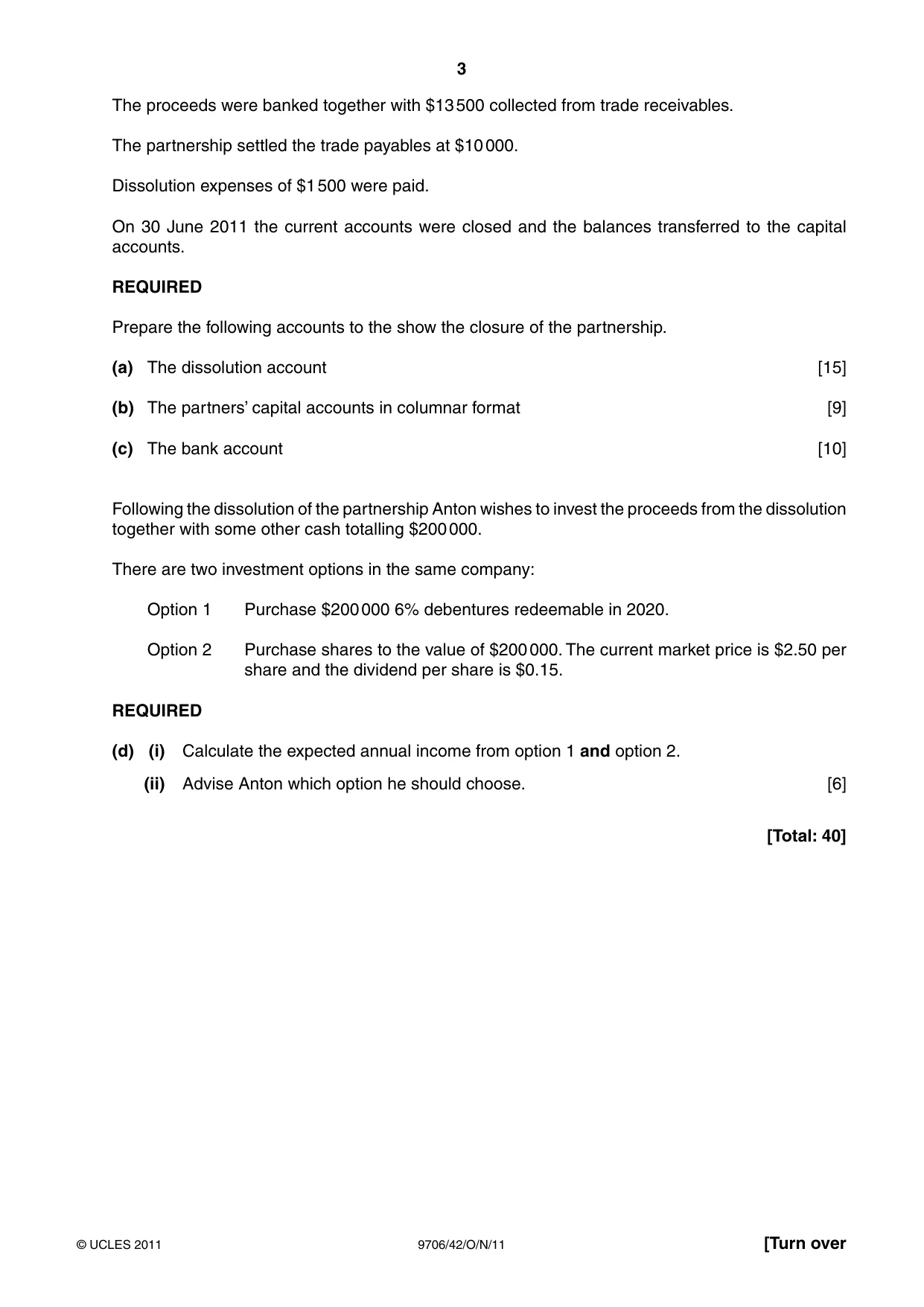
3 9706/42/O/N/11 © UCLES 2011 [Turn over The proceeds were banked together with $13 500 collected from trade receivables. The partnership settled the trade payables at $10 000. Dissolution expenses of $1 500 were paid. On 30 June 2011 the current accounts were closed and the balances transferred to the capital accounts. REQUIRED Prepare the following accounts to the show the closure of the partnership. (a) The dissolution account [15] (b) The partners’ capital accounts in columnar format [9] (c) The bank account [10] Following the dissolution of the partnership Anton wishes to invest the proceeds from the dissolution together with some other cash totalling $200 000. There are two investment options in the same company: Option 1 Purchase $200 000 6% debentures redeemable in 2020. Option 2 Purchase shares to the value of $200 000. The current market price is $2.50 per share and the dividend per share is $0.15. REQUIRED (d) (i) Calculate the expected annual income from option 1 and option 2. (ii) Advise Anton which option he should choose. [6] [Total: 40]
Question paper, page 4
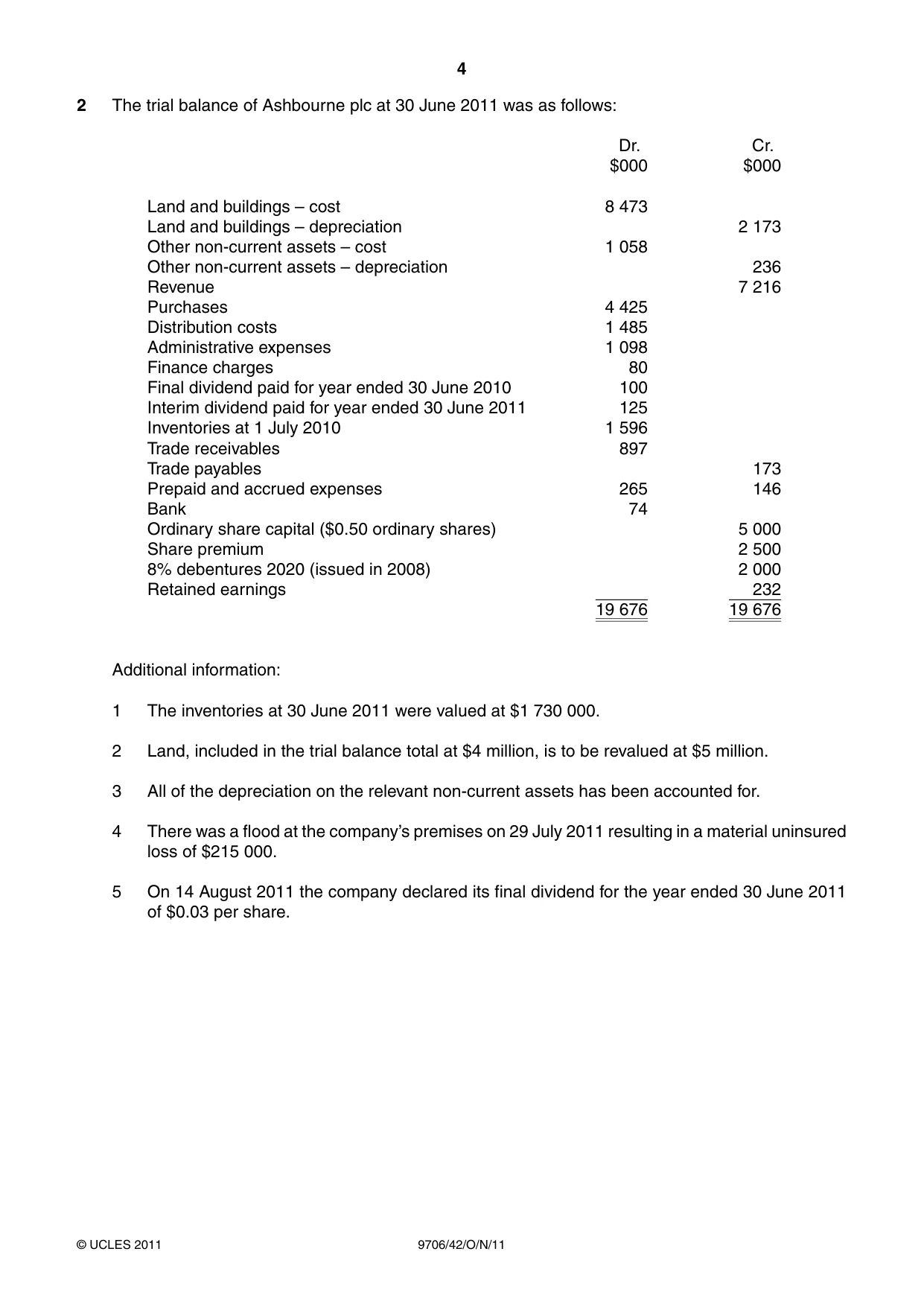
4 9706/42/O/N/11 © UCLES 2011 2 The trial balance of Ashbourne plc at 30 June 2011 was as follows: Dr. Cr. $000 $000 Land and buildings – cost 8 473 Land and buildings – depreciation 2 173 Other non-current assets – cost 1 058 Other non-current assets – depreciation 236 Revenue 7 216 Purchases 4 425 Distribution costs 1 485 Administrative expenses 1 098 Finance charges 80 Final dividend paid for year ended 30 June 2010 100 Interim dividend paid for year ended 30 June 2011 125 Inventories at 1 July 2010 1 596 Trade receivables 897 Trade payables 173 Prepaid and accrued expenses 265 146 Bank 74 Ordinary share capital ($0.50 ordinary shares) 5 000 Share premium 2 500 8% debentures 2020 (issued in 2008) 2 000 Retained earnings 232 19 676 19 676 Additional information: 1 The inventories at 30 June 2011 were valued at $1 730 000. 2 Land, included in the trial balance total at $4 million, is to be revalued at $5 million. 3 All of the depreciation on the relevant non-current assets has been accounted for. 4 There was a flood at the company’s premises on 29 July 2011 resulting in a material uninsured loss of $215 000. 5 On 14 August 2011 the company declared its final dividend for the year ended 30 June 2011 of $0.03 per share.
Question paper, page 5
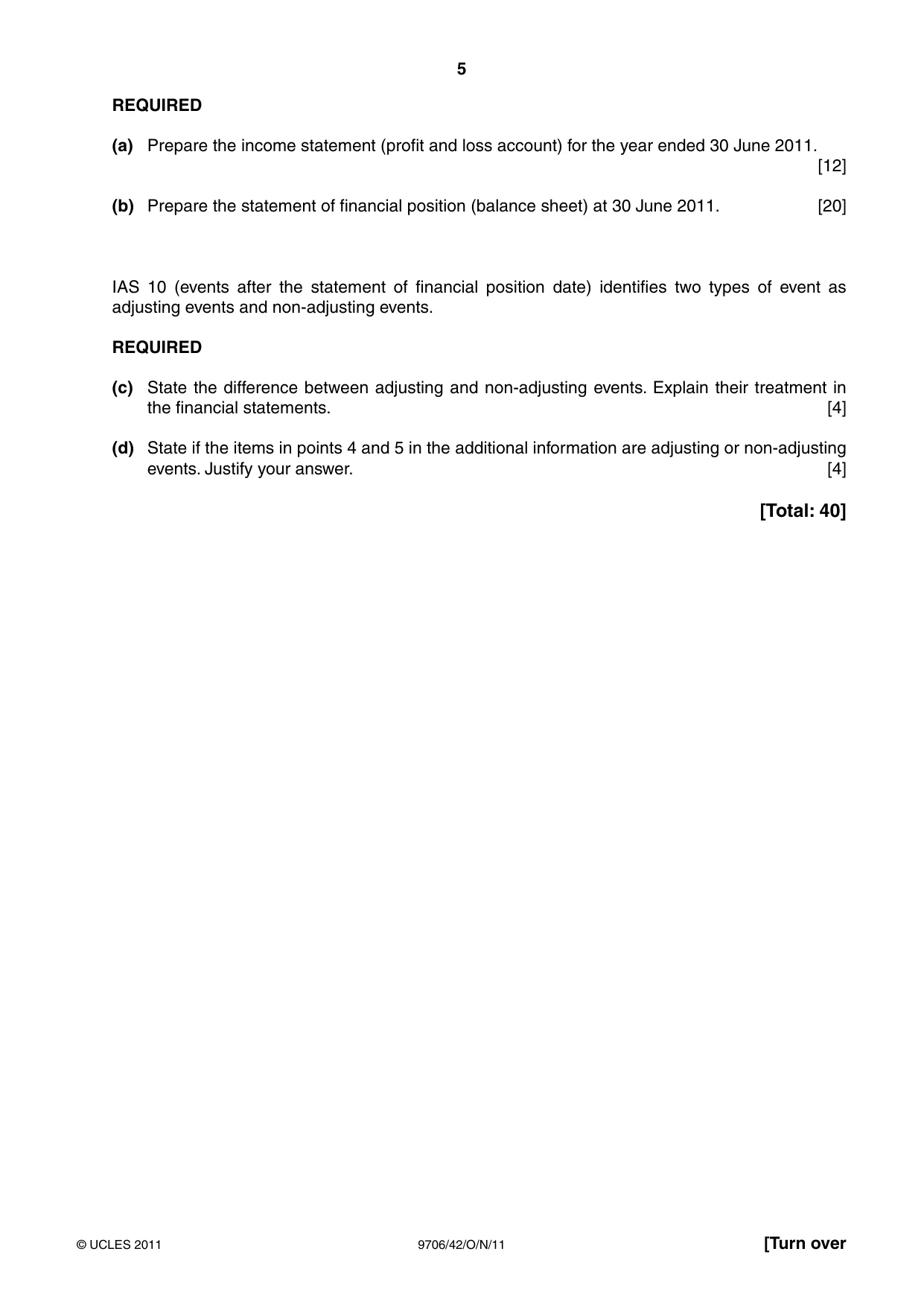
5 9706/42/O/N/11 © UCLES 2011 [Turn over REQUIRED (a) Prepare the income statement (profit and loss account) for the year ended 30 June 2011. [12] (b) Prepare the statement of financial position (balance sheet) at 30 June 2011. [20] IAS 10 (events after the statement of financial position date) identifies two types of event as adjusting events and non-adjusting events. REQUIRED (c) State the difference between adjusting and non-adjusting events. Explain their treatment in the financial statements. [4] (d) State if the items in points 4 and 5 in the additional information are adjusting or non-adjusting events. Justify your answer. [4] [Total: 40]
Question paper, page 6
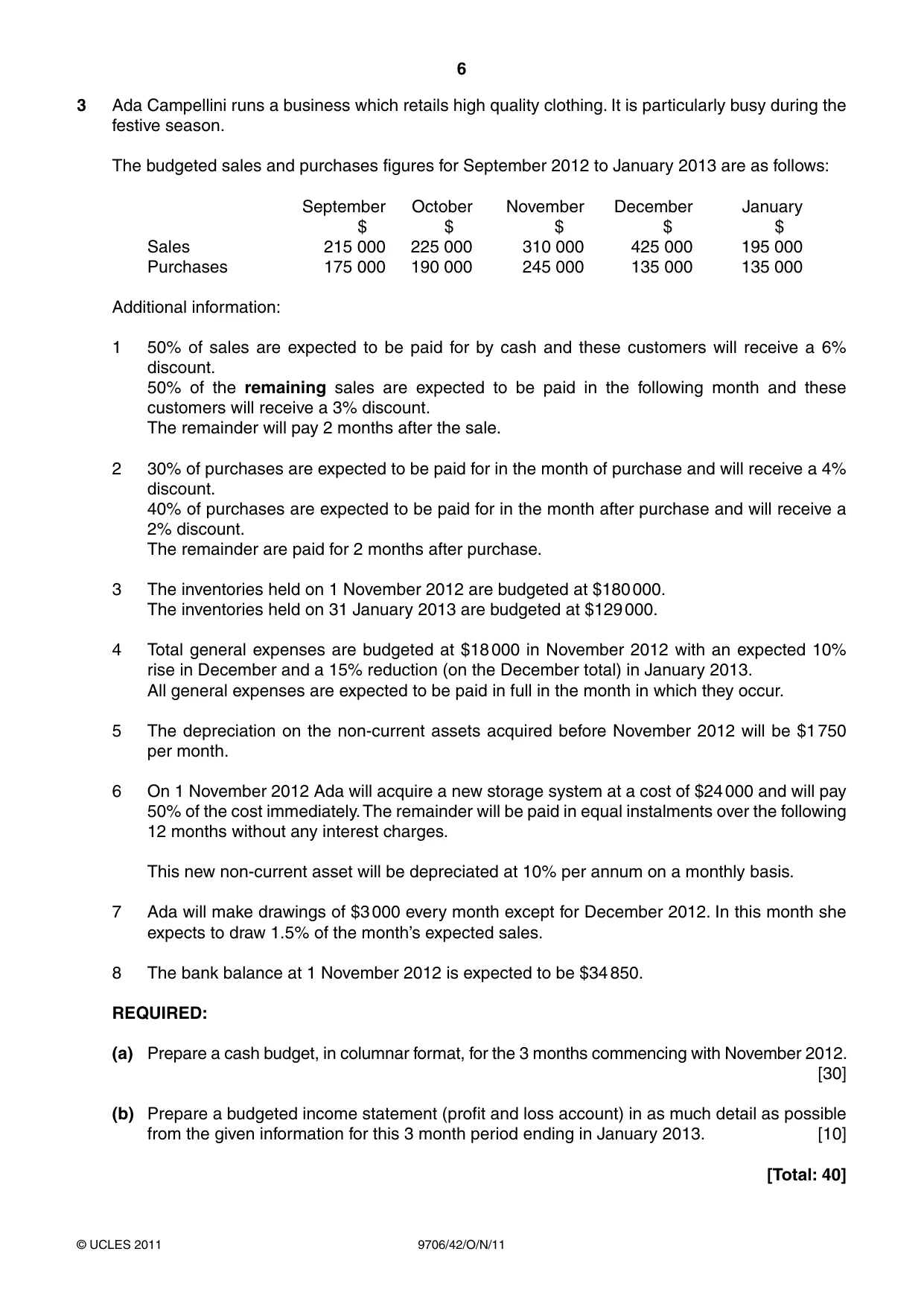
6 9706/42/O/N/11 © UCLES 2011 3 Ada Campellini runs a business which retails high quality clothing. It is particularly busy during the festive season. The budgeted sales and purchases figures for September 2012 to January 2013 are as follows: September October November December January $ $ $ $ $ Sales 215 000 225 000 310 000 425 000 195 000 Purchases 175 000 190 000 245 000 135 000 135 000 Additional information: 1 50% of sales are expected to be paid for by cash and these customers will receive a 6% discount. 50% of the remaining sales are expected to be paid in the following month and these customers will receive a 3% discount. The remainder will pay 2 months after the sale. 2 30% of purchases are expected to be paid for in the month of purchase and will receive a 4% discount. 40% of purchases are expected to be paid for in the month after purchase and will receive a 2% discount. The remainder are paid for 2 months after purchase. 3 The inventories held on 1 November 2012 are budgeted at $180 000. The inventories held on 31 January 2013 are budgeted at $129 000. 4 Total general expenses are budgeted at $18 000 in November 2012 with an expected 10% rise in December and a 15% reduction (on the December total) in January 2013. All general expenses are expected to be paid in full in the month in which they occur. 5 The depreciation on the non-current assets acquired before November 2012 will be $1 750 per month. 6 On 1 November 2012 Ada will acquire a new storage system at a cost of $24 000 and will pay 50% of the cost immediately. The remainder will be paid in equal instalments over the following 12 months without any interest charges. This new non-current asset will be depreciated at 10% per annum on a monthly basis. 7 Ada will make drawings of $3 000 every month except for December 2012. In this month she expects to draw 1.5% of the month’s expected sales. 8 The bank balance at 1 November 2012 is expected to be $34 850. REQUIRED: (a) Prepare a cash budget, in columnar format, for the 3 months commencing with November 2012. [30] (b) Prepare a budgeted income statement (profit and loss account) in as much detail as possible from the given information for this 3 month period ending in January 2013. [10] [Total: 40]
Question paper, page 7
7 9706/42/O/N/11 © UCLES 2011 BLANK PAGE
Question paper, page 8
8 9706/42/O/N/11 © UCLES 2011 Permission to reproduce items where third-party owned material protected by copyright is included has been sought and cleared where possible. Every reasonable effort has been made by the publisher (UCLES) to trace copyright holders, but if any items requiring clearance have unwittingly been included, the publisher will be pleased to make amends at the earliest possible opportunity. University of Cambridge International Examinations is part of the Cambridge Assessment Group. Cambridge Assessment is the brand name of University of Cambridge Local Examinations Syndicate (UCLES), which is itself a department of the University of Cambridge. BLANK PAGE
Mark scheme, page 1
UNIVERSITY OF CAMBRIDGE INTERNATIONAL EXAMINATIONS GCE Advanced Subsidiary Level and GCE Advanced Level MARK SCHEME for the October/November 2011 question paper for the guidance of teachers 9706 ACCOUNTING 9706/42 Paper 4 (Problem Solving – Supplement), maximum raw mark 120 This mark scheme is published as an aid to teachers and candidates, to indicate the requirements of the examination. It shows the basis on which Examiners were instructed to award marks. It does not indicate the details of the discussions that took place at an Examiners’ meeting before marking began, which would have considered the acceptability of alternative answers. Mark schemes must be read in conjunction with the question papers and the report on the examination. • Cambridge will not enter into discussions or correspondence in connection with these mark schemes. Cambridge is publishing the mark schemes for the October/November 2011 question papers for most IGCSE, GCE Advanced Level and Advanced Subsidiary Level syllabuses and some Ordinary Level syllabuses.
Mark scheme, page 2
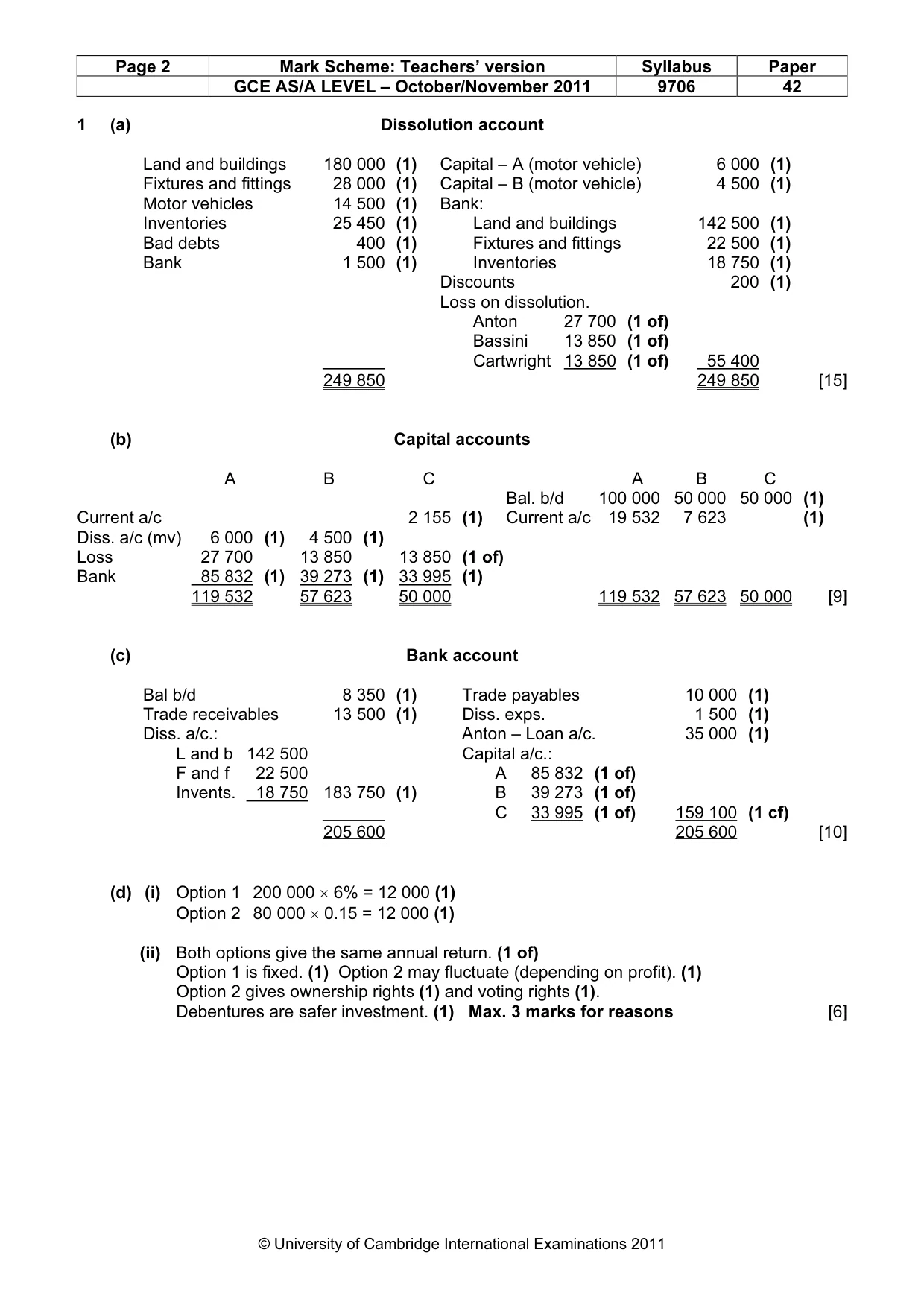
Page 2 Mark Scheme: Teachers’ version Syllabus Paper GCE AS/A LEVEL – October/November 2011 9706 42 © University of Cambridge International Examinations 2011 1 (a) Dissolution account Land and buildings 180 000 (1) Capital – A (motor vehicle) 6 000 (1) Fixtures and fittings 28 000 (1) Capital – B (motor vehicle) 4 500 (1) Motor vehicles 14 500 (1) Bank: Inventories 25 450 (1) Land and buildings 142 500 (1) Bad debts 400 (1) Fixtures and fittings 22 500 (1) Bank 1 500 (1) Inventories 18 750 (1) Discounts 200 (1) Loss on dissolution. Anton 27 700 (1 of) Bassini 13 850 (1 of) Cartwright 13 850 (1 of) 55 400 249 850 249 850 [15] (b) Capital accounts A B C A B C Bal. b/d 100 000 50 000 50 000 (1) Current a/c 2 155 (1) Current a/c 19 532 7 623 (1) Diss. a/c (mv) 6 000 (1) 4 500 (1) Loss 27 700 13 850 13 850 (1 of) Bank 85 832 (1) 39 273 (1) 33 995 (1) 119 532 57 623 50 000 119 532 57 623 50 000 [9] (c) Bank account Bal b/d 8 350 (1) Trade payables 10 000 (1) Trade receivables 13 500 (1) Diss. exps. 1 500 (1) Diss. a/c.: Anton – Loan a/c. 35 000 (1) L and b 142 500 Capital a/c.: F and f 22 500 A 85 832 (1 of) Invents. 18 750 183 750 (1) B 39 273 (1 of) C 33 995 (1 of) 159 100 (1 cf) 205 600 205 600 [10] (d) (i) Option 1 200 000 × 6% = 12 000 (1) Option 2 80 000 × 0.15 = 12 000 (1) (ii) Both options give the same annual return. (1 of) Option 1 is fixed. (1) Option 2 may fluctuate (depending on profit). (1) Option 2 gives ownership rights (1) and voting rights (1). Debentures are safer investment. (1) Max. 3 marks for reasons [6]
Mark scheme, page 3
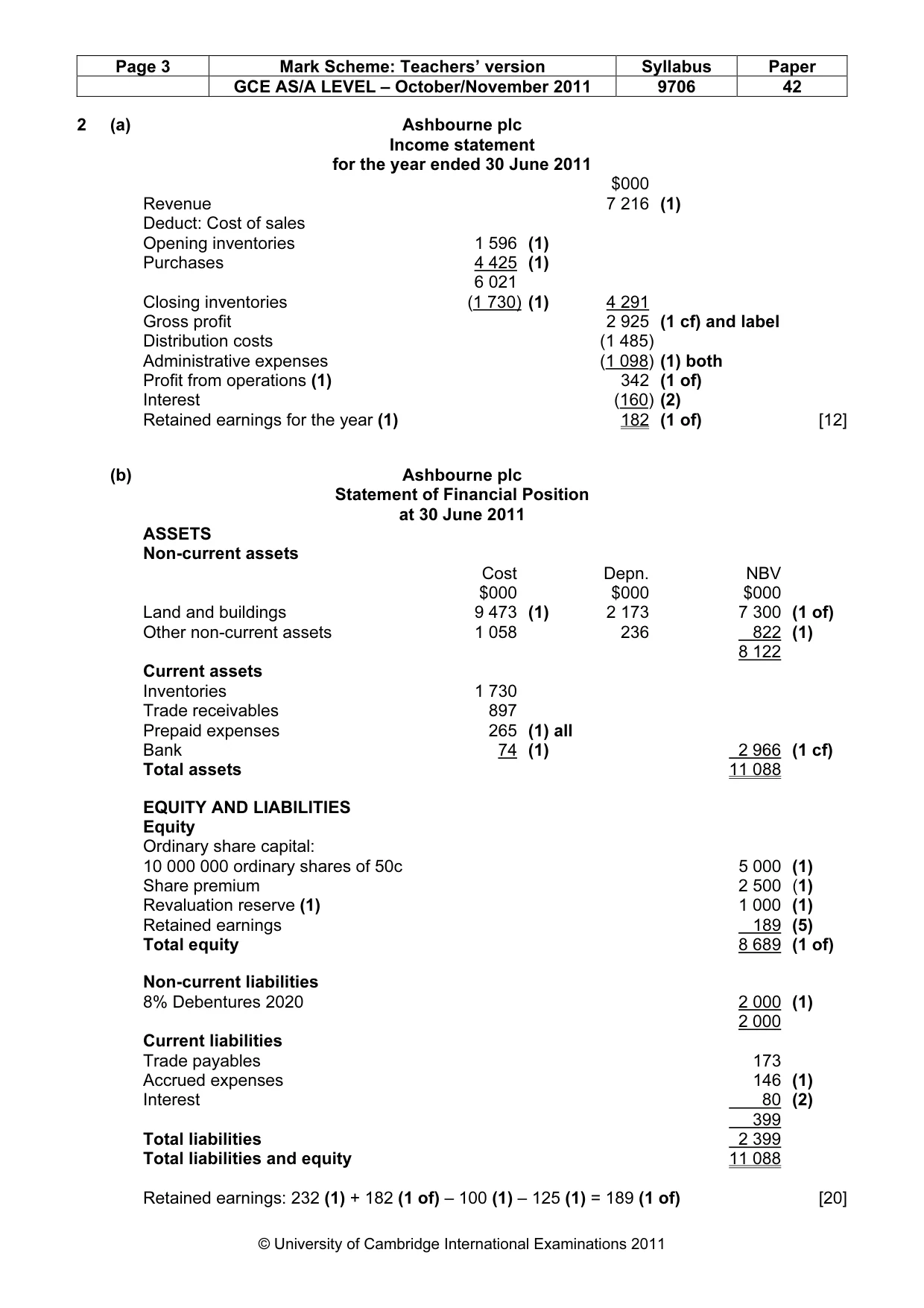
Page 3 Mark Scheme: Teachers’ version Syllabus Paper GCE AS/A LEVEL – October/November 2011 9706 42 © University of Cambridge International Examinations 2011 2 (a) Ashbourne plc Income statement for the year ended 30 June 2011 $000 Revenue 7 216 (1) Deduct: Cost of sales Opening inventories 1 596 (1) Purchases 4 425 (1) 6 021 Closing inventories (1 730) (1) 4 291 Gross profit 2 925 (1 cf) and label Distribution costs (1 485) Administrative expenses (1 098) (1) both Profit from operations (1) 342 (1 of) Interest (160) (2) Retained earnings for the year (1) 182 (1 of) [12] (b) Ashbourne plc Statement of Financial Position at 30 June 2011 ASSETS Non-current assets Cost Depn. NBV $000 $000 $000 Land and buildings 9 473 (1) 2 173 7 300 (1 of) Other non-current assets 1 058 236 822 (1) 8 122 Current assets Inventories 1 730 Trade receivables 897 Prepaid expenses 265 (1) all Bank 74 (1) 2 966 (1 cf) Total assets 11 088 EQUITY AND LIABILITIES Equity Ordinary share capital: 10 000 000 ordinary shares of 50c 5 000 (1) Share premium 2 500 (1) Revaluation reserve (1) 1 000 (1) Retained earnings 189 (5) Total equity 8 689 (1 of) Non-current liabilities 8% Debentures 2020 2 000 (1) 2 000 Current liabilities Trade payables 173 Accrued expenses 146 (1) Interest 80 (2) 399 Total liabilities 2 399 Total liabilities and equity 11 088 Retained earnings: 232 (1) + 182 (1 of) – 100 (1) – 125 (1) = 189 (1 of) [20]
Mark scheme, page 4
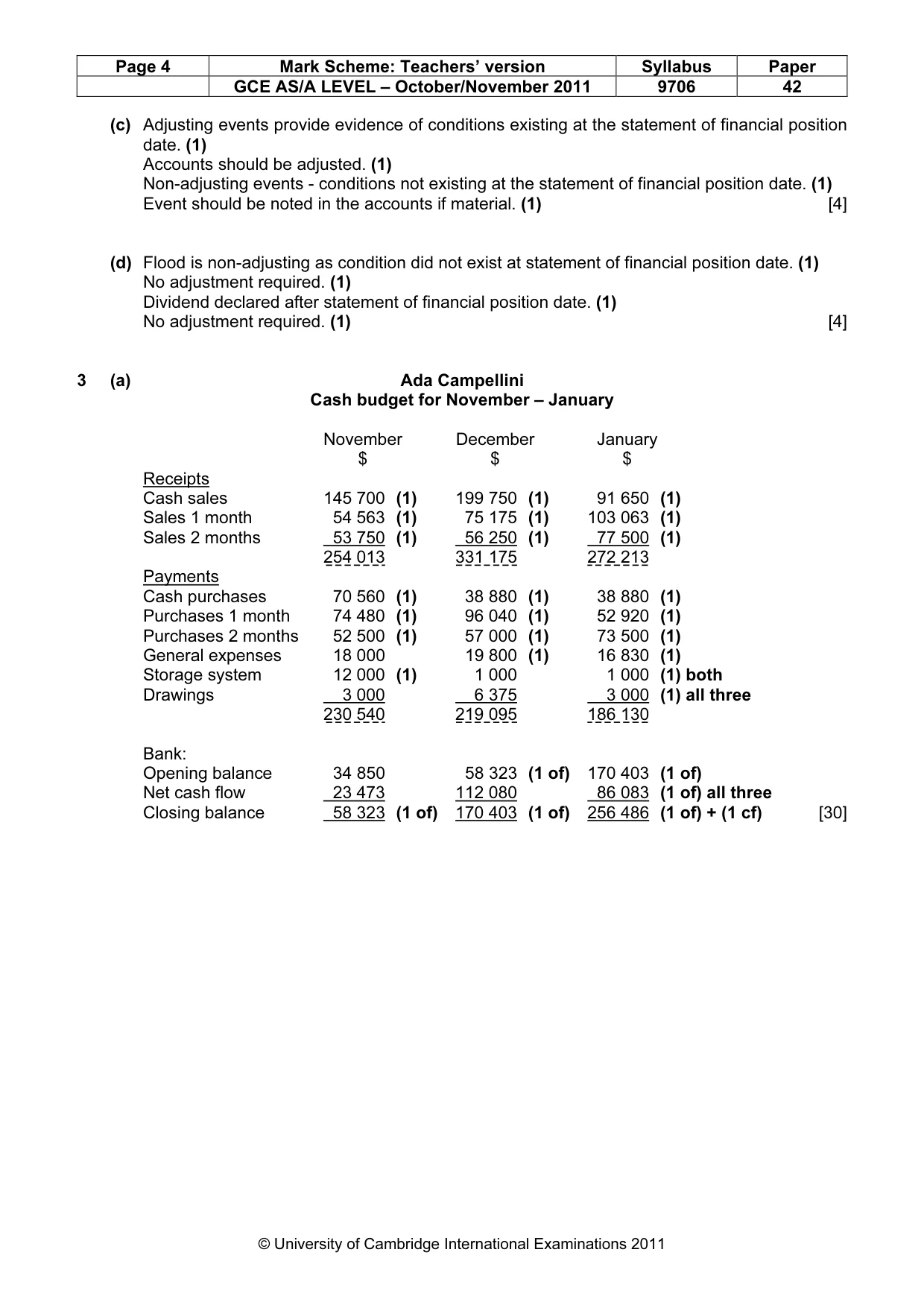
Page 4 Mark Scheme: Teachers’ version Syllabus Paper GCE AS/A LEVEL – October/November 2011 9706 42 © University of Cambridge International Examinations 2011 (c) Adjusting events provide evidence of conditions existing at the statement of financial position date. (1) Accounts should be adjusted. (1) Non-adjusting events - conditions not existing at the statement of financial position date. (1) Event should be noted in the accounts if material. (1) [4] (d) Flood is non-adjusting as condition did not exist at statement of financial position date. (1) No adjustment required. (1) Dividend declared after statement of financial position date. (1) No adjustment required. (1) [4] 3 (a) Ada Campellini Cash budget for November – January November December January $ $ $ Receipts Cash sales 145 700 (1) 199 750 (1) 91 650 (1) Sales 1 month 54 563 (1) 75 175 (1) 103 063 (1) Sales 2 months 53 750 (1) 56 250 (1) 77 500 (1) 254 013 331 175 272 213 Payments Cash purchases 70 560 (1) 38 880 (1) 38 880 (1) Purchases 1 month 74 480 (1) 96 040 (1) 52 920 (1) Purchases 2 months 52 500 (1) 57 000 (1) 73 500 (1) General expenses 18 000 19 800 (1) 16 830 (1) Storage system 12 000 (1) 1 000 1 000 (1) both Drawings 3 000 6 375 3 000 (1) all three 230 540 219 095 186 130 Bank: Opening balance 34 850 58 323 (1 of) 170 403 (1 of) Net cash flow 23 473 112 080 86 083 (1 of) all three Closing balance 58 323 (1 of) 170 403 (1 of) 256 486 (1 of) + (1 cf) [30]
Mark scheme, page 5
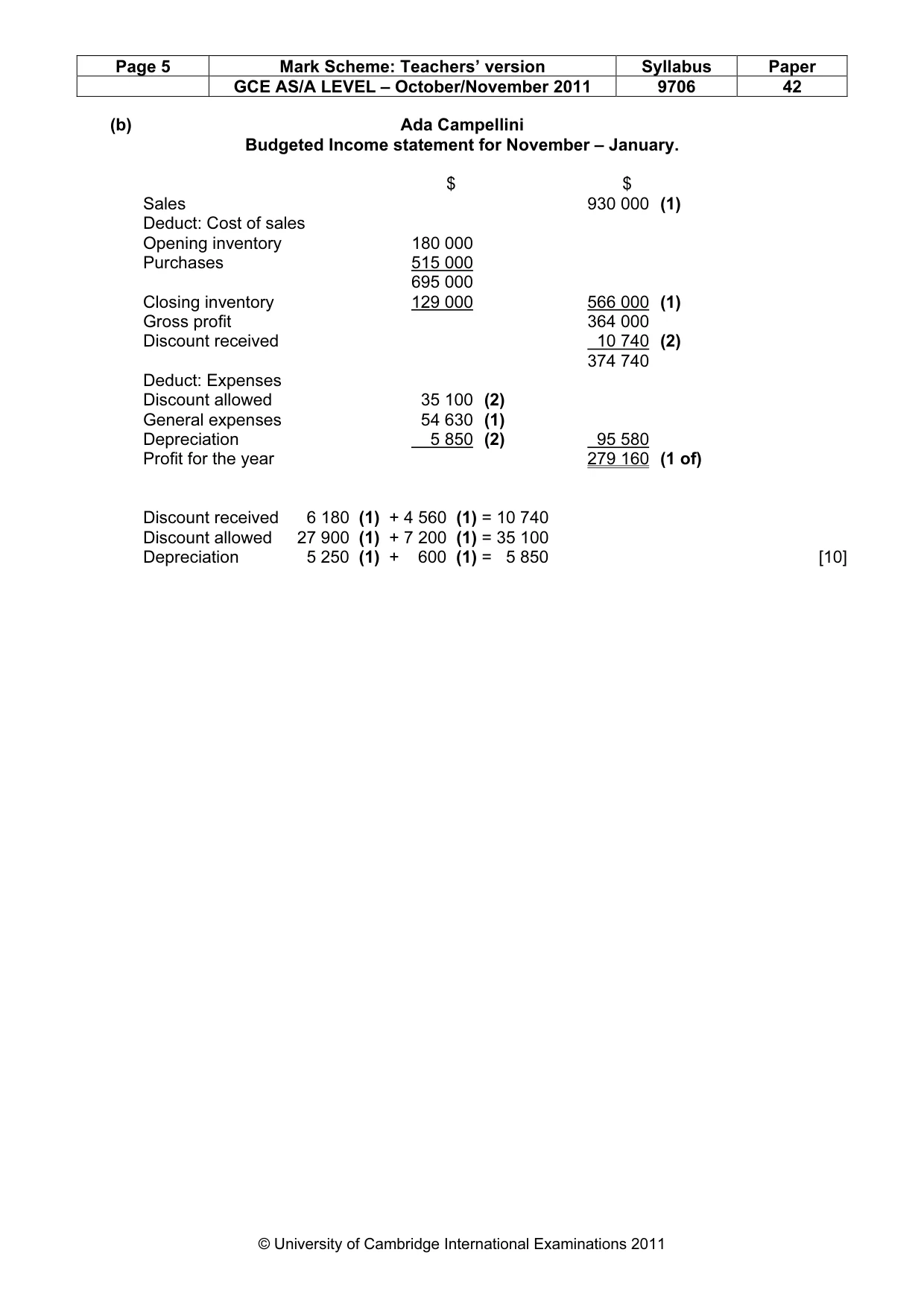
Page 5 Mark Scheme: Teachers’ version Syllabus Paper GCE AS/A LEVEL – October/November 2011 9706 42 © University of Cambridge International Examinations 2011 (b) Ada Campellini Budgeted Income statement for November – January. $ $ Sales 930 000 (1) Deduct: Cost of sales Opening inventory 180 000 Purchases 515 000 695 000 Closing inventory 129 000 566 000 (1) Gross profit 364 000 Discount received 10 740 (2) 374 740 Deduct: Expenses Discount allowed 35 100 (2) General expenses 54 630 (1) Depreciation 5 850 (2) 95 580 Profit for the year 279 160 (1 of) Discount received 6 180 (1) + 4 560 (1) = 10 740 Discount allowed 27 900 (1) + 7 200 (1) = 35 100 Depreciation 5 250 (1) + 600 (1) = 5 850 [10]
What you needed in this session
Cambridge’s own grade thresholds for 2011 Oct/Nov, Paper 4 · Variant 2. A higher threshold means an easier paper — the bar moves with how the cohort did.