Cambridge A Level Accounting 9706 — 2011 Oct/Nov Paper 4 · Variant 1
9706/41/O/N/11 · 120 marks · ≈135 min
The question paper and its mark scheme, free to read here and free to download. This is Cambridge’s own paper, exactly as it was sat.
Question paper8 pages

Mark scheme5 pages
Answers below. Sit the paper first if you are practising.
Paper as text
Question paper, page 1
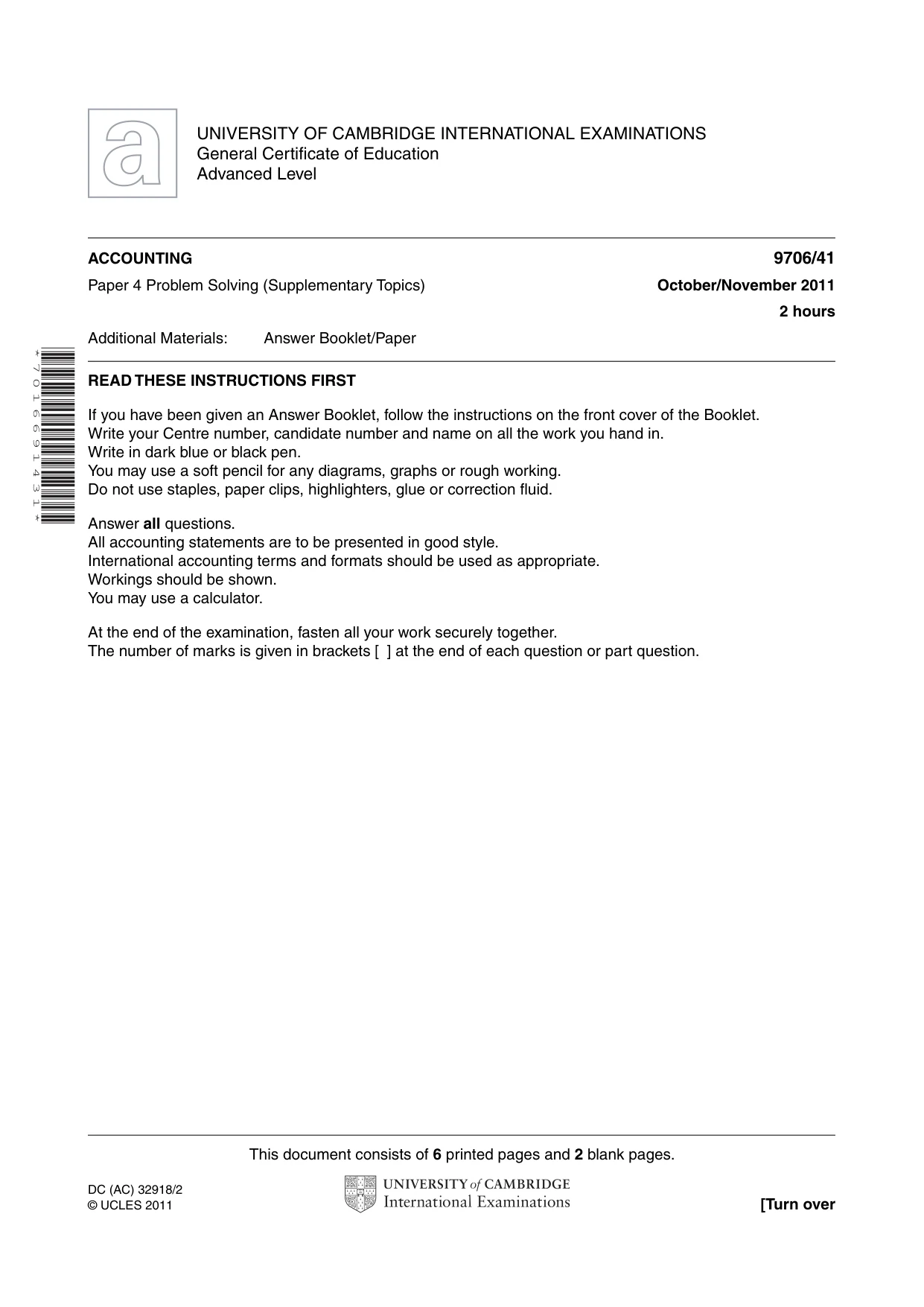
This document consists of 6 printed pages and 2 blank pages. DC (AC) 32918/2 © UCLES 2011 [Turn over UNIVERSITY OF CAMBRIDGE INTERNATIONAL EXAMINATIONS General Certificate of Education Advanced Level * 7 0 1 6 6 9 1 4 3 1 * ACCOUNTING 9706/41 Paper 4 Problem Solving (Supplementary Topics) October/November 2011 2 hours Additional Materials: Answer Booklet/Paper READ THESE INSTRUCTIONS FIRST If you have been given an Answer Booklet, follow the instructions on the front cover of the Booklet. Write your Centre number, candidate number and name on all the work you hand in. Write in dark blue or black pen. You may use a soft pencil for any diagrams, graphs or rough working. Do not use staples, paper clips, highlighters, glue or correction fluid. Answer all questions. All accounting statements are to be presented in good style. International accounting terms and formats should be used as appropriate. Workings should be shown. You may use a calculator. At the end of the examination, fasten all your work securely together. The number of marks is given in brackets [ ] at the end of each question or part question.
Question paper, page 2
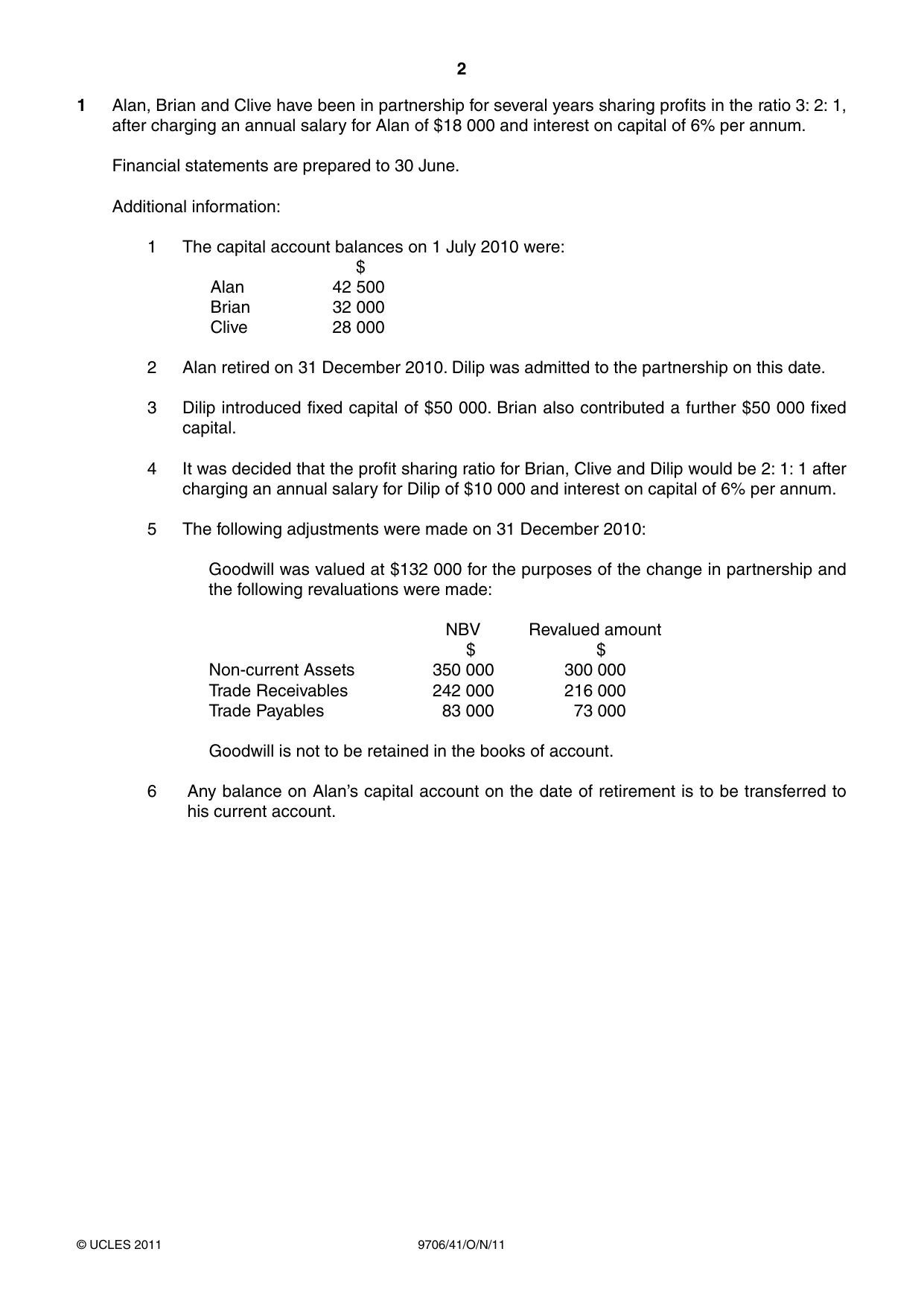
2 9706/41/O/N/11 © UCLES 2011 1 Alan, Brian and Clive have been in partnership for several years sharing profits in the ratio 3: 2: 1, after charging an annual salary for Alan of $18 000 and interest on capital of 6% per annum. Financial statements are prepared to 30 June. Additional information: 1 The capital account balances on 1 July 2010 were: $ Alan 42 500 Brian 32 000 Clive 28 000 2 Alan retired on 31 December 2010. Dilip was admitted to the partnership on this date. 3 Dilip introduced fixed capital of $50 000. Brian also contributed a further $50 000 fixed capital. 4 It was decided that the profit sharing ratio for Brian, Clive and Dilip would be 2: 1: 1 after charging an annual salary for Dilip of $10 000 and interest on capital of 6% per annum. 5 The following adjustments were made on 31 December 2010: Goodwill was valued at $132 000 for the purposes of the change in partnership and the following revaluations were made: NBV Revalued amount $ $ Non-current Assets 350 000 300 000 Trade Receivables 242 000 216 000 Trade Payables 83 000 73 000 Goodwill is not to be retained in the books of account. 6 Any balance on Alan’s capital account on the date of retirement is to be transferred to his current account.
Question paper, page 3
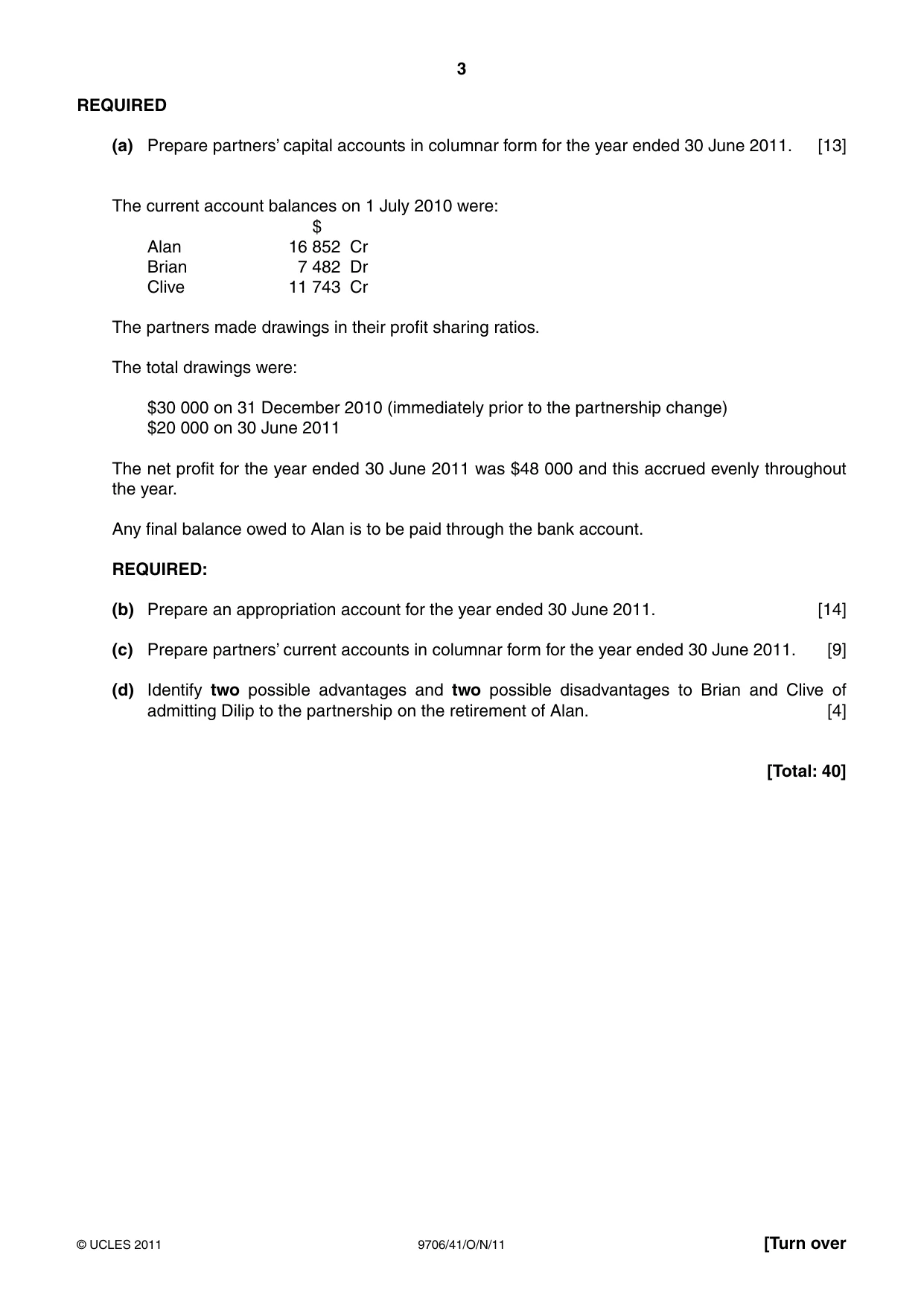
3 9706/41/O/N/11 © UCLES 2011 [Turn over REQUIRED (a) Prepare partners’ capital accounts in columnar form for the year ended 30 June 2011. [13] The current account balances on 1 July 2010 were: $ Alan 16 852 Cr Brian 7 482 Dr Clive 11 743 Cr The partners made drawings in their profit sharing ratios. The total drawings were: $30 000 on 31 December 2010 (immediately prior to the partnership change) $20 000 on 30 June 2011 The net profit for the year ended 30 June 2011 was $48 000 and this accrued evenly throughout the year. Any final balance owed to Alan is to be paid through the bank account. REQUIRED: (b) Prepare an appropriation account for the year ended 30 June 2011. [14] (c) Prepare partners’ current accounts in columnar form for the year ended 30 June 2011. [9] (d) Identify two possible advantages and two possible disadvantages to Brian and Clive of admitting Dilip to the partnership on the retirement of Alan. [4] [Total: 40]
Question paper, page 4
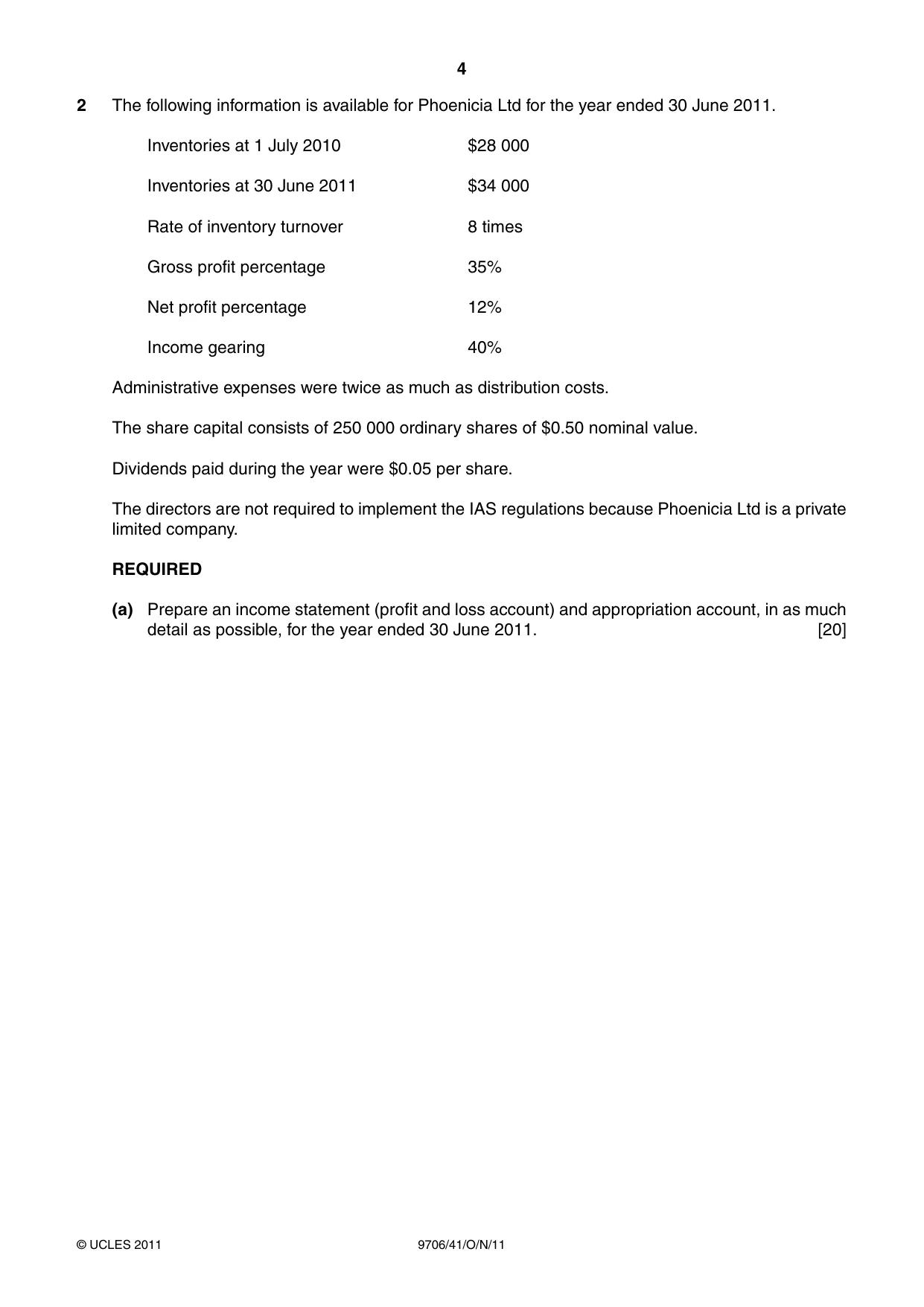
4 9706/41/O/N/11 © UCLES 2011 2 The following information is available for Phoenicia Ltd for the year ended 30 June 2011. Inventories at 1 July 2010 $28 000 Inventories at 30 June 2011 $34 000 Rate of inventory turnover 8 times Gross profit percentage 35% Net profit percentage 12% Income gearing 40% Administrative expenses were twice as much as distribution costs. The share capital consists of 250 000 ordinary shares of $0.50 nominal value. Dividends paid during the year were $0.05 per share. The directors are not required to implement the IAS regulations because Phoenicia Ltd is a private limited company. REQUIRED (a) Prepare an income statement (profit and loss account) and appropriation account, in as much detail as possible, for the year ended 30 June 2011. [20]
Question paper, page 5
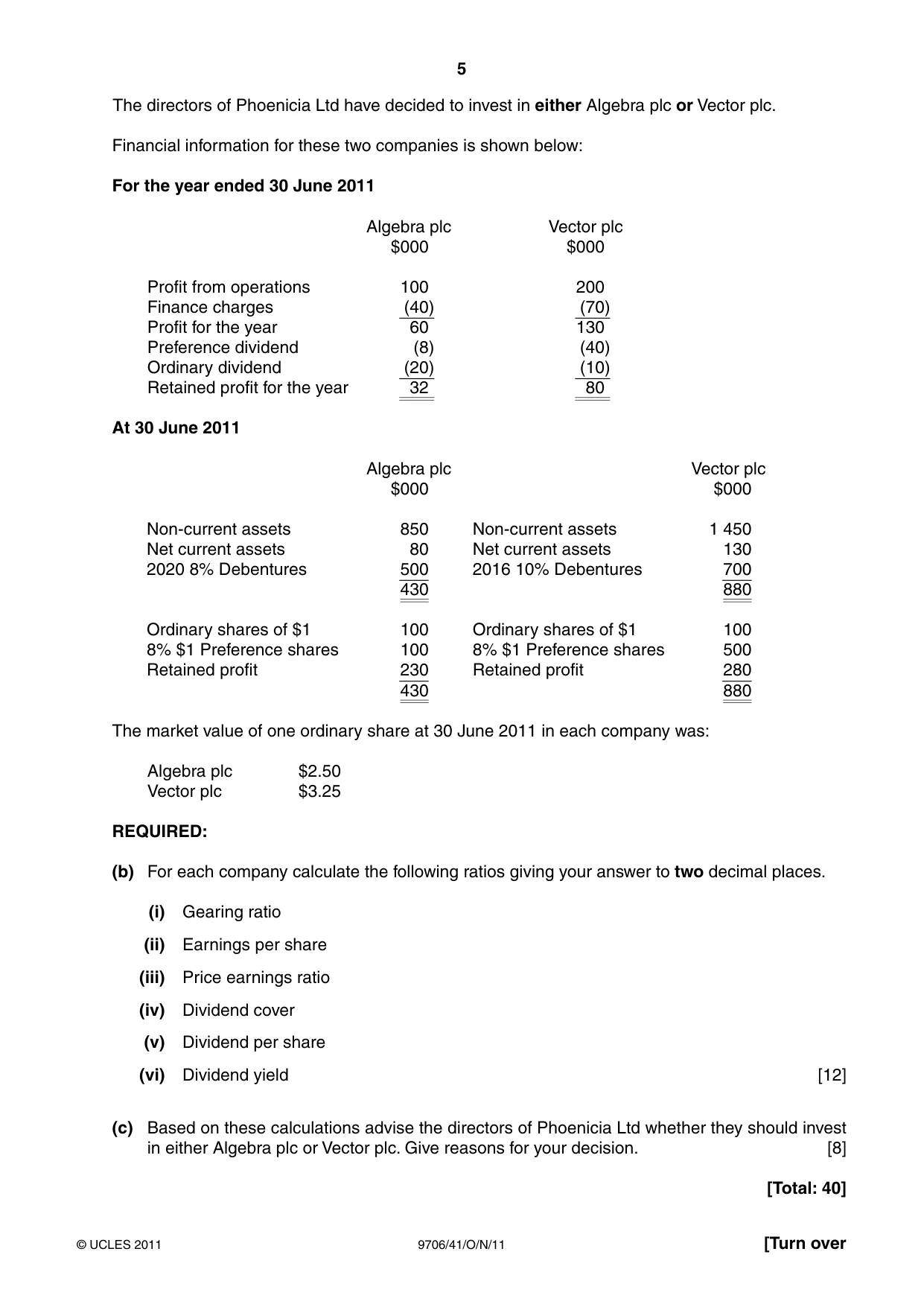
5 9706/41/O/N/11 © UCLES 2011 [Turn over The directors of Phoenicia Ltd have decided to invest in either Algebra plc or Vector plc. Financial information for these two companies is shown below: For the year ended 30 June 2011 Algebra plc Vector plc $000 $000 Profit from operations 100 200 Finance charges (40) (70) Profit for the year 60 130 Preference dividend (8) (40) Ordinary dividend (20) (10) Retained profit for the year 32 80 At 30 June 2011 Algebra plc Vector plc $000 $000 Non-current assets 850 Non-current assets 1 450 Net current assets 80 Net current assets 130 2020 8% Debentures 500 2016 10% Debentures 700 430 880 Ordinary shares of $1 100 Ordinary shares of $1 100 8% $1 Preference shares 100 8% $1 Preference shares 500 Retained profit 230 Retained profit 280 430 880 The market value of one ordinary share at 30 June 2011 in each company was: Algebra plc $2.50 Vector plc $3.25 REQUIRED: (b) For each company calculate the following ratios giving your answer to two decimal places. (i) Gearing ratio (ii) Earnings per share (iii) Price earnings ratio (iv) Dividend cover (v) Dividend per share (vi) Dividend yield [12] (c) Based on these calculations advise the directors of Phoenicia Ltd whether they should invest in either Algebra plc or Vector plc. Give reasons for your decision. [8] [Total: 40]
Question paper, page 6
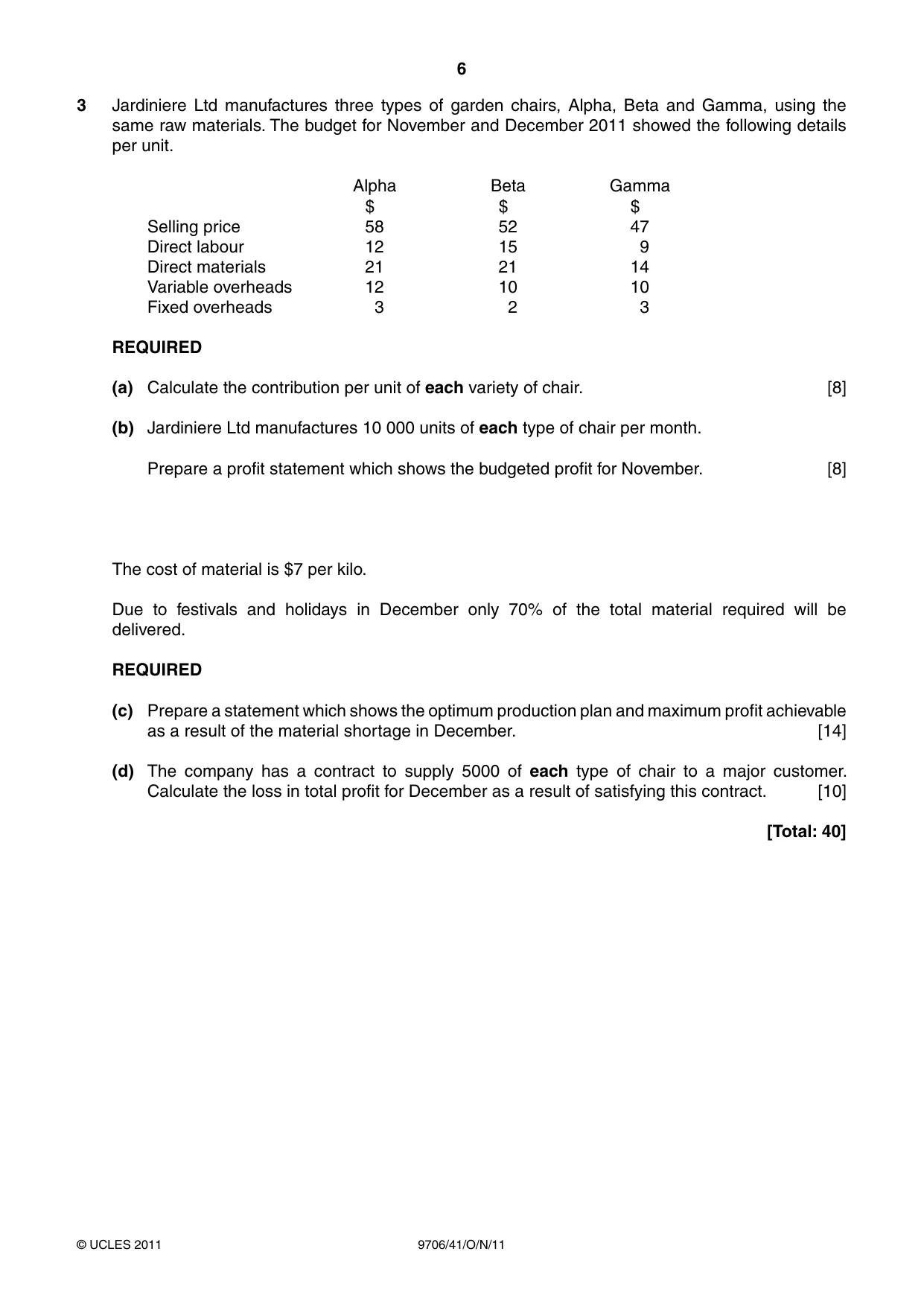
6 9706/41/O/N/11 © UCLES 2011 3 Jardiniere Ltd manufactures three types of garden chairs, Alpha, Beta and Gamma, using the same raw materials. The budget for November and December 2011 showed the following details per unit. Alpha Beta Gamma $ $ $ Selling price 58 52 47 Direct labour 12 15 9 Direct materials 21 21 14 Variable overheads 12 10 10 Fixed overheads 3 2 3 REQUIRED (a) Calculate the contribution per unit of each variety of chair. [8] (b) Jardiniere Ltd manufactures 10 000 units of each type of chair per month. Prepare a profit statement which shows the budgeted profit for November. [8] The cost of material is $7 per kilo. Due to festivals and holidays in December only 70% of the total material required will be delivered. REQUIRED (c) Prepare a statement which shows the optimum production plan and maximum profit achievable as a result of the material shortage in December. [14] (d) The company has a contract to supply 5000 of each type of chair to a major customer. Calculate the loss in total profit for December as a result of satisfying this contract. [10] [Total: 40]
Question paper, page 7
7 9706/41/O/N/11 © UCLES 2011 BLANK PAGE
Question paper, page 8
8 9706/41/O/N/11 © UCLES 2011 Permission to reproduce items where third-party owned material protected by copyright is included has been sought and cleared where possible. Every reasonable effort has been made by the publisher (UCLES) to trace copyright holders, but if any items requiring clearance have unwittingly been included, the publisher will be pleased to make amends at the earliest possible opportunity. University of Cambridge International Examinations is part of the Cambridge Assessment Group. Cambridge Assessment is the brand name of University of Cambridge Local Examinations Syndicate (UCLES), which is itself a department of the University of Cambridge. BLANK PAGE
Mark scheme, page 1
UNIVERSITY OF CAMBRIDGE INTERNATIONAL EXAMINATIONS GCE Advanced Subsidiary Level and GCE Advanced Level MARK SCHEME for the October/November 2011 question paper for the guidance of teachers 9706 ACCOUNTING 9706/41 Paper 4 (Problem Solving – Supplement), maximum raw mark 120 This mark scheme is published as an aid to teachers and candidates, to indicate the requirements of the examination. It shows the basis on which Examiners were instructed to award marks. It does not indicate the details of the discussions that took place at an Examiners’ meeting before marking began, which would have considered the acceptability of alternative answers. Mark schemes must be read in conjunction with the question papers and the report on the examination. • Cambridge will not enter into discussions or correspondence in connection with these mark schemes. Cambridge is publishing the mark schemes for the October/November 2011 question papers for most IGCSE, GCE Advanced Level and Advanced Subsidiary Level syllabuses and some Ordinary Level syllabuses.
Mark scheme, page 2
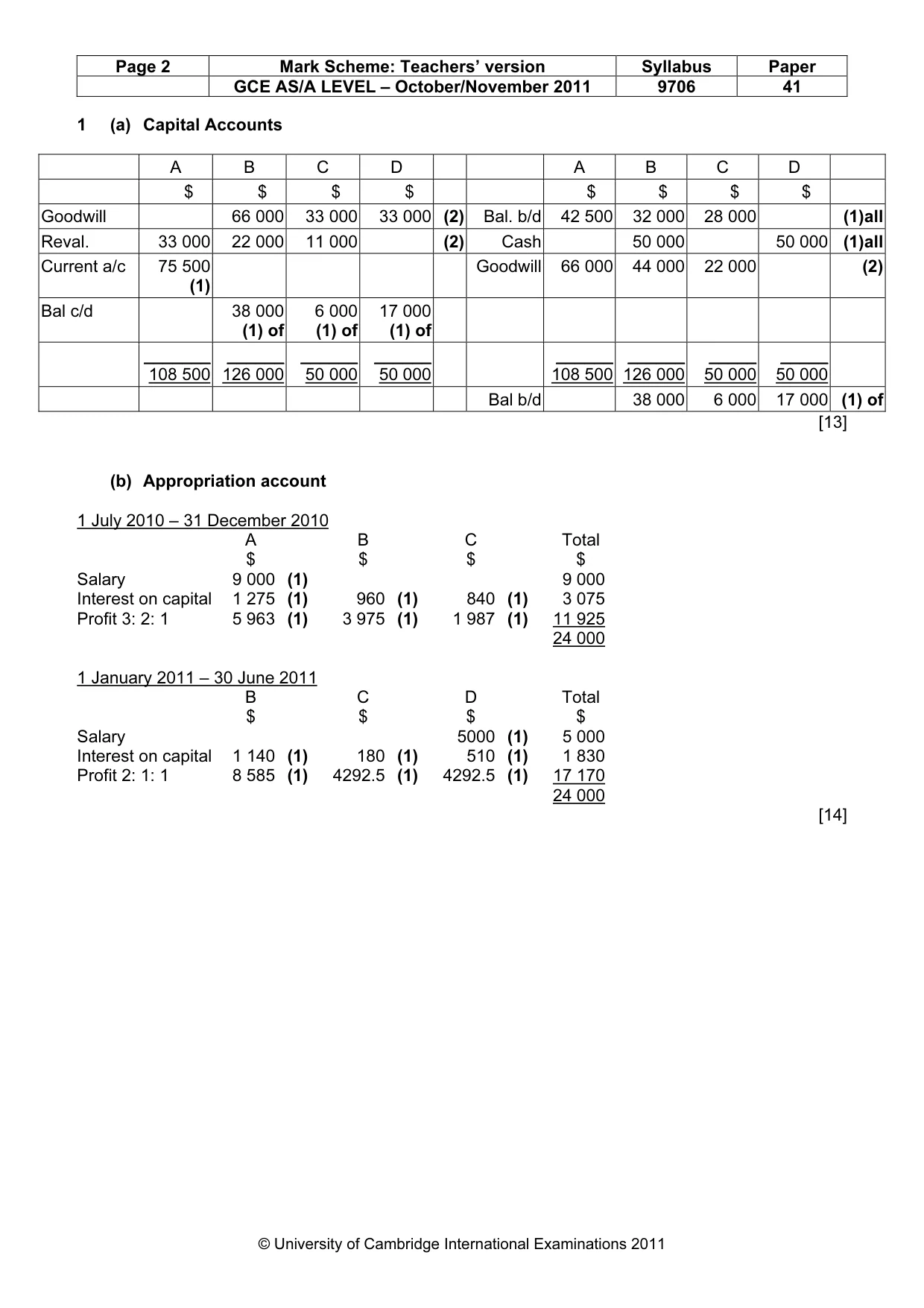
Page 2 Mark Scheme: Teachers’ version Syllabus Paper GCE AS/A LEVEL – October/November 2011 9706 41 © University of Cambridge International Examinations 2011 1 (a) Capital Accounts A B C D A B C D $ $ $ $ $ $ $ $ Goodwill 66 000 33 000 33 000 (2) Bal. b/d 42 500 32 000 28 000 (1)all Reval. 33 000 22 000 11 000 (2) Cash 50 000 50 000 (1)all Current a/c 75 500 (1) Goodwill 66 000 44 000 22 000 (2) Bal c/d 38 000 (1) of 6 000 (1) of 17 000 (1) of _______ 108 500 ______ 126 000 ______ 50 000 ______ 50 000 ______ 108 500 ______ 126 000 _____ 50 000 _____ 50 000 Bal b/d 38 000 6 000 17 000 (1) of [13] (b) Appropriation account 1 July 2010 – 31 December 2010 A B C Total $ $ $ $ Salary 9 000 (1) 9 000 Interest on capital 1 275 (1) 960 (1) 840 (1) 3 075 Profit 3: 2: 1 5 963 (1) 3 975 (1) 1 987 (1) 11 925 24 000 1 January 2011 – 30 June 2011 B C D Total $ $ $ $ Salary 5000 (1) 5 000 Interest on capital 1 140 (1) 180 (1) 510 (1) 1 830 Profit 2: 1: 1 8 585 (1) 4292.5 (1) 4292.5 (1) 17 170 24 000 [14]
Mark scheme, page 3
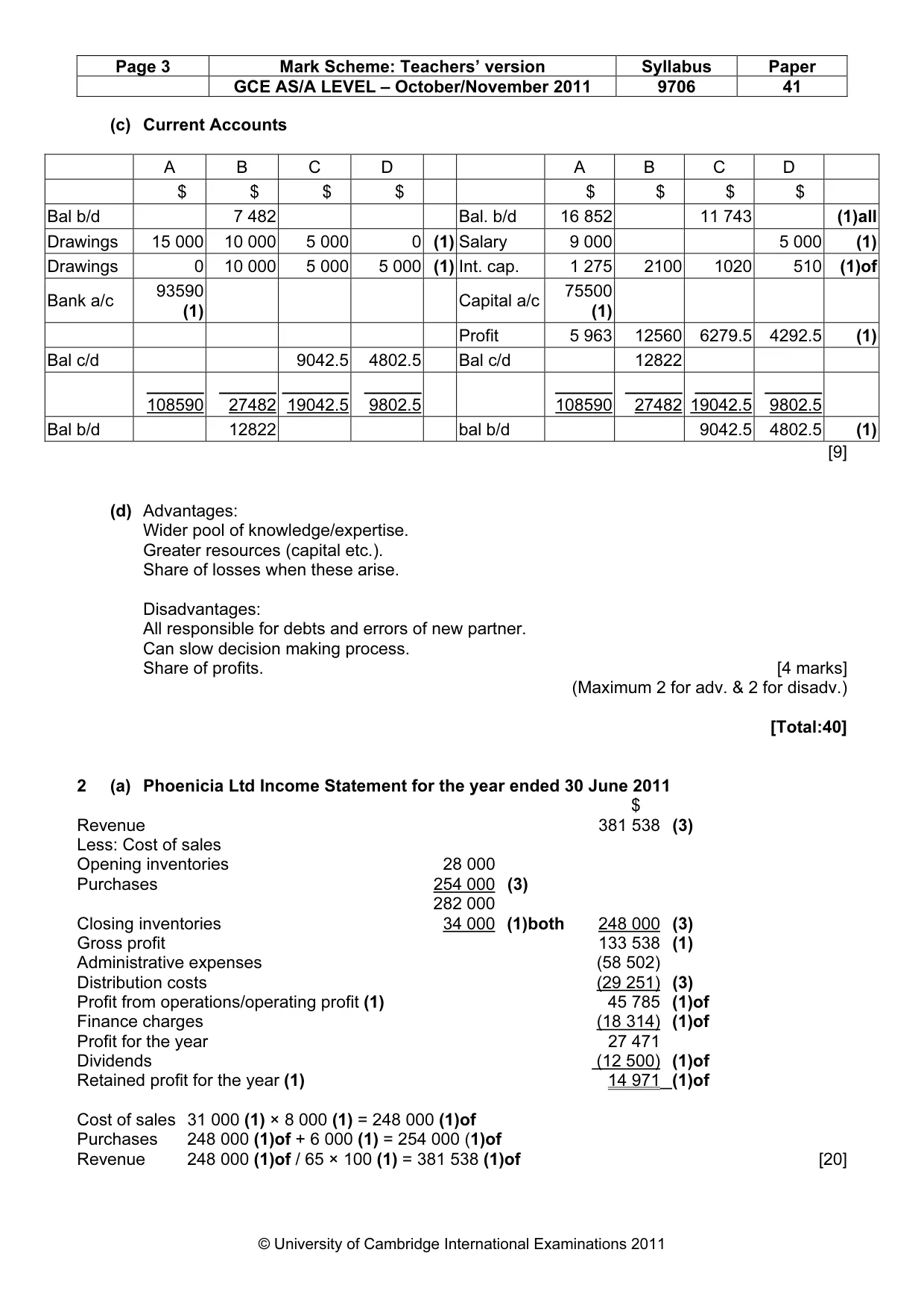
Page 3 Mark Scheme: Teachers’ version Syllabus Paper GCE AS/A LEVEL – October/November 2011 9706 41 © University of Cambridge International Examinations 2011 (c) Current Accounts A B C D A B C D $ $ $ $ $ $ $ $ Bal b/d 7 482 Bal. b/d 16 852 11 743 (1)all Drawings 15 000 10 000 5 000 0 (1) Salary 9 000 5 000 (1) Drawings 0 10 000 5 000 5 000 (1) Int. cap. 1 275 2100 1020 510 (1)of Bank a/c 93590 (1) Capital a/c 75500 (1) Profit 5 963 12560 6279.5 4292.5 (1) Bal c/d 9042.5 4802.5 Bal c/d 12822 ______ 108590 ______ 27482 _______ 19042.5 ______ 9802.5 ______ 108590 ______ 27482 ______ 19042.5 ______ 9802.5 Bal b/d 12822 bal b/d 9042.5 4802.5 (1) [9] (d) Advantages: Wider pool of knowledge/expertise. Greater resources (capital etc.). Share of losses when these arise. Disadvantages: All responsible for debts and errors of new partner. Can slow decision making process. Share of profits. [4 marks] (Maximum 2 for adv. & 2 for disadv.) [Total:40] 2 (a) Phoenicia Ltd Income Statement for the year ended 30 June 2011 $ Revenue 381 538 (3) Less: Cost of sales Opening inventories 28 000 Purchases 254 000 (3) 282 000 Closing inventories 34 000 (1)both 248 000 (3) Gross profit 133 538 (1) Administrative expenses (58 502) Distribution costs (29 251) (3) Profit from operations/operating profit (1) 45 785 (1)of Finance charges (18 314) (1)of Profit for the year 27 471 Dividends (12 500) (1)of Retained profit for the year (1) 14 971 (1)of Cost of sales 31 000 (1) × 8 000 (1) = 248 000 (1)of Purchases 248 000 (1)of + 6 000 (1) = 254 000 (1)of Revenue 248 000 (1)of / 65 × 100 (1) = 381 538 (1)of [20]
Mark scheme, page 4
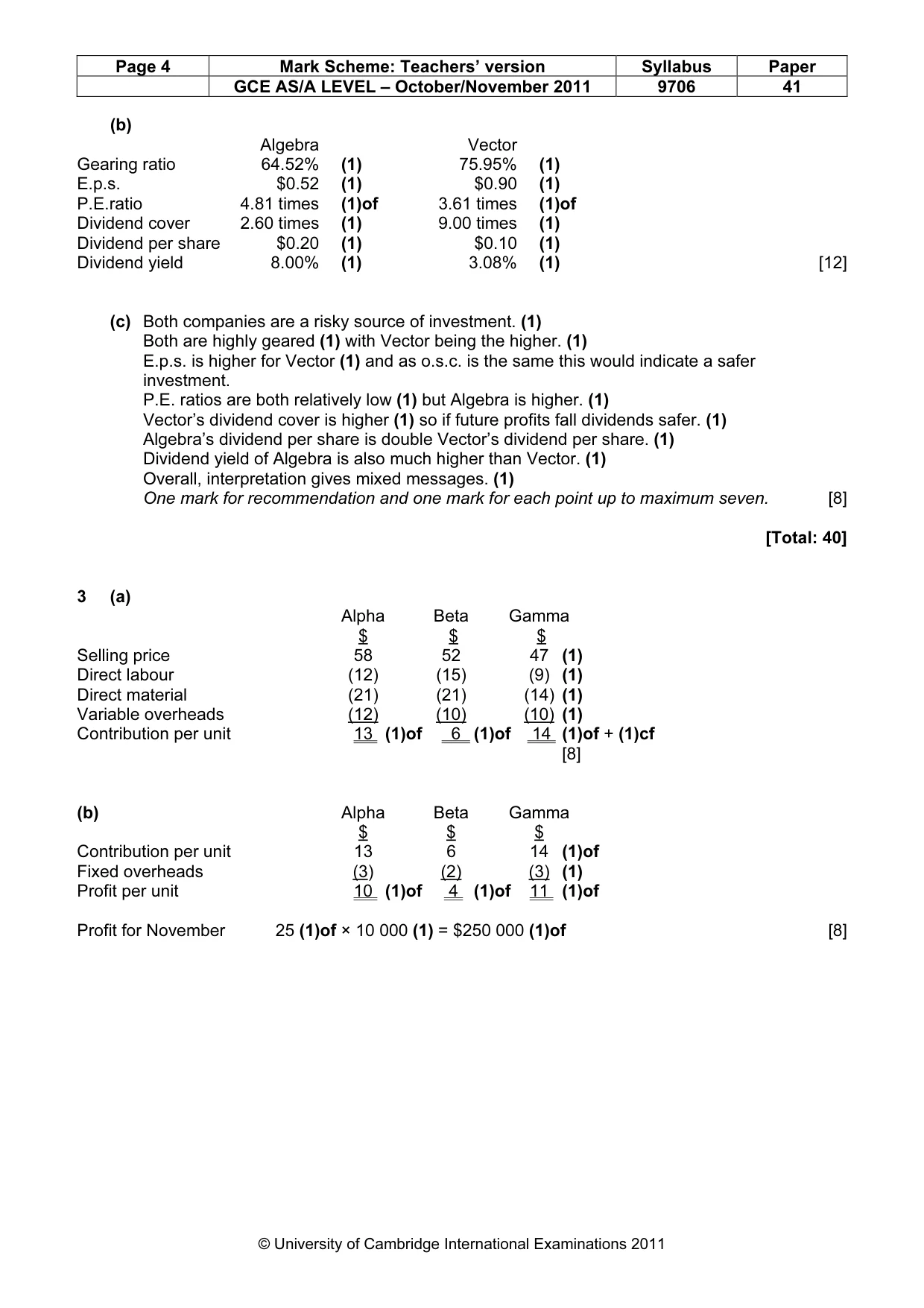
Page 4 Mark Scheme: Teachers’ version Syllabus Paper GCE AS/A LEVEL – October/November 2011 9706 41 © University of Cambridge International Examinations 2011 (b) Algebra Vector Gearing ratio 64.52% (1) 75.95% (1) E.p.s. $0.52 (1) $0.90 (1) P.E.ratio 4.81 times (1)of 3.61 times (1)of Dividend cover 2.60 times (1) 9.00 times (1) Dividend per share $0.20 (1) $0.10 (1) Dividend yield 8.00% (1) 3.08% (1) [12] (c) Both companies are a risky source of investment. (1) Both are highly geared (1) with Vector being the higher. (1) E.p.s. is higher for Vector (1) and as o.s.c. is the same this would indicate a safer investment. P.E. ratios are both relatively low (1) but Algebra is higher. (1) Vector’s dividend cover is higher (1) so if future profits fall dividends safer. (1) Algebra’s dividend per share is double Vector’s dividend per share. (1) Dividend yield of Algebra is also much higher than Vector. (1) Overall, interpretation gives mixed messages. (1) One mark for recommendation and one mark for each point up to maximum seven. [8] [Total: 40] 3 (a) Alpha Beta Gamma $ $ $ Selling price 58 52 47 (1) Direct labour (12) (15) (9) (1) Direct material (21) (21) (14) (1) Variable overheads (12) (10) (10) (1) Contribution per unit 13 (1)of 6 (1)of 14 (1)of + (1)cf [8] (b) Alpha Beta Gamma $ $ $ Contribution per unit 13 6 14 (1)of Fixed overheads (3) (2) (3) (1) Profit per unit 10 (1)of 4 (1)of 11 (1)of Profit for November 25 (1)of × 10 000 (1) = $250 000 (1)of [8]
Mark scheme, page 5
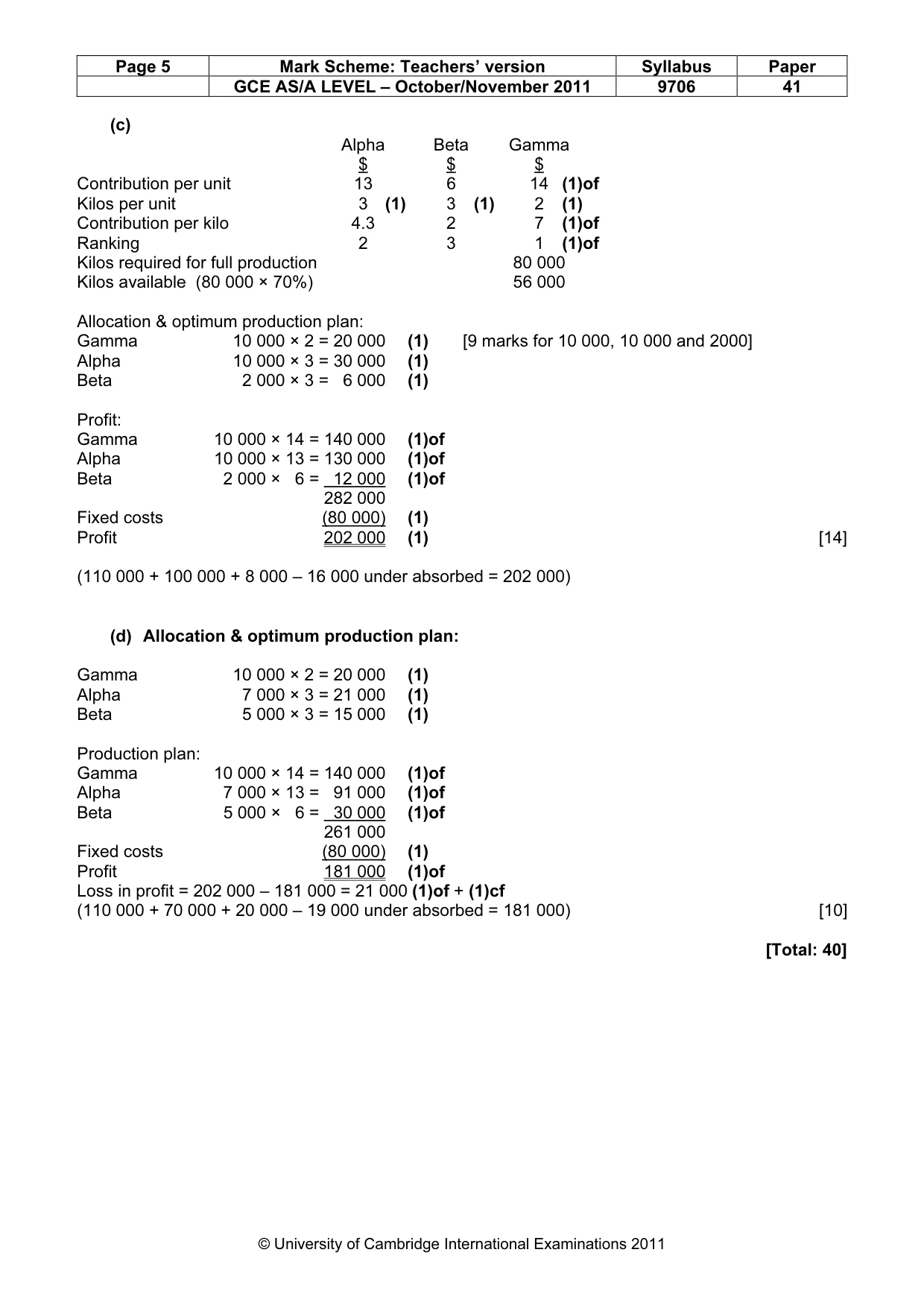
Page 5 Mark Scheme: Teachers’ version Syllabus Paper GCE AS/A LEVEL – October/November 2011 9706 41 © University of Cambridge International Examinations 2011 (c) Alpha Beta Gamma $ $ $ Contribution per unit 13 6 14 (1)of Kilos per unit 3 (1) 3 (1) 2 (1) Contribution per kilo 4.3 2 7 (1)of Ranking 2 3 1 (1)of Kilos required for full production 80 000 Kilos available (80 000 × 70%) 56 000 Allocation & optimum production plan: Gamma 10 000 × 2 = 20 000 (1) [9 marks for 10 000, 10 000 and 2000] Alpha 10 000 × 3 = 30 000 (1) Beta 2 000 × 3 = 6 000 (1) Profit: Gamma 10 000 × 14 = 140 000 (1)of Alpha 10 000 × 13 = 130 000 (1)of Beta 2 000 × 6 = 12 000 (1)of 282 000 Fixed costs (80 000) (1) Profit 202 000 (1) [14] (110 000 + 100 000 + 8 000 – 16 000 under absorbed = 202 000) (d) Allocation & optimum production plan: Gamma 10 000 × 2 = 20 000 (1) Alpha 7 000 × 3 = 21 000 (1) Beta 5 000 × 3 = 15 000 (1) Production plan: Gamma 10 000 × 14 = 140 000 (1)of Alpha 7 000 × 13 = 91 000 (1)of Beta 5 000 × 6 = 30 000 (1)of 261 000 Fixed costs (80 000) (1) Profit 181 000 (1)of Loss in profit = 202 000 – 181 000 = 21 000 (1)of + (1)cf (110 000 + 70 000 + 20 000 – 19 000 under absorbed = 181 000) [10] [Total: 40]
What you needed in this session
Cambridge’s own grade thresholds for 2011 Oct/Nov, Paper 4 · Variant 1. A higher threshold means an easier paper — the bar moves with how the cohort did.