Cambridge A Level Accounting 9706 — 2011 Oct/Nov Paper 4 · Variant 3
9706/43/O/N/11 · 120 marks · ≈135 min
The question paper and its mark scheme, free to read here and free to download. This is Cambridge’s own paper, exactly as it was sat.
Question paper8 pages

Mark scheme5 pages
Answers below. Sit the paper first if you are practising.
Paper as text
Question paper, page 1
This document consists of 7 printed pages and 1 blank page. DC (AC) 32980/5 © UCLES 2011 [Turn over UNIVERSITY OF CAMBRIDGE INTERNATIONAL EXAMINATIONS General Certificate of Education Advanced Subsidiary Level and Advanced Level * 1 9 0 6 1 1 3 7 1 3 * ACCOUNTING 9706/43 Paper 4 Problem Solving (Supplementary Topics) October/November 2011 2 hours Additional Materials: Answer Booklet/Paper READ THESE INSTRUCTIONS FIRST If you have been given an Answer Booklet, follow the instructions on the front cover of the Booklet. Write your Centre number, candidate number and name on all the work you hand in. Write in dark blue or black pen. You may use a soft pencil for any diagrams, graphs or rough working. Do not use staples, paper clips, highlighters, glue or correction fluid. Answer all questions. All accounting statements are to be presented in good style. International accounting terms and formats should be used as appropriate. Workings should be shown. You may use a calculator. At the end of the examination, fasten all your work securely together. The number of marks is given in brackets [ ] at the end of each question or part question.
Question paper, page 2
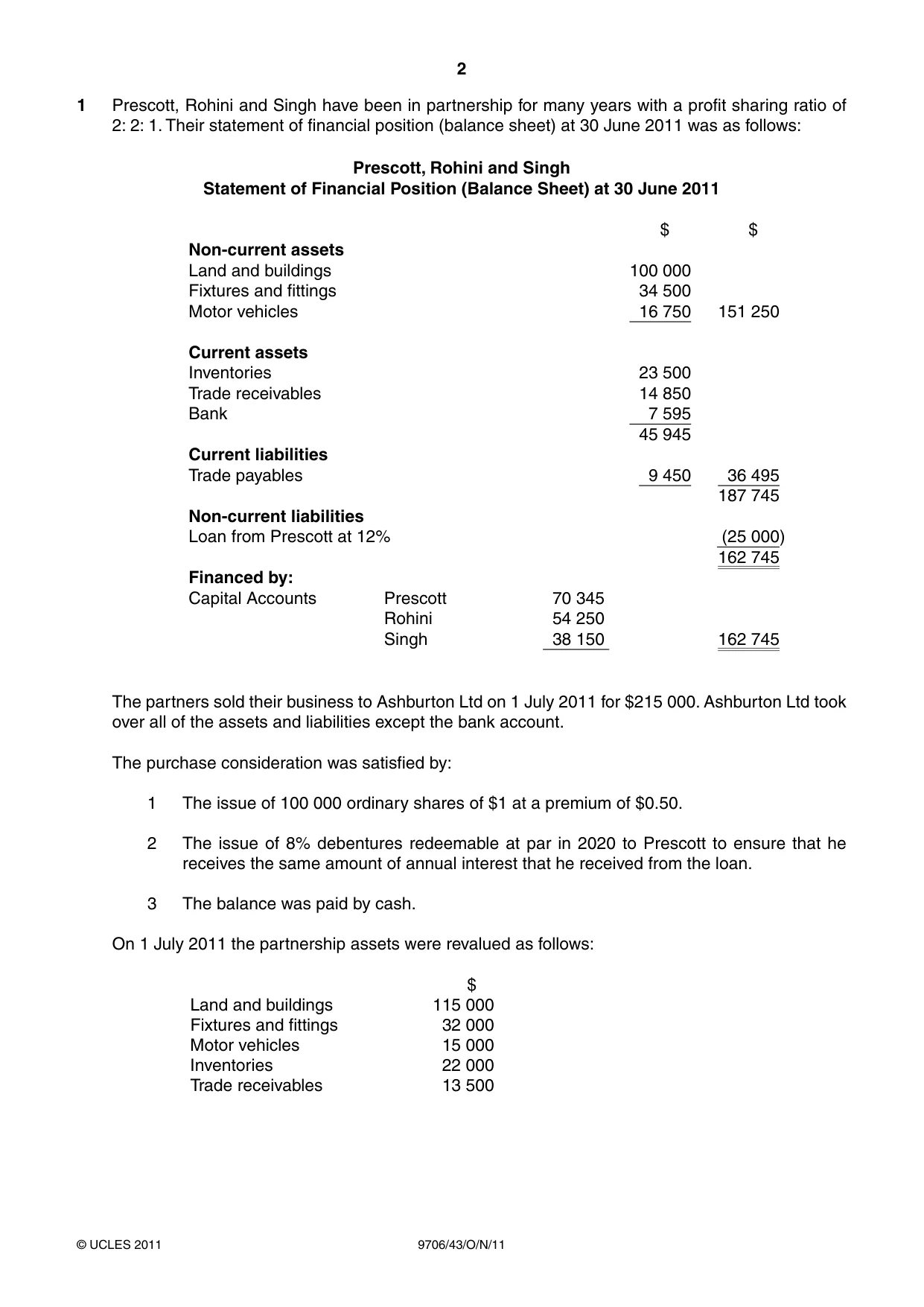
2 9706/43/O/N/11 © UCLES 2011 1 Prescott, Rohini and Singh have been in partnership for many years with a profit sharing ratio of 2: 2: 1. Their statement of financial position (balance sheet) at 30 June 2011 was as follows: Prescott, Rohini and Singh Statement of Financial Position (Balance Sheet) at 30 June 2011 $ $ Non-current assets Land and buildings 100 000 Fixtures and fi ttings 34 500 Motor vehicles 16 750 151 250 Current assets Inventories 23 500 Trade receivables 14 850 Bank 7 595 45 945 Current liabilities Trade payables 9 450 36 495 187 745 Non-current liabilities Loan from Prescott at 12% (25 000) 162 745 Financed by: Capital Accounts Prescott 70 345 Rohini 54 250 Singh 38 150 162 745 The partners sold their business to Ashburton Ltd on 1 July 2011 for $215 000. Ashburton Ltd took over all of the assets and liabilities except the bank account. The purchase consideration was satisfied by: 1 The issue of 100 000 ordinary shares of $1 at a premium of $0.50. 2 The issue of 8% debentures redeemable at par in 2020 to Prescott to ensure that he receives the same amount of annual interest that he received from the loan. 3 The balance was paid by cash. On 1 July 2011 the partnership assets were revalued as follows: $ Land and buildings 115 000 Fixtures and fittings 32 000 Motor vehicles 15 000 Inventories 22 000 Trade receivables 13 500
Question paper, page 3
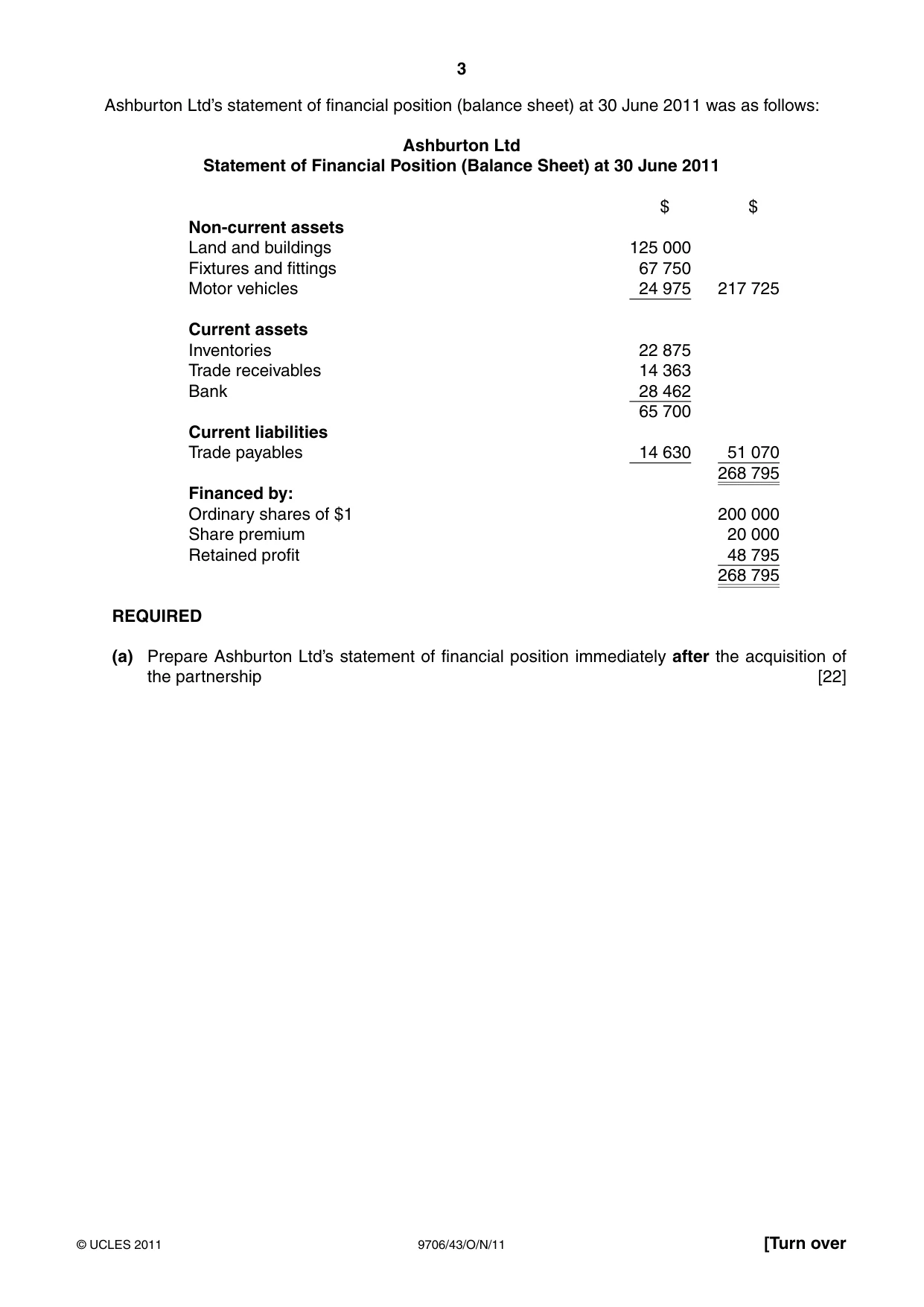
3 9706/43/O/N/11 © UCLES 2011 [Turn over Ashburton Ltd’s statement of financial position (balance sheet) at 30 June 2011 was as follows: Ashburton Ltd Statement of Financial Position (Balance Sheet) at 30 June 2011 $ $ Non-current assets Land and buildings 125 000 Fixtures and fi ttings 67 750 Motor vehicles 24 975 217 725 Current assets Inventories 22 875 Trade receivables 14 363 Bank 28 462 65 700 Current liabilities Trade payables 14 630 51 070 268 795 Financed by: Ordinary shares of $1 200 000 Share premium 20 000 Retained profi t 48 795 268 795 REQUIRED (a) Prepare Ashburton Ltd’s statement of financial position immediately after the acquisition of the partnership [22]
Question paper, page 4
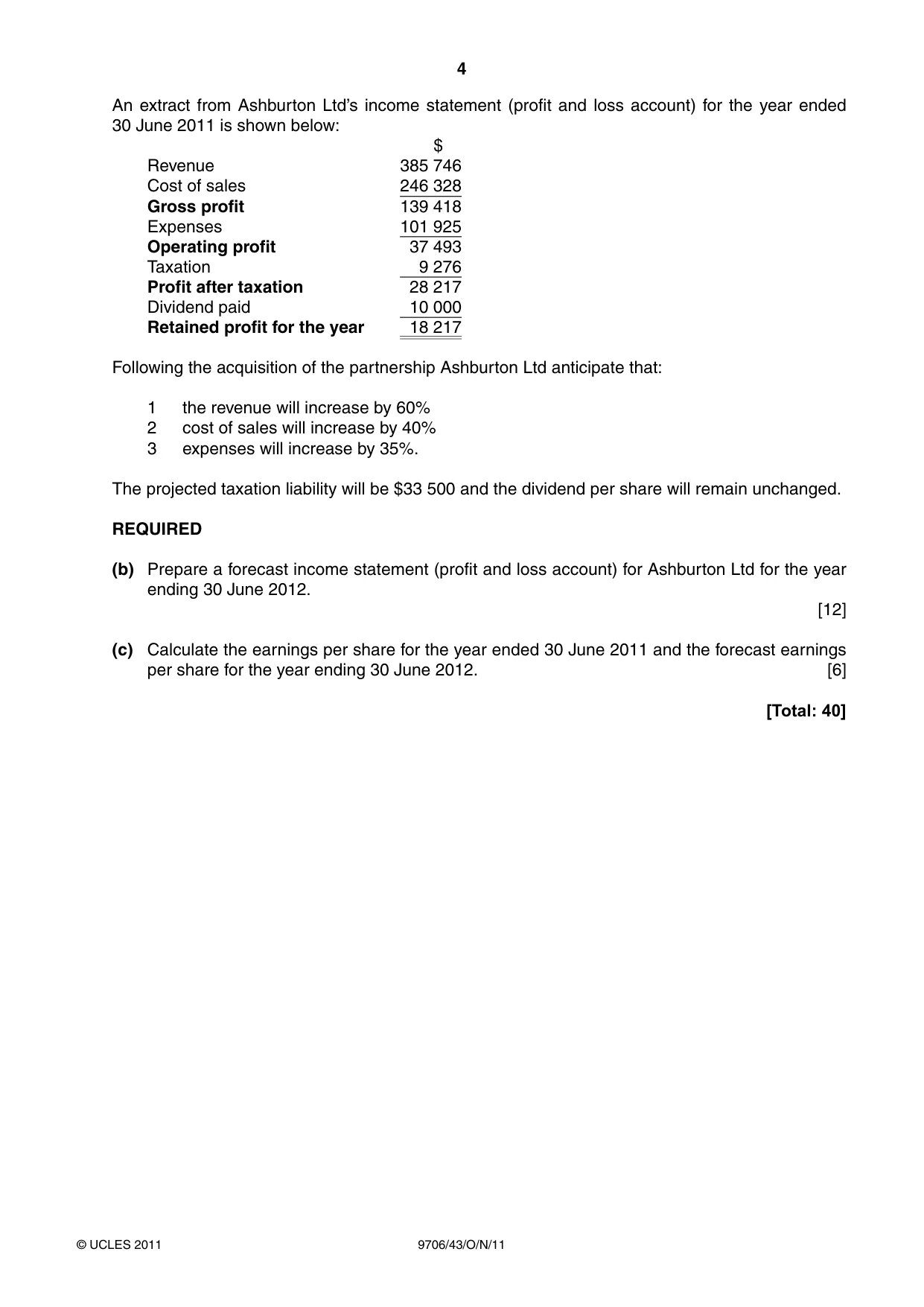
4 9706/43/O/N/11 © UCLES 2011 An extract from Ashburton Ltd’s income statement (profit and loss account) for the year ended 30 June 2011 is shown below: $ Revenue 385 746 Cost of sales 246 328 Gross profit 139 418 Expenses 101 925 Operating profit 37 493 Taxation 9 276 Profit after taxation 28 217 Dividend paid 10 000 Retained profit for the year 18 217 Following the acquisition of the partnership Ashburton Ltd anticipate that: 1 the revenue will increase by 60% 2 cost of sales will increase by 40% 3 expenses will increase by 35%. The projected taxation liability will be $33 500 and the dividend per share will remain unchanged. REQUIRED (b) Prepare a forecast income statement (profit and loss account) for Ashburton Ltd for the year ending 30 June 2012. [12] (c) Calculate the earnings per share for the year ended 30 June 2011 and the forecast earnings per share for the year ending 30 June 2012. [6] [Total: 40]
Question paper, page 5
5 9706/43/O/N/11 © UCLES 2011 [Turn over BLANK PAGE Question 2 is on the next page.
Question paper, page 6
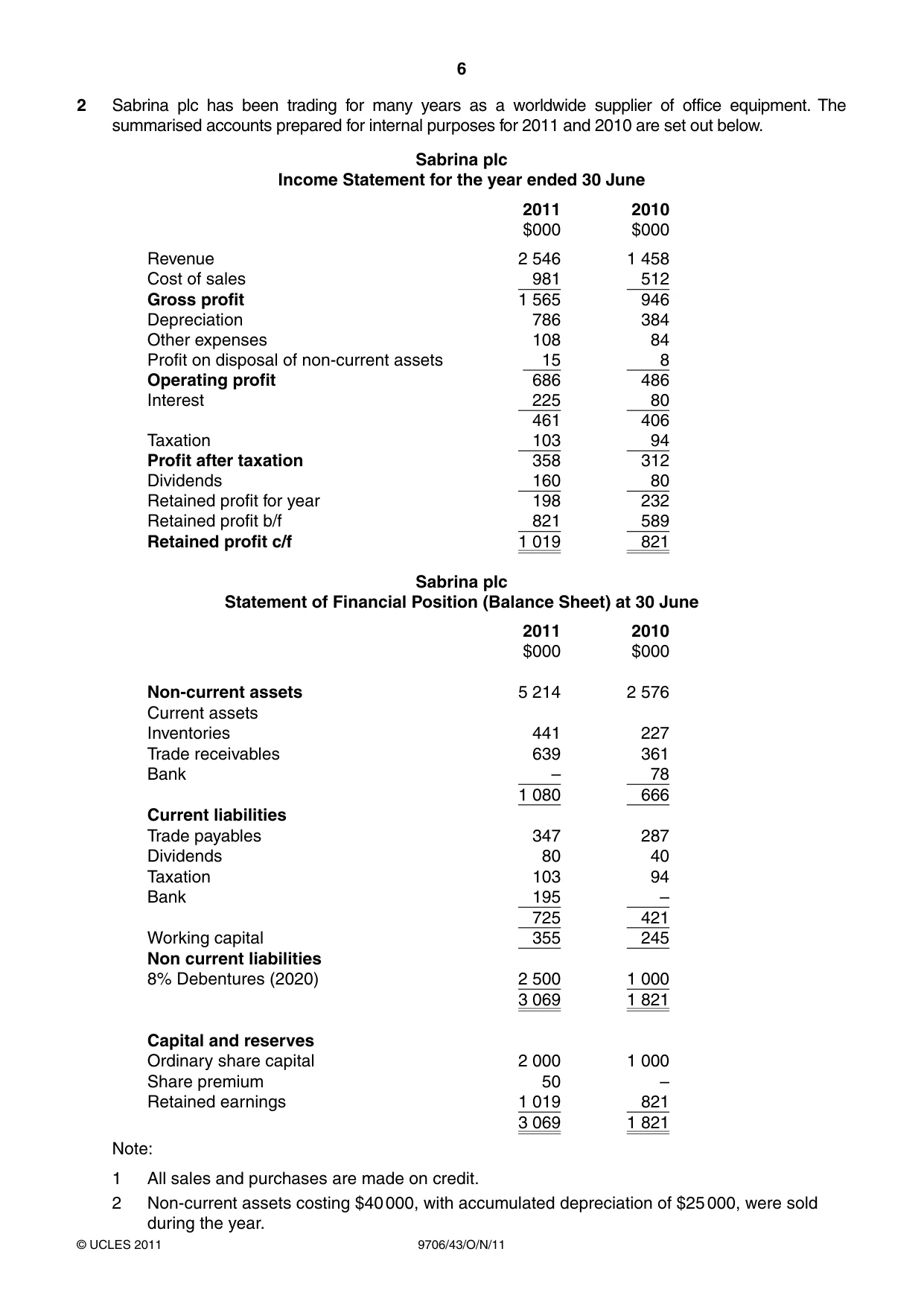
6 9706/43/O/N/11 © UCLES 2011 2 Sabrina plc has been trading for many years as a worldwide supplier of office equipment. The summarised accounts prepared for internal purposes for 2011 and 2010 are set out below. Sabrina plc Income Statement for the year ended 30 June 2011 2010 $000 $000 Revenue 2 546 1 458 Cost of sales 981 512 Gross profit 1 565 946 Depreciation 786 384 Other expenses 108 84 Profit on disposal of non-current assets 15 8 Operating profit 686 486 Interest 225 80 461 406 Taxation 103 94 Profit after taxation 358 312 Dividends 160 80 Retained profit for year 198 232 Retained profit b/f 821 589 Retained profit c/f 1 019 821 Sabrina plc Statement of Financial Position (Balance Sheet) at 30 June 2011 2010 $000 $000 Non-current assets 5 214 2 576 Current assets Inventories 441 227 Trade receivables 639 361 Bank – 78 1 080 666 Current liabilities Trade payables 347 287 Dividends 80 40 Taxation 103 94 Bank 195 – 725 421 Working capital 355 245 Non current liabilities 8% Debentures (2020) 2 500 1 000 3 069 1 821 Capital and reserves Ordinary share capital 2 000 1 000 Share premium 50 – Retained earnings 1 019 821 3 069 1 821 Note: 1 All sales and purchases are made on credit. 2 Non-current assets costing $40 000, with accumulated depreciation of $25 000, were sold during the year.
Question paper, page 7
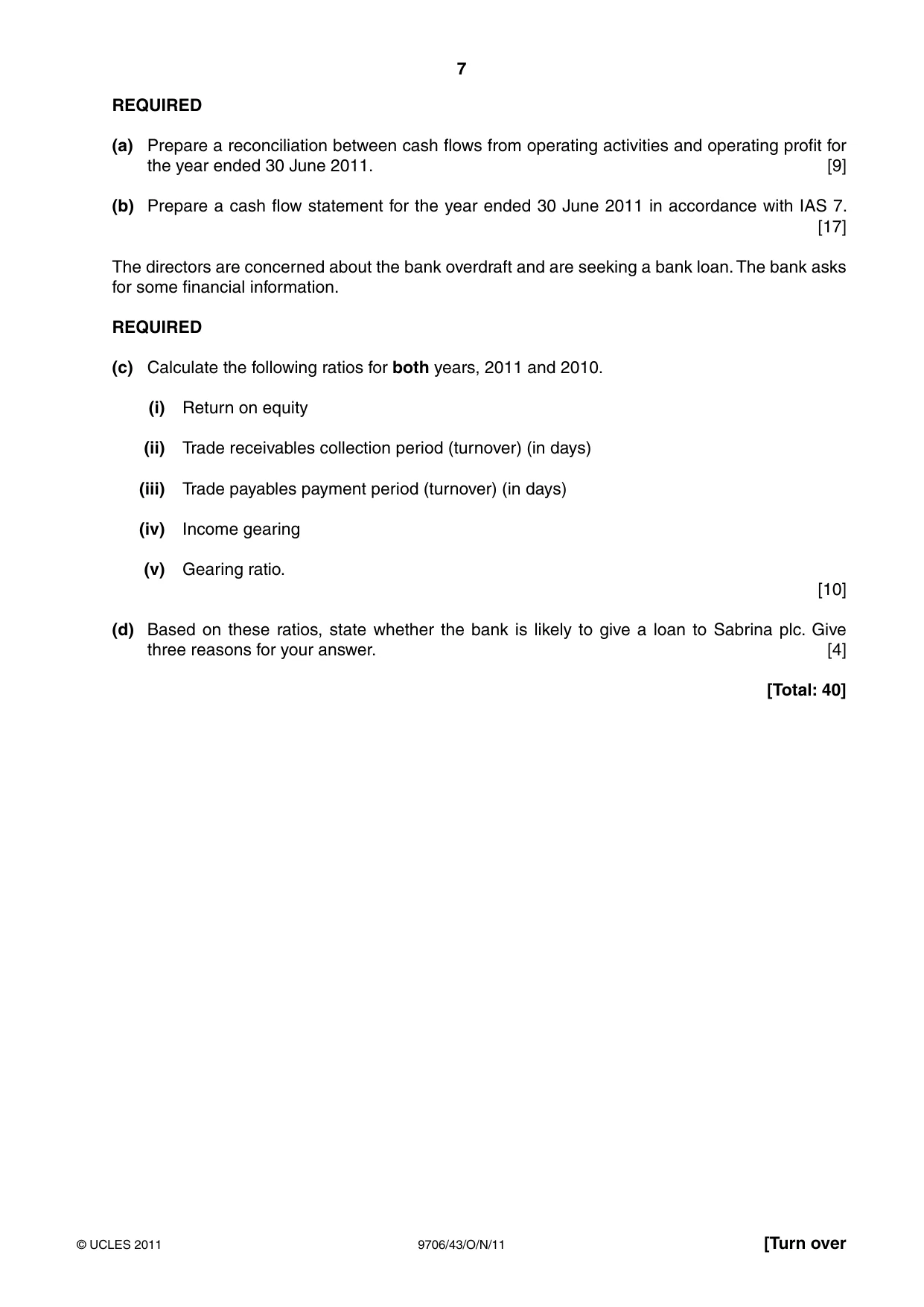
7 9706/43/O/N/11 © UCLES 2011 [Turn over REQUIRED (a) Prepare a reconciliation between cash flows from operating activities and operating profit for the year ended 30 June 2011. [9] (b) Prepare a cash flow statement for the year ended 30 June 2011 in accordance with IAS 7. [17] The directors are concerned about the bank overdraft and are seeking a bank loan. The bank asks for some financial information. REQUIRED (c) Calculate the following ratios for both years, 2011 and 2010. (i) Return on equity (ii) Trade receivables collection period (turnover) (in days) (iii) Trade payables payment period (turnover) (in days) (iv) Income gearing (v) Gearing ratio. [10] (d) Based on these ratios, state whether the bank is likely to give a loan to Sabrina plc. Give three reasons for your answer. [4] [Total: 40]
Question paper, page 8
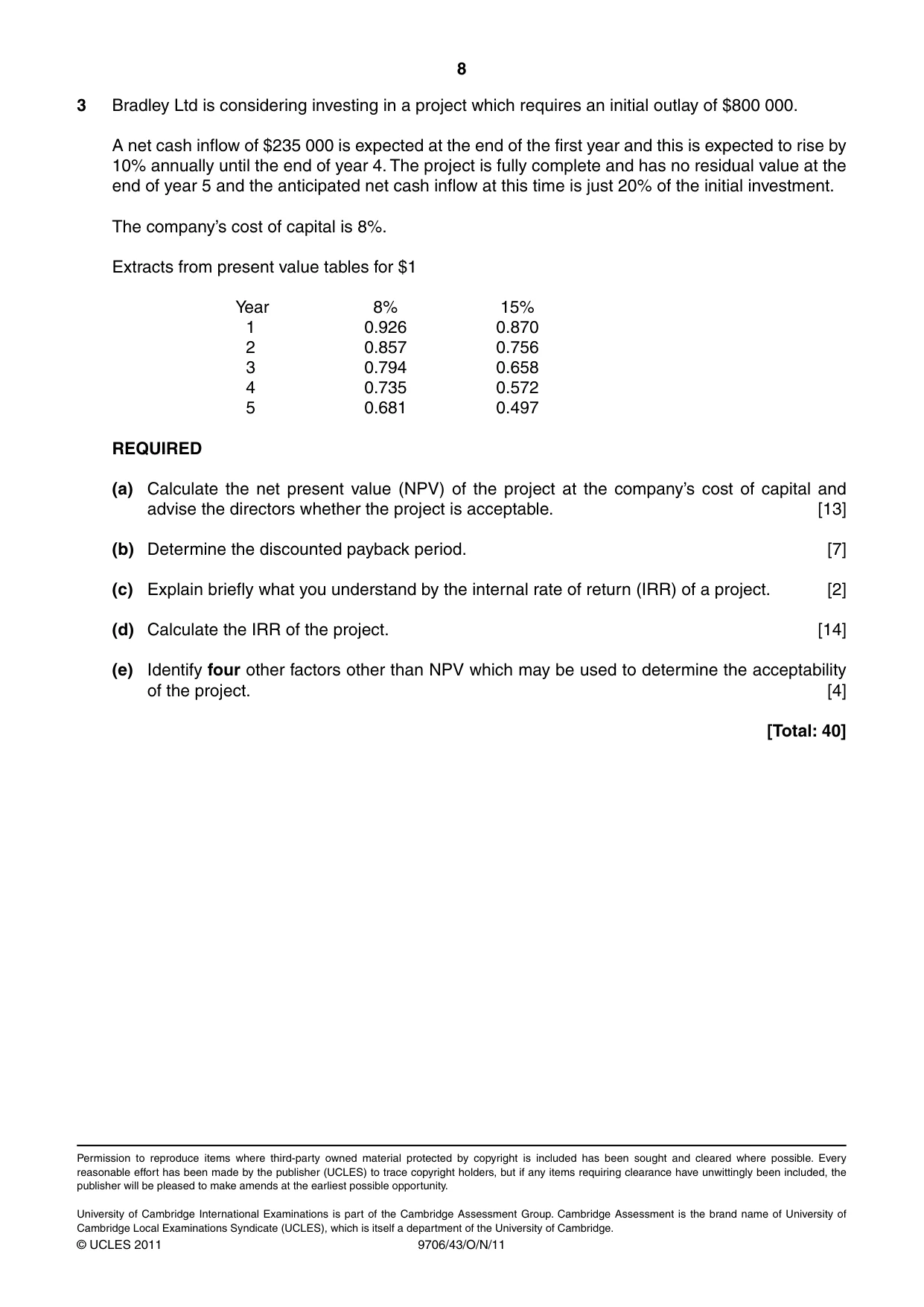
8 9706/43/O/N/11 © UCLES 2011 Permission to reproduce items where third-party owned material protected by copyright is included has been sought and cleared where possible. Every reasonable effort has been made by the publisher (UCLES) to trace copyright holders, but if any items requiring clearance have unwittingly been included, the publisher will be pleased to make amends at the earliest possible opportunity. University of Cambridge International Examinations is part of the Cambridge Assessment Group. Cambridge Assessment is the brand name of University of Cambridge Local Examinations Syndicate (UCLES), which is itself a department of the University of Cambridge. 3 Bradley Ltd is considering investing in a project which requires an initial outlay of $800 000. A net cash inflow of $235 000 is expected at the end of the first year and this is expected to rise by 10% annually until the end of year 4. The project is fully complete and has no residual value at the end of year 5 and the anticipated net cash inflow at this time is just 20% of the initial investment. The company’s cost of capital is 8%. Extracts from present value tables for $1 Year 8% 15% 1 0.926 0.870 2 0.857 0.756 3 0.794 0.658 4 0.735 0.572 5 0.681 0.497 REQUIRED (a) Calculate the net present value (NPV) of the project at the company’s cost of capital and advise the directors whether the project is acceptable. [13] (b) Determine the discounted payback period. [7] (c) Explain briefly what you understand by the internal rate of return (IRR) of a project. [2] (d) Calculate the IRR of the project. [14] (e) Identify four other factors other than NPV which may be used to determine the acceptability of the project. [4] [Total: 40]
Mark scheme, page 1
UNIVERSITY OF CAMBRIDGE INTERNATIONAL EXAMINATIONS GCE Advanced Subsidiary Level and GCE Advanced Level MARK SCHEME for the October/November 2011 question paper for the guidance of teachers 9706 ACCOUNTING 9706/43 Paper 4 (Problem Solving – Supplement), maximum raw mark 120 This mark scheme is published as an aid to teachers and candidates, to indicate the requirements of the examination. It shows the basis on which Examiners were instructed to award marks. It does not indicate the details of the discussions that took place at an Examiners’ meeting before marking began, which would have considered the acceptability of alternative answers. Mark schemes must be read in conjunction with the question papers and the report on the examination. • Cambridge will not enter into discussions or correspondence in connection with these mark schemes. Cambridge is publishing the mark schemes for the October/November 2011 question papers for most IGCSE, GCE Advanced Level and Advanced Subsidiary Level syllabuses and some Ordinary Level syllabuses.
Mark scheme, page 2
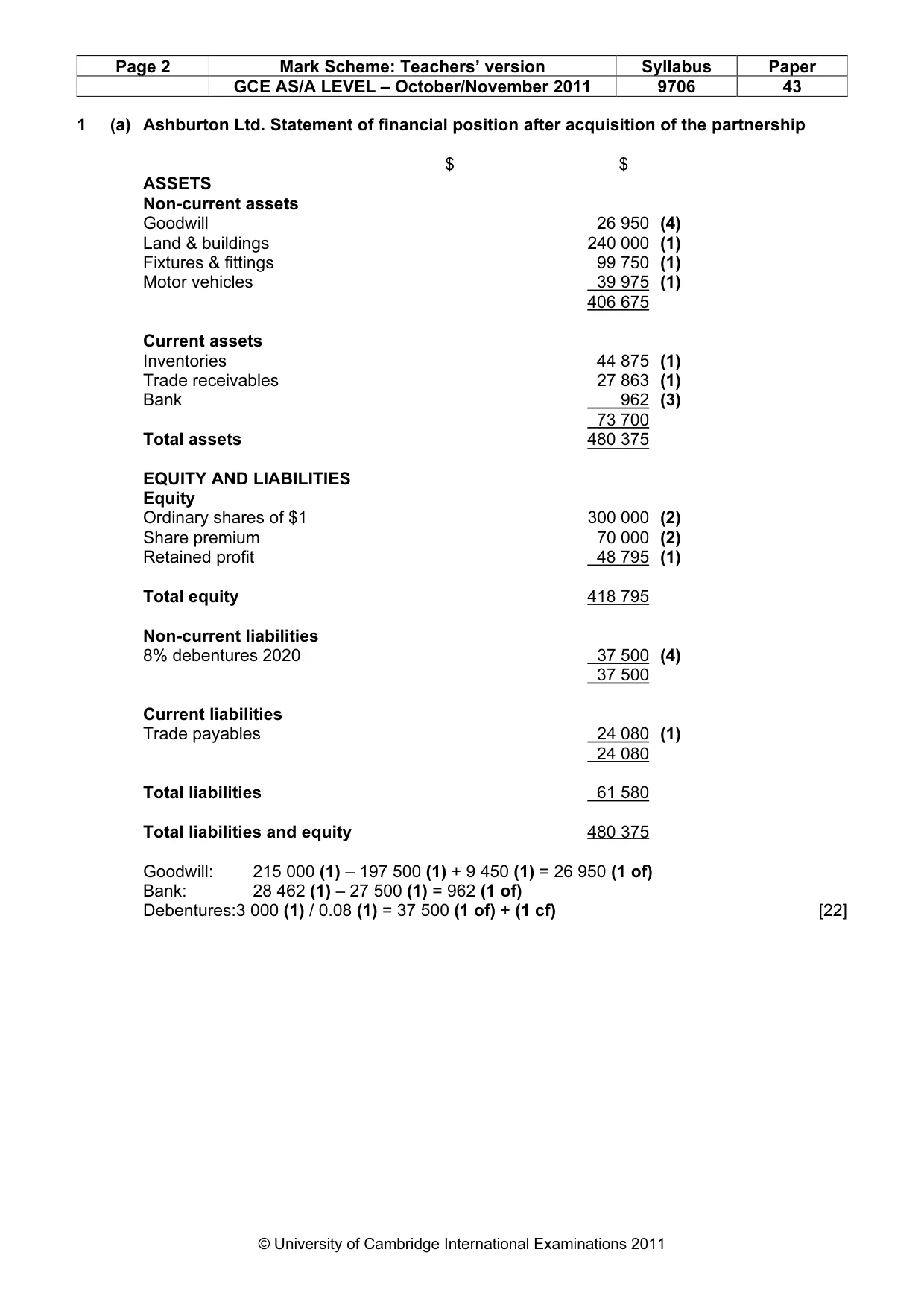
Page 2 Mark Scheme: Teachers’ version Syllabus Paper GCE AS/A LEVEL – October/November 2011 9706 43 © University of Cambridge International Examinations 2011 1 (a) Ashburton Ltd. Statement of financial position after acquisition of the partnership $ $ ASSETS Non-current assets Goodwill 26 950 (4) Land & buildings 240 000 (1) Fixtures & fittings 99 750 (1) Motor vehicles 39 975 (1) 406 675 Current assets Inventories 44 875 (1) Trade receivables 27 863 (1) Bank 962 (3) 73 700 Total assets 480 375 EQUITY AND LIABILITIES Equity Ordinary shares of $1 300 000 (2) Share premium 70 000 (2) Retained profit 48 795 (1) Total equity 418 795 Non-current liabilities 8% debentures 2020 37 500 (4) 37 500 Current liabilities Trade payables 24 080 (1) 24 080 Total liabilities 61 580 Total liabilities and equity 480 375 Goodwill: 215 000 (1) – 197 500 (1) + 9 450 (1) = 26 950 (1 of) Bank: 28 462 (1) – 27 500 (1) = 962 (1 of) Debentures:3 000 (1) / 0.08 (1) = 37 500 (1 of) + (1 cf) [22]
Mark scheme, page 3
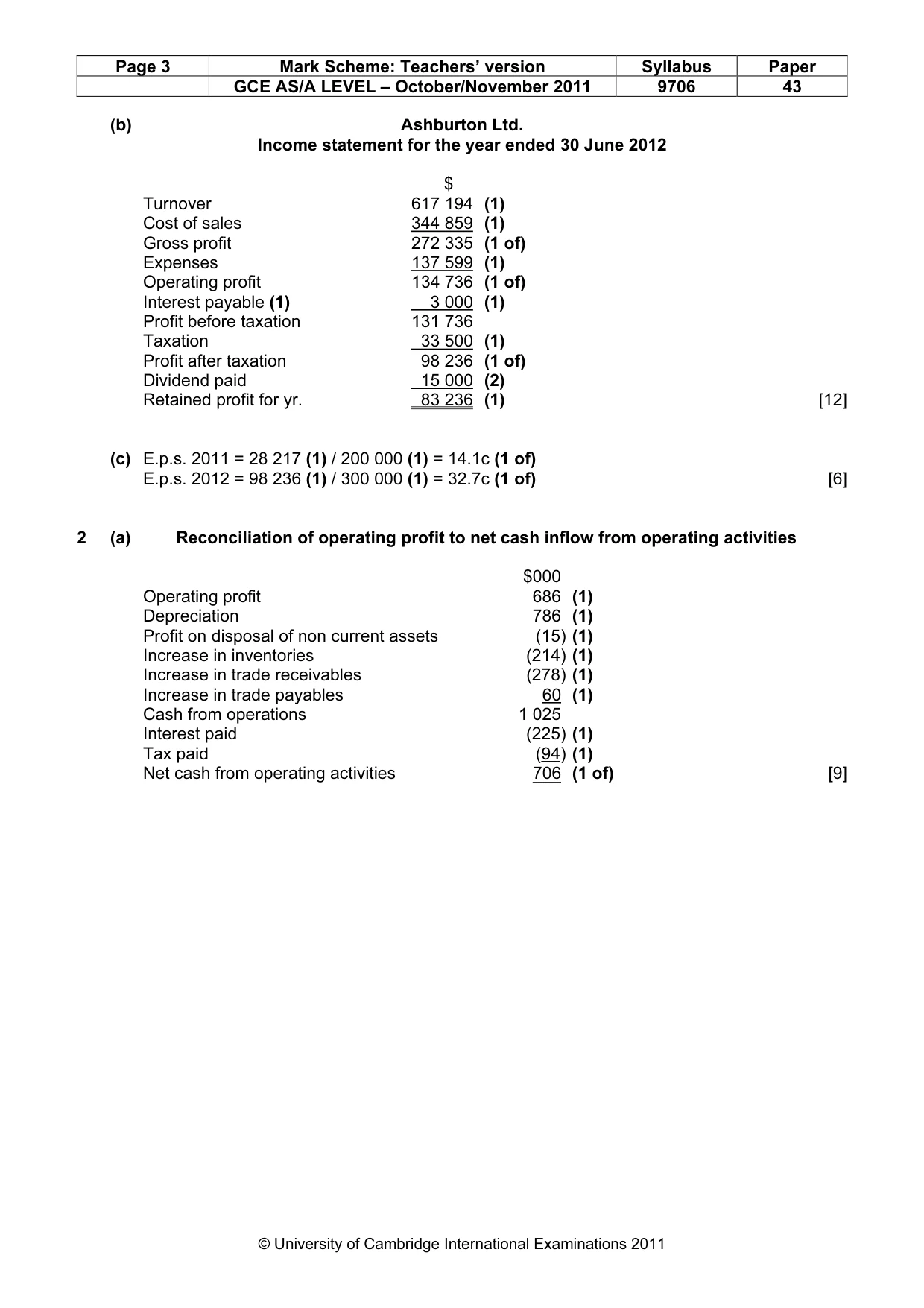
Page 3 Mark Scheme: Teachers’ version Syllabus Paper GCE AS/A LEVEL – October/November 2011 9706 43 © University of Cambridge International Examinations 2011 (b) Ashburton Ltd. Income statement for the year ended 30 June 2012 $ Turnover 617 194 (1) Cost of sales 344 859 (1) Gross profit 272 335 (1 of) Expenses 137 599 (1) Operating profit 134 736 (1 of) Interest payable (1) 3 000 (1) Profit before taxation 131 736 Taxation 33 500 (1) Profit after taxation 98 236 (1 of) Dividend paid 15 000 (2) Retained profit for yr. 83 236 (1) [12] (c) E.p.s. 2011 = 28 217 (1) / 200 000 (1) = 14.1c (1 of) E.p.s. 2012 = 98 236 (1) / 300 000 (1) = 32.7c (1 of) [6] 2 (a) Reconciliation of operating profit to net cash inflow from operating activities $000 Operating profit 686 (1) Depreciation 786 (1) Profit on disposal of non current assets (15) (1) Increase in inventories (214) (1) Increase in trade receivables (278) (1) Increase in trade payables 60 (1) Cash from operations 1 025 Interest paid (225) (1) Tax paid (94) (1) Net cash from operating activities 706 (1 of) [9]
Mark scheme, page 4
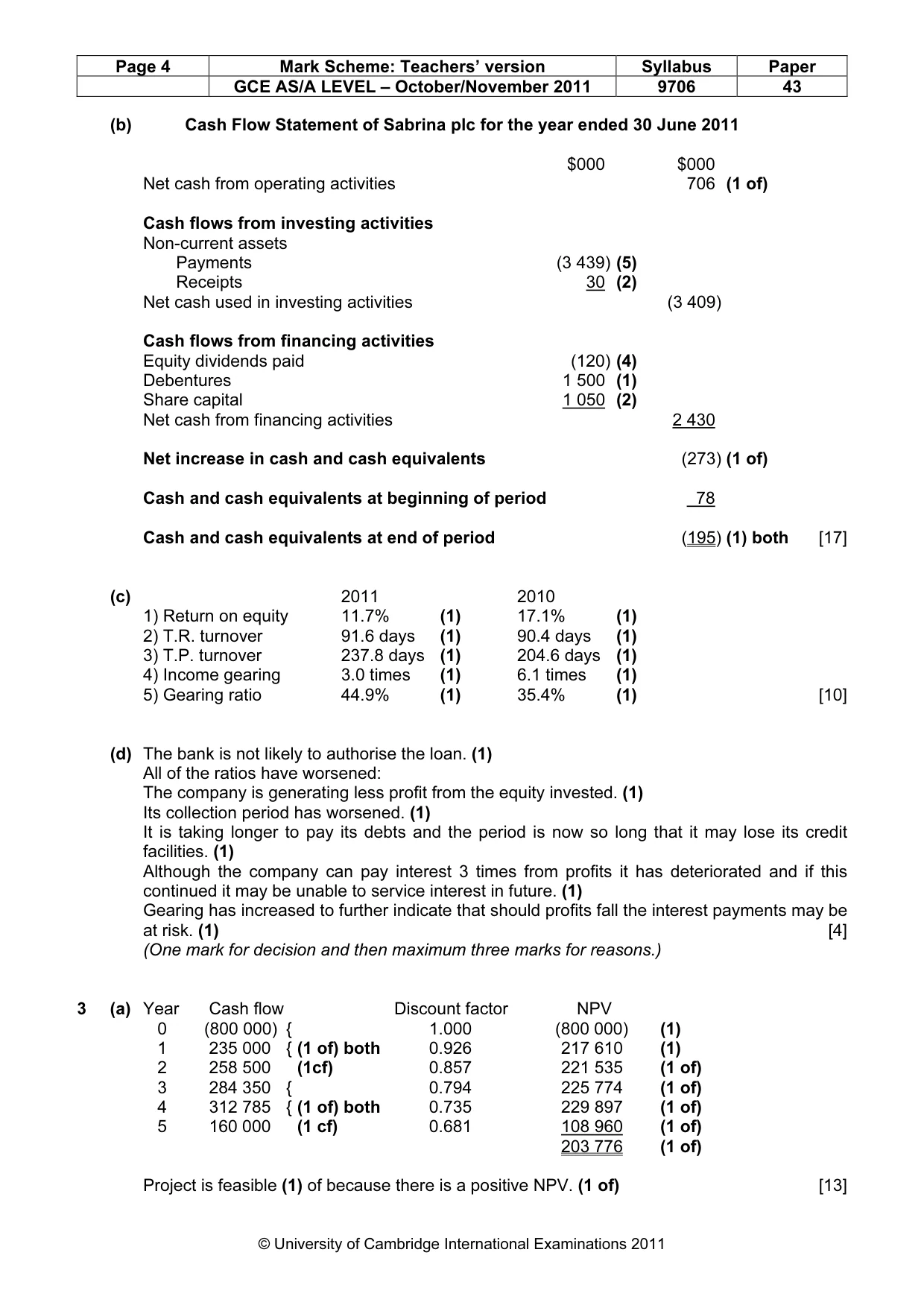
Page 4 Mark Scheme: Teachers’ version Syllabus Paper GCE AS/A LEVEL – October/November 2011 9706 43 © University of Cambridge International Examinations 2011 (b) Cash Flow Statement of Sabrina plc for the year ended 30 June 2011 $000 $000 Net cash from operating activities 706 (1 of) Cash flows from investing activities Non-current assets Payments (3 439) (5) Receipts 30 (2) Net cash used in investing activities (3 409) Cash flows from financing activities Equity dividends paid (120) (4) Debentures 1 500 (1) Share capital 1 050 (2) Net cash from financing activities 2 430 Net increase in cash and cash equivalents (273) (1 of) Cash and cash equivalents at beginning of period 78 Cash and cash equivalents at end of period (195) (1) both [17] (c) 2011 2010 1) Return on equity 11.7% (1) 17.1% (1) 2) T.R. turnover 91.6 days (1) 90.4 days (1) 3) T.P. turnover 237.8 days (1) 204.6 days (1) 4) Income gearing 3.0 times (1) 6.1 times (1) 5) Gearing ratio 44.9% (1) 35.4% (1) [10] (d) The bank is not likely to authorise the loan. (1) All of the ratios have worsened: The company is generating less profit from the equity invested. (1) Its collection period has worsened. (1) It is taking longer to pay its debts and the period is now so long that it may lose its credit facilities. (1) Although the company can pay interest 3 times from profits it has deteriorated and if this continued it may be unable to service interest in future. (1) Gearing has increased to further indicate that should profits fall the interest payments may be at risk. (1) [4] (One mark for decision and then maximum three marks for reasons.) 3 (a) Year Cash flow Discount factor NPV 0 (800 000) { 1.000 (800 000) (1) 1 235 000 { (1 of) both 0.926 217 610 (1) 2 258 500 (1cf) 0.857 221 535 (1 of) 3 284 350 { 0.794 225 774 (1 of) 4 312 785 { (1 of) both 0.735 229 897 (1 of) 5 160 000 (1 cf) 0.681 108 960 (1 of) 203 776 (1 of) Project is feasible (1) of because there is a positive NPV. (1 of) [13]
Mark scheme, page 5
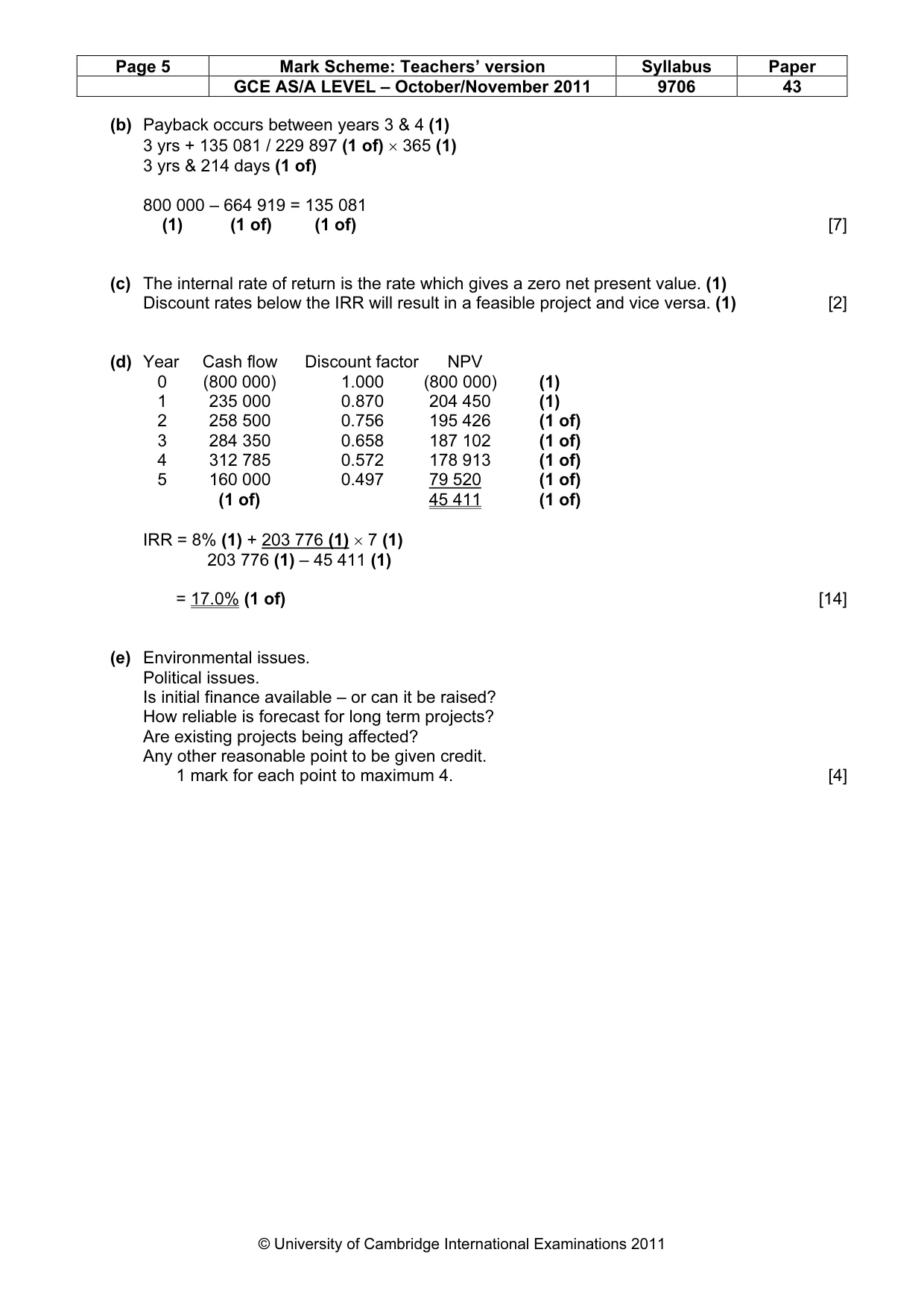
Page 5 Mark Scheme: Teachers’ version Syllabus Paper GCE AS/A LEVEL – October/November 2011 9706 43 © University of Cambridge International Examinations 2011 (b) Payback occurs between years 3 & 4 (1) 3 yrs + 135 081 / 229 897 (1 of) × 365 (1) 3 yrs & 214 days (1 of) 800 000 – 664 919 = 135 081 (1) (1 of) (1 of) [7] (c) The internal rate of return is the rate which gives a zero net present value. (1) Discount rates below the IRR will result in a feasible project and vice versa. (1) [2] (d) Year Cash flow Discount factor NPV 0 (800 000) 1.000 (800 000) (1) 1 235 000 0.870 204 450 (1) 2 258 500 0.756 195 426 (1 of) 3 284 350 0.658 187 102 (1 of) 4 312 785 0.572 178 913 (1 of) 5 160 000 0.497 79 520 (1 of) (1 of) 45 411 (1 of) IRR = 8% (1) + 203 776 (1) × 7 (1) 203 776 (1) – 45 411 (1) = 17.0% (1 of) [14] (e) Environmental issues. Political issues. Is initial finance available – or can it be raised? How reliable is forecast for long term projects? Are existing projects being affected? Any other reasonable point to be given credit. 1 mark for each point to maximum 4. [4]
What you needed in this session
Cambridge’s own grade thresholds for 2011 Oct/Nov, Paper 4 · Variant 3. A higher threshold means an easier paper — the bar moves with how the cohort did.