Cambridge A Level Accounting 9706 — 2011 Oct/Nov Paper 2 · Variant 2
9706/22/O/N/11 · 90 marks · ≈101 min
The question paper and its mark scheme, free to read here and free to download. This is Cambridge’s own paper, exactly as it was sat.
Question paper16 pages

Mark scheme7 pages
Answers below. Sit the paper first if you are practising.
Paper as text
Question paper, page 1
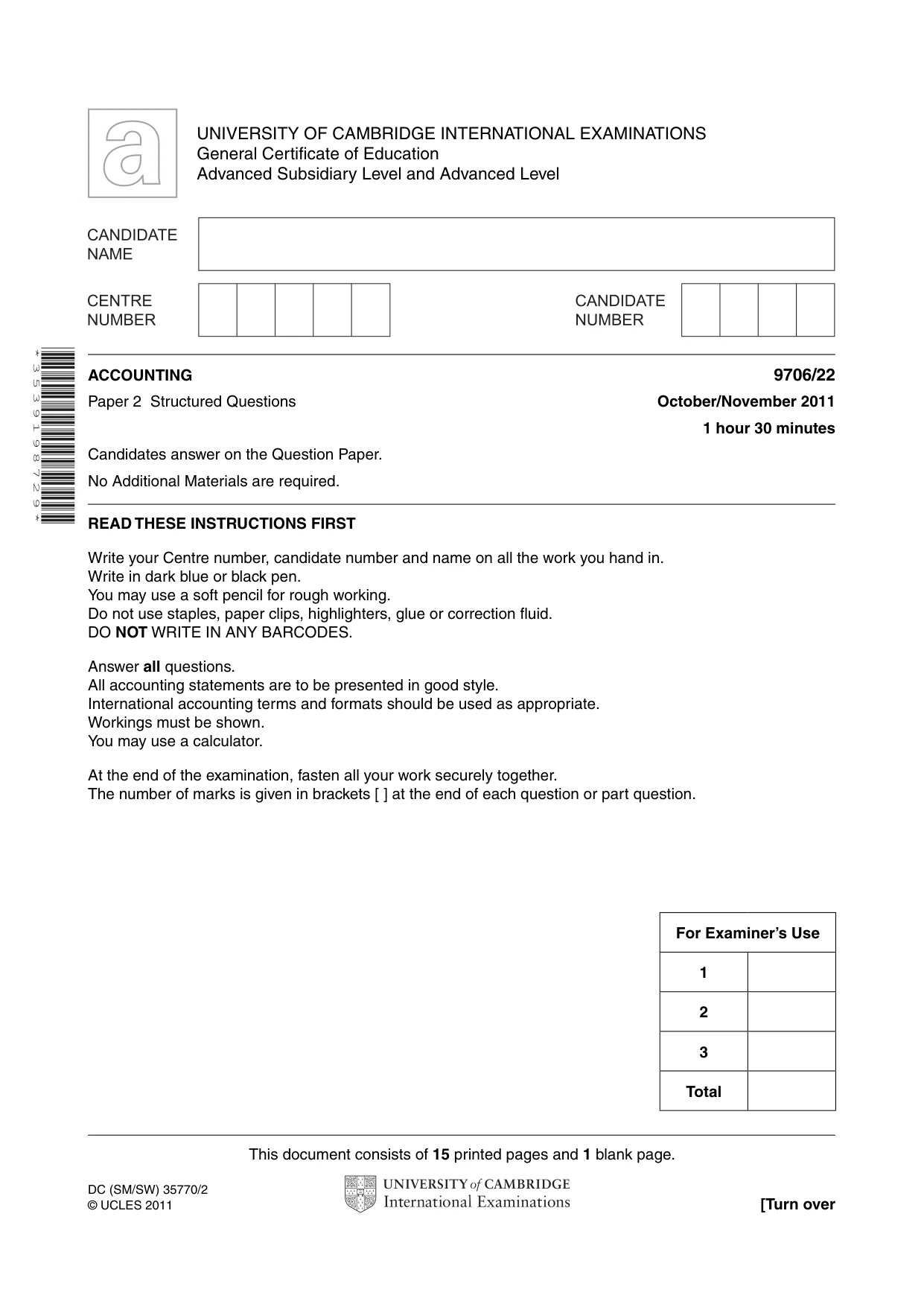
This document consists of 15 printed pages and 1 blank page. DC (SM/SW) 35770/2 © UCLES 2011 [Turn over UNIVERSITY OF CAMBRIDGE INTERNATIONAL EXAMINATIONS General Certificate of Education Advanced Subsidiary Level and Advanced Level * 3 5 3 9 1 9 8 7 2 9 * ACCOUNTING 9706/22 Paper 2 Structured Questions October/November 2011 1 hour 30 minutes Candidates answer on the Question Paper. No Additional Materials are required. READ THESE INSTRUCTIONS FIRST Write your Centre number, candidate number and name on all the work you hand in. Write in dark blue or black pen. You may use a soft pencil for rough working. Do not use staples, paper clips, highlighters, glue or correction fluid. DO NOT WRITE IN ANY BARCODES. Answer all questions. All accounting statements are to be presented in good style. International accounting terms and formats should be used as appropriate. Workings must be shown. You may use a calculator. At the end of the examination, fasten all your work securely together. The number of marks is given in brackets [ ] at the end of each question or part question. For Examiner’s Use 1 2 3 Total
Question paper, page 2
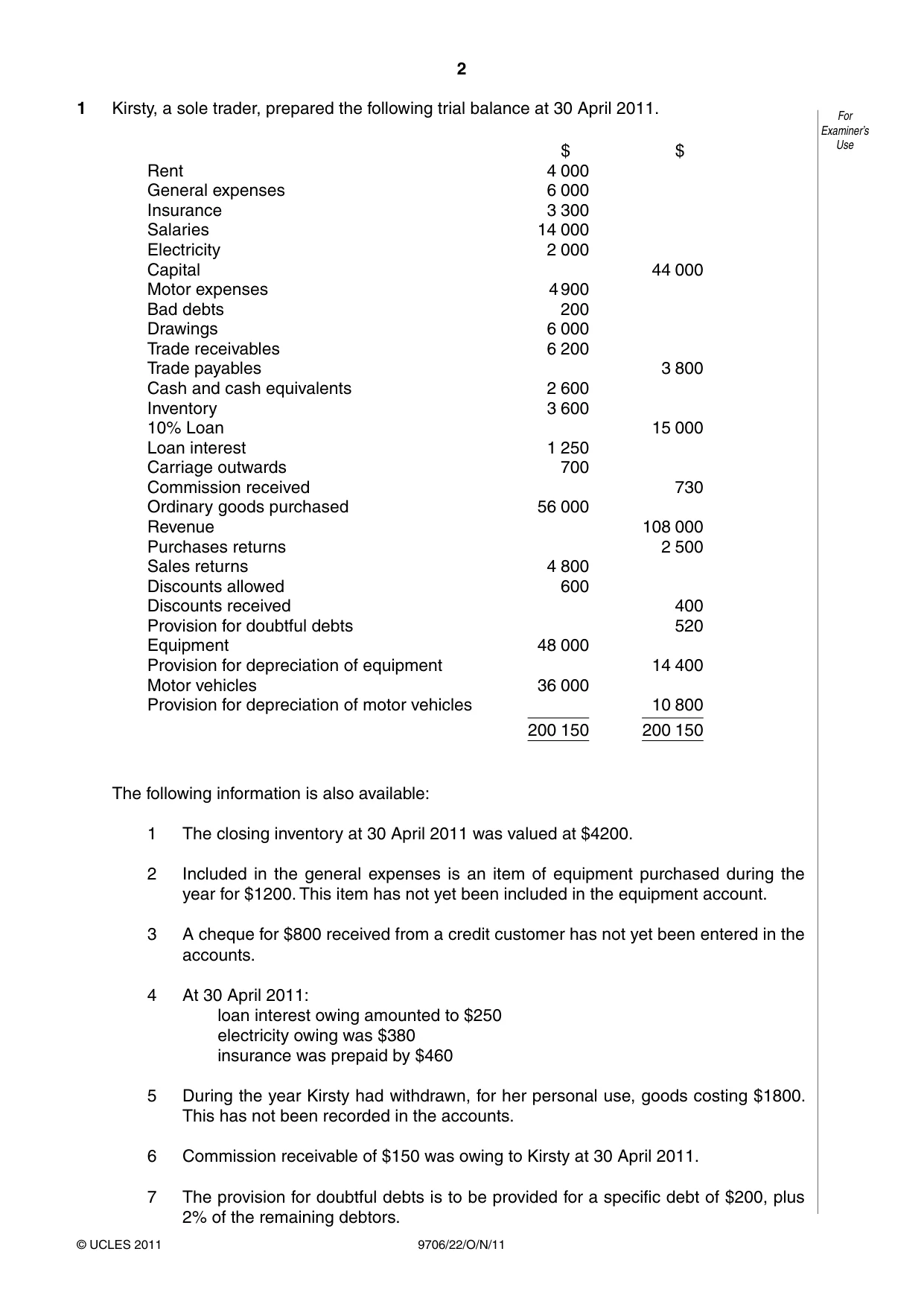
2 9706/22/O/N/11 © UCLES 2011 For Examiner’s Use 1 Kirsty, a sole trader, prepared the following trial balance at 30 April 2011. $ $ Rent 4 000 General expenses 6 000 Insurance 3 300 Salaries 14 000 Electricity 2 000 Capital 44 000 Motor expenses 4 900 Bad debts 200 Drawings 6 000 Trade receivables 6 200 Trade payables 3 800 Cash and cash equivalents 2 600 Inventory 3 600 10% Loan 15 000 Loan interest 1 250 Carriage outwards 700 Commission received 730 Ordinary goods purchased 56 000 Revenue 108 000 Purchases returns 2 500 Sales returns 4 800 Discounts allowed 600 Discounts received 400 Provision for doubtful debts 520 Equipment 48 000 Provision for depreciation of equipment 14 400 Motor vehicles 36 000 Provision for depreciation of motor vehicles 10 800 200 150 200 150 The following information is also available: 1 The closing inventory at 30 April 2011 was valued at $4200. 2 Included in the general expenses is an item of equipment purchased during the year for $1200. This item has not yet been included in the equipment account. 3 A cheque for $800 received from a credit customer has not yet been entered in the accounts. 4 At 30 April 2011: loan interest owing amounted to $250 electricity owing was $380 insurance was prepaid by $460 5 During the year Kirsty had withdrawn, for her personal use, goods costing $1800. This has not been recorded in the accounts. 6 Commission receivable of $150 was owing to Kirsty at 30 April 2011. 7 The provision for doubtful debts is to be provided for a specific debt of $200, plus 2% of the remaining debtors.
Question paper, page 3
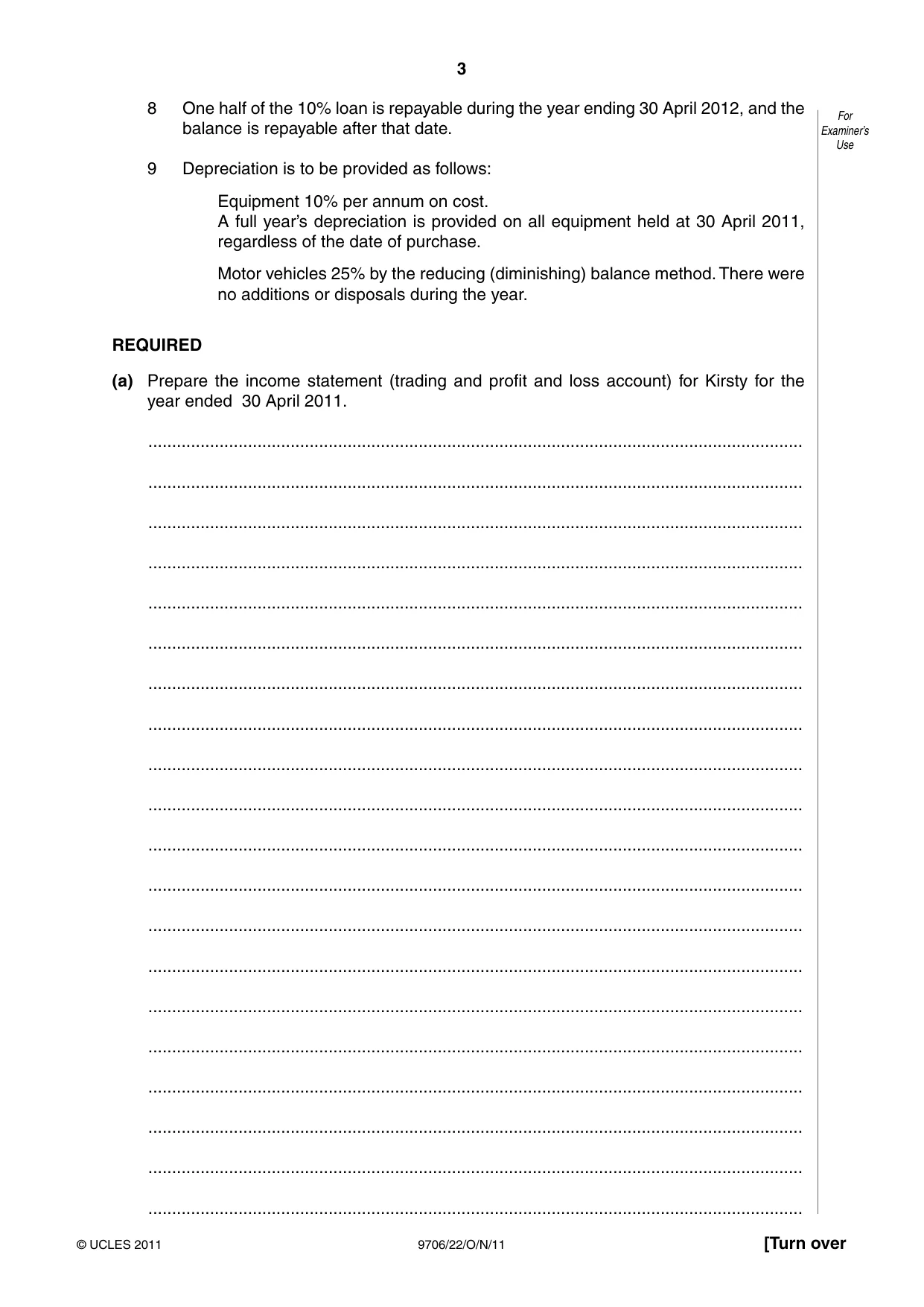
3 9706/22/O/N/11 © UCLES 2011 [Turn over For Examiner’s Use 8 One half of the 10% loan is repayable during the year ending 30 April 2012, and the balance is repayable after that date. 9 Depreciation is to be provided as follows: Equipment 10% per annum on cost. A full year’s depreciation is provided on all equipment held at 30 April 2011, regardless of the date of purchase. Motor vehicles 25% by the reducing (diminishing) balance method. There were no additions or disposals during the year. REQUIRED (a) Prepare the income statement (trading and profit and loss account) for Kirsty for the year ended 30 April 2011. … … … … … … … … … … … … … … … … … … … …
Question paper, page 4
4 9706/22/O/N/11 © UCLES 2011 For Examiner’s Use … … … … … … … … … … … … … … … … … … … … … … … … … … … …[12]
Question paper, page 5
5 9706/22/O/N/11 © UCLES 2011 [Turn over For Examiner’s Use (b) Prepare the statement of financial position (balance sheet) for Kirsty at 30 April 2011. … … … … … … … … … … … … … … … … … … … … … … … … … … …
Question paper, page 6
6 9706/22/O/N/11 © UCLES 2011 For Examiner’s Use … … … … … … … … … … … … … … … … … … … … … … … … … … …[8]
Question paper, page 7
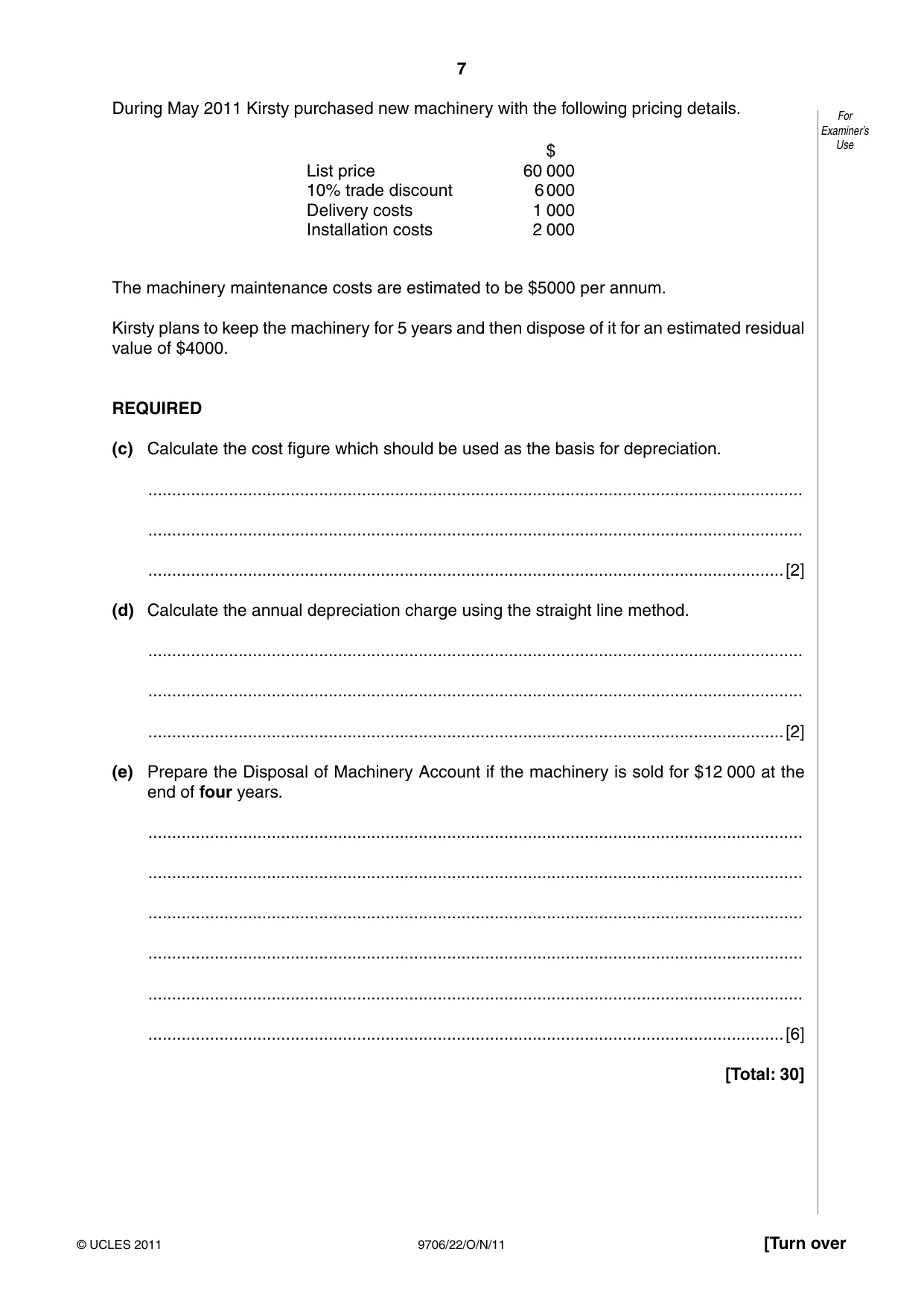
7 9706/22/O/N/11 © UCLES 2011 [Turn over For Examiner’s Use During May 2011 Kirsty purchased new machinery with the following pricing details. $ List price 60 000 10% trade discount 6 000 Delivery costs 1 000 Installation costs 2 000 The machinery maintenance costs are estimated to be $5000 per annum. Kirsty plans to keep the machinery for 5 years and then dispose of it for an estimated residual value of $4000. REQUIRED (c) Calculate the cost figure which should be used as the basis for depreciation. … … …[2] (d) Calculate the annual depreciation charge using the straight line method. … … …[2] (e) Prepare the Disposal of Machinery Account if the machinery is sold for $12 000 at the end of four years. … … … … … …[6] [Total: 30]
Question paper, page 8
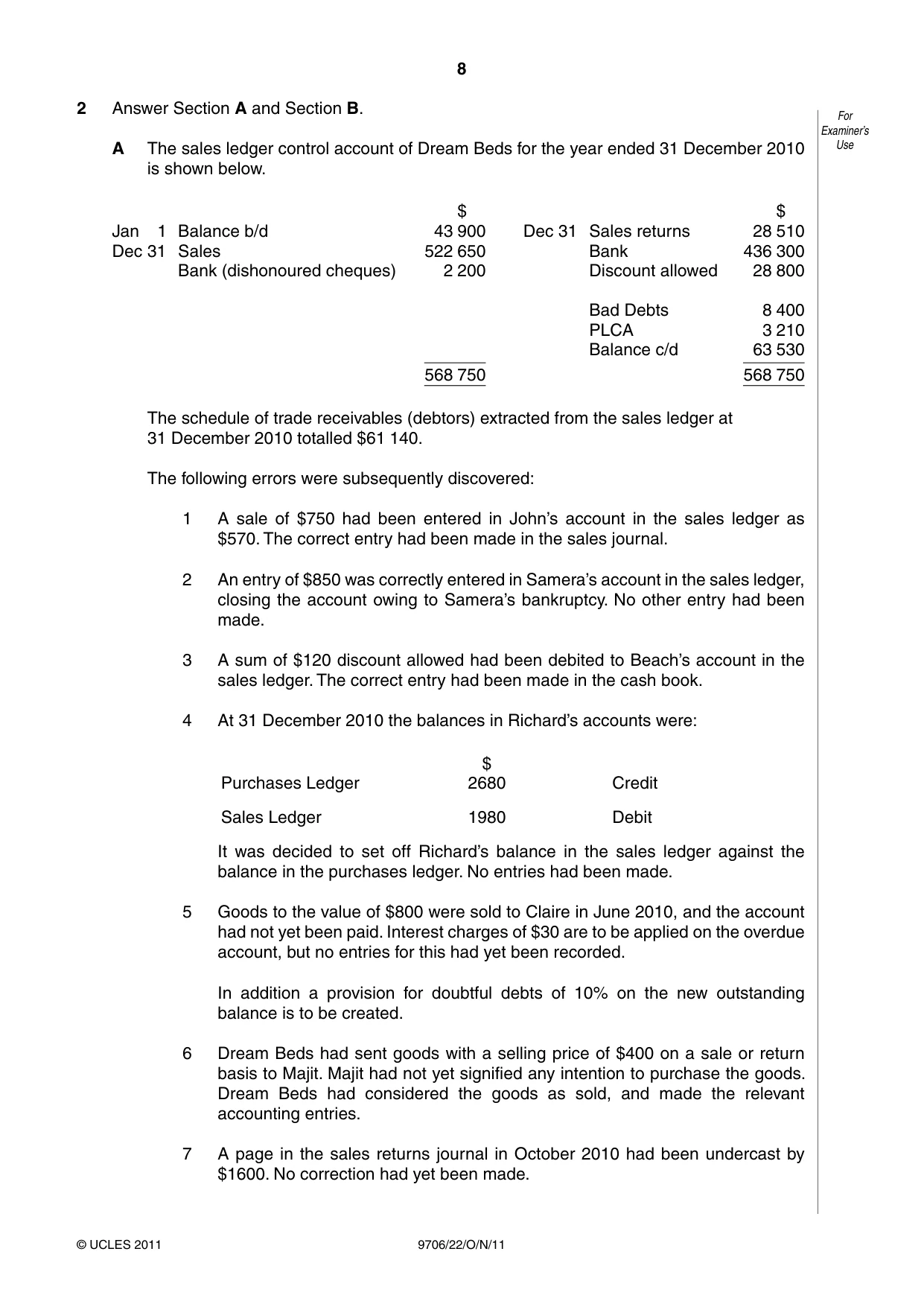
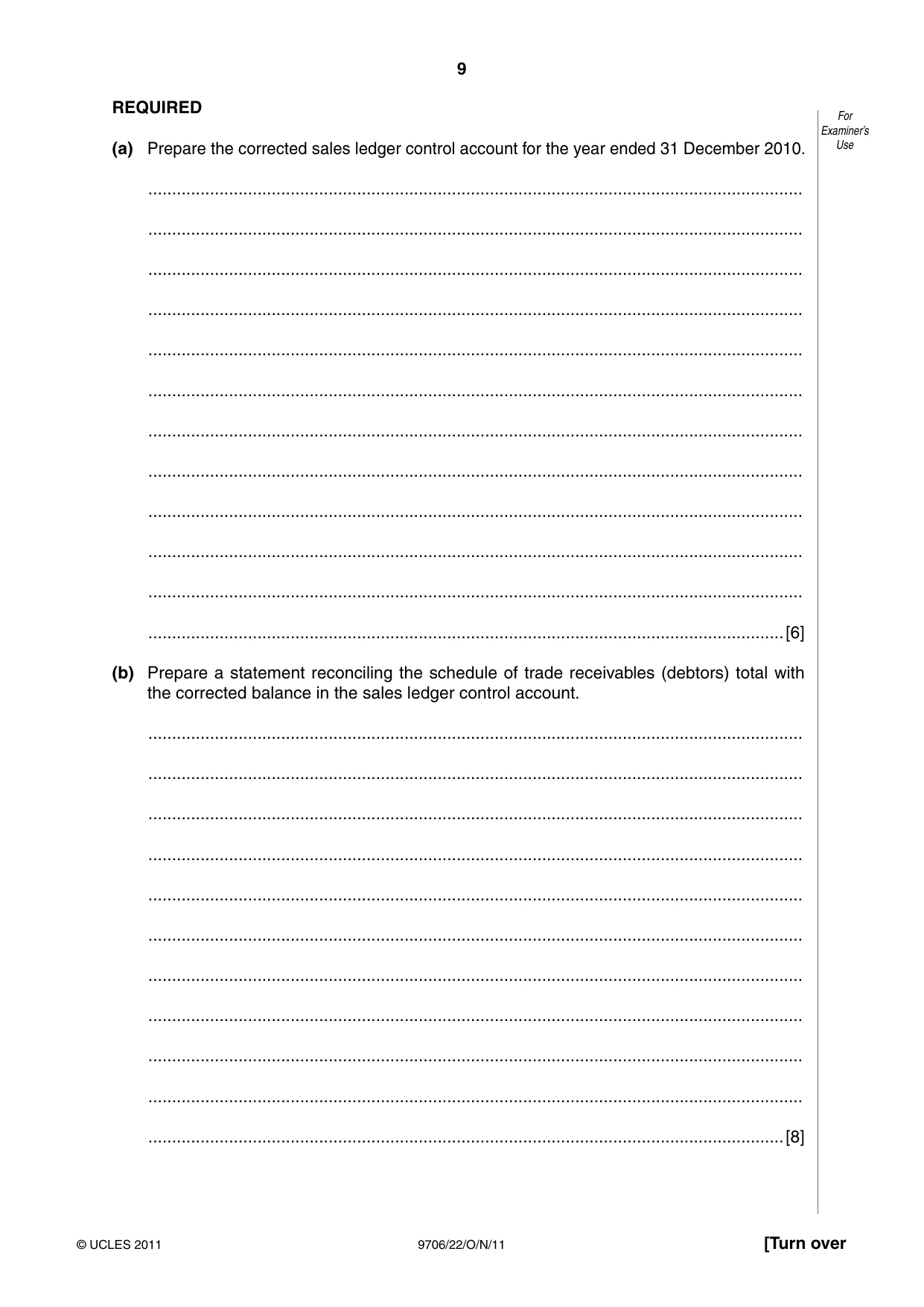
8 9706/22/O/N/11 © UCLES 2011 For Examiner’s Use 2 Answer Section A and Section B. A The sales ledger control account of Dream Beds for the year ended 31 December 2010 is shown below. $ $ Jan 1 Balance b/d 43 900 Dec 31 Sales returns 28 510 Dec 31 Sales 522 650 Bank 436 300 Bank (dishonoured cheques) 2 200 Discount allowed 28 800 Bad Debts 8 400 PLCA 3 210 Balance c/d 63 530 568 750 568 750 The schedule of trade receivables (debtors) extracted from the sales ledger at 31 December 2010 totalled $61 140. The following errors were subsequently discovered: 1 A sale of $750 had been entered in John’s account in the sales ledger as $570. The correct entry had been made in the sales journal. 2 An entry of $850 was correctly entered in Samera’s account in the sales ledger, closing the account owing to Samera’s bankruptcy. No other entry had been made. 3 A sum of $120 discount allowed had been debited to Beach’s account in the sales ledger. The correct entry had been made in the cash book. 4 At 31 December 2010 the balances in Richard’s accounts were: $ Purchases Ledger 2680 Credit Sales Ledger 1980 Debit It was decided to set off Richard’s balance in the sales ledger against the balance in the purchases ledger. No entries had been made. 5 Goods to the value of $800 were sold to Claire in June 2010, and the account had not yet been paid. Interest charges of $30 are to be applied on the overdue account, but no entries for this had yet been recorded. In addition a provision for doubtful debts of 10% on the new outstanding balance is to be created. 6 Dream Beds had sent goods with a selling price of $400 on a sale or return basis to Majit. Majit had not yet signified any intention to purchase the goods. Dream Beds had considered the goods as sold, and made the relevant accounting entries. 7 A page in the sales returns journal in October 2010 had been undercast by $1600. No correction had yet been made.
Question paper, page 9
9 9706/22/O/N/11 © UCLES 2011 [Turn over For Examiner’s Use REQUIRED (a) Prepare the corrected sales ledger control account for the year ended 31 December 2010. … … … … … … … … … … … …[6] (b) Prepare a statement reconciling the schedule of trade receivables (debtors) total with the corrected balance in the sales ledger control account. … … … … … … … … … … …[8]
Question paper, page 10
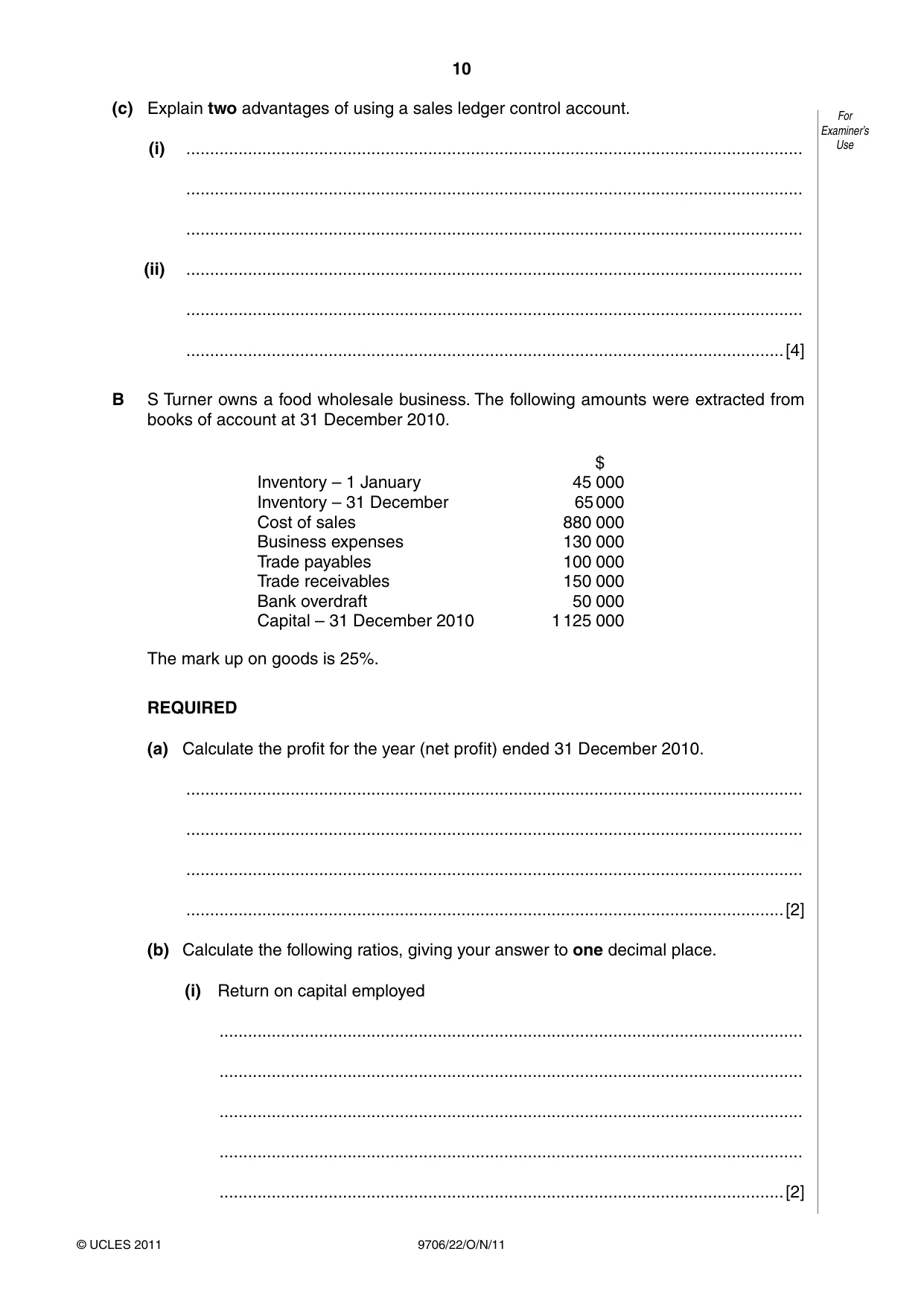
10 9706/22/O/N/11 © UCLES 2011 For Examiner’s Use (c) Explain two advantages of using a sales ledger control account. (i) … … … (ii) … … …[4] B S Turner owns a food wholesale business. The following amounts were extracted from books of account at 31 December 2010. $ Inventory – 1 January 45 000 Inventory – 31 December 65 000 Cost of sales 880 000 Business expenses 130 000 Trade payables 100 000 Trade receivables 150 000 Bank overdraft 50 000 Capital – 31 December 2010 1 125 000 The mark up on goods is 25%. REQUIRED (a) Calculate the profit for the year (net profit) ended 31 December 2010. … … … …[2] (b) Calculate the following ratios, giving your answer to one decimal place. (i) Return on capital employed … … … … …[2]
Question paper, page 11
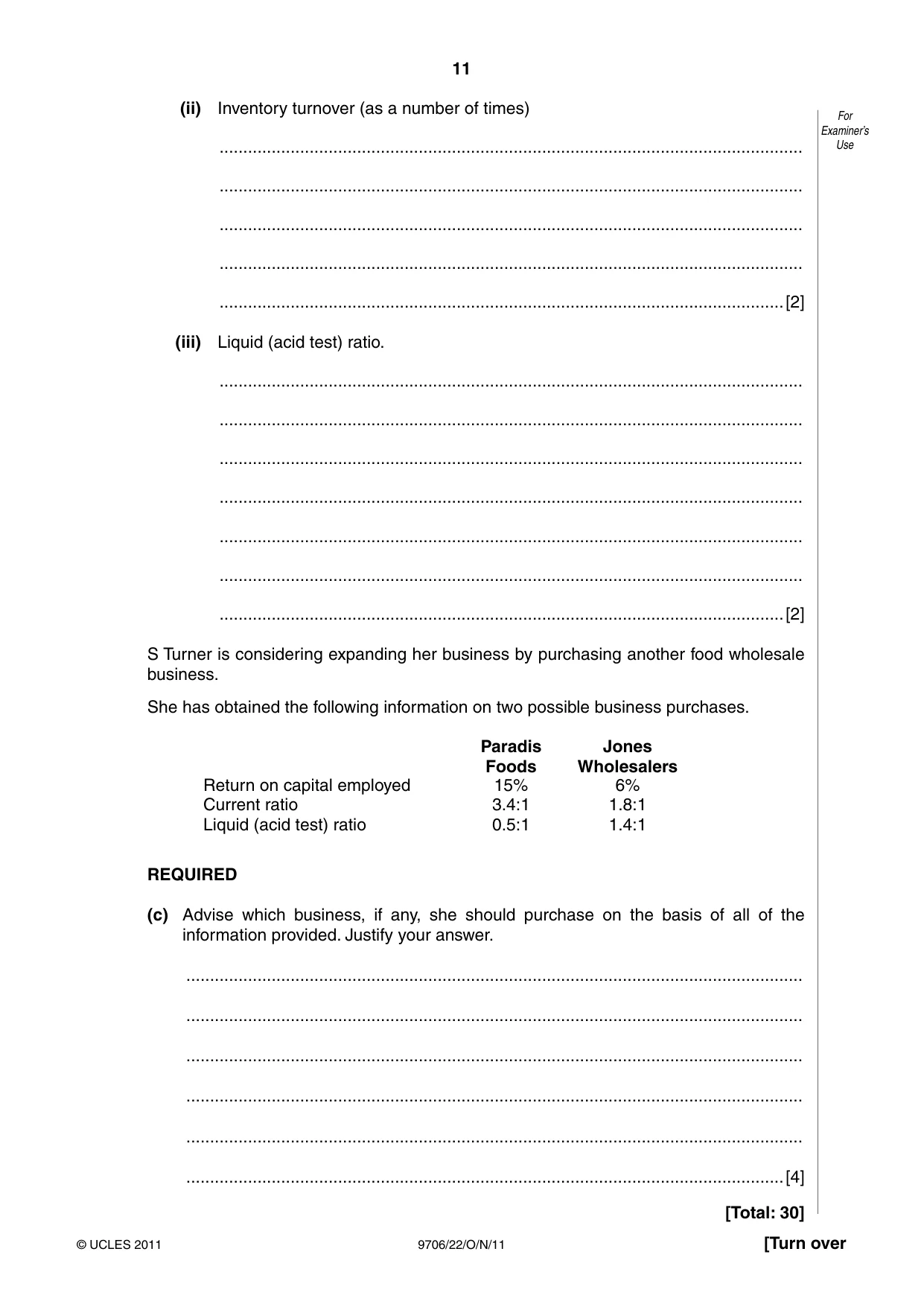
11 9706/22/O/N/11 © UCLES 2011 [Turn over For Examiner’s Use (ii) Inventory turnover (as a number of times) … … … … …[2] (iii) Liquid (acid test) ratio. … … … … … … …[2] S Turner is considering expanding her business by purchasing another food wholesale business. She has obtained the following information on two possible business purchases. Paradis Foods Jones Wholesalers Return on capital employed 15% 6% Current ratio 3.4:1 1.8:1 Liquid (acid test) ratio 0.5:1 1.4:1 REQUIRED (c) Advise which business, if any, she should purchase on the basis of all of the information provided. Justify your answer. … … … … … …[4] [Total: 30]
Question paper, page 12
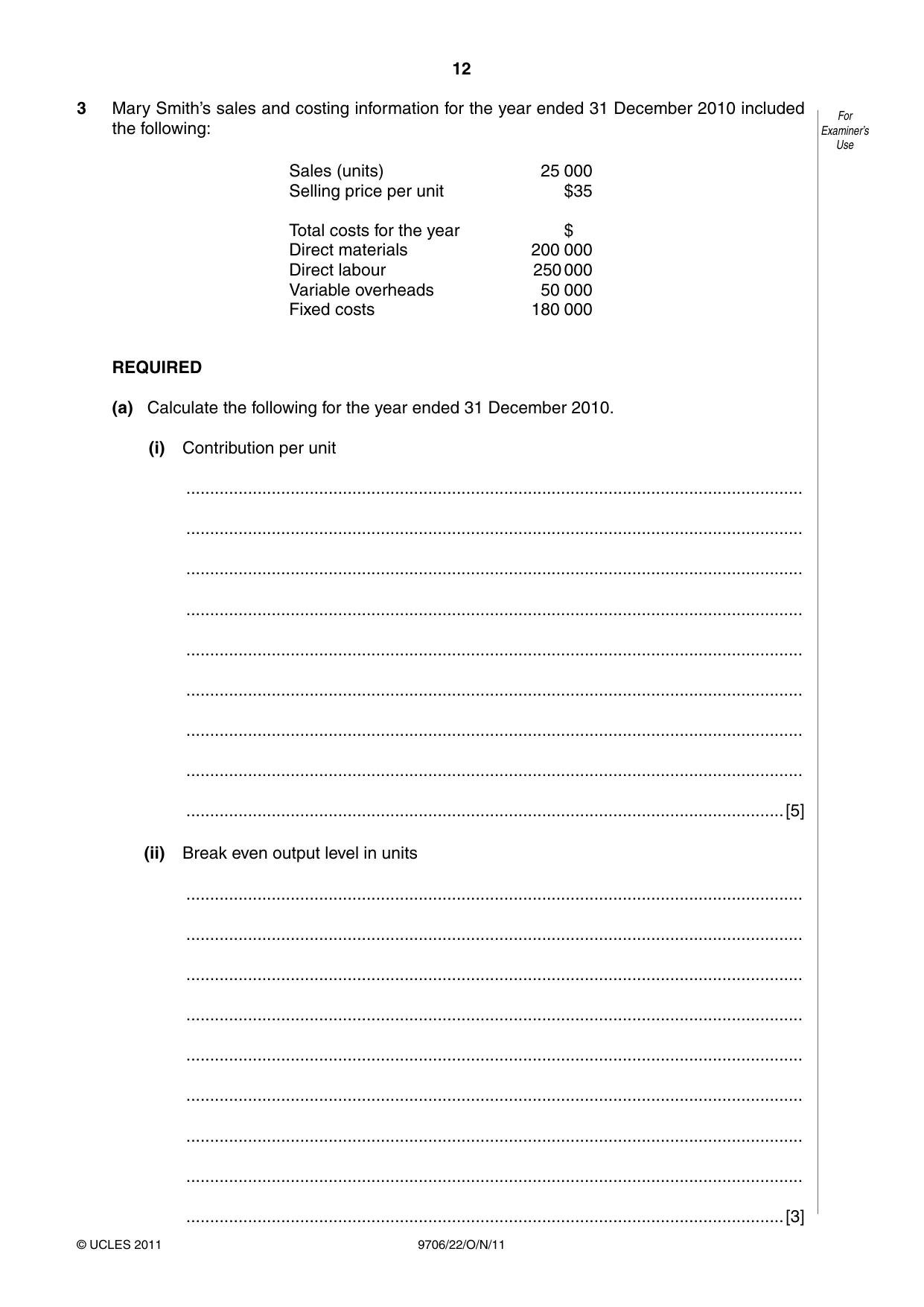
12 9706/22/O/N/11 © UCLES 2011 For Examiner’s Use 3 Mary Smith’s sales and costing information for the year ended 31 December 2010 included the following: Sales (units) 25 000 Selling price per unit $35 Total costs for the year $ Direct materials 200 000 Direct labour 250 000 Variable overheads 50 000 Fixed costs 180 000 REQUIRED (a) Calculate the following for the year ended 31 December 2010. (i) Contribution per unit … … … … … … … … …[5] (ii) Break even output level in units … … … … … … … … …[3]
Question paper, page 13
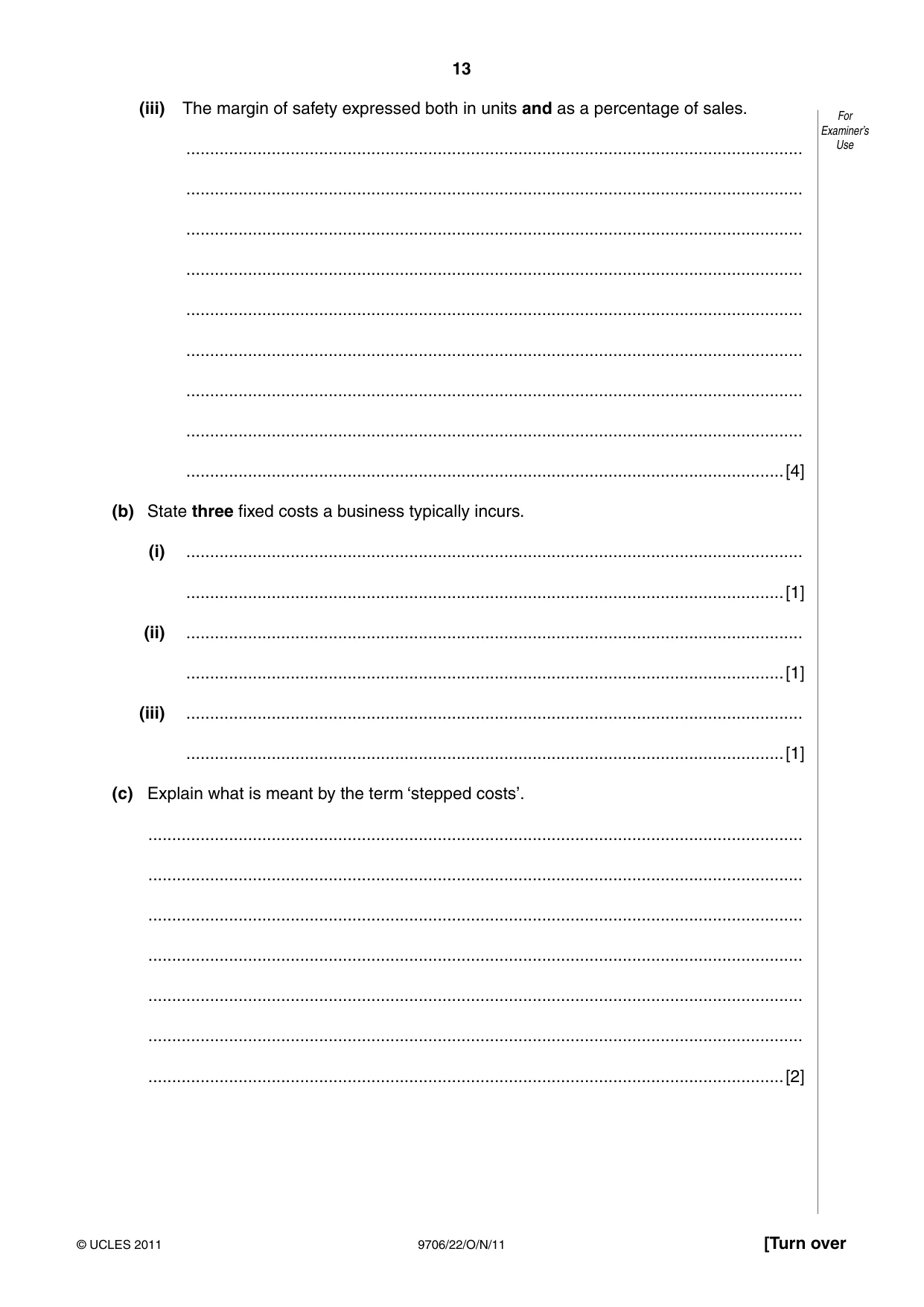
13 9706/22/O/N/11 © UCLES 2011 [Turn over For Examiner’s Use (iii) The margin of safety expressed both in units and as a percentage of sales. … … … … … … … … …[4] (b) State three fixed costs a business typically incurs. (i) … …[1] (ii) … …[1] (iii) … …[1] (c) Explain what is meant by the term ‘stepped costs’. … … … … … … …[2]
Question paper, page 14
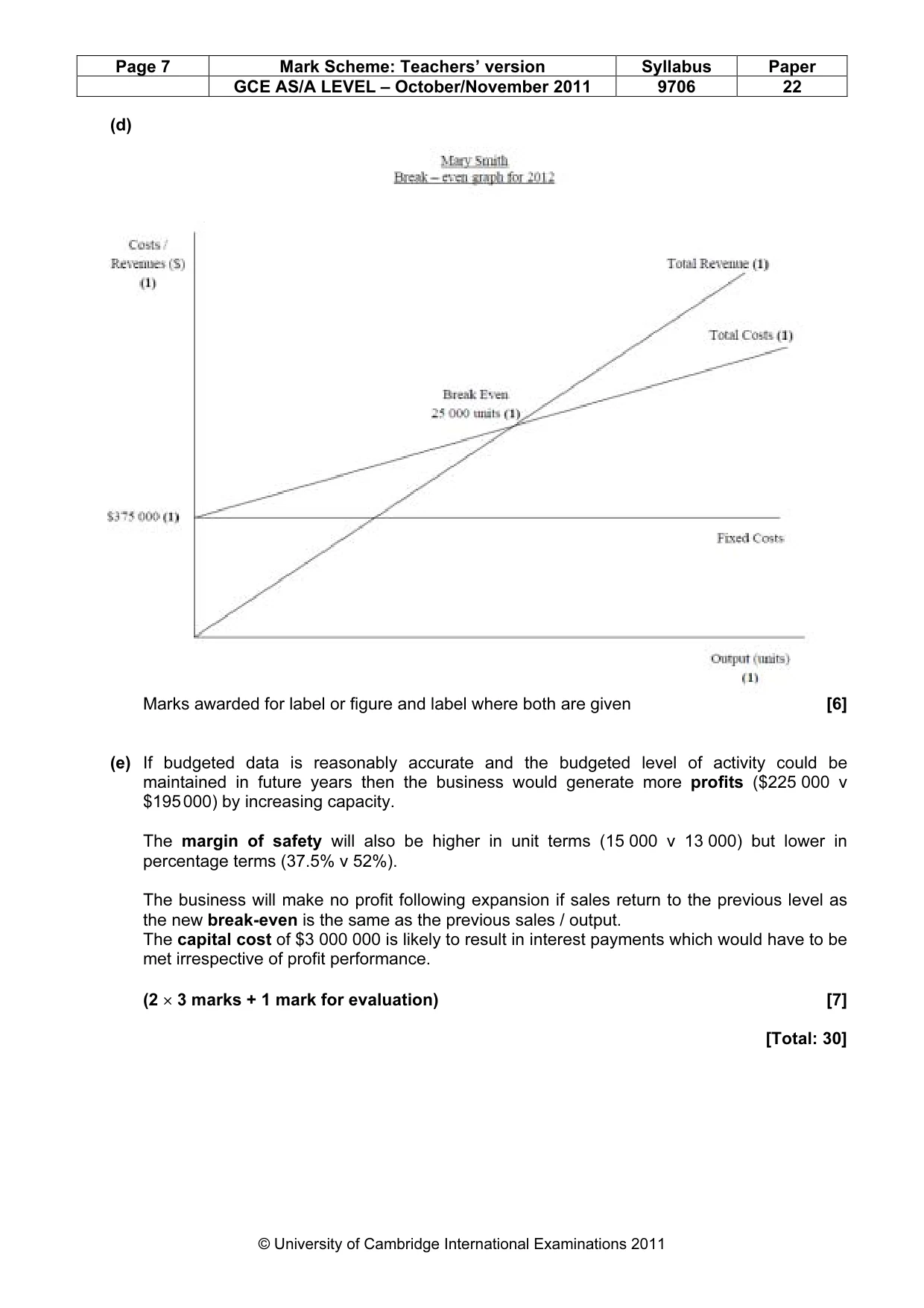
14 9706/22/O/N/11 © UCLES 2011 For Examiner’s Use During 2011 sales (in units) were expected to remain at the 2010 level of 25 000 units. Mary Smith is in the process of compiling her 2012 budget. Research has indicated a potential increase in sales (in units) of 60% compared with the 2010 level. The company is assuming that selling price and all variable costs per unit in 2012 will remain at the 2010 level. The current production level is 32 000 units per annum. To increase production further would require: capital investment of $3 000 000; an increase in fixed costs of $195 000 per annum. REQUIRED (d) Prepare and label a break-even chart for 2012, taking into account all of the potential amendments. Use the space below for your workings. … … … … … [6]
Question paper, page 15
15 9706/22/O/N/11 © UCLES 2011 For Examiner’s Use (e) Increasing production will allow the firm to potentially earn more profit. However, it could pose significant risks to the business. Evaluate the above statement using your answers to parts (a) and (d). … … … … … … … … … … … …[7] [Total: 30]
Question paper, page 16
16 9706/22/O/N/11 © UCLES 2011 Permission to reproduce items where third-party owned material protected by copyright is included has been sought and cleared where possible. Every reasonable effort has been made by the publisher (UCLES) to trace copyright holders, but if any items requiring clearance have unwittingly been included, the publisher will be pleased to make amends at the earliest possible opportunity. University of Cambridge International Examinations is part of the Cambridge Assessment Group. Cambridge Assessment is the brand name of University of Cambridge Local Examinations Syndicate (UCLES), which is itself a department of the University of Cambridge. BLANK PAGE
Mark scheme, page 1
UNIVERSITY OF CAMBRIDGE INTERNATIONAL EXAMINATIONS GCE Advanced Subsidiary Level and GCE Advanced Level MARK SCHEME for the October/November 2011 question paper for the guidance of teachers 9706 ACCOUNTING 9706/22 Paper 2 (Structured Questions – Core), maximum raw mark 90 This mark scheme is published as an aid to teachers and candidates, to indicate the requirements of the examination. It shows the basis on which Examiners were instructed to award marks. It does not indicate the details of the discussions that took place at an Examiners’ meeting before marking began, which would have considered the acceptability of alternative answers. Mark schemes must be read in conjunction with the question papers and the report on the examination. • Cambridge will not enter into discussions or correspondence in connection with these mark schemes. Cambridge is publishing the mark schemes for the October/November 2011 question papers for most IGCSE, GCE Advanced Level and Advanced Subsidiary Level syllabuses and some Ordinary Level syllabuses.
Mark scheme, page 2
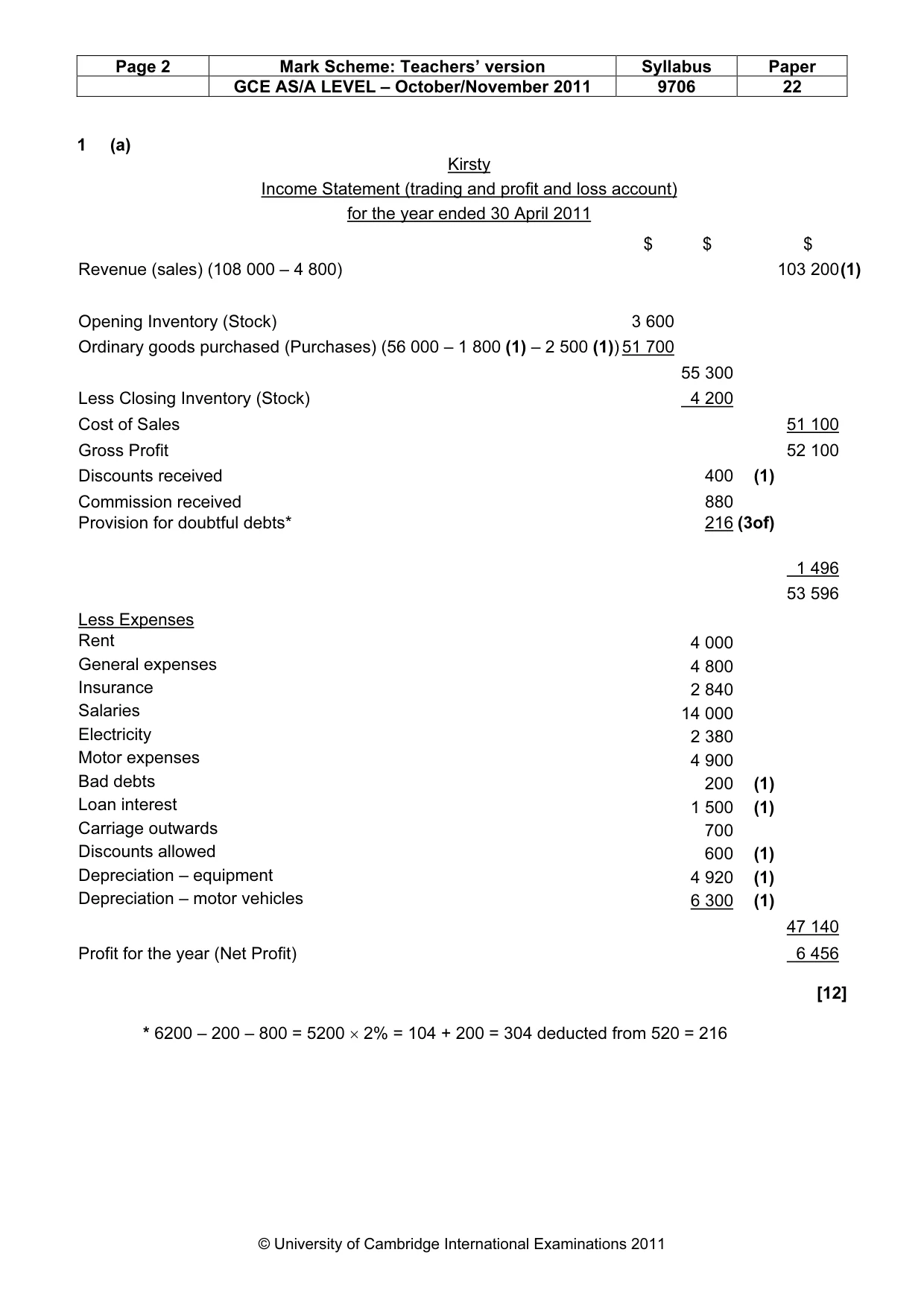
Page 2 Mark Scheme: Teachers’ version Syllabus Paper GCE AS/A LEVEL – October/November 2011 9706 22 © University of Cambridge International Examinations 2011 1 (a) [12] * 6200 – 200 – 800 = 5200 × 2% = 104 + 200 = 304 deducted from 520 = 216 Kirsty Income Statement (trading and profit and loss account) for the year ended 30 April 2011 $ $ $ Revenue (sales) (108 000 – 4 800) 103 200 (1) Opening Inventory (Stock) 3 600 Ordinary goods purchased (Purchases) (56 000 – 1 800 (1) – 2 500 (1)) 51 700 55 300 Less Closing Inventory (Stock) 4 200 Cost of Sales 51 100 Gross Profit 52 100 Discounts received 400 (1) Commission received 880 Provision for doubtful debts* 216 (3of) 1 496 53 596 Less Expenses Rent 4 000 General expenses 4 800 Insurance 2 840 Salaries 14 000 Electricity 2 380 Motor expenses 4 900 Bad debts 200 (1) Loan interest 1 500 (1) Carriage outwards 700 Discounts allowed 600 (1) Depreciation – equipment 4 920 (1) Depreciation – motor vehicles 6 300 (1) 47 140 Profit for the year (Net Profit) 6 456
Mark scheme, page 3
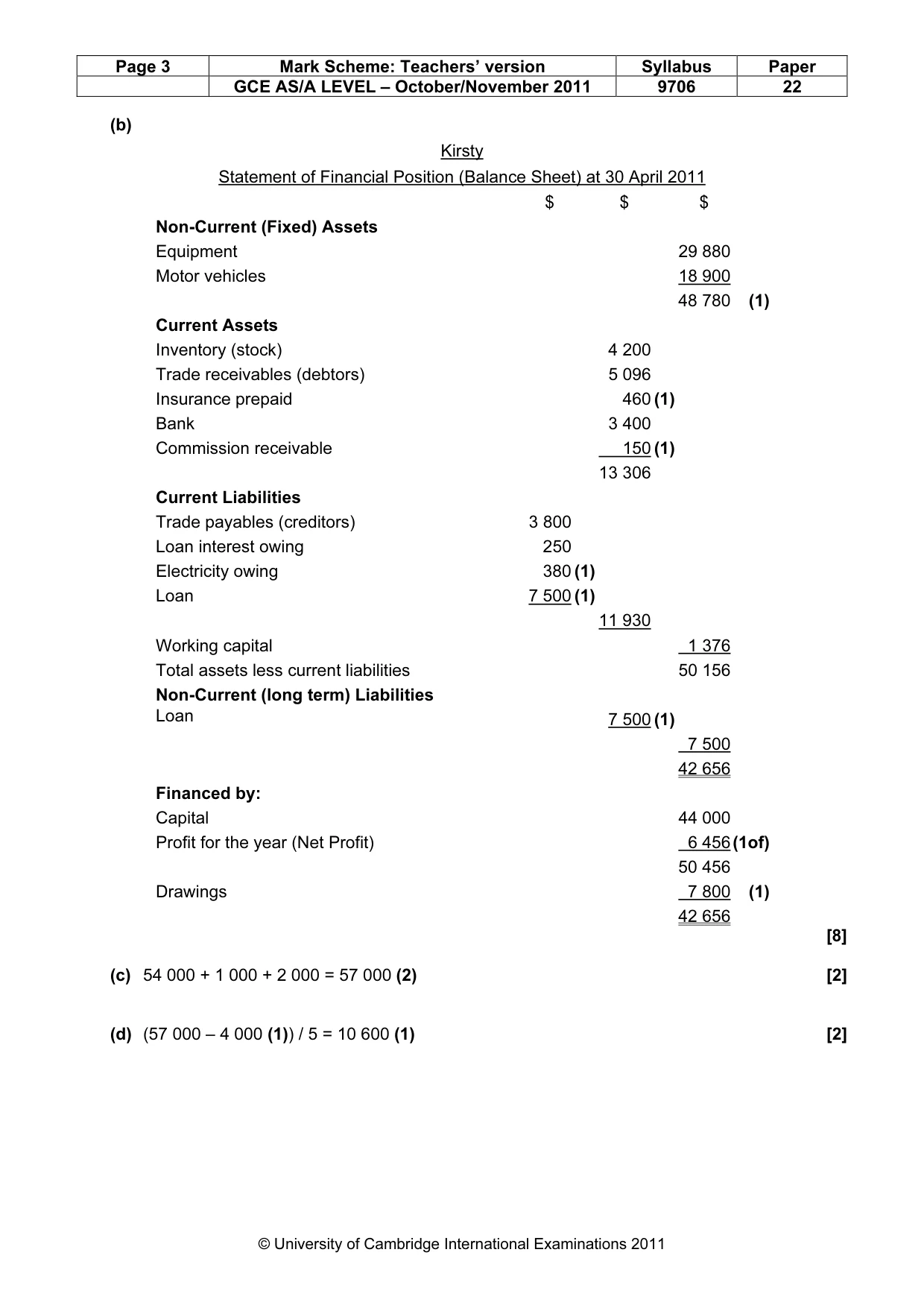
Page 3 Mark Scheme: Teachers’ version Syllabus Paper GCE AS/A LEVEL – October/November 2011 9706 22 © University of Cambridge International Examinations 2011 (b) Kirsty Statement of Financial Position (Balance Sheet) at 30 April 2011 $ $ $ Non-Current (Fixed) Assets Equipment 29 880 Motor vehicles 18 900 48 780 (1) Current Assets Inventory (stock) 4 200 Trade receivables (debtors) 5 096 Insurance prepaid 460 (1) Bank 3 400 Commission receivable 150 (1) 13 306 Current Liabilities Trade payables (creditors) 3 800 Loan interest owing 250 Electricity owing 380 (1) Loan 7 500 (1) 11 930 Working capital 1 376 Total assets less current liabilities 50 156 Non-Current (long term) Liabilities Loan 7 500 (1) 7 500 42 656 Financed by: Capital 44 000 Profit for the year (Net Profit) 6 456 (1of) 50 456 Drawings 7 800 (1) 42 656 [8] (c) 54 000 + 1 000 + 2 000 = 57 000 (2) [2] (d) (57 000 – 4 000 (1)) / 5 = 10 600 (1) [2]
Mark scheme, page 4
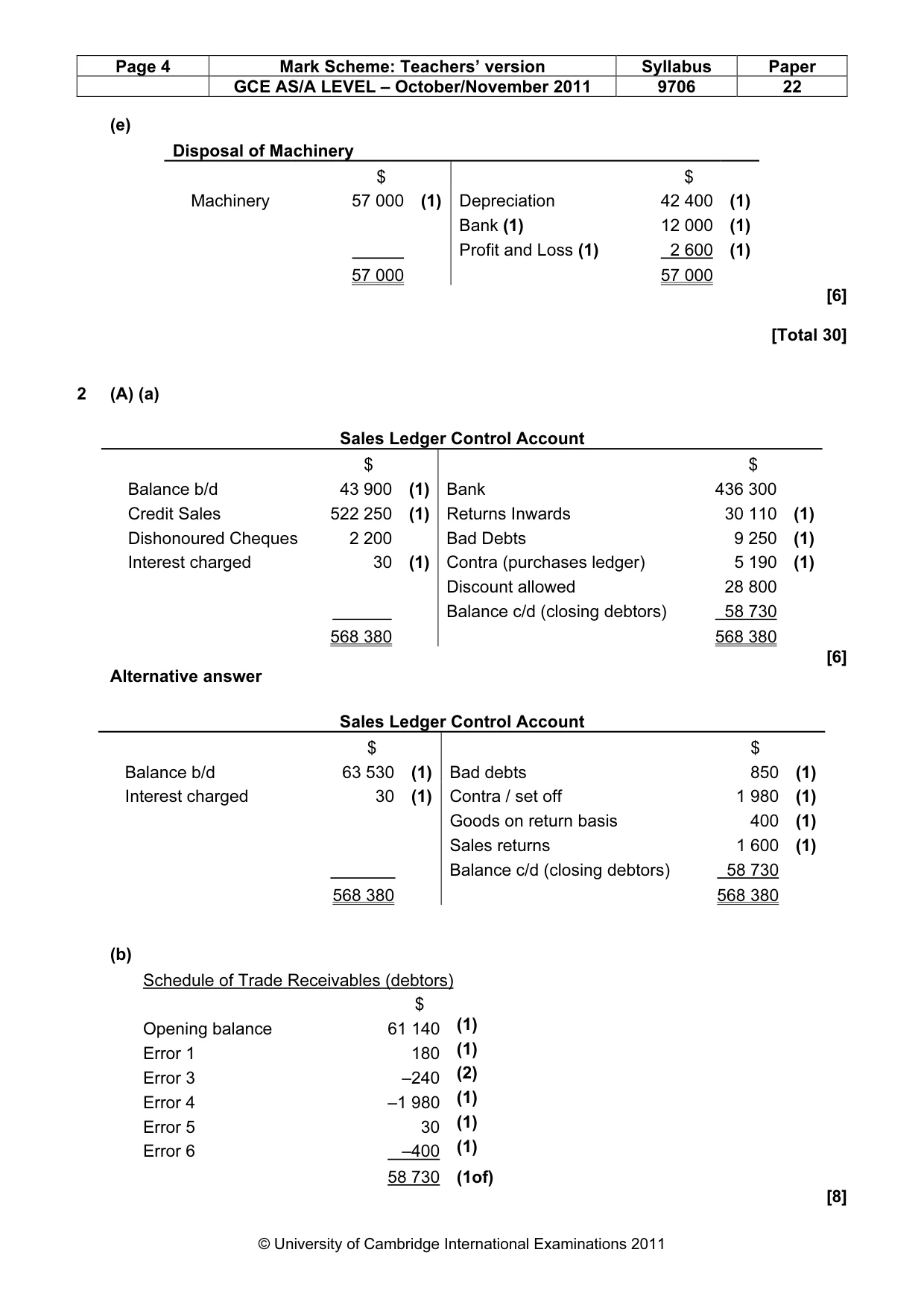
Page 4 Mark Scheme: Teachers’ version Syllabus Paper GCE AS/A LEVEL – October/November 2011 9706 22 © University of Cambridge International Examinations 2011 (e) Disposal of Machinery $ $ Machinery 57 000 (1) Depreciation 42 400 (1) Bank (1) 12 000 (1) Profit and Loss (1) 2 600 (1) 57 000 57 000 [6] [Total 30] 2 (A) (a) Sales Ledger Control Account $ $ Balance b/d 43 900 (1) Bank 436 300 Credit Sales 522 250 (1) Returns Inwards 30 110 (1) Dishonoured Cheques 2 200 Bad Debts 9 250 (1) Interest charged 30 (1) Contra (purchases ledger) 5 190 (1) Discount allowed 28 800 Balance c/d (closing debtors) 58 730 568 380 568 380 [6] Alternative answer Sales Ledger Control Account $ $ Balance b/d 63 530 (1) Bad debts 850 (1) Interest charged 30 (1) Contra / set off 1 980 (1) Goods on return basis 400 (1) Sales returns 1 600 (1) Balance c/d (closing debtors) 58 730 568 380 568 380 (b) Schedule of Trade Receivables (debtors) $ Opening balance 61 140 (1) Error 1 180 (1) Error 3 –240 (2) Error 4 –1 980 (1) Error 5 30 (1) Error 6 –400 (1) 58 730 (1of) [8]
Mark scheme, page 5
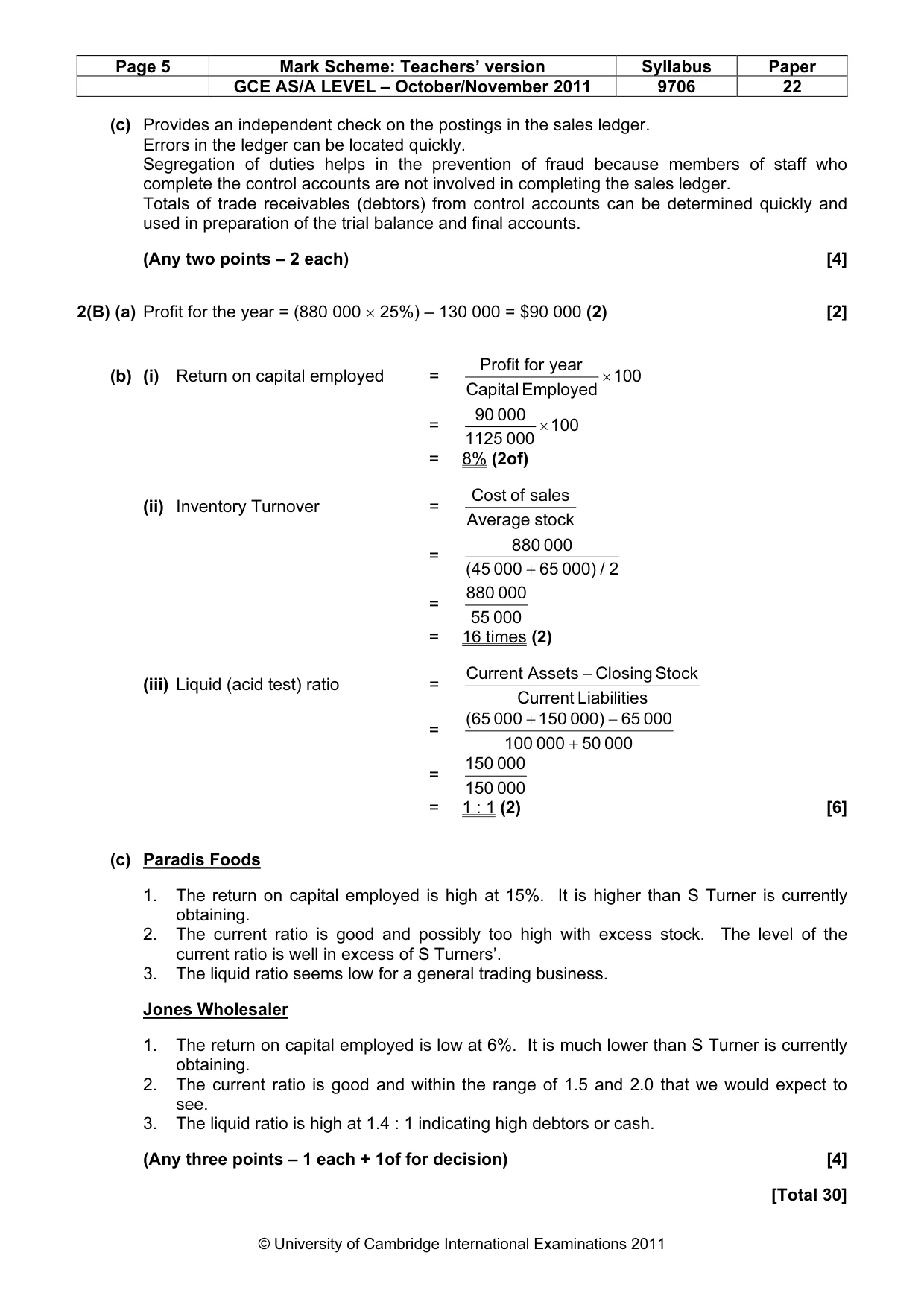
Page 5 Mark Scheme: Teachers’ version Syllabus Paper GCE AS/A LEVEL – October/November 2011 9706 22 © University of Cambridge International Examinations 2011 (c) Provides an independent check on the postings in the sales ledger. Errors in the ledger can be located quickly. Segregation of duties helps in the prevention of fraud because members of staff who complete the control accounts are not involved in completing the sales ledger. Totals of trade receivables (debtors) from control accounts can be determined quickly and used in preparation of the trial balance and final accounts. (Any two points – 2 each) [4] 2(B) (a) Profit for the year = (880 000 × 25%) – 130 000 = $90 000 (2) [2] (b) (i) Return on capital employed = 100 Employed Capital year for Profit × = 100 000 125 1 000 90 × = 8% (2of) (ii) Inventory Turnover = stock Average sales of Cost = 2 / 000) 65 000 (45 000 880 + = 000 55 000 880 = 16 times (2) (iii) Liquid (acid test) ratio = s Liabilitie Current Stock Closing Assets Current − = 000 50 000 100 000 65 000) 150 000 (65 + − + = 000 150 000 150 = 1 : 1 (2) [6] (c) Paradis Foods 1. The return on capital employed is high at 15%. It is higher than S Turner is currently obtaining. 2. The current ratio is good and possibly too high with excess stock. The level of the current ratio is well in excess of S Turners’. 3. The liquid ratio seems low for a general trading business. Jones Wholesaler 1. The return on capital employed is low at 6%. It is much lower than S Turner is currently obtaining. 2. The current ratio is good and within the range of 1.5 and 2.0 that we would expect to see. 3. The liquid ratio is high at 1.4 : 1 indicating high debtors or cash. (Any three points – 1 each + 1of for decision) [4] [Total 30]
Mark scheme, page 6
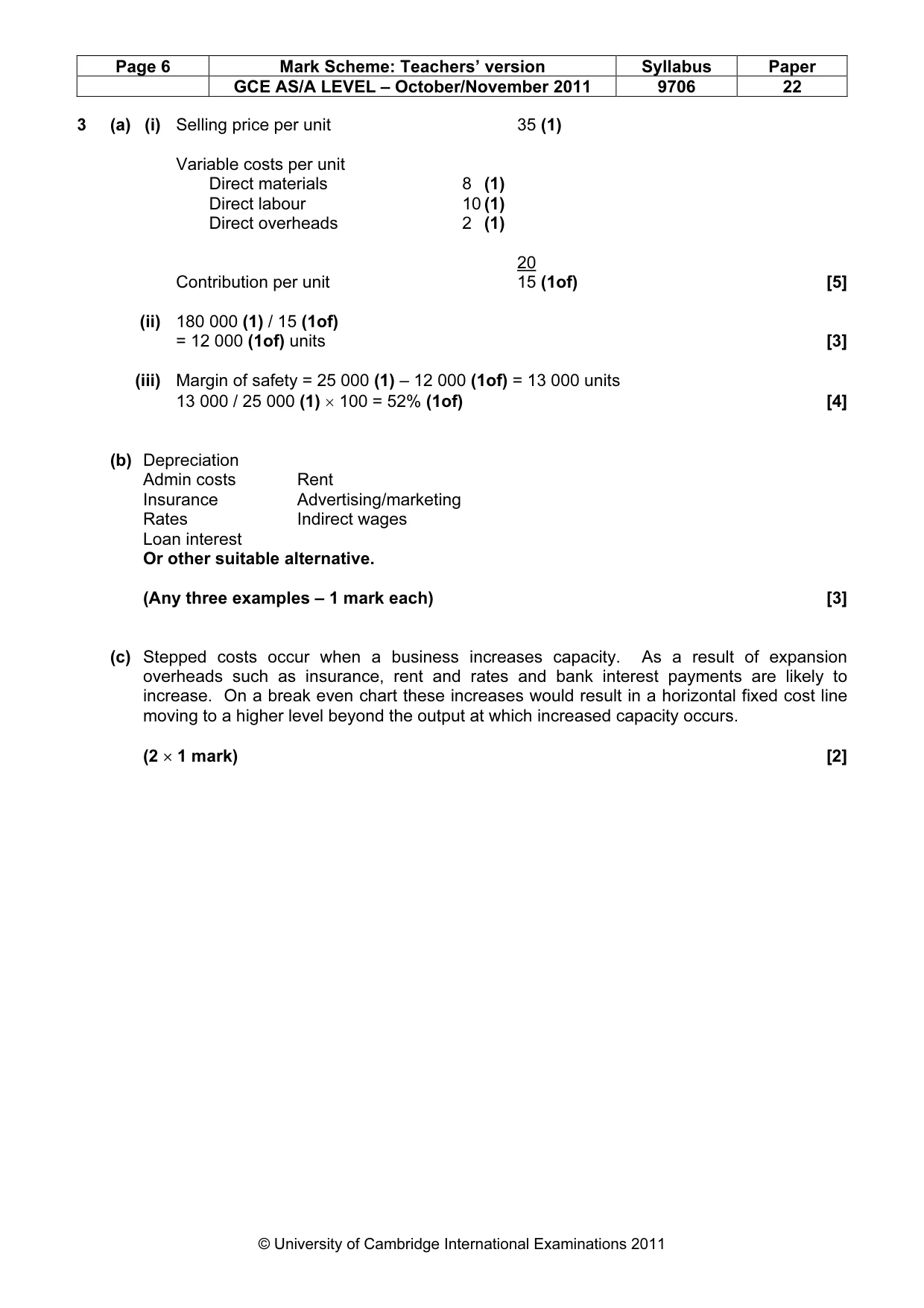
Page 6 Mark Scheme: Teachers’ version Syllabus Paper GCE AS/A LEVEL – October/November 2011 9706 22 © University of Cambridge International Examinations 2011 3 (a) (i) Selling price per unit 35 (1) Variable costs per unit Direct materials 8 (1) Direct labour 10 (1) Direct overheads 2 (1) 20 Contribution per unit 15 (1of) [5] (ii) 180 000 (1) / 15 (1of) = 12 000 (1of) units [3] (iii) Margin of safety = 25 000 (1) – 12 000 (1of) = 13 000 units 13 000 / 25 000 (1) × 100 = 52% (1of) [4] (b) Depreciation Admin costs Rent Insurance Advertising/marketing Rates Indirect wages Loan interest Or other suitable alternative. (Any three examples – 1 mark each) [3] (c) Stepped costs occur when a business increases capacity. As a result of expansion overheads such as insurance, rent and rates and bank interest payments are likely to increase. On a break even chart these increases would result in a horizontal fixed cost line moving to a higher level beyond the output at which increased capacity occurs. (2 × 1 mark) [2]
Mark scheme, page 7
Page 7 Mark Scheme: Teachers’ version Syllabus Paper GCE AS/A LEVEL – October/November 2011 9706 22 © University of Cambridge International Examinations 2011 (d) Marks awarded for label or figure and label where both are given [6] (e) If budgeted data is reasonably accurate and the budgeted level of activity could be maintained in future years then the business would generate more profits ($225 000 v $195 000) by increasing capacity. The margin of safety will also be higher in unit terms (15 000 v 13 000) but lower in percentage terms (37.5% v 52%). The business will make no profit following expansion if sales return to the previous level as the new break-even is the same as the previous sales / output. The capital cost of $3 000 000 is likely to result in interest payments which would have to be met irrespective of profit performance. (2 × 3 marks + 1 mark for evaluation) [7] [Total: 30]
What you needed in this session
Cambridge’s own grade thresholds for 2011 Oct/Nov, Paper 2 · Variant 2. A higher threshold means an easier paper — the bar moves with how the cohort did.