Cambridge A Level Accounting 9706 — 2011 Oct/Nov Paper 2 · Variant 1
9706/21/O/N/11 · 90 marks · ≈101 min
The question paper and its mark scheme, free to read here and free to download. This is Cambridge’s own paper, exactly as it was sat.
Question paper12 pages
Mark scheme5 pages
Answers below. Sit the paper first if you are practising.
Paper as text
Question paper, page 1
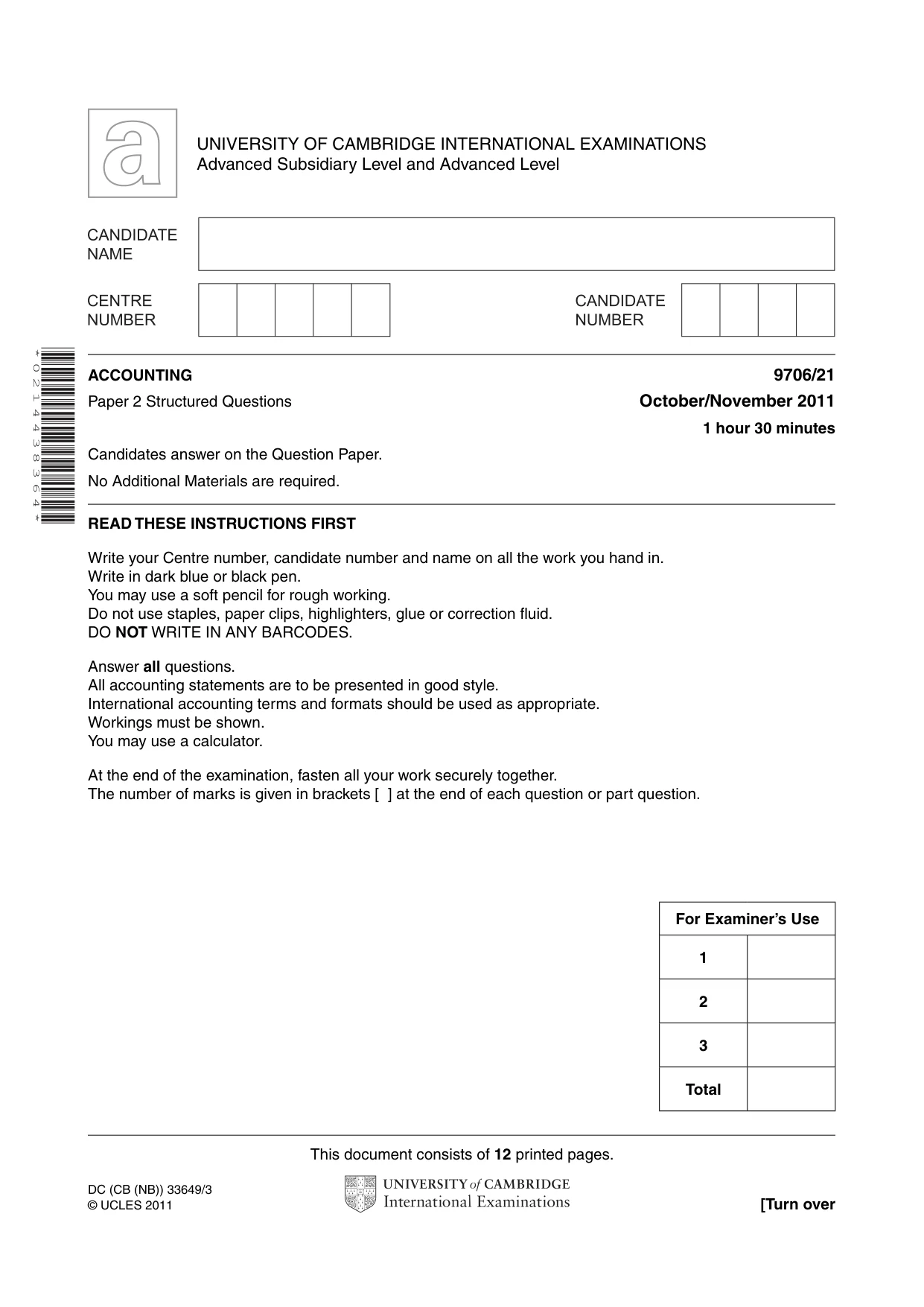
This document consists of 12 printed pages. DC (CB (NB)) 33649/3 © UCLES 2011 [Turn over UNIVERSITY OF CAMBRIDGE INTERNATIONAL EXAMINATIONS Advanced Subsidiary Level and Advanced Level * 0 2 1 4 4 3 8 3 6 4 * ACCOUNTING 9706/21 Paper 2 Structured Questions October/November 2011 1 hour 30 minutes Candidates answer on the Question Paper. No Additional Materials are required. READ THESE INSTRUCTIONS FIRST Write your Centre number, candidate number and name on all the work you hand in. Write in dark blue or black pen. You may use a soft pencil for rough working. Do not use staples, paper clips, highlighters, glue or correction fluid. DO NOT WRITE IN ANY BARCODES. Answer all questions. All accounting statements are to be presented in good style. International accounting terms and formats should be used as appropriate. Workings must be shown. You may use a calculator. At the end of the examination, fasten all your work securely together. The number of marks is given in brackets [ ] at the end of each question or part question. For Examiner’s Use 1 2 3 Total
Question paper, page 2
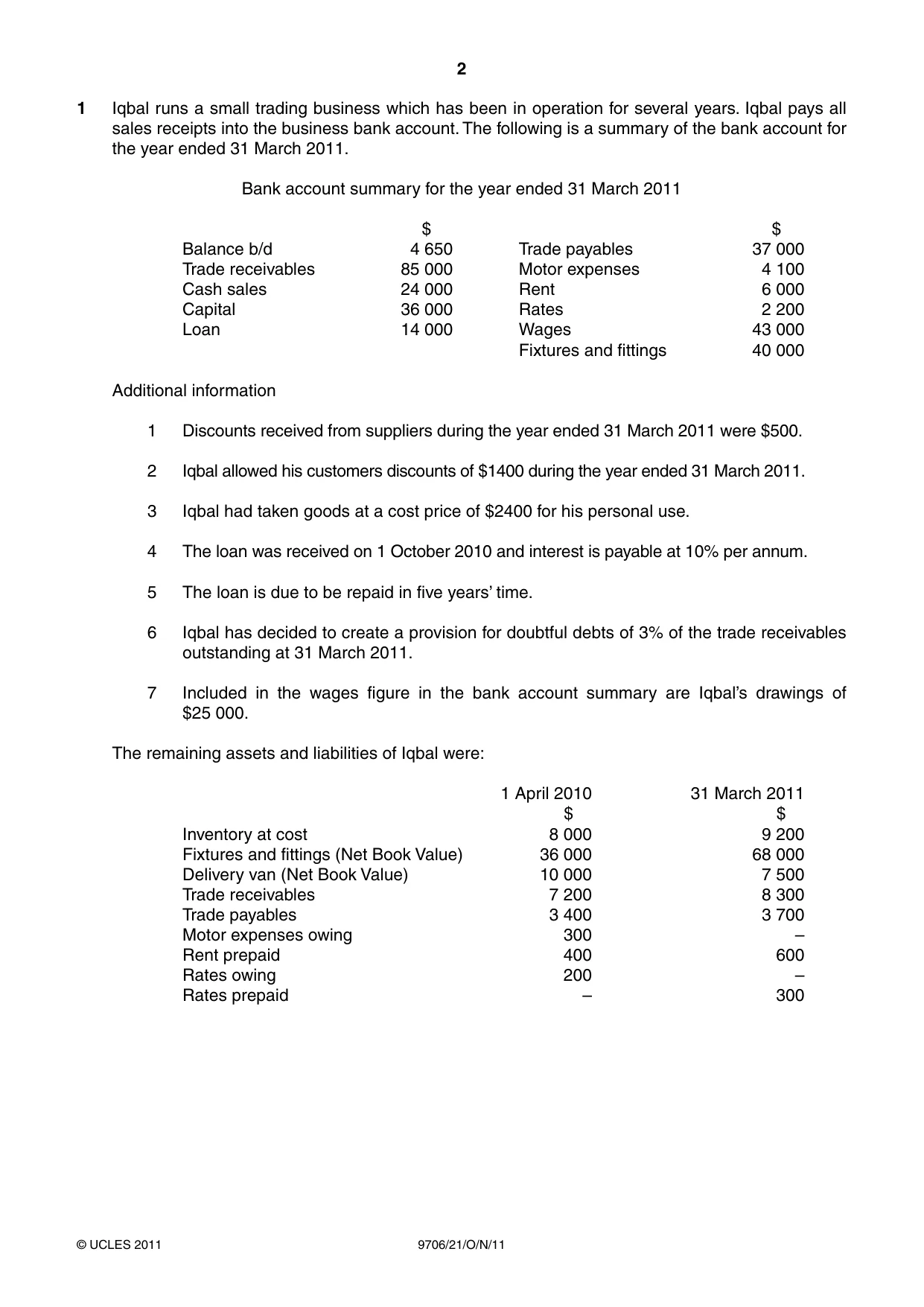
2 9706/21/O/N/11 © UCLES 2011 1 Iqbal runs a small trading business which has been in operation for several years. Iqbal pays all sales receipts into the business bank account. The following is a summary of the bank account for the year ended 31 March 2011. Bank account summary for the year ended 31 March 2011 $ $ Balance b/d 4 650 Trade payables 37 000 Trade receivables 85 000 Motor expenses 4 100 Cash sales 24 000 Rent 6 000 Capital 36 000 Rates 2 200 Loan 14 000 Wages 43 000 Fixtures and fittings 40 000 Additional information 1 Discounts received from suppliers during the year ended 31 March 2011 were $500. 2 Iqbal allowed his customers discounts of $1400 during the year ended 31 March 2011. 3 Iqbal had taken goods at a cost price of $2400 for his personal use. 4 The loan was received on 1 October 2010 and interest is payable at 10% per annum. 5 The loan is due to be repaid in five years’ time. 6 Iqbal has decided to create a provision for doubtful debts of 3% of the trade receivables outstanding at 31 March 2011. 7 Included in the wages figure in the bank account summary are Iqbal’s drawings of $25 000. The remaining assets and liabilities of Iqbal were: 1 April 2010 31 March 2011 $ $ Inventory at cost 8 000 9 200 Fixtures and fittings (Net Book Value) 36 000 68 000 Delivery van (Net Book Value) 10 000 7 500 Trade receivables 7 200 8 300 Trade payables 3 400 3 700 Motor expenses owing 300 – Rent prepaid 400 600 Rates owing 200 – Rates prepaid – 300
Question paper, page 3
3 9706/21/O/N/11 © UCLES 2011 [Turn over For Examiner’s Use REQUIRED (a) Prepare the income statement (trading and profit and loss account) for Iqbal for the year ended 31 March 2011. … … … … … … … … … … … … … … … … … … … … … … … … … …
Question paper, page 4
4 9706/21/O/N/11 © UCLES 2011 For Examiner’s Use … … … … … … … … … … … … … … … … … … … … … … … … … … … … [18]
Question paper, page 5
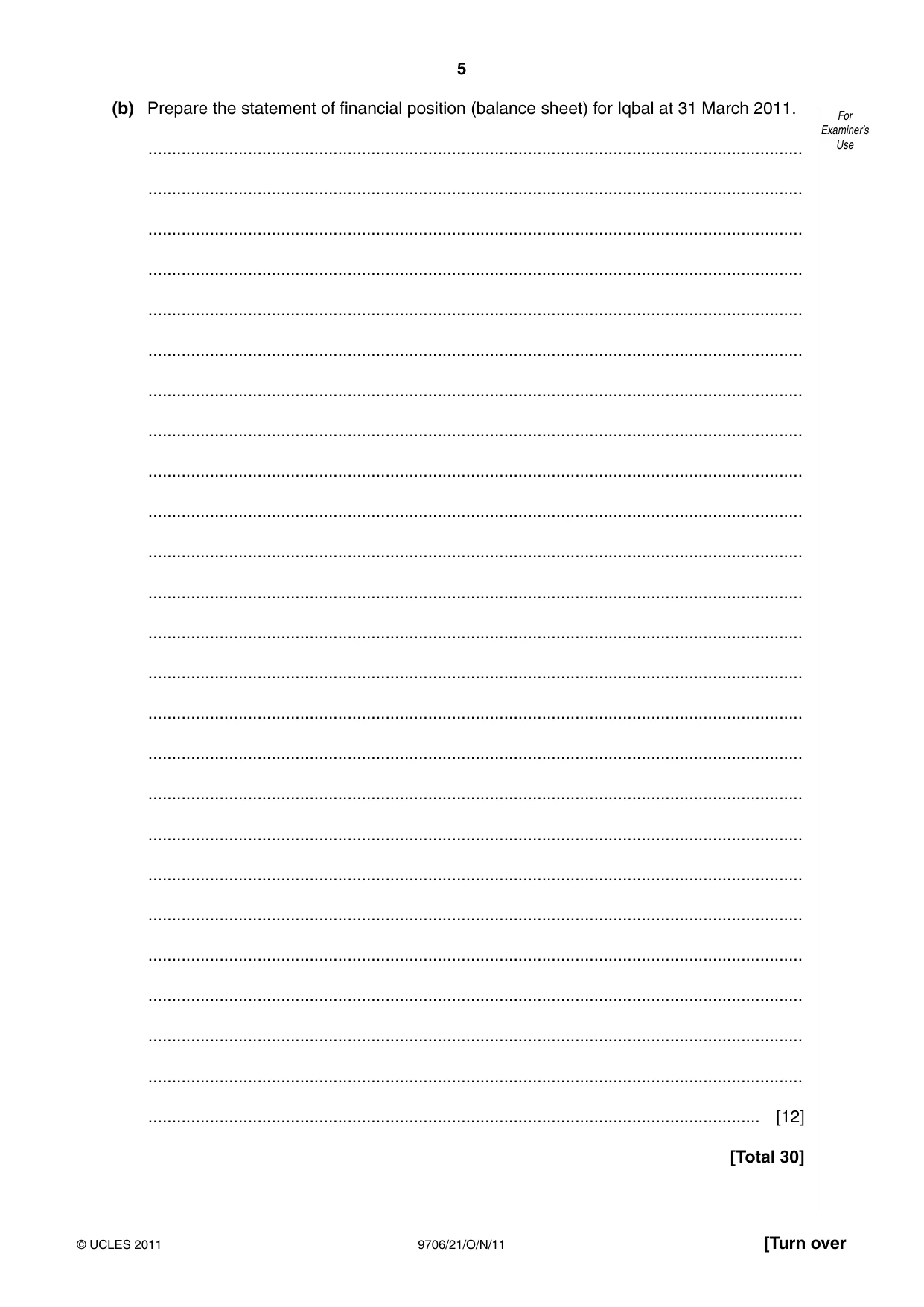
5 9706/21/O/N/11 © UCLES 2011 [Turn over For Examiner’s Use (b) Prepare the statement of financial position (balance sheet) for Iqbal at 31 March 2011. … … … … … … … … … … … … … … … … … … … … … … … … … [12] [Total 30]
Question paper, page 6
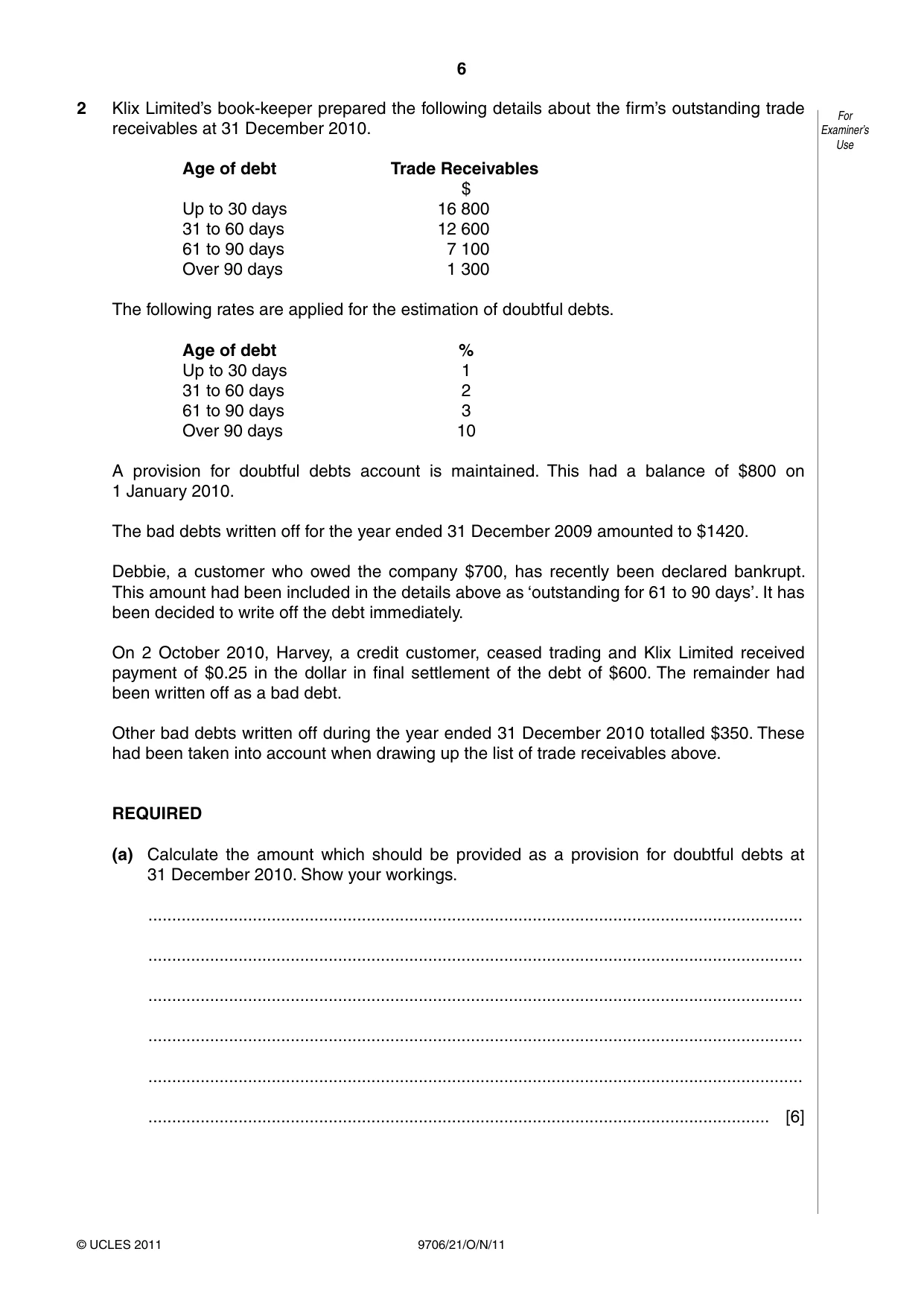
6 9706/21/O/N/11 © UCLES 2011 For Examiner’s Use 2 Klix Limited’s book-keeper prepared the following details about the firm’s outstanding trade receivables at 31 December 2010. Age of debt Trade Receivables $ Up to 30 days 16 800 31 to 60 days 12 600 61 to 90 days 7 100 Over 90 days 1 300 The following rates are applied for the estimation of doubtful debts. Age of debt % Up to 30 days 1 31 to 60 days 2 61 to 90 days 3 Over 90 days 10 A provision for doubtful debts account is maintained. This had a balance of $800 on 1 January 2010. The bad debts written off for the year ended 31 December 2009 amounted to $1420. Debbie, a customer who owed the company $700, has recently been declared bankrupt. This amount had been included in the details above as ‘outstanding for 61 to 90 days’. It has been decided to write off the debt immediately. On 2 October 2010, Harvey, a credit customer, ceased trading and Klix Limited received payment of $0.25 in the dollar in final settlement of the debt of $600. The remainder had been written off as a bad debt. Other bad debts written off during the year ended 31 December 2010 totalled $350. These had been taken into account when drawing up the list of trade receivables above. REQUIRED (a) Calculate the amount which should be provided as a provision for doubtful debts at 31 December 2010. Show your workings. … … … … … … [6]
Question paper, page 7
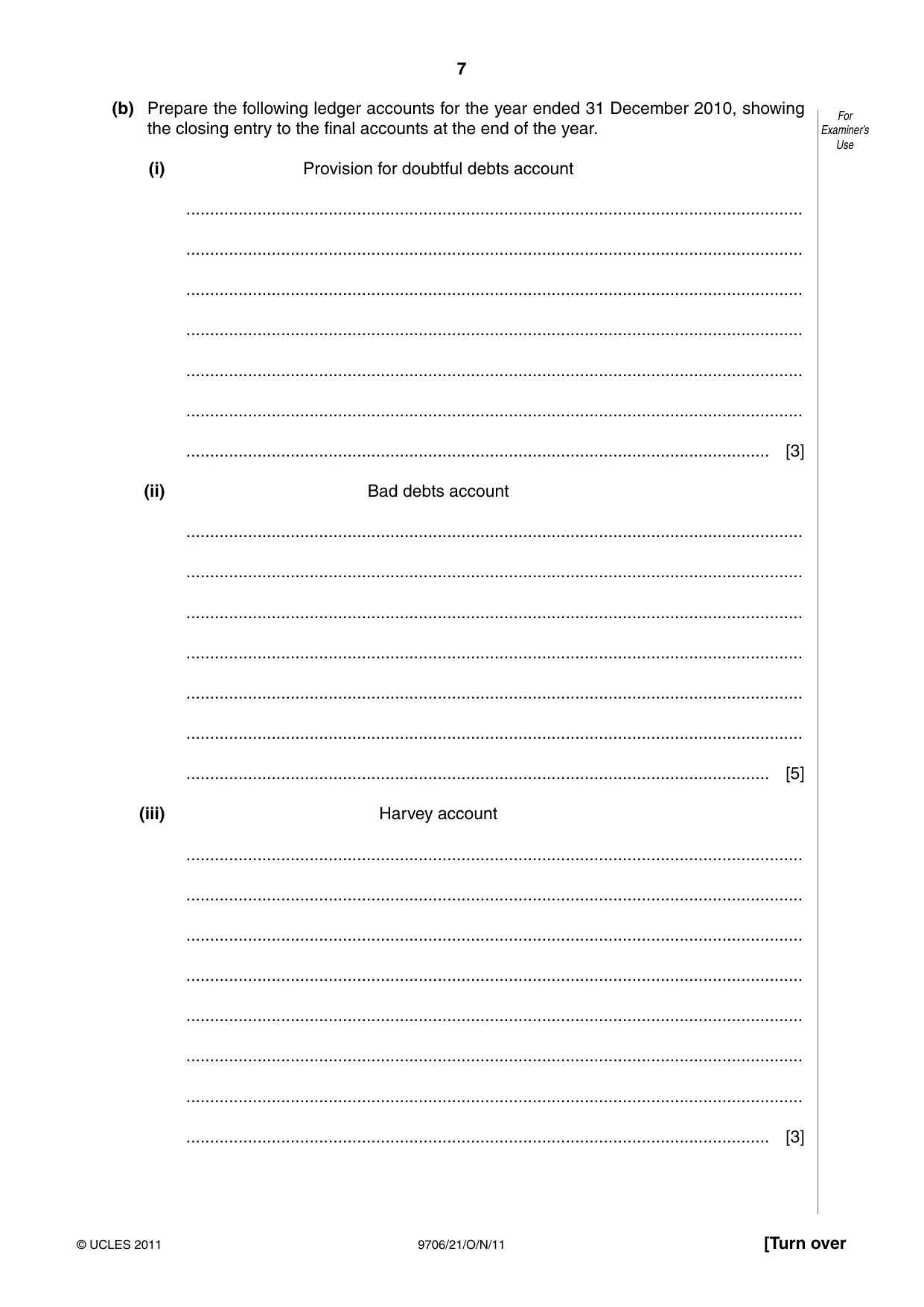
7 9706/21/O/N/11 © UCLES 2011 [Turn over For Examiner’s Use (b) Prepare the following ledger accounts for the year ended 31 December 2010, showing the closing entry to the final accounts at the end of the year. (i) Provision for doubtful debts account … … … … … … … [3] (ii) Bad debts account … … … … … … … [5] (iii) Harvey account … … … … … … … … [3]
Question paper, page 8
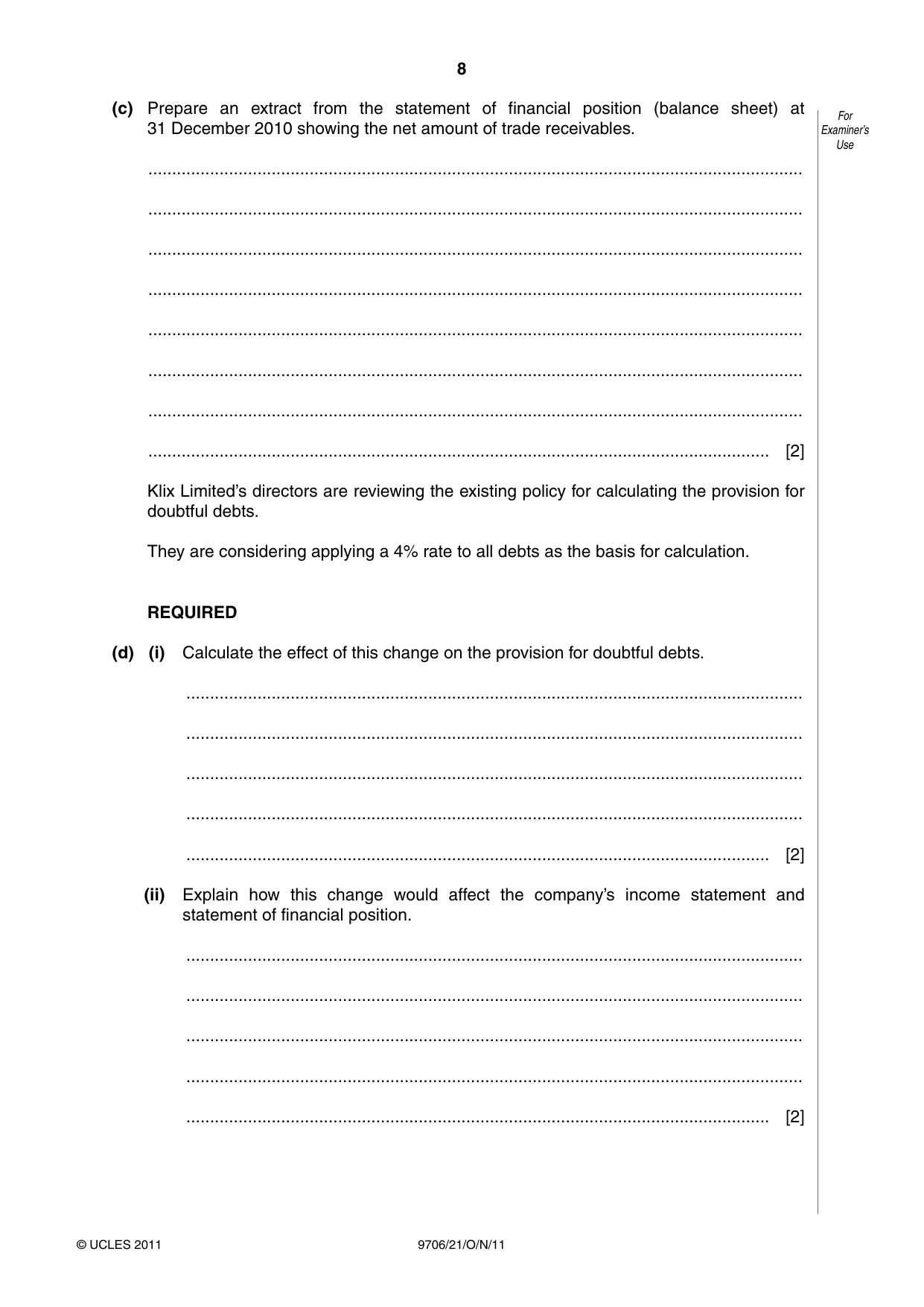
8 9706/21/O/N/11 © UCLES 2011 For Examiner’s Use (c) Prepare an extract from the statement of financial position (balance sheet) at 31 December 2010 showing the net amount of trade receivables. … … … … … … … … [2] Klix Limited’s directors are reviewing the existing policy for calculating the provision for doubtful debts. They are considering applying a 4% rate to all debts as the basis for calculation. REQUIRED (d) (i) Calculate the effect of this change on the provision for doubtful debts. … … … … … [2] (ii) Explain how this change would affect the company’s income statement and statement of financial position. … … … … … [2]
Question paper, page 9
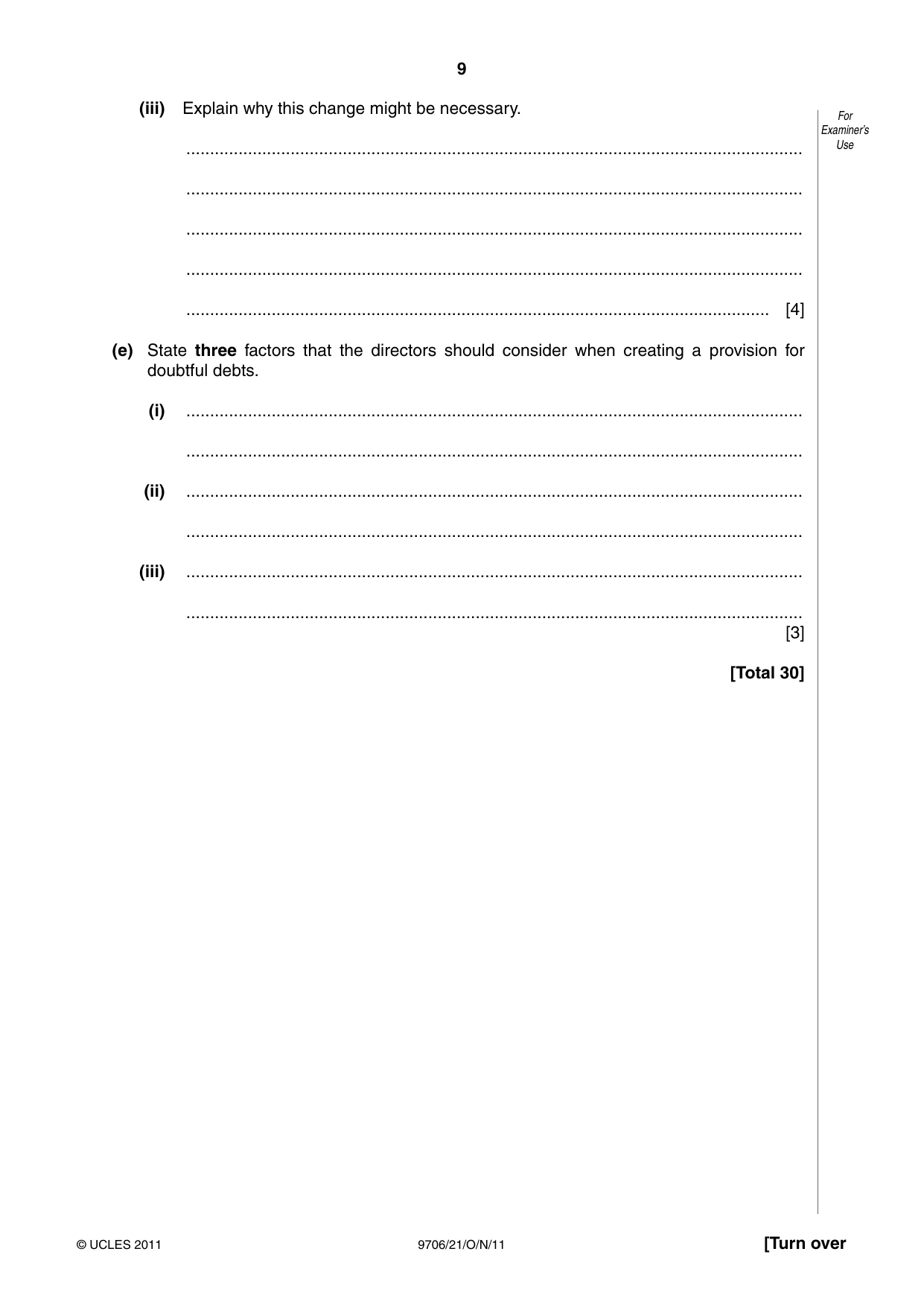
9 9706/21/O/N/11 © UCLES 2011 [Turn over For Examiner’s Use (iii) Explain why this change might be necessary. … … … … … [4] (e) State three factors that the directors should consider when creating a provision for doubtful debts. (i) … … (ii) … … (iii) … … [3] [Total 30]
Question paper, page 10
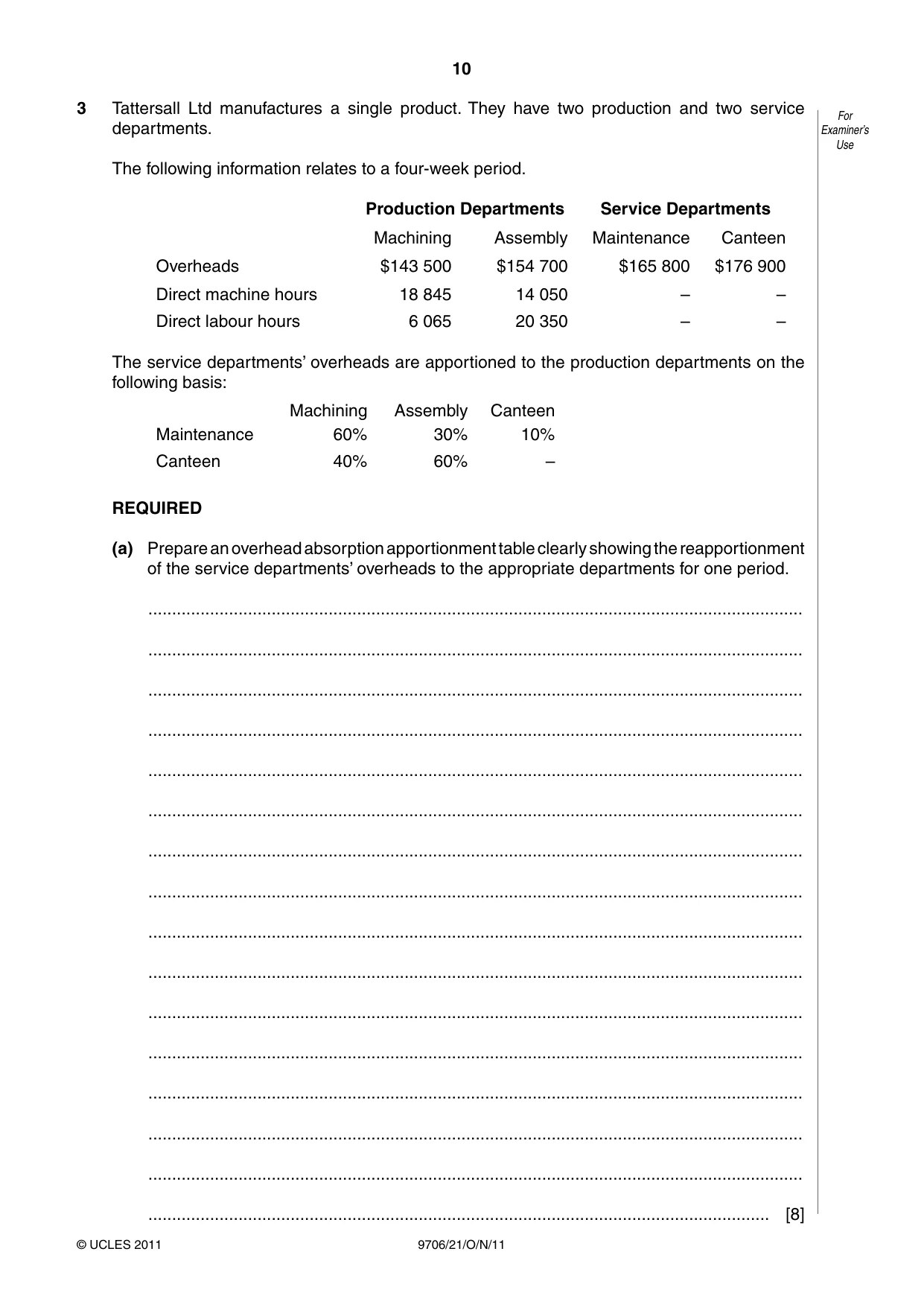
10 9706/21/O/N/11 © UCLES 2011 For Examiner’s Use 3 Tattersall Ltd manufactures a single product. They have two production and two service departments. The following information relates to a four-week period. Production Departments Service Departments Machining Assembly Maintenance Canteen Overheads $143 500 $154 700 $165 800 $176 900 Direct machine hours 18 845 14 050 – – Direct labour hours 6 065 20 350 – – The service departments’ overheads are apportioned to the production departments on the following basis: Machining Assembly Canteen Maintenance 60% 30% 10% Canteen 40% 60% – REQUIRED (a) Prepare an overhead absorption apportionment table clearly showing the reapportionment of the service departments’ overheads to the appropriate departments for one period. … … … … … … … … … … … … … … … … [8]
Question paper, page 11
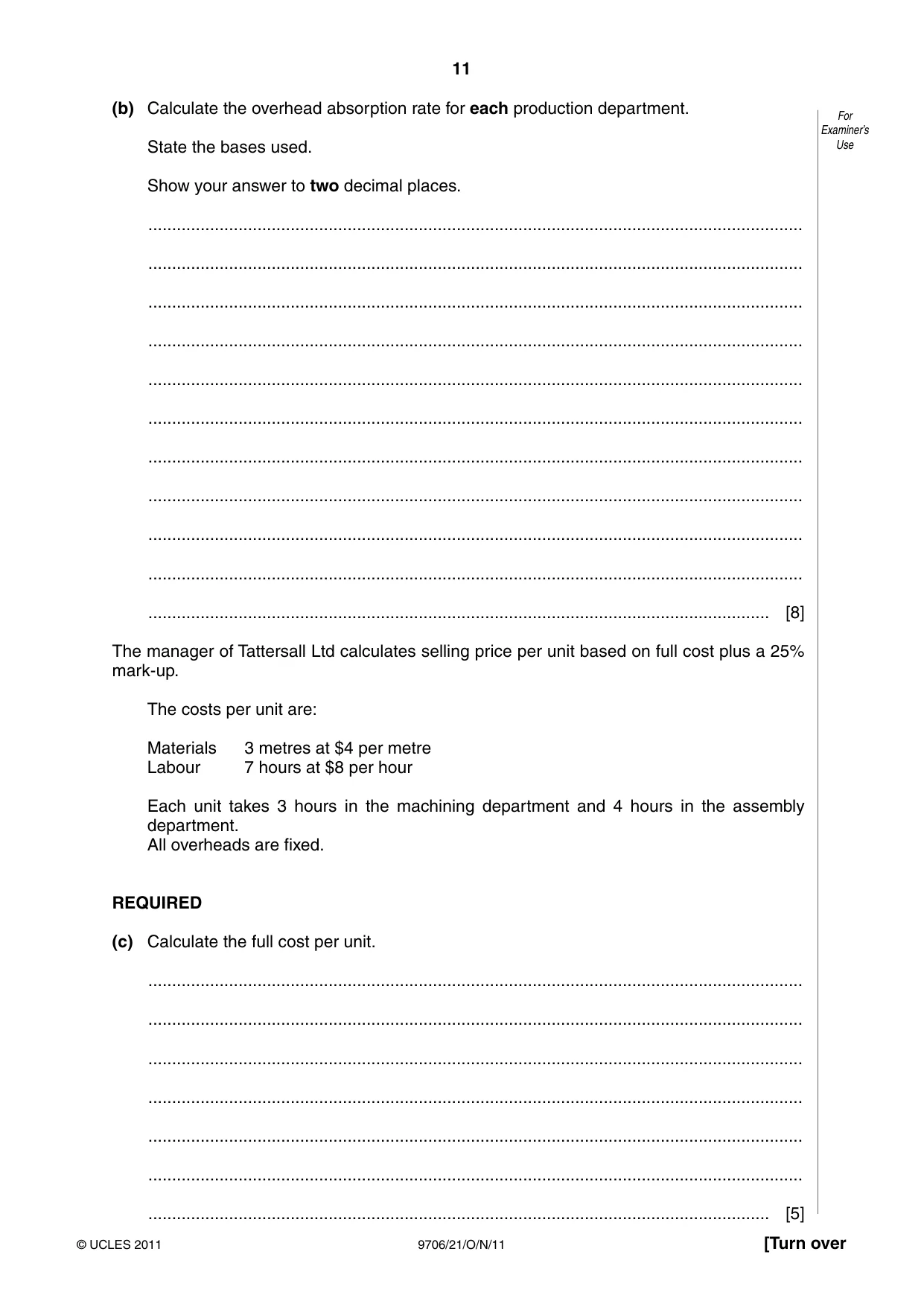
11 9706/21/O/N/11 © UCLES 2011 [Turn over For Examiner’s Use (b) Calculate the overhead absorption rate for each production department. State the bases used. Show your answer to two decimal places. … … … … … … … … … … … [8] The manager of Tattersall Ltd calculates selling price per unit based on full cost plus a 25% mark-up. The costs per unit are: Materials 3 metres at $4 per metre Labour 7 hours at $8 per hour Each unit takes 3 hours in the machining department and 4 hours in the assembly department. All overheads are fixed. REQUIRED (c) Calculate the full cost per unit. … … … … … … … [5]
Question paper, page 12
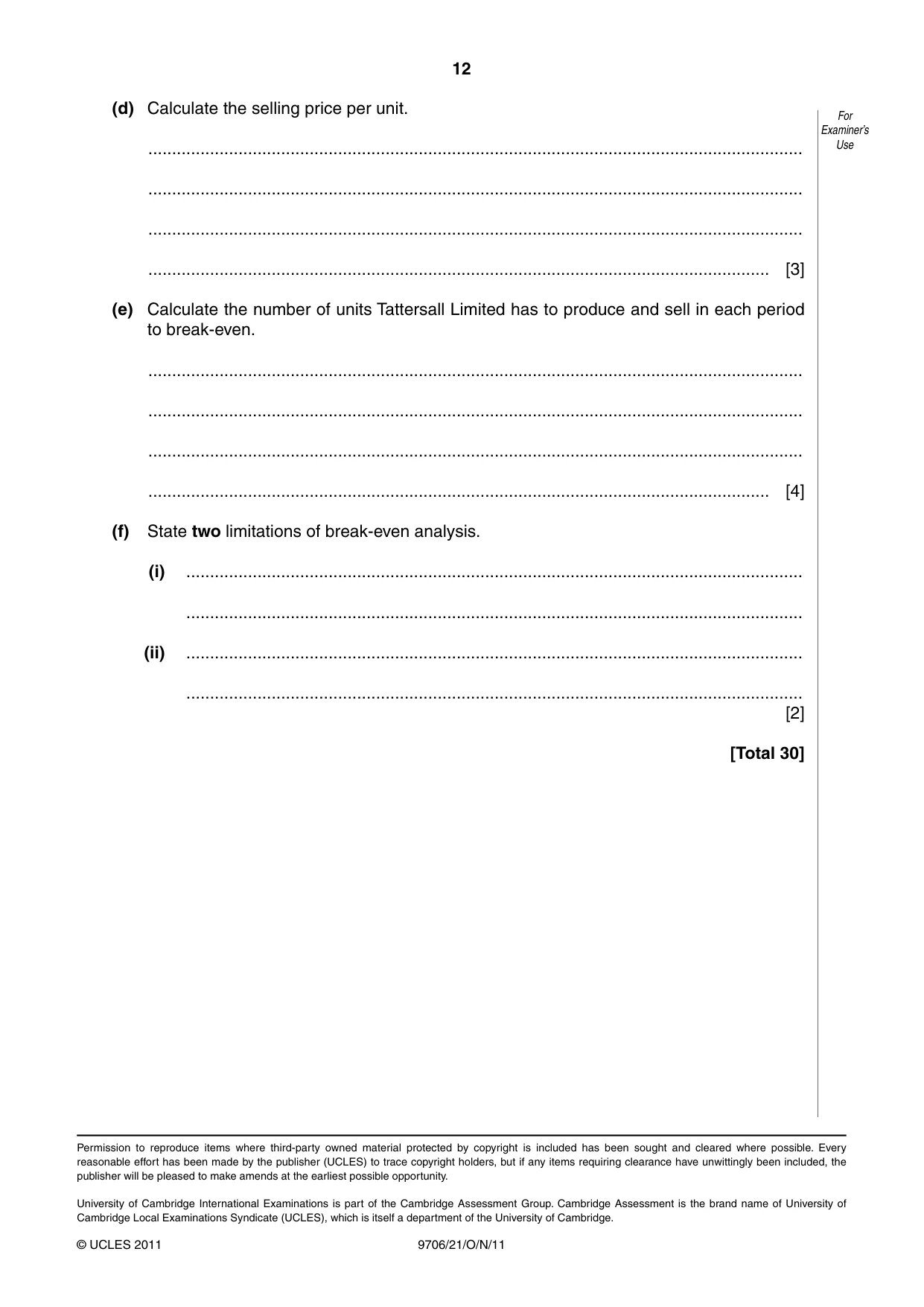
12 9706/21/O/N/11 © UCLES 2011 For Examiner’s Use (d) Calculate the selling price per unit. … … … … [3] (e) Calculate the number of units Tattersall Limited has to produce and sell in each period to break-even. … … … … [4] (f) State two limitations of break-even analysis. (i) … … (ii) … … [2] [Total 30] Permission to reproduce items where third-party owned material protected by copyright is included has been sought and cleared where possible. Every reasonable effort has been made by the publisher (UCLES) to trace copyright holders, but if any items requiring clearance have unwittingly been included, the publisher will be pleased to make amends at the earliest possible opportunity. University of Cambridge International Examinations is part of the Cambridge Assessment Group. Cambridge Assessment is the brand name of University of Cambridge Local Examinations Syndicate (UCLES), which is itself a department of the University of Cambridge.
Mark scheme, page 1
UNIVERSITY OF CAMBRIDGE INTERNATIONAL EXAMINATIONS GCE Advanced Subsidiary Level and GCE Advanced Level MARK SCHEME for the October/November 2011 question paper for the guidance of teachers 9706 ACCOUNTING 9706/21 Paper 2 (Structured Questions – Core), maximum raw mark 90 This mark scheme is published as an aid to teachers and candidates, to indicate the requirements of the examination. It shows the basis on which Examiners were instructed to award marks. It does not indicate the details of the discussions that took place at an Examiners’ meeting before marking began, which would have considered the acceptability of alternative answers. Mark schemes must be read in conjunction with the question papers and the report on the examination. • Cambridge will not enter into discussions or correspondence in connection with these mark schemes. Cambridge is publishing the mark schemes for the October/November 2011 question papers for most IGCSE, GCE Advanced Level and Advanced Subsidiary Level syllabuses and some Ordinary Level syllabuses.
Mark scheme, page 2
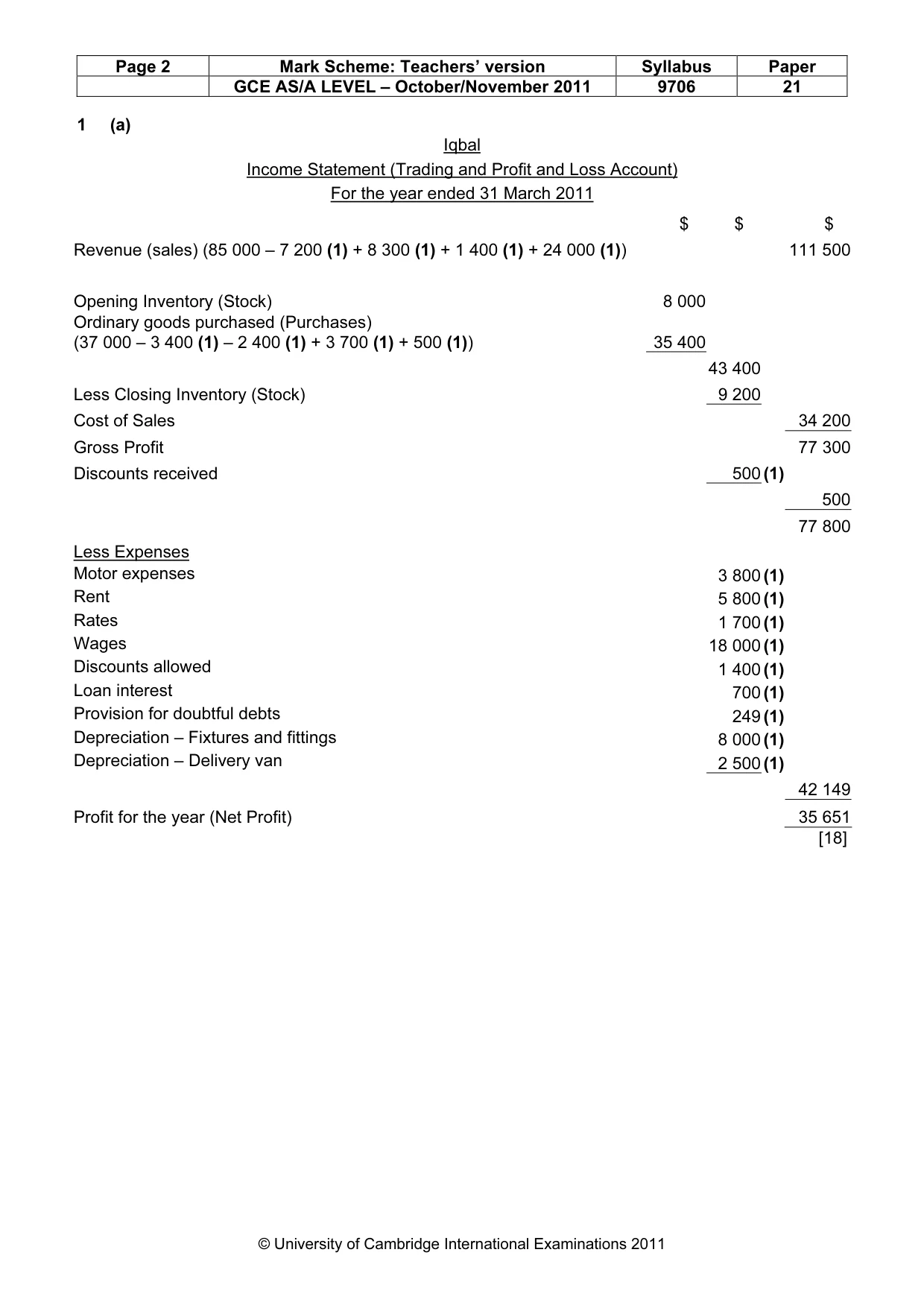
Page 2 Mark Scheme: Teachers’ version Syllabus Paper GCE AS/A LEVEL – October/November 2011 9706 21 © University of Cambridge International Examinations 2011 1 (a) Iqbal Income Statement (Trading and Profit and Loss Account) For the year ended 31 March 2011 $ $ $ Revenue (sales) (85 000 – 7 200 (1) + 8 300 (1) + 1 400 (1) + 24 000 (1)) 111 500 Opening Inventory (Stock) 8 000 Ordinary goods purchased (Purchases) (37 000 – 3 400 (1) – 2 400 (1) + 3 700 (1) + 500 (1)) 35 400 43 400 Less Closing Inventory (Stock) 9 200 Cost of Sales 34 200 Gross Profit 77 300 Discounts received 500 (1) 500 77 800 Less Expenses Motor expenses 3 800 (1) Rent 5 800 (1) Rates 1 700 (1) Wages 18 000 (1) Discounts allowed 1 400 (1) Loan interest 700 (1) Provision for doubtful debts 249 (1) Depreciation – Fixtures and fittings 8 000 (1) Depreciation – Delivery van 2 500 (1) 42 149 Profit for the year (Net Profit) 35 651 [18]
Mark scheme, page 3
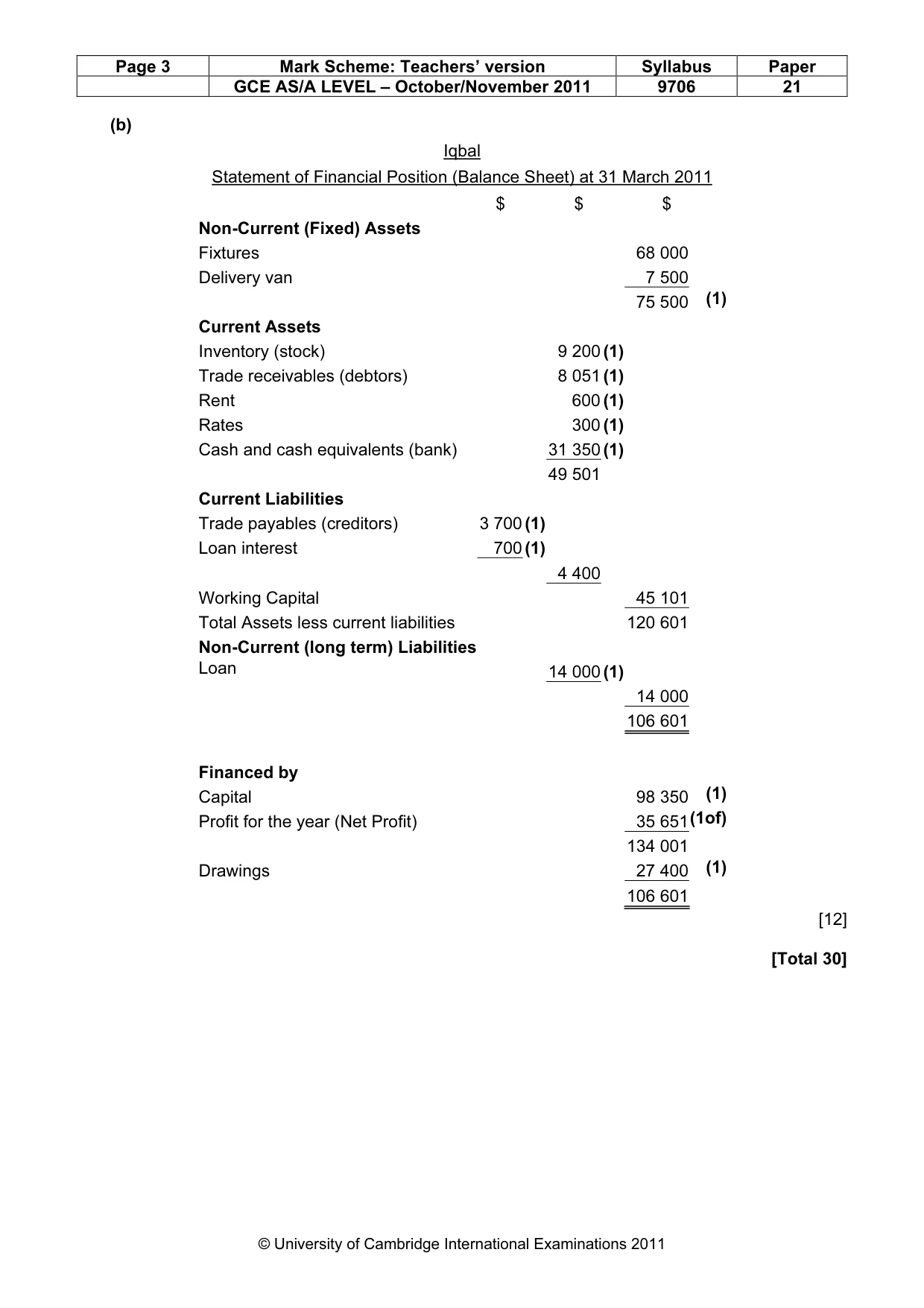
Page 3 Mark Scheme: Teachers’ version Syllabus Paper GCE AS/A LEVEL – October/November 2011 9706 21 © University of Cambridge International Examinations 2011 (b) Iqbal Statement of Financial Position (Balance Sheet) at 31 March 2011 $ $ $ Non-Current (Fixed) Assets Fixtures 68 000 Delivery van 7 500 75 500 (1) Current Assets Inventory (stock) 9 200 (1) Trade receivables (debtors) 8 051 (1) Rent 600 (1) Rates 300 (1) Cash and cash equivalents (bank) 31 350 (1) 49 501 Current Liabilities Trade payables (creditors) 3 700 (1) Loan interest 700 (1) 4 400 Working Capital 45 101 Total Assets less current liabilities 120 601 Non-Current (long term) Liabilities Loan 14 000 (1) 14 000 106 601 Financed by Capital 98 350 (1) Profit for the year (Net Profit) 35 651 (1of) 134 001 Drawings 27 400 (1) 106 601 [12] [Total 30]
Mark scheme, page 4
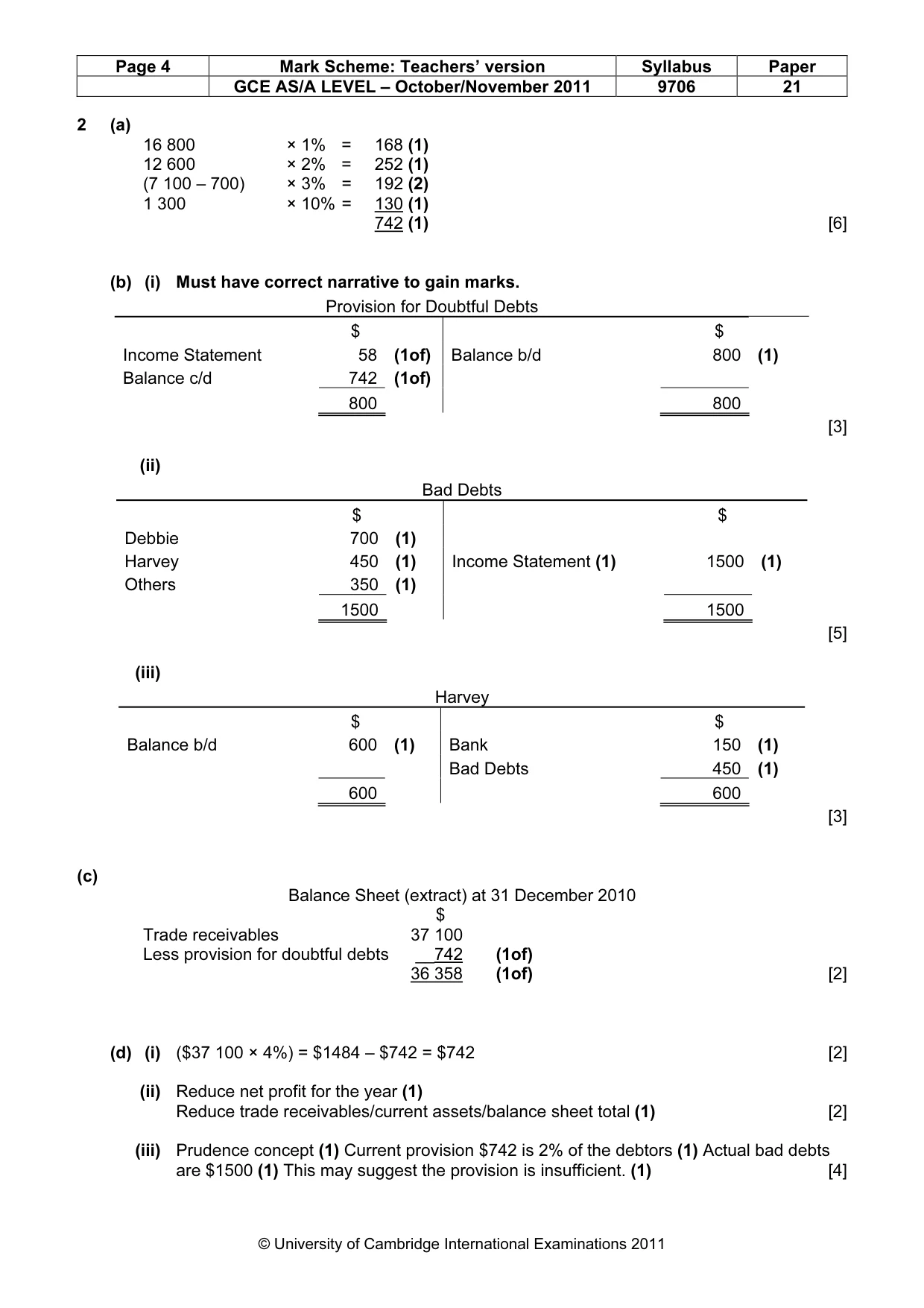
Page 4 Mark Scheme: Teachers’ version Syllabus Paper GCE AS/A LEVEL – October/November 2011 9706 21 © University of Cambridge International Examinations 2011 2 (a) 16 800 × 1% = 168 (1) 12 600 × 2% = 252 (1) (7 100 – 700) × 3% = 192 (2) 1 300 × 10% = 130 (1) 742 (1) [6] (b) (i) Must have correct narrative to gain marks. Provision for Doubtful Debts $ $ Income Statement 58 (1of) Balance b/d 800 (1) Balance c/d 742 (1of) 800 800 [3] (ii) Bad Debts $ $ Debbie 700 (1) Harvey 450 (1) Income Statement (1) 1500 (1) Others 350 (1) 1500 1500 [5] (iii) Harvey $ $ Balance b/d 600 (1) Bank 150 (1) Bad Debts 450 (1) 600 600 [3] (c) Balance Sheet (extract) at 31 December 2010 $ Trade receivables 37 100 Less provision for doubtful debts __742 (1of) 36 358 (1of) [2] (d) (i) ($37 100 × 4%) = $1484 – $742 = $742 [2] (ii) Reduce net profit for the year (1) Reduce trade receivables/current assets/balance sheet total (1) [2] (iii) Prudence concept (1) Current provision $742 is 2% of the debtors (1) Actual bad debts are $1500 (1) This may suggest the provision is insufficient. (1) [4]
Mark scheme, page 5
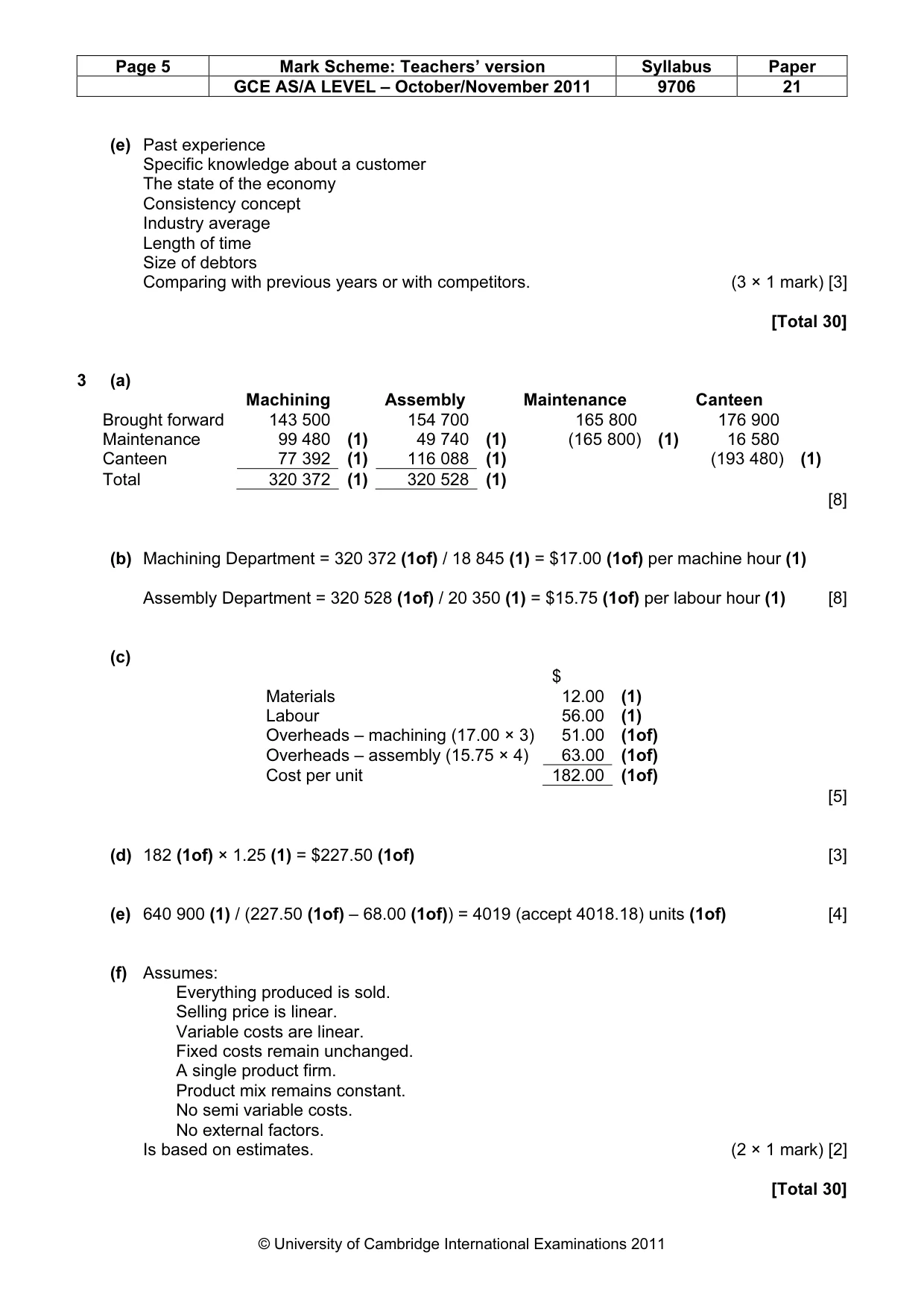
Page 5 Mark Scheme: Teachers’ version Syllabus Paper GCE AS/A LEVEL – October/November 2011 9706 21 © University of Cambridge International Examinations 2011 (e) Past experience Specific knowledge about a customer The state of the economy Consistency concept Industry average Length of time Size of debtors Comparing with previous years or with competitors. (3 × 1 mark) [3] [Total 30] 3 (a) Machining Assembly Maintenance Canteen Brought forward 143 500 154 700 165 800 176 900 Maintenance 99 480 (1) 49 740 (1) (165 800) (1) 16 580 Canteen 77 392 (1) 116 088 (1) (193 480) (1) Total 320 372 (1) 320 528 (1) [8] (b) Machining Department = 320 372 (1of) / 18 845 (1) = $17.00 (1of) per machine hour (1) Assembly Department = 320 528 (1of) / 20 350 (1) = $15.75 (1of) per labour hour (1) [8] (c) $ Materials 12.00 (1) Labour 56.00 (1) Overheads – machining (17.00 × 3) 51.00 (1of) Overheads – assembly (15.75 × 4) 63.00 (1of) Cost per unit 182.00 (1of) [5] (d) 182 (1of) × 1.25 (1) = $227.50 (1of) [3] (e) 640 900 (1) / (227.50 (1of) – 68.00 (1of)) = 4019 (accept 4018.18) units (1of) [4] (f) Assumes: Everything produced is sold. Selling price is linear. Variable costs are linear. Fixed costs remain unchanged. A single product firm. Product mix remains constant. No semi variable costs. No external factors. Is based on estimates. (2 × 1 mark) [2] [Total 30]
What you needed in this session
Cambridge’s own grade thresholds for 2011 Oct/Nov, Paper 2 · Variant 1. A higher threshold means an easier paper — the bar moves with how the cohort did.