Cambridge A Level Accounting 9706 — 2011 Oct/Nov Paper 2 · Variant 3
9706/23/O/N/11 · 90 marks · ≈101 min
The question paper and its mark scheme, free to read here and free to download. This is Cambridge’s own paper, exactly as it was sat.
Question paper12 pages
Mark scheme6 pages
Answers below. Sit the paper first if you are practising.
Paper as text
Question paper, page 1
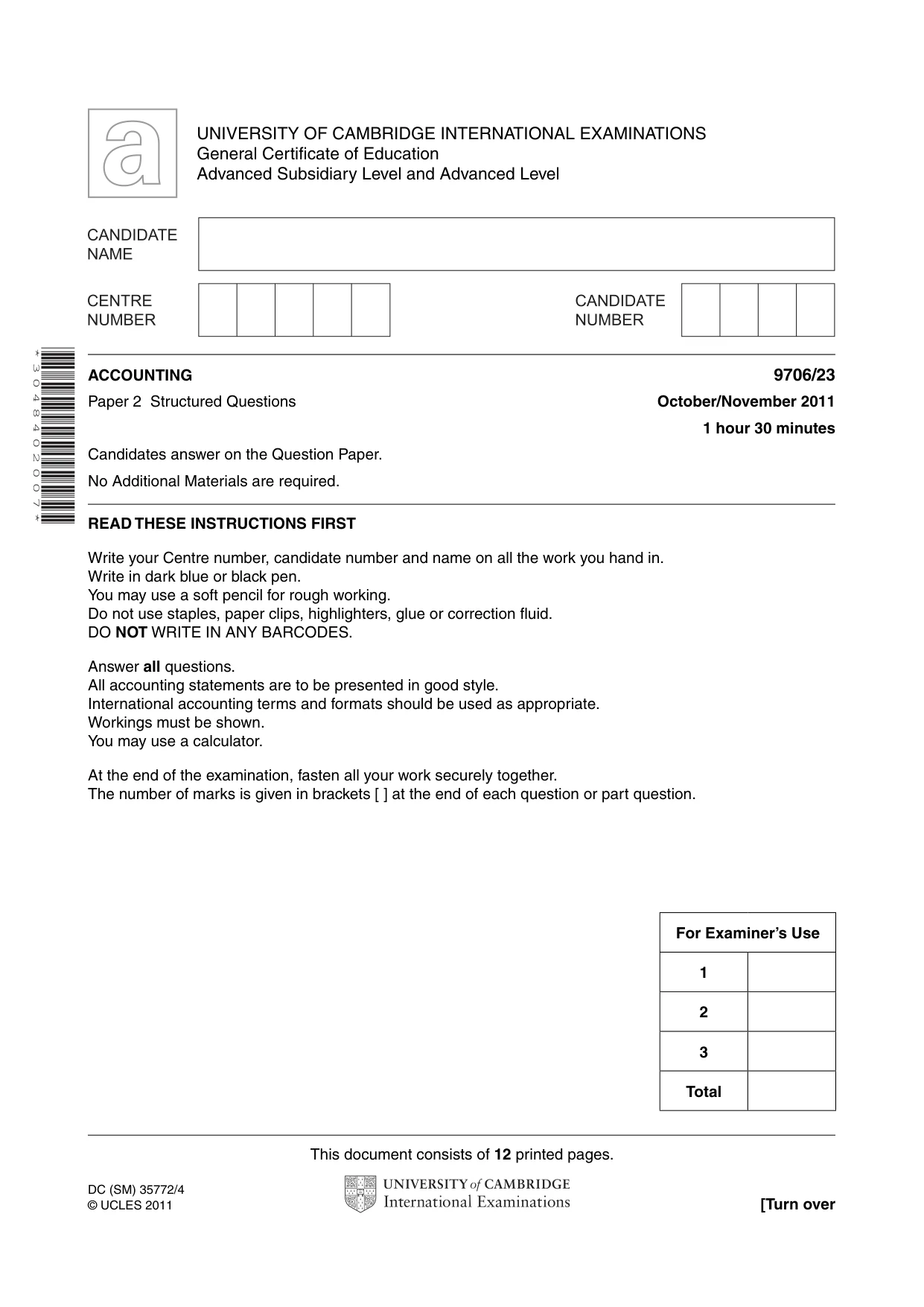
This document consists of 12 printed pages. DC (SM) 35772/4 © UCLES 2011 [Turn over UNIVERSITY OF CAMBRIDGE INTERNATIONAL EXAMINATIONS General Certificate of Education Advanced Subsidiary Level and Advanced Level * 3 0 4 8 4 0 2 0 0 7 * ACCOUNTING 9706/23 Paper 2 Structured Questions October/November 2011 1 hour 30 minutes Candidates answer on the Question Paper. No Additional Materials are required. READ THESE INSTRUCTIONS FIRST Write your Centre number, candidate number and name on all the work you hand in. Write in dark blue or black pen. You may use a soft pencil for rough working. Do not use staples, paper clips, highlighters, glue or correction fluid. DO NOT WRITE IN ANY BARCODES. Answer all questions. All accounting statements are to be presented in good style. International accounting terms and formats should be used as appropriate. Workings must be shown. You may use a calculator. At the end of the examination, fasten all your work securely together. The number of marks is given in brackets [ ] at the end of each question or part question. For Examiner’s Use 1 2 3 Total
Question paper, page 2
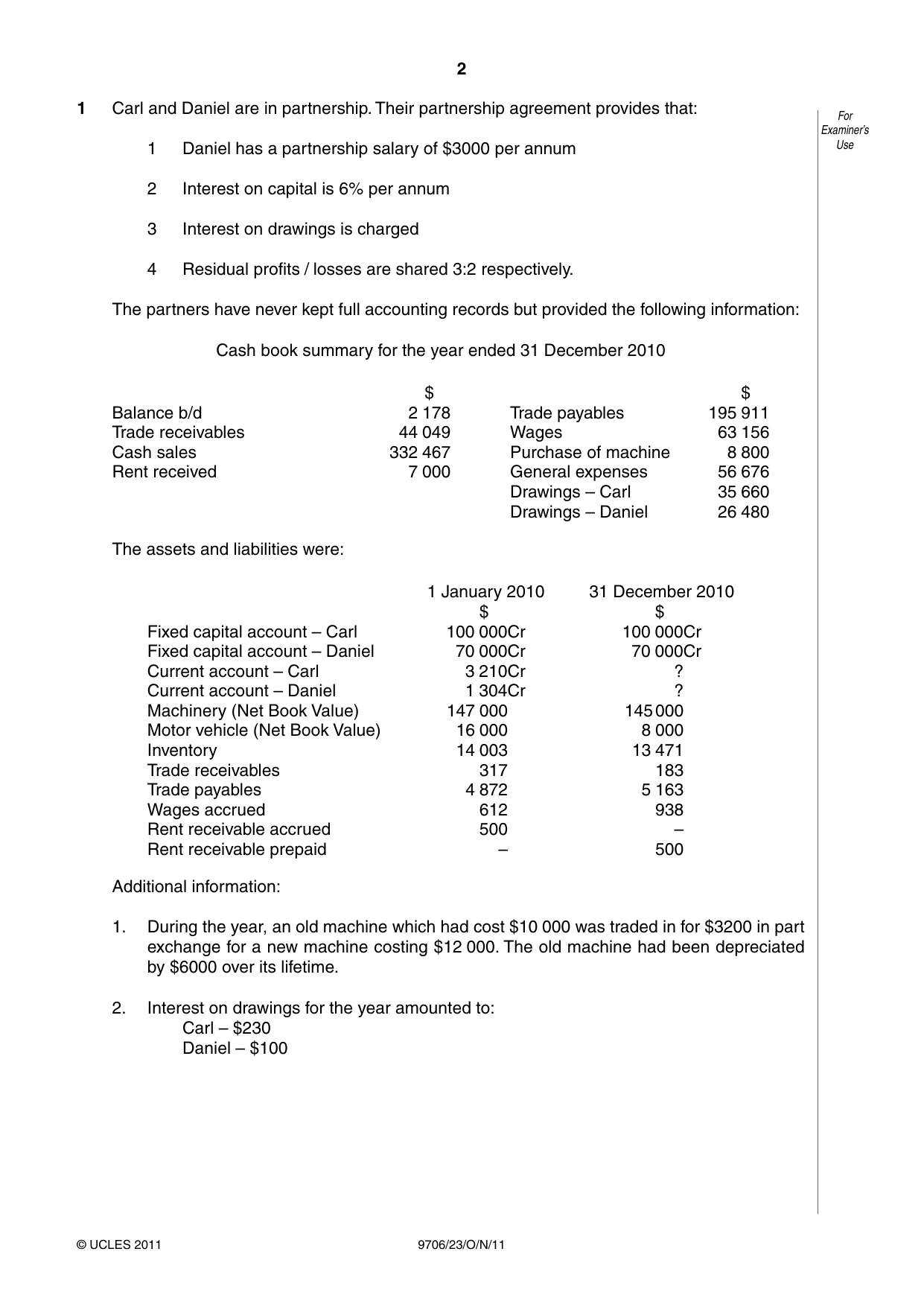
2 9706/23/O/N/11 © UCLES 2011 For Examiner’s Use 1 Carl and Daniel are in partnership. Their partnership agreement provides that: 1 Daniel has a partnership salary of $3000 per annum 2 Interest on capital is 6% per annum 3 Interest on drawings is charged 4 Residual profits / losses are shared 3:2 respectively. The partners have never kept full accounting records but provided the following information: Cash book summary for the year ended 31 December 2010 $ $ Balance b/d 2 178 Trade payables 195 911 Trade receivables 44 049 Wages 63 156 Cash sales 332 467 Purchase of machine 8 800 Rent received 7 000 General expenses 56 676 Drawings – Carl 35 660 Drawings – Daniel 26 480 The assets and liabilities were: 1 January 2010 31 December 2010 $ $ Fixed capital account – Carl 100 000Cr 100 000Cr Fixed capital account – Daniel 70 000Cr 70 000Cr Current account – Carl 3 210Cr ? Current account – Daniel 1 304Cr ? Machinery (Net Book Value) 147 000 145 000 Motor vehicle (Net Book Value) 16 000 8 000 Inventory 14 003 13 471 Trade receivables 317 183 Trade payables 4 872 5 163 Wages accrued 612 938 Rent receivable accrued 500 – Rent receivable prepaid – 500 Additional information: 1. During the year, an old machine which had cost $10 000 was traded in for $3200 in part exchange for a new machine costing $12 000. The old machine had been depreciated by $6000 over its lifetime. 2. Interest on drawings for the year amounted to: Carl – $230 Daniel – $100
Question paper, page 3
3 9706/23/O/N/11 © UCLES 2011 [Turn over For Examiner’s Use REQUIRED (a) Prepare the income statement (trading and profit and loss account) and appropriation account for Carl and Daniel for the year ended 31 December 2010. … … … … … … … … … … … … … … … … … … … … … … … … … …
Question paper, page 4
4 9706/23/O/N/11 © UCLES 2011 For Examiner’s Use … … … … … … … … … … … … … … … … … … … … … … … … … … …[22]
Question paper, page 5
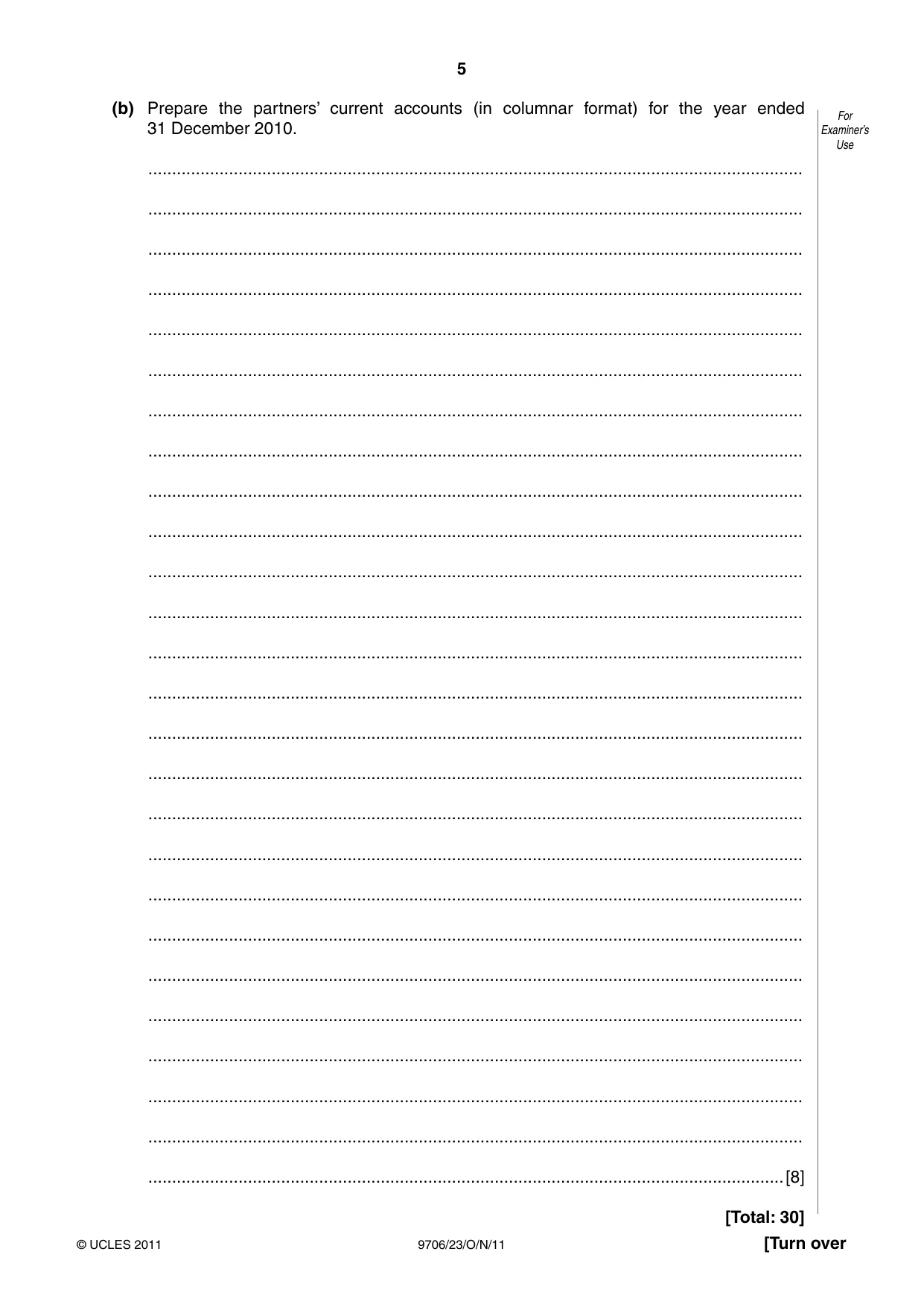
5 9706/23/O/N/11 © UCLES 2011 [Turn over For Examiner’s Use (b) Prepare the partners’ current accounts (in columnar format) for the year ended 31 December 2010. … … … … … … … … … … … … … … … … … … … … … … … … … …[8] [Total: 30]
Question paper, page 6
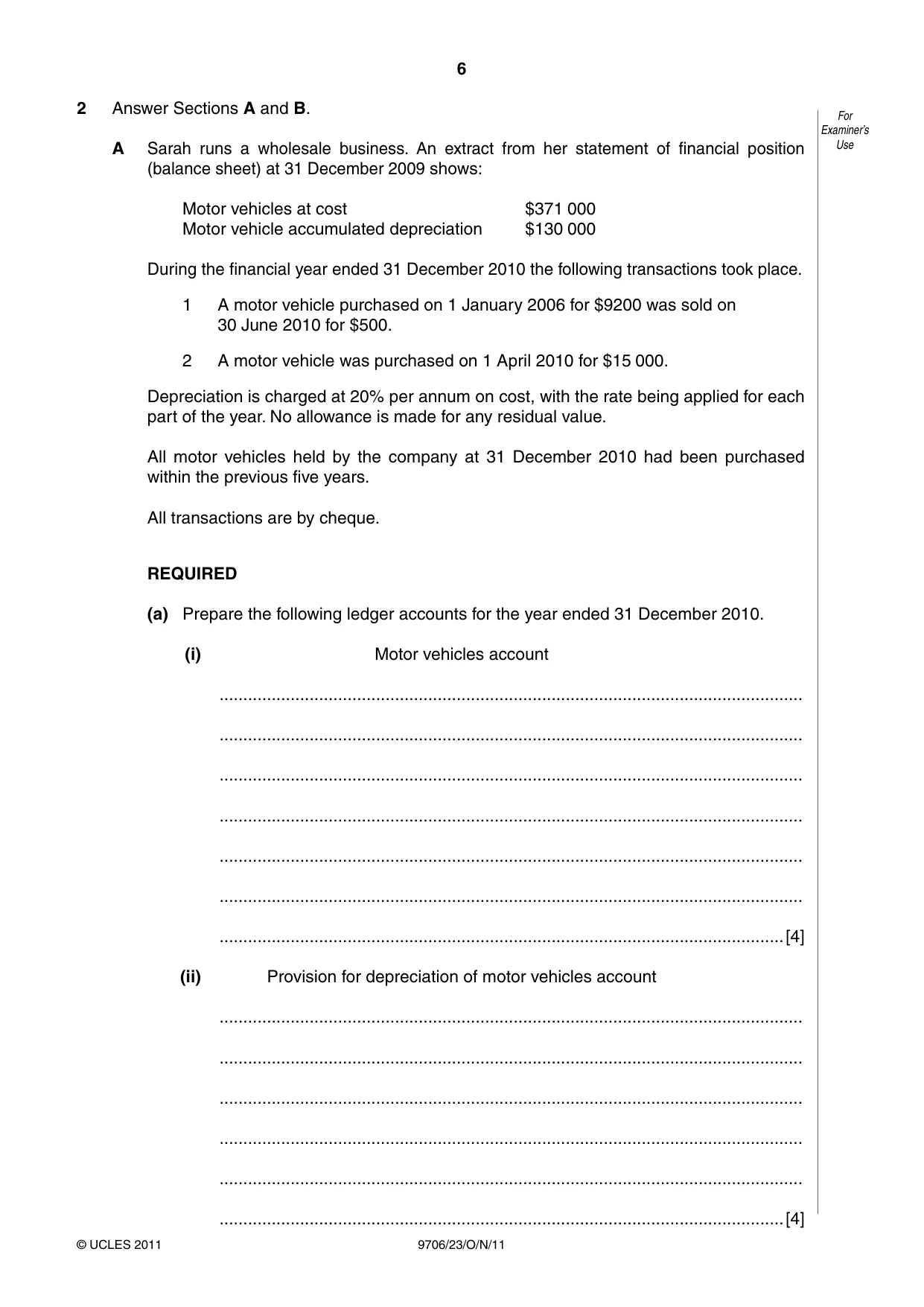
6 9706/23/O/N/11 © UCLES 2011 For Examiner’s Use 2 Answer Sections A and B. A Sarah runs a wholesale business. An extract from her statement of financial position (balance sheet) at 31 December 2009 shows: Motor vehicles at cost $371 000 Motor vehicle accumulated depreciation $130 000 During the financial year ended 31 December 2010 the following transactions took place. 1 A motor vehicle purchased on 1 January 2006 for $9200 was sold on 30 June 2010 for $500. 2 A motor vehicle was purchased on 1 April 2010 for $15 000. Depreciation is charged at 20% per annum on cost, with the rate being applied for each part of the year. No allowance is made for any residual value. All motor vehicles held by the company at 31 December 2010 had been purchased within the previous five years. All transactions are by cheque. REQUIRED (a) Prepare the following ledger accounts for the year ended 31 December 2010. (i) Motor vehicles account … … … … … … …[4] (ii) Provision for depreciation of motor vehicles account … … … … … …[4]
Question paper, page 7
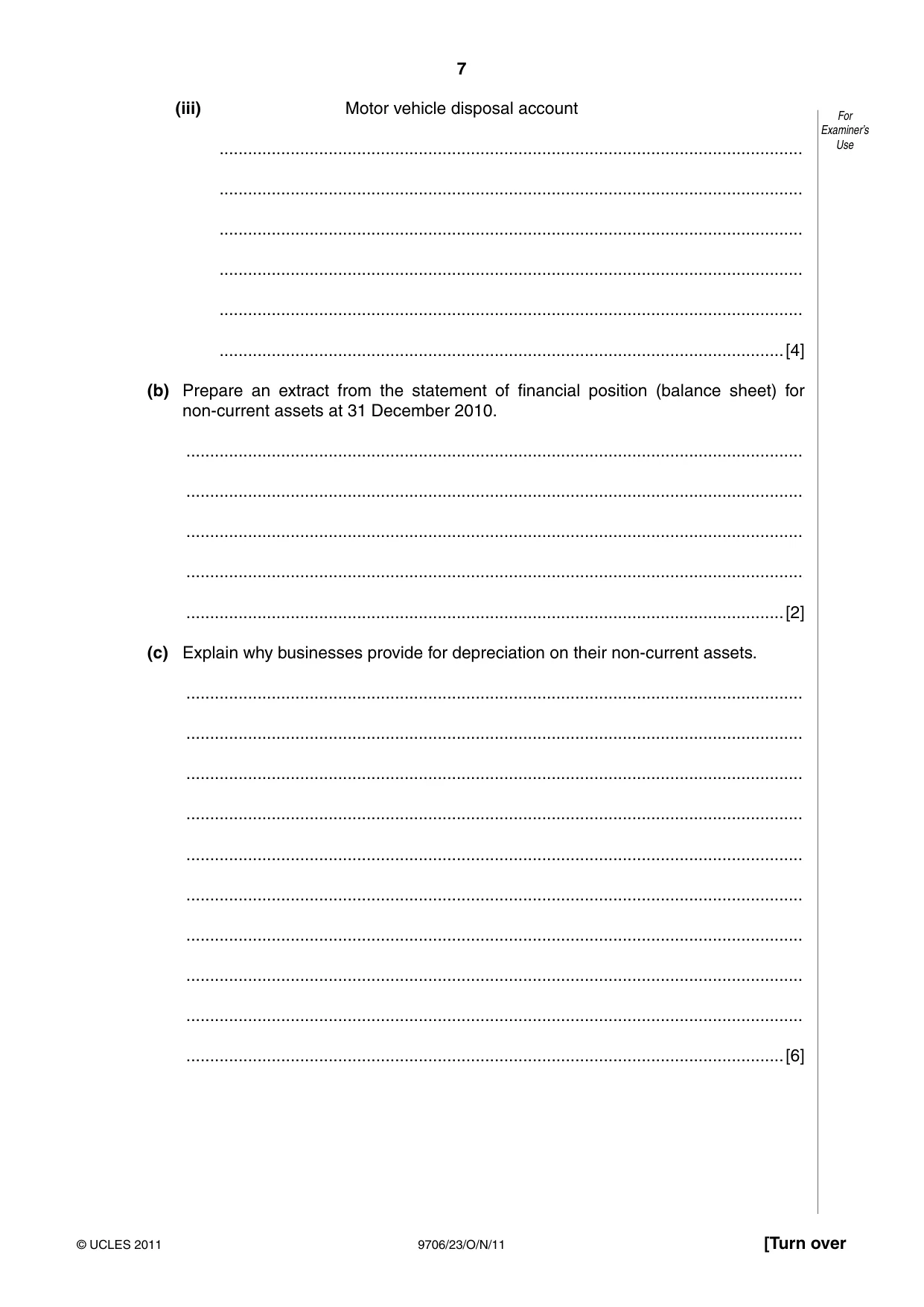
7 9706/23/O/N/11 © UCLES 2011 [Turn over For Examiner’s Use (iii) Motor vehicle disposal account … … … … … …[4] (b) Prepare an extract from the statement of financial position (balance sheet) for non-current assets at 31 December 2010. … … … … …[2] (c) Explain why businesses provide for depreciation on their non-current assets. … … … … … … … … … …[6]
Question paper, page 8
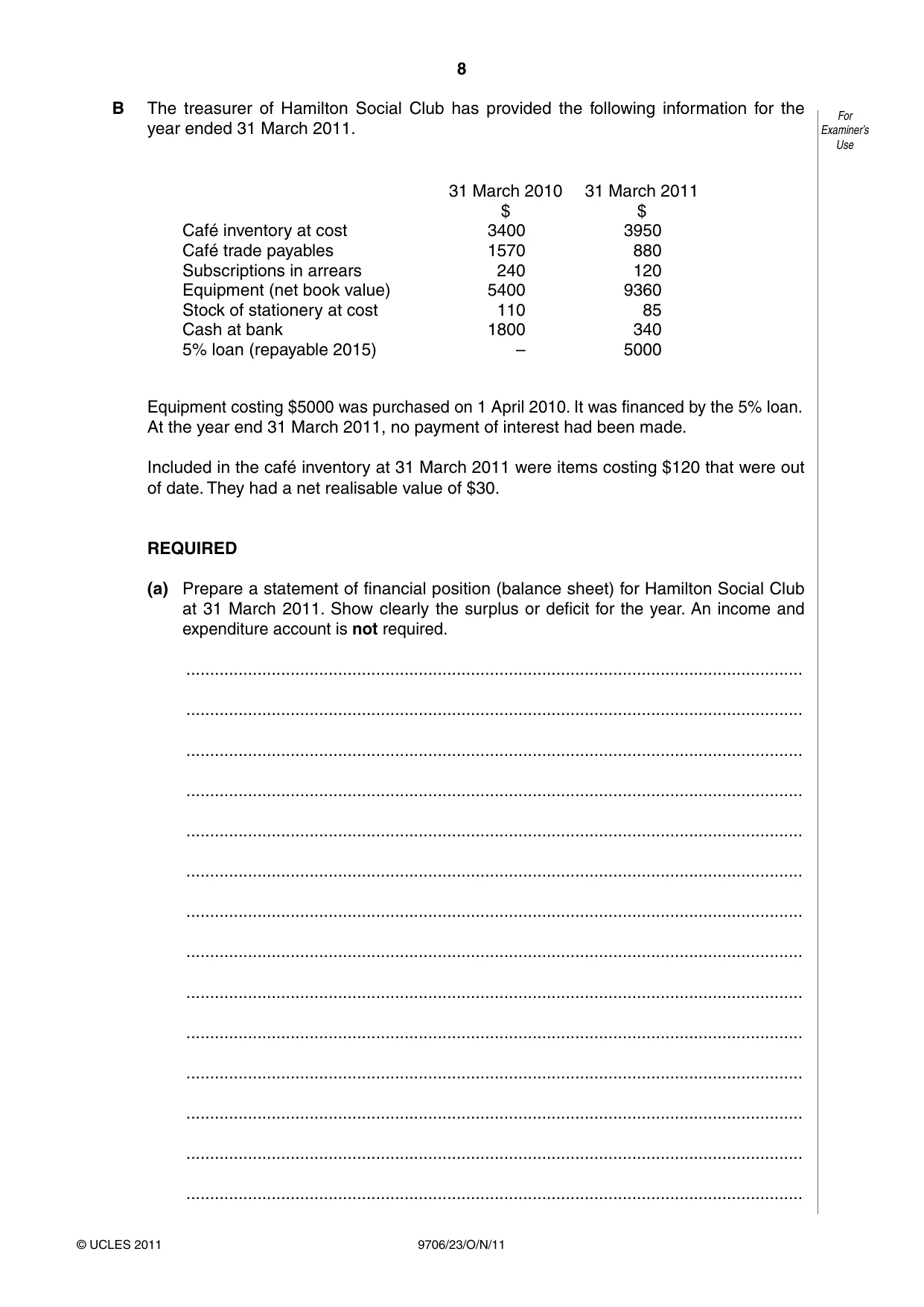
8 9706/23/O/N/11 © UCLES 2011 For Examiner’s Use B The treasurer of Hamilton Social Club has provided the following information for the year ended 31 March 2011. 31 March 2010 31 March 2011 $ $ Café inventory at cost 3400 3950 Café trade payables 1570 880 Subscriptions in arrears 240 120 Equipment (net book value) 5400 9360 Stock of stationery at cost 110 85 Cash at bank 1800 340 5% loan (repayable 2015) – 5000 Equipment costing $5000 was purchased on 1 April 2010. It was financed by the 5% loan. At the year end 31 March 2011, no payment of interest had been made. Included in the café inventory at 31 March 2011 were items costing $120 that were out of date. They had a net realisable value of $30. REQUIRED (a) Prepare a statement of financial position (balance sheet) for Hamilton Social Club at 31 March 2011. Show clearly the surplus or deficit for the year. An income and expenditure account is not required. … … … … … … … … … … … … … …
Question paper, page 9
9 9706/23/O/N/11 © UCLES 2011 [Turn over For Examiner’s Use … … … … … … … … … … … … … … … … … … … … … … … … … … …[10] [Total: 30]
Question paper, page 10
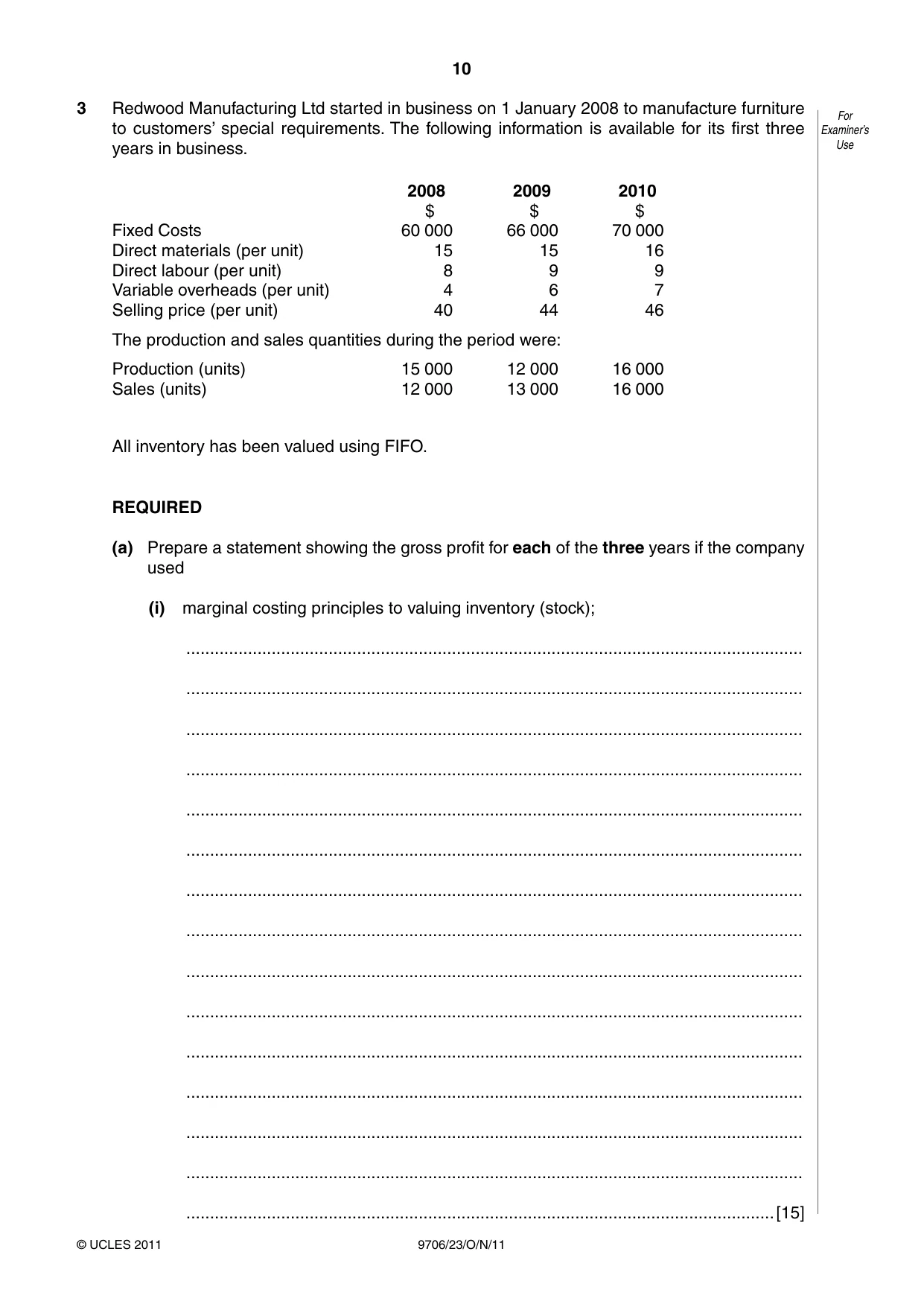
10 9706/23/O/N/11 © UCLES 2011 For Examiner’s Use 3 Redwood Manufacturing Ltd started in business on 1 January 2008 to manufacture furniture to customers’ special requirements. The following information is available for its first three years in business. 2008 2009 2010 $ $ $ Fixed Costs 60 000 66 000 70 000 Direct materials (per unit) 15 15 16 Direct labour (per unit) 8 9 9 Variable overheads (per unit) 4 6 7 Selling price (per unit) 40 44 46 The production and sales quantities during the period were: Production (units) 15 000 12 000 16 000 Sales (units) 12 000 13 000 16 000 All inventory has been valued using FIFO. REQUIRED (a) Prepare a statement showing the gross profit for each of the three years if the company used (i) marginal costing principles to valuing inventory (stock); … … … … … … … … … … … … … … …[15]
Question paper, page 11
11 9706/23/O/N/11 © UCLES 2011 [Turn over For Examiner’s Use (ii) absorption costing principles to valuing inventory (stock). … … … … … … … … … … … … … … … … … … … … … … …[9]
Question paper, page 12
12 9706/23/O/N/11 © UCLES 2011 For Examiner’s Use (b) Prepare a statement to reconcile the amounts of profit for each of the three years calculated under both marginal costing and absorption costing principles. … … … … … … … … … … … … … … … … … … … … … … …[6] [Total: 30] Permission to reproduce items where third-party owned material protected by copyright is included has been sought and cleared where possible. Every reasonable effort has been made by the publisher (UCLES) to trace copyright holders, but if any items requiring clearance have unwittingly been included, the publisher will be pleased to make amends at the earliest possible opportunity. University of Cambridge International Examinations is part of the Cambridge Assessment Group. Cambridge Assessment is the brand name of University of Cambridge Local Examinations Syndicate (UCLES), which is itself a department of the University of Cambridge.
Mark scheme, page 1
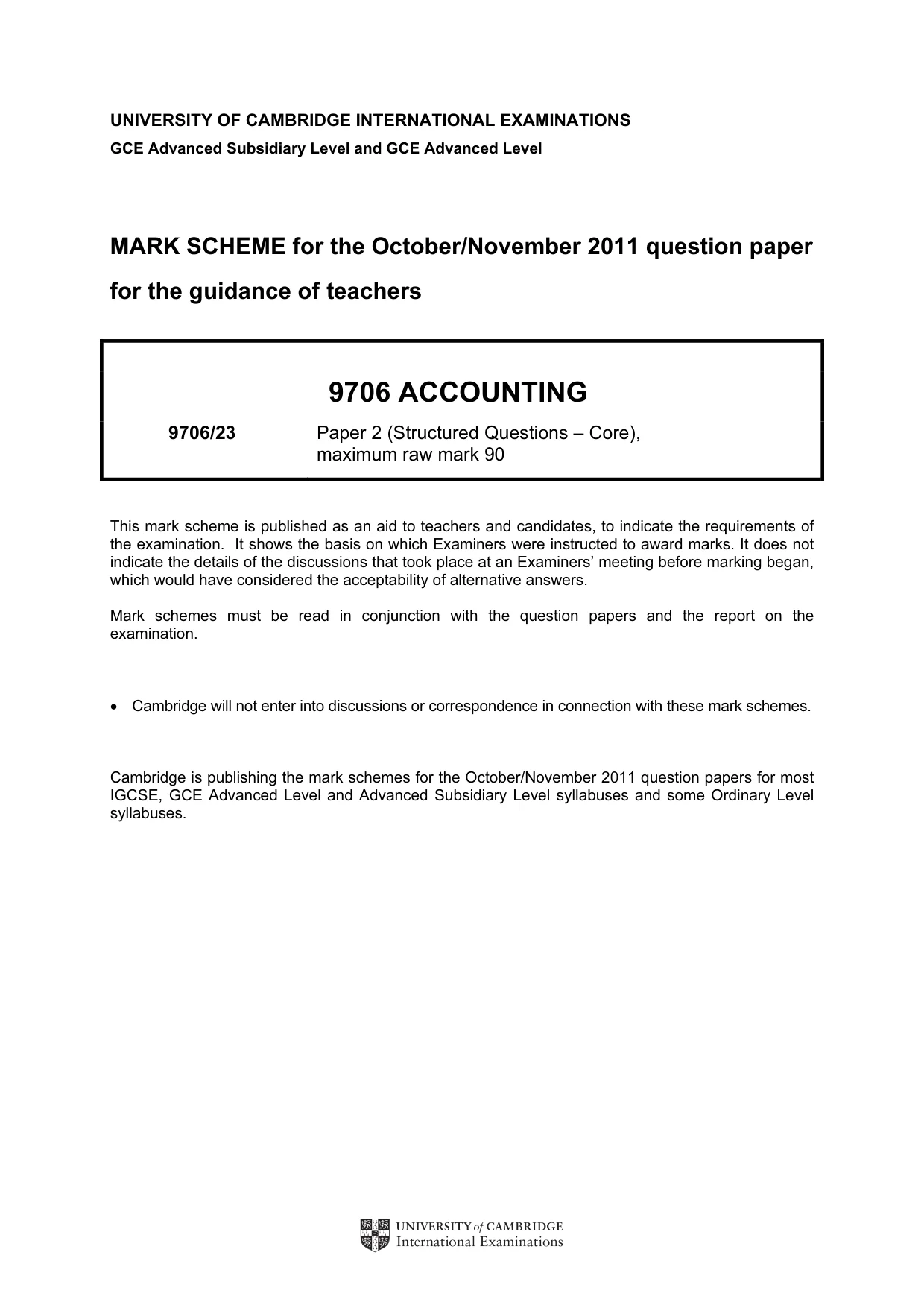
UNIVERSITY OF CAMBRIDGE INTERNATIONAL EXAMINATIONS GCE Advanced Subsidiary Level and GCE Advanced Level MARK SCHEME for the October/November 2011 question paper for the guidance of teachers 9706 ACCOUNTING 9706/23 Paper 2 (Structured Questions – Core), maximum raw mark 90 This mark scheme is published as an aid to teachers and candidates, to indicate the requirements of the examination. It shows the basis on which Examiners were instructed to award marks. It does not indicate the details of the discussions that took place at an Examiners’ meeting before marking began, which would have considered the acceptability of alternative answers. Mark schemes must be read in conjunction with the question papers and the report on the examination. • Cambridge will not enter into discussions or correspondence in connection with these mark schemes. Cambridge is publishing the mark schemes for the October/November 2011 question papers for most IGCSE, GCE Advanced Level and Advanced Subsidiary Level syllabuses and some Ordinary Level syllabuses.
Mark scheme, page 2
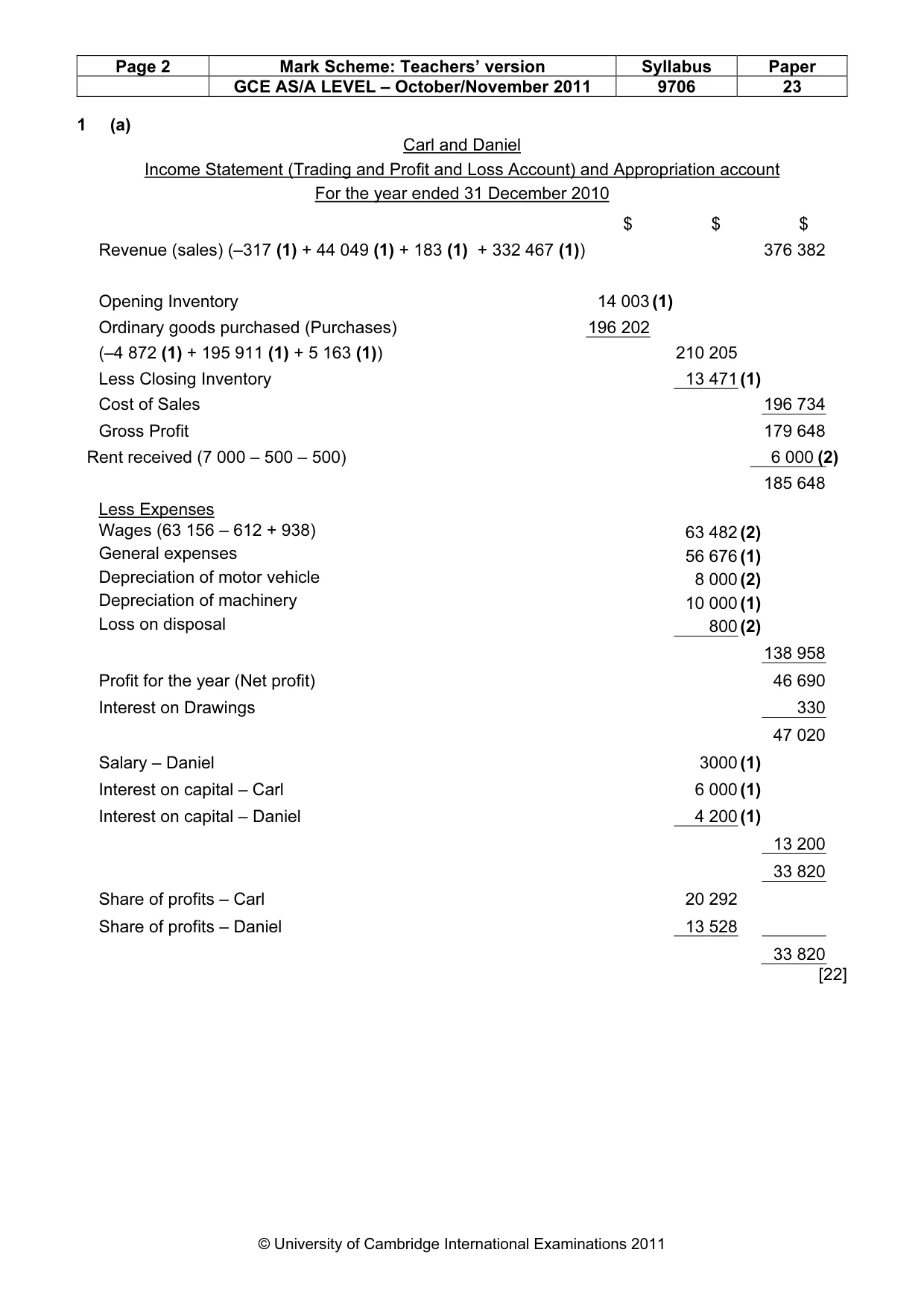
Page 2 Mark Scheme: Teachers’ version Syllabus Paper GCE AS/A LEVEL – October/November 2011 9706 23 © University of Cambridge International Examinations 2011 1 (a) Carl and Daniel Income Statement (Trading and Profit and Loss Account) and Appropriation account For the year ended 31 December 2010 $ $ $ Revenue (sales) (–317 (1) + 44 049 (1) + 183 (1) + 332 467 (1)) 376 382 Opening Inventory 14 003(1) Ordinary goods purchased (Purchases) 196 202 (–4 872 (1) + 195 911 (1) + 5 163 (1)) 210 205 Less Closing Inventory 13 471 (1) Cost of Sales 196 734 Gross Profit 179 648 Rent received (7 000 – 500 – 500) 6 000 (2) 185 648 Less Expenses Wages (63 156 – 612 + 938) 63 482 (2) General expenses 56 676 (1) Depreciation of motor vehicle 8 000 (2) Depreciation of machinery 10 000 (1) Loss on disposal 800 (2) 138 958 Profit for the year (Net profit) 46 690 Interest on Drawings 330 47 020 Salary – Daniel 3000 (1) Interest on capital – Carl 6 000 (1) Interest on capital – Daniel 4 200 (1) 13 200 33 820 Share of profits – Carl 20 292 Share of profits – Daniel 13 528 33 820 [22]
Mark scheme, page 3
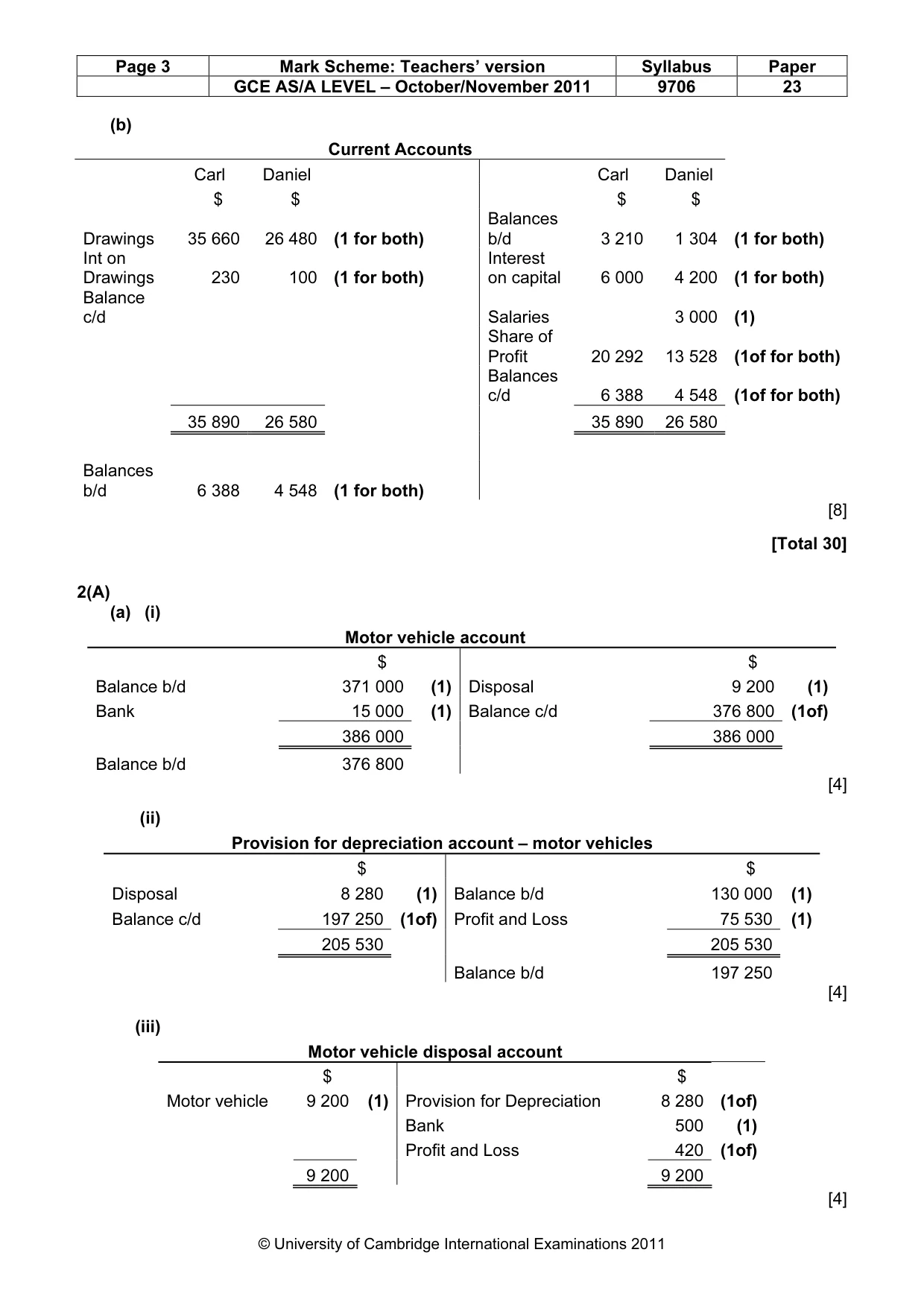
Page 3 Mark Scheme: Teachers’ version Syllabus Paper GCE AS/A LEVEL – October/November 2011 9706 23 © University of Cambridge International Examinations 2011 (b) Current Accounts Carl Daniel Carl Daniel $ $ $ $ Drawings 35 660 26 480 (1 for both) Balances b/d 3 210 1 304 (1 for both) Int on Drawings 230 100 (1 for both) Interest on capital 6 000 4 200 (1 for both) Balance c/d Salaries 3 000 (1) Share of Profit 20 292 13 528 (1of for both) Balances c/d 6 388 4 548 (1of for both) 35 890 26 580 35 890 26 580 Balances b/d 6 388 4 548 (1 for both) [8] [Total 30] 2(A) (a) (i) Motor vehicle account $ $ Balance b/d 371 000 (1) Disposal 9 200 (1) Bank 15 000 (1) Balance c/d 376 800 (1of) 386 000 386 000 Balance b/d 376 800 [4] (ii) Provision for depreciation account – motor vehicles $ $ Disposal 8 280 (1) Balance b/d 130 000 (1) Balance c/d 197 250 (1of) Profit and Loss 75 530 (1) 205 530 205 530 Balance b/d 197 250 [4] (iii) Motor vehicle disposal account $ $ Motor vehicle 9 200 (1) Provision for Depreciation 8 280 (1of) Bank 500 (1) Profit and Loss 420 (1of) 9 200 9 200 [4]
Mark scheme, page 4
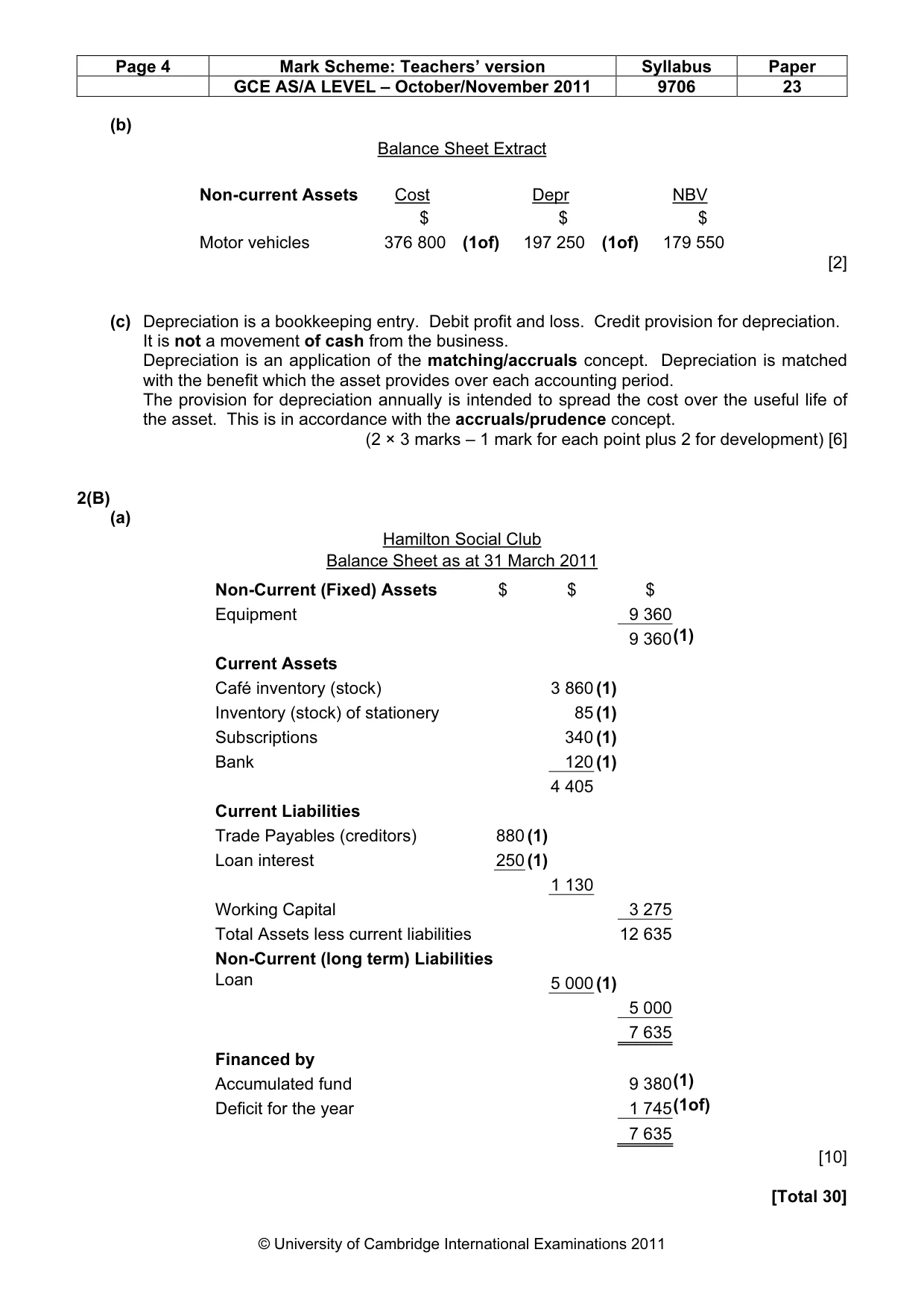
Page 4 Mark Scheme: Teachers’ version Syllabus Paper GCE AS/A LEVEL – October/November 2011 9706 23 © University of Cambridge International Examinations 2011 (b) Balance Sheet Extract Non-current Assets Cost Depr NBV $ $ $ Motor vehicles 376 800 (1of) 197 250 (1of) 179 550 [2] (c) Depreciation is a bookkeeping entry. Debit profit and loss. Credit provision for depreciation. It is not a movement of cash from the business. Depreciation is an application of the matching/accruals concept. Depreciation is matched with the benefit which the asset provides over each accounting period. The provision for depreciation annually is intended to spread the cost over the useful life of the asset. This is in accordance with the accruals/prudence concept. (2 × 3 marks – 1 mark for each point plus 2 for development) [6] 2(B) (a) Hamilton Social Club Balance Sheet as at 31 March 2011 Non-Current (Fixed) Assets $ $ $ Equipment 9 360 9 360 (1) Current Assets Café inventory (stock) 3 860 (1) Inventory (stock) of stationery 85 (1) Subscriptions 340 (1) Bank 120 (1) 4 405 Current Liabilities Trade Payables (creditors) 880 (1) Loan interest 250 (1) 1 130 Working Capital 3 275 Total Assets less current liabilities 12 635 Non-Current (long term) Liabilities Loan 5 000 (1) 5 000 7 635 Financed by Accumulated fund 9 380 (1) Deficit for the year 1 745 (1of) 7 635 [10] [Total 30]
Mark scheme, page 5
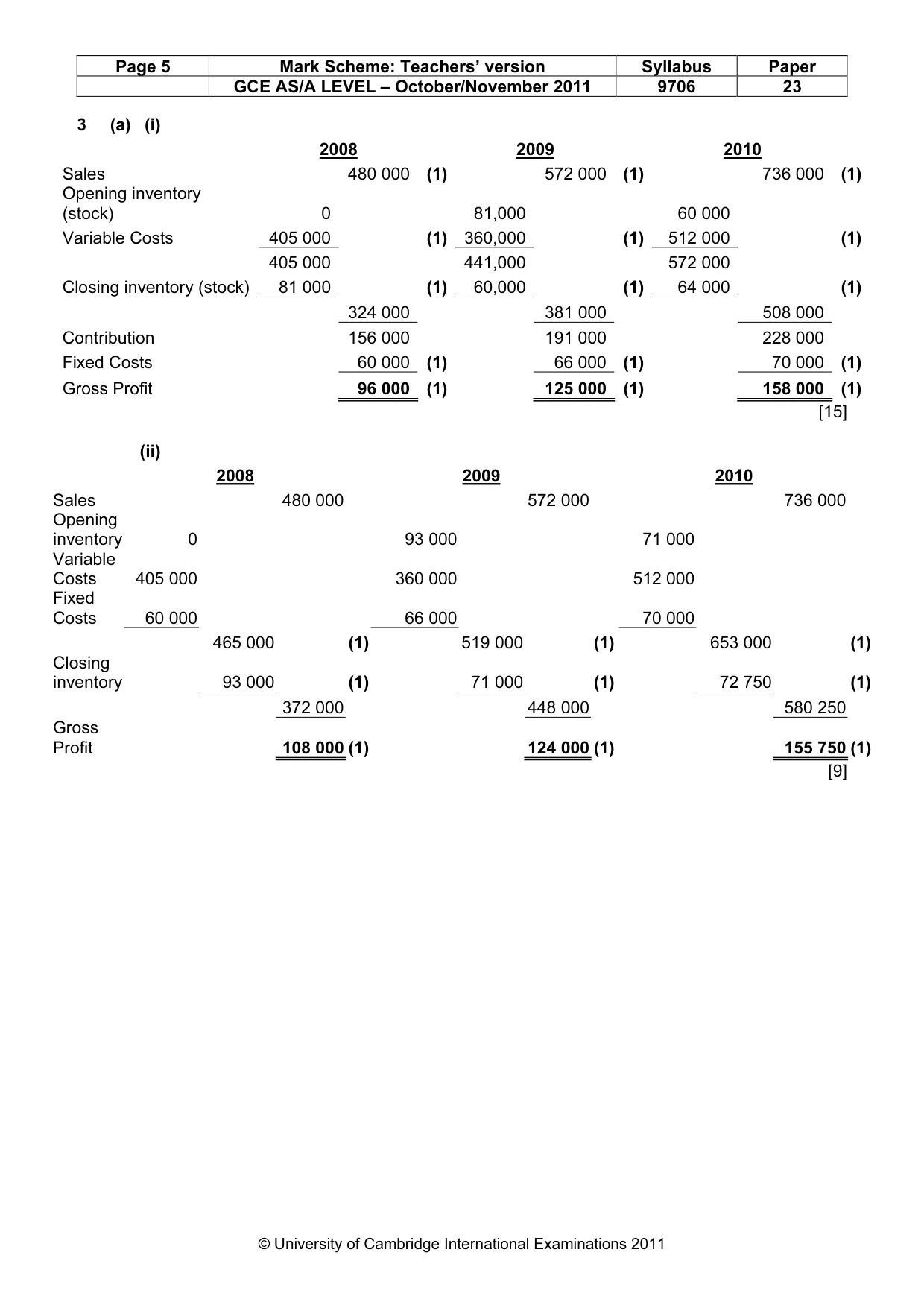
Page 5 Mark Scheme: Teachers’ version Syllabus Paper GCE AS/A LEVEL – October/November 2011 9706 23 © University of Cambridge International Examinations 2011 3 (a) (i) 2008 2009 2010 Sales 480 000 (1) 572 000 (1) 736 000 (1) Opening inventory (stock) 0 81,000 60 000 Variable Costs 405 000 (1) 360,000 (1) 512 000 (1) 405 000 441,000 572 000 Closing inventory (stock) 81 000 (1) 60,000 (1) 64 000 (1) 324 000 381 000 508 000 Contribution 156 000 191 000 228 000 Fixed Costs 60 000 (1) 66 000 (1) 70 000 (1) Gross Profit 96 000 (1) 125 000 (1) 158 000 (1) [15] (ii) 2008 2009 2010 Sales 480 000 572 000 736 000 Opening inventory 0 93 000 71 000 Variable Costs 405 000 360 000 512 000 Fixed Costs 60 000 66 000 70 000 465 000 (1) 519 000 (1) 653 000 (1) Closing inventory 93 000 (1) 71 000 (1) 72 750 (1) 372 000 448 000 580 250 Gross Profit 108 000 (1) 124 000 (1) 155 750 (1) [9]
Mark scheme, page 6
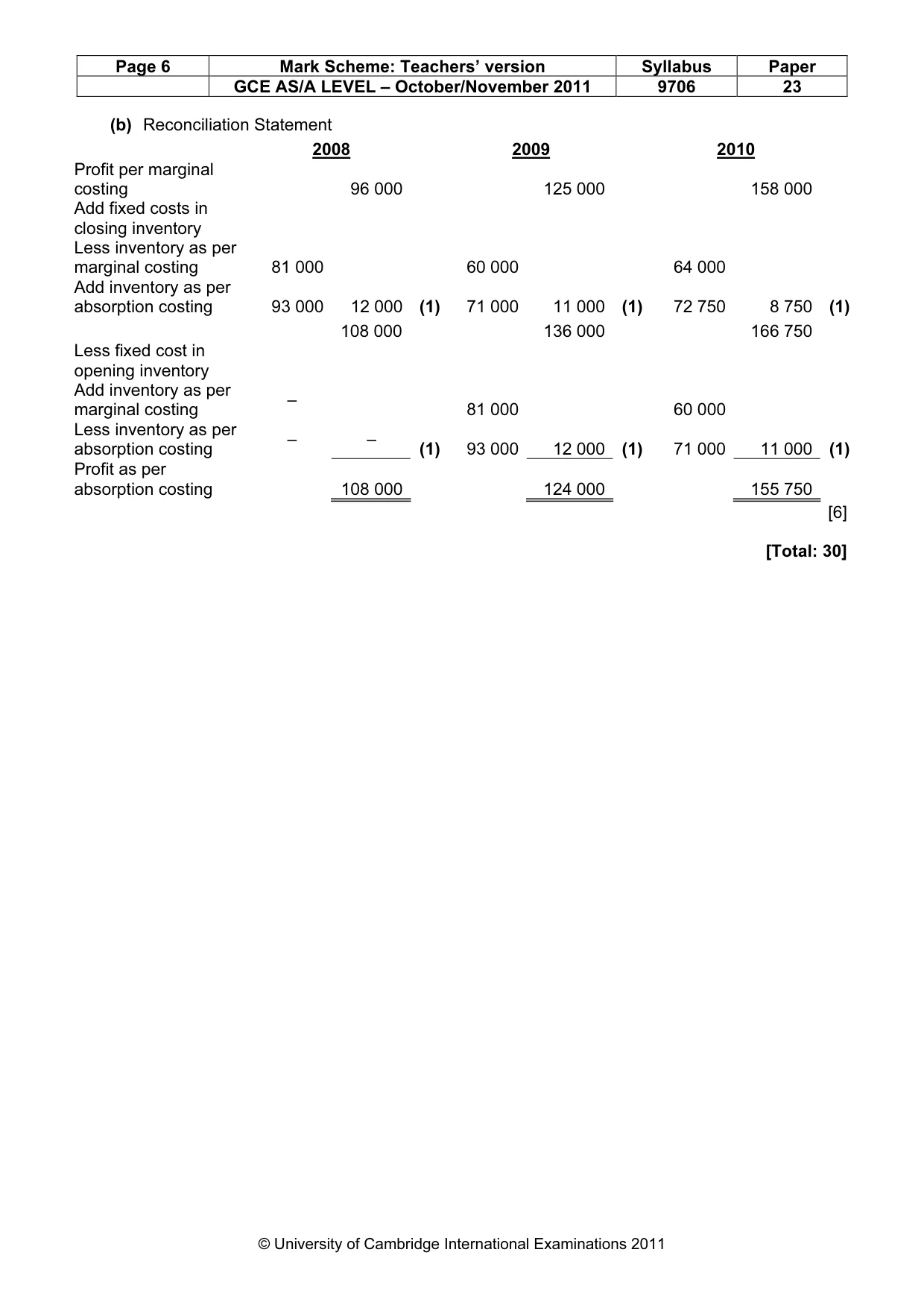
Page 6 Mark Scheme: Teachers’ version Syllabus Paper GCE AS/A LEVEL – October/November 2011 9706 23 © University of Cambridge International Examinations 2011 (b) Reconciliation Statement 2008 2009 2010 Profit per marginal costing 96 000 125 000 158 000 Add fixed costs in closing inventory Less inventory as per marginal costing 81 000 60 000 64 000 Add inventory as per absorption costing 93 000 12 000 (1) 71 000 11 000 (1) 72 750 8 750 (1) 108 000 136 000 166 750 Less fixed cost in opening inventory Add inventory as per marginal costing – 81 000 60 000 Less inventory as per absorption costing – – (1) 93 000 12 000 (1) 71 000 11 000 (1) Profit as per absorption costing 108 000 124 000 155 750 [6] [Total: 30]
What you needed in this session
Cambridge’s own grade thresholds for 2011 Oct/Nov, Paper 2 · Variant 3. A higher threshold means an easier paper — the bar moves with how the cohort did.