Cambridge A Level Accounting 9706 — 2011 May/June Paper 4 · Variant 2
9706/42/M/J/11 · 120 marks · ≈135 min
The question paper and its mark scheme, free to read here and free to download. This is Cambridge’s own paper, exactly as it was sat.
Question paper8 pages

Mark scheme5 pages
Answers below. Sit the paper first if you are practising.
Paper as text
Question paper, page 1
This document consists of 7 printed pages and 1 blank page. DC (CW) 43690/4 R © UCLES 2011 [Turn over UNIVERSITY OF CAMBRIDGE INTERNATIONAL EXAMINATIONS General Certificate of Education Advanced Level * 0 9 2 1 4 3 5 8 0 7 * ACCOUNTING 9706/42 Paper 4 Problem Solving (Supplementary Topics) May/June 2011 2 hours Additional Materials: Answer Booklet/Paper READ THESE INSTRUCTIONS FIRST If you have been given an Answer Booklet, follow the instructions on the front cover of the Booklet. Write your Centre number, candidate number and name on all the work you hand in. Write in dark blue or black pen. You may use a soft pencil for any diagrams, graphs or rough working. Do not use staples, paper clips, highlighters, glue or correction fluid. Answer all questions. All accounting statements are to be presented in good style. International accounting terms and formats should be used as appropriate. Workings should be shown. You may use a calculator. At the end of the examination, fasten all your work securely together. The number of marks is given in brackets [ ] at the end of each question or part question.
Question paper, page 2
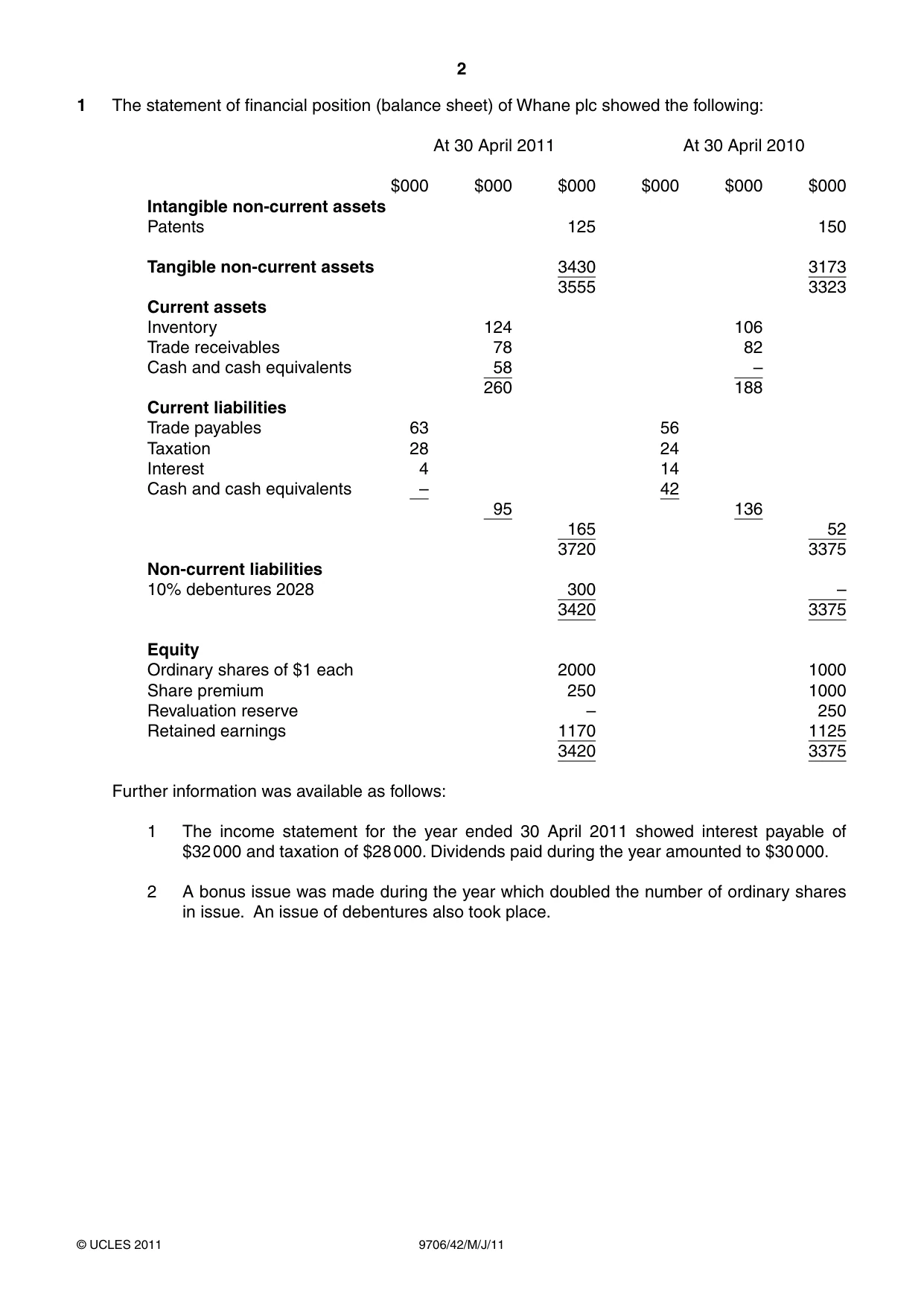
2 9706/42/M/J/11 © UCLES 2011 1 The statement of financial position (balance sheet) of Whane plc showed the following: At 30 April 2011 At 30 April 2010 $000 $000 $000 $000 $000 $000 Intangible non-current assets Patents 125 150 Tangible non-current assets 3430 3173 3555 3323 Current assets Inventory 124 106 Trade receivables 78 82 Cash and cash equivalents 58 – 260 188 Current liabilities Trade payables 63 56 Taxation 28 24 Interest 4 14 Cash and cash equivalents – 42 95 136 165 52 3720 3375 Non-current liabilities 10% debentures 2028 300 – 3420 3375 Equity Ordinary shares of $1 each 2000 1000 Share premium 250 1000 Revaluation reserve – 250 Retained earnings 1170 1125 3420 3375 Further information was available as follows: 1 The income statement for the year ended 30 April 2011 showed interest payable of $32 000 and taxation of $28 000. Dividends paid during the year amounted to $30 000. 2 A bonus issue was made during the year which doubled the number of ordinary shares in issue. An issue of debentures also took place.
Question paper, page 3
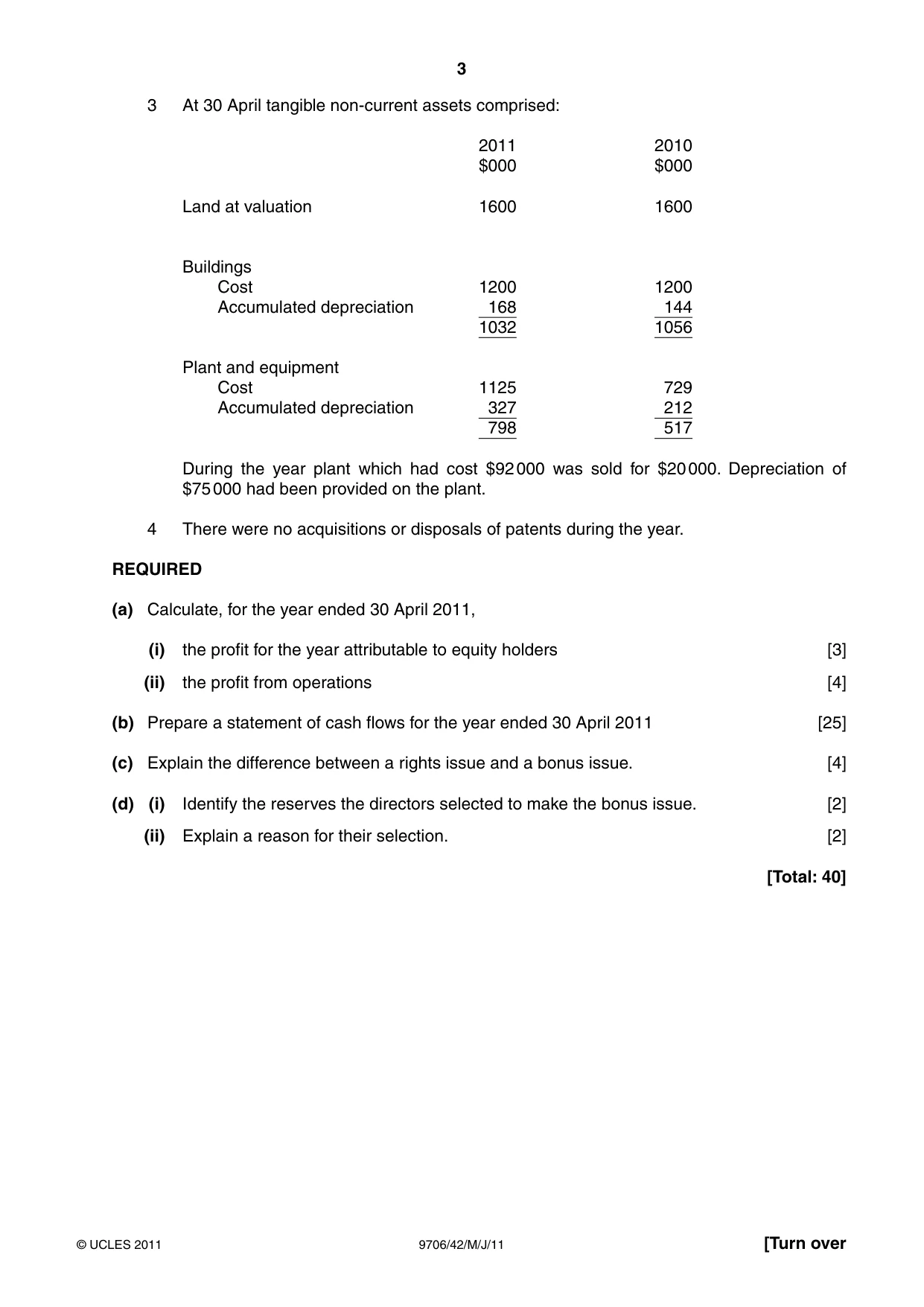
3 9706/42/M/J/11 © UCLES 2011 [Turn over 3 At 30 April tangible non-current assets comprised: 2011 2010 $000 $000 Land at valuation 1600 1600 Buildings Cost 1200 1200 Accumulated depreciation 168 144 1032 1056 Plant and equipment Cost 1125 729 Accumulated depreciation 327 212 798 517 During the year plant which had cost $92 000 was sold for $20 000. Depreciation of $75 000 had been provided on the plant. 4 There were no acquisitions or disposals of patents during the year. REQUIRED (a) Calculate, for the year ended 30 April 2011, (i) the profit for the year attributable to equity holders [3] (ii) the profit from operations [4] (b) Prepare a statement of cash flows for the year ended 30 April 2011 [25] (c) Explain the difference between a rights issue and a bonus issue. [4] (d) (i) Identify the reserves the directors selected to make the bonus issue. [2] (ii) Explain a reason for their selection. [2] [Total: 40]
Question paper, page 4
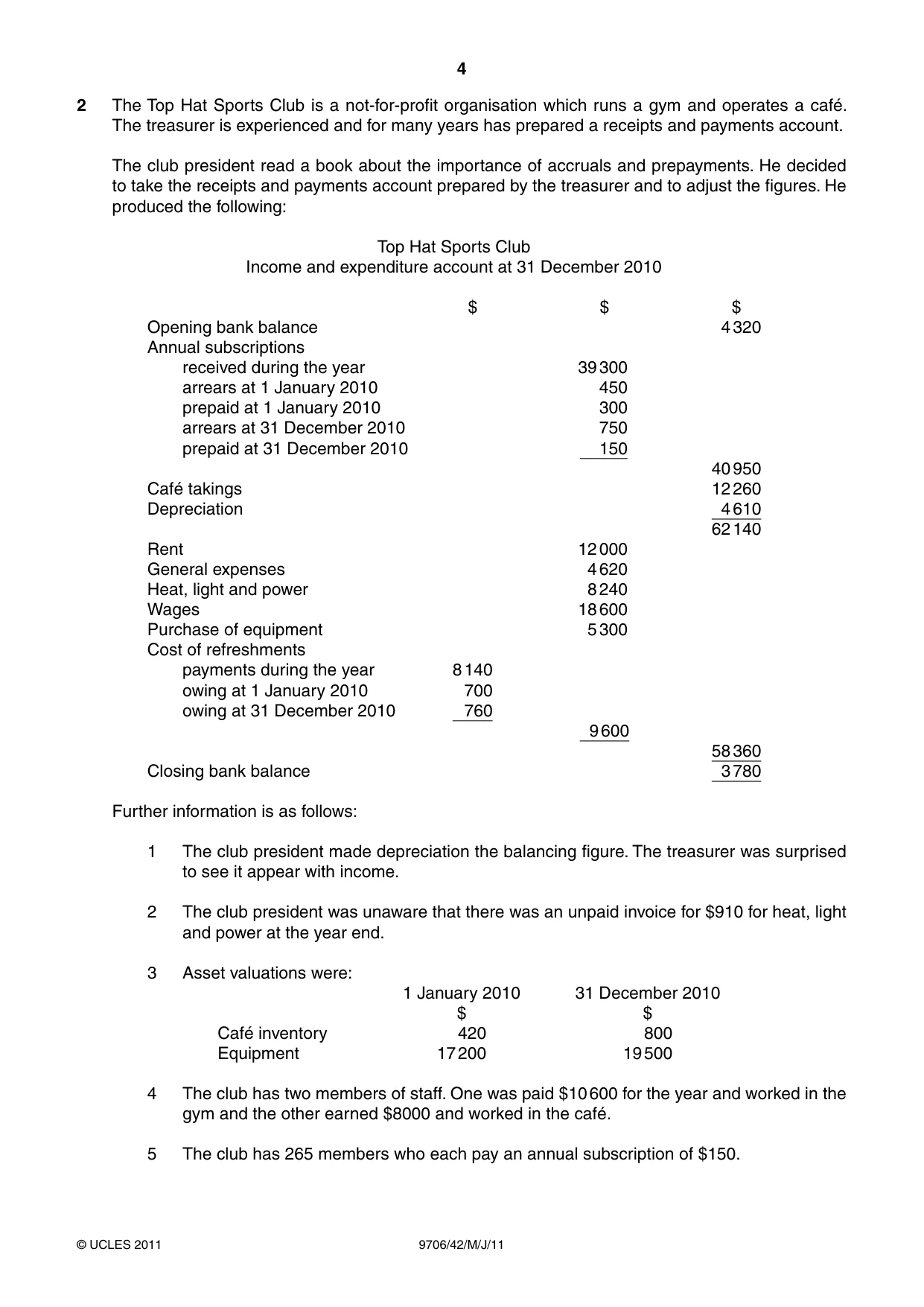
4 9706/42/M/J/11 © UCLES 2011 2 The Top Hat Sports Club is a not-for-profit organisation which runs a gym and operates a café. The treasurer is experienced and for many years has prepared a receipts and payments account. The club president read a book about the importance of accruals and prepayments. He decided to take the receipts and payments account prepared by the treasurer and to adjust the figures. He produced the following: Top Hat Sports Club Income and expenditure account at 31 December 2010 $ $ $ Opening bank balance 4 320 Annual subscriptions received during the year 39 300 arrears at 1 January 2010 450 prepaid at 1 January 2010 300 arrears at 31 December 2010 750 prepaid at 31 December 2010 150 40 950 Café takings 12 260 Depreciation 4 610 62 140 Rent 12 000 General expenses 4 620 Heat, light and power 8 240 Wages 18 600 Purchase of equipment 5 300 Cost of refreshments payments during the year 8 140 owing at 1 January 2010 700 owing at 31 December 2010 760 9 600 58 360 Closing bank balance 3 780 Further information is as follows: 1 The club president made depreciation the balancing figure. The treasurer was surprised to see it appear with income. 2 The club president was unaware that there was an unpaid invoice for $910 for heat, light and power at the year end. 3 Asset valuations were: 1 January 2010 31 December 2010 $ $ Café inventory 420 800 Equipment 17 200 19 500 4 The club has two members of staff. One was paid $10 600 for the year and worked in the gym and the other earned $8000 and worked in the café. 5 The club has 265 members who each pay an annual subscription of $150.
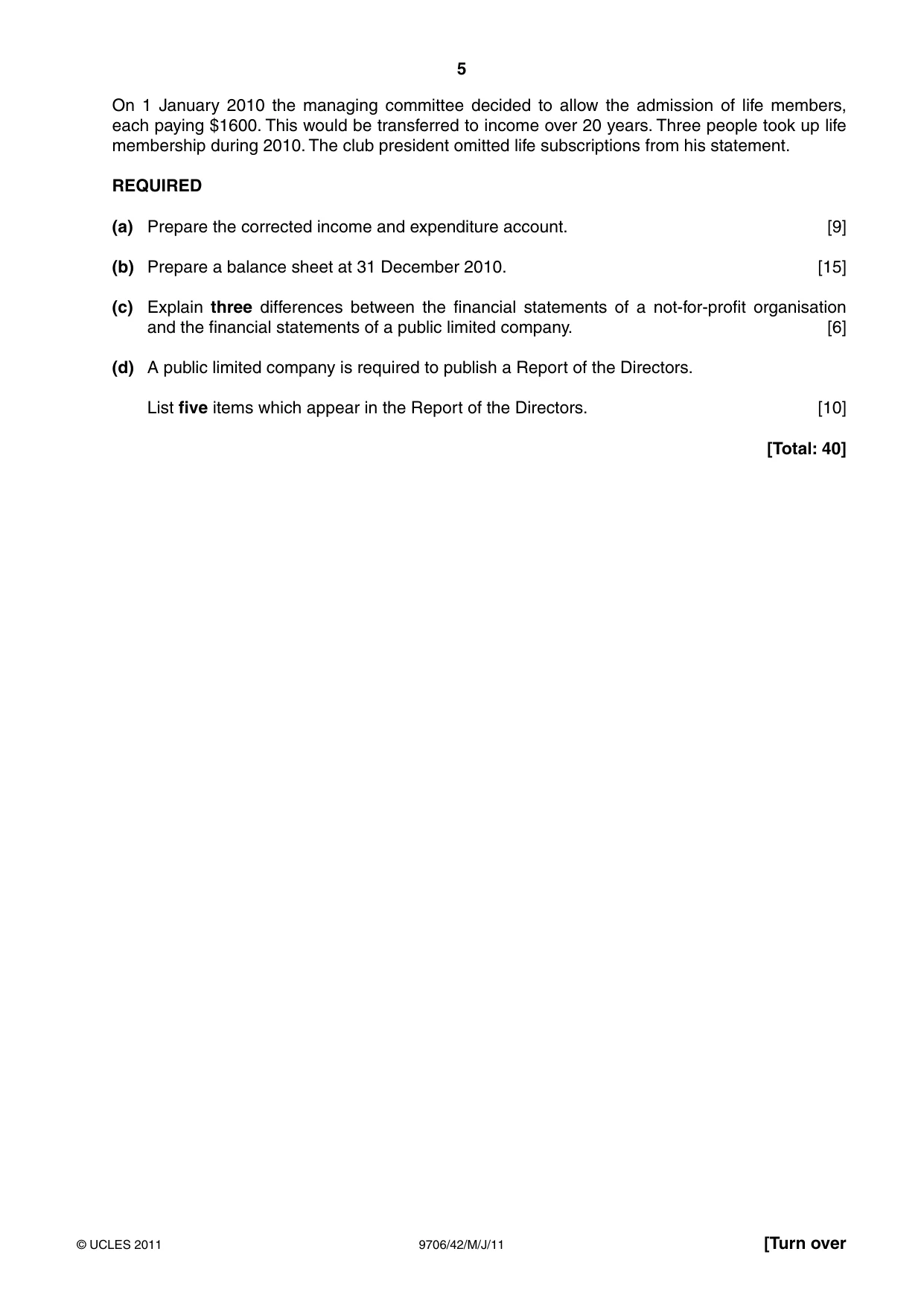
Question paper, page 5
5 9706/42/M/J/11 © UCLES 2011 [Turn over On 1 January 2010 the managing committee decided to allow the admission of life members, each paying $1600. This would be transferred to income over 20 years. Three people took up life membership during 2010. The club president omitted life subscriptions from his statement. REQUIRED (a) Prepare the corrected income and expenditure account. [9] (b) Prepare a balance sheet at 31 December 2010. [15] (c) Explain three differences between the financial statements of a not-for-profit organisation and the financial statements of a public limited company. [6] (d) A public limited company is required to publish a Report of the Directors. List five items which appear in the Report of the Directors. [10] [Total: 40]
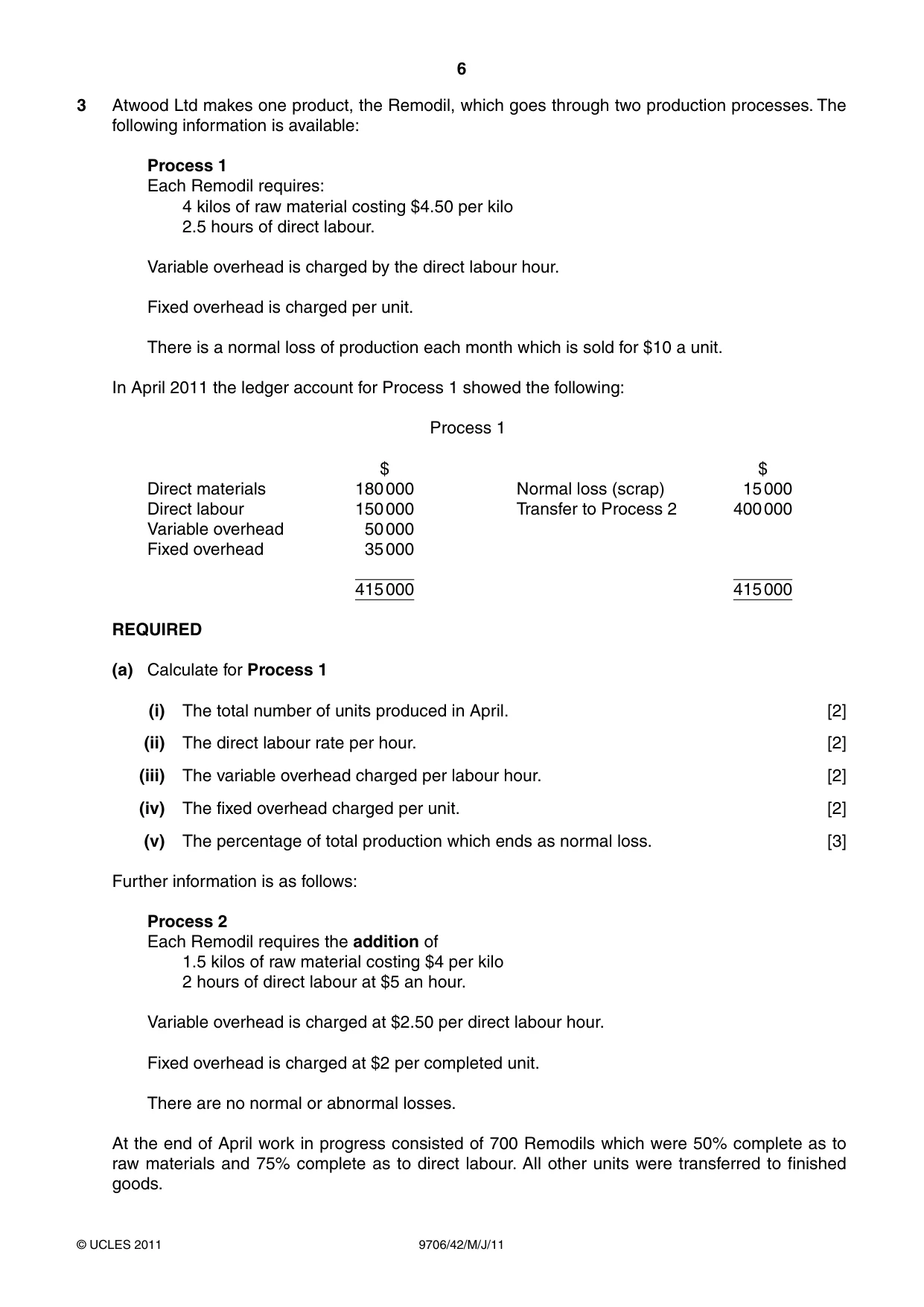
Question paper, page 6
6 9706/42/M/J/11 © UCLES 2011 3 Atwood Ltd makes one product, the Remodil, which goes through two production processes. The following information is available: Process 1 Each Remodil requires: 4 kilos of raw material costing $4.50 per kilo 2.5 hours of direct labour. Variable overhead is charged by the direct labour hour. Fixed overhead is charged per unit. There is a normal loss of production each month which is sold for $10 a unit. In April 2011 the ledger account for Process 1 showed the following: Process 1 $ $ Direct materials 180 000 Normal loss (scrap) 15 000 Direct labour 150 000 Transfer to Process 2 400 000 Variable overhead 50 000 Fixed overhead 35 000 315 000 315 000 415 000 415 000 REQUIRED (a) Calculate for Process 1 (i) The total number of units produced in April. [2] (ii) The direct labour rate per hour. [2] (iii) The variable overhead charged per labour hour. [2] (iv) The fixed overhead charged per unit. [2] (v) The percentage of total production which ends as normal loss. [3] Further information is as follows: Process 2 Each Remodil requires the addition of 1.5 kilos of raw material costing $4 per kilo 2 hours of direct labour at $5 an hour. Variable overhead is charged at $2.50 per direct labour hour. Fixed overhead is charged at $2 per completed unit. There are no normal or abnormal losses. At the end of April work in progress consisted of 700 Remodils which were 50% complete as to raw materials and 75% complete as to direct labour. All other units were transferred to finished goods.
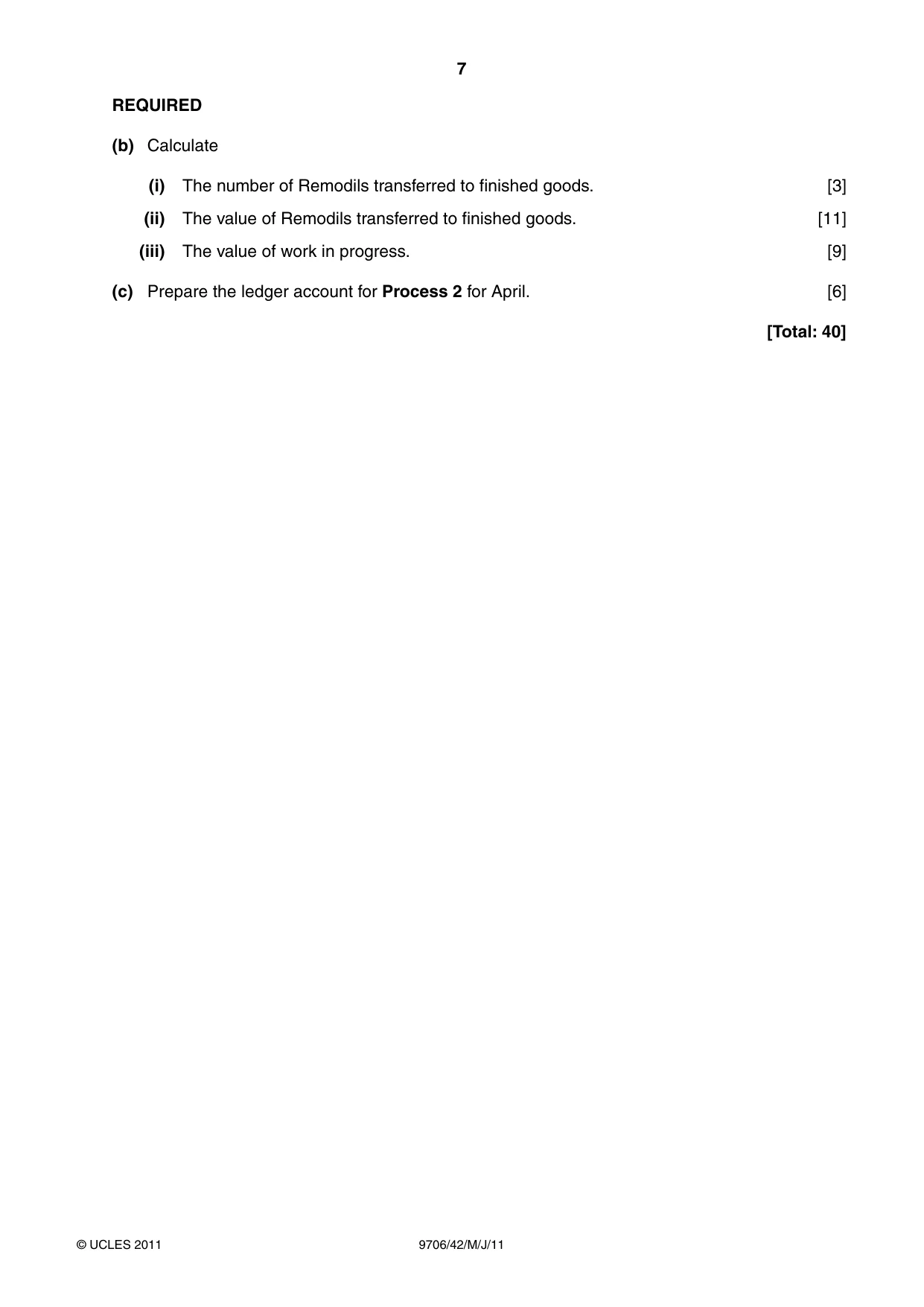
Question paper, page 7
7 9706/42/M/J/11 © UCLES 2011 REQUIRED (b) Calculate (i) The number of Remodils transferred to finished goods. [3] (ii) The value of Remodils transferred to finished goods. [11] (iii) The value of work in progress. [9] (c) Prepare the ledger account for Process 2 for April. [6] [Total: 40]
Question paper, page 8
8 9706/42/M/J/11 © UCLES 2011 BLANK PAGE Permission to reproduce items where third-party owned material protected by copyright is included has been sought and cleared where possible. Every reasonable effort has been made by the publisher (UCLES) to trace copyright holders, but if any items requiring clearance have unwittingly been included, the publisher will be pleased to make amends at the earliest possible opportunity. University of Cambridge International Examinations is part of the Cambridge Assessment Group. Cambridge Assessment is the brand name of University of Cambridge Local Examinations Syndicate (UCLES), which is itself a department of the University of Cambridge.
Mark scheme, page 1
UNIVERSITY OF CAMBRIDGE INTERNATIONAL EXAMINATIONS GCE Advanced Level MARK SCHEME for the May/June 2011 question paper for the guidance of teachers 9706 ACCOUNTING 9706/42 Paper 4 (Problem Solving (Supplement)), maximum raw mark 120 This mark scheme is published as an aid to teachers and candidates, to indicate the requirements of the examination. It shows the basis on which Examiners were instructed to award marks. It does not indicate the details of the discussions that took place at an Examiners’ meeting before marking began, which would have considered the acceptability of alternative answers. Mark schemes must be read in conjunction with the question papers and the report on the examination. • Cambridge will not enter into discussions or correspondence in connection with these mark schemes. Cambridge is publishing the mark schemes for the May/June 2011 question papers for most IGCSE, GCE Advanced Level and Advanced Subsidiary Level syllabuses and some Ordinary Level syllabuses.
Mark scheme, page 2
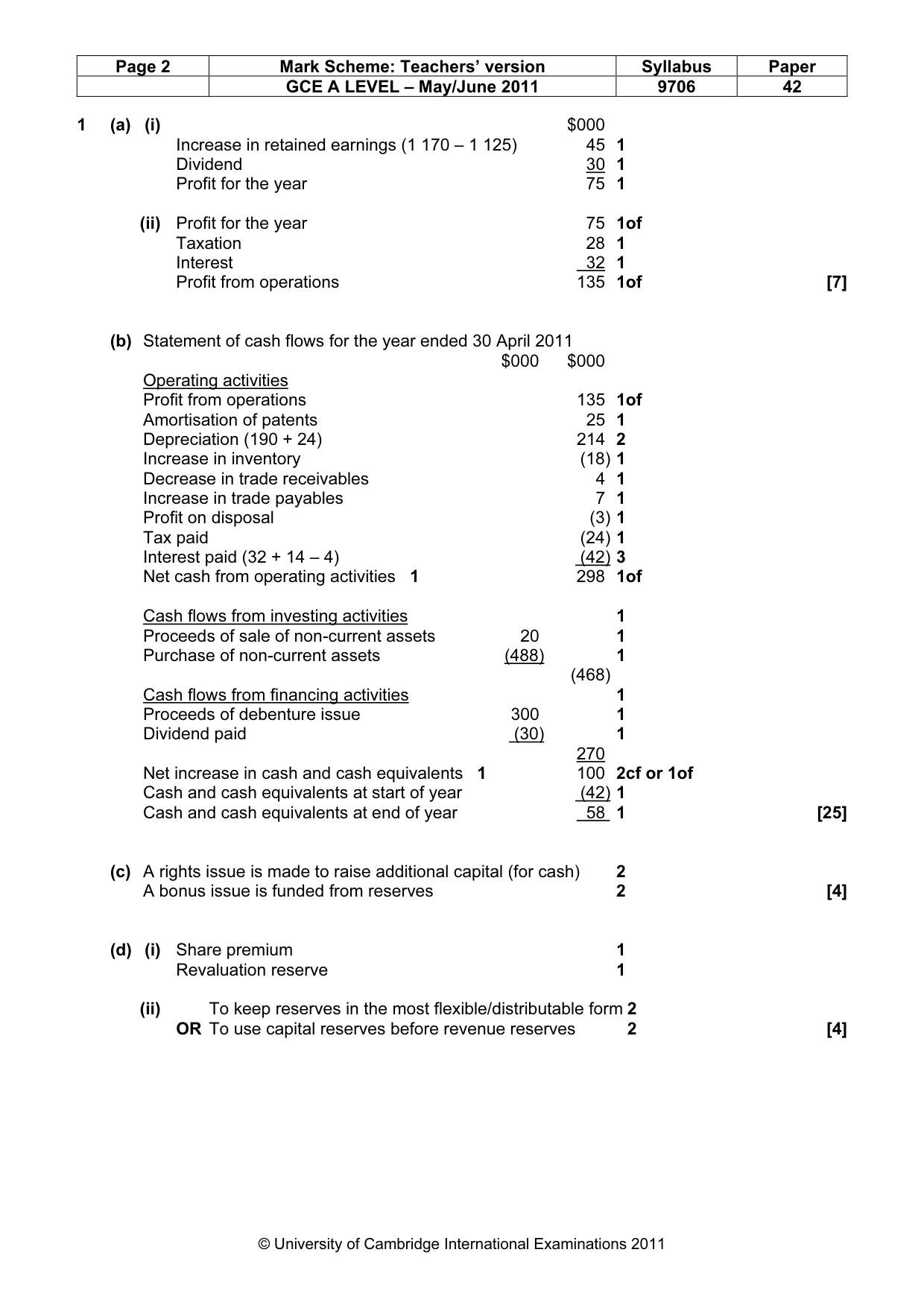
Page 2 Mark Scheme: Teachers’ version Syllabus Paper GCE A LEVEL – May/June 2011 9706 42 © University of Cambridge International Examinations 2011 1 (a) (i) $000 Increase in retained earnings (1 170 – 1 125) 45 1 Dividend 30 1 Profit for the year 75 1 (ii) Profit for the year 75 1of Taxation 28 1 Interest 32 1 Profit from operations 135 1of [7] (b) Statement of cash flows for the year ended 30 April 2011 $000 $000 Operating activities Profit from operations 135 1of Amortisation of patents 25 1 Depreciation (190 + 24) 214 2 Increase in inventory (18) 1 Decrease in trade receivables 4 1 Increase in trade payables 7 1 Profit on disposal (3) 1 Tax paid (24) 1 Interest paid (32 + 14 – 4) (42) 3 Net cash from operating activities 1 298 1of Cash flows from investing activities 1 Proceeds of sale of non-current assets 20 1 Purchase of non-current assets (488) 1 (468) Cash flows from financing activities 1 Proceeds of debenture issue 300 1 Dividend paid (30) 1 270 Net increase in cash and cash equivalents 1 100 2cf or 1of Cash and cash equivalents at start of year (42) 1 Cash and cash equivalents at end of year 58 1 [25] (c) A rights issue is made to raise additional capital (for cash) 2 A bonus issue is funded from reserves 2 [4] (d) (i) Share premium 1 Revaluation reserve 1 (ii) To keep reserves in the most flexible/distributable form 2 OR To use capital reserves before revenue reserves 2 [4]
Mark scheme, page 3
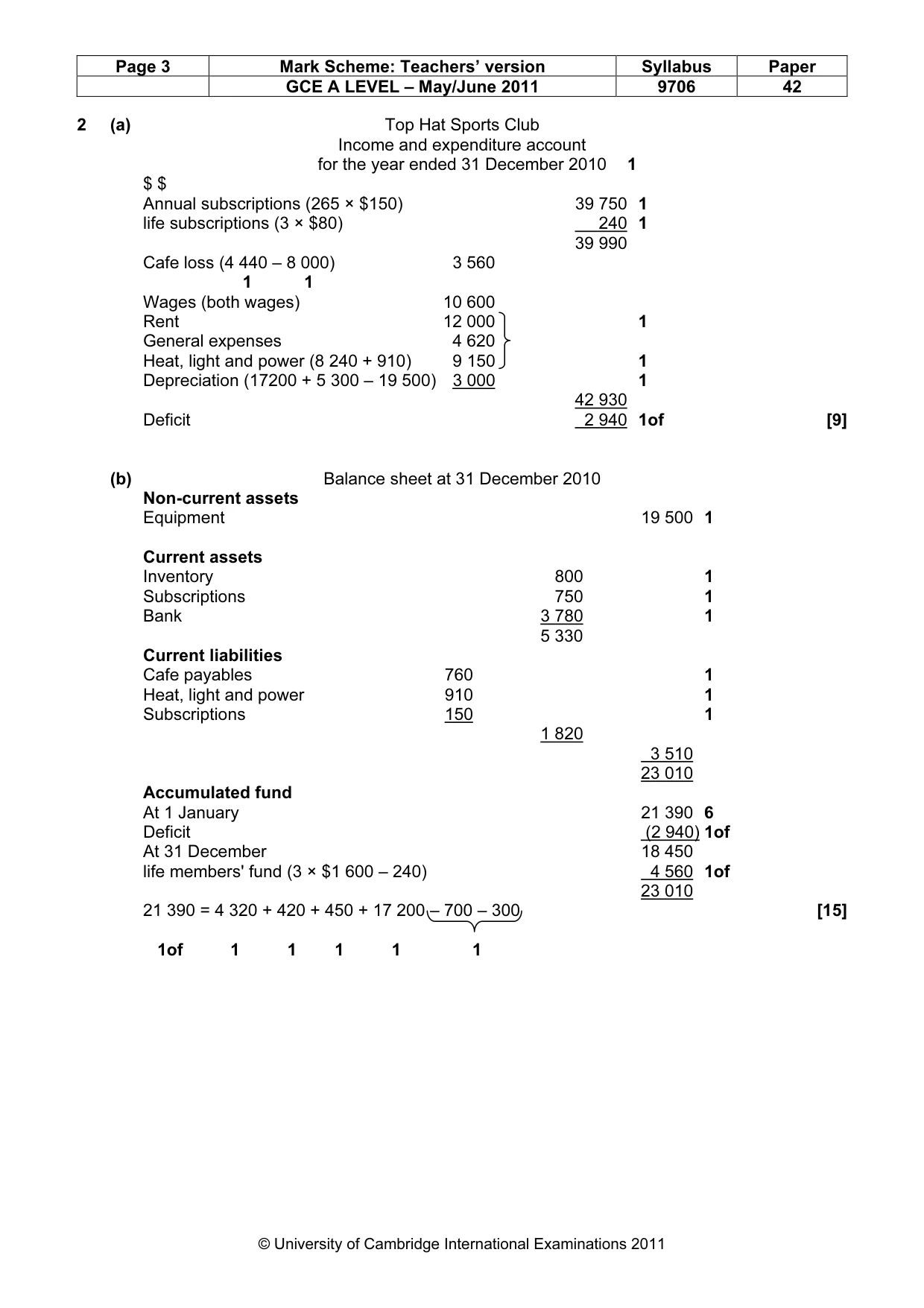
Page 3 Mark Scheme: Teachers’ version Syllabus Paper GCE A LEVEL – May/June 2011 9706 42 © University of Cambridge International Examinations 2011 2 (a) Top Hat Sports Club Income and expenditure account for the year ended 31 December 2010 1 $ $ Annual subscriptions (265 × $150) 39 750 1 life subscriptions (3 × $80) 240 1 39 990 Cafe loss (4 440 – 8 000) 3 560 1 1 Wages (both wages) 10 600 Rent 12 000 1 General expenses 4 620 Heat, light and power (8 240 + 910) 9 150 1 Depreciation (17200 + 5 300 – 19 500) 3 000 1 42 930 Deficit 2 940 1of [9] (b) Balance sheet at 31 December 2010 Non-current assets Equipment 19 500 1 Current assets Inventory 800 1 Subscriptions 750 1 Bank 3 780 1 5 330 Current liabilities Cafe payables 760 1 Heat, light and power 910 1 Subscriptions 150 1 1 820 3 510 23 010 Accumulated fund At 1 January 21 390 6 Deficit (2 940) 1of At 31 December 18 450 life members' fund (3 × $1 600 – 240) 4 560 1of 23 010 21 390 = 4 320 + 420 + 450 + 17 200 – 700 – 300 [15] 1of 1 1 1 1 1
Mark scheme, page 4
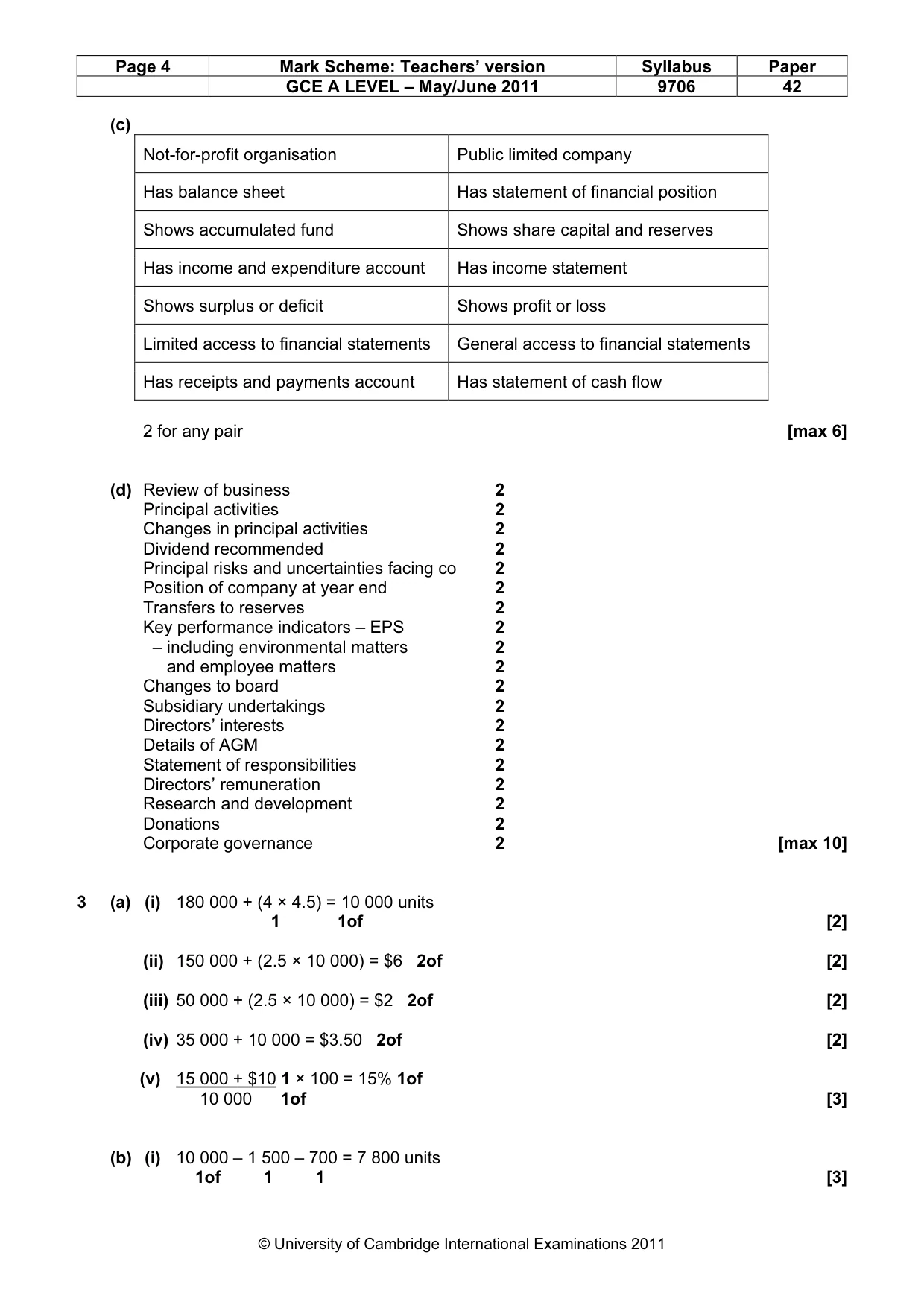
Page 4 Mark Scheme: Teachers’ version Syllabus Paper GCE A LEVEL – May/June 2011 9706 42 © University of Cambridge International Examinations 2011 (c) Not-for-profit organisation Public limited company Has balance sheet Has statement of financial position Shows accumulated fund Shows share capital and reserves Has income and expenditure account Has income statement Shows surplus or deficit Shows profit or loss Limited access to financial statements General access to financial statements Has receipts and payments account Has statement of cash flow 2 for any pair [max 6] (d) Review of business 2 Principal activities 2 Changes in principal activities 2 Dividend recommended 2 Principal risks and uncertainties facing co 2 Position of company at year end 2 Transfers to reserves 2 Key performance indicators – EPS 2 – including environmental matters 2 and employee matters 2 Changes to board 2 Subsidiary undertakings 2 Directors’ interests 2 Details of AGM 2 Statement of responsibilities 2 Directors’ remuneration 2 Research and development 2 Donations 2 Corporate governance 2 [max 10] 3 (a) (i) 180 000 + (4 × 4.5) = 10 000 units 1 1of [2] (ii) 150 000 + (2.5 × 10 000) = $6 2of [2] (iii) 50 000 + (2.5 × 10 000) = $2 2of [2] (iv) 35 000 + 10 000 = $3.50 2of [2] (v) 15 000 + $10 1 × 100 = 15% 1of 10 000 1of [3] (b) (i) 10 000 – 1 500 – 700 = 7 800 units 1of 1 1 [3]
Mark scheme, page 5
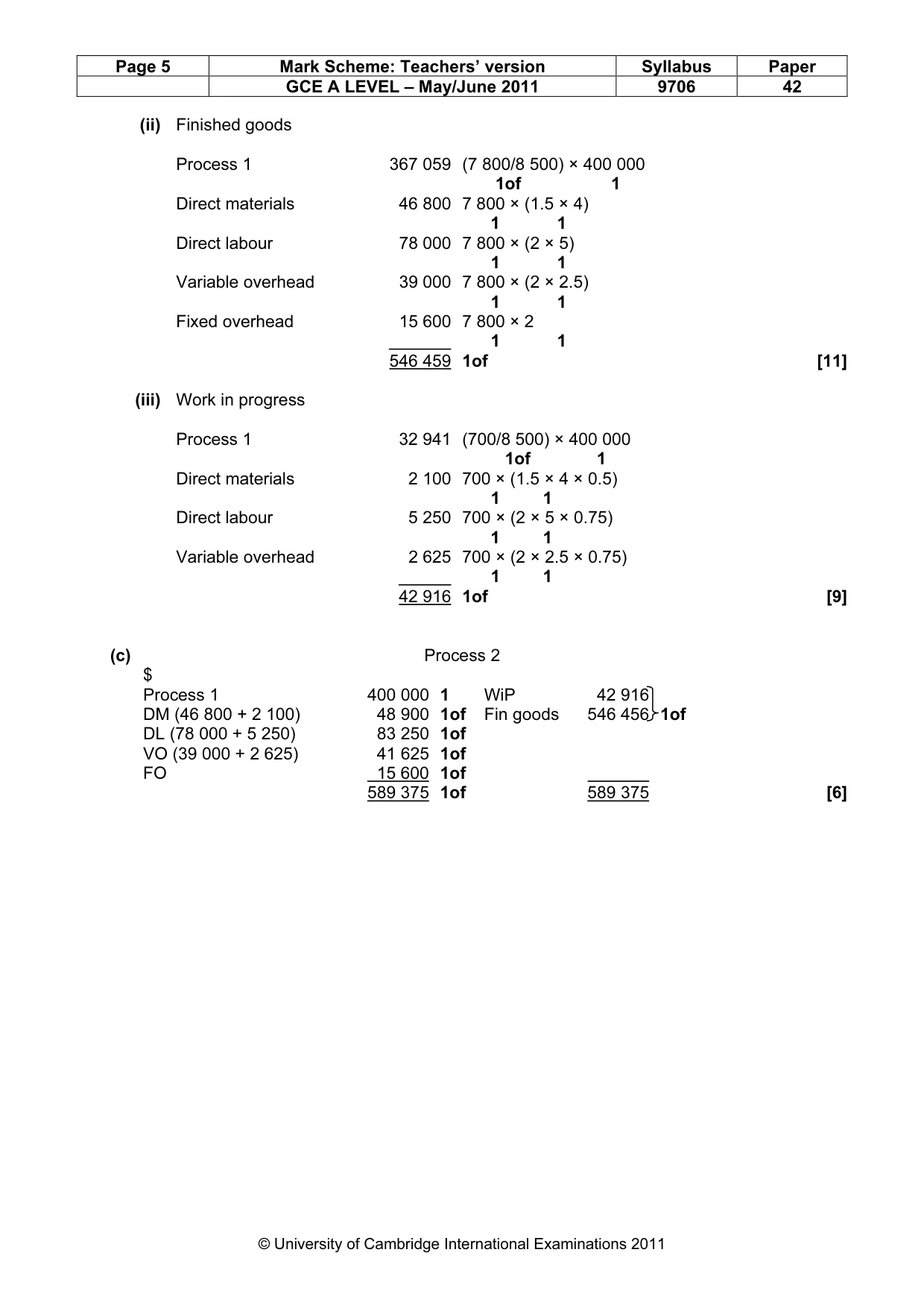
Page 5 Mark Scheme: Teachers’ version Syllabus Paper GCE A LEVEL – May/June 2011 9706 42 © University of Cambridge International Examinations 2011 (ii) Finished goods Process 1 367 059 (7 800/8 500) × 400 000 1of 1 Direct materials 46 800 7 800 × (1.5 × 4) 1 1 Direct labour 78 000 7 800 × (2 × 5) 1 1 Variable overhead 39 000 7 800 × (2 × 2.5) 1 1 Fixed overhead 15 600 7 800 × 2 1 1 546 459 1of [11] (iii) Work in progress Process 1 32 941 (700/8 500) × 400 000 1of 1 Direct materials 2 100 700 × (1.5 × 4 × 0.5) 1 1 Direct labour 5 250 700 × (2 × 5 × 0.75) 1 1 Variable overhead 2 625 700 × (2 × 2.5 × 0.75) 1 1 42 916 1of [9] (c) Process 2 $ Process 1 400 000 1 WiP 42 916 DM (46 800 + 2 100) 48 900 1of Fin goods 546 456 1of DL (78 000 + 5 250) 83 250 1of VO (39 000 + 2 625) 41 625 1of FO 15 600 1of 589 375 1of 589 375 [6]
What you needed in this session
Cambridge’s own grade thresholds for 2011 May/June, Paper 4 · Variant 2. A higher threshold means an easier paper — the bar moves with how the cohort did.