Cambridge A Level Accounting 9706 — 2011 May/June Paper 4 · Variant 3
9706/43/M/J/11 · 120 marks · ≈135 min
The question paper and its mark scheme, free to read here and free to download. This is Cambridge’s own paper, exactly as it was sat.
Question paper4 pages
Mark scheme4 pages
Answers below. Sit the paper first if you are practising.
Paper as text
Question paper, page 1
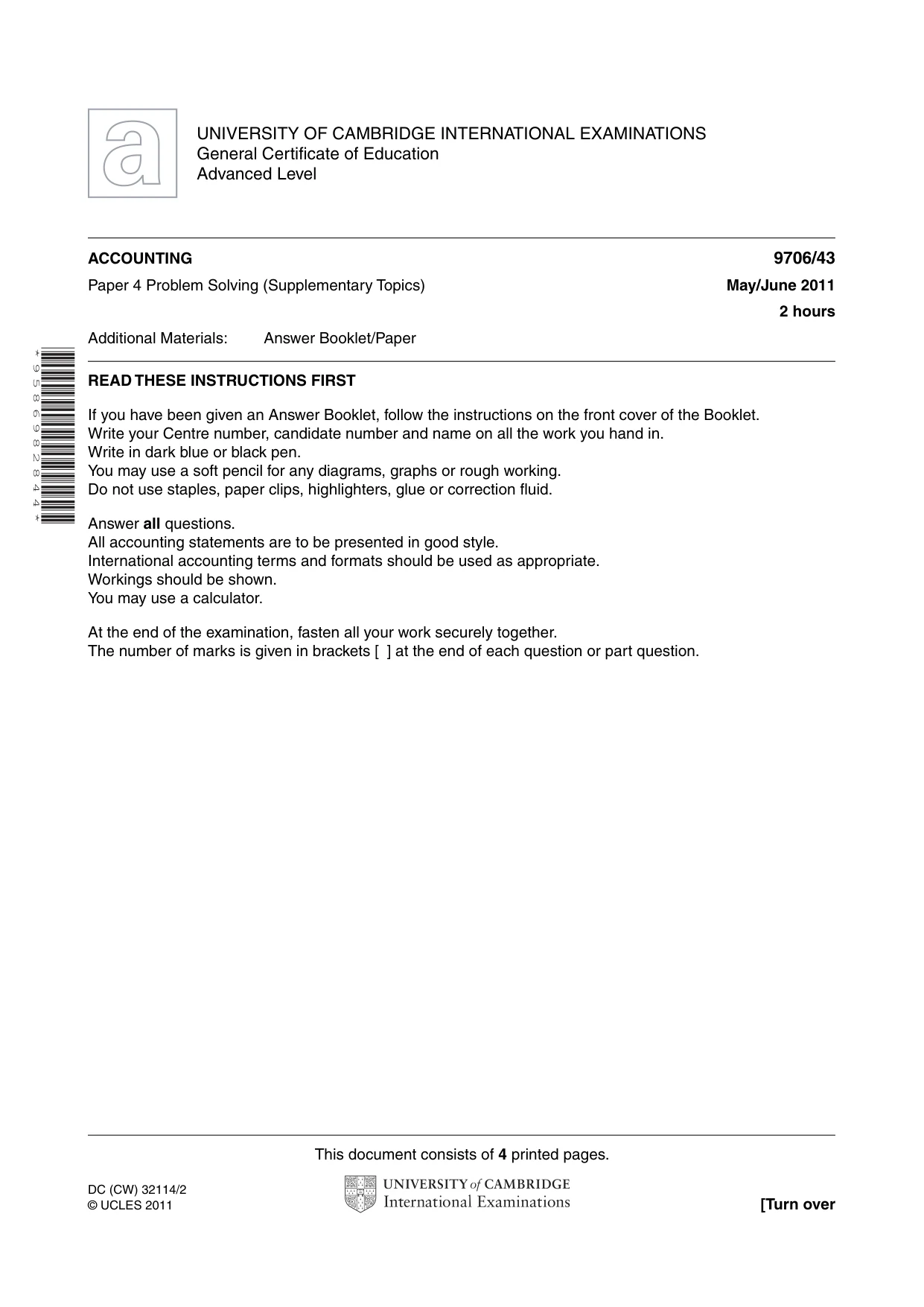
This document consists of 4 printed pages. DC (CW) 32114/2 © UCLES 2011 [Turn over UNIVERSITY OF CAMBRIDGE INTERNATIONAL EXAMINATIONS General Certificate of Education Advanced Level * 9 5 8 6 9 8 2 8 4 4 * ACCOUNTING 9706/43 Paper 4 Problem Solving (Supplementary Topics) May/June 2011 2 hours Additional Materials: Answer Booklet/Paper READ THESE INSTRUCTIONS FIRST If you have been given an Answer Booklet, follow the instructions on the front cover of the Booklet. Write your Centre number, candidate number and name on all the work you hand in. Write in dark blue or black pen. You may use a soft pencil for any diagrams, graphs or rough working. Do not use staples, paper clips, highlighters, glue or correction fluid. Answer all questions. All accounting statements are to be presented in good style. International accounting terms and formats should be used as appropriate. Workings should be shown. You may use a calculator. At the end of the examination, fasten all your work securely together. The number of marks is given in brackets [ ] at the end of each question or part question.
Question paper, page 2
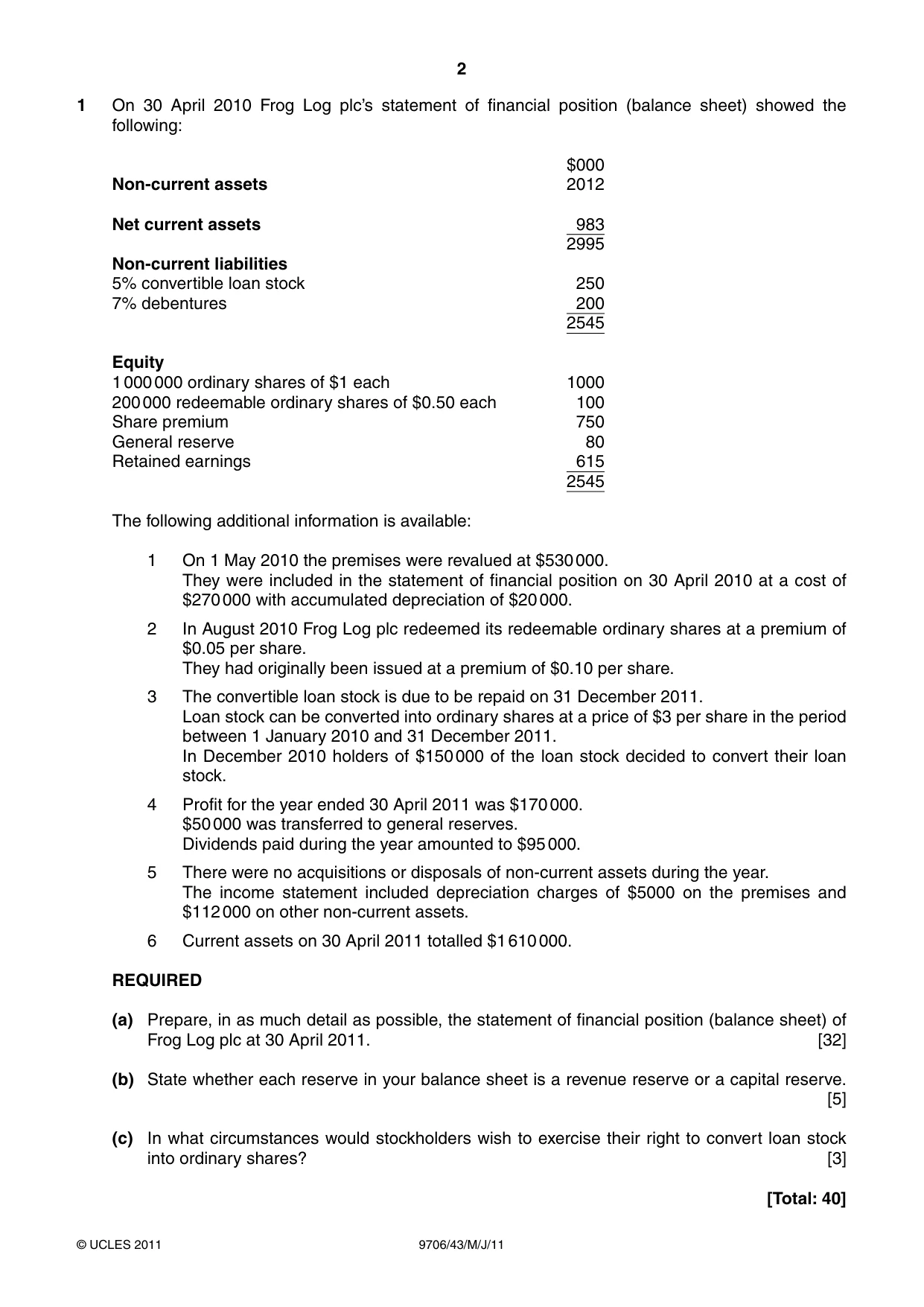
2 9706/43/M/J/11 © UCLES 2011 1 On 30 April 2010 Frog Log plc’s statement of financial position (balance sheet) showed the following: $000 Non-current assets 2012 Net current assets 983 2995 Non-current liabilities 5% convertible loan stock 250 7% debentures 200 2545 Equity 1 000 000 ordinary shares of $1 each 1000 200 000 redeemable ordinary shares of $0.50 each 100 Share premium 750 General reserve 80 Retained earnings 615 2545 The following additional information is available: 1 On 1 May 2010 the premises were revalued at $530 000. They were included in the statement of financial position on 30 April 2010 at a cost of $270 000 with accumulated depreciation of $20 000. 2 In August 2010 Frog Log plc redeemed its redeemable ordinary shares at a premium of $0.05 per share. They had originally been issued at a premium of $0.10 per share. 3 The convertible loan stock is due to be repaid on 31 December 2011. Loan stock can be converted into ordinary shares at a price of $3 per share in the period between 1 January 2010 and 31 December 2011. In December 2010 holders of $150 000 of the loan stock decided to convert their loan stock. 4 Profit for the year ended 30 April 2011 was $170 000. $50 000 was transferred to general reserves. Dividends paid during the year amounted to $95 000. 5 There were no acquisitions or disposals of non-current assets during the year. The income statement included depreciation charges of $5000 on the premises and $112 000 on other non-current assets. 6 Current assets on 30 April 2011 totalled $1 610 000. REQUIRED (a) Prepare, in as much detail as possible, the statement of financial position (balance sheet) of Frog Log plc at 30 April 2011. [32] (b) State whether each reserve in your balance sheet is a revenue reserve or a capital reserve. [5] (c) In what circumstances would stockholders wish to exercise their right to convert loan stock into ordinary shares? [3] [Total: 40]
Question paper, page 3
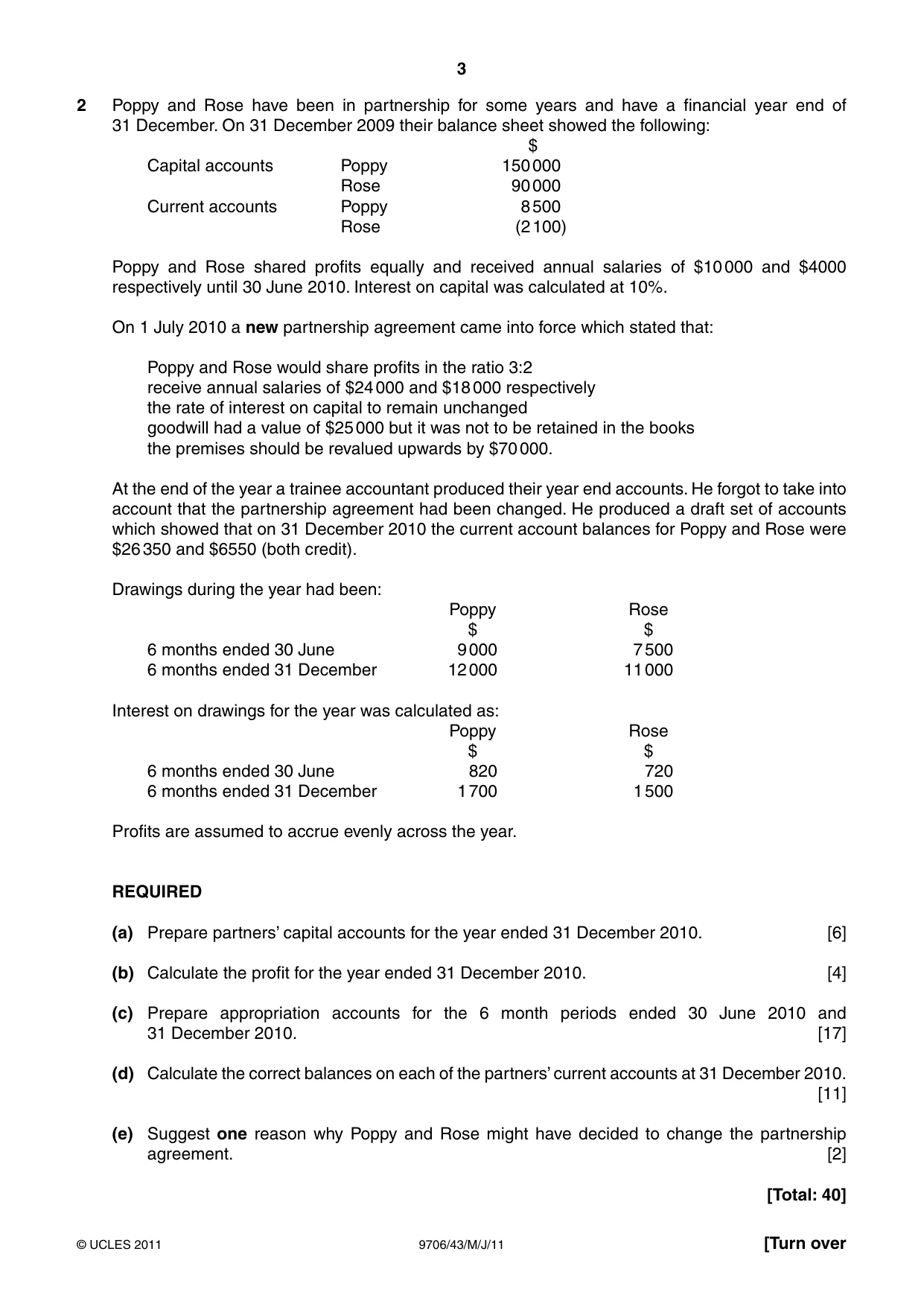
3 9706/43/M/J/11 © UCLES 2011 [Turn over 2 Poppy and Rose have been in partnership for some years and have a financial year end of 31 December. On 31 December 2009 their balance sheet showed the following: $ Capital accounts Poppy 150 000 Rose 90 000 Current accounts Poppy 8 500 Rose (2 100) Poppy and Rose shared profits equally and received annual salaries of $10 000 and $4000 respectively until 30 June 2010. Interest on capital was calculated at 10%. On 1 July 2010 a new partnership agreement came into force which stated that: Poppy and Rose would share profits in the ratio 3:2 receive annual salaries of $24 000 and $18 000 respectively the rate of interest on capital to remain unchanged goodwill had a value of $25 000 but it was not to be retained in the books the premises should be revalued upwards by $70 000. At the end of the year a trainee accountant produced their year end accounts. He forgot to take into account that the partnership agreement had been changed. He produced a draft set of accounts which showed that on 31 December 2010 the current account balances for Poppy and Rose were $26 350 and $6550 (both credit). Drawings during the year had been: Poppy Rose $ $ 6 months ended 30 June 9 000 7 500 6 months ended 31 December 12 000 11 000 Interest on drawings for the year was calculated as: Poppy Rose $ $ 6 months ended 30 June 820 720 6 months ended 31 December 1 700 1 500 Profits are assumed to accrue evenly across the year. REQUIRED (a) Prepare partners’ capital accounts for the year ended 31 December 2010. [6] (b) Calculate the profit for the year ended 31 December 2010. [4] (c) Prepare appropriation accounts for the 6 month periods ended 30 June 2010 and 31 December 2010. [17] (d) Calculate the correct balances on each of the partners’ current accounts at 31 December 2010. [11] (e) Suggest one reason why Poppy and Rose might have decided to change the partnership agreement. [2] [Total: 40]
Question paper, page 4
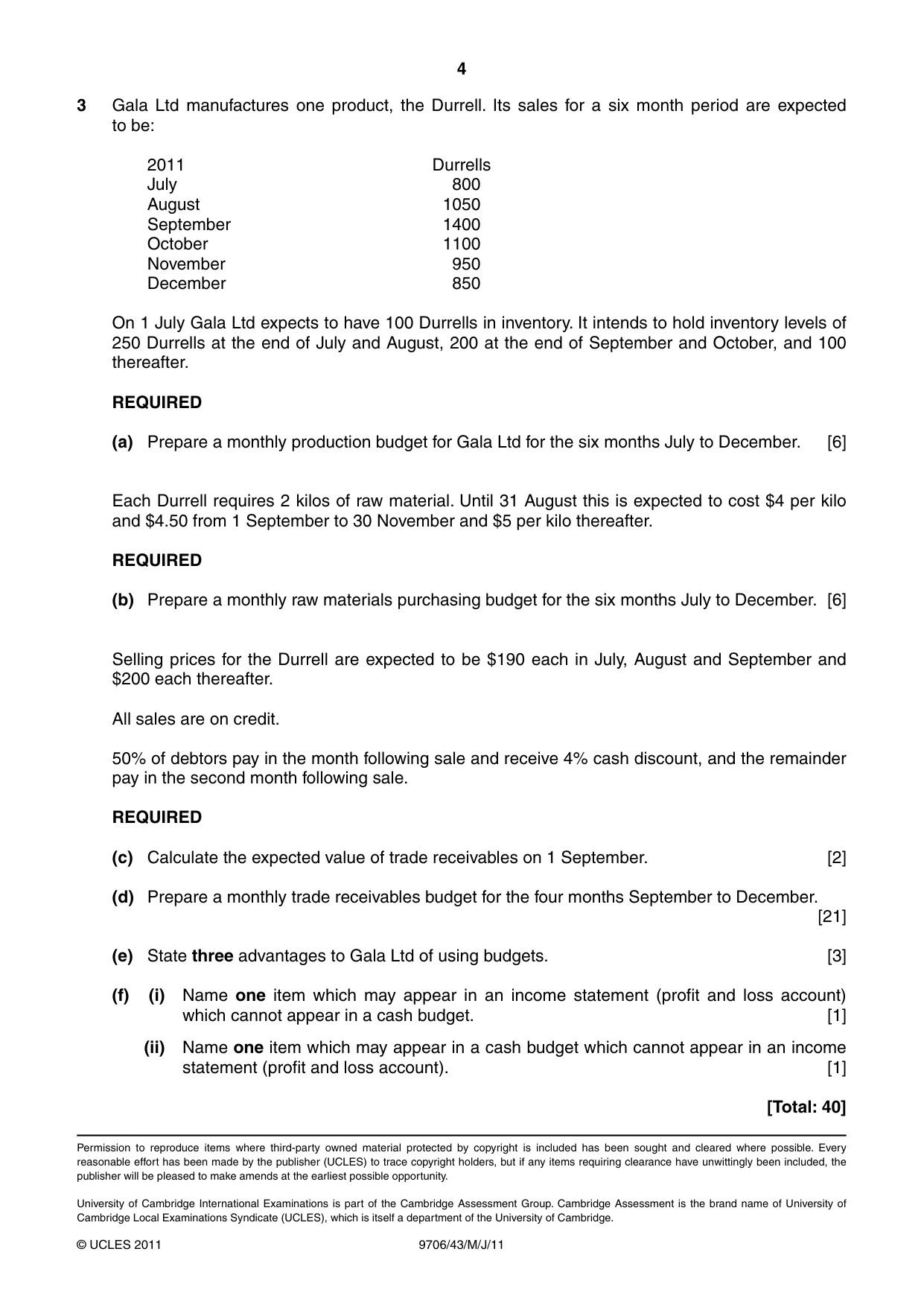
4 9706/43/M/J/11 © UCLES 2011 3 Gala Ltd manufactures one product, the Durrell. Its sales for a six month period are expected to be: 2011 Durrells July 800 August 1050 September 1400 October 1100 November 950 December 850 On 1 July Gala Ltd expects to have 100 Durrells in inventory. It intends to hold inventory levels of 250 Durrells at the end of July and August, 200 at the end of September and October, and 100 thereafter. REQUIRED (a) Prepare a monthly production budget for Gala Ltd for the six months July to December. [6] Each Durrell requires 2 kilos of raw material. Until 31 August this is expected to cost $4 per kilo and $4.50 from 1 September to 30 November and $5 per kilo thereafter. REQUIRED (b) Prepare a monthly raw materials purchasing budget for the six months July to December. [6] Selling prices for the Durrell are expected to be $190 each in July, August and September and $200 each thereafter. All sales are on credit. 50% of debtors pay in the month following sale and receive 4% cash discount, and the remainder pay in the second month following sale. REQUIRED (c) Calculate the expected value of trade receivables on 1 September. [2] (d) Prepare a monthly trade receivables budget for the four months September to December. [21] (e) State three advantages to Gala Ltd of using budgets. [3] (f) (i) Name one item which may appear in an income statement (profit and loss account) which cannot appear in a cash budget. [1] (ii) Name one item which may appear in a cash budget which cannot appear in an income statement (profit and loss account). [1] [Total: 40] Permission to reproduce items where third-party owned material protected by copyright is included has been sought and cleared where possible. Every reasonable effort has been made by the publisher (UCLES) to trace copyright holders, but if any items requiring clearance have unwittingly been included, the publisher will be pleased to make amends at the earliest possible opportunity. University of Cambridge International Examinations is part of the Cambridge Assessment Group. Cambridge Assessment is the brand name of University of Cambridge Local Examinations Syndicate (UCLES), which is itself a department of the University of Cambridge.
Mark scheme, page 1
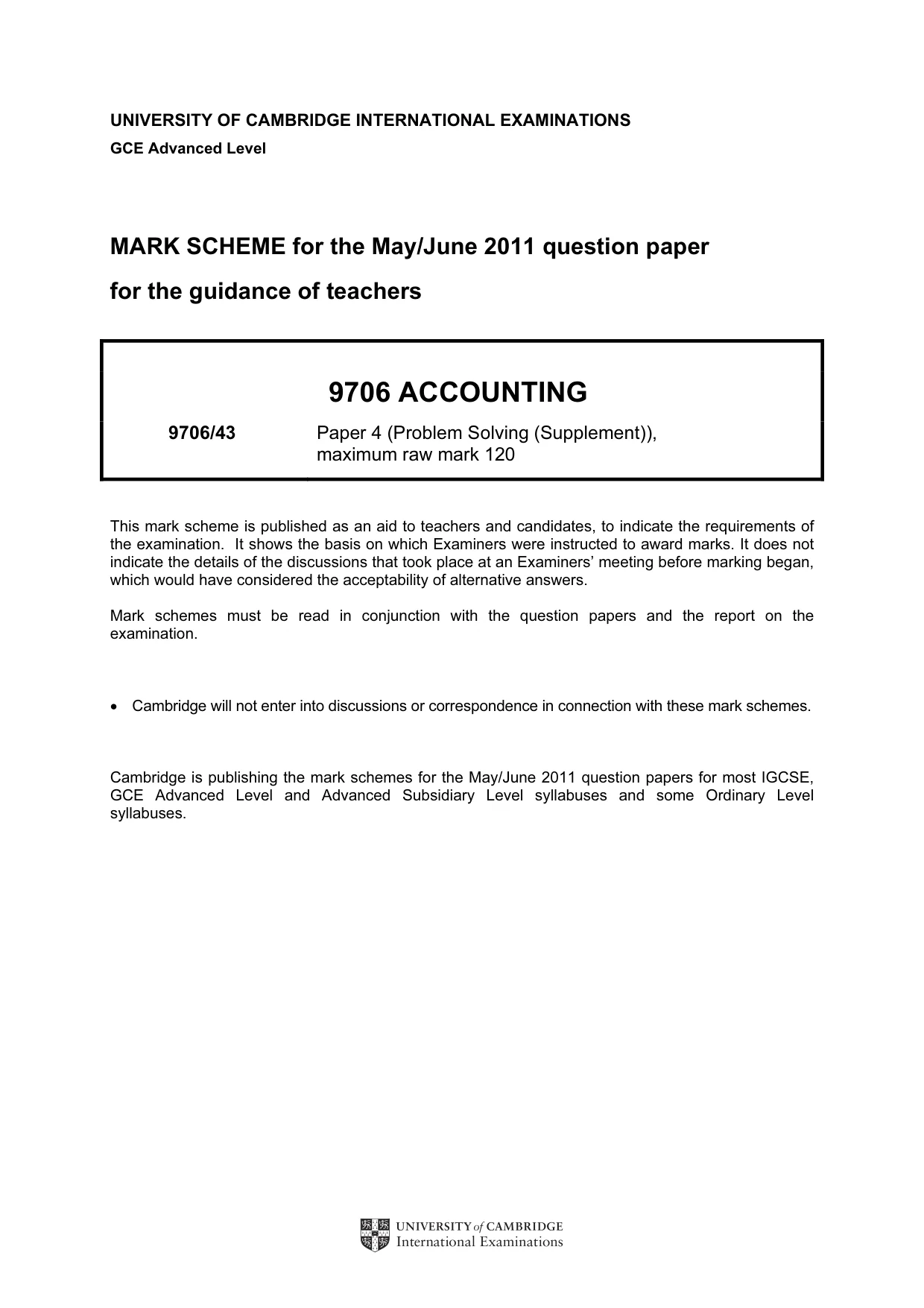
UNIVERSITY OF CAMBRIDGE INTERNATIONAL EXAMINATIONS GCE Advanced Level MARK SCHEME for the May/June 2011 question paper for the guidance of teachers 9706 ACCOUNTING 9706/43 Paper 4 (Problem Solving (Supplement)), maximum raw mark 120 This mark scheme is published as an aid to teachers and candidates, to indicate the requirements of the examination. It shows the basis on which Examiners were instructed to award marks. It does not indicate the details of the discussions that took place at an Examiners’ meeting before marking began, which would have considered the acceptability of alternative answers. Mark schemes must be read in conjunction with the question papers and the report on the examination. • Cambridge will not enter into discussions or correspondence in connection with these mark schemes. Cambridge is publishing the mark schemes for the May/June 2011 question papers for most IGCSE, GCE Advanced Level and Advanced Subsidiary Level syllabuses and some Ordinary Level syllabuses.
Mark scheme, page 2
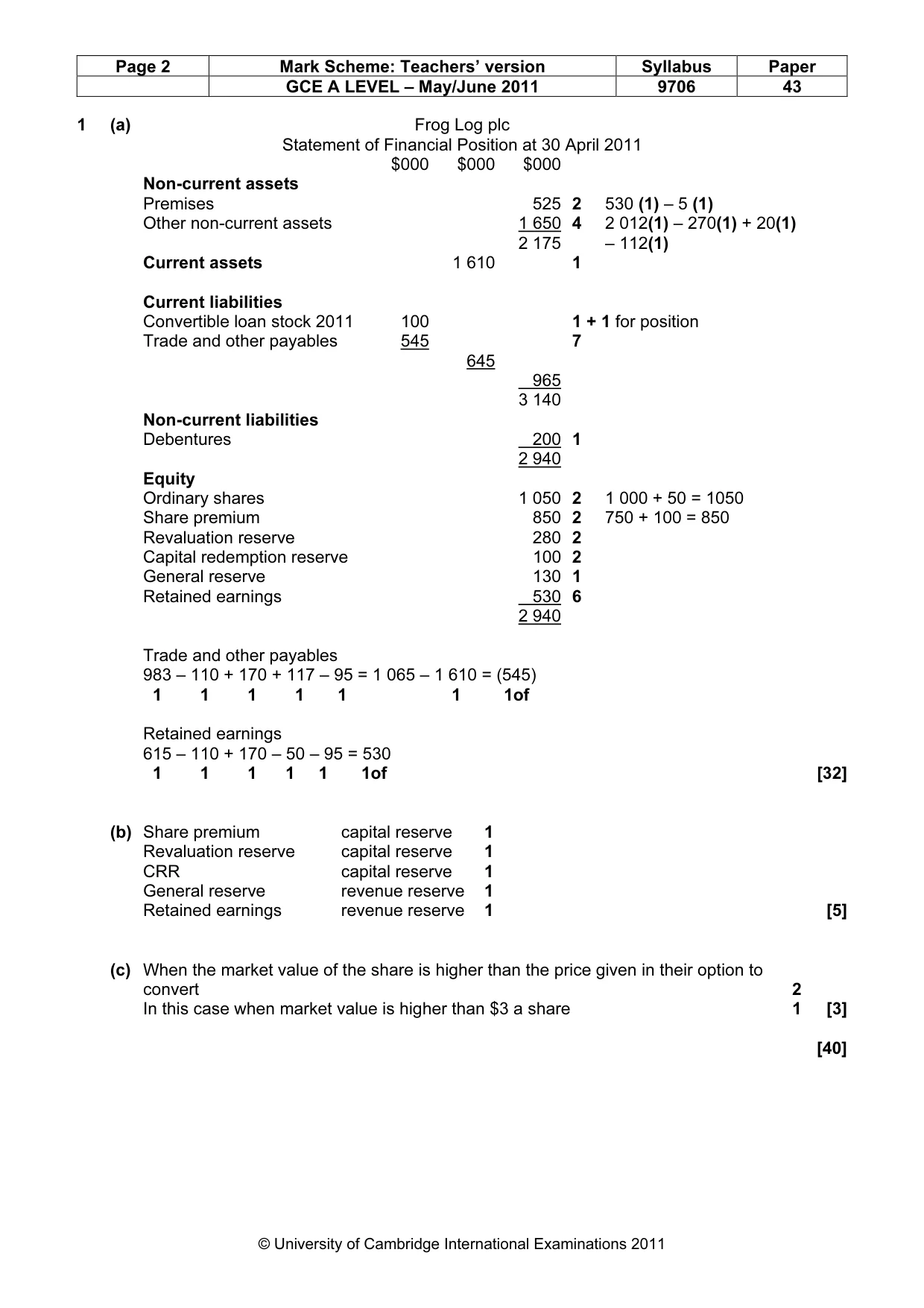
Page 2 Mark Scheme: Teachers’ version Syllabus Paper GCE A LEVEL – May/June 2011 9706 43 © University of Cambridge International Examinations 2011 1 (a) Frog Log plc Statement of Financial Position at 30 April 2011 $000 $000 $000 Non-current assets Premises 525 2 530 (1) – 5 (1) Other non-current assets 1 650 4 2 012(1) – 270(1) + 20(1) 2 175 – 112(1) Current assets 1 610 1 Current liabilities Convertible loan stock 2011 100 1 + 1 for position Trade and other payables 545 7 645 965 3 140 Non-current liabilities Debentures 200 1 2 940 Equity Ordinary shares 1 050 2 1 000 + 50 = 1050 Share premium 850 2 750 + 100 = 850 Revaluation reserve 280 2 Capital redemption reserve 100 2 General reserve 130 1 Retained earnings 530 6 2 940 Trade and other payables 983 – 110 + 170 + 117 – 95 = 1 065 – 1 610 = (545) 1 1 1 1 1 1 1of Retained earnings 615 – 110 + 170 – 50 – 95 = 530 1 1 1 1 1 1of [32] (b) Share premium capital reserve 1 Revaluation reserve capital reserve 1 CRR capital reserve 1 General reserve revenue reserve 1 Retained earnings revenue reserve 1 [5] (c) When the market value of the share is higher than the price given in their option to convert 2 In this case when market value is higher than $3 a share 1 [3] [40]
Mark scheme, page 3
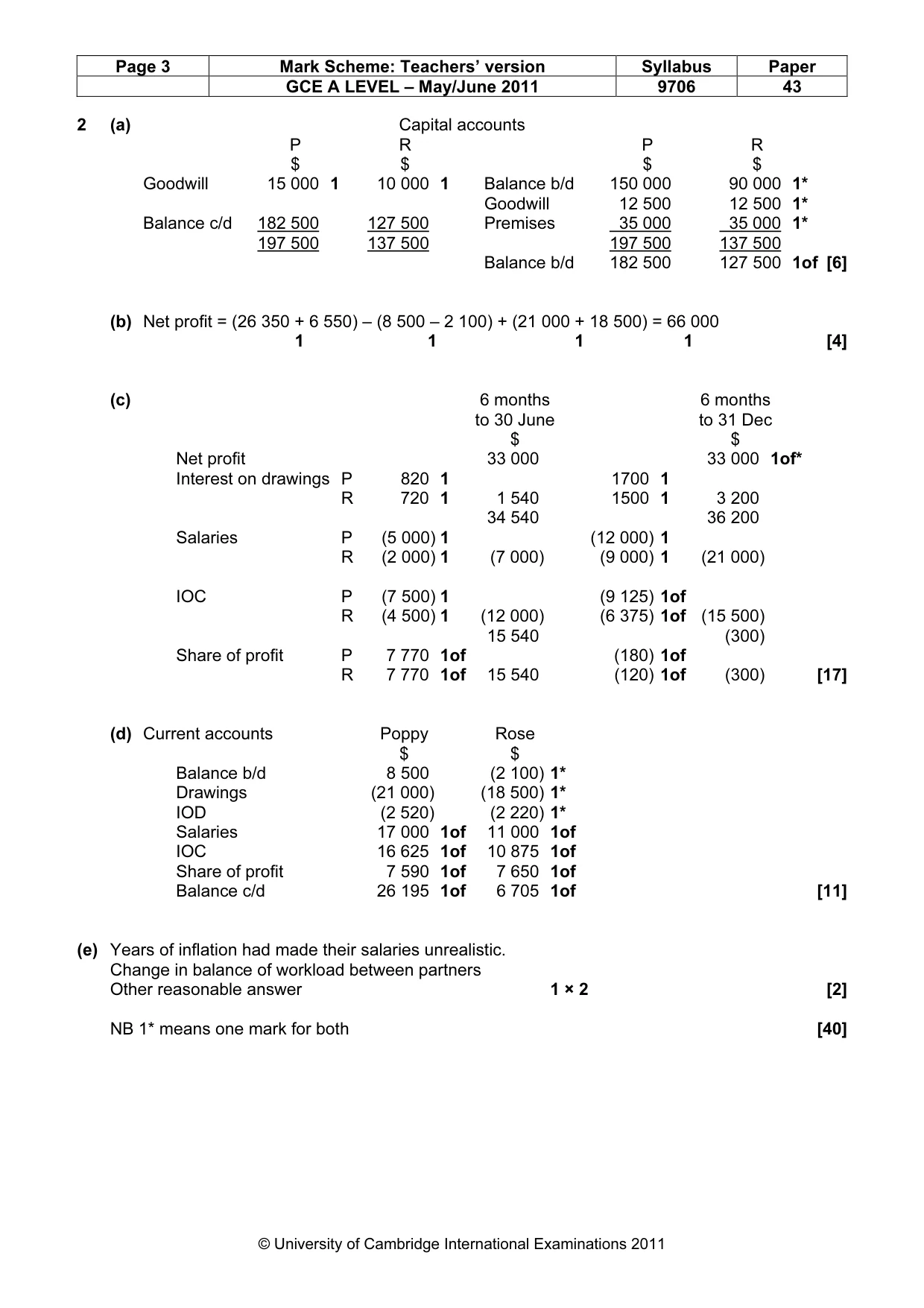
Page 3 Mark Scheme: Teachers’ version Syllabus Paper GCE A LEVEL – May/June 2011 9706 43 © University of Cambridge International Examinations 2011 2 (a) Capital accounts P R P R $ $ $ $ Goodwill 15 000 1 10 000 1 Balance b/d 150 000 90 000 1* Goodwill 12 500 12 500 1* Balance c/d 182 500 127 500 Premises 35 000 35 000 1* 197 500 137 500 197 500 137 500 Balance b/d 182 500 127 500 1of [6] (b) Net profit = (26 350 + 6 550) – (8 500 – 2 100) + (21 000 + 18 500) = 66 000 1 1 1 1 [4] (c) 6 months 6 months to 30 June to 31 Dec $ $ Net profit 33 000 33 000 1of* Interest on drawings P 820 1 1700 1 R 720 1 1 540 1500 1 3 200 34 540 36 200 Salaries P (5 000) 1 (12 000) 1 R (2 000) 1 (7 000) (9 000) 1 (21 000) IOC P (7 500) 1 (9 125) 1of R (4 500) 1 (12 000) (6 375) 1of (15 500) 15 540 (300) Share of profit P 7 770 1of (180) 1of R 7 770 1of 15 540 (120) 1of (300) [17] (d) Current accounts Poppy Rose $ $ Balance b/d 8 500 (2 100) 1* Drawings (21 000) (18 500) 1* IOD (2 520) (2 220) 1* Salaries 17 000 1of 11 000 1of IOC 16 625 1of 10 875 1of Share of profit 7 590 1of 7 650 1of Balance c/d 26 195 1of 6 705 1of [11] (e) Years of inflation had made their salaries unrealistic. Change in balance of workload between partners Other reasonable answer 1 × 2 [2] NB 1* means one mark for both [40]
Mark scheme, page 4
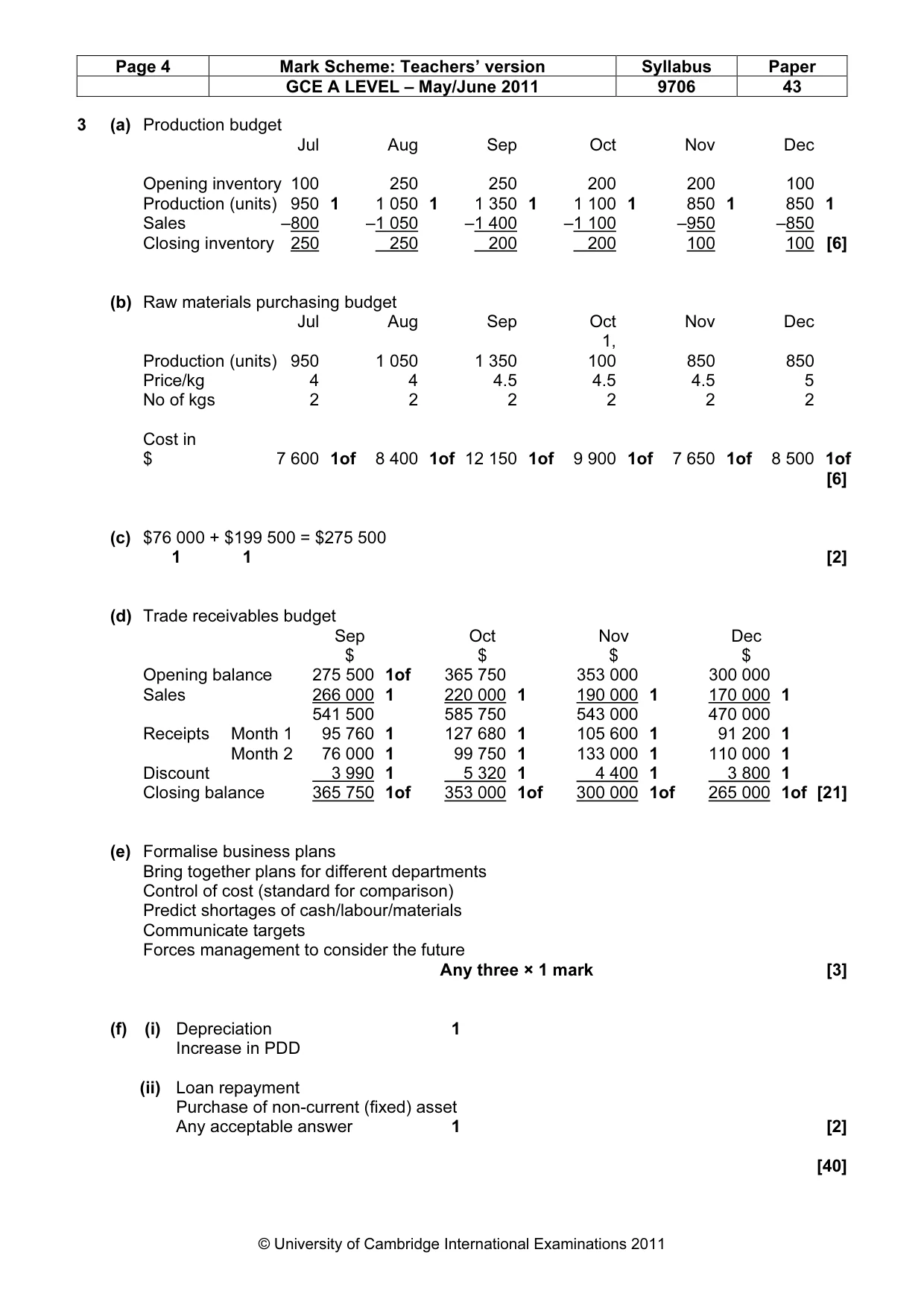
Page 4 Mark Scheme: Teachers’ version Syllabus Paper GCE A LEVEL – May/June 2011 9706 43 © University of Cambridge International Examinations 2011 3 (a) Production budget Jul Aug Sep Oct Nov Dec Opening inventory 100 250 250 200 200 100 Production (units) 950 1 1 050 1 1 350 1 1 100 1 850 1 850 1 Sales –800 –1 050 –1 400 –1 100 –950 –850 Closing inventory 250 250 200 200 100 100 [6] (b) Raw materials purchasing budget Jul Aug Sep Oct Nov Dec 1, Production (units) 950 1 050 1 350 100 850 850 Price/kg 4 4 4.5 4.5 4.5 5 No of kgs 2 2 2 2 2 2 Cost in $ 7 600 1of 8 400 1of 12 150 1of 9 900 1of 7 650 1of 8 500 1of [6] (c) $76 000 + $199 500 = $275 500 1 1 [2] (d) Trade receivables budget Sep Oct Nov Dec $ $ $ $ Opening balance 275 500 1of 365 750 353 000 300 000 Sales 266 000 1 220 000 1 190 000 1 170 000 1 541 500 585 750 543 000 470 000 Receipts Month 1 95 760 1 127 680 1 105 600 1 91 200 1 Month 2 76 000 1 99 750 1 133 000 1 110 000 1 Discount 3 990 1 5 320 1 4 400 1 3 800 1 Closing balance 365 750 1of 353 000 1of 300 000 1of 265 000 1of [21] (e) Formalise business plans Bring together plans for different departments Control of cost (standard for comparison) Predict shortages of cash/labour/materials Communicate targets Forces management to consider the future Any three × 1 mark [3] (f) (i) Depreciation 1 Increase in PDD (ii) Loan repayment Purchase of non-current (fixed) asset Any acceptable answer 1 [2] [40]
What you needed in this session
Cambridge’s own grade thresholds for 2011 May/June, Paper 4 · Variant 3. A higher threshold means an easier paper — the bar moves with how the cohort did.