Cambridge A Level Accounting 9706 — 2011 May/June Paper 4 · Variant 1
9706/41/M/J/11 · 120 marks · ≈135 min
The question paper and its mark scheme, free to read here and free to download. This is Cambridge’s own paper, exactly as it was sat.
Question paper8 pages
Mark scheme5 pages
Answers below. Sit the paper first if you are practising.
Paper as text
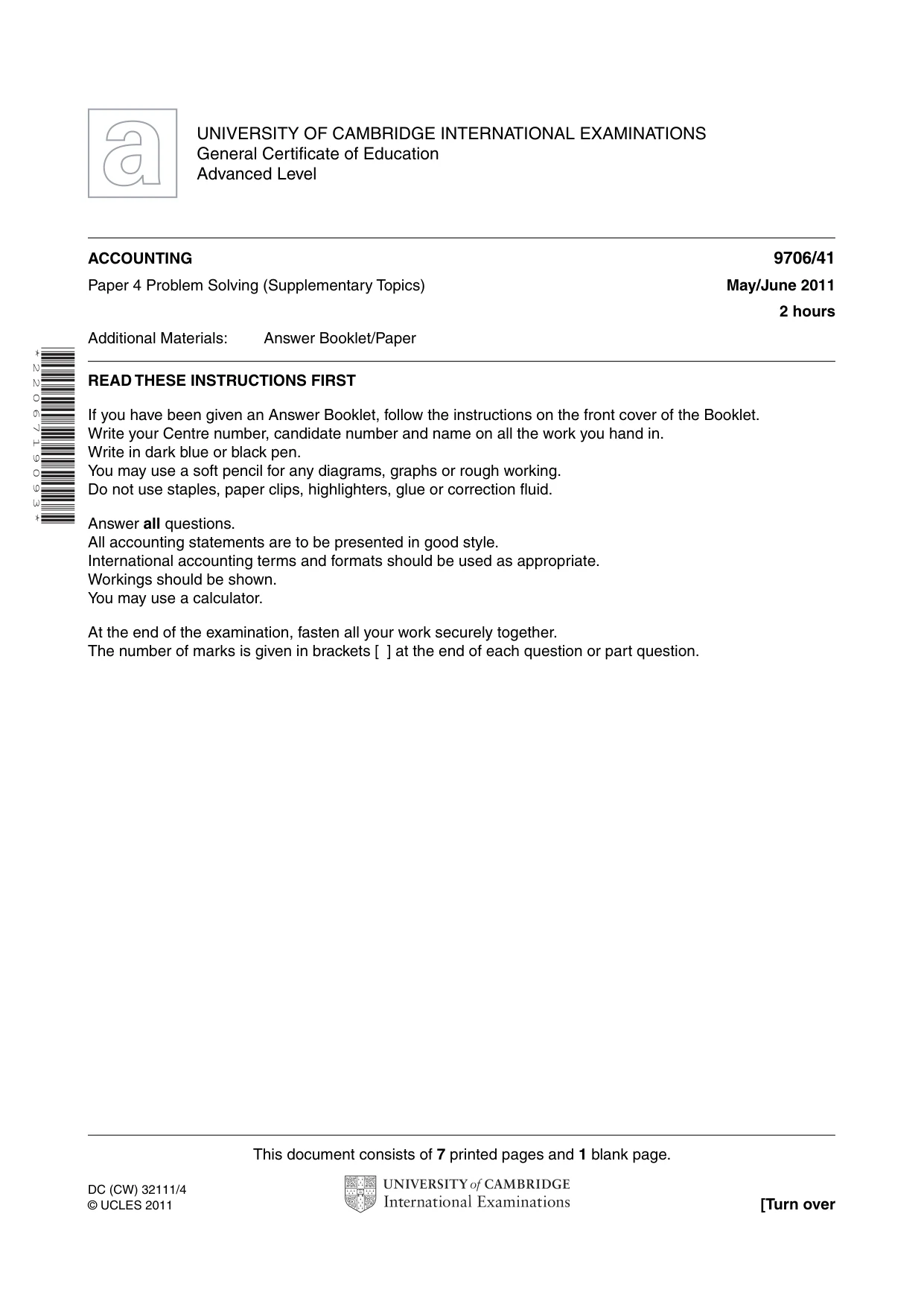
Question paper, page 1
This document consists of 7 printed pages and 1 blank page. DC (CW) 32111/4 © UCLES 2011 [Turn over UNIVERSITY OF CAMBRIDGE INTERNATIONAL EXAMINATIONS General Certificate of Education Advanced Level * 2 2 0 6 7 1 9 0 9 3 * ACCOUNTING 9706/41 Paper 4 Problem Solving (Supplementary Topics) May/June 2011 2 hours Additional Materials: Answer Booklet/Paper READ THESE INSTRUCTIONS FIRST If you have been given an Answer Booklet, follow the instructions on the front cover of the Booklet. Write your Centre number, candidate number and name on all the work you hand in. Write in dark blue or black pen. You may use a soft pencil for any diagrams, graphs or rough working. Do not use staples, paper clips, highlighters, glue or correction fluid. Answer all questions. All accounting statements are to be presented in good style. International accounting terms and formats should be used as appropriate. Workings should be shown. You may use a calculator. At the end of the examination, fasten all your work securely together. The number of marks is given in brackets [ ] at the end of each question or part question.
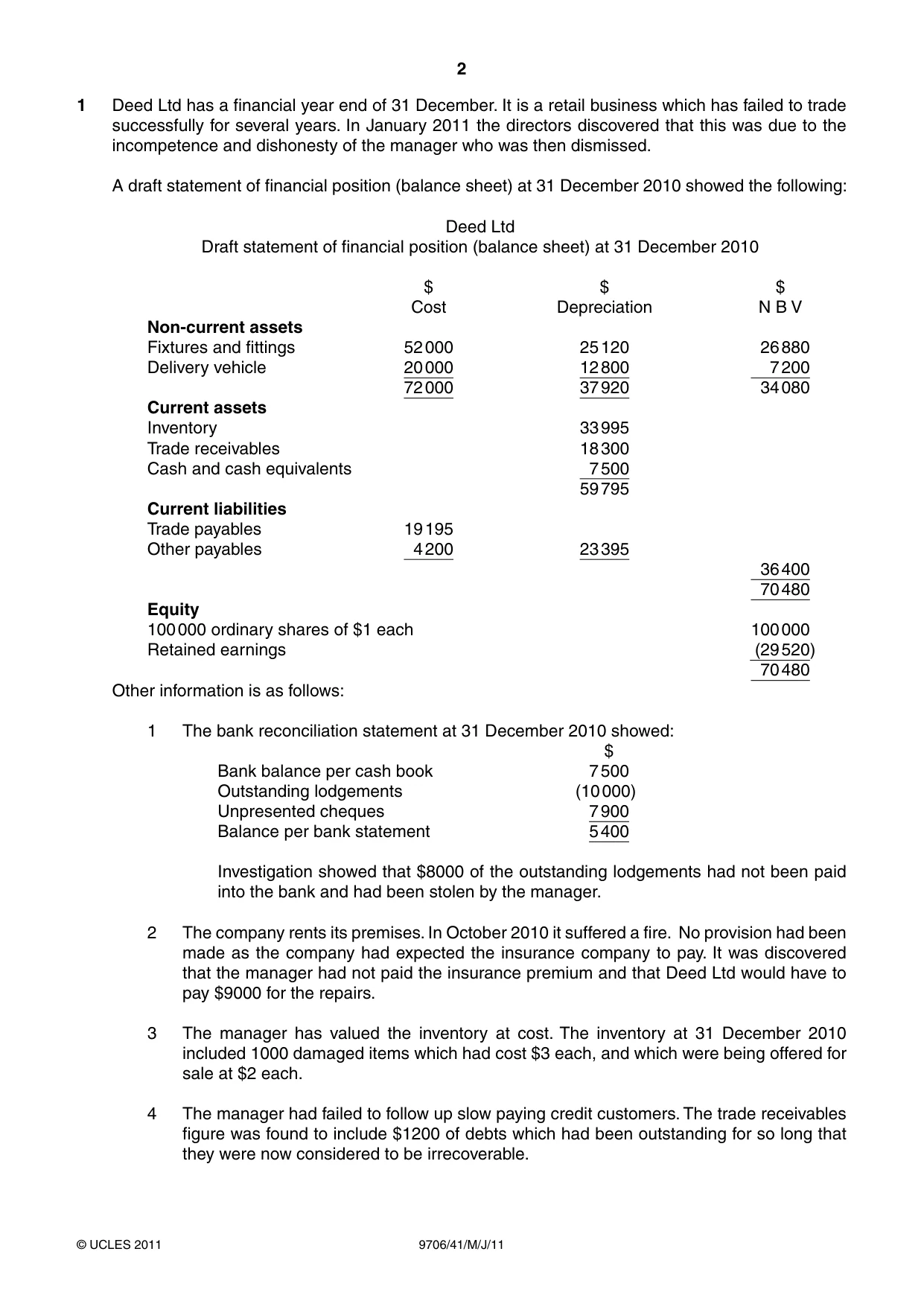
Question paper, page 2
2 9706/41/M/J/11 © UCLES 2011 1 Deed Ltd has a financial year end of 31 December. It is a retail business which has failed to trade successfully for several years. In January 2011 the directors discovered that this was due to the incompetence and dishonesty of the manager who was then dismissed. A draft statement of financial position (balance sheet) at 31 December 2010 showed the following: Deed Ltd Draft statement of financial position (balance sheet) at 31 December 2010 $ $ $ Cost Depreciation N B V Non-current assets Fixtures and fittings 52 000 25 120 26 880 Delivery vehicle 20 000 12 800 7 200 72 000 37 920 34 080 Current assets Inventory 33 995 Trade receivables 18 300 Cash and cash equivalents 7 500 59 795 Current liabilities Trade payables 19 195 Other payables 4 200 23 395 36 400 70 480 Equity 100 000 ordinary shares of $1 each 100 000 Retained earnings (29 520) 70 480 Other information is as follows: 1 The bank reconciliation statement at 31 December 2010 showed: $ Bank balance per cash book 7 500 Outstanding lodgements (10 000) Unpresented cheques 7 900 Balance per bank statement 5 400 Investigation showed that $8000 of the outstanding lodgements had not been paid into the bank and had been stolen by the manager. 2 The company rents its premises. In October 2010 it suffered a fire. No provision had been made as the company had expected the insurance company to pay. It was discovered that the manager had not paid the insurance premium and that Deed Ltd would have to pay $9000 for the repairs. 3 The manager has valued the inventory at cost. The inventory at 31 December 2010 included 1000 damaged items which had cost $3 each, and which were being offered for sale at $2 each. 4 The manager had failed to follow up slow paying credit customers. The trade receivables figure was found to include $1200 of debts which had been outstanding for so long that they were now considered to be irrecoverable.
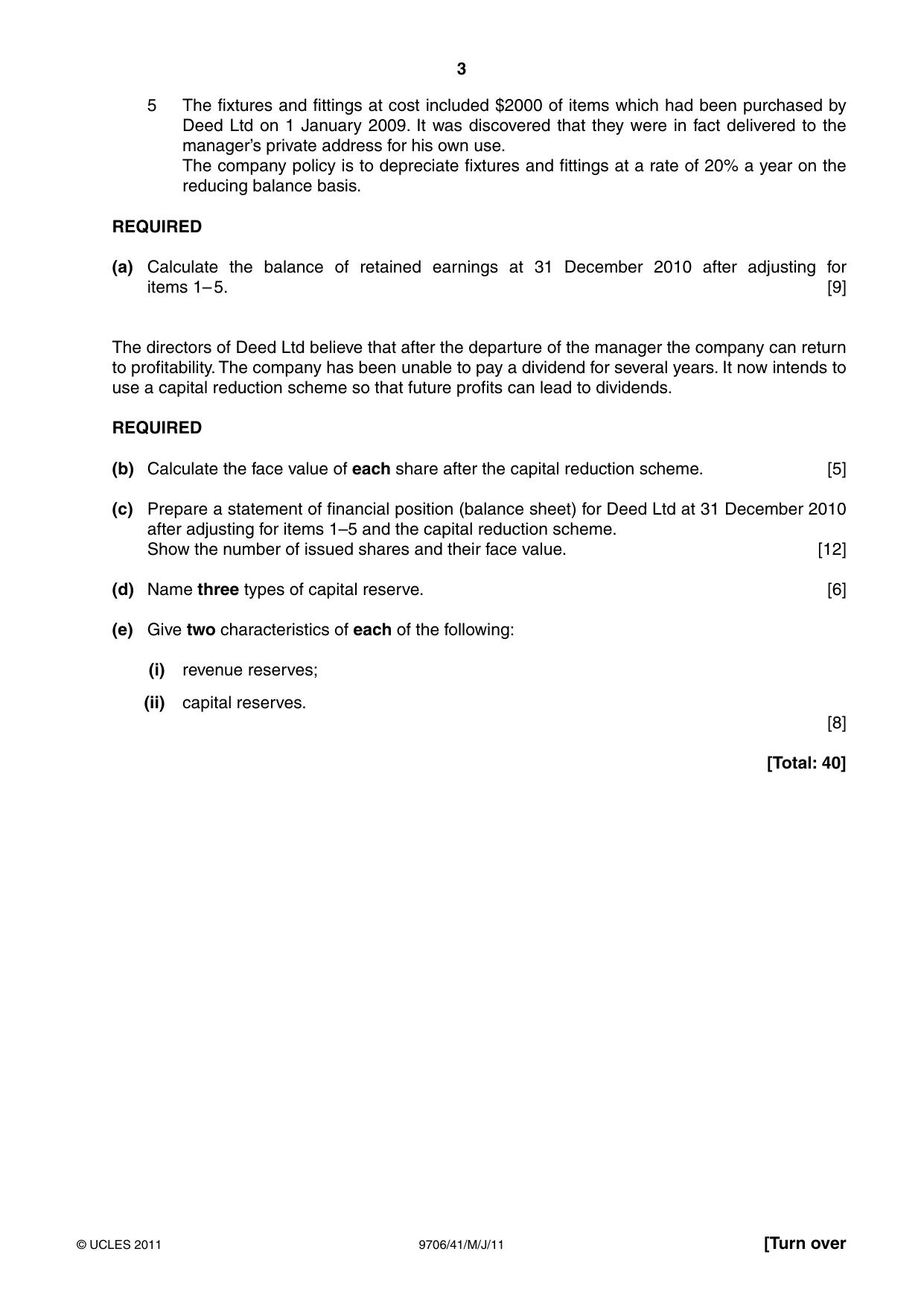
Question paper, page 3
3 9706/41/M/J/11 © UCLES 2011 [Turn over 5 The fixtures and fittings at cost included $2000 of items which had been purchased by Deed Ltd on 1 January 2009. It was discovered that they were in fact delivered to the manager’s private address for his own use. The company policy is to depreciate fixtures and fittings at a rate of 20% a year on the reducing balance basis. REQUIRED (a) Calculate the balance of retained earnings at 31 December 2010 after adjusting for items 1– 5. [9] The directors of Deed Ltd believe that after the departure of the manager the company can return to profitability. The company has been unable to pay a dividend for several years. It now intends to use a capital reduction scheme so that future profits can lead to dividends. REQUIRED (b) Calculate the face value of each share after the capital reduction scheme. [5] (c) Prepare a statement of financial position (balance sheet) for Deed Ltd at 31 December 2010 after adjusting for items 1–5 and the capital reduction scheme. Show the number of issued shares and their face value. [12] (d) Name three types of capital reserve. [6] (e) Give two characteristics of each of the following: (i) revenue reserves; (ii) capital reserves. [8] [Total: 40]
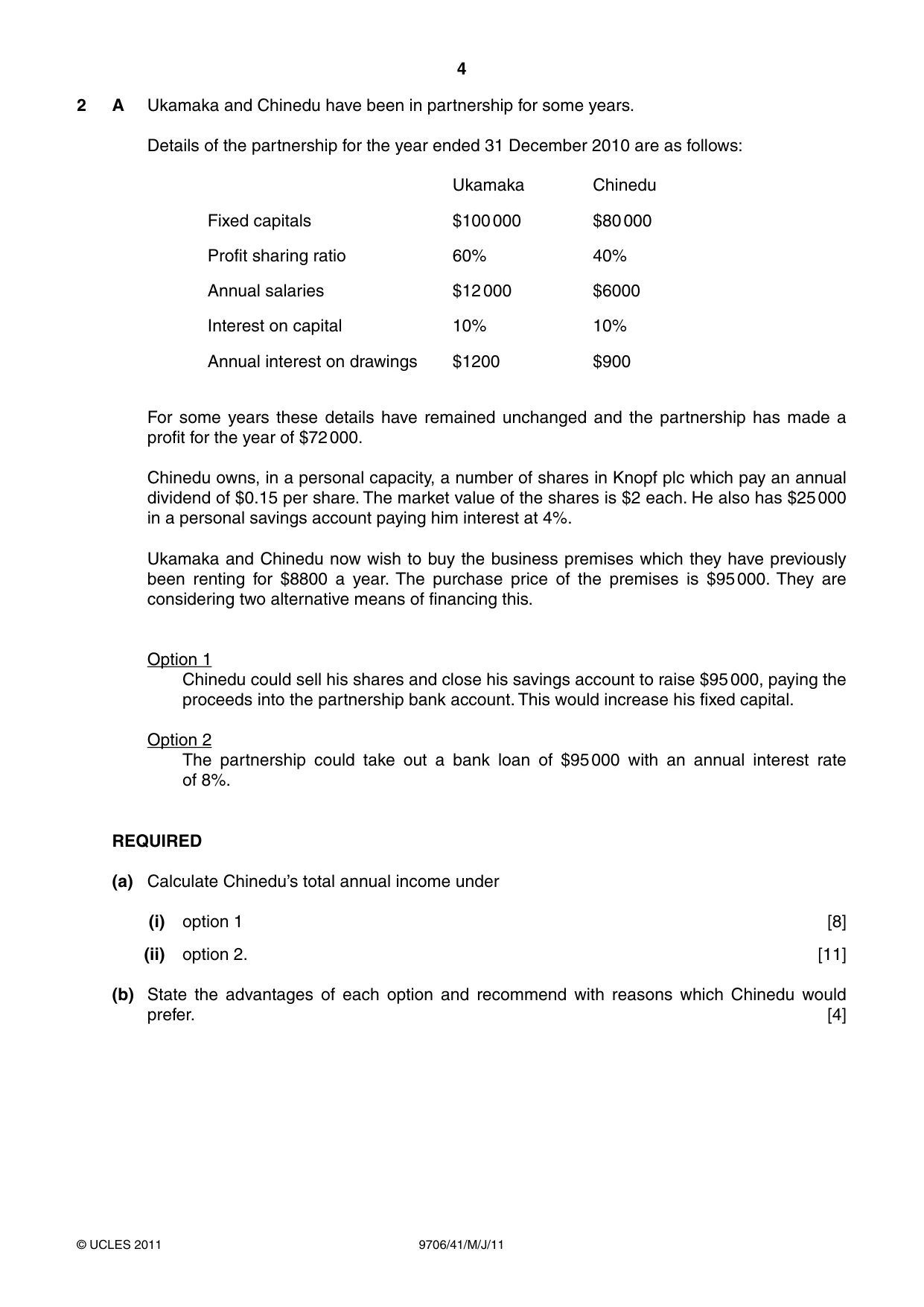
Question paper, page 4
4 9706/41/M/J/11 © UCLES 2011 2 A Ukamaka and Chinedu have been in partnership for some years. Details of the partnership for the year ended 31 December 2010 are as follows: Ukamaka Chinedu Fixed capitals $100 000 $80 000 Profit sharing ratio 60% 40% Annual salaries $12 000 $6000 Interest on capital 10% 10% Annual interest on drawings $1200 $900 For some years these details have remained unchanged and the partnership has made a profit for the year of $72 000. Chinedu owns, in a personal capacity, a number of shares in Knopf plc which pay an annual dividend of $0.15 per share. The market value of the shares is $2 each. He also has $25 000 in a personal savings account paying him interest at 4%. Ukamaka and Chinedu now wish to buy the business premises which they have previously been renting for $8800 a year. The purchase price of the premises is $95 000. They are considering two alternative means of financing this. Option 1 Chinedu could sell his shares and close his savings account to raise $95 000, paying the proceeds into the partnership bank account. This would increase his fixed capital. Option 2 The partnership could take out a bank loan of $95 000 with an annual interest rate of 8%. REQUIRED (a) Calculate Chinedu’s total annual income under (i) option 1 [8] (ii) option 2. [11] (b) State the advantages of each option and recommend with reasons which Chinedu would prefer. [4]
Question paper, page 5
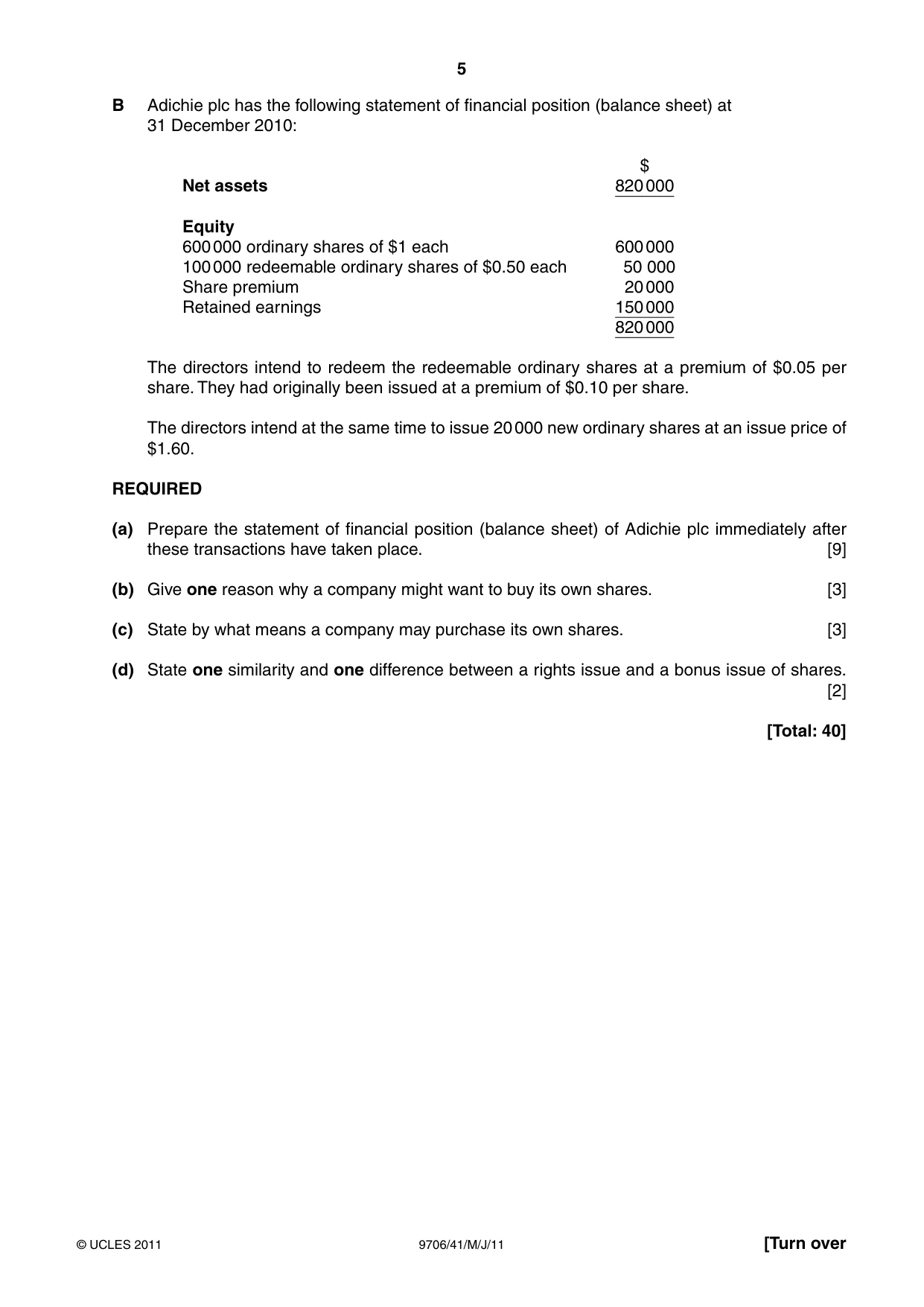
5 9706/41/M/J/11 © UCLES 2011 [Turn over B Adichie plc has the following statement of financial position (balance sheet) at 31 December 2010: $ Net assets 820 000 Equity 600 000 ordinary shares of $1 each 600 000 100 000 redeemable ordinary shares of $0.50 each 50 000 Share premium 20 000 Retained earnings 150 000 820 000 The directors intend to redeem the redeemable ordinary shares at a premium of $0.05 per share. They had originally been issued at a premium of $0.10 per share. The directors intend at the same time to issue 20 000 new ordinary shares at an issue price of $1.60. REQUIRED (a) Prepare the statement of financial position (balance sheet) of Adichie plc immediately after these transactions have taken place. [9] (b) Give one reason why a company might want to buy its own shares. [3] (c) State by what means a company may purchase its own shares. [3] (d) State one similarity and one difference between a rights issue and a bonus issue of shares. [2] [Total: 40]
Question paper, page 6
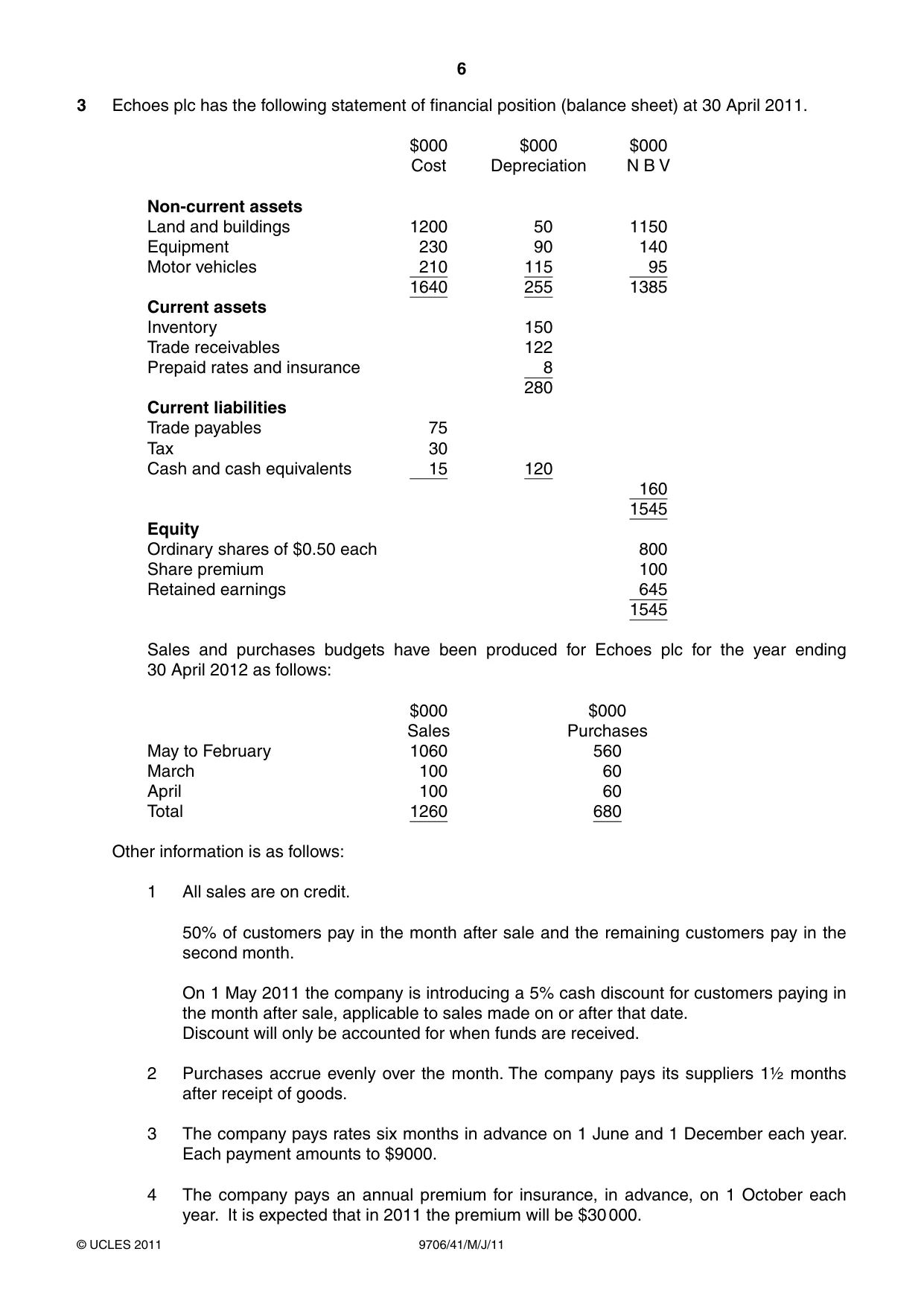
6 9706/41/M/J/11 © UCLES 2011 3 Echoes plc has the following statement of financial position (balance sheet) at 30 April 2011. $000 $000 $000 Cost Depreciation N B V Non-current assets Land and buildings 1200 50 1150 Equipment 230 90 140 Motor vehicles 210 115 95 1640 255 1385 Current assets Inventory 150 Trade receivables 122 Prepaid rates and insurance 8 280 Current liabilities Trade payables 75 Tax 30 Cash and cash equivalents 15 120 160 1545 Equity Ordinary shares of $0.50 each 800 Share premium 100 Retained earnings 645 1545 Sales and purchases budgets have been produced for Echoes plc for the year ending 30 April 2012 as follows: $000 $000 Sales Purchases May to February 1060 560 March 100 60 April 100 60 Total 1260 680 Other information is as follows: 1 All sales are on credit. 50% of customers pay in the month after sale and the remaining customers pay in the second month. On 1 May 2011 the company is introducing a 5% cash discount for customers paying in the month after sale, applicable to sales made on or after that date. Discount will only be accounted for when funds are received. 2 Purchases accrue evenly over the month. The company pays its suppliers 1½ months after receipt of goods. 3 The company pays rates six months in advance on 1 June and 1 December each year. Each payment amounts to $9000. 4 The company pays an annual premium for insurance, in advance, on 1 October each year. It is expected that in 2011 the premium will be $30 000.
Question paper, page 7
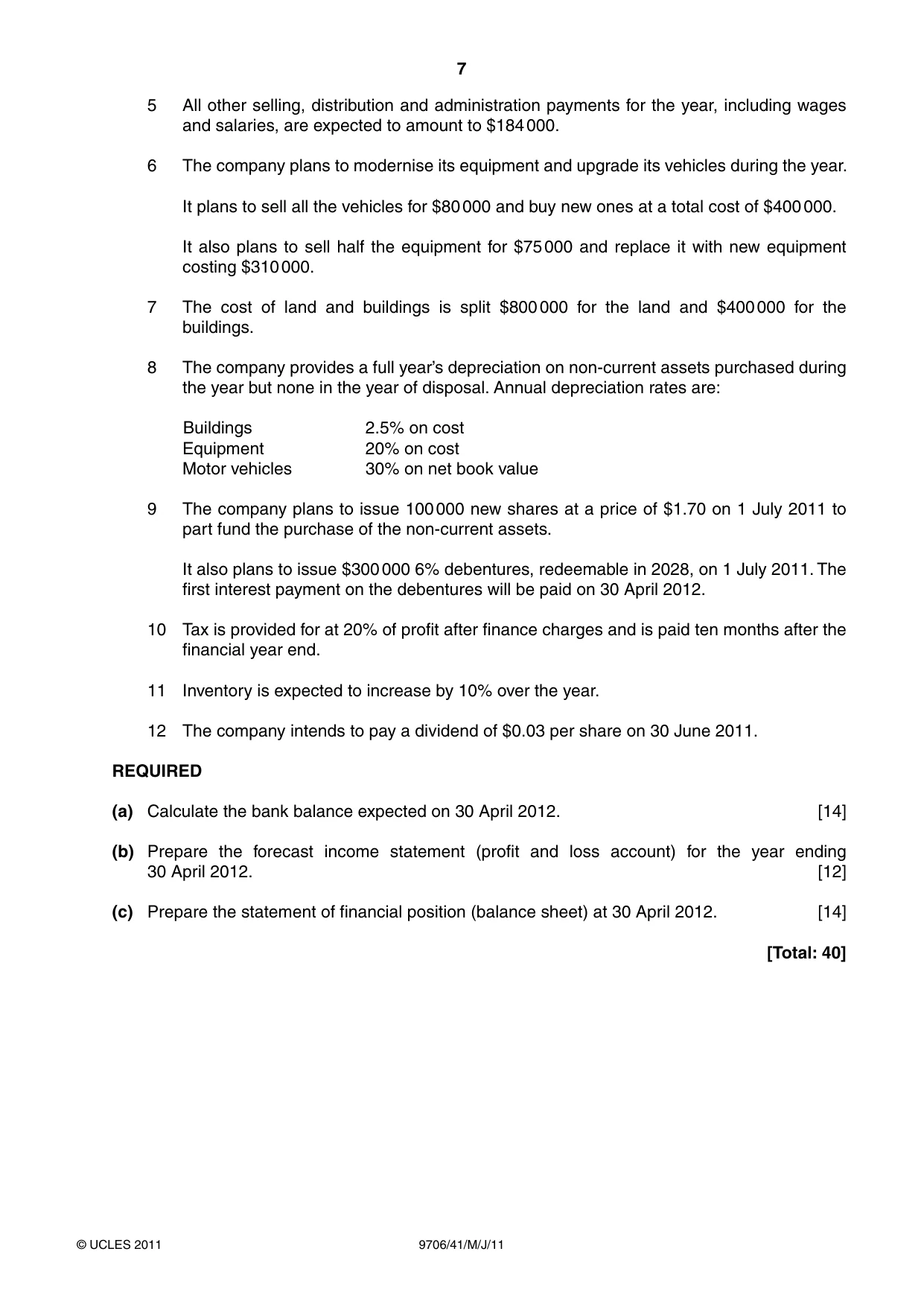
7 9706/41/M/J/11 © UCLES 2011 5 All other selling, distribution and administration payments for the year, including wages and salaries, are expected to amount to $184 000. 6 The company plans to modernise its equipment and upgrade its vehicles during the year. It plans to sell all the vehicles for $80 000 and buy new ones at a total cost of $400 000. It also plans to sell half the equipment for $75 000 and replace it with new equipment costing $310 000. 7 The cost of land and buildings is split $800 000 for the land and $400 000 for the buildings. 8 The company provides a full year’s depreciation on non-current assets purchased during the year but none in the year of disposal. Annual depreciation rates are: Buildings 2.5% on cost Equipment 20% on cost Motor vehicles 30% on net book value 9 The company plans to issue 100 000 new shares at a price of $1.70 on 1 July 2011 to part fund the purchase of the non-current assets. It also plans to issue $300 000 6% debentures, redeemable in 2028, on 1 July 2011. The first interest payment on the debentures will be paid on 30 April 2012. 10 Tax is provided for at 20% of profit after finance charges and is paid ten months after the financial year end. 11 Inventory is expected to increase by 10% over the year. 12 The company intends to pay a dividend of $0.03 per share on 30 June 2011. REQUIRED (a) Calculate the bank balance expected on 30 April 2012. [14] (b) Prepare the forecast income statement (profit and loss account) for the year ending 30 April 2012. [12] (c) Prepare the statement of financial position (balance sheet) at 30 April 2012. [14] [Total: 40]
Question paper, page 8
8 9706/41/M/J/11 © UCLES 2011 BLANK PAGE Permission to reproduce items where third-party owned material protected by copyright is included has been sought and cleared where possible. Every reasonable effort has been made by the publisher (UCLES) to trace copyright holders, but if any items requiring clearance have unwittingly been included, the publisher will be pleased to make amends at the earliest possible opportunity. University of Cambridge International Examinations is part of the Cambridge Assessment Group. Cambridge Assessment is the brand name of University of Cambridge Local Examinations Syndicate (UCLES), which is itself a department of the University of Cambridge.
Mark scheme, page 1
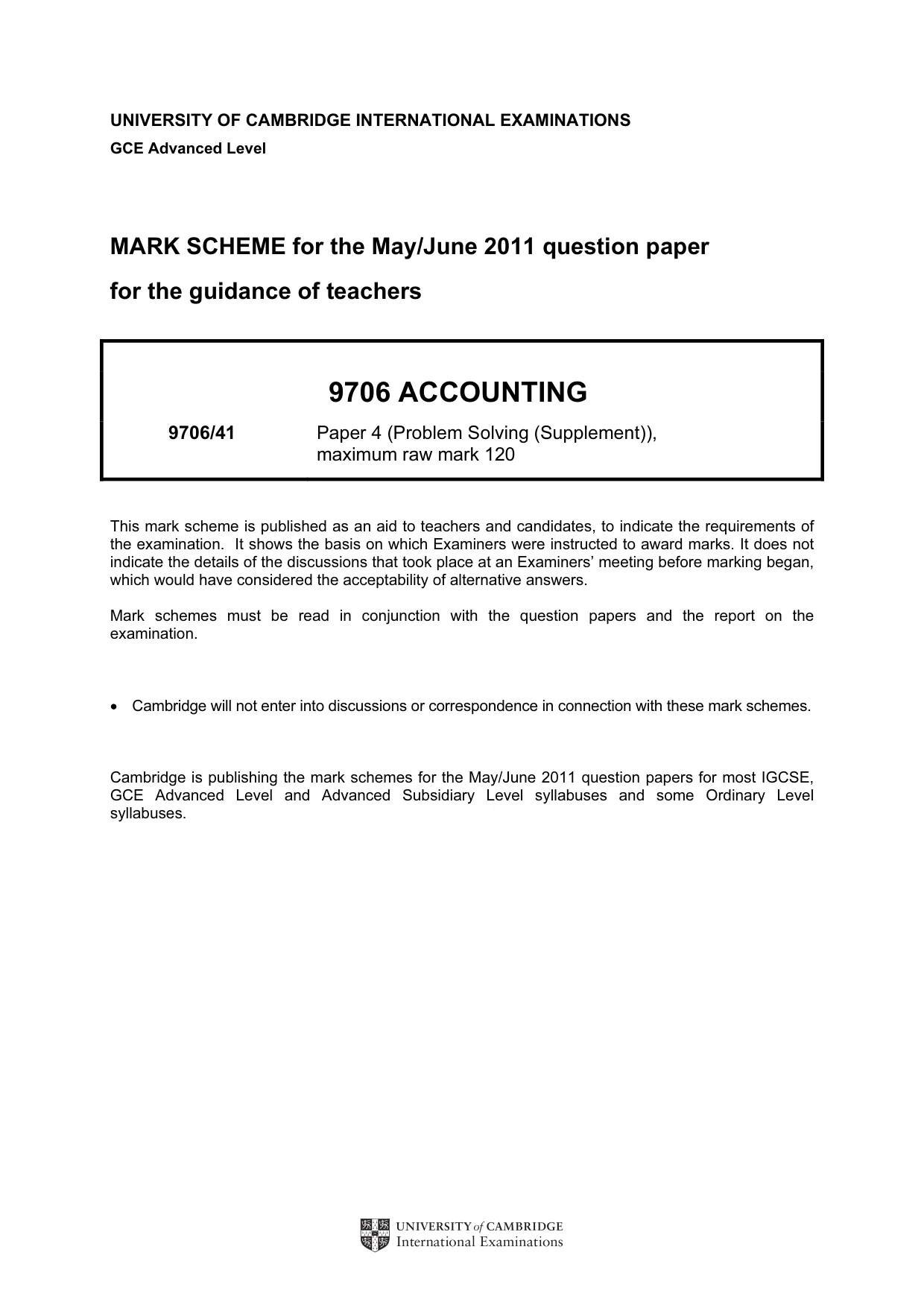
UNIVERSITY OF CAMBRIDGE INTERNATIONAL EXAMINATIONS GCE Advanced Level MARK SCHEME for the May/June 2011 question paper for the guidance of teachers 9706 ACCOUNTING 9706/41 Paper 4 (Problem Solving (Supplement)), maximum raw mark 120 This mark scheme is published as an aid to teachers and candidates, to indicate the requirements of the examination. It shows the basis on which Examiners were instructed to award marks. It does not indicate the details of the discussions that took place at an Examiners’ meeting before marking began, which would have considered the acceptability of alternative answers. Mark schemes must be read in conjunction with the question papers and the report on the examination. • Cambridge will not enter into discussions or correspondence in connection with these mark schemes. Cambridge is publishing the mark schemes for the May/June 2011 question papers for most IGCSE, GCE Advanced Level and Advanced Subsidiary Level syllabuses and some Ordinary Level syllabuses.
Mark scheme, page 2
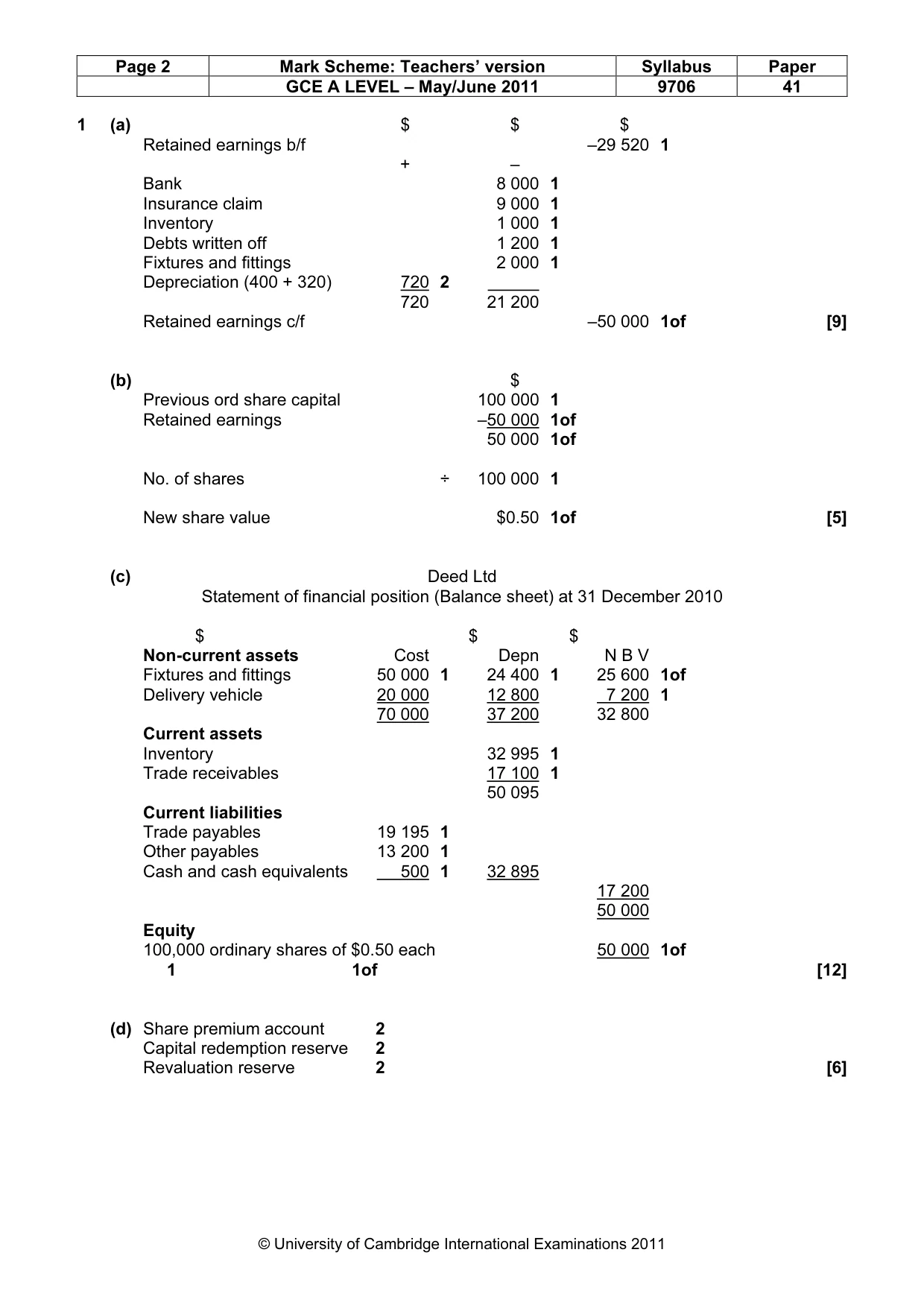
Page 2 Mark Scheme: Teachers’ version Syllabus Paper GCE A LEVEL – May/June 2011 9706 41 © University of Cambridge International Examinations 2011 1 (a) $ $ $ Retained earnings b/f –29 520 1 + – Bank 8 000 1 Insurance claim 9 000 1 Inventory 1 000 1 Debts written off 1 200 1 Fixtures and fittings 2 000 1 Depreciation (400 + 320) 720 2 720 21 200 Retained earnings c/f –50 000 1of [9] (b) $ Previous ord share capital 100 000 1 Retained earnings –50 000 1of 50 000 1of No. of shares ÷ 100 000 1 New share value $0.50 1of [5] (c) Deed Ltd Statement of financial position (Balance sheet) at 31 December 2010 $ $ $ Non-current assets Cost Depn N B V Fixtures and fittings 50 000 1 24 400 1 25 600 1of Delivery vehicle 20 000 12 800 7 200 1 70 000 37 200 32 800 Current assets Inventory 32 995 1 Trade receivables 17 100 1 50 095 Current liabilities Trade payables 19 195 1 Other payables 13 200 1 Cash and cash equivalents 500 1 32 895 17 200 50 000 Equity 100,000 ordinary shares of $0.50 each 50 000 1of 1 1of [12] (d) Share premium account 2 Capital redemption reserve 2 Revaluation reserve 2 [6]
Mark scheme, page 3
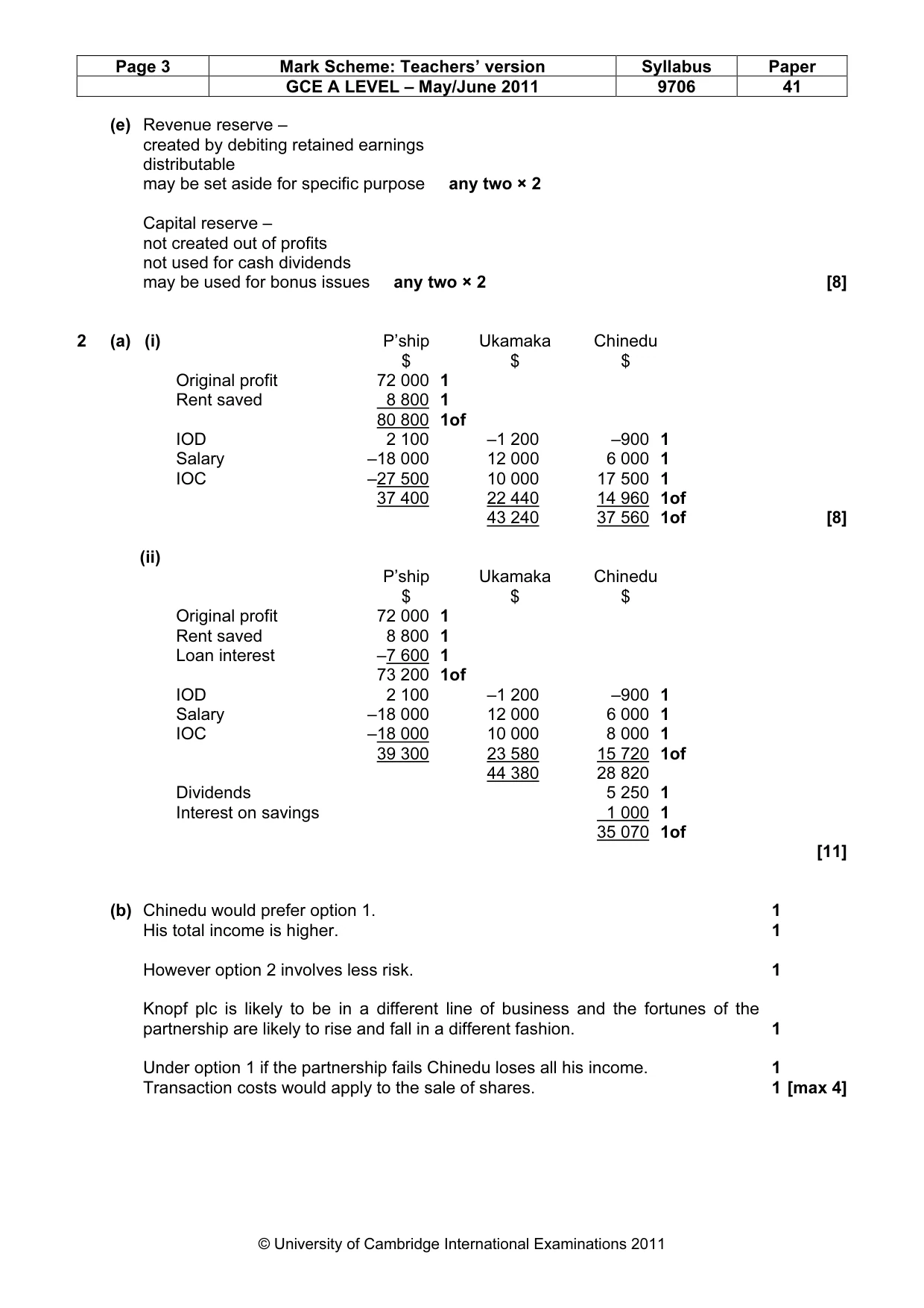
Page 3 Mark Scheme: Teachers’ version Syllabus Paper GCE A LEVEL – May/June 2011 9706 41 © University of Cambridge International Examinations 2011 (e) Revenue reserve – created by debiting retained earnings distributable may be set aside for specific purpose any two × 2 Capital reserve – not created out of profits not used for cash dividends may be used for bonus issues any two × 2 [8] 2 (a) (i) P’ship Ukamaka Chinedu $ $ $ Original profit 72 000 1 Rent saved 8 800 1 80 800 1of IOD 2 100 –1 200 –900 1 Salary –18 000 12 000 6 000 1 IOC –27 500 10 000 17 500 1 37 400 22 440 14 960 1of 43 240 37 560 1of [8] (ii) P’ship Ukamaka Chinedu $ $ $ Original profit 72 000 1 Rent saved 8 800 1 Loan interest –7 600 1 73 200 1of IOD 2 100 –1 200 –900 1 Salary –18 000 12 000 6 000 1 IOC –18 000 10 000 8 000 1 39 300 23 580 15 720 1of 44 380 28 820 Dividends 5 250 1 Interest on savings 1 000 1 35 070 1of [11] (b) Chinedu would prefer option 1. 1 His total income is higher. 1 However option 2 involves less risk. 1 Knopf plc is likely to be in a different line of business and the fortunes of the partnership are likely to rise and fall in a different fashion. 1 Under option 1 if the partnership fails Chinedu loses all his income. 1 Transaction costs would apply to the sale of shares. 1 [max 4]
Mark scheme, page 4
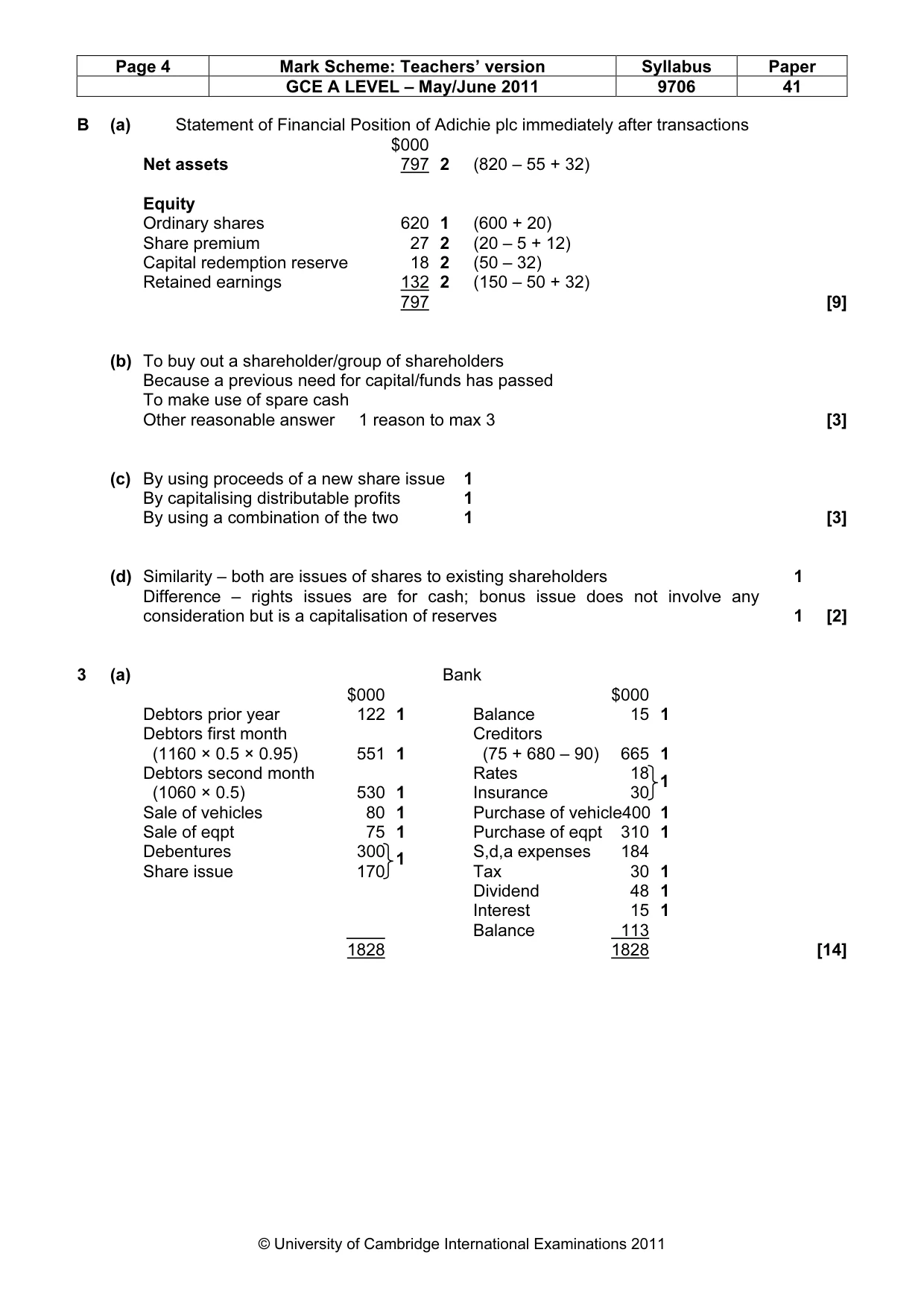
Page 4 Mark Scheme: Teachers’ version Syllabus Paper GCE A LEVEL – May/June 2011 9706 41 © University of Cambridge International Examinations 2011 B (a) Statement of Financial Position of Adichie plc immediately after transactions $000 Net assets 797 2 (820 – 55 + 32) Equity Ordinary shares 620 1 (600 + 20) Share premium 27 2 (20 – 5 + 12) Capital redemption reserve 18 2 (50 – 32) Retained earnings 132 2 (150 – 50 + 32) 797 [9] (b) To buy out a shareholder/group of shareholders Because a previous need for capital/funds has passed To make use of spare cash Other reasonable answer 1 reason to max 3 [3] (c) By using proceeds of a new share issue 1 By capitalising distributable profits 1 By using a combination of the two 1 [3] (d) Similarity – both are issues of shares to existing shareholders 1 Difference – rights issues are for cash; bonus issue does not involve any consideration but is a capitalisation of reserves 1 [2] 3 (a) Bank $000 $000 Debtors prior year 122 1 Balance 15 1 Debtors first month Creditors (1160 × 0.5 × 0.95) 551 1 (75 + 680 – 90) 665 1 Debtors second month Rates 18 (1060 × 0.5) 530 1 Insurance 30 Sale of vehicles 80 1 Purchase of vehicle400 1 Sale of eqpt 75 1 Purchase of eqpt 310 1 Debentures 300 S,d,a expenses 184 Share issue 170 Tax 30 1 Dividend 48 1 Interest 15 1 Balance 113 1828 1828 [14] 1 1
Mark scheme, page 5
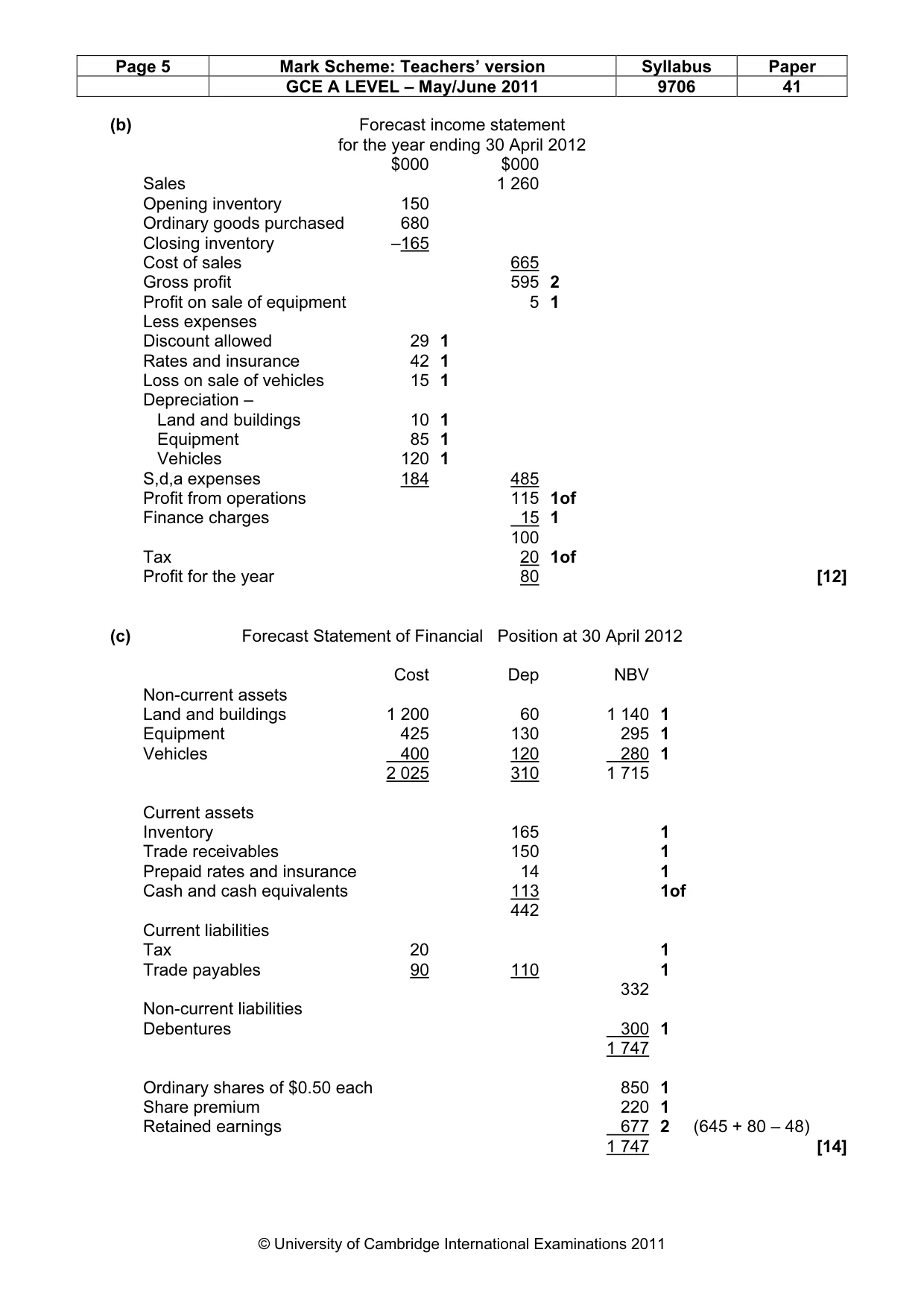
Page 5 Mark Scheme: Teachers’ version Syllabus Paper GCE A LEVEL – May/June 2011 9706 41 © University of Cambridge International Examinations 2011 (b) Forecast income statement for the year ending 30 April 2012 $000 $000 Sales 1 260 Opening inventory 150 Ordinary goods purchased 680 Closing inventory –165 Cost of sales 665 Gross profit 595 2 Profit on sale of equipment 5 1 Less expenses Discount allowed 29 1 Rates and insurance 42 1 Loss on sale of vehicles 15 1 Depreciation – Land and buildings 10 1 Equipment 85 1 Vehicles 120 1 S,d,a expenses 184 485 Profit from operations 115 1of Finance charges 15 1 100 Tax 20 1of Profit for the year 80 [12] (c) Forecast Statement of Financial Position at 30 April 2012 Cost Dep NBV Non-current assets Land and buildings 1 200 60 1 140 1 Equipment 425 130 295 1 Vehicles 400 120 280 1 2 025 310 1 715 Current assets Inventory 165 1 Trade receivables 150 1 Prepaid rates and insurance 14 1 Cash and cash equivalents 113 1of 442 Current liabilities Tax 20 1 Trade payables 90 110 1 332 Non-current liabilities Debentures 300 1 1 747 Ordinary shares of $0.50 each 850 1 Share premium 220 1 Retained earnings 677 2 (645 + 80 – 48) 1 747 [14]
What you needed in this session
Cambridge’s own grade thresholds for 2011 May/June, Paper 4 · Variant 1. A higher threshold means an easier paper — the bar moves with how the cohort did.