Cambridge IGCSE Spanish - Literature 0488 — 2024 May/June Paper 3 · Variant 3
0488/33/M/J/24 · 20 marks · ≈23 min
The question paper and its mark scheme, free to read here and free to download. This is Cambridge’s own paper, exactly as it was sat.
Question paper8 pages




Mark scheme8 pages
Answers below. Sit the paper first if you are practising.
Paper as text
Question paper, page 1
This document has 8 pages. Any blank pages are indicated. [Turn over Cambridge IGCSE™ * 3 8 2 6 2 8 1 2 0 4 * DC (DE) 325821/2 © UCLES 2024 LITERATURE (SPANISH) 0488/33 Paper 3 Alternative to Coursework May/June 2024 1 hour 20 minutes You must answer on the enclosed answer booklet. You will need: Answer booklet (enclosed) INSTRUCTIONS ● Answer the question. ● Follow the instructions on the front cover of the answer booklet. If you need additional answer paper, ask the invigilator for a continuation booklet. INFORMATION ● The total mark for this paper is 20. ● The number of marks for each question or part question is shown in brackets [ ]. INSTRUCCIONES ● Conteste a la pregunta. ● Siga las instrucciones que aparecen en la portada del cuadernillo de respuestas. Las instrucciones aparecen también en español a continuación. Si necesita hojas adicionales, pídale al supervisor un cuadernillo de respuestas adicional. INFORMACIÓN ● La puntuación total de este examen es de 20. ● La puntuación de cada pregunta o apartados de la misma aparece entre corchetes [ ].
Question paper, page 2
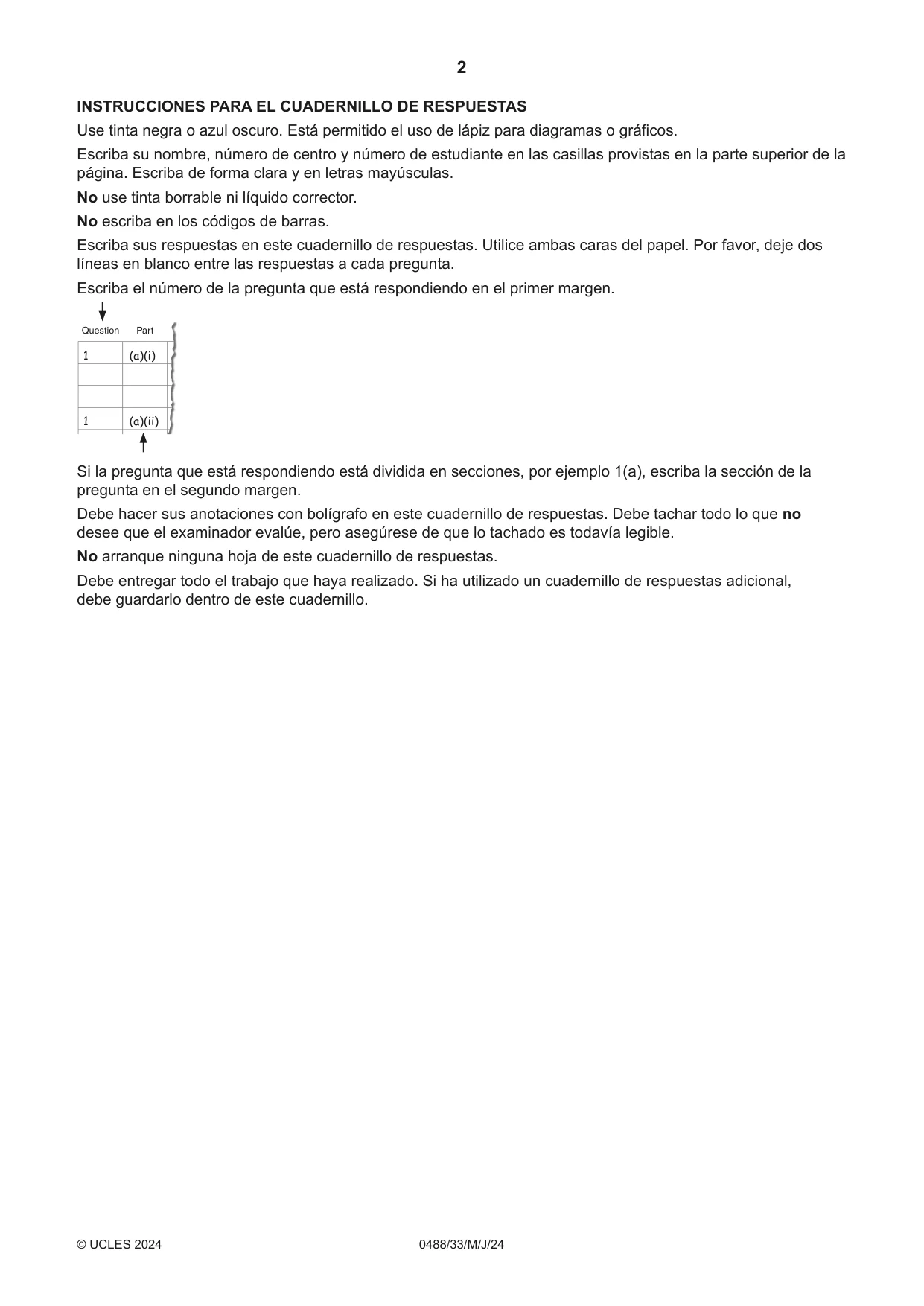
2 0488/33/ M / J /24 © UCLES 2024 INSTRUCCIONES PARA EL CUADERNILLO DE RESPUESTAS Use tinta negra o azul oscuro. Está permitido el uso de lápiz para diagramas o gráficos. Escriba su nombre, número de centro y número de estudiante en las casillas provistas en la parte superior de la página. Escriba de forma clara y en letras mayúsculas. No use tinta borrable ni líquido corrector. No escriba en los códigos de barras. Escriba sus respuestas en este cuadernillo de respuestas. Utilice ambas caras del papel. Por favor, deje dos líneas en blanco entre las respuestas a cada pregunta. Escriba el número de la pregunta que está respondiendo en el primer margen. Question Part 1 1 (a)(i) (a)(ii) Si la pregunta que está respondiendo está dividida en secciones, por ejemplo 1(a), escriba la sección de la pregunta en el segundo margen. Debe hacer sus anotaciones con bolígrafo en este cuadernillo de respuestas. Debe tachar todo lo que no desee que el examinador evalúe, pero asegúrese de que lo tachado es todavía legible. No arranque ninguna hoja de este cuadernillo de respuestas. Debe entregar todo el trabajo que haya realizado. Si ha utilizado un cuadernillo de respuestas adicional, debe guardarlo dentro de este cuadernillo.
Question paper, page 3
3 0488/33/M/J/24 © UCLES 2024 [Turn over BLANK PAGE
Question paper, page 4
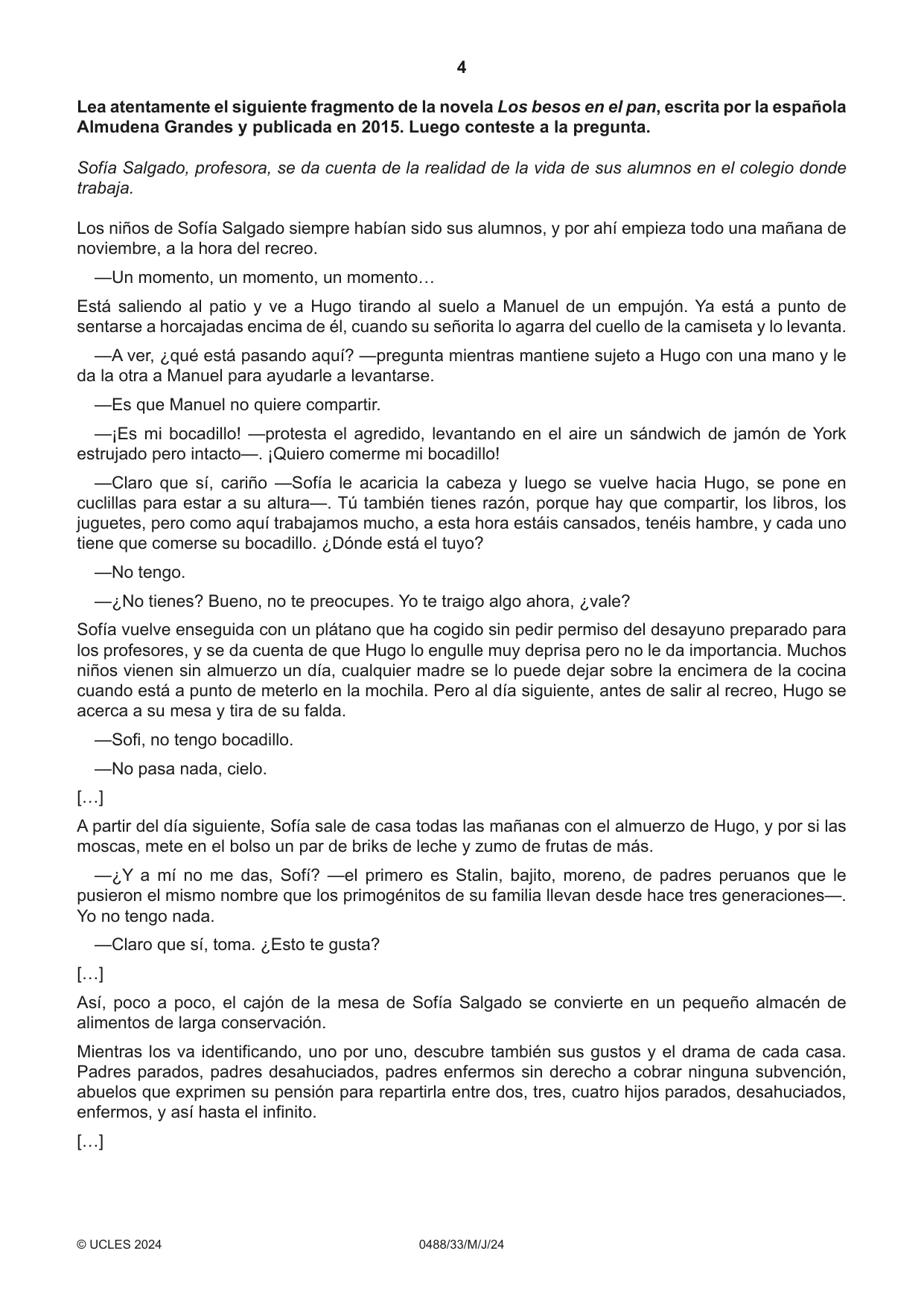
4 0488/33/M/J/24 © UCLES 2024 Lea atentamente el siguiente fragmento de la novela Los besos en el pan, escrita por la española Almudena Grandes y publicada en 2015. Luego conteste a la pregunta. Sofía Salgado, profesora, se da cuenta de la realidad de la vida de sus alumnos en el colegio donde trabaja. Los niños de Sofía Salgado siempre habían sido sus alumnos, y por ahí empieza todo una mañana de noviembre, a la hora del recreo. —Un momento, un momento, un momento… Está saliendo al patio y ve a Hugo tirando al suelo a Manuel de un empujón. Ya está a punto de sentarse a horcajadas encima de él, cuando su señorita lo agarra del cuello de la camiseta y lo levanta. —A ver, ¿qué está pasando aquí? —pregunta mientras mantiene sujeto a Hugo con una mano y le da la otra a Manuel para ayudarle a levantarse. —Es que Manuel no quiere compartir. —¡Es mi bocadillo! —protesta el agredido, levantando en el aire un sándwich de jamón de York estrujado pero intacto—. ¡Quiero comerme mi bocadillo! —Claro que sí, cariño —Sofía le acaricia la cabeza y luego se vuelve hacia Hugo, se pone en cuclillas para estar a su altura—. Tú también tienes razón, porque hay que compartir, los libros, los juguetes, pero como aquí trabajamos mucho, a esta hora estáis cansados, tenéis hambre, y cada uno tiene que comerse su bocadillo. ¿Dónde está el tuyo? —No tengo. —¿No tienes? Bueno, no te preocupes. Yo te traigo algo ahora, ¿vale? Sofía vuelve enseguida con un plátano que ha cogido sin pedir permiso del desayuno preparado para los profesores, y se da cuenta de que Hugo lo engulle muy deprisa pero no le da importancia. Muchos niños vienen sin almuerzo un día, cualquier madre se lo puede dejar sobre la encimera de la cocina cuando está a punto de meterlo en la mochila. Pero al día siguiente, antes de salir al recreo, Hugo se acerca a su mesa y tira de su falda. —Sofi, no tengo bocadillo. —No pasa nada, cielo. […] A partir del día siguiente, Sofía sale de casa todas las mañanas con el almuerzo de Hugo, y por si las moscas, mete en el bolso un par de briks de leche y zumo de frutas de más. —¿Y a mí no me das, Sofí? —el primero es Stalin, bajito, moreno, de padres peruanos que le pusieron el mismo nombre que los primogénitos de su familia llevan desde hace tres generaciones—. Yo no tengo nada. —Claro que sí, toma. ¿Esto te gusta? […] Así, poco a poco, el cajón de la mesa de Sofía Salgado se convierte en un pequeño almacén de alimentos de larga conservación. Mientras los va identificando, uno por uno, descubre también sus gustos y el drama de cada casa. Padres parados, padres desahuciados, padres enfermos sin derecho a cobrar ninguna subvención, abuelos que exprimen su pensión para repartirla entre dos, tres, cuatro hijos parados, desahuciados, enfermos, y así hasta el infinito. […]
Question paper, page 5
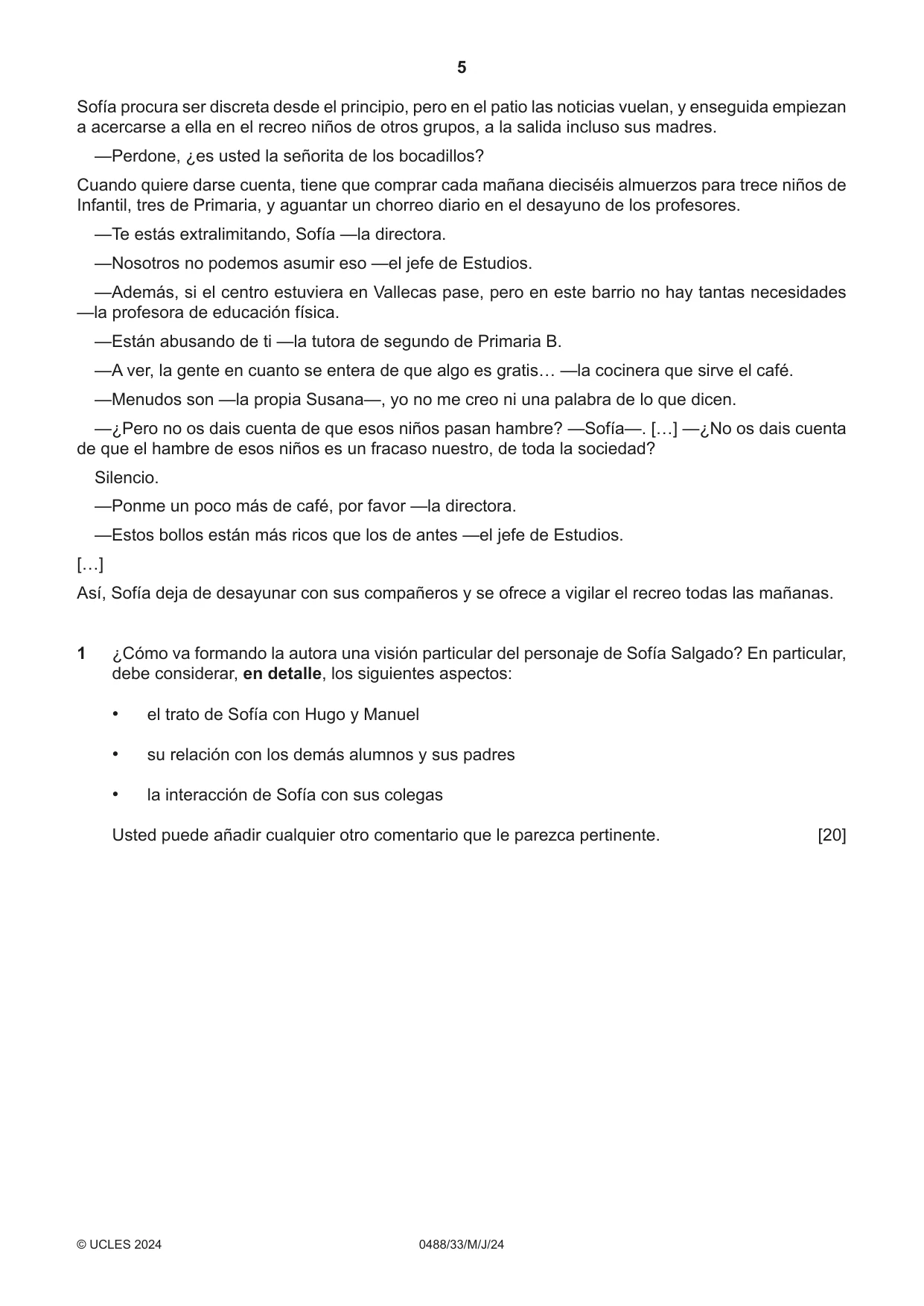
5 0488/33/M/J/24 © UCLES 2024 Sofía procura ser discreta desde el principio, pero en el patio las noticias vuelan, y enseguida empiezan a acercarse a ella en el recreo niños de otros grupos, a la salida incluso sus madres. —Perdone, ¿es usted la señorita de los bocadillos? Cuando quiere darse cuenta, tiene que comprar cada mañana dieciséis almuerzos para trece niños de Infantil, tres de Primaria, y aguantar un chorreo diario en el desayuno de los profesores. —Te estás extralimitando, Sofía —la directora. —Nosotros no podemos asumir eso —el jefe de Estudios. —Además, si el centro estuviera en Vallecas pase, pero en este barrio no hay tantas necesidades —la profesora de educación física. —Están abusando de ti —la tutora de segundo de Primaria B. —A ver, la gente en cuanto se entera de que algo es gratis… —la cocinera que sirve el café. —Menudos son —la propia Susana—, yo no me creo ni una palabra de lo que dicen. —¿Pero no os dais cuenta de que esos niños pasan hambre? —Sofía—. […] —¿No os dais cuenta de que el hambre de esos niños es un fracaso nuestro, de toda la sociedad? Silencio. —Ponme un poco más de café, por favor —la directora. —Estos bollos están más ricos que los de antes —el jefe de Estudios. […] Así, Sofía deja de desayunar con sus compañeros y se ofrece a vigilar el recreo todas las mañanas. 1 ¿Cómo va formando la autora una visión particular del personaje de Sofía Salgado? En particular, debe considerar, en detalle, los siguientes aspectos: • el trato de Sofía con Hugo y Manuel • su relación con los demás alumnos y sus padres • la interacción de Sofía con sus colegas Usted puede añadir cualquier otro comentario que le parezca pertinente. [20]
Question paper, page 6
6 0488/33/M/J/24 © UCLES 2024 BLANK PAGE
Question paper, page 7
7 0488/33/M/J/24 © UCLES 2024 BLANK PAGE
Question paper, page 8
8 0488/33/M/J/24 © UCLES 2024 Permission to reproduce items where third-party owned material protected by copyright is included has been sought and cleared where possible. Every reasonable effort has been made by the publisher (UCLES) to trace copyright holders, but if any items requiring clearance have unwittingly been included, the publisher will be pleased to make amends at the earliest possible opportunity. To avoid the issue of disclosure of answer-related information to candidates, all copyright acknowledgements are reproduced online in the Cambridge Assessment International Education Copyright Acknowledgements Booklet. This is produced for each series of examinations and is freely available to download at www.cambridgeinternational.org after the live examination series. Cambridge Assessment International Education is part of Cambridge Assessment. Cambridge Assessment is the brand name of the University of Cambridge Local Examinations Syndicate (UCLES), which is a department of the University of Cambridge. BLANK PAGE
Mark scheme, page 1
This document consists of 8 printed pages. © Cambridge University Press & Assessment 2024 [Turn over Cambridge IGCSE™ LITERATURE (SPANISH) 0488/33 Paper 3 Alternative to Coursework May/June 2024 MARK SCHEME Maximum Mark: 20 Published This mark scheme is published as an aid to teachers and candidates, to indicate the requirements of the examination. It shows the basis on which Examiners were instructed to award marks. It does not indicate the details of the discussions that took place at an Examiners’ meeting before marking began, which would have considered the acceptability of alternative answers. Mark schemes should be read in conjunction with the question paper and the Principal Examiner Report for Teachers. Cambridge International will not enter into discussions about these mark schemes. Cambridge International is publishing the mark schemes for the May/June 2024 series for most Cambridge IGCSE, Cambridge International A and AS Level and Cambridge Pre-U components, and some Cambridge O Level components.
Mark scheme, page 2
0488/33 Cambridge IGCSE – Mark Scheme PUBLISHED May/June 2024 © Cambridge University Press & Assessment 2024 Page 2 of 8 Generic Marking Principles These general marking principles must be applied by all examiners when marking candidate answers. They should be applied alongside the specific content of the mark scheme or generic level descriptions for a question. Each question paper and mark scheme will also comply with these marking principles. GENERIC MARKING PRINCIPLE 1: Marks must be awarded in line with: the specific content of the mark scheme or the generic level descriptors for the question the specific skills defined in the mark scheme or in the generic level descriptors for the question the standard of response required by a candidate as exemplified by the standardisation scripts. GENERIC MARKING PRINCIPLE 2: Marks awarded are always whole marks (not half marks, or other fractions). GENERIC MARKING PRINCIPLE 3: Marks must be awarded positively: marks are awarded for correct/valid answers, as defined in the mark scheme. However, credit is given for valid answers which go beyond the scope of the syllabus and mark scheme, referring to your Team Leader as appropriate marks are awarded when candidates clearly demonstrate what they know and can do marks are not deducted for errors marks are not deducted for omissions answers should only be judged on the quality of spelling, punctuation and grammar when these features are specifically assessed by the question as indicated by the mark scheme. The meaning, however, should be unambiguous. GENERIC MARKING PRINCIPLE 4: Rules must be applied consistently, e.g. in situations where candidates have not followed instructions or in the application of generic level descriptors. GENERIC MARKING PRINCIPLE 5: Marks should be awarded using the full range of marks defined in the mark scheme for the question (however; the use of the full mark range may be limited according to the quality of the candidate responses seen). GENERIC MARKING PRINCIPLE 6: Marks awarded are based solely on the requirements as defined in the mark scheme. Marks should not be awarded with grade thresholds or grade descriptors in mind.
Mark scheme, page 3
0488/33 Cambridge IGCSE – Mark Scheme PUBLISHED May/June 2024 © Cambridge University Press & Assessment 2024 Page 3 of 8 GENERAL MARKING PRINCIPLES The General Descriptors guide examiners to an understanding of the qualities normally expected of, or typical of, work in a band. They are a means of general guidance and must not be interpreted as hurdle statements. For the purposes of standardisation of marking, they are to be used in conjunction with standardisation scripts and discussed during the examiners’ coordination meeting, as well as the question-specific notes. Because of the nature of the subject, these notes are for general guidance; they are not designed as prescriptions of required content and must not be treated as such. The syllabus aims at encouraging candidates to make some personal response to their reading. This means that, while we may have legitimate expectations as to the ground most answers may occupy, we must be prepared to meet candidates on their chosen ground. Hence, we must at all times tease out what the candidate is trying to say to us. We must recognise that it is possible for a candidate whose technical command of Spanish is limited, but whose language still manages to communicate understanding, to receive high marks. Nor should we reward fluency and display of literary terms if we feel that there is little evidence of such understanding. Remember that we are looking for response to literature, not demonstration of language skills. It is vital that we constantly remind ourselves that this is unseen work and we should not be overcritical of an occasional false note or misunderstanding. We are marking the quality of the process of engaging with literature, and not merely assessing the accuracy or otherwise of the conclusions reached. Regular reference to the standardisation scripts discussed during coordination will be crucial to maintaining the standard throughout the marking process. The detailed questions are intended to help the candidate respond. Candidates are required to answer them but need not do so in a rigid sequence; some of the answers may be implicit in the essay, although it is expected that candidates will be able to spell out their views and interpretations with sufficient clarity. There is no prescribed application of marks to each question and the response should be marked holistically. Candidates who do not answer the prescribed questions will penalise themselves automatically, as the questions are central to the passage. USE OF BAND DESCRIPTORS The Descriptors are an attempt to guide examiners to an understanding of the qualities normally expected of, or ‘typical’ of work in the band. First place the script within a Band, and then, having balanced its different qualities and their relationship to the Assessment Objectives and the three strands within each Band, decide whether you place it at the top, in the middle or at the bottom of that Band. In writing comments on the script, use the annotations available from RM Assessor.
Mark scheme, page 4
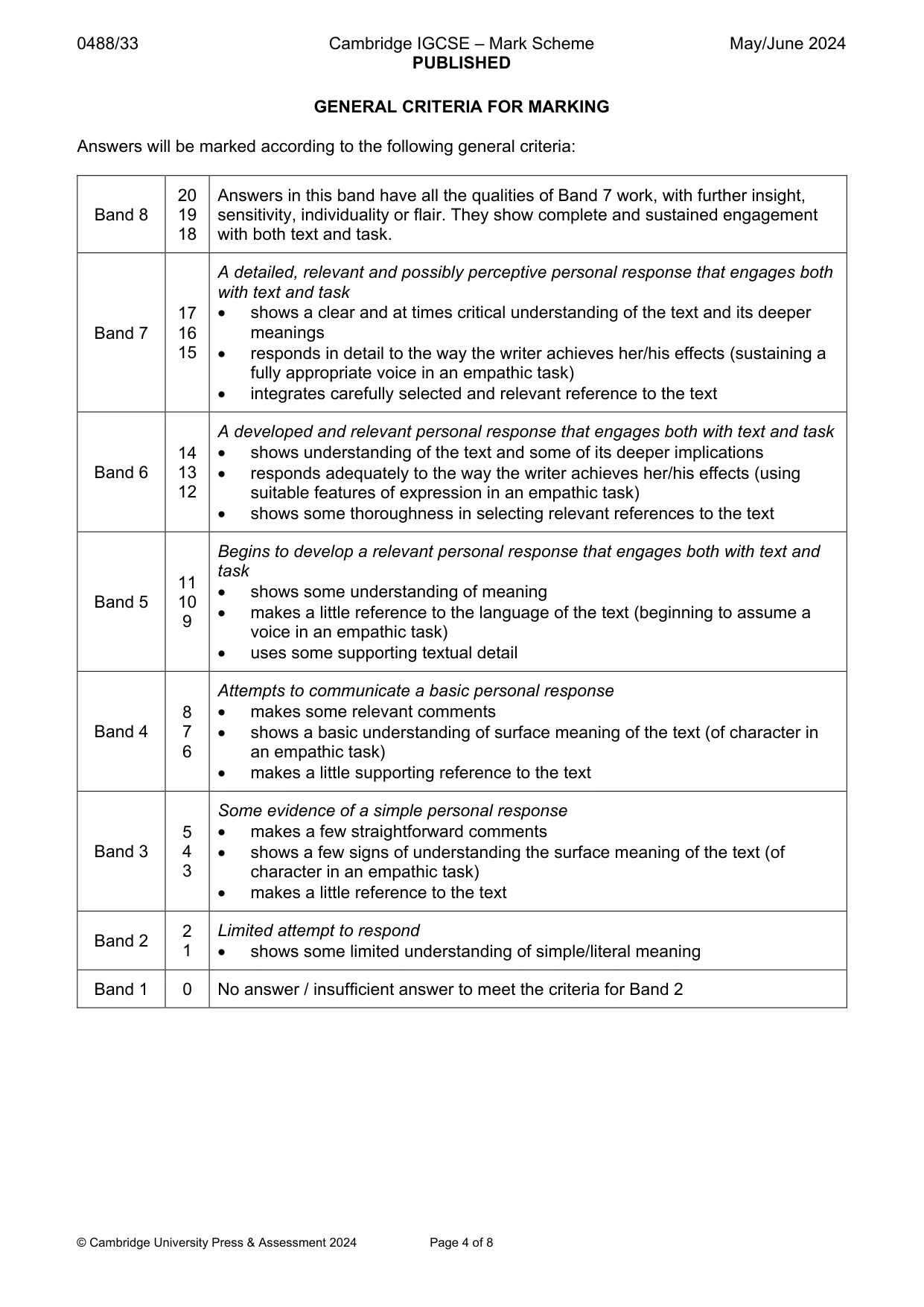
0488/33 Cambridge IGCSE – Mark Scheme PUBLISHED May/June 2024 © Cambridge University Press & Assessment 2024 Page 4 of 8 GENERAL CRITERIA FOR MARKING Answers will be marked according to the following general criteria: Band 8 20 19 18 Answers in this band have all the qualities of Band 7 work, with further insight, sensitivity, individuality or flair. They show complete and sustained engagement with both text and task. Band 7 17 16 15 A detailed, relevant and possibly perceptive personal response that engages both with text and task shows a clear and at times critical understanding of the text and its deeper meanings responds in detail to the way the writer achieves her/his effects (sustaining a fully appropriate voice in an empathic task) integrates carefully selected and relevant reference to the text Band 6 14 13 12 A developed and relevant personal response that engages both with text and task shows understanding of the text and some of its deeper implications responds adequately to the way the writer achieves her/his effects (using suitable features of expression in an empathic task) shows some thoroughness in selecting relevant references to the text Band 5 11 10 9 Begins to develop a relevant personal response that engages both with text and task shows some understanding of meaning makes a little reference to the language of the text (beginning to assume a voice in an empathic task) uses some supporting textual detail Band 4 8 7 6 Attempts to communicate a basic personal response makes some relevant comments shows a basic understanding of surface meaning of the text (of character in an empathic task) makes a little supporting reference to the text Band 3 5 4 3 Some evidence of a simple personal response makes a few straightforward comments shows a few signs of understanding the surface meaning of the text (of character in an empathic task) makes a little reference to the text Band 2 2 1 Limited attempt to respond shows some limited understanding of simple/literal meaning Band 1 0 No answer / insufficient answer to meet the criteria for Band 2
Mark scheme, page 5
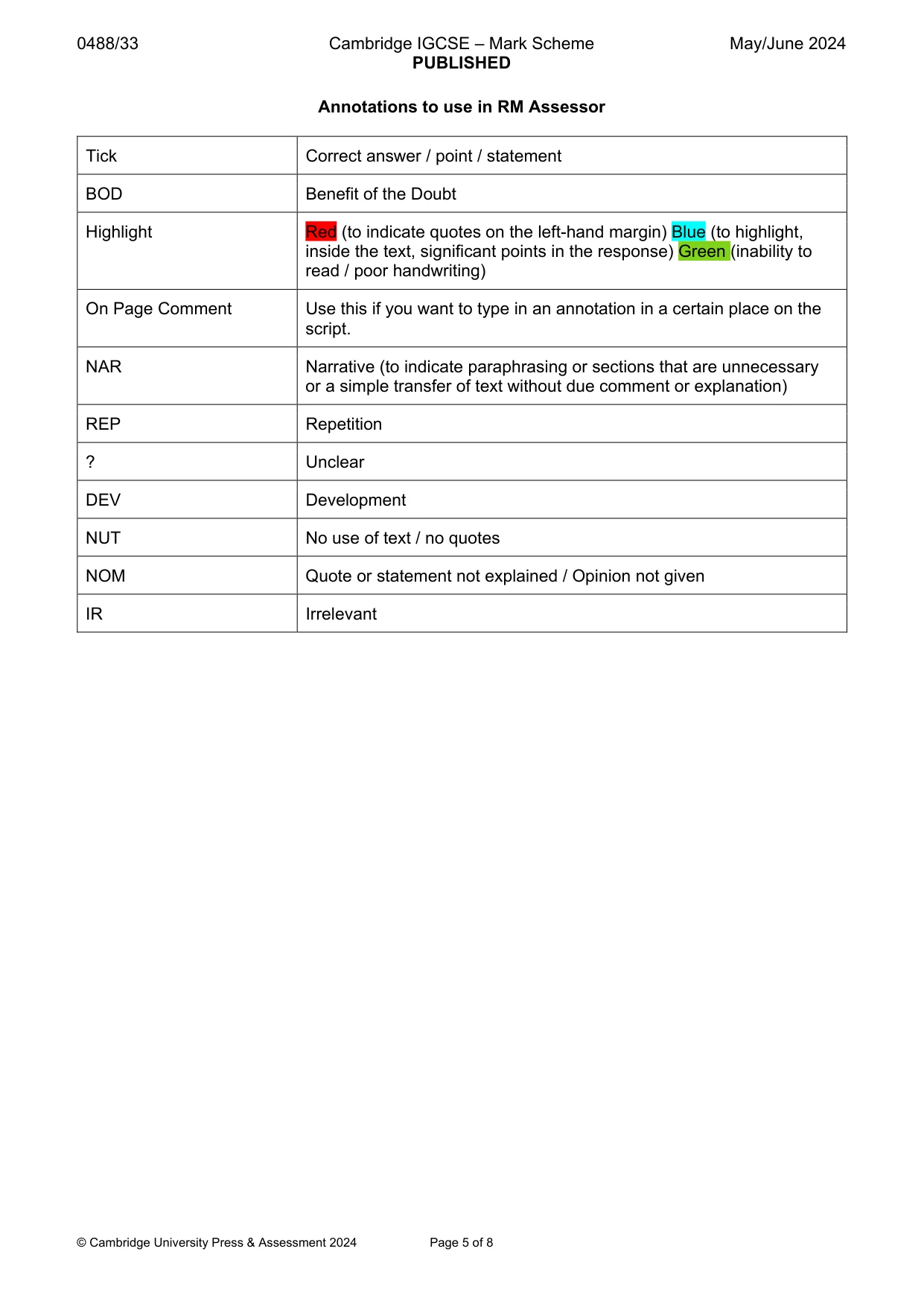
0488/33 Cambridge IGCSE – Mark Scheme PUBLISHED May/June 2024 © Cambridge University Press & Assessment 2024 Page 5 of 8 Annotations to use in RM Assessor Tick Correct answer / point / statement BOD Benefit of the Doubt Highlight Red (to indicate quotes on the left-hand margin) Blue (to highlight, inside the text, significant points in the response) Green (inability to read / poor handwriting) On Page Comment Use this if you want to type in an annotation in a certain place on the script. NAR Narrative (to indicate paraphrasing or sections that are unnecessary or a simple transfer of text without due comment or explanation) REP Repetition ? Unclear DEV Development NUT No use of text / no quotes NOM Quote or statement not explained / Opinion not given IR Irrelevant
Mark scheme, page 6
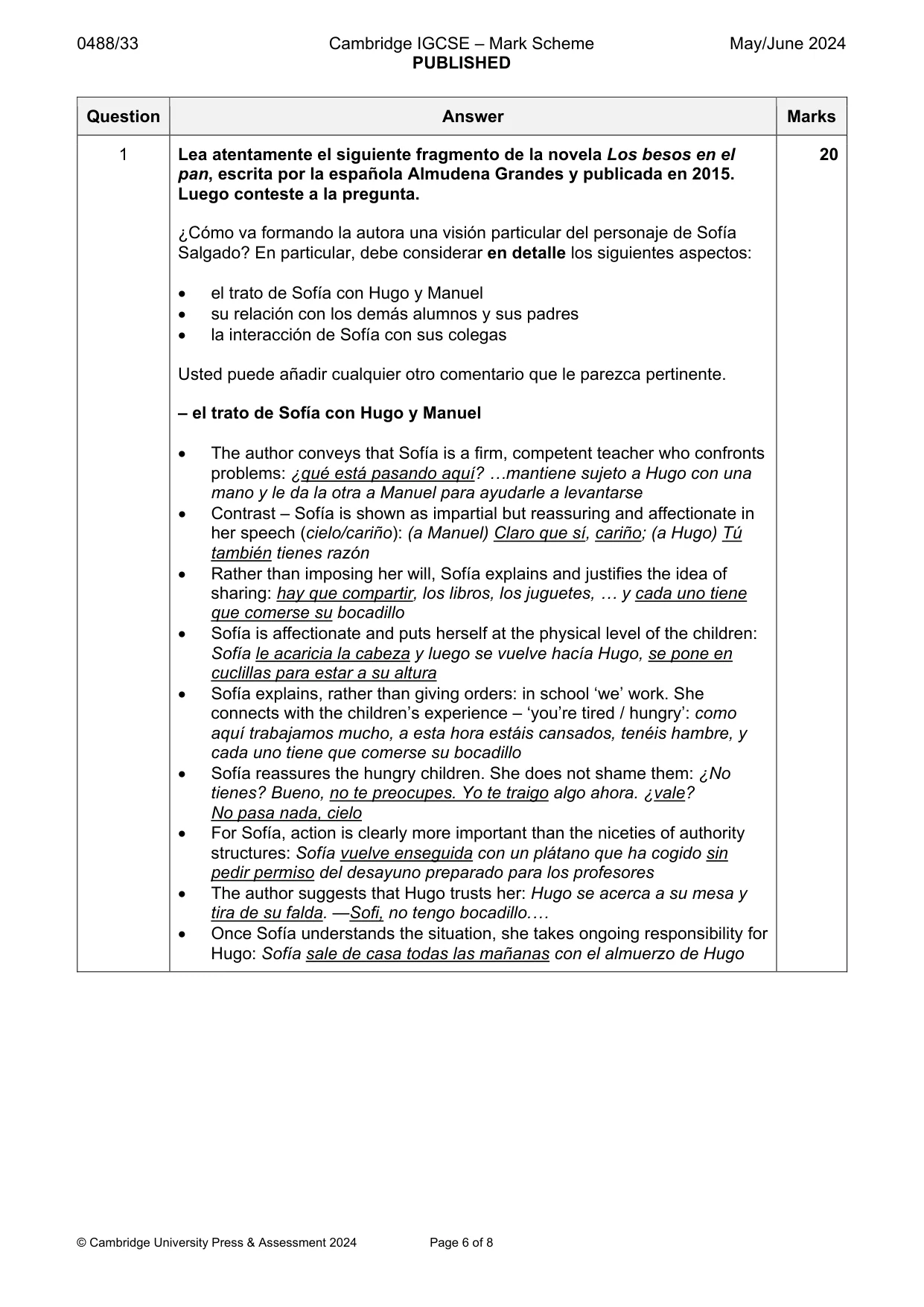
0488/33 Cambridge IGCSE – Mark Scheme PUBLISHED May/June 2024 © Cambridge University Press & Assessment 2024 Page 6 of 8 Question Answer Marks 1 Lea atentamente el siguiente fragmento de la novela Los besos en el pan, escrita por la española Almudena Grandes y publicada en 2015. Luego conteste a la pregunta. ¿Cómo va formando la autora una visión particular del personaje de Sofía Salgado? En particular, debe considerar en detalle los siguientes aspectos: el trato de Sofía con Hugo y Manuel su relación con los demás alumnos y sus padres la interacción de Sofía con sus colegas Usted puede añadir cualquier otro comentario que le parezca pertinente. – el trato de Sofía con Hugo y Manuel The author conveys that Sofía is a firm, competent teacher who confronts problems: ¿qué está pasando aquí? …mantiene sujeto a Hugo con una mano y le da la otra a Manuel para ayudarle a levantarse Contrast – Sofía is shown as impartial but reassuring and affectionate in her speech (cielo/cariño): (a Manuel) Claro que sí, cariño; (a Hugo) Tú también tienes razón Rather than imposing her will, Sofía explains and justifies the idea of sharing: hay que compartir, los libros, los juguetes, … y cada uno tiene que comerse su bocadillo Sofía is affectionate and puts herself at the physical level of the children: Sofía le acaricia la cabeza y luego se vuelve hacía Hugo, se pone en cuclillas para estar a su altura Sofía explains, rather than giving orders: in school ‘we’ work. She connects with the children’s experience – ‘you’re tired / hungry’: como aquí trabajamos mucho, a esta hora estáis cansados, tenéis hambre, y cada uno tiene que comerse su bocadillo Sofía reassures the hungry children. She does not shame them: ¿No tienes? Bueno, no te preocupes. Yo te traigo algo ahora. ¿vale? No pasa nada, cielo For Sofía, action is clearly more important than the niceties of authority structures: Sofía vuelve enseguida con un plátano que ha cogido sin pedir permiso del desayuno preparado para los profesores The author suggests that Hugo trusts her: Hugo se acerca a su mesa y tira de su falda. —Sofi, no tengo bocadillo.… Once Sofía understands the situation, she takes ongoing responsibility for Hugo: Sofía sale de casa todas las mañanas con el almuerzo de Hugo 20
Mark scheme, page 7
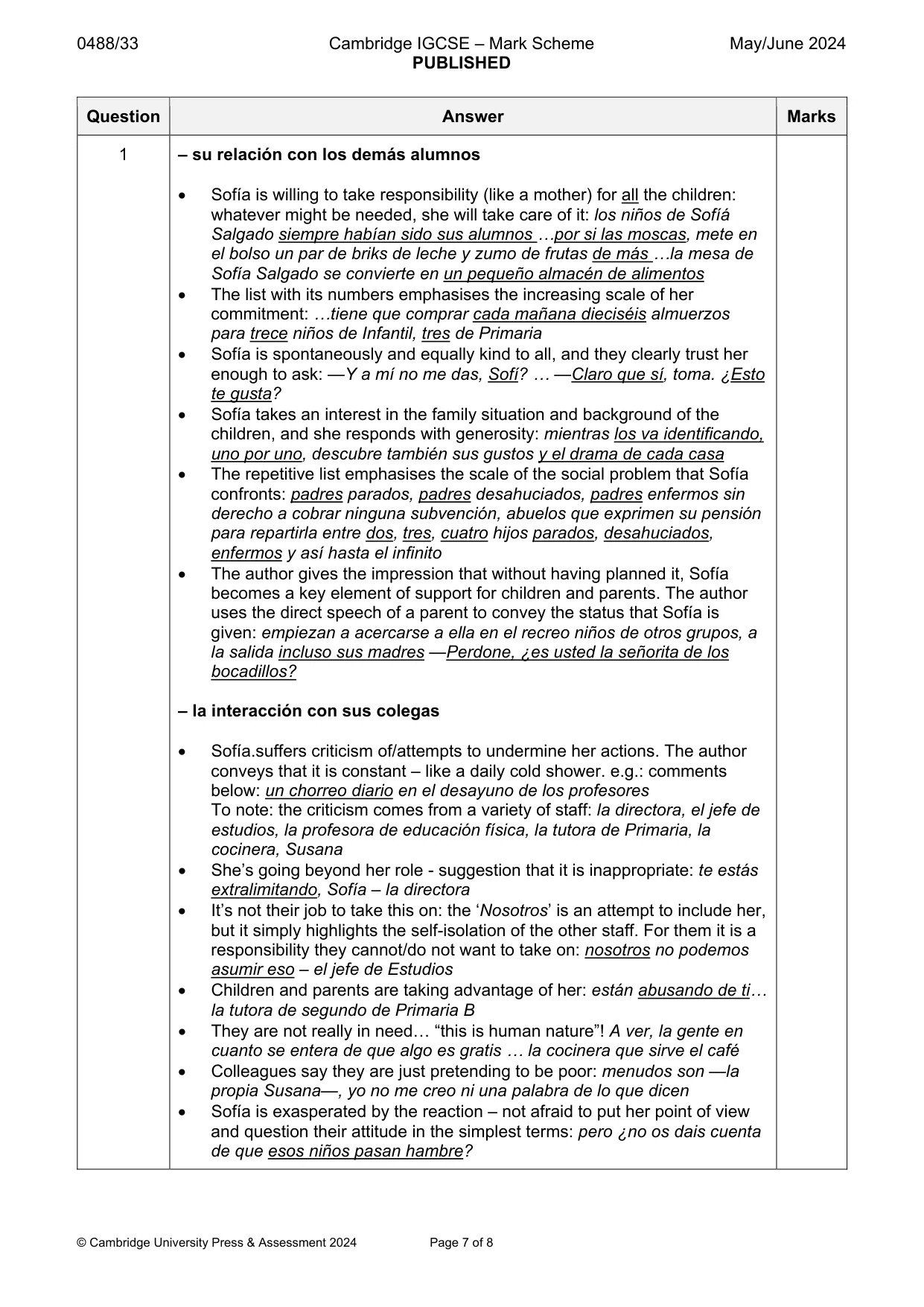
0488/33 Cambridge IGCSE – Mark Scheme PUBLISHED May/June 2024 © Cambridge University Press & Assessment 2024 Page 7 of 8 Question Answer Marks 1 – su relación con los demás alumnos Sofía is willing to take responsibility (like a mother) for all the children: whatever might be needed, she will take care of it: los niños de Sofíá Salgado siempre habían sido sus alumnos …por si las moscas, mete en el bolso un par de briks de leche y zumo de frutas de más …la mesa de Sofía Salgado se convierte en un pequeño almacén de alimentos The list with its numbers emphasises the increasing scale of her commitment: …tiene que comprar cada mañana dieciséis almuerzos para trece niños de Infantil, tres de Primaria Sofía is spontaneously and equally kind to all, and they clearly trust her enough to ask: —Y a mí no me das, Sofí? … —Claro que sí, toma. ¿Esto te gusta? Sofía takes an interest in the family situation and background of the children, and she responds with generosity: mientras los va identificando, uno por uno, descubre también sus gustos y el drama de cada casa The repetitive list emphasises the scale of the social problem that Sofía confronts: padres parados, padres desahuciados, padres enfermos sin derecho a cobrar ninguna subvención, abuelos que exprimen su pensión para repartirla entre dos, tres, cuatro hijos parados, desahuciados, enfermos y así hasta el infinito The author gives the impression that without having planned it, Sofía becomes a key element of support for children and parents. The author uses the direct speech of a parent to convey the status that Sofía is given: empiezan a acercarse a ella en el recreo niños de otros grupos, a la salida incluso sus madres —Perdone, ¿es usted la señorita de los bocadillos? – la interacción con sus colegas Sofía.suffers criticism of/attempts to undermine her actions. The author conveys that it is constant – like a daily cold shower. e.g.: comments below: un chorreo diario en el desayuno de los profesores To note: the criticism comes from a variety of staff: la directora, el jefe de estudios, la profesora de educación física, la tutora de Primaria, la cocinera, Susana She’s going beyond her role - suggestion that it is inappropriate: te estás extralimitando, Sofía – la directora It’s not their job to take this on: the ‘Nosotros’ is an attempt to include her, but it simply highlights the self-isolation of the other staff. For them it is a responsibility they cannot/do not want to take on: nosotros no podemos asumir eso – el jefe de Estudios Children and parents are taking advantage of her: están abusando de ti… la tutora de segundo de Primaria B They are not really in need… “this is human nature”! A ver, la gente en cuanto se entera de que algo es gratis … la cocinera que sirve el café Colleagues say they are just pretending to be poor: menudos son —la propia Susana—, yo no me creo ni una palabra de lo que dicen Sofía is exasperated by the reaction – not afraid to put her point of view and question their attitude in the simplest terms: pero ¿no os dais cuenta de que esos niños pasan hambre?
Mark scheme, page 8
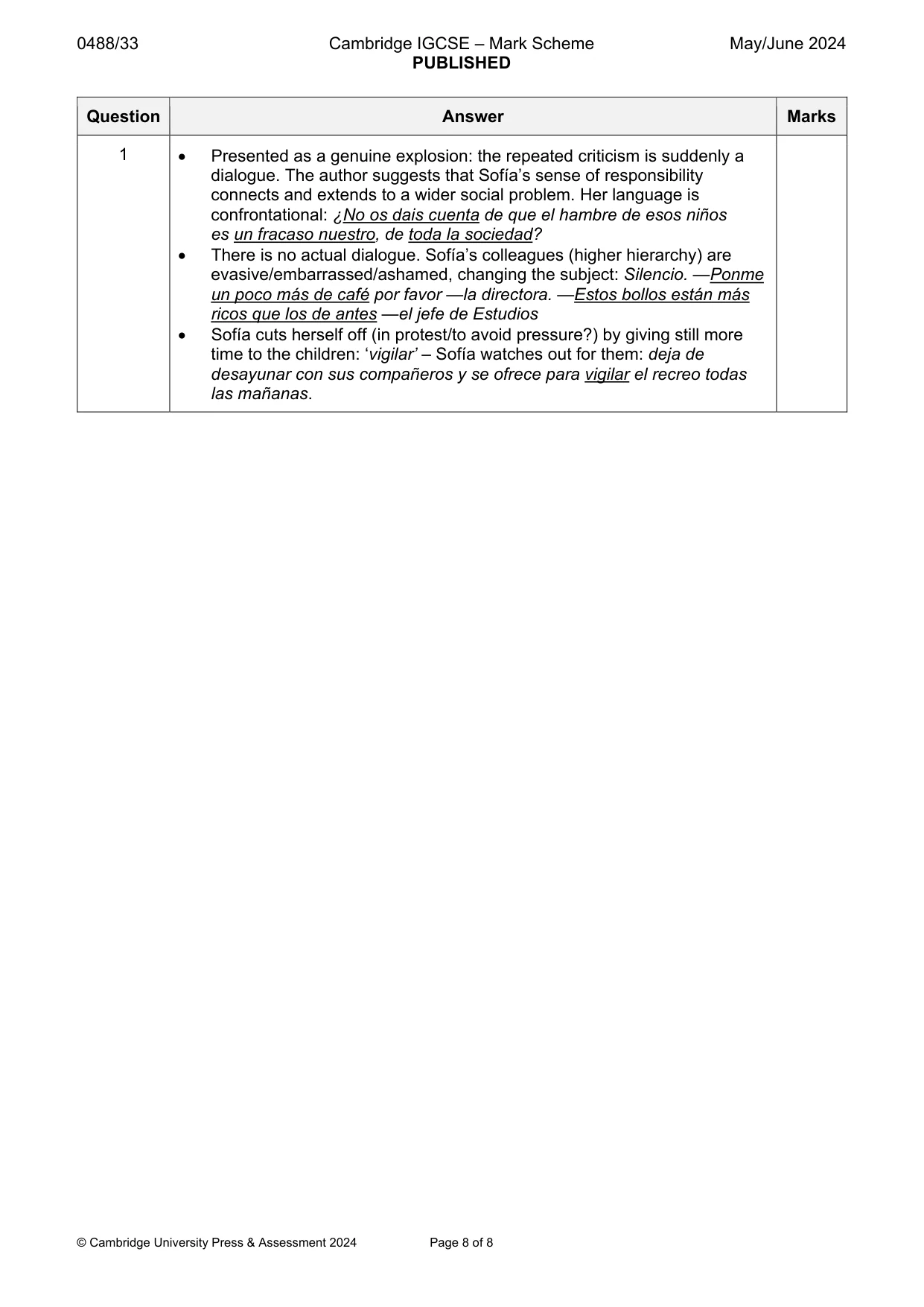
0488/33 Cambridge IGCSE – Mark Scheme PUBLISHED May/June 2024 © Cambridge University Press & Assessment 2024 Page 8 of 8 Question Answer Marks 1 Presented as a genuine explosion: the repeated criticism is suddenly a dialogue. The author suggests that Sofía’s sense of responsibility connects and extends to a wider social problem. Her language is confrontational: ¿No os dais cuenta de que el hambre de esos niños es un fracaso nuestro, de toda la sociedad? There is no actual dialogue. Sofía’s colleagues (higher hierarchy) are evasive/embarrassed/ashamed, changing the subject: Silencio. —Ponme un poco más de café por favor —la directora. —Estos bollos están más ricos que los de antes —el jefe de Estudios Sofía cuts herself off (in protest/to avoid pressure?) by giving still more time to the children: ‘vigilar’ – Sofía watches out for them: deja de desayunar con sus compañeros y se ofrece para vigilar el recreo todas las mañanas.
What you needed in this session
Cambridge’s own grade thresholds for 2024 May/June, Paper 3 · Variant 3. A higher threshold means an easier paper — the bar moves with how the cohort did.