Cambridge IGCSE Spanish - Literature 0488 — 2023 May/June Paper 3 · Variant 3
0488/33/M/J/23 · 20 marks · ≈23 min
The question paper and its mark scheme, free to read here and free to download. This is Cambridge’s own paper, exactly as it was sat.
Question paper8 pages




Mark scheme7 pages
Answers below. Sit the paper first if you are practising.
Paper as text
Question paper, page 1
This document has 8 pages. Any blank pages are indicated. [Turn over Cambridge IGCSE™ DC (LK) 313688/4 © UCLES 2023 LITERATURE (SPANISH) 0488/33 Paper 3 Alternative to Coursework May/June 2023 1 hour 20 minutes You must answer on the enclosed answer booklet. You will need: Answer booklet (enclosed) INSTRUCTIONS ● Answer the question. ● Follow the instructions on the front cover of the answer booklet. If you need additional answer paper, ask the invigilator for a continuation booklet. INFORMATION ● The total mark for this paper is 20. ● The number of marks for each question or part question is shown in brackets [ ]. INSTRUCCIONES ● Conteste a la pregunta. ● Siga las instrucciones que aparecen en la portada del cuadernillo de respuestas. Las instrucciones aparecen también en español a continuación. Si necesita hojas adicionales, pídale al supervisor un cuadernillo de respuestas adicional. INFORMACIÓN ● La puntuación total de este examen es de 20. ● La puntuación de cada pregunta o apartados de la misma aparece entre corchetes [ ]. * 4 1 3 9 5 6 4 4 7 6 *
Question paper, page 2
2 0488/33/ M / J /23 © UCLES 2023 INSTRUCCIONES PARA EL CUADERNILLO DE RESPUESTAS Use tinta negra o azul oscuro. Está permitido el uso de lápiz para diagramas o gráficos. Escriba su nombre, número de centro y número de estudiante en las casillas provistas en la parte superior de la página. Escriba de forma clara y en letras mayúsculas. No use tinta borrable ni líquido corrector. No escriba en los códigos de barras. Escriba sus respuestas en este cuadernillo de respuestas. Utilice ambas caras del papel. Por favor, deje dos líneas en blanco entre las respuestas a cada pregunta. Escriba el número de la pregunta que está respondiendo en el primer margen. Question Part 1 1 (a)(i) (a)(ii) Si la pregunta que está respondiendo está dividida en secciones, por ejemplo 1(a), escriba la sección de la pregunta en el segundo margen. Debe hacer sus anotaciones con bolígrafo en este cuadernillo de respuestas. Debe tachar todo lo que no desee que el examinador evalúe, pero asegúrese de que lo tachado es todavía legible. No arranque ninguna hoja de este cuadernillo de respuestas. Debe entregar todo el trabajo que haya realizado. Si ha utilizado un cuadernillo de respuestas adicional, debe guardarlo dentro de este cuadernillo.
Question paper, page 3
3 0488/33/M/J/23 © UCLES 2023 [Turn over BLANK PAGE
Question paper, page 4
4 0488/33/M/J/23 © UCLES 2023 Lea atentamente el siguiente fragmento extraído del cuento Adiós a Ruibarbo, escrito por el autor chileno Guillermo Blanco y publicado en 2003. Luego conteste la pregunta: Este relato trata del afecto de un niño apodado Potrillo hacia un caballo llamado Ruibarbo. Potrillo va todos los días a visitarlo a la panadería donde Ruibarbo tira del carro que reparte el pan. Mañana a mañana, casi al filo del alba, el chico llegaba a sentarse en la acera empedrada, frente al portón de la panadería. Adoptaba siempre la misma postura: cruzadas las piernas, las manos cruzadas delante de ellas, la vista fija en el callejón que conducía a las caballerizas. […] Un día, cuando salía al reparto el carro tirado por Ruibarbo, el anciano conductor dijo al chico: —Despídete de él, Potrillo. Su mirada preguntó por qué. —El patrón lo vendió. —¿A quién? Quiso el hombre callar, pero las pupilas del niño no permitían huirle. Con voz ronca explicó que lo llevarían al matadero mañana de alba, que harían charqui1 de él. Bueno, estaba tan viejo que… Al matadero. Se fue el muchacho pensativo calle abajo. […] Llegó el chico al río, se puso a andar por la orilla. […] Era la hora de la escuela. No fue a la escuela. Permaneció la mañana entera tendido en su roca de siempre, aunque sin soñar, como siempre: meditando, obsesionado, desesperado. […] Por la tarde se encaminó a la panadería y se quedó hasta que ya estuvo oscuro junto al viejo Ruibarbo, musitando su caricia inútil: —Manco2, manco, Ruibarbo… De pronto oyó que cerraban la puerta. Colocaban trancas. Alguien se despedía: —Hasta mañana patrón. —Hasta mañana ¿Les pusiste agua a los caballos? —Sí. —¿A los cuatro? —No sé si al Ruibarbo. Total, para qué darles trabajo de más a los charqueadores3. Sonó una carcajada. El chico se estremeció. No hizo ningún movimiento. Esperaría a que se fueran, y daría de beber a su amigo. Eso sí lo iba a entender. […] Se asomó al patio: una luna blanquecina emergía ya, y alumbraba todo vagamente. Nadie. Sigiloso, buscando los rincones, avanzó hacia la llave del agua. Al pasar frente al callejón de salida
Question paper, page 5
5 0488/33/M/J/23 © UCLES 2023 una idea le aceleró el pulso hasta la angustia: corrió, jadeante, al portón, y comenzó a hurgar a tientas. Por fin halló la tranca. Pesaba mucho. La alzó a duras penas. Cuando lo hubo conseguido, el madero se vino al suelo con estrépito. Creyó que no podría evitar el llanto. Se contuvo porque era demasiado grande su miedo. Trató de hacerse ovillo. Esperó. […] El chico permaneció quieto por interminables minutos. Una campana de reloj dio la hora, pero él no atinó a contar los golpes. Aún resonó otro antes de que se atreviese a cambiar de postura. Se levantó entonces con mil precauciones, fue hasta la caballeriza de Ruibarbo, desató la cuerda que lo ligaba a un poste y comenzó a conducirlo hacia el portón. El animal se resistía al principio. Después le siguió, a paso lento. Le pareció al niño que nunca habían resonado tanto las herraduras sobre los adoquines. La espesa hoja de madera se abrió con quejidos de vieja. No se atrevió a cerrarla. En la calle no había nadie, ni encontraron a nadie en el trecho breve que la panadería distaba del río. Así alcanzaron al puente, a cuyo extremo opuesto el llano y los cerros se abrían, libres, semejantes al reino con que el chico soñaba, y revestidos ahora de magia por la claridad de la luna. Tenso de emoción, quitó la cuerda del cuello de Ruibarbo, le dio las últimas palmadas de afecto y murmuró cálidamente: —Adiós. El caballo permaneció unos momentos inmóvil, como si no entendiera. Después dio media vuelta y se fue trotando, trotando, hasta el portón de la panadería por el que desapareció. Glosario: 1 charqui: carne procesada típica de la región andina 2 manco: expresión de cariño para el caballo 3 charqueadores: los que procesan el charqui 1 ¿Hasta qué punto, y cómo, ha logrado el autor impactarlo/la a usted con lo que acontece en este relato? En particular debe considerar, en detalle, los siguientes aspectos: • lo que aprendemos sobre el significado de Ruibarbo para el niño • cómo el autor transmite tensión durante el intento de liberación de Ruibarbo • su opinión como lector/a acerca del desenlace de la historia. Usted puede añadir cualquier otro comentario que le parezca pertinente. [20]
Question paper, page 6
6 0488/33/M/J/23 © UCLES 2023 BLANK PAGE
Question paper, page 7
7 0488/33/M/J/23 © UCLES 2023 BLANK PAGE
Question paper, page 8
8 0488/33/M/J/23 © UCLES 2023 Permission to reproduce items where third-party owned material protected by copyright is included has been sought and cleared where possible. Every reasonable effort has been made by the publisher (UCLES) to trace copyright holders, but if any items requiring clearance have unwittingly been included, the publisher will be pleased to make amends at the earliest possible opportunity. To avoid the issue of disclosure of answer-related information to candidates, all copyright acknowledgements are reproduced online in the Cambridge Assessment International Education Copyright Acknowledgements Booklet. This is produced for each series of examinations and is freely available to download at www.cambridgeinternational.org after the live examination series. Cambridge Assessment International Education is part of Cambridge Assessment. Cambridge Assessment is the brand name of the University of Cambridge Local Examinations Syndicate (UCLES), which is a department of the University of Cambridge. BLANK PAGE
Mark scheme, page 1
This document consists of 7 printed pages. © UCLES 2023 [Turn over Cambridge IGCSE™ LITERATURE (SPANISH) 0488/33 Paper 3 Alternative to Coursework May/June 2023 MARK SCHEME Maximum Mark: 20 Published This mark scheme is published as an aid to teachers and candidates, to indicate the requirements of the examination. It shows the basis on which Examiners were instructed to award marks. It does not indicate the details of the discussions that took place at an Examiners’ meeting before marking began, which would have considered the acceptability of alternative answers. Mark schemes should be read in conjunction with the question paper and the Principal Examiner Report for Teachers. Cambridge International will not enter into discussions about these mark schemes. Cambridge International is publishing the mark schemes for the May/June 2023 series for most Cambridge IGCSE, Cambridge International A and AS Level and Cambridge Pre-U components, and some Cambridge O Level components.
Mark scheme, page 2
0488/33 Cambridge IGCSE – Mark Scheme PUBLISHED May/June 2023 © UCLES 2023 Page 2 of 7 Generic Marking Principles These general marking principles must be applied by all examiners when marking candidate answers. They should be applied alongside the specific content of the mark scheme or generic level descriptors for a question. Each question paper and mark scheme will also comply with these marking principles. GENERIC MARKING PRINCIPLE 1: Marks must be awarded in line with: the specific content of the mark scheme or the generic level descriptors for the question the specific skills defined in the mark scheme or in the generic level descriptors for the question the standard of response required by a candidate as exemplified by the standardisation scripts. GENERIC MARKING PRINCIPLE 2: Marks awarded are always whole marks (not half marks, or other fractions). GENERIC MARKING PRINCIPLE 3: Marks must be awarded positively: marks are awarded for correct/valid answers, as defined in the mark scheme. However, credit is given for valid answers which go beyond the scope of the syllabus and mark scheme, referring to your Team Leader as appropriate marks are awarded when candidates clearly demonstrate what they know and can do marks are not deducted for errors marks are not deducted for omissions answers should only be judged on the quality of spelling, punctuation and grammar when these features are specifically assessed by the question as indicated by the mark scheme. The meaning, however, should be unambiguous. GENERIC MARKING PRINCIPLE 4: Rules must be applied consistently, e.g. in situations where candidates have not followed instructions or in the application of generic level descriptors. GENERIC MARKING PRINCIPLE 5: Marks should be awarded using the full range of marks defined in the mark scheme for the question (however; the use of the full mark range may be limited according to the quality of the candidate responses seen). GENERIC MARKING PRINCIPLE 6: Marks awarded are based solely on the requirements as defined in the mark scheme. Marks should not be awarded with grade thresholds or grade descriptors in mind.
Mark scheme, page 3
0488/33 Cambridge IGCSE – Mark Scheme PUBLISHED May/June 2023 © UCLES 2023 Page 3 of 7 GENERAL MARKING PRINCIPLES The General Descriptors guide examiners to an understanding of the qualities normally expected of, or typical of, work in a band. They are a means of general guidance and must not be interpreted as hurdle statements. For the purposes of standardisation of marking, they are to be used in conjunction with standardisation scripts and discussed during the examiners’ coordination meeting, as well as the question-specific notes. Because of the nature of the subject, these notes are for general guidance; they are not designed as prescriptions of required content and must not be treated as such. The syllabus aims at encouraging candidates to make some personal response to their reading. This means that, while we may have legitimate expectations as to the ground most answers may occupy, we must be prepared to meet candidates on their chosen ground. Hence, we must at all times tease out what the candidate is trying to say to us. We must recognise that it is possible for a candidate whose technical command of Spanish is limited, but whose language still manages to communicate understanding, to receive high marks. Nor should we reward fluency and display of literary terms if we feel that there is little evidence of such understanding. Remember that we are looking for response to literature, not demonstration of language skills. It is vital that we constantly remind ourselves that this is unseen work and we should not be overcritical of an occasional false note or misunderstanding. We are marking the quality of the process of engaging with literature, and not merely assessing the accuracy or otherwise of the conclusions reached. Regular reference to the standardisation scripts discussed during coordination will be crucial to maintaining the standard throughout the marking process. The detailed questions are intended to help the candidate respond. Candidates are required to answer them but need not do so in a rigid sequence; some of the answers may be implicit in the essay, although it is expected that candidates will be able to spell out their views and interpretations with sufficient clarity. There is no prescribed application of marks to each question and the response should be marked holistically. Candidates who do not answer the prescribed questions will penalise themselves automatically, as the questions are central to the passage. USE OF BAND DESCRIPTORS The Descriptors are an attempt to guide examiners to an understanding of the qualities normally expected of, or ‘typical’ of work in the band. First place the script within a Band, and then, having balanced its different qualities and their relationship to the Assessment Objectives and the three strands within each Band, decide whether you place it at the top, in the middle or at the bottom of that Band. Place a tick on every page to show you have not missed a page. In writing comments on the script, use the annotations available from RM Assessor.
Mark scheme, page 4
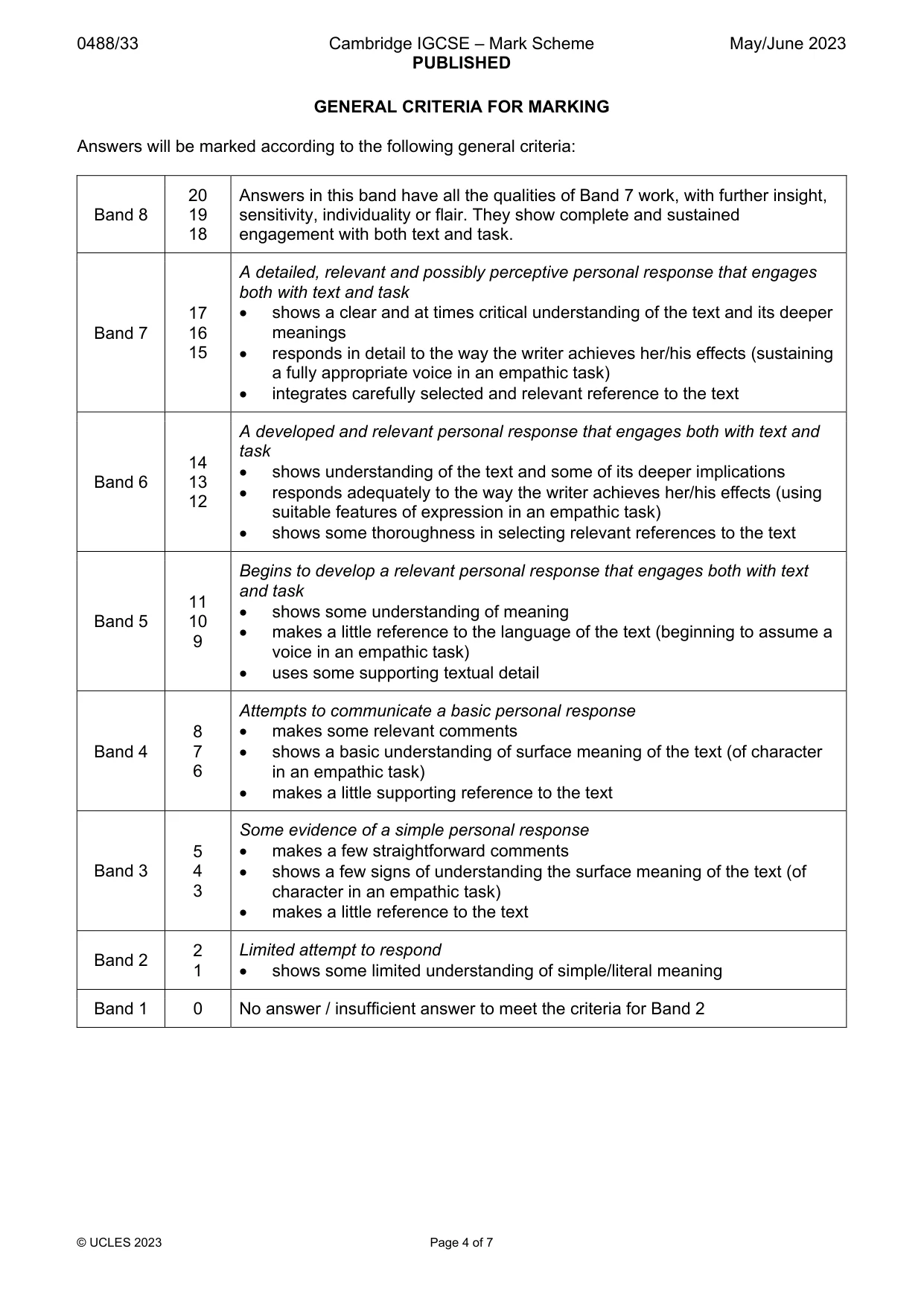
0488/33 Cambridge IGCSE – Mark Scheme PUBLISHED May/June 2023 © UCLES 2023 Page 4 of 7 GENERAL CRITERIA FOR MARKING Answers will be marked according to the following general criteria: Band 8 20 19 18 Answers in this band have all the qualities of Band 7 work, with further insight, sensitivity, individuality or flair. They show complete and sustained engagement with both text and task. Band 7 17 16 15 A detailed, relevant and possibly perceptive personal response that engages both with text and task shows a clear and at times critical understanding of the text and its deeper meanings responds in detail to the way the writer achieves her/his effects (sustaining a fully appropriate voice in an empathic task) integrates carefully selected and relevant reference to the text Band 6 14 13 12 A developed and relevant personal response that engages both with text and task shows understanding of the text and some of its deeper implications responds adequately to the way the writer achieves her/his effects (using suitable features of expression in an empathic task) shows some thoroughness in selecting relevant references to the text Band 5 11 10 9 Begins to develop a relevant personal response that engages both with text and task shows some understanding of meaning makes a little reference to the language of the text (beginning to assume a voice in an empathic task) uses some supporting textual detail Band 4 8 7 6 Attempts to communicate a basic personal response makes some relevant comments shows a basic understanding of surface meaning of the text (of character in an empathic task) makes a little supporting reference to the text Band 3 5 4 3 Some evidence of a simple personal response makes a few straightforward comments shows a few signs of understanding the surface meaning of the text (of character in an empathic task) makes a little reference to the text Band 2 2 1 Limited attempt to respond shows some limited understanding of simple/literal meaning Band 1 0 No answer / insufficient answer to meet the criteria for Band 2
Mark scheme, page 5
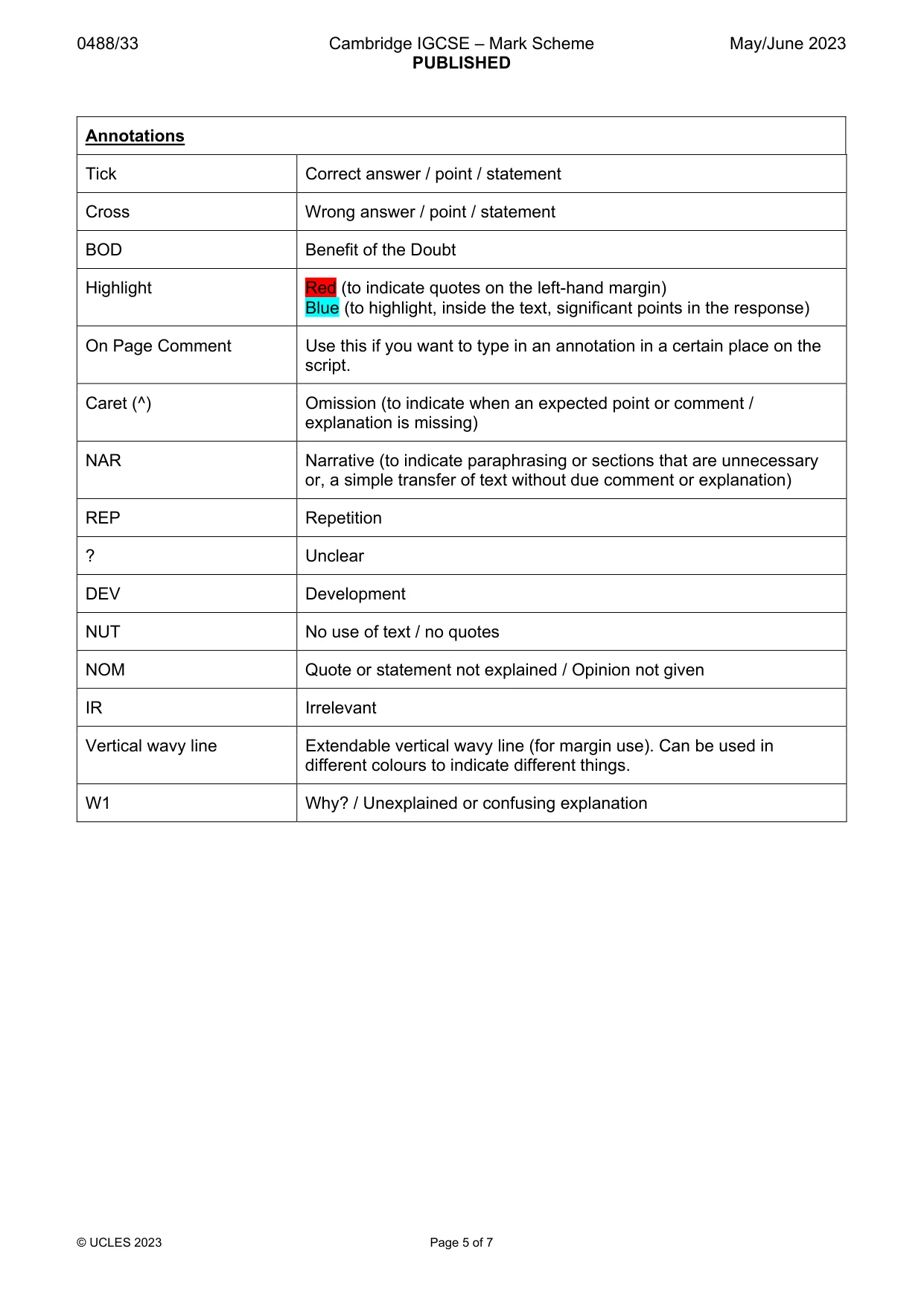
0488/33 Cambridge IGCSE – Mark Scheme PUBLISHED May/June 2023 © UCLES 2023 Page 5 of 7 Annotations Tick Correct answer / point / statement Cross Wrong answer / point / statement BOD Benefit of the Doubt Highlight Red (to indicate quotes on the left-hand margin) Blue (to highlight, inside the text, significant points in the response) On Page Comment Use this if you want to type in an annotation in a certain place on the script. Caret (^) Omission (to indicate when an expected point or comment / explanation is missing) NAR Narrative (to indicate paraphrasing or sections that are unnecessary or, a simple transfer of text without due comment or explanation) REP Repetition ? Unclear DEV Development NUT No use of text / no quotes NOM Quote or statement not explained / Opinion not given IR Irrelevant Vertical wavy line Extendable vertical wavy line (for margin use). Can be used in different colours to indicate different things. W1 Why? / Unexplained or confusing explanation
Mark scheme, page 6
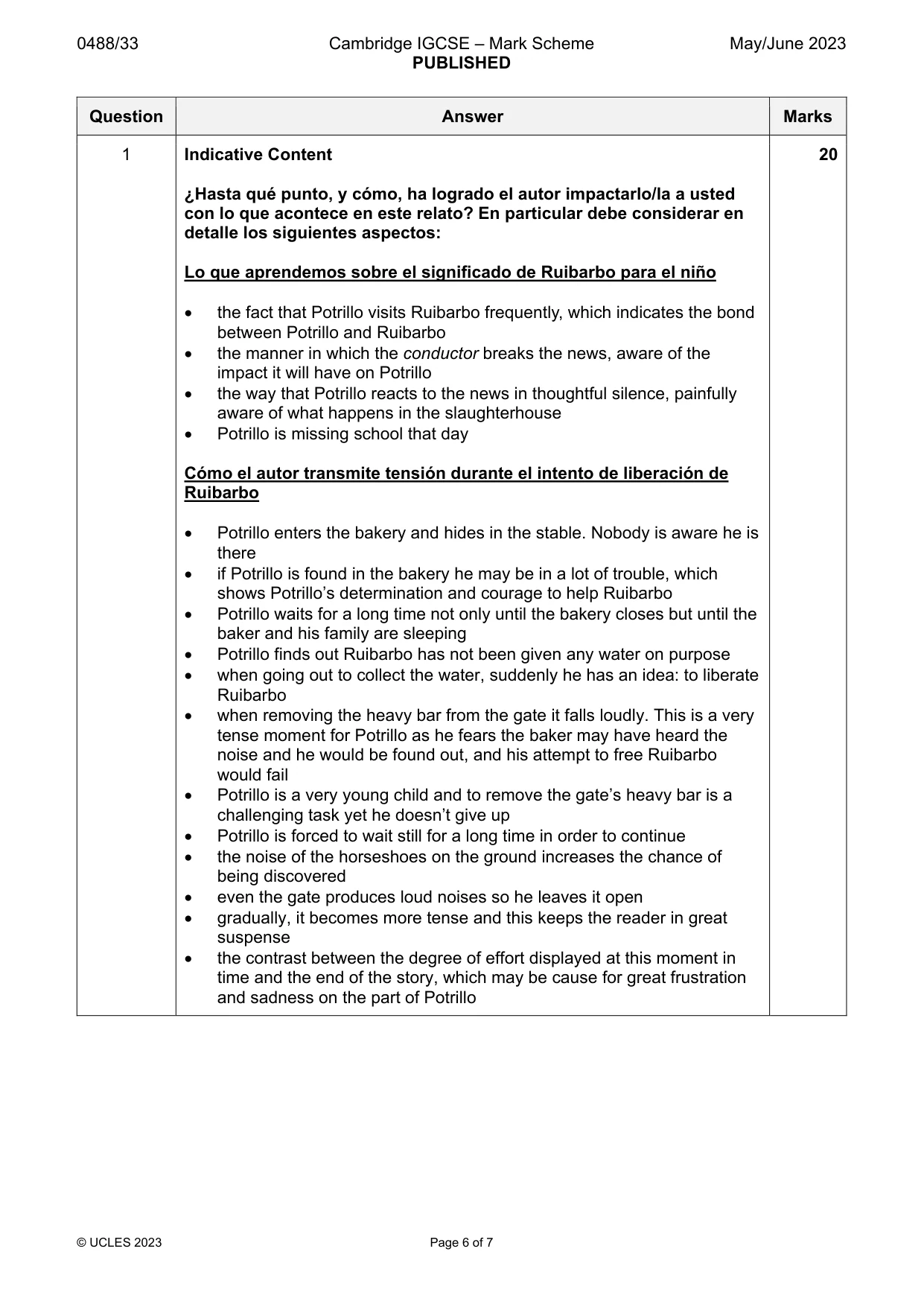
0488/33 Cambridge IGCSE – Mark Scheme PUBLISHED May/June 2023 © UCLES 2023 Page 6 of 7 Question Answer Marks 1 Indicative Content ¿Hasta qué punto, y cómo, ha logrado el autor impactarlo/la a usted con lo que acontece en este relato? En particular debe considerar en detalle los siguientes aspectos: Lo que aprendemos sobre el significado de Ruibarbo para el niño the fact that Potrillo visits Ruibarbo frequently, which indicates the bond between Potrillo and Ruibarbo the manner in which the conductor breaks the news, aware of the impact it will have on Potrillo the way that Potrillo reacts to the news in thoughtful silence, painfully aware of what happens in the slaughterhouse Potrillo is missing school that day Cómo el autor transmite tensión durante el intento de liberación de Ruibarbo Potrillo enters the bakery and hides in the stable. Nobody is aware he is there if Potrillo is found in the bakery he may be in a lot of trouble, which shows Potrillo’s determination and courage to help Ruibarbo Potrillo waits for a long time not only until the bakery closes but until the baker and his family are sleeping Potrillo finds out Ruibarbo has not been given any water on purpose when going out to collect the water, suddenly he has an idea: to liberate Ruibarbo when removing the heavy bar from the gate it falls loudly. This is a very tense moment for Potrillo as he fears the baker may have heard the noise and he would be found out, and his attempt to free Ruibarbo would fail Potrillo is a very young child and to remove the gate’s heavy bar is a challenging task yet he doesn’t give up Potrillo is forced to wait still for a long time in order to continue the noise of the horseshoes on the ground increases the chance of being discovered even the gate produces loud noises so he leaves it open gradually, it becomes more tense and this keeps the reader in great suspense the contrast between the degree of effort displayed at this moment in time and the end of the story, which may be cause for great frustration and sadness on the part of Potrillo 20
Mark scheme, page 7
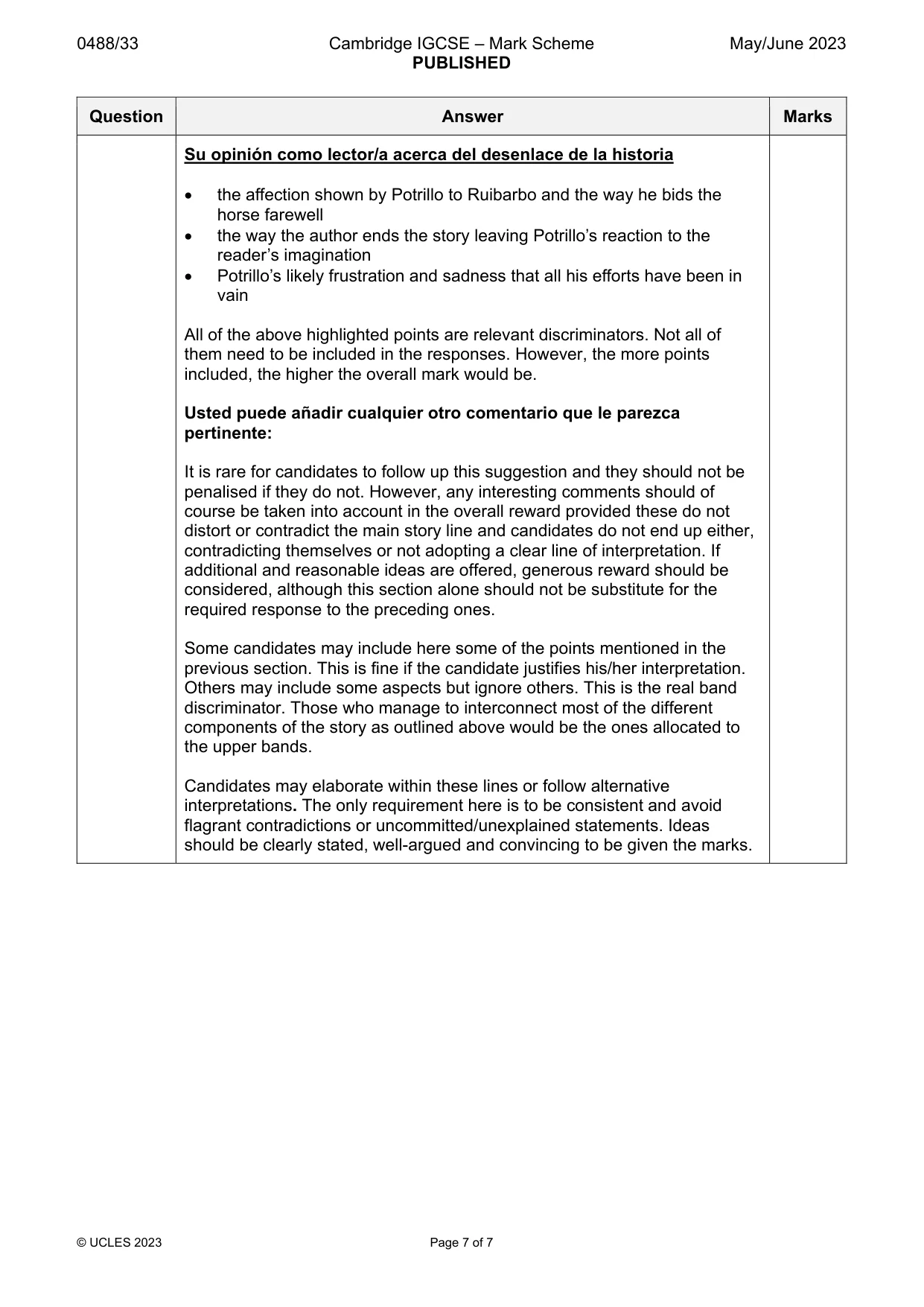
0488/33 Cambridge IGCSE – Mark Scheme PUBLISHED May/June 2023 © UCLES 2023 Page 7 of 7 Question Answer Marks Su opinión como lector/a acerca del desenlace de la historia the affection shown by Potrillo to Ruibarbo and the way he bids the horse farewell the way the author ends the story leaving Potrillo’s reaction to the reader’s imagination Potrillo’s likely frustration and sadness that all his efforts have been in vain All of the above highlighted points are relevant discriminators. Not all of them need to be included in the responses. However, the more points included, the higher the overall mark would be. Usted puede añadir cualquier otro comentario que le parezca pertinente: It is rare for candidates to follow up this suggestion and they should not be penalised if they do not. However, any interesting comments should of course be taken into account in the overall reward provided these do not distort or contradict the main story line and candidates do not end up either, contradicting themselves or not adopting a clear line of interpretation. If additional and reasonable ideas are offered, generous reward should be considered, although this section alone should not be substitute for the required response to the preceding ones. Some candidates may include here some of the points mentioned in the previous section. This is fine if the candidate justifies his/her interpretation. Others may include some aspects but ignore others. This is the real band discriminator. Those who manage to interconnect most of the different components of the story as outlined above would be the ones allocated to the upper bands. Candidates may elaborate within these lines or follow alternative interpretations. The only requirement here is to be consistent and avoid flagrant contradictions or uncommitted/unexplained statements. Ideas should be clearly stated, well-argued and convincing to be given the marks.
What you needed in this session
Cambridge’s own grade thresholds for 2023 May/June, Paper 3 · Variant 3. A higher threshold means an easier paper — the bar moves with how the cohort did.