Cambridge IGCSE Spanish - Literature 0488 — 2020 May/June Paper 3 · Variant 3
0488/33/M/J/20
The question paper and its mark scheme, free to read here and free to download. This is Cambridge’s own paper, exactly as it was sat.
Question paper8 pages




Mark scheme9 pages
Answers below. Sit the paper first if you are practising.
Paper as text
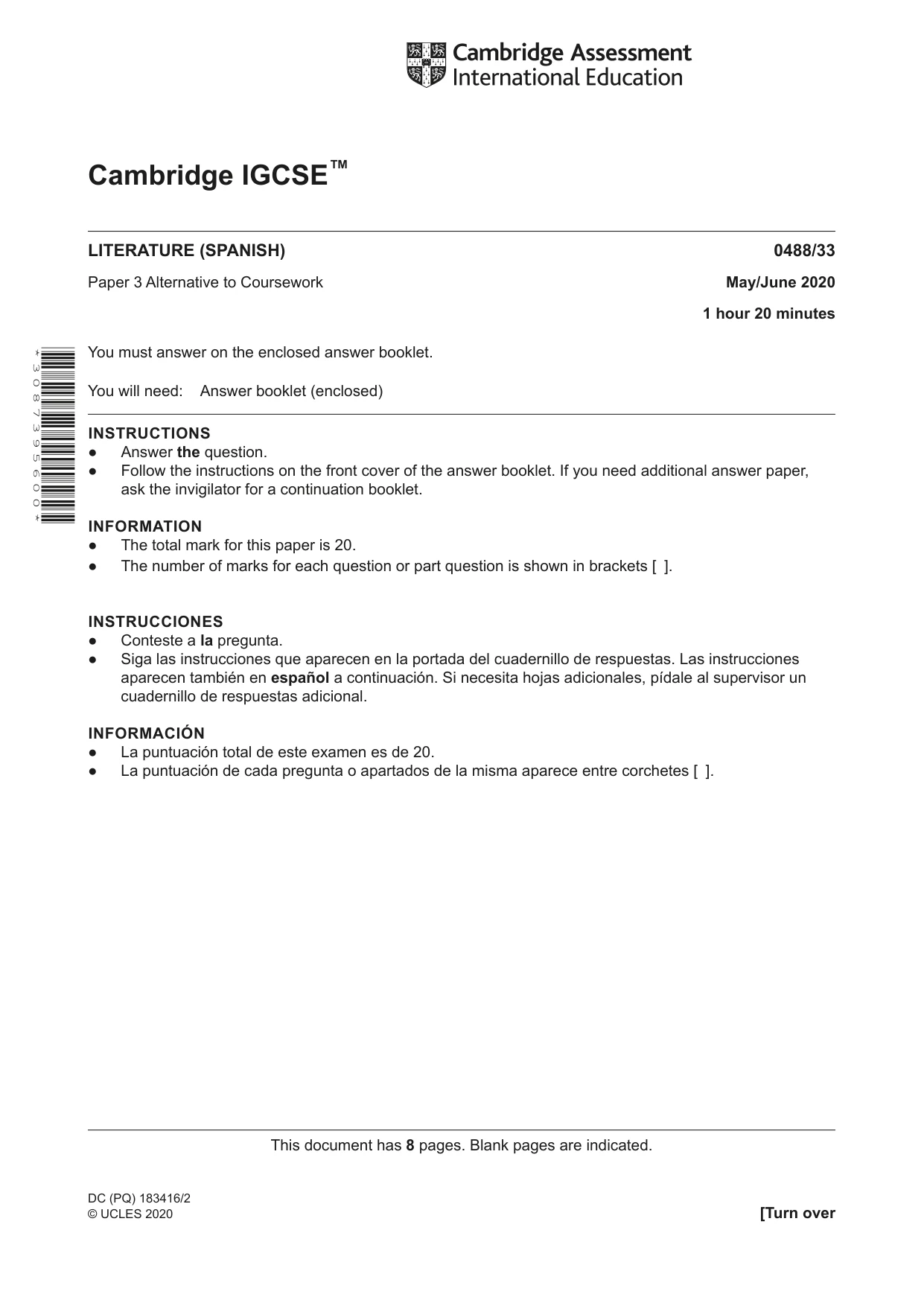
Question paper, page 1
Cambridge IGCSE™ DC (PQ) 183416/2 © UCLES 2020 [Turn over This document has 8 pages. Blank pages are indicated. * 3 0 8 7 3 9 5 6 0 0 * LITERATURE (SPANISH) 0488/33 Paper 3 Alternative to Coursework May/June 2020 1 hour 20 minutes You must answer on the enclosed answer booklet. You will need: Answer booklet (enclosed) INSTRUCTIONS ● Answer the question. ● Follow the instructions on the front cover of the answer booklet. If you need additional answer paper, ask the invigilator for a continuation booklet. INFORMATION ● The total mark for this paper is 20. ● The number of marks for each question or part question is shown in brackets [ ]. INSTRUCCIONES ● Conteste a la pregunta. ● Siga las instrucciones que aparecen en la portada del cuadernillo de respuestas. Las instrucciones aparecen también en español a continuación. Si necesita hojas adicionales, pídale al supervisor un cuadernillo de respuestas adicional. INFORMACIÓN ● La puntuación total de este examen es de 20. ● La puntuación de cada pregunta o apartados de la misma aparece entre corchetes [ ].
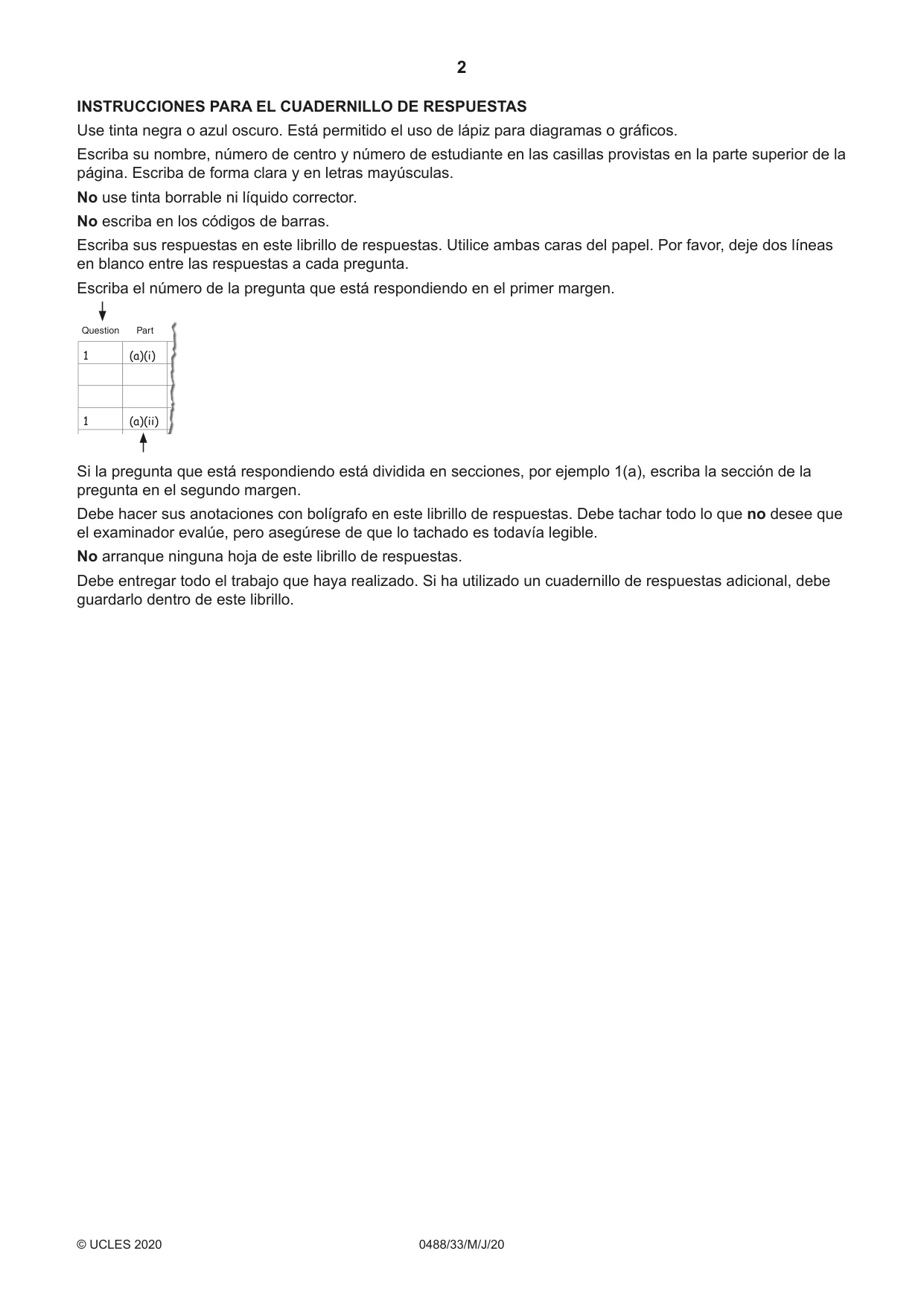
Question paper, page 2
2 0488/33/M/J/20 © UCLES 2020 INSTRUCCIONES PARA EL CUADERNILLO DE RESPUESTAS Use tinta negra o azul oscuro. Está permitido el uso de lápiz para diagramas o gráficos. Escriba su nombre, número de centro y número de estudiante en las casillas provistas en la parte superior de la página. Escriba de forma clara y en letras mayúsculas. No use tinta borrable ni líquido corrector. No escriba en los códigos de barras. Escriba sus respuestas en este librillo de respuestas. Utilice ambas caras del papel. Por favor, deje dos líneas en blanco entre las respuestas a cada pregunta. Escriba el número de la pregunta que está respondiendo en el primer margen. Question Part 1 1 (a)(i) (a)(ii) Si la pregunta que está respondiendo está dividida en secciones, por ejemplo 1(a), escriba la sección de la pregunta en el segundo margen. Debe hacer sus anotaciones con bolígrafo en este librillo de respuestas. Debe tachar todo lo que no desee que el examinador evalúe, pero asegúrese de que lo tachado es todavía legible. No arranque ninguna hoja de este librillo de respuestas. Debe entregar todo el trabajo que haya realizado. Si ha utilizado un cuadernillo de respuestas adicional, debe guardarlo dentro de este librillo.
Question paper, page 3
3 0488/33/M/J/20 © UCLES 2020 [Turn over BLANK PAGE
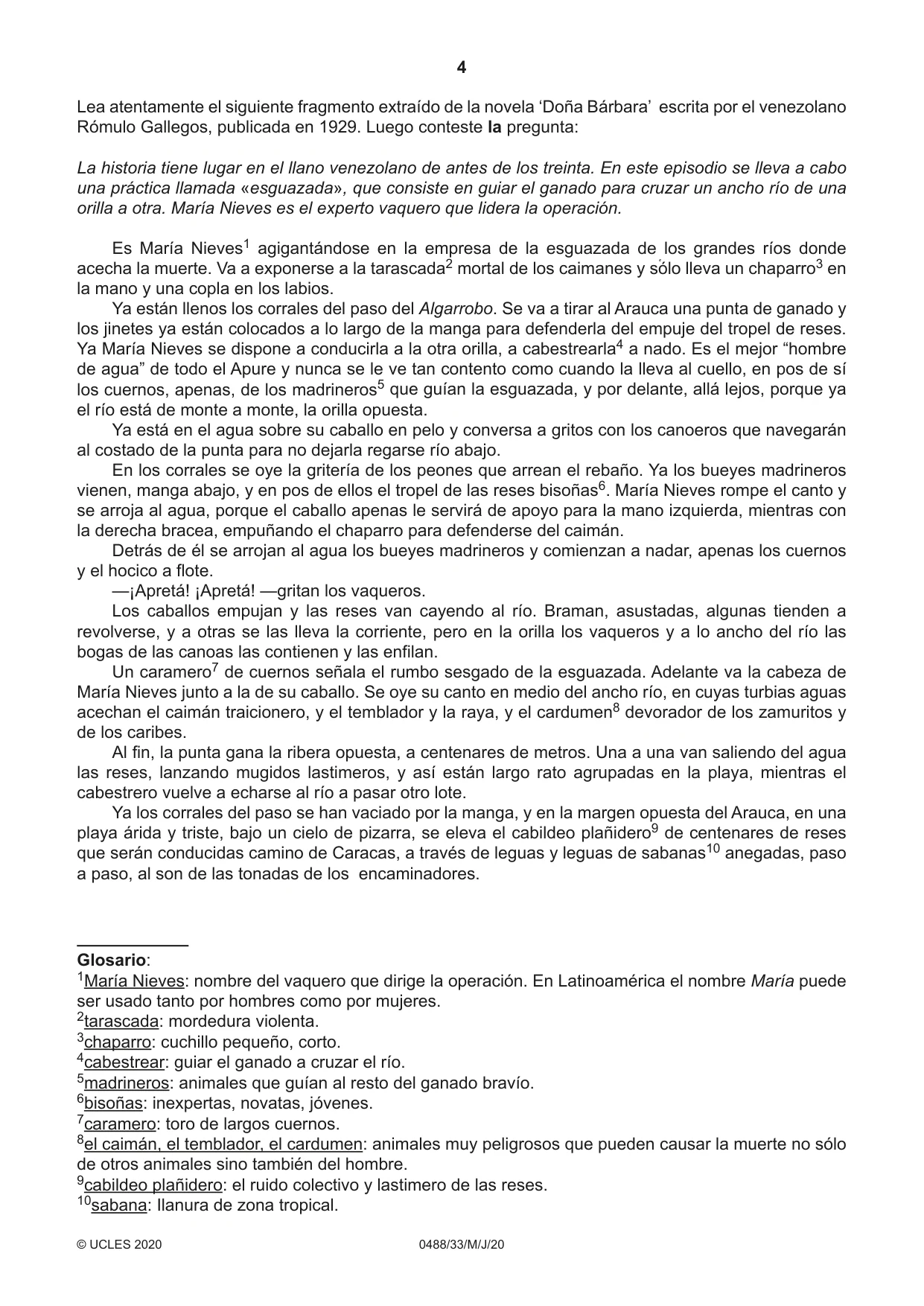
Question paper, page 4
4 0488/33/M/J/20 © UCLES 2020 Lea atentamente el siguiente fragmento extraído de la novela ‘Doña Bárbara’ escrita por el venezolano Rómulo Gallegos, publicada en 1929. Luego conteste la pregunta: La historia tiene lugar en el llano venezolano de antes de los treinta. En este episodio se lleva a cabo una práctica llamada «esguazada», que consiste en guiar el ganado para cruzar un ancho río de una orilla a otra. María Nieves es el experto vaquero que lidera la operación. Es María Nieves1 agigantándose en la empresa de la esguazada de los grandes ríos donde acecha la muerte. Va a exponerse a la tarascada2 mortal de los caimanes y sٴólo lleva un chaparro3 en la mano y una copla en los labios. Ya están llenos los corrales del paso del Algarrobo. Se va a tirar al Arauca una punta de ganado y los jinetes ya están colocados a lo largo de la manga para defenderla del empuje del tropel de reses. Ya María Nieves se dispone a conducirla a la otra orilla, a cabestrearla4 a nado. Es el mejor “hombre de agua” de todo el Apure y nunca se le ve tan contento como cuando la lleva al cuello, en pos de sí los cuernos, apenas, de los madrineros5 que guían la esguazada, y por delante, allá lejos, porque ya el río está de monte a monte, la orilla opuesta. Ya está en el agua sobre su caballo en pelo y conversa a gritos con los canoeros que navegarán al costado de la punta para no dejarla regarse río abajo. En los corrales se oye la gritería de los peones que arrean el rebaño. Ya los bueyes madrineros vienen, manga abajo, y en pos de ellos el tropel de las reses bisoñas6. María Nieves rompe el canto y se arroja al agua, porque el caballo apenas le servirá de apoyo para la mano izquierda, mientras con la derecha bracea, empuñando el chaparro para defenderse del caimán. Detrás de él se arrojan al agua los bueyes madrineros y comienzan a nadar, apenas los cuernos y el hocico a flote. —¡Apretá! ¡Apretá! —gritan los vaqueros. Los caballos empujan y las reses van cayendo al río. Braman, asustadas, algunas tienden a revolverse, y a otras se las lleva la corriente, pero en la orilla los vaqueros y a lo ancho del río las bogas de las canoas las contienen y las enfilan. Un caramero7 de cuernos señala el rumbo sesgado de la esguazada. Adelante va la cabeza de María Nieves junto a la de su caballo. Se oye su canto en medio del ancho río, en cuyas turbias aguas acechan el caimán traicionero, y el temblador y la raya, y el cardumen8 devorador de los zamuritos y de los caribes. Al fin, la punta gana la ribera opuesta, a centenares de metros. Una a una van saliendo del agua las reses, lanzando mugidos lastimeros, y así están largo rato agrupadas en la playa, mientras el cabestrero vuelve a echarse al río a pasar otro lote. Ya los corrales del paso se han vaciado por la manga, y en la margen opuesta del Arauca, en una playa árida y triste, bajo un cielo de pizarra, se eleva el cabildeo plañidero9 de centenares de reses que serán conducidas camino de Caracas, a través de leguas y leguas de sabanas10 anegadas, paso a paso, al son de las tonadas de los encaminadores. Glosario: 1María Nieves: nombre del vaquero que dirige la operación. En Latinoamérica el nombre María puede ser usado tanto por hombres como por mujeres. 2tarascada: mordedura violenta. 3chaparro: cuchillo pequeño, corto. 4cabestrear: guiar el ganado a cruzar el río. 5madrineros: animales que guían al resto del ganado bravío. 6bisoñas: inexpertas, novatas, jóvenes. 7caramero: toro de largos cuernos. 8el caimán, el temblador, el cardumen: animales muy peligrosos que pueden causar la muerte no sólo de otros animales sino también del hombre. 9cabildeo plañidero: el ruido colectivo y lastimero de las reses. 10sabana: Ilanura de zona tropical.
Question paper, page 5
5 0488/33/M/J/20 © UCLES 2020 Ajilá, ajilá, novillo, por la huella el “cabestrero” para contarte los pasos del corral al matadero. […] Es la vida hermosa y fuerte de los grandes ríos y las sabanas inmensas, por donde el hombre va siempre cantando entre el peligro. Es la epopeya misma. El Llano bárbaro, bajo su aspecto más imponente; el invierno que exige más paciencia y más audacia, la inundación que centuplica los riesgos y hace sentir en el pedazo de tierra enjuta la enormidad del desierto; pero también la enormidad del hombre y lo bien acompañado que se halla, cuando no pudiendo esperar nada de nadie, está resuelto a afrontarlo todo. [Turn over
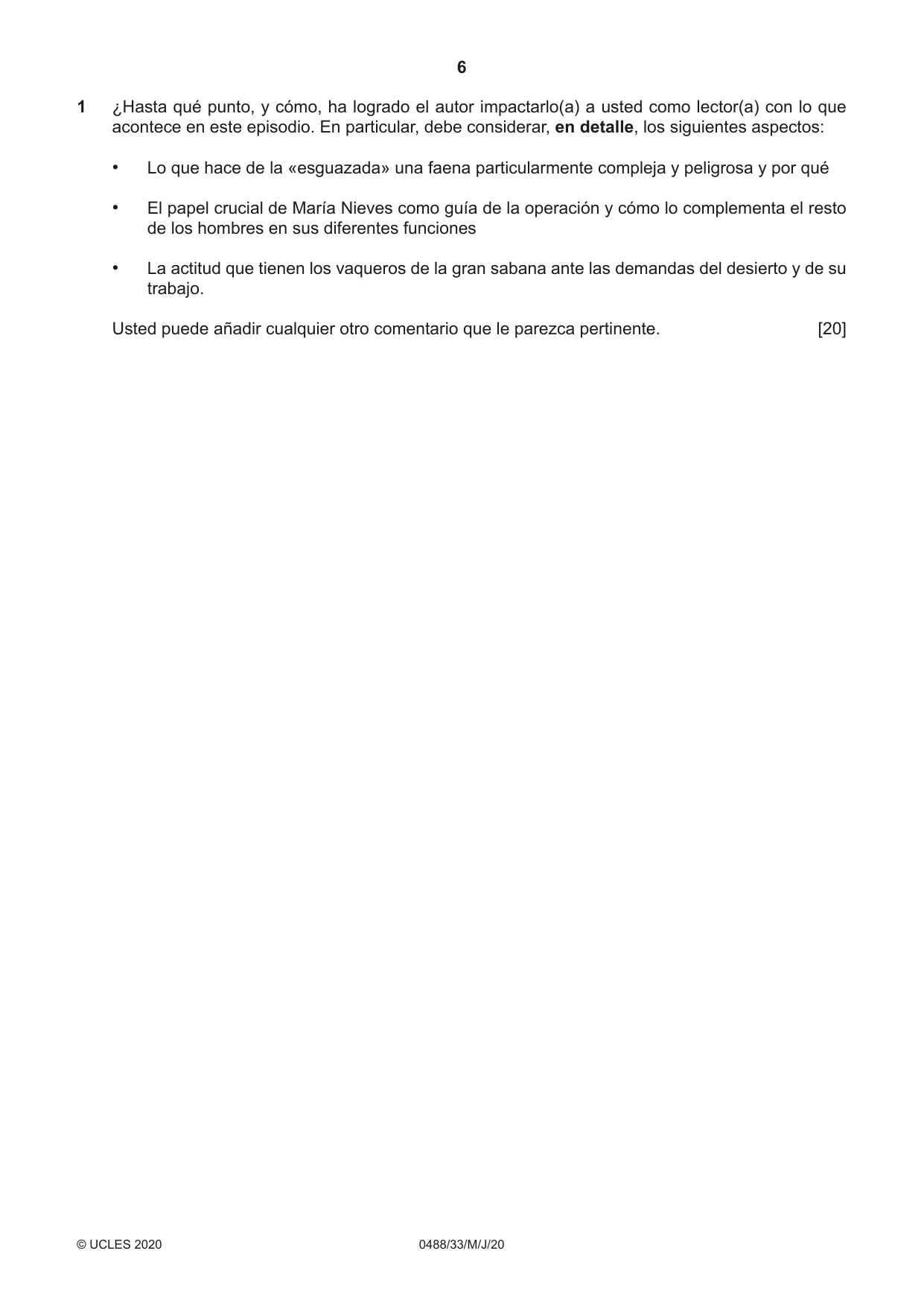
Question paper, page 6
6 0488/33/M/J/20 © UCLES 2020 1 ¿Hasta qué punto, y cómo, ha logrado el autor impactarlo(a) a usted como lector(a) con lo que acontece en este episodio. En particular, debe considerar, en detalle, los siguientes aspectos: • Lo que hace de la «esguazada» una faena particularmente compleja y peligrosa y por qué • El papel crucial de María Nieves como guía de la operación y cómo lo complementa el resto de los hombres en sus diferentes funciones • La actitud que tienen los vaqueros de la gran sabana ante las demandas del desierto y de su trabajo. Usted puede añadir cualquier otro comentario que le parezca pertinente. [20]
Question paper, page 7
7 0488/33/M/J/20 © UCLES 2020 BLANK PAGE
Question paper, page 8
8 0488/33/M/J/20 © UCLES 2020 Permission to reproduce items where third-party owned material protected by copyright is included has been sought and cleared where possible. Every reasonable effort has been made by the publisher (UCLES) to trace copyright holders, but if any items requiring clearance have unwittingly been included, the publisher will be pleased to make amends at the earliest possible opportunity. To avoid the issue of disclosure of answer-related information to candidates, all copyright acknowledgements are reproduced online in the Cambridge Assessment International Education Copyright Acknowledgements Booklet. This is produced for each series of examinations and is freely available to download at www.cambridgeinternational.org after the live examination series. Cambridge Assessment International Education is part of the Cambridge Assessment Group. Cambridge Assessment is the brand name of the University of Cambridge Local Examinations Syndicate (UCLES), which itself is a department of the University of Cambridge. BLANK PAGE
Mark scheme, page 1
This document consists of 9 printed pages. © UCLES 2020 [Turn over Cambridge IGCSE™ LITERATURE (SPANISH) 0488/33 Paper 3 Alternative to Coursework May/June 2020 MARK SCHEME Maximum Mark: 20 Published Students did not sit exam papers in the June 2020 series due to the Covid-19 global pandemic. This mark scheme is published to support teachers and students and should be read together with the question paper. It shows the requirements of the exam. The answer column of the mark scheme shows the proposed basis on which Examiners would award marks for this exam. Where appropriate, this column also provides the most likely acceptable alternative responses expected from students. Examiners usually review the mark scheme after they have seen student responses and update the mark scheme if appropriate. In the June series, Examiners were unable to consider the acceptability of alternative responses, as there were no student responses to consider. Mark schemes should usually be read together with the Principal Examiner Report for Teachers. However, because students did not sit exam papers, there is no Principal Examiner Report for Teachers for the June 2020 series. Cambridge International will not enter into discussions about these mark schemes. Cambridge International is publishing the mark schemes for the June 2020 series for most Cambridge IGCSE™ and Cambridge International A & AS Level components, and some Cambridge O Level components.
Mark scheme, page 2
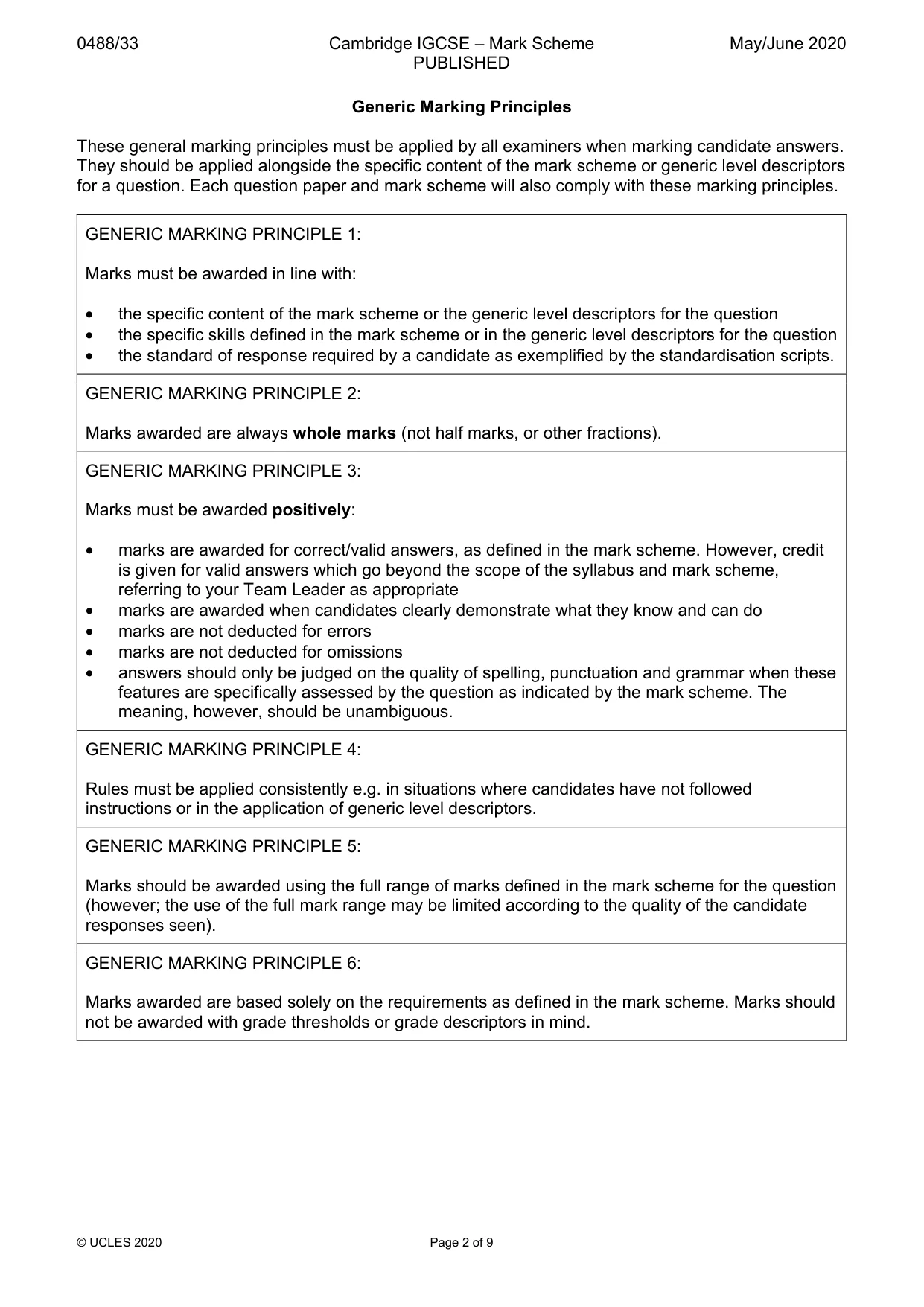
0488/33 Cambridge IGCSE – Mark Scheme PUBLISHED May/June 2020 © UCLES 2020 Page 2 of 9 Generic Marking Principles These general marking principles must be applied by all examiners when marking candidate answers. They should be applied alongside the specific content of the mark scheme or generic level descriptors for a question. Each question paper and mark scheme will also comply with these marking principles. GENERIC MARKING PRINCIPLE 1: Marks must be awarded in line with: • the specific content of the mark scheme or the generic level descriptors for the question • the specific skills defined in the mark scheme or in the generic level descriptors for the question • the standard of response required by a candidate as exemplified by the standardisation scripts. GENERIC MARKING PRINCIPLE 2: Marks awarded are always whole marks (not half marks, or other fractions). GENERIC MARKING PRINCIPLE 3: Marks must be awarded positively: • marks are awarded for correct/valid answers, as defined in the mark scheme. However, credit is given for valid answers which go beyond the scope of the syllabus and mark scheme, referring to your Team Leader as appropriate • marks are awarded when candidates clearly demonstrate what they know and can do • marks are not deducted for errors • marks are not deducted for omissions • answers should only be judged on the quality of spelling, punctuation and grammar when these features are specifically assessed by the question as indicated by the mark scheme. The meaning, however, should be unambiguous. GENERIC MARKING PRINCIPLE 4: Rules must be applied consistently e.g. in situations where candidates have not followed instructions or in the application of generic level descriptors. GENERIC MARKING PRINCIPLE 5: Marks should be awarded using the full range of marks defined in the mark scheme for the question (however; the use of the full mark range may be limited according to the quality of the candidate responses seen). GENERIC MARKING PRINCIPLE 6: Marks awarded are based solely on the requirements as defined in the mark scheme. Marks should not be awarded with grade thresholds or grade descriptors in mind.
Mark scheme, page 3
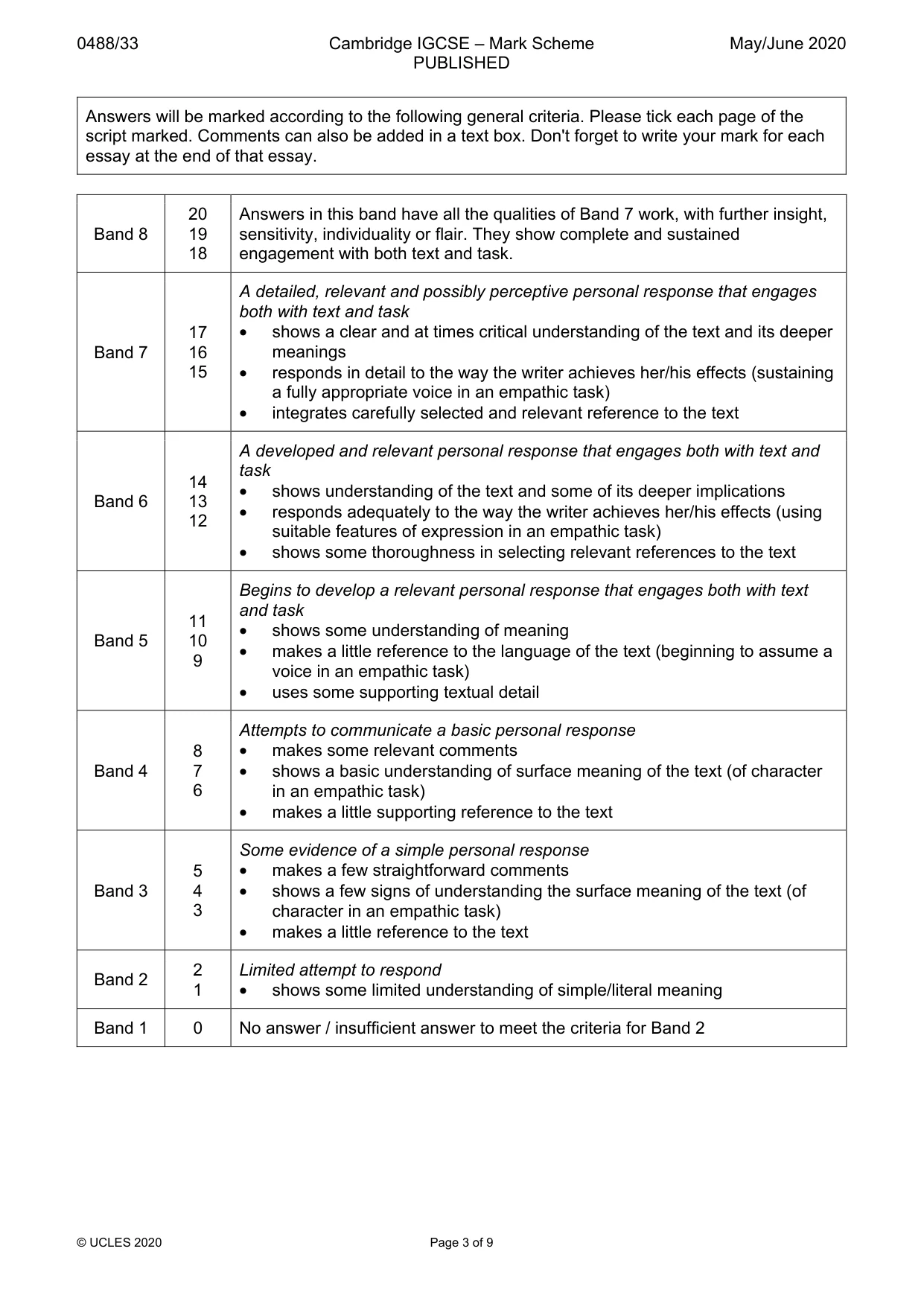
0488/33 Cambridge IGCSE – Mark Scheme PUBLISHED May/June 2020 © UCLES 2020 Page 3 of 9 Answers will be marked according to the following general criteria. Please tick each page of the script marked. Comments can also be added in a text box. Don't forget to write your mark for each essay at the end of that essay. Band 8 20 19 18 Answers in this band have all the qualities of Band 7 work, with further insight, sensitivity, individuality or flair. They show complete and sustained engagement with both text and task. Band 7 17 16 15 A detailed, relevant and possibly perceptive personal response that engages both with text and task • shows a clear and at times critical understanding of the text and its deeper meanings • responds in detail to the way the writer achieves her/his effects (sustaining a fully appropriate voice in an empathic task) • integrates carefully selected and relevant reference to the text Band 6 14 13 12 A developed and relevant personal response that engages both with text and task • shows understanding of the text and some of its deeper implications • responds adequately to the way the writer achieves her/his effects (using suitable features of expression in an empathic task) • shows some thoroughness in selecting relevant references to the text Band 5 11 10 9 Begins to develop a relevant personal response that engages both with text and task • shows some understanding of meaning • makes a little reference to the language of the text (beginning to assume a voice in an empathic task) • uses some supporting textual detail Band 4 8 7 6 Attempts to communicate a basic personal response • makes some relevant comments • shows a basic understanding of surface meaning of the text (of character in an empathic task) • makes a little supporting reference to the text Band 3 5 4 3 Some evidence of a simple personal response • makes a few straightforward comments • shows a few signs of understanding the surface meaning of the text (of character in an empathic task) • makes a little reference to the text Band 2 2 1 Limited attempt to respond • shows some limited understanding of simple/literal meaning Band 1 0 No answer / insufficient answer to meet the criteria for Band 2
Mark scheme, page 4
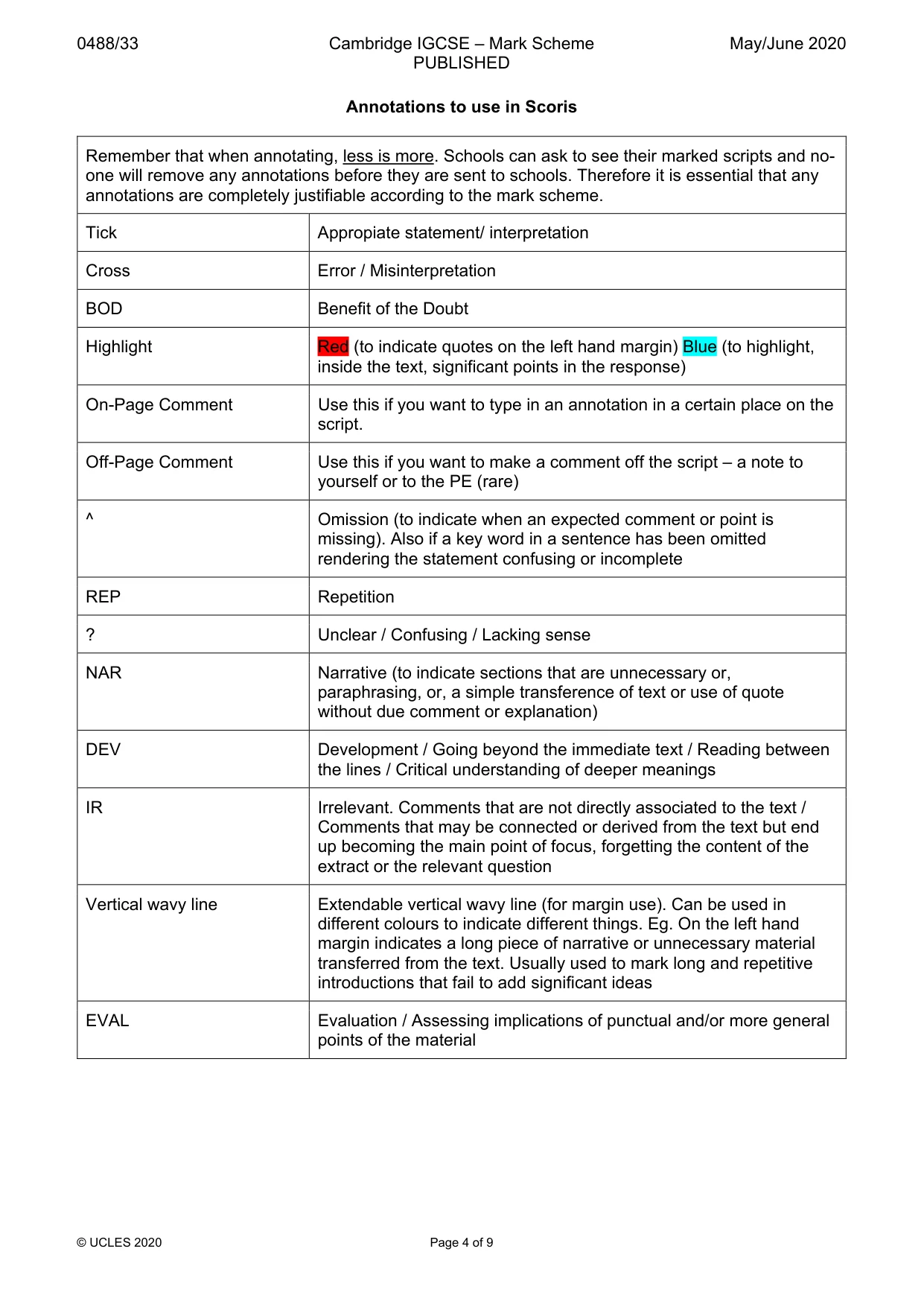
0488/33 Cambridge IGCSE – Mark Scheme PUBLISHED May/June 2020 © UCLES 2020 Page 4 of 9 Annotations to use in Scoris Remember that when annotating, less is more. Schools can ask to see their marked scripts and no- one will remove any annotations before they are sent to schools. Therefore it is essential that any annotations are completely justifiable according to the mark scheme. Tick Appropiate statement/ interpretation Cross Error / Misinterpretation BOD Benefit of the Doubt Highlight Red (to indicate quotes on the left hand margin) Blue (to highlight, inside the text, significant points in the response) On-Page Comment Use this if you want to type in an annotation in a certain place on the script. Off-Page Comment Use this if you want to make a comment off the script – a note to yourself or to the PE (rare) ^ Omission (to indicate when an expected comment or point is missing). Also if a key word in a sentence has been omitted rendering the statement confusing or incomplete REP Repetition ? Unclear / Confusing / Lacking sense NAR Narrative (to indicate sections that are unnecessary or, paraphrasing, or, a simple transference of text or use of quote without due comment or explanation) DEV Development / Going beyond the immediate text / Reading between the lines / Critical understanding of deeper meanings IR Irrelevant. Comments that are not directly associated to the text / Comments that may be connected or derived from the text but end up becoming the main point of focus, forgetting the content of the extract or the relevant question Vertical wavy line Extendable vertical wavy line (for margin use). Can be used in different colours to indicate different things. Eg. On the left hand margin indicates a long piece of narrative or unnecessary material transferred from the text. Usually used to mark long and repetitive introductions that fail to add significant ideas EVAL Evaluation / Assessing implications of punctual and/or more general points of the material
Mark scheme, page 5
0488/33 Cambridge IGCSE – Mark Scheme PUBLISHED May/June 2020 © UCLES 2020 Page 5 of 9 Using annotations on Scoris Remember that this is a literature not a language assessment: do not correct or comment on individual spelling and grammatical errors. (But you might comment if relevant at the end of the script – e.g. ‘Frequent errors obscure meaning.’) These may be factual comments or comments on key features of the answer related to the mark scheme e.g. well-developed/undeveloped, clear/unclear, insufficient /reference to text; needs to explain point; good ref to dramatic qualities; needs to expand; evidence?; detail; not answering question. Be careful to distinguish between an unusual opinion and a factual error. At the bottom of the script put a brief summary comment based on the mark scheme: e.g. Competent answer with some evidence of personal appreciation; a couple of significant omissions What not to write on scripts Do not use more than one question mark (???) Do not use exclamation marks at all in a comment box. Do not use capital letters to “shout” e.g. NO. Do not use any pejorative or disparaging emotive word or phrase- this includes: poor, bad, wrong, get on with it, so what? hardly! What? this is NOT the point, muddled, nonsense, shallow, etc. Do not comment on handwriting or untidiness unless this interferes with the task of marking. Do not comment on the Centre as a whole or their teaching. Do not focus on what the candidate has NOT written but rather on what s/he has written (though significant omissions having a bearing on the question might be mentioned).
Mark scheme, page 6
0488/33 Cambridge IGCSE – Mark Scheme PUBLISHED May/June 2020 © UCLES 2020 Page 6 of 9 Question Answer Marks Indicative Content The detailed questions are intended to help the candidate respond. Candidates are required to answer them, but need not do so in a rigid sequence; some of the answers may be implicit in the essay, although it is expected that candidates will be able to spell out their views and interpretations with sufficient clarity. There is no prescribed application of marks to each question and the response should be marked holistically. Candidates who do not answer the prescribed questions will penalise themselves automatically, as the questions are central to the passage.
Mark scheme, page 7
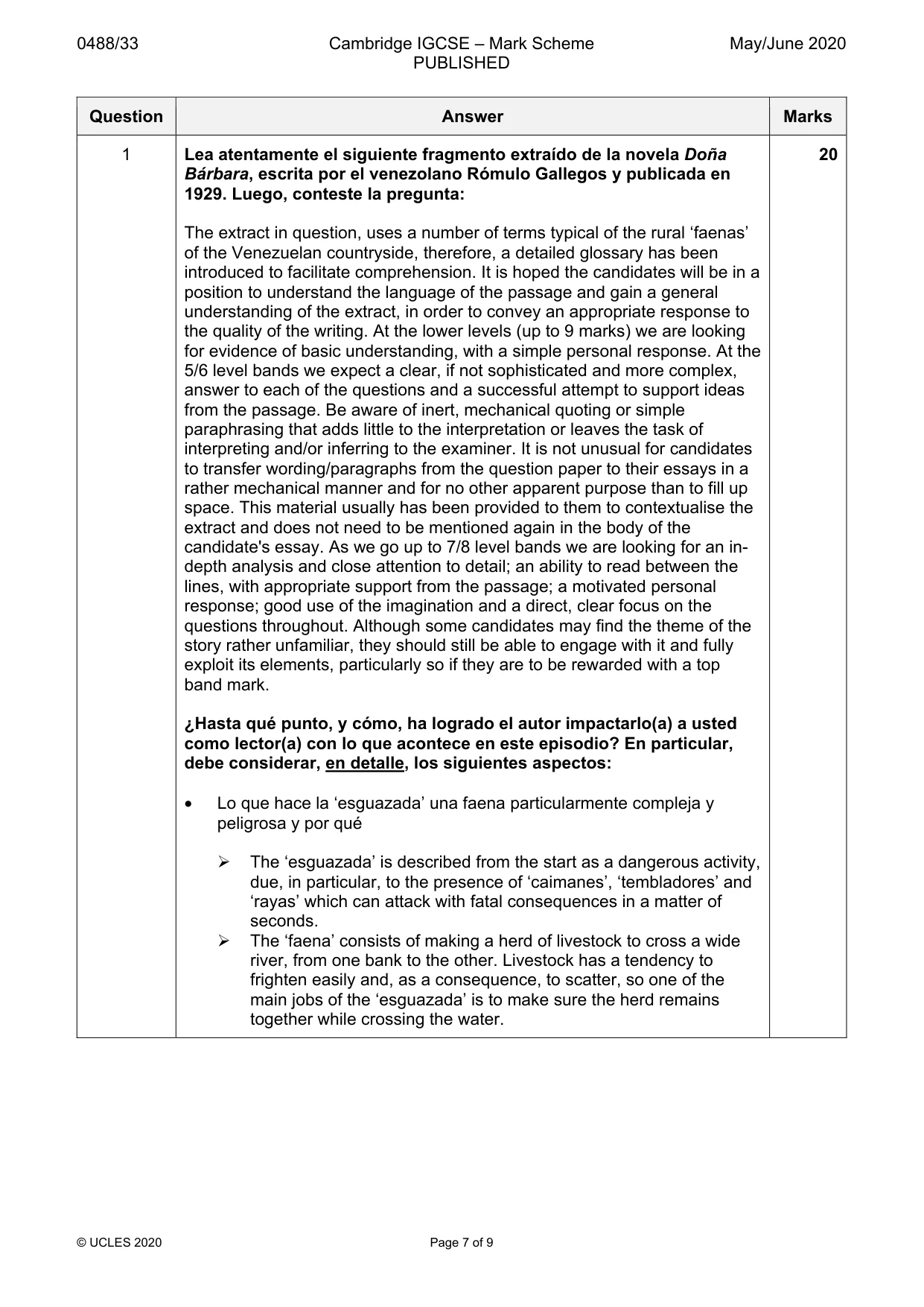
0488/33 Cambridge IGCSE – Mark Scheme PUBLISHED May/June 2020 © UCLES 2020 Page 7 of 9 Question Answer Marks 1 Lea atentamente el siguiente fragmento extraído de la novela Doña Bárbara, escrita por el venezolano Rómulo Gallegos y publicada en 1929. Luego, conteste la pregunta: The extract in question, uses a number of terms typical of the rural ‘faenas’ of the Venezuelan countryside, therefore, a detailed glossary has been introduced to facilitate comprehension. It is hoped the candidates will be in a position to understand the language of the passage and gain a general understanding of the extract, in order to convey an appropriate response to the quality of the writing. At the lower levels (up to 9 marks) we are looking for evidence of basic understanding, with a simple personal response. At the 5/6 level bands we expect a clear, if not sophisticated and more complex, answer to each of the questions and a successful attempt to support ideas from the passage. Be aware of inert, mechanical quoting or simple paraphrasing that adds little to the interpretation or leaves the task of interpreting and/or inferring to the examiner. It is not unusual for candidates to transfer wording/paragraphs from the question paper to their essays in a rather mechanical manner and for no other apparent purpose than to fill up space. This material usually has been provided to them to contextualise the extract and does not need to be mentioned again in the body of the candidate's essay. As we go up to 7/8 level bands we are looking for an in- depth analysis and close attention to detail; an ability to read between the lines, with appropriate support from the passage; a motivated personal response; good use of the imagination and a direct, clear focus on the questions throughout. Although some candidates may find the theme of the story rather unfamiliar, they should still be able to engage with it and fully exploit its elements, particularly so if they are to be rewarded with a top band mark. ¿Hasta qué punto, y cómo, ha logrado el autor impactarlo(a) a usted como lector(a) con lo que acontece en este episodio? En particular, debe considerar, en detalle, los siguientes aspectos: • Lo que hace la ‘esguazada’ una faena particularmente compleja y peligrosa y por qué The ‘esguazada’ is described from the start as a dangerous activity, due, in particular, to the presence of ‘caimanes’, ‘tembladores’ and ‘rayas’ which can attack with fatal consequences in a matter of seconds. The ‘faena’ consists of making a herd of livestock to cross a wide river, from one bank to the other. Livestock has a tendency to frighten easily and, as a consequence, to scatter, so one of the main jobs of the ‘esguazada’ is to make sure the herd remains together while crossing the water. 20
Mark scheme, page 8
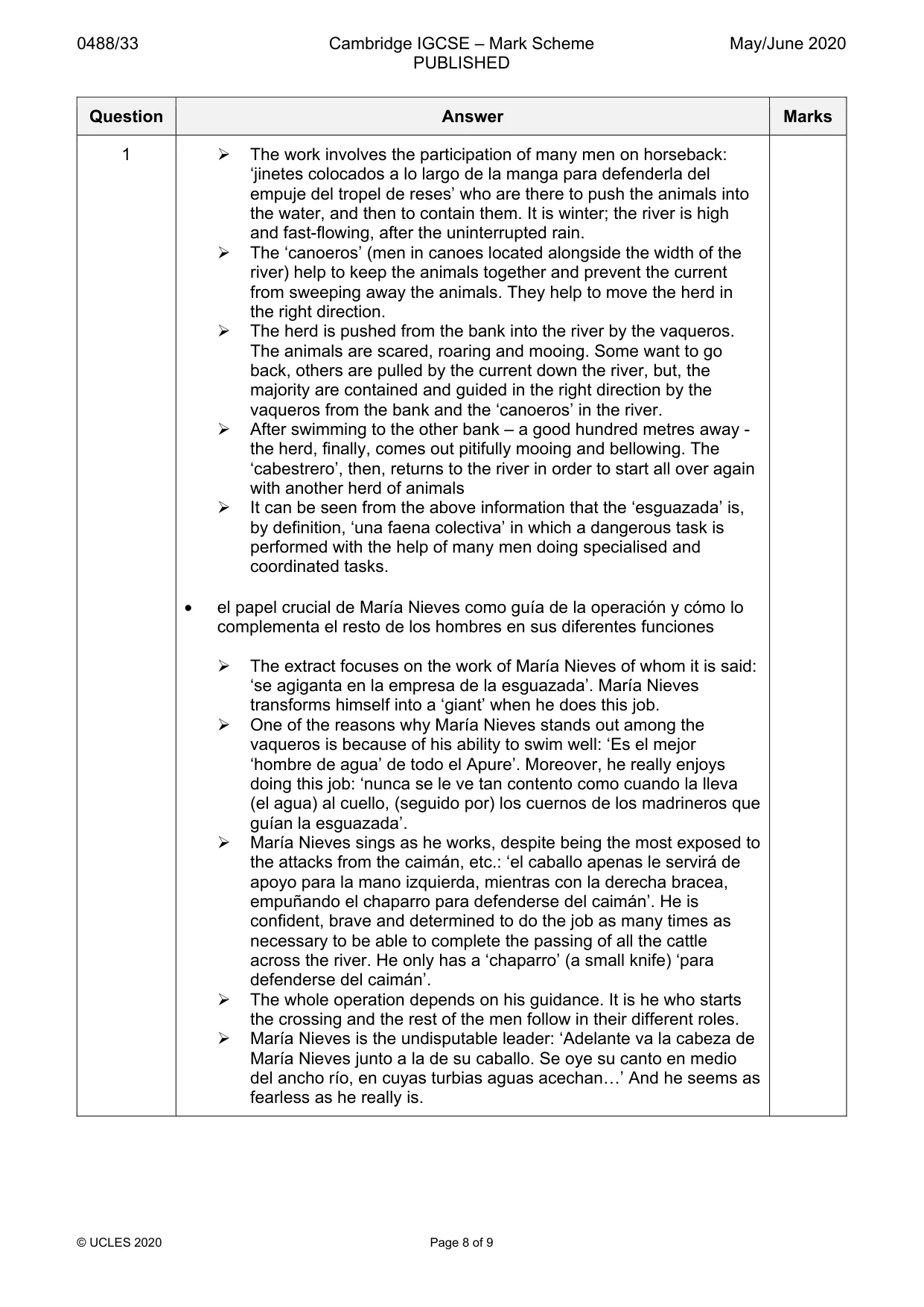
0488/33 Cambridge IGCSE – Mark Scheme PUBLISHED May/June 2020 © UCLES 2020 Page 8 of 9 Question Answer Marks 1 The work involves the participation of many men on horseback: ‘jinetes colocados a lo largo de la manga para defenderla del empuje del tropel de reses’ who are there to push the animals into the water, and then to contain them. It is winter; the river is high and fast-flowing, after the uninterrupted rain. The ‘canoeros’ (men in canoes located alongside the width of the river) help to keep the animals together and prevent the current from sweeping away the animals. They help to move the herd in the right direction. The herd is pushed from the bank into the river by the vaqueros. The animals are scared, roaring and mooing. Some want to go back, others are pulled by the current down the river, but, the majority are contained and guided in the right direction by the vaqueros from the bank and the ‘canoeros’ in the river. After swimming to the other bank – a good hundred metres away - the herd, finally, comes out pitifully mooing and bellowing. The ‘cabestrero’, then, returns to the river in order to start all over again with another herd of animals It can be seen from the above information that the ‘esguazada’ is, by definition, ‘una faena colectiva’ in which a dangerous task is performed with the help of many men doing specialised and coordinated tasks. • el papel crucial de María Nieves como guía de la operación y cómo lo complementa el resto de los hombres en sus diferentes funciones The extract focuses on the work of María Nieves of whom it is said: ‘se agiganta en la empresa de la esguazada’. María Nieves transforms himself into a ‘giant’ when he does this job. One of the reasons why María Nieves stands out among the vaqueros is because of his ability to swim well: ‘Es el mejor ‘hombre de agua’ de todo el Apure’. Moreover, he really enjoys doing this job: ‘nunca se le ve tan contento como cuando la lleva (el agua) al cuello, (seguido por) los cuernos de los madrineros que guían la esguazada’. María Nieves sings as he works, despite being the most exposed to the attacks from the caimán, etc.: ‘el caballo apenas le servirá de apoyo para la mano izquierda, mientras con la derecha bracea, empuñando el chaparro para defenderse del caimán’. He is confident, brave and determined to do the job as many times as necessary to be able to complete the passing of all the cattle across the river. He only has a ‘chaparro’ (a small knife) ‘para defenderse del caimán’. The whole operation depends on his guidance. It is he who starts the crossing and the rest of the men follow in their different roles. María Nieves is the undisputable leader: ‘Adelante va la cabeza de María Nieves junto a la de su caballo. Se oye su canto en medio del ancho río, en cuyas turbias aguas acechan…’ And he seems as fearless as he really is.
Mark scheme, page 9
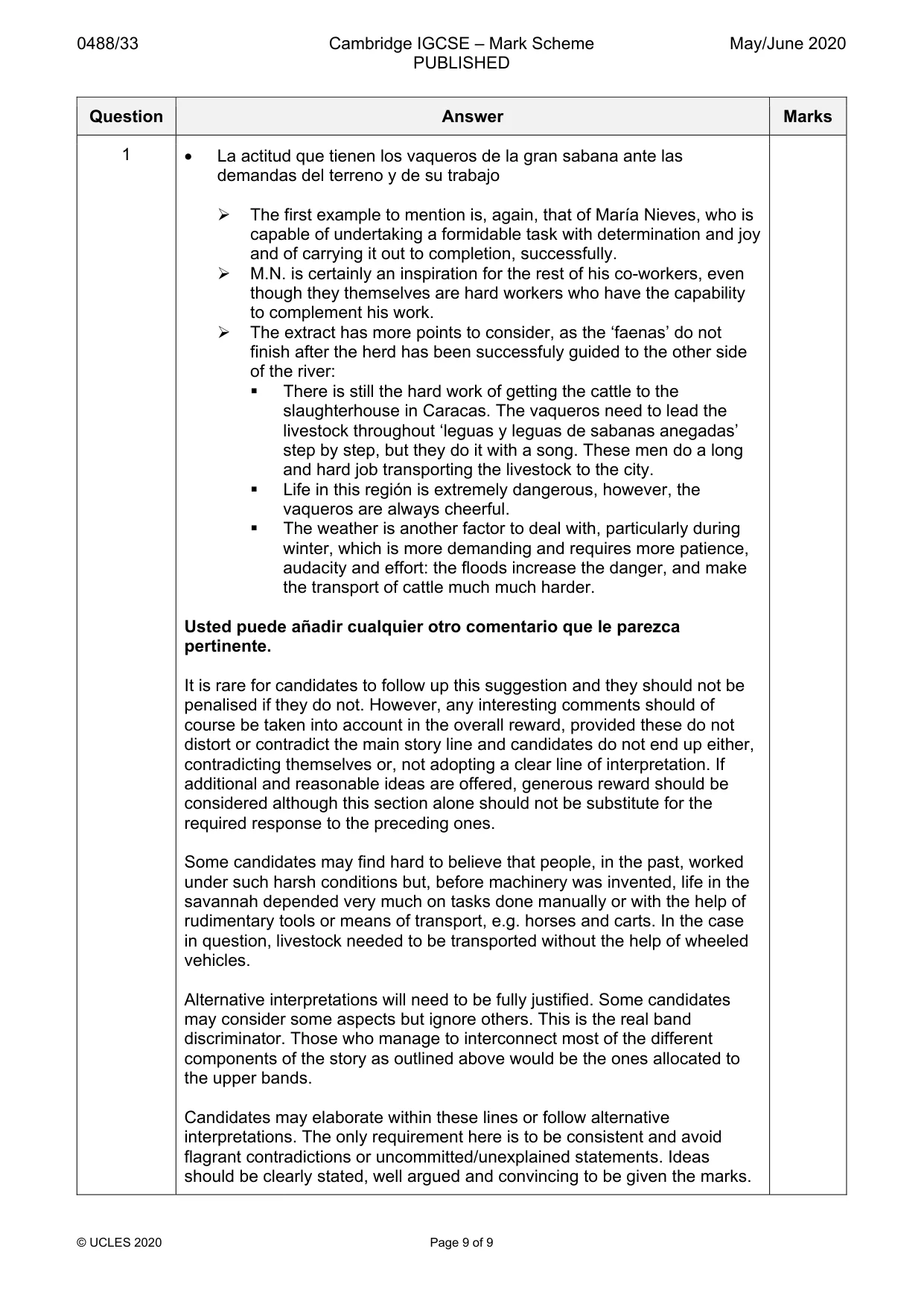
0488/33 Cambridge IGCSE – Mark Scheme PUBLISHED May/June 2020 © UCLES 2020 Page 9 of 9 Question Answer Marks 1 • La actitud que tienen los vaqueros de la gran sabana ante las demandas del terreno y de su trabajo The first example to mention is, again, that of María Nieves, who is capable of undertaking a formidable task with determination and joy and of carrying it out to completion, successfully. M.N. is certainly an inspiration for the rest of his co-workers, even though they themselves are hard workers who have the capability to complement his work. The extract has more points to consider, as the ‘faenas’ do not finish after the herd has been successfuly guided to the other side of the river: There is still the hard work of getting the cattle to the slaughterhouse in Caracas. The vaqueros need to lead the livestock throughout ‘leguas y leguas de sabanas anegadas’ step by step, but they do it with a song. These men do a long and hard job transporting the livestock to the city. Life in this región is extremely dangerous, however, the vaqueros are always cheerful. The weather is another factor to deal with, particularly during winter, which is more demanding and requires more patience, audacity and effort: the floods increase the danger, and make the transport of cattle much much harder. Usted puede añadir cualquier otro comentario que le parezca pertinente. It is rare for candidates to follow up this suggestion and they should not be penalised if they do not. However, any interesting comments should of course be taken into account in the overall reward, provided these do not distort or contradict the main story line and candidates do not end up either, contradicting themselves or, not adopting a clear line of interpretation. If additional and reasonable ideas are offered, generous reward should be considered although this section alone should not be substitute for the required response to the preceding ones. Some candidates may find hard to believe that people, in the past, worked under such harsh conditions but, before machinery was invented, life in the savannah depended very much on tasks done manually or with the help of rudimentary tools or means of transport, e.g. horses and carts. In the case in question, livestock needed to be transported without the help of wheeled vehicles. Alternative interpretations will need to be fully justified. Some candidates may consider some aspects but ignore others. This is the real band discriminator. Those who manage to interconnect most of the different components of the story as outlined above would be the ones allocated to the upper bands. Candidates may elaborate within these lines or follow alternative interpretations. The only requirement here is to be consistent and avoid flagrant contradictions or uncommitted/unexplained statements. Ideas should be clearly stated, well argued and convincing to be given the marks.