Cambridge IGCSE Spanish - Literature 0488 — 2019 May/June Paper 3 · Variant 3
0488/33/M/J/19 · 20 marks · ≈23 min
The question paper and its mark scheme, free to read here and free to download. This is Cambridge’s own paper, exactly as it was sat.
Question paper4 pages

Mark scheme6 pages
Answers below. Sit the paper first if you are practising.
Paper as text
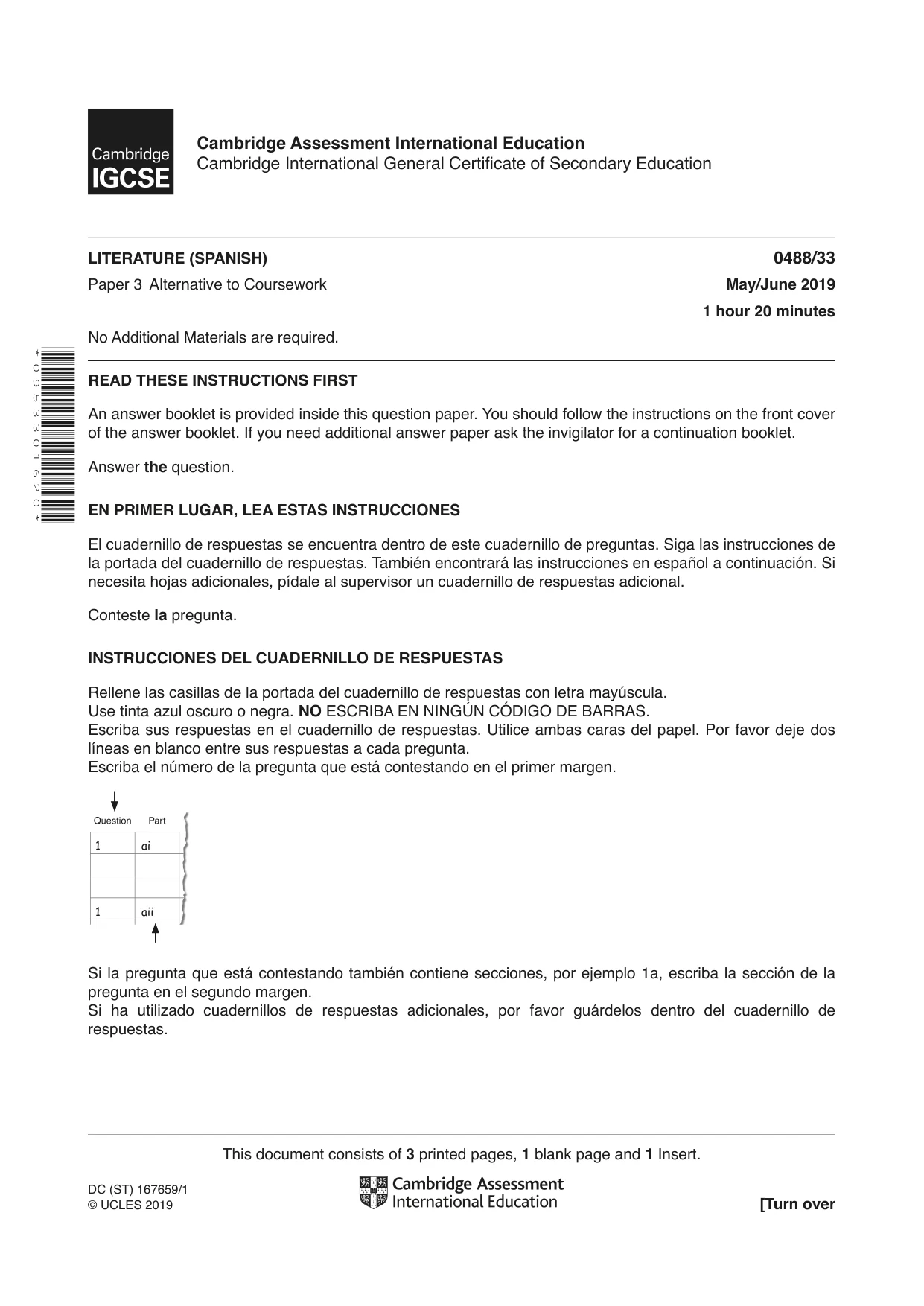
Question paper, page 1
This document consists of 3 printed pages, 1 blank page and 1 Insert. DC (ST) 167659/1 © UCLES 2019 [Turn over Cambridge Assessment International Education Cambridge International General Certificate of Secondary Education * 0 9 5 3 3 0 1 6 2 0 * LITERATURE (SPANISH) 0488/33 Paper 3 Alternative to Coursework May/June 2019 1 hour 20 minutes No Additional Materials are required. READ THESE INSTRUCTIONS FIRST An answer booklet is provided inside this question paper. You should follow the instructions on the front cover of the answer booklet. If you need additional answer paper ask the invigilator for a continuation booklet. Answer the question. EN PRIMER LUGAR, LEA ESTAS INSTRUCCIONES El cuadernillo de respuestas se encuentra dentro de este cuadernillo de preguntas. Siga las instrucciones de la portada del cuadernillo de respuestas. También encontrará las instrucciones en español a continuación. Si necesita hojas adicionales, pídale al supervisor un cuadernillo de respuestas adicional. Conteste la pregunta. INSTRUCCIONES DEL CUADERNILLO DE RESPUESTAS Rellene las casillas de la portada del cuadernillo de respuestas con letra mayúscula. Use tinta azul oscuro o negra. NO ESCRIBA EN NINGÚN CÓDIGO DE BARRAS. Escriba sus respuestas en el cuadernillo de respuestas. Utilice ambas caras del papel. Por favor deje dos líneas en blanco entre sus respuestas a cada pregunta. Escriba el número de la pregunta que está contestando en el primer margen. Si la pregunta que está contestando también contiene secciones, por ejemplo 1a, escriba la sección de la pregunta en el segundo margen. Si ha utilizado cuadernillos de respuestas adicionales, por favor guárdelos dentro del cuadernillo de respuestas.
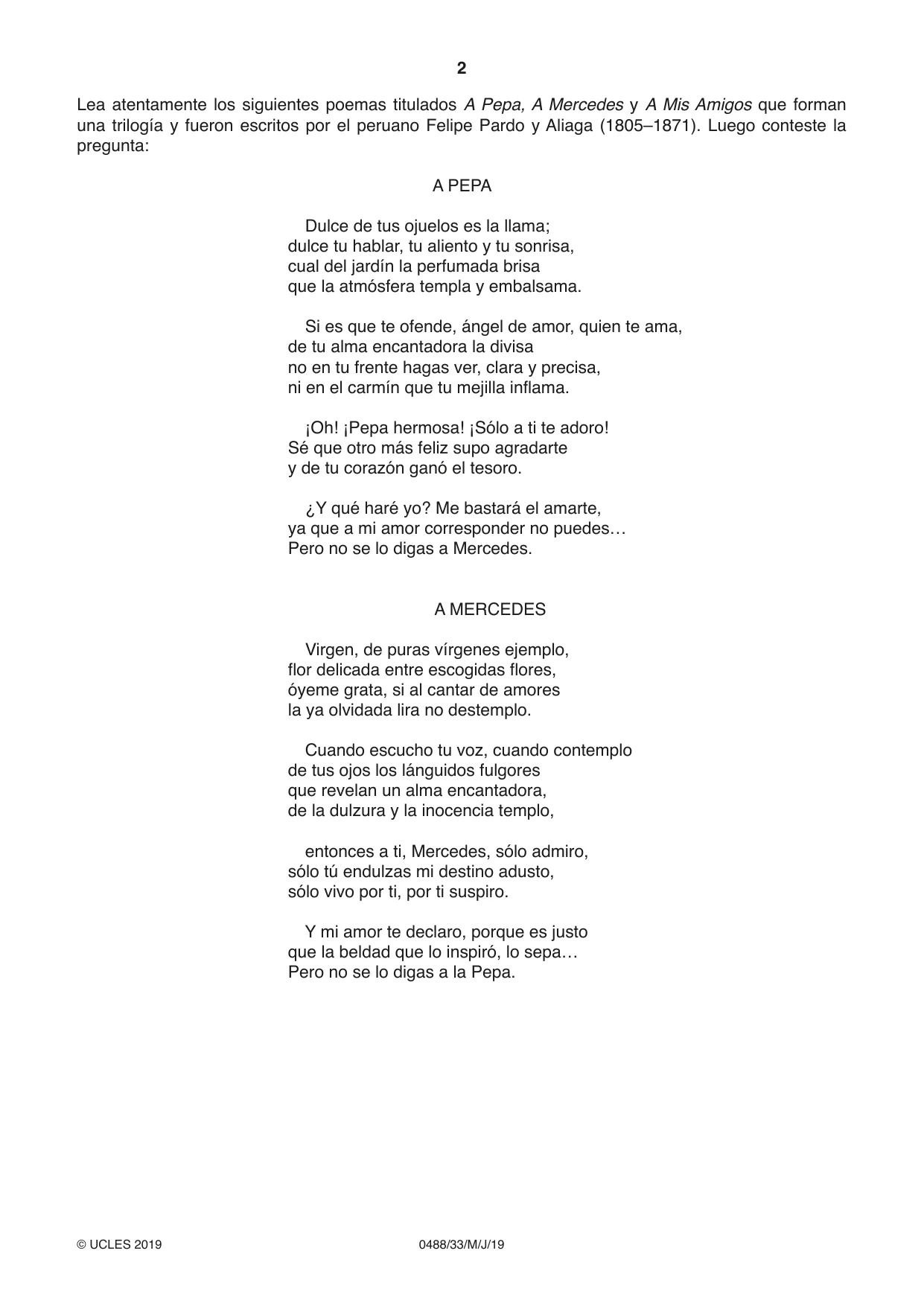
Question paper, page 2
2 0488/33/M/J/19 © UCLES 2019 Lea atentamente los siguientes poemas titulados A Pepa, A Mercedes y A Mis Amigos que forman una trilogía y fueron escritos por el peruano Felipe Pardo y Aliaga (1805–1871). Luego conteste la pregunta: A PEPA Dulce de tus ojuelos es la llama; dulce tu hablar, tu aliento y tu sonrisa, cual del jardín la perfumada brisa que la atmósfera templa y embalsama. Si es que te ofende, ángel de amor, quien te ama, de tu alma encantadora la divisa no en tu frente hagas ver, clara y precisa, ni en el carmín que tu mejilla inflama. ¡Oh! ¡Pepa hermosa! ¡Sólo a ti te adoro! Sé que otro más feliz supo agradarte y de tu corazón ganó el tesoro. ¿Y qué haré yo? Me bastará el amarte, ya que a mi amor corresponder no puedes… Pero no se lo digas a Mercedes. A MERCEDES Virgen, de puras vírgenes ejemplo, flor delicada entre escogidas flores, óyeme grata, si al cantar de amores la ya olvidada lira no destemplo. Cuando escucho tu voz, cuando contemplo de tus ojos los lánguidos fulgores que revelan un alma encantadora, de la dulzura y la inocencia templo, entonces a ti, Mercedes, sólo admiro, sólo tú endulzas mi destino adusto, sólo vivo por ti, por ti suspiro. Y mi amor te declaro, porque es justo que la beldad que lo inspiró, lo sepa… Pero no se lo digas a la Pepa.
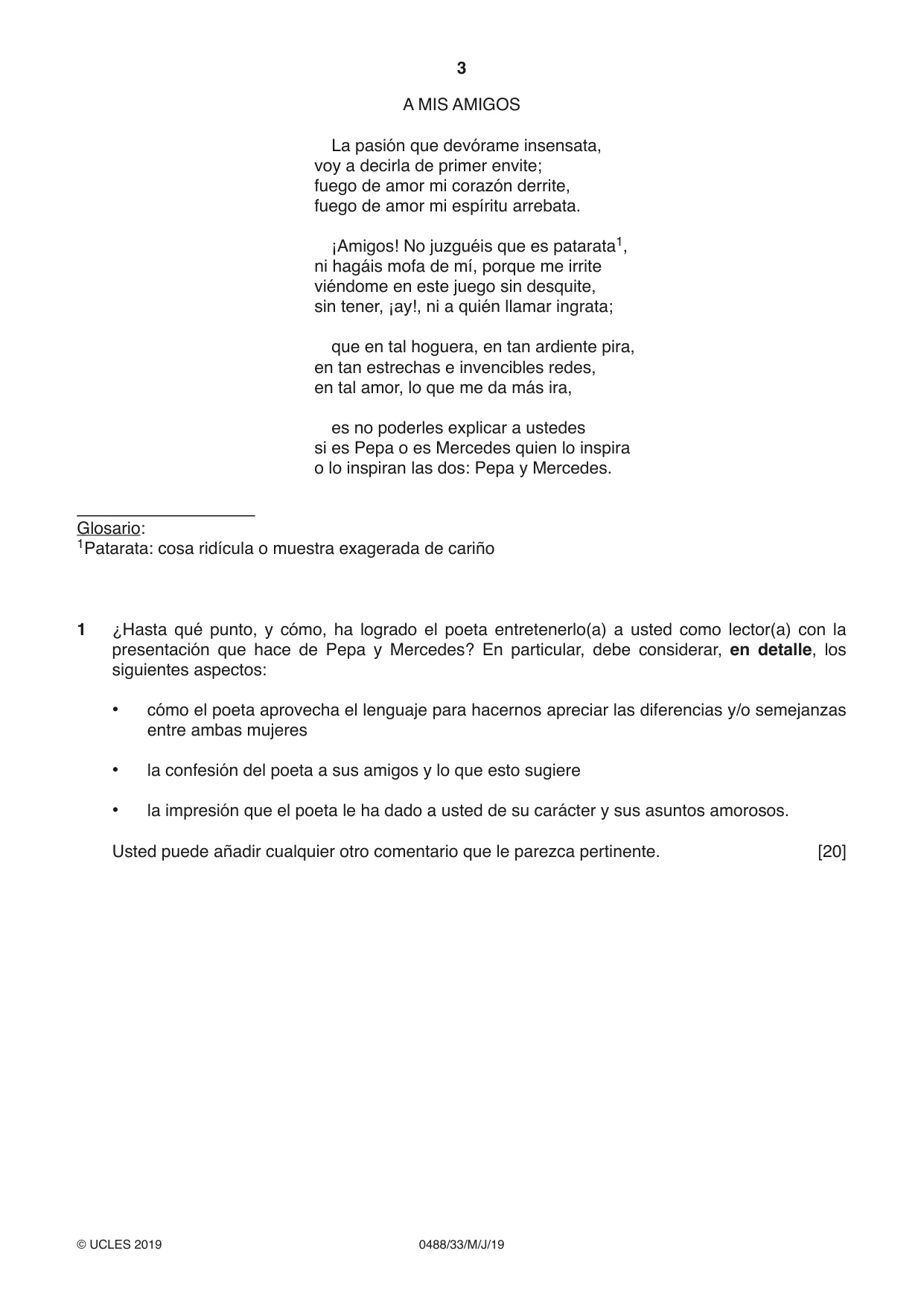
Question paper, page 3
3 0488/33/M/J/19 © UCLES 2019 A MIS AMIGOS La pasión que devórame insensata, voy a decirla de primer envite; fuego de amor mi corazón derrite, fuego de amor mi espíritu arrebata. ¡Amigos! No juzguéis que es patarata1, ni hagáis mofa de mí, porque me irrite viéndome en este juego sin desquite, sin tener, ¡ay!, ni a quién llamar ingrata; que en tal hoguera, en tan ardiente pira, en tan estrechas e invencibles redes, en tal amor, lo que me da más ira, es no poderles explicar a ustedes si es Pepa o es Mercedes quien lo inspira o lo inspiran las dos: Pepa y Mercedes. Glosario: 1Patarata: cosa ridícula o muestra exagerada de cariño 1 ¿Hasta qué punto, y cómo, ha logrado el poeta entretenerlo(a) a usted como lector(a) con la presentación que hace de Pepa y Mercedes? En particular, debe considerar, en detalle, los siguientes aspectos: • cómo el poeta aprovecha el lenguaje para hacernos apreciar las diferencias y/o semejanzas entre ambas mujeres • la confesión del poeta a sus amigos y lo que esto sugiere • la impresión que el poeta le ha dado a usted de su carácter y sus asuntos amorosos. Usted puede añadir cualquier otro comentario que le parezca pertinente. [20]
Question paper, page 4
4 0488/33/M/J/19 © UCLES 2019 BLANK PAGE Permission to reproduce items where third-party owned material protected by copyright is included has been sought and cleared where possible. Every reasonable effort has been made by the publisher (UCLES) to trace copyright holders, but if any items requiring clearance have unwittingly been included, the publisher will be pleased to make amends at the earliest possible opportunity. To avoid the issue of disclosure of answer-related information to candidates, all copyright acknowledgements are reproduced online in the Cambridge Assessment International Education Copyright Acknowledgements Booklet. This is produced for each series of examinations and is freely available to download at www.cambridgeinternational.org after the live examination series. Cambridge Assessment International Education is part of the Cambridge Assessment Group. Cambridge Assessment is the brand name of the University of Cambridge Local Examinations Syndicate (UCLES), which itself is a department of the University of Cambridge.
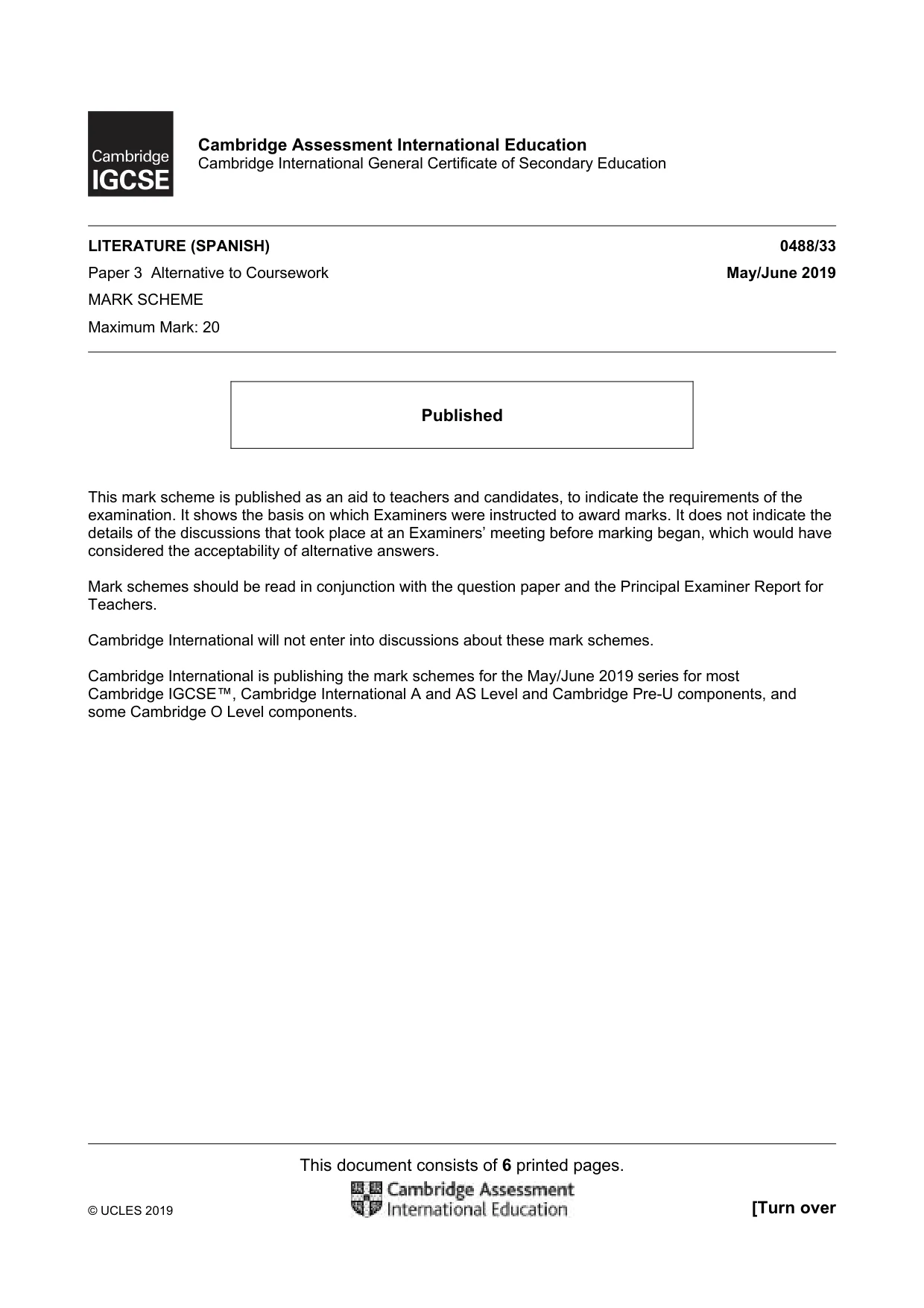
Mark scheme, page 1
This document consists of 6 printed pages. © UCLES 2019 [Turn over Cambridge Assessment International Education Cambridge International General Certificate of Secondary Education LITERATURE (SPANISH) 0488/33 Paper 3 Alternative to Coursework May/June 2019 MARK SCHEME Maximum Mark: 20 Published This mark scheme is published as an aid to teachers and candidates, to indicate the requirements of the examination. It shows the basis on which Examiners were instructed to award marks. It does not indicate the details of the discussions that took place at an Examiners’ meeting before marking began, which would have considered the acceptability of alternative answers. Mark schemes should be read in conjunction with the question paper and the Principal Examiner Report for Teachers. Cambridge International will not enter into discussions about these mark schemes. Cambridge International is publishing the mark schemes for the May/June 2019 series for most Cambridge IGCSE™, Cambridge International A and AS Level and Cambridge Pre-U components, and some Cambridge O Level components.
Mark scheme, page 2
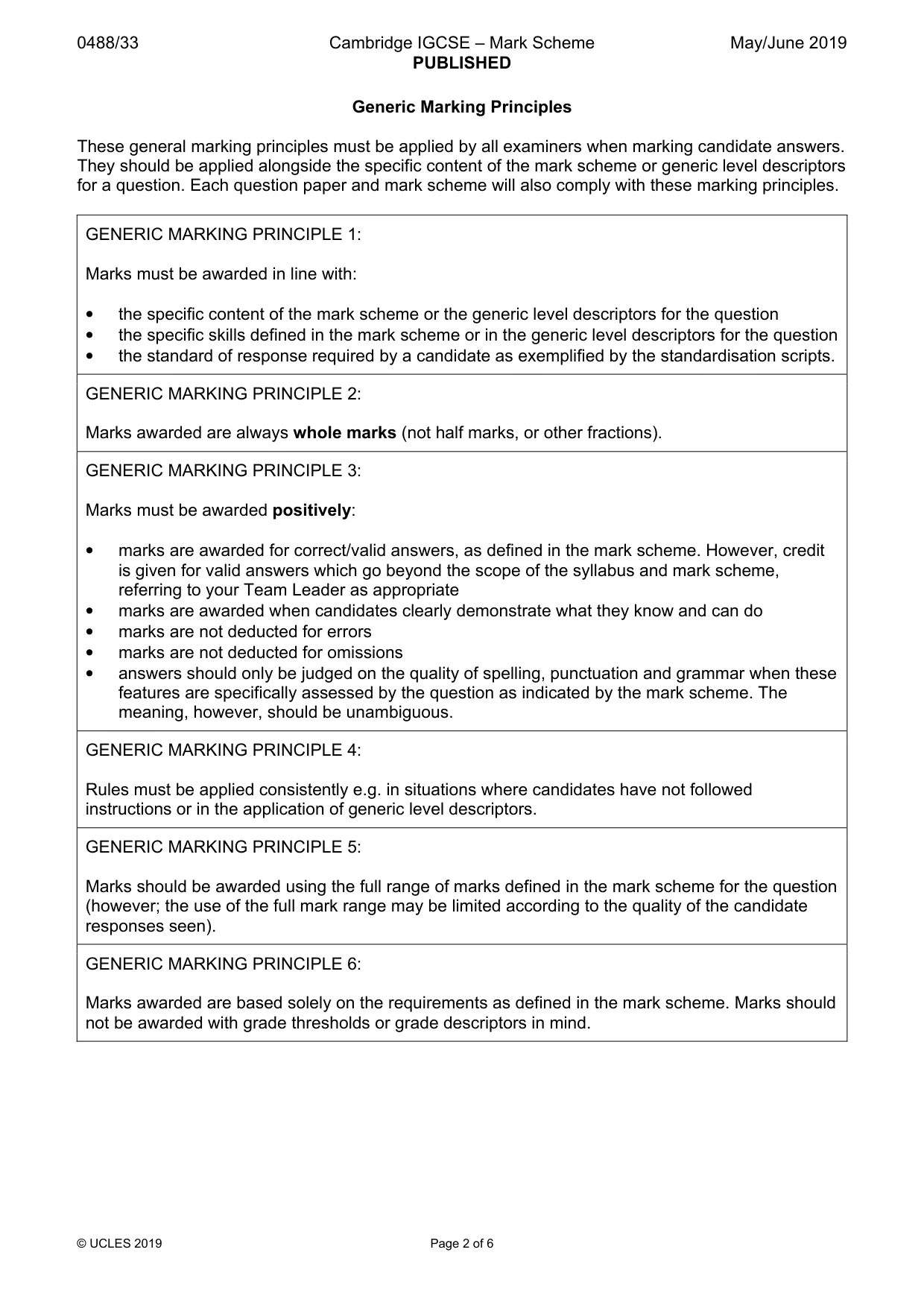
0488/33 Cambridge IGCSE – Mark Scheme PUBLISHED May/June 2019 © UCLES 2019 Page 2 of 6 Generic Marking Principles These general marking principles must be applied by all examiners when marking candidate answers. They should be applied alongside the specific content of the mark scheme or generic level descriptors for a question. Each question paper and mark scheme will also comply with these marking principles. GENERIC MARKING PRINCIPLE 1: Marks must be awarded in line with: • the specific content of the mark scheme or the generic level descriptors for the question • the specific skills defined in the mark scheme or in the generic level descriptors for the question • the standard of response required by a candidate as exemplified by the standardisation scripts. GENERIC MARKING PRINCIPLE 2: Marks awarded are always whole marks (not half marks, or other fractions). GENERIC MARKING PRINCIPLE 3: Marks must be awarded positively: • marks are awarded for correct/valid answers, as defined in the mark scheme. However, credit is given for valid answers which go beyond the scope of the syllabus and mark scheme, referring to your Team Leader as appropriate • marks are awarded when candidates clearly demonstrate what they know and can do • marks are not deducted for errors • marks are not deducted for omissions • answers should only be judged on the quality of spelling, punctuation and grammar when these features are specifically assessed by the question as indicated by the mark scheme. The meaning, however, should be unambiguous. GENERIC MARKING PRINCIPLE 4: Rules must be applied consistently e.g. in situations where candidates have not followed instructions or in the application of generic level descriptors. GENERIC MARKING PRINCIPLE 5: Marks should be awarded using the full range of marks defined in the mark scheme for the question (however; the use of the full mark range may be limited according to the quality of the candidate responses seen). GENERIC MARKING PRINCIPLE 6: Marks awarded are based solely on the requirements as defined in the mark scheme. Marks should not be awarded with grade thresholds or grade descriptors in mind.
Mark scheme, page 3
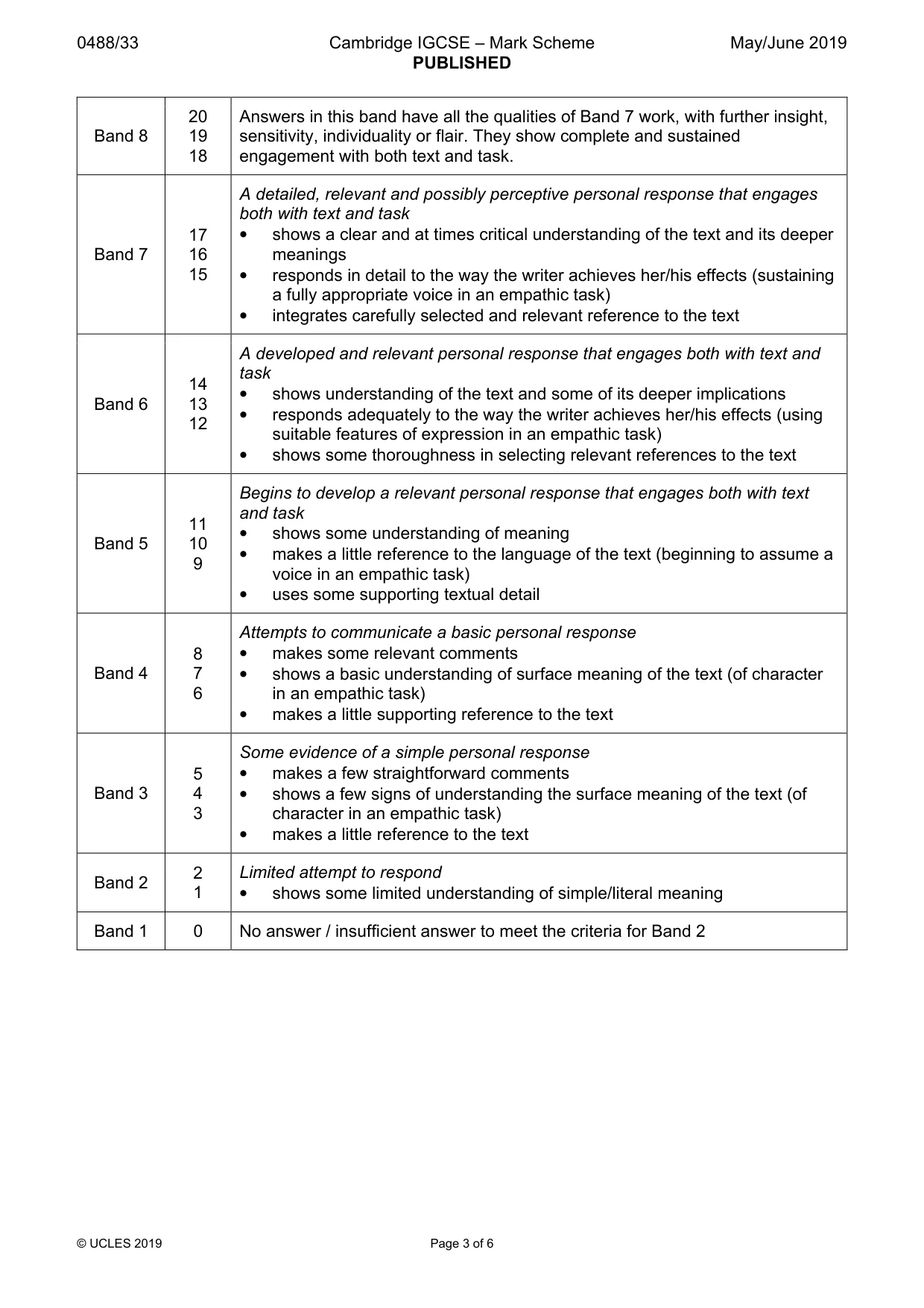
0488/33 Cambridge IGCSE – Mark Scheme PUBLISHED May/June 2019 © UCLES 2019 Page 3 of 6 Band 8 20 19 18 Answers in this band have all the qualities of Band 7 work, with further insight, sensitivity, individuality or flair. They show complete and sustained engagement with both text and task. Band 7 17 16 15 A detailed, relevant and possibly perceptive personal response that engages both with text and task • shows a clear and at times critical understanding of the text and its deeper meanings • responds in detail to the way the writer achieves her/his effects (sustaining a fully appropriate voice in an empathic task) • integrates carefully selected and relevant reference to the text Band 6 14 13 12 A developed and relevant personal response that engages both with text and task • shows understanding of the text and some of its deeper implications • responds adequately to the way the writer achieves her/his effects (using suitable features of expression in an empathic task) • shows some thoroughness in selecting relevant references to the text Band 5 11 10 9 Begins to develop a relevant personal response that engages both with text and task • shows some understanding of meaning • makes a little reference to the language of the text (beginning to assume a voice in an empathic task) • uses some supporting textual detail Band 4 8 7 6 Attempts to communicate a basic personal response • makes some relevant comments • shows a basic understanding of surface meaning of the text (of character in an empathic task) • makes a little supporting reference to the text Band 3 5 4 3 Some evidence of a simple personal response • makes a few straightforward comments • shows a few signs of understanding the surface meaning of the text (of character in an empathic task) • makes a little reference to the text Band 2 2 1 Limited attempt to respond • shows some limited understanding of simple/literal meaning Band 1 0 No answer / insufficient answer to meet the criteria for Band 2
Mark scheme, page 4
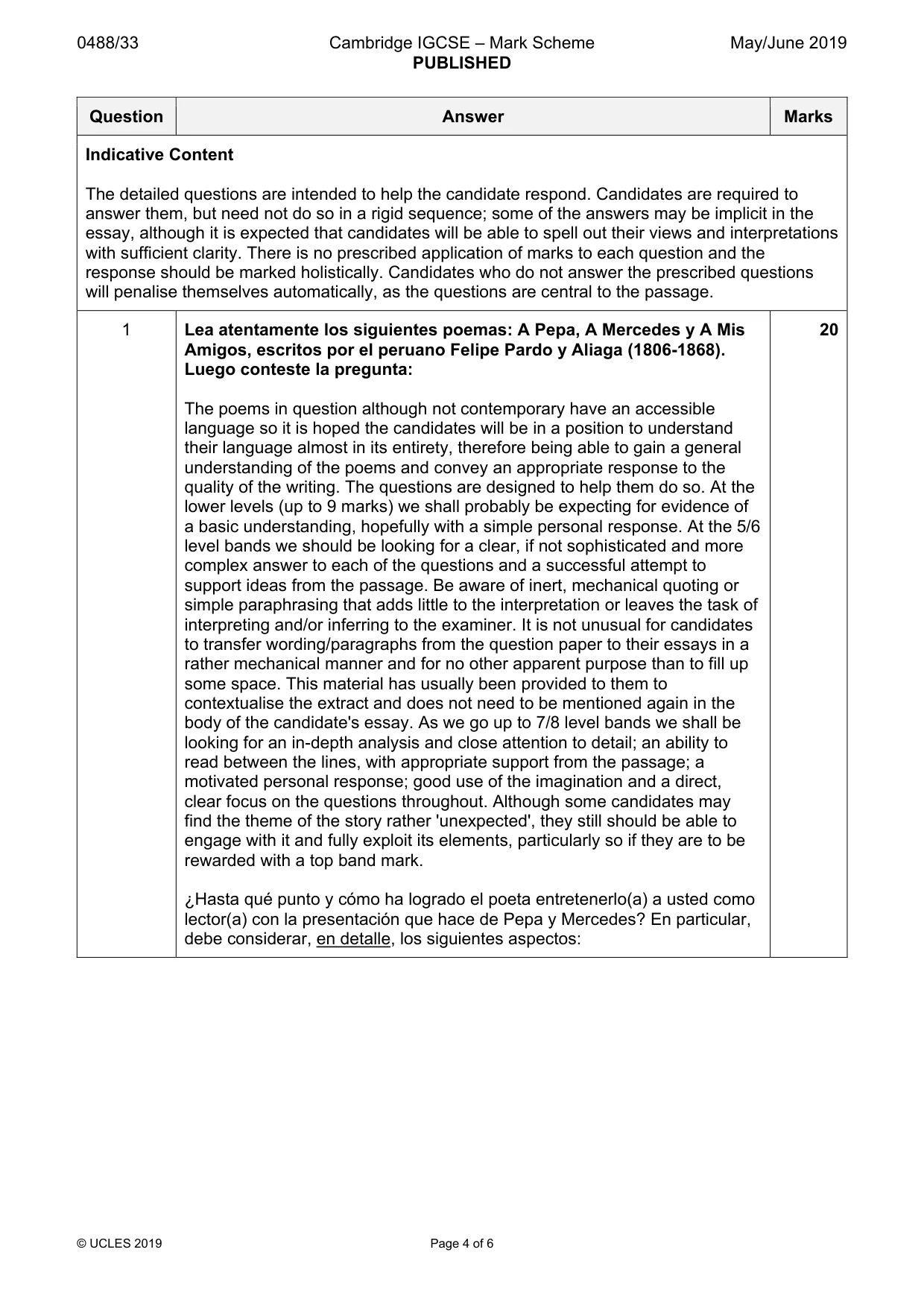
0488/33 Cambridge IGCSE – Mark Scheme PUBLISHED May/June 2019 © UCLES 2019 Page 4 of 6 Question Answer Marks Indicative Content The detailed questions are intended to help the candidate respond. Candidates are required to answer them, but need not do so in a rigid sequence; some of the answers may be implicit in the essay, although it is expected that candidates will be able to spell out their views and interpretations with sufficient clarity. There is no prescribed application of marks to each question and the response should be marked holistically. Candidates who do not answer the prescribed questions will penalise themselves automatically, as the questions are central to the passage. 1 Lea atentamente los siguientes poemas: A Pepa, A Mercedes y A Mis Amigos, escritos por el peruano Felipe Pardo y Aliaga (1806-1868). Luego conteste la pregunta: The poems in question although not contemporary have an accessible language so it is hoped the candidates will be in a position to understand their language almost in its entirety, therefore being able to gain a general understanding of the poems and convey an appropriate response to the quality of the writing. The questions are designed to help them do so. At the lower levels (up to 9 marks) we shall probably be expecting for evidence of a basic understanding, hopefully with a simple personal response. At the 5/6 level bands we should be looking for a clear, if not sophisticated and more complex answer to each of the questions and a successful attempt to support ideas from the passage. Be aware of inert, mechanical quoting or simple paraphrasing that adds little to the interpretation or leaves the task of interpreting and/or inferring to the examiner. It is not unusual for candidates to transfer wording/paragraphs from the question paper to their essays in a rather mechanical manner and for no other apparent purpose than to fill up some space. This material has usually been provided to them to contextualise the extract and does not need to be mentioned again in the body of the candidate's essay. As we go up to 7/8 level bands we shall be looking for an in-depth analysis and close attention to detail; an ability to read between the lines, with appropriate support from the passage; a motivated personal response; good use of the imagination and a direct, clear focus on the questions throughout. Although some candidates may find the theme of the story rather 'unexpected', they still should be able to engage with it and fully exploit its elements, particularly so if they are to be rewarded with a top band mark. ¿Hasta qué punto y cómo ha logrado el poeta entretenerlo(a) a usted como lector(a) con la presentación que hace de Pepa y Mercedes? En particular, debe considerar, en detalle, los siguientes aspectos: 20
Mark scheme, page 5
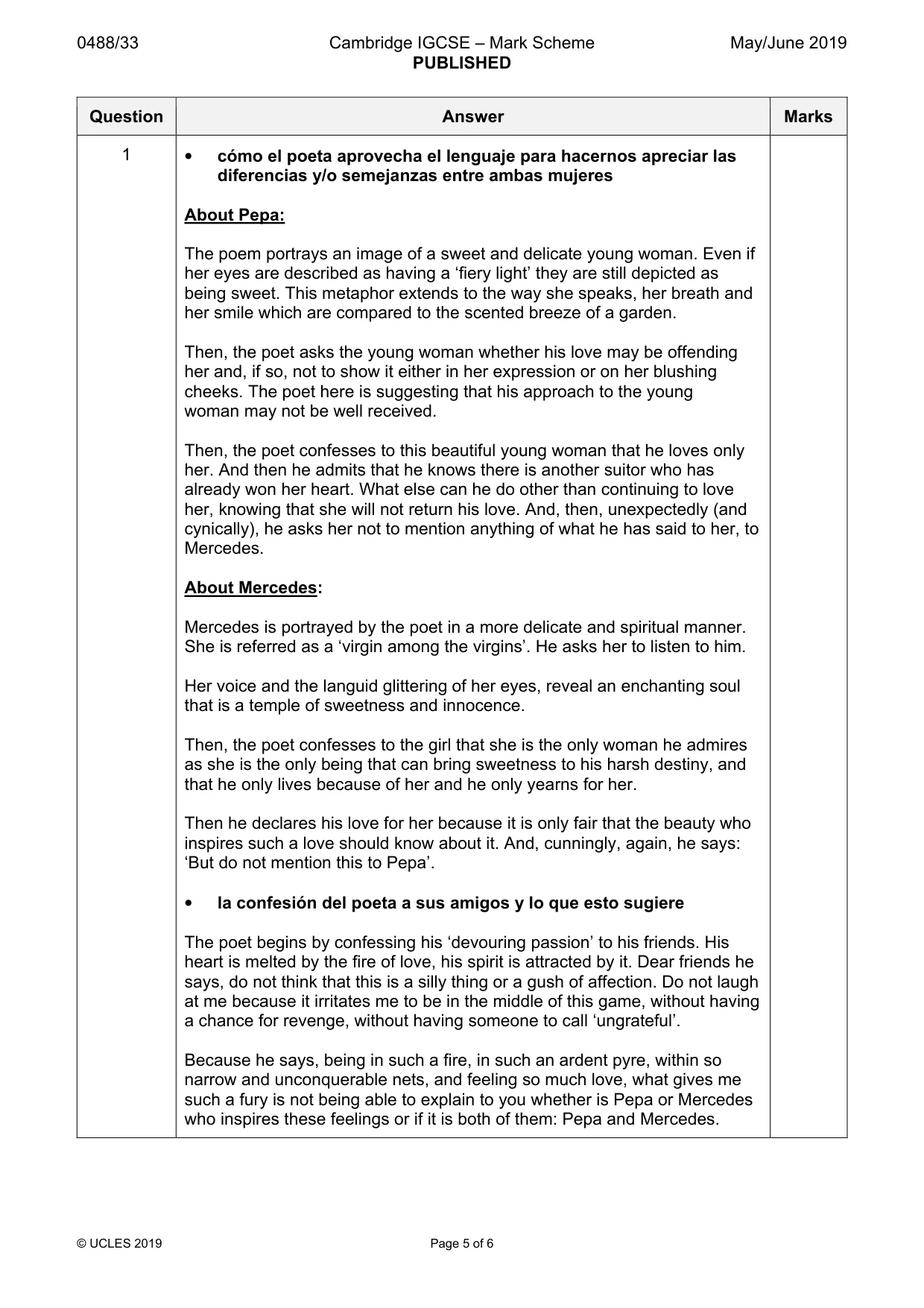
0488/33 Cambridge IGCSE – Mark Scheme PUBLISHED May/June 2019 © UCLES 2019 Page 5 of 6 Question Answer Marks 1 • cómo el poeta aprovecha el lenguaje para hacernos apreciar las diferencias y/o semejanzas entre ambas mujeres About Pepa: The poem portrays an image of a sweet and delicate young woman. Even if her eyes are described as having a ‘fiery light’ they are still depicted as being sweet. This metaphor extends to the way she speaks, her breath and her smile which are compared to the scented breeze of a garden. Then, the poet asks the young woman whether his love may be offending her and, if so, not to show it either in her expression or on her blushing cheeks. The poet here is suggesting that his approach to the young woman may not be well received. Then, the poet confesses to this beautiful young woman that he loves only her. And then he admits that he knows there is another suitor who has already won her heart. What else can he do other than continuing to love her, knowing that she will not return his love. And, then, unexpectedly (and cynically), he asks her not to mention anything of what he has said to her, to Mercedes. About Mercedes: Mercedes is portrayed by the poet in a more delicate and spiritual manner. She is referred as a ‘virgin among the virgins’. He asks her to listen to him. Her voice and the languid glittering of her eyes, reveal an enchanting soul that is a temple of sweetness and innocence. Then, the poet confesses to the girl that she is the only woman he admires as she is the only being that can bring sweetness to his harsh destiny, and that he only lives because of her and he only yearns for her. Then he declares his love for her because it is only fair that the beauty who inspires such a love should know about it. And, cunningly, again, he says: ‘But do not mention this to Pepa’. • la confesión del poeta a sus amigos y lo que esto sugiere The poet begins by confessing his ‘devouring passion’ to his friends. His heart is melted by the fire of love, his spirit is attracted by it. Dear friends he says, do not think that this is a silly thing or a gush of affection. Do not laugh at me because it irritates me to be in the middle of this game, without having a chance for revenge, without having someone to call ‘ungrateful’. Because he says, being in such a fire, in such an ardent pyre, within so narrow and unconquerable nets, and feeling so much love, what gives me such a fury is not being able to explain to you whether is Pepa or Mercedes who inspires these feelings or if it is both of them: Pepa and Mercedes.
Mark scheme, page 6
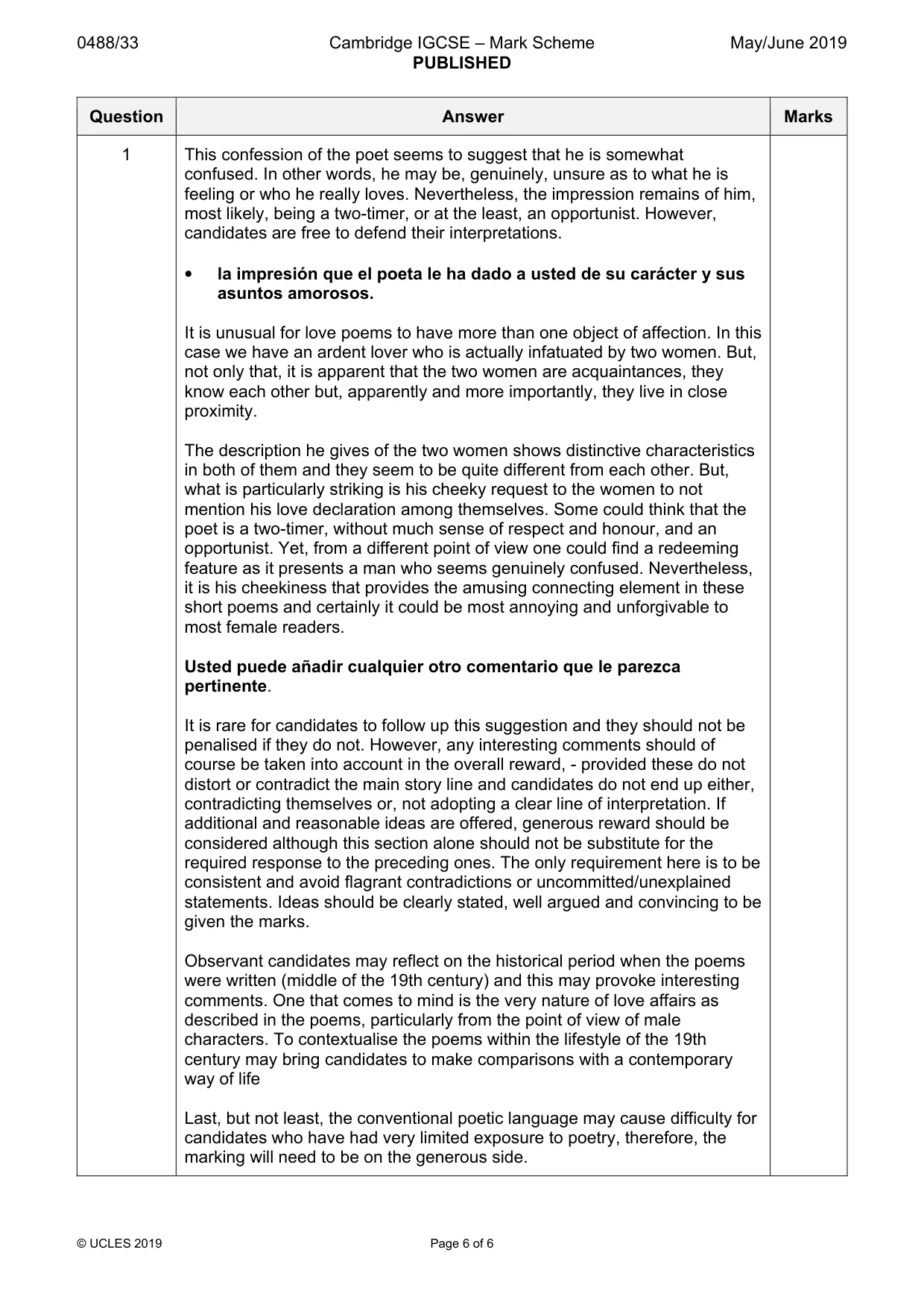
0488/33 Cambridge IGCSE – Mark Scheme PUBLISHED May/June 2019 © UCLES 2019 Page 6 of 6 Question Answer Marks 1 This confession of the poet seems to suggest that he is somewhat confused. In other words, he may be, genuinely, unsure as to what he is feeling or who he really loves. Nevertheless, the impression remains of him, most likely, being a two-timer, or at the least, an opportunist. However, candidates are free to defend their interpretations. • la impresión que el poeta le ha dado a usted de su carácter y sus asuntos amorosos. It is unusual for love poems to have more than one object of affection. In this case we have an ardent lover who is actually infatuated by two women. But, not only that, it is apparent that the two women are acquaintances, they know each other but, apparently and more importantly, they live in close proximity. The description he gives of the two women shows distinctive characteristics in both of them and they seem to be quite different from each other. But, what is particularly striking is his cheeky request to the women to not mention his love declaration among themselves. Some could think that the poet is a two-timer, without much sense of respect and honour, and an opportunist. Yet, from a different point of view one could find a redeeming feature as it presents a man who seems genuinely confused. Nevertheless, it is his cheekiness that provides the amusing connecting element in these short poems and certainly it could be most annoying and unforgivable to most female readers. Usted puede añadir cualquier otro comentario que le parezca pertinente. It is rare for candidates to follow up this suggestion and they should not be penalised if they do not. However, any interesting comments should of course be taken into account in the overall reward, - provided these do not distort or contradict the main story line and candidates do not end up either, contradicting themselves or, not adopting a clear line of interpretation. If additional and reasonable ideas are offered, generous reward should be considered although this section alone should not be substitute for the required response to the preceding ones. The only requirement here is to be consistent and avoid flagrant contradictions or uncommitted/unexplained statements. Ideas should be clearly stated, well argued and convincing to be given the marks. Observant candidates may reflect on the historical period when the poems were written (middle of the 19th century) and this may provoke interesting comments. One that comes to mind is the very nature of love affairs as described in the poems, particularly from the point of view of male characters. To contextualise the poems within the lifestyle of the 19th century may bring candidates to make comparisons with a contemporary way of life Last, but not least, the conventional poetic language may cause difficulty for candidates who have had very limited exposure to poetry, therefore, the marking will need to be on the generous side.
What you needed in this session
Cambridge’s own grade thresholds for 2019 May/June, Paper 3 · Variant 3. A higher threshold means an easier paper — the bar moves with how the cohort did.