Cambridge IGCSE Spanish - Literature 0488 — 2022 May/June Paper 3 · Variant 3
0488/33/M/J/22 · 20 marks · ≈23 min
The question paper and its mark scheme, free to read here and free to download. This is Cambridge’s own paper, exactly as it was sat.
Question paper8 pages




Mark scheme8 pages
Answers below. Sit the paper first if you are practising.

Paper as text
Question paper, page 1
This document has 8 pages. Any blank pages are indicated. [Turn over Cambridge IGCSE™ DC (CE) 303679/3 © UCLES 2022 LITERATURE (SPANISH) 0488/33 Paper 3 Alternative to Coursework May/June 2022 1 hour 20 minutes You must answer on the enclosed answer booklet. You will need: Answer booklet (enclosed) INSTRUCTIONS ● Answer the question. ● Follow the instructions on the front cover of the answer booklet. If you need additional answer paper, ask the invigilator for a continuation booklet. INFORMATION ● The total mark for this paper is 20. ● The number of marks for each question or part question is shown in brackets [ ]. INSTRUCCIONES ● Conteste a la pregunta. ● Siga las instrucciones que aparecen en la portada del cuadernillo de respuestas. Las instrucciones aparecen también en español a continuación. Si necesita hojas adicionales, pídale al supervisor un cuadernillo de respuestas adicional. INFORMACIÓN ● La puntuación total de este examen es de 20. ● La puntuación de cada pregunta o apartados de la misma aparece entre corchetes [ ]. * 7 4 0 6 0 9 8 4 5 0 *
Question paper, page 2
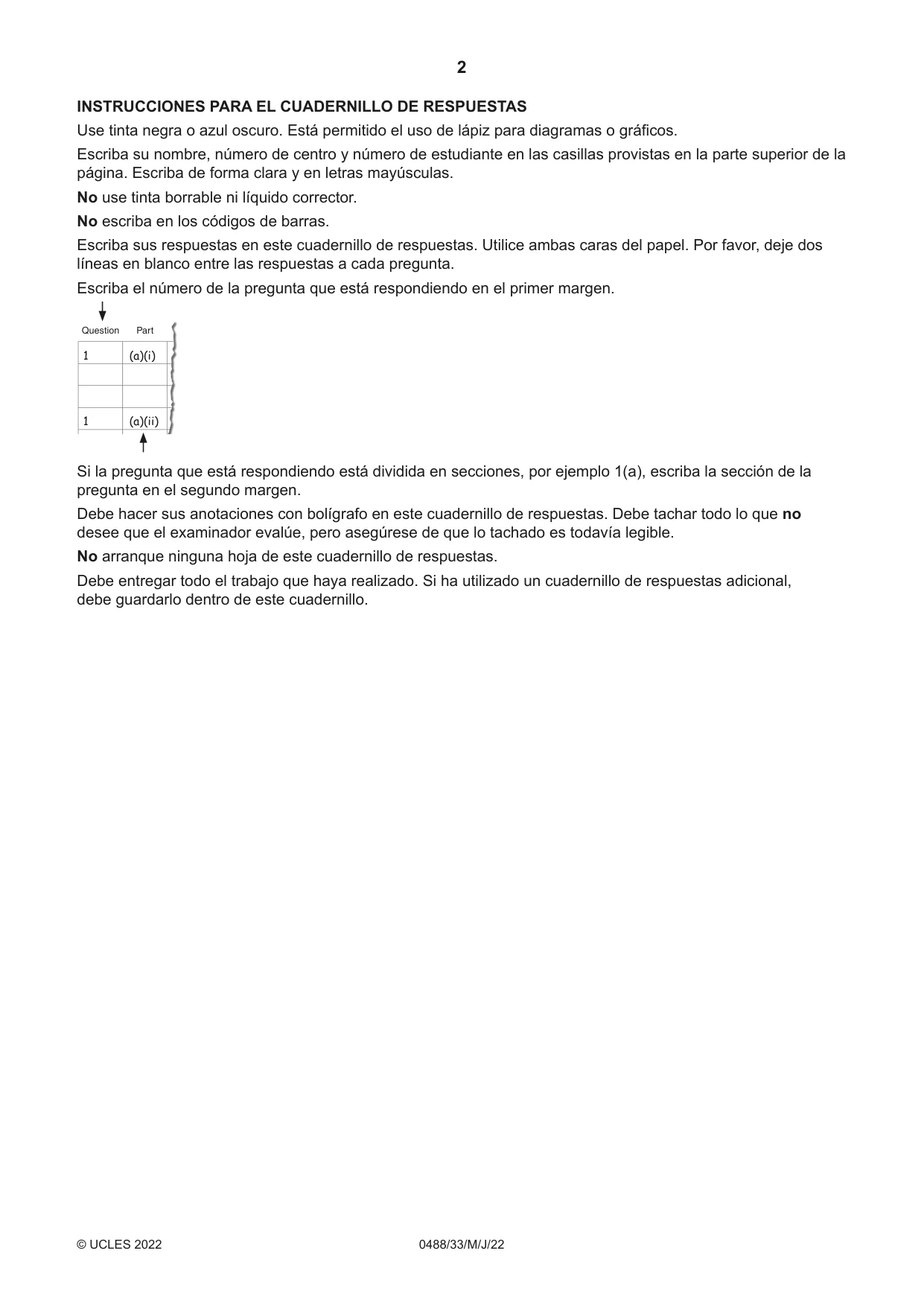
2 0488/33/ M / J /22 © UCLES 2022 INSTRUCCIONES PARA EL CUADERNILLO DE RESPUESTAS Use tinta negra o azul oscuro. Está permitido el uso de lápiz para diagramas o gráficos. Escriba su nombre, número de centro y número de estudiante en las casillas provistas en la parte superior de la página. Escriba de forma clara y en letras mayúsculas. No use tinta borrable ni líquido corrector. No escriba en los códigos de barras. Escriba sus respuestas en este cuadernillo de respuestas. Utilice ambas caras del papel. Por favor, deje dos líneas en blanco entre las respuestas a cada pregunta. Escriba el número de la pregunta que está respondiendo en el primer margen. Question Part 1 1 (a)(i) (a)(ii) Si la pregunta que está respondiendo está dividida en secciones, por ejemplo 1(a), escriba la sección de la pregunta en el segundo margen. Debe hacer sus anotaciones con bolígrafo en este cuadernillo de respuestas. Debe tachar todo lo que no desee que el examinador evalúe, pero asegúrese de que lo tachado es todavía legible. No arranque ninguna hoja de este cuadernillo de respuestas. Debe entregar todo el trabajo que haya realizado. Si ha utilizado un cuadernillo de respuestas adicional, debe guardarlo dentro de este cuadernillo.
Question paper, page 3
3 0488/33/M/J/22 © UCLES 2022 [Turn over BLANK PAGE
Question paper, page 4
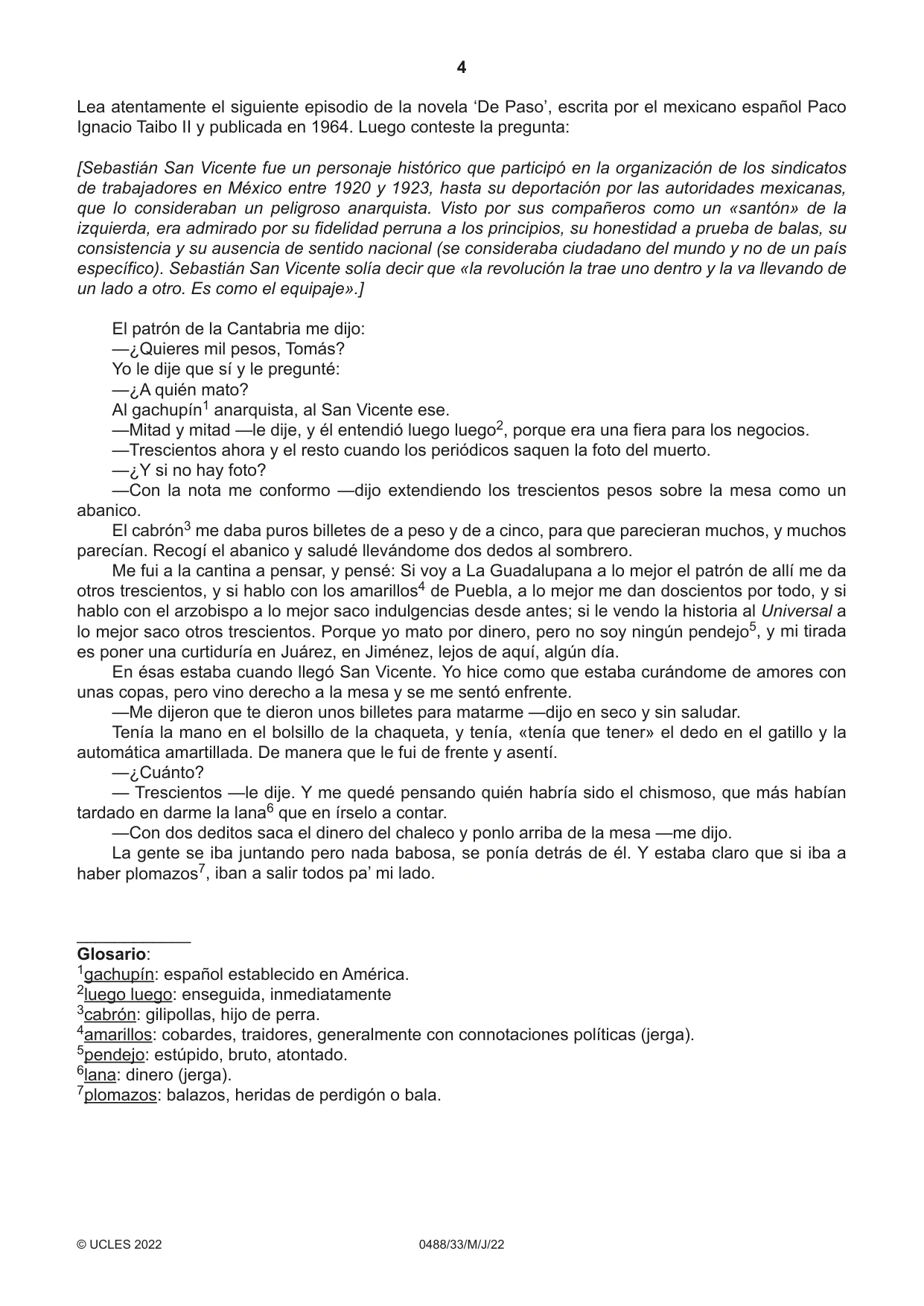
4 0488/33/M/J/22 © UCLES 2022 Lea atentamente el siguiente episodio de la novela ‘De Paso’, escrita por el mexicano español Paco Ignacio Taibo II y publicada en 1964. Luego conteste la pregunta: [Sebastián San Vicente fue un personaje histórico que participó en la organización de los sindicatos de trabajadores en México entre 1920 y 1923, hasta su deportación por las autoridades mexicanas, que lo consideraban un peligroso anarquista. Visto por sus compañeros como un «santón» de la izquierda, era admirado por su fidelidad perruna a los principios, su honestidad a prueba de balas, su consistencia y su ausencia de sentido nacional (se consideraba ciudadano del mundo y no de un país específico). Sebastián San Vicente solía decir que «la revolución la trae uno dentro y la va llevando de un lado a otro. Es como el equipaje».] El patrón de la Cantabria me dijo: —¿Quieres mil pesos, Tomás? Yo le dije que sí y le pregunté: —¿A quién mato? Al gachupín1 anarquista, al San Vicente ese. —Mitad y mitad —le dije, y él entendió luego luego2, porque era una fiera para los negocios. —Trescientos ahora y el resto cuando los periódicos saquen la foto del muerto. —¿Y si no hay foto? —Con la nota me conformo —dijo extendiendo los trescientos pesos sobre la mesa como un abanico. El cabrón3 me daba puros billetes de a peso y de a cinco, para que parecieran muchos, y muchos parecían. Recogí el abanico y saludé llevándome dos dedos al sombrero. Me fui a la cantina a pensar, y pensé: Si voy a La Guadalupana a lo mejor el patrón de allí me da otros trescientos, y si hablo con los amarillos4 de Puebla, a lo mejor me dan doscientos por todo, y si hablo con el arzobispo a lo mejor saco indulgencias desde antes; si le vendo la historia al Universal a lo mejor saco otros trescientos. Porque yo mato por dinero, pero no soy ningún pendejo5, y mi tirada es poner una curtiduría en Juárez, en Jiménez, lejos de aquí, algún día. En ésas estaba cuando llegó San Vicente. Yo hice como que estaba curándome de amores con unas copas, pero vino derecho a la mesa y se me sentó enfrente. —Me dijeron que te dieron unos billetes para matarme —dijo en seco y sin saludar. Tenía la mano en el bolsillo de la chaqueta, y tenía, «tenía que tener» el dedo en el gatillo y la automática amartillada. De manera que le fui de frente y asentí. —¿Cuánto? — Trescientos —le dije. Y me quedé pensando quién habría sido el chismoso, que más habían tardado en darme la lana6 que en írselo a contar. —Con dos deditos saca el dinero del chaleco y ponlo arriba de la mesa —me dijo. La gente se iba juntando pero nada babosa, se ponía detrás de él. Y estaba claro que si iba a haber plomazos7, iban a salir todos pa’ mi lado. ____________ Glosario: 1gachupín: español establecido en América. 2luego luego: enseguida, inmediatamente 3cabrón: gilipollas, hijo de perra. 4amarillos: cobardes, traidores, generalmente con connotaciones políticas (jerga). 5pendejo: estúpido, bruto, atontado. 6lana: dinero (jerga). 7plomazos: balazos, heridas de perdigón o bala.
Question paper, page 5
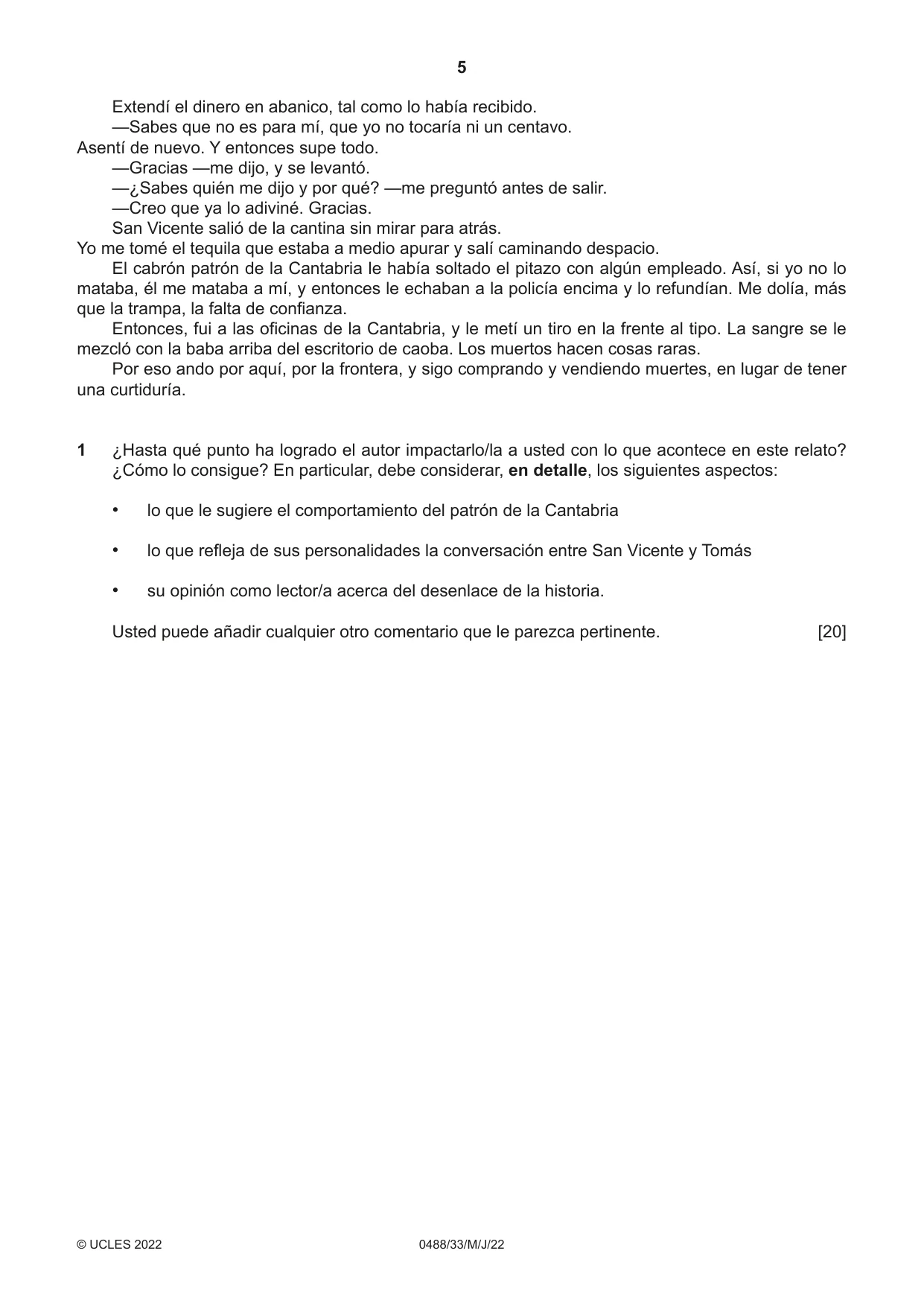
5 0488/33/M/J/22 © UCLES 2022 Extendí el dinero en abanico, tal como lo había recibido. —Sabes que no es para mí, que yo no tocaría ni un centavo. Asentí de nuevo. Y entonces supe todo. —Gracias —me dijo, y se levantó. —¿Sabes quién me dijo y por qué? —me preguntó antes de salir. —Creo que ya lo adiviné. Gracias. San Vicente salió de la cantina sin mirar para atrás. Yo me tomé el tequila que estaba a medio apurar y salí caminando despacio. El cabrón patrón de la Cantabria le había soltado el pitazo con algún empleado. Así, si yo no lo mataba, él me mataba a mí, y entonces le echaban a la policía encima y lo refundían. Me dolía, más que la trampa, la falta de confianza. Entonces, fui a las oficinas de la Cantabria, y le metí un tiro en la frente al tipo. La sangre se le mezcló con la baba arriba del escritorio de caoba. Los muertos hacen cosas raras. Por eso ando por aquí, por la frontera, y sigo comprando y vendiendo muertes, en lugar de tener una curtiduría. 1 ¿Hasta qué punto ha logrado el autor impactarlo/la a usted con lo que acontece en este relato? ¿Cómo lo consigue? En particular, debe considerar, en detalle, los siguientes aspectos: • lo que le sugiere el comportamiento del patrón de la Cantabria • lo que refleja de sus personalidades la conversación entre San Vicente y Tomás • su opinión como lector/a acerca del desenlace de la historia. Usted puede añadir cualquier otro comentario que le parezca pertinente. [20]
Question paper, page 6
6 0488/33/M/J/22 © UCLES 2022 BLANK PAGE
Question paper, page 7
7 0488/33/M/J/22 © UCLES 2022 BLANK PAGE
Question paper, page 8
8 0488/33/M/J/22 © UCLES 2022 Permission to reproduce items where third-party owned material protected by copyright is included has been sought and cleared where possible. Every reasonable effort has been made by the publisher (UCLES) to trace copyright holders, but if any items requiring clearance have unwittingly been included, the publisher will be pleased to make amends at the earliest possible opportunity. To avoid the issue of disclosure of answer-related information to candidates, all copyright acknowledgements are reproduced online in the Cambridge Assessment International Education Copyright Acknowledgements Booklet. This is produced for each series of examinations and is freely available to download at www.cambridgeinternational.org after the live examination series. Cambridge Assessment International Education is part of Cambridge Assessment. Cambridge Assessment is the brand name of the University of Cambridge Local Examinations Syndicate (UCLES), which is a department of the University of Cambridge. BLANK PAGE
Mark scheme, page 1
This document consists of 8 printed pages. © UCLES 2022 [Turn over Cambridge IGCSE™ LITERATURE (SPANISH) 0488/33 Paper 3 Alternative to Coursework May/June 2022 MARK SCHEME Maximum Mark: 20 Published This mark scheme is published as an aid to teachers and candidates, to indicate the requirements of the examination. It shows the basis on which Examiners were instructed to award marks. It does not indicate the details of the discussions that took place at an Examiners’ meeting before marking began, which would have considered the acceptability of alternative answers. Mark schemes should be read in conjunction with the question paper and the Principal Examiner Report for Teachers. Cambridge International will not enter into discussions about these mark schemes. Cambridge International is publishing the mark schemes for the May/June 2022 series for most Cambridge IGCSE, Cambridge International A and AS Level and Cambridge Pre-U components, and some Cambridge O Level components.
Mark scheme, page 2
0488/33 Cambridge IGCSE – Mark Scheme PUBLISHED May/June 2022 © UCLES 2022 Page 2 of 8 Generic Marking Principles These general marking principles must be applied by all examiners when marking candidate answers. They should be applied alongside the specific content of the mark scheme or generic level descriptors for a question. Each question paper and mark scheme will also comply with these marking principles. GENERIC MARKING PRINCIPLE 1: Marks must be awarded in line with: the specific content of the mark scheme or the generic level descriptors for the question the specific skills defined in the mark scheme or in the generic level descriptors for the question the standard of response required by a candidate as exemplified by the standardisation scripts. GENERIC MARKING PRINCIPLE 2: Marks awarded are always whole marks (not half marks, or other fractions). GENERIC MARKING PRINCIPLE 3: Marks must be awarded positively: marks are awarded for correct/valid answers, as defined in the mark scheme. However, credit is given for valid answers which go beyond the scope of the syllabus and mark scheme, referring to your Team Leader as appropriate marks are awarded when candidates clearly demonstrate what they know and can do marks are not deducted for errors marks are not deducted for omissions answers should only be judged on the quality of spelling, punctuation and grammar when these features are specifically assessed by the question as indicated by the mark scheme. The meaning, however, should be unambiguous. GENERIC MARKING PRINCIPLE 4: Rules must be applied consistently, e.g. in situations where candidates have not followed instructions or in the application of generic level descriptors. GENERIC MARKING PRINCIPLE 5: Marks should be awarded using the full range of marks defined in the mark scheme for the question (however; the use of the full mark range may be limited according to the quality of the candidate responses seen). GENERIC MARKING PRINCIPLE 6: Marks awarded are based solely on the requirements as defined in the mark scheme. Marks should not be awarded with grade thresholds or grade descriptors in mind.
Mark scheme, page 3
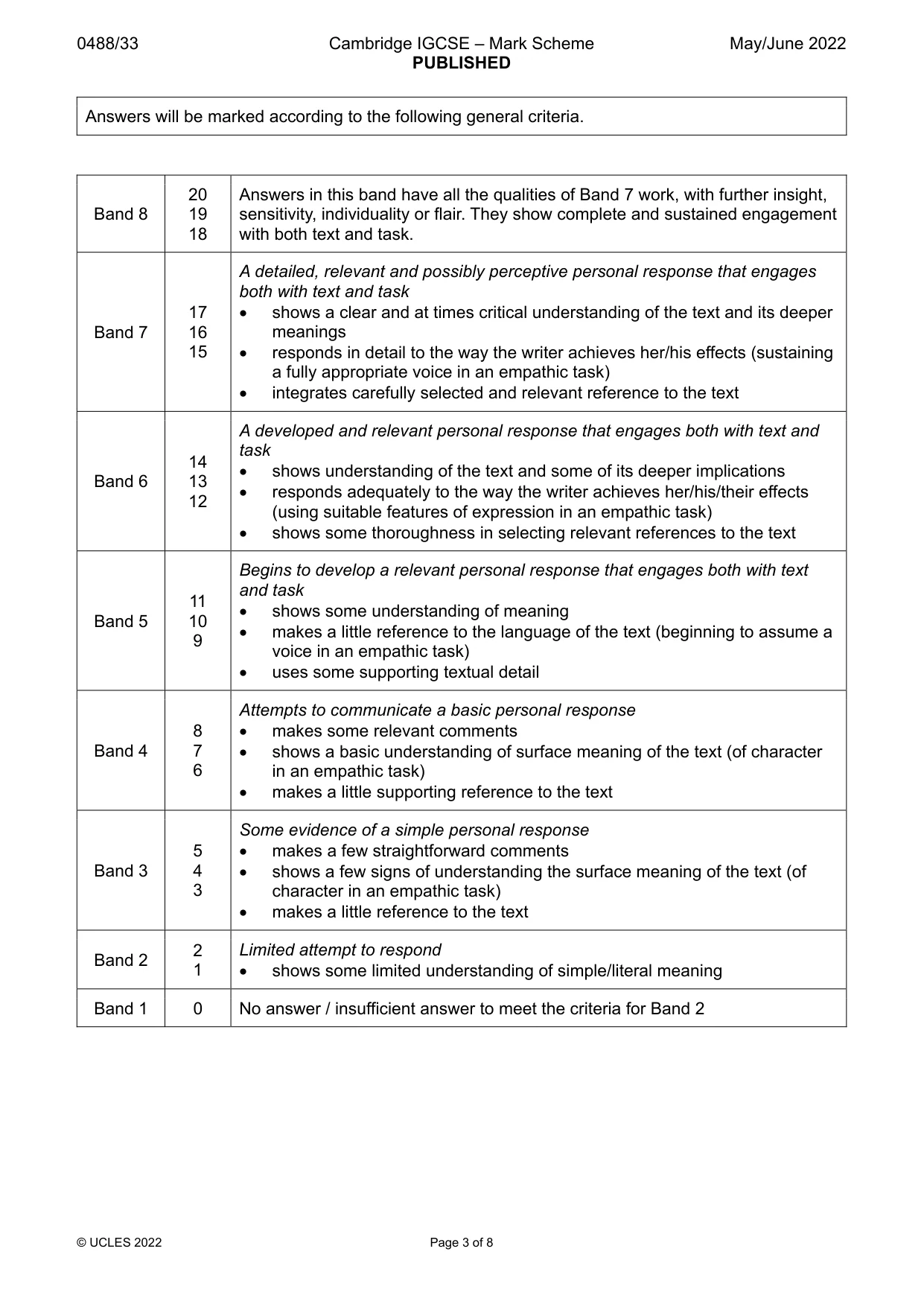
0488/33 Cambridge IGCSE – Mark Scheme PUBLISHED May/June 2022 © UCLES 2022 Page 3 of 8 Answers will be marked according to the following general criteria. Band 8 20 19 18 Answers in this band have all the qualities of Band 7 work, with further insight, sensitivity, individuality or flair. They show complete and sustained engagement with both text and task. Band 7 17 16 15 A detailed, relevant and possibly perceptive personal response that engages both with text and task shows a clear and at times critical understanding of the text and its deeper meanings responds in detail to the way the writer achieves her/his effects (sustaining a fully appropriate voice in an empathic task) integrates carefully selected and relevant reference to the text Band 6 14 13 12 A developed and relevant personal response that engages both with text and task shows understanding of the text and some of its deeper implications responds adequately to the way the writer achieves her/his/their effects (using suitable features of expression in an empathic task) shows some thoroughness in selecting relevant references to the text Band 5 11 10 9 Begins to develop a relevant personal response that engages both with text and task shows some understanding of meaning makes a little reference to the language of the text (beginning to assume a voice in an empathic task) uses some supporting textual detail Band 4 8 7 6 Attempts to communicate a basic personal response makes some relevant comments shows a basic understanding of surface meaning of the text (of character in an empathic task) makes a little supporting reference to the text Band 3 5 4 3 Some evidence of a simple personal response makes a few straightforward comments shows a few signs of understanding the surface meaning of the text (of character in an empathic task) makes a little reference to the text Band 2 2 1 Limited attempt to respond shows some limited understanding of simple/literal meaning Band 1 0 No answer / insufficient answer to meet the criteria for Band 2
Mark scheme, page 4
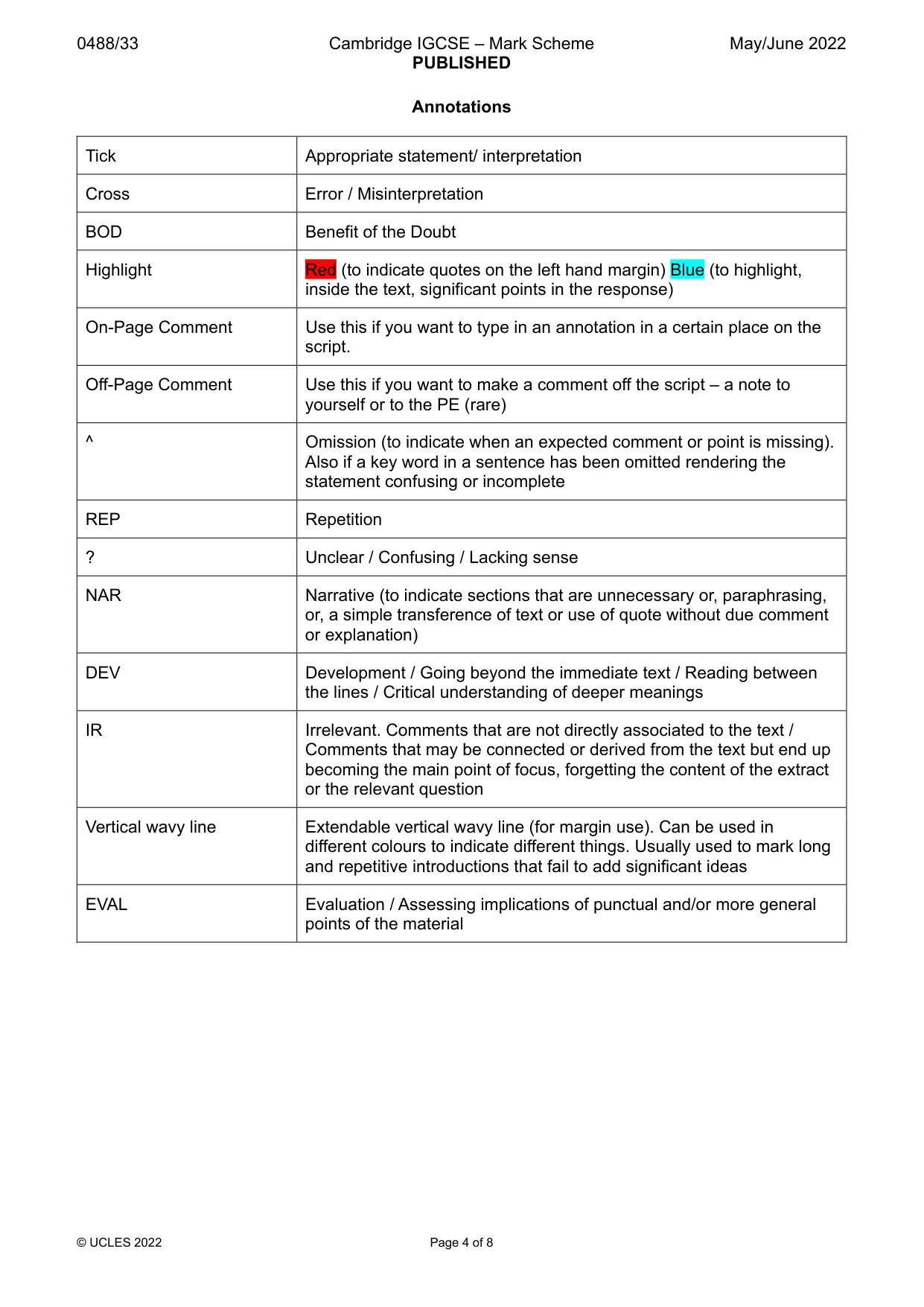
0488/33 Cambridge IGCSE – Mark Scheme PUBLISHED May/June 2022 © UCLES 2022 Page 4 of 8 Annotations Tick Appropriate statement/ interpretation Cross Error / Misinterpretation BOD Benefit of the Doubt Highlight Red (to indicate quotes on the left hand margin) Blue (to highlight, inside the text, significant points in the response) On-Page Comment Use this if you want to type in an annotation in a certain place on the script. Off-Page Comment Use this if you want to make a comment off the script – a note to yourself or to the PE (rare) ^ Omission (to indicate when an expected comment or point is missing). Also if a key word in a sentence has been omitted rendering the statement confusing or incomplete REP Repetition ? Unclear / Confusing / Lacking sense NAR Narrative (to indicate sections that are unnecessary or, paraphrasing, or, a simple transference of text or use of quote without due comment or explanation) DEV Development / Going beyond the immediate text / Reading between the lines / Critical understanding of deeper meanings IR Irrelevant. Comments that are not directly associated to the text / Comments that may be connected or derived from the text but end up becoming the main point of focus, forgetting the content of the extract or the relevant question Vertical wavy line Extendable vertical wavy line (for margin use). Can be used in different colours to indicate different things. Usually used to mark long and repetitive introductions that fail to add significant ideas EVAL Evaluation / Assessing implications of punctual and/or more general points of the material
Mark scheme, page 5
0488/33 Cambridge IGCSE – Mark Scheme PUBLISHED May/June 2022 © UCLES 2022 Page 5 of 8 Using annotations Remember that this is a literature not a language assessment: do not correct or comment on individual spelling and grammatical errors. (But you might comment if relevant at the end of the script – e.g. ‘Frequent errors obscure meaning.’) These may be factual comments or comments on key features of the answer related to the mark scheme e.g. well-developed/undeveloped, clear/unclear, insufficient/reference to text; needs to explain point; good ref to dramatic qualities; needs to expand; evidence?; detail; not answering question. Be careful to distinguish between an unusual opinion and a factual error. At the bottom of the script put a brief summary comment based on the mark scheme e.g. Competent answer with some evidence of personal appreciation; a couple of significant omissions.
Mark scheme, page 6
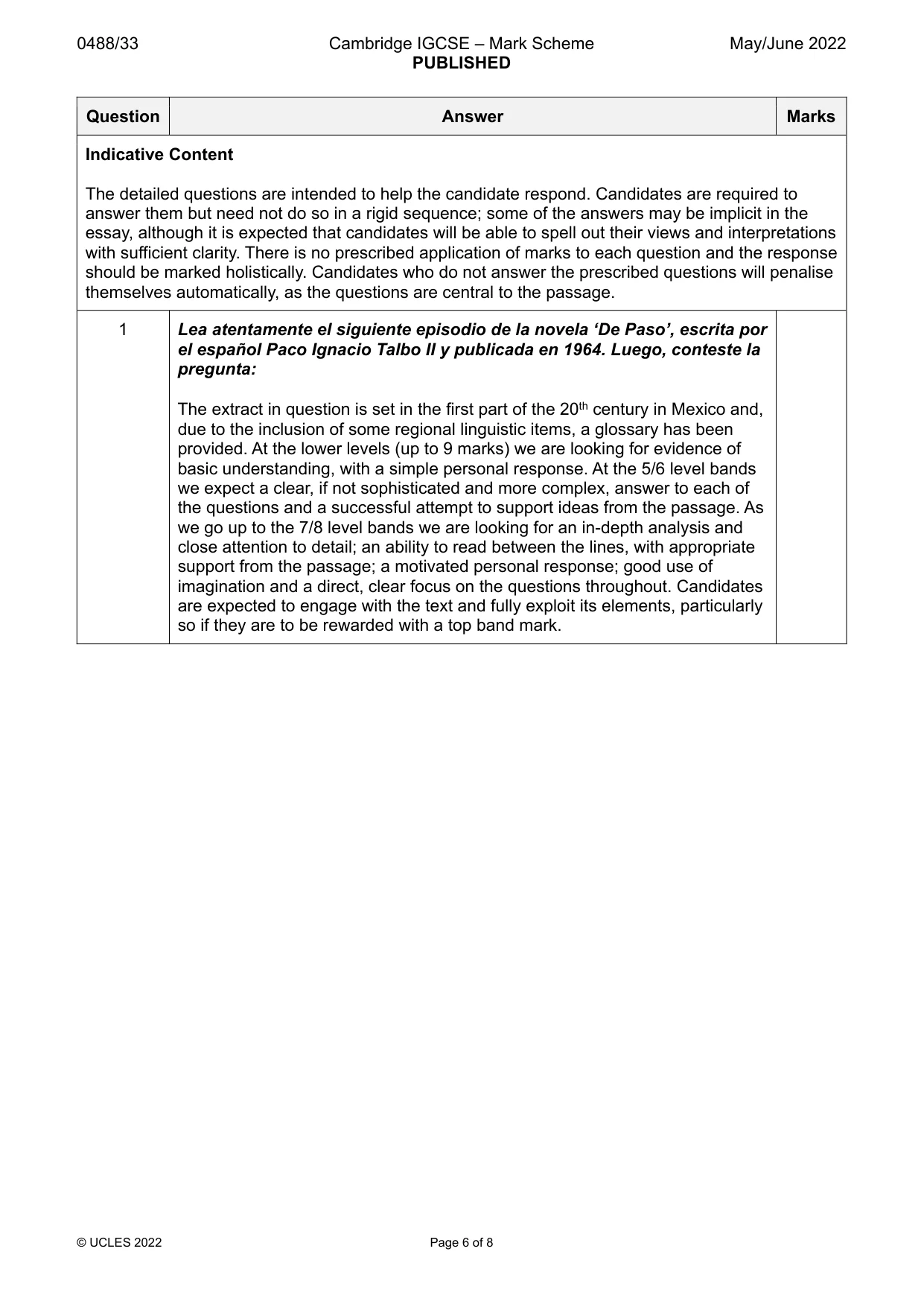
0488/33 Cambridge IGCSE – Mark Scheme PUBLISHED May/June 2022 © UCLES 2022 Page 6 of 8 Question Answer Marks Indicative Content The detailed questions are intended to help the candidate respond. Candidates are required to answer them but need not do so in a rigid sequence; some of the answers may be implicit in the essay, although it is expected that candidates will be able to spell out their views and interpretations with sufficient clarity. There is no prescribed application of marks to each question and the response should be marked holistically. Candidates who do not answer the prescribed questions will penalise themselves automatically, as the questions are central to the passage. 1 Lea atentamente el siguiente episodio de la novela ‘De Paso’, escrita por el español Paco Ignacio Talbo II y publicada en 1964. Luego, conteste la pregunta: The extract in question is set in the first part of the 20th century in Mexico and, due to the inclusion of some regional linguistic items, a glossary has been provided. At the lower levels (up to 9 marks) we are looking for evidence of basic understanding, with a simple personal response. At the 5/6 level bands we expect a clear, if not sophisticated and more complex, answer to each of the questions and a successful attempt to support ideas from the passage. As we go up to the 7/8 level bands we are looking for an in-depth analysis and close attention to detail; an ability to read between the lines, with appropriate support from the passage; a motivated personal response; good use of imagination and a direct, clear focus on the questions throughout. Candidates are expected to engage with the text and fully exploit its elements, particularly so if they are to be rewarded with a top band mark.
Mark scheme, page 7
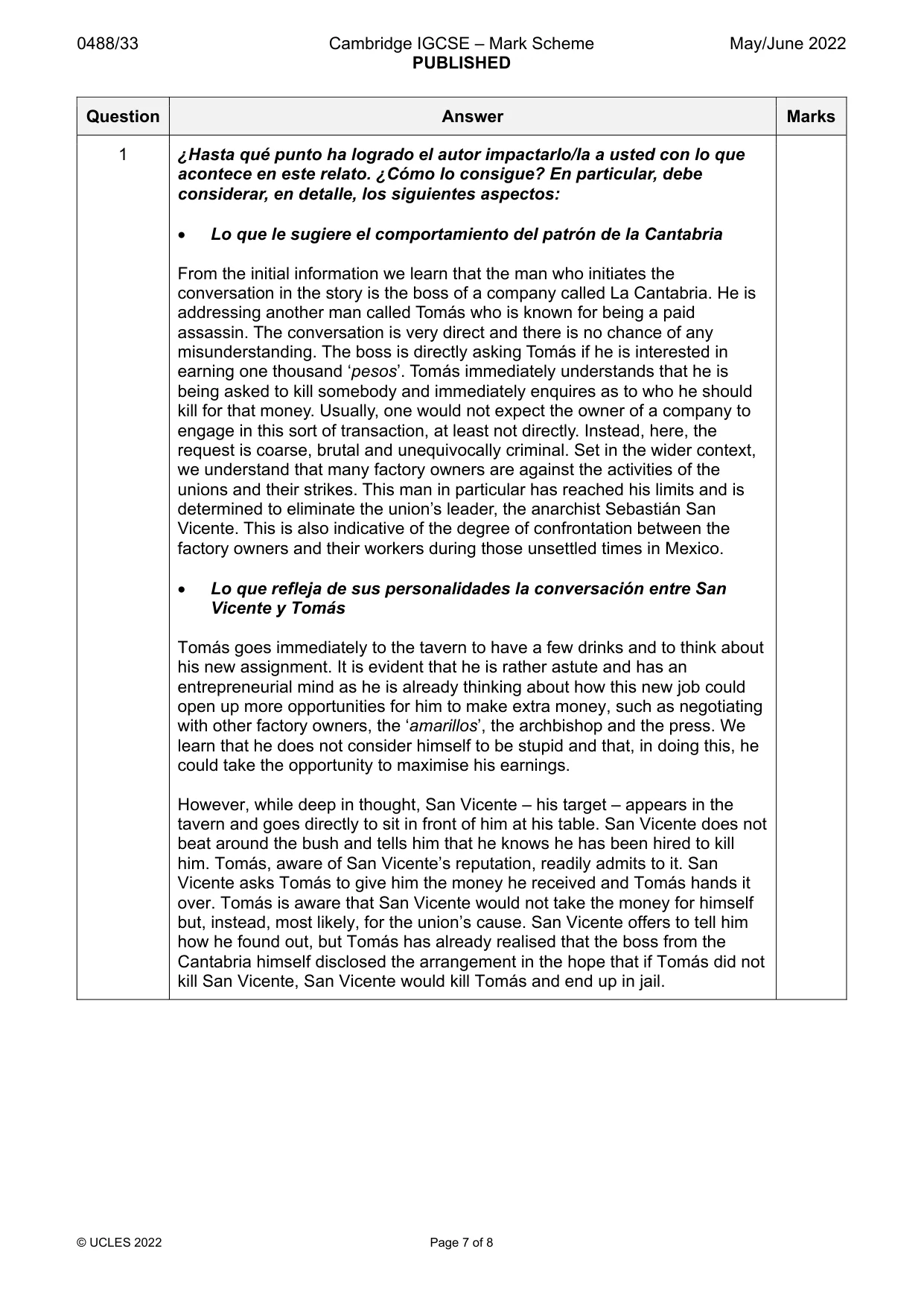
0488/33 Cambridge IGCSE – Mark Scheme PUBLISHED May/June 2022 © UCLES 2022 Page 7 of 8 Question Answer Marks 1 ¿Hasta qué punto ha logrado el autor impactarlo/la a usted con lo que acontece en este relato. ¿Cómo lo consigue? En particular, debe considerar, en detalle, los siguientes aspectos: Lo que le sugiere el comportamiento del patrón de la Cantabria From the initial information we learn that the man who initiates the conversation in the story is the boss of a company called La Cantabria. He is addressing another man called Tomás who is known for being a paid assassin. The conversation is very direct and there is no chance of any misunderstanding. The boss is directly asking Tomás if he is interested in earning one thousand ‘pesos’. Tomás immediately understands that he is being asked to kill somebody and immediately enquires as to who he should kill for that money. Usually, one would not expect the owner of a company to engage in this sort of transaction, at least not directly. Instead, here, the request is coarse, brutal and unequivocally criminal. Set in the wider context, we understand that many factory owners are against the activities of the unions and their strikes. This man in particular has reached his limits and is determined to eliminate the union’s leader, the anarchist Sebastián San Vicente. This is also indicative of the degree of confrontation between the factory owners and their workers during those unsettled times in Mexico. Lo que refleja de sus personalidades la conversación entre San Vicente y Tomás Tomás goes immediately to the tavern to have a few drinks and to think about his new assignment. It is evident that he is rather astute and has an entrepreneurial mind as he is already thinking about how this new job could open up more opportunities for him to make extra money, such as negotiating with other factory owners, the ‘amarillos’, the archbishop and the press. We learn that he does not consider himself to be stupid and that, in doing this, he could take the opportunity to maximise his earnings. However, while deep in thought, San Vicente – his target – appears in the tavern and goes directly to sit in front of him at his table. San Vicente does not beat around the bush and tells him that he knows he has been hired to kill him. Tomás, aware of San Vicente’s reputation, readily admits to it. San Vicente asks Tomás to give him the money he received and Tomás hands it over. Tomás is aware that San Vicente would not take the money for himself but, instead, most likely, for the union’s cause. San Vicente offers to tell him how he found out, but Tomás has already realised that the boss from the Cantabria himself disclosed the arrangement in the hope that if Tomás did not kill San Vicente, San Vicente would kill Tomás and end up in jail.
Mark scheme, page 8
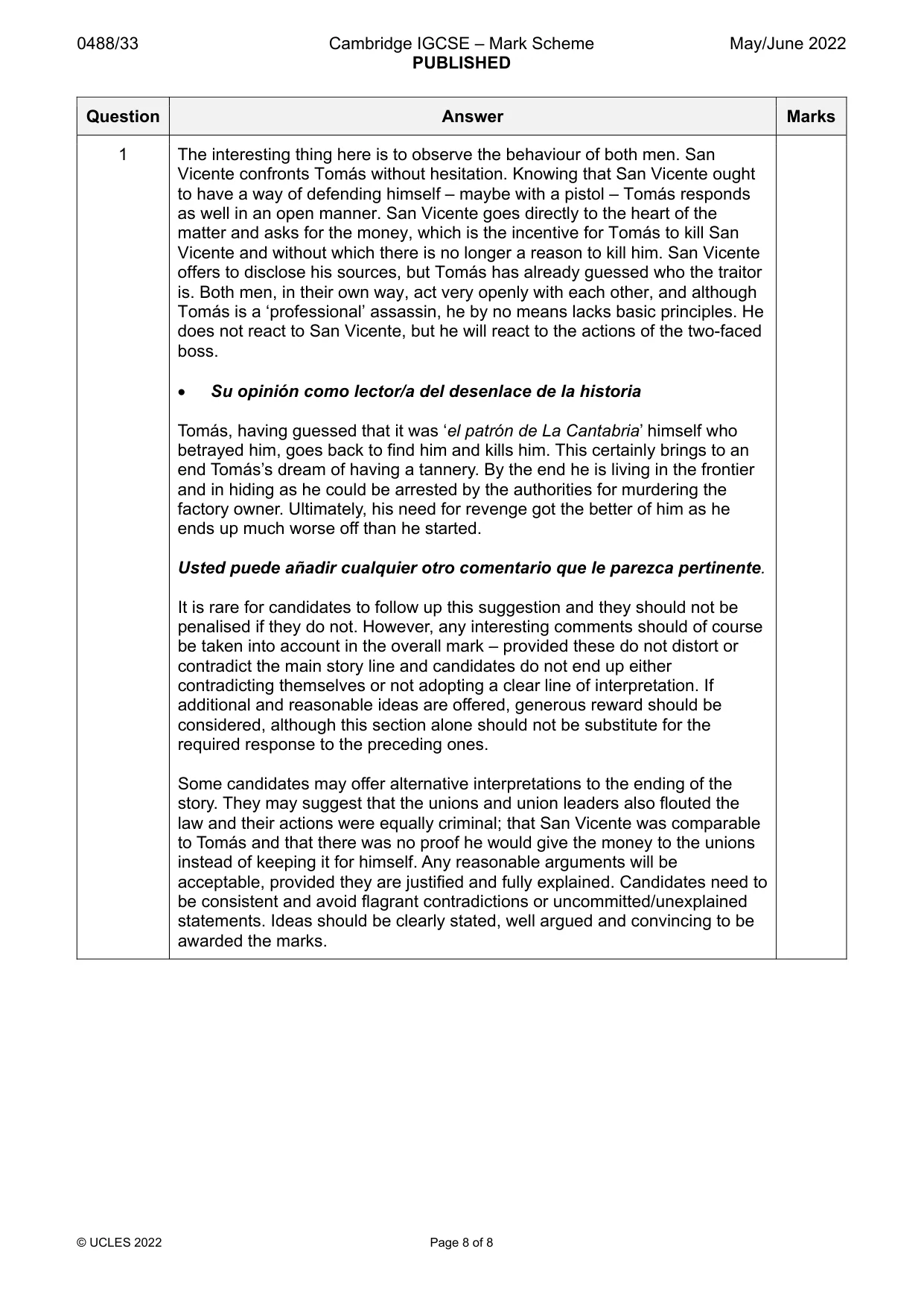
0488/33 Cambridge IGCSE – Mark Scheme PUBLISHED May/June 2022 © UCLES 2022 Page 8 of 8 Question Answer Marks 1 The interesting thing here is to observe the behaviour of both men. San Vicente confronts Tomás without hesitation. Knowing that San Vicente ought to have a way of defending himself – maybe with a pistol – Tomás responds as well in an open manner. San Vicente goes directly to the heart of the matter and asks for the money, which is the incentive for Tomás to kill San Vicente and without which there is no longer a reason to kill him. San Vicente offers to disclose his sources, but Tomás has already guessed who the traitor is. Both men, in their own way, act very openly with each other, and although Tomás is a ‘professional’ assassin, he by no means lacks basic principles. He does not react to San Vicente, but he will react to the actions of the two-faced boss. Su opinión como lector/a del desenlace de la historia Tomás, having guessed that it was ‘el patrón de La Cantabria’ himself who betrayed him, goes back to find him and kills him. This certainly brings to an end Tomás’s dream of having a tannery. By the end he is living in the frontier and in hiding as he could be arrested by the authorities for murdering the factory owner. Ultimately, his need for revenge got the better of him as he ends up much worse off than he started. Usted puede añadir cualquier otro comentario que le parezca pertinente. It is rare for candidates to follow up this suggestion and they should not be penalised if they do not. However, any interesting comments should of course be taken into account in the overall mark – provided these do not distort or contradict the main story line and candidates do not end up either contradicting themselves or not adopting a clear line of interpretation. If additional and reasonable ideas are offered, generous reward should be considered, although this section alone should not be substitute for the required response to the preceding ones. Some candidates may offer alternative interpretations to the ending of the story. They may suggest that the unions and union leaders also flouted the law and their actions were equally criminal; that San Vicente was comparable to Tomás and that there was no proof he would give the money to the unions instead of keeping it for himself. Any reasonable arguments will be acceptable, provided they are justified and fully explained. Candidates need to be consistent and avoid flagrant contradictions or uncommitted/unexplained statements. Ideas should be clearly stated, well argued and convincing to be awarded the marks.
What you needed in this session
Cambridge’s own grade thresholds for 2022 May/June, Paper 3 · Variant 3. A higher threshold means an easier paper — the bar moves with how the cohort did.