Cambridge IGCSE Spanish - Literature 0488 — 2021 May/June Paper 3 · Variant 3
0488/33/M/J/21 · 20 marks · ≈23 min
The question paper and its mark scheme, free to read here and free to download. This is Cambridge’s own paper, exactly as it was sat.
Question paper8 pages




Mark scheme9 pages
Answers below. Sit the paper first if you are practising.
Paper as text
Question paper, page 1
This document has 8 pages. Any blank pages are indicated. DC (JP) 202001/2 © UCLES 2021 [Turn over * 7 5 2 2 4 1 0 0 7 6 * Cambridge IGCSE™ LITERATURE (SPANISH) 0488/33 Paper 3 Alternative to Coursework May/June 2021 1 hour 20 minutes You must answer on the enclosed answer booklet. You will need: Answer booklet (enclosed) INSTRUCTIONS ● Answer the question. ● Follow the instructions on the front cover of the answer booklet. If you need additional answer paper, ask the invigilator for a continuation booklet. INFORMATION ● The total mark for this paper is 20. ● The number of marks for each question or part question is shown in brackets [ ]. INSTRUCCIONES ● Conteste a la pregunta. ● Siga las instrucciones que aparecen en la portada del cuadernillo de respuestas. Las instrucciones aparecen también en español a continuación. Si necesita hojas adicionales, pídale al supervisor un cuadernillo de respuestas adicional. INFORMACIÓN ● La puntuación total de este examen es de 20. ● La puntuación de cada pregunta o apartados de la misma aparece entre corchetes [ ].
Question paper, page 2
2 0488/33/ M / J /21 © UCLES 2021 INSTRUCCIONES PARA EL CUADERNILLO DE RESPUESTAS Use tinta negra o azul oscuro. Está permitido el uso de lápiz para diagramas o gráficos. Escriba su nombre, número de centro y número de estudiante en las casillas provistas en la parte superior de la página. Escriba de forma clara y en letras mayúsculas. No use tinta borrable ni líquido corrector. No escriba en los códigos de barras. Escriba sus respuestas en este librillo de respuestas. Utilice ambas caras del papel. Por favor, deje dos líneas en blanco entre las respuestas a cada pregunta. Escriba el número de la pregunta que está respondiendo en el primer margen. Question Part 1 1 (a)(i) (a)(ii) Si la pregunta que está respondiendo está dividida en secciones, por ejemplo 1(a), escriba la sección de la pregunta en el segundo margen. Debe hacer sus anotaciones con bolígrafo en este librillo de respuestas. Debe tachar todo lo que no desee que el examinador evalúe, pero asegúrese de que lo tachado es todavía legible. No arranque ninguna hoja de este librillo de respuestas. Debe entregar todo el trabajo que haya realizado. Si ha utilizado un cuadernillo de respuestas adicional, debe guardarlo dentro de este librillo.
Question paper, page 3
3 0488/33/M/J/21 © UCLES 2021 [Turn over BLANK PAGE
Question paper, page 4
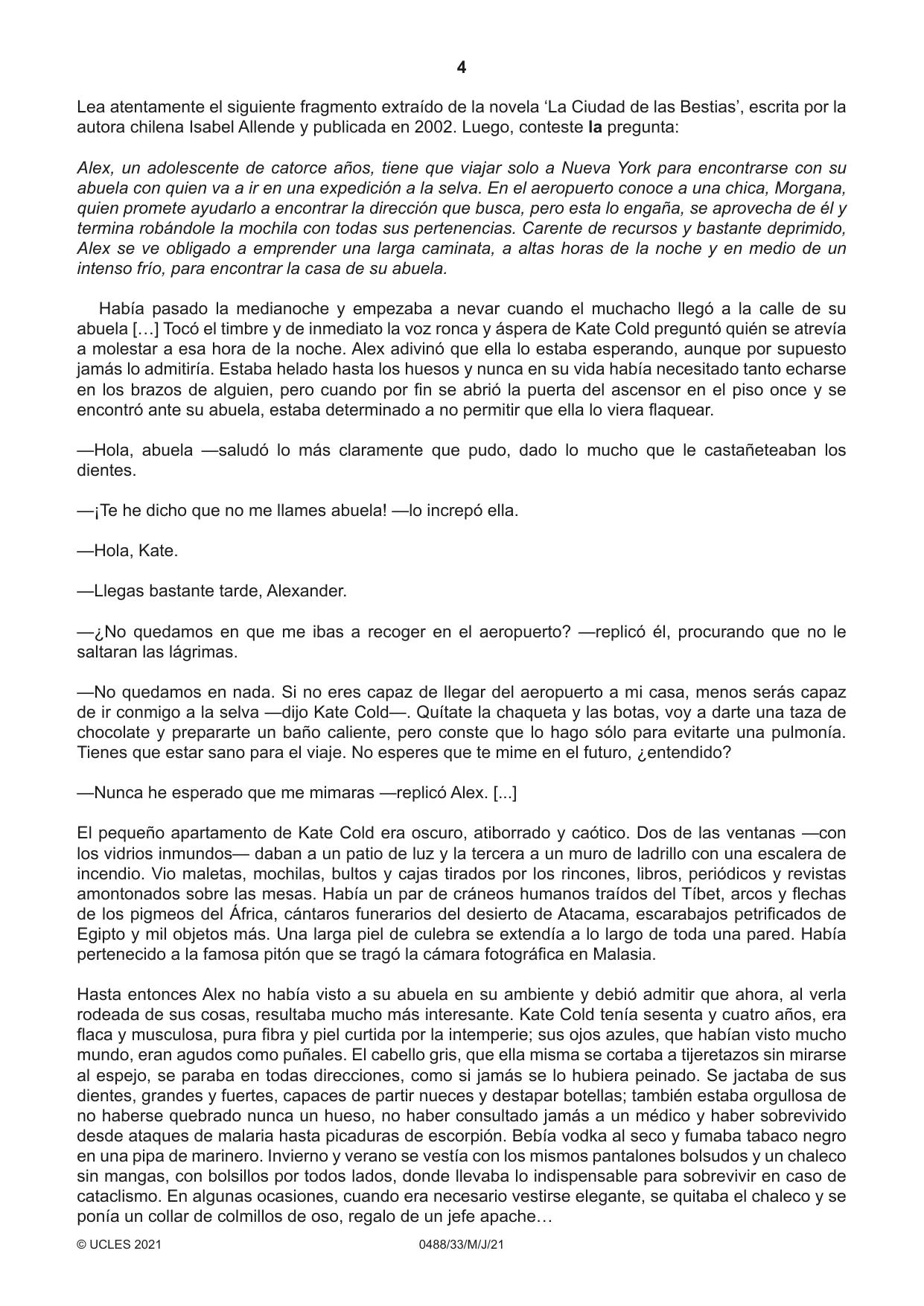
4 0488/33/M/J/21 © UCLES 2021 Lea atentamente el siguiente fragmento extraído de la novela ‘La Ciudad de las Bestias’, escrita por la autora chilena Isabel Allende y publicada en 2002. Luego, conteste la pregunta: Alex, un adolescente de catorce años, tiene que viajar solo a Nueva York para encontrarse con su abuela con quien va a ir en una expedición a la selva. En el aeropuerto conoce a una chica, Morgana, quien promete ayudarlo a encontrar la dirección que busca, pero esta lo engaña, se aprovecha de él y termina robándole la mochila con todas sus pertenencias. Carente de recursos y bastante deprimido, Alex se ve obligado a emprender una larga caminata, a altas horas de la noche y en medio de un intenso frío, para encontrar la casa de su abuela. Había pasado la medianoche y empezaba a nevar cuando el muchacho llegó a la calle de su abuela […] Tocó el timbre y de inmediato la voz ronca y áspera de Kate Cold preguntó quién se atrevía a molestar a esa hora de la noche. Alex adivinó que ella lo estaba esperando, aunque por supuesto jamás lo admitiría. Estaba helado hasta los huesos y nunca en su vida había necesitado tanto echarse en los brazos de alguien, pero cuando por fin se abrió la puerta del ascensor en el piso once y se encontró ante su abuela, estaba determinado a no permitir que ella lo viera flaquear. —Hola, abuela —saludó lo más claramente que pudo, dado lo mucho que le castañeteaban los dientes. —¡Te he dicho que no me llames abuela! —lo increpó ella. —Hola, Kate. —Llegas bastante tarde, Alexander. —¿No quedamos en que me ibas a recoger en el aeropuerto? —replicó él, procurando que no le saltaran las lágrimas. —No quedamos en nada. Si no eres capaz de llegar del aeropuerto a mi casa, menos serás capaz de ir conmigo a la selva —dijo Kate Cold—. Quítate la chaqueta y las botas, voy a darte una taza de chocolate y prepararte un baño caliente, pero conste que lo hago sólo para evitarte una pulmonía. Tienes que estar sano para el viaje. No esperes que te mime en el futuro, ¿entendido? —Nunca he esperado que me mimaras —replicó Alex. [...] El pequeño apartamento de Kate Cold era oscuro, atiborrado y caótico. Dos de las ventanas —con los vidrios inmundos— daban a un patio de luz y la tercera a un muro de ladrillo con una escalera de incendio. Vio maletas, mochilas, bultos y cajas tirados por los rincones, libros, periódicos y revistas amontonados sobre las mesas. Había un par de cráneos humanos traídos del Tíbet, arcos y flechas de los pigmeos del África, cántaros funerarios del desierto de Atacama, escarabajos petrificados de Egipto y mil objetos más. Una larga piel de culebra se extendía a lo largo de toda una pared. Había pertenecido a la famosa pitón que se tragó la cámara fotográfica en Malasia. Hasta entonces Alex no había visto a su abuela en su ambiente y debió admitir que ahora, al verla rodeada de sus cosas, resultaba mucho más interesante. Kate Cold tenía sesenta y cuatro años, era flaca y musculosa, pura fibra y piel curtida por la intemperie; sus ojos azules, que habían visto mucho mundo, eran agudos como puñales. El cabello gris, que ella misma se cortaba a tijeretazos sin mirarse al espejo, se paraba en todas direcciones, como si jamás se lo hubiera peinado. Se jactaba de sus dientes, grandes y fuertes, capaces de partir nueces y destapar botellas; también estaba orgullosa de no haberse quebrado nunca un hueso, no haber consultado jamás a un médico y haber sobrevivido desde ataques de malaria hasta picaduras de escorpión. Bebía vodka al seco y fumaba tabaco negro en una pipa de marinero. Invierno y verano se vestía con los mismos pantalones bolsudos y un chaleco sin mangas, con bolsillos por todos lados, donde llevaba lo indispensable para sobrevivir en caso de cataclismo. En algunas ocasiones, cuando era necesario vestirse elegante, se quitaba el chaleco y se ponía un collar de colmillos de oso, regalo de un jefe apache…
Question paper, page 5
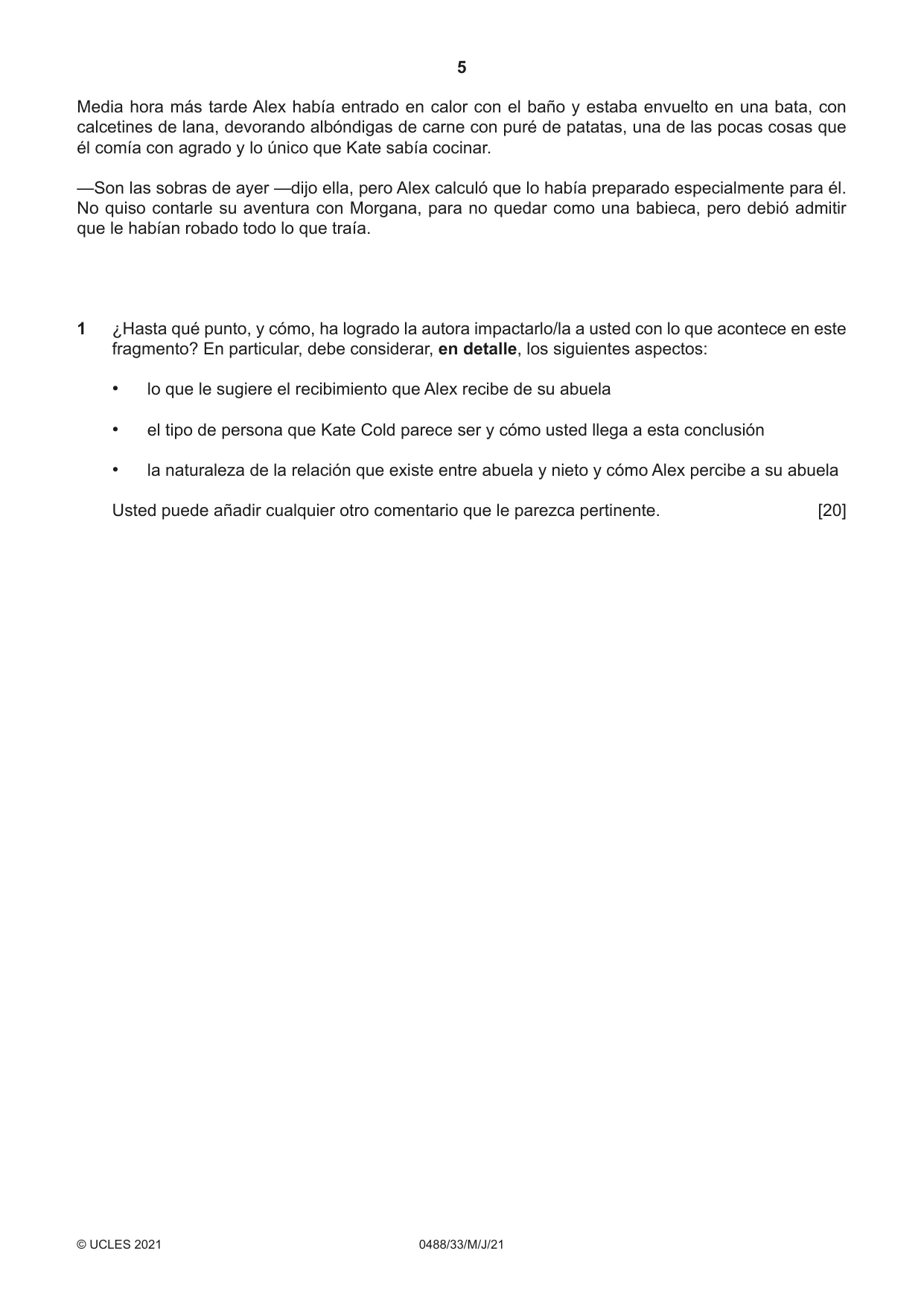
5 0488/33/M/J/21 © UCLES 2021 Media hora más tarde Alex había entrado en calor con el baño y estaba envuelto en una bata, con calcetines de lana, devorando albóndigas de carne con puré de patatas, una de las pocas cosas que él comía con agrado y lo único que Kate sabía cocinar. —Son las sobras de ayer —dijo ella, pero Alex calculó que lo había preparado especialmente para él. No quiso contarle su aventura con Morgana, para no quedar como una babieca, pero debió admitir que le habían robado todo lo que traía. 1 ¿Hasta qué punto, y cómo, ha logrado la autora impactarlo/la a usted con lo que acontece en este fragmento? En particular, debe considerar, en detalle, los siguientes aspectos: • lo que le sugiere el recibimiento que Alex recibe de su abuela • el tipo de persona que Kate Cold parece ser y cómo usted llega a esta conclusión • la naturaleza de la relación que existe entre abuela y nieto y cómo Alex percibe a su abuela Usted puede añadir cualquier otro comentario que le parezca pertinente. [20]
Question paper, page 6
6 0488/33/M/J/21 © UCLES 2021 BLANK PAGE
Question paper, page 7
7 0488/33/M/J/21 © UCLES 2021 BLANK PAGE
Question paper, page 8
8 0488/33/M/J/21 © UCLES 2021 Permission to reproduce items where third-party owned material protected by copyright is included has been sought and cleared where possible. Every reasonable effort has been made by the publisher (UCLES) to trace copyright holders, but if any items requiring clearance have unwittingly been included, the publisher will be pleased to make amends at the earliest possible opportunity. To avoid the issue of disclosure of answer-related information to candidates, all copyright acknowledgements are reproduced online in the Cambridge Assessment International Education Copyright Acknowledgements Booklet. This is produced for each series of examinations and is freely available to download at www.cambridgeinternational.org after the live examination series. Cambridge Assessment International Education is part of the Cambridge Assessment Group. Cambridge Assessment is the brand name of the University of Cambridge Local Examinations Syndicate (UCLES), which itself is a department of the University of Cambridge. BLANK PAGE
Mark scheme, page 1
This document consists of 9 printed pages. © UCLES 2021 [Turn over Cambridge IGCSE™ LITERATURE (SPANISH) 0488/33 Paper 3 Alternative to Coursework May/June 2021 MARK SCHEME Maximum Mark: 20 Published This mark scheme is published as an aid to teachers and candidates, to indicate the requirements of the examination. It shows the basis on which Examiners were instructed to award marks. It does not indicate the details of the discussions that took place at an Examiners’ meeting before marking began, which would have considered the acceptability of alternative answers. Mark schemes should be read in conjunction with the question paper and the Principal Examiner Report for Teachers. Cambridge International will not enter into discussions about these mark schemes. Cambridge International is publishing the mark schemes for the May/June 2021 series for most Cambridge IGCSE™, Cambridge International A and AS Level components and some Cambridge O Level components.
Mark scheme, page 2
0488/33 Cambridge IGCSE – Mark Scheme PUBLISHED May/June 2021 © UCLES 2021 Page 2 of 9 Generic Marking Principles These general marking principles must be applied by all examiners when marking candidate answers. They should be applied alongside the specific content of the mark scheme or generic level descriptors for a question. Each question paper and mark scheme will also comply with these marking principles. GENERIC MARKING PRINCIPLE 1: Marks must be awarded in line with: • the specific content of the mark scheme or the generic level descriptors for the question • the specific skills defined in the mark scheme or in the generic level descriptors for the question • the standard of response required by a candidate as exemplified by the standardisation scripts. GENERIC MARKING PRINCIPLE 2: Marks awarded are always whole marks (not half marks, or other fractions). GENERIC MARKING PRINCIPLE 3: Marks must be awarded positively: • marks are awarded for correct/valid answers, as defined in the mark scheme. However, credit is given for valid answers which go beyond the scope of the syllabus and mark scheme, referring to your Team Leader as appropriate • marks are awarded when candidates clearly demonstrate what they know and can do • marks are not deducted for errors • marks are not deducted for omissions • answers should only be judged on the quality of spelling, punctuation and grammar when these features are specifically assessed by the question as indicated by the mark scheme. The meaning, however, should be unambiguous. GENERIC MARKING PRINCIPLE 4: Rules must be applied consistently, e.g. in situations where candidates have not followed instructions or in the application of generic level descriptors. GENERIC MARKING PRINCIPLE 5: Marks should be awarded using the full range of marks defined in the mark scheme for the question (however; the use of the full mark range may be limited according to the quality of the candidate responses seen). GENERIC MARKING PRINCIPLE 6: Marks awarded are based solely on the requirements as defined in the mark scheme. Marks should not be awarded with grade thresholds or grade descriptors in mind.
Mark scheme, page 3
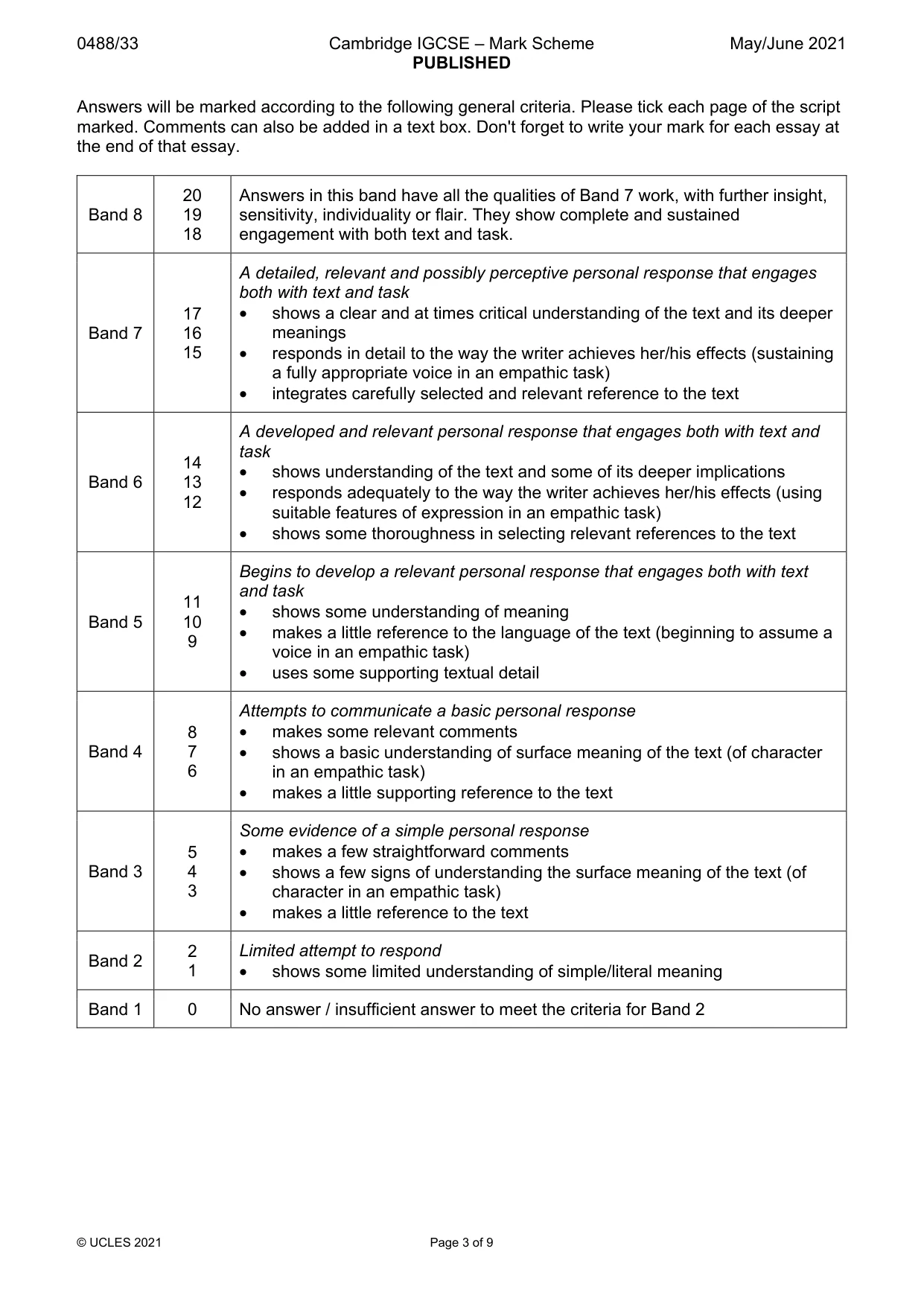
0488/33 Cambridge IGCSE – Mark Scheme PUBLISHED May/June 2021 © UCLES 2021 Page 3 of 9 Answers will be marked according to the following general criteria. Please tick each page of the script marked. Comments can also be added in a text box. Don't forget to write your mark for each essay at the end of that essay. Band 8 20 19 18 Answers in this band have all the qualities of Band 7 work, with further insight, sensitivity, individuality or flair. They show complete and sustained engagement with both text and task. Band 7 17 16 15 A detailed, relevant and possibly perceptive personal response that engages both with text and task • shows a clear and at times critical understanding of the text and its deeper meanings • responds in detail to the way the writer achieves her/his effects (sustaining a fully appropriate voice in an empathic task) • integrates carefully selected and relevant reference to the text Band 6 14 13 12 A developed and relevant personal response that engages both with text and task • shows understanding of the text and some of its deeper implications • responds adequately to the way the writer achieves her/his effects (using suitable features of expression in an empathic task) • shows some thoroughness in selecting relevant references to the text Band 5 11 10 9 Begins to develop a relevant personal response that engages both with text and task • shows some understanding of meaning • makes a little reference to the language of the text (beginning to assume a voice in an empathic task) • uses some supporting textual detail Band 4 8 7 6 Attempts to communicate a basic personal response • makes some relevant comments • shows a basic understanding of surface meaning of the text (of character in an empathic task) • makes a little supporting reference to the text Band 3 5 4 3 Some evidence of a simple personal response • makes a few straightforward comments • shows a few signs of understanding the surface meaning of the text (of character in an empathic task) • makes a little reference to the text Band 2 2 1 Limited attempt to respond • shows some limited understanding of simple/literal meaning Band 1 0 No answer / insufficient answer to meet the criteria for Band 2
Mark scheme, page 4
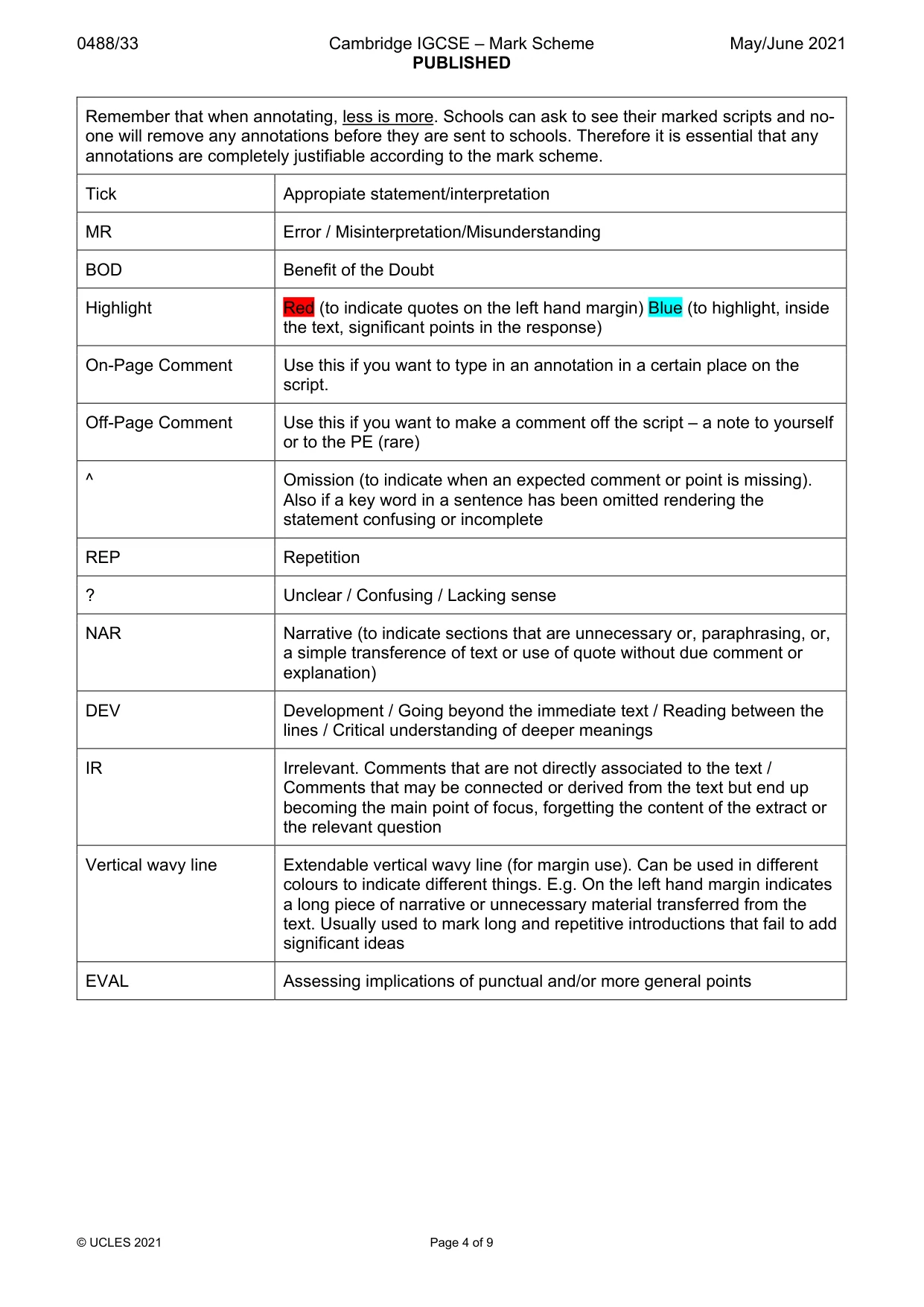
0488/33 Cambridge IGCSE – Mark Scheme PUBLISHED May/June 2021 © UCLES 2021 Page 4 of 9 Remember that when annotating, less is more. Schools can ask to see their marked scripts and no- one will remove any annotations before they are sent to schools. Therefore it is essential that any annotations are completely justifiable according to the mark scheme. Tick Appropiate statement/interpretation MR Error / Misinterpretation/Misunderstanding BOD Benefit of the Doubt Highlight Red (to indicate quotes on the left hand margin) Blue (to highlight, inside the text, significant points in the response) On-Page Comment Use this if you want to type in an annotation in a certain place on the script. Off-Page Comment Use this if you want to make a comment off the script – a note to yourself or to the PE (rare) ^ Omission (to indicate when an expected comment or point is missing). Also if a key word in a sentence has been omitted rendering the statement confusing or incomplete REP Repetition ? Unclear / Confusing / Lacking sense NAR Narrative (to indicate sections that are unnecessary or, paraphrasing, or, a simple transference of text or use of quote without due comment or explanation) DEV Development / Going beyond the immediate text / Reading between the lines / Critical understanding of deeper meanings IR Irrelevant. Comments that are not directly associated to the text / Comments that may be connected or derived from the text but end up becoming the main point of focus, forgetting the content of the extract or the relevant question Vertical wavy line Extendable vertical wavy line (for margin use). Can be used in different colours to indicate different things. E.g. On the left hand margin indicates a long piece of narrative or unnecessary material transferred from the text. Usually used to mark long and repetitive introductions that fail to add significant ideas EVAL Assessing implications of punctual and/or more general points
Mark scheme, page 5
0488/33 Cambridge IGCSE – Mark Scheme PUBLISHED May/June 2021 © UCLES 2021 Page 5 of 9 Using annotations on Scoris Remember that this is a literature not a language assessment: do not correct or comment on individual spelling and grammatical errors (but you might comment if relevant at the end of the script – e.g. ‘Frequent errors obscure meaning’). These may be factual comments or comments on key features of the answer related to the mark scheme e.g. well-developed/undeveloped, clear/unclear, insufficient /reference to text; needs to explain point; good ref to dramatic qualities; needs to expand; evidence?; detail; not answering question. Be careful to distinguish between an unusual opinion and a factual error. At the bottom of the script put a brief summary comment based on the mark scheme: e.g. Competent answer with some evidence of personal appreciation; a couple of significant omissions What not to write on scripts Do not use more than one question mark (???). Do not use exclamation marks at all in a comment box. Do not use capital letters to “shout” e.g. NO. Do not use any pejorative or disparaging emotive word or phrase- this includes: poor, bad, wrong, get on with it, so what? hardly! What? this is NOT the point, muddled, nonsense, shallow, etc. Do not comment on handwriting or untidiness unless this interferes with the task of marking. Do not comment on the Centre as a whole or their teaching. Do not focus on what the candidate has NOT written but rather on what s/he has written (though significant omissions having a bearing on the question might be mentioned).
Mark scheme, page 6
0488/33 Cambridge IGCSE – Mark Scheme PUBLISHED May/June 2021 © UCLES 2021 Page 6 of 9 Question Answer Marks Indicative Content The detailed questions are intended to help the candidate respond. Candidates are required to answer them, but need not do so in a rigid sequence; some of the answers may be implicit in the essay, although it is expected that candidates will be able to spell out their views and interpretations with sufficient clarity. There is no prescribed application of marks to each question and the response should be marked holistically. Candidates who do not answer the prescribed questions will penalise themselves automatically, as the questions are central to the passage. 1 Lea atentamente el siguiente fragmento extraído de la novela La Ciudad de las Bestias, escrita por la autora chilena Isabel Allende y publicada en 2003. Luego, conteste la pregunta: The extract in question is contemporary and poses no problems of linguistic comprehension. At the lower levels (up to 9 marks) we are looking for evidence of basic understanding, with a simple personal response. At the 5/6 level bands we expect a clear, if not sophisticated and more complex, answer to each of the questions and a successful attempt to support ideas from the passage. Be aware of inert, mechanical quoting or simple paraphrasing that adds little to the interpretation or leaves the task of interpreting and/or inferring to the examiner. It is not unusual for candidates to transfer wording/paragraphs from the question paper to their essays in a rather mechanical manner. This material usually has been provided to them to contextualize the extract and does not need to be mentioned again in the body of the candidate's essay. As we go up to 7/8 level bands we are looking for an in-depth analysis and close attention to detail; an ability to read between the lines, with appropriate support from the passage; a motivated personal response; good use of the imagination and a direct, clear focus on the questions throughout. Candidates are expected to engage with the text and fully exploit its elements, particularly if they are to be rewarded with a top band mark. ¿Hasta qué punto, y cómo, ha logrado la autora impactarlo/la a usted con lo que acontece en este fragmento? En particular, debe considerar, en detalle, los siguientes aspectos: • lo que nos sugiere el recibimiento que Alex recibe de su abuela From the beginning it is clear that his grandmother‘s attitude towards Alex is not particularly welcoming. He has been travelling for hours by plane to get to New York and walking a long distance on foot, in very cold temperatures, to find her flat. The first thing he hears is her complaining about his late arrival: ‘preguntó quién se atrevía a molestar a esa hora de la noche’. At this point Alex is beyond exhaustion and although he would have very much appreciated a comforting hug, which he is denied, he is determined to put on a brave face: ‘no permitir que ella lo viera flaquear’. 20
Mark scheme, page 7
0488/33 Cambridge IGCSE – Mark Scheme PUBLISHED May/June 2021 © UCLES 2021 Page 7 of 9 Question Answer Marks 1 When Alex greets his grandmother she protests at being called grandmother, an indication that she is probably a vain woman who detests any allusion to her age and/or family status: ‘Te he dicho que no me llames abuela’. Then, immediately after this, she reproaches him for arriving late: ‘llegas bastante tarde’. And when Alex clarifies that such is due to her failing to collect him from the airport, as previously agreed [‘¿No quedamos en que me ibas a recoger en el aeropuerto?’], she replies quite curtly: ‘No quedamos en nada’, denying she ever offered to collect him from the airport. At this stage, he is about to burst into tears: ‘procurando que no se le saltaran las lágrimas’. It needs to be remembered that Kate’s failure to collect him from the airport, is what led to the loss of all his possessions and the hardship of needing to walk a long distance, in the middle of terrible weather, at night, to get to her house. Then, Alex is offered a cup of hot chocolate and a bath by his grandmother but only to prevent a possible illness rather than an attempt to pamper him. She even warns him that she does not intend to spoil him in the future, to which Alex replies that he has never expected to be spoilt: ‘nunca he esperado que me mimaras’. It is made very clear, from the start, that a certain degree of aggressiveness/ hostility underlies Alex’s grandmother’s attitude towards him. • el tipo de persona que Kate Cold parece ser y cómo usted llega a esta conclusión We are given detailed information about Kate Cold’s apartment. This can provide some idea of the sort of person she is, the sort of things that are important in her life and what sort of occupation she may have. It is quite obvious that she is not house-proud: ‘apartamento…oscuro, atiborrado y caótico’; ‘maletas, mochilas, bultos y cajas tirados por los rincones, libros, periódicos y revistas amontonados sobre las mesas’. It is also clear that the sort of things that interest Kate are highly unusual: ‘un par de cráneos humanos traídos del Tíbet, arcos y flechas de los pigmeos del África, cántaros funerarios del desierto de Atacama, escarabajos petrificados de Egipto y mil objetos más. Una larga piel de culebra…’. The mentioned objects are an indication of the type of things that make Kate Gold tick. She is not interested in the ordinary things of everyday life. Also, her apartment seems to belong to somebody who spends a lot of her time in remote areas; she may be an anthropologist, a geographer, a travel guide reporter or a photographer, but certainly someone who travels to traditional settings where aboriginal people live. We also know that, at this particular moment, she is about to travel to the jungle with Alex.
Mark scheme, page 8
0488/33 Cambridge IGCSE – Mark Scheme PUBLISHED May/June 2021 © UCLES 2021 Page 8 of 9 Question Answer Marks 1 There is a sketch of her physical appearance and lifestyle: ‘sesenta y cuatro años…flaca y musculosa, pura fibra…piel curtida por la intemperie…ojos azules…agudos como puñales…cabello gris, que…se cortaba a tijeretazos sin mirarse al espejo...’. Her health is exceptional for her age: ‘dientes, grandes y fuertes, capaces de partir nueces y destapar botellas…orgullosa de no haberse quebrado nunca un hueso, no haber consultado jamás a un médico y haber sobrevivido desde ataques de malaria hasta picaduras de escorpión.’ Some of her habits may not be ideal health choices, but they do not seem to interfere with her tough everyday lifestyle: ‘Bebía vodka al seco y fumaba tabaco negro en una pipa de marinero’. Her style of dressing is, undeniably, outlandish: ‘Invierno y verano se vestía con los mismos pantalones bolsudos y un chaleco sin mangas, con bolsillos por todos lados, donde llevaba lo indispensable para sobrevivir en caso de cataclismo. En algunas ocasiones, cuando era necesario vestirse elegante, se quitaba el chaleco y se ponía un collar de colmillos de oso, regalo de un jefe apache…’. • la naturaleza de la relación que existe entre abuela y nieto y cómo Alex percibe a su abuela At various points in the extract we are exposed to exchanges between Alex and his grandmother that give us conflicting impressions. In the beginning there are strong indications that Kate is quite tough with Alex: she decides against collecting him from the airport without warning; she leaves him to his own devices to find her flat, although it is quite obvious that to do that in an unknown city such as New York at night would be quite an undertaking; she makes sure to tell him, at every turn, that the help she is giving him, does not come from her heart but from sheer necessity /obligation. She even makes it clear that her role is not that of a motherly woman and that he should not expect any such consideration from her. During all these exchanges Alex has a very controlled attitude, and at no point he behaves rudely or inconsiderately towards her. We also notice, as does Alex, that Kate is pretending not to care. After all, after his arrival, he receives just what he most needed: a hot bath, dry clothes and much needed nourishment which, not by chance, is of the kind he likes. When Kate says that she has only given him leftovers, his inner voice tells him that Kate has prepared that food especially for him. At this point one is forced to revise first impressions. As a tough woman, Kate does not follow the feminine/maternal traditional role one would expect from a grandmother – grandparents are known for spoiling and pampering their grandchildren. Her lifestyle has made her live roughly, in remote areas, where the niceties of life do not exist. And she has had the strength and personality to endure that and survive it. Also, she wants to make sure that she does not show any weaknesses because that would undermine her image. She treats Alex quite firmly, but at the end of the day, produces the goods. She sees Alex as an adolescent who needs a firm hand.
Mark scheme, page 9
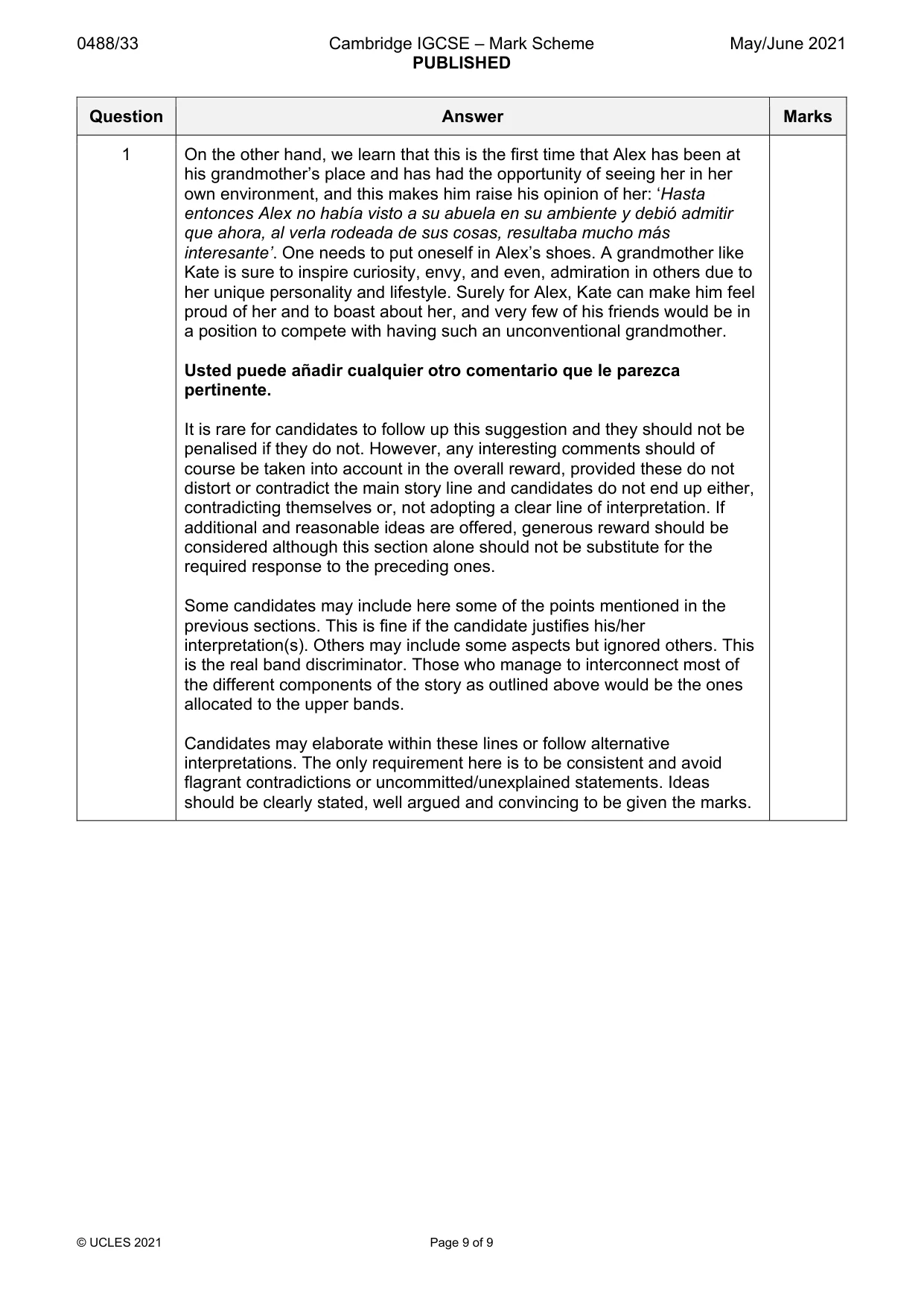
0488/33 Cambridge IGCSE – Mark Scheme PUBLISHED May/June 2021 © UCLES 2021 Page 9 of 9 Question Answer Marks 1 On the other hand, we learn that this is the first time that Alex has been at his grandmother’s place and has had the opportunity of seeing her in her own environment, and this makes him raise his opinion of her: ‘Hasta entonces Alex no había visto a su abuela en su ambiente y debió admitir que ahora, al verla rodeada de sus cosas, resultaba mucho más interesante’. One needs to put oneself in Alex’s shoes. A grandmother like Kate is sure to inspire curiosity, envy, and even, admiration in others due to her unique personality and lifestyle. Surely for Alex, Kate can make him feel proud of her and to boast about her, and very few of his friends would be in a position to compete with having such an unconventional grandmother. Usted puede añadir cualquier otro comentario que le parezca pertinente. It is rare for candidates to follow up this suggestion and they should not be penalised if they do not. However, any interesting comments should of course be taken into account in the overall reward, provided these do not distort or contradict the main story line and candidates do not end up either, contradicting themselves or, not adopting a clear line of interpretation. If additional and reasonable ideas are offered, generous reward should be considered although this section alone should not be substitute for the required response to the preceding ones. Some candidates may include here some of the points mentioned in the previous sections. This is fine if the candidate justifies his/her interpretation(s). Others may include some aspects but ignored others. This is the real band discriminator. Those who manage to interconnect most of the different components of the story as outlined above would be the ones allocated to the upper bands. Candidates may elaborate within these lines or follow alternative interpretations. The only requirement here is to be consistent and avoid flagrant contradictions or uncommitted/unexplained statements. Ideas should be clearly stated, well argued and convincing to be given the marks.
What you needed in this session
Cambridge’s own grade thresholds for 2021 May/June, Paper 3 · Variant 3. A higher threshold means an easier paper — the bar moves with how the cohort did.