Cambridge IGCSE Spanish - Literature 0488 — 2024 May/June Paper 3 · Variant 1
0488/31/M/J/24 · 20 marks · ≈23 min
The question paper and its mark scheme, free to read here and free to download. This is Cambridge’s own paper, exactly as it was sat.
Question paper8 pages




Mark scheme8 pages
Answers below. Sit the paper first if you are practising.
Paper as text
Question paper, page 1
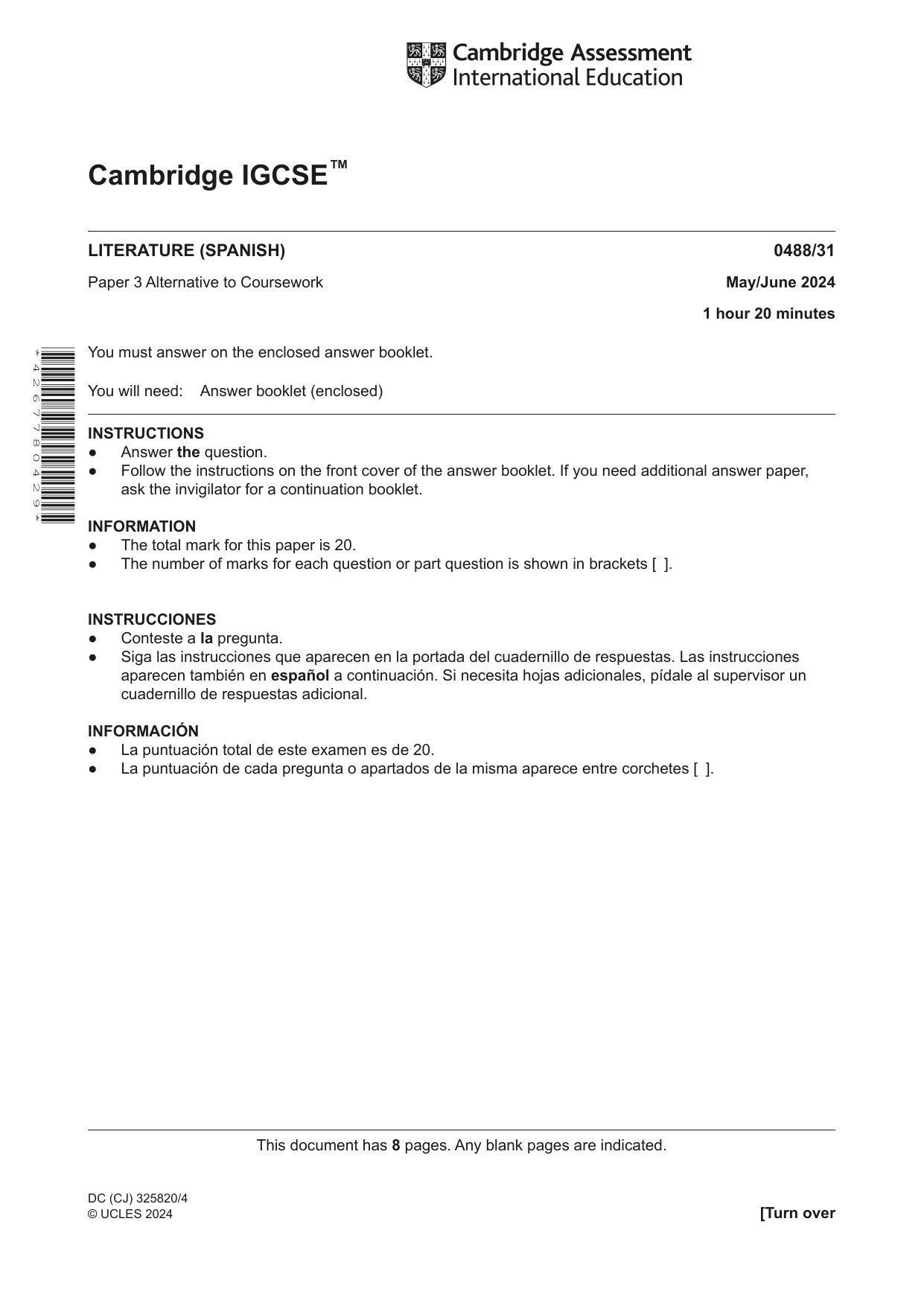
This document has 8 pages. Any blank pages are indicated. [Turn over Cambridge IGCSE™ * 4 2 6 7 7 8 0 4 2 9 * DC (CJ) 325820/4 © UCLES 2024 LITERATURE (SPANISH) 0488/31 Paper 3 Alternative to Coursework May/June 2024 1 hour 20 minutes You must answer on the enclosed answer booklet. You will need: Answer booklet (enclosed) INSTRUCTIONS ● Answer the question. ● Follow the instructions on the front cover of the answer booklet. If you need additional answer paper, ask the invigilator for a continuation booklet. INFORMATION ● The total mark for this paper is 20. ● The number of marks for each question or part question is shown in brackets [ ]. INSTRUCCIONES ● Conteste a la pregunta. ● Siga las instrucciones que aparecen en la portada del cuadernillo de respuestas. Las instrucciones aparecen también en español a continuación. Si necesita hojas adicionales, pídale al supervisor un cuadernillo de respuestas adicional. INFORMACIÓN ● La puntuación total de este examen es de 20. ● La puntuación de cada pregunta o apartados de la misma aparece entre corchetes [ ].
Question paper, page 2
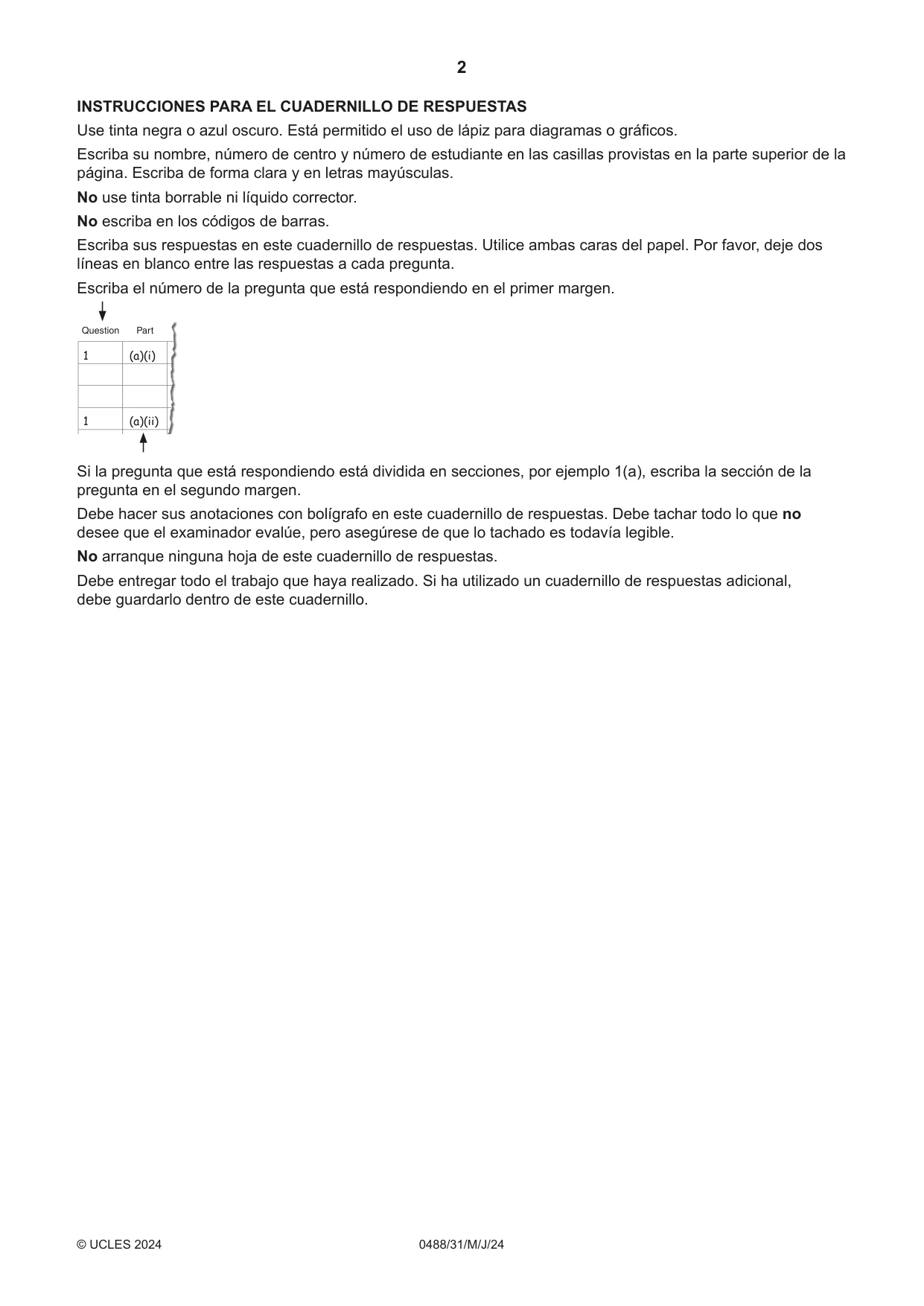
2 0488/31/ M/J/24 © UCLES 2024 INSTRUCCIONES PARA EL CUADERNILLO DE RESPUESTAS Use tinta negra o azul oscuro. Está permitido el uso de lápiz para diagramas o gráficos. Escriba su nombre, número de centro y número de estudiante en las casillas provistas en la parte superior de la página. Escriba de forma clara y en letras mayúsculas. No use tinta borrable ni líquido corrector. No escriba en los códigos de barras. Escriba sus respuestas en este cuadernillo de respuestas. Utilice ambas caras del papel. Por favor, deje dos líneas en blanco entre las respuestas a cada pregunta. Escriba el número de la pregunta que está respondiendo en el primer margen. Question Part 1 1 (a)(i) (a)(ii) Si la pregunta que está respondiendo está dividida en secciones, por ejemplo 1(a), escriba la sección de la pregunta en el segundo margen. Debe hacer sus anotaciones con bolígrafo en este cuadernillo de respuestas. Debe tachar todo lo que no desee que el examinador evalúe, pero asegúrese de que lo tachado es todavía legible. No arranque ninguna hoja de este cuadernillo de respuestas. Debe entregar todo el trabajo que haya realizado. Si ha utilizado un cuadernillo de respuestas adicional, debe guardarlo dentro de este cuadernillo.
Question paper, page 3
3 0488/31/M/J/24 © UCLES 2024 [Turn over BLANK PAGE
Question paper, page 4
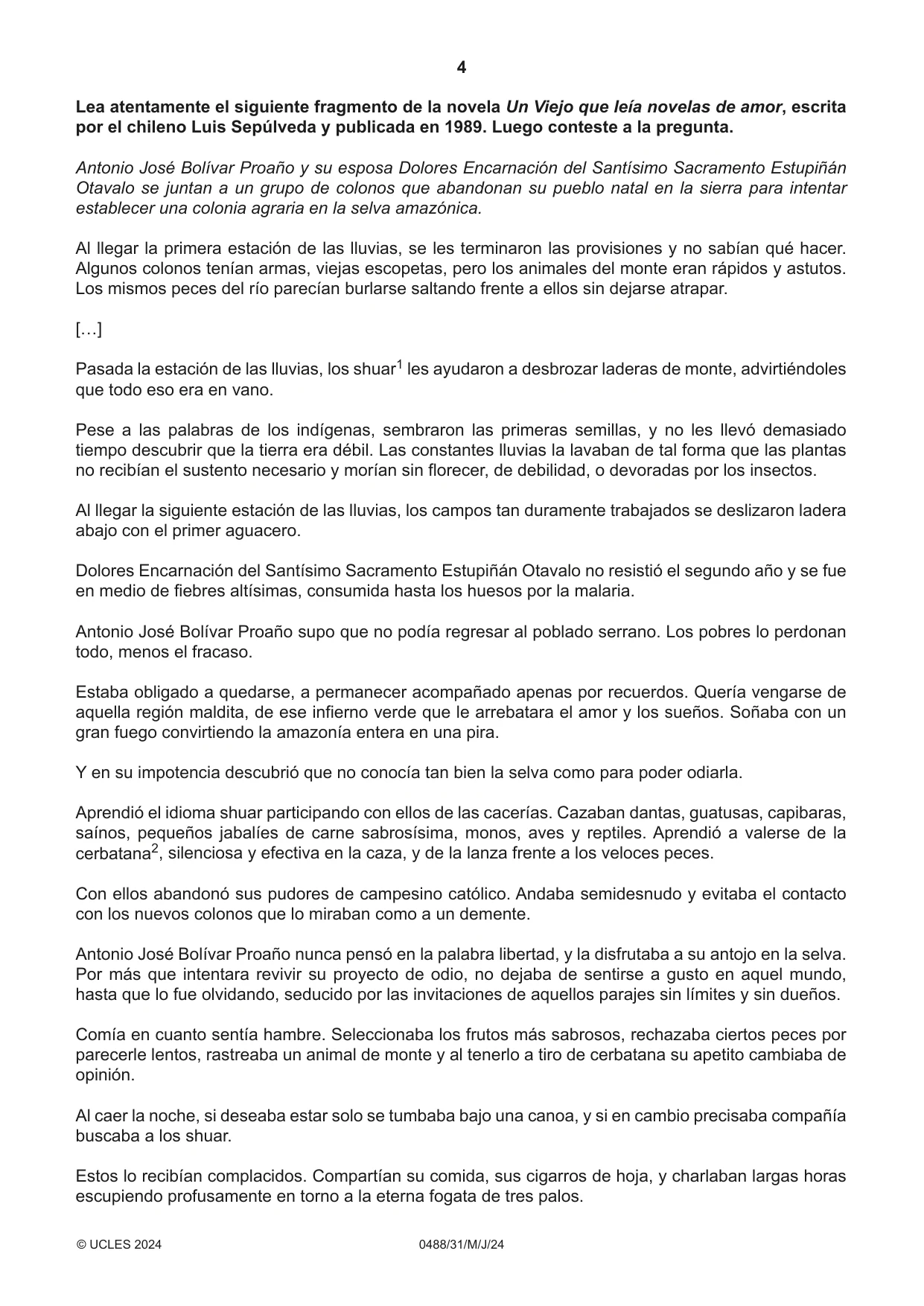
4 0488/31/M/J/24 © UCLES 2024 Lea atentamente el siguiente fragmento de la novela Un Viejo que leía novelas de amor, escrita por el chileno Luis Sepúlveda y publicada en 1989. Luego conteste a la pregunta. Antonio José Bolívar Proaño y su esposa Dolores Encarnación del Santísimo Sacramento Estupiñán Otavalo se juntan a un grupo de colonos que abandonan su pueblo natal en la sierra para intentar establecer una colonia agraria en la selva amazónica. Al llegar la primera estación de las lluvias, se les terminaron las provisiones y no sabían qué hacer. Algunos colonos tenían armas, viejas escopetas, pero los animales del monte eran rápidos y astutos. Los mismos peces del río parecían burlarse saltando frente a ellos sin dejarse atrapar. […] Pasada la estación de las lluvias, los shuar1 les ayudaron a desbrozar laderas de monte, advirtiéndoles que todo eso era en vano. Pese a las palabras de los indígenas, sembraron las primeras semillas, y no les llevó demasiado tiempo descubrir que la tierra era débil. Las constantes lluvias la lavaban de tal forma que las plantas no recibían el sustento necesario y morían sin florecer, de debilidad, o devoradas por los insectos. Al llegar la siguiente estación de las lluvias, los campos tan duramente trabajados se deslizaron ladera abajo con el primer aguacero. Dolores Encarnación del Santísimo Sacramento Estupiñán Otavalo no resistió el segundo año y se fue en medio de fiebres altísimas, consumida hasta los huesos por la malaria. Antonio José Bolívar Proaño supo que no podía regresar al poblado serrano. Los pobres lo perdonan todo, menos el fracaso. Estaba obligado a quedarse, a permanecer acompañado apenas por recuerdos. Quería vengarse de aquella región maldita, de ese infierno verde que le arrebatara el amor y los sueños. Soñaba con un gran fuego convirtiendo la amazonía entera en una pira. Y en su impotencia descubrió que no conocía tan bien la selva como para poder odiarla. Aprendió el idioma shuar participando con ellos de las cacerías. Cazaban dantas, guatusas, capibaras, saínos, pequeños jabalíes de carne sabrosísima, monos, aves y reptiles. Aprendió a valerse de la cerbatana2, silenciosa y efectiva en la caza, y de la lanza frente a los veloces peces. Con ellos abandonó sus pudores de campesino católico. Andaba semidesnudo y evitaba el contacto con los nuevos colonos que lo miraban como a un demente. Antonio José Bolívar Proaño nunca pensó en la palabra libertad, y la disfrutaba a su antojo en la selva. Por más que intentara revivir su proyecto de odio, no dejaba de sentirse a gusto en aquel mundo, hasta que lo fue olvidando, seducido por las invitaciones de aquellos parajes sin límites y sin dueños. Comía en cuanto sentía hambre. Seleccionaba los frutos más sabrosos, rechazaba ciertos peces por parecerle lentos, rastreaba un animal de monte y al tenerlo a tiro de cerbatana su apetito cambiaba de opinión. Al caer la noche, si deseaba estar solo se tumbaba bajo una canoa, y si en cambio precisaba compañía buscaba a los shuar. Estos lo recibían complacidos. Compartían su comida, sus cigarros de hoja, y charlaban largas horas escupiendo profusamente en torno a la eterna fogata de tres palos.
Question paper, page 5
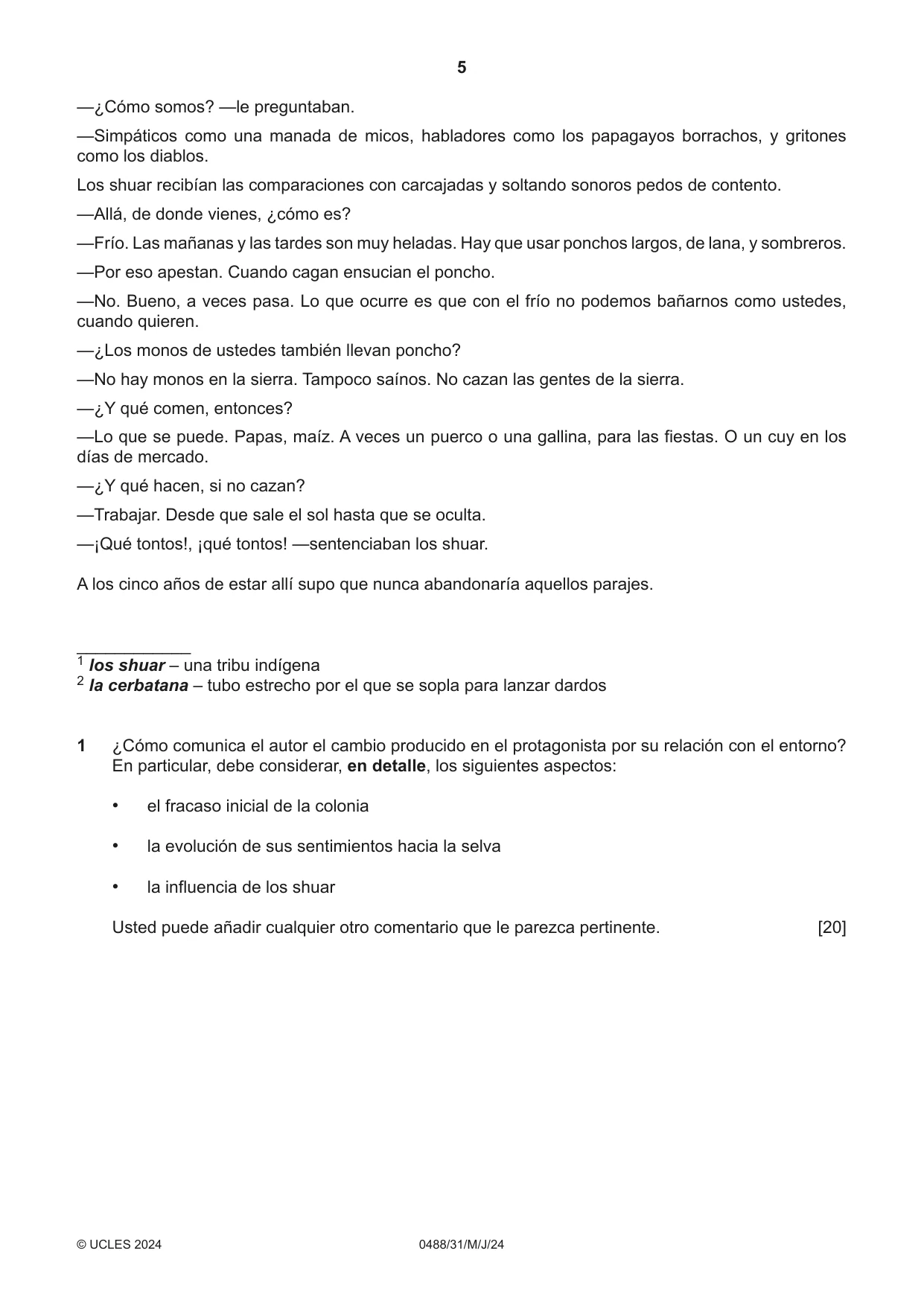
5 0488/31/M/J/24 © UCLES 2024 —¿Cómo somos? —le preguntaban. —Simpáticos como una manada de micos, habladores como los papagayos borrachos, y gritones como los diablos. Los shuar recibían las comparaciones con carcajadas y soltando sonoros pedos de contento. —Allá, de donde vienes, ¿cómo es? —Frío. Las mañanas y las tardes son muy heladas. Hay que usar ponchos largos, de lana, y sombreros. —Por eso apestan. Cuando cagan ensucian el poncho. —No. Bueno, a veces pasa. Lo que ocurre es que con el frío no podemos bañarnos como ustedes, cuando quieren. —¿Los monos de ustedes también llevan poncho? —No hay monos en la sierra. Tampoco saínos. No cazan las gentes de la sierra. —¿Y qué comen, entonces? —Lo que se puede. Papas, maíz. A veces un puerco o una gallina, para las fiestas. O un cuy en los días de mercado. —¿Y qué hacen, si no cazan? —Trabajar. Desde que sale el sol hasta que se oculta. —¡Qué tontos!, ¡qué tontos! —sentenciaban los shuar. A los cinco años de estar allí supo que nunca abandonaría aquellos parajes. ____________ 1 los shuar – una tribu indígena 2 la cerbatana – tubo estrecho por el que se sopla para lanzar dardos 1 ¿Cómo comunica el autor el cambio producido en el protagonista por su relación con el entorno? En particular, debe considerar, en detalle, los siguientes aspectos: • el fracaso inicial de la colonia • la evolución de sus sentimientos hacia la selva • la influencia de los shuar Usted puede añadir cualquier otro comentario que le parezca pertinente. [20]
Question paper, page 6
6 0488/31/M/J/24 © UCLES 2024 BLANK PAGE
Question paper, page 7
7 0488/31/M/J/24 © UCLES 2024 BLANK PAGE
Question paper, page 8
8 0488/31/M/J/24 © UCLES 2024 Permission to reproduce items where third-party owned material protected by copyright is included has been sought and cleared where possible. Every reasonable effort has been made by the publisher (UCLES) to trace copyright holders, but if any items requiring clearance have unwittingly been included, the publisher will be pleased to make amends at the earliest possible opportunity. To avoid the issue of disclosure of answer-related information to candidates, all copyright acknowledgements are reproduced online in the Cambridge Assessment International Education Copyright Acknowledgements Booklet. This is produced for each series of examinations and is freely available to download at www.cambridgeinternational.org after the live examination series. Cambridge Assessment International Education is part of Cambridge Assessment. Cambridge Assessment is the brand name of the University of Cambridge Local Examinations Syndicate (UCLES), which is a department of the University of Cambridge. BLANK PAGE
Mark scheme, page 1
This document consists of 8 printed pages. © Cambridge University Press & Assessment 2024 [Turn over Cambridge IGCSE™ LITERATURE (SPANISH) 0488/31 Paper 3 Alternative to Coursework May/June 2024 MARK SCHEME Maximum Mark: 20 Published This mark scheme is published as an aid to teachers and candidates, to indicate the requirements of the examination. It shows the basis on which Examiners were instructed to award marks. It does not indicate the details of the discussions that took place at an Examiners’ meeting before marking began, which would have considered the acceptability of alternative answers. Mark schemes should be read in conjunction with the question paper and the Principal Examiner Report for Teachers. Cambridge International will not enter into discussions about these mark schemes. Cambridge International is publishing the mark schemes for the May/June 2024 series for most Cambridge IGCSE, Cambridge International A and AS Level and Cambridge Pre-U components, and some Cambridge O Level components.
Mark scheme, page 2
0488/31 Cambridge IGCSE – Mark Scheme PUBLISHED May/June 2024 © Cambridge University Press & Assessment 2024 Page 2 of 8 Generic Marking Principles These general marking principles must be applied by all examiners when marking candidate answers. They should be applied alongside the specific content of the mark scheme or generic level descriptions for a question. Each question paper and mark scheme will also comply with these marking principles. GENERIC MARKING PRINCIPLE 1: Marks must be awarded in line with: the specific content of the mark scheme or the generic level descriptors for the question the specific skills defined in the mark scheme or in the generic level descriptors for the question the standard of response required by a candidate as exemplified by the standardisation scripts. GENERIC MARKING PRINCIPLE 2: Marks awarded are always whole marks (not half marks, or other fractions). GENERIC MARKING PRINCIPLE 3: Marks must be awarded positively: marks are awarded for correct/valid answers, as defined in the mark scheme. However, credit is given for valid answers which go beyond the scope of the syllabus and mark scheme, referring to your Team Leader as appropriate marks are awarded when candidates clearly demonstrate what they know and can do marks are not deducted for errors marks are not deducted for omissions answers should only be judged on the quality of spelling, punctuation and grammar when these features are specifically assessed by the question as indicated by the mark scheme. The meaning, however, should be unambiguous. GENERIC MARKING PRINCIPLE 4: Rules must be applied consistently, e.g. in situations where candidates have not followed instructions or in the application of generic level descriptors. GENERIC MARKING PRINCIPLE 5: Marks should be awarded using the full range of marks defined in the mark scheme for the question (however; the use of the full mark range may be limited according to the quality of the candidate responses seen). GENERIC MARKING PRINCIPLE 6: Marks awarded are based solely on the requirements as defined in the mark scheme. Marks should not be awarded with grade thresholds or grade descriptors in mind.
Mark scheme, page 3
0488/31 Cambridge IGCSE – Mark Scheme PUBLISHED May/June 2024 © Cambridge University Press & Assessment 2024 Page 3 of 8 GENERAL MARKING PRINCIPLES The General Descriptors guide examiners to an understanding of the qualities normally expected of, or typical of, work in a band. They are a means of general guidance and must not be interpreted as hurdle statements. For the purposes of standardisation of marking, they are to be used in conjunction with standardisation scripts and discussed during the examiners’ coordination meeting, as well as the question-specific notes. Because of the nature of the subject, these notes are for general guidance; they are not designed as prescriptions of required content and must not be treated as such. The syllabus aims at encouraging candidates to make some personal response to their reading. This means that, while we may have legitimate expectations as to the ground most answers may occupy, we must be prepared to meet candidates on their chosen ground. Hence, we must at all times tease out what the candidate is trying to say to us. We must recognise that it is possible for a candidate whose technical command of Spanish is limited, but whose language still manages to communicate understanding, to receive high marks. Nor should we reward fluency and display of literary terms if we feel that there is little evidence of such understanding. Remember that we are looking for response to literature, not demonstration of language skills. It is vital that we constantly remind ourselves that this is unseen work and we should not be overcritical of an occasional false note or misunderstanding. We are marking the quality of the process of engaging with literature, and not merely assessing the accuracy or otherwise of the conclusions reached. Regular reference to the standardisation scripts discussed during coordination will be crucial to maintaining the standard throughout the marking process. The detailed questions are intended to help the candidate respond. Candidates are required to answer them but need not do so in a rigid sequence; some of the answers may be implicit in the essay, although it is expected that candidates will be able to spell out their views and interpretations with sufficient clarity. There is no prescribed application of marks to each question and the response should be marked holistically. Candidates who do not answer the prescribed questions will penalise themselves automatically, as the questions are central to the passage. USE OF BAND DESCRIPTORS The Descriptors are an attempt to guide examiners to an understanding of the qualities normally expected of, or ‘typical’ of work in the band. First place the script within a Band, and then, having balanced its different qualities and their relationship to the Assessment Objectives and the three strands within each Band, decide whether you place it at the top, in the middle or at the bottom of that Band. In writing comments on the script, use the annotations available from RM Assessor.
Mark scheme, page 4
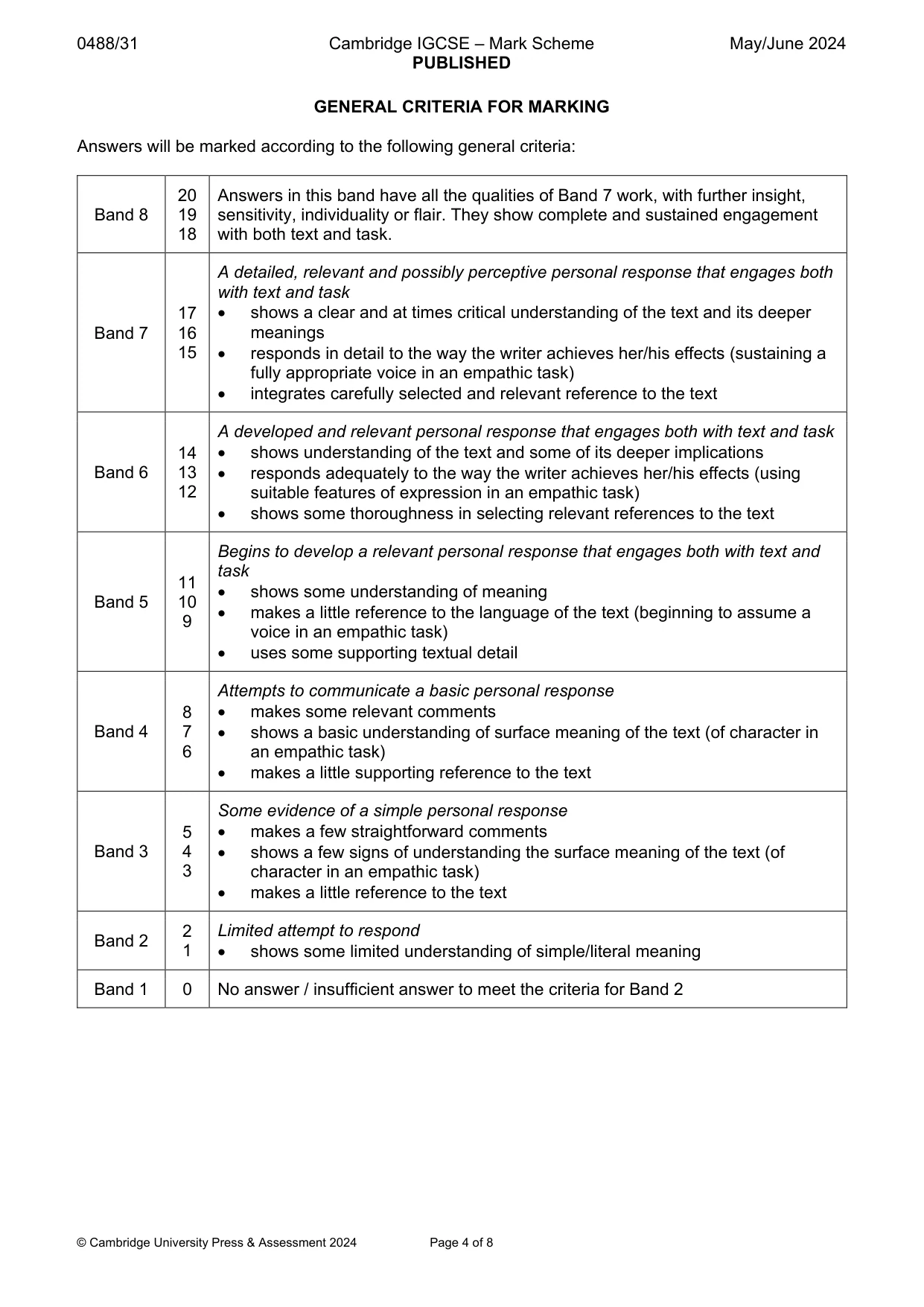
0488/31 Cambridge IGCSE – Mark Scheme PUBLISHED May/June 2024 © Cambridge University Press & Assessment 2024 Page 4 of 8 GENERAL CRITERIA FOR MARKING Answers will be marked according to the following general criteria: Band 8 20 19 18 Answers in this band have all the qualities of Band 7 work, with further insight, sensitivity, individuality or flair. They show complete and sustained engagement with both text and task. Band 7 17 16 15 A detailed, relevant and possibly perceptive personal response that engages both with text and task shows a clear and at times critical understanding of the text and its deeper meanings responds in detail to the way the writer achieves her/his effects (sustaining a fully appropriate voice in an empathic task) integrates carefully selected and relevant reference to the text Band 6 14 13 12 A developed and relevant personal response that engages both with text and task shows understanding of the text and some of its deeper implications responds adequately to the way the writer achieves her/his effects (using suitable features of expression in an empathic task) shows some thoroughness in selecting relevant references to the text Band 5 11 10 9 Begins to develop a relevant personal response that engages both with text and task shows some understanding of meaning makes a little reference to the language of the text (beginning to assume a voice in an empathic task) uses some supporting textual detail Band 4 8 7 6 Attempts to communicate a basic personal response makes some relevant comments shows a basic understanding of surface meaning of the text (of character in an empathic task) makes a little supporting reference to the text Band 3 5 4 3 Some evidence of a simple personal response makes a few straightforward comments shows a few signs of understanding the surface meaning of the text (of character in an empathic task) makes a little reference to the text Band 2 2 1 Limited attempt to respond shows some limited understanding of simple/literal meaning Band 1 0 No answer / insufficient answer to meet the criteria for Band 2
Mark scheme, page 5
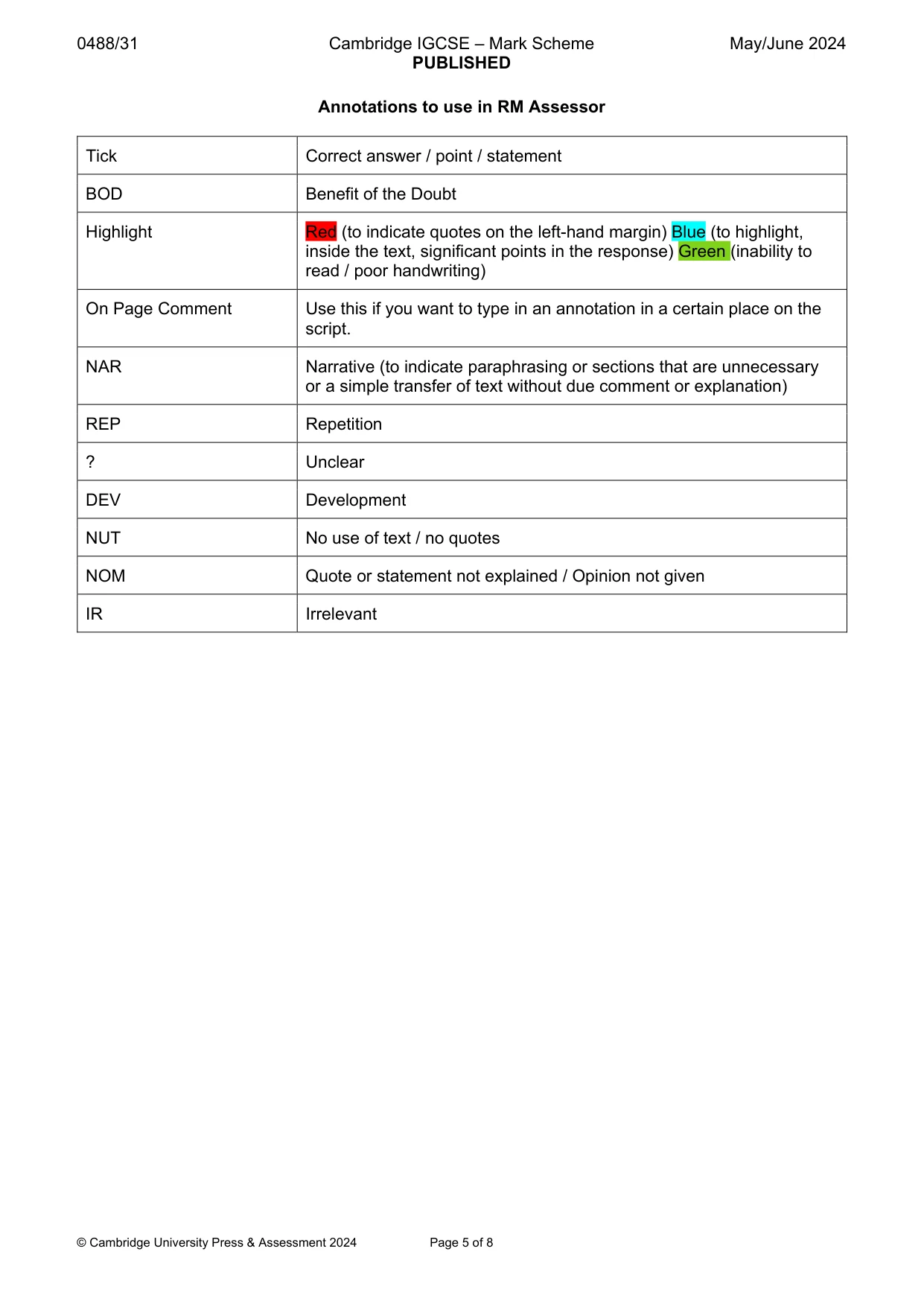
0488/31 Cambridge IGCSE – Mark Scheme PUBLISHED May/June 2024 © Cambridge University Press & Assessment 2024 Page 5 of 8 Annotations to use in RM Assessor Tick Correct answer / point / statement BOD Benefit of the Doubt Highlight Red (to indicate quotes on the left-hand margin) Blue (to highlight, inside the text, significant points in the response) Green (inability to read / poor handwriting) On Page Comment Use this if you want to type in an annotation in a certain place on the script. NAR Narrative (to indicate paraphrasing or sections that are unnecessary or a simple transfer of text without due comment or explanation) REP Repetition ? Unclear DEV Development NUT No use of text / no quotes NOM Quote or statement not explained / Opinion not given IR Irrelevant
Mark scheme, page 6
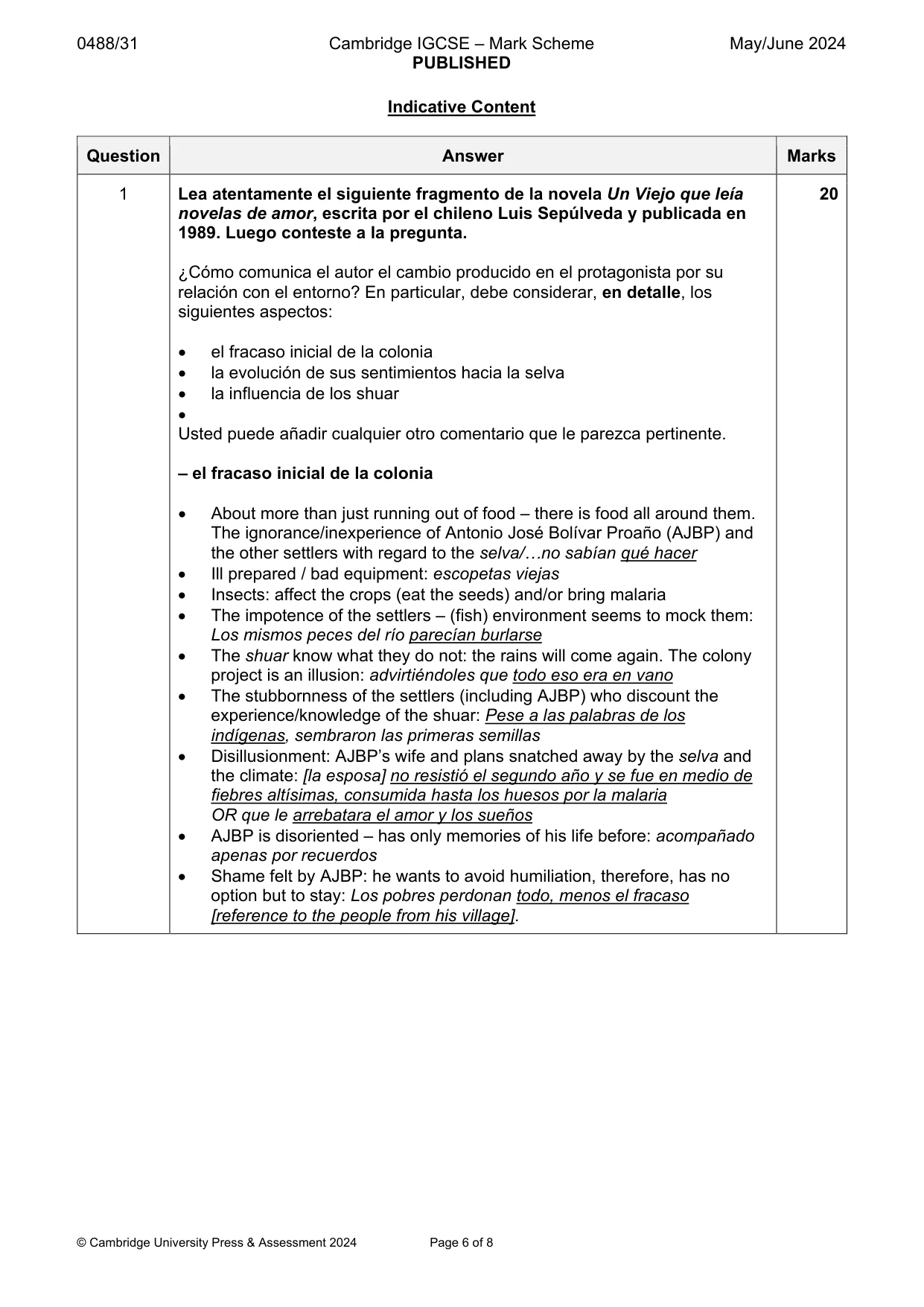
0488/31 Cambridge IGCSE – Mark Scheme PUBLISHED May/June 2024 © Cambridge University Press & Assessment 2024 Page 6 of 8 Indicative Content Question Answer Marks 1 Lea atentamente el siguiente fragmento de la novela Un Viejo que leía novelas de amor, escrita por el chileno Luis Sepúlveda y publicada en 1989. Luego conteste a la pregunta. ¿Cómo comunica el autor el cambio producido en el protagonista por su relación con el entorno? En particular, debe considerar, en detalle, los siguientes aspectos: el fracaso inicial de la colonia la evolución de sus sentimientos hacia la selva la influencia de los shuar Usted puede añadir cualquier otro comentario que le parezca pertinente. – el fracaso inicial de la colonia About more than just running out of food – there is food all around them. The ignorance/inexperience of Antonio José Bolívar Proaño (AJBP) and the other settlers with regard to the selva/…no sabían qué hacer Ill prepared / bad equipment: escopetas viejas Insects: affect the crops (eat the seeds) and/or bring malaria The impotence of the settlers – (fish) environment seems to mock them: Los mismos peces del río parecían burlarse The shuar know what they do not: the rains will come again. The colony project is an illusion: advirtiéndoles que todo eso era en vano The stubbornness of the settlers (including AJBP) who discount the experience/knowledge of the shuar: Pese a las palabras de los indígenas, sembraron las primeras semillas Disillusionment: AJBP’s wife and plans snatched away by the selva and the climate: [la esposa] no resistió el segundo año y se fue en medio de fiebres altísimas, consumida hasta los huesos por la malaria OR que le arrebatara el amor y los sueños AJBP is disoriented – has only memories of his life before: acompañado apenas por recuerdos Shame felt by AJBP: he wants to avoid humiliation, therefore, has no option but to stay: Los pobres perdonan todo, menos el fracaso [reference to the people from his village]. 20
Mark scheme, page 7
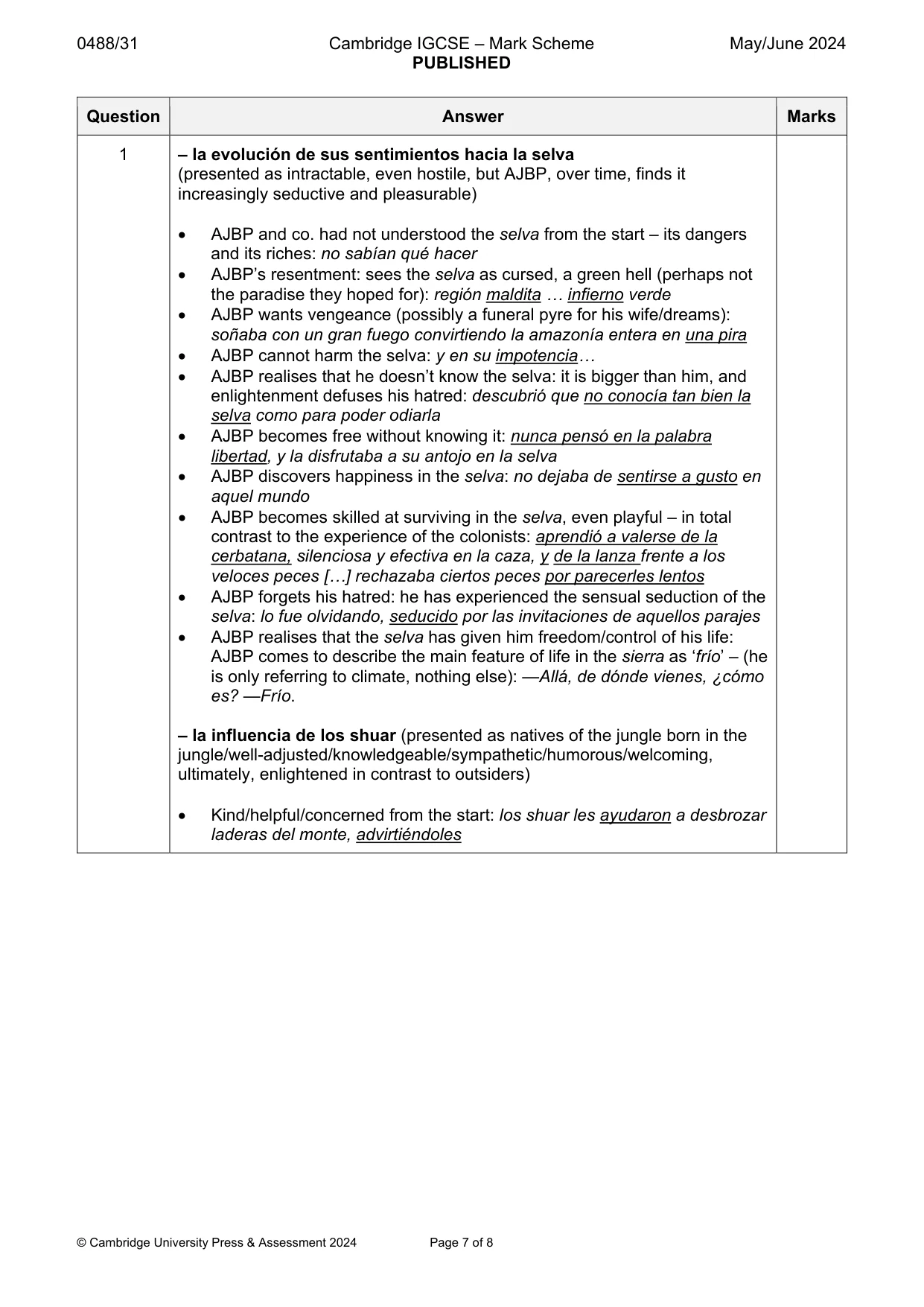
0488/31 Cambridge IGCSE – Mark Scheme PUBLISHED May/June 2024 © Cambridge University Press & Assessment 2024 Page 7 of 8 Question Answer Marks 1 – la evolución de sus sentimientos hacia la selva (presented as intractable, even hostile, but AJBP, over time, finds it increasingly seductive and pleasurable) AJBP and co. had not understood the selva from the start – its dangers and its riches: no sabían qué hacer AJBP’s resentment: sees the selva as cursed, a green hell (perhaps not the paradise they hoped for): región maldita … infierno verde AJBP wants vengeance (possibly a funeral pyre for his wife/dreams): soñaba con un gran fuego convirtiendo la amazonía entera en una pira AJBP cannot harm the selva: y en su impotencia… AJBP realises that he doesn’t know the selva: it is bigger than him, and enlightenment defuses his hatred: descubrió que no conocía tan bien la selva como para poder odiarla AJBP becomes free without knowing it: nunca pensó en la palabra libertad, y la disfrutaba a su antojo en la selva AJBP discovers happiness in the selva: no dejaba de sentirse a gusto en aquel mundo AJBP becomes skilled at surviving in the selva, even playful – in total contrast to the experience of the colonists: aprendió a valerse de la cerbatana, silenciosa y efectiva en la caza, y de la lanza frente a los veloces peces […] rechazaba ciertos peces por parecerles lentos AJBP forgets his hatred: he has experienced the sensual seduction of the selva: lo fue olvidando, seducido por las invitaciones de aquellos parajes AJBP realises that the selva has given him freedom/control of his life: AJBP comes to describe the main feature of life in the sierra as ‘frío’ – (he is only referring to climate, nothing else): —Allá, de dónde vienes, ¿cómo es? —Frío. – la influencia de los shuar (presented as natives of the jungle born in the jungle/well-adjusted/knowledgeable/sympathetic/humorous/welcoming, ultimately, enlightened in contrast to outsiders) Kind/helpful/concerned from the start: los shuar les ayudaron a desbrozar laderas del monte, advirtiéndoles
Mark scheme, page 8
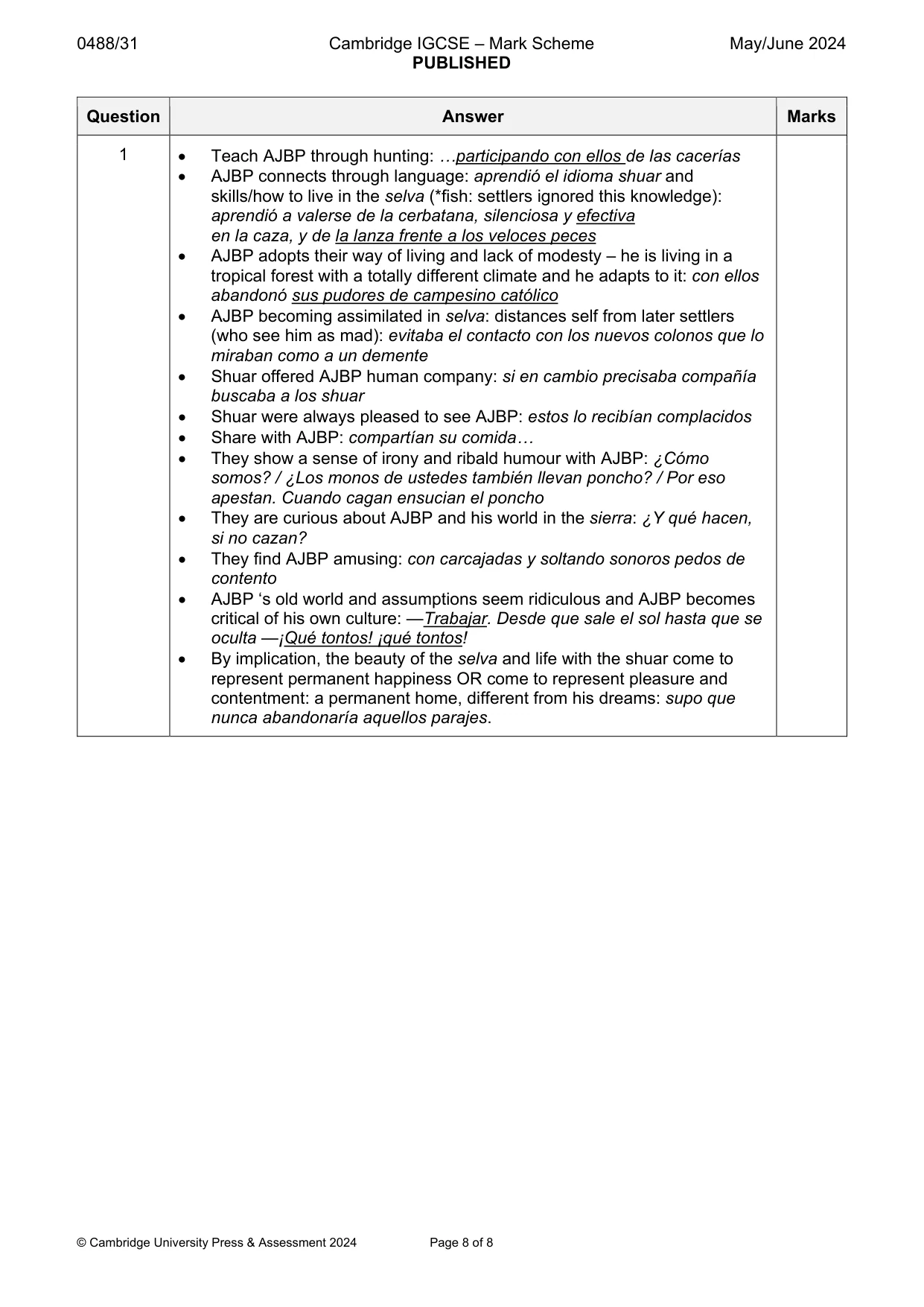
0488/31 Cambridge IGCSE – Mark Scheme PUBLISHED May/June 2024 © Cambridge University Press & Assessment 2024 Page 8 of 8 Question Answer Marks 1 Teach AJBP through hunting: …participando con ellos de las cacerías AJBP connects through language: aprendió el idioma shuar and skills/how to live in the selva (*fish: settlers ignored this knowledge): aprendió a valerse de la cerbatana, silenciosa y efectiva en la caza, y de la lanza frente a los veloces peces AJBP adopts their way of living and lack of modesty – he is living in a tropical forest with a totally different climate and he adapts to it: con ellos abandonó sus pudores de campesino católico AJBP becoming assimilated in selva: distances self from later settlers (who see him as mad): evitaba el contacto con los nuevos colonos que lo miraban como a un demente Shuar offered AJBP human company: si en cambio precisaba compañía buscaba a los shuar Shuar were always pleased to see AJBP: estos lo recibían complacidos Share with AJBP: compartían su comida… They show a sense of irony and ribald humour with AJBP: ¿Cómo somos? / ¿Los monos de ustedes también llevan poncho? / Por eso apestan. Cuando cagan ensucian el poncho They are curious about AJBP and his world in the sierra: ¿Y qué hacen, si no cazan? They find AJBP amusing: con carcajadas y soltando sonoros pedos de contento AJBP ‘s old world and assumptions seem ridiculous and AJBP becomes critical of his own culture: —Trabajar. Desde que sale el sol hasta que se oculta —¡Qué tontos! ¡qué tontos! By implication, the beauty of the selva and life with the shuar come to represent permanent happiness OR come to represent pleasure and contentment: a permanent home, different from his dreams: supo que nunca abandonaría aquellos parajes.
What you needed in this session
Cambridge’s own grade thresholds for 2024 May/June, Paper 3 · Variant 1. A higher threshold means an easier paper — the bar moves with how the cohort did.