Cambridge IGCSE Spanish - Literature 0488 — 2018 May/June Paper 3 · Variant 3
0488/33/M/J/18 · 20 marks · ≈23 min
The question paper and its mark scheme, free to read here and free to download. This is Cambridge’s own paper, exactly as it was sat.
Question paper4 pages


Mark scheme7 pages
Answers below. Sit the paper first if you are practising.
Paper as text
Question paper, page 1
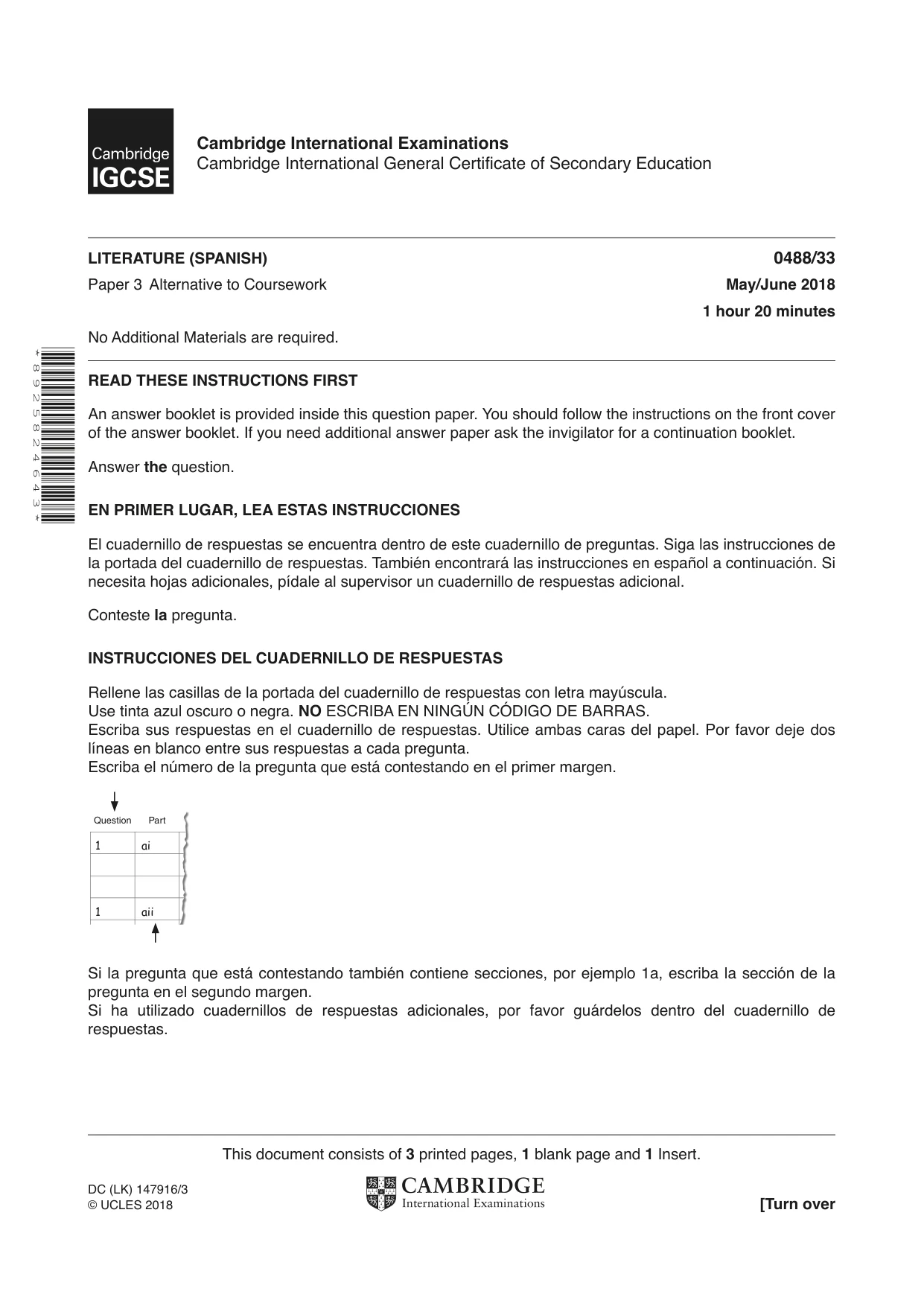
* 8 9 2 5 8 2 4 6 4 3 * This document consists of 3 printed pages, 1 blank page and 1 Insert. DC (LK) 147916/3 © UCLES 2018 [Turn over Cambridge International Examinations Cambridge International General Certificate of Secondary Education LITERATURE (SPANISH) 0488/33 Paper 3 Alternative to Coursework May/June 2018 1 hour 20 minutes No Additional Materials are required. READ THESE INSTRUCTIONS FIRST An answer booklet is provided inside this question paper. You should follow the instructions on the front cover of the answer booklet. If you need additional answer paper ask the invigilator for a continuation booklet. Answer the question. EN PRIMER LUGAR, LEA ESTAS INSTRUCCIONES El cuadernillo de respuestas se encuentra dentro de este cuadernillo de preguntas. Siga las instrucciones de la portada del cuadernillo de respuestas. También encontrará las instrucciones en español a continuación. Si necesita hojas adicionales, pídale al supervisor un cuadernillo de respuestas adicional. Conteste la pregunta. INSTRUCCIONES DEL CUADERNILLO DE RESPUESTAS Rellene las casillas de la portada del cuadernillo de respuestas con letra mayúscula. Use tinta azul oscuro o negra. NO ESCRIBA EN NINGÚN CÓDIGO DE BARRAS. Escriba sus respuestas en el cuadernillo de respuestas. Utilice ambas caras del papel. Por favor deje dos líneas en blanco entre sus respuestas a cada pregunta. Escriba el número de la pregunta que está contestando en el primer margen. Question Part 1 1 ai aii Si la pregunta que está contestando también contiene secciones, por ejemplo 1a, escriba la sección de la pregunta en el segundo margen. Si ha utilizado cuadernillos de respuestas adicionales, por favor guárdelos dentro del cuadernillo de respuestas.
Question paper, page 2
2 0488/33/M/J/18 © UCLES 2018 Lea atentamente el siguiente fragmento extraído de la novela ‘Travesuras de la niña mala’ escrita por el peruano Mario Vargas Llosa en 2006. Luego conteste la pregunta: La siguiente historia toma lugar en el barrio de Miraflores, uno de los distritos más afluentes de la ciudad de Lima, Perú. Lucy y Lily son conocidas como ‘las chilenitas’. Pero, a mis amigos y sobre todo a mis amigas miraflorinas, les daba mala espina que Lucy y Lily no nos abrieran las puertas de su casa. «¿Serán tan muertas de hambre que no pueden organizar ni siquiera una fiesta?» se preguntaban. «Acaso no es por pobres, sino por amarretes», trataba de componerla Tico Tiravante, empeorándola. Los chicos del barrio empezaron de pronto a hablar mal de las chilenitas por la manera cómo se maquillaban y vestían, a burlarse del escaso vestuario que lucían – todos conocíamos ya de memoria esas falditas, blusitas y sandalias que, para disimular, combinaban de todas las maneras pos- ibles –, y yo las defendía, lleno de santa indignación, esos rajes1 eran envidia, envidia verde, envidia ponzoñosa, porque en las fiestas las chilenitas nunca planchaban, todos los chicos hacían cola para sacarlas a bailar – «Porque se dejan pegar el cuerpo, así quién va a planchar», replicaba Laura – o porque, en las reuniones en el barrio, en los juegos, en la playa o en el Parque Salazar, eran siempre el centro de la atracción, y todos los chicos las rodeaban, en tanto que a las otras… – «¡Porque son unas agrandadas y unas descaradas y porque con ellas ustedes se atreven a contar unos chistes colorados que nosotras no les permitiríamos!», contraatacaba Teresita –, y, por último, porque las chilenitas eran regias, modernas, despercudidas y ellas, en cambio, unas remilgadas, unas atrasadas, unas anticuadas, unas cucufatas y unas prejuiciadas. «¡A mucha honra!», respondía Ilse, sacándonos cachita2. Pero, aunque rajaban de ellas, las chicas del Barrio Alegre las seguían invitando a las fiestas y saliendo con ellas en patota3 a los baños de Miraflores, a la misa de doce los domingos, a las matinées y a dar las vueltas obligadas por el Parque Salazar desde el atardecer hasta la aparición de las primeras estrellas… Lo hacían porque los chicos se lo pedíamos, y porque, en el fondo, las chicas de Miraflores sentían por las chilenitas la fascinación que ejerce sobre el pajarito la cobra que lo hipnotiza antes de tragárselo, la pecadora sobre la santa, el diablo sobre el ángel. Envidiaban en las forasteras venidas de ese remoto país que era Chile la libertad, que ellas no tenían, de salir a todas partes y quedarse paseando o bailando hasta tardísimo sin pedir permiso para un ratito más, sin que su papá, su mamá o alguna hermana mayor o una tía viniera a espiar por las ventanas de la fiesta con quién y cómo bailaban, o a llevárselas a casa porque ya eran las doce de la noche, hora en que las chicas decentes no estaban bailando ni conversando en las calles con hombres – eso hacían las agrandadas, las huachafas y las cholas – sino en sus casitas y en su cama, soñando con los angelitos. Envidiaban que las chilenitas fueran tan sueltas, bailaran con tantos disfuerzos…como no lo hacía ninguna chica en Miraflores, y que, a lo mejor, se permitieran con los chicos libertades que ellas ni se atrevían a imaginar. Pero, si eran tan libres, ¿por qué ni Lily ni Lucy querían tener enamorado? ¿Por qué nos decían que no a todos los que les caíamos?4 Ese y otros misterios relacionados con Lily y Lucy se aclararon inesperadamente …el último día de aquel verano memorable… Glosario: 1rajes: chismes, cotilleos, murmuraciones. 2sacar cachita: hacer burla. 3en patota: en grupo, pandilla. 4caerle a una chica: pedirle que sea su enamorada/novia.
Question paper, page 3
3 0488/33/M/J/18 © UCLES 2018 1 ¿Hasta qué punto, y cómo, ha logrado el autor entretenerlo(a) a lo largo de este fragmento con lo fascinantes que son ‘las chilenitas’? En particular, debe considerar, en detalle, los siguientes aspectos: • El por qué del atractivo que ejercen ‘las chilenitas’ sobre los chicos del Barrio Alegre • Lo que realmente fastidia a las chicas miraflorinas y por qué • Cómo el autor crea el ambiente de misterio que envuelve a ‘las chilenitas’ • Usted puede añadir cualquier otro comentario que le parezca pertinente. [20]
Question paper, page 4
4 0488/33/M/J/18 © UCLES 2018 Permission to reproduce items where third-party owned material protected by copyright is included has been sought and cleared where possible. Every reasonable effort has been made by the publisher (UCLES) to trace copyright holders, but if any items requiring clearance have unwittingly been included, the publisher will be pleased to make amends at the earliest possible opportunity. To avoid the issue of disclosure of answer-related information to candidates, all copyright acknowledgements are reproduced online in the Cambridge International Examinations Copyright Acknowledgements Booklet. This is produced for each series of examinations and is freely available to download at www.cie.org.uk after the live examination series. Cambridge International Examinations is part of the Cambridge Assessment Group. Cambridge Assessment is the brand name of University of Cambridge Local Examinations Syndicate (UCLES), which is itself a department of the University of Cambridge. BLANK PAGE
Mark scheme, page 1
IGCSE™ is a registered trademark. This document consists of 7 printed pages. © UCLES 2018 [Turn over Cambridge Assessment International Education Cambridge International General Certificate of Secondary Education LITERATURE (SPANISH) 0488/33 Paper 3 Alternative to Coursework May/June 2018 MARK SCHEME Maximum Mark: 20 Published This mark scheme is published as an aid to teachers and candidates, to indicate the requirements of the examination. It shows the basis on which Examiners were instructed to award marks. It does not indicate the details of the discussions that took place at an Examiners’ meeting before marking began, which would have considered the acceptability of alternative answers. Mark schemes should be read in conjunction with the question paper and the Principal Examiner Report for Teachers. Cambridge International will not enter into discussions about these mark schemes. Cambridge International is publishing the mark schemes for the May/June 2018 series for most Cambridge IGCSE™, Cambridge International A and AS Level and Cambridge Pre-U components, and some Cambridge O Level components.
Mark scheme, page 2
0488/33 Cambridge IGCSE – Mark Scheme PUBLISHED May/June 2018 © UCLES 2018 Page 2 of 7 Generic Marking Principles These general marking principles must be applied by all examiners when marking candidate answers. They should be applied alongside the specific content of the mark scheme or generic level descriptors for a question. Each question paper and mark scheme will also comply with these marking principles. GENERIC MARKING PRINCIPLE 1: Marks must be awarded in line with: • the specific content of the mark scheme or the generic level descriptors for the question • the specific skills defined in the mark scheme or in the generic level descriptors for the question • the standard of response required by a candidate as exemplified by the standardisation scripts. GENERIC MARKING PRINCIPLE 2: Marks awarded are always whole marks (not half marks, or other fractions). GENERIC MARKING PRINCIPLE 3: Marks must be awarded positively: • marks are awarded for correct/valid answers, as defined in the mark scheme. However, credit is given for valid answers which go beyond the scope of the syllabus and mark scheme, referring to your Team Leader as appropriate • marks are awarded when candidates clearly demonstrate what they know and can do • marks are not deducted for errors • marks are not deducted for omissions • answers should only be judged on the quality of spelling, punctuation and grammar when these features are specifically assessed by the question as indicated by the mark scheme. The meaning, however, should be unambiguous. GENERIC MARKING PRINCIPLE 4: Rules must be applied consistently e.g. in situations where candidates have not followed instructions or in the application of generic level descriptors. GENERIC MARKING PRINCIPLE 5: Marks should be awarded using the full range of marks defined in the mark scheme for the question (however; the use of the full mark range may be limited according to the quality of the candidate responses seen). GENERIC MARKING PRINCIPLE 6: Marks awarded are based solely on the requirements as defined in the mark scheme. Marks should not be awarded with grade thresholds or grade descriptors in mind.
Mark scheme, page 3
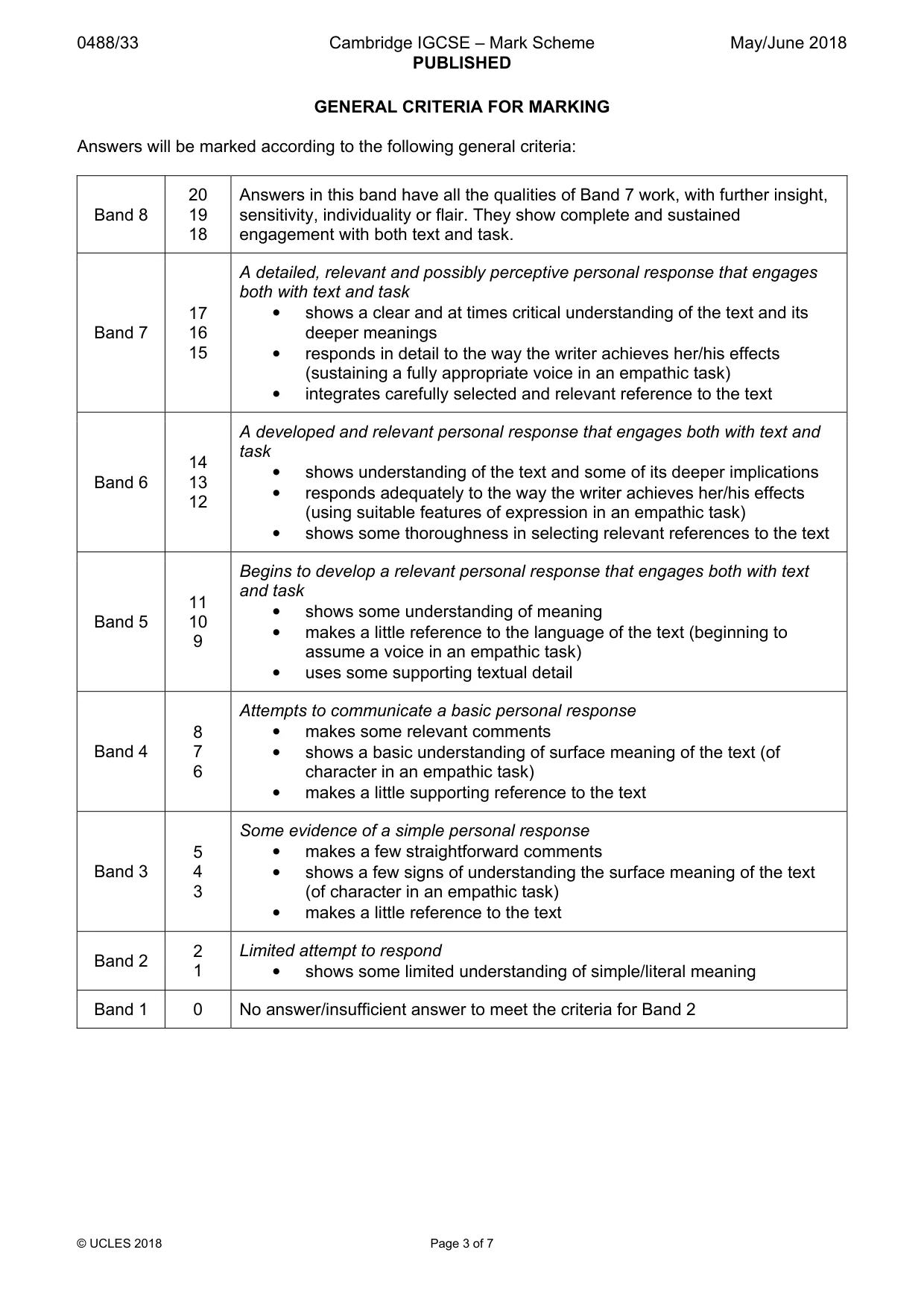
0488/33 Cambridge IGCSE – Mark Scheme PUBLISHED May/June 2018 © UCLES 2018 Page 3 of 7 GENERAL CRITERIA FOR MARKING Answers will be marked according to the following general criteria: Band 8 20 19 18 Answers in this band have all the qualities of Band 7 work, with further insight, sensitivity, individuality or flair. They show complete and sustained engagement with both text and task. Band 7 17 16 15 A detailed, relevant and possibly perceptive personal response that engages both with text and task • shows a clear and at times critical understanding of the text and its deeper meanings • responds in detail to the way the writer achieves her/his effects (sustaining a fully appropriate voice in an empathic task) • integrates carefully selected and relevant reference to the text Band 6 14 13 12 A developed and relevant personal response that engages both with text and task • shows understanding of the text and some of its deeper implications • responds adequately to the way the writer achieves her/his effects (using suitable features of expression in an empathic task) • shows some thoroughness in selecting relevant references to the text Band 5 11 10 9 Begins to develop a relevant personal response that engages both with text and task • shows some understanding of meaning • makes a little reference to the language of the text (beginning to assume a voice in an empathic task) • uses some supporting textual detail Band 4 8 7 6 Attempts to communicate a basic personal response • makes some relevant comments • shows a basic understanding of surface meaning of the text (of character in an empathic task) • makes a little supporting reference to the text Band 3 5 4 3 Some evidence of a simple personal response • makes a few straightforward comments • shows a few signs of understanding the surface meaning of the text (of character in an empathic task) • makes a little reference to the text Band 2 2 1 Limited attempt to respond • shows some limited understanding of simple/literal meaning Band 1 0 No answer/insufficient answer to meet the criteria for Band 2
Mark scheme, page 4
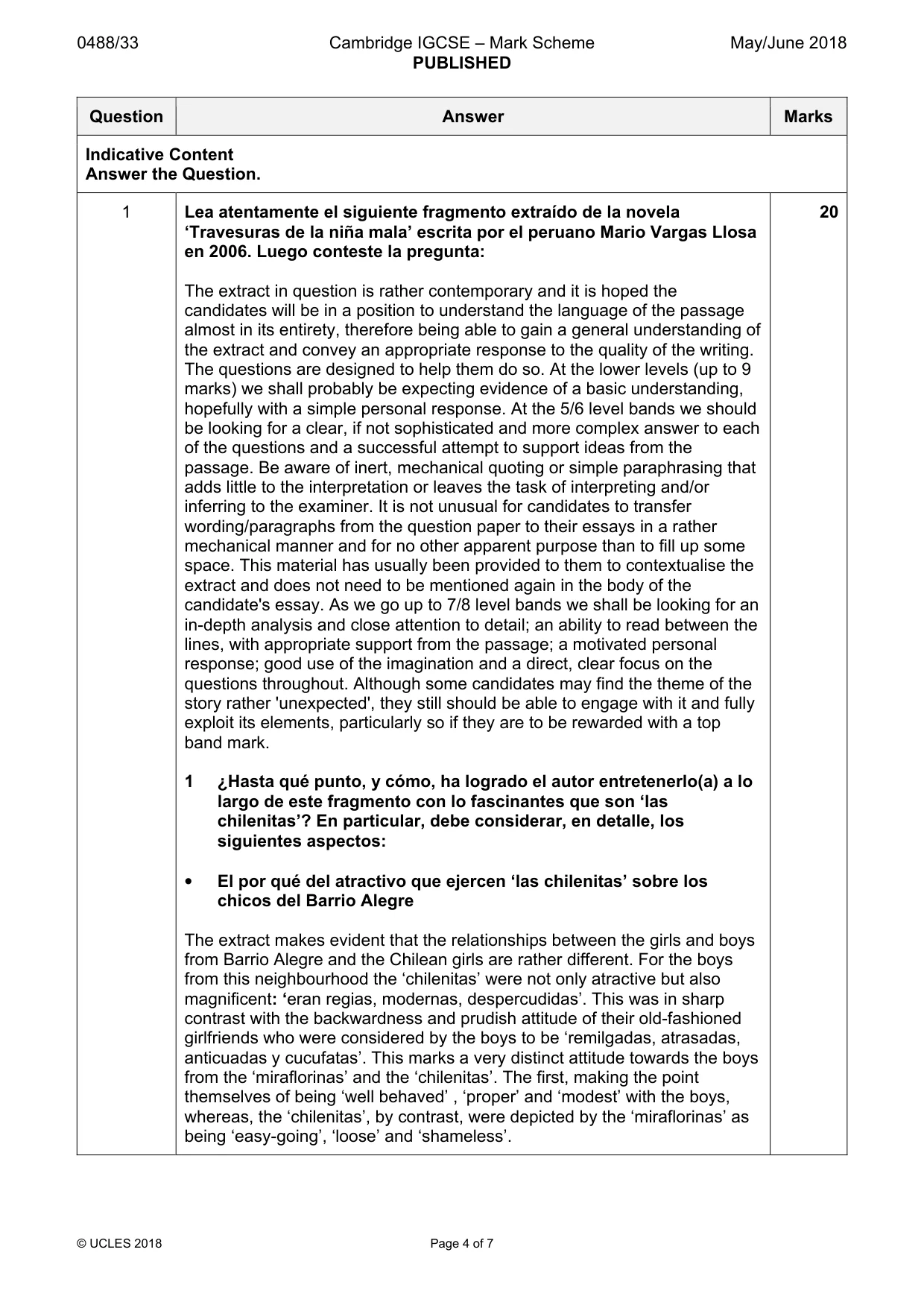
0488/33 Cambridge IGCSE – Mark Scheme PUBLISHED May/June 2018 © UCLES 2018 Page 4 of 7 Question Answer Marks Indicative Content Answer the Question. 1 Lea atentamente el siguiente fragmento extraído de la novela ‘Travesuras de la niña mala’ escrita por el peruano Mario Vargas Llosa en 2006. Luego conteste la pregunta: The extract in question is rather contemporary and it is hoped the candidates will be in a position to understand the language of the passage almost in its entirety, therefore being able to gain a general understanding of the extract and convey an appropriate response to the quality of the writing. The questions are designed to help them do so. At the lower levels (up to 9 marks) we shall probably be expecting evidence of a basic understanding, hopefully with a simple personal response. At the 5/6 level bands we should be looking for a clear, if not sophisticated and more complex answer to each of the questions and a successful attempt to support ideas from the passage. Be aware of inert, mechanical quoting or simple paraphrasing that adds little to the interpretation or leaves the task of interpreting and/or inferring to the examiner. It is not unusual for candidates to transfer wording/paragraphs from the question paper to their essays in a rather mechanical manner and for no other apparent purpose than to fill up some space. This material has usually been provided to them to contextualise the extract and does not need to be mentioned again in the body of the candidate's essay. As we go up to 7/8 level bands we shall be looking for an in-depth analysis and close attention to detail; an ability to read between the lines, with appropriate support from the passage; a motivated personal response; good use of the imagination and a direct, clear focus on the questions throughout. Although some candidates may find the theme of the story rather 'unexpected', they still should be able to engage with it and fully exploit its elements, particularly so if they are to be rewarded with a top band mark. 1 ¿Hasta qué punto, y cómo, ha logrado el autor entretenerlo(a) a lo largo de este fragmento con lo fascinantes que son ‘las chilenitas’? En particular, debe considerar, en detalle, los siguientes aspectos: • El por qué del atractivo que ejercen ‘las chilenitas’ sobre los chicos del Barrio Alegre The extract makes evident that the relationships between the girls and boys from Barrio Alegre and the Chilean girls are rather different. For the boys from this neighbourhood the ‘chilenitas’ were not only atractive but also magnificent: ‘eran regias, modernas, despercudidas’. This was in sharp contrast with the backwardness and prudish attitude of their old-fashioned girlfriends who were considered by the boys to be ‘remilgadas, atrasadas, anticuadas y cucufatas’. This marks a very distinct attitude towards the boys from the ‘miraflorinas’ and the ‘chilenitas’. The first, making the point themselves of being ‘well behaved’ , ‘proper’ and ‘modest’ with the boys, whereas, the ‘chilenitas’, by contrast, were depicted by the ‘miraflorinas’ as being ‘easy-going’, ‘loose’ and ‘shameless’. 20
Mark scheme, page 5
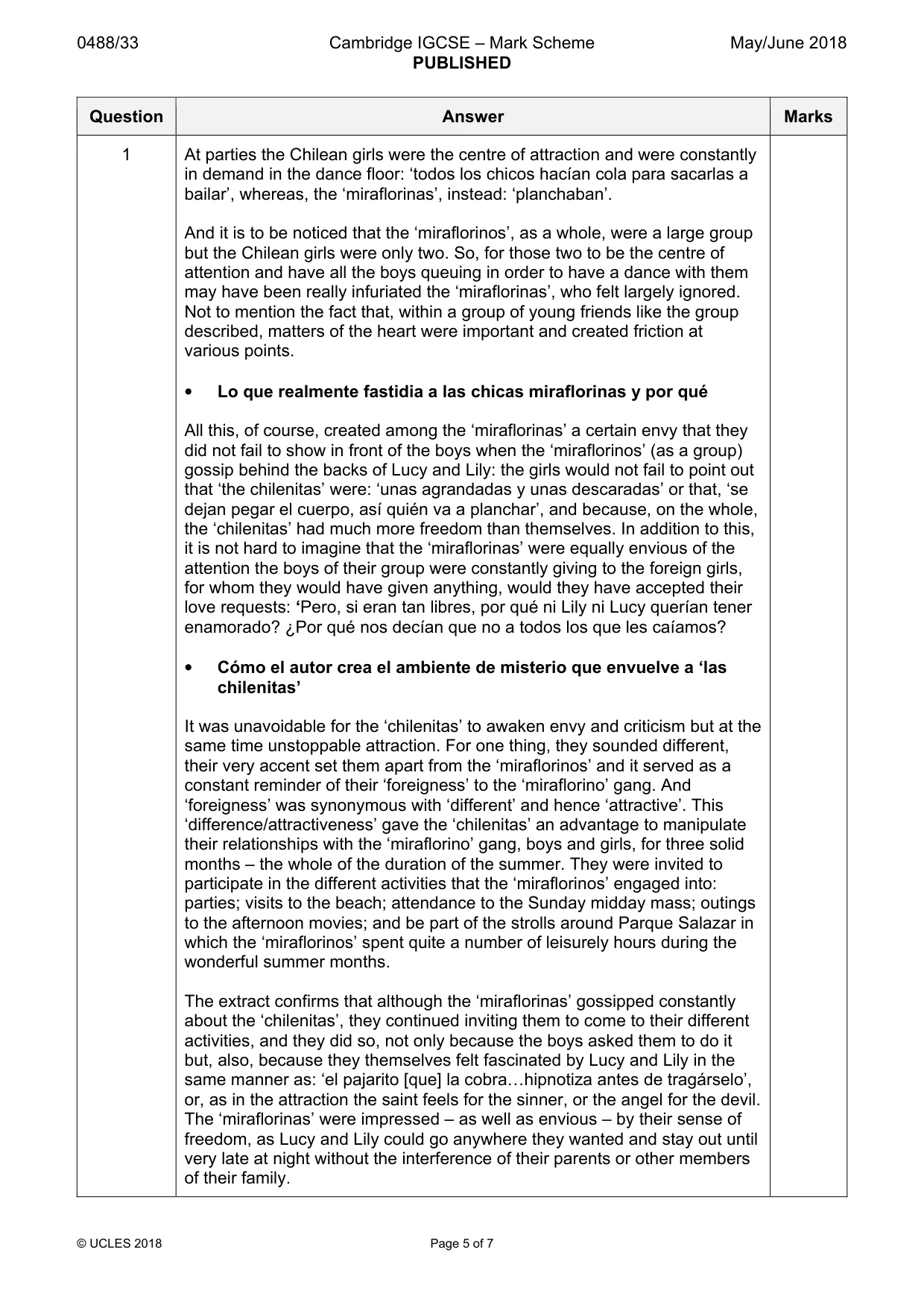
0488/33 Cambridge IGCSE – Mark Scheme PUBLISHED May/June 2018 © UCLES 2018 Page 5 of 7 Question Answer Marks 1 At parties the Chilean girls were the centre of attraction and were constantly in demand in the dance floor: ‘todos los chicos hacían cola para sacarlas a bailar’, whereas, the ‘miraflorinas’, instead: ‘planchaban’. And it is to be noticed that the ‘miraflorinos’, as a whole, were a large group but the Chilean girls were only two. So, for those two to be the centre of attention and have all the boys queuing in order to have a dance with them may have been really infuriated the ‘miraflorinas’, who felt largely ignored. Not to mention the fact that, within a group of young friends like the group described, matters of the heart were important and created friction at various points. • Lo que realmente fastidia a las chicas miraflorinas y por qué All this, of course, created among the ‘miraflorinas’ a certain envy that they did not fail to show in front of the boys when the ‘miraflorinos’ (as a group) gossip behind the backs of Lucy and Lily: the girls would not fail to point out that ‘the chilenitas’ were: ‘unas agrandadas y unas descaradas’ or that, ‘se dejan pegar el cuerpo, así quién va a planchar’, and because, on the whole, the ‘chilenitas’ had much more freedom than themselves. In addition to this, it is not hard to imagine that the ‘miraflorinas’ were equally envious of the attention the boys of their group were constantly giving to the foreign girls, for whom they would have given anything, would they have accepted their love requests: ‘Pero, si eran tan libres, por qué ni Lily ni Lucy querían tener enamorado? ¿Por qué nos decían que no a todos los que les caíamos? • Cómo el autor crea el ambiente de misterio que envuelve a ‘las chilenitas’ It was unavoidable for the ‘chilenitas’ to awaken envy and criticism but at the same time unstoppable attraction. For one thing, they sounded different, their very accent set them apart from the ‘miraflorinos’ and it served as a constant reminder of their ‘foreigness’ to the ‘miraflorino’ gang. And ‘foreigness’ was synonymous with ‘different’ and hence ‘attractive’. This ‘difference/attractiveness’ gave the ‘chilenitas’ an advantage to manipulate their relationships with the ‘miraflorino’ gang, boys and girls, for three solid months – the whole of the duration of the summer. They were invited to participate in the different activities that the ‘miraflorinos’ engaged into: parties; visits to the beach; attendance to the Sunday midday mass; outings to the afternoon movies; and be part of the strolls around Parque Salazar in which the ‘miraflorinos’ spent quite a number of leisurely hours during the wonderful summer months. The extract confirms that although the ‘miraflorinas’ gossipped constantly about the ‘chilenitas’, they continued inviting them to come to their different activities, and they did so, not only because the boys asked them to do it but, also, because they themselves felt fascinated by Lucy and Lily in the same manner as: ‘el pajarito [que] la cobra«hipnotiza antes de tragárselo’, or, as in the attraction the saint feels for the sinner, or the angel for the devil. The ‘miraflorinas’ were impressed – as well as envious – by their sense of freedom, as Lucy and Lily could go anywhere they wanted and stay out until very late at night without the interference of their parents or other members of their family.
Mark scheme, page 6
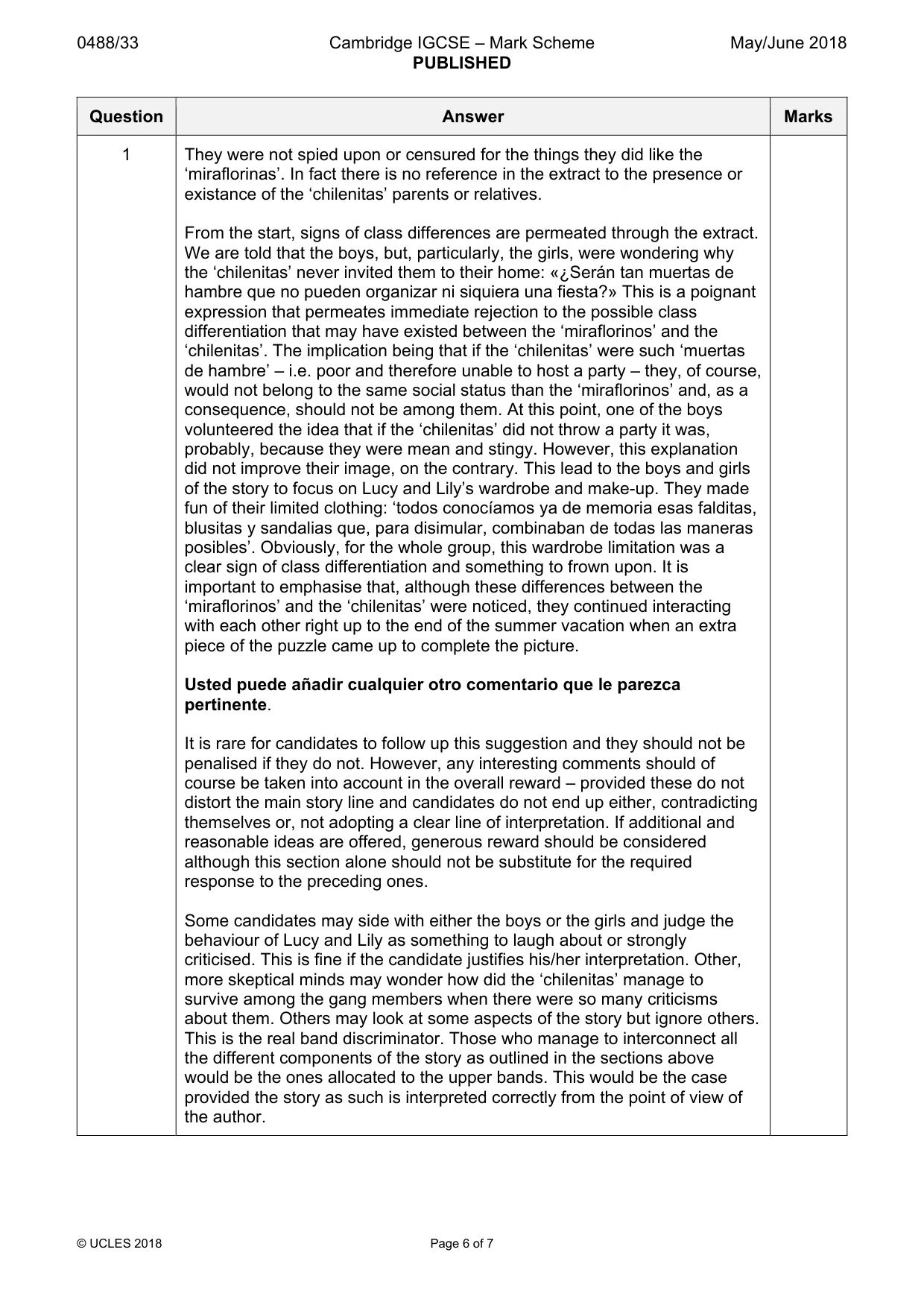
0488/33 Cambridge IGCSE – Mark Scheme PUBLISHED May/June 2018 © UCLES 2018 Page 6 of 7 Question Answer Marks 1 They were not spied upon or censured for the things they did like the ‘miraflorinas’. In fact there is no reference in the extract to the presence or existance of the ‘chilenitas’ parents or relatives. From the start, signs of class differences are permeated through the extract. We are told that the boys, but, particularly, the girls, were wondering why the ‘chilenitas’ never invited them to their home: «¿Serán tan muertas de hambre que no pueden organizar ni siquiera una fiesta?» This is a poignant expression that permeates immediate rejection to the possible class differentiation that may have existed between the ‘miraflorinos’ and the ‘chilenitas’. The implication being that if the ‘chilenitas’ were such ‘muertas de hambre’ – i.e. poor and therefore unable to host a party – they, of course, would not belong to the same social status than the ‘miraflorinos’ and, as a consequence, should not be among them. At this point, one of the boys volunteered the idea that if the ‘chilenitas’ did not throw a party it was, probably, because they were mean and stingy. However, this explanation did not improve their image, on the contrary. This lead to the boys and girls of the story to focus on Lucy and Lily’s wardrobe and make-up. They made fun of their limited clothing: ‘todos conocíamos ya de memoria esas falditas, blusitas y sandalias que, para disimular, combinaban de todas las maneras posibles’. Obviously, for the whole group, this wardrobe limitation was a clear sign of class differentiation and something to frown upon. It is important to emphasise that, although these differences between the ‘miraflorinos’ and the ‘chilenitas’ were noticed, they continued interacting with each other right up to the end of the summer vacation when an extra piece of the puzzle came up to complete the picture. Usted puede añadir cualquier otro comentario que le parezca pertinente. It is rare for candidates to follow up this suggestion and they should not be penalised if they do not. However, any interesting comments should of course be taken into account in the overall reward – provided these do not distort the main story line and candidates do not end up either, contradicting themselves or, not adopting a clear line of interpretation. If additional and reasonable ideas are offered, generous reward should be considered although this section alone should not be substitute for the required response to the preceding ones. Some candidates may side with either the boys or the girls and judge the behaviour of Lucy and Lily as something to laugh about or strongly criticised. This is fine if the candidate justifies his/her interpretation. Other, more skeptical minds may wonder how did the ‘chilenitas’ manage to survive among the gang members when there were so many criticisms about them. Others may look at some aspects of the story but ignore others. This is the real band discriminator. Those who manage to interconnect all the different components of the story as outlined in the sections above would be the ones allocated to the upper bands. This would be the case provided the story as such is interpreted correctly from the point of view of the author.
Mark scheme, page 7
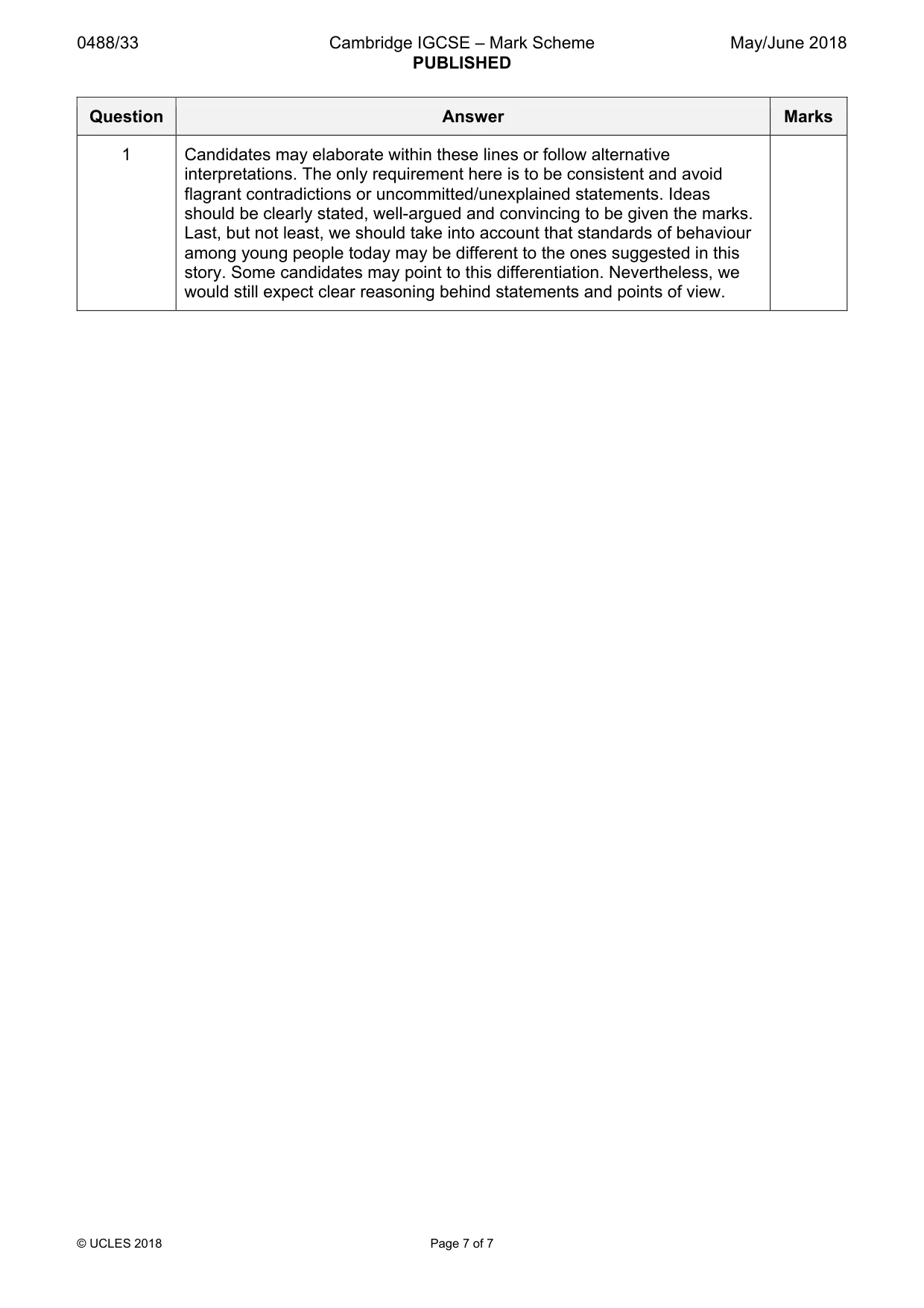
0488/33 Cambridge IGCSE – Mark Scheme PUBLISHED May/June 2018 © UCLES 2018 Page 7 of 7 Question Answer Marks 1 Candidates may elaborate within these lines or follow alternative interpretations. The only requirement here is to be consistent and avoid flagrant contradictions or uncommitted/unexplained statements. Ideas should be clearly stated, well-argued and convincing to be given the marks. Last, but not least, we should take into account that standards of behaviour among young people today may be different to the ones suggested in this story. Some candidates may point to this differentiation. Nevertheless, we would still expect clear reasoning behind statements and points of view.
What you needed in this session
Cambridge’s own grade thresholds for 2018 May/June, Paper 3 · Variant 3. A higher threshold means an easier paper — the bar moves with how the cohort did.