Cambridge IGCSE Spanish - Literature 0488 — 2023 May/June Paper 3 · Variant 1
0488/31/M/J/23 · 20 marks · ≈23 min
The question paper and its mark scheme, free to read here and free to download. This is Cambridge’s own paper, exactly as it was sat.
Question paper8 pages




Mark scheme8 pages
Answers below. Sit the paper first if you are practising.
Paper as text
Question paper, page 1
This document has 8 pages. Any blank pages are indicated. [Turn over Cambridge IGCSE™ LITERATURE (SPANISH) 0488/31 Paper 3 Alternative to Coursework May/June 2023 1 hour 20 minutes You must answer on the enclosed answer booklet. You will need: Answer booklet (enclosed) INSTRUCTIONS ● Answer the question. ● Follow the instructions on the front cover of the answer booklet. If you need additional answer paper, ask the invigilator for a continuation booklet. INFORMATION ● The total mark for this paper is 20. ● The number of marks for each question or part question is shown in brackets [ ]. INSTRUCCIONES ● Conteste a la pregunta. ● Siga las instrucciones que aparecen en la portada del cuadernillo de respuestas. Las instrucciones aparecen también en español a continuación. Si necesita hojas adicionales, pídale al supervisor un cuadernillo de respuestas adicional. INFORMACIÓN ● La puntuación total de este examen es de 20. ● La puntuación de cada pregunta o apartados de la misma aparece entre corchetes [ ]. * 9 2 7 6 0 3 3 5 9 7 * DC (PQ) 324042/3 © UCLES 2023
Question paper, page 2
2 0488/31/ M / J /23 © UCLES 2023 INSTRUCCIONES PARA EL CUADERNILLO DE RESPUESTAS Use tinta negra o azul oscuro. Está permitido el uso de lápiz para diagramas o gráficos. Escriba su nombre, número de centro y número de estudiante en las casillas provistas en la parte superior de la página. Escriba de forma clara y en letras mayúsculas. No use tinta borrable ni líquido corrector. No escriba en los códigos de barras. Escriba sus respuestas en este cuadernillo de respuestas. Utilice ambas caras del papel. Por favor, deje dos líneas en blanco entre las respuestas a cada pregunta. Escriba el número de la pregunta que está respondiendo en el primer margen. Question Part 1 1 (a)(i) (a)(ii) Si la pregunta que está respondiendo está dividida en secciones, por ejemplo 1(a), escriba la sección de la pregunta en el segundo margen. Debe hacer sus anotaciones con bolígrafo en este cuadernillo de respuestas. Debe tachar todo lo que no desee que el examinador evalúe, pero asegúrese de que lo tachado es todavía legible. No arranque ninguna hoja de este cuadernillo de respuestas. Debe entregar todo el trabajo que haya realizado. Si ha utilizado un cuadernillo de respuestas adicional, debe guardarlo dentro de este cuadernillo.
Question paper, page 3
3 0488/31/M/J/23 © UCLES 2023 [Turn over BLANK PAGE
Question paper, page 4
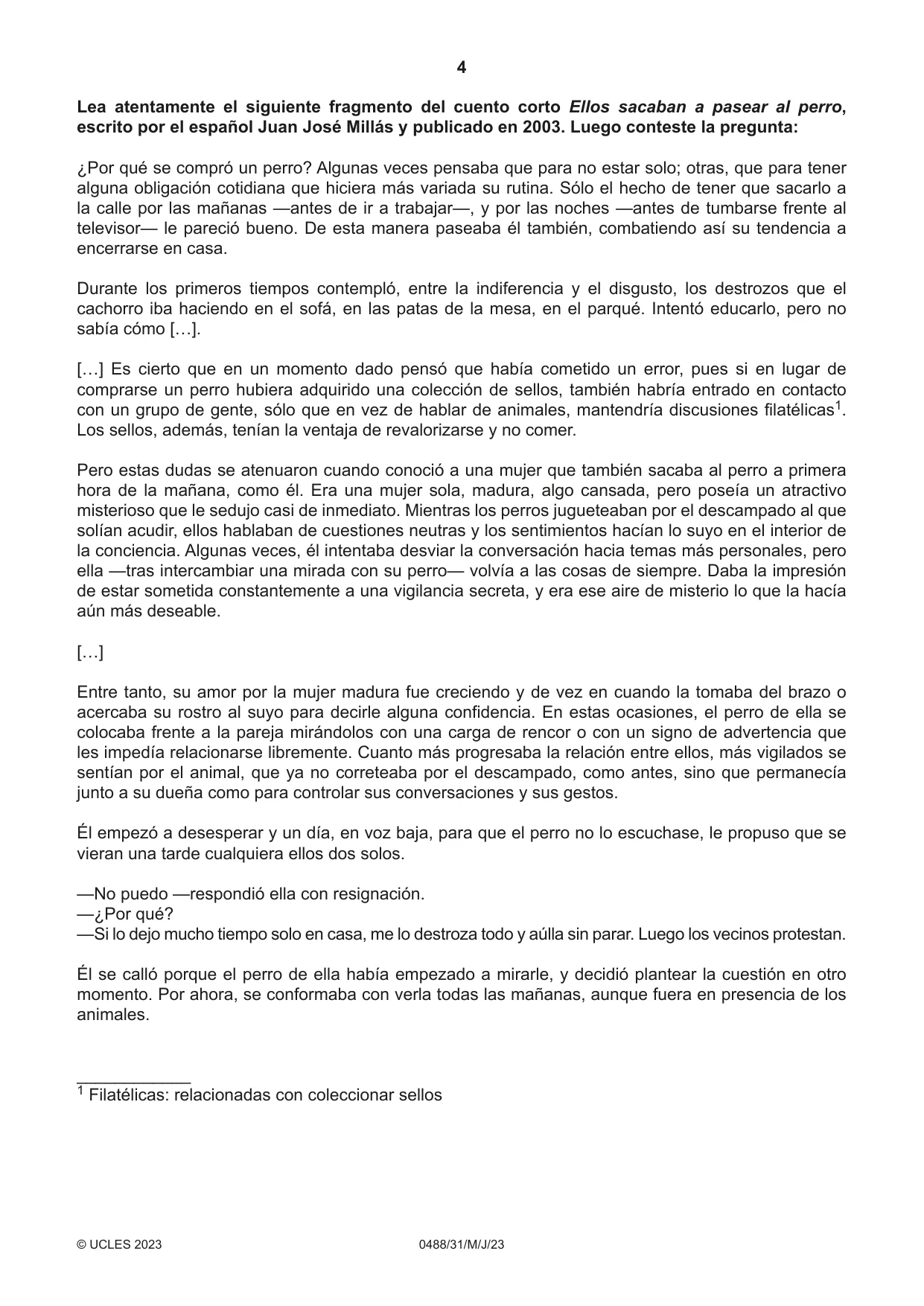
4 0488/31/M/J/23 © UCLES 2023 Lea atentamente el siguiente fragmento del cuento corto Ellos sacaban a pasear al perro, escrito por el español Juan José Millás y publicado en 2003. Luego conteste la pregunta: ¿Por qué se compró un perro? Algunas veces pensaba que para no estar solo; otras, que para tener alguna obligación cotidiana que hiciera más variada su rutina. Sólo el hecho de tener que sacarlo a la calle por las mañanas —antes de ir a trabajar—, y por las noches —antes de tumbarse frente al televisor— le pareció bueno. De esta manera paseaba él también, combatiendo así su tendencia a encerrarse en casa. Durante los primeros tiempos contempló, entre la indiferencia y el disgusto, los destrozos que el cachorro iba haciendo en el sofá, en las patas de la mesa, en el parqué. Intentó educarlo, pero no sabía cómo […]. […] Es cierto que en un momento dado pensó que había cometido un error, pues si en lugar de comprarse un perro hubiera adquirido una colección de sellos, también habría entrado en contacto con un grupo de gente, sólo que en vez de hablar de animales, mantendría discusiones filatélicas1. Los sellos, además, tenían la ventaja de revalorizarse y no comer. Pero estas dudas se atenuaron cuando conoció a una mujer que también sacaba al perro a primera hora de la mañana, como él. Era una mujer sola, madura, algo cansada, pero poseía un atractivo misterioso que le sedujo casi de inmediato. Mientras los perros jugueteaban por el descampado al que solían acudir, ellos hablaban de cuestiones neutras y los sentimientos hacían lo suyo en el interior de la conciencia. Algunas veces, él intentaba desviar la conversación hacia temas más personales, pero ella —tras intercambiar una mirada con su perro— volvía a las cosas de siempre. Daba la impresión de estar sometida constantemente a una vigilancia secreta, y era ese aire de misterio lo que la hacía aún más deseable. […] Entre tanto, su amor por la mujer madura fue creciendo y de vez en cuando la tomaba del brazo o acercaba su rostro al suyo para decirle alguna confidencia. En estas ocasiones, el perro de ella se colocaba frente a la pareja mirándolos con una carga de rencor o con un signo de advertencia que les impedía relacionarse libremente. Cuanto más progresaba la relación entre ellos, más vigilados se sentían por el animal, que ya no correteaba por el descampado, como antes, sino que permanecía junto a su dueña como para controlar sus conversaciones y sus gestos. Él empezó a desesperar y un día, en voz baja, para que el perro no lo escuchase, le propuso que se vieran una tarde cualquiera ellos dos solos. —No puedo —respondió ella con resignación. —¿Por qué? —Si lo dejo mucho tiempo solo en casa, me lo destroza todo y aúlla sin parar. Luego los vecinos protestan. Él se calló porque el perro de ella había empezado a mirarle, y decidió plantear la cuestión en otro momento. Por ahora, se conformaba con verla todas las mañanas, aunque fuera en presencia de los animales. ____________ 1 Filatélicas: relacionadas con coleccionar sellos
Question paper, page 5
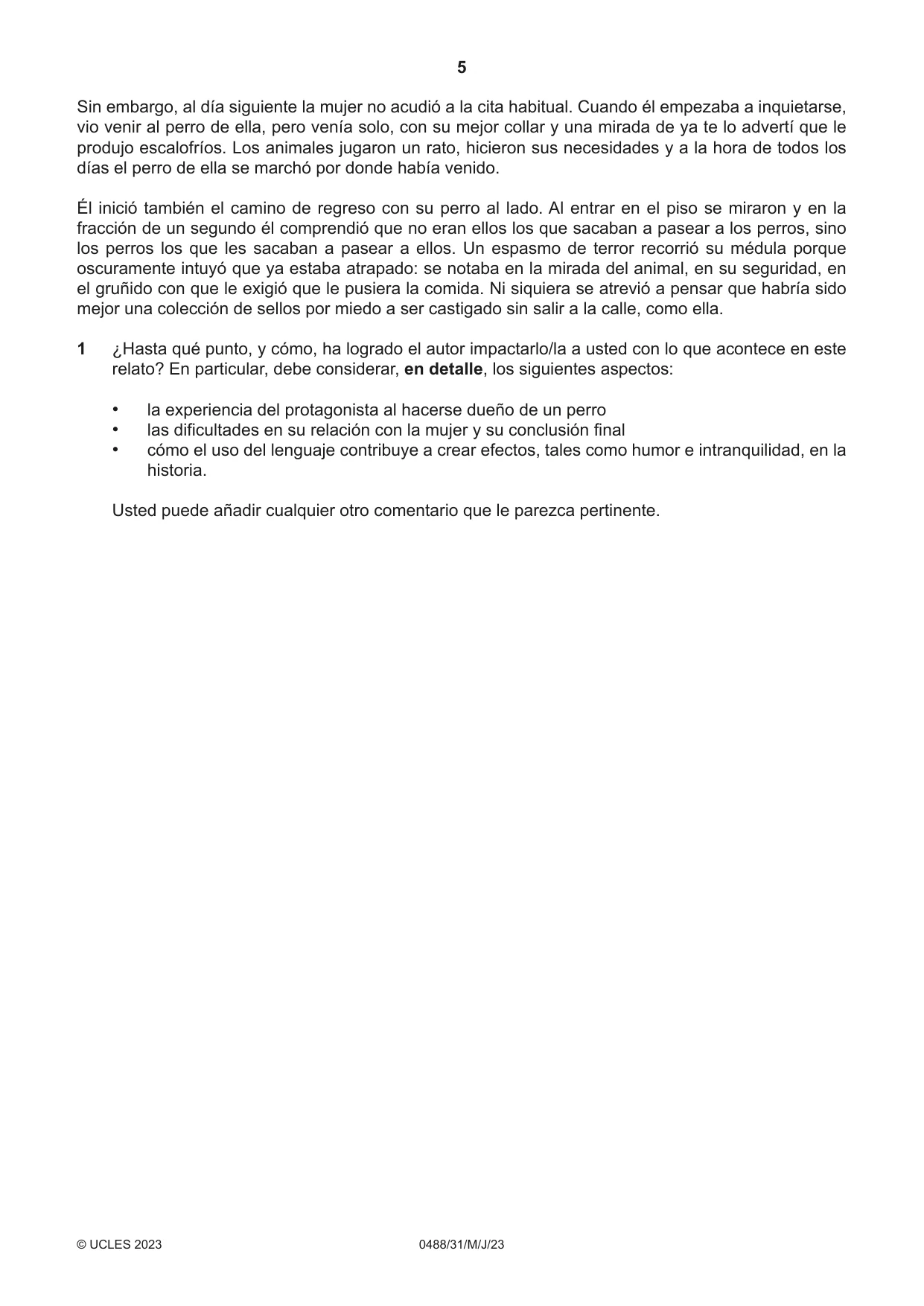
5 0488/31/M/J/23 © UCLES 2023 Sin embargo, al día siguiente la mujer no acudió a la cita habitual. Cuando él empezaba a inquietarse, vio venir al perro de ella, pero venía solo, con su mejor collar y una mirada de ya te lo advertí que le produjo escalofríos. Los animales jugaron un rato, hicieron sus necesidades y a la hora de todos los días el perro de ella se marchó por donde había venido. Él inició también el camino de regreso con su perro al lado. Al entrar en el piso se miraron y en la fracción de un segundo él comprendió que no eran ellos los que sacaban a pasear a los perros, sino los perros los que les sacaban a pasear a ellos. Un espasmo de terror recorrió su médula porque oscuramente intuyó que ya estaba atrapado: se notaba en la mirada del animal, en su seguridad, en el gruñido con que le exigió que le pusiera la comida. Ni siquiera se atrevió a pensar que habría sido mejor una colección de sellos por miedo a ser castigado sin salir a la calle, como ella. 1 ¿Hasta qué punto, y cómo, ha logrado el autor impactarlo/la a usted con lo que acontece en este relato? En particular, debe considerar, en detalle, los siguientes aspectos: • la experiencia del protagonista al hacerse dueño de un perro • las dificultades en su relación con la mujer y su conclusión final • cómo el uso del lenguaje contribuye a crear efectos, tales como humor e intranquilidad, en la historia. Usted puede añadir cualquier otro comentario que le parezca pertinente.
Question paper, page 6
6 0488/31/M/J/23 © UCLES 2023 BLANK PAGE
Question paper, page 7
7 0488/31/M/J/23 © UCLES 2023 BLANK PAGE
Question paper, page 8
8 0488/31/M/J/23 © UCLES 2023 Permission to reproduce items where third-party owned material protected by copyright is included has been sought and cleared where possible. Every reasonable effort has been made by the publisher (UCLES) to trace copyright holders, but if any items requiring clearance have unwittingly been included, the publisher will be pleased to make amends at the earliest possible opportunity. To avoid the issue of disclosure of answer-related information to candidates, all copyright acknowledgements are reproduced online in the Cambridge Assessment International Education Copyright Acknowledgements Booklet. This is produced for each series of examinations and is freely available to download at www.cambridgeinternational.org after the live examination series. Cambridge Assessment International Education is part of Cambridge Assessment. Cambridge Assessment is the brand name of the University of Cambridge Local Examinations Syndicate (UCLES), which is a department of the University of Cambridge. BLANK PAGE
Mark scheme, page 1
This document consists of 8 printed pages. © UCLES 2023 [Turn over Cambridge IGCSE™ LITERATURE (SPANISH) 0488/31 Paper 3 Alternative to Coursework May/June 2023 MARK SCHEME Maximum Mark: 20 Published This mark scheme is published as an aid to teachers and candidates, to indicate the requirements of the examination. It shows the basis on which Examiners were instructed to award marks. It does not indicate the details of the discussions that took place at an Examiners’ meeting before marking began, which would have considered the acceptability of alternative answers. Mark schemes should be read in conjunction with the question paper and the Principal Examiner Report for Teachers. Cambridge International will not enter into discussions about these mark schemes. Cambridge International is publishing the mark schemes for the May/June 2023 series for most Cambridge IGCSE, Cambridge International A and AS Level and Cambridge Pre-U components, and some Cambridge O Level components.
Mark scheme, page 2
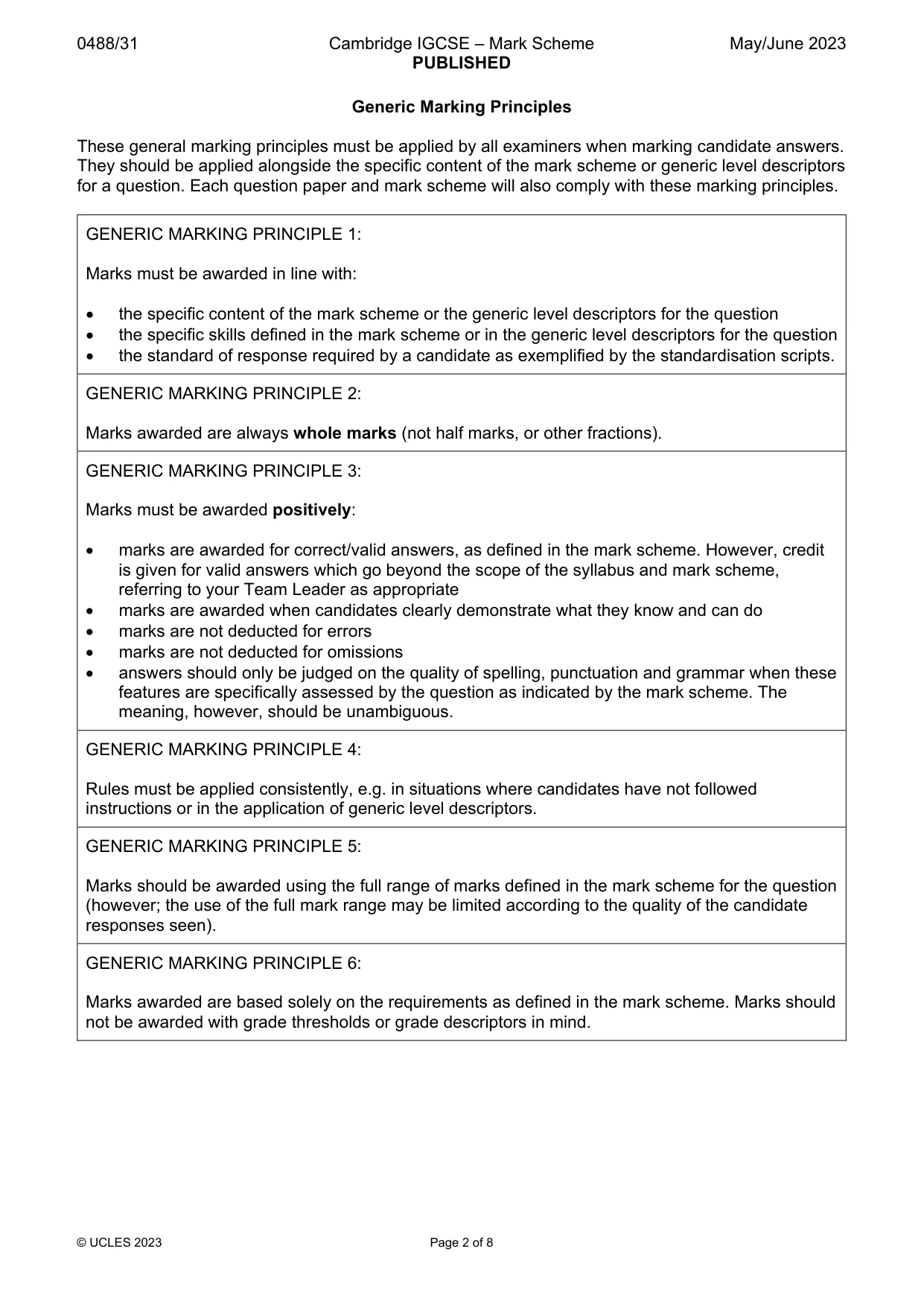
0488/31 Cambridge IGCSE – Mark Scheme PUBLISHED May/June 2023 © UCLES 2023 Page 2 of 8 Generic Marking Principles These general marking principles must be applied by all examiners when marking candidate answers. They should be applied alongside the specific content of the mark scheme or generic level descriptors for a question. Each question paper and mark scheme will also comply with these marking principles. GENERIC MARKING PRINCIPLE 1: Marks must be awarded in line with: the specific content of the mark scheme or the generic level descriptors for the question the specific skills defined in the mark scheme or in the generic level descriptors for the question the standard of response required by a candidate as exemplified by the standardisation scripts. GENERIC MARKING PRINCIPLE 2: Marks awarded are always whole marks (not half marks, or other fractions). GENERIC MARKING PRINCIPLE 3: Marks must be awarded positively: marks are awarded for correct/valid answers, as defined in the mark scheme. However, credit is given for valid answers which go beyond the scope of the syllabus and mark scheme, referring to your Team Leader as appropriate marks are awarded when candidates clearly demonstrate what they know and can do marks are not deducted for errors marks are not deducted for omissions answers should only be judged on the quality of spelling, punctuation and grammar when these features are specifically assessed by the question as indicated by the mark scheme. The meaning, however, should be unambiguous. GENERIC MARKING PRINCIPLE 4: Rules must be applied consistently, e.g. in situations where candidates have not followed instructions or in the application of generic level descriptors. GENERIC MARKING PRINCIPLE 5: Marks should be awarded using the full range of marks defined in the mark scheme for the question (however; the use of the full mark range may be limited according to the quality of the candidate responses seen). GENERIC MARKING PRINCIPLE 6: Marks awarded are based solely on the requirements as defined in the mark scheme. Marks should not be awarded with grade thresholds or grade descriptors in mind.
Mark scheme, page 3
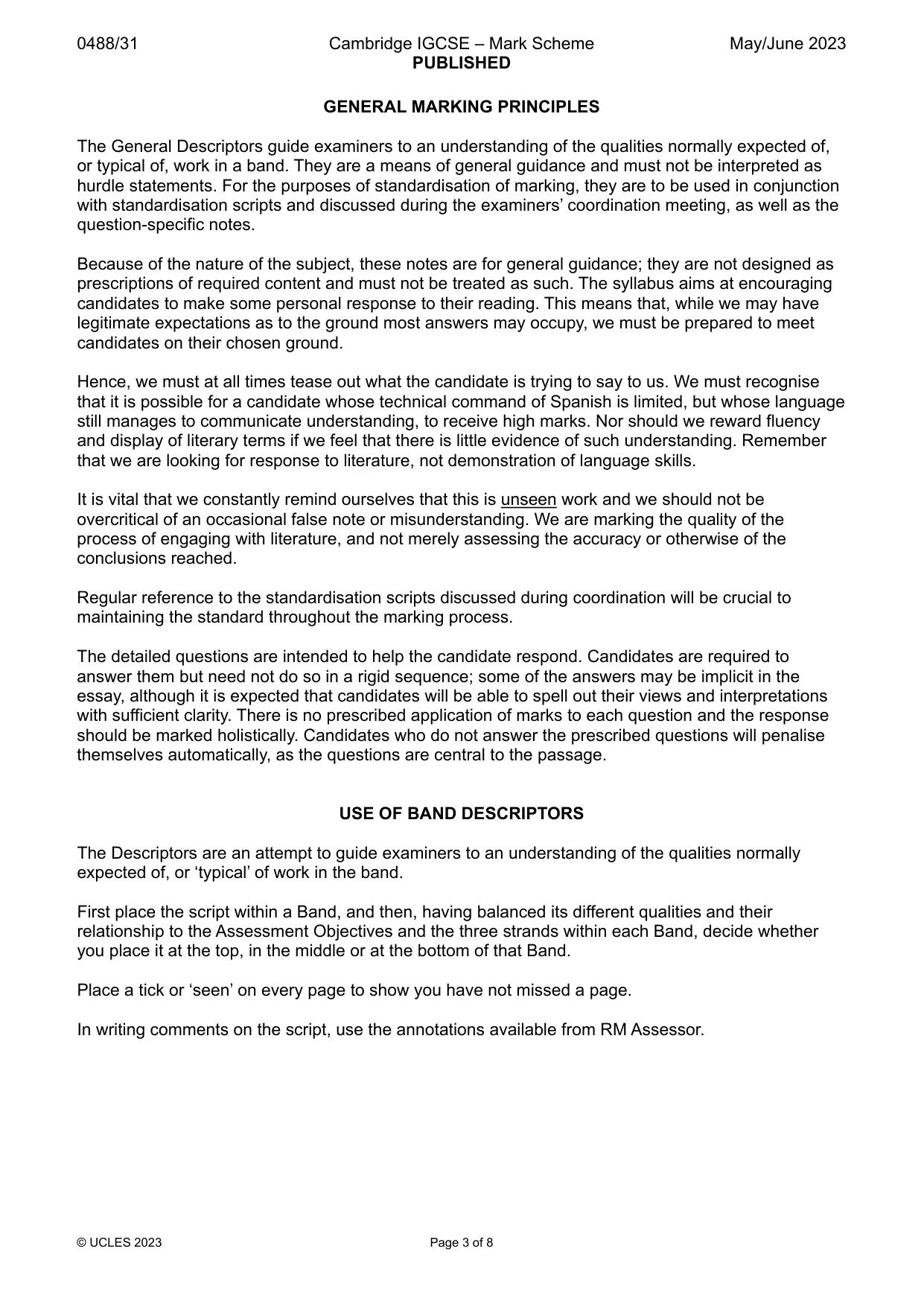
0488/31 Cambridge IGCSE – Mark Scheme PUBLISHED May/June 2023 © UCLES 2023 Page 3 of 8 GENERAL MARKING PRINCIPLES The General Descriptors guide examiners to an understanding of the qualities normally expected of, or typical of, work in a band. They are a means of general guidance and must not be interpreted as hurdle statements. For the purposes of standardisation of marking, they are to be used in conjunction with standardisation scripts and discussed during the examiners’ coordination meeting, as well as the question-specific notes. Because of the nature of the subject, these notes are for general guidance; they are not designed as prescriptions of required content and must not be treated as such. The syllabus aims at encouraging candidates to make some personal response to their reading. This means that, while we may have legitimate expectations as to the ground most answers may occupy, we must be prepared to meet candidates on their chosen ground. Hence, we must at all times tease out what the candidate is trying to say to us. We must recognise that it is possible for a candidate whose technical command of Spanish is limited, but whose language still manages to communicate understanding, to receive high marks. Nor should we reward fluency and display of literary terms if we feel that there is little evidence of such understanding. Remember that we are looking for response to literature, not demonstration of language skills. It is vital that we constantly remind ourselves that this is unseen work and we should not be overcritical of an occasional false note or misunderstanding. We are marking the quality of the process of engaging with literature, and not merely assessing the accuracy or otherwise of the conclusions reached. Regular reference to the standardisation scripts discussed during coordination will be crucial to maintaining the standard throughout the marking process. The detailed questions are intended to help the candidate respond. Candidates are required to answer them but need not do so in a rigid sequence; some of the answers may be implicit in the essay, although it is expected that candidates will be able to spell out their views and interpretations with sufficient clarity. There is no prescribed application of marks to each question and the response should be marked holistically. Candidates who do not answer the prescribed questions will penalise themselves automatically, as the questions are central to the passage. USE OF BAND DESCRIPTORS The Descriptors are an attempt to guide examiners to an understanding of the qualities normally expected of, or ‘typical’ of work in the band. First place the script within a Band, and then, having balanced its different qualities and their relationship to the Assessment Objectives and the three strands within each Band, decide whether you place it at the top, in the middle or at the bottom of that Band. Place a tick or ‘seen’ on every page to show you have not missed a page. In writing comments on the script, use the annotations available from RM Assessor.
Mark scheme, page 4
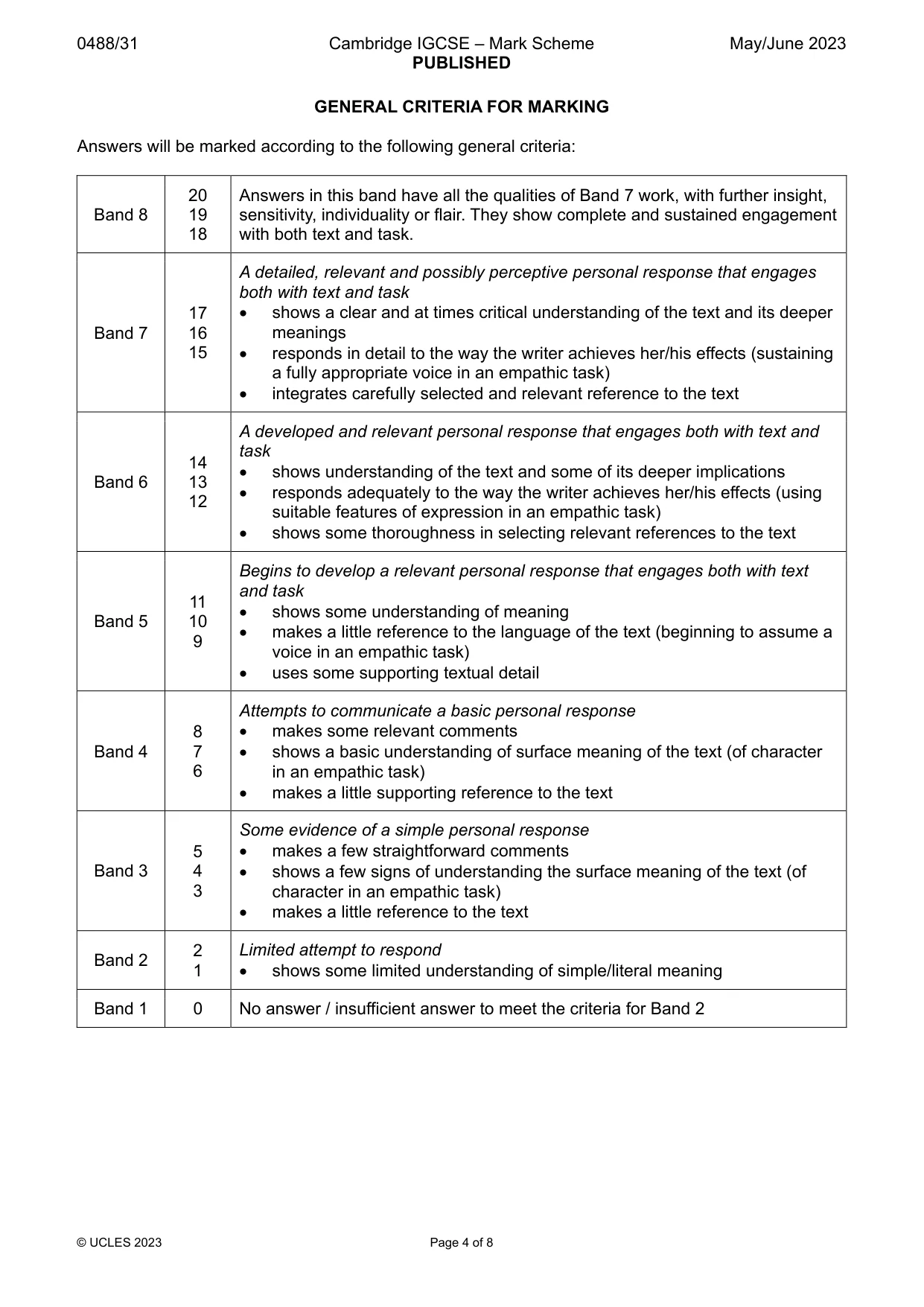
0488/31 Cambridge IGCSE – Mark Scheme PUBLISHED May/June 2023 © UCLES 2023 Page 4 of 8 GENERAL CRITERIA FOR MARKING Answers will be marked according to the following general criteria: Band 8 20 19 18 Answers in this band have all the qualities of Band 7 work, with further insight, sensitivity, individuality or flair. They show complete and sustained engagement with both text and task. Band 7 17 16 15 A detailed, relevant and possibly perceptive personal response that engages both with text and task shows a clear and at times critical understanding of the text and its deeper meanings responds in detail to the way the writer achieves her/his effects (sustaining a fully appropriate voice in an empathic task) integrates carefully selected and relevant reference to the text Band 6 14 13 12 A developed and relevant personal response that engages both with text and task shows understanding of the text and some of its deeper implications responds adequately to the way the writer achieves her/his effects (using suitable features of expression in an empathic task) shows some thoroughness in selecting relevant references to the text Band 5 11 10 9 Begins to develop a relevant personal response that engages both with text and task shows some understanding of meaning makes a little reference to the language of the text (beginning to assume a voice in an empathic task) uses some supporting textual detail Band 4 8 7 6 Attempts to communicate a basic personal response makes some relevant comments shows a basic understanding of surface meaning of the text (of character in an empathic task) makes a little supporting reference to the text Band 3 5 4 3 Some evidence of a simple personal response makes a few straightforward comments shows a few signs of understanding the surface meaning of the text (of character in an empathic task) makes a little reference to the text Band 2 2 1 Limited attempt to respond shows some limited understanding of simple/literal meaning Band 1 0 No answer / insufficient answer to meet the criteria for Band 2
Mark scheme, page 5
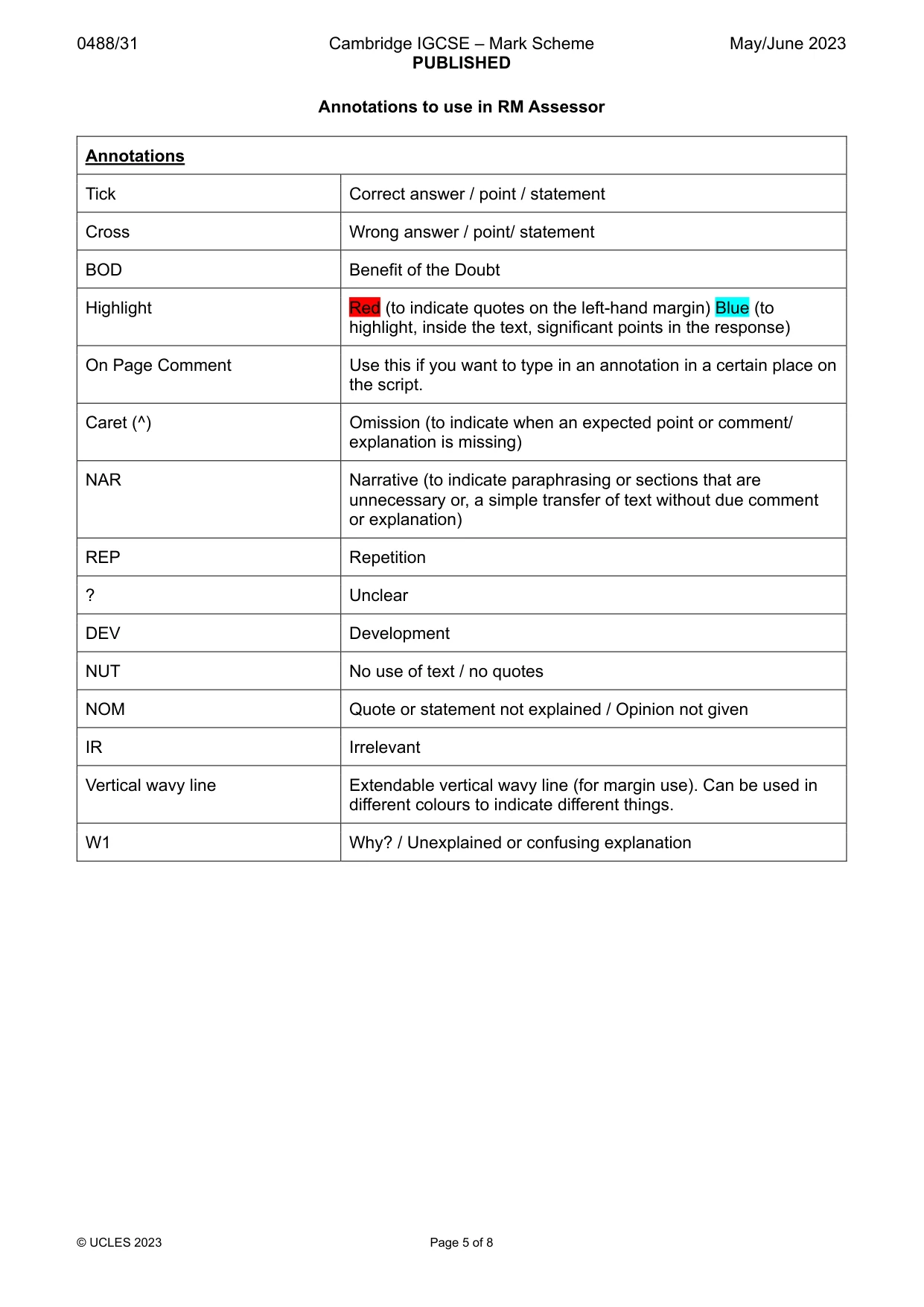
0488/31 Cambridge IGCSE – Mark Scheme PUBLISHED May/June 2023 © UCLES 2023 Page 5 of 8 Annotations to use in RM Assessor Annotations Tick Correct answer / point / statement Cross Wrong answer / point/ statement BOD Benefit of the Doubt Highlight Red (to indicate quotes on the left-hand margin) Blue (to highlight, inside the text, significant points in the response) On Page Comment Use this if you want to type in an annotation in a certain place on the script. Caret (^) Omission (to indicate when an expected point or comment/ explanation is missing) NAR Narrative (to indicate paraphrasing or sections that are unnecessary or, a simple transfer of text without due comment or explanation) REP Repetition ? Unclear DEV Development NUT No use of text / no quotes NOM Quote or statement not explained / Opinion not given IR Irrelevant Vertical wavy line Extendable vertical wavy line (for margin use). Can be used in different colours to indicate different things. W1 Why? / Unexplained or confusing explanation
Mark scheme, page 6
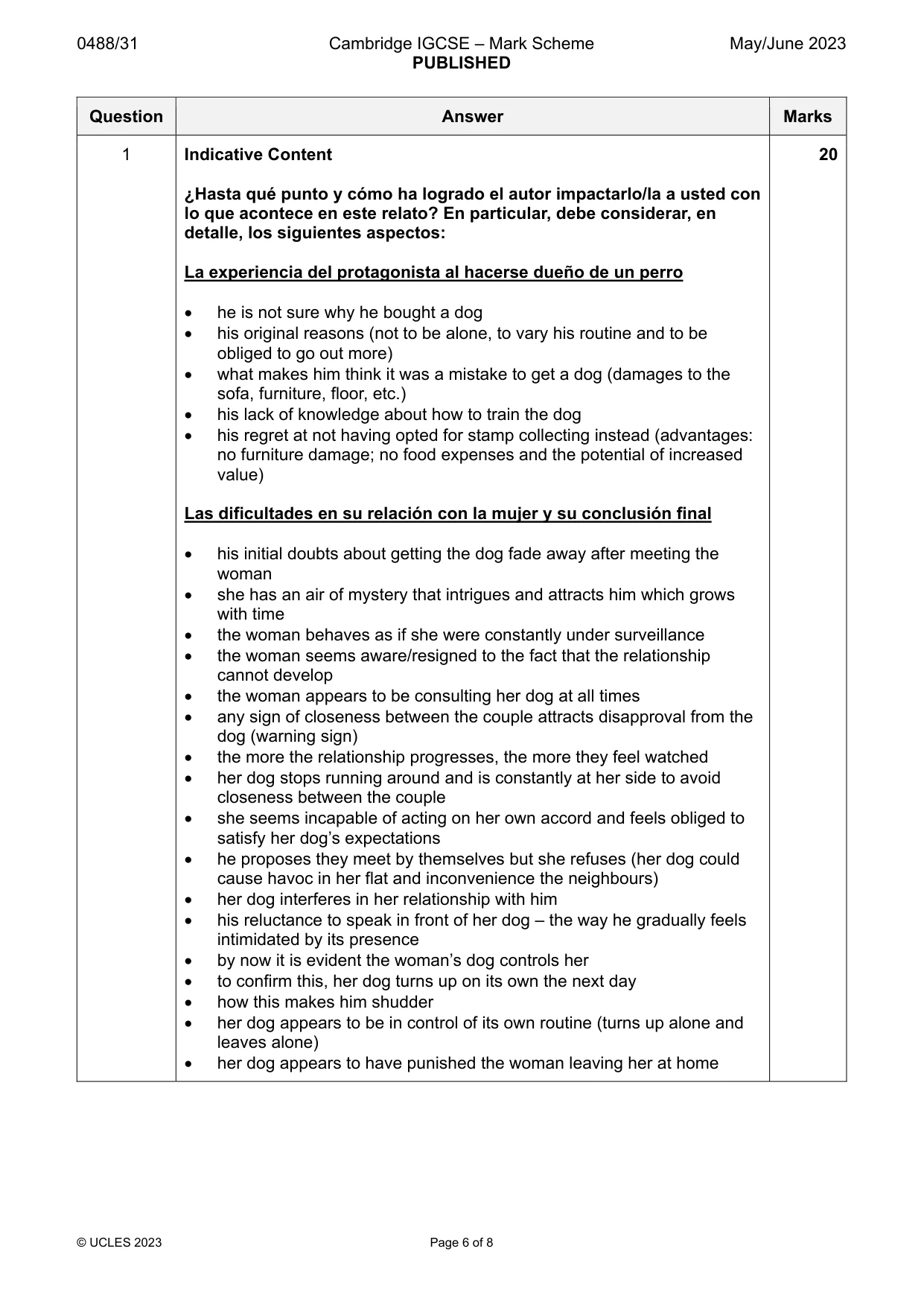
0488/31 Cambridge IGCSE – Mark Scheme PUBLISHED May/June 2023 © UCLES 2023 Page 6 of 8 Question Answer Marks 1 Indicative Content ¿Hasta qué punto y cómo ha logrado el autor impactarlo/la a usted con lo que acontece en este relato? En particular, debe considerar, en detalle, los siguientes aspectos: La experiencia del protagonista al hacerse dueño de un perro he is not sure why he bought a dog his original reasons (not to be alone, to vary his routine and to be obliged to go out more) what makes him think it was a mistake to get a dog (damages to the sofa, furniture, floor, etc.) his lack of knowledge about how to train the dog his regret at not having opted for stamp collecting instead (advantages: no furniture damage; no food expenses and the potential of increased value) Las dificultades en su relación con la mujer y su conclusión final his initial doubts about getting the dog fade away after meeting the woman she has an air of mystery that intrigues and attracts him which grows with time the woman behaves as if she were constantly under surveillance the woman seems aware/resigned to the fact that the relationship cannot develop the woman appears to be consulting her dog at all times any sign of closeness between the couple attracts disapproval from the dog (warning sign) the more the relationship progresses, the more they feel watched her dog stops running around and is constantly at her side to avoid closeness between the couple she seems incapable of acting on her own accord and feels obliged to satisfy her dog’s expectations he proposes they meet by themselves but she refuses (her dog could cause havoc in her flat and inconvenience the neighbours) her dog interferes in her relationship with him his reluctance to speak in front of her dog – the way he gradually feels intimidated by its presence by now it is evident the woman’s dog controls her to confirm this, her dog turns up on its own the next day how this makes him shudder her dog appears to be in control of its own routine (turns up alone and leaves alone) her dog appears to have punished the woman leaving her at home 20
Mark scheme, page 7
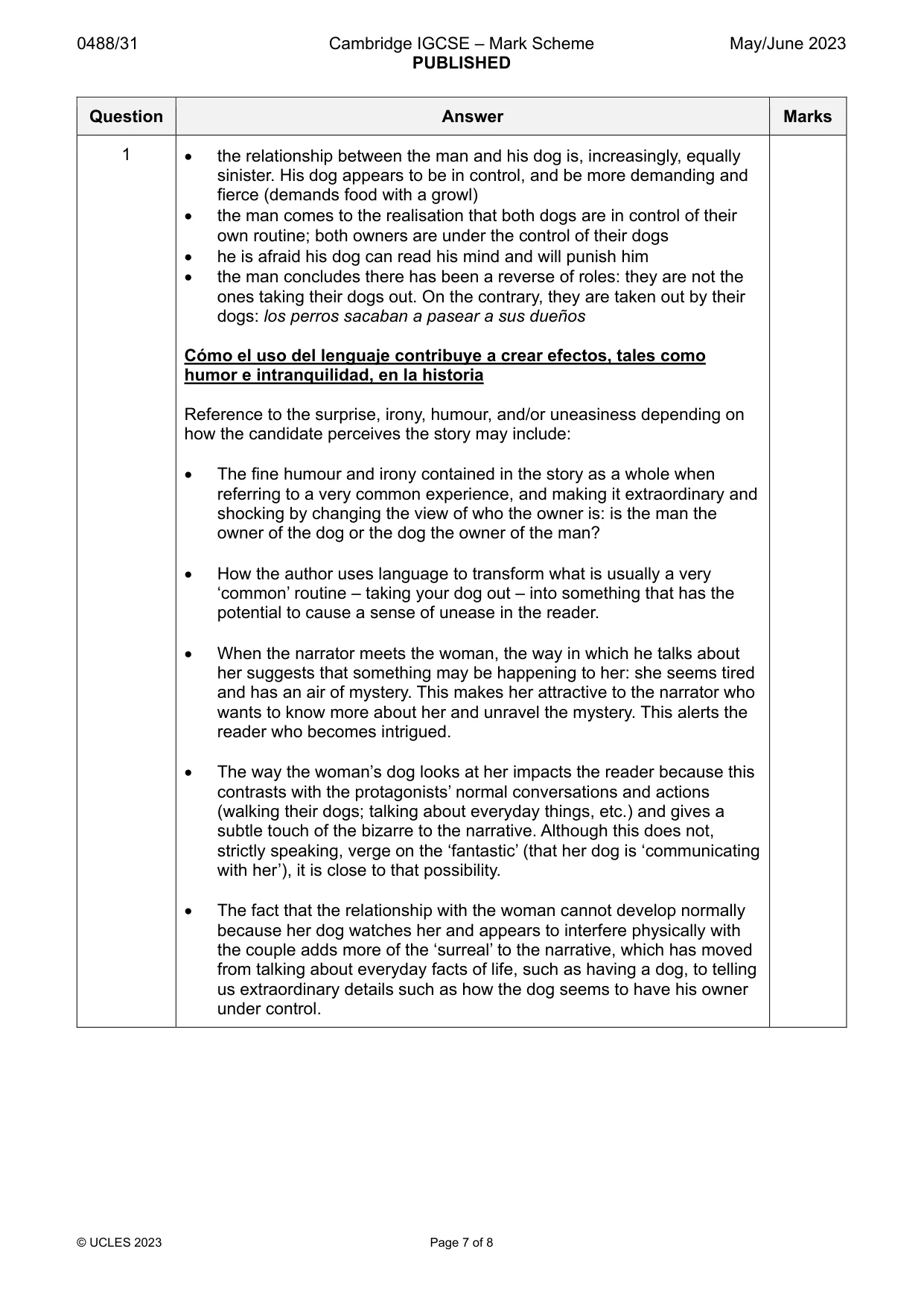
0488/31 Cambridge IGCSE – Mark Scheme PUBLISHED May/June 2023 © UCLES 2023 Page 7 of 8 Question Answer Marks 1 the relationship between the man and his dog is, increasingly, equally sinister. His dog appears to be in control, and be more demanding and fierce (demands food with a growl) the man comes to the realisation that both dogs are in control of their own routine; both owners are under the control of their dogs he is afraid his dog can read his mind and will punish him the man concludes there has been a reverse of roles: they are not the ones taking their dogs out. On the contrary, they are taken out by their dogs: los perros sacaban a pasear a sus dueños Cómo el uso del lenguaje contribuye a crear efectos, tales como humor e intranquilidad, en la historia Reference to the surprise, irony, humour, and/or uneasiness depending on how the candidate perceives the story may include: The fine humour and irony contained in the story as a whole when referring to a very common experience, and making it extraordinary and shocking by changing the view of who the owner is: is the man the owner of the dog or the dog the owner of the man? How the author uses language to transform what is usually a very ‘common’ routine – taking your dog out – into something that has the potential to cause a sense of unease in the reader. When the narrator meets the woman, the way in which he talks about her suggests that something may be happening to her: she seems tired and has an air of mystery. This makes her attractive to the narrator who wants to know more about her and unravel the mystery. This alerts the reader who becomes intrigued. The way the woman’s dog looks at her impacts the reader because this contrasts with the protagonists’ normal conversations and actions (walking their dogs; talking about everyday things, etc.) and gives a subtle touch of the bizarre to the narrative. Although this does not, strictly speaking, verge on the ‘fantastic’ (that her dog is ‘communicating with her’), it is close to that possibility. The fact that the relationship with the woman cannot develop normally because her dog watches her and appears to interfere physically with the couple adds more of the ‘surreal’ to the narrative, which has moved from talking about everyday facts of life, such as having a dog, to telling us extraordinary details such as how the dog seems to have his owner under control.
Mark scheme, page 8
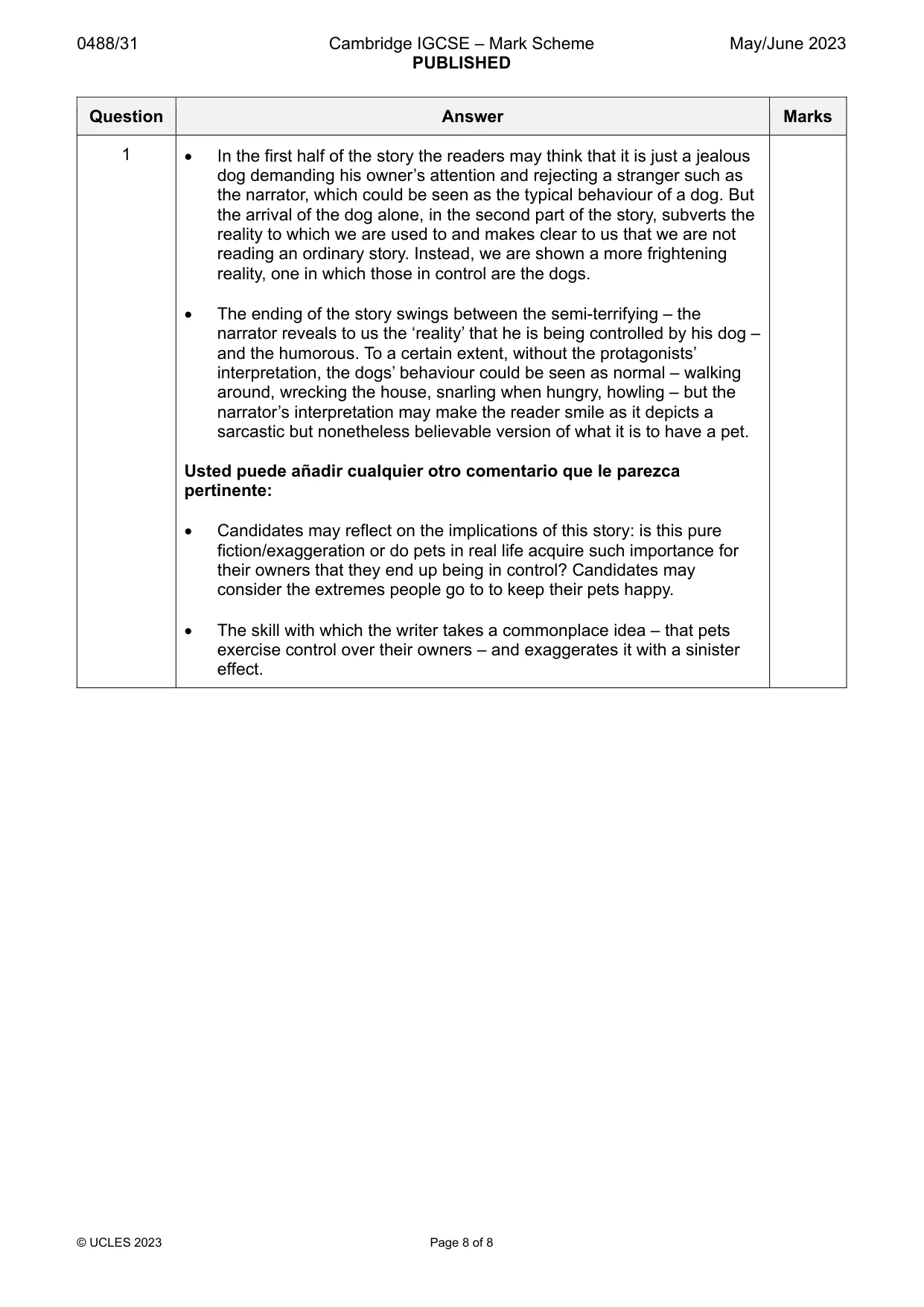
0488/31 Cambridge IGCSE – Mark Scheme PUBLISHED May/June 2023 © UCLES 2023 Page 8 of 8 Question Answer Marks 1 In the first half of the story the readers may think that it is just a jealous dog demanding his owner’s attention and rejecting a stranger such as the narrator, which could be seen as the typical behaviour of a dog. But the arrival of the dog alone, in the second part of the story, subverts the reality to which we are used to and makes clear to us that we are not reading an ordinary story. Instead, we are shown a more frightening reality, one in which those in control are the dogs. The ending of the story swings between the semi-terrifying – the narrator reveals to us the ‘reality’ that he is being controlled by his dog – and the humorous. To a certain extent, without the protagonists’ interpretation, the dogs’ behaviour could be seen as normal – walking around, wrecking the house, snarling when hungry, howling – but the narrator’s interpretation may make the reader smile as it depicts a sarcastic but nonetheless believable version of what it is to have a pet. Usted puede añadir cualquier otro comentario que le parezca pertinente: Candidates may reflect on the implications of this story: is this pure fiction/exaggeration or do pets in real life acquire such importance for their owners that they end up being in control? Candidates may consider the extremes people go to to keep their pets happy. The skill with which the writer takes a commonplace idea – that pets exercise control over their owners – and exaggerates it with a sinister effect.
What you needed in this session
Cambridge’s own grade thresholds for 2023 May/June, Paper 3 · Variant 1. A higher threshold means an easier paper — the bar moves with how the cohort did.