Cambridge IGCSE Spanish - Literature 0488 — 2022 May/June Paper 3 · Variant 1
0488/31/M/J/22 · 20 marks · ≈23 min
The question paper and its mark scheme, free to read here and free to download. This is Cambridge’s own paper, exactly as it was sat.
Question paper8 pages




Mark scheme8 pages
Answers below. Sit the paper first if you are practising.
Paper as text
Question paper, page 1
This document has 8 pages. Any blank pages are indicated. [Turn over Cambridge IGCSE™ * 0 8 6 2 3 1 9 0 8 0 * DC (LK) 322086/5 © UCLES 2022 LITERATURE (SPANISH) 0488/31 Paper 3 Alternative to Coursework May/June 2022 1 hour 20 minutes You must answer on the enclosed answer booklet. You will need: Answer booklet (enclosed) INSTRUCTIONS ● Answer the question. ● Follow the instructions on the front cover of the answer booklet. If you need additional answer paper, ask the invigilator for a continuation booklet. INFORMATION ● The total mark for this paper is 20. ● The number of marks for each question or part question is shown in brackets [ ]. INSTRUCCIONES ● Conteste a la pregunta. ● Siga las instrucciones que aparecen en la portada del cuadernillo de respuestas. Las instrucciones aparecen también en español a continuación. Si necesita hojas adicionales, pídale al supervisor un cuadernillo de respuestas adicional. INFORMACIÓN ● La puntuación total de este examen es de 20. ● La puntuación de cada pregunta o apartados de la misma aparece entre corchetes [ ].
Question paper, page 2
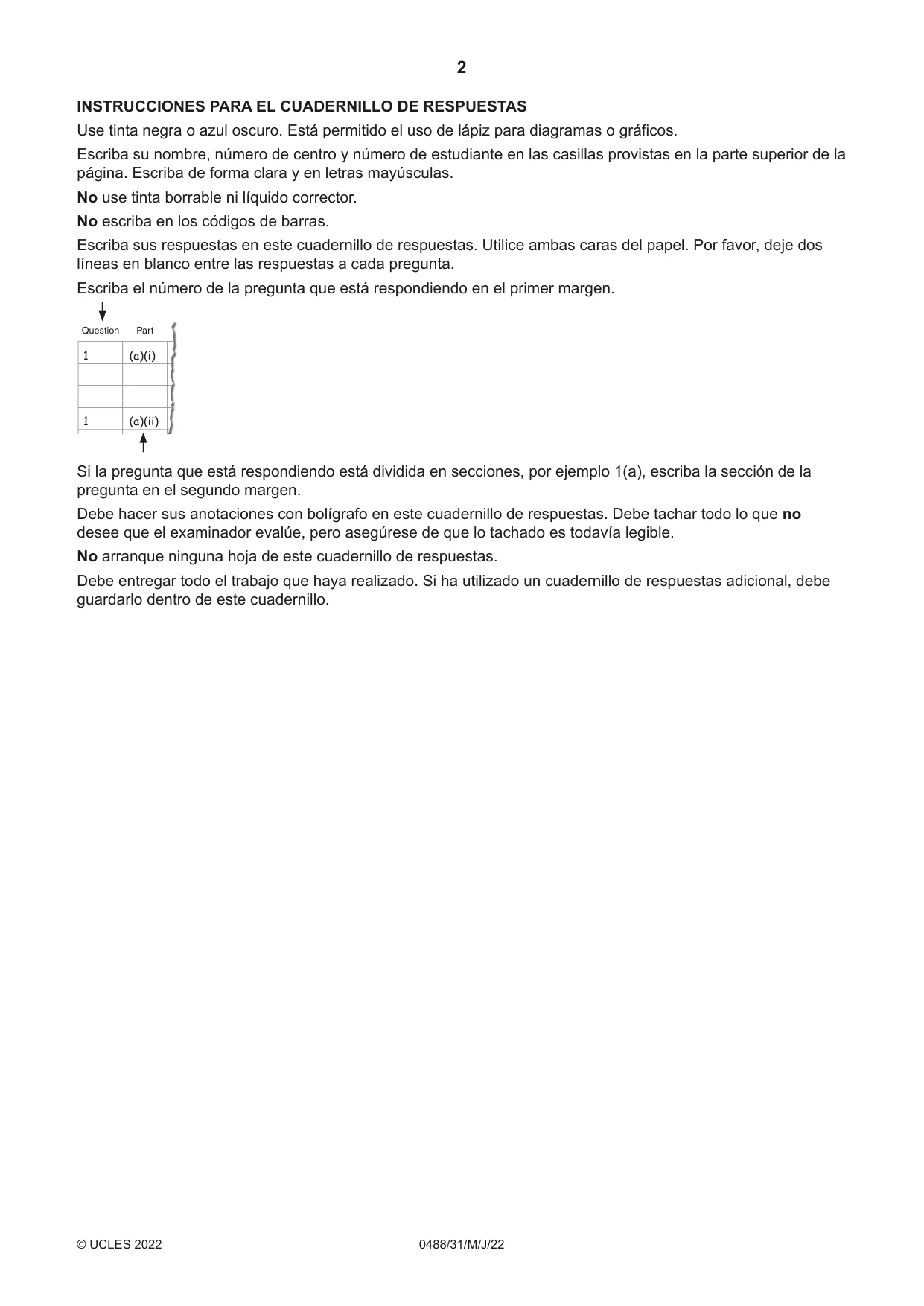
2 0488/31/ M / J /22 © UCLES 2022 INSTRUCCIONES PARA EL CUADERNILLO DE RESPUESTAS Use tinta negra o azul oscuro. Está permitido el uso de lápiz para diagramas o gráficos. Escriba su nombre, número de centro y número de estudiante en las casillas provistas en la parte superior de la página. Escriba de forma clara y en letras mayúsculas. No use tinta borrable ni líquido corrector. No escriba en los códigos de barras. Escriba sus respuestas en este cuadernillo de respuestas. Utilice ambas caras del papel. Por favor, deje dos líneas en blanco entre las respuestas a cada pregunta. Escriba el número de la pregunta que está respondiendo en el primer margen. Question Part 1 1 (a)(i) (a)(ii) Si la pregunta que está respondiendo está dividida en secciones, por ejemplo 1(a), escriba la sección de la pregunta en el segundo margen. Debe hacer sus anotaciones con bolígrafo en este cuadernillo de respuestas. Debe tachar todo lo que no desee que el examinador evalúe, pero asegúrese de que lo tachado es todavía legible. No arranque ninguna hoja de este cuadernillo de respuestas. Debe entregar todo el trabajo que haya realizado. Si ha utilizado un cuadernillo de respuestas adicional, debe guardarlo dentro de este cuadernillo.
Question paper, page 3
3 0488/31/M/J/22 © UCLES 2022 [Turn over BLANK PAGE
Question paper, page 4
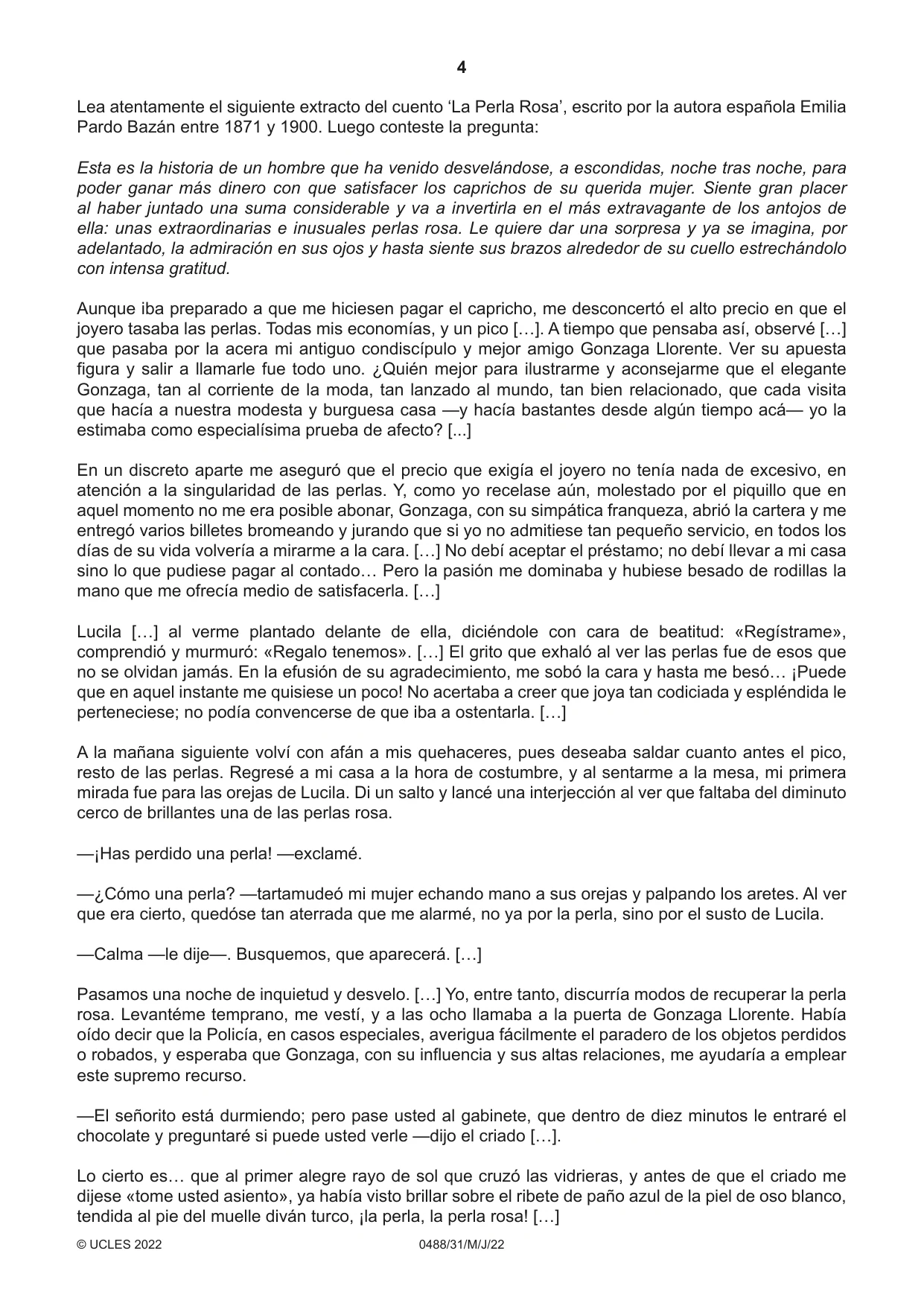
4 0488/31/M/J/22 © UCLES 2022 Lea atentamente el siguiente extracto del cuento ‘La Perla Rosa’, escrito por la autora española Emilia Pardo Bazán entre 1871 y 1900. Luego conteste la pregunta: Esta es la historia de un hombre que ha venido desvelándose, a escondidas, noche tras noche, para poder ganar más dinero con que satisfacer los caprichos de su querida mujer. Siente gran placer al haber juntado una suma considerable y va a invertirla en el más extravagante de los antojos de ella: unas extraordinarias e inusuales perlas rosa. Le quiere dar una sorpresa y ya se imagina, por adelantado, la admiración en sus ojos y hasta siente sus brazos alrededor de su cuello estrechándolo con intensa gratitud. Aunque iba preparado a que me hiciesen pagar el capricho, me desconcertó el alto precio en que el joyero tasaba las perlas. Todas mis economías, y un pico […]. A tiempo que pensaba así, observé […] que pasaba por la acera mi antiguo condiscípulo y mejor amigo Gonzaga Llorente. Ver su apuesta figura y salir a llamarle fue todo uno. ¿Quién mejor para ilustrarme y aconsejarme que el elegante Gonzaga, tan al corriente de la moda, tan lanzado al mundo, tan bien relacionado, que cada visita que hacía a nuestra modesta y burguesa casa —y hacía bastantes desde algún tiempo acá— yo la estimaba como especialísima prueba de afecto? [...] En un discreto aparte me aseguró que el precio que exigía el joyero no tenía nada de excesivo, en atención a la singularidad de las perlas. Y, como yo recelase aún, molestado por el piquillo que en aquel momento no me era posible abonar, Gonzaga, con su simpática franqueza, abrió la cartera y me entregó varios billetes bromeando y jurando que si yo no admitiese tan pequeño servicio, en todos los días de su vida volvería a mirarme a la cara. […] No debí aceptar el préstamo; no debí llevar a mi casa sino lo que pudiese pagar al contado… Pero la pasión me dominaba y hubiese besado de rodillas la mano que me ofrecía medio de satisfacerla. […] Lucila […] al verme plantado delante de ella, diciéndole con cara de beatitud: «Regístrame», comprendió y murmuró: «Regalo tenemos». […] El grito que exhaló al ver las perlas fue de esos que no se olvidan jamás. En la efusión de su agradecimiento, me sobó la cara y hasta me besó… ¡Puede que en aquel instante me quisiese un poco! No acertaba a creer que joya tan codiciada y espléndida le perteneciese; no podía convencerse de que iba a ostentarla. […] A la mañana siguiente volví con afán a mis quehaceres, pues deseaba saldar cuanto antes el pico, resto de las perlas. Regresé a mi casa a la hora de costumbre, y al sentarme a la mesa, mi primera mirada fue para las orejas de Lucila. Di un salto y lancé una interjección al ver que faltaba del diminuto cerco de brillantes una de las perlas rosa. —¡Has perdido una perla! —exclamé. —¿Cómo una perla? —tartamudeó mi mujer echando mano a sus orejas y palpando los aretes. Al ver que era cierto, quedóse tan aterrada que me alarmé, no ya por la perla, sino por el susto de Lucila. —Calma —le dije—. Busquemos, que aparecerá. […] Pasamos una noche de inquietud y desvelo. […] Yo, entre tanto, discurría modos de recuperar la perla rosa. Levantéme temprano, me vestí, y a las ocho llamaba a la puerta de Gonzaga Llorente. Había oído decir que la Policía, en casos especiales, averigua fácilmente el paradero de los objetos perdidos o robados, y esperaba que Gonzaga, con su influencia y sus altas relaciones, me ayudaría a emplear este supremo recurso. —El señorito está durmiendo; pero pase usted al gabinete, que dentro de diez minutos le entraré el chocolate y preguntaré si puede usted verle —dijo el criado […]. Lo cierto es… que al primer alegre rayo de sol que cruzó las vidrieras, y antes de que el criado me dijese «tome usted asiento», ya había visto brillar sobre el ribete de paño azul de la piel de oso blanco, tendida al pie del muelle diván turco, ¡la perla, la perla rosa! […]
Question paper, page 5
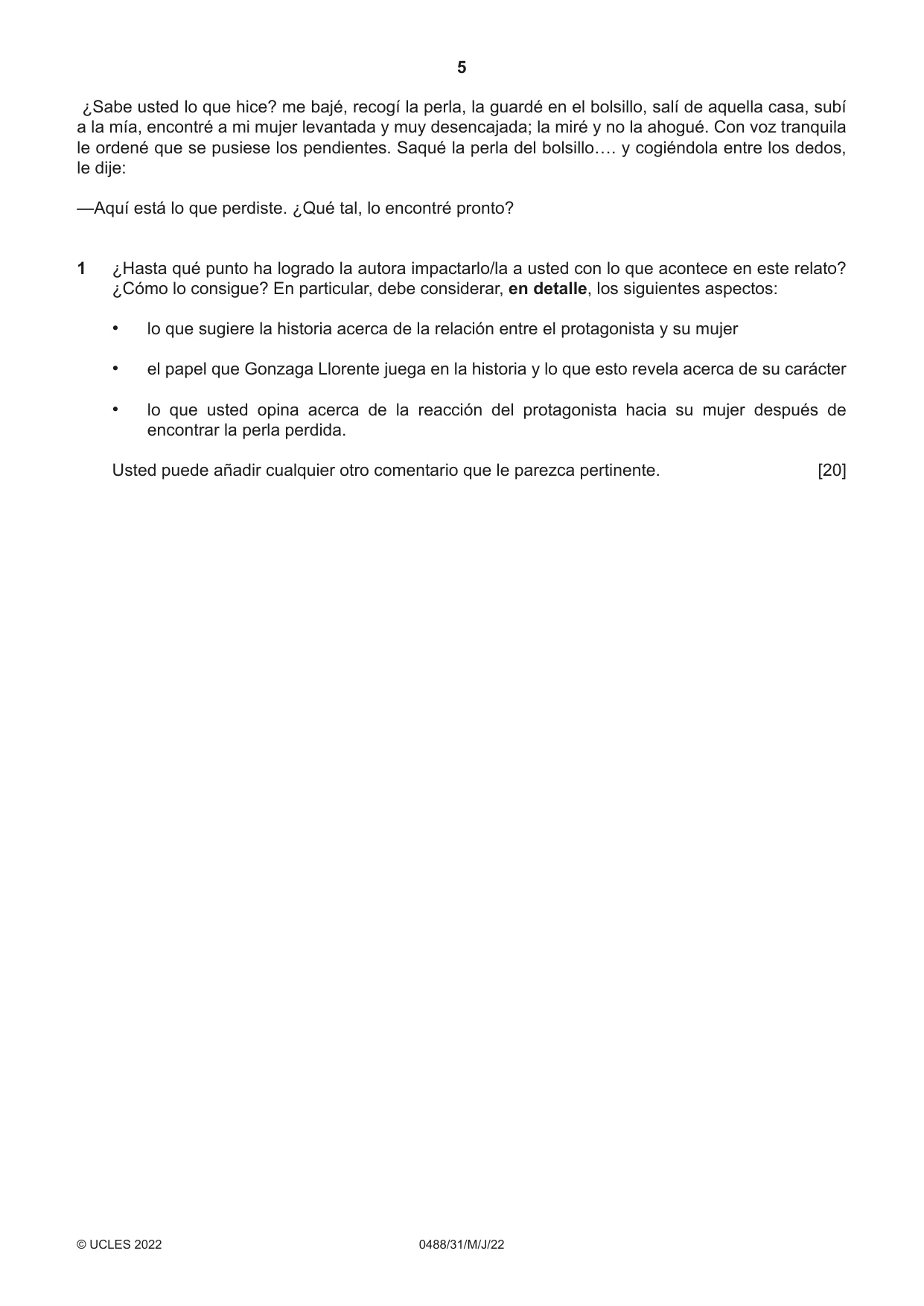
5 0488/31/M/J/22 © UCLES 2022 ¿Sabe usted lo que hice? me bajé, recogí la perla, la guardé en el bolsillo, salí de aquella casa, subí a la mía, encontré a mi mujer levantada y muy desencajada; la miré y no la ahogué. Con voz tranquila le ordené que se pusiese los pendientes. Saqué la perla del bolsillo…. y cogiéndola entre los dedos, le dije: —Aquí está lo que perdiste. ¿Qué tal, lo encontré pronto? 1 ¿Hasta qué punto ha logrado la autora impactarlo/la a usted con lo que acontece en este relato? ¿Cómo lo consigue? En particular, debe considerar, en detalle, los siguientes aspectos: • lo que sugiere la historia acerca de la relación entre el protagonista y su mujer • el papel que Gonzaga Llorente juega en la historia y lo que esto revela acerca de su carácter • lo que usted opina acerca de la reacción del protagonista hacia su mujer después de encontrar la perla perdida. Usted puede añadir cualquier otro comentario que le parezca pertinente. [20]
Question paper, page 6
6 0488/31/M/J/22 © UCLES 2022 BLANK PAGE
Question paper, page 7
7 0488/31/M/J/22 © UCLES 2022 BLANK PAGE
Question paper, page 8
8 0488/31/M/J/22 © UCLES 2022 Permission to reproduce items where third-party owned material protected by copyright is included has been sought and cleared where possible. Every reasonable effort has been made by the publisher (UCLES) to trace copyright holders, but if any items requiring clearance have unwittingly been included, the publisher will be pleased to make amends at the earliest possible opportunity. To avoid the issue of disclosure of answer-related information to candidates, all copyright acknowledgements are reproduced online in the Cambridge Assessment International Education Copyright Acknowledgements Booklet. This is produced for each series of examinations and is freely available to download at www.cambridgeinternational.org after the live examination series. Cambridge Assessment International Education is part of Cambridge Assessment. Cambridge Assessment is the brand name of the University of Cambridge Local Examinations Syndicate (UCLES), which is a department of the University of Cambridge. BLANK PAGE
Mark scheme, page 1
This document consists of 8 printed pages. © UCLES 2022 [Turn over Cambridge IGCSE™ LITERATURE (SPANISH) 0488/31 Paper 3 Alternative to Coursework May/June 2022 MARK SCHEME Maximum Mark: 20 Published This mark scheme is published as an aid to teachers and candidates, to indicate the requirements of the examination. It shows the basis on which Examiners were instructed to award marks. It does not indicate the details of the discussions that took place at an Examiners’ meeting before marking began, which would have considered the acceptability of alternative answers. Mark schemes should be read in conjunction with the question paper and the Principal Examiner Report for Teachers. Cambridge International will not enter into discussions about these mark schemes. Cambridge International is publishing the mark schemes for the May/June 2022 series for most Cambridge IGCSE, Cambridge International A and AS Level and Cambridge Pre-U components, and some Cambridge O Level components.
Mark scheme, page 2
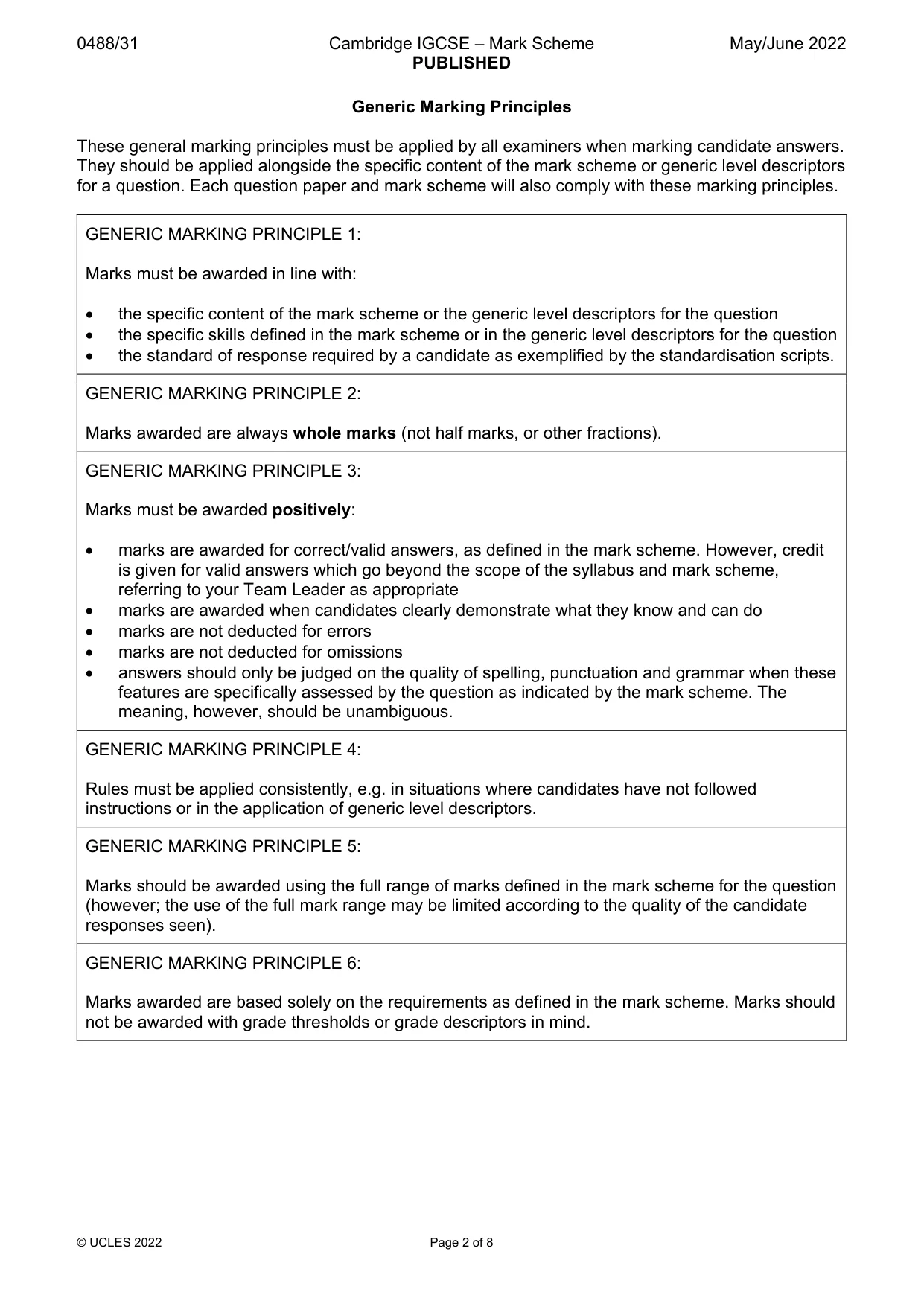
0488/31 Cambridge IGCSE – Mark Scheme PUBLISHED May/June 2022 © UCLES 2022 Page 2 of 8 Generic Marking Principles These general marking principles must be applied by all examiners when marking candidate answers. They should be applied alongside the specific content of the mark scheme or generic level descriptors for a question. Each question paper and mark scheme will also comply with these marking principles. GENERIC MARKING PRINCIPLE 1: Marks must be awarded in line with: the specific content of the mark scheme or the generic level descriptors for the question the specific skills defined in the mark scheme or in the generic level descriptors for the question the standard of response required by a candidate as exemplified by the standardisation scripts. GENERIC MARKING PRINCIPLE 2: Marks awarded are always whole marks (not half marks, or other fractions). GENERIC MARKING PRINCIPLE 3: Marks must be awarded positively: marks are awarded for correct/valid answers, as defined in the mark scheme. However, credit is given for valid answers which go beyond the scope of the syllabus and mark scheme, referring to your Team Leader as appropriate marks are awarded when candidates clearly demonstrate what they know and can do marks are not deducted for errors marks are not deducted for omissions answers should only be judged on the quality of spelling, punctuation and grammar when these features are specifically assessed by the question as indicated by the mark scheme. The meaning, however, should be unambiguous. GENERIC MARKING PRINCIPLE 4: Rules must be applied consistently, e.g. in situations where candidates have not followed instructions or in the application of generic level descriptors. GENERIC MARKING PRINCIPLE 5: Marks should be awarded using the full range of marks defined in the mark scheme for the question (however; the use of the full mark range may be limited according to the quality of the candidate responses seen). GENERIC MARKING PRINCIPLE 6: Marks awarded are based solely on the requirements as defined in the mark scheme. Marks should not be awarded with grade thresholds or grade descriptors in mind.
Mark scheme, page 3
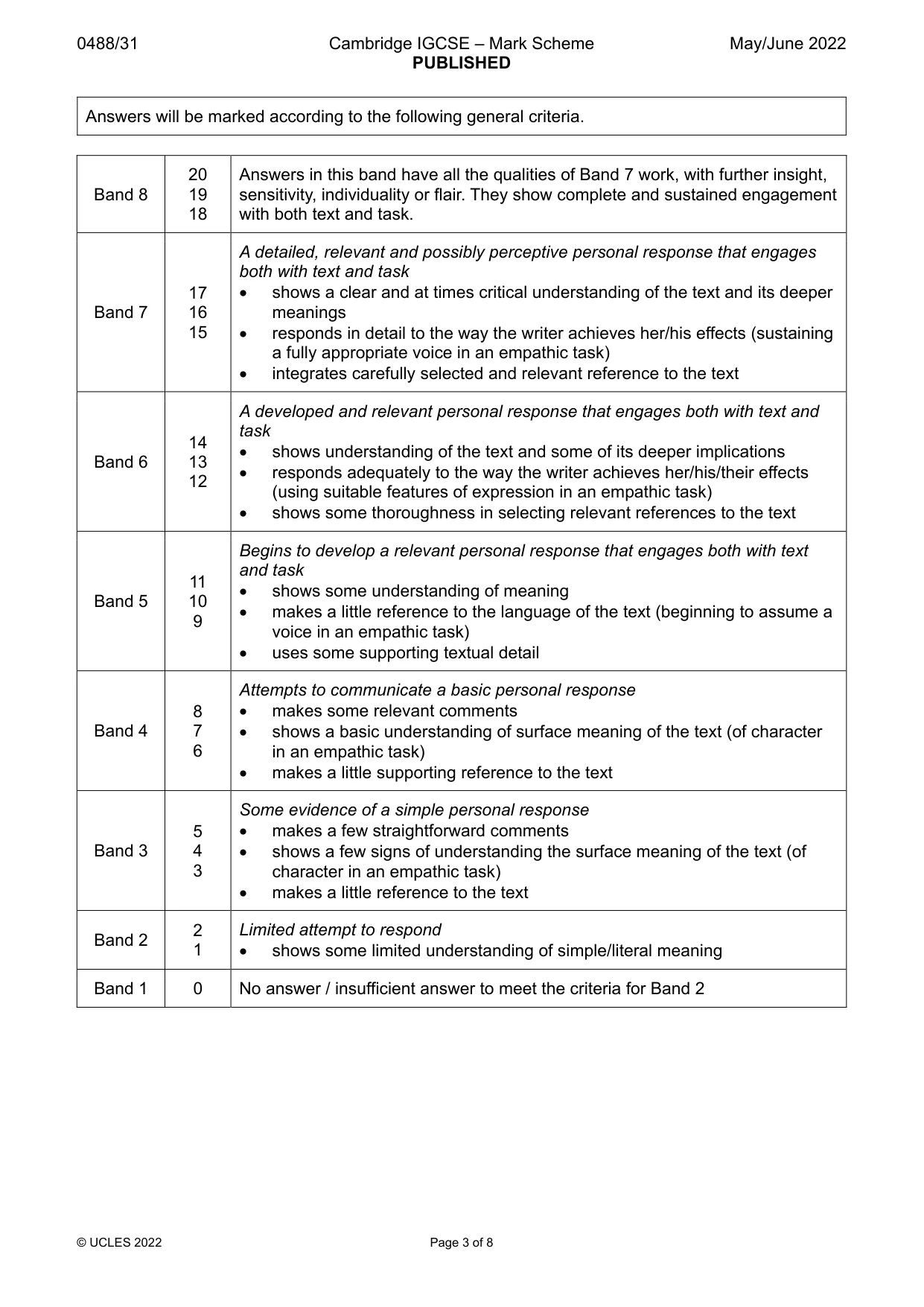
0488/31 Cambridge IGCSE – Mark Scheme PUBLISHED May/June 2022 © UCLES 2022 Page 3 of 8 Answers will be marked according to the following general criteria. Band 8 20 19 18 Answers in this band have all the qualities of Band 7 work, with further insight, sensitivity, individuality or flair. They show complete and sustained engagement with both text and task. Band 7 17 16 15 A detailed, relevant and possibly perceptive personal response that engages both with text and task shows a clear and at times critical understanding of the text and its deeper meanings responds in detail to the way the writer achieves her/his effects (sustaining a fully appropriate voice in an empathic task) integrates carefully selected and relevant reference to the text Band 6 14 13 12 A developed and relevant personal response that engages both with text and task shows understanding of the text and some of its deeper implications responds adequately to the way the writer achieves her/his/their effects (using suitable features of expression in an empathic task) shows some thoroughness in selecting relevant references to the text Band 5 11 10 9 Begins to develop a relevant personal response that engages both with text and task shows some understanding of meaning makes a little reference to the language of the text (beginning to assume a voice in an empathic task) uses some supporting textual detail Band 4 8 7 6 Attempts to communicate a basic personal response makes some relevant comments shows a basic understanding of surface meaning of the text (of character in an empathic task) makes a little supporting reference to the text Band 3 5 4 3 Some evidence of a simple personal response makes a few straightforward comments shows a few signs of understanding the surface meaning of the text (of character in an empathic task) makes a little reference to the text Band 2 2 1 Limited attempt to respond shows some limited understanding of simple/literal meaning Band 1 0 No answer / insufficient answer to meet the criteria for Band 2
Mark scheme, page 4
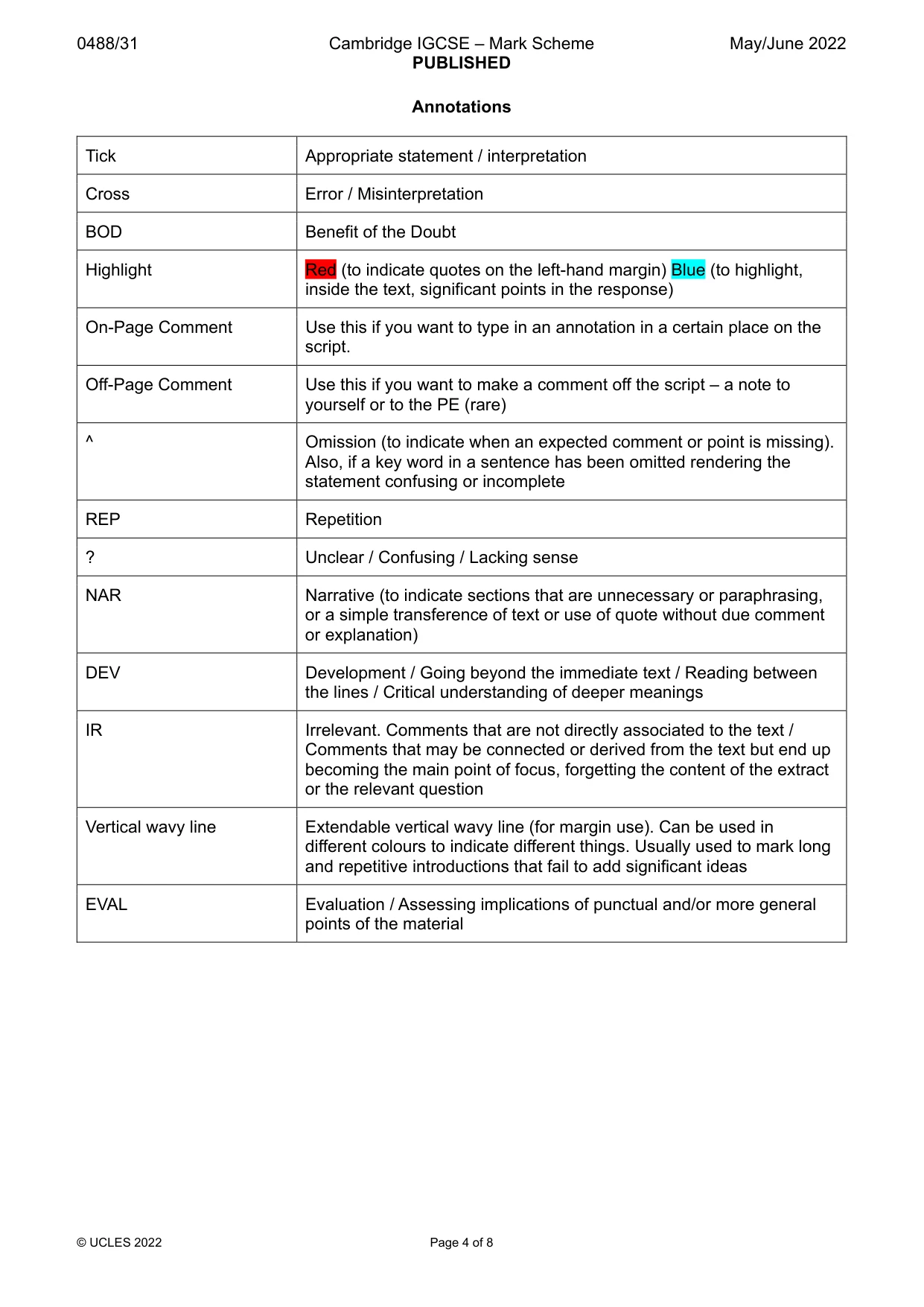
0488/31 Cambridge IGCSE – Mark Scheme PUBLISHED May/June 2022 © UCLES 2022 Page 4 of 8 Annotations Tick Appropriate statement / interpretation Cross Error / Misinterpretation BOD Benefit of the Doubt Highlight Red (to indicate quotes on the left-hand margin) Blue (to highlight, inside the text, significant points in the response) On-Page Comment Use this if you want to type in an annotation in a certain place on the script. Off-Page Comment Use this if you want to make a comment off the script – a note to yourself or to the PE (rare) ^ Omission (to indicate when an expected comment or point is missing). Also, if a key word in a sentence has been omitted rendering the statement confusing or incomplete REP Repetition ? Unclear / Confusing / Lacking sense NAR Narrative (to indicate sections that are unnecessary or paraphrasing, or a simple transference of text or use of quote without due comment or explanation) DEV Development / Going beyond the immediate text / Reading between the lines / Critical understanding of deeper meanings IR Irrelevant. Comments that are not directly associated to the text / Comments that may be connected or derived from the text but end up becoming the main point of focus, forgetting the content of the extract or the relevant question Vertical wavy line Extendable vertical wavy line (for margin use). Can be used in different colours to indicate different things. Usually used to mark long and repetitive introductions that fail to add significant ideas EVAL Evaluation / Assessing implications of punctual and/or more general points of the material
Mark scheme, page 5
0488/31 Cambridge IGCSE – Mark Scheme PUBLISHED May/June 2022 © UCLES 2022 Page 5 of 8 Using annotations Remember that this is a literature not a language assessment: do not correct or comment on individual spelling and grammatical errors. (But you might comment if relevant at the end of the script – e.g. ‘Frequent errors obscure meaning.’) These may be factual comments or comments on key features of the answer related to the mark scheme e.g. well-developed/undeveloped, clear/unclear, insufficient/reference to text; needs to explain point; good ref to dramatic qualities; needs to expand; evidence?; detail; not answering question. Be careful to distinguish between an unusual opinion and a factual error. At the bottom of the script put a brief summary comment based on the mark scheme e.g. Competent answer with some evidence of personal appreciation; a couple of significant omissions.
Mark scheme, page 6
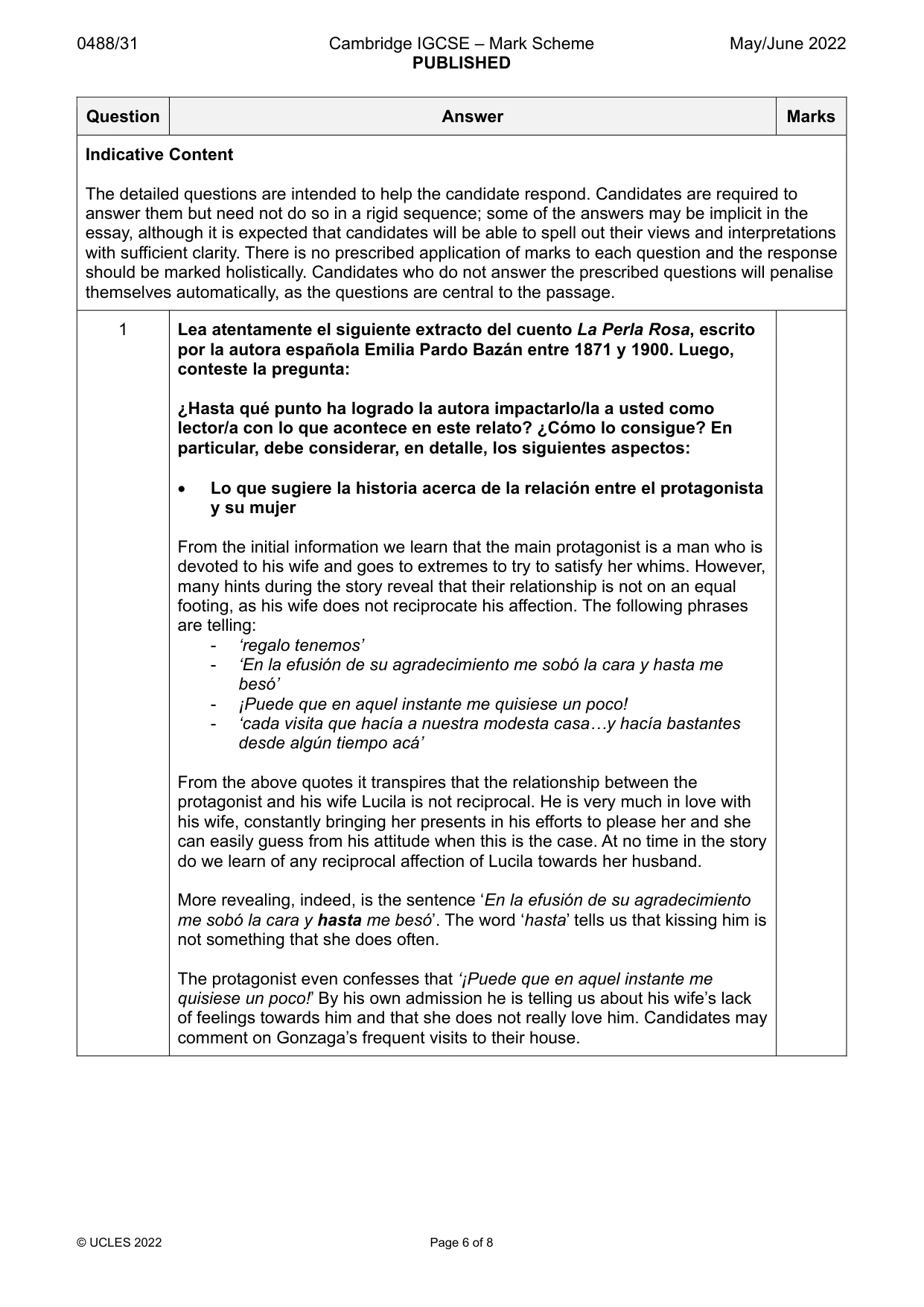
0488/31 Cambridge IGCSE – Mark Scheme PUBLISHED May/June 2022 © UCLES 2022 Page 6 of 8 Question Answer Marks Indicative Content The detailed questions are intended to help the candidate respond. Candidates are required to answer them but need not do so in a rigid sequence; some of the answers may be implicit in the essay, although it is expected that candidates will be able to spell out their views and interpretations with sufficient clarity. There is no prescribed application of marks to each question and the response should be marked holistically. Candidates who do not answer the prescribed questions will penalise themselves automatically, as the questions are central to the passage. 1 Lea atentamente el siguiente extracto del cuento La Perla Rosa, escrito por la autora española Emilia Pardo Bazán entre 1871 y 1900. Luego, conteste la pregunta: ¿Hasta qué punto ha logrado la autora impactarlo/la a usted como lector/a con lo que acontece en este relato? ¿Cómo lo consigue? En particular, debe considerar, en detalle, los siguientes aspectos: Lo que sugiere la historia acerca de la relación entre el protagonista y su mujer From the initial information we learn that the main protagonist is a man who is devoted to his wife and goes to extremes to try to satisfy her whims. However, many hints during the story reveal that their relationship is not on an equal footing, as his wife does not reciprocate his affection. The following phrases are telling: - ‘regalo tenemos’ - ‘En la efusión de su agradecimiento me sobó la cara y hasta me besó’ - ¡Puede que en aquel instante me quisiese un poco! - ‘cada visita que hacía a nuestra modesta casa…y hacía bastantes desde algún tiempo acá’ From the above quotes it transpires that the relationship between the protagonist and his wife Lucila is not reciprocal. He is very much in love with his wife, constantly bringing her presents in his efforts to please her and she can easily guess from his attitude when this is the case. At no time in the story do we learn of any reciprocal affection of Lucila towards her husband. More revealing, indeed, is the sentence ‘En la efusión de su agradecimiento me sobó la cara y hasta me besó’. The word ‘hasta’ tells us that kissing him is not something that she does often. The protagonist even confesses that ‘¡Puede que en aquel instante me quisiese un poco!’ By his own admission he is telling us about his wife’s lack of feelings towards him and that she does not really love him. Candidates may comment on Gonzaga’s frequent visits to their house.
Mark scheme, page 7
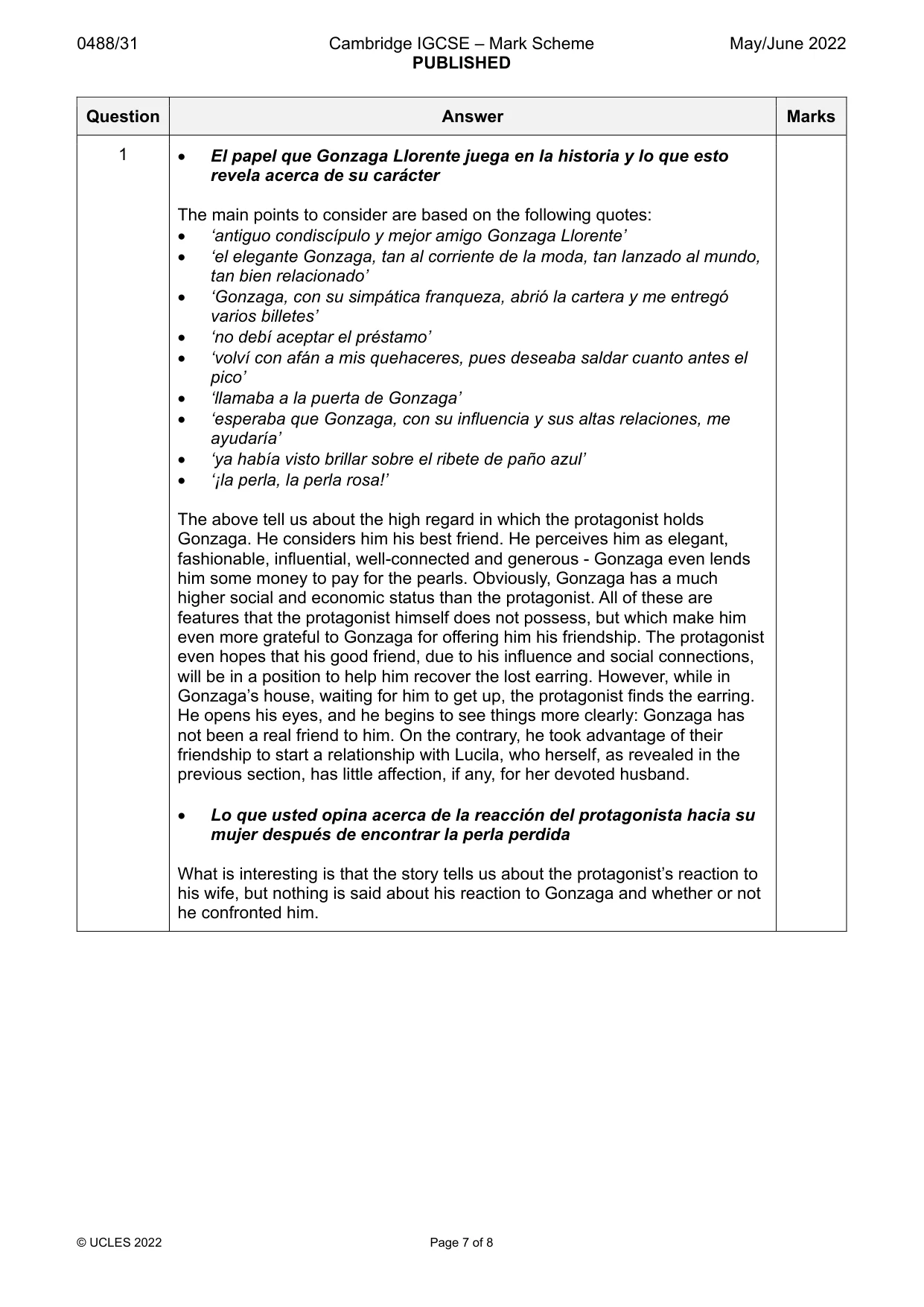
0488/31 Cambridge IGCSE – Mark Scheme PUBLISHED May/June 2022 © UCLES 2022 Page 7 of 8 Question Answer Marks 1 El papel que Gonzaga Llorente juega en la historia y lo que esto revela acerca de su carácter The main points to consider are based on the following quotes: ‘antiguo condiscípulo y mejor amigo Gonzaga Llorente’ ‘el elegante Gonzaga, tan al corriente de la moda, tan lanzado al mundo, tan bien relacionado’ ‘Gonzaga, con su simpática franqueza, abrió la cartera y me entregó varios billetes’ ‘no debí aceptar el préstamo’ ‘volví con afán a mis quehaceres, pues deseaba saldar cuanto antes el pico’ ‘llamaba a la puerta de Gonzaga’ ‘esperaba que Gonzaga, con su influencia y sus altas relaciones, me ayudaría’ ‘ya había visto brillar sobre el ribete de paño azul’ ‘¡la perla, la perla rosa!’ The above tell us about the high regard in which the protagonist holds Gonzaga. He considers him his best friend. He perceives him as elegant, fashionable, influential, well-connected and generous - Gonzaga even lends him some money to pay for the pearls. Obviously, Gonzaga has a much higher social and economic status than the protagonist. All of these are features that the protagonist himself does not possess, but which make him even more grateful to Gonzaga for offering him his friendship. The protagonist even hopes that his good friend, due to his influence and social connections, will be in a position to help him recover the lost earring. However, while in Gonzaga’s house, waiting for him to get up, the protagonist finds the earring. He opens his eyes, and he begins to see things more clearly: Gonzaga has not been a real friend to him. On the contrary, he took advantage of their friendship to start a relationship with Lucila, who herself, as revealed in the previous section, has little affection, if any, for her devoted husband. Lo que usted opina acerca de la reacción del protagonista hacia su mujer después de encontrar la perla perdida What is interesting is that the story tells us about the protagonist’s reaction to his wife, but nothing is said about his reaction to Gonzaga and whether or not he confronted him.
Mark scheme, page 8
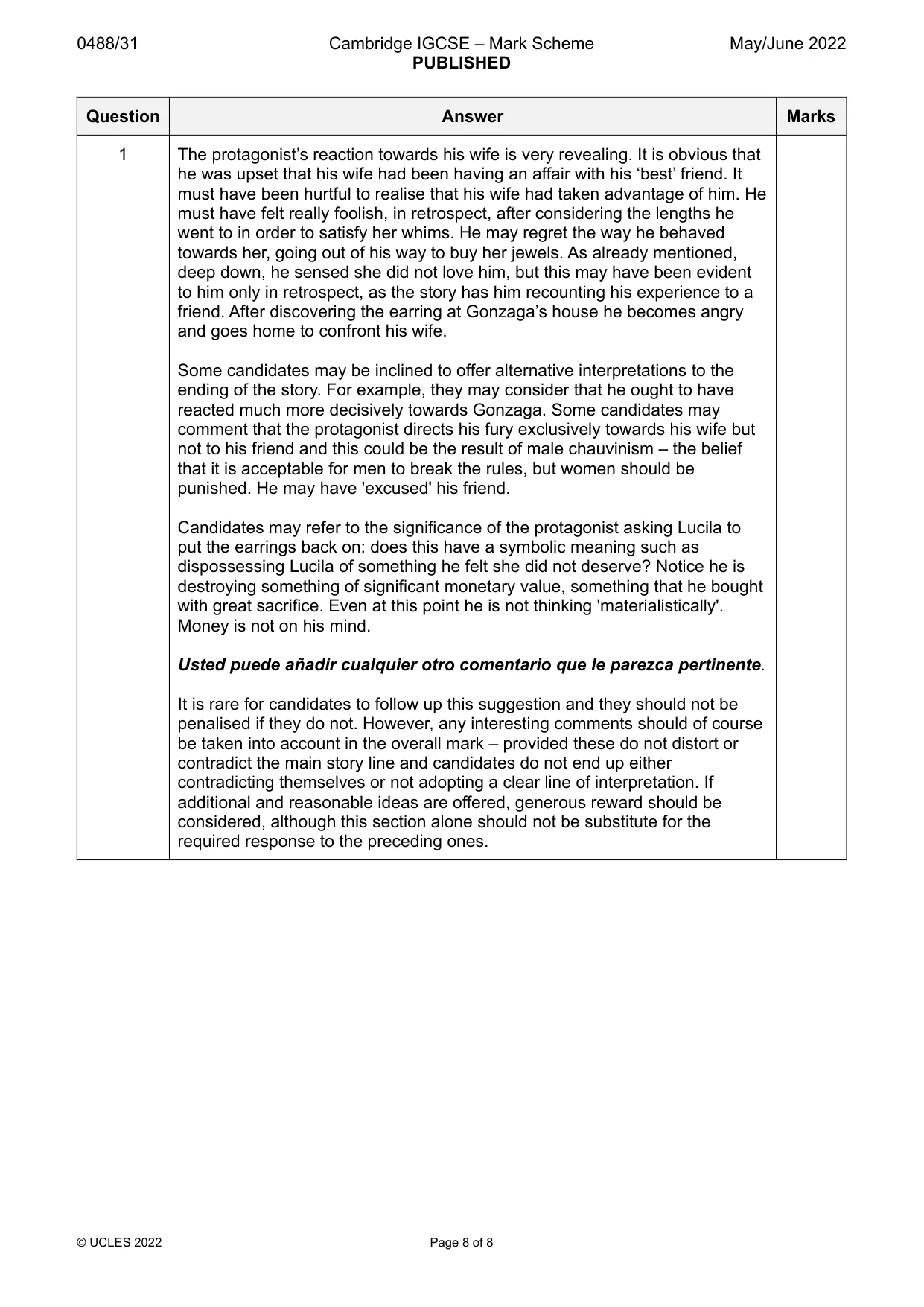
0488/31 Cambridge IGCSE – Mark Scheme PUBLISHED May/June 2022 © UCLES 2022 Page 8 of 8 Question Answer Marks 1 The protagonist’s reaction towards his wife is very revealing. It is obvious that he was upset that his wife had been having an affair with his ‘best’ friend. It must have been hurtful to realise that his wife had taken advantage of him. He must have felt really foolish, in retrospect, after considering the lengths he went to in order to satisfy her whims. He may regret the way he behaved towards her, going out of his way to buy her jewels. As already mentioned, deep down, he sensed she did not love him, but this may have been evident to him only in retrospect, as the story has him recounting his experience to a friend. After discovering the earring at Gonzaga’s house he becomes angry and goes home to confront his wife. Some candidates may be inclined to offer alternative interpretations to the ending of the story. For example, they may consider that he ought to have reacted much more decisively towards Gonzaga. Some candidates may comment that the protagonist directs his fury exclusively towards his wife but not to his friend and this could be the result of male chauvinism – the belief that it is acceptable for men to break the rules, but women should be punished. He may have 'excused' his friend. Candidates may refer to the significance of the protagonist asking Lucila to put the earrings back on: does this have a symbolic meaning such as dispossessing Lucila of something he felt she did not deserve? Notice he is destroying something of significant monetary value, something that he bought with great sacrifice. Even at this point he is not thinking 'materialistically'. Money is not on his mind. Usted puede añadir cualquier otro comentario que le parezca pertinente. It is rare for candidates to follow up this suggestion and they should not be penalised if they do not. However, any interesting comments should of course be taken into account in the overall mark – provided these do not distort or contradict the main story line and candidates do not end up either contradicting themselves or not adopting a clear line of interpretation. If additional and reasonable ideas are offered, generous reward should be considered, although this section alone should not be substitute for the required response to the preceding ones.
What you needed in this session
Cambridge’s own grade thresholds for 2022 May/June, Paper 3 · Variant 1. A higher threshold means an easier paper — the bar moves with how the cohort did.