Cambridge IGCSE Spanish - Literature 0488 — 2021 May/June Paper 3 · Variant 1
0488/31/M/J/21 · 20 marks · ≈23 min
The question paper and its mark scheme, free to read here and free to download. This is Cambridge’s own paper, exactly as it was sat.
Question paper8 pages




Mark scheme10 pages
Answers below. Sit the paper first if you are practising.
Paper as text
Question paper, page 1
This document has 8 pages. Any blank pages are indicated. DC (JP) 202000/2 © UCLES 2021 [Turn over * 7 6 0 4 7 7 6 9 0 7 * Cambridge IGCSE™ LITERATURE (SPANISH) 0488/31 Paper 3 Alternative to Coursework May/June 2021 1 hour 20 minutes You must answer on the enclosed answer booklet. You will need: Answer booklet (enclosed) INSTRUCTIONS ● Answer the question. ● Follow the instructions on the front cover of the answer booklet. If you need additional answer paper, ask the invigilator for a continuation booklet. INFORMATION ● The total mark for this paper is 20. ● The number of marks for each question or part question is shown in brackets [ ]. INSTRUCCIONES ● Conteste a la pregunta. ● Siga las instrucciones que aparecen en la portada del cuadernillo de respuestas. Las instrucciones aparecen también en español a continuación. Si necesita hojas adicionales, pídale al supervisor un cuadernillo de respuestas adicional. INFORMACIÓN ● La puntuación total de este examen es de 20. ● La puntuación de cada pregunta o apartados de la misma aparece entre corchetes [ ].
Question paper, page 2
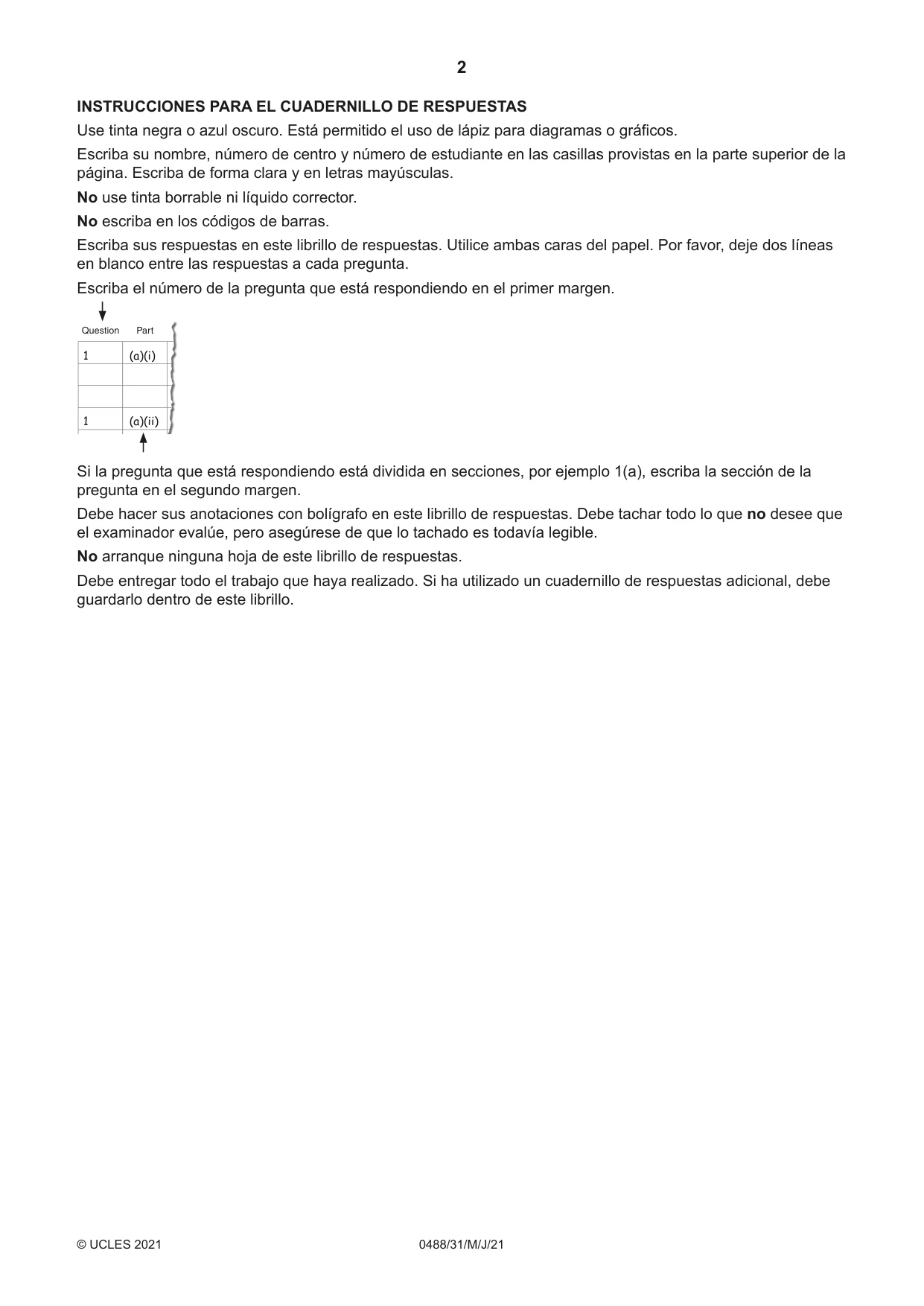
2 0488/31/ M / J /21 © UCLES 2021 INSTRUCCIONES PARA EL CUADERNILLO DE RESPUESTAS Use tinta negra o azul oscuro. Está permitido el uso de lápiz para diagramas o gráficos. Escriba su nombre, número de centro y número de estudiante en las casillas provistas en la parte superior de la página. Escriba de forma clara y en letras mayúsculas. No use tinta borrable ni líquido corrector. No escriba en los códigos de barras. Escriba sus respuestas en este librillo de respuestas. Utilice ambas caras del papel. Por favor, deje dos líneas en blanco entre las respuestas a cada pregunta. Escriba el número de la pregunta que está respondiendo en el primer margen. Question Part 1 1 (a)(i) (a)(ii) Si la pregunta que está respondiendo está dividida en secciones, por ejemplo 1(a), escriba la sección de la pregunta en el segundo margen. Debe hacer sus anotaciones con bolígrafo en este librillo de respuestas. Debe tachar todo lo que no desee que el examinador evalúe, pero asegúrese de que lo tachado es todavía legible. No arranque ninguna hoja de este librillo de respuestas. Debe entregar todo el trabajo que haya realizado. Si ha utilizado un cuadernillo de respuestas adicional, debe guardarlo dentro de este librillo.
Question paper, page 3
3 0488/31/M/J/21 © UCLES 2021 [Turn over BLANK PAGE
Question paper, page 4
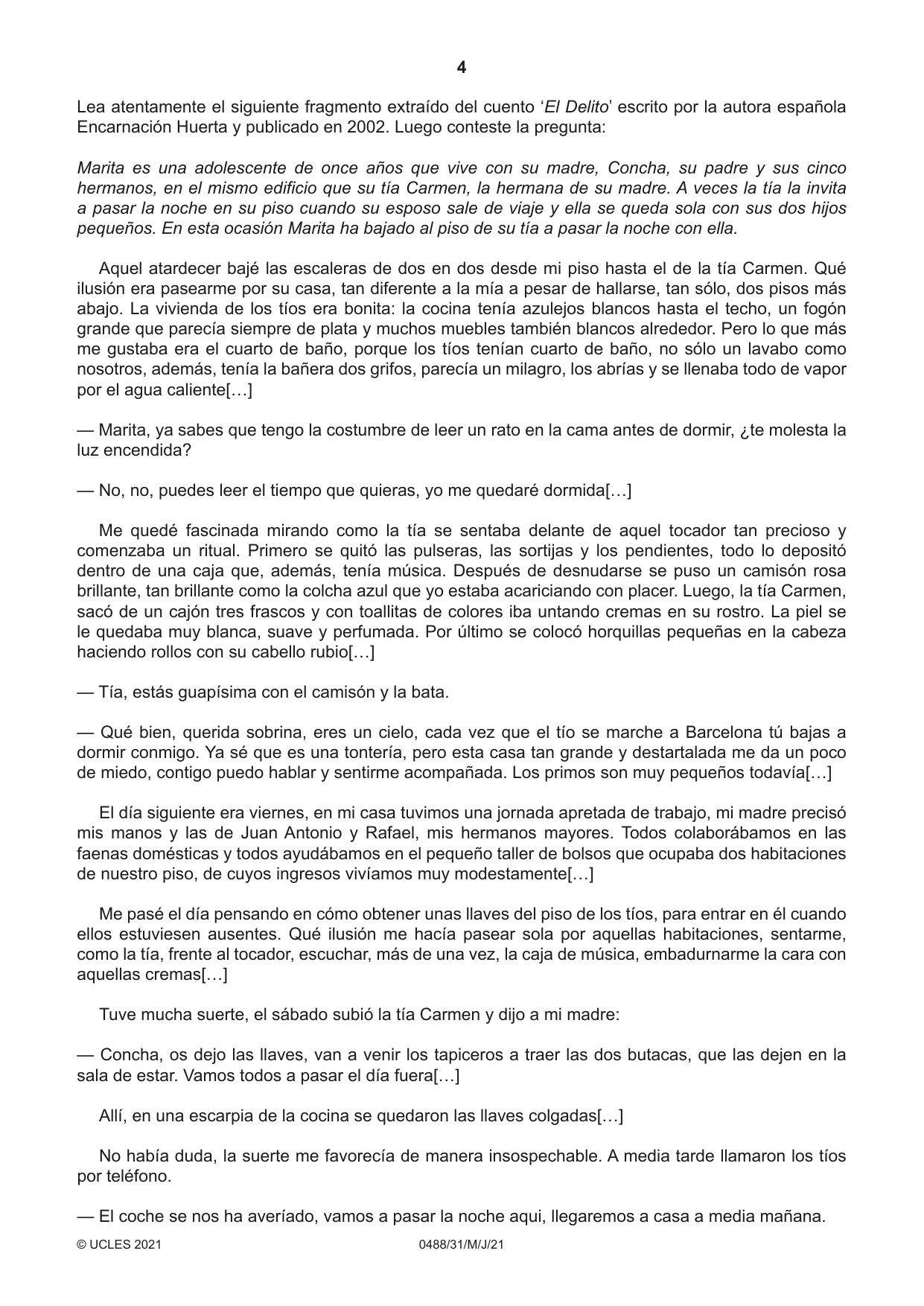
4 0488/31/M/J/21 © UCLES 2021 Lea atentamente el siguiente fragmento extraído del cuento ‘El Delito’ escrito por la autora española Encarnación Huerta y publicado en 2002. Luego conteste la pregunta: Marita es una adolescente de once años que vive con su madre, Concha, su padre y sus cinco hermanos, en el mismo edificio que su tía Carmen, la hermana de su madre. A veces la tía la invita a pasar la noche en su piso cuando su esposo sale de viaje y ella se queda sola con sus dos hijos pequeños. En esta ocasión Marita ha bajado al piso de su tía a pasar la noche con ella. Aquel atardecer bajé las escaleras de dos en dos desde mi piso hasta el de la tía Carmen. Qué ilusión era pasearme por su casa, tan diferente a la mía a pesar de hallarse, tan sólo, dos pisos más abajo. La vivienda de los tíos era bonita: la cocina tenía azulejos blancos hasta el techo, un fogón grande que parecía siempre de plata y muchos muebles también blancos alrededor. Pero lo que más me gustaba era el cuarto de baño, porque los tíos tenían cuarto de baño, no sólo un lavabo como nosotros, además, tenía la bañera dos grifos, parecía un milagro, los abrías y se llenaba todo de vapor por el agua caliente[…] — Marita, ya sabes que tengo la costumbre de leer un rato en la cama antes de dormir, ¿te molesta la luz encendida? — No, no, puedes leer el tiempo que quieras, yo me quedaré dormida[…] Me quedé fascinada mirando como la tía se sentaba delante de aquel tocador tan precioso y comenzaba un ritual. Primero se quitó las pulseras, las sortijas y los pendientes, todo lo depositó dentro de una caja que, además, tenía música. Después de desnudarse se puso un camisón rosa brillante, tan brillante como la colcha azul que yo estaba acariciando con placer. Luego, la tía Carmen, sacó de un cajón tres frascos y con toallitas de colores iba untando cremas en su rostro. La piel se le quedaba muy blanca, suave y perfumada. Por último se colocó horquillas pequeñas en la cabeza haciendo rollos con su cabello rubio[…] — Tía, estás guapísima con el camisón y la bata. — Qué bien, querida sobrina, eres un cielo, cada vez que el tío se marche a Barcelona tú bajas a dormir conmigo. Ya sé que es una tontería, pero esta casa tan grande y destartalada me da un poco de miedo, contigo puedo hablar y sentirme acompañada. Los primos son muy pequeños todavía[…] El día siguiente era viernes, en mi casa tuvimos una jornada apretada de trabajo, mi madre precisó mis manos y las de Juan Antonio y Rafael, mis hermanos mayores. Todos colaborábamos en las faenas domésticas y todos ayudábamos en el pequeño taller de bolsos que ocupaba dos habitaciones de nuestro piso, de cuyos ingresos vivíamos muy modestamente[…] Me pasé el día pensando en cómo obtener unas llaves del piso de los tíos, para entrar en él cuando ellos estuviesen ausentes. Qué ilusión me hacía pasear sola por aquellas habitaciones, sentarme, como la tía, frente al tocador, escuchar, más de una vez, la caja de música, embadurnarme la cara con aquellas cremas[…] Tuve mucha suerte, el sábado subió la tía Carmen y dijo a mi madre: — Concha, os dejo las llaves, van a venir los tapiceros a traer las dos butacas, que las dejen en la sala de estar. Vamos todos a pasar el día fuera[…] Allí, en una escarpia de la cocina se quedaron las llaves colgadas[…] No había duda, la suerte me favorecía de manera insospechable. A media tarde llamaron los tíos por teléfono. — El coche se nos ha averíado, vamos a pasar la noche aqui, llegaremos a casa a media mañana.
Question paper, page 5
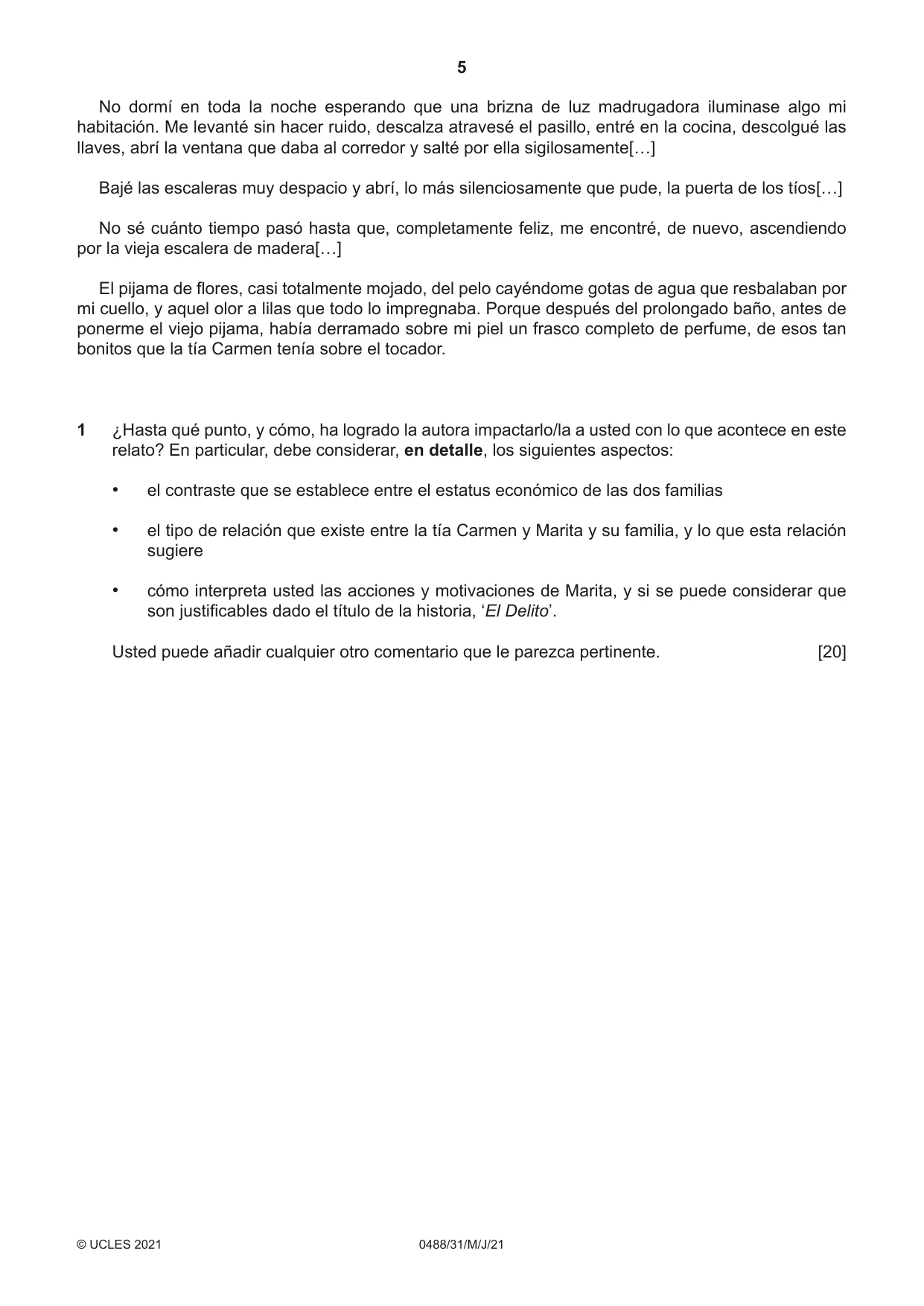
5 0488/31/M/J/21 © UCLES 2021 No dormí en toda la noche esperando que una brizna de luz madrugadora iluminase algo mi habitación. Me levanté sin hacer ruido, descalza atravesé el pasillo, entré en la cocina, descolgué las llaves, abrí la ventana que daba al corredor y salté por ella sigilosamente[…] Bajé las escaleras muy despacio y abrí, lo más silenciosamente que pude, la puerta de los tíos[…] No sé cuánto tiempo pasó hasta que, completamente feliz, me encontré, de nuevo, ascendiendo por la vieja escalera de madera[…] El pijama de flores, casi totalmente mojado, del pelo cayéndome gotas de agua que resbalaban por mi cuello, y aquel olor a lilas que todo lo impregnaba. Porque después del prolongado baño, antes de ponerme el viejo pijama, había derramado sobre mi piel un frasco completo de perfume, de esos tan bonitos que la tía Carmen tenía sobre el tocador. 1 ¿Hasta qué punto, y cómo, ha logrado la autora impactarlo/la a usted con lo que acontece en este relato? En particular, debe considerar, en detalle, los siguientes aspectos: • el contraste que se establece entre el estatus económico de las dos familias • el tipo de relación que existe entre la tía Carmen y Marita y su familia, y lo que esta relación sugiere • cómo interpreta usted las acciones y motivaciones de Marita, y si se puede considerar que son justificables dado el título de la historia, ‘El Delito’. Usted puede añadir cualquier otro comentario que le parezca pertinente. [20]
Question paper, page 6
6 0488/31/M/J/21 © UCLES 2021 BLANK PAGE
Question paper, page 7
7 0488/31/M/J/21 © UCLES 2021 BLANK PAGE
Question paper, page 8
8 0488/31/M/J/21 © UCLES 2021 Permission to reproduce items where third-party owned material protected by copyright is included has been sought and cleared where possible. Every reasonable effort has been made by the publisher (UCLES) to trace copyright holders, but if any items requiring clearance have unwittingly been included, the publisher will be pleased to make amends at the earliest possible opportunity. To avoid the issue of disclosure of answer-related information to candidates, all copyright acknowledgements are reproduced online in the Cambridge Assessment International Education Copyright Acknowledgements Booklet. This is produced for each series of examinations and is freely available to download at www.cambridgeinternational.org after the live examination series. Cambridge Assessment International Education is part of the Cambridge Assessment Group. Cambridge Assessment is the brand name of the University of Cambridge Local Examinations Syndicate (UCLES), which itself is a department of the University of Cambridge. BLANK PAGE
Mark scheme, page 1
This document consists of 10 printed pages. © UCLES 2021 [Turn over Cambridge IGCSE™ LITERATURE (SPANISH) 0488/31 Paper 3 Alternative to Coursework May/June 2021 MARK SCHEME Maximum Mark: 20 Published This mark scheme is published as an aid to teachers and candidates, to indicate the requirements of the examination. It shows the basis on which Examiners were instructed to award marks. It does not indicate the details of the discussions that took place at an Examiners’ meeting before marking began, which would have considered the acceptability of alternative answers. Mark schemes should be read in conjunction with the question paper and the Principal Examiner Report for Teachers. Cambridge International will not enter into discussions about these mark schemes. Cambridge International is publishing the mark schemes for the May/June 2021 series for most Cambridge IGCSE™, Cambridge International A and AS Level components and some Cambridge O Level components.
Mark scheme, page 2
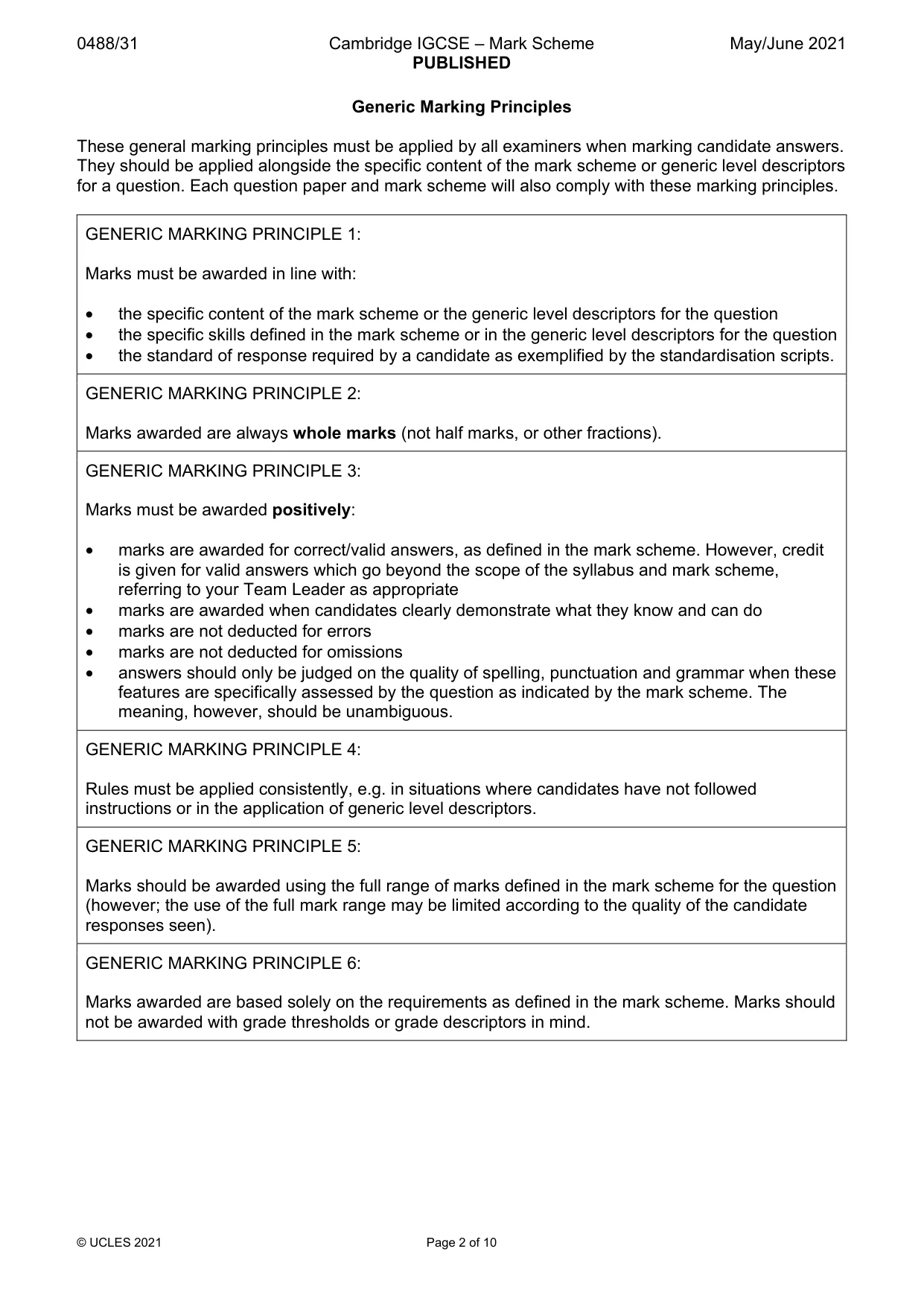
0488/31 Cambridge IGCSE – Mark Scheme PUBLISHED May/June 2021 © UCLES 2021 Page 2 of 10 Generic Marking Principles These general marking principles must be applied by all examiners when marking candidate answers. They should be applied alongside the specific content of the mark scheme or generic level descriptors for a question. Each question paper and mark scheme will also comply with these marking principles. GENERIC MARKING PRINCIPLE 1: Marks must be awarded in line with: • the specific content of the mark scheme or the generic level descriptors for the question • the specific skills defined in the mark scheme or in the generic level descriptors for the question • the standard of response required by a candidate as exemplified by the standardisation scripts. GENERIC MARKING PRINCIPLE 2: Marks awarded are always whole marks (not half marks, or other fractions). GENERIC MARKING PRINCIPLE 3: Marks must be awarded positively: • marks are awarded for correct/valid answers, as defined in the mark scheme. However, credit is given for valid answers which go beyond the scope of the syllabus and mark scheme, referring to your Team Leader as appropriate • marks are awarded when candidates clearly demonstrate what they know and can do • marks are not deducted for errors • marks are not deducted for omissions • answers should only be judged on the quality of spelling, punctuation and grammar when these features are specifically assessed by the question as indicated by the mark scheme. The meaning, however, should be unambiguous. GENERIC MARKING PRINCIPLE 4: Rules must be applied consistently, e.g. in situations where candidates have not followed instructions or in the application of generic level descriptors. GENERIC MARKING PRINCIPLE 5: Marks should be awarded using the full range of marks defined in the mark scheme for the question (however; the use of the full mark range may be limited according to the quality of the candidate responses seen). GENERIC MARKING PRINCIPLE 6: Marks awarded are based solely on the requirements as defined in the mark scheme. Marks should not be awarded with grade thresholds or grade descriptors in mind.
Mark scheme, page 3
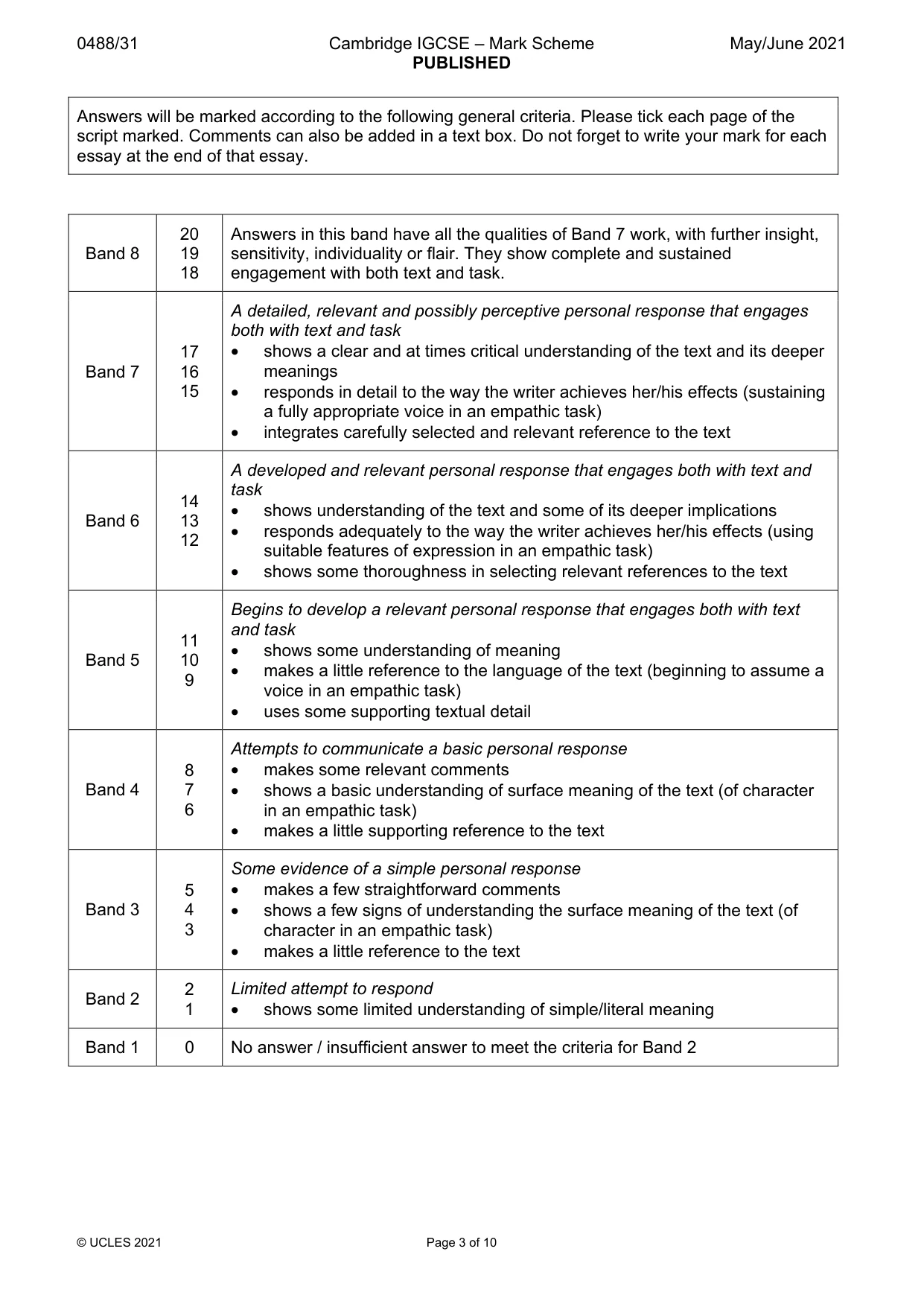
0488/31 Cambridge IGCSE – Mark Scheme PUBLISHED May/June 2021 © UCLES 2021 Page 3 of 10 Answers will be marked according to the following general criteria. Please tick each page of the script marked. Comments can also be added in a text box. Do not forget to write your mark for each essay at the end of that essay. Band 8 20 19 18 Answers in this band have all the qualities of Band 7 work, with further insight, sensitivity, individuality or flair. They show complete and sustained engagement with both text and task. Band 7 17 16 15 A detailed, relevant and possibly perceptive personal response that engages both with text and task • shows a clear and at times critical understanding of the text and its deeper meanings • responds in detail to the way the writer achieves her/his effects (sustaining a fully appropriate voice in an empathic task) • integrates carefully selected and relevant reference to the text Band 6 14 13 12 A developed and relevant personal response that engages both with text and task • shows understanding of the text and some of its deeper implications • responds adequately to the way the writer achieves her/his effects (using suitable features of expression in an empathic task) • shows some thoroughness in selecting relevant references to the text Band 5 11 10 9 Begins to develop a relevant personal response that engages both with text and task • shows some understanding of meaning • makes a little reference to the language of the text (beginning to assume a voice in an empathic task) • uses some supporting textual detail Band 4 8 7 6 Attempts to communicate a basic personal response • makes some relevant comments • shows a basic understanding of surface meaning of the text (of character in an empathic task) • makes a little supporting reference to the text Band 3 5 4 3 Some evidence of a simple personal response • makes a few straightforward comments • shows a few signs of understanding the surface meaning of the text (of character in an empathic task) • makes a little reference to the text Band 2 2 1 Limited attempt to respond • shows some limited understanding of simple/literal meaning Band 1 0 No answer / insufficient answer to meet the criteria for Band 2
Mark scheme, page 4
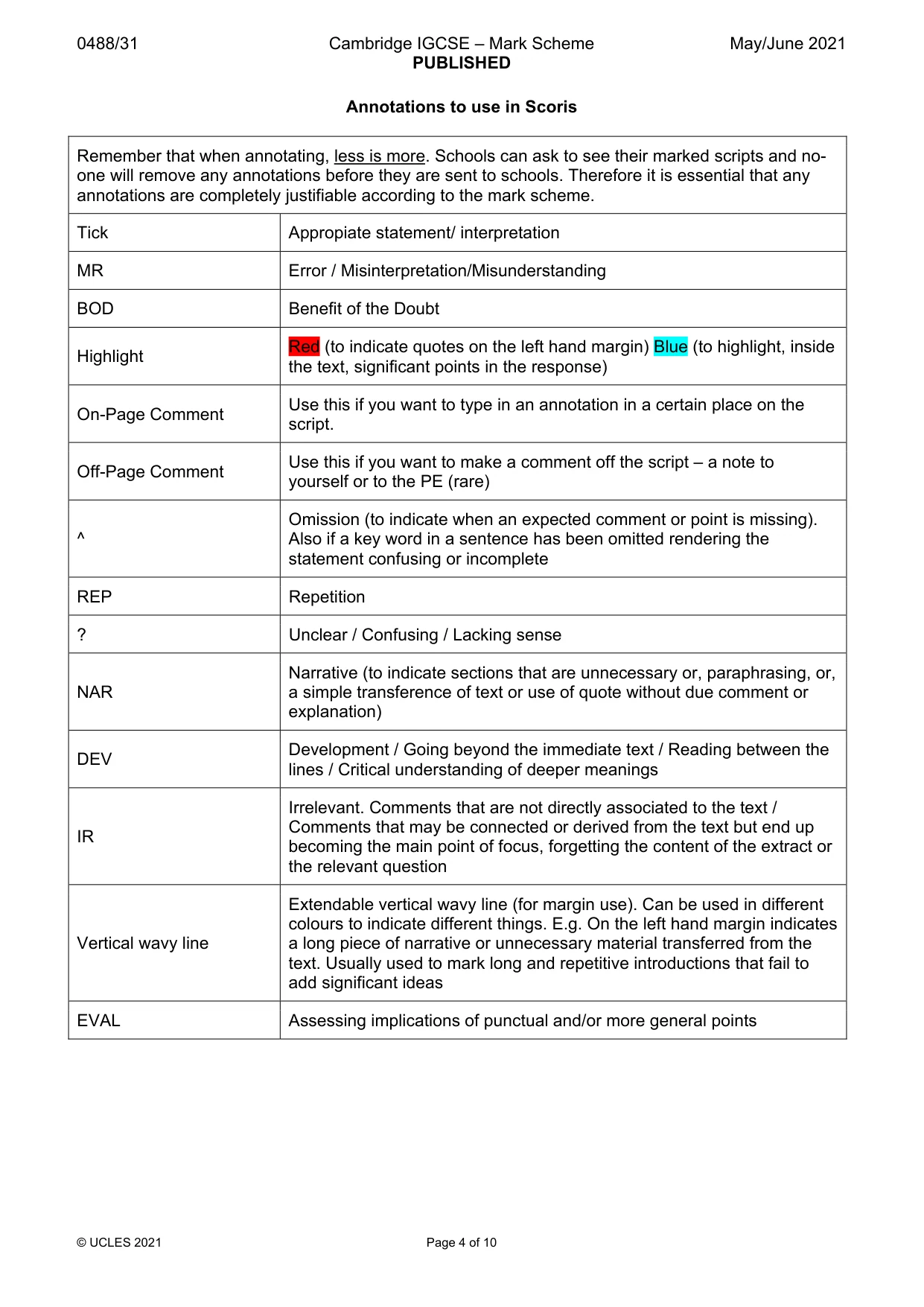
0488/31 Cambridge IGCSE – Mark Scheme PUBLISHED May/June 2021 © UCLES 2021 Page 4 of 10 Annotations to use in Scoris Remember that when annotating, less is more. Schools can ask to see their marked scripts and no- one will remove any annotations before they are sent to schools. Therefore it is essential that any annotations are completely justifiable according to the mark scheme. Tick Appropiate statement/ interpretation MR Error / Misinterpretation/Misunderstanding BOD Benefit of the Doubt Highlight Red (to indicate quotes on the left hand margin) Blue (to highlight, inside the text, significant points in the response) On-Page Comment Use this if you want to type in an annotation in a certain place on the script. Off-Page Comment Use this if you want to make a comment off the script – a note to yourself or to the PE (rare) ^ Omission (to indicate when an expected comment or point is missing). Also if a key word in a sentence has been omitted rendering the statement confusing or incomplete REP Repetition ? Unclear / Confusing / Lacking sense NAR Narrative (to indicate sections that are unnecessary or, paraphrasing, or, a simple transference of text or use of quote without due comment or explanation) DEV Development / Going beyond the immediate text / Reading between the lines / Critical understanding of deeper meanings IR Irrelevant. Comments that are not directly associated to the text / Comments that may be connected or derived from the text but end up becoming the main point of focus, forgetting the content of the extract or the relevant question Vertical wavy line Extendable vertical wavy line (for margin use). Can be used in different colours to indicate different things. E.g. On the left hand margin indicates a long piece of narrative or unnecessary material transferred from the text. Usually used to mark long and repetitive introductions that fail to add significant ideas EVAL Assessing implications of punctual and/or more general points
Mark scheme, page 5
0488/31 Cambridge IGCSE – Mark Scheme PUBLISHED May/June 2021 © UCLES 2021 Page 5 of 10 Using annotations on Scoris Remember that this is a literature not a language assessment: do not correct or comment on individual spelling and grammatical errors (but you might comment if relevant at the end of the script – e.g. ‘Frequent errors obscure meaning’). These may be factual comments or comments on key features of the answer related to the mark scheme, e.g. well-developed/undeveloped, clear / unclear, insufficient / reference to text; needs to explain point; good ref to dramatic qualities; needs to expand; evidence?; detail; not answering question. Be careful to distinguish between an unusual opinion and a factual error. At the bottom of the script put a brief summary comment based on the mark scheme: e.g. Competent answer with some evidence of personal appreciation; a couple of significant omissions. What not to write on scripts Do not use more than one question mark (???). Do not use exclamation marks at all in a comment box. Do not use capital letters to ‘shout’, e.g. NO. Do not use any pejorative or disparaging emotive word or phrase – this includes: poor, bad, wrong, get on with it, so what? hardly! What? this is NOT the point, muddled, nonsense, shallow, etc. Do not comment on handwriting or untidiness unless this interferes with the task of marking. Do not comment on the centre as a whole or their teaching. Do not focus on what the candidate has NOT written but rather on what s/he has written (though significant omissions having a bearing on the question might be mentioned).
Mark scheme, page 6
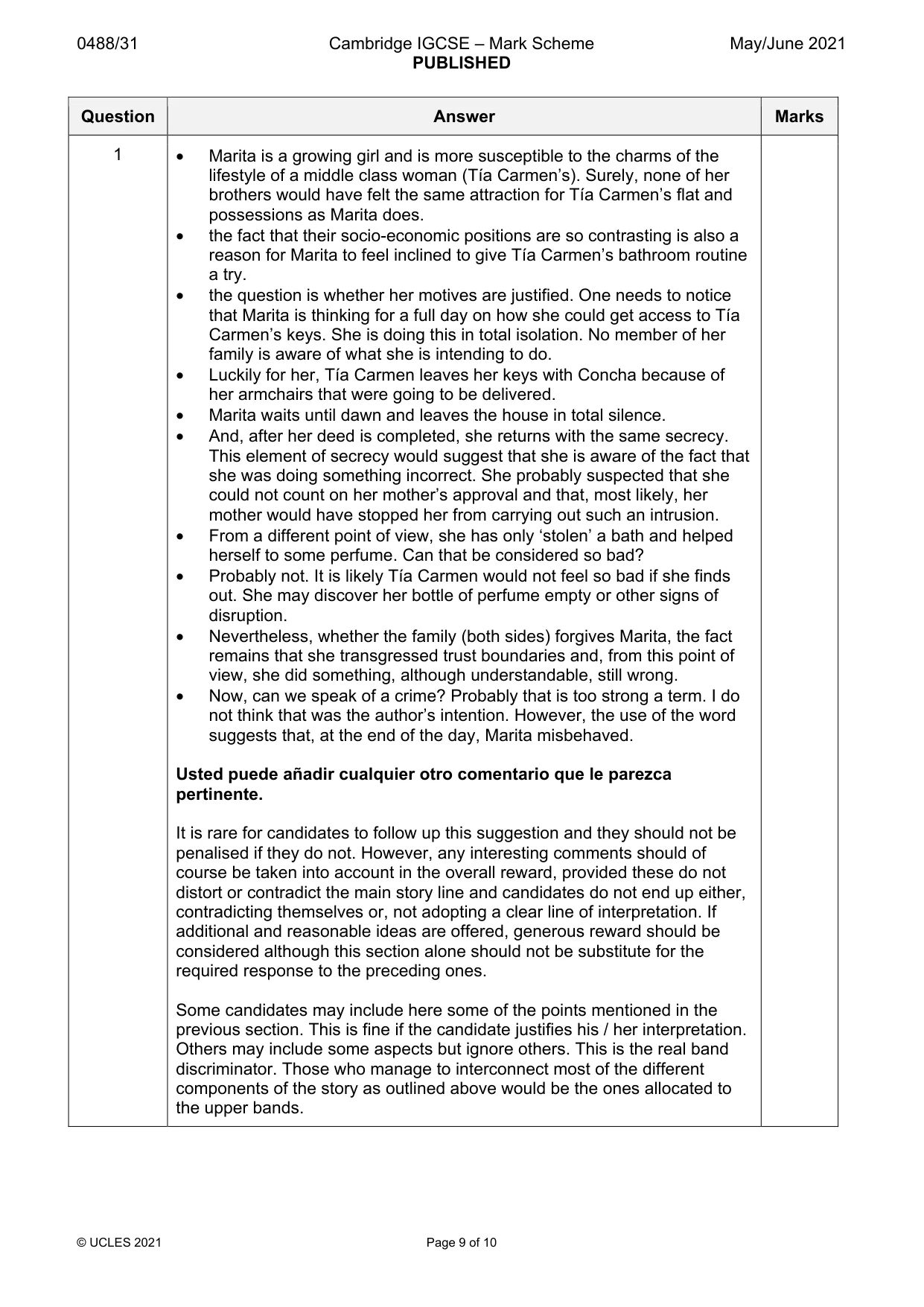
0488/31 Cambridge IGCSE – Mark Scheme PUBLISHED May/June 2021 © UCLES 2021 Page 6 of 10 Question Answer Marks Indicative Content The detailed questions are intended to help the candidate respond. Candidates are required to answer them, but need not do so in a rigid sequence; some of the answers may be implicit in the essay, although it is expected that candidates will be able to spell out their views and interpretations with sufficient clarity. There is no prescribed application of marks to each question and the response should be marked holistically. Candidates who do not answer the prescribed questions will penalise themselves automatically, as the questions are central to the passage. 1 Lea atentamente el siguiente fragmento extraído del cuento ‘El Delito’ escrito por la autora española Encarnación Huerta y publicado en 2002. Luego conteste la pregunta: The extract in question is contemporary and so poses no problem in terms of linguistic comprehension. At the lower levels (up to 9 marks) we are looking for evidence of basic understanding, with a simple personal response. At the 5/6 level bands we expect a clear, if not sophisticated and more complex, answer to each of the questions and a successful attempt to support ideas from the passage. Be aware of inert, mechanical quoting or simple paraphrasing that adds little to the interpretation or leaves the task of interpreting and/or inferring to the examiner. It is not unusual for candidates to transfer wording/paragraphs from the question paper to their essays in a rather mechanical manner. This material has usually been provided for them to contextualise the extract and does not need to be mentioned again in the body of the candidate's essay. As we go up to 7/8 level bands we are looking for an in-depth analysis and close attention to detail; an ability to read between the lines, with appropriate support from the passage; a motivated personal response; good use of the imagination and a direct, clear focus on the questions throughout. Candidates are expected to engage with the text and fully exploit its elements, particularly if they are to be rewarded with a top band mark. ¿Hasta qué punto, y cómo, ha logrado la autora impactarlo/la a usted con lo que acontece en este relato? En particular, debe considerar, en detalle, los siguientes aspectos: • el contraste que se establece entre el estatus económico de las dos familias The extract suggests from the beginning that there is a marked difference between the economic status of both families: Tía Carmen’s economic status is suggested by the following points: • qué ilusión era pasearme por su casa, tan diferente a la mía → indicates contrast between their dwellings. • esta casa tan grande y destartalada → Tia Carmen’s flat is very large but is also dilapidated / ramshackle / roundown 20
Mark scheme, page 7
0488/31 Cambridge IGCSE – Mark Scheme PUBLISHED May/June 2021 © UCLES 2021 Page 7 of 10 Question Answer Marks 1 • a pesar de hallarse, tan sólo, dos pisos más abajo (mismo edificio) → yet both flats are in the same building. This also indicates how different dwellings in the same building can be of rather different standards. In this case the upper floors are poorer than the lower floors, it seems, and this may mean that Tia Carmen may have upgraded her flat (installing a bath tap or making a proper bathroom, upgrading the kitchen) and may indicate better economic position but would not make them millionaries. Only better-off than their relatives. • la vivienda de los tíos era bonita: la cocina tenía azulejos…hasta el techo, fogón grande …y muchos muebles también blancos alrededor. → this indicates what Marita does not have in her flat. • los tíos tenían cuarto de baño, no sólo un lavabo como nosotros → Marita’s flat only had a wash basin. • bañera con dos grifos, parecía un milagro, agua caliente… → hot water, which she considers a ‘miracle’. • me quedé fascinada… → how Marita admires her Tía Carmen’s lifestyle. • aquel tocador tan precioso → furniture. • una caja que, además, tenía música. → artefacts. • se puso un camisón rosa brillante, tan brillante como la colcha azul que yo estaba acariciando con placer. → clothing / bedlinen • tres frascos y con toallitas de colores iba untando cremas en su rostro→ luxurious toiletries. • la piel se le quedaba muy blanca, suave y perfumada. • van a venir los tapiceros a traer dos butacas → acquiring even more furniture / or re-upholstering them. • vamos todos a pasar el día fuera → able to take breaks/to rest/going out. • el coche se nos ha averíado, vamos a pasar la noche aqui → they have a car; they can afford to pay for accommodation somewhere else. • Marita admires her Tia Carmen’s lifestyle Marita’s economic status: • tuvimos una jornada apretada de trabajo → hard work. • mi madre precisó mis manos y las de Juan Antonio y Rafael, mis hermanos mayores → mother and children need to work together. • todos colaborábamos en las faenas domésticas y todos ayudábamos en el pequeño taller de bolsos que ocupaba dos habitaciones de nuestro piso → workshop in the same dwelling / → also a united family. • de cuyos ingresos vivíamos muy modestamente… → only means of survival • also shown by implication by the fact that Marita does not have what she admires in her aunt’s home. Development: Why the different economic status: It is likely that Tia Carmen has a better economic position because she married a wealthy man or because of the job of her husband.
Mark scheme, page 8
0488/31 Cambridge IGCSE – Mark Scheme PUBLISHED May/June 2021 © UCLES 2021 Page 8 of 10 Question Answer Marks 1 • el tipo de relación que existe entre la tía Carmen y Marita y su familia, y lo que esta relación sugiere. The relationship between Marita and Tía Carmen can be noticed in the following exchanges: • — Marita, ya sabes que tengo la costumbre de leer un rato en la cama antes de dormir, ¿te molesta la luz encendida? • — No, no, puedes leer el tiempo que quieras, yo me quedaré dormida… The above dialogue suggests that there is a friendly and considerate relationship between Marita and her aunt. • — Tía, estás guapísima con el camisón y la bata. → Marita admires her aunt. It is to be noted that Marita does not show, at any time, negative feelings towards her aunt, such as envy or disapproval. • — Qué bien, querida sobrina, eres un cielo, cada vez que el tío se marche a Barcelona tú bajas a dormir conmigo. → Her aunt shows recognition and care for Marita. She wants to see more of Marita and appreciates her feelings. The above dialogue suggests that there are very positive feelings between Marita and her aunt. Both show care and affection for each other all along. Also, the fact that tía Carmen invites Marita to go to her flat to keep her company is a sign of a loving relationship between aunt and niece but, also, between the aunt and her sister. From this point in the story Tia Carmen is even more inclined to have Marita visiting her every time that her husband is away. This indicates an even closer relationsips between the two. One additional point can be made about the relationship between the sisters: • — Concha, os dejo las llaves… The above sentence confirms that there is trust between the sisters as well as constant interaction. There is no basis to assume that Tia Carmen treats her sister with a sense of superiority. No hay base en el texto para asumir que el trato de la tia es de superioridad hacia su hermana o su sobrina. • cómo interpreta usted las acciones y motivaciones de Marita, y si se puede considerar que son justificables dado el título de la historia, ‘El Delito’ At this stage, candidates will have formed their own opinion about this unusual event. It is very important that they reflect carefully on the two previous questions as they can provide support for their interpretations. What can be said of Marita’s actions and her motivations, and, is it possible to talk about ‘a crime’ in these circumstances, as the author suggests? • a starting point to make is that Marita has reached the age of 11 and is in a position to be more observant and aware of differences between her own family and Tia Carmen’s.
Mark scheme, page 9
0488/31 Cambridge IGCSE – Mark Scheme PUBLISHED May/June 2021 © UCLES 2021 Page 9 of 10 Question Answer Marks 1 • Marita is a growing girl and is more susceptible to the charms of the lifestyle of a middle class woman (Tía Carmen’s). Surely, none of her brothers would have felt the same attraction for Tía Carmen’s flat and possessions as Marita does. • the fact that their socio-economic positions are so contrasting is also a reason for Marita to feel inclined to give Tía Carmen’s bathroom routine a try. • the question is whether her motives are justified. One needs to notice that Marita is thinking for a full day on how she could get access to Tía Carmen’s keys. She is doing this in total isolation. No member of her family is aware of what she is intending to do. • Luckily for her, Tía Carmen leaves her keys with Concha because of her armchairs that were going to be delivered. • Marita waits until dawn and leaves the house in total silence. • And, after her deed is completed, she returns with the same secrecy. This element of secrecy would suggest that she is aware of the fact that she was doing something incorrect. She probably suspected that she could not count on her mother’s approval and that, most likely, her mother would have stopped her from carrying out such an intrusion. • From a different point of view, she has only ‘stolen’ a bath and helped herself to some perfume. Can that be considered so bad? • Probably not. It is likely Tía Carmen would not feel so bad if she finds out. She may discover her bottle of perfume empty or other signs of disruption. • Nevertheless, whether the family (both sides) forgives Marita, the fact remains that she transgressed trust boundaries and, from this point of view, she did something, although understandable, still wrong. • Now, can we speak of a crime? Probably that is too strong a term. I do not think that was the author’s intention. However, the use of the word suggests that, at the end of the day, Marita misbehaved. Usted puede añadir cualquier otro comentario que le parezca pertinente. It is rare for candidates to follow up this suggestion and they should not be penalised if they do not. However, any interesting comments should of course be taken into account in the overall reward, provided these do not distort or contradict the main story line and candidates do not end up either, contradicting themselves or, not adopting a clear line of interpretation. If additional and reasonable ideas are offered, generous reward should be considered although this section alone should not be substitute for the required response to the preceding ones. Some candidates may include here some of the points mentioned in the previous section. This is fine if the candidate justifies his / her interpretation. Others may include some aspects but ignore others. This is the real band discriminator. Those who manage to interconnect most of the different components of the story as outlined above would be the ones allocated to the upper bands.
Mark scheme, page 10
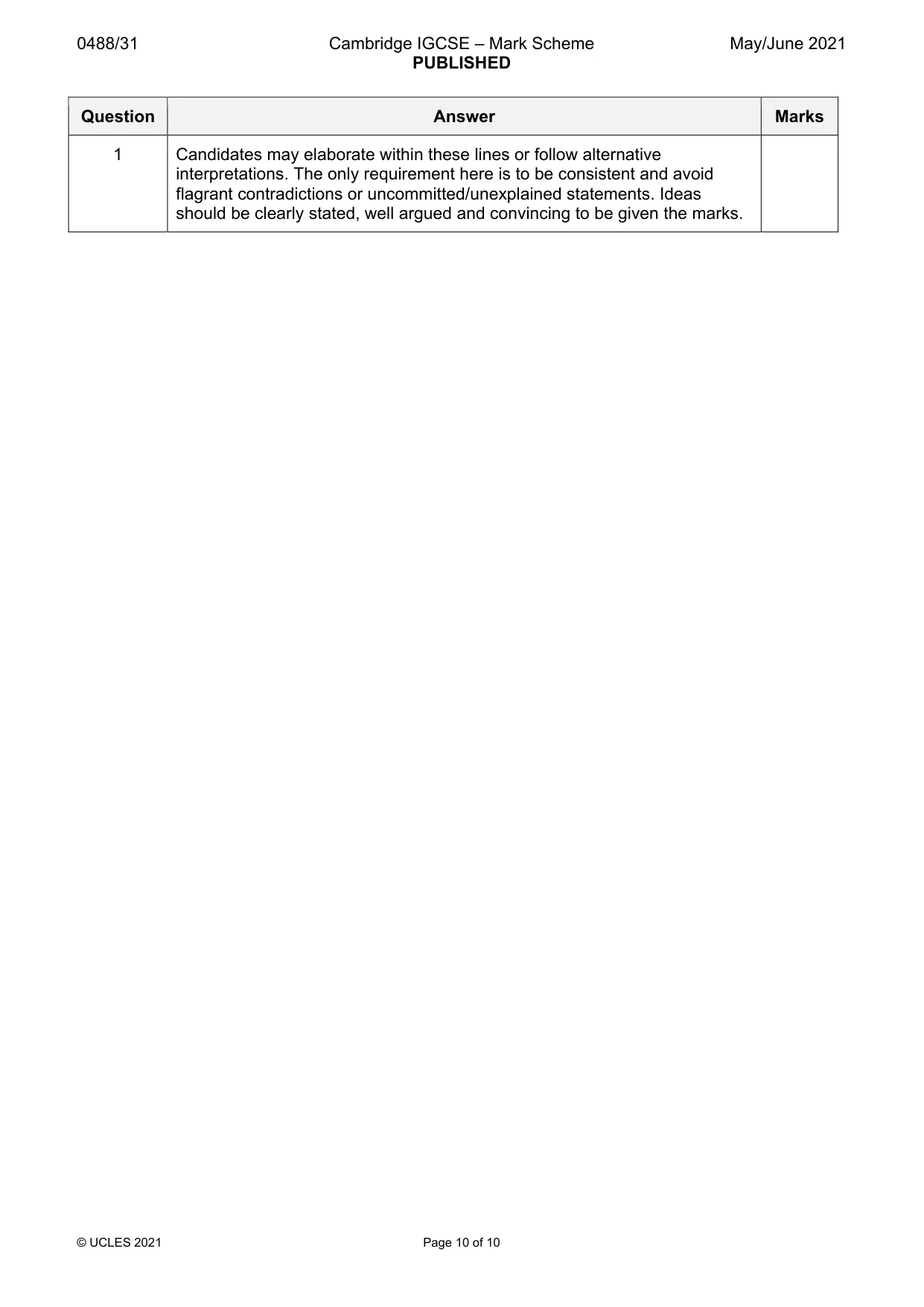
0488/31 Cambridge IGCSE – Mark Scheme PUBLISHED May/June 2021 © UCLES 2021 Page 10 of 10 Question Answer Marks 1 Candidates may elaborate within these lines or follow alternative interpretations. The only requirement here is to be consistent and avoid flagrant contradictions or uncommitted/unexplained statements. Ideas should be clearly stated, well argued and convincing to be given the marks.
What you needed in this session
Cambridge’s own grade thresholds for 2021 May/June, Paper 3 · Variant 1. A higher threshold means an easier paper — the bar moves with how the cohort did.