Cambridge IGCSE Spanish - Literature 0488 — 2019 May/June Paper 3 · Variant 1
0488/31/M/J/19 · 20 marks · ≈23 min
The question paper and its mark scheme, free to read here and free to download. This is Cambridge’s own paper, exactly as it was sat.
Question paper4 pages

Mark scheme8 pages
Answers below. Sit the paper first if you are practising.
Paper as text
Question paper, page 1
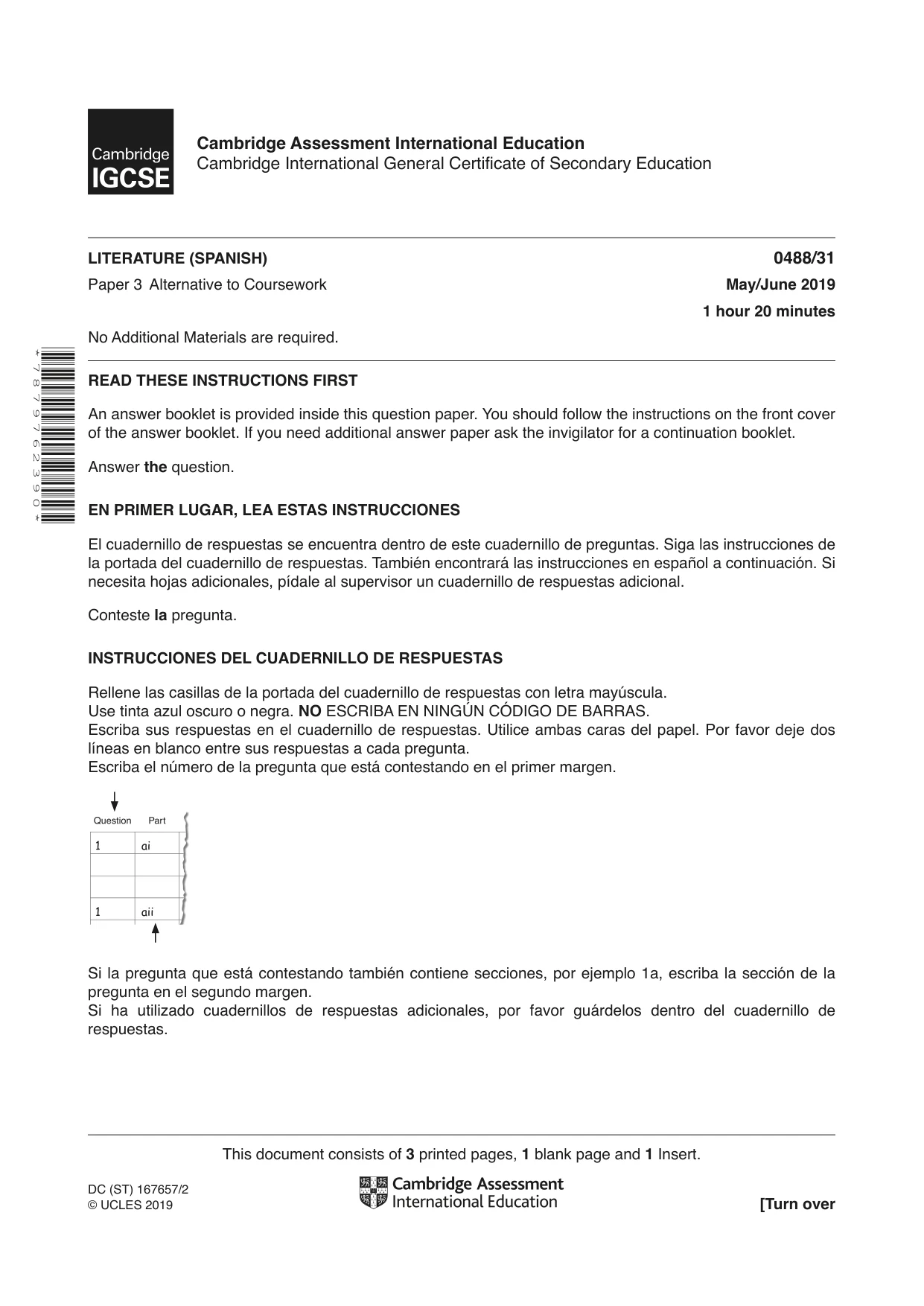
This document consists of 3 printed pages, 1 blank page and 1 Insert. DC (ST) 167657/2 © UCLES 2019 [Turn over Cambridge Assessment International Education Cambridge International General Certificate of Secondary Education * 7 8 7 9 7 6 2 3 9 0 * LITERATURE (SPANISH) 0488/31 Paper 3 Alternative to Coursework May/June 2019 1 hour 20 minutes No Additional Materials are required. READ THESE INSTRUCTIONS FIRST An answer booklet is provided inside this question paper. You should follow the instructions on the front cover of the answer booklet. If you need additional answer paper ask the invigilator for a continuation booklet. Answer the question. EN PRIMER LUGAR, LEA ESTAS INSTRUCCIONES El cuadernillo de respuestas se encuentra dentro de este cuadernillo de preguntas. Siga las instrucciones de la portada del cuadernillo de respuestas. También encontrará las instrucciones en español a continuación. Si necesita hojas adicionales, pídale al supervisor un cuadernillo de respuestas adicional. Conteste la pregunta. INSTRUCCIONES DEL CUADERNILLO DE RESPUESTAS Rellene las casillas de la portada del cuadernillo de respuestas con letra mayúscula. Use tinta azul oscuro o negra. NO ESCRIBA EN NINGÚN CÓDIGO DE BARRAS. Escriba sus respuestas en el cuadernillo de respuestas. Utilice ambas caras del papel. Por favor deje dos líneas en blanco entre sus respuestas a cada pregunta. Escriba el número de la pregunta que está contestando en el primer margen. Si la pregunta que está contestando también contiene secciones, por ejemplo 1a, escriba la sección de la pregunta en el segundo margen. Si ha utilizado cuadernillos de respuestas adicionales, por favor guárdelos dentro del cuadernillo de respuestas.
Question paper, page 2
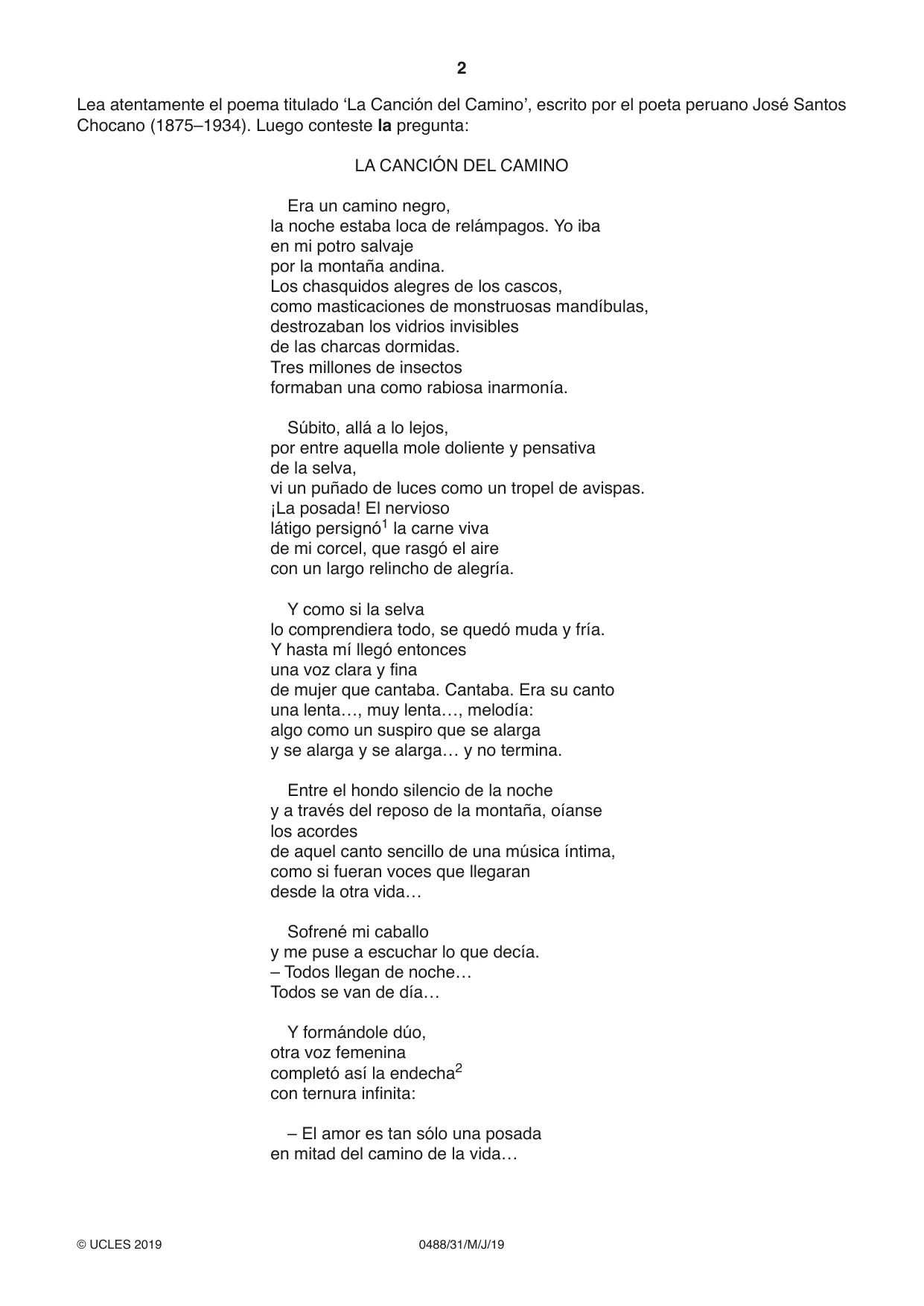
2 0488/31/M/J/19 © UCLES 2019 Lea atentamente el poema titulado ‘La Canción del Camino’, escrito por el poeta peruano José Santos Chocano (1875–1934). Luego conteste la pregunta: LA CANCIÓN DEL CAMINO Era un camino negro, la noche estaba loca de relámpagos. Yo iba en mi potro salvaje por la montaña andina. Los chasquidos alegres de los cascos, como masticaciones de monstruosas mandíbulas, destrozaban los vidrios invisibles de las charcas dormidas. Tres millones de insectos formaban una como rabiosa inarmonía. Súbito, allá a lo lejos, por entre aquella mole doliente y pensativa de la selva, vi un puñado de luces como un tropel de avispas. ¡La posada! El nervioso látigo persignó1 la carne viva de mi corcel, que rasgó el aire con un largo relincho de alegría. Y como si la selva lo comprendiera todo, se quedó muda y fría. Y hasta mí llegó entonces una voz clara y fina de mujer que cantaba. Cantaba. Era su canto una lenta…, muy lenta…, melodía: algo como un suspiro que se alarga y se alarga y se alarga… y no termina. Entre el hondo silencio de la noche y a través del reposo de la montaña, oíanse los acordes de aquel canto sencillo de una música íntima, como si fueran voces que llegaran desde la otra vida… Sofrené mi caballo y me puse a escuchar lo que decía. – Todos llegan de noche… Todos se van de día… Y formándole dúo, otra voz femenina completó así la endecha2 con ternura infinita: – El amor es tan sólo una posada en mitad del camino de la vida…
Question paper, page 3
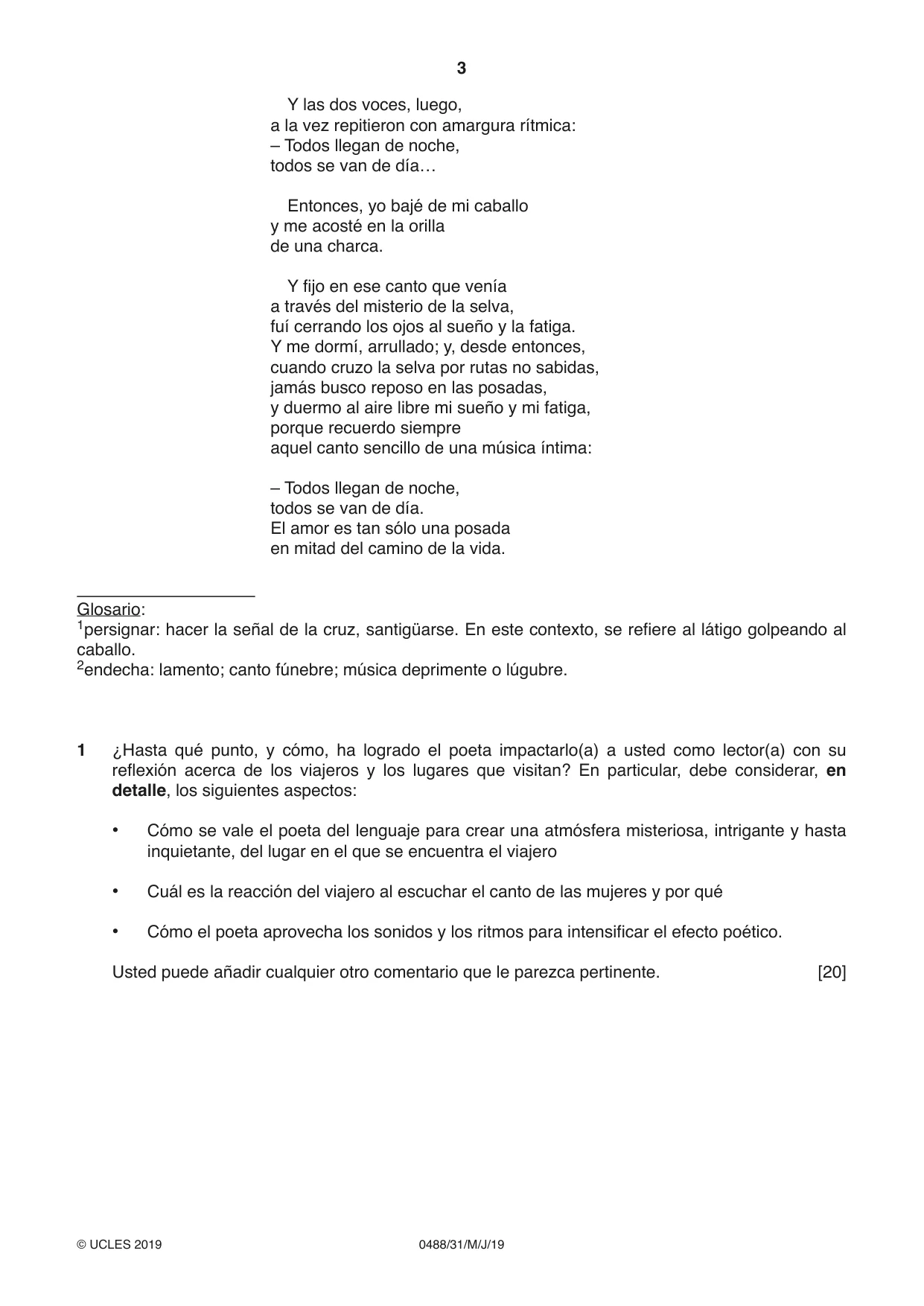
3 0488/31/M/J/19 © UCLES 2019 Y las dos voces, luego, a la vez repitieron con amargura rítmica: – Todos llegan de noche, todos se van de día… Entonces, yo bajé de mi caballo y me acosté en la orilla de una charca. Y fijo en ese canto que venía a través del misterio de la selva, fuí cerrando los ojos al sueño y la fatiga. Y me dormí, arrullado; y, desde entonces, cuando cruzo la selva por rutas no sabidas, jamás busco reposo en las posadas, y duermo al aire libre mi sueño y mi fatiga, porque recuerdo siempre aquel canto sencillo de una música íntima: – Todos llegan de noche, todos se van de día. El amor es tan sólo una posada en mitad del camino de la vida. Glosario: 1persignar: hacer la señal de la cruz, santigüarse. En este contexto, se refiere al látigo golpeando al caballo. 2endecha: lamento; canto fúnebre; música deprimente o lúgubre. 1 ¿Hasta qué punto, y cómo, ha logrado el poeta impactarlo(a) a usted como lector(a) con su reflexión acerca de los viajeros y los lugares que visitan? En particular, debe considerar, en detalle, los siguientes aspectos: • Cómo se vale el poeta del lenguaje para crear una atmósfera misteriosa, intrigante y hasta inquietante, del lugar en el que se encuentra el viajero • Cuál es la reacción del viajero al escuchar el canto de las mujeres y por qué • Cómo el poeta aprovecha los sonidos y los ritmos para intensificar el efecto poético. Usted puede añadir cualquier otro comentario que le parezca pertinente. [20]
Question paper, page 4
4 0488/31/M/J/19 © UCLES 2019 BLANK PAGE Permission to reproduce items where third-party owned material protected by copyright is included has been sought and cleared where possible. Every reasonable effort has been made by the publisher (UCLES) to trace copyright holders, but if any items requiring clearance have unwittingly been included, the publisher will be pleased to make amends at the earliest possible opportunity. To avoid the issue of disclosure of answer-related information to candidates, all copyright acknowledgements are reproduced online in the Cambridge Assessment International Education Copyright Acknowledgements Booklet. This is produced for each series of examinations and is freely available to download at www.cambridgeinternational.org after the live examination series. Cambridge Assessment International Education is part of the Cambridge Assessment Group. Cambridge Assessment is the brand name of the University of Cambridge Local Examinations Syndicate (UCLES), which itself is a department of the University of Cambridge.
Mark scheme, page 1
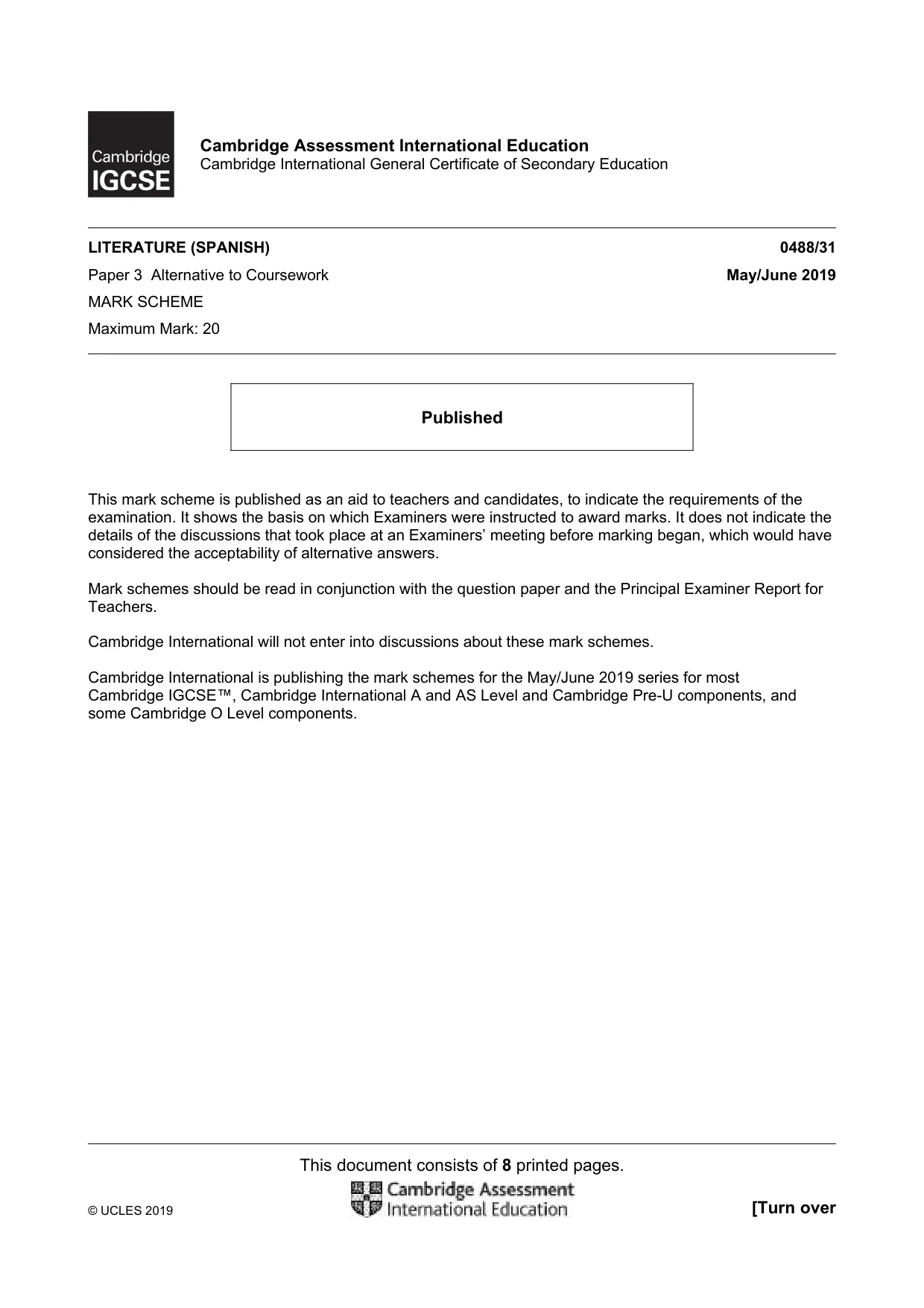
This document consists of 8 printed pages. © UCLES 2019 [Turn over Cambridge Assessment International Education Cambridge International General Certificate of Secondary Education LITERATURE (SPANISH) 0488/31 Paper 3 Alternative to Coursework May/June 2019 MARK SCHEME Maximum Mark: 20 Published This mark scheme is published as an aid to teachers and candidates, to indicate the requirements of the examination. It shows the basis on which Examiners were instructed to award marks. It does not indicate the details of the discussions that took place at an Examiners’ meeting before marking began, which would have considered the acceptability of alternative answers. Mark schemes should be read in conjunction with the question paper and the Principal Examiner Report for Teachers. Cambridge International will not enter into discussions about these mark schemes. Cambridge International is publishing the mark schemes for the May/June 2019 series for most Cambridge IGCSE™, Cambridge International A and AS Level and Cambridge Pre-U components, and some Cambridge O Level components.
Mark scheme, page 2
0488/31 Cambridge IGCSE – Mark Scheme PUBLISHED May/June 2019 © UCLES 2019 Page 2 of 8 Generic Marking Principles These general marking principles must be applied by all examiners when marking candidate answers. They should be applied alongside the specific content of the mark scheme or generic level descriptors for a question. Each question paper and mark scheme will also comply with these marking principles. GENERIC MARKING PRINCIPLE 1: Marks must be awarded in line with: • the specific content of the mark scheme or the generic level descriptors for the question • the specific skills defined in the mark scheme or in the generic level descriptors for the question • the standard of response required by a candidate as exemplified by the standardisation scripts. GENERIC MARKING PRINCIPLE 2: Marks awarded are always whole marks (not half marks, or other fractions). GENERIC MARKING PRINCIPLE 3: Marks must be awarded positively: • marks are awarded for correct/valid answers, as defined in the mark scheme. However, credit is given for valid answers which go beyond the scope of the syllabus and mark scheme, referring to your Team Leader as appropriate • marks are awarded when candidates clearly demonstrate what they know and can do • marks are not deducted for errors • marks are not deducted for omissions • answers should only be judged on the quality of spelling, punctuation and grammar when these features are specifically assessed by the question as indicated by the mark scheme. The meaning, however, should be unambiguous. GENERIC MARKING PRINCIPLE 4: Rules must be applied consistently e.g. in situations where candidates have not followed instructions or in the application of generic level descriptors. GENERIC MARKING PRINCIPLE 5: Marks should be awarded using the full range of marks defined in the mark scheme for the question (however; the use of the full mark range may be limited according to the quality of the candidate responses seen). GENERIC MARKING PRINCIPLE 6: Marks awarded are based solely on the requirements as defined in the mark scheme. Marks should not be awarded with grade thresholds or grade descriptors in mind.
Mark scheme, page 3
0488/31 Cambridge IGCSE – Mark Scheme PUBLISHED May/June 2019 © UCLES 2019 Page 3 of 8 GENERAL MARKING PRINCIPLES The detailed questions are intended to help the candidate respond. Candidates are required to answer them, but need not do so in a rigid sequence; some of the answers may be implicit in the essay, although it is expected that candidates will be able to spell out their views and interpretations with sufficient clarity. There is no prescribed application of marks to each question and the response should be marked holistically. Candidates who do not answer the prescribed questions will penalise themselves automatically, as the questions are central to the passage. The General Descriptors guide examiners to an understanding of the qualities normally expected of, or typical of, work in a band. They are a means of general guidance, and must not be interpreted as hurdle statements. For the purposes of standardisation of marking, they are to be used in conjunction with standardisation scripts and discussed during the examiners’ coordination meeting, as well as the question-specific notes. Because of the nature of the subject, these notes are for general guidance; they are not designed as prescriptions of required content and must not be treated as such. The syllabus aims at encouraging candidates to make some personal response to their reading. This means that, while we may have legitimate expectations as to the ground most answers may occupy, we must all times be prepared to meet candidates on their chosen ground. Hence we must at all times tease out what the candidate is trying to say to us. We must recognise that it is possible for a candidate whose technical command of Spanish is limited, but whose language still manages to communicate understanding, to receive high marks. Nor should we reward fluency and display of literary terms if we feel that there is little evidence of such understanding. Remember that we are looking for response to literature, not demonstration of language skills. It is vital that we constantly remind ourselves that this is unseen work and we should not be overcritical of an occasional false note or misunderstanding. We are marking the quality of the process of engaging with literature, and not merely assessing the accuracy or otherwise of the conclusions reached. Above all, we should be alert to any response to the effective power of the words, however it might be expressed. Reference to the standardisation scripts discussed during coordination will be crucial to maintaining the standard throughout the marking process. USE OF BAND DESCRIPTORS The Descriptors are an attempt to guide examiners to an understanding of the qualities normally expected of, or ‘typical’ of work in the band. First place the script within a Band, and then, having balanced its different qualities and their relationship to the Assessment Objectives and the three strands within each Band, decide whether you place it at the top, in the middle or at the borderline of that Band. Place a tick on every page to show you have not missed a page. In writing comments on the script, use abbreviations, words or phrases from the mark scheme, comments on how the essay is developing, and where necessary brief factual comments or corrections. Add a summative comment at the end of the script related to the criteria. As a general rule your comments should be positive.
Mark scheme, page 4
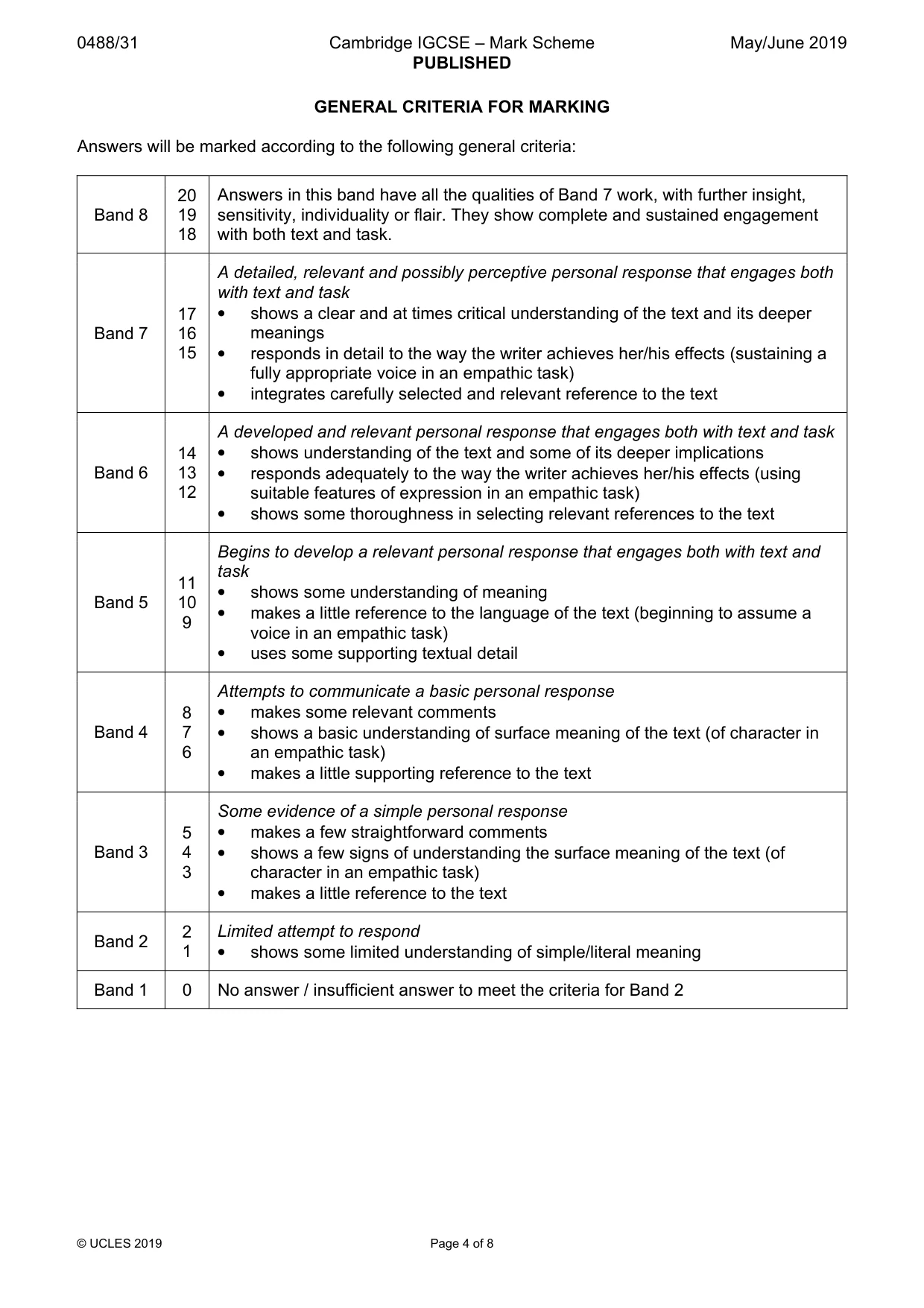
0488/31 Cambridge IGCSE – Mark Scheme PUBLISHED May/June 2019 © UCLES 2019 Page 4 of 8 GENERAL CRITERIA FOR MARKING Answers will be marked according to the following general criteria: Band 8 20 19 18 Answers in this band have all the qualities of Band 7 work, with further insight, sensitivity, individuality or flair. They show complete and sustained engagement with both text and task. Band 7 17 16 15 A detailed, relevant and possibly perceptive personal response that engages both with text and task • shows a clear and at times critical understanding of the text and its deeper meanings • responds in detail to the way the writer achieves her/his effects (sustaining a fully appropriate voice in an empathic task) • integrates carefully selected and relevant reference to the text Band 6 14 13 12 A developed and relevant personal response that engages both with text and task • shows understanding of the text and some of its deeper implications • responds adequately to the way the writer achieves her/his effects (using suitable features of expression in an empathic task) • shows some thoroughness in selecting relevant references to the text Band 5 11 10 9 Begins to develop a relevant personal response that engages both with text and task • shows some understanding of meaning • makes a little reference to the language of the text (beginning to assume a voice in an empathic task) • uses some supporting textual detail Band 4 8 7 6 Attempts to communicate a basic personal response • makes some relevant comments • shows a basic understanding of surface meaning of the text (of character in an empathic task) • makes a little supporting reference to the text Band 3 5 4 3 Some evidence of a simple personal response • makes a few straightforward comments • shows a few signs of understanding the surface meaning of the text (of character in an empathic task) • makes a little reference to the text Band 2 2 1 Limited attempt to respond • shows some limited understanding of simple/literal meaning Band 1 0 No answer / insufficient answer to meet the criteria for Band 2
Mark scheme, page 5
0488/31 Cambridge IGCSE – Mark Scheme PUBLISHED May/June 2019 © UCLES 2019 Page 5 of 8 Question Answer Marks Indicative Content The detailed questions are intended to help the candidate respond. Candidates are required to answer them, but need not do so in a rigid sequence; some of the answers may be implicit in the essay, although it is expected that candidates will be able to spell out their views and interpretations with sufficient clarity. There is no prescribed application of marks to each question and the response should be marked holistically. Candidates who do not answer the prescribed questions will penalise themselves automatically, as the questions are central to the passage. 1 Lea atentamente el poema titulado ‘La Canción del Camino’, escrito por el poeta peruano José Santos Chocano (1875–1934). Luego conteste la pregunta. The language of the poem in question is highly accessible and it is hoped the candidates will be in a position to understand the poem almost in its entirety, therefore being able to gain a general understanding of the extract and convey an appropriate response to the quality of the writing. The questions are designed to help them do so. At the lower levels (up to 9 marks) we shall probably be expecting for evidence of a basic understanding, hopefully with a simple personal response. At the 5/6 level bands we should be looking for a clear, if not sophisticated and more complex answer to each of the questions and a successful attempt to support ideas from the passage. Be aware of inert, mechanical quoting or simple paraphrasing that adds little to the interpretation or leaves the task of interpreting and/or inferring to the examiner. It is not unusual for candidates to transfer wording/paragraphs from the question paper to their essays in a rather mechanical manner and for no other apparent purpose than to fill up some space. This material has usually been provided to help the candidate to contextualise the extract and does not need to be mentioned again in the body of the candidate's essay. As we go up to 7/8 level bands we shall be looking for an in-depth analysis and close attention to detail; an ability to read between the lines, with appropriate support from the passage; a motivated personal response; good use of the imagination and a direct, clear focus on the questions throughout. Although some candidates may find the theme of the story rather 'unexpected', they still should be able to engage with it and fully exploit its elements, particularly so if they are to be rewarded with a top band mark. 20
Mark scheme, page 6
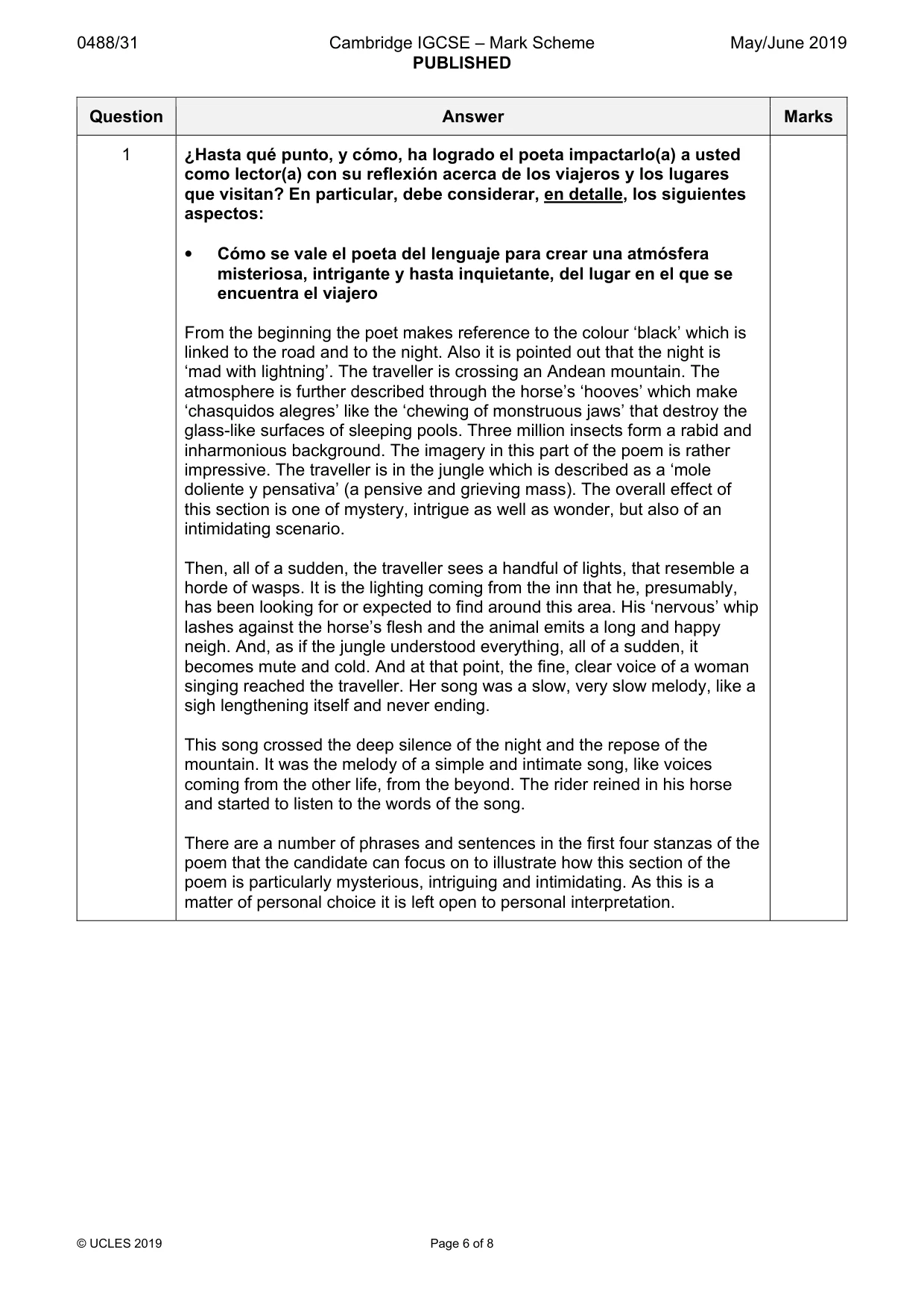
0488/31 Cambridge IGCSE – Mark Scheme PUBLISHED May/June 2019 © UCLES 2019 Page 6 of 8 Question Answer Marks 1 ¿Hasta qué punto, y cómo, ha logrado el poeta impactarlo(a) a usted como lector(a) con su reflexión acerca de los viajeros y los lugares que visitan? En particular, debe considerar, en detalle, los siguientes aspectos: • Cómo se vale el poeta del lenguaje para crear una atmósfera misteriosa, intrigante y hasta inquietante, del lugar en el que se encuentra el viajero From the beginning the poet makes reference to the colour ‘black’ which is linked to the road and to the night. Also it is pointed out that the night is ‘mad with lightning’. The traveller is crossing an Andean mountain. The atmosphere is further described through the horse’s ‘hooves’ which make ‘chasquidos alegres’ like the ‘chewing of monstruous jaws’ that destroy the glass-like surfaces of sleeping pools. Three million insects form a rabid and inharmonious background. The imagery in this part of the poem is rather impressive. The traveller is in the jungle which is described as a ‘mole doliente y pensativa’ (a pensive and grieving mass). The overall effect of this section is one of mystery, intrigue as well as wonder, but also of an intimidating scenario. Then, all of a sudden, the traveller sees a handful of lights, that resemble a horde of wasps. It is the lighting coming from the inn that he, presumably, has been looking for or expected to find around this area. His ‘nervous’ whip lashes against the horse’s flesh and the animal emits a long and happy neigh. And, as if the jungle understood everything, all of a sudden, it becomes mute and cold. And at that point, the fine, clear voice of a woman singing reached the traveller. Her song was a slow, very slow melody, like a sigh lengthening itself and never ending. This song crossed the deep silence of the night and the repose of the mountain. It was the melody of a simple and intimate song, like voices coming from the other life, from the beyond. The rider reined in his horse and started to listen to the words of the song. There are a number of phrases and sentences in the first four stanzas of the poem that the candidate can focus on to illustrate how this section of the poem is particularly mysterious, intriguing and intimidating. As this is a matter of personal choice it is left open to personal interpretation.
Mark scheme, page 7
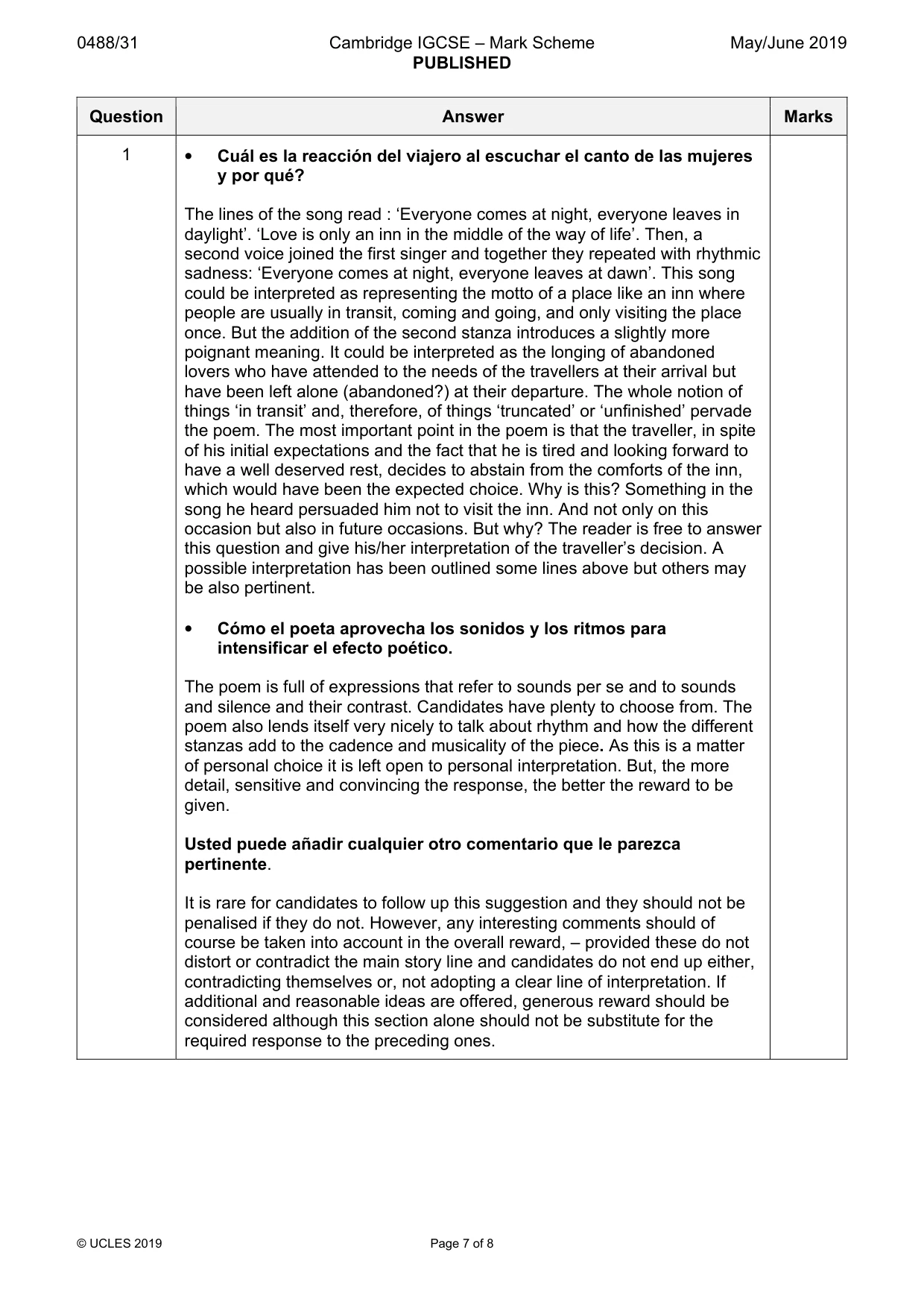
0488/31 Cambridge IGCSE – Mark Scheme PUBLISHED May/June 2019 © UCLES 2019 Page 7 of 8 Question Answer Marks 1 • Cuál es la reacción del viajero al escuchar el canto de las mujeres y por qué? The lines of the song read : ‘Everyone comes at night, everyone leaves in daylight’. ‘Love is only an inn in the middle of the way of life’. Then, a second voice joined the first singer and together they repeated with rhythmic sadness: ‘Everyone comes at night, everyone leaves at dawn’. This song could be interpreted as representing the motto of a place like an inn where people are usually in transit, coming and going, and only visiting the place once. But the addition of the second stanza introduces a slightly more poignant meaning. It could be interpreted as the longing of abandoned lovers who have attended to the needs of the travellers at their arrival but have been left alone (abandoned?) at their departure. The whole notion of things ‘in transit’ and, therefore, of things ‘truncated’ or ‘unfinished’ pervade the poem. The most important point in the poem is that the traveller, in spite of his initial expectations and the fact that he is tired and looking forward to have a well deserved rest, decides to abstain from the comforts of the inn, which would have been the expected choice. Why is this? Something in the song he heard persuaded him not to visit the inn. And not only on this occasion but also in future occasions. But why? The reader is free to answer this question and give his/her interpretation of the traveller’s decision. A possible interpretation has been outlined some lines above but others may be also pertinent. • Cómo el poeta aprovecha los sonidos y los ritmos para intensificar el efecto poético. The poem is full of expressions that refer to sounds per se and to sounds and silence and their contrast. Candidates have plenty to choose from. The poem also lends itself very nicely to talk about rhythm and how the different stanzas add to the cadence and musicality of the piece. As this is a matter of personal choice it is left open to personal interpretation. But, the more detail, sensitive and convincing the response, the better the reward to be given. Usted puede añadir cualquier otro comentario que le parezca pertinente. It is rare for candidates to follow up this suggestion and they should not be penalised if they do not. However, any interesting comments should of course be taken into account in the overall reward, – provided these do not distort or contradict the main story line and candidates do not end up either, contradicting themselves or, not adopting a clear line of interpretation. If additional and reasonable ideas are offered, generous reward should be considered although this section alone should not be substitute for the required response to the preceding ones.
Mark scheme, page 8
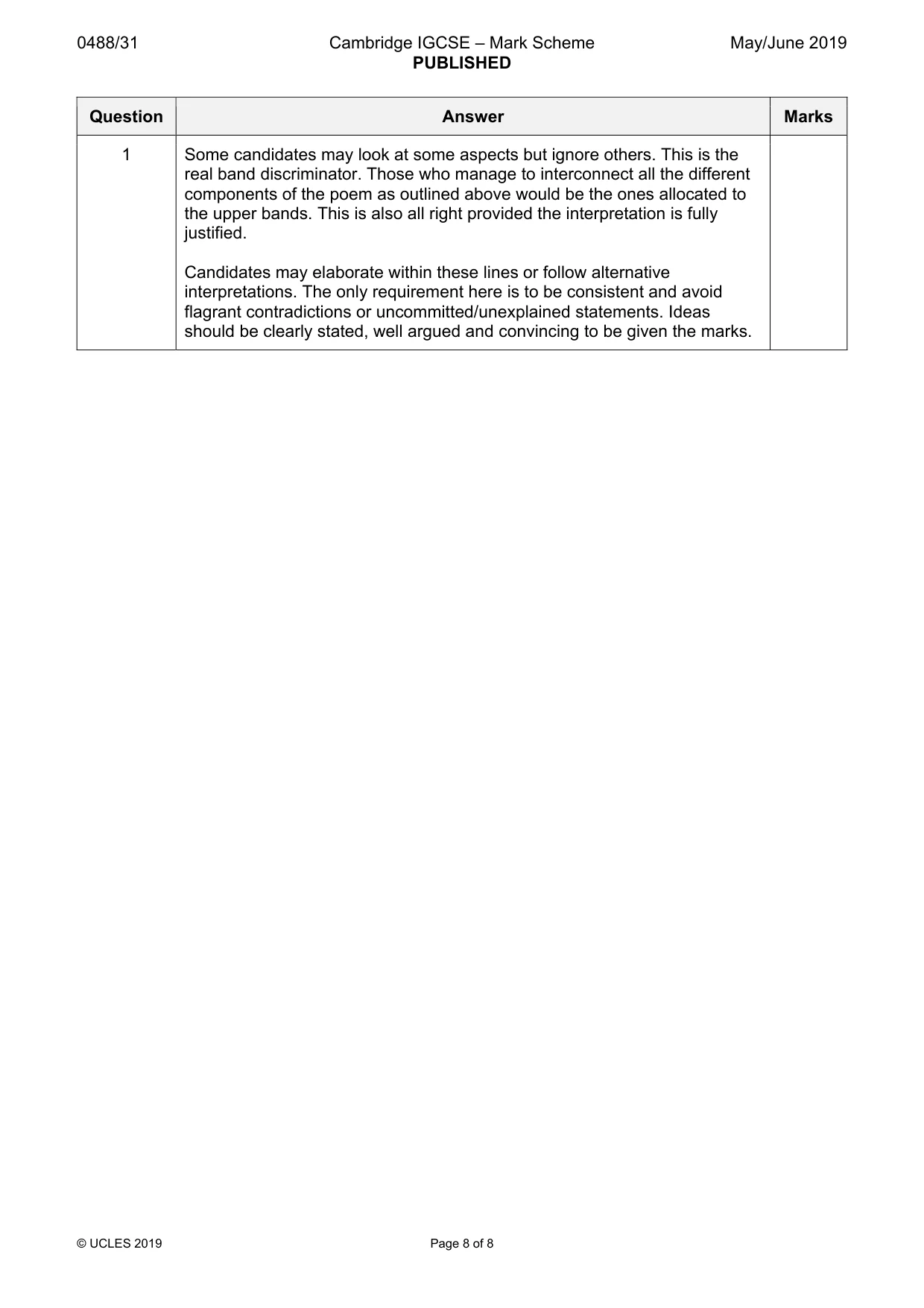
0488/31 Cambridge IGCSE – Mark Scheme PUBLISHED May/June 2019 © UCLES 2019 Page 8 of 8 Question Answer Marks 1 Some candidates may look at some aspects but ignore others. This is the real band discriminator. Those who manage to interconnect all the different components of the poem as outlined above would be the ones allocated to the upper bands. This is also all right provided the interpretation is fully justified. Candidates may elaborate within these lines or follow alternative interpretations. The only requirement here is to be consistent and avoid flagrant contradictions or uncommitted/unexplained statements. Ideas should be clearly stated, well argued and convincing to be given the marks.
What you needed in this session
Cambridge’s own grade thresholds for 2019 May/June, Paper 3 · Variant 1. A higher threshold means an easier paper — the bar moves with how the cohort did.