Cambridge IGCSE Spanish - Literature 0488 — 2018 May/June Paper 3 · Variant 1
0488/31/M/J/18 · 20 marks · ≈23 min
The question paper and its mark scheme, free to read here and free to download. This is Cambridge’s own paper, exactly as it was sat.
Question paper4 pages

Mark scheme6 pages
Answers below. Sit the paper first if you are practising.
Paper as text
Question paper, page 1
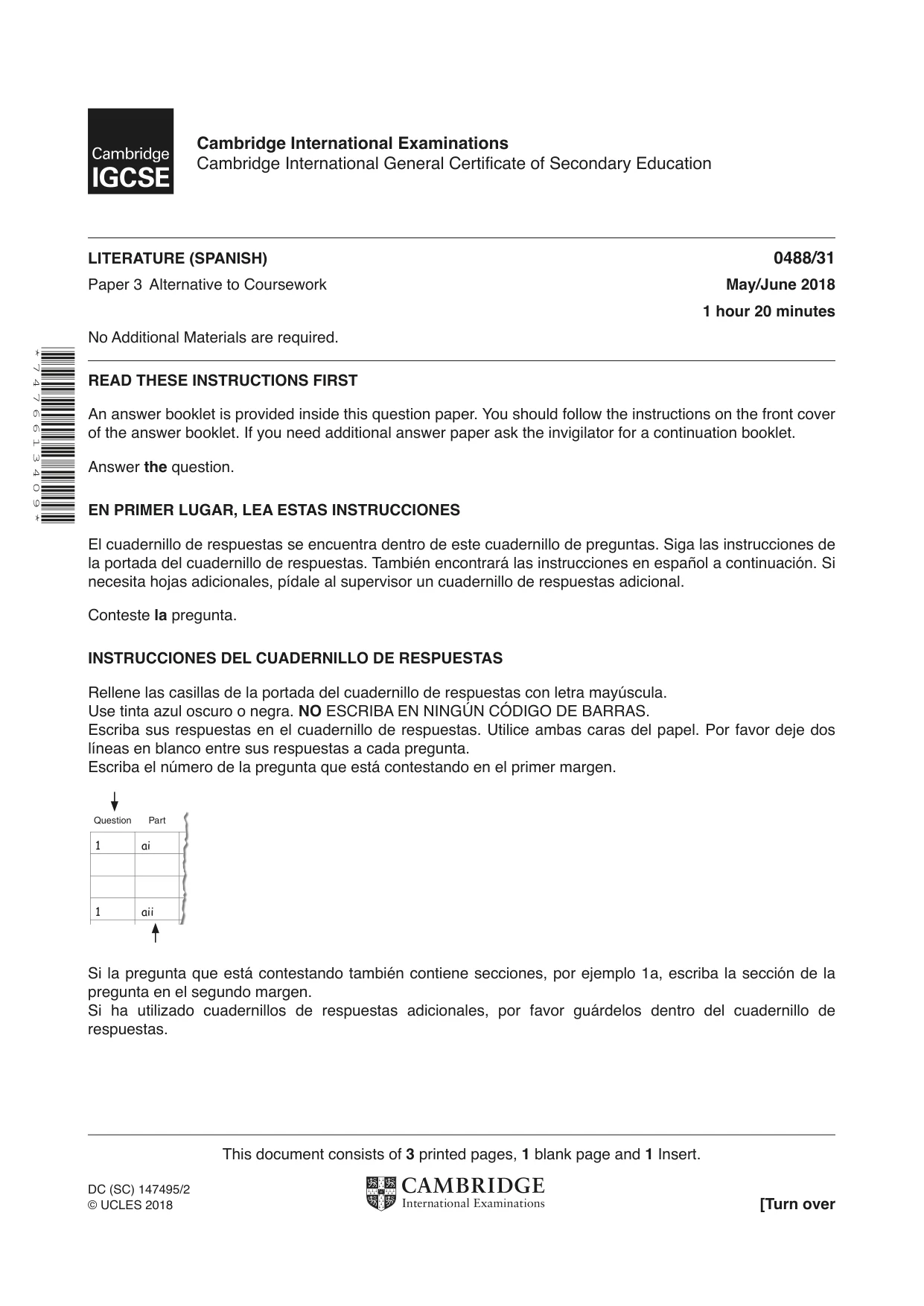
* 7 4 7 6 6 1 3 4 0 9 * This document consists of 3 printed pages, 1 blank page and 1 Insert. DC (SC) 147495/2 © UCLES 2018 [Turn over Cambridge International Examinations Cambridge International General Certificate of Secondary Education LITERATURE (SPANISH) 0488/31 Paper 3 Alternative to Coursework May/June 2018 1 hour 20 minutes No Additional Materials are required. READ THESE INSTRUCTIONS FIRST An answer booklet is provided inside this question paper. You should follow the instructions on the front cover of the answer booklet. If you need additional answer paper ask the invigilator for a continuation booklet. Answer the question. EN PRIMER LUGAR, LEA ESTAS INSTRUCCIONES El cuadernillo de respuestas se encuentra dentro de este cuadernillo de preguntas. Siga las instrucciones de la portada del cuadernillo de respuestas. También encontrará las instrucciones en español a continuación. Si necesita hojas adicionales, pídale al supervisor un cuadernillo de respuestas adicional. Conteste la pregunta. INSTRUCCIONES DEL CUADERNILLO DE RESPUESTAS Rellene las casillas de la portada del cuadernillo de respuestas con letra mayúscula. Use tinta azul oscuro o negra. NO ESCRIBA EN NINGÚN CÓDIGO DE BARRAS. Escriba sus respuestas en el cuadernillo de respuestas. Utilice ambas caras del papel. Por favor deje dos líneas en blanco entre sus respuestas a cada pregunta. Escriba el número de la pregunta que está contestando en el primer margen. Question Part 1 1 ai aii Si la pregunta que está contestando también contiene secciones, por ejemplo 1a, escriba la sección de la pregunta en el segundo margen. Si ha utilizado cuadernillos de respuestas adicionales, por favor guárdelos dentro del cuadernillo de respuestas.
Question paper, page 2
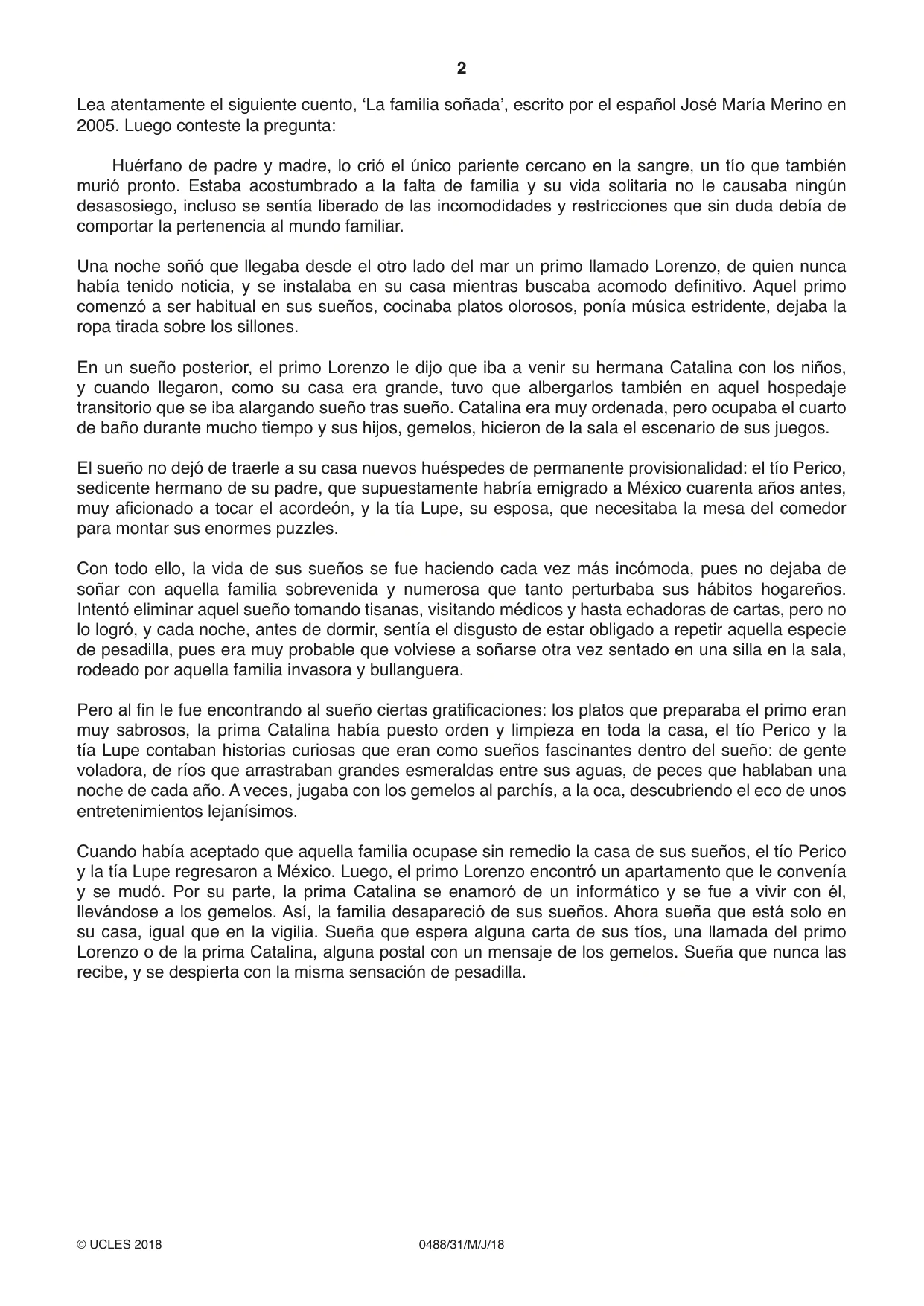
2 0488/31/M/J/18 © UCLES 2018 Lea atentamente el siguiente cuento, ‘La familia soñada’, escrito por el español José María Merino en 2005. Luego conteste la pregunta: Huérfano de padre y madre, lo crió el único pariente cercano en la sangre, un tío que también murió pronto. Estaba acostumbrado a la falta de familia y su vida solitaria no le causaba ningún desasosiego, incluso se sentía liberado de las incomodidades y restricciones que sin duda debía de comportar la pertenencia al mundo familiar. Una noche soñó que llegaba desde el otro lado del mar un primo llamado Lorenzo, de quien nunca había tenido noticia, y se instalaba en su casa mientras buscaba acomodo definitivo. Aquel primo comenzó a ser habitual en sus sueños, cocinaba platos olorosos, ponía música estridente, dejaba la ropa tirada sobre los sillones. En un sueño posterior, el primo Lorenzo le dijo que iba a venir su hermana Catalina con los niños, y cuando llegaron, como su casa era grande, tuvo que albergarlos también en aquel hospedaje transitorio que se iba alargando sueño tras sueño. Catalina era muy ordenada, pero ocupaba el cuarto de baño durante mucho tiempo y sus hijos, gemelos, hicieron de la sala el escenario de sus juegos. El sueño no dejó de traerle a su casa nuevos huéspedes de permanente provisionalidad: el tío Perico, sedicente hermano de su padre, que supuestamente habría emigrado a México cuarenta años antes, muy aficionado a tocar el acordeón, y la tía Lupe, su esposa, que necesitaba la mesa del comedor para montar sus enormes puzzles. Con todo ello, la vida de sus sueños se fue haciendo cada vez más incómoda, pues no dejaba de soñar con aquella familia sobrevenida y numerosa que tanto perturbaba sus hábitos hogareños. Intentó eliminar aquel sueño tomando tisanas, visitando médicos y hasta echadoras de cartas, pero no lo logró, y cada noche, antes de dormir, sentía el disgusto de estar obligado a repetir aquella especie de pesadilla, pues era muy probable que volviese a soñarse otra vez sentado en una silla en la sala, rodeado por aquella familia invasora y bullanguera. Pero al fin le fue encontrando al sueño ciertas gratificaciones: los platos que preparaba el primo eran muy sabrosos, la prima Catalina había puesto orden y limpieza en toda la casa, el tío Perico y la tía Lupe contaban historias curiosas que eran como sueños fascinantes dentro del sueño: de gente voladora, de ríos que arrastraban grandes esmeraldas entre sus aguas, de peces que hablaban una noche de cada año. A veces, jugaba con los gemelos al parchís, a la oca, descubriendo el eco de unos entretenimientos lejanísimos. Cuando había aceptado que aquella familia ocupase sin remedio la casa de sus sueños, el tío Perico y la tía Lupe regresaron a México. Luego, el primo Lorenzo encontró un apartamento que le convenía y se mudó. Por su parte, la prima Catalina se enamoró de un informático y se fue a vivir con él, llevándose a los gemelos. Así, la familia desapareció de sus sueños. Ahora sueña que está solo en su casa, igual que en la vigilia. Sueña que espera alguna carta de sus tíos, una llamada del primo Lorenzo o de la prima Catalina, alguna postal con un mensaje de los gemelos. Sueña que nunca las recibe, y se despierta con la misma sensación de pesadilla.
Question paper, page 3
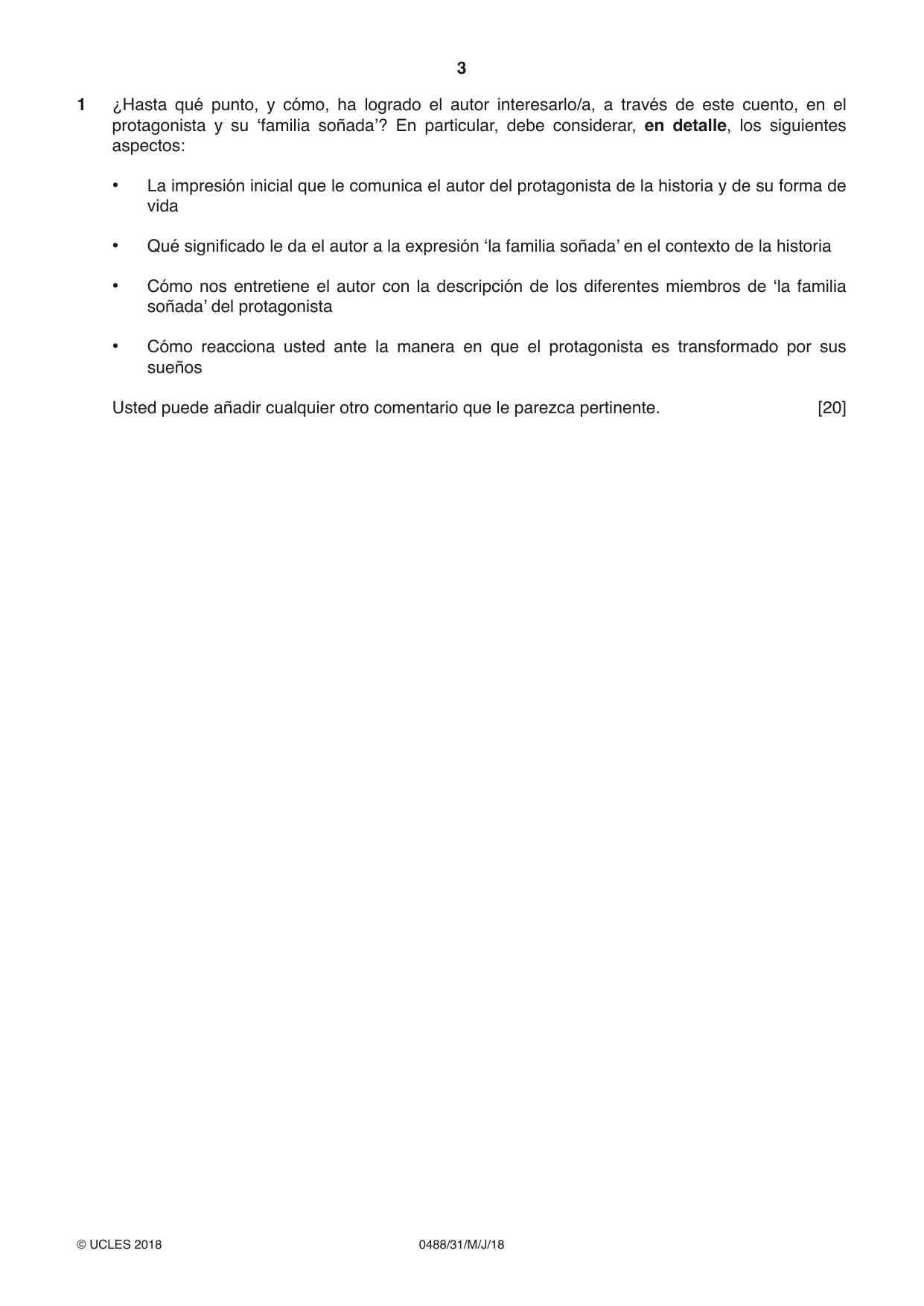
3 0488/31/M/J/18 © UCLES 2018 1 ¿Hasta qué punto, y cómo, ha logrado el autor interesarlo/a, a través de este cuento, en el protagonista y su ‘familia soñada’? En particular, debe considerar, en detalle, los siguientes aspectos: • La impresión inicial que le comunica el autor del protagonista de la historia y de su forma de vida • Qué significado le da el autor a la expresión ‘la familia soñada’ en el contexto de la historia • Cómo nos entretiene el autor con la descripción de los diferentes miembros de ‘la familia soñada’ del protagonista • Cómo reacciona usted ante la manera en que el protagonista es transformado por sus sueños Usted puede añadir cualquier otro comentario que le parezca pertinente. [20]
Question paper, page 4
4 0488/31/M/J/18 © UCLES 2018 BLANK PAGE Permission to reproduce items where third-party owned material protected by copyright is included has been sought and cleared where possible. Every reasonable effort has been made by the publisher (UCLES) to trace copyright holders, but if any items requiring clearance have unwittingly been included, the publisher will be pleased to make amends at the earliest possible opportunity. To avoid the issue of disclosure of answer-related information to candidates, all copyright acknowledgements are reproduced online in the Cambridge International Examinations Copyright Acknowledgements Booklet. This is produced for each series of examinations and is freely available to download at www.cie.org.uk after the live examination series. Cambridge International Examinations is part of the Cambridge Assessment Group. Cambridge Assessment is the brand name of University of Cambridge Local Examinations Syndicate (UCLES), which is itself a department of the University of Cambridge.
Mark scheme, page 1
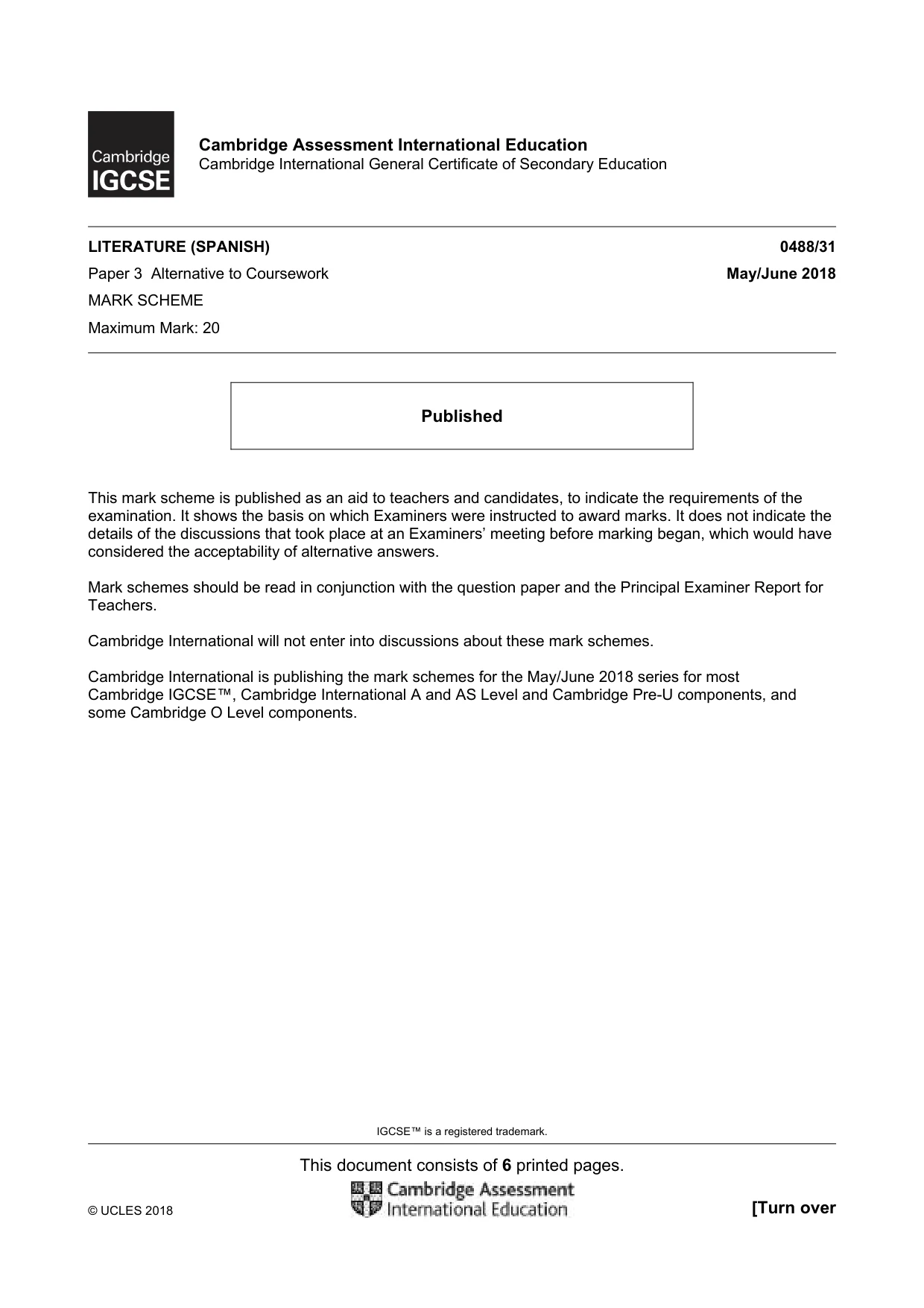
IGCSE™ is a registered trademark. This document consists of 6 printed pages. © UCLES 2018 [Turn over Cambridge Assessment International Education Cambridge International General Certificate of Secondary Education LITERATURE (SPANISH) 0488/31 Paper 3 Alternative to Coursework May/June 2018 MARK SCHEME Maximum Mark: 20 Published This mark scheme is published as an aid to teachers and candidates, to indicate the requirements of the examination. It shows the basis on which Examiners were instructed to award marks. It does not indicate the details of the discussions that took place at an Examiners’ meeting before marking began, which would have considered the acceptability of alternative answers. Mark schemes should be read in conjunction with the question paper and the Principal Examiner Report for Teachers. Cambridge International will not enter into discussions about these mark schemes. Cambridge International is publishing the mark schemes for the May/June 2018 series for most Cambridge IGCSE™, Cambridge International A and AS Level and Cambridge Pre-U components, and some Cambridge O Level components.
Mark scheme, page 2
0488/31 Cambridge IGCSE – Mark Scheme PUBLISHED May/June 2018 © UCLES 2018 Page 2 of 6 Generic Marking Principles These general marking principles must be applied by all examiners when marking candidate answers. They should be applied alongside the specific content of the mark scheme or generic level descriptors for a question. Each question paper and mark scheme will also comply with these marking principles. GENERIC MARKING PRINCIPLE 1: Marks must be awarded in line with: • the specific content of the mark scheme or the generic level descriptors for the question • the specific skills defined in the mark scheme or in the generic level descriptors for the question • the standard of response required by a candidate as exemplified by the standardisation scripts. GENERIC MARKING PRINCIPLE 2: Marks awarded are always whole marks (not half marks, or other fractions). GENERIC MARKING PRINCIPLE 3: Marks must be awarded positively: • marks are awarded for correct/valid answers, as defined in the mark scheme. However, credit is given for valid answers which go beyond the scope of the syllabus and mark scheme, referring to your Team Leader as appropriate • marks are awarded when candidates clearly demonstrate what they know and can do • marks are not deducted for errors • marks are not deducted for omissions • answers should only be judged on the quality of spelling, punctuation and grammar when these features are specifically assessed by the question as indicated by the mark scheme. The meaning, however, should be unambiguous. GENERIC MARKING PRINCIPLE 4: Rules must be applied consistently e.g. in situations where candidates have not followed instructions or in the application of generic level descriptors. GENERIC MARKING PRINCIPLE 5: Marks should be awarded using the full range of marks defined in the mark scheme for the question (however; the use of the full mark range may be limited according to the quality of the candidate responses seen). GENERIC MARKING PRINCIPLE 6: Marks awarded are based solely on the requirements as defined in the mark scheme. Marks should not be awarded with grade thresholds or grade descriptors in mind.
Mark scheme, page 3
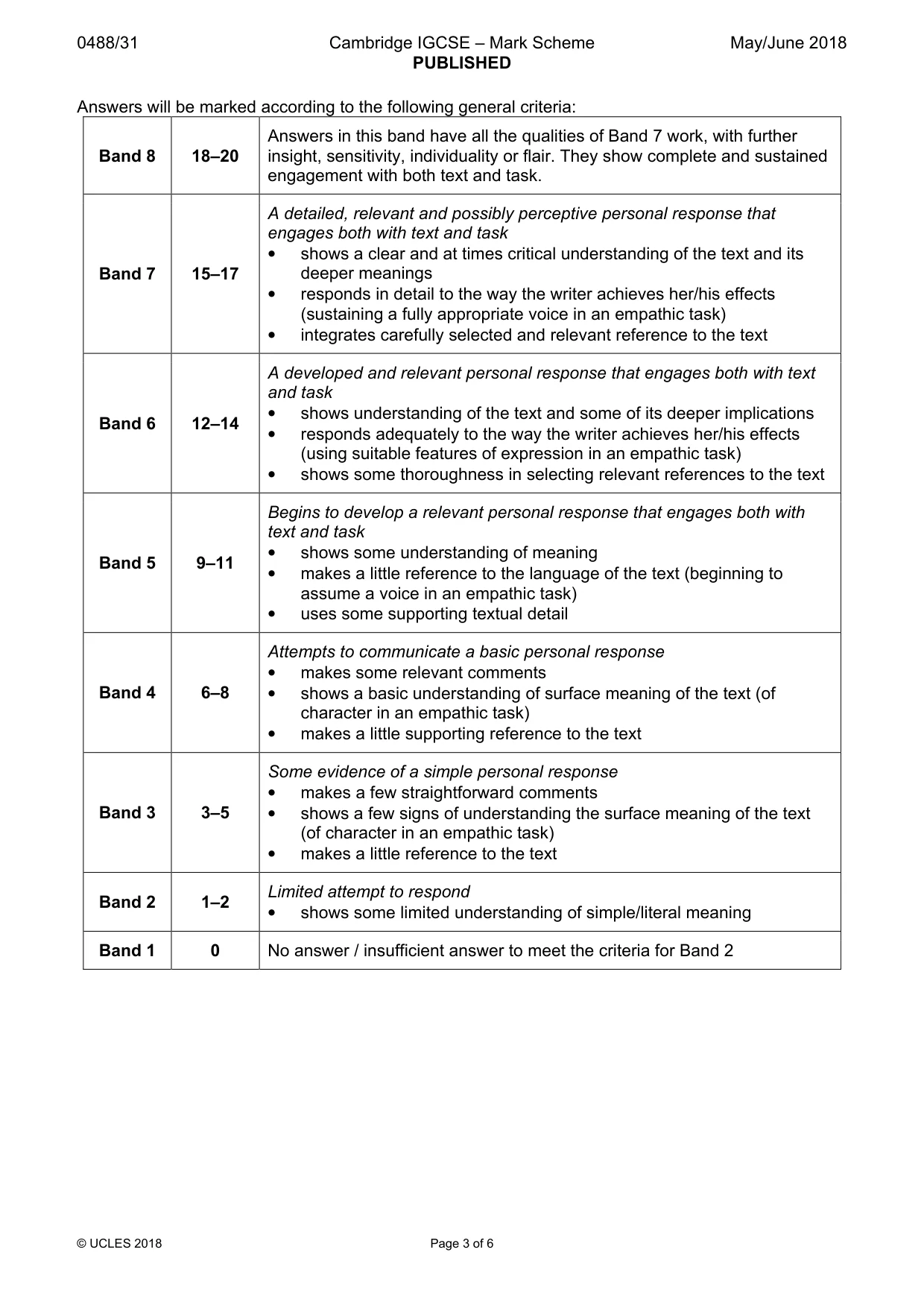
0488/31 Cambridge IGCSE – Mark Scheme PUBLISHED May/June 2018 © UCLES 2018 Page 3 of 6 Answers will be marked according to the following general criteria: Band 8 18–20 Answers in this band have all the qualities of Band 7 work, with further insight, sensitivity, individuality or flair. They show complete and sustained engagement with both text and task. Band 7 15–17 A detailed, relevant and possibly perceptive personal response that engages both with text and task • shows a clear and at times critical understanding of the text and its deeper meanings • responds in detail to the way the writer achieves her/his effects (sustaining a fully appropriate voice in an empathic task) • integrates carefully selected and relevant reference to the text Band 6 12–14 A developed and relevant personal response that engages both with text and task • shows understanding of the text and some of its deeper implications • responds adequately to the way the writer achieves her/his effects (using suitable features of expression in an empathic task) • shows some thoroughness in selecting relevant references to the text Band 5 9–11 Begins to develop a relevant personal response that engages both with text and task • shows some understanding of meaning • makes a little reference to the language of the text (beginning to assume a voice in an empathic task) • uses some supporting textual detail Band 4 6–8 Attempts to communicate a basic personal response • makes some relevant comments • shows a basic understanding of surface meaning of the text (of character in an empathic task) • makes a little supporting reference to the text Band 3 3–5 Some evidence of a simple personal response • makes a few straightforward comments • shows a few signs of understanding the surface meaning of the text (of character in an empathic task) • makes a little reference to the text Band 2 1–2 Limited attempt to respond • shows some limited understanding of simple/literal meaning Band 1 0 No answer / insufficient answer to meet the criteria for Band 2
Mark scheme, page 4
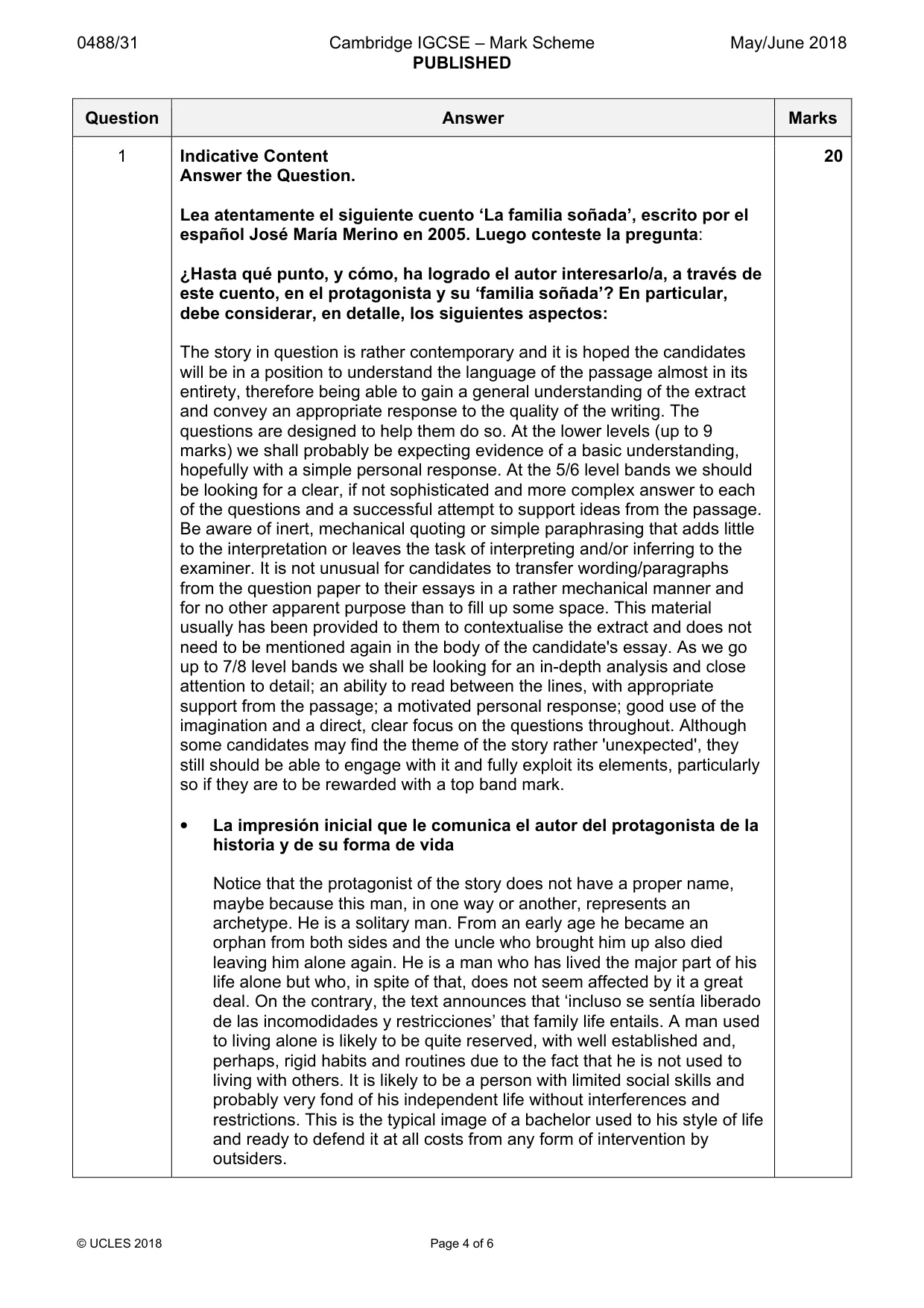
0488/31 Cambridge IGCSE – Mark Scheme PUBLISHED May/June 2018 © UCLES 2018 Page 4 of 6 Question Answer Marks 1 Indicative Content Answer the Question. Lea atentamente el siguiente cuento ‘La familia soñada’, escrito por el español José María Merino en 2005. Luego conteste la pregunta: ¿Hasta qué punto, y cómo, ha logrado el autor interesarlo/a, a través de este cuento, en el protagonista y su ‘familia soñada’? En particular, debe considerar, en detalle, los siguientes aspectos: The story in question is rather contemporary and it is hoped the candidates will be in a position to understand the language of the passage almost in its entirety, therefore being able to gain a general understanding of the extract and convey an appropriate response to the quality of the writing. The questions are designed to help them do so. At the lower levels (up to 9 marks) we shall probably be expecting evidence of a basic understanding, hopefully with a simple personal response. At the 5/6 level bands we should be looking for a clear, if not sophisticated and more complex answer to each of the questions and a successful attempt to support ideas from the passage. Be aware of inert, mechanical quoting or simple paraphrasing that adds little to the interpretation or leaves the task of interpreting and/or inferring to the examiner. It is not unusual for candidates to transfer wording/paragraphs from the question paper to their essays in a rather mechanical manner and for no other apparent purpose than to fill up some space. This material usually has been provided to them to contextualise the extract and does not need to be mentioned again in the body of the candidate's essay. As we go up to 7/8 level bands we shall be looking for an in-depth analysis and close attention to detail; an ability to read between the lines, with appropriate support from the passage; a motivated personal response; good use of the imagination and a direct, clear focus on the questions throughout. Although some candidates may find the theme of the story rather 'unexpected', they still should be able to engage with it and fully exploit its elements, particularly so if they are to be rewarded with a top band mark. • La impresión inicial que le comunica el autor del protagonista de la historia y de su forma de vida Notice that the protagonist of the story does not have a proper name, maybe because this man, in one way or another, represents an archetype. He is a solitary man. From an early age he became an orphan from both sides and the uncle who brought him up also died leaving him alone again. He is a man who has lived the major part of his life alone but who, in spite of that, does not seem affected by it a great deal. On the contrary, the text announces that ‘incluso se sentía liberado de las incomodidades y restricciones’ that family life entails. A man used to living alone is likely to be quite reserved, with well established and, perhaps, rigid habits and routines due to the fact that he is not used to living with others. It is likely to be a person with limited social skills and probably very fond of his independent life without interferences and restrictions. This is the typical image of a bachelor used to his style of life and ready to defend it at all costs from any form of intervention by outsiders. 20
Mark scheme, page 5
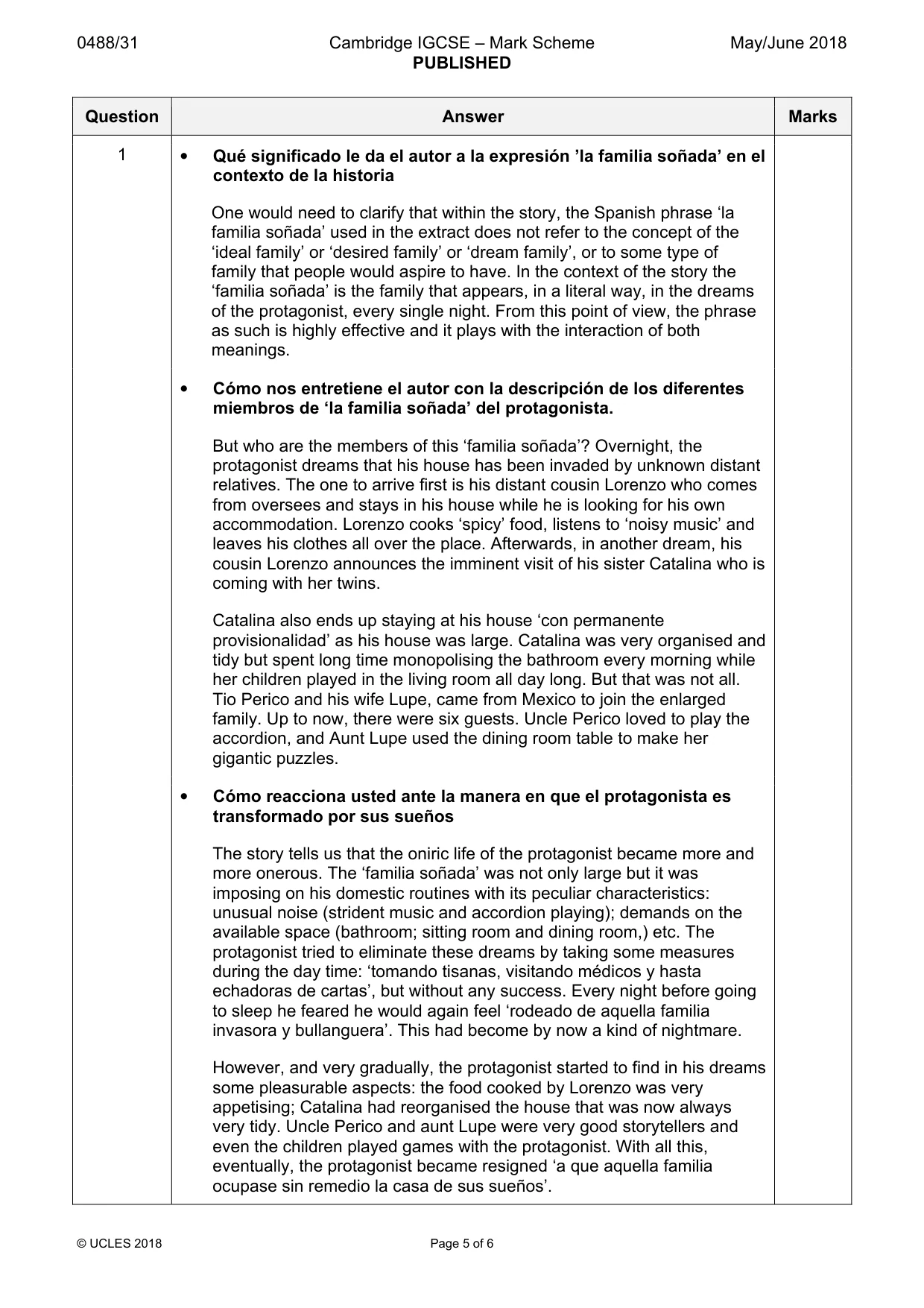
0488/31 Cambridge IGCSE – Mark Scheme PUBLISHED May/June 2018 © UCLES 2018 Page 5 of 6 Question Answer Marks 1 • Qué significado le da el autor a la expresión ’la familia soñada’ en el contexto de la historia One would need to clarify that within the story, the Spanish phrase ‘la familia soñada’ used in the extract does not refer to the concept of the ‘ideal family’ or ‘desired family’ or ‘dream family’, or to some type of family that people would aspire to have. In the context of the story the ‘familia soñada’ is the family that appears, in a literal way, in the dreams of the protagonist, every single night. From this point of view, the phrase as such is highly effective and it plays with the interaction of both meanings. • Cómo nos entretiene el autor con la descripción de los diferentes miembros de ‘la familia soñada’ del protagonista. But who are the members of this ‘familia soñada’? Overnight, the protagonist dreams that his house has been invaded by unknown distant relatives. The one to arrive first is his distant cousin Lorenzo who comes from oversees and stays in his house while he is looking for his own accommodation. Lorenzo cooks ‘spicy’ food, listens to ‘noisy music’ and leaves his clothes all over the place. Afterwards, in another dream, his cousin Lorenzo announces the imminent visit of his sister Catalina who is coming with her twins. Catalina also ends up staying at his house ‘con permanente provisionalidad’ as his house was large. Catalina was very organised and tidy but spent long time monopolising the bathroom every morning while her children played in the living room all day long. But that was not all. Tio Perico and his wife Lupe, came from Mexico to join the enlarged family. Up to now, there were six guests. Uncle Perico loved to play the accordion, and Aunt Lupe used the dining room table to make her gigantic puzzles. • Cómo reacciona usted ante la manera en que el protagonista es transformado por sus sueños The story tells us that the oniric life of the protagonist became more and more onerous. The ‘familia soñada’ was not only large but it was imposing on his domestic routines with its peculiar characteristics: unusual noise (strident music and accordion playing); demands on the available space (bathroom; sitting room and dining room,) etc. The protagonist tried to eliminate these dreams by taking some measures during the day time: ‘tomando tisanas, visitando médicos y hasta echadoras de cartas’, but without any success. Every night before going to sleep he feared he would again feel ‘rodeado de aquella familia invasora y bullanguera’. This had become by now a kind of nightmare. However, and very gradually, the protagonist started to find in his dreams some pleasurable aspects: the food cooked by Lorenzo was very appetising; Catalina had reorganised the house that was now always very tidy. Uncle Perico and aunt Lupe were very good storytellers and even the children played games with the protagonist. With all this, eventually, the protagonist became resigned ‘a que aquella familia ocupase sin remedio la casa de sus sueños’.
Mark scheme, page 6
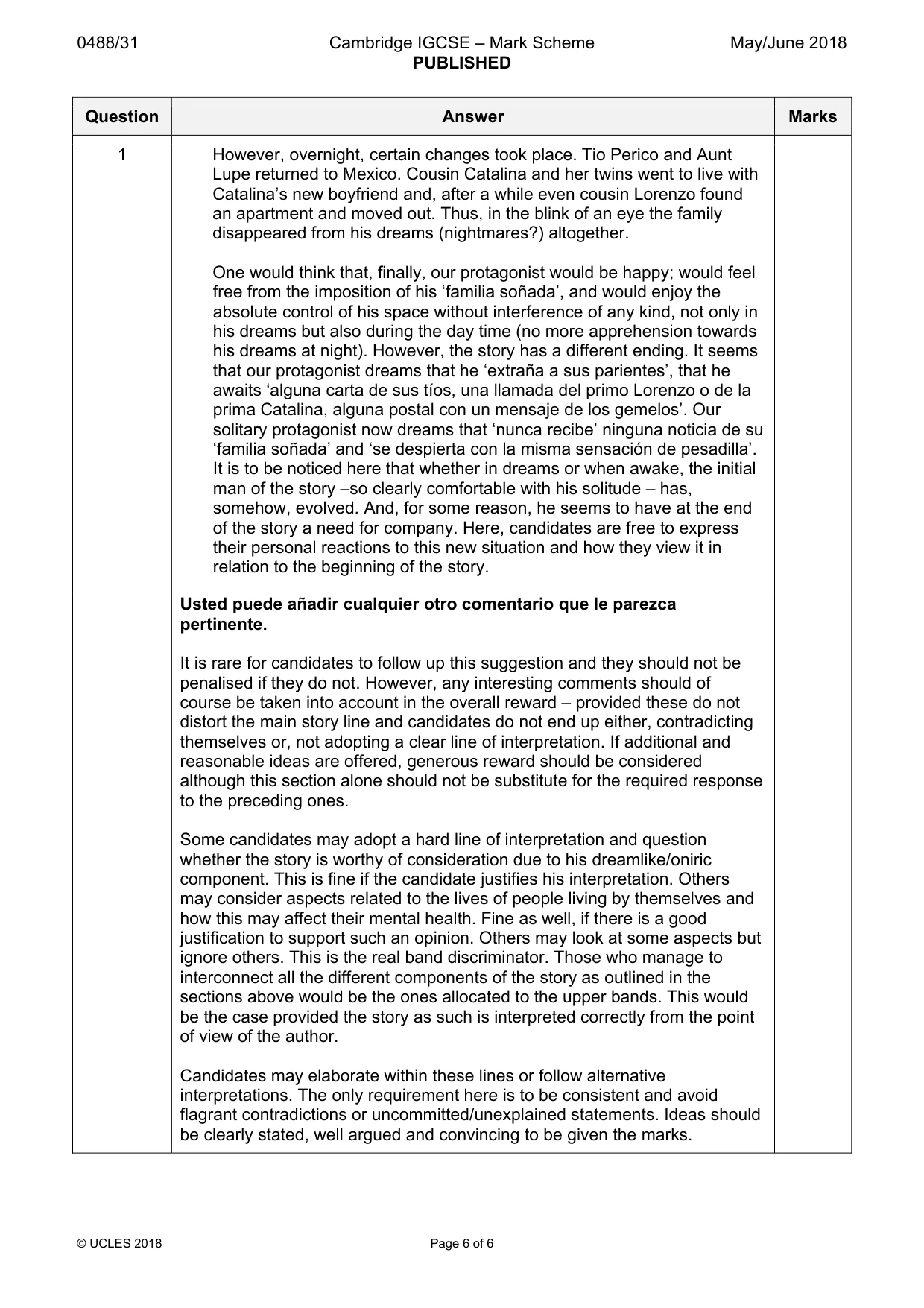
0488/31 Cambridge IGCSE – Mark Scheme PUBLISHED May/June 2018 © UCLES 2018 Page 6 of 6 Question Answer Marks 1 However, overnight, certain changes took place. Tio Perico and Aunt Lupe returned to Mexico. Cousin Catalina and her twins went to live with Catalina’s new boyfriend and, after a while even cousin Lorenzo found an apartment and moved out. Thus, in the blink of an eye the family disappeared from his dreams (nightmares?) altogether. One would think that, finally, our protagonist would be happy; would feel free from the imposition of his ‘familia soñada’, and would enjoy the absolute control of his space without interference of any kind, not only in his dreams but also during the day time (no more apprehension towards his dreams at night). However, the story has a different ending. It seems that our protagonist dreams that he ‘extraña a sus parientes’, that he awaits ‘alguna carta de sus tíos, una llamada del primo Lorenzo o de la prima Catalina, alguna postal con un mensaje de los gemelos’. Our solitary protagonist now dreams that ‘nunca recibe’ ninguna noticia de su ‘familia soñada’ and ‘se despierta con la misma sensación de pesadilla’. It is to be noticed here that whether in dreams or when awake, the initial man of the story –so clearly comfortable with his solitude – has, somehow, evolved. And, for some reason, he seems to have at the end of the story a need for company. Here, candidates are free to express their personal reactions to this new situation and how they view it in relation to the beginning of the story. Usted puede añadir cualquier otro comentario que le parezca pertinente. It is rare for candidates to follow up this suggestion and they should not be penalised if they do not. However, any interesting comments should of course be taken into account in the overall reward – provided these do not distort the main story line and candidates do not end up either, contradicting themselves or, not adopting a clear line of interpretation. If additional and reasonable ideas are offered, generous reward should be considered although this section alone should not be substitute for the required response to the preceding ones. Some candidates may adopt a hard line of interpretation and question whether the story is worthy of consideration due to his dreamlike/oniric component. This is fine if the candidate justifies his interpretation. Others may consider aspects related to the lives of people living by themselves and how this may affect their mental health. Fine as well, if there is a good justification to support such an opinion. Others may look at some aspects but ignore others. This is the real band discriminator. Those who manage to interconnect all the different components of the story as outlined in the sections above would be the ones allocated to the upper bands. This would be the case provided the story as such is interpreted correctly from the point of view of the author. Candidates may elaborate within these lines or follow alternative interpretations. The only requirement here is to be consistent and avoid flagrant contradictions or uncommitted/unexplained statements. Ideas should be clearly stated, well argued and convincing to be given the marks.
What you needed in this session
Cambridge’s own grade thresholds for 2018 May/June, Paper 3 · Variant 1. A higher threshold means an easier paper — the bar moves with how the cohort did.