Cambridge IGCSE Spanish - Literature 0488 — 2017 May/June Paper 3 · Variant 3
0488/33/M/J/17 · 20 marks · ≈23 min
The question paper and its mark scheme, free to read here and free to download. This is Cambridge’s own paper, exactly as it was sat.
Question paper4 pages

Mark scheme5 pages
Answers below. Sit the paper first if you are practising.
Paper as text
Question paper, page 1
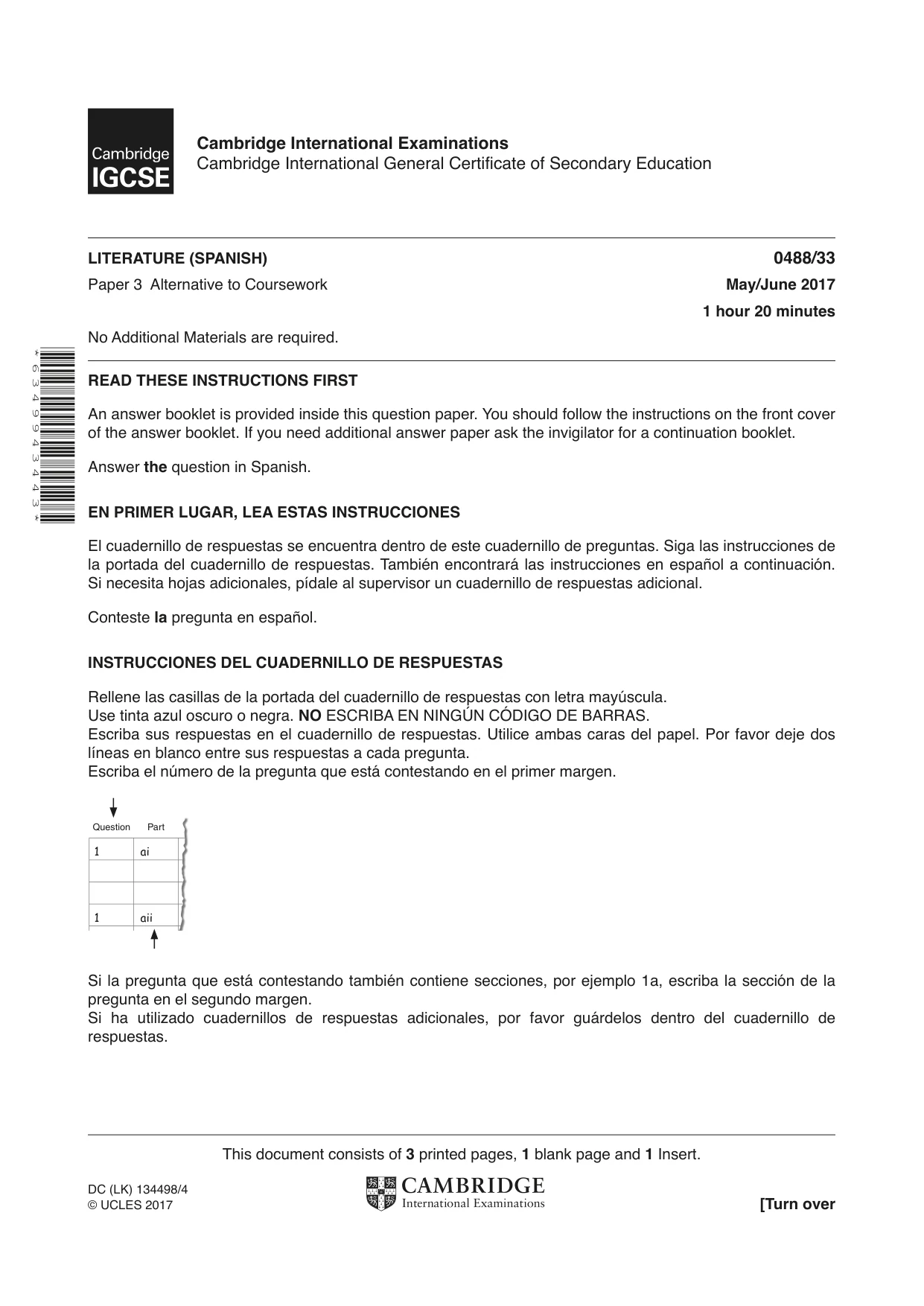
* 6 3 4 9 9 4 3 4 4 3 * This document consists of 3 printed pages, 1 blank page and 1 Insert. DC (LK) 134498/4 © UCLES 2017 [Turn over Cambridge International Examinations Cambridge International General Certificate of Secondary Education LITERATURE (SPANISH) 0488/33 Paper 3 Alternative to Coursework May/June 2017 1 hour 20 minutes No Additional Materials are required. READ THESE INSTRUCTIONS FIRST An answer booklet is provided inside this question paper. You should follow the instructions on the front cover of the answer booklet. If you need additional answer paper ask the invigilator for a continuation booklet. Answer the question in Spanish. EN PRIMER LUGAR, LEA ESTAS INSTRUCCIONES El cuadernillo de respuestas se encuentra dentro de este cuadernillo de preguntas. Siga las instrucciones de la portada del cuadernillo de respuestas. También encontrará las instrucciones en español a continuación. Si necesita hojas adicionales, pídale al supervisor un cuadernillo de respuestas adicional. Conteste la pregunta en español. INSTRUCCIONES DEL CUADERNILLO DE RESPUESTAS Rellene las casillas de la portada del cuadernillo de respuestas con letra mayúscula. Use tinta azul oscuro o negra. NO ESCRIBA EN NINGÚN CÓDIGO DE BARRAS. Escriba sus respuestas en el cuadernillo de respuestas. Utilice ambas caras del papel. Por favor deje dos líneas en blanco entre sus respuestas a cada pregunta. Escriba el número de la pregunta que está contestando en el primer margen. Question Part 1 1 ai aii Si la pregunta que está contestando también contiene secciones, por ejemplo 1a, escriba la sección de la pregunta en el segundo margen. Si ha utilizado cuadernillos de respuestas adicionales, por favor guárdelos dentro del cuadernillo de respuestas.
Question paper, page 2
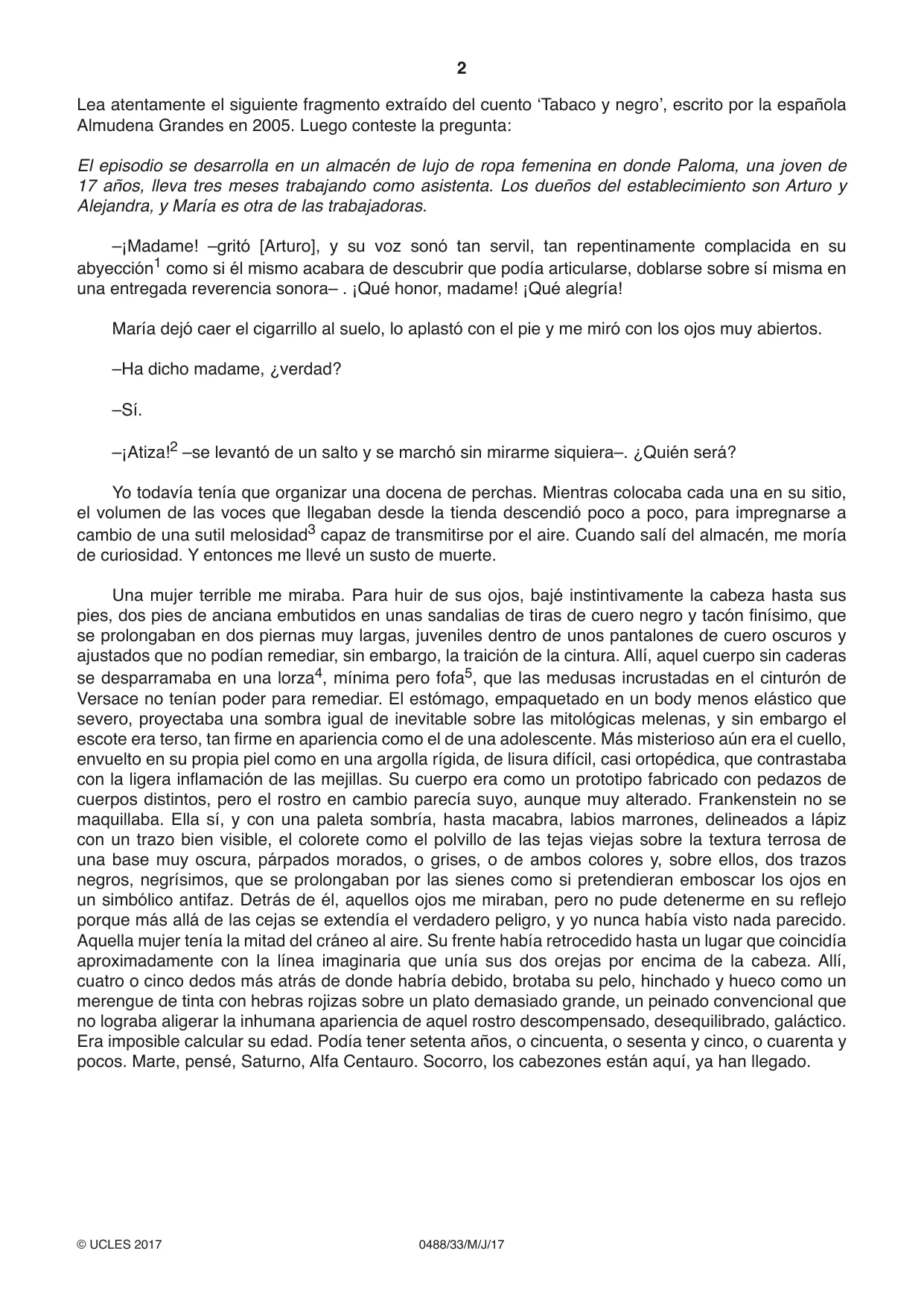
2 0488/33/M/J/17 © UCLES 2017 Lea atentamente el siguiente fragmento extraído del cuento ‘Tabaco y negro’, escrito por la española Almudena Grandes en 2005. Luego conteste la pregunta: El episodio se desarrolla en un almacén de lujo de ropa femenina en donde Paloma, una joven de 17 años, lleva tres meses trabajando como asistenta. Los dueños del establecimiento son Arturo y Alejandra, y María es otra de las trabajadoras. –¡Madame! –gritó [Arturo], y su voz sonó tan servil, tan repentinamente complacida en su abyección1 como si él mismo acabara de descubrir que podía articularse, doblarse sobre sí misma en una entregada reverencia sonora– . ¡Qué honor, madame! ¡Qué alegría! María dejó caer el cigarrillo al suelo, lo aplastó con el pie y me miró con los ojos muy abiertos. –Ha dicho madame, ¿verdad? –Sí. –¡Atiza!2 –se levantó de un salto y se marchó sin mirarme siquiera–. ¿Quién será? Yo todavía tenía que organizar una docena de perchas. Mientras colocaba cada una en su sitio, el volumen de las voces que llegaban desde la tienda descendió poco a poco, para impregnarse a cambio de una sutil melosidad3 capaz de transmitirse por el aire. Cuando salí del almacén, me moría de curiosidad. Y entonces me llevé un susto de muerte. Una mujer terrible me miraba. Para huir de sus ojos, bajé instintivamente la cabeza hasta sus pies, dos pies de anciana embutidos en unas sandalias de tiras de cuero negro y tacón finísimo, que se prolongaban en dos piernas muy largas, juveniles dentro de unos pantalones de cuero oscuros y ajustados que no podían remediar, sin embargo, la traición de la cintura. Allí, aquel cuerpo sin caderas se desparramaba en una lorza4, mínima pero fofa5, que las medusas incrustadas en el cinturón de Versace no tenían poder para remediar. El estómago, empaquetado en un body menos elástico que severo, proyectaba una sombra igual de inevitable sobre las mitológicas melenas, y sin embargo el escote era terso, tan firme en apariencia como el de una adolescente. Más misterioso aún era el cuello, envuelto en su propia piel como en una argolla rígida, de lisura difícil, casi ortopédica, que contrastaba con la ligera inflamación de las mejillas. Su cuerpo era como un prototipo fabricado con pedazos de cuerpos distintos, pero el rostro en cambio parecía suyo, aunque muy alterado. Frankenstein no se maquillaba. Ella sí, y con una paleta sombría, hasta macabra, labios marrones, delineados a lápiz con un trazo bien visible, el colorete como el polvillo de las tejas viejas sobre la textura terrosa de una base muy oscura, párpados morados, o grises, o de ambos colores y, sobre ellos, dos trazos negros, negrísimos, que se prolongaban por las sienes como si pretendieran emboscar los ojos en un simbólico antifaz. Detrás de él, aquellos ojos me miraban, pero no pude detenerme en su reflejo porque más allá de las cejas se extendía el verdadero peligro, y yo nunca había visto nada parecido. Aquella mujer tenía la mitad del cráneo al aire. Su frente había retrocedido hasta un lugar que coincidía aproximadamente con la línea imaginaria que unía sus dos orejas por encima de la cabeza. Allí, cuatro o cinco dedos más atrás de donde habría debido, brotaba su pelo, hinchado y hueco como un merengue de tinta con hebras rojizas sobre un plato demasiado grande, un peinado convencional que no lograba aligerar la inhumana apariencia de aquel rostro descompensado, desequilibrado, galáctico. Era imposible calcular su edad. Podía tener setenta años, o cincuenta, o sesenta y cinco, o cuarenta y pocos. Marte, pensé, Saturno, Alfa Centauro. Socorro, los cabezones están aquí, ya han llegado.
Question paper, page 3
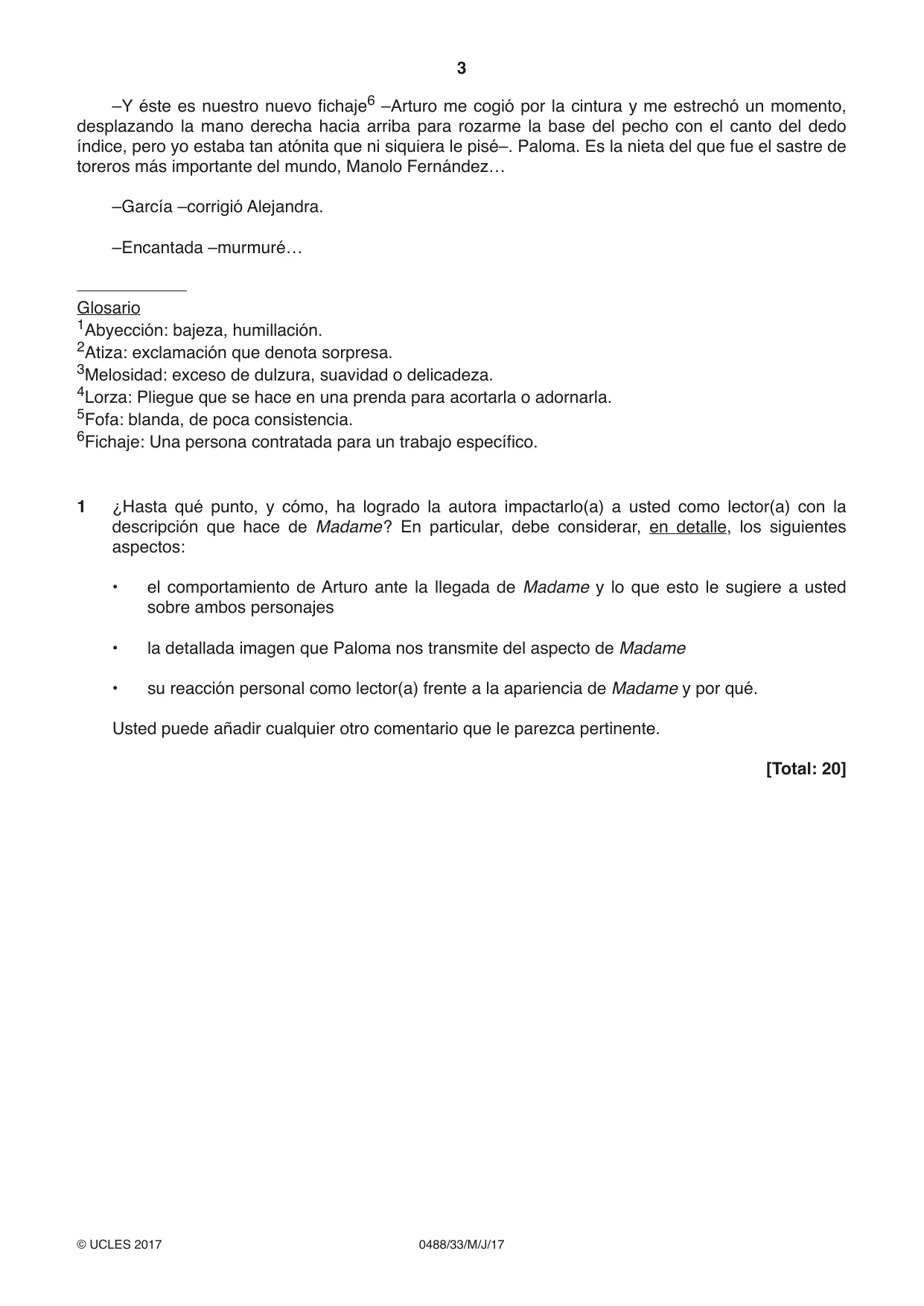
3 0488/33/M/J/17 © UCLES 2017 –Y éste es nuestro nuevo fichaje6 –Arturo me cogió por la cintura y me estrechó un momento, desplazando la mano derecha hacia arriba para rozarme la base del pecho con el canto del dedo índice, pero yo estaba tan atónita que ni siquiera le pisé–. Paloma. Es la nieta del que fue el sastre de toreros más importante del mundo, Manolo Fernández… –García –corrigió Alejandra. –Encantada –murmuré… Glosario 1Abyección: bajeza, humillación. 2Atiza: exclamación que denota sorpresa. 3Melosidad: exceso de dulzura, suavidad o delicadeza. 4Lorza: Pliegue que se hace en una prenda para acortarla o adornarla. 5Fofa: blanda, de poca consistencia. 6Fichaje: Una persona contratada para un trabajo específico. 1 ¿Hasta qué punto, y cómo, ha logrado la autora impactarlo(a) a usted como lector(a) con la descripción que hace de Madame ? En particular, debe considerar, en detalle, los siguientes aspectos: • el comportamiento de Arturo ante la llegada de Madame y lo que esto le sugiere a usted sobre ambos personajes • la detallada imagen que Paloma nos transmite del aspecto de Madame • su reacción personal como lector(a) frente a la apariencia de Madame y por qué. Usted puede añadir cualquier otro comentario que le parezca pertinente. [Total: 20]
Question paper, page 4
4 0488/33/M/J/17 © UCLES 2017 Permission to reproduce items where third-party owned material protected by copyright is included has been sought and cleared where possible. Every reasonable effort has been made by the publisher (UCLES) to trace copyright holders, but if any items requiring clearance have unwittingly been included, the publisher will be pleased to make amends at the earliest possible opportunity. To avoid the issue of disclosure of answer-related information to candidates, all copyright acknowledgements are reproduced online in the Cambridge International Examinations Copyright Acknowledgements Booklet. This is produced for each series of examinations and is freely available to download at www.cie.org.uk after the live examination series. Cambridge International Examinations is part of the Cambridge Assessment Group. Cambridge Assessment is the brand name of University of Cambridge Local Examinations Syndicate (UCLES), which is itself a department of the University of Cambridge. BLANK PAGE
Mark scheme, page 1
® IGCSE is a registered trademark. This document consists of 5 printed pages. © UCLES 2017 [Turn over Cambridge International Examinations Cambridge International General Certificate of Secondary Education LITERATURE (SPANISH) 0488/33 Paper 3 Alternative to Coursework May/June 2017 MARK SCHEME Maximum Mark: 20 Published This mark scheme is published as an aid to teachers and candidates, to indicate the requirements of the examination. It shows the basis on which Examiners were instructed to award marks. It does not indicate the details of the discussions that took place at an Examiners’ meeting before marking began, which would have considered the acceptability of alternative answers. Mark schemes should be read in conjunction with the question paper and the Principal Examiner Report for Teachers. Cambridge will not enter into discussions about these mark schemes. Cambridge is publishing the mark schemes for the May/June 2017 series for most Cambridge IGCSE®, Cambridge International A and AS Level and Cambridge Pre-U components, and some Cambridge O Level components.
Mark scheme, page 2
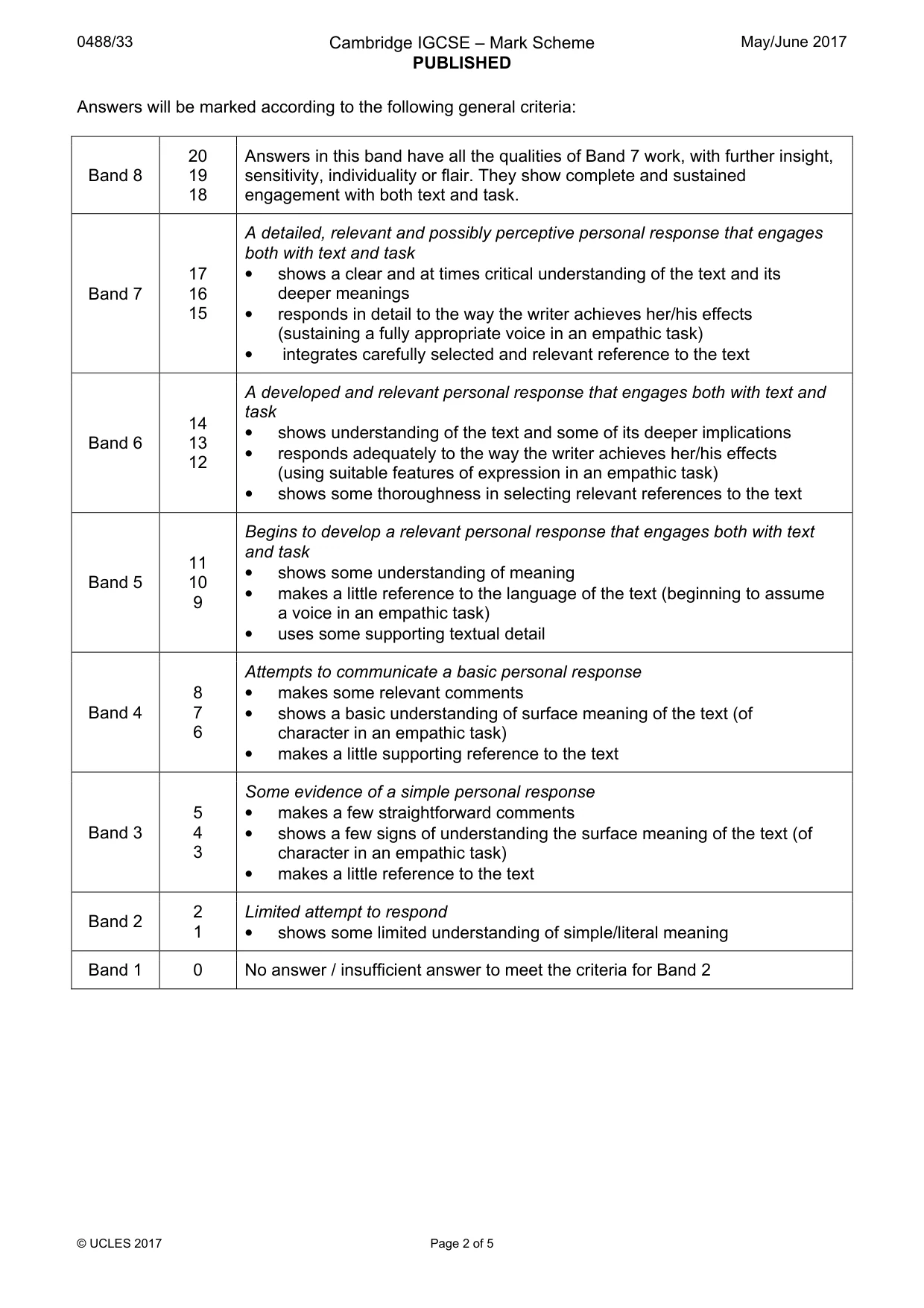
0488/33 Cambridge IGCSE – Mark Scheme PUBLISHED May/June 2017 © UCLES 2017 Page 2 of 5 Answers will be marked according to the following general criteria: Band 8 20 19 18 Answers in this band have all the qualities of Band 7 work, with further insight, sensitivity, individuality or flair. They show complete and sustained engagement with both text and task. Band 7 17 16 15 A detailed, relevant and possibly perceptive personal response that engages both with text and task • shows a clear and at times critical understanding of the text and its deeper meanings • responds in detail to the way the writer achieves her/his effects (sustaining a fully appropriate voice in an empathic task) • integrates carefully selected and relevant reference to the text Band 6 14 13 12 A developed and relevant personal response that engages both with text and task • shows understanding of the text and some of its deeper implications • responds adequately to the way the writer achieves her/his effects (using suitable features of expression in an empathic task) • shows some thoroughness in selecting relevant references to the text Band 5 11 10 9 Begins to develop a relevant personal response that engages both with text and task • shows some understanding of meaning • makes a little reference to the language of the text (beginning to assume a voice in an empathic task) • uses some supporting textual detail Band 4 8 7 6 Attempts to communicate a basic personal response • makes some relevant comments • shows a basic understanding of surface meaning of the text (of character in an empathic task) • makes a little supporting reference to the text Band 3 5 4 3 Some evidence of a simple personal response • makes a few straightforward comments • shows a few signs of understanding the surface meaning of the text (of character in an empathic task) • makes a little reference to the text Band 2 2 1 Limited attempt to respond • shows some limited understanding of simple/literal meaning Band 1 0 No answer / insufficient answer to meet the criteria for Band 2
Mark scheme, page 3
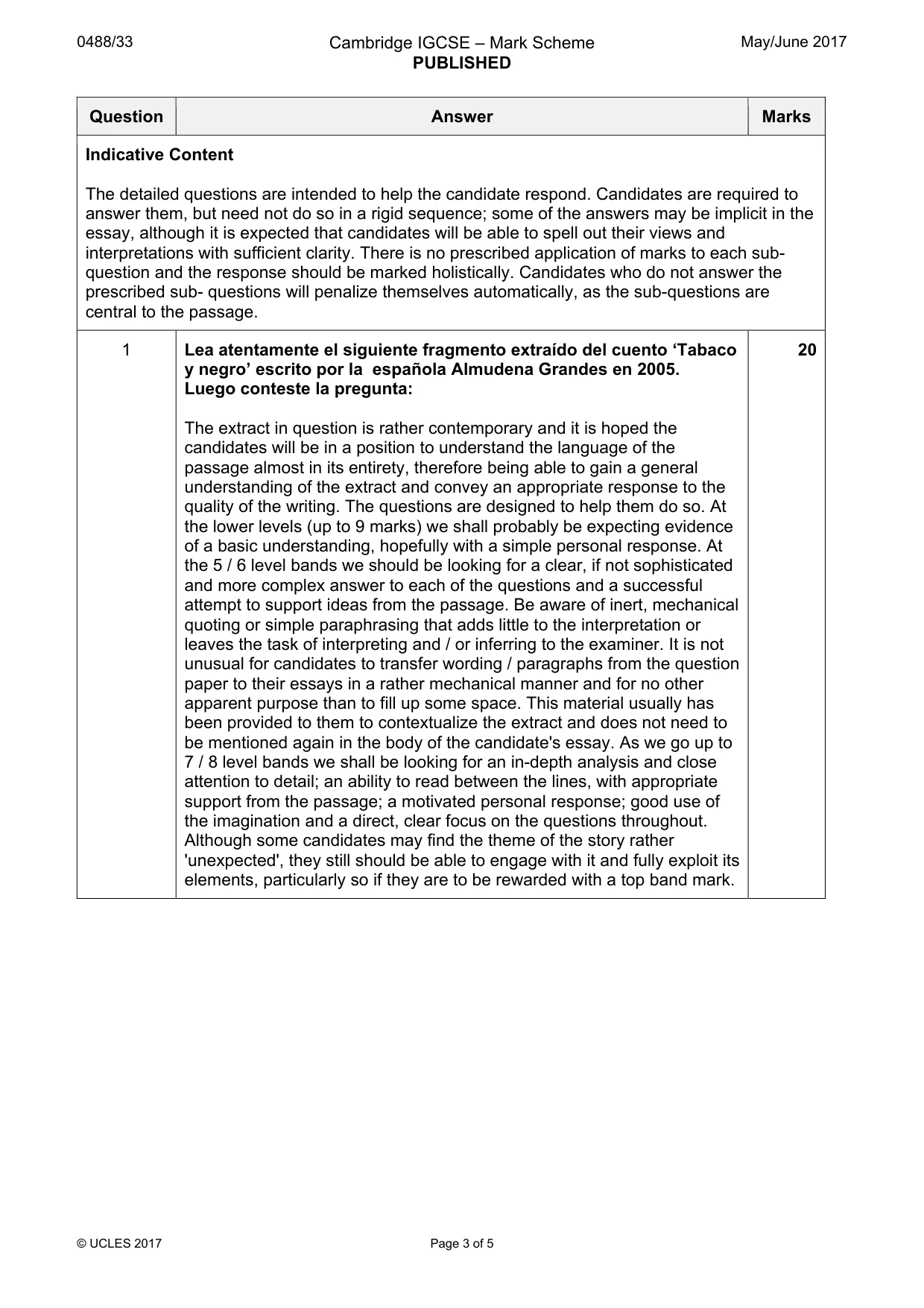
0488/33 Cambridge IGCSE – Mark Scheme PUBLISHED May/June 2017 © UCLES 2017 Page 3 of 5 Question Answer Marks Indicative Content The detailed questions are intended to help the candidate respond. Candidates are required to answer them, but need not do so in a rigid sequence; some of the answers may be implicit in the essay, although it is expected that candidates will be able to spell out their views and interpretations with sufficient clarity. There is no prescribed application of marks to each sub- question and the response should be marked holistically. Candidates who do not answer the prescribed sub- questions will penalize themselves automatically, as the sub-questions are central to the passage. 1 Lea atentamente el siguiente fragmento extraído del cuento ‘Tabaco y negro’ escrito por la española Almudena Grandes en 2005. Luego conteste la pregunta: The extract in question is rather contemporary and it is hoped the candidates will be in a position to understand the language of the passage almost in its entirety, therefore being able to gain a general understanding of the extract and convey an appropriate response to the quality of the writing. The questions are designed to help them do so. At the lower levels (up to 9 marks) we shall probably be expecting evidence of a basic understanding, hopefully with a simple personal response. At the 5 / 6 level bands we should be looking for a clear, if not sophisticated and more complex answer to each of the questions and a successful attempt to support ideas from the passage. Be aware of inert, mechanical quoting or simple paraphrasing that adds little to the interpretation or leaves the task of interpreting and / or inferring to the examiner. It is not unusual for candidates to transfer wording / paragraphs from the question paper to their essays in a rather mechanical manner and for no other apparent purpose than to fill up some space. This material usually has been provided to them to contextualize the extract and does not need to be mentioned again in the body of the candidate's essay. As we go up to 7 / 8 level bands we shall be looking for an in-depth analysis and close attention to detail; an ability to read between the lines, with appropriate support from the passage; a motivated personal response; good use of the imagination and a direct, clear focus on the questions throughout. Although some candidates may find the theme of the story rather 'unexpected', they still should be able to engage with it and fully exploit its elements, particularly so if they are to be rewarded with a top band mark. 20
Mark scheme, page 4
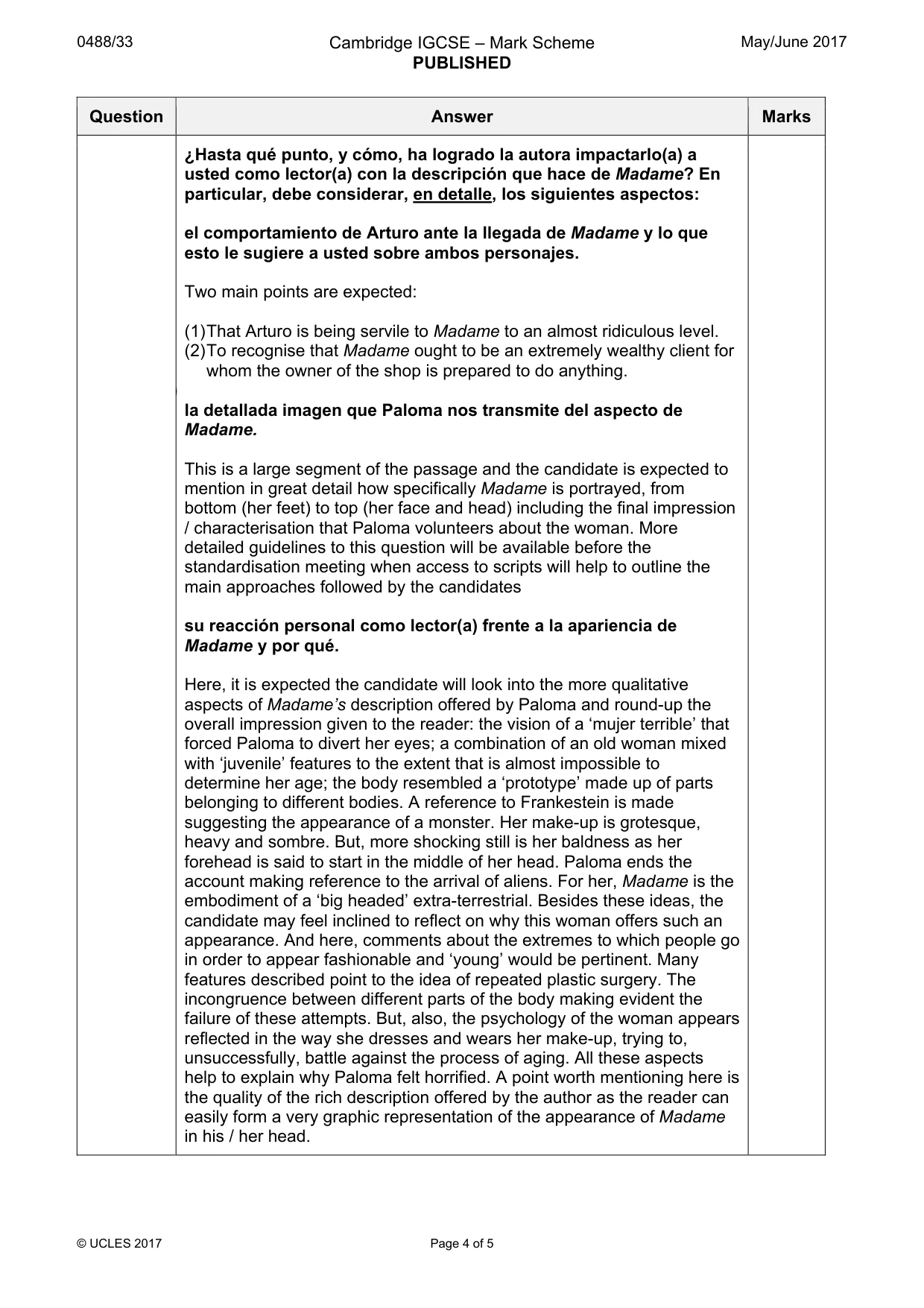
0488/33 Cambridge IGCSE – Mark Scheme PUBLISHED May/June 2017 © UCLES 2017 Page 4 of 5 Question Answer Marks ¿Hasta qué punto, y cómo, ha logrado la autora impactarlo(a) a usted como lector(a) con la descripción que hace de Madame? En particular, debe considerar, en detalle, los siguientes aspectos: el comportamiento de Arturo ante la llegada de Madame y lo que esto le sugiere a usted sobre ambos personajes. Two main points are expected: (1) That Arturo is being servile to Madame to an almost ridiculous level. (2) To recognise that Madame ought to be an extremely wealthy client for whom the owner of the shop is prepared to do anything. ) la detallada imagen que Paloma nos transmite del aspecto de Madame. This is a large segment of the passage and the candidate is expected to mention in great detail how specifically Madame is portrayed, from bottom (her feet) to top (her face and head) including the final impression / characterisation that Paloma volunteers about the woman. More detailed guidelines to this question will be available before the standardisation meeting when access to scripts will help to outline the main approaches followed by the candidates su reacción personal como lector(a) frente a la apariencia de Madame y por qué. Here, it is expected the candidate will look into the more qualitative aspects of Madame’s description offered by Paloma and round-up the overall impression given to the reader: the vision of a ‘mujer terrible’ that forced Paloma to divert her eyes; a combination of an old woman mixed with ‘juvenile’ features to the extent that is almost impossible to determine her age; the body resembled a ‘prototype’ made up of parts belonging to different bodies. A reference to Frankestein is made suggesting the appearance of a monster. Her make-up is grotesque, heavy and sombre. But, more shocking still is her baldness as her forehead is said to start in the middle of her head. Paloma ends the account making reference to the arrival of aliens. For her, Madame is the embodiment of a ‘big headed’ extra-terrestrial. Besides these ideas, the candidate may feel inclined to reflect on why this woman offers such an appearance. And here, comments about the extremes to which people go in order to appear fashionable and ‘young’ would be pertinent. Many features described point to the idea of repeated plastic surgery. The incongruence between different parts of the body making evident the failure of these attempts. But, also, the psychology of the woman appears reflected in the way she dresses and wears her make-up, trying to, unsuccessfully, battle against the process of aging. All these aspects help to explain why Paloma felt horrified. A point worth mentioning here is the quality of the rich description offered by the author as the reader can easily form a very graphic representation of the appearance of Madame in his / her head.
Mark scheme, page 5
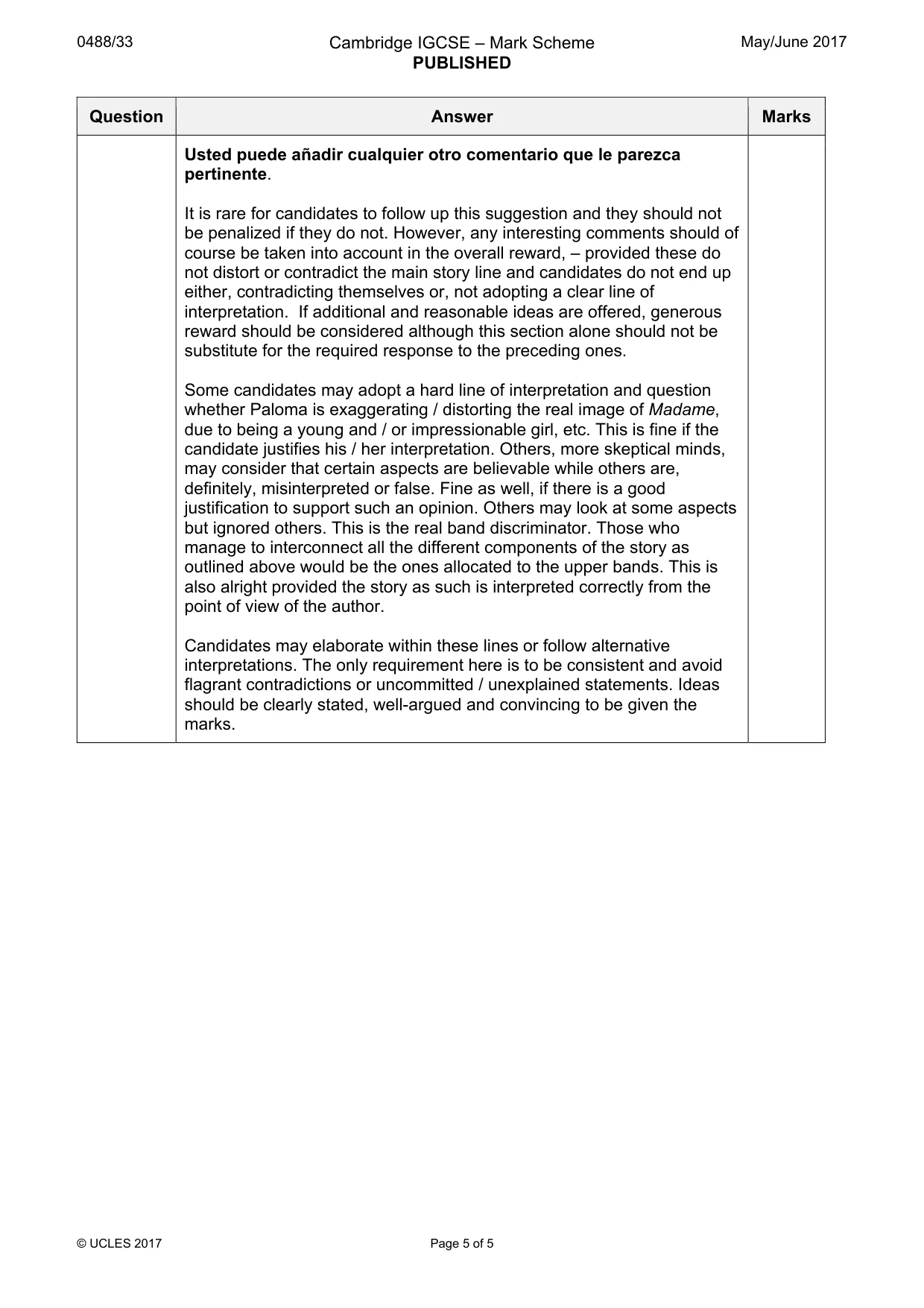
0488/33 Cambridge IGCSE – Mark Scheme PUBLISHED May/June 2017 © UCLES 2017 Page 5 of 5 Question Answer Marks Usted puede añadir cualquier otro comentario que le parezca pertinente. It is rare for candidates to follow up this suggestion and they should not be penalized if they do not. However, any interesting comments should of course be taken into account in the overall reward, – provided these do not distort or contradict the main story line and candidates do not end up either, contradicting themselves or, not adopting a clear line of interpretation. If additional and reasonable ideas are offered, generous reward should be considered although this section alone should not be substitute for the required response to the preceding ones. Some candidates may adopt a hard line of interpretation and question whether Paloma is exaggerating / distorting the real image of Madame, due to being a young and / or impressionable girl, etc. This is fine if the candidate justifies his / her interpretation. Others, more skeptical minds, may consider that certain aspects are believable while others are, definitely, misinterpreted or false. Fine as well, if there is a good justification to support such an opinion. Others may look at some aspects but ignored others. This is the real band discriminator. Those who manage to interconnect all the different components of the story as outlined above would be the ones allocated to the upper bands. This is also alright provided the story as such is interpreted correctly from the point of view of the author. Candidates may elaborate within these lines or follow alternative interpretations. The only requirement here is to be consistent and avoid flagrant contradictions or uncommitted / unexplained statements. Ideas should be clearly stated, well-argued and convincing to be given the marks.
What you needed in this session
Cambridge’s own grade thresholds for 2017 May/June, Paper 3 · Variant 3. A higher threshold means an easier paper — the bar moves with how the cohort did.