Cambridge IGCSE Spanish - Literature 0488 — 2017 May/June Paper 3 · Variant 1
0488/31/M/J/17 · 20 marks · ≈23 min
The question paper and its mark scheme, free to read here and free to download. This is Cambridge’s own paper, exactly as it was sat.
Question paper4 pages

Mark scheme7 pages
Answers below. Sit the paper first if you are practising.
Paper as text
Question paper, page 1
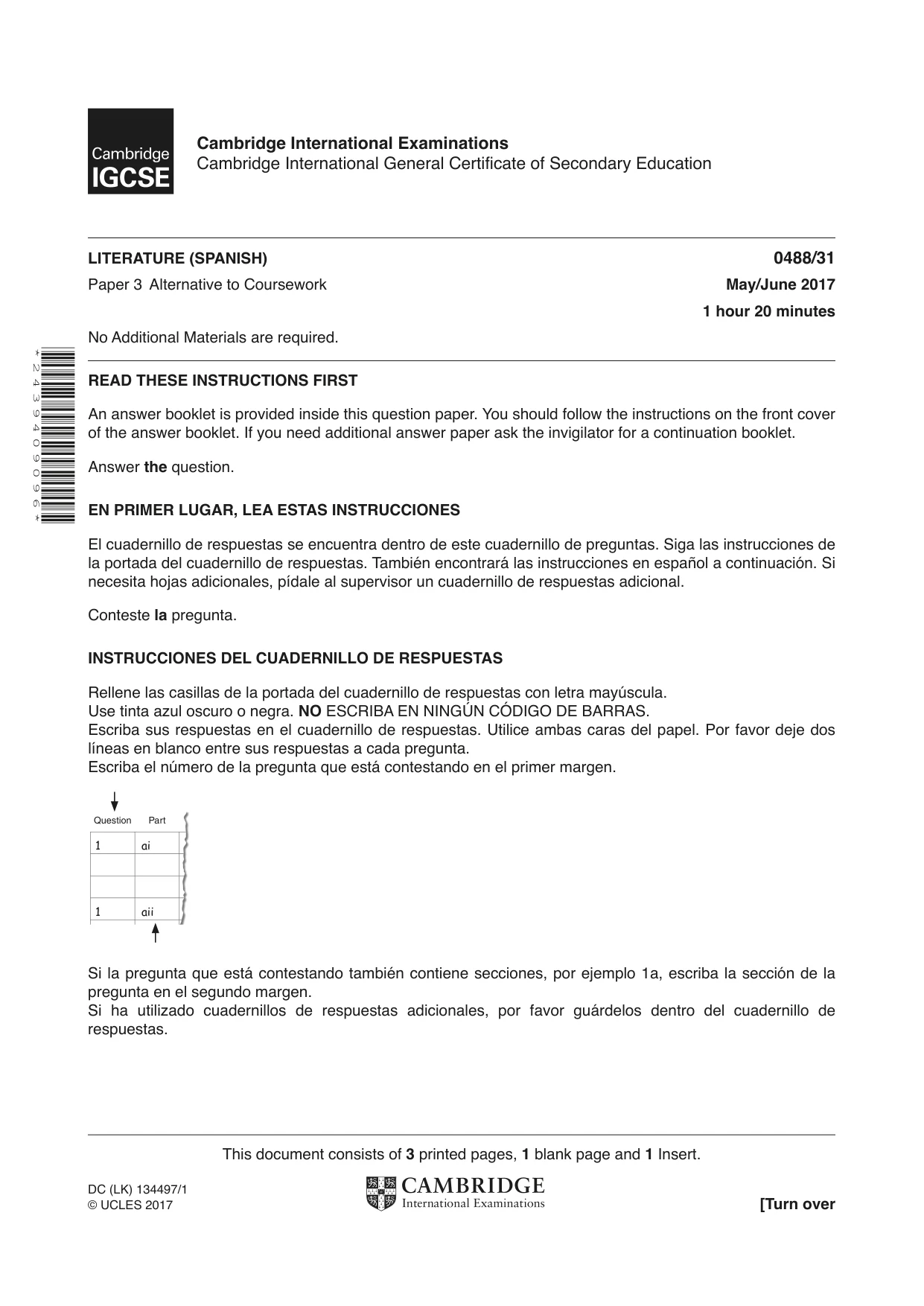
* 2 4 3 9 4 0 9 0 9 6 * This document consists of 3 printed pages, 1 blank page and 1 Insert. DC (LK) 134497/1 © UCLES 2017 [Turn over Cambridge International Examinations Cambridge International General Certificate of Secondary Education LITERATURE (SPANISH) 0488/31 Paper 3 Alternative to Coursework May/June 2017 1 hour 20 minutes No Additional Materials are required. READ THESE INSTRUCTIONS FIRST An answer booklet is provided inside this question paper. You should follow the instructions on the front cover of the answer booklet. If you need additional answer paper ask the invigilator for a continuation booklet. Answer the question. EN PRIMER LUGAR, LEA ESTAS INSTRUCCIONES El cuadernillo de respuestas se encuentra dentro de este cuadernillo de preguntas. Siga las instrucciones de la portada del cuadernillo de respuestas. También encontrará las instrucciones en español a continuación. Si necesita hojas adicionales, pídale al supervisor un cuadernillo de respuestas adicional. Conteste la pregunta. INSTRUCCIONES DEL CUADERNILLO DE RESPUESTAS Rellene las casillas de la portada del cuadernillo de respuestas con letra mayúscula. Use tinta azul oscuro o negra. NO ESCRIBA EN NINGÚN CÓDIGO DE BARRAS. Escriba sus respuestas en el cuadernillo de respuestas. Utilice ambas caras del papel. Por favor deje dos líneas en blanco entre sus respuestas a cada pregunta. Escriba el número de la pregunta que está contestando en el primer margen. Question Part 1 1 ai aii Si la pregunta que está contestando también contiene secciones, por ejemplo 1a, escriba la sección de la pregunta en el segundo margen. Si ha utilizado cuadernillos de respuestas adicionales, por favor guárdelos dentro del cuadernillo de respuestas.
Question paper, page 2
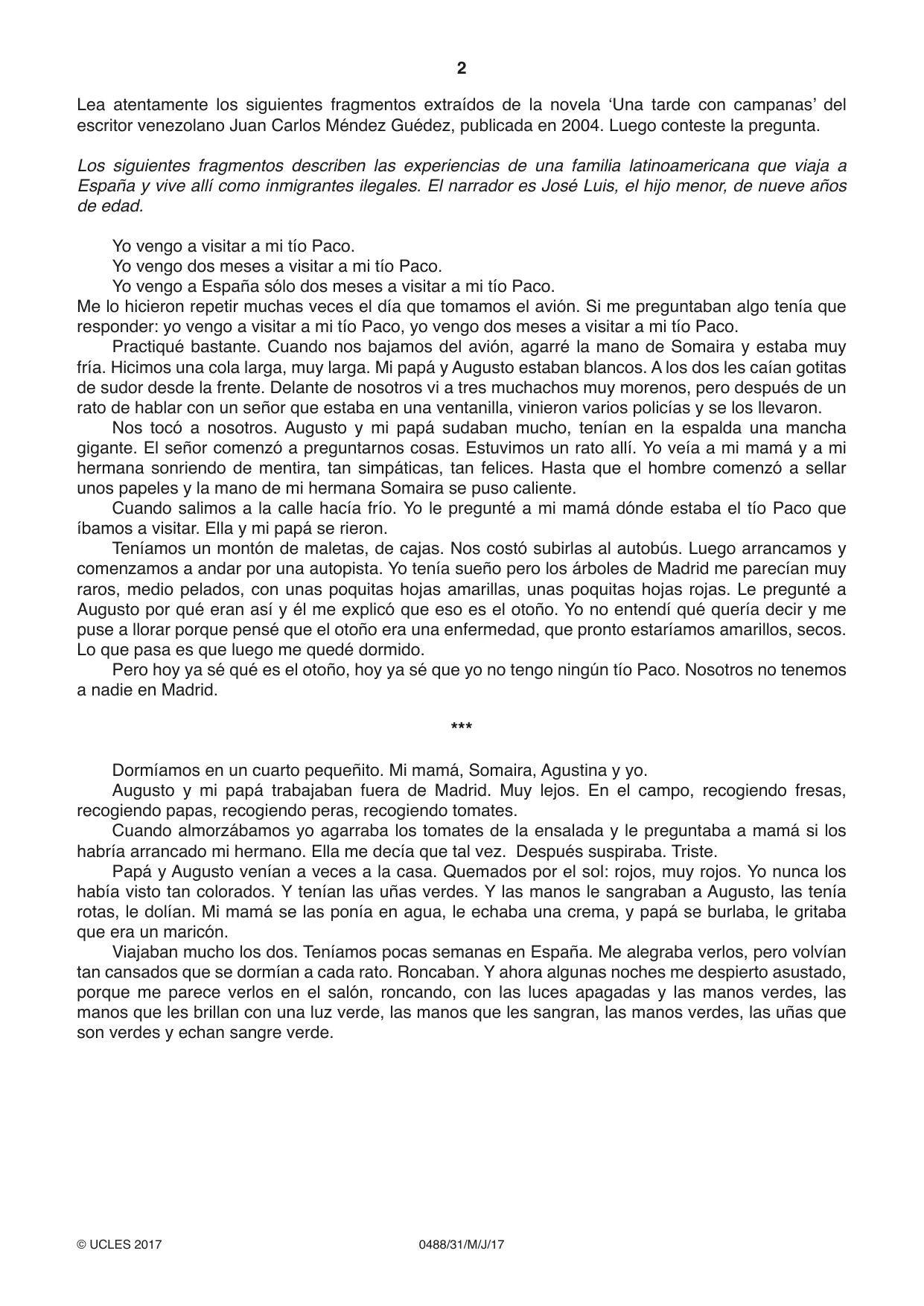
2 0488/31/M/J/17 © UCLES 2017 Lea atentamente los siguientes fragmentos extraídos de la novela ‘Una tarde con campanas’ del escritor venezolano Juan Carlos Méndez Guédez, publicada en 2004. Luego conteste la pregunta. Los siguientes fragmentos describen las experiencias de una familia latinoamericana que viaja a España y vive allí como inmigrantes ilegales. El narrador es José Luis, el hijo menor, de nueve años de edad. Yo vengo a visitar a mi tío Paco. Yo vengo dos meses a visitar a mi tío Paco. Yo vengo a España sólo dos meses a visitar a mi tío Paco. Me lo hicieron repetir muchas veces el día que tomamos el avión. Si me preguntaban algo tenía que responder: yo vengo a visitar a mi tío Paco, yo vengo dos meses a visitar a mi tío Paco. Practiqué bastante. Cuando nos bajamos del avión, agarré la mano de Somaira y estaba muy fría. Hicimos una cola larga, muy larga. Mi papá y Augusto estaban blancos. A los dos les caían gotitas de sudor desde la frente. Delante de nosotros vi a tres muchachos muy morenos, pero después de un rato de hablar con un señor que estaba en una ventanilla, vinieron varios policías y se los llevaron. Nos tocó a nosotros. Augusto y mi papá sudaban mucho, tenían en la espalda una mancha gigante. El señor comenzó a preguntarnos cosas. Estuvimos un rato allí. Yo veía a mi mamá y a mi hermana sonriendo de mentira, tan simpáticas, tan felices. Hasta que el hombre comenzó a sellar unos papeles y la mano de mi hermana Somaira se puso caliente. Cuando salimos a la calle hacía frío. Yo le pregunté a mi mamá dónde estaba el tío Paco que íbamos a visitar. Ella y mi papá se rieron. Teníamos un montón de maletas, de cajas. Nos costó subirlas al autobús. Luego arrancamos y comenzamos a andar por una autopista. Yo tenía sueño pero los árboles de Madrid me parecían muy raros, medio pelados, con unas poquitas hojas amarillas, unas poquitas hojas rojas. Le pregunté a Augusto por qué eran así y él me explicó que eso es el otoño. Yo no entendí qué quería decir y me puse a llorar porque pensé que el otoño era una enfermedad, que pronto estaríamos amarillos, secos. Lo que pasa es que luego me quedé dormido. Pero hoy ya sé qué es el otoño, hoy ya sé que yo no tengo ningún tío Paco. Nosotros no tenemos a nadie en Madrid. *** Dormíamos en un cuarto pequeñito. Mi mamá, Somaira, Agustina y yo. Augusto y mi papá trabajaban fuera de Madrid. Muy lejos. En el campo, recogiendo fresas, recogiendo papas, recogiendo peras, recogiendo tomates. Cuando almorzábamos yo agarraba los tomates de la ensalada y le preguntaba a mamá si los habría arrancado mi hermano. Ella me decía que tal vez. Después suspiraba. Triste. Papá y Augusto venían a veces a la casa. Quemados por el sol: rojos, muy rojos. Yo nunca los había visto tan colorados. Y tenían las uñas verdes. Y las manos le sangraban a Augusto, las tenía rotas, le dolían. Mi mamá se las ponía en agua, le echaba una crema, y papá se burlaba, le gritaba que era un maricón. Viajaban mucho los dos. Teníamos pocas semanas en España. Me alegraba verlos, pero volvían tan cansados que se dormían a cada rato. Roncaban. Y ahora algunas noches me despierto asustado, porque me parece verlos en el salón, roncando, con las luces apagadas y las manos verdes, las manos que les brillan con una luz verde, las manos que les sangran, las manos verdes, las uñas que son verdes y echan sangre verde.
Question paper, page 3
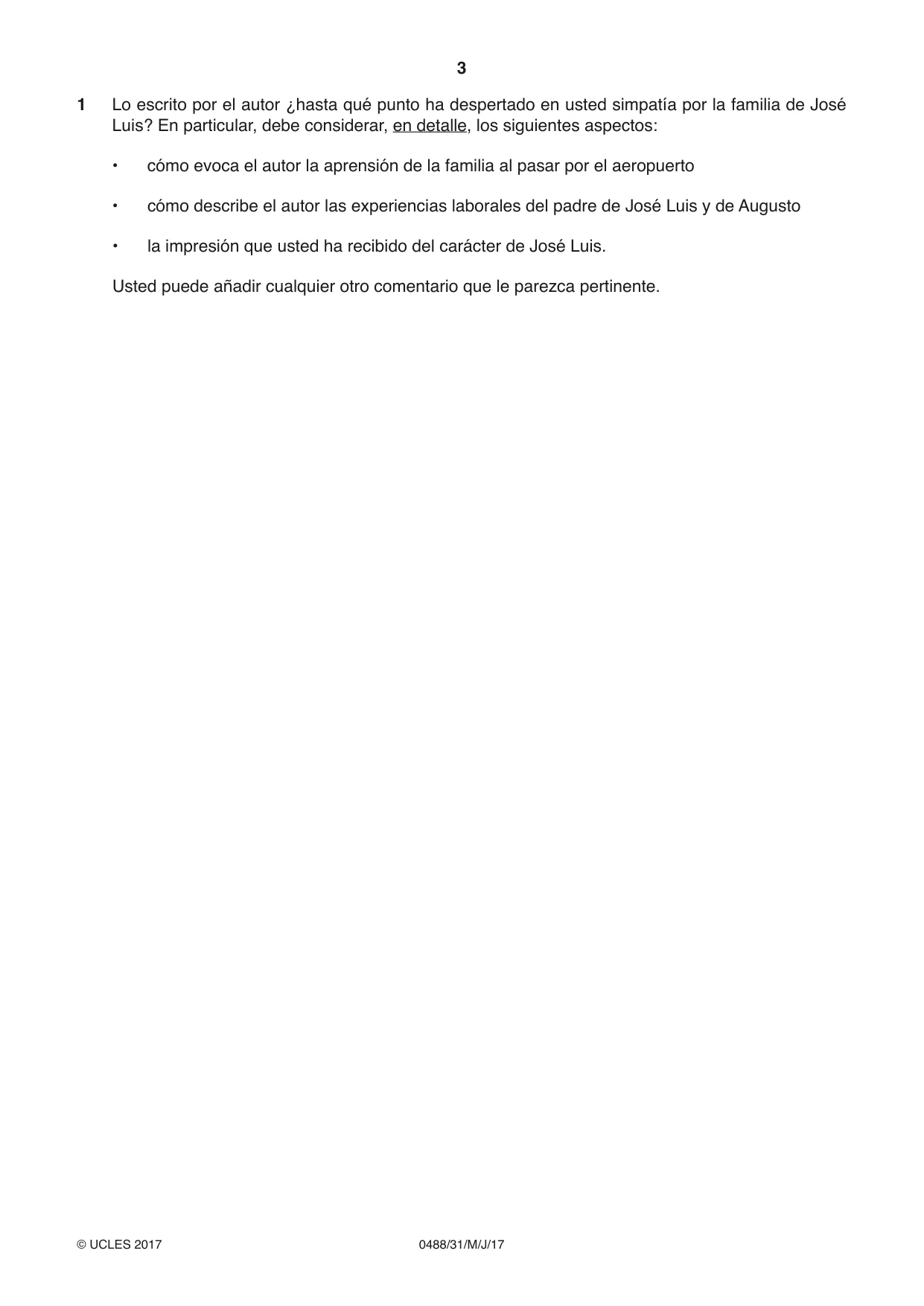
3 0488/31/M/J/17 © UCLES 2017 1 Lo escrito por el autor ¿hasta qué punto ha despertado en usted simpatía por la familia de José Luis? En particular, debe considerar, en detalle, los siguientes aspectos: • cómo evoca el autor la aprensión de la familia al pasar por el aeropuerto • cómo describe el autor las experiencias laborales del padre de José Luis y de Augusto • la impresión que usted ha recibido del carácter de José Luis. Usted puede añadir cualquier otro comentario que le parezca pertinente.
Question paper, page 4
4 0488/31/M/J/17 © UCLES 2017 Permission to reproduce items where third-party owned material protected by copyright is included has been sought and cleared where possible. Every reasonable effort has been made by the publisher (UCLES) to trace copyright holders, but if any items requiring clearance have unwittingly been included, the publisher will be pleased to make amends at the earliest possible opportunity. To avoid the issue of disclosure of answer-related information to candidates, all copyright acknowledgements are reproduced online in the Cambridge International Examinations Copyright Acknowledgements Booklet. This is produced for each series of examinations and is freely available to download at www.cie.org.uk after the live examination series. Cambridge International Examinations is part of the Cambridge Assessment Group. Cambridge Assessment is the brand name of University of Cambridge Local Examinations Syndicate (UCLES), which is itself a department of the University of Cambridge. BLANK PAGE
Mark scheme, page 1
® IGCSE is a registered trademark. This document consists of 7 printed pages. © UCLES 2017 [Turn over Cambridge International Examinations Cambridge International General Certificate of Secondary Education LITERATURE (SPANISH) 0488/31 Paper 3 Alternative to Coursework May/June 2017 MARK SCHEME Maximum Mark: 20 Published This mark scheme is published as an aid to teachers and candidates, to indicate the requirements of the examination. It shows the basis on which Examiners were instructed to award marks. It does not indicate the details of the discussions that took place at an Examiners’ meeting before marking began, which would have considered the acceptability of alternative answers. Mark schemes should be read in conjunction with the question paper and the Principal Examiner Report for Teachers. Cambridge will not enter into discussions about these mark schemes. Cambridge is publishing the mark schemes for the May/June 2017 series for most Cambridge IGCSE®, Cambridge International A and AS Level and Cambridge Pre-U components, and some Cambridge O Level components.
Mark scheme, page 2
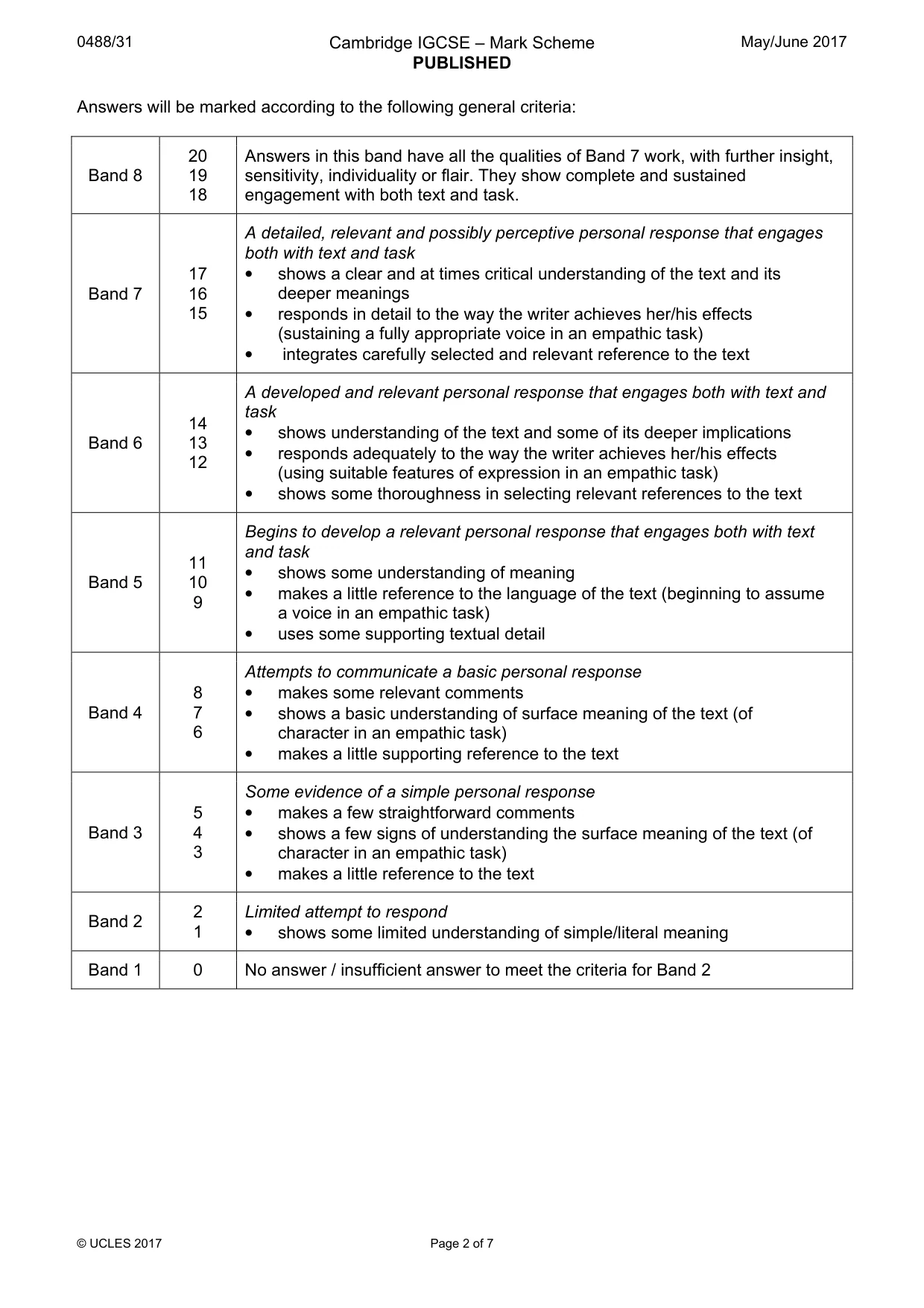
0488/31 Cambridge IGCSE – Mark Scheme PUBLISHED May/June 2017 © UCLES 2017 Page 2 of 7 Answers will be marked according to the following general criteria: Band 8 20 19 18 Answers in this band have all the qualities of Band 7 work, with further insight, sensitivity, individuality or flair. They show complete and sustained engagement with both text and task. Band 7 17 16 15 A detailed, relevant and possibly perceptive personal response that engages both with text and task • shows a clear and at times critical understanding of the text and its deeper meanings • responds in detail to the way the writer achieves her/his effects (sustaining a fully appropriate voice in an empathic task) • integrates carefully selected and relevant reference to the text Band 6 14 13 12 A developed and relevant personal response that engages both with text and task • shows understanding of the text and some of its deeper implications • responds adequately to the way the writer achieves her/his effects (using suitable features of expression in an empathic task) • shows some thoroughness in selecting relevant references to the text Band 5 11 10 9 Begins to develop a relevant personal response that engages both with text and task • shows some understanding of meaning • makes a little reference to the language of the text (beginning to assume a voice in an empathic task) • uses some supporting textual detail Band 4 8 7 6 Attempts to communicate a basic personal response • makes some relevant comments • shows a basic understanding of surface meaning of the text (of character in an empathic task) • makes a little supporting reference to the text Band 3 5 4 3 Some evidence of a simple personal response • makes a few straightforward comments • shows a few signs of understanding the surface meaning of the text (of character in an empathic task) • makes a little reference to the text Band 2 2 1 Limited attempt to respond • shows some limited understanding of simple/literal meaning Band 1 0 No answer / insufficient answer to meet the criteria for Band 2
Mark scheme, page 3
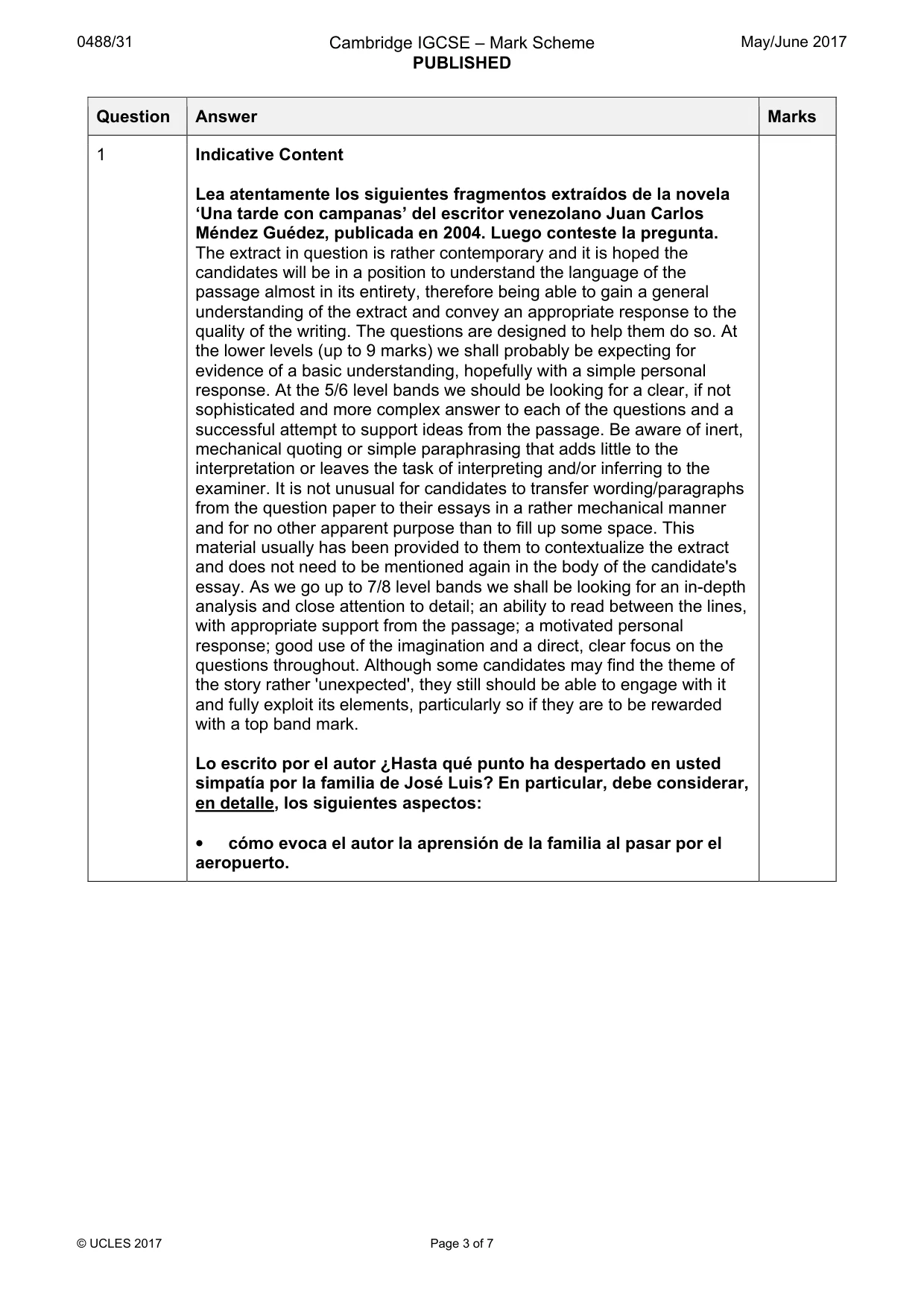
0488/31 Cambridge IGCSE – Mark Scheme PUBLISHED May/June 2017 © UCLES 2017 Page 3 of 7 Question Answer Marks 1 Indicative Content Lea atentamente los siguientes fragmentos extraídos de la novela ‘Una tarde con campanas’ del escritor venezolano Juan Carlos Méndez Guédez, publicada en 2004. Luego conteste la pregunta. The extract in question is rather contemporary and it is hoped the candidates will be in a position to understand the language of the passage almost in its entirety, therefore being able to gain a general understanding of the extract and convey an appropriate response to the quality of the writing. The questions are designed to help them do so. At the lower levels (up to 9 marks) we shall probably be expecting for evidence of a basic understanding, hopefully with a simple personal response. At the 5/6 level bands we should be looking for a clear, if not sophisticated and more complex answer to each of the questions and a successful attempt to support ideas from the passage. Be aware of inert, mechanical quoting or simple paraphrasing that adds little to the interpretation or leaves the task of interpreting and/or inferring to the examiner. It is not unusual for candidates to transfer wording/paragraphs from the question paper to their essays in a rather mechanical manner and for no other apparent purpose than to fill up some space. This material usually has been provided to them to contextualize the extract and does not need to be mentioned again in the body of the candidate's essay. As we go up to 7/8 level bands we shall be looking for an in-depth analysis and close attention to detail; an ability to read between the lines, with appropriate support from the passage; a motivated personal response; good use of the imagination and a direct, clear focus on the questions throughout. Although some candidates may find the theme of the story rather 'unexpected', they still should be able to engage with it and fully exploit its elements, particularly so if they are to be rewarded with a top band mark. Lo escrito por el autor ¿Hasta qué punto ha despertado en usted simpatía por la familia de José Luis? En particular, debe considerar, en detalle, los siguientes aspectos: • cómo evoca el autor la aprensión de la familia al pasar por el aeropuerto.
Mark scheme, page 4
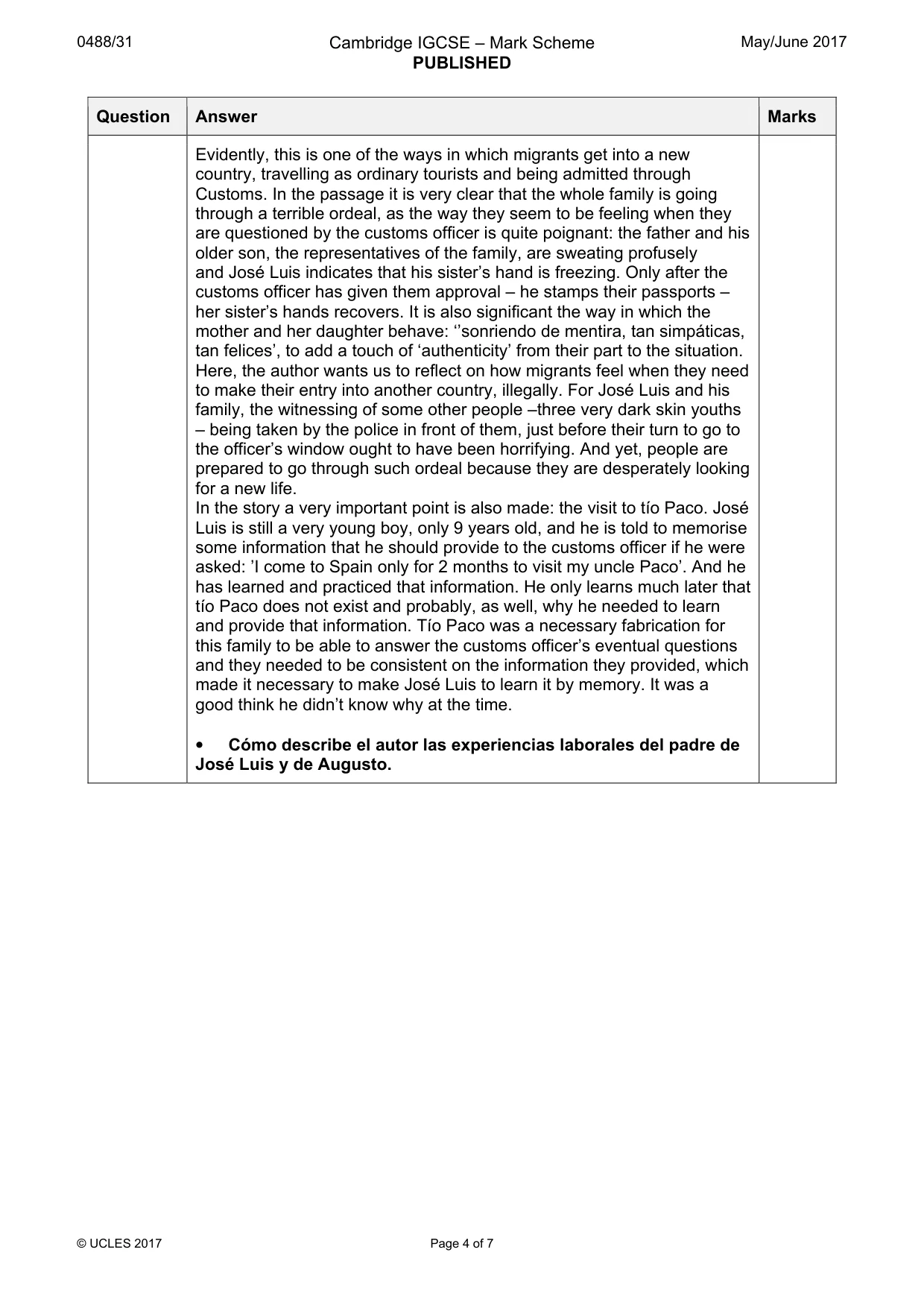
0488/31 Cambridge IGCSE – Mark Scheme PUBLISHED May/June 2017 © UCLES 2017 Page 4 of 7 Question Answer Marks Evidently, this is one of the ways in which migrants get into a new country, travelling as ordinary tourists and being admitted through Customs. In the passage it is very clear that the whole family is going through a terrible ordeal, as the way they seem to be feeling when they are questioned by the customs officer is quite poignant: the father and his older son, the representatives of the family, are sweating profusely and José Luis indicates that his sister’s hand is freezing. Only after the customs officer has given them approval – he stamps their passports – her sister’s hands recovers. It is also significant the way in which the mother and her daughter behave: ‘’sonriendo de mentira, tan simpáticas, tan felices’, to add a touch of ‘authenticity’ from their part to the situation. Here, the author wants us to reflect on how migrants feel when they need to make their entry into another country, illegally. For José Luis and his family, the witnessing of some other people –three very dark skin youths – being taken by the police in front of them, just before their turn to go to the officer’s window ought to have been horrifying. And yet, people are prepared to go through such ordeal because they are desperately looking for a new life. In the story a very important point is also made: the visit to tío Paco. José Luis is still a very young boy, only 9 years old, and he is told to memorise some information that he should provide to the customs officer if he were asked: ’I come to Spain only for 2 months to visit my uncle Paco’. And he has learned and practiced that information. He only learns much later that tío Paco does not exist and probably, as well, why he needed to learn and provide that information. Tío Paco was a necessary fabrication for this family to be able to answer the customs officer’s eventual questions and they needed to be consistent on the information they provided, which made it necessary to make José Luis to learn it by memory. It was a good think he didn’t know why at the time. • Cómo describe el autor las experiencias laborales del padre de José Luis y de Augusto.
Mark scheme, page 5
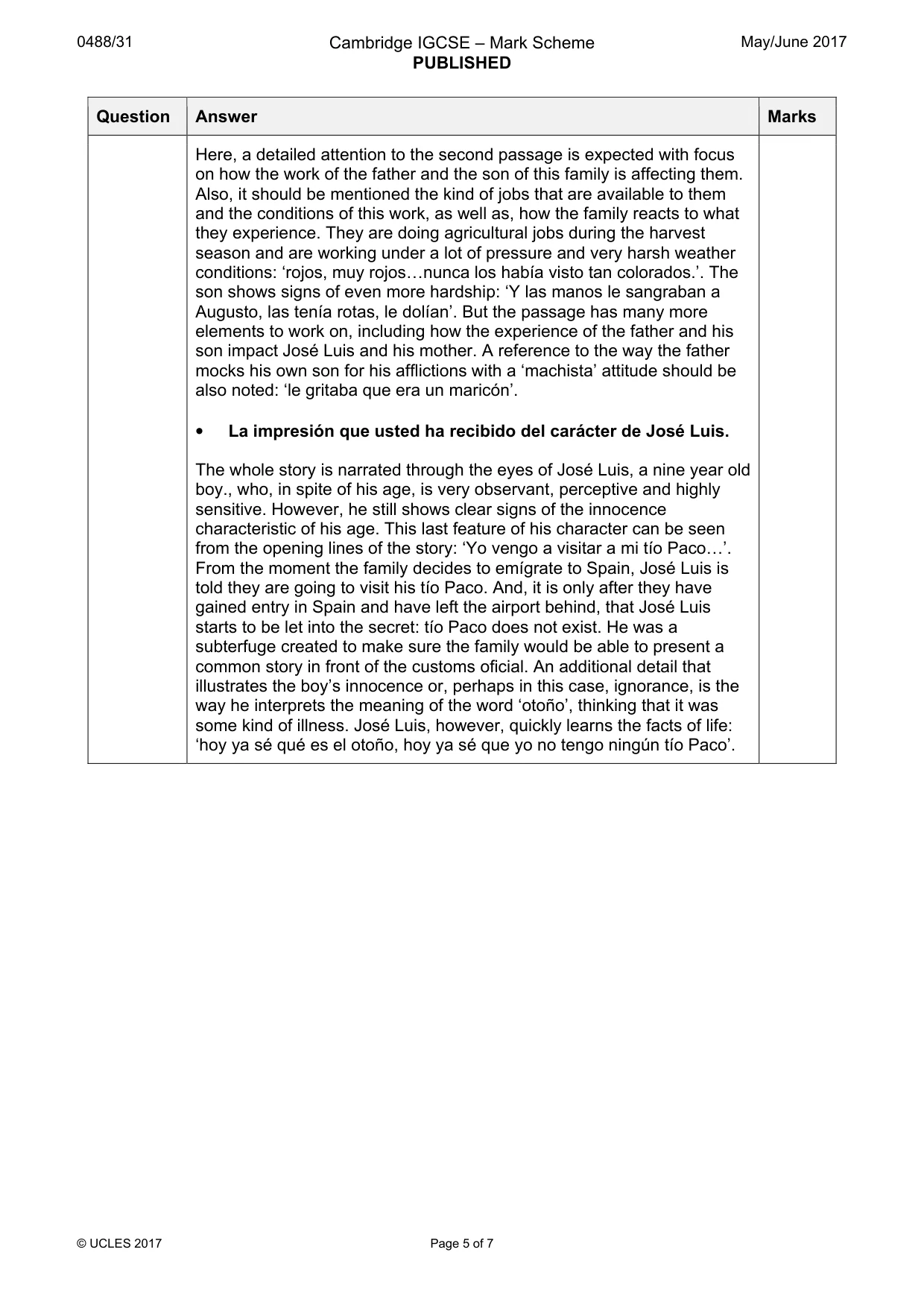
0488/31 Cambridge IGCSE – Mark Scheme PUBLISHED May/June 2017 © UCLES 2017 Page 5 of 7 Question Answer Marks Here, a detailed attention to the second passage is expected with focus on how the work of the father and the son of this family is affecting them. Also, it should be mentioned the kind of jobs that are available to them and the conditions of this work, as well as, how the family reacts to what they experience. They are doing agricultural jobs during the harvest season and are working under a lot of pressure and very harsh weather conditions: ‘rojos, muy rojos«nunca los había visto tan colorados.’. The son shows signs of even more hardship: ‘Y las manos le sangraban a Augusto, las tenía rotas, le dolían’. But the passage has many more elements to work on, including how the experience of the father and his son impact José Luis and his mother. A reference to the way the father mocks his own son for his afflictions with a ‘machista’ attitude should be also noted: ‘le gritaba que era un maricón’. • La impresión que usted ha recibido del carácter de José Luis. The whole story is narrated through the eyes of José Luis, a nine year old boy., who, in spite of his age, is very observant, perceptive and highly sensitive. However, he still shows clear signs of the innocence characteristic of his age. This last feature of his character can be seen from the opening lines of the story: ‘Yo vengo a visitar a mi tío Paco«’. From the moment the family decides to emígrate to Spain, José Luis is told they are going to visit his tío Paco. And, it is only after they have gained entry in Spain and have left the airport behind, that José Luis starts to be let into the secret: tío Paco does not exist. He was a subterfuge created to make sure the family would be able to present a common story in front of the customs oficial. An additional detail that illustrates the boy’s innocence or, perhaps in this case, ignorance, is the way he interprets the meaning of the word ‘otoño’, thinking that it was some kind of illness. José Luis, however, quickly learns the facts of life: ‘hoy ya sé qué es el otoño, hoy ya sé que yo no tengo ningún tío Paco’.
Mark scheme, page 6
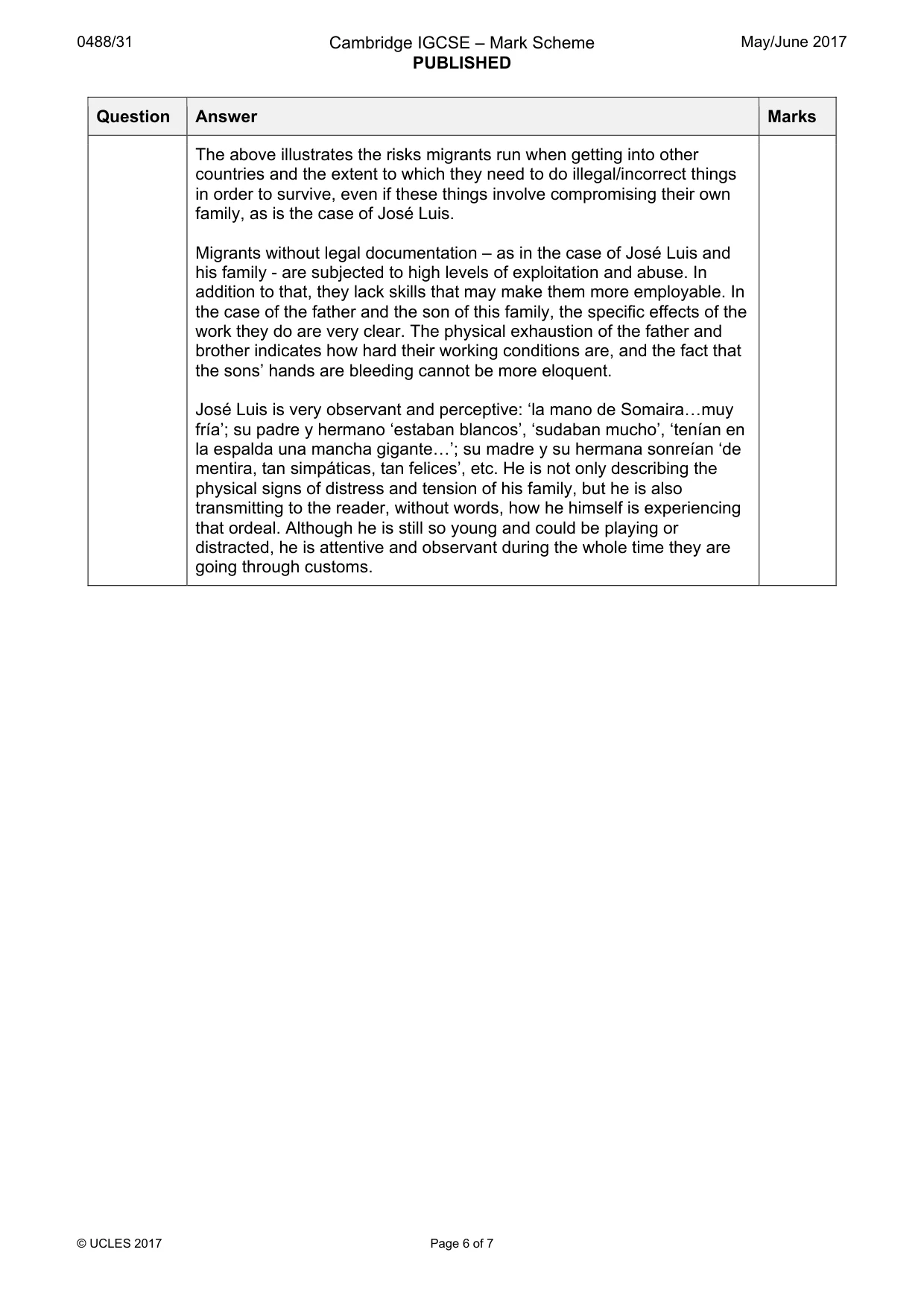
0488/31 Cambridge IGCSE – Mark Scheme PUBLISHED May/June 2017 © UCLES 2017 Page 6 of 7 Question Answer Marks The above illustrates the risks migrants run when getting into other countries and the extent to which they need to do illegal/incorrect things in order to survive, even if these things involve compromising their own family, as is the case of José Luis. Migrants without legal documentation – as in the case of José Luis and his family - are subjected to high levels of exploitation and abuse. In addition to that, they lack skills that may make them more employable. In the case of the father and the son of this family, the specific effects of the work they do are very clear. The physical exhaustion of the father and brother indicates how hard their working conditions are, and the fact that the sons’ hands are bleeding cannot be more eloquent. José Luis is very observant and perceptive: ‘la mano de Somaira«muy fría’; su padre y hermano ‘estaban blancos’, ‘sudaban mucho’, ‘tenían en la espalda una mancha gigante«’; su madre y su hermana sonreían ‘de mentira, tan simpáticas, tan felices’, etc. He is not only describing the physical signs of distress and tension of his family, but he is also transmitting to the reader, without words, how he himself is experiencing that ordeal. Although he is still so young and could be playing or distracted, he is attentive and observant during the whole time they are going through customs.
Mark scheme, page 7
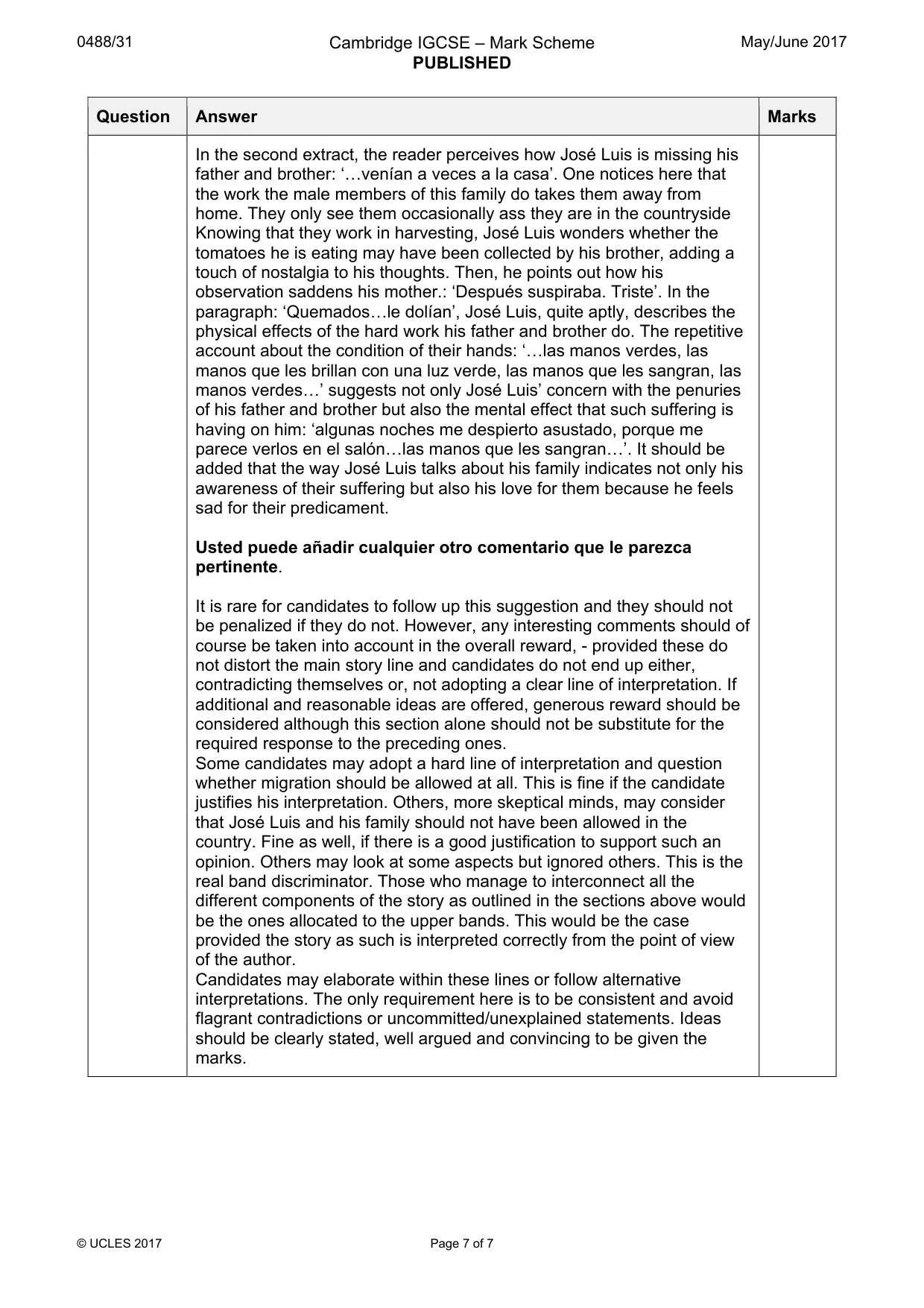
0488/31 Cambridge IGCSE – Mark Scheme PUBLISHED May/June 2017 © UCLES 2017 Page 7 of 7 Question Answer Marks In the second extract, the reader perceives how José Luis is missing his father and brother: ‘«venían a veces a la casa’. One notices here that the work the male members of this family do takes them away from home. They only see them occasionally ass they are in the countryside Knowing that they work in harvesting, José Luis wonders whether the tomatoes he is eating may have been collected by his brother, adding a touch of nostalgia to his thoughts. Then, he points out how his observation saddens his mother.: ‘Después suspiraba. Triste’. In the paragraph: ‘Quemados«le dolían’, José Luis, quite aptly, describes the physical effects of the hard work his father and brother do. The repetitive account about the condition of their hands: ‘«las manos verdes, las manos que les brillan con una luz verde, las manos que les sangran, las manos verdes«’ suggests not only José Luis’ concern with the penuries of his father and brother but also the mental effect that such suffering is having on him: ‘algunas noches me despierto asustado, porque me parece verlos en el salón«las manos que les sangran«’. It should be added that the way José Luis talks about his family indicates not only his awareness of their suffering but also his love for them because he feels sad for their predicament. Usted puede añadir cualquier otro comentario que le parezca pertinente. It is rare for candidates to follow up this suggestion and they should not be penalized if they do not. However, any interesting comments should of course be taken into account in the overall reward, - provided these do not distort the main story line and candidates do not end up either, contradicting themselves or, not adopting a clear line of interpretation. If additional and reasonable ideas are offered, generous reward should be considered although this section alone should not be substitute for the required response to the preceding ones. Some candidates may adopt a hard line of interpretation and question whether migration should be allowed at all. This is fine if the candidate justifies his interpretation. Others, more skeptical minds, may consider that José Luis and his family should not have been allowed in the country. Fine as well, if there is a good justification to support such an opinion. Others may look at some aspects but ignored others. This is the real band discriminator. Those who manage to interconnect all the different components of the story as outlined in the sections above would be the ones allocated to the upper bands. This would be the case provided the story as such is interpreted correctly from the point of view of the author. Candidates may elaborate within these lines or follow alternative interpretations. The only requirement here is to be consistent and avoid flagrant contradictions or uncommitted/unexplained statements. Ideas should be clearly stated, well argued and convincing to be given the marks.
What you needed in this session
Cambridge’s own grade thresholds for 2017 May/June, Paper 3 · Variant 1. A higher threshold means an easier paper — the bar moves with how the cohort did.