Cambridge IGCSE Spanish - Literature 0488 — 2016 May/June Paper 3 · Variant 3
0488/33/M/J/16 · 20 marks · ≈23 min
The question paper and its mark scheme, free to read here and free to download. This is Cambridge’s own paper, exactly as it was sat.
Question paper4 pages

Mark scheme6 pages
Answers below. Sit the paper first if you are practising.
Paper as text
Question paper, page 1
This document consists of 3 printed pages, 1 blank page and 1 Insert. DC (LK) 115928/3 © UCLES 2016 [Turn over Cambridge International Examinations Cambridge International General Certificate of Secondary Education * 1 5 0 1 1 6 2 9 5 4 * LITERATURE (SPANISH) 0488/33 Paper 3 Alternative to Coursework May/June 2016 1 hour 20 minutes No Additional Materials are required. READ THESE INSTRUCTIONS FIRST An Answer Booklet is provided inside this Question Paper. You should follow the instructions on the front cover of the Answer Booklet. If you need additional answer paper ask the invigilator for a Continuation Booklet. Answer the question in Spanish. EN PRIMER LUGAR, LEA ESTAS INSTRUCCIONES El cuadernillo de respuestas se encuentra dentro de este cuadernillo de preguntas. Siga las instrucciones de la portada del cuadernillo de respuestas. También encontrará las instrucciones en español a continuación. Si necesita hojas adicionales, pídale al supervisor un cuadernillo de respuestas adicional. Conteste la pregunta en español. INSTRUCCIONES DEL CUADERNILLO DE RESPUESTAS Rellene las casillas de la portada del cuadernillo de respuestas con letra mayúscula. Use tinta azul oscuro o negra. NO ESCRIBA EN NINGÚN CÓDIGO DE BARRAS. Escriba sus respuestas en el cuadernillo de respuestas. Utilice ambas caras del papel. Por favor deje dos líneas en blanco entre sus respuestas a cada pregunta. Escriba el número de la pregunta que está contestando en el primer margen. Question Part 1 1 ai aii Si la pregunta que está contestando también contiene secciones, por ejemplo 1a, escriba la sección de la pregunta en el segundo margen. Si ha utilizado cuadernillos de respuestas adicionales, por favor guárdelos dentro del cuadernillo de respuestas.
Question paper, page 2
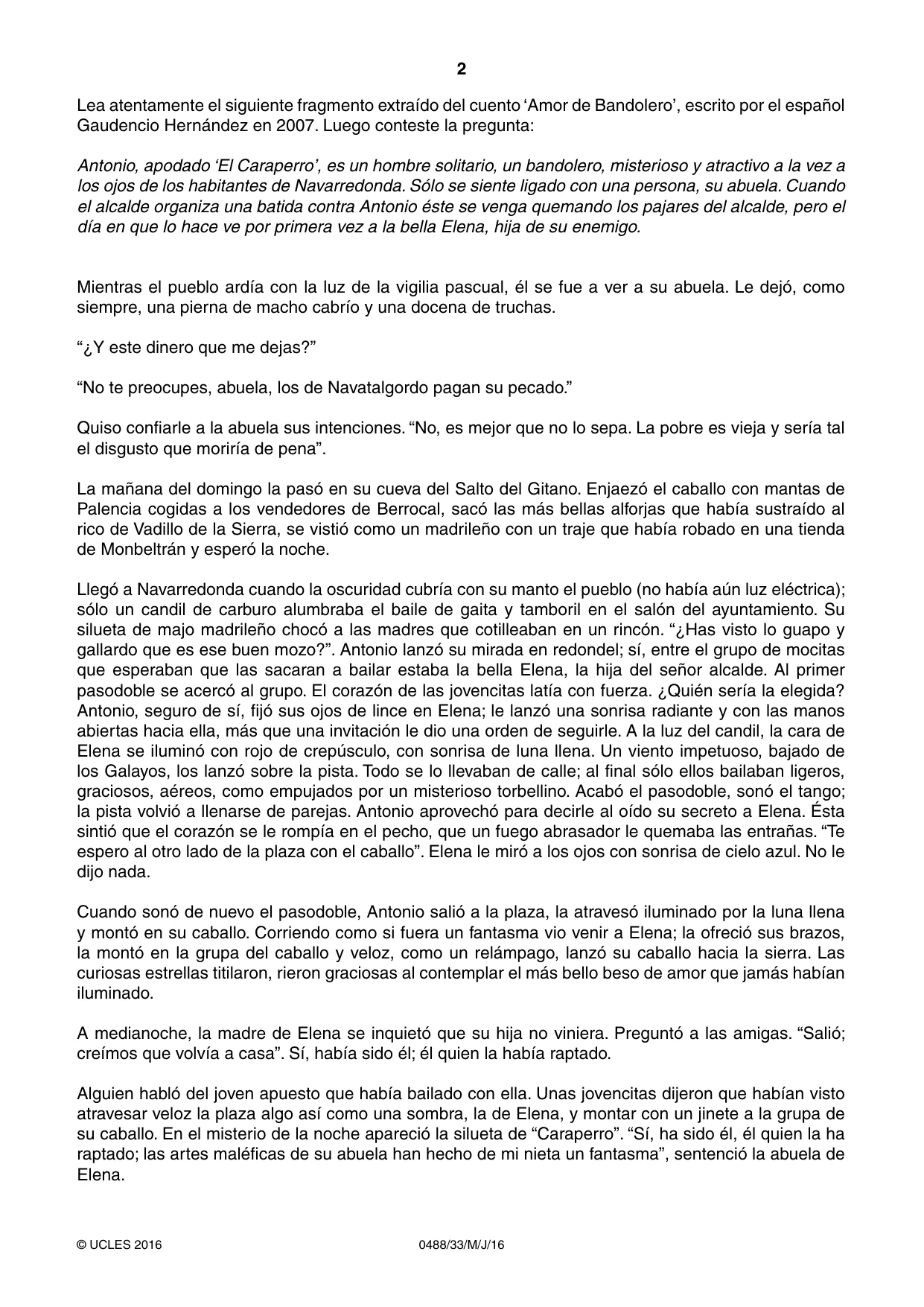
2 0488/33/M/J/16 © UCLES 2016 Lea atentamente el siguiente fragmento extraído del cuento ‘Amor de Bandolero’, escrito por el español Gaudencio Hernández en 2007. Luego conteste la pregunta: Antonio, apodado ‘El Caraperro’, es un hombre solitario, un bandolero, misterioso y atractivo a la vez a los ojos de los habitantes de Navarredonda. Sólo se siente ligado con una persona, su abuela. Cuando el alcalde organiza una batida contra Antonio éste se venga quemando los pajares del alcalde, pero el día en que lo hace ve por primera vez a la bella Elena, hija de su enemigo. Mientras el pueblo ardía con la luz de la vigilia pascual, él se fue a ver a su abuela. Le dejó, como siempre, una pierna de macho cabrío y una docena de truchas. “¿Y este dinero que me dejas?” “No te preocupes, abuela, los de Navatalgordo pagan su pecado.” Quiso confiarle a la abuela sus intenciones. “No, es mejor que no lo sepa. La pobre es vieja y sería tal el disgusto que moriría de pena”. La mañana del domingo la pasó en su cueva del Salto del Gitano. Enjaezó el caballo con mantas de Palencia cogidas a los vendedores de Berrocal, sacó las más bellas alforjas que había sustraído al rico de Vadillo de la Sierra, se vistió como un madrileño con un traje que había robado en una tienda de Monbeltrán y esperó la noche. Llegó a Navarredonda cuando la oscuridad cubría con su manto el pueblo (no había aún luz eléctrica); sólo un candil de carburo alumbraba el baile de gaita y tamboril en el salón del ayuntamiento. Su silueta de majo madrileño chocó a las madres que cotilleaban en un rincón. “¿Has visto lo guapo y gallardo que es ese buen mozo?”. Antonio lanzó su mirada en redondel; sí, entre el grupo de mocitas que esperaban que las sacaran a bailar estaba la bella Elena, la hija del señor alcalde. Al primer pasodoble se acercó al grupo. El corazón de las jovencitas latía con fuerza. ¿Quién sería la elegida? Antonio, seguro de sí, fijó sus ojos de lince en Elena; le lanzó una sonrisa radiante y con las manos abiertas hacia ella, más que una invitación le dio una orden de seguirle. A la luz del candil, la cara de Elena se iluminó con rojo de crepúsculo, con sonrisa de luna llena. Un viento impetuoso, bajado de los Galayos, los lanzó sobre la pista. Todo se lo llevaban de calle; al final sólo ellos bailaban ligeros, graciosos, aéreos, como empujados por un misterioso torbellino. Acabó el pasodoble, sonó el tango; la pista volvió a llenarse de parejas. Antonio aprovechó para decirle al oído su secreto a Elena. Ésta sintió que el corazón se le rompía en el pecho, que un fuego abrasador le quemaba las entrañas. “Te espero al otro lado de la plaza con el caballo”. Elena le miró a los ojos con sonrisa de cielo azul. No le dijo nada. Cuando sonó de nuevo el pasodoble, Antonio salió a la plaza, la atravesó iluminado por la luna llena y montó en su caballo. Corriendo como si fuera un fantasma vio venir a Elena; la ofreció sus brazos, la montó en la grupa del caballo y veloz, como un relámpago, lanzó su caballo hacia la sierra. Las curiosas estrellas titilaron, rieron graciosas al contemplar el más bello beso de amor que jamás habían iluminado. A medianoche, la madre de Elena se inquietó que su hija no viniera. Preguntó a las amigas. “Salió; creímos que volvía a casa”. Sí, había sido él; él quien la había raptado. Alguien habló del joven apuesto que había bailado con ella. Unas jovencitas dijeron que habían visto atravesar veloz la plaza algo así como una sombra, la de Elena, y montar con un jinete a la grupa de su caballo. En el misterio de la noche apareció la silueta de “Caraperro”. “Sí, ha sido él, él quien la ha raptado; las artes maléficas de su abuela han hecho de mi nieta un fantasma”, sentenció la abuela de Elena.
Question paper, page 3
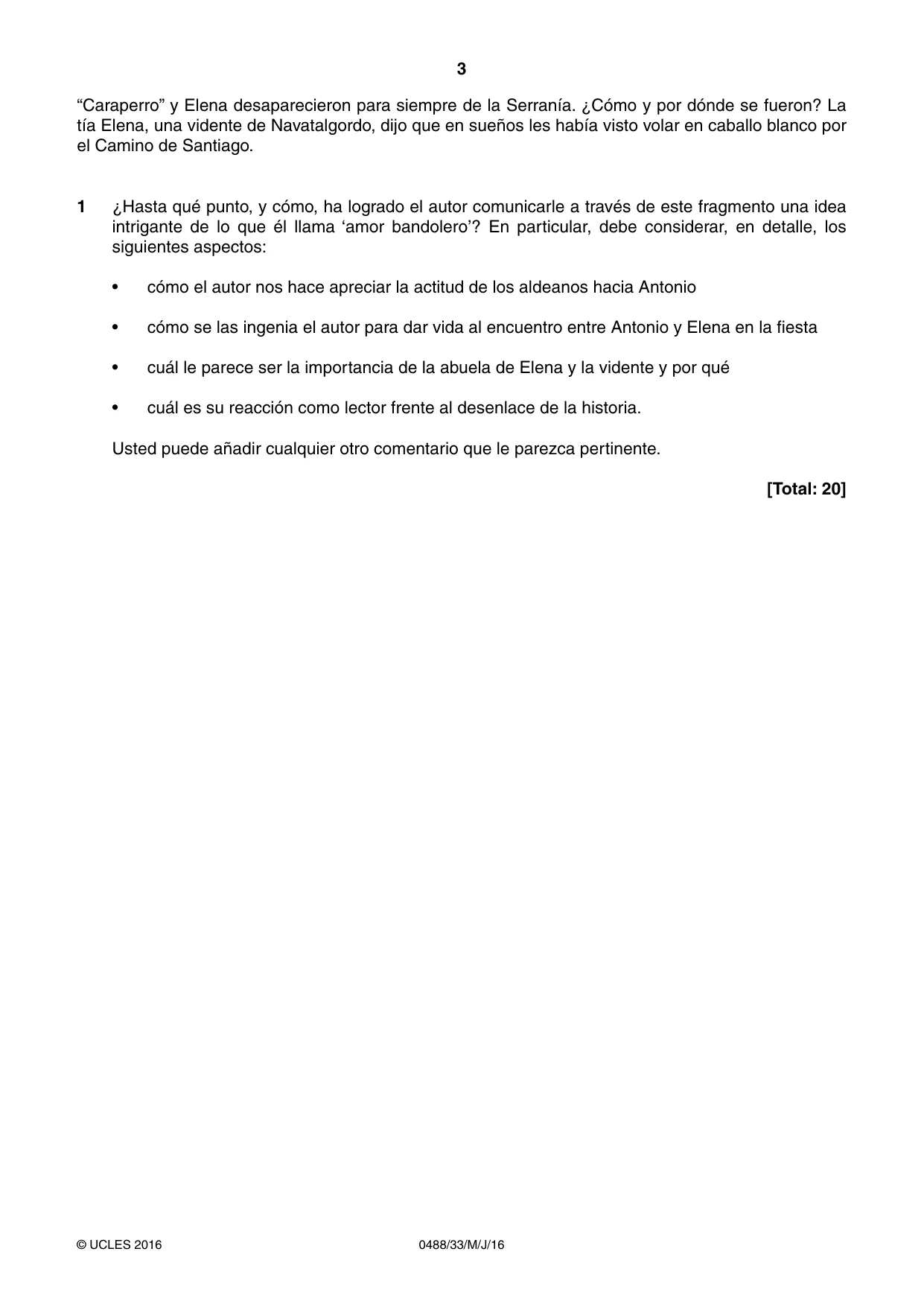
3 0488/33/M/J/16 © UCLES 2016 “Caraperro” y Elena desaparecieron para siempre de la Serranía. ¿Cómo y por dónde se fueron? La tía Elena, una vidente de Navatalgordo, dijo que en sueños les había visto volar en caballo blanco por el Camino de Santiago. 1 ¿Hasta qué punto, y cómo, ha logrado el autor comunicarle a través de este fragmento una idea intrigante de lo que él llama ‘amor bandolero’? En particular, debe considerar, en detalle, los siguientes aspectos: • cómo el autor nos hace apreciar la actitud de los aldeanos hacia Antonio • cómo se las ingenia el autor para dar vida al encuentro entre Antonio y Elena en la fiesta • cuál le parece ser la importancia de la abuela de Elena y la vidente y por qué • cuál es su reacción como lector frente al desenlace de la historia. Usted puede añadir cualquier otro comentario que le parezca pertinente. [Total: 20]
Question paper, page 4
4 0488/33/M/J/16 © UCLES 2016 Permission to reproduce items where third-party owned material protected by copyright is included has been sought and cleared where possible. Every reasonable effort has been made by the publisher (UCLES) to trace copyright holders, but if any items requiring clearance have unwittingly been included, the publisher will be pleased to make amends at the earliest possible opportunity. To avoid the issue of disclosure of answer-related information to candidates, all copyright acknowledgements are reproduced online in the Cambridge International Examinations Copyright Acknowledgements Booklet. This is produced for each series of examinations and is freely available to download at www.cie.org.uk after the live examination series. Cambridge International Examinations is part of the Cambridge Assessment Group. Cambridge Assessment is the brand name of University of Cambridge Local Examinations Syndicate (UCLES), which is itself a department of the University of Cambridge. BLANK PAGE
Mark scheme, page 1
® IGCSE is the registered trademark of Cambridge International Examinations. This document consists of 6 printed pages. © UCLES 2016 [Turn over Cambridge International Examinations Cambridge International General Certificate of Secondary Education LITERATURE 0488/33 Paper 3 Alternative to Coursework May/June 2016 MARK SCHEME Maximum Mark: 20 Published This mark scheme is published as an aid to teachers and candidates, to indicate the requirements of the examination. It shows the basis on which Examiners were instructed to award marks. It does not indicate the details of the discussions that took place at an Examiners’ meeting before marking began, which would have considered the acceptability of alternative answers. Mark schemes should be read in conjunction with the question paper and the Principal Examiner Report for Teachers. Cambridge will not enter into discussions about these mark schemes. Cambridge is publishing the mark schemes for the May/June 2016 series for most Cambridge IGCSE®, Cambridge International A and AS Level components and some Cambridge O Level components.
Mark scheme, page 2
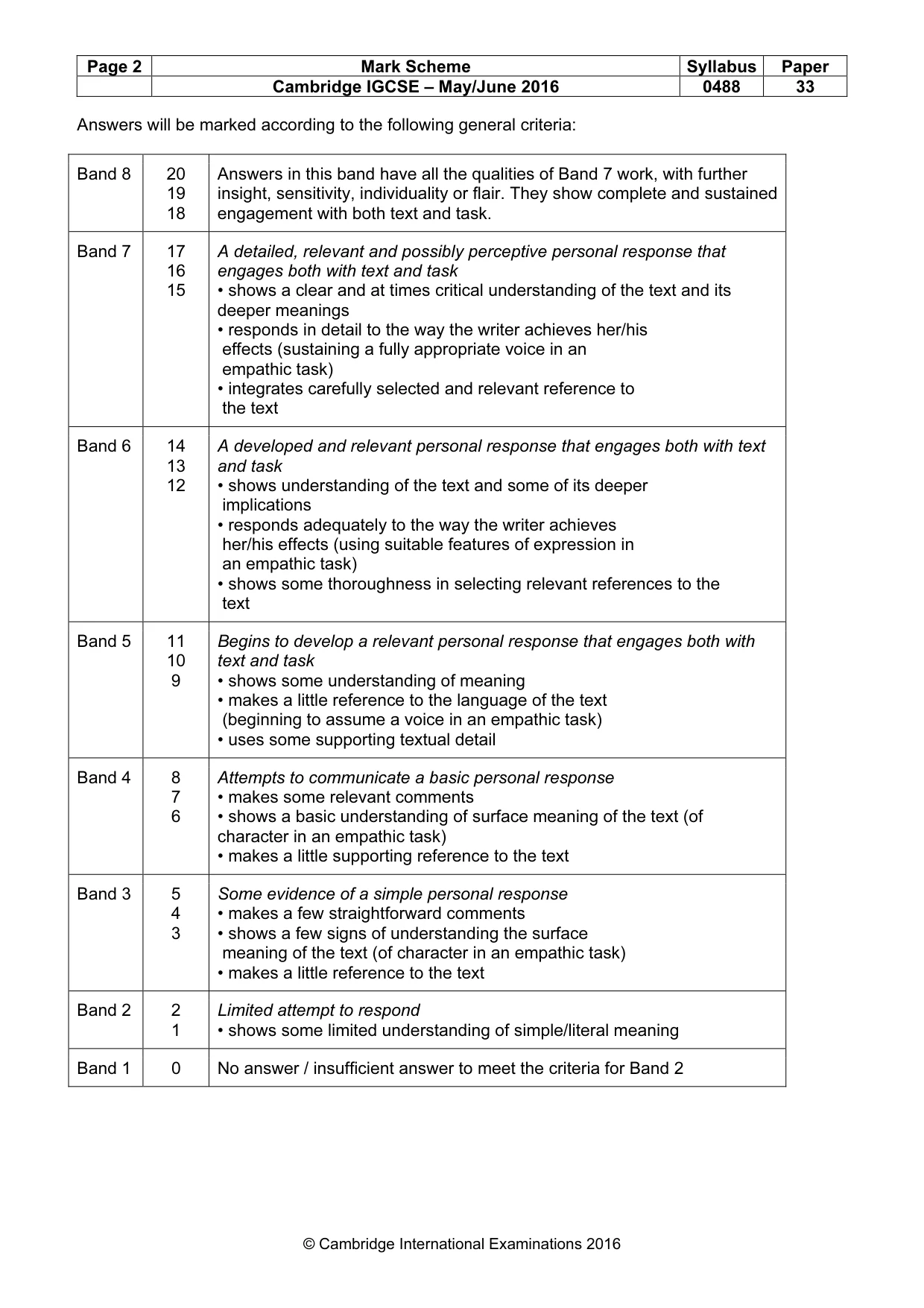
Page 2 Mark Scheme Syllabus Paper Cambridge IGCSE – May/June 2016 0488 33 © Cambridge International Examinations 2016 Answers will be marked according to the following general criteria: Band 8 20 19 18 Answers in this band have all the qualities of Band 7 work, with further insight, sensitivity, individuality or flair. They show complete and sustained engagement with both text and task. Band 7 17 16 15 A detailed, relevant and possibly perceptive personal response that engages both with text and task • shows a clear and at times critical understanding of the text and its deeper meanings • responds in detail to the way the writer achieves her/his effects (sustaining a fully appropriate voice in an empathic task) • integrates carefully selected and relevant reference to the text Band 6 14 13 12 A developed and relevant personal response that engages both with text and task • shows understanding of the text and some of its deeper implications • responds adequately to the way the writer achieves her/his effects (using suitable features of expression in an empathic task) • shows some thoroughness in selecting relevant references to the text Band 5 11 10 9 Begins to develop a relevant personal response that engages both with text and task • shows some understanding of meaning • makes a little reference to the language of the text (beginning to assume a voice in an empathic task) • uses some supporting textual detail Band 4 8 7 6 Attempts to communicate a basic personal response • makes some relevant comments • shows a basic understanding of surface meaning of the text (of character in an empathic task) • makes a little supporting reference to the text Band 3 5 4 3 Some evidence of a simple personal response • makes a few straightforward comments • shows a few signs of understanding the surface meaning of the text (of character in an empathic task) • makes a little reference to the text Band 2 2 1 Limited attempt to respond • shows some limited understanding of simple/literal meaning Band 1 0 No answer / insufficient answer to meet the criteria for Band 2
Mark scheme, page 3
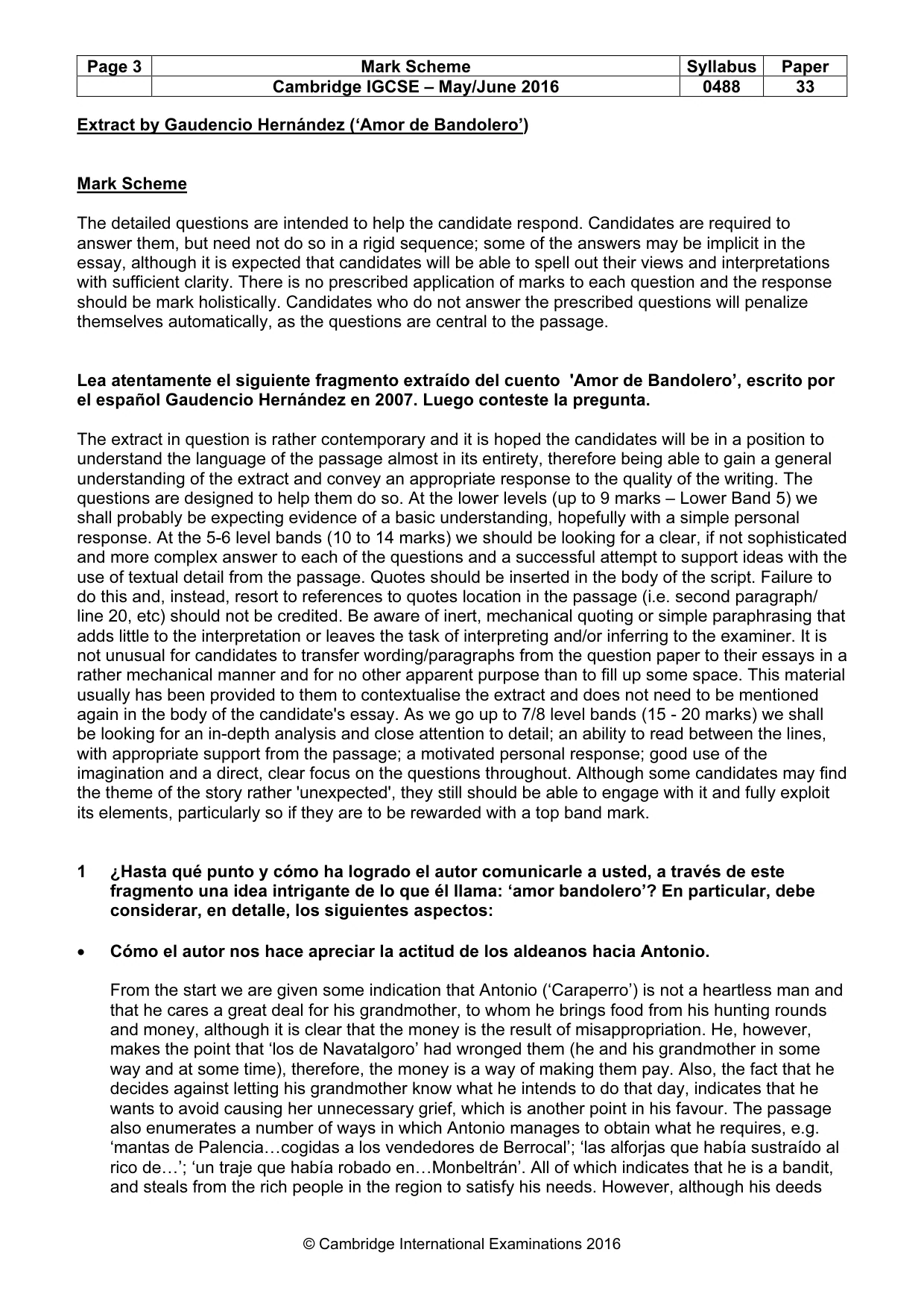
Page 3 Mark Scheme Syllabus Paper Cambridge IGCSE – May/June 2016 0488 33 © Cambridge International Examinations 2016 Extract by Gaudencio Hernández (‘Amor de Bandolero’) Mark Scheme The detailed questions are intended to help the candidate respond. Candidates are required to answer them, but need not do so in a rigid sequence; some of the answers may be implicit in the essay, although it is expected that candidates will be able to spell out their views and interpretations with sufficient clarity. There is no prescribed application of marks to each question and the response should be mark holistically. Candidates who do not answer the prescribed questions will penalize themselves automatically, as the questions are central to the passage. Lea atentamente el siguiente fragmento extraído del cuento 'Amor de Bandolero’, escrito por el español Gaudencio Hernández en 2007. Luego conteste la pregunta. The extract in question is rather contemporary and it is hoped the candidates will be in a position to understand the language of the passage almost in its entirety, therefore being able to gain a general understanding of the extract and convey an appropriate response to the quality of the writing. The questions are designed to help them do so. At the lower levels (up to 9 marks – Lower Band 5) we shall probably be expecting evidence of a basic understanding, hopefully with a simple personal response. At the 5-6 level bands (10 to 14 marks) we should be looking for a clear, if not sophisticated and more complex answer to each of the questions and a successful attempt to support ideas with the use of textual detail from the passage. Quotes should be inserted in the body of the script. Failure to do this and, instead, resort to references to quotes location in the passage (i.e. second paragraph/ line 20, etc) should not be credited. Be aware of inert, mechanical quoting or simple paraphrasing that adds little to the interpretation or leaves the task of interpreting and/or inferring to the examiner. It is not unusual for candidates to transfer wording/paragraphs from the question paper to their essays in a rather mechanical manner and for no other apparent purpose than to fill up some space. This material usually has been provided to them to contextualise the extract and does not need to be mentioned again in the body of the candidate's essay. As we go up to 7/8 level bands (15 - 20 marks) we shall be looking for an in-depth analysis and close attention to detail; an ability to read between the lines, with appropriate support from the passage; a motivated personal response; good use of the imagination and a direct, clear focus on the questions throughout. Although some candidates may find the theme of the story rather 'unexpected', they still should be able to engage with it and fully exploit its elements, particularly so if they are to be rewarded with a top band mark. 1 ¿Hasta qué punto y cómo ha logrado el autor comunicarle a usted, a través de este fragmento una idea intrigante de lo que él llama: ‘amor bandolero’? En particular, debe considerar, en detalle, los siguientes aspectos: • Cómo el autor nos hace apreciar la actitud de los aldeanos hacia Antonio. From the start we are given some indication that Antonio (‘Caraperro’) is not a heartless man and that he cares a great deal for his grandmother, to whom he brings food from his hunting rounds and money, although it is clear that the money is the result of misappropriation. He, however, makes the point that ‘los de Navatalgoro’ had wronged them (he and his grandmother in some way and at some time), therefore, the money is a way of making them pay. Also, the fact that he decides against letting his grandmother know what he intends to do that day, indicates that he wants to avoid causing her unnecessary grief, which is another point in his favour. The passage also enumerates a number of ways in which Antonio manages to obtain what he requires, e.g. ‘mantas de Palencia…cogidas a los vendedores de Berrocal’; ‘las alforjas que había sustraído al rico de…’; ‘un traje que había robado en…Monbeltrán’. All of which indicates that he is a bandit, and steals from the rich people in the region to satisfy his needs. However, although his deeds
Mark scheme, page 4
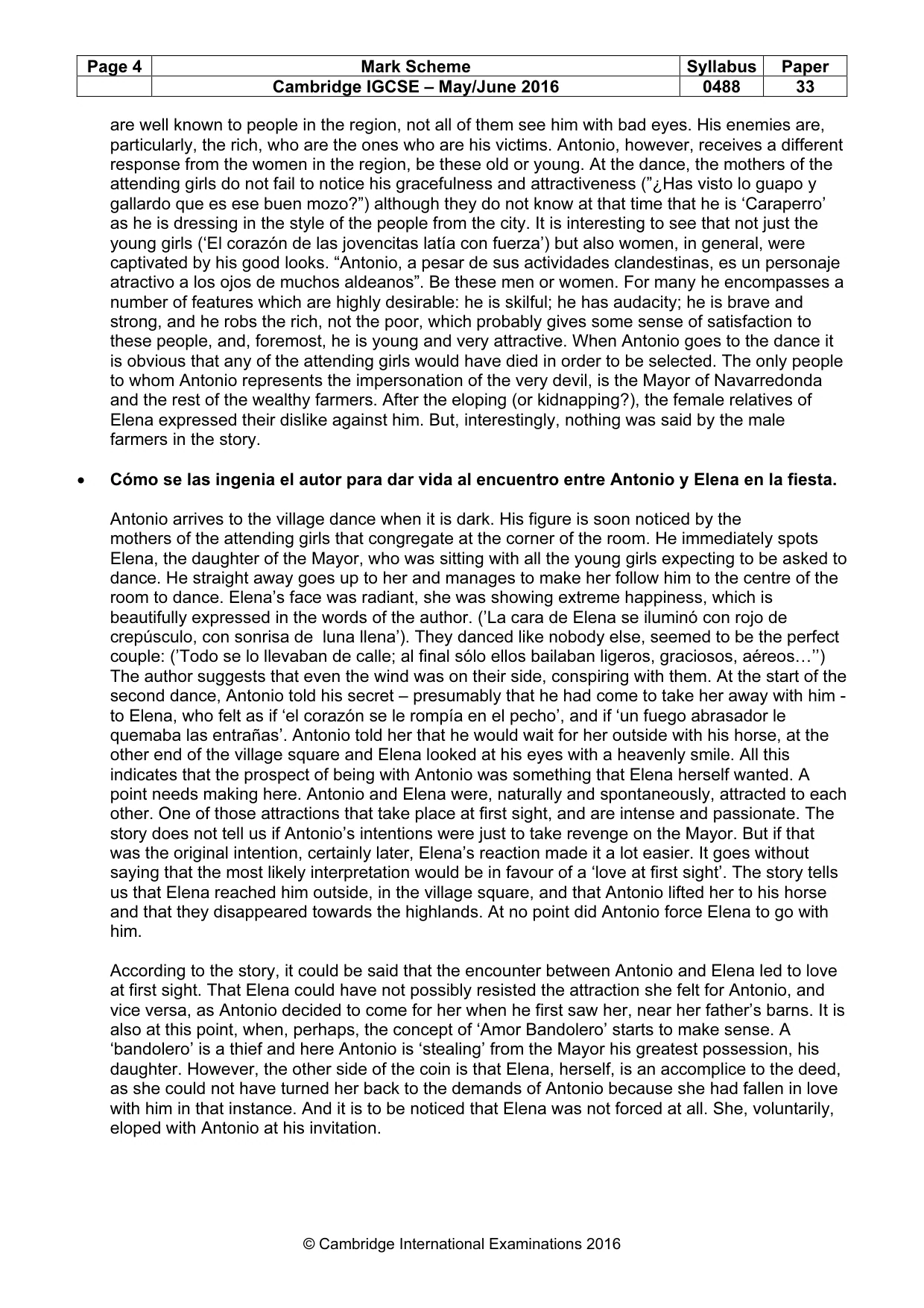
Page 4 Mark Scheme Syllabus Paper Cambridge IGCSE – May/June 2016 0488 33 © Cambridge International Examinations 2016 are well known to people in the region, not all of them see him with bad eyes. His enemies are, particularly, the rich, who are the ones who are his victims. Antonio, however, receives a different response from the women in the region, be these old or young. At the dance, the mothers of the attending girls do not fail to notice his gracefulness and attractiveness (”¿Has visto lo guapo y gallardo que es ese buen mozo?”) although they do not know at that time that he is ‘Caraperro’ as he is dressing in the style of the people from the city. It is interesting to see that not just the young girls (‘El corazón de las jovencitas latía con fuerza’) but also women, in general, were captivated by his good looks. “Antonio, a pesar de sus actividades clandestinas, es un personaje atractivo a los ojos de muchos aldeanos”. Be these men or women. For many he encompasses a number of features which are highly desirable: he is skilful; he has audacity; he is brave and strong, and he robs the rich, not the poor, which probably gives some sense of satisfaction to these people, and, foremost, he is young and very attractive. When Antonio goes to the dance it is obvious that any of the attending girls would have died in order to be selected. The only people to whom Antonio represents the impersonation of the very devil, is the Mayor of Navarredonda and the rest of the wealthy farmers. After the eloping (or kidnapping?), the female relatives of Elena expressed their dislike against him. But, interestingly, nothing was said by the male farmers in the story. • Cómo se las ingenia el autor para dar vida al encuentro entre Antonio y Elena en la fiesta. Antonio arrives to the village dance when it is dark. His figure is soon noticed by the mothers of the attending girls that congregate at the corner of the room. He immediately spots Elena, the daughter of the Mayor, who was sitting with all the young girls expecting to be asked to dance. He straight away goes up to her and manages to make her follow him to the centre of the room to dance. Elena’s face was radiant, she was showing extreme happiness, which is beautifully expressed in the words of the author. (’La cara de Elena se iluminó con rojo de crepúsculo, con sonrisa de luna llena’). They danced like nobody else, seemed to be the perfect couple: (’Todo se lo llevaban de calle; al final sólo ellos bailaban ligeros, graciosos, aéreos…’’) The author suggests that even the wind was on their side, conspiring with them. At the start of the second dance, Antonio told his secret – presumably that he had come to take her away with him - to Elena, who felt as if ‘el corazón se le rompía en el pecho’, and if ‘un fuego abrasador le quemaba las entrañas’. Antonio told her that he would wait for her outside with his horse, at the other end of the village square and Elena looked at his eyes with a heavenly smile. All this indicates that the prospect of being with Antonio was something that Elena herself wanted. A point needs making here. Antonio and Elena were, naturally and spontaneously, attracted to each other. One of those attractions that take place at first sight, and are intense and passionate. The story does not tell us if Antonio’s intentions were just to take revenge on the Mayor. But if that was the original intention, certainly later, Elena’s reaction made it a lot easier. It goes without saying that the most likely interpretation would be in favour of a ‘love at first sight’. The story tells us that Elena reached him outside, in the village square, and that Antonio lifted her to his horse and that they disappeared towards the highlands. At no point did Antonio force Elena to go with him. According to the story, it could be said that the encounter between Antonio and Elena led to love at first sight. That Elena could have not possibly resisted the attraction she felt for Antonio, and vice versa, as Antonio decided to come for her when he first saw her, near her father’s barns. It is also at this point, when, perhaps, the concept of ‘Amor Bandolero’ starts to make sense. A ‘bandolero’ is a thief and here Antonio is ‘stealing’ from the Mayor his greatest possession, his daughter. However, the other side of the coin is that Elena, herself, is an accomplice to the deed, as she could not have turned her back to the demands of Antonio because she had fallen in love with him in that instance. And it is to be noticed that Elena was not forced at all. She, voluntarily, eloped with Antonio at his invitation.
Mark scheme, page 5
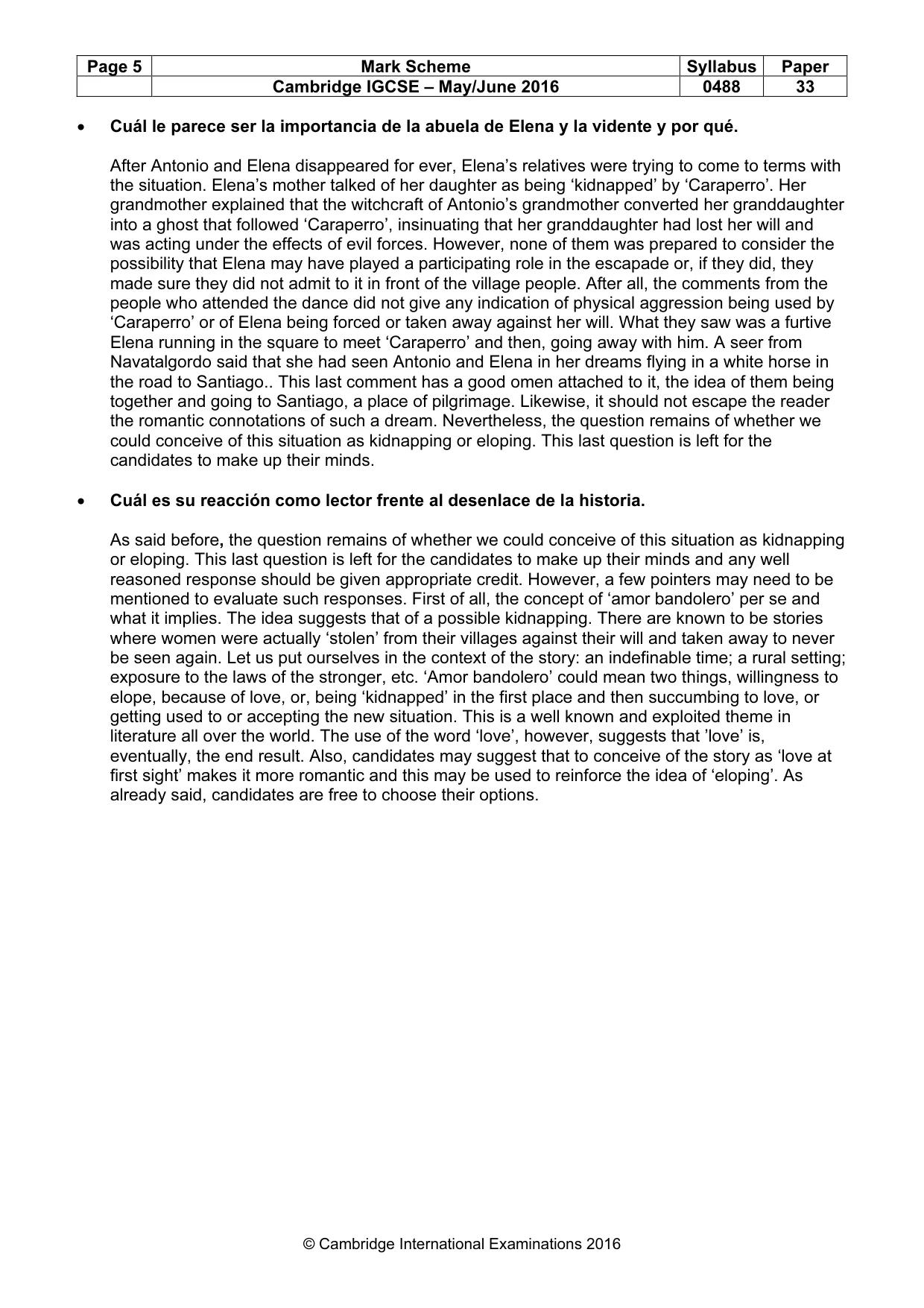
Page 5 Mark Scheme Syllabus Paper Cambridge IGCSE – May/June 2016 0488 33 © Cambridge International Examinations 2016 • Cuál le parece ser la importancia de la abuela de Elena y la vidente y por qué. After Antonio and Elena disappeared for ever, Elena’s relatives were trying to come to terms with the situation. Elena’s mother talked of her daughter as being ‘kidnapped’ by ‘Caraperro’. Her grandmother explained that the witchcraft of Antonio’s grandmother converted her granddaughter into a ghost that followed ‘Caraperro’, insinuating that her granddaughter had lost her will and was acting under the effects of evil forces. However, none of them was prepared to consider the possibility that Elena may have played a participating role in the escapade or, if they did, they made sure they did not admit to it in front of the village people. After all, the comments from the people who attended the dance did not give any indication of physical aggression being used by ‘Caraperro’ or of Elena being forced or taken away against her will. What they saw was a furtive Elena running in the square to meet ‘Caraperro’ and then, going away with him. A seer from Navatalgordo said that she had seen Antonio and Elena in her dreams flying in a white horse in the road to Santiago.. This last comment has a good omen attached to it, the idea of them being together and going to Santiago, a place of pilgrimage. Likewise, it should not escape the reader the romantic connotations of such a dream. Nevertheless, the question remains of whether we could conceive of this situation as kidnapping or eloping. This last question is left for the candidates to make up their minds. • Cuál es su reacción como lector frente al desenlace de la historia. As said before, the question remains of whether we could conceive of this situation as kidnapping or eloping. This last question is left for the candidates to make up their minds and any well reasoned response should be given appropriate credit. However, a few pointers may need to be mentioned to evaluate such responses. First of all, the concept of ‘amor bandolero’ per se and what it implies. The idea suggests that of a possible kidnapping. There are known to be stories where women were actually ‘stolen’ from their villages against their will and taken away to never be seen again. Let us put ourselves in the context of the story: an indefinable time; a rural setting; exposure to the laws of the stronger, etc. ‘Amor bandolero’ could mean two things, willingness to elope, because of love, or, being ‘kidnapped’ in the first place and then succumbing to love, or getting used to or accepting the new situation. This is a well known and exploited theme in literature all over the world. The use of the word ‘love’, however, suggests that ’love’ is, eventually, the end result. Also, candidates may suggest that to conceive of the story as ‘love at first sight’ makes it more romantic and this may be used to reinforce the idea of ‘eloping’. As already said, candidates are free to choose their options.
Mark scheme, page 6
Page 6 Mark Scheme Syllabus Paper Cambridge IGCSE – May/June 2016 0488 33 © Cambridge International Examinations 2016 Usted puede añadir cualquier otro comentario que le parezca pertinente. It is rare for candidates to follow up this suggestion and they should not be penalised if they do not. However, any interesting comments should of course be taken into account in the overall reward, - provided these do not distort or contradict the main story line and candidates do not end up either, contradicting themselves or, not adopting a clear line of interpretation. If additional and reasonable ideas are offered, generous reward should be considered although this section alone should not be substitute for the required response to the preceding ones. There are a number of ideas that can be referred to, such as the glamour associated with the idea of a ‘bandit’ and the effect this can have on young girls, suggesting that the bandit has the upper hand. Or, the attraction that a handsome face can exert on young girls to persuade them to do things that their parents would not recommend. Or even, to think about how matters of love were resolved in the rural communities many, many years ago, where girls did not have an education and the best they could do was to get married and, frequently, without having a say in the matter. Thus, from the point of view of Elena, one could say that at least she got together with someone she liked and who also liked her as it is obvious she exerted a big influence in ‘Caraperro’ who decided to move far away in order to be with her. Candidates may elaborate within these lines or follow alternative interpretations. The only requirement here is to be consistent and avoid flagrant contradictions or uncommitted/ unexplained statements. Ideas should be clearly stated, well argued and convincing to be given the marks.
What you needed in this session
Cambridge’s own grade thresholds for 2016 May/June, Paper 3 · Variant 3. A higher threshold means an easier paper — the bar moves with how the cohort did.