Cambridge IGCSE Spanish - Literature 0488 — 2016 May/June Paper 3 · Variant 1
0488/31/M/J/16 · 20 marks · ≈23 min
The question paper and its mark scheme, free to download. This is Cambridge’s own paper, exactly as it was sat — the on-screen preview is on its way; download below in the meantime.
Question paper
The on-screen preview isn’t ready for this paper yet — download it above instead.
Mark scheme5 pages
Answers below. Sit the paper first if you are practising.
Paper as text
Mark scheme, page 1
® IGCSE is the registered trademark of Cambridge International Examinations. This document consists of 5 printed pages. © UCLES 2016 [Turn over Cambridge International Examinations Cambridge International General Certificate of Secondary Education LITERATURE (SPANISH) 0488/31 Paper 3 Alternative to Coursework May/June 2016 MARK SCHEME Maximum Mark: 20 Published This mark scheme is published as an aid to teachers and candidates, to indicate the requirements of the examination. It shows the basis on which Examiners were instructed to award marks. It does not indicate the details of the discussions that took place at an Examiners’ meeting before marking began, which would have considered the acceptability of alternative answers. Mark schemes should be read in conjunction with the question paper and the Principal Examiner Report for Teachers. Cambridge will not enter into discussions about these mark schemes. Cambridge is publishing the mark schemes for the May/June 2016 series for most Cambridge IGCSE®, Cambridge International A and AS Level components and some Cambridge O Level components.
Mark scheme, page 2
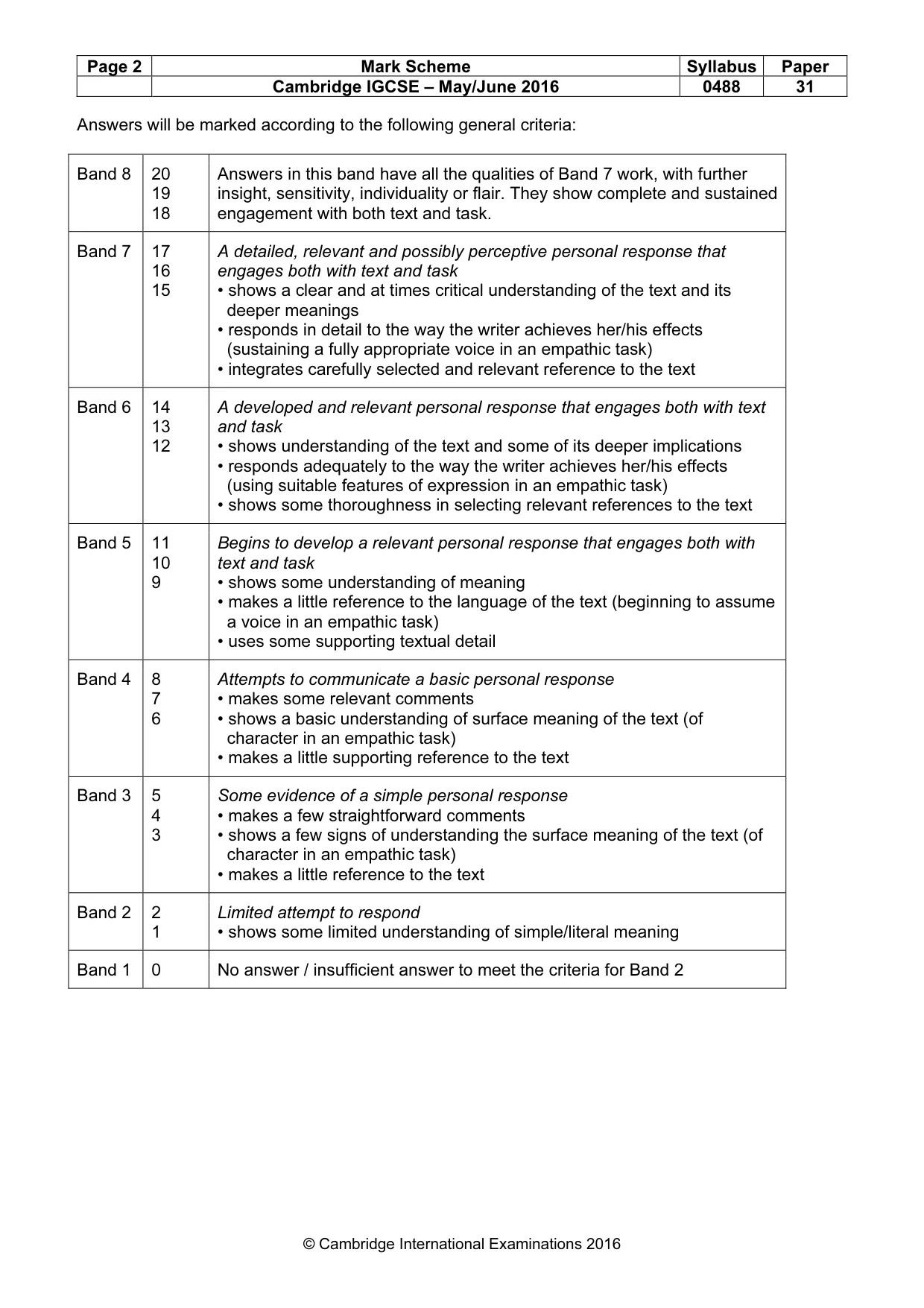
Page 2 Mark Scheme Syllabus Paper Cambridge IGCSE – May/June 2016 0488 31 © Cambridge International Examinations 2016 Answers will be marked according to the following general criteria: Band 8 20 19 18 Answers in this band have all the qualities of Band 7 work, with further insight, sensitivity, individuality or flair. They show complete and sustained engagement with both text and task. Band 7 17 16 15 A detailed, relevant and possibly perceptive personal response that engages both with text and task • shows a clear and at times critical understanding of the text and its deeper meanings • responds in detail to the way the writer achieves her/his effects (sustaining a fully appropriate voice in an empathic task) • integrates carefully selected and relevant reference to the text Band 6 14 13 12 A developed and relevant personal response that engages both with text and task • shows understanding of the text and some of its deeper implications • responds adequately to the way the writer achieves her/his effects (using suitable features of expression in an empathic task) • shows some thoroughness in selecting relevant references to the text Band 5 11 10 9 Begins to develop a relevant personal response that engages both with text and task • shows some understanding of meaning • makes a little reference to the language of the text (beginning to assume a voice in an empathic task) • uses some supporting textual detail Band 4 8 7 6 Attempts to communicate a basic personal response • makes some relevant comments • shows a basic understanding of surface meaning of the text (of character in an empathic task) • makes a little supporting reference to the text Band 3 5 4 3 Some evidence of a simple personal response • makes a few straightforward comments • shows a few signs of understanding the surface meaning of the text (of character in an empathic task) • makes a little reference to the text Band 2 2 1 Limited attempt to respond • shows some limited understanding of simple/literal meaning Band 1 0 No answer / insufficient answer to meet the criteria for Band 2
Mark scheme, page 3
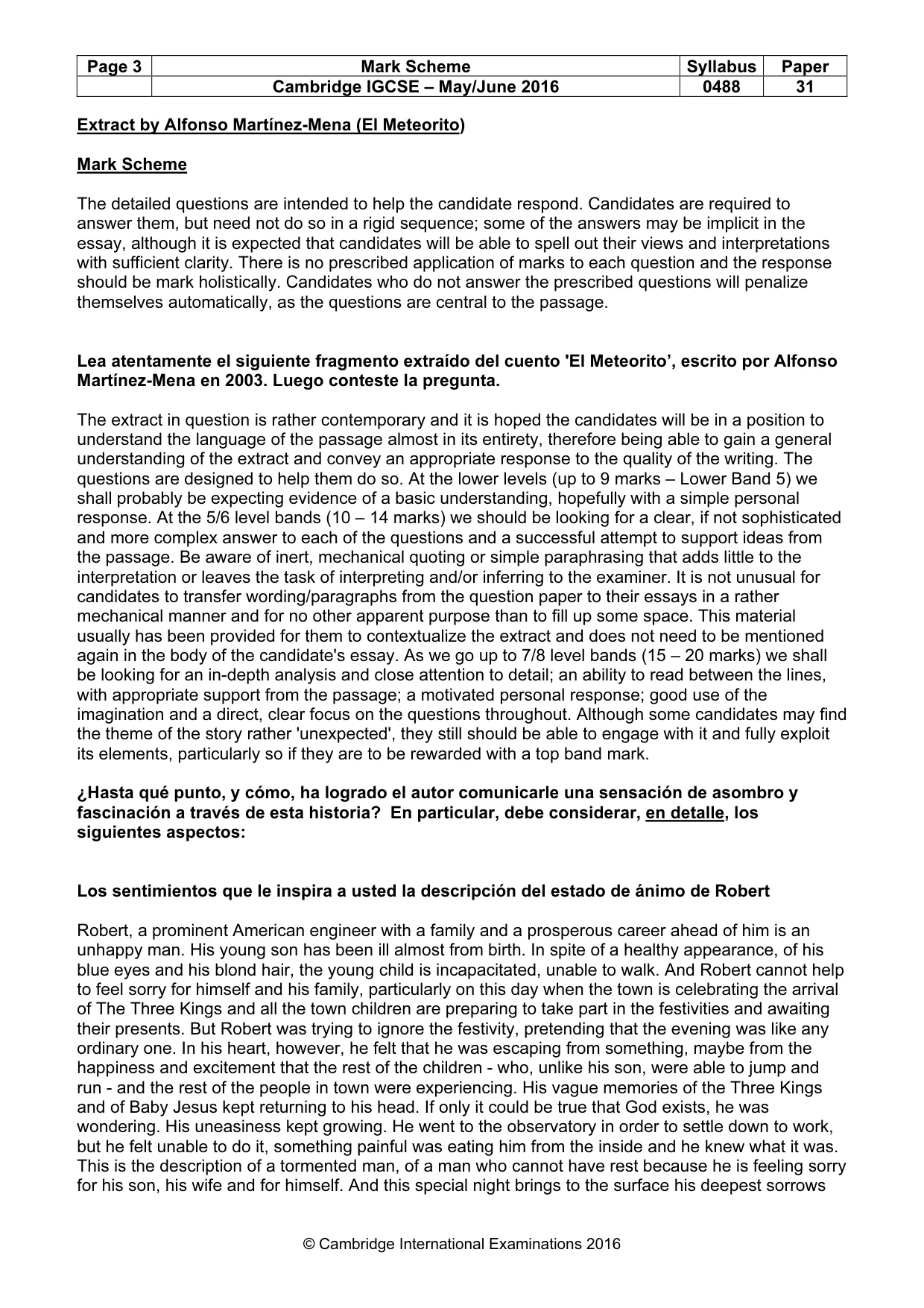
Page 3 Mark Scheme Syllabus Paper Cambridge IGCSE – May/June 2016 0488 31 © Cambridge International Examinations 2016 Extract by Alfonso Martínez-Mena (El Meteorito) Mark Scheme The detailed questions are intended to help the candidate respond. Candidates are required to answer them, but need not do so in a rigid sequence; some of the answers may be implicit in the essay, although it is expected that candidates will be able to spell out their views and interpretations with sufficient clarity. There is no prescribed application of marks to each question and the response should be mark holistically. Candidates who do not answer the prescribed questions will penalize themselves automatically, as the questions are central to the passage. Lea atentamente el siguiente fragmento extraído del cuento 'El Meteorito’, escrito por Alfonso Martínez-Mena en 2003. Luego conteste la pregunta. The extract in question is rather contemporary and it is hoped the candidates will be in a position to understand the language of the passage almost in its entirety, therefore being able to gain a general understanding of the extract and convey an appropriate response to the quality of the writing. The questions are designed to help them do so. At the lower levels (up to 9 marks – Lower Band 5) we shall probably be expecting evidence of a basic understanding, hopefully with a simple personal response. At the 5/6 level bands (10 – 14 marks) we should be looking for a clear, if not sophisticated and more complex answer to each of the questions and a successful attempt to support ideas from the passage. Be aware of inert, mechanical quoting or simple paraphrasing that adds little to the interpretation or leaves the task of interpreting and/or inferring to the examiner. It is not unusual for candidates to transfer wording/paragraphs from the question paper to their essays in a rather mechanical manner and for no other apparent purpose than to fill up some space. This material usually has been provided for them to contextualize the extract and does not need to be mentioned again in the body of the candidate's essay. As we go up to 7/8 level bands (15 – 20 marks) we shall be looking for an in-depth analysis and close attention to detail; an ability to read between the lines, with appropriate support from the passage; a motivated personal response; good use of the imagination and a direct, clear focus on the questions throughout. Although some candidates may find the theme of the story rather 'unexpected', they still should be able to engage with it and fully exploit its elements, particularly so if they are to be rewarded with a top band mark. ¿Hasta qué punto, y cómo, ha logrado el autor comunicarle una sensación de asombro y fascinación a través de esta historia? En particular, debe considerar, en detalle, los siguientes aspectos: Los sentimientos que le inspira a usted la descripción del estado de ánimo de Robert Robert, a prominent American engineer with a family and a prosperous career ahead of him is an unhappy man. His young son has been ill almost from birth. In spite of a healthy appearance, of his blue eyes and his blond hair, the young child is incapacitated, unable to walk. And Robert cannot help to feel sorry for himself and his family, particularly on this day when the town is celebrating the arrival of The Three Kings and all the town children are preparing to take part in the festivities and awaiting their presents. But Robert was trying to ignore the festivity, pretending that the evening was like any ordinary one. In his heart, however, he felt that he was escaping from something, maybe from the happiness and excitement that the rest of the children - who, unlike his son, were able to jump and run - and the rest of the people in town were experiencing. His vague memories of the Three Kings and of Baby Jesus kept returning to his head. If only it could be true that God exists, he was wondering. His uneasiness kept growing. He went to the observatory in order to settle down to work, but he felt unable to do it, something painful was eating him from the inside and he knew what it was. This is the description of a tormented man, of a man who cannot have rest because he is feeling sorry for his son, his wife and for himself. And this special night brings to the surface his deepest sorrows
Mark scheme, page 4
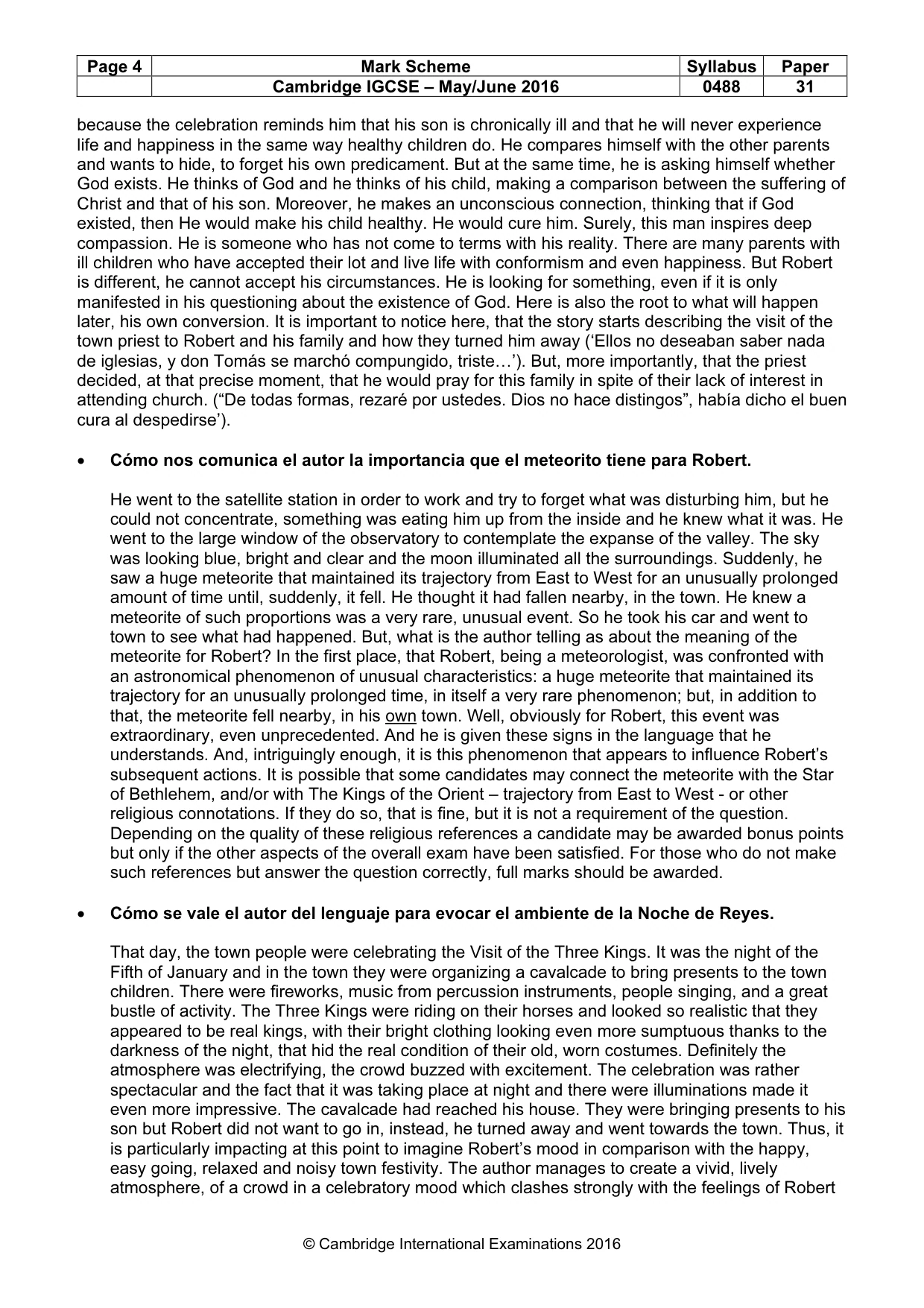
Page 4 Mark Scheme Syllabus Paper Cambridge IGCSE – May/June 2016 0488 31 © Cambridge International Examinations 2016 because the celebration reminds him that his son is chronically ill and that he will never experience life and happiness in the same way healthy children do. He compares himself with the other parents and wants to hide, to forget his own predicament. But at the same time, he is asking himself whether God exists. He thinks of God and he thinks of his child, making a comparison between the suffering of Christ and that of his son. Moreover, he makes an unconscious connection, thinking that if God existed, then He would make his child healthy. He would cure him. Surely, this man inspires deep compassion. He is someone who has not come to terms with his reality. There are many parents with ill children who have accepted their lot and live life with conformism and even happiness. But Robert is different, he cannot accept his circumstances. He is looking for something, even if it is only manifested in his questioning about the existence of God. Here is also the root to what will happen later, his own conversion. It is important to notice here, that the story starts describing the visit of the town priest to Robert and his family and how they turned him away (‘Ellos no deseaban saber nada de iglesias, y don Tomás se marchó compungido, triste…’). But, more importantly, that the priest decided, at that precise moment, that he would pray for this family in spite of their lack of interest in attending church. (“De todas formas, rezaré por ustedes. Dios no hace distingos”, había dicho el buen cura al despedirse’). • Cómo nos comunica el autor la importancia que el meteorito tiene para Robert. He went to the satellite station in order to work and try to forget what was disturbing him, but he could not concentrate, something was eating him up from the inside and he knew what it was. He went to the large window of the observatory to contemplate the expanse of the valley. The sky was looking blue, bright and clear and the moon illuminated all the surroundings. Suddenly, he saw a huge meteorite that maintained its trajectory from East to West for an unusually prolonged amount of time until, suddenly, it fell. He thought it had fallen nearby, in the town. He knew a meteorite of such proportions was a very rare, unusual event. So he took his car and went to town to see what had happened. But, what is the author telling as about the meaning of the meteorite for Robert? In the first place, that Robert, being a meteorologist, was confronted with an astronomical phenomenon of unusual characteristics: a huge meteorite that maintained its trajectory for an unusually prolonged time, in itself a very rare phenomenon; but, in addition to that, the meteorite fell nearby, in his own town. Well, obviously for Robert, this event was extraordinary, even unprecedented. And he is given these signs in the language that he understands. And, intriguingly enough, it is this phenomenon that appears to influence Robert’s subsequent actions. It is possible that some candidates may connect the meteorite with the Star of Bethlehem, and/or with The Kings of the Orient – trajectory from East to West - or other religious connotations. If they do so, that is fine, but it is not a requirement of the question. Depending on the quality of these religious references a candidate may be awarded bonus points but only if the other aspects of the overall exam have been satisfied. For those who do not make such references but answer the question correctly, full marks should be awarded. • Cómo se vale el autor del lenguaje para evocar el ambiente de la Noche de Reyes. That day, the town people were celebrating the Visit of the Three Kings. It was the night of the Fifth of January and in the town they were organizing a cavalcade to bring presents to the town children. There were fireworks, music from percussion instruments, people singing, and a great bustle of activity. The Three Kings were riding on their horses and looked so realistic that they appeared to be real kings, with their bright clothing looking even more sumptuous thanks to the darkness of the night, that hid the real condition of their old, worn costumes. Definitely the atmosphere was electrifying, the crowd buzzed with excitement. The celebration was rather spectacular and the fact that it was taking place at night and there were illuminations made it even more impressive. The cavalcade had reached his house. They were bringing presents to his son but Robert did not want to go in, instead, he turned away and went towards the town. Thus, it is particularly impacting at this point to imagine Robert’s mood in comparison with the happy, easy going, relaxed and noisy town festivity. The author manages to create a vivid, lively atmosphere, of a crowd in a celebratory mood which clashes strongly with the feelings of Robert
Mark scheme, page 5
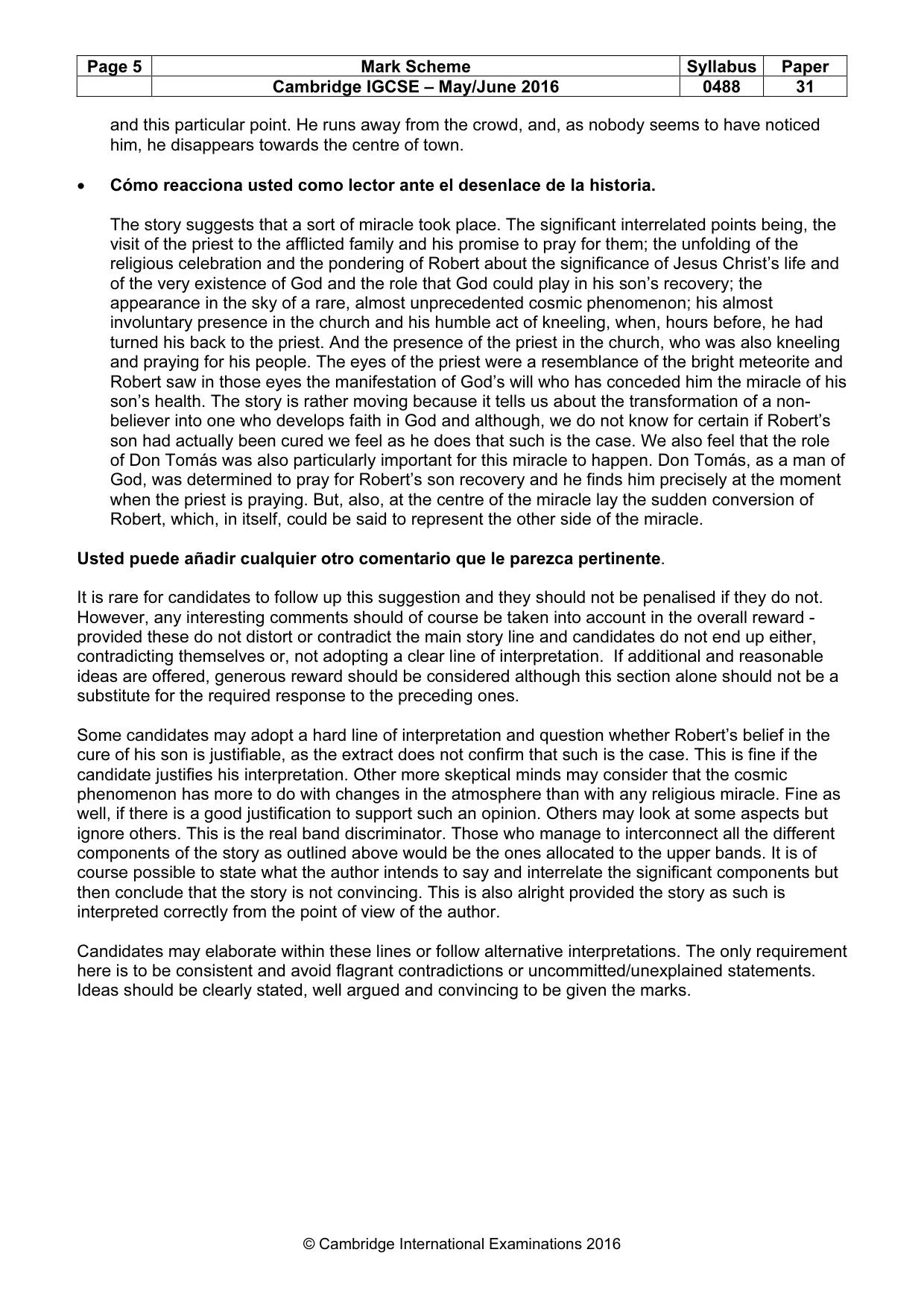
Page 5 Mark Scheme Syllabus Paper Cambridge IGCSE – May/June 2016 0488 31 © Cambridge International Examinations 2016 and this particular point. He runs away from the crowd, and, as nobody seems to have noticed him, he disappears towards the centre of town. • Cómo reacciona usted como lector ante el desenlace de la historia. The story suggests that a sort of miracle took place. The significant interrelated points being, the visit of the priest to the afflicted family and his promise to pray for them; the unfolding of the religious celebration and the pondering of Robert about the significance of Jesus Christ’s life and of the very existence of God and the role that God could play in his son’s recovery; the appearance in the sky of a rare, almost unprecedented cosmic phenomenon; his almost involuntary presence in the church and his humble act of kneeling, when, hours before, he had turned his back to the priest. And the presence of the priest in the church, who was also kneeling and praying for his people. The eyes of the priest were a resemblance of the bright meteorite and Robert saw in those eyes the manifestation of God’s will who has conceded him the miracle of his son’s health. The story is rather moving because it tells us about the transformation of a non- believer into one who develops faith in God and although, we do not know for certain if Robert’s son had actually been cured we feel as he does that such is the case. We also feel that the role of Don Tomás was also particularly important for this miracle to happen. Don Tomás, as a man of God, was determined to pray for Robert’s son recovery and he finds him precisely at the moment when the priest is praying. But, also, at the centre of the miracle lay the sudden conversion of Robert, which, in itself, could be said to represent the other side of the miracle. Usted puede añadir cualquier otro comentario que le parezca pertinente. It is rare for candidates to follow up this suggestion and they should not be penalised if they do not. However, any interesting comments should of course be taken into account in the overall reward - provided these do not distort or contradict the main story line and candidates do not end up either, contradicting themselves or, not adopting a clear line of interpretation. If additional and reasonable ideas are offered, generous reward should be considered although this section alone should not be a substitute for the required response to the preceding ones. Some candidates may adopt a hard line of interpretation and question whether Robert’s belief in the cure of his son is justifiable, as the extract does not confirm that such is the case. This is fine if the candidate justifies his interpretation. Other more skeptical minds may consider that the cosmic phenomenon has more to do with changes in the atmosphere than with any religious miracle. Fine as well, if there is a good justification to support such an opinion. Others may look at some aspects but ignore others. This is the real band discriminator. Those who manage to interconnect all the different components of the story as outlined above would be the ones allocated to the upper bands. It is of course possible to state what the author intends to say and interrelate the significant components but then conclude that the story is not convincing. This is also alright provided the story as such is interpreted correctly from the point of view of the author. Candidates may elaborate within these lines or follow alternative interpretations. The only requirement here is to be consistent and avoid flagrant contradictions or uncommitted/unexplained statements. Ideas should be clearly stated, well argued and convincing to be given the marks.
What you needed in this session
Cambridge’s own grade thresholds for 2016 May/June, Paper 3 · Variant 1. A higher threshold means an easier paper — the bar moves with how the cohort did.