Cambridge IGCSE Spanish - Literature 0488 — 2015 May/June Paper 3 · Variant 3
0488/33/M/J/15 · 20 marks · ≈23 min
The question paper and its mark scheme, free to read here and free to download. This is Cambridge’s own paper, exactly as it was sat.
Question paper4 pages

Mark scheme5 pages
Answers below. Sit the paper first if you are practising.
Paper as text
Question paper, page 1
This document consists of 3 printed pages, 1 blank page and 1 insert. DC (ST) 102285/2 © UCLES 2015 [Turn over Cambridge International Examinations Cambridge International General Certificate of Secondary Education * 8 9 9 5 8 0 7 2 7 9 * LITERATURE (SPANISH) 0488/33 Paper 3 Alternative to Coursework May/June 2015 1 hour 20 minutes No Additional Materials are required. READ THESE INSTRUCTIONS FIRST An answer booklet is provided inside this question paper. You should follow the instructions on the front cover of the answer booklet. If you need additional answer paper ask the invigilator for a continuation booklet. Answer the question in Spanish. EN PRIMER LUGAR, LEA ESTAS INSTRUCCIONES El cuadernillo de respuestas se encuentra dentro de este cuadernillo de preguntas. Siga las instrucciones de la portada del cuadernillo de respuestas. También encontrará las instrucciones en español a continuación. Si necesita hojas adicionales, pídale al supervisor un cuadernillo de respuestas adicional. Conteste la pregunta en español. INSTRUCCIONES DEL CUADERNILLO DE RESPUESTAS Rellene las casillas de la portada del cuadernillo de respuestas con letra mayúscula. Use tinta azul oscuro o negra. NO ESCRIBA EN NINGÚN CÓDIGO DE BARRAS. Escriba sus respuestas en el cuadernillo de respuestas. Utilice ambas caras del papel. Por favor deje dos líneas en blanco entre sus respuestas a cada pregunta. Escriba el número de la pregunta que está contestando en el primer margen. Question Part 1 1 ai aii Si la pregunta que está contestando también contiene secciones, por ejemplo 1a, escriba la sección de la pregunta en el segundo margen. Si ha utilizado cuadernillos de respuestas adicionales, por favor guárdelos dentro del cuadernillo de respuestas.
Question paper, page 2
2 0488/33/M/J/15 © UCLES 2015 Lea atentamente el siguiente pasaje extraído del cuento corto ‘La Grajilla’ del escritor español Miguel Delibes (1982). Esta historia está basada en hechos verídícos ocurridos en la vida del autor. Luego conteste la pregunta: A lo largo de tres meses, yo conviví en Sedano con Morris, una grajilla1 que encontró mi hijo Miguel, aún en carnutas2 y medio muerta de inanición, en los acantilados de San Felices. El animalito se había caído del nido y, al verla tan débil y depauperada, no di un real por su existencia. No obstante, mis hijos Juan y Adolfo, muy chicos por aquel entonces, le habilitaron un nido en una caja de zapatos y empezaron a alimentarla con pienso humedecido que Morris devoraba glotonamente. En pocos días, la grajilla se repuso, empezaron a asomarle los primeros cañones3 y, cuatro semanas más tarde, estaba completamente emplumada. Pero lo más sorprendente de Morris era la naturalidad con que aceptaba la vecindad de las personas, especialmente la de Juan y Adolfo, que la habían criado. Únicamente, en su trato con el hombre, le repugnaba una cosa: que le pusieran la mano encima. Es decir, Morris reposaba erguida y tranquila sobre el antebrazo o el hombro de cualquiera de nosotros, pero si el mismo porteador u otra persona, incluidos Juan y Adolfo, intentaban agarrarla, el pájaro se escabullía, revoloteaba y terminaba por caer al suelo. Esta repulsión instintiva a ser apresada le duró hasta que la perdimos. Morris hacía causa común con la familia, le divertía vernos comer alrededor de la rueda de molino, participaba a su manera de nuestras tertulias, no extrañaba las visitas, pero rechazaba terminantemente la caricia y cualquier tipo de contacto. Yo creo que la situación de mi refugio a media ladera, en alto, sobre el valle de frutales, facilitó la adaptación de la grajilla. Ella no podía disfrutar, ciertamente, de la compañía de sus congéneres, pero la visión del mundo era la que le correspondía en su condición de ave, desde arriba, “a vista de pájaro”. Una mañana, cuando Adolfo, en traje de baño, se dirigía hacia la piscina con ella al hombro, Morris empezó a aletear con cierta torpeza, se afirmó gradualmente en el aire, tomó altura y se posó en la copa del olmo que sombrea la mesa de piedra. La reacción de la familia fue semejante a la que suscitan los primeros pasos de un niño: alegría y estupor. Pero, enseguida, se presentó el dilema: ¿había elegido Morris la libertad y escaparía, o simplemente era aquello la prueba de la culminación de su desarrollo? Confieso que me incliné por lo primero. La abierta curiosidad con que contemplaba el valle desde una nueva perspectiva, el notorio placer que le deparaba su balanceo en la ramita del olmo, su indiferencia ante nuestras voces al pie del árbol, parecían indicar que Morris ya no nos necesitaba y que, en lo sucesivo, podría prescindir de nosotros. El hecho de que la grajilla permaneciera durante largo rato en la punta del olmo, despiojándose, realizando su aseo cotidiano, desinteresada de cuanto sucedía a su alrededor, me reafirmó en mi opinión. No obstante, al cabo de una hora, Juan, que solía imitar, al darle de comer, la voz peculiar de estas aves, remedando los arrumacos maternos, apareció con el cacharrito donde mezclaba el pienso con agua y moduló un “quia-quia-quia” aterciopelado, dulce, digno de enternecer a la grajeta4 más esquiva. Morris acusó el golpe. Empezó a inquietarse, a mover la cabeza de un lado a otro, y, por primera vez desde que se encaramó en el árbol, prestó atención a lo que ocurría bajo ella y fijó en Juan sus ojillos transparentes como abalorios. Mi hijo repitió entonces la llamada con mayor unción, y, al instante, Morris se lanzó al vacío, desplegó sus amplias alas negras, describió un pequeño círculo alrededor de nuestras cabezas y fue a posarse blandamente sobre su hombro, al tiempo que reclamaba el alimento con un “quia-quia-quia” perentorio. ________________________________________________ 1Grajilla: Tipo de pájaro ruidoso de la familia de los cuervos. 2En carnutas: Sin plumaje. 3Cañones: Plumas, especialmente las más duras que se encuentran en el ala o la cola de un ave. 4Grajeta: Ave pequeña
Question paper, page 3
3 0488/33/M/J/15 © UCLES 2015 1 ¿Hasta qué punto, y cómo, ha logrado el autor comunicarle un sentimiento de simpatía y afecto hacia Morris a través de este fragmento? En particular, debe considerar, en detalle, los siguientes aspectos: • cómo se vale el autor del lenguaje para persuadirnos de que Morris es una criatura extraordinaria • qué impresión le da el autor de la relación entre Morris y el mundo humano • cuál es su reacción como lector frente al desenlace de la historia y por qué. Usted puede añadir cualquier otro comentario que le parezca pertinente.
Question paper, page 4
4 0488/33/M/J/15 © UCLES 2015 Permission to reproduce items where third-party owned material protected by copyright is included has been sought and cleared where possible. Every reasonable effort has been made by the publisher (UCLES) to trace copyright holders, but if any items requiring clearance have unwittingly been included, the publisher will be pleased to make amends at the earliest possible opportunity. To avoid the issue of disclosure of answer-related information to candidates, all copyright acknowledgements are reproduced online in the Cambridge International Examinations Copyright Acknowledgements Booklet. This is produced for each series of examinations and is freely available to download at www.cie.org.uk after the live examination series. Cambridge International Examinations is part of the Cambridge Assessment Group. Cambridge Assessment is the brand name of University of Cambridge Local Examinations Syndicate (UCLES), which is itself a department of the University of Cambridge.
Mark scheme, page 1
® IGCSE is the registered trademark of Cambridge International Examinations. CAMBRIDGE INTERNATIONAL EXAMINATIONS Cambridge International General Certificate of Secondary Education MARK SCHEME for the May/June 2015 series 0488 LITERATURE (SPANISH) 0488/33 Paper 3 (Alternative to Coursework), maximum raw mark 20 This mark scheme is published as an aid to teachers and candidates, to indicate the requirements of the examination. It shows the basis on which Examiners were instructed to award marks. It does not indicate the details of the discussions that took place at an Examiners’ meeting before marking began, which would have considered the acceptability of alternative answers. Mark schemes should be read in conjunction with the question paper and the Principal Examiner Report for Teachers. Cambridge will not enter into discussions about these mark schemes. Cambridge is publishing the mark schemes for the May/June 2015 series for most Cambridge IGCSE®, Cambridge International A and AS Level components and some Cambridge O Level components.
Mark scheme, page 2
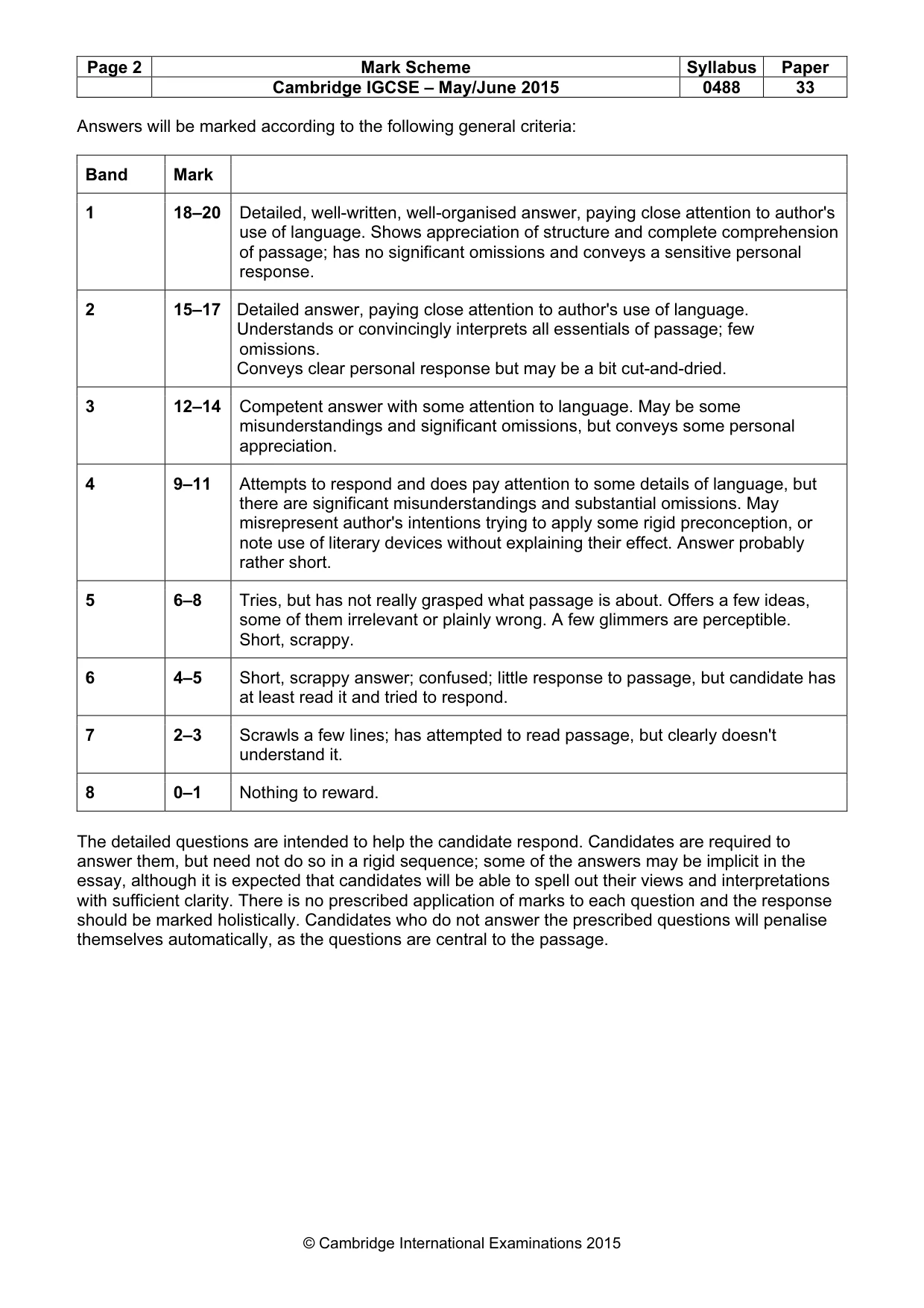
Page 2 Mark Scheme Syllabus Paper Cambridge IGCSE – May/June 2015 0488 33 © Cambridge International Examinations 2015 Answers will be marked according to the following general criteria: Band Mark 1 18–20 Detailed, well-written, well-organised answer, paying close attention to author's use of language. Shows appreciation of structure and complete comprehension of passage; has no significant omissions and conveys a sensitive personal response. 2 15–17 Detailed answer, paying close attention to author's use of language. Understands or convincingly interprets all essentials of passage; few omissions. Conveys clear personal response but may be a bit cut-and-dried. 3 12–14 Competent answer with some attention to language. May be some misunderstandings and significant omissions, but conveys some personal appreciation. 4 9–11 Attempts to respond and does pay attention to some details of language, but there are significant misunderstandings and substantial omissions. May misrepresent author's intentions trying to apply some rigid preconception, or note use of literary devices without explaining their effect. Answer probably rather short. 5 6–8 Tries, but has not really grasped what passage is about. Offers a few ideas, some of them irrelevant or plainly wrong. A few glimmers are perceptible. Short, scrappy. 6 4–5 Short, scrappy answer; confused; little response to passage, but candidate has at least read it and tried to respond. 7 2–3 Scrawls a few lines; has attempted to read passage, but clearly doesn't understand it. 8 0–1 Nothing to reward. The detailed questions are intended to help the candidate respond. Candidates are required to answer them, but need not do so in a rigid sequence; some of the answers may be implicit in the essay, although it is expected that candidates will be able to spell out their views and interpretations with sufficient clarity. There is no prescribed application of marks to each question and the response should be marked holistically. Candidates who do not answer the prescribed questions will penalise themselves automatically, as the questions are central to the passage.
Mark scheme, page 3
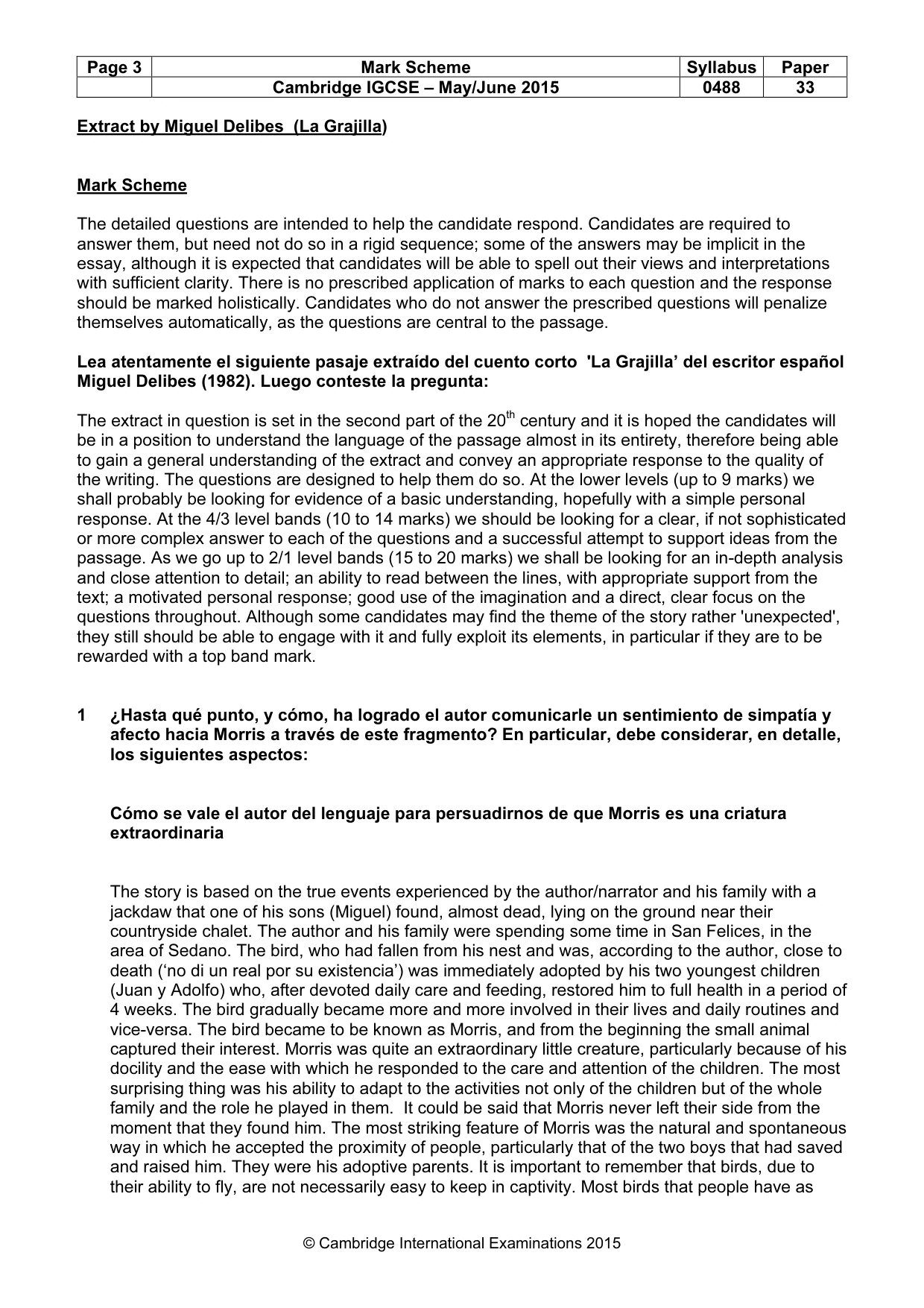
Page 3 Mark Scheme Syllabus Paper Cambridge IGCSE – May/June 2015 0488 33 © Cambridge International Examinations 2015 Extract by Miguel Delibes (La Grajilla) Mark Scheme The detailed questions are intended to help the candidate respond. Candidates are required to answer them, but need not do so in a rigid sequence; some of the answers may be implicit in the essay, although it is expected that candidates will be able to spell out their views and interpretations with sufficient clarity. There is no prescribed application of marks to each question and the response should be marked holistically. Candidates who do not answer the prescribed questions will penalize themselves automatically, as the questions are central to the passage. Lea atentamente el siguiente pasaje extraído del cuento corto 'La Grajilla’ del escritor español Miguel Delibes (1982). Luego conteste la pregunta: The extract in question is set in the second part of the 20th century and it is hoped the candidates will be in a position to understand the language of the passage almost in its entirety, therefore being able to gain a general understanding of the extract and convey an appropriate response to the quality of the writing. The questions are designed to help them do so. At the lower levels (up to 9 marks) we shall probably be looking for evidence of a basic understanding, hopefully with a simple personal response. At the 4/3 level bands (10 to 14 marks) we should be looking for a clear, if not sophisticated or more complex answer to each of the questions and a successful attempt to support ideas from the passage. As we go up to 2/1 level bands (15 to 20 marks) we shall be looking for an in-depth analysis and close attention to detail; an ability to read between the lines, with appropriate support from the text; a motivated personal response; good use of the imagination and a direct, clear focus on the questions throughout. Although some candidates may find the theme of the story rather 'unexpected', they still should be able to engage with it and fully exploit its elements, in particular if they are to be rewarded with a top band mark. 1 ¿Hasta qué punto, y cómo, ha logrado el autor comunicarle un sentimiento de simpatía y afecto hacia Morris a través de este fragmento? En particular, debe considerar, en detalle, los siguientes aspectos: Cómo se vale el autor del lenguaje para persuadirnos de que Morris es una criatura extraordinaria The story is based on the true events experienced by the author/narrator and his family with a jackdaw that one of his sons (Miguel) found, almost dead, lying on the ground near their countryside chalet. The author and his family were spending some time in San Felices, in the area of Sedano. The bird, who had fallen from his nest and was, according to the author, close to death (‘no di un real por su existencia’) was immediately adopted by his two youngest children (Juan y Adolfo) who, after devoted daily care and feeding, restored him to full health in a period of 4 weeks. The bird gradually became more and more involved in their lives and daily routines and vice-versa. The bird became to be known as Morris, and from the beginning the small animal captured their interest. Morris was quite an extraordinary little creature, particularly because of his docility and the ease with which he responded to the care and attention of the children. The most surprising thing was his ability to adapt to the activities not only of the children but of the whole family and the role he played in them. It could be said that Morris never left their side from the moment that they found him. The most striking feature of Morris was the natural and spontaneous way in which he accepted the proximity of people, particularly that of the two boys that had saved and raised him. They were his adoptive parents. It is important to remember that birds, due to their ability to fly, are not necessarily easy to keep in captivity. Most birds that people have as
Mark scheme, page 4
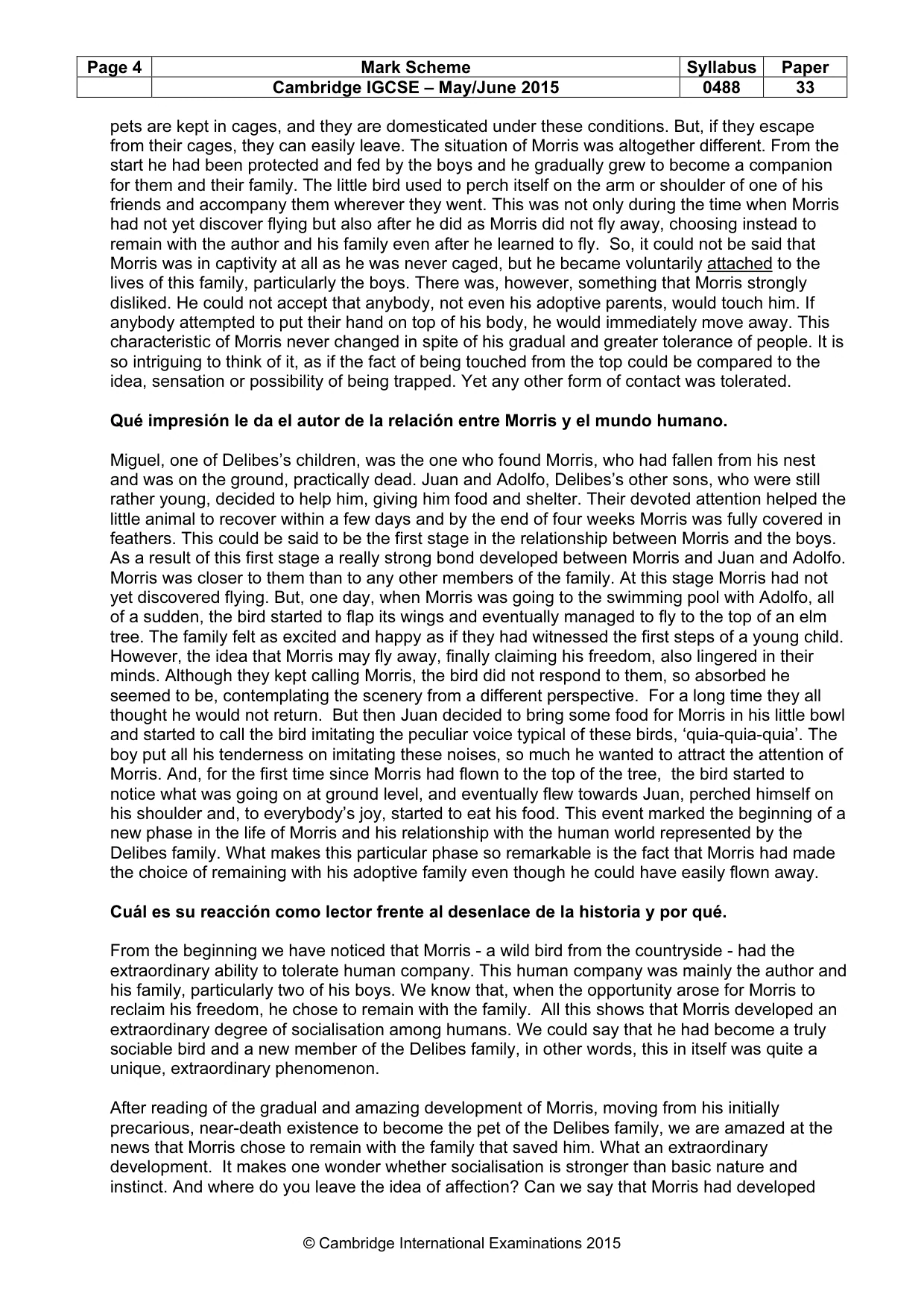
Page 4 Mark Scheme Syllabus Paper Cambridge IGCSE – May/June 2015 0488 33 © Cambridge International Examinations 2015 pets are kept in cages, and they are domesticated under these conditions. But, if they escape from their cages, they can easily leave. The situation of Morris was altogether different. From the start he had been protected and fed by the boys and he gradually grew to become a companion for them and their family. The little bird used to perch itself on the arm or shoulder of one of his friends and accompany them wherever they went. This was not only during the time when Morris had not yet discover flying but also after he did as Morris did not fly away, choosing instead to remain with the author and his family even after he learned to fly. So, it could not be said that Morris was in captivity at all as he was never caged, but he became voluntarily attached to the lives of this family, particularly the boys. There was, however, something that Morris strongly disliked. He could not accept that anybody, not even his adoptive parents, would touch him. If anybody attempted to put their hand on top of his body, he would immediately move away. This characteristic of Morris never changed in spite of his gradual and greater tolerance of people. It is so intriguing to think of it, as if the fact of being touched from the top could be compared to the idea, sensation or possibility of being trapped. Yet any other form of contact was tolerated. Qué impresión le da el autor de la relación entre Morris y el mundo humano. Miguel, one of Delibes’s children, was the one who found Morris, who had fallen from his nest and was on the ground, practically dead. Juan and Adolfo, Delibes’s other sons, who were still rather young, decided to help him, giving him food and shelter. Their devoted attention helped the little animal to recover within a few days and by the end of four weeks Morris was fully covered in feathers. This could be said to be the first stage in the relationship between Morris and the boys. As a result of this first stage a really strong bond developed between Morris and Juan and Adolfo. Morris was closer to them than to any other members of the family. At this stage Morris had not yet discovered flying. But, one day, when Morris was going to the swimming pool with Adolfo, all of a sudden, the bird started to flap its wings and eventually managed to fly to the top of an elm tree. The family felt as excited and happy as if they had witnessed the first steps of a young child. However, the idea that Morris may fly away, finally claiming his freedom, also lingered in their minds. Although they kept calling Morris, the bird did not respond to them, so absorbed he seemed to be, contemplating the scenery from a different perspective. For a long time they all thought he would not return. But then Juan decided to bring some food for Morris in his little bowl and started to call the bird imitating the peculiar voice typical of these birds, ‘quia-quia-quia’. The boy put all his tenderness on imitating these noises, so much he wanted to attract the attention of Morris. And, for the first time since Morris had flown to the top of the tree, the bird started to notice what was going on at ground level, and eventually flew towards Juan, perched himself on his shoulder and, to everybody’s joy, started to eat his food. This event marked the beginning of a new phase in the life of Morris and his relationship with the human world represented by the Delibes family. What makes this particular phase so remarkable is the fact that Morris had made the choice of remaining with his adoptive family even though he could have easily flown away. Cuál es su reacción como lector frente al desenlace de la historia y por qué. From the beginning we have noticed that Morris - a wild bird from the countryside - had the extraordinary ability to tolerate human company. This human company was mainly the author and his family, particularly two of his boys. We know that, when the opportunity arose for Morris to reclaim his freedom, he chose to remain with the family. All this shows that Morris developed an extraordinary degree of socialisation among humans. We could say that he had become a truly sociable bird and a new member of the Delibes family, in other words, this in itself was quite a unique, extraordinary phenomenon. After reading of the gradual and amazing development of Morris, moving from his initially precarious, near-death existence to become the pet of the Delibes family, we are amazed at the news that Morris chose to remain with the family that saved him. What an extraordinary development. It makes one wonder whether socialisation is stronger than basic nature and instinct. And where do you leave the idea of affection? Can we say that Morris had developed
Mark scheme, page 5
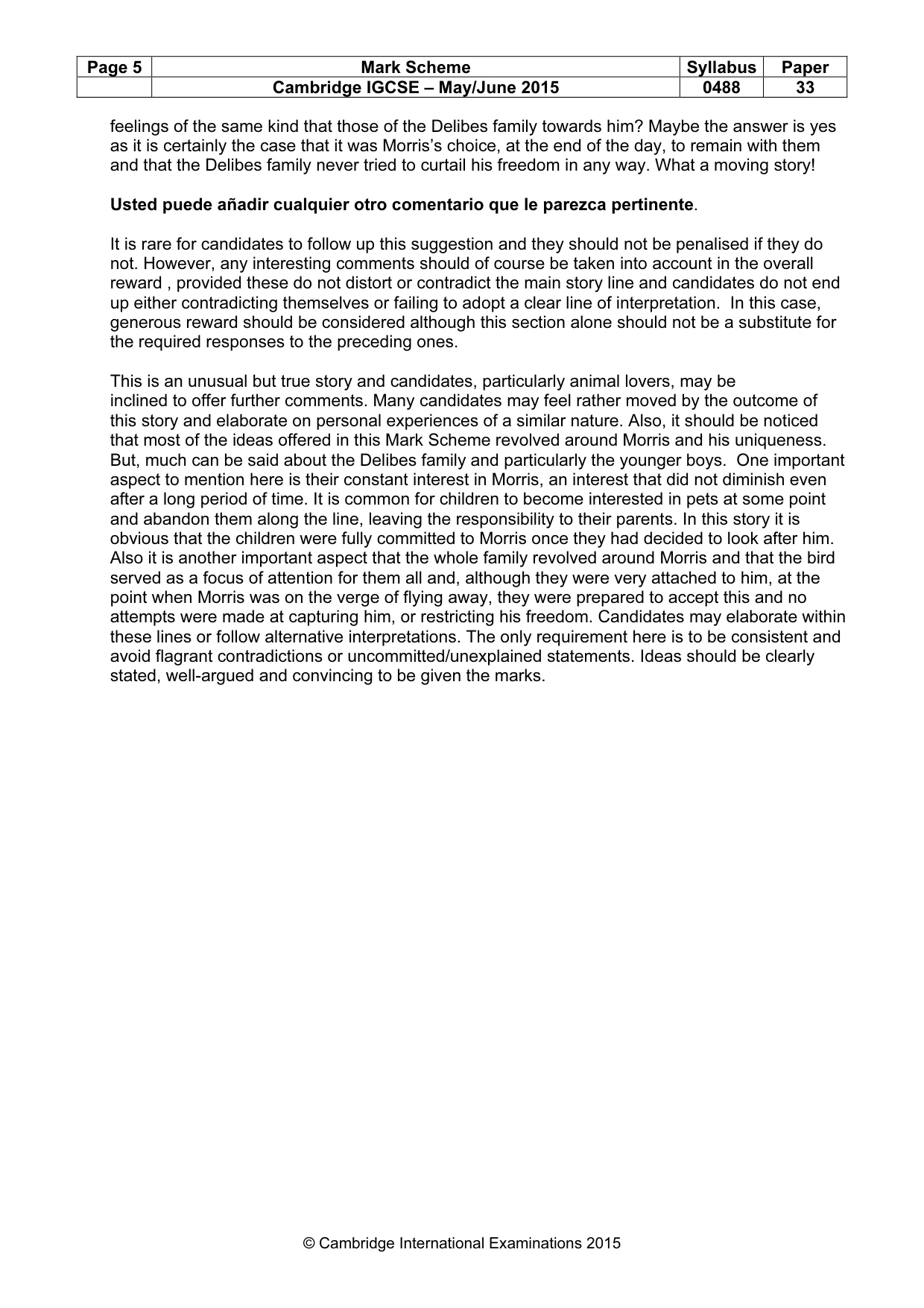
Page 5 Mark Scheme Syllabus Paper Cambridge IGCSE – May/June 2015 0488 33 © Cambridge International Examinations 2015 feelings of the same kind that those of the Delibes family towards him? Maybe the answer is yes as it is certainly the case that it was Morris’s choice, at the end of the day, to remain with them and that the Delibes family never tried to curtail his freedom in any way. What a moving story! Usted puede añadir cualquier otro comentario que le parezca pertinente. It is rare for candidates to follow up this suggestion and they should not be penalised if they do not. However, any interesting comments should of course be taken into account in the overall reward , provided these do not distort or contradict the main story line and candidates do not end up either contradicting themselves or failing to adopt a clear line of interpretation. In this case, generous reward should be considered although this section alone should not be a substitute for the required responses to the preceding ones. This is an unusual but true story and candidates, particularly animal lovers, may be inclined to offer further comments. Many candidates may feel rather moved by the outcome of this story and elaborate on personal experiences of a similar nature. Also, it should be noticed that most of the ideas offered in this Mark Scheme revolved around Morris and his uniqueness. But, much can be said about the Delibes family and particularly the younger boys. One important aspect to mention here is their constant interest in Morris, an interest that did not diminish even after a long period of time. It is common for children to become interested in pets at some point and abandon them along the line, leaving the responsibility to their parents. In this story it is obvious that the children were fully committed to Morris once they had decided to look after him. Also it is another important aspect that the whole family revolved around Morris and that the bird served as a focus of attention for them all and, although they were very attached to him, at the point when Morris was on the verge of flying away, they were prepared to accept this and no attempts were made at capturing him, or restricting his freedom. Candidates may elaborate within these lines or follow alternative interpretations. The only requirement here is to be consistent and avoid flagrant contradictions or uncommitted/unexplained statements. Ideas should be clearly stated, well-argued and convincing to be given the marks.
What you needed in this session
Cambridge’s own grade thresholds for 2015 May/June, Paper 3 · Variant 3. A higher threshold means an easier paper — the bar moves with how the cohort did.