Cambridge IGCSE Spanish - Literature 0488 — 2015 May/June Paper 3 · Variant 2
0488/32/M/J/15
The question paper and its mark scheme, free to read here and free to download. This is Cambridge’s own paper, exactly as it was sat.
Question paper4 pages

Mark scheme5 pages
Answers below. Sit the paper first if you are practising.
Paper as text
Question paper, page 1
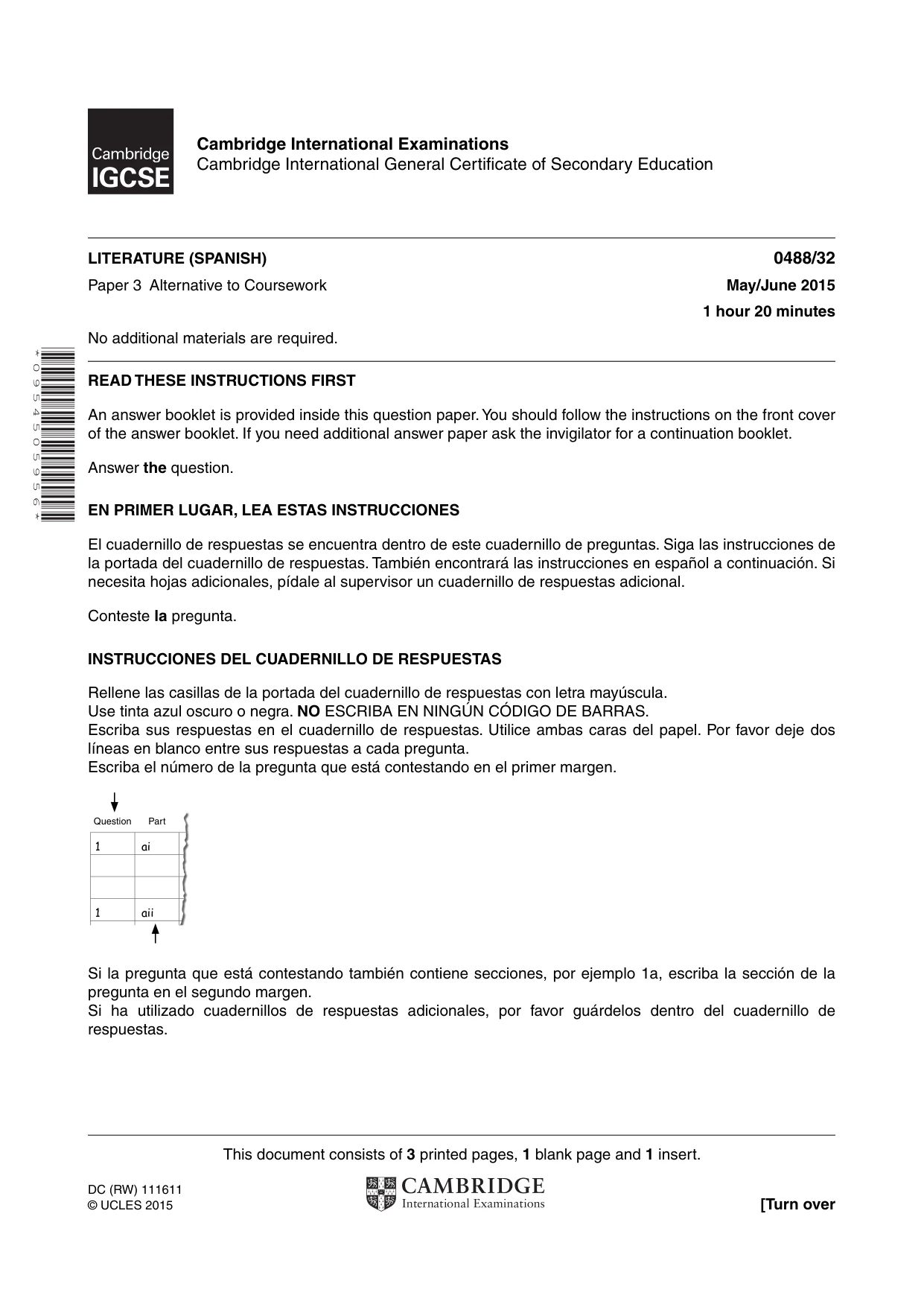
This document consists of 3 printed pages, 1 blank page and 1 insert. DC (RW) 111611 © UCLES 2015 [Turn over Cambridge International Examinations Cambridge International General Certificate of Secondary Education * 0 9 5 4 5 0 5 9 5 6 * LITERATURE (SPANISH) 0488/32 Paper 3 Alternative to Coursework May/June 2015 1 hour 20 minutes No additional materials are required. READ THESE INSTRUCTIONS FIRST An answer booklet is provided inside this question paper. You should follow the instructions on the front cover of the answer booklet. If you need additional answer paper ask the invigilator for a continuation booklet. Answer the question. EN PRIMER LUGAR, LEA ESTAS INSTRUCCIONES El cuadernillo de respuestas se encuentra dentro de este cuadernillo de preguntas. Siga las instrucciones de la portada del cuadernillo de respuestas. También encontrará las instrucciones en español a continuación. Si necesita hojas adicionales, pídale al supervisor un cuadernillo de respuestas adicional. Conteste la pregunta. INSTRUCCIONES DEL CUADERNILLO DE RESPUESTAS Rellene las casillas de la portada del cuadernillo de respuestas con letra mayúscula. Use tinta azul oscuro o negra. NO ESCRIBA EN NINGÚN CÓDIGO DE BARRAS. Escriba sus respuestas en el cuadernillo de respuestas. Utilice ambas caras del papel. Por favor deje dos líneas en blanco entre sus respuestas a cada pregunta. Escriba el número de la pregunta que está contestando en el primer margen. Question Part 1 1 ai aii Si la pregunta que está contestando también contiene secciones, por ejemplo 1a, escriba la sección de la pregunta en el segundo margen. Si ha utilizado cuadernillos de respuestas adicionales, por favor guárdelos dentro del cuadernillo de respuestas.
Question paper, page 2
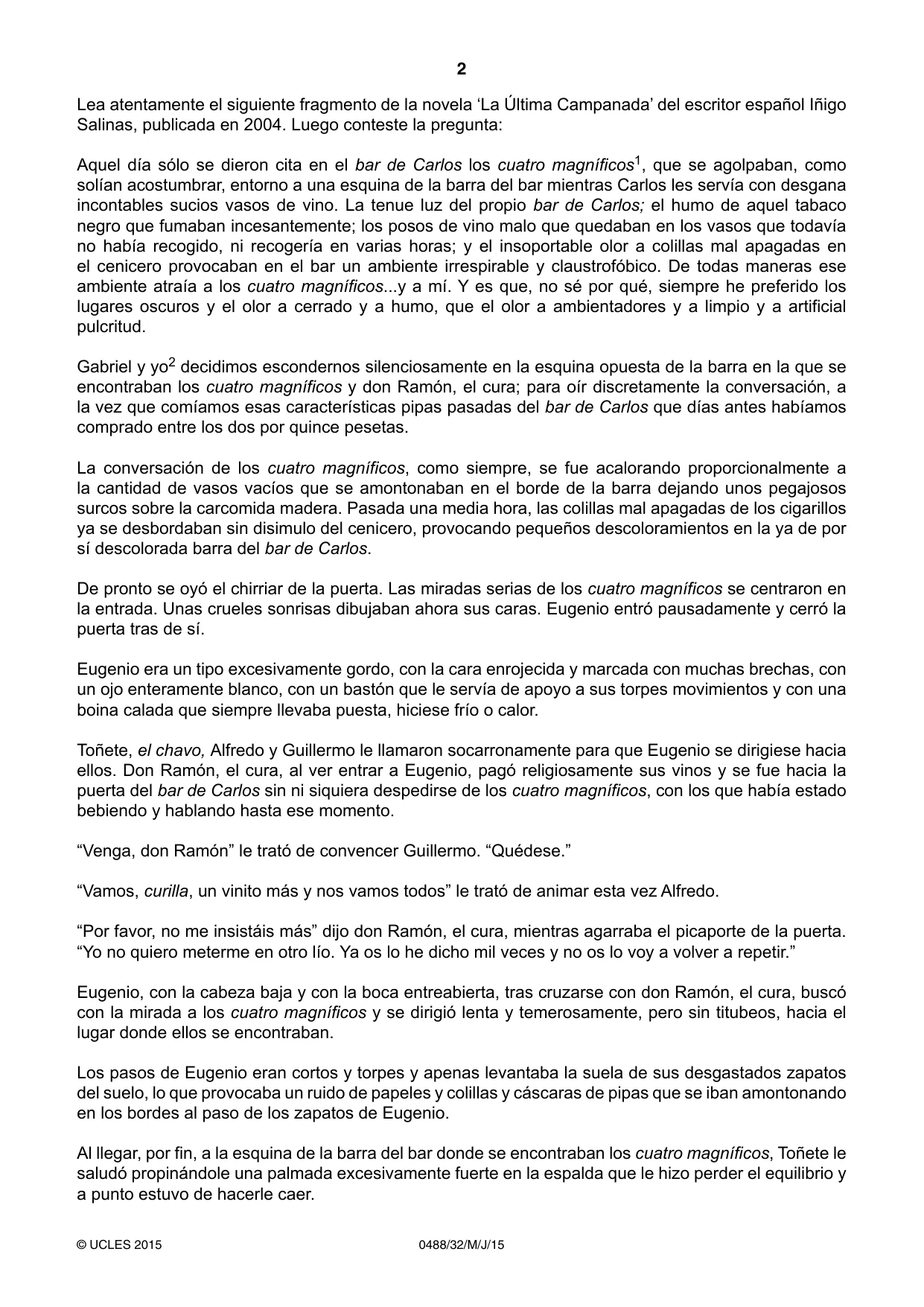
2 0488/32/M/J/15 © UCLES 2015 Lea atentamente el siguiente fragmento de la novela ‘La Última Campanada’ del escritor español Iñigo Salinas, publicada en 2004. Luego conteste la pregunta: Aquel día sólo se dieron cita en el bar de Carlos los cuatro magníficos1, que se agolpaban, como solían acostumbrar, entorno a una esquina de la barra del bar mientras Carlos les servía con desgana incontables sucios vasos de vino. La tenue luz del propio bar de Carlos; el humo de aquel tabaco negro que fumaban incesantemente; los posos de vino malo que quedaban en los vasos que todavía no había recogido, ni recogería en varias horas; y el insoportable olor a colillas mal apagadas en el cenicero provocaban en el bar un ambiente irrespirable y claustrofóbico. De todas maneras ese ambiente atraía a los cuatro magníficos...y a mí. Y es que, no sé por qué, siempre he preferido los lugares oscuros y el olor a cerrado y a humo, que el olor a ambientadores y a limpio y a artificial pulcritud. Gabriel y yo2 decidimos escondernos silenciosamente en la esquina opuesta de la barra en la que se encontraban los cuatro magníficos y don Ramón, el cura; para oír discretamente la conversación, a la vez que comíamos esas características pipas pasadas del bar de Carlos que días antes habíamos comprado entre los dos por quince pesetas. La conversación de los cuatro magníficos, como siempre, se fue acalorando proporcionalmente a la cantidad de vasos vacíos que se amontonaban en el borde de la barra dejando unos pegajosos surcos sobre la carcomida madera. Pasada una media hora, las colillas mal apagadas de los cigarillos ya se desbordaban sin disimulo del cenicero, provocando pequeños descoloramientos en la ya de por sí descolorada barra del bar de Carlos. De pronto se oyó el chirriar de la puerta. Las miradas serias de los cuatro magníficos se centraron en la entrada. Unas crueles sonrisas dibujaban ahora sus caras. Eugenio entró pausadamente y cerró la puerta tras de sí. Eugenio era un tipo excesivamente gordo, con la cara enrojecida y marcada con muchas brechas, con un ojo enteramente blanco, con un bastón que le servía de apoyo a sus torpes movimientos y con una boina calada que siempre llevaba puesta, hiciese frío o calor. Toñete, el chavo, Alfredo y Guillermo le llamaron socarronamente para que Eugenio se dirigiese hacia ellos. Don Ramón, el cura, al ver entrar a Eugenio, pagó religiosamente sus vinos y se fue hacia la puerta del bar de Carlos sin ni siquiera despedirse de los cuatro magníficos, con los que había estado bebiendo y hablando hasta ese momento. “Venga, don Ramón” le trató de convencer Guillermo. “Quédese.” “Vamos, curilla, un vinito más y nos vamos todos” le trató de animar esta vez Alfredo. “Por favor, no me insistáis más” dijo don Ramón, el cura, mientras agarraba el picaporte de la puerta. “Yo no quiero meterme en otro lío. Ya os lo he dicho mil veces y no os lo voy a volver a repetir.” Eugenio, con la cabeza baja y con la boca entreabierta, tras cruzarse con don Ramón, el cura, buscó con la mirada a los cuatro magníficos y se dirigió lenta y temerosamente, pero sin titubeos, hacia el lugar donde ellos se encontraban. Los pasos de Eugenio eran cortos y torpes y apenas levantaba la suela de sus desgastados zapatos del suelo, lo que provocaba un ruido de papeles y colillas y cáscaras de pipas que se iban amontonando en los bordes al paso de los zapatos de Eugenio. Al llegar, por fin, a la esquina de la barra del bar donde se encontraban los cuatro magníficos, Toñete le saludó propinándole una palmada excesivamente fuerte en la espalda que le hizo perder el equilibrio y a punto estuvo de hacerle caer.
Question paper, page 3
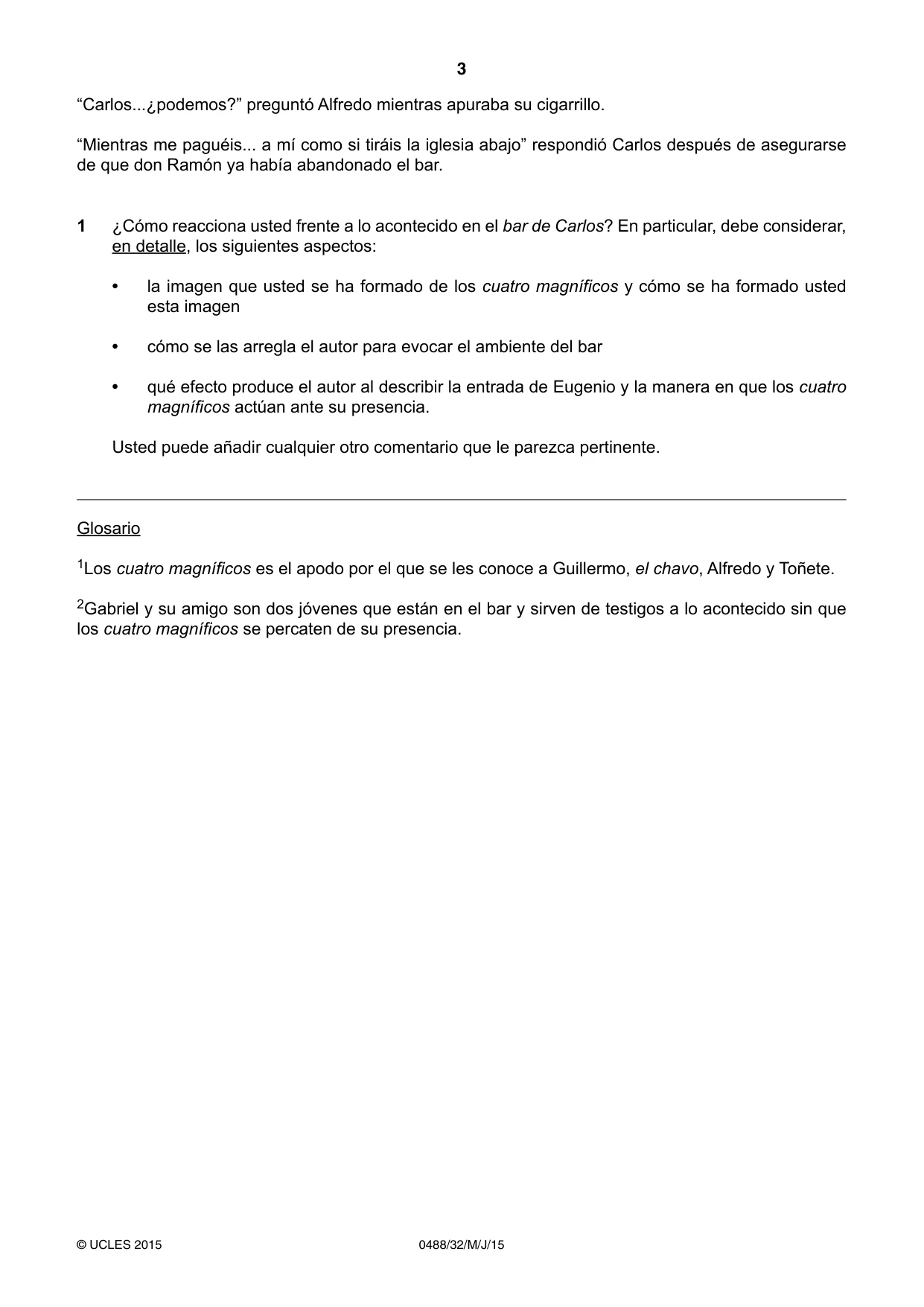
3 0488/32/M/J/15 © UCLES 2015 “Carlos...¿podemos?” preguntó Alfredo mientras apuraba su cigarrillo. “Mientras me paguéis... a mí como si tiráis la iglesia abajo” respondió Carlos después de asegurarse de que don Ramón ya había abandonado el bar. 1 ¿Cómo reacciona usted frente a lo acontecido en el bar de Carlos? En particular, debe considerar, en detalle, los siguientes aspectos: • la imagen que usted se ha formado de los cuatro magníficos y cómo se ha formado usted esta imagen • cómo se las arregla el autor para evocar el ambiente del bar • qué efecto produce el autor al describir la entrada de Eugenio y la manera en que los cuatro magníficos actúan ante su presencia. Usted puede añadir cualquier otro comentario que le parezca pertinente. Glosario 1Los cuatro magníficos es el apodo por el que se les conoce a Guillermo, el chavo, Alfredo y Toñete. 2Gabriel y su amigo son dos jóvenes que están en el bar y sirven de testigos a lo acontecido sin que los cuatro magníficos se percaten de su presencia.
Question paper, page 4
4 0488/32/M/J/15 © UCLES 2015 BLANK PAGE Permission to reproduce items where third-party owned material protected by copyright is included has been sought and cleared where possible. Every reasonable effort has been made by the publisher (UCLES) to trace copyright holders, but if any items requiring clearance have unwittingly been included, the publisher will be pleased to make amends at the earliest possible opportunity. To avoid the issue of disclosure of answer-related information to candidates, all copyright acknowledgements are reproduced online in the Cambridge International Examinations Copyright Acknowledgements Booklet. This is produced for each series of examinations and is freely available to download at www.cie.org.uk after the live examination series. Cambridge International Examinations is part of the Cambridge Assessment Group. Cambridge Assessment is the brand name of University of Cambridge Local Examinations Syndicate (UCLES), which is itself a department of the University of Cambridge.
Mark scheme, page 1
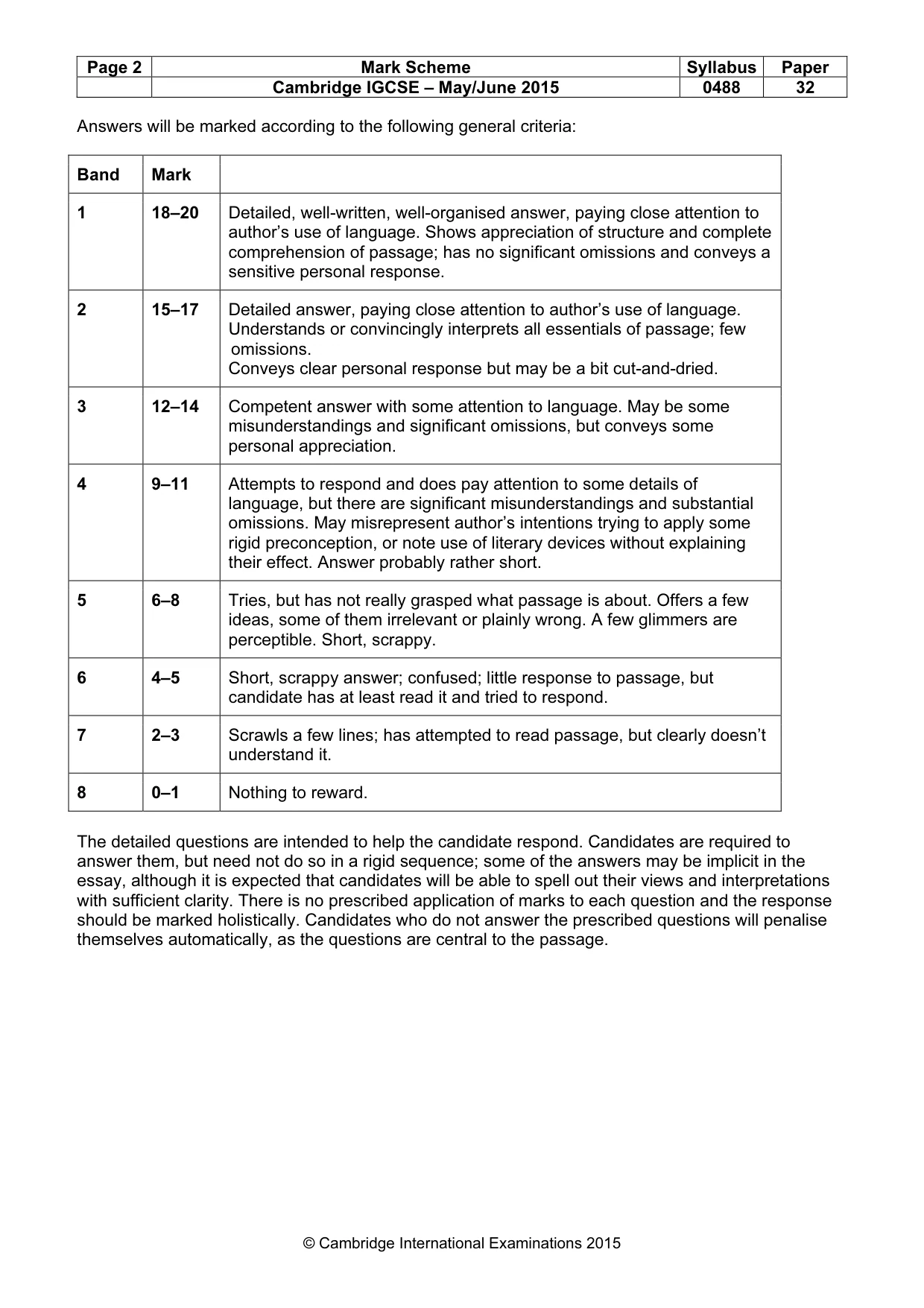
® IGCSE is the registered trademark of Cambridge International Examinations. CAMBRIDGE INTERNATIONAL EXAMINATIONS Cambridge International General Certificate of Secondary Education MARK SCHEME for the May/June 2015 series 0488 LITERATURE – SPANISH 0488/32 Paper 3 (Alternative to Coursework), maximum raw mark 20 This mark scheme is published as an aid to teachers and candidates, to indicate the requirements of the examination. It shows the basis on which Examiners were instructed to award marks. It does not indicate the details of the discussions that took place at an Examiners’ meeting before marking began, which would have considered the acceptability of alternative answers. Mark schemes should be read in conjunction with the question paper and the Principal Examiner Report for Teachers. Cambridge will not enter into discussions about these mark schemes. Cambridge is publishing the mark schemes for the May/June 2015 series for most Cambridge IGCSE®, Cambridge International A and AS Level components and some Cambridge O Level components.
Mark scheme, page 2
Page 2 Mark Scheme Syllabus Paper Cambridge IGCSE – May/June 2015 0488 32 © Cambridge International Examinations 2015 Answers will be marked according to the following general criteria: Band Mark 1 18–20 Detailed, well-written, well-organised answer, paying close attention to author’s use of language. Shows appreciation of structure and complete comprehension of passage; has no significant omissions and conveys a sensitive personal response. 2 15–17 Detailed answer, paying close attention to author’s use of language. Understands or convincingly interprets all essentials of passage; few omissions. Conveys clear personal response but may be a bit cut-and-dried. 3 12–14 Competent answer with some attention to language. May be some misunderstandings and significant omissions, but conveys some personal appreciation. 4 9–11 Attempts to respond and does pay attention to some details of language, but there are significant misunderstandings and substantial omissions. May misrepresent author’s intentions trying to apply some rigid preconception, or note use of literary devices without explaining their effect. Answer probably rather short. 5 6–8 Tries, but has not really grasped what passage is about. Offers a few ideas, some of them irrelevant or plainly wrong. A few glimmers are perceptible. Short, scrappy. 6 4–5 Short, scrappy answer; confused; little response to passage, but candidate has at least read it and tried to respond. 7 2–3 Scrawls a few lines; has attempted to read passage, but clearly doesn’t understand it. 8 0–1 Nothing to reward. The detailed questions are intended to help the candidate respond. Candidates are required to answer them, but need not do so in a rigid sequence; some of the answers may be implicit in the essay, although it is expected that candidates will be able to spell out their views and interpretations with sufficient clarity. There is no prescribed application of marks to each question and the response should be marked holistically. Candidates who do not answer the prescribed questions will penalise themselves automatically, as the questions are central to the passage.
Mark scheme, page 3
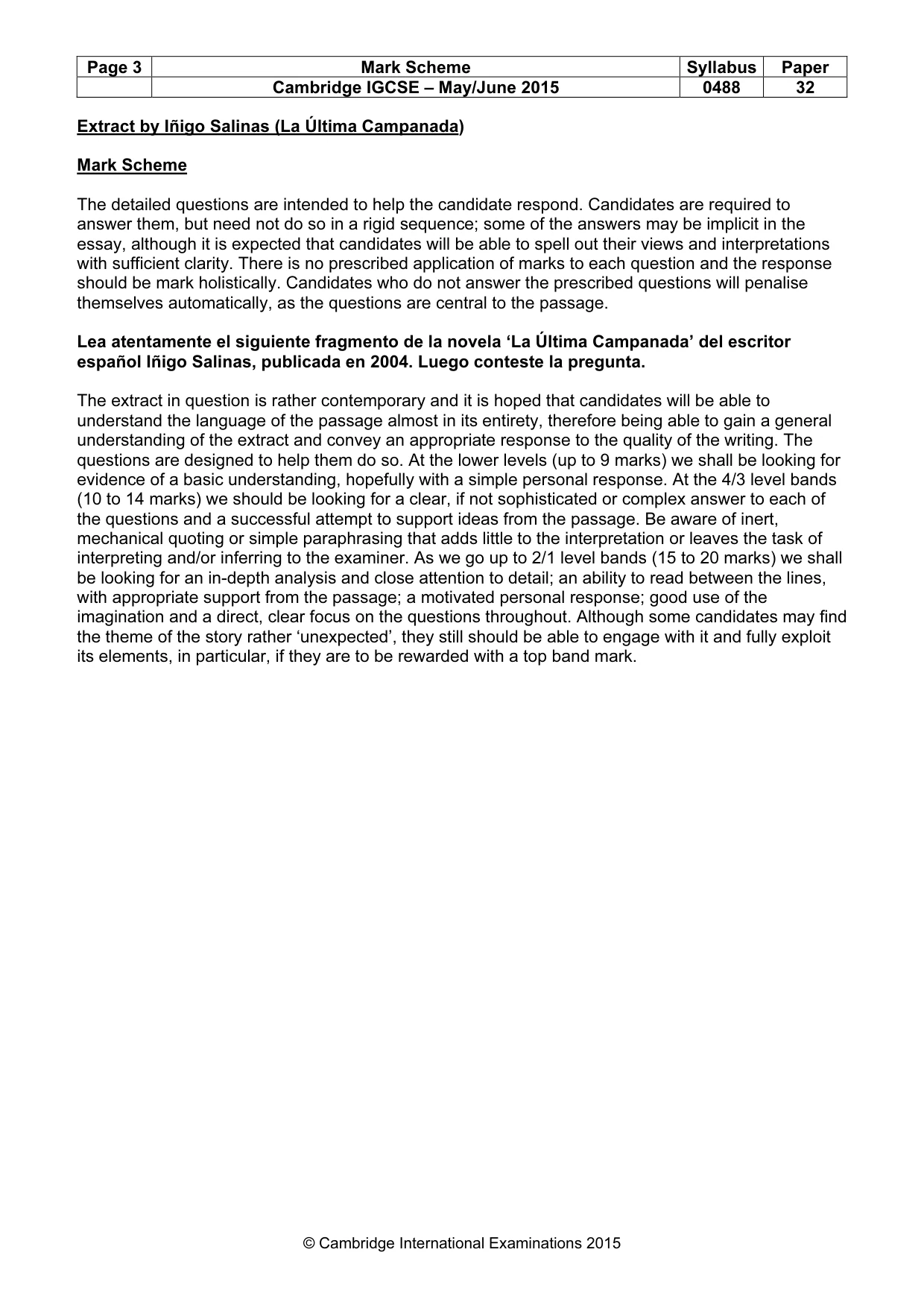
Page 3 Mark Scheme Syllabus Paper Cambridge IGCSE – May/June 2015 0488 32 © Cambridge International Examinations 2015 Extract by Iñigo Salinas (La Última Campanada) Mark Scheme The detailed questions are intended to help the candidate respond. Candidates are required to answer them, but need not do so in a rigid sequence; some of the answers may be implicit in the essay, although it is expected that candidates will be able to spell out their views and interpretations with sufficient clarity. There is no prescribed application of marks to each question and the response should be mark holistically. Candidates who do not answer the prescribed questions will penalise themselves automatically, as the questions are central to the passage. Lea atentamente el siguiente fragmento de la novela ‘La Última Campanada’ del escritor español Iñigo Salinas, publicada en 2004. Luego conteste la pregunta. The extract in question is rather contemporary and it is hoped that candidates will be able to understand the language of the passage almost in its entirety, therefore being able to gain a general understanding of the extract and convey an appropriate response to the quality of the writing. The questions are designed to help them do so. At the lower levels (up to 9 marks) we shall be looking for evidence of a basic understanding, hopefully with a simple personal response. At the 4/3 level bands (10 to 14 marks) we should be looking for a clear, if not sophisticated or complex answer to each of the questions and a successful attempt to support ideas from the passage. Be aware of inert, mechanical quoting or simple paraphrasing that adds little to the interpretation or leaves the task of interpreting and/or inferring to the examiner. As we go up to 2/1 level bands (15 to 20 marks) we shall be looking for an in-depth analysis and close attention to detail; an ability to read between the lines, with appropriate support from the passage; a motivated personal response; good use of the imagination and a direct, clear focus on the questions throughout. Although some candidates may find the theme of the story rather ‘unexpected’, they still should be able to engage with it and fully exploit its elements, in particular, if they are to be rewarded with a top band mark.
Mark scheme, page 4
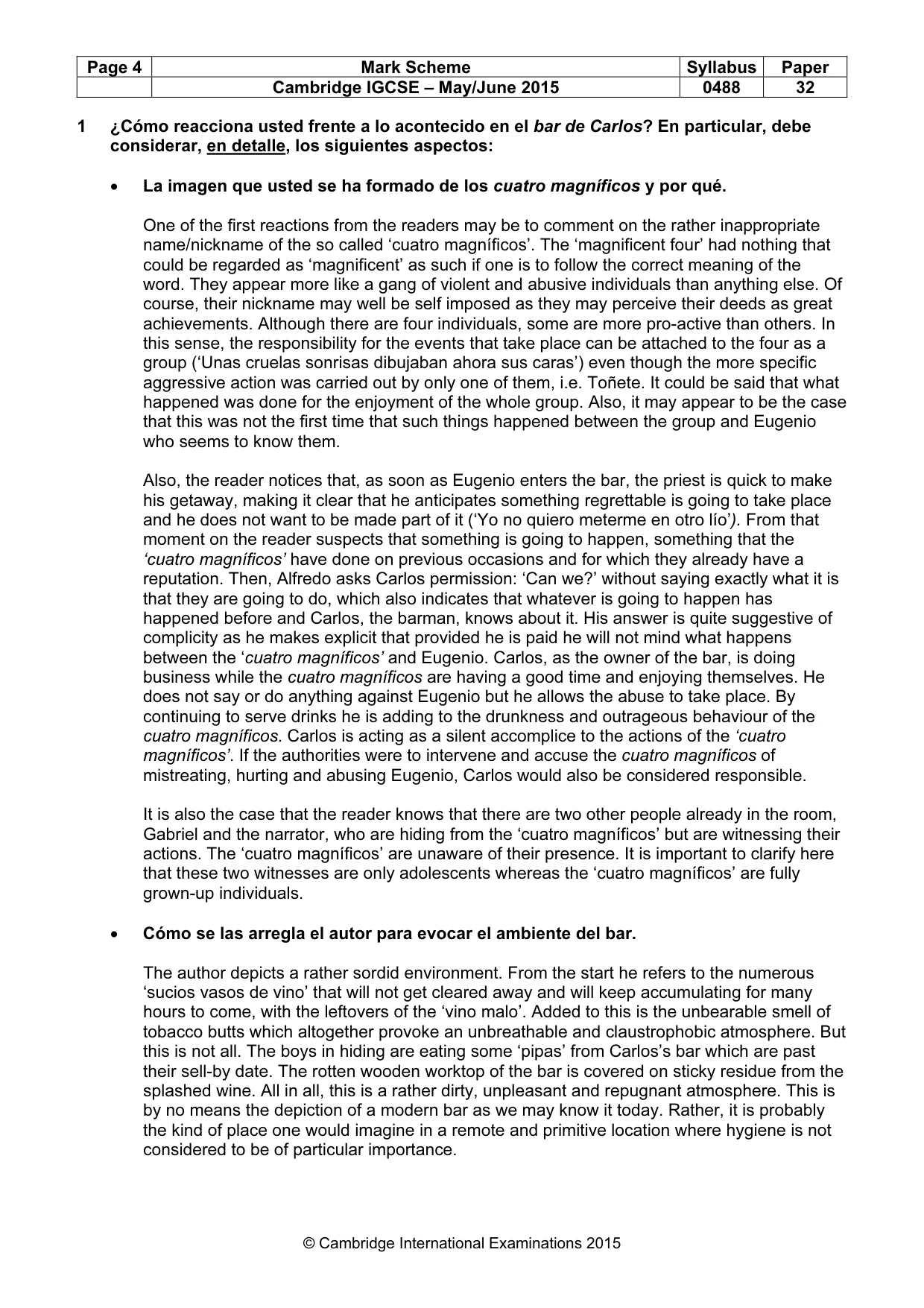
Page 4 Mark Scheme Syllabus Paper Cambridge IGCSE – May/June 2015 0488 32 © Cambridge International Examinations 2015 1 ¿Cómo reacciona usted frente a lo acontecido en el bar de Carlos? En particular, debe considerar, en detalle, los siguientes aspectos: • La imagen que usted se ha formado de los cuatro magníficos y por qué. One of the first reactions from the readers may be to comment on the rather inappropriate name/nickname of the so called ‘cuatro magníficos’. The ‘magnificent four’ had nothing that could be regarded as ‘magnificent’ as such if one is to follow the correct meaning of the word. They appear more like a gang of violent and abusive individuals than anything else. Of course, their nickname may well be self imposed as they may perceive their deeds as great achievements. Although there are four individuals, some are more pro-active than others. In this sense, the responsibility for the events that take place can be attached to the four as a group (‘Unas cruelas sonrisas dibujaban ahora sus caras’) even though the more specific aggressive action was carried out by only one of them, i.e. Toñete. It could be said that what happened was done for the enjoyment of the whole group. Also, it may appear to be the case that this was not the first time that such things happened between the group and Eugenio who seems to know them. Also, the reader notices that, as soon as Eugenio enters the bar, the priest is quick to make his getaway, making it clear that he anticipates something regrettable is going to take place and he does not want to be made part of it (‘Yo no quiero meterme en otro lío’). From that moment on the reader suspects that something is going to happen, something that the ‘cuatro magníficos’ have done on previous occasions and for which they already have a reputation. Then, Alfredo asks Carlos permission: ‘Can we?’ without saying exactly what it is that they are going to do, which also indicates that whatever is going to happen has happened before and Carlos, the barman, knows about it. His answer is quite suggestive of complicity as he makes explicit that provided he is paid he will not mind what happens between the ‘cuatro magníficos’ and Eugenio. Carlos, as the owner of the bar, is doing business while the cuatro magníficos are having a good time and enjoying themselves. He does not say or do anything against Eugenio but he allows the abuse to take place. By continuing to serve drinks he is adding to the drunkness and outrageous behaviour of the cuatro magníficos. Carlos is acting as a silent accomplice to the actions of the ‘cuatro magníficos’. If the authorities were to intervene and accuse the cuatro magníficos of mistreating, hurting and abusing Eugenio, Carlos would also be considered responsible. It is also the case that the reader knows that there are two other people already in the room, Gabriel and the narrator, who are hiding from the ‘cuatro magníficos’ but are witnessing their actions. The ‘cuatro magníficos’ are unaware of their presence. It is important to clarify here that these two witnesses are only adolescents whereas the ‘cuatro magníficos’ are fully grown-up individuals. • Cómo se las arregla el autor para evocar el ambiente del bar. The author depicts a rather sordid environment. From the start he refers to the numerous ‘sucios vasos de vino’ that will not get cleared away and will keep accumulating for many hours to come, with the leftovers of the ‘vino malo’. Added to this is the unbearable smell of tobacco butts which altogether provoke an unbreathable and claustrophobic atmosphere. But this is not all. The boys in hiding are eating some ‘pipas’ from Carlos’s bar which are past their sell-by date. The rotten wooden worktop of the bar is covered on sticky residue from the splashed wine. All in all, this is a rather dirty, unpleasant and repugnant atmosphere. This is by no means the depiction of a modern bar as we may know it today. Rather, it is probably the kind of place one would imagine in a remote and primitive location where hygiene is not considered to be of particular importance.
Mark scheme, page 5
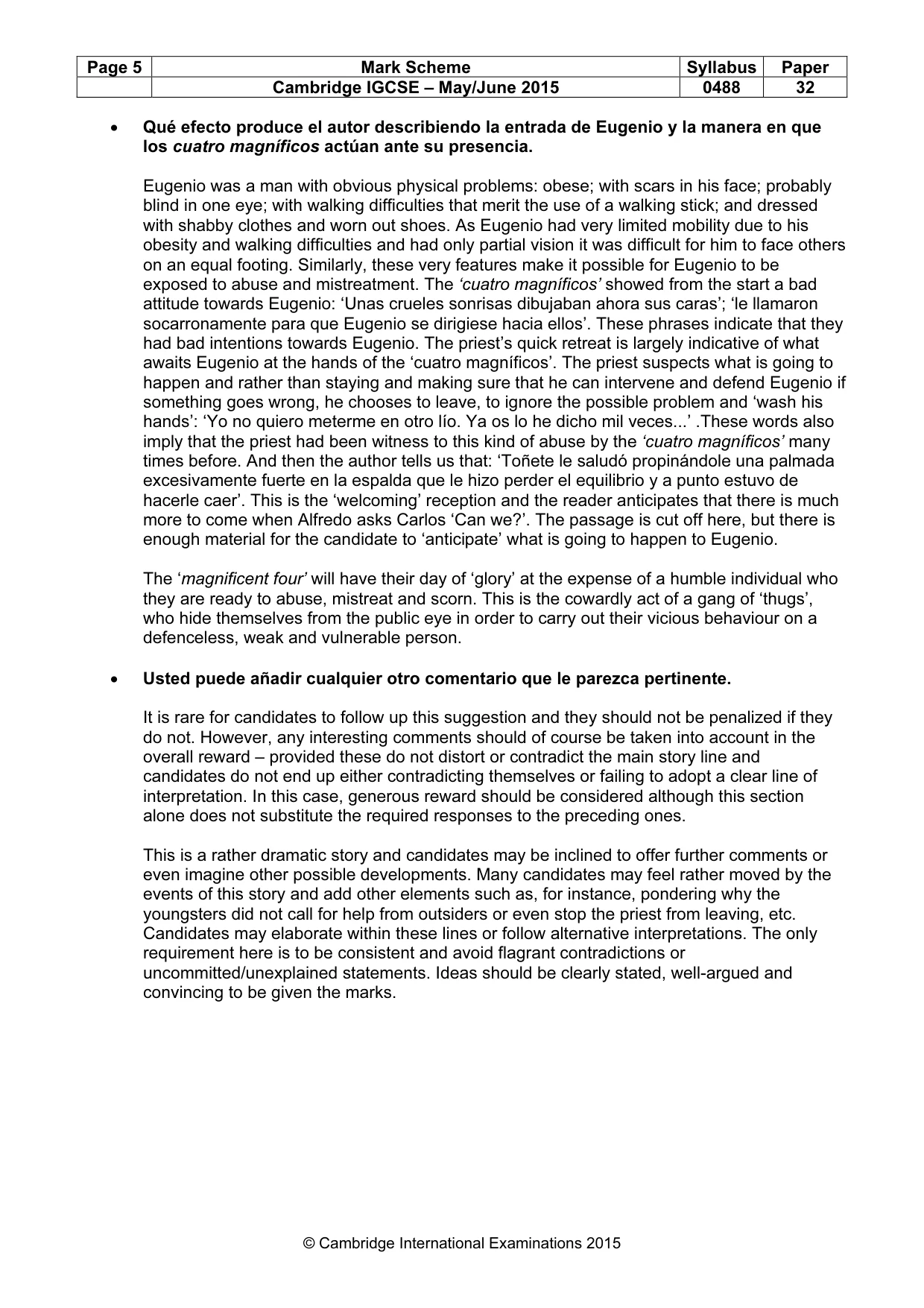
Page 5 Mark Scheme Syllabus Paper Cambridge IGCSE – May/June 2015 0488 32 © Cambridge International Examinations 2015 • Qué efecto produce el autor describiendo la entrada de Eugenio y la manera en que los cuatro magníficos actúan ante su presencia. Eugenio was a man with obvious physical problems: obese; with scars in his face; probably blind in one eye; with walking difficulties that merit the use of a walking stick; and dressed with shabby clothes and worn out shoes. As Eugenio had very limited mobility due to his obesity and walking difficulties and had only partial vision it was difficult for him to face others on an equal footing. Similarly, these very features make it possible for Eugenio to be exposed to abuse and mistreatment. The ‘cuatro magníficos’ showed from the start a bad attitude towards Eugenio: ‘Unas crueles sonrisas dibujaban ahora sus caras’; ‘le llamaron socarronamente para que Eugenio se dirigiese hacia ellos’. These phrases indicate that they had bad intentions towards Eugenio. The priest’s quick retreat is largely indicative of what awaits Eugenio at the hands of the ‘cuatro magníficos’. The priest suspects what is going to happen and rather than staying and making sure that he can intervene and defend Eugenio if something goes wrong, he chooses to leave, to ignore the possible problem and ‘wash his hands’: ‘Yo no quiero meterme en otro lío. Ya os lo he dicho mil veces...’ .These words also imply that the priest had been witness to this kind of abuse by the ‘cuatro magníficos’ many times before. And then the author tells us that: ‘Toñete le saludó propinándole una palmada excesivamente fuerte en la espalda que le hizo perder el equilibrio y a punto estuvo de hacerle caer’. This is the ‘welcoming’ reception and the reader anticipates that there is much more to come when Alfredo asks Carlos ‘Can we?’. The passage is cut off here, but there is enough material for the candidate to ‘anticipate’ what is going to happen to Eugenio. The ‘magnificent four’ will have their day of ‘glory’ at the expense of a humble individual who they are ready to abuse, mistreat and scorn. This is the cowardly act of a gang of ‘thugs’, who hide themselves from the public eye in order to carry out their vicious behaviour on a defenceless, weak and vulnerable person. • Usted puede añadir cualquier otro comentario que le parezca pertinente. It is rare for candidates to follow up this suggestion and they should not be penalized if they do not. However, any interesting comments should of course be taken into account in the overall reward – provided these do not distort or contradict the main story line and candidates do not end up either contradicting themselves or failing to adopt a clear line of interpretation. In this case, generous reward should be considered although this section alone does not substitute the required responses to the preceding ones. This is a rather dramatic story and candidates may be inclined to offer further comments or even imagine other possible developments. Many candidates may feel rather moved by the events of this story and add other elements such as, for instance, pondering why the youngsters did not call for help from outsiders or even stop the priest from leaving, etc. Candidates may elaborate within these lines or follow alternative interpretations. The only requirement here is to be consistent and avoid flagrant contradictions or uncommitted/unexplained statements. Ideas should be clearly stated, well-argued and convincing to be given the marks.