Cambridge IGCSE Spanish - Literature 0488 — 2014 May/June Paper 3 · Variant 3
0488/33/M/J/14 · 20 marks · ≈23 min
The question paper and its mark scheme, free to read here and free to download. This is Cambridge’s own paper, exactly as it was sat.
Question paper4 pages

Mark scheme4 pages
Answers below. Sit the paper first if you are practising.
Paper as text
Question paper, page 1
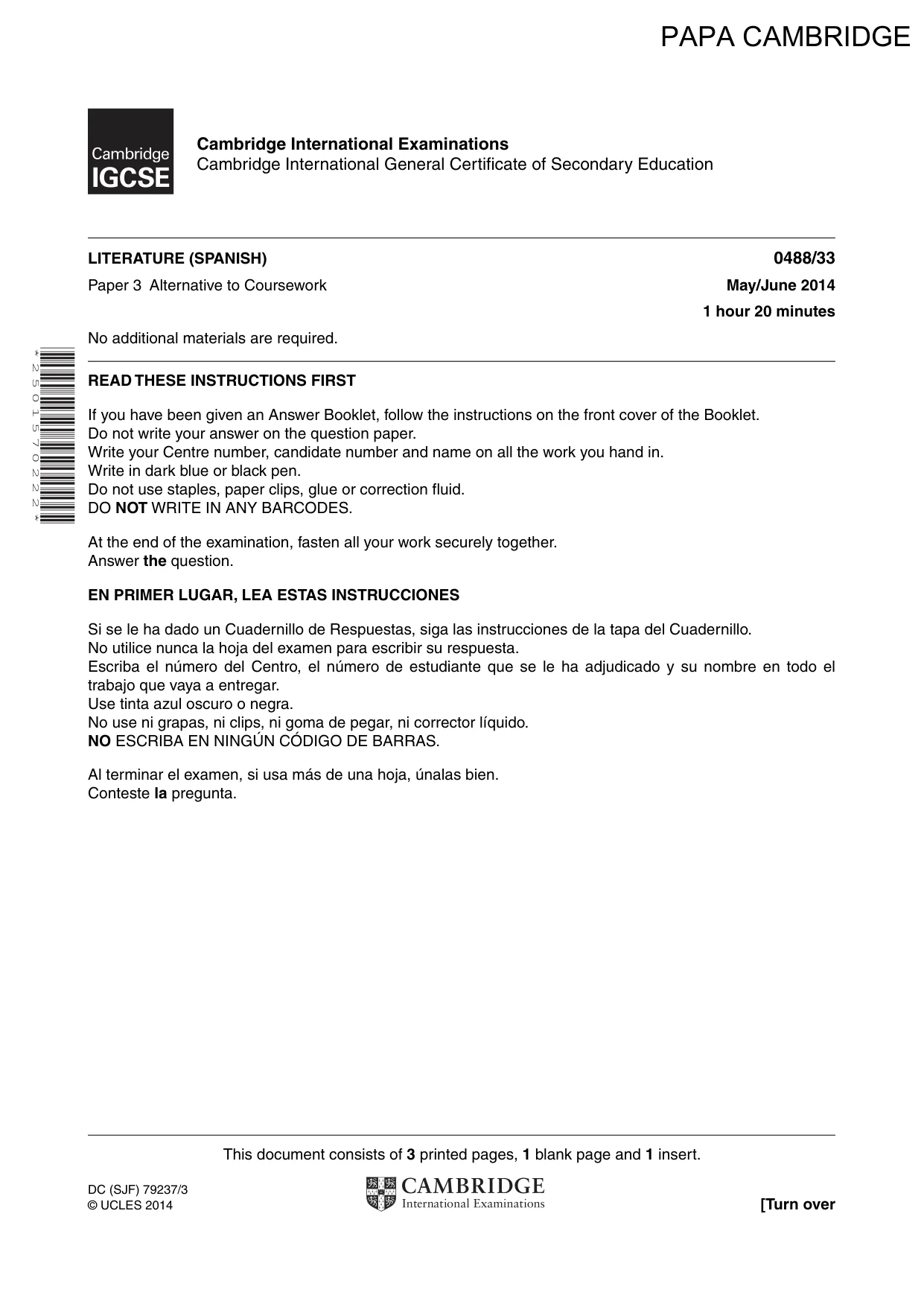
This document consists of 3 printed pages, 1 blank page and 1 insert. DC (SJF) 79237/3 © UCLES 2014 [Turn over Cambridge International Examinations Cambridge International General Certificate of Secondary Education * 2 5 0 1 5 7 0 2 2 2 * LITERATURE (SPANISH) 0488/33 Paper 3 Alternative to Coursework May/June 2014 1 hour 20 minutes No additional materials are required. READ THESE INSTRUCTIONS FIRST If you have been given an Answer Booklet, follow the instructions on the front cover of the Booklet. Do not write your answer on the question paper. Write your Centre number, candidate number and name on all the work you hand in. Write in dark blue or black pen. Do not use staples, paper clips, glue or correction fluid. DO NOT WRITE IN ANY BARCODES. At the end of the examination, fasten all your work securely together. Answer the question. EN PRIMER LUGAR, LEA ESTAS INSTRUCCIONES Si se le ha dado un Cuadernillo de Respuestas, siga las instrucciones de la tapa del Cuadernillo. No utilice nunca la hoja del examen para escribir su respuesta. Escriba el número del Centro, el número de estudiante que se le ha adjudicado y su nombre en todo el trabajo que vaya a entregar. Use tinta azul oscuro o negra. No use ni grapas, ni clips, ni goma de pegar, ni corrector líquido. NO ESCRIBA EN NINGÚN CÓDIGO DE BARRAS. Al terminar el examen, si usa más de una hoja, únalas bien. Conteste la pregunta. PAPA CAMBRIDGE
Question paper, page 2
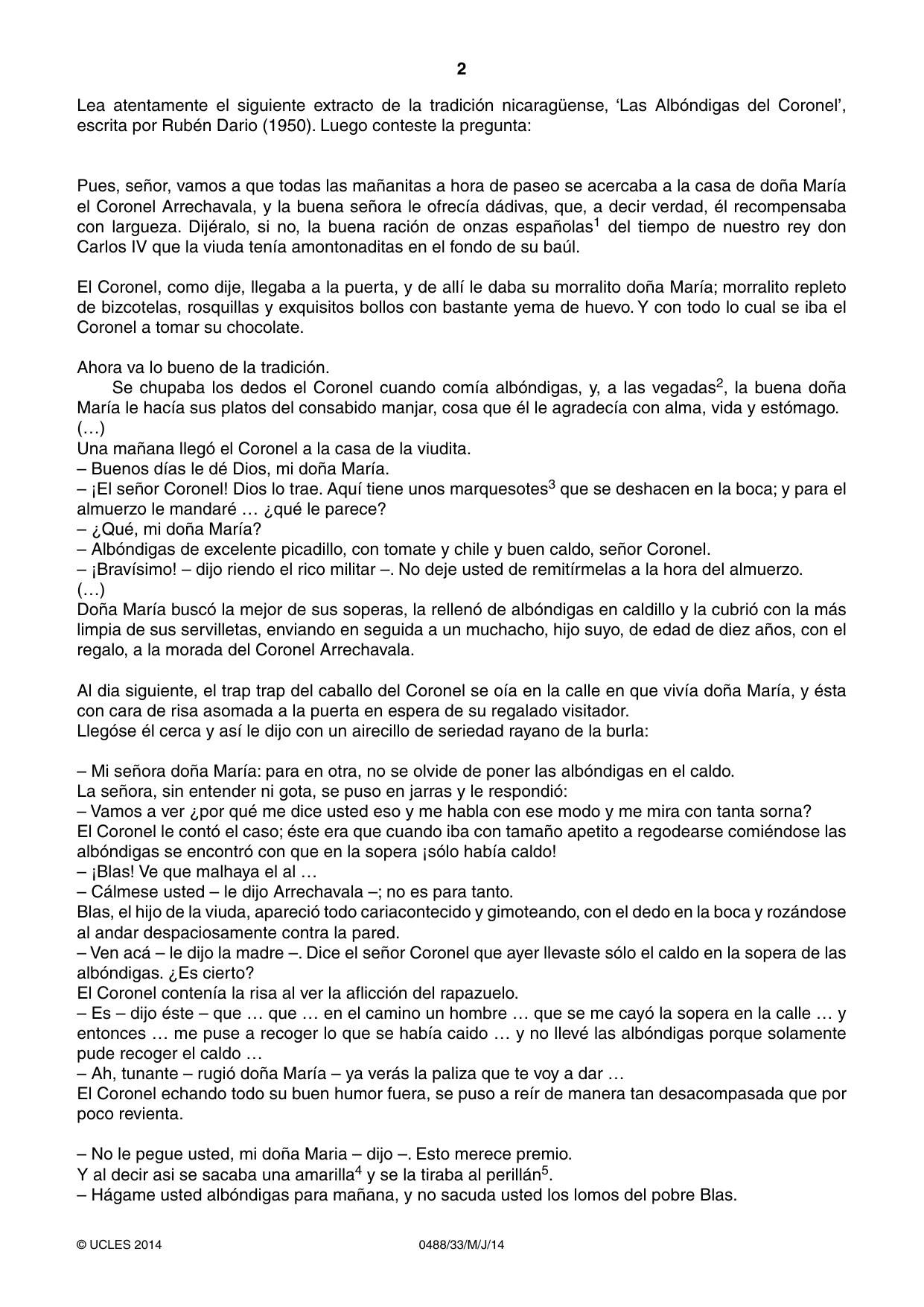
2 0488/33/M/J/14 © UCLES 2014 Lea atentamente el siguiente extracto de la tradición nicaragüense, ‘Las Albóndigas del Coronel’, escrita por Rubén Dario (1950). Luego conteste la pregunta: Pues, señor, vamos a que todas las mañanitas a hora de paseo se acercaba a la casa de doña María el Coronel Arrechavala, y la buena señora le ofrecía dádivas, que, a decir verdad, él recompensaba con largueza. Dijéralo, si no, la buena ración de onzas españolas1 del tiempo de nuestro rey don Carlos IV que la viuda tenía amontonaditas en el fondo de su baúl. El Coronel, como dije, llegaba a la puerta, y de allí le daba su morralito doña María; morralito repleto de bizcotelas, rosquillas y exquisitos bollos con bastante yema de huevo. Y con todo lo cual se iba el Coronel a tomar su chocolate. Ahora va lo bueno de la tradición. Se chupaba los dedos el Coronel cuando comía albóndigas, y, a las vegadas2, la buena doña María le hacía sus platos del consabido manjar, cosa que él le agradecía con alma, vida y estómago. (…) Una mañana llegó el Coronel a la casa de la viudita. – Buenos días le dé Dios, mi doña María. – ¡El señor Coronel! Dios lo trae. Aquí tiene unos marquesotes3 que se deshacen en la boca; y para el almuerzo le mandaré … ¿qué le parece? – ¿Qué, mi doña María? – Albóndigas de excelente picadillo, con tomate y chile y buen caldo, señor Coronel. – ¡Bravísimo! – dijo riendo el rico militar –. No deje usted de remitírmelas a la hora del almuerzo. (…) Doña María buscó la mejor de sus soperas, la rellenó de albóndigas en caldillo y la cubrió con la más limpia de sus servilletas, enviando en seguida a un muchacho, hijo suyo, de edad de diez años, con el regalo, a la morada del Coronel Arrechavala. Al dia siguiente, el trap trap del caballo del Coronel se oía en la calle en que vivía doña María, y ésta con cara de risa asomada a la puerta en espera de su regalado visitador. Llegóse él cerca y así le dijo con un airecillo de seriedad rayano de la burla: – Mi señora doña María: para en otra, no se olvide de poner las albóndigas en el caldo. La señora, sin entender ni gota, se puso en jarras y le respondió: – Vamos a ver ¿por qué me dice usted eso y me habla con ese modo y me mira con tanta sorna? El Coronel le contó el caso; éste era que cuando iba con tamaño apetito a regodearse comiéndose las albóndigas se encontró con que en la sopera ¡sólo había caldo! – ¡Blas! Ve que malhaya el al … – Cálmese usted – le dijo Arrechavala –; no es para tanto. Blas, el hijo de la viuda, apareció todo cariacontecido y gimoteando, con el dedo en la boca y rozándose al andar despaciosamente contra la pared. – Ven acá – le dijo la madre –. Dice el señor Coronel que ayer llevaste sólo el caldo en la sopera de las albóndigas. ¿Es cierto? El Coronel contenía la risa al ver la aflicción del rapazuelo. – Es – dijo éste – que … que … en el camino un hombre … que se me cayó la sopera en la calle … y entonces … me puse a recoger lo que se había caido … y no llevé las albóndigas porque solamente pude recoger el caldo … – Ah, tunante – rugió doña María – ya verás la paliza que te voy a dar … El Coronel echando todo su buen humor fuera, se puso a reír de manera tan desacompasada que por poco revienta. – No le pegue usted, mi doña Maria – dijo –. Esto merece premio. Y al decir asi se sacaba una amarilla4 y se la tiraba al perillán5. – Hágame usted albóndigas para mañana, y no sacuda usted los lomos del pobre Blas.
Question paper, page 3
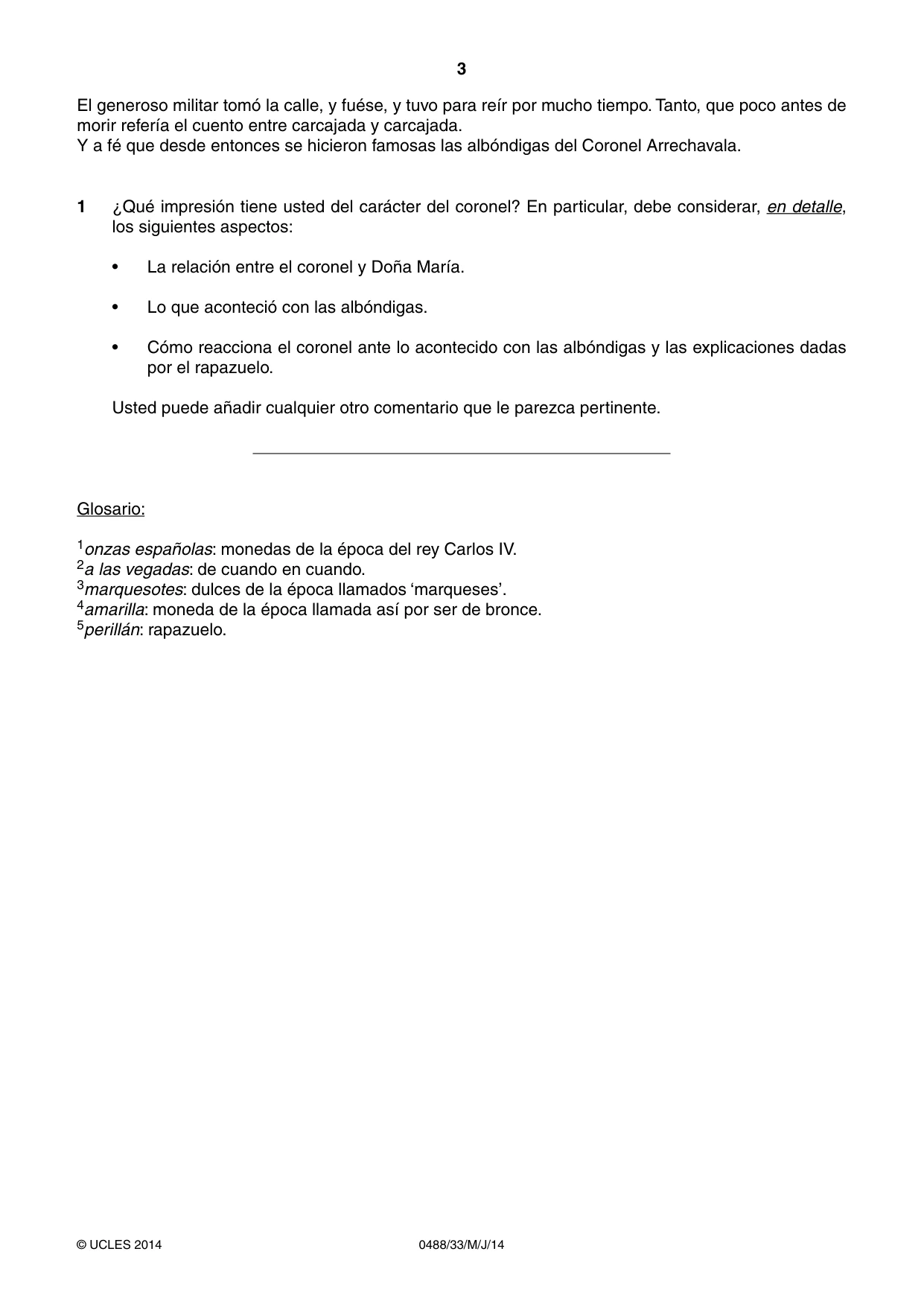
3 0488/33/M/J/14 © UCLES 2014 El generoso militar tomó la calle, y fuése, y tuvo para reír por mucho tiempo. Tanto, que poco antes de morir refería el cuento entre carcajada y carcajada. Y a fé que desde entonces se hicieron famosas las albóndigas del Coronel Arrechavala. 1 ¿Qué impresión tiene usted del carácter del coronel? En particular, debe considerar, en detalle, los siguientes aspectos: • La relación entre el coronel y Doña María. • Lo que aconteció con las albóndigas. • Cómo reacciona el coronel ante lo acontecido con las albóndigas y las explicaciones dadas por el rapazuelo. Usted puede añadir cualquier otro comentario que le parezca pertinente. Glosario: 1onzas españolas: monedas de la época del rey Carlos IV. 2a las vegadas: de cuando en cuando. 3marquesotes: dulces de la época llamados ‘marqueses’. 4amarilla: moneda de la época llamada así por ser de bronce. 5perillán: rapazuelo.
Question paper, page 4
4 0488/33/M/J/14 © UCLES 2014 Copyright Acknowledgements: Question 1 © Rubén Dario; Las albóndigas del coronel; Fondo de Cultural Economical; 1950. Permission to reproduce items where third-party owned material protected by copyright is included has been sought and cleared where possible. Every reasonable effort has been made by the publisher (UCLES) to trace copyright holders, but if any items requiring clearance have unwittingly been included, the publisher will be pleased to make amends at the earliest possible opportunity. Cambridge International Examinations is part of the Cambridge Assessment Group. Cambridge Assessment is the brand name of University of Cambridge Local Examinations Syndicate (UCLES), which is itself a department of the University of Cambridge. BLANK PAGE
Mark scheme, page 1
CAMBRIDGE INTERNATIONAL EXAMINATIONS International General Certificate of Secondary Education MARK SCHEME for the May/June 2014 series 0488 LITERATURE (SPANISH) 0488/33 Paper 3 (Alternative to Coursework), maximum raw mark 20 This mark scheme is published as an aid to teachers and candidates, to indicate the requirements of the examination. It shows the basis on which Examiners were instructed to award marks. It does not indicate the details of the discussions that took place at an Examiners’ meeting before marking began, which would have considered the acceptability of alternative answers. Mark schemes should be read in conjunction with the question paper and the Principal Examiner Report for Teachers. Cambridge will not enter into discussions about these mark schemes. Cambridge is publishing the mark schemes for the May/June 2014 series for most IGCSE, GCE Advanced Level and Advanced Subsidiary Level components and some Ordinary Level components. PAPA CAMBRIDGE
Mark scheme, page 2
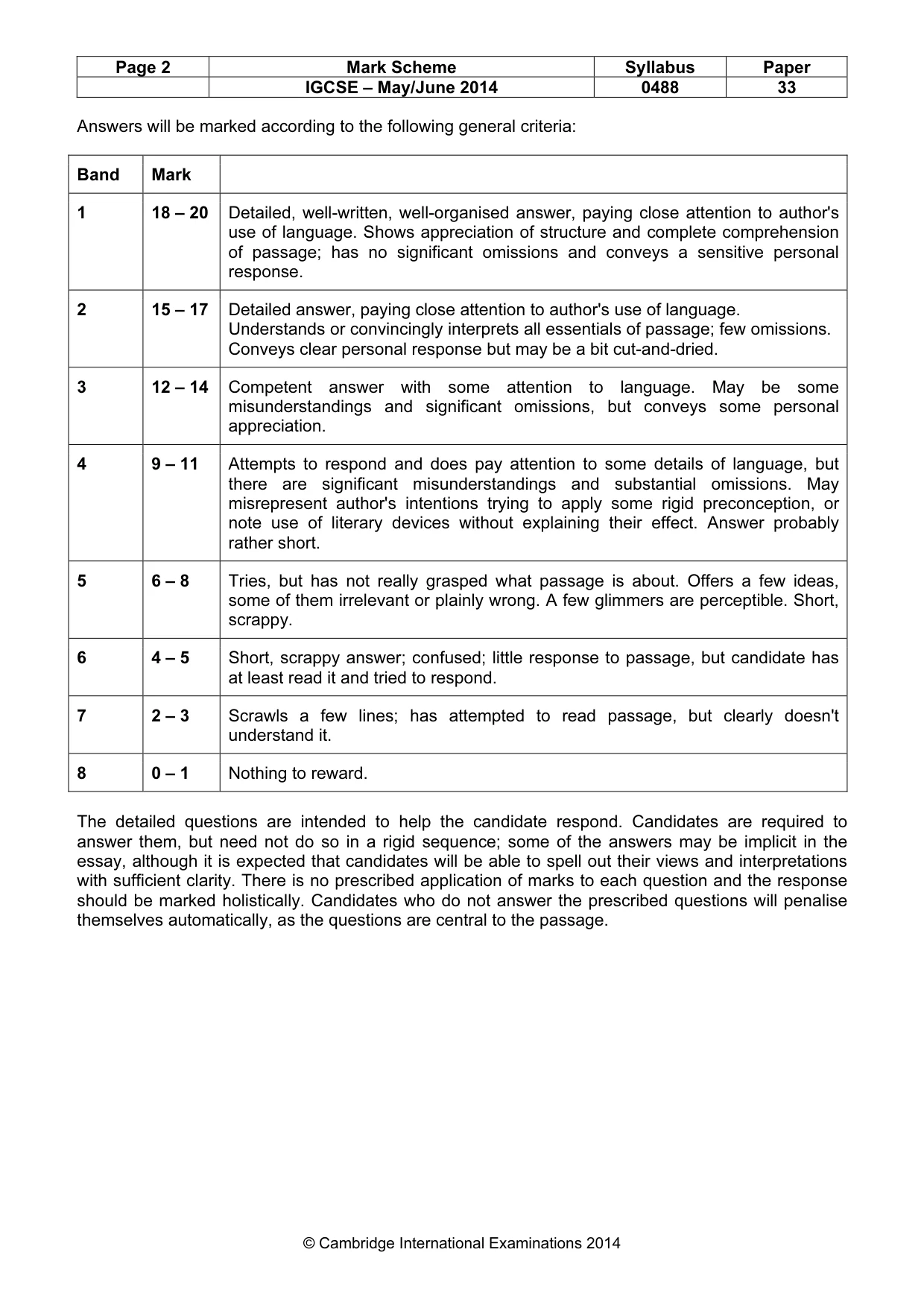
Page 2 Mark Scheme Syllabus Paper IGCSE – May/June 2014 0488 33 © Cambridge International Examinations 2014 Answers will be marked according to the following general criteria: Band Mark 1 18 – 20 Detailed, well-written, well-organised answer, paying close attention to author's use of language. Shows appreciation of structure and complete comprehension of passage; has no significant omissions and conveys a sensitive personal response. 2 15 – 17 Detailed answer, paying close attention to author's use of language. Understands or convincingly interprets all essentials of passage; few omissions. Conveys clear personal response but may be a bit cut-and-dried. 3 12 – 14 Competent answer with some attention to language. May be some misunderstandings and significant omissions, but conveys some personal appreciation. 4 9 – 11 Attempts to respond and does pay attention to some details of language, but there are significant misunderstandings and substantial omissions. May misrepresent author's intentions trying to apply some rigid preconception, or note use of literary devices without explaining their effect. Answer probably rather short. 5 6 – 8 Tries, but has not really grasped what passage is about. Offers a few ideas, some of them irrelevant or plainly wrong. A few glimmers are perceptible. Short, scrappy. 6 4 – 5 Short, scrappy answer; confused; little response to passage, but candidate has at least read it and tried to respond. 7 2 – 3 Scrawls a few lines; has attempted to read passage, but clearly doesn't understand it. 8 0 – 1 Nothing to reward. The detailed questions are intended to help the candidate respond. Candidates are required to answer them, but need not do so in a rigid sequence; some of the answers may be implicit in the essay, although it is expected that candidates will be able to spell out their views and interpretations with sufficient clarity. There is no prescribed application of marks to each question and the response should be marked holistically. Candidates who do not answer the prescribed questions will penalise themselves automatically, as the questions are central to the passage.
Mark scheme, page 3
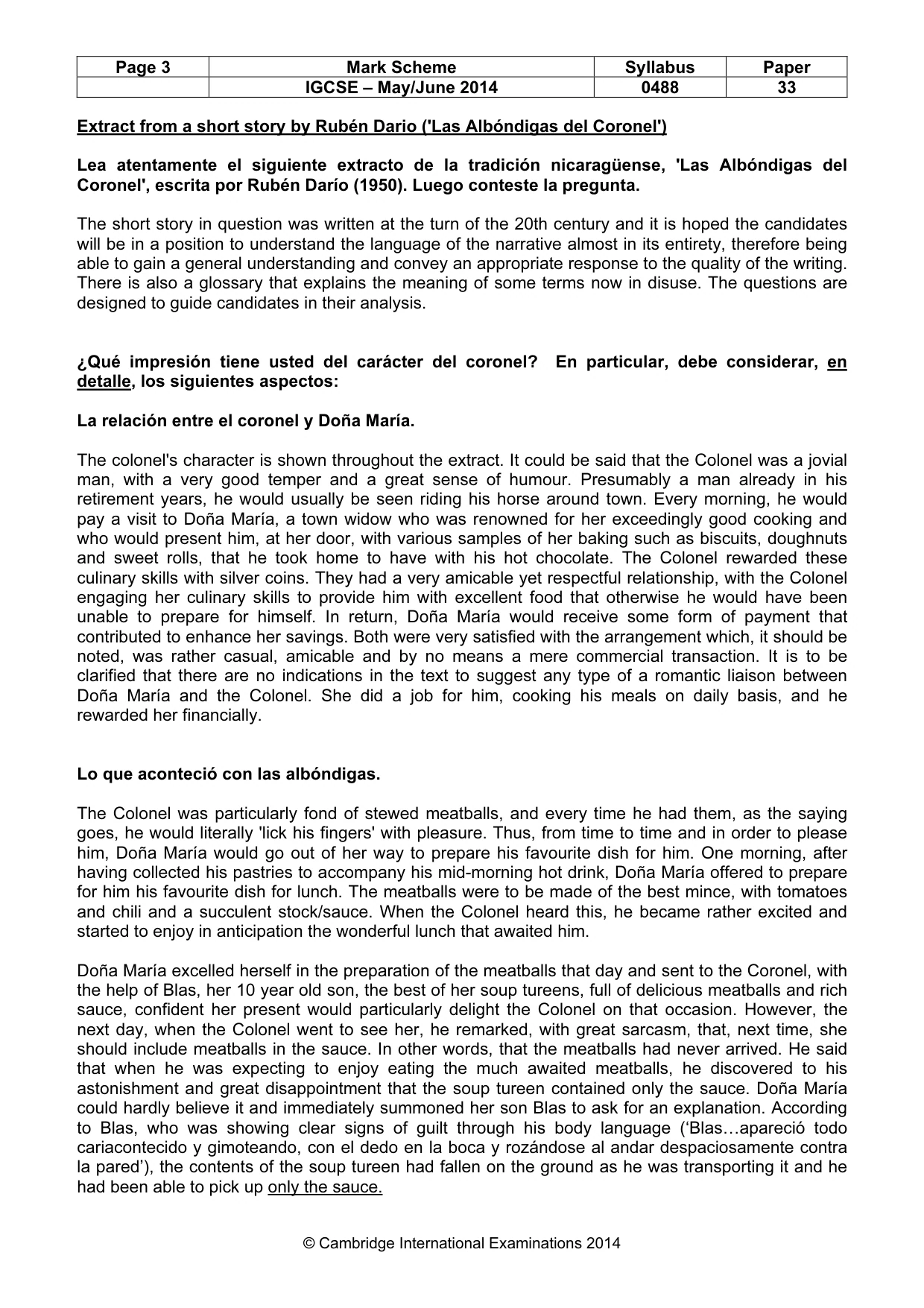
Page 3 Mark Scheme Syllabus Paper IGCSE – May/June 2014 0488 33 © Cambridge International Examinations 2014 Extract from a short story by Rubén Dario ('Las Albóndigas del Coronel') Lea atentamente el siguiente extracto de la tradición nicaragüense, 'Las Albóndigas del Coronel', escrita por Rubén Darío (1950). Luego conteste la pregunta. The short story in question was written at the turn of the 20th century and it is hoped the candidates will be in a position to understand the language of the narrative almost in its entirety, therefore being able to gain a general understanding and convey an appropriate response to the quality of the writing. There is also a glossary that explains the meaning of some terms now in disuse. The questions are designed to guide candidates in their analysis. ¿Qué impresión tiene usted del carácter del coronel? En particular, debe considerar, en detalle, los siguientes aspectos: La relación entre el coronel y Doña María. The colonel's character is shown throughout the extract. It could be said that the Colonel was a jovial man, with a very good temper and a great sense of humour. Presumably a man already in his retirement years, he would usually be seen riding his horse around town. Every morning, he would pay a visit to Doña María, a town widow who was renowned for her exceedingly good cooking and who would present him, at her door, with various samples of her baking such as biscuits, doughnuts and sweet rolls, that he took home to have with his hot chocolate. The Colonel rewarded these culinary skills with silver coins. They had a very amicable yet respectful relationship, with the Colonel engaging her culinary skills to provide him with excellent food that otherwise he would have been unable to prepare for himself. In return, Doña María would receive some form of payment that contributed to enhance her savings. Both were very satisfied with the arrangement which, it should be noted, was rather casual, amicable and by no means a mere commercial transaction. It is to be clarified that there are no indications in the text to suggest any type of a romantic liaison between Doña María and the Colonel. She did a job for him, cooking his meals on daily basis, and he rewarded her financially. Lo que aconteció con las albóndigas. The Colonel was particularly fond of stewed meatballs, and every time he had them, as the saying goes, he would literally 'lick his fingers' with pleasure. Thus, from time to time and in order to please him, Doña María would go out of her way to prepare his favourite dish for him. One morning, after having collected his pastries to accompany his mid-morning hot drink, Doña María offered to prepare for him his favourite dish for lunch. The meatballs were to be made of the best mince, with tomatoes and chili and a succulent stock/sauce. When the Colonel heard this, he became rather excited and started to enjoy in anticipation the wonderful lunch that awaited him. Doña María excelled herself in the preparation of the meatballs that day and sent to the Coronel, with the help of Blas, her 10 year old son, the best of her soup tureens, full of delicious meatballs and rich sauce, confident her present would particularly delight the Colonel on that occasion. However, the next day, when the Colonel went to see her, he remarked, with great sarcasm, that, next time, she should include meatballs in the sauce. In other words, that the meatballs had never arrived. He said that when he was expecting to enjoy eating the much awaited meatballs, he discovered to his astonishment and great disappointment that the soup tureen contained only the sauce. Doña María could hardly believe it and immediately summoned her son Blas to ask for an explanation. According to Blas, who was showing clear signs of guilt through his body language (‘Blas…apareció todo cariacontecido y gimoteando, con el dedo en la boca y rozándose al andar despaciosamente contra la pared’), the contents of the soup tureen had fallen on the ground as he was transporting it and he had been able to pick up only the sauce.
Mark scheme, page 4
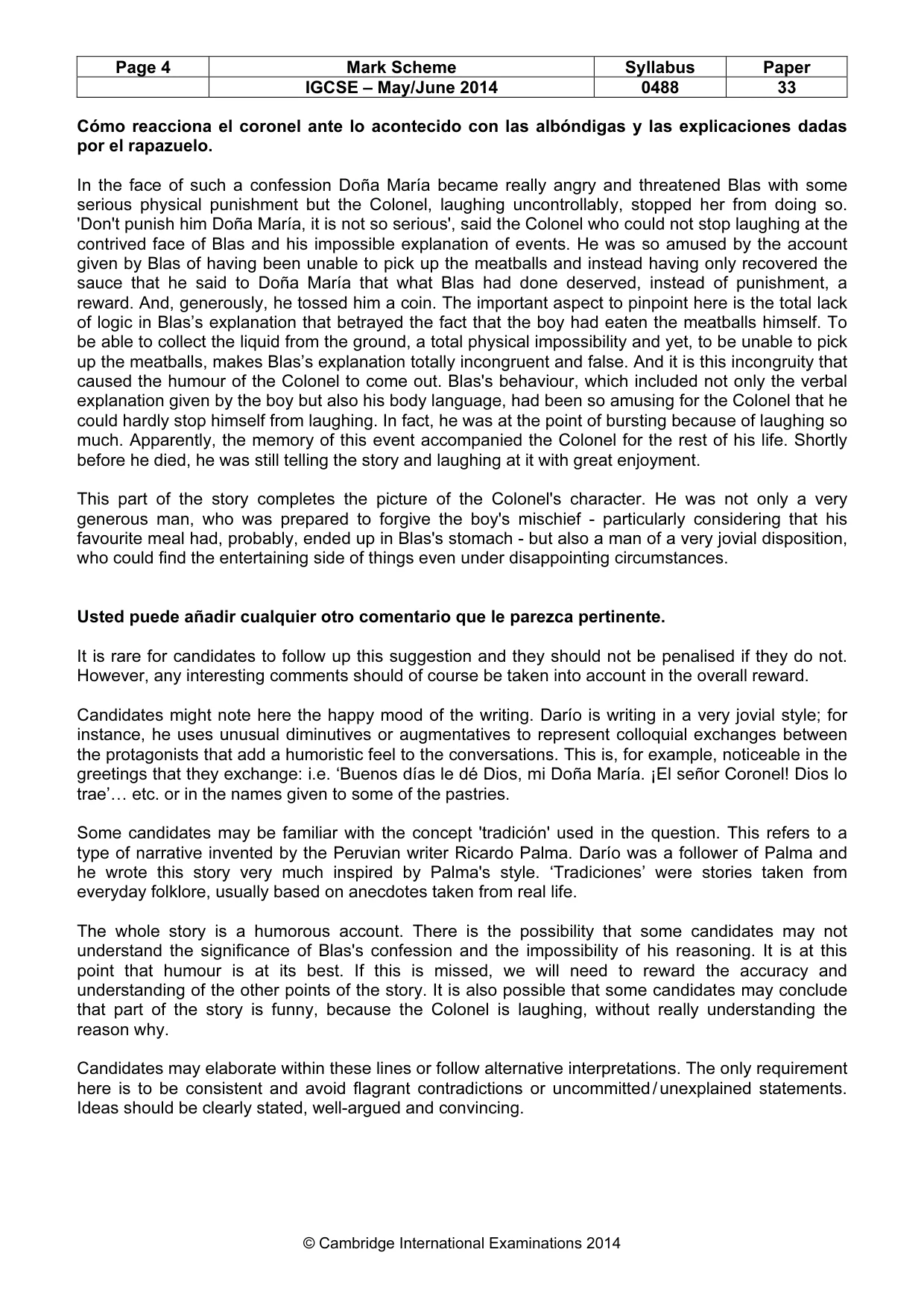
Page 4 Mark Scheme Syllabus Paper IGCSE – May/June 2014 0488 33 © Cambridge International Examinations 2014 Cómo reacciona el coronel ante lo acontecido con las albóndigas y las explicaciones dadas por el rapazuelo. In the face of such a confession Doña María became really angry and threatened Blas with some serious physical punishment but the Colonel, laughing uncontrollably, stopped her from doing so. 'Don't punish him Doña María, it is not so serious', said the Colonel who could not stop laughing at the contrived face of Blas and his impossible explanation of events. He was so amused by the account given by Blas of having been unable to pick up the meatballs and instead having only recovered the sauce that he said to Doña María that what Blas had done deserved, instead of punishment, a reward. And, generously, he tossed him a coin. The important aspect to pinpoint here is the total lack of logic in Blas’s explanation that betrayed the fact that the boy had eaten the meatballs himself. To be able to collect the liquid from the ground, a total physical impossibility and yet, to be unable to pick up the meatballs, makes Blas’s explanation totally incongruent and false. And it is this incongruity that caused the humour of the Colonel to come out. Blas's behaviour, which included not only the verbal explanation given by the boy but also his body language, had been so amusing for the Colonel that he could hardly stop himself from laughing. In fact, he was at the point of bursting because of laughing so much. Apparently, the memory of this event accompanied the Colonel for the rest of his life. Shortly before he died, he was still telling the story and laughing at it with great enjoyment. This part of the story completes the picture of the Colonel's character. He was not only a very generous man, who was prepared to forgive the boy's mischief - particularly considering that his favourite meal had, probably, ended up in Blas's stomach - but also a man of a very jovial disposition, who could find the entertaining side of things even under disappointing circumstances. Usted puede añadir cualquier otro comentario que le parezca pertinente. It is rare for candidates to follow up this suggestion and they should not be penalised if they do not. However, any interesting comments should of course be taken into account in the overall reward. Candidates might note here the happy mood of the writing. Darío is writing in a very jovial style; for instance, he uses unusual diminutives or augmentatives to represent colloquial exchanges between the protagonists that add a humoristic feel to the conversations. This is, for example, noticeable in the greetings that they exchange: i.e. ‘Buenos días le dé Dios, mi Doña María. ¡El señor Coronel! Dios lo trae’… etc. or in the names given to some of the pastries. Some candidates may be familiar with the concept 'tradición' used in the question. This refers to a type of narrative invented by the Peruvian writer Ricardo Palma. Darío was a follower of Palma and he wrote this story very much inspired by Palma's style. ‘Tradiciones’ were stories taken from everyday folklore, usually based on anecdotes taken from real life. The whole story is a humorous account. There is the possibility that some candidates may not understand the significance of Blas's confession and the impossibility of his reasoning. It is at this point that humour is at its best. If this is missed, we will need to reward the accuracy and understanding of the other points of the story. It is also possible that some candidates may conclude that part of the story is funny, because the Colonel is laughing, without really understanding the reason why. Candidates may elaborate within these lines or follow alternative interpretations. The only requirement here is to be consistent and avoid flagrant contradictions or uncommitted / unexplained statements. Ideas should be clearly stated, well-argued and convincing.
What you needed in this session
Cambridge’s own grade thresholds for 2014 May/June, Paper 3 · Variant 3. A higher threshold means an easier paper — the bar moves with how the cohort did.