Cambridge IGCSE Spanish - Literature 0488 — 2014 May/June Paper 3 · Variant 1
0488/31/M/J/14 · 20 marks · ≈23 min
The question paper and its mark scheme, free to read here and free to download. This is Cambridge’s own paper, exactly as it was sat.
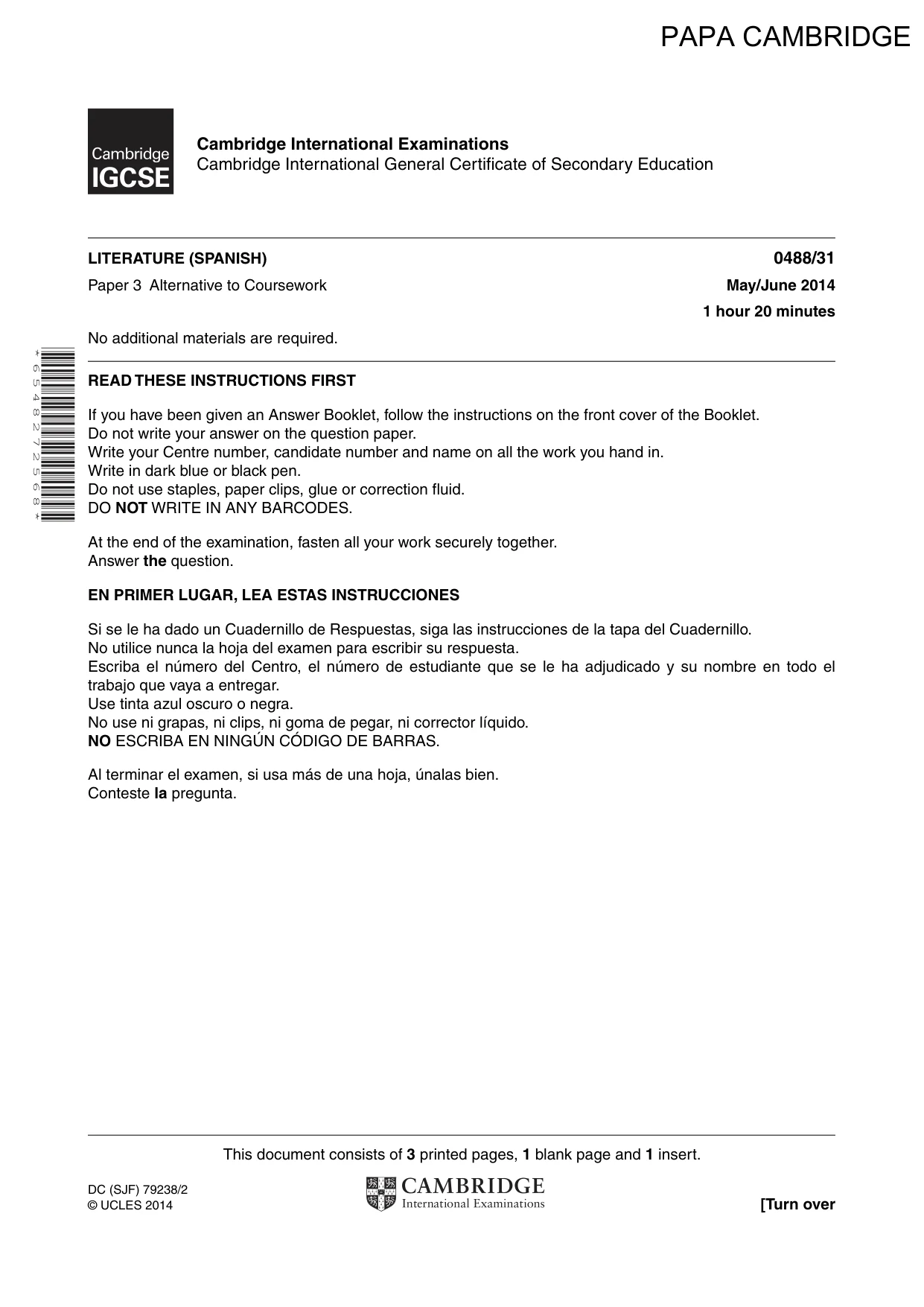
Question paper4 pages


Mark scheme4 pages
Answers below. Sit the paper first if you are practising.
Paper as text
Question paper, page 1
This document consists of 3 printed pages, 1 blank page and 1 insert. DC (SJF) 79238/2 © UCLES 2014 [Turn over Cambridge International Examinations Cambridge International General Certificate of Secondary Education * 6 5 4 8 2 7 2 5 6 8 * LITERATURE (SPANISH) 0488/31 Paper 3 Alternative to Coursework May/June 2014 1 hour 20 minutes No additional materials are required. READ THESE INSTRUCTIONS FIRST If you have been given an Answer Booklet, follow the instructions on the front cover of the Booklet. Do not write your answer on the question paper. Write your Centre number, candidate number and name on all the work you hand in. Write in dark blue or black pen. Do not use staples, paper clips, glue or correction fluid. DO NOT WRITE IN ANY BARCODES. At the end of the examination, fasten all your work securely together. Answer the question. EN PRIMER LUGAR, LEA ESTAS INSTRUCCIONES Si se le ha dado un Cuadernillo de Respuestas, siga las instrucciones de la tapa del Cuadernillo. No utilice nunca la hoja del examen para escribir su respuesta. Escriba el número del Centro, el número de estudiante que se le ha adjudicado y su nombre en todo el trabajo que vaya a entregar. Use tinta azul oscuro o negra. No use ni grapas, ni clips, ni goma de pegar, ni corrector líquido. NO ESCRIBA EN NINGÚN CÓDIGO DE BARRAS. Al terminar el examen, si usa más de una hoja, únalas bien. Conteste la pregunta. PAPA CAMBRIDGE
Question paper, page 2
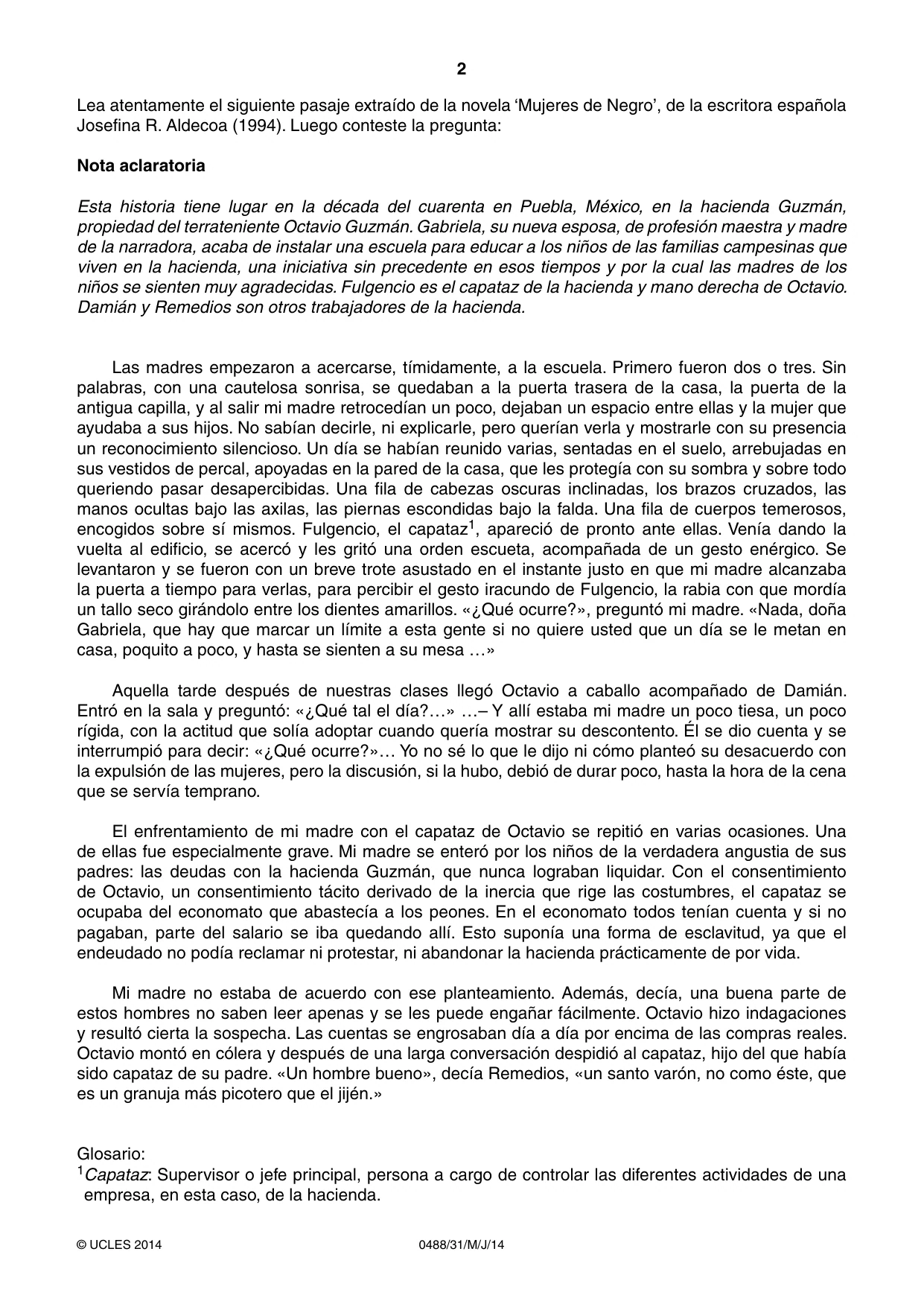
2 0488/31/M/J/14 © UCLES 2014 Lea atentamente el siguiente pasaje extraído de la novela ‘Mujeres de Negro’, de la escritora española Josefina R. Aldecoa (1994). Luego conteste la pregunta: Nota aclaratoria Esta historia tiene lugar en la década del cuarenta en Puebla, México, en la hacienda Guzmán, propiedad del terrateniente Octavio Guzmán. Gabriela, su nueva esposa, de profesión maestra y madre de la narradora, acaba de instalar una escuela para educar a los niños de las familias campesinas que viven en la hacienda, una iniciativa sin precedente en esos tiempos y por la cual las madres de los niños se sienten muy agradecidas. Fulgencio es el capataz de la hacienda y mano derecha de Octavio. Damián y Remedios son otros trabajadores de la hacienda. Las madres empezaron a acercarse, tímidamente, a la escuela. Primero fueron dos o tres. Sin palabras, con una cautelosa sonrisa, se quedaban a la puerta trasera de la casa, la puerta de la antigua capilla, y al salir mi madre retrocedían un poco, dejaban un espacio entre ellas y la mujer que ayudaba a sus hijos. No sabían decirle, ni explicarle, pero querían verla y mostrarle con su presencia un reconocimiento silencioso. Un día se habían reunido varias, sentadas en el suelo, arrebujadas en sus vestidos de percal, apoyadas en la pared de la casa, que les protegía con su sombra y sobre todo queriendo pasar desapercibidas. Una fila de cabezas oscuras inclinadas, los brazos cruzados, las manos ocultas bajo las axilas, las piernas escondidas bajo la falda. Una fila de cuerpos temerosos, encogidos sobre sí mismos. Fulgencio, el capataz1, apareció de pronto ante ellas. Venía dando la vuelta al edificio, se acercó y les gritó una orden escueta, acompañada de un gesto enérgico. Se levantaron y se fueron con un breve trote asustado en el instante justo en que mi madre alcanzaba la puerta a tiempo para verlas, para percibir el gesto iracundo de Fulgencio, la rabia con que mordía un tallo seco girándolo entre los dientes amarillos. «¿Qué ocurre?», preguntó mi madre. «Nada, doña Gabriela, que hay que marcar un límite a esta gente si no quiere usted que un día se le metan en casa, poquito a poco, y hasta se sienten a su mesa …» Aquella tarde después de nuestras clases llegó Octavio a caballo acompañado de Damián. Entró en la sala y preguntó: «¿Qué tal el día?…» …– Y allí estaba mi madre un poco tiesa, un poco rígida, con la actitud que solía adoptar cuando quería mostrar su descontento. Él se dio cuenta y se interrumpió para decir: «¿Qué ocurre?»… Yo no sé lo que le dijo ni cómo planteó su desacuerdo con la expulsión de las mujeres, pero la discusión, si la hubo, debió de durar poco, hasta la hora de la cena que se servía temprano. El enfrentamiento de mi madre con el capataz de Octavio se repitió en varias ocasiones. Una de ellas fue especialmente grave. Mi madre se enteró por los niños de la verdadera angustia de sus padres: las deudas con la hacienda Guzmán, que nunca lograban liquidar. Con el consentimiento de Octavio, un consentimiento tácito derivado de la inercia que rige las costumbres, el capataz se ocupaba del economato que abastecía a los peones. En el economato todos tenían cuenta y si no pagaban, parte del salario se iba quedando allí. Esto suponía una forma de esclavitud, ya que el endeudado no podía reclamar ni protestar, ni abandonar la hacienda prácticamente de por vida. Mi madre no estaba de acuerdo con ese planteamiento. Además, decía, una buena parte de estos hombres no saben leer apenas y se les puede engañar fácilmente. Octavio hizo indagaciones y resultó cierta la sospecha. Las cuentas se engrosaban día a día por encima de las compras reales. Octavio montó en cólera y después de una larga conversación despidió al capataz, hijo del que había sido capataz de su padre. «Un hombre bueno», decía Remedios, «un santo varón, no como éste, que es un granuja más picotero que el jijén.» Glosario: 1 Capataz: Supervisor o jefe principal, persona a cargo de controlar las diferentes actividades de una empresa, en esta caso, de la hacienda.
Question paper, page 3
3 0488/31/M/J/14 © UCLES 2014 1 ¿Hasta que punto y cómo ha logrado la autora inspirarle a usted, a través de la narradora, un sentimiento de admiración hacia Doña Gabriela en este fragmento? En particular, debe considerar, en detalle, los siguientes aspectos: • El significado del incidente con las mujeres campesinas. • Las acciones y la actitud de Fulgencio, el capataz, hacia los trabajadores de la hacienda. • La reacción de Octavio a las demandas de su mujer. Usted puede añadir cualquier otro comentario que le parezca pertinente.
Question paper, page 4
4 0488/31/M/J/14 © UCLES 2014 Copyright Acknowledgements: Question 1 © Josefina Aldecoa; Mujeres de Negro; Editorial Anagrama; 1994. Permission to reproduce items where third-party owned material protected by copyright is included has been sought and cleared where possible. Every reasonable effort has been made by the publisher (UCLES) to trace copyright holders, but if any items requiring clearance have unwittingly been included, the publisher will be pleased to make amends at the earliest possible opportunity. Cambridge International Examinations is part of the Cambridge Assessment Group. Cambridge Assessment is the brand name of University of Cambridge Local Examinations Syndicate (UCLES), which is itself a department of the University of Cambridge. BLANK PAGE
Mark scheme, page 1
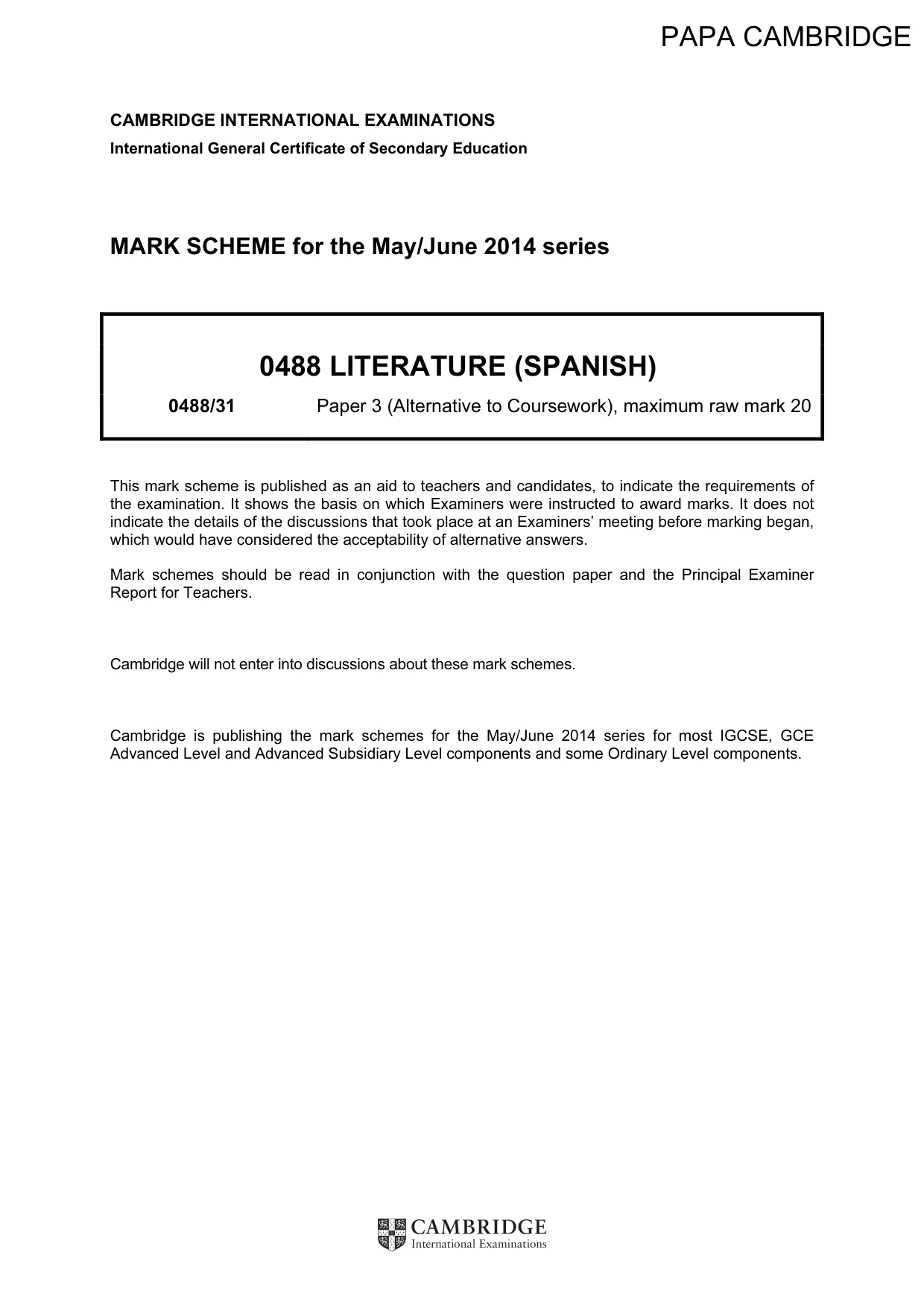
CAMBRIDGE INTERNATIONAL EXAMINATIONS International General Certificate of Secondary Education MARK SCHEME for the May/June 2014 series 0488 LITERATURE (SPANISH) 0488/31 Paper 3 (Alternative to Coursework), maximum raw mark 20 This mark scheme is published as an aid to teachers and candidates, to indicate the requirements of the examination. It shows the basis on which Examiners were instructed to award marks. It does not indicate the details of the discussions that took place at an Examiners’ meeting before marking began, which would have considered the acceptability of alternative answers. Mark schemes should be read in conjunction with the question paper and the Principal Examiner Report for Teachers. Cambridge will not enter into discussions about these mark schemes. Cambridge is publishing the mark schemes for the May/June 2014 series for most IGCSE, GCE Advanced Level and Advanced Subsidiary Level components and some Ordinary Level components. PAPA CAMBRIDGE
Mark scheme, page 2
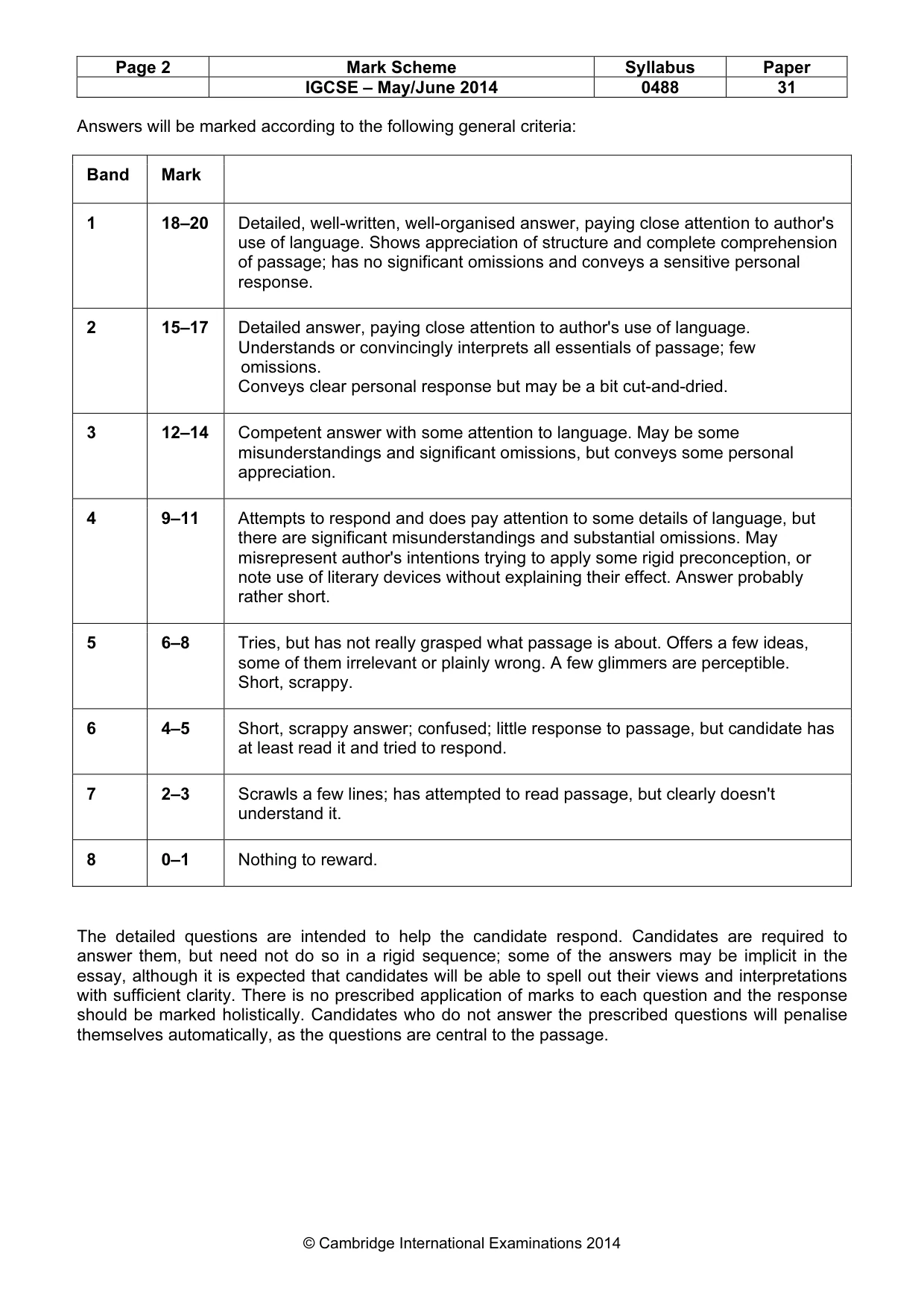
Page 2 Mark Scheme Syllabus Paper IGCSE – May/June 2014 0488 31 © Cambridge International Examinations 2014 Answers will be marked according to the following general criteria: Band Mark 1 18–20 Detailed, well-written, well-organised answer, paying close attention to author's use of language. Shows appreciation of structure and complete comprehension of passage; has no significant omissions and conveys a sensitive personal response. 2 15–17 Detailed answer, paying close attention to author's use of language. Understands or convincingly interprets all essentials of passage; few omissions. Conveys clear personal response but may be a bit cut-and-dried. 3 12–14 Competent answer with some attention to language. May be some misunderstandings and significant omissions, but conveys some personal appreciation. 4 9–11 Attempts to respond and does pay attention to some details of language, but there are significant misunderstandings and substantial omissions. May misrepresent author's intentions trying to apply some rigid preconception, or note use of literary devices without explaining their effect. Answer probably rather short. 5 6–8 Tries, but has not really grasped what passage is about. Offers a few ideas, some of them irrelevant or plainly wrong. A few glimmers are perceptible. Short, scrappy. 6 4–5 Short, scrappy answer; confused; little response to passage, but candidate has at least read it and tried to respond. 7 2–3 Scrawls a few lines; has attempted to read passage, but clearly doesn't understand it. 8 0–1 Nothing to reward. The detailed questions are intended to help the candidate respond. Candidates are required to answer them, but need not do so in a rigid sequence; some of the answers may be implicit in the essay, although it is expected that candidates will be able to spell out their views and interpretations with sufficient clarity. There is no prescribed application of marks to each question and the response should be marked holistically. Candidates who do not answer the prescribed questions will penalise themselves automatically, as the questions are central to the passage.
Mark scheme, page 3
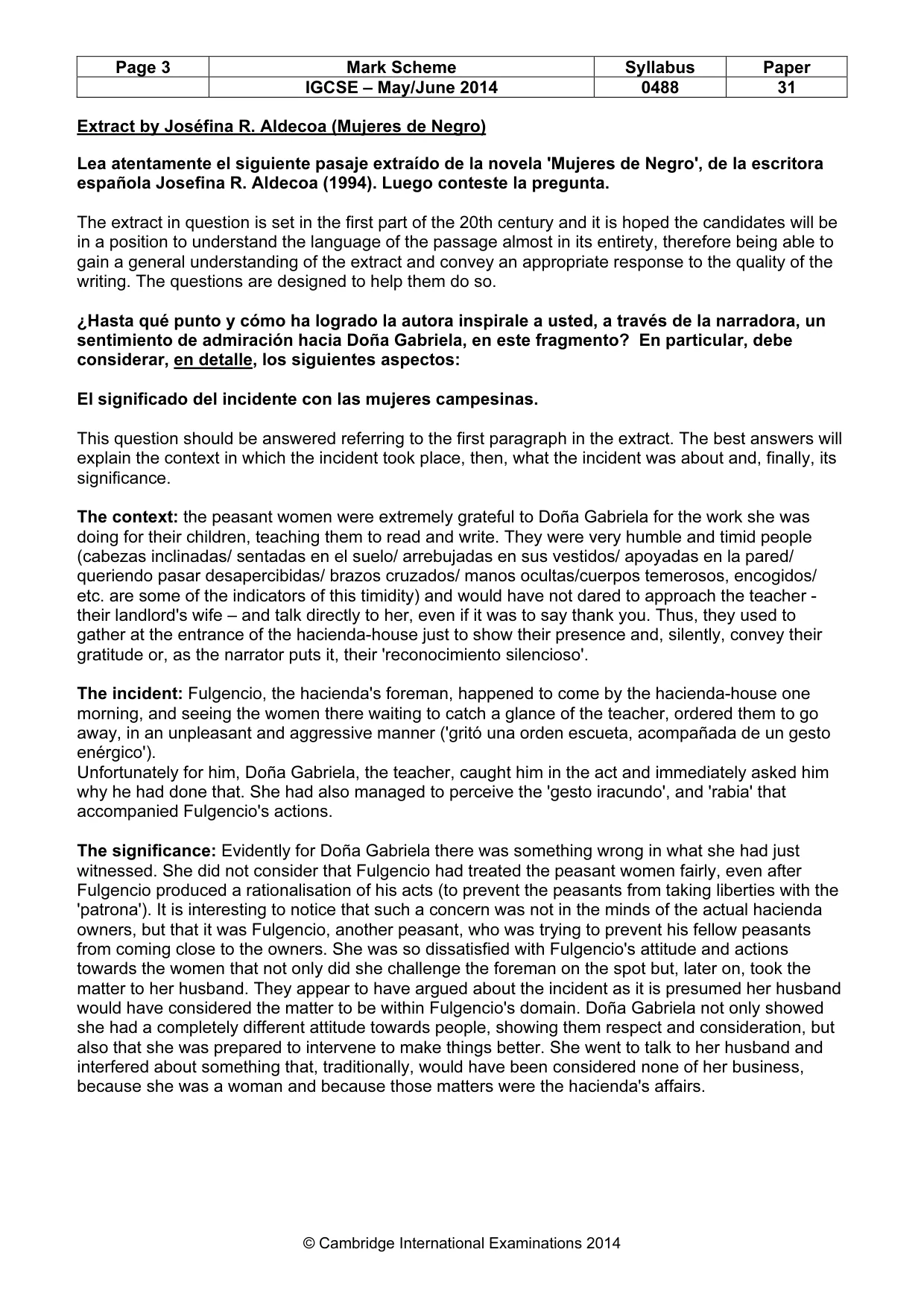
Page 3 Mark Scheme Syllabus Paper IGCSE – May/June 2014 0488 31 © Cambridge International Examinations 2014 Extract by Joséfina R. Aldecoa (Mujeres de Negro) Lea atentamente el siguiente pasaje extraído de la novela 'Mujeres de Negro', de la escritora española Josefina R. Aldecoa (1994). Luego conteste la pregunta. The extract in question is set in the first part of the 20th century and it is hoped the candidates will be in a position to understand the language of the passage almost in its entirety, therefore being able to gain a general understanding of the extract and convey an appropriate response to the quality of the writing. The questions are designed to help them do so. ¿Hasta qué punto y cómo ha logrado la autora inspirale a usted, a través de la narradora, un sentimiento de admiración hacia Doña Gabriela, en este fragmento? En particular, debe considerar, en detalle, los siguientes aspectos: El significado del incidente con las mujeres campesinas. This question should be answered referring to the first paragraph in the extract. The best answers will explain the context in which the incident took place, then, what the incident was about and, finally, its significance. The context: the peasant women were extremely grateful to Doña Gabriela for the work she was doing for their children, teaching them to read and write. They were very humble and timid people (cabezas inclinadas/ sentadas en el suelo/ arrebujadas en sus vestidos/ apoyadas en la pared/ queriendo pasar desapercibidas/ brazos cruzados/ manos ocultas/cuerpos temerosos, encogidos/ etc. are some of the indicators of this timidity) and would have not dared to approach the teacher - their landlord's wife – and talk directly to her, even if it was to say thank you. Thus, they used to gather at the entrance of the hacienda-house just to show their presence and, silently, convey their gratitude or, as the narrator puts it, their 'reconocimiento silencioso'. The incident: Fulgencio, the hacienda's foreman, happened to come by the hacienda-house one morning, and seeing the women there waiting to catch a glance of the teacher, ordered them to go away, in an unpleasant and aggressive manner ('gritó una orden escueta, acompañada de un gesto enérgico'). Unfortunately for him, Doña Gabriela, the teacher, caught him in the act and immediately asked him why he had done that. She had also managed to perceive the 'gesto iracundo', and 'rabia' that accompanied Fulgencio's actions. The significance: Evidently for Doña Gabriela there was something wrong in what she had just witnessed. She did not consider that Fulgencio had treated the peasant women fairly, even after Fulgencio produced a rationalisation of his acts (to prevent the peasants from taking liberties with the 'patrona'). It is interesting to notice that such a concern was not in the minds of the actual hacienda owners, but that it was Fulgencio, another peasant, who was trying to prevent his fellow peasants from coming close to the owners. She was so dissatisfied with Fulgencio's attitude and actions towards the women that not only did she challenge the foreman on the spot but, later on, took the matter to her husband. They appear to have argued about the incident as it is presumed her husband would have considered the matter to be within Fulgencio's domain. Doña Gabriela not only showed she had a completely different attitude towards people, showing them respect and consideration, but also that she was prepared to intervene to make things better. She went to talk to her husband and interfered about something that, traditionally, would have been considered none of her business, because she was a woman and because those matters were the hacienda's affairs.
Mark scheme, page 4
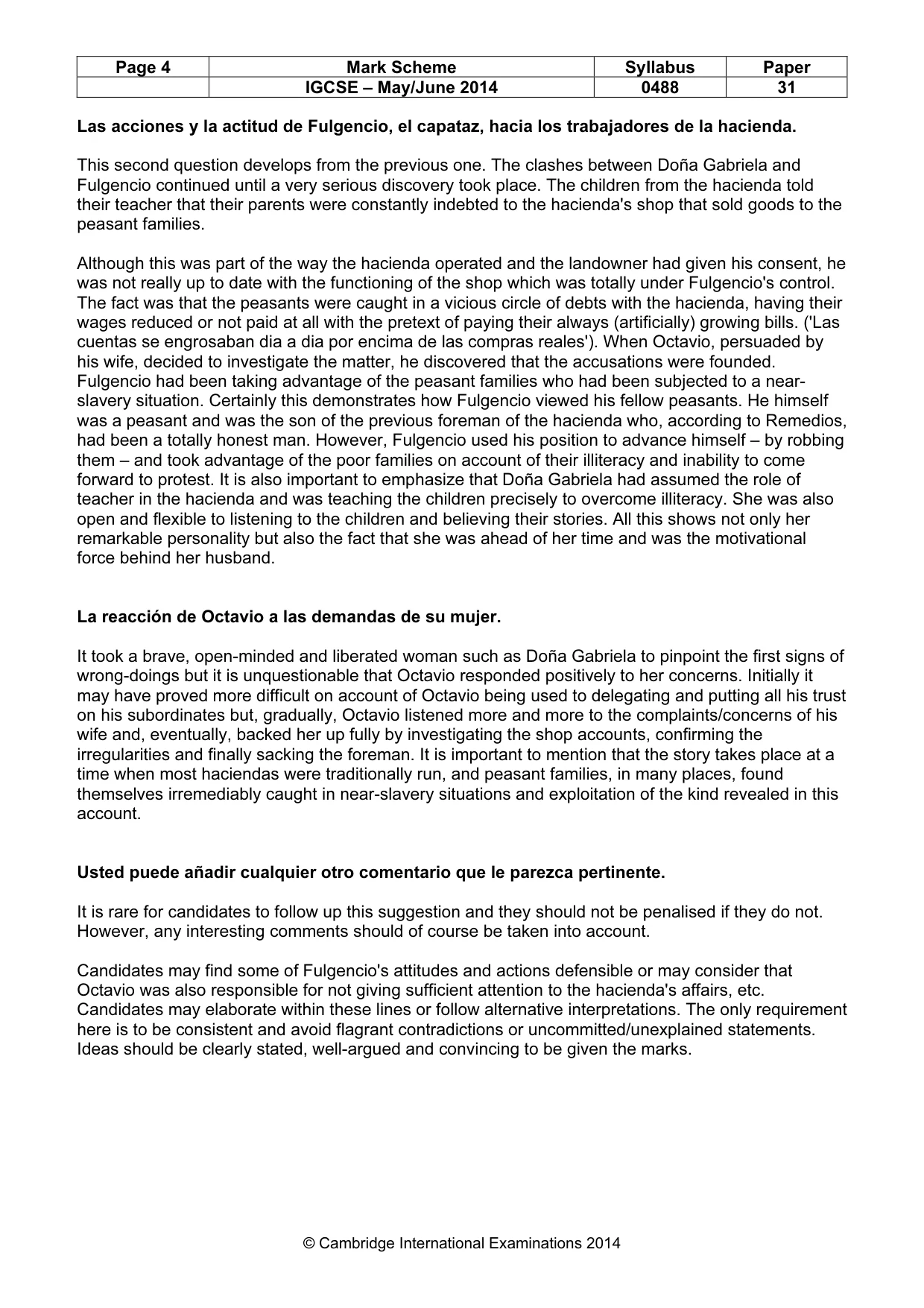
Page 4 Mark Scheme Syllabus Paper IGCSE – May/June 2014 0488 31 © Cambridge International Examinations 2014 Las acciones y la actitud de Fulgencio, el capataz, hacia los trabajadores de la hacienda. This second question develops from the previous one. The clashes between Doña Gabriela and Fulgencio continued until a very serious discovery took place. The children from the hacienda told their teacher that their parents were constantly indebted to the hacienda's shop that sold goods to the peasant families. Although this was part of the way the hacienda operated and the landowner had given his consent, he was not really up to date with the functioning of the shop which was totally under Fulgencio's control. The fact was that the peasants were caught in a vicious circle of debts with the hacienda, having their wages reduced or not paid at all with the pretext of paying their always (artificially) growing bills. ('Las cuentas se engrosaban dia a dia por encima de las compras reales'). When Octavio, persuaded by his wife, decided to investigate the matter, he discovered that the accusations were founded. Fulgencio had been taking advantage of the peasant families who had been subjected to a near- slavery situation. Certainly this demonstrates how Fulgencio viewed his fellow peasants. He himself was a peasant and was the son of the previous foreman of the hacienda who, according to Remedios, had been a totally honest man. However, Fulgencio used his position to advance himself – by robbing them – and took advantage of the poor families on account of their illiteracy and inability to come forward to protest. It is also important to emphasize that Doña Gabriela had assumed the role of teacher in the hacienda and was teaching the children precisely to overcome illiteracy. She was also open and flexible to listening to the children and believing their stories. All this shows not only her remarkable personality but also the fact that she was ahead of her time and was the motivational force behind her husband. La reacción de Octavio a las demandas de su mujer. It took a brave, open-minded and liberated woman such as Doña Gabriela to pinpoint the first signs of wrong-doings but it is unquestionable that Octavio responded positively to her concerns. Initially it may have proved more difficult on account of Octavio being used to delegating and putting all his trust on his subordinates but, gradually, Octavio listened more and more to the complaints/concerns of his wife and, eventually, backed her up fully by investigating the shop accounts, confirming the irregularities and finally sacking the foreman. It is important to mention that the story takes place at a time when most haciendas were traditionally run, and peasant families, in many places, found themselves irremediably caught in near-slavery situations and exploitation of the kind revealed in this account. Usted puede añadir cualquier otro comentario que le parezca pertinente. It is rare for candidates to follow up this suggestion and they should not be penalised if they do not. However, any interesting comments should of course be taken into account. Candidates may find some of Fulgencio's attitudes and actions defensible or may consider that Octavio was also responsible for not giving sufficient attention to the hacienda's affairs, etc. Candidates may elaborate within these lines or follow alternative interpretations. The only requirement here is to be consistent and avoid flagrant contradictions or uncommitted/unexplained statements. Ideas should be clearly stated, well-argued and convincing to be given the marks.
What you needed in this session
Cambridge’s own grade thresholds for 2014 May/June, Paper 3 · Variant 1. A higher threshold means an easier paper — the bar moves with how the cohort did.