Cambridge IGCSE Spanish - Literature 0488 — 2013 May/June Paper 3 · Variant 3
0488/33/M/J/13 · 20 marks · ≈23 min
The question paper and its mark scheme, free to read here and free to download. This is Cambridge’s own paper, exactly as it was sat.
Question paper4 pages
Mark scheme7 pages
Answers below. Sit the paper first if you are practising.
Paper as text
Question paper, page 1
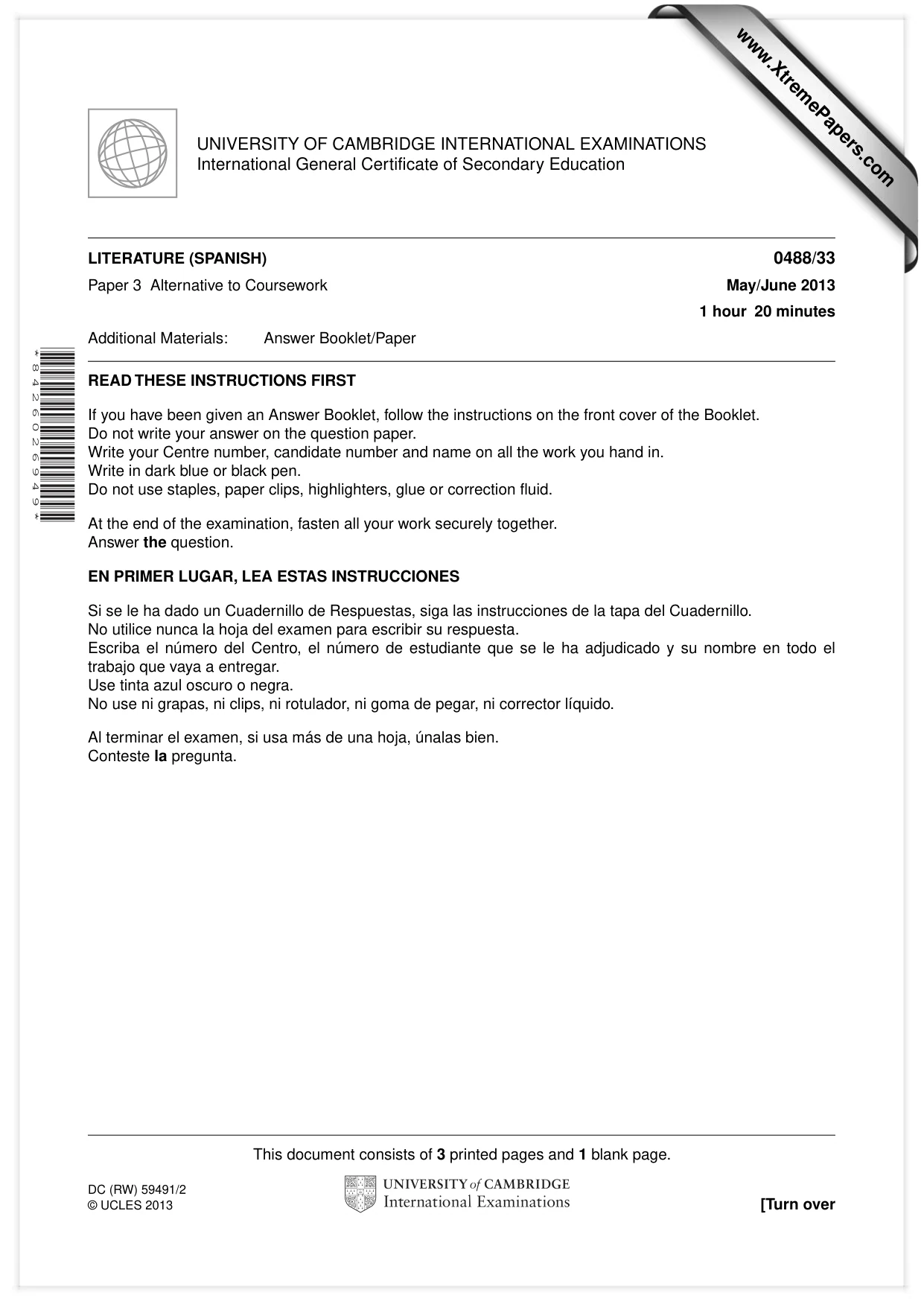
This document consists of 3 printed pages and 1 blank page. DC (RW) 59491/2 © UCLES 2013 [Turn over UNIVERSITY OF CAMBRIDGE INTERNATIONAL EXAMINATIONS International General Certificate of Secondary Education * 8 4 2 6 0 2 6 9 4 9 * LITERATURE (SPANISH) 0488/33 Paper 3 Alternative to Coursework May/June 2013 1 hour 20 minutes Additional Materials: Answer Booklet/Paper READ THESE INSTRUCTIONS FIRST If you have been given an Answer Booklet, follow the instructions on the front cover of the Booklet. Do not write your answer on the question paper. Write your Centre number, candidate number and name on all the work you hand in. Write in dark blue or black pen. Do not use staples, paper clips, highlighters, glue or correction fluid. At the end of the examination, fasten all your work securely together. Answer the question. EN PRIMER LUGAR, LEA ESTAS INSTRUCCIONES Si se le ha dado un Cuadernillo de Respuestas, siga las instrucciones de la tapa del Cuadernillo. No utilice nunca la hoja del examen para escribir su respuesta. Escriba el número del Centro, el número de estudiante que se le ha adjudicado y su nombre en todo el trabajo que vaya a entregar. Use tinta azul oscuro o negra. No use ni grapas, ni clips, ni rotulador, ni goma de pegar, ni corrector líquido. Al terminar el examen, si usa más de una hoja, únalas bien. Conteste la pregunta. www.XtremePapers.com
Question paper, page 2
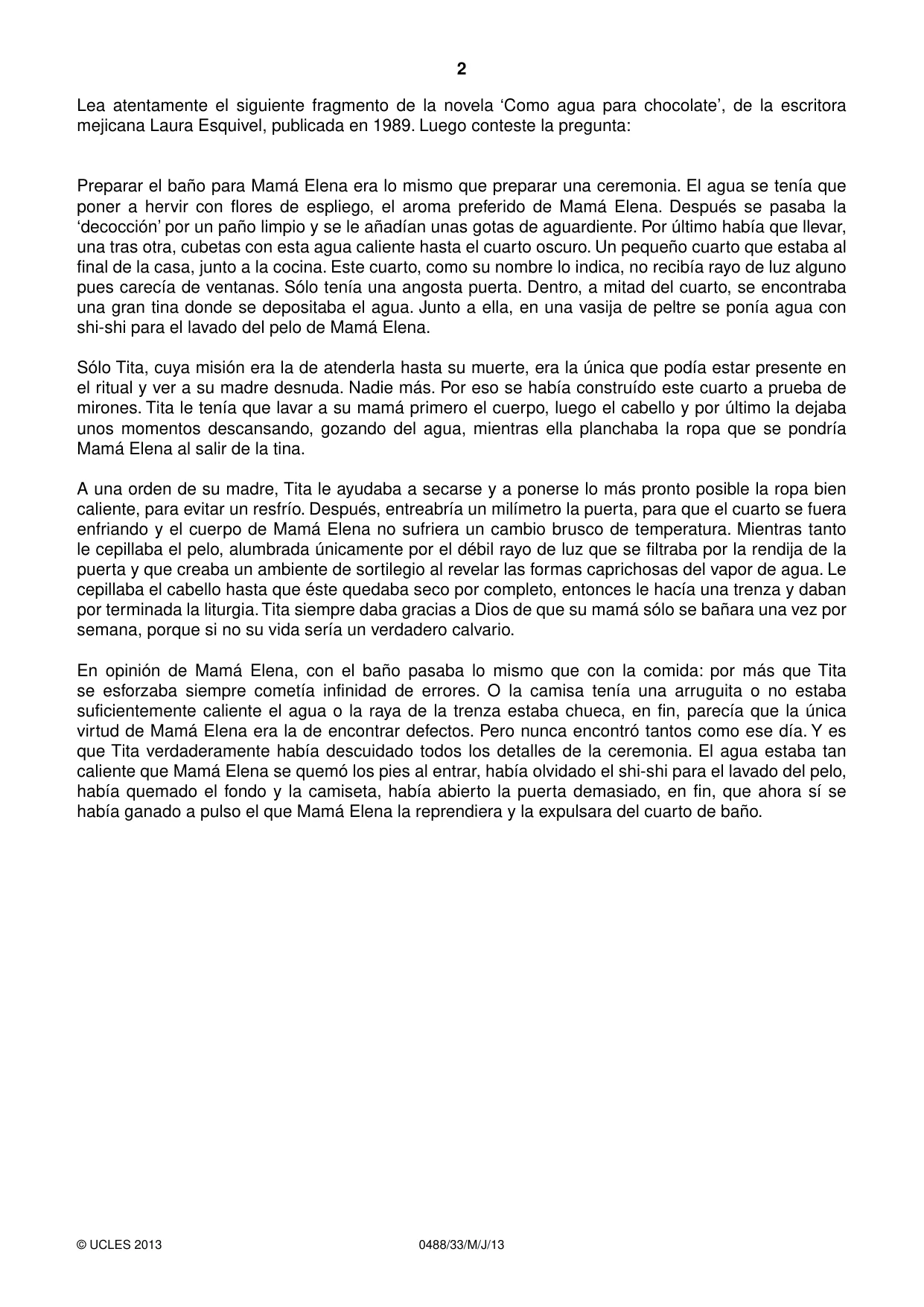
2 0488/33/M/J/13 © UCLES 2013 Lea atentamente el siguiente fragmento de la novela ‘Como agua para chocolate’, de la escritora mejicana Laura Esquivel, publicada en 1989. Luego conteste la pregunta: Preparar el baño para Mamá Elena era lo mismo que preparar una ceremonia. El agua se tenía que poner a hervir con flores de espliego, el aroma preferido de Mamá Elena. Después se pasaba la ‘decocción’ por un paño limpio y se le añadían unas gotas de aguardiente. Por último había que llevar, una tras otra, cubetas con esta agua caliente hasta el cuarto oscuro. Un pequeño cuarto que estaba al final de la casa, junto a la cocina. Este cuarto, como su nombre lo indica, no recibía rayo de luz alguno pues carecía de ventanas. Sólo tenía una angosta puerta. Dentro, a mitad del cuarto, se encontraba una gran tina donde se depositaba el agua. Junto a ella, en una vasija de peltre se ponía agua con shi-shi para el lavado del pelo de Mamá Elena. Sólo Tita, cuya misión era la de atenderla hasta su muerte, era la única que podía estar presente en el ritual y ver a su madre desnuda. Nadie más. Por eso se había construído este cuarto a prueba de mirones. Tita le tenía que lavar a su mamá primero el cuerpo, luego el cabello y por último la dejaba unos momentos descansando, gozando del agua, mientras ella planchaba la ropa que se pondría Mamá Elena al salir de la tina. A una orden de su madre, Tita le ayudaba a secarse y a ponerse lo más pronto posible la ropa bien caliente, para evitar un resfrío. Después, entreabría un milímetro la puerta, para que el cuarto se fuera enfriando y el cuerpo de Mamá Elena no sufriera un cambio brusco de temperatura. Mientras tanto le cepillaba el pelo, alumbrada únicamente por el débil rayo de luz que se filtraba por la rendija de la puerta y que creaba un ambiente de sortilegio al revelar las formas caprichosas del vapor de agua. Le cepillaba el cabello hasta que éste quedaba seco por completo, entonces le hacía una trenza y daban por terminada la liturgia. Tita siempre daba gracias a Dios de que su mamá sólo se bañara una vez por semana, porque si no su vida sería un verdadero calvario. En opinión de Mamá Elena, con el baño pasaba lo mismo que con la comida: por más que Tita se esforzaba siempre cometía infinidad de errores. O la camisa tenía una arruguita o no estaba suficientemente caliente el agua o la raya de la trenza estaba chueca, en fin, parecía que la única virtud de Mamá Elena era la de encontrar defectos. Pero nunca encontró tantos como ese día. Y es que Tita verdaderamente había descuidado todos los detalles de la ceremonia. El agua estaba tan caliente que Mamá Elena se quemó los pies al entrar, había olvidado el shi-shi para el lavado del pelo, había quemado el fondo y la camiseta, había abierto la puerta demasiado, en fin, que ahora sí se había ganado a pulso el que Mamá Elena la reprendiera y la expulsara del cuarto de baño.
Question paper, page 3
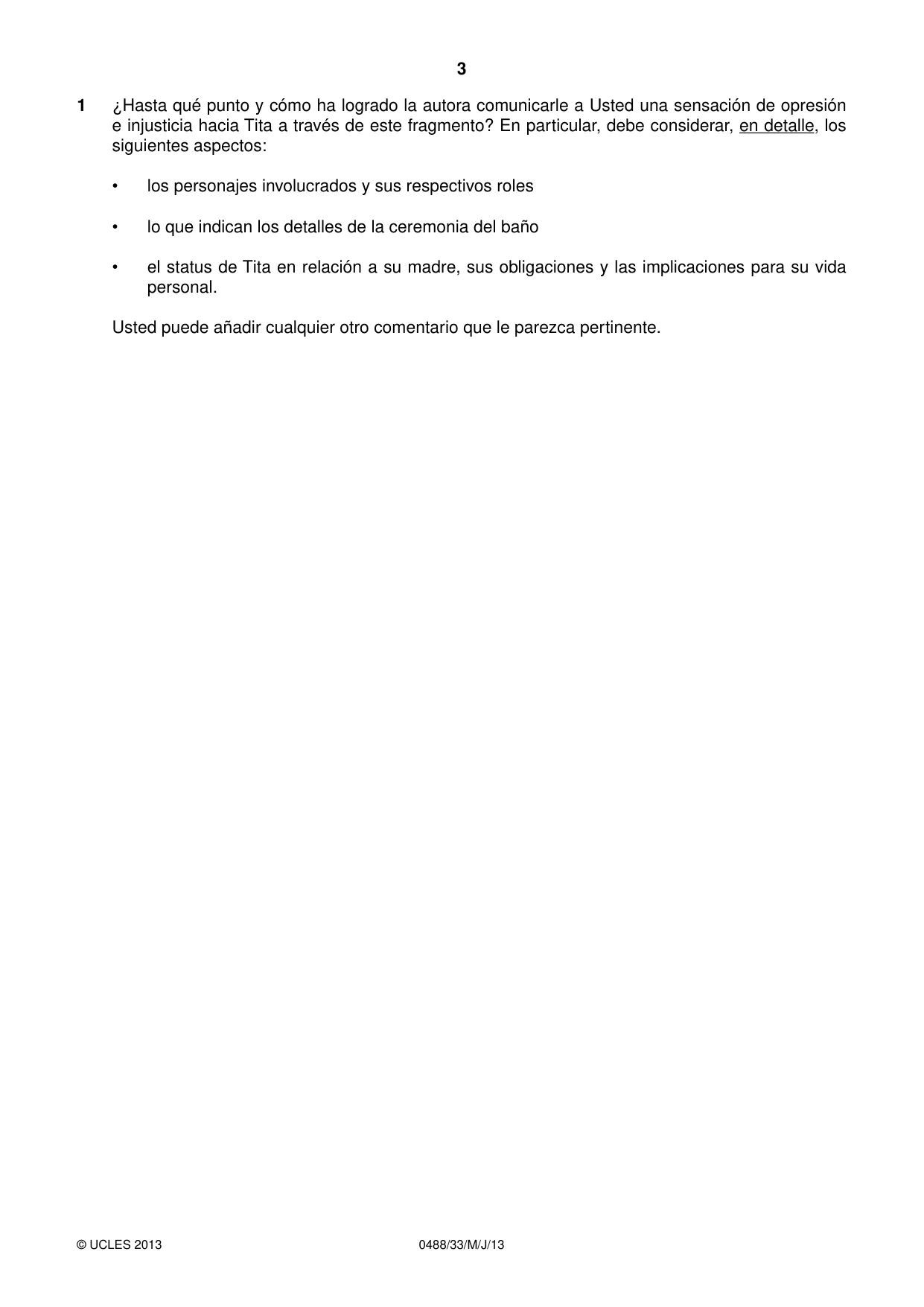
3 0488/33/M/J/13 © UCLES 2013 1 ¿Hasta qué punto y cómo ha logrado la autora comunicarle a Usted una sensación de opresión e injusticia hacia Tita a través de este fragmento? En particular, debe considerar, en detalle, los siguientes aspectos: • los personajes involucrados y sus respectivos roles • lo que indican los detalles de la ceremonia del baño • el status de Tita en relación a su madre, sus obligaciones y las implicaciones para su vida personal. Usted puede añadir cualquier otro comentario que le parezca pertinente.
Question paper, page 4
4 0488/33/M/J/13 © UCLES 2013 Copyright Acknowledgements: Question 1 © Laura Esquivel; Como agua para chocolate; Editorial Planeta Mexicanas, S.A; 1989. Permission to reproduce items where third-party owned material protected by copyright is included has been sought and cleared where possible. Every reasonable effort has been made by the publisher (UCLES) to trace copyright holders, but if any items requiring clearance have unwittingly been included, the publisher will be pleased to make amends at the earliest possible opportunity. University of Cambridge International Examinations is part of the Cambridge Assessment Group. Cambridge Assessment is the brand name of University of Cambridge Local Examinations Syndicate (UCLES), which is itself a department of the University of Cambridge. BLANK PAGE
Mark scheme, page 1
CAMBRIDGE INTERNATIONAL EXAMINATIONS International General Certificate of Secondary Education MARK SCHEME for the May/June 2013 series 0488 LITERATURE (SPANISH) 0488/33 Paper 3 (Alternative to Coursework), maximum raw mark 20 This mark scheme is published as an aid to teachers and candidates, to indicate the requirements of the examination. It shows the basis on which Examiners were instructed to award marks. It does not indicate the details of the discussions that took place at an Examiners’ meeting before marking began, which would have considered the acceptability of alternative answers. Mark schemes should be read in conjunction with the question paper and the Principal Examiner Report for Teachers. Cambridge will not enter into discussions about these mark schemes. Cambridge is publishing the mark schemes for the May/June 2013 series for most IGCSE, GCE Advanced Level and Advanced Subsidiary Level components and some Ordinary Level components. www.XtremePapers.com
Mark scheme, page 2
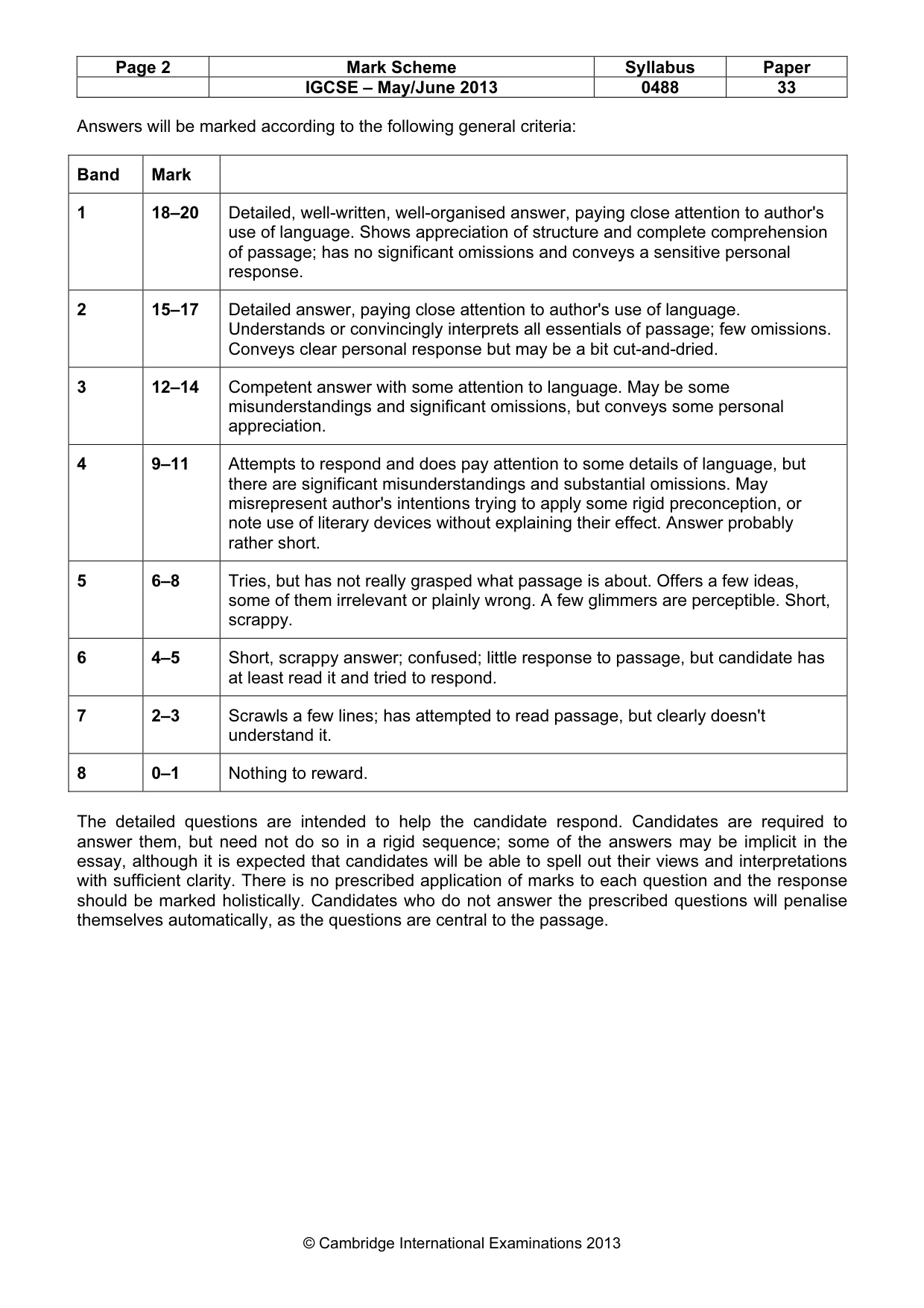
Page 2 Mark Scheme Syllabus Paper IGCSE – May/June 2013 0488 33 © Cambridge International Examinations 2013 Answers will be marked according to the following general criteria: Band Mark 1 18–20 Detailed, well-written, well-organised answer, paying close attention to author's use of language. Shows appreciation of structure and complete comprehension of passage; has no significant omissions and conveys a sensitive personal response. 2 15–17 Detailed answer, paying close attention to author's use of language. Understands or convincingly interprets all essentials of passage; few omissions. Conveys clear personal response but may be a bit cut-and-dried. 3 12–14 Competent answer with some attention to language. May be some misunderstandings and significant omissions, but conveys some personal appreciation. 4 9–11 Attempts to respond and does pay attention to some details of language, but there are significant misunderstandings and substantial omissions. May misrepresent author's intentions trying to apply some rigid preconception, or note use of literary devices without explaining their effect. Answer probably rather short. 5 6–8 Tries, but has not really grasped what passage is about. Offers a few ideas, some of them irrelevant or plainly wrong. A few glimmers are perceptible. Short, scrappy. 6 4–5 Short, scrappy answer; confused; little response to passage, but candidate has at least read it and tried to respond. 7 2–3 Scrawls a few lines; has attempted to read passage, but clearly doesn't understand it. 8 0–1 Nothing to reward. The detailed questions are intended to help the candidate respond. Candidates are required to answer them, but need not do so in a rigid sequence; some of the answers may be implicit in the essay, although it is expected that candidates will be able to spell out their views and interpretations with sufficient clarity. There is no prescribed application of marks to each question and the response should be marked holistically. Candidates who do not answer the prescribed questions will penalise themselves automatically, as the questions are central to the passage.
Mark scheme, page 3
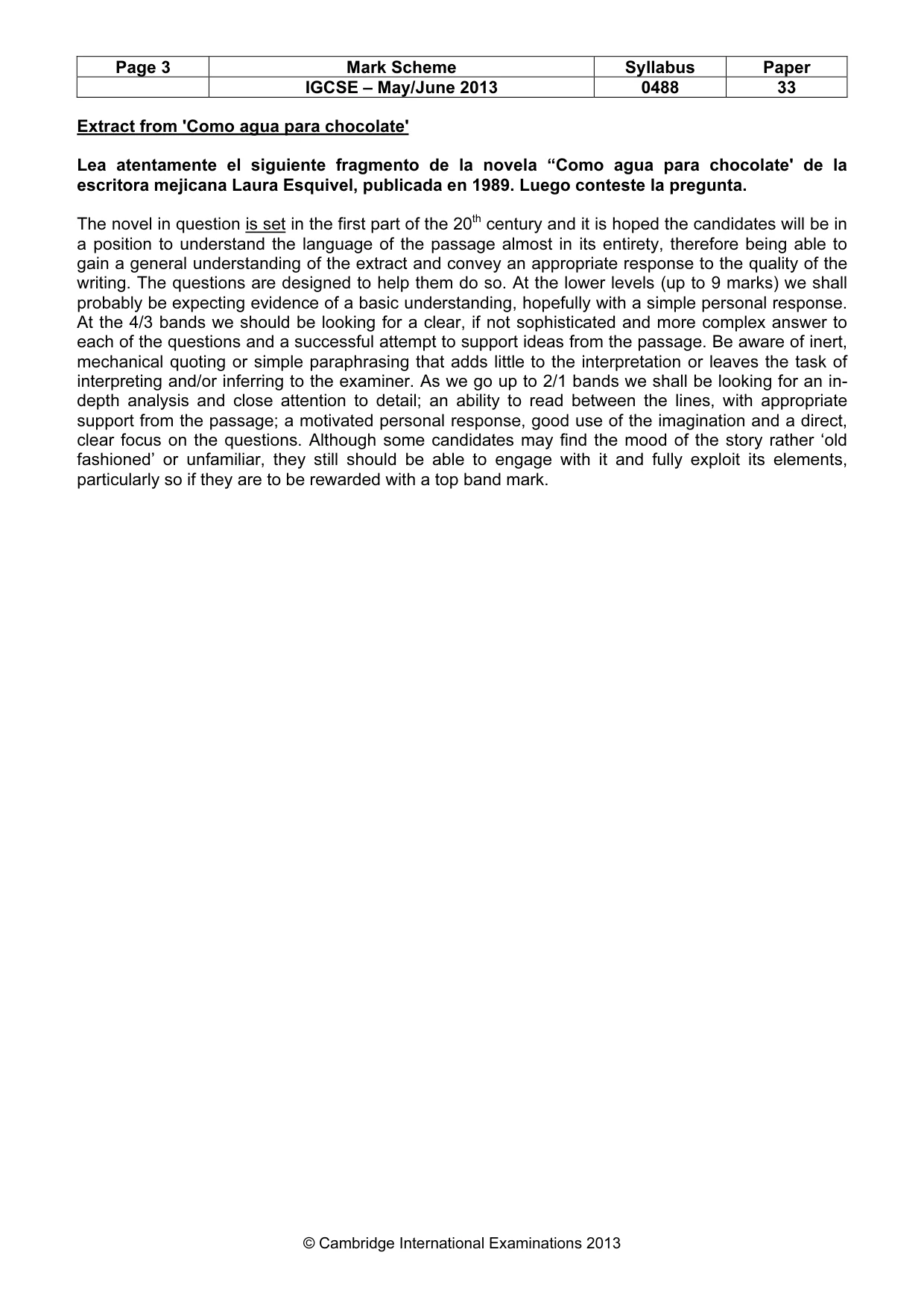
Page 3 Mark Scheme Syllabus Paper IGCSE – May/June 2013 0488 33 © Cambridge International Examinations 2013 Extract from 'Como agua para chocolate' Lea atentamente el siguiente fragmento de la novela “Como agua para chocolate' de la escritora mejicana Laura Esquivel, publicada en 1989. Luego conteste la pregunta. The novel in question is set in the first part of the 20th century and it is hoped the candidates will be in a position to understand the language of the passage almost in its entirety, therefore being able to gain a general understanding of the extract and convey an appropriate response to the quality of the writing. The questions are designed to help them do so. At the lower levels (up to 9 marks) we shall probably be expecting evidence of a basic understanding, hopefully with a simple personal response. At the 4/3 bands we should be looking for a clear, if not sophisticated and more complex answer to each of the questions and a successful attempt to support ideas from the passage. Be aware of inert, mechanical quoting or simple paraphrasing that adds little to the interpretation or leaves the task of interpreting and/or inferring to the examiner. As we go up to 2/1 bands we shall be looking for an in- depth analysis and close attention to detail; an ability to read between the lines, with appropriate support from the passage; a motivated personal response, good use of the imagination and a direct, clear focus on the questions. Although some candidates may find the mood of the story rather ‘old fashioned’ or unfamiliar, they still should be able to engage with it and fully exploit its elements, particularly so if they are to be rewarded with a top band mark.
Mark scheme, page 4
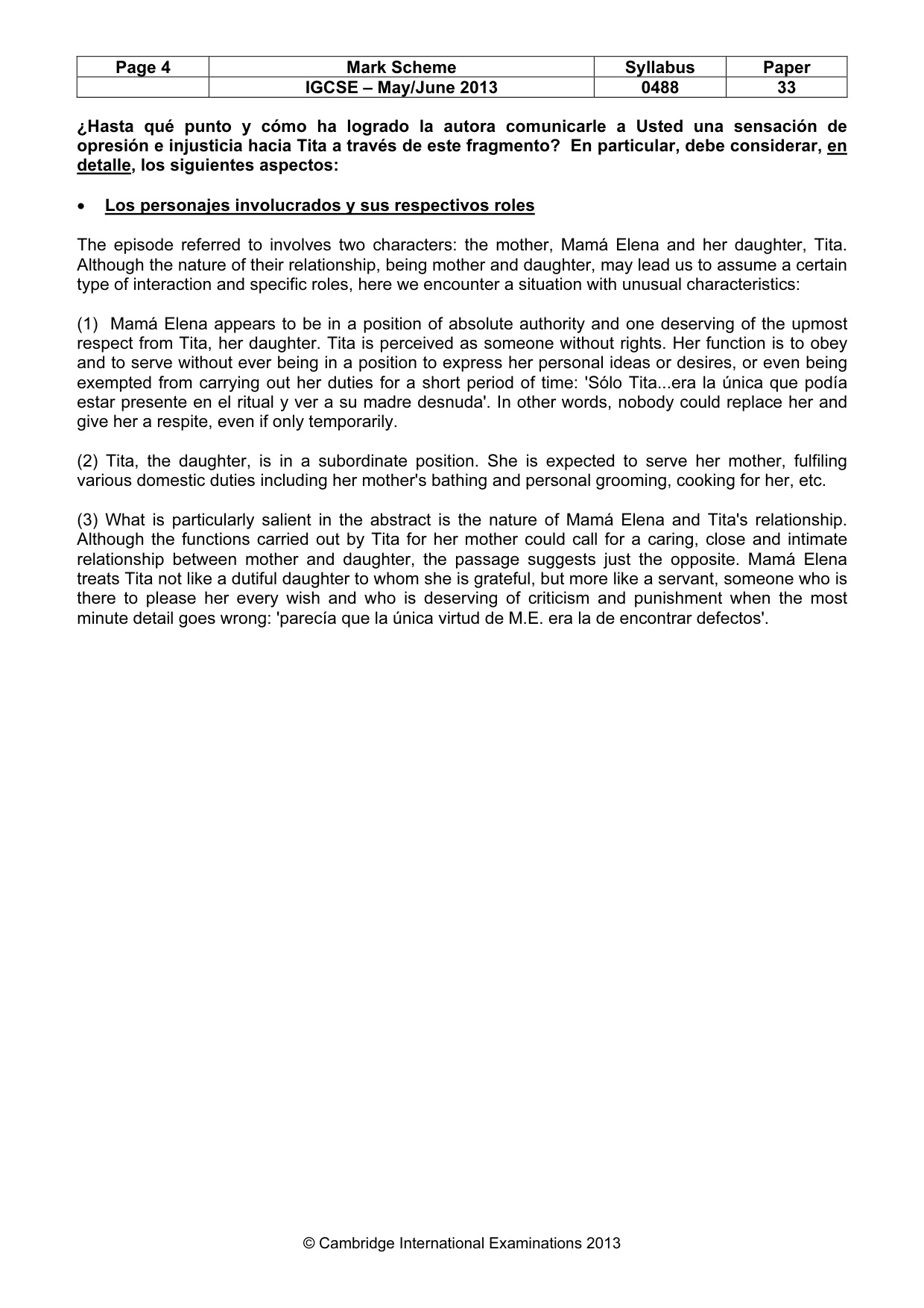
Page 4 Mark Scheme Syllabus Paper IGCSE – May/June 2013 0488 33 © Cambridge International Examinations 2013 ¿Hasta qué punto y cómo ha logrado la autora comunicarle a Usted una sensación de opresión e injusticia hacia Tita a través de este fragmento? En particular, debe considerar, en detalle, los siguientes aspectos: • Los personajes involucrados y sus respectivos roles The episode referred to involves two characters: the mother, Mamá Elena and her daughter, Tita. Although the nature of their relationship, being mother and daughter, may lead us to assume a certain type of interaction and specific roles, here we encounter a situation with unusual characteristics: (1) Mamá Elena appears to be in a position of absolute authority and one deserving of the upmost respect from Tita, her daughter. Tita is perceived as someone without rights. Her function is to obey and to serve without ever being in a position to express her personal ideas or desires, or even being exempted from carrying out her duties for a short period of time: 'Sólo Tita...era la única que podía estar presente en el ritual y ver a su madre desnuda'. In other words, nobody could replace her and give her a respite, even if only temporarily. (2) Tita, the daughter, is in a subordinate position. She is expected to serve her mother, fulfiling various domestic duties including her mother's bathing and personal grooming, cooking for her, etc. (3) What is particularly salient in the abstract is the nature of Mamá Elena and Tita's relationship. Although the functions carried out by Tita for her mother could call for a caring, close and intimate relationship between mother and daughter, the passage suggests just the opposite. Mamá Elena treats Tita not like a dutiful daughter to whom she is grateful, but more like a servant, someone who is there to please her every wish and who is deserving of criticism and punishment when the most minute detail goes wrong: 'parecía que la única virtud de M.E. era la de encontrar defectos'.
Mark scheme, page 5
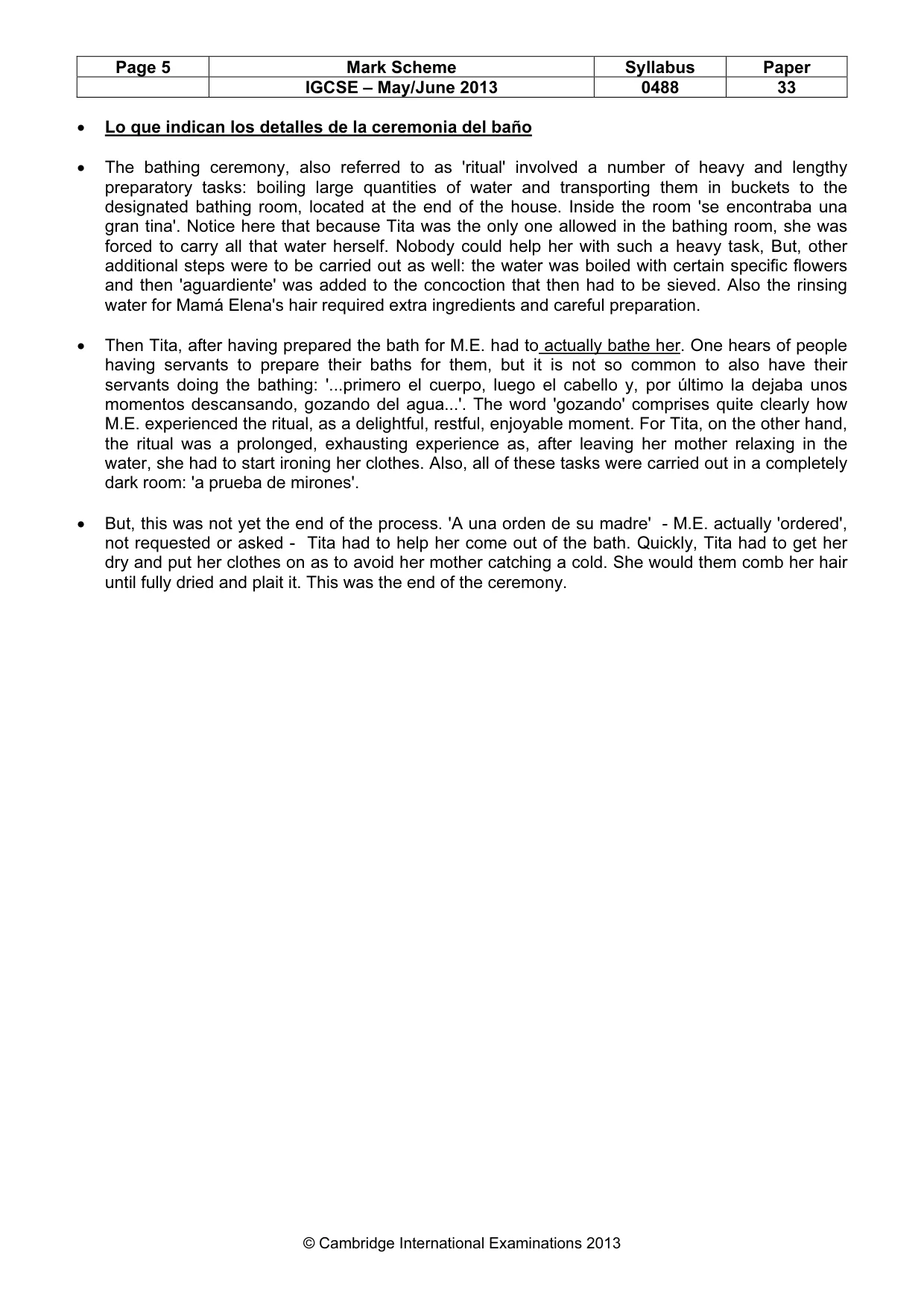
Page 5 Mark Scheme Syllabus Paper IGCSE – May/June 2013 0488 33 © Cambridge International Examinations 2013 • Lo que indican los detalles de la ceremonia del baño • The bathing ceremony, also referred to as 'ritual' involved a number of heavy and lengthy preparatory tasks: boiling large quantities of water and transporting them in buckets to the designated bathing room, located at the end of the house. Inside the room 'se encontraba una gran tina'. Notice here that because Tita was the only one allowed in the bathing room, she was forced to carry all that water herself. Nobody could help her with such a heavy task, But, other additional steps were to be carried out as well: the water was boiled with certain specific flowers and then 'aguardiente' was added to the concoction that then had to be sieved. Also the rinsing water for Mamá Elena's hair required extra ingredients and careful preparation. • Then Tita, after having prepared the bath for M.E. had to actually bathe her. One hears of people having servants to prepare their baths for them, but it is not so common to also have their servants doing the bathing: '...primero el cuerpo, luego el cabello y, por último la dejaba unos momentos descansando, gozando del agua...'. The word 'gozando' comprises quite clearly how M.E. experienced the ritual, as a delightful, restful, enjoyable moment. For Tita, on the other hand, the ritual was a prolonged, exhausting experience as, after leaving her mother relaxing in the water, she had to start ironing her clothes. Also, all of these tasks were carried out in a completely dark room: 'a prueba de mirones'. • But, this was not yet the end of the process. 'A una orden de su madre' - M.E. actually 'ordered', not requested or asked - Tita had to help her come out of the bath. Quickly, Tita had to get her dry and put her clothes on as to avoid her mother catching a cold. She would them comb her hair until fully dried and plait it. This was the end of the ceremony.
Mark scheme, page 6
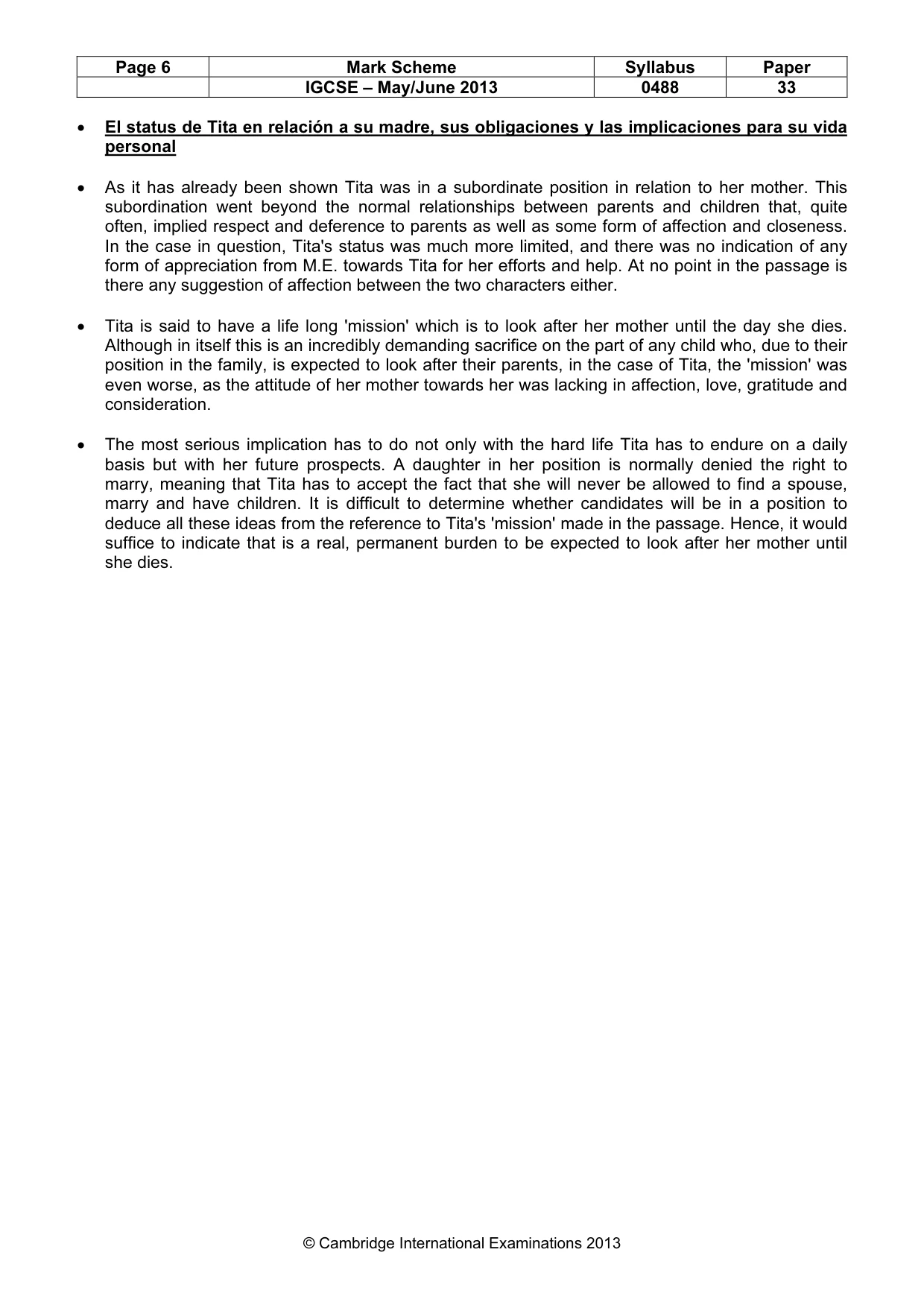
Page 6 Mark Scheme Syllabus Paper IGCSE – May/June 2013 0488 33 © Cambridge International Examinations 2013 • El status de Tita en relación a su madre, sus obligaciones y las implicaciones para su vida personal • As it has already been shown Tita was in a subordinate position in relation to her mother. This subordination went beyond the normal relationships between parents and children that, quite often, implied respect and deference to parents as well as some form of affection and closeness. In the case in question, Tita's status was much more limited, and there was no indication of any form of appreciation from M.E. towards Tita for her efforts and help. At no point in the passage is there any suggestion of affection between the two characters either. • Tita is said to have a life long 'mission' which is to look after her mother until the day she dies. Although in itself this is an incredibly demanding sacrifice on the part of any child who, due to their position in the family, is expected to look after their parents, in the case of Tita, the 'mission' was even worse, as the attitude of her mother towards her was lacking in affection, love, gratitude and consideration. • The most serious implication has to do not only with the hard life Tita has to endure on a daily basis but with her future prospects. A daughter in her position is normally denied the right to marry, meaning that Tita has to accept the fact that she will never be allowed to find a spouse, marry and have children. It is difficult to determine whether candidates will be in a position to deduce all these ideas from the reference to Tita's 'mission' made in the passage. Hence, it would suffice to indicate that is a real, permanent burden to be expected to look after her mother until she dies.
Mark scheme, page 7
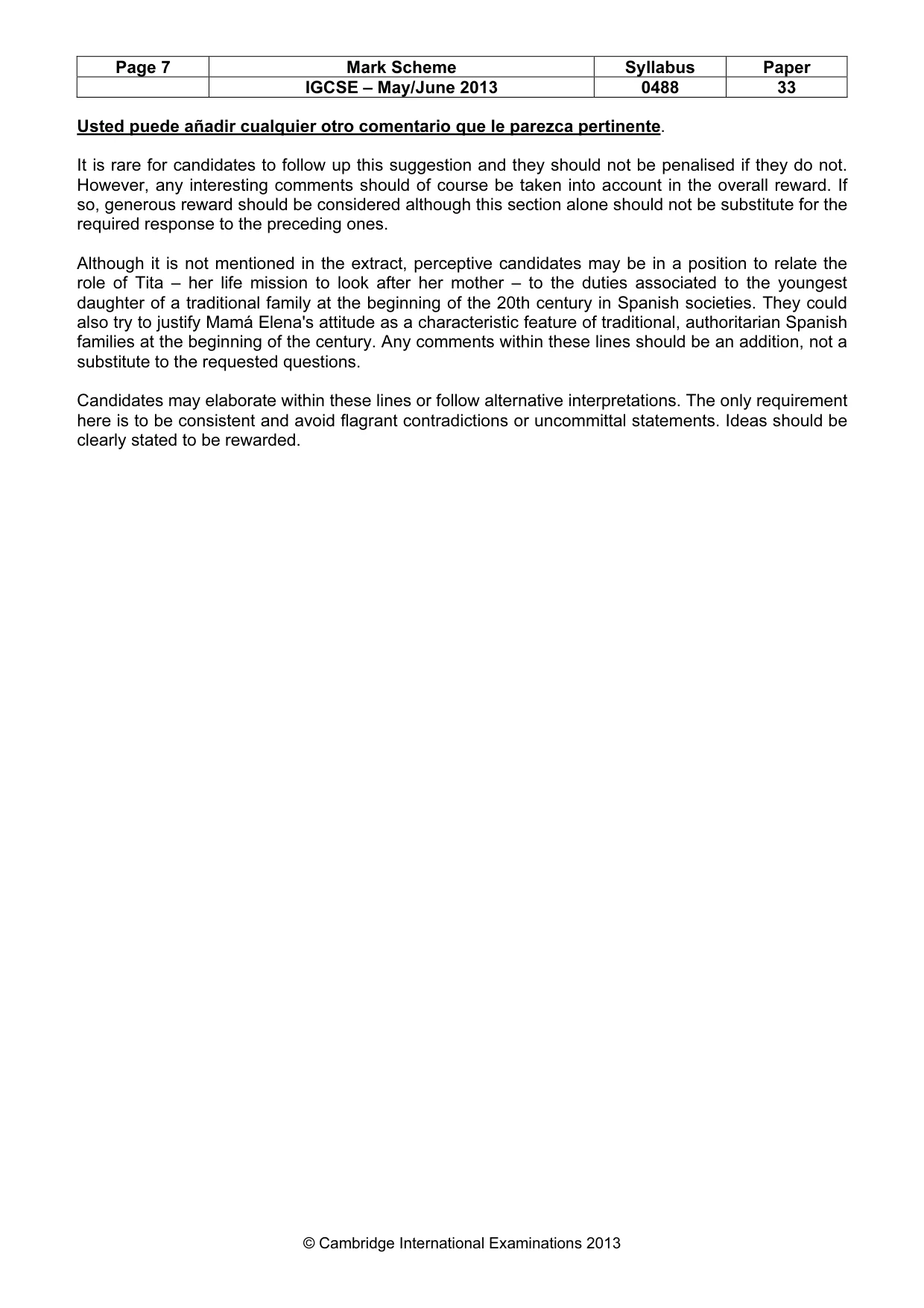
Page 7 Mark Scheme Syllabus Paper IGCSE – May/June 2013 0488 33 © Cambridge International Examinations 2013 Usted puede añadir cualquier otro comentario que le parezca pertinente. It is rare for candidates to follow up this suggestion and they should not be penalised if they do not. However, any interesting comments should of course be taken into account in the overall reward. If so, generous reward should be considered although this section alone should not be substitute for the required response to the preceding ones. Although it is not mentioned in the extract, perceptive candidates may be in a position to relate the role of Tita – her life mission to look after her mother – to the duties associated to the youngest daughter of a traditional family at the beginning of the 20th century in Spanish societies. They could also try to justify Mamá Elena's attitude as a characteristic feature of traditional, authoritarian Spanish families at the beginning of the century. Any comments within these lines should be an addition, not a substitute to the requested questions. Candidates may elaborate within these lines or follow alternative interpretations. The only requirement here is to be consistent and avoid flagrant contradictions or uncommittal statements. Ideas should be clearly stated to be rewarded.
What you needed in this session
Cambridge’s own grade thresholds for 2013 May/June, Paper 3 · Variant 3. A higher threshold means an easier paper — the bar moves with how the cohort did.