Cambridge IGCSE Spanish - Literature 0488 — 2013 May/June Paper 3 · Variant 1
0488/31/M/J/13 · 20 marks · ≈23 min
The question paper and its mark scheme, free to read here and free to download. This is Cambridge’s own paper, exactly as it was sat.
Question paper4 pages
Mark scheme5 pages
Answers below. Sit the paper first if you are practising.
Paper as text
Question paper, page 1
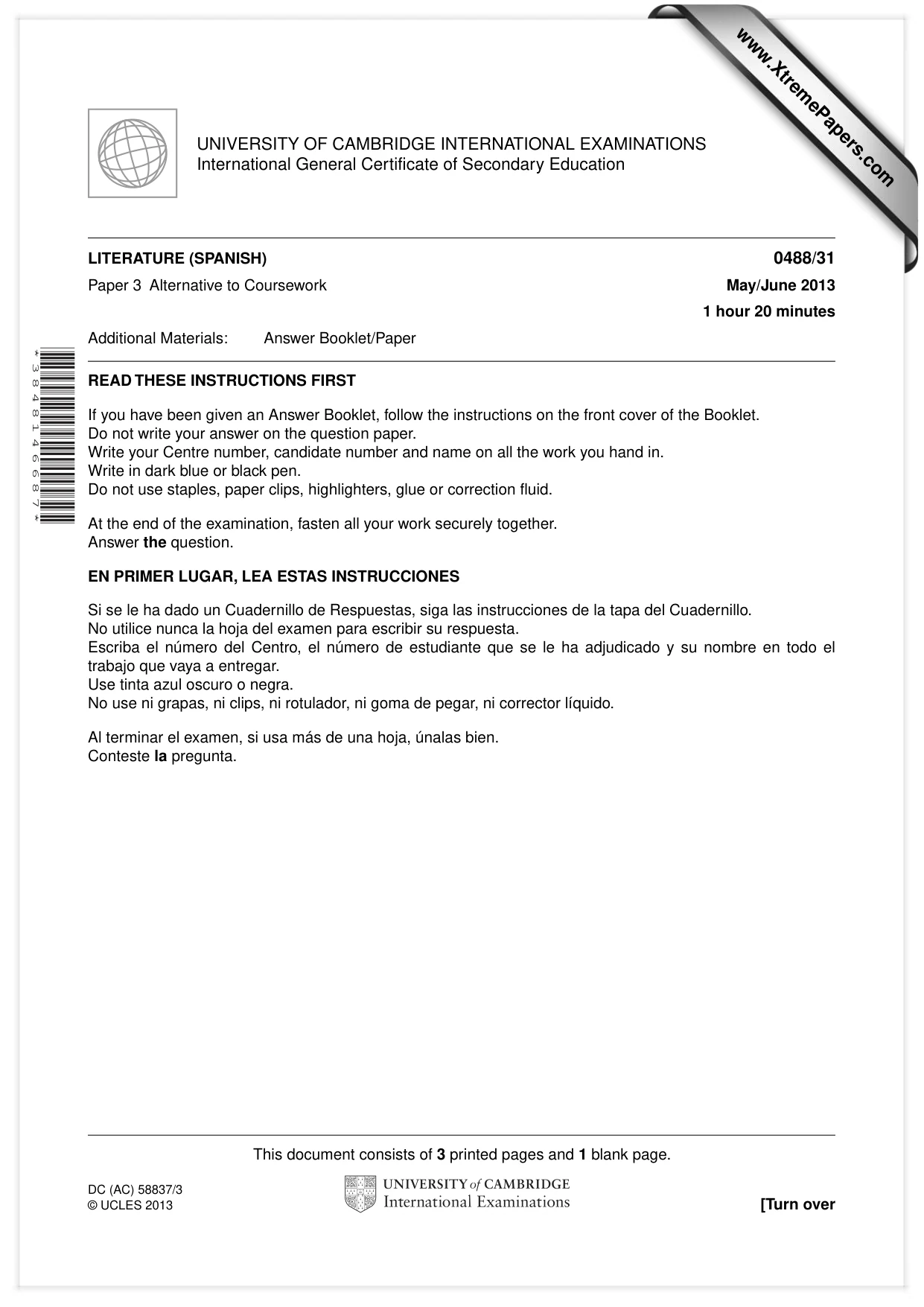
This document consists of 3 printed pages and 1 blank page. DC (AC) 58837/3 © UCLES 2013 [Turn over UNIVERSITY OF CAMBRIDGE INTERNATIONAL EXAMINATIONS International General Certificate of Secondary Education * 3 8 4 8 1 4 6 6 8 7 * LITERATURE (SPANISH) 0488/31 Paper 3 Alternative to Coursework May/June 2013 1 hour 20 minutes Additional Materials: Answer Booklet/Paper READ THESE INSTRUCTIONS FIRST If you have been given an Answer Booklet, follow the instructions on the front cover of the Booklet. Do not write your answer on the question paper. Write your Centre number, candidate number and name on all the work you hand in. Write in dark blue or black pen. Do not use staples, paper clips, highlighters, glue or correction fluid. At the end of the examination, fasten all your work securely together. Answer the question. EN PRIMER LUGAR, LEA ESTAS INSTRUCCIONES Si se le ha dado un Cuadernillo de Respuestas, siga las instrucciones de la tapa del Cuadernillo. No utilice nunca la hoja del examen para escribir su respuesta. Escriba el número del Centro, el número de estudiante que se le ha adjudicado y su nombre en todo el trabajo que vaya a entregar. Use tinta azul oscuro o negra. No use ni grapas, ni clips, ni rotulador, ni goma de pegar, ni corrector líquido. Al terminar el examen, si usa más de una hoja, únalas bien. Conteste la pregunta. www.XtremePapers.com
Question paper, page 2
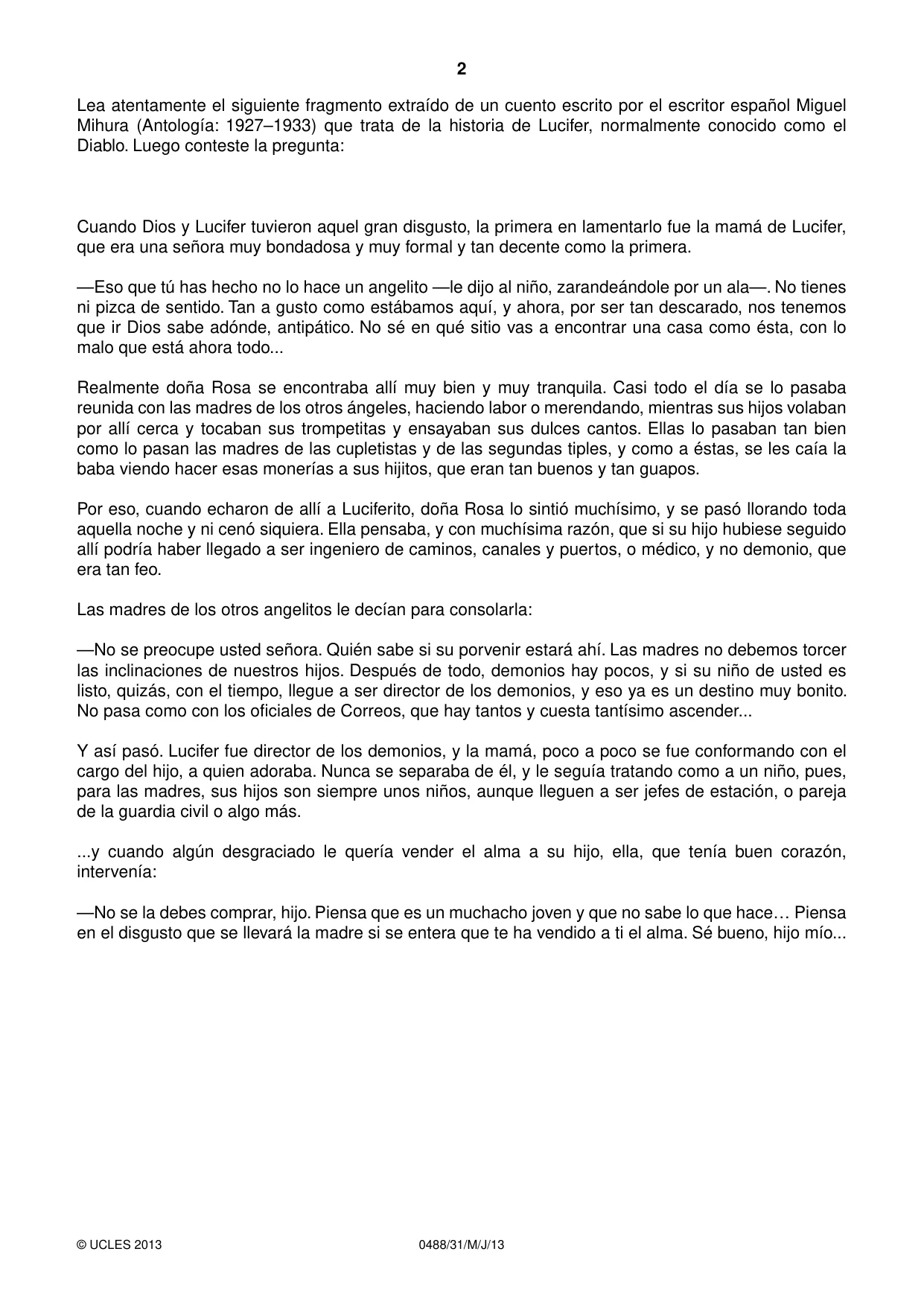
2 0488/31/M/J/13 © UCLES 2013 Lea atentamente el siguiente fragmento extraído de un cuento escrito por el escritor español Miguel Mihura (Antología: 1927–1933) que trata de la historia de Lucifer, normalmente conocido como el Diablo. Luego conteste la pregunta: Cuando Dios y Lucifer tuvieron aquel gran disgusto, la primera en lamentarlo fue la mamá de Lucifer, que era una señora muy bondadosa y muy formal y tan decente como la primera. —Eso que tú has hecho no lo hace un angelito —le dijo al niño, zarandeándole por un ala—. No tienes ni pizca de sentido. Tan a gusto como estábamos aquí, y ahora, por ser tan descarado, nos tenemos que ir Dios sabe adónde, antipático. No sé en qué sitio vas a encontrar una casa como ésta, con lo malo que está ahora todo... Realmente doña Rosa se encontraba allí muy bien y muy tranquila. Casi todo el día se lo pasaba reunida con las madres de los otros ángeles, haciendo labor o merendando, mientras sus hijos volaban por allí cerca y tocaban sus trompetitas y ensayaban sus dulces cantos. Ellas lo pasaban tan bien como lo pasan las madres de las cupletistas y de las segundas tiples, y como a éstas, se les caía la baba viendo hacer esas monerías a sus hijitos, que eran tan buenos y tan guapos. Por eso, cuando echaron de allí a Luciferito, doña Rosa lo sintió muchísimo, y se pasó llorando toda aquella noche y ni cenó siquiera. Ella pensaba, y con muchísima razón, que si su hijo hubiese seguido allí podría haber llegado a ser ingeniero de caminos, canales y puertos, o médico, y no demonio, que era tan feo. Las madres de los otros angelitos le decían para consolarla: —No se preocupe usted señora. Quién sabe si su porvenir estará ahí. Las madres no debemos torcer las inclinaciones de nuestros hijos. Después de todo, demonios hay pocos, y si su niño de usted es listo, quizás, con el tiempo, llegue a ser director de los demonios, y eso ya es un destino muy bonito. No pasa como con los oficiales de Correos, que hay tantos y cuesta tantísimo ascender... Y así pasó. Lucifer fue director de los demonios, y la mamá, poco a poco se fue conformando con el cargo del hijo, a quien adoraba. Nunca se separaba de él, y le seguía tratando como a un niño, pues, para las madres, sus hijos son siempre unos niños, aunque lleguen a ser jefes de estación, o pareja de la guardia civil o algo más. ...y cuando algún desgraciado le quería vender el alma a su hijo, ella, que tenía buen corazón, intervenía: —No se la debes comprar, hijo. Piensa que es un muchacho joven y que no sabe lo que hace… Piensa en el disgusto que se llevará la madre si se entera que te ha vendido a ti el alma. Sé bueno, hijo mío...
Question paper, page 3
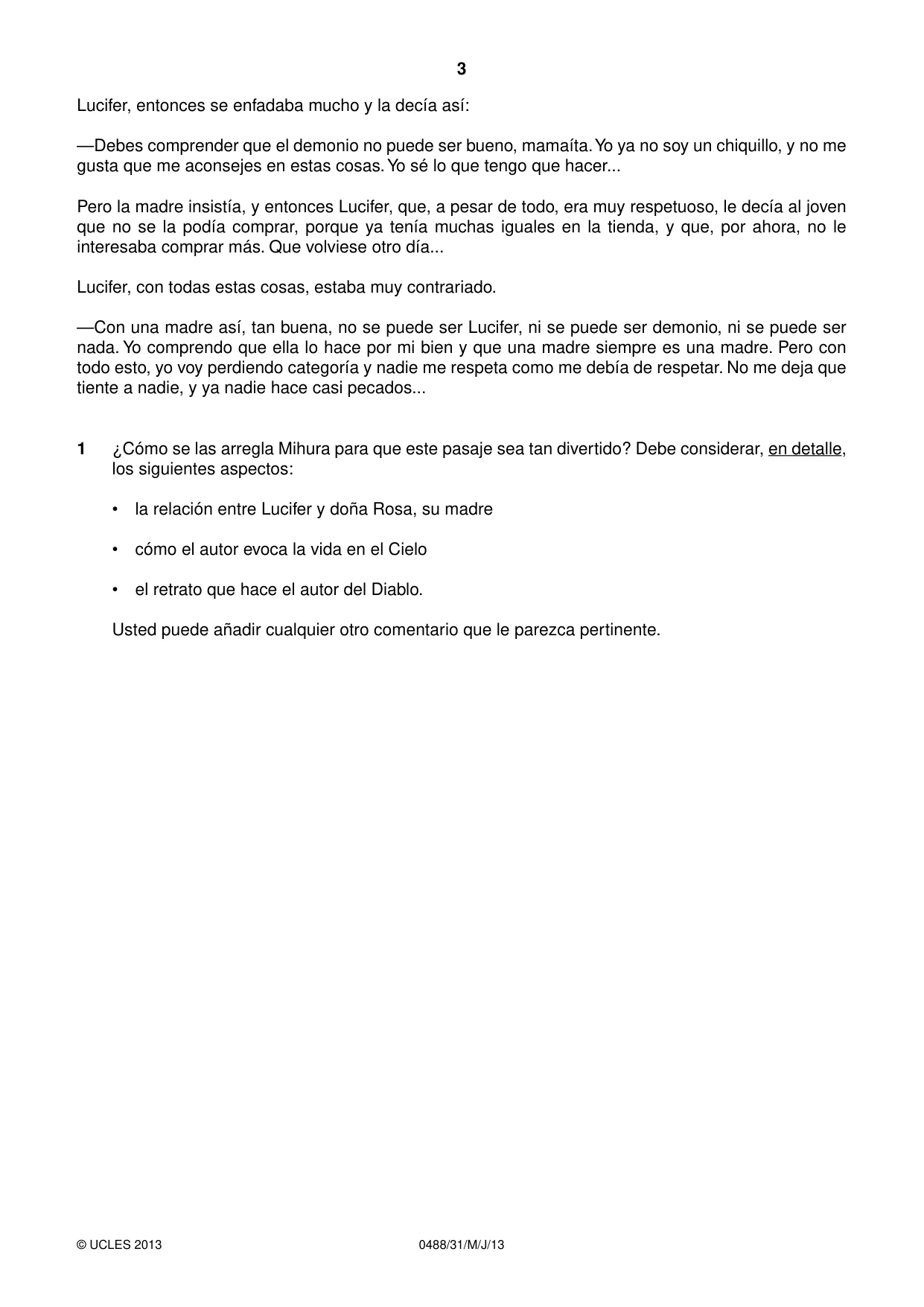
3 0488/31/M/J/13 © UCLES 2013 Lucifer, entonces se enfadaba mucho y la decía así: —Debes comprender que el demonio no puede ser bueno, mamaíta. Yo ya no soy un chiquillo, y no me gusta que me aconsejes en estas cosas. Yo sé lo que tengo que hacer... Pero la madre insistía, y entonces Lucifer, que, a pesar de todo, era muy respetuoso, le decía al joven que no se la podía comprar, porque ya tenía muchas iguales en la tienda, y que, por ahora, no le interesaba comprar más. Que volviese otro día... Lucifer, con todas estas cosas, estaba muy contrariado. —Con una madre así, tan buena, no se puede ser Lucifer, ni se puede ser demonio, ni se puede ser nada. Yo comprendo que ella lo hace por mi bien y que una madre siempre es una madre. Pero con todo esto, yo voy perdiendo categoría y nadie me respeta como me debía de respetar. No me deja que tiente a nadie, y ya nadie hace casi pecados... 1 ¿Cómo se las arregla Mihura para que este pasaje sea tan divertido? Debe considerar, en detalle, los siguientes aspectos: • la relación entre Lucifer y doña Rosa, su madre • cómo el autor evoca la vida en el Cielo • el retrato que hace el autor del Diablo. Usted puede añadir cualquier otro comentario que le parezca pertinente.
Question paper, page 4
4 0488/31/M/J/13 © UCLES 2013 Copyright Acknowledgements: Question 1 © Mihura; Antologia 1927-1933; Verdaderamente, con una madre así, tan buena, no se puede ser Lucifer, ni se puede ser demonio, ni se puede ser nada; Editorial Prensa Española, S.A.; 1978. Permission to reproduce items where third-party owned material protected by copyright is included has been sought and cleared where possible. Every reasonable effort has been made by the publisher (UCLES) to trace copyright holders, but if any items requiring clearance have unwittingly been included, the publisher will be pleased to make amends at the earliest possible opportunity. University of Cambridge International Examinations is part of the Cambridge Assessment Group. Cambridge Assessment is the brand name of University of Cambridge Local Examinations Syndicate (UCLES), which is itself a department of the University of Cambridge. BLANK PAGE
Mark scheme, page 1
CAMBRIDGE INTERNATIONAL EXAMINATIONS International General Certificate of Secondary Education MARK SCHEME for the May/June 2013 series 0488 LITERATURE (SPANISH) 0488/31 Paper 3 (Alternative to Coursework), maximum raw mark 20 This mark scheme is published as an aid to teachers and candidates, to indicate the requirements of the examination. It shows the basis on which Examiners were instructed to award marks. It does not indicate the details of the discussions that took place at an Examiners’ meeting before marking began, which would have considered the acceptability of alternative answers. Mark schemes should be read in conjunction with the question paper and the Principal Examiner Report for Teachers. Cambridge will not enter into discussions about these mark schemes. Cambridge is publishing the mark schemes for the May/June 2013 series for most IGCSE, GCE Advanced Level and Advanced Subsidiary Level components and some Ordinary Level components. www.XtremePapers.com
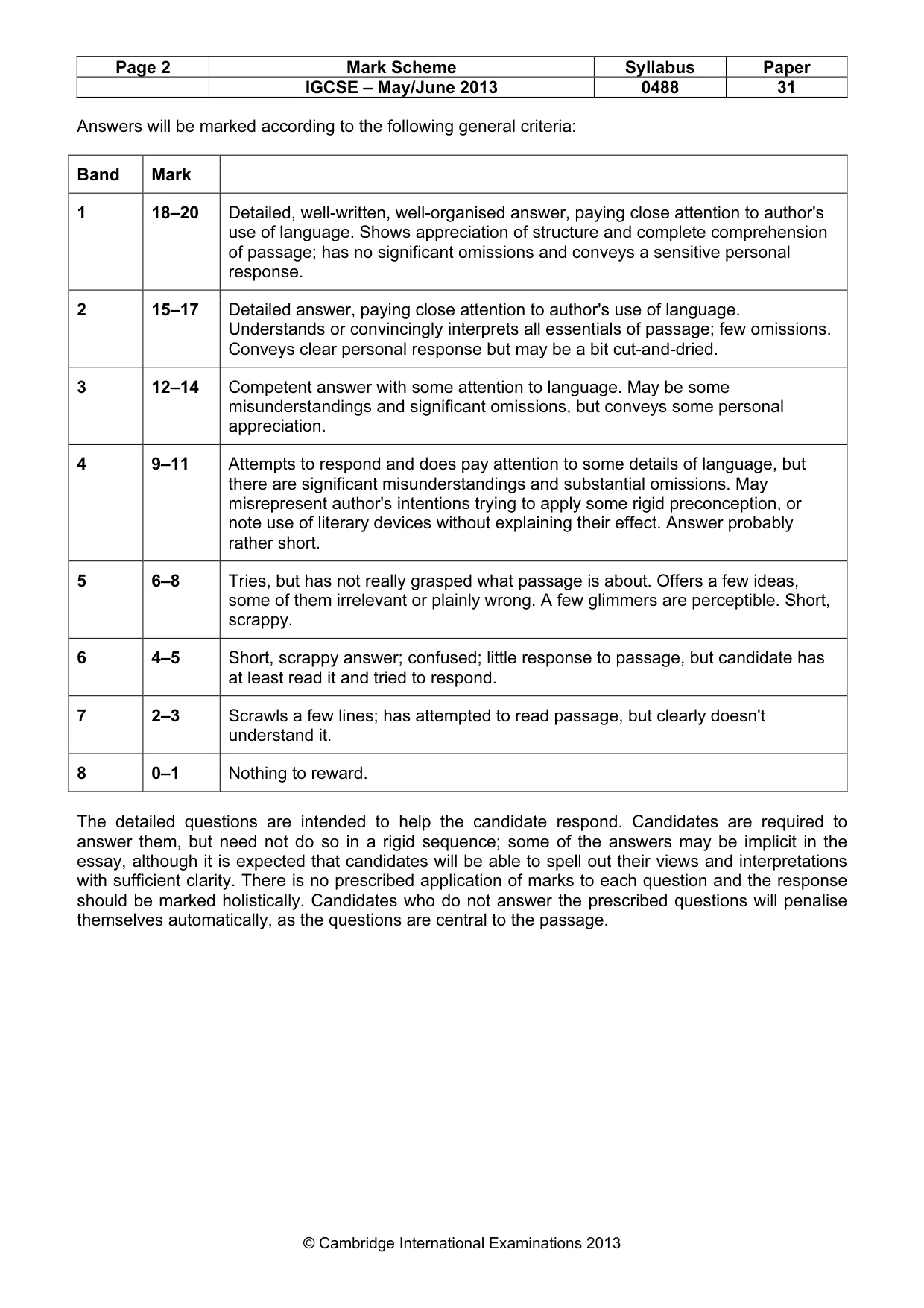
Mark scheme, page 2
Page 2 Mark Scheme Syllabus Paper IGCSE – May/June 2013 0488 31 © Cambridge International Examinations 2013 Answers will be marked according to the following general criteria: Band Mark 1 18–20 Detailed, well-written, well-organised answer, paying close attention to author's use of language. Shows appreciation of structure and complete comprehension of passage; has no significant omissions and conveys a sensitive personal response. 2 15–17 Detailed answer, paying close attention to author's use of language. Understands or convincingly interprets all essentials of passage; few omissions. Conveys clear personal response but may be a bit cut-and-dried. 3 12–14 Competent answer with some attention to language. May be some misunderstandings and significant omissions, but conveys some personal appreciation. 4 9–11 Attempts to respond and does pay attention to some details of language, but there are significant misunderstandings and substantial omissions. May misrepresent author's intentions trying to apply some rigid preconception, or note use of literary devices without explaining their effect. Answer probably rather short. 5 6–8 Tries, but has not really grasped what passage is about. Offers a few ideas, some of them irrelevant or plainly wrong. A few glimmers are perceptible. Short, scrappy. 6 4–5 Short, scrappy answer; confused; little response to passage, but candidate has at least read it and tried to respond. 7 2–3 Scrawls a few lines; has attempted to read passage, but clearly doesn't understand it. 8 0–1 Nothing to reward. The detailed questions are intended to help the candidate respond. Candidates are required to answer them, but need not do so in a rigid sequence; some of the answers may be implicit in the essay, although it is expected that candidates will be able to spell out their views and interpretations with sufficient clarity. There is no prescribed application of marks to each question and the response should be marked holistically. Candidates who do not answer the prescribed questions will penalise themselves automatically, as the questions are central to the passage.
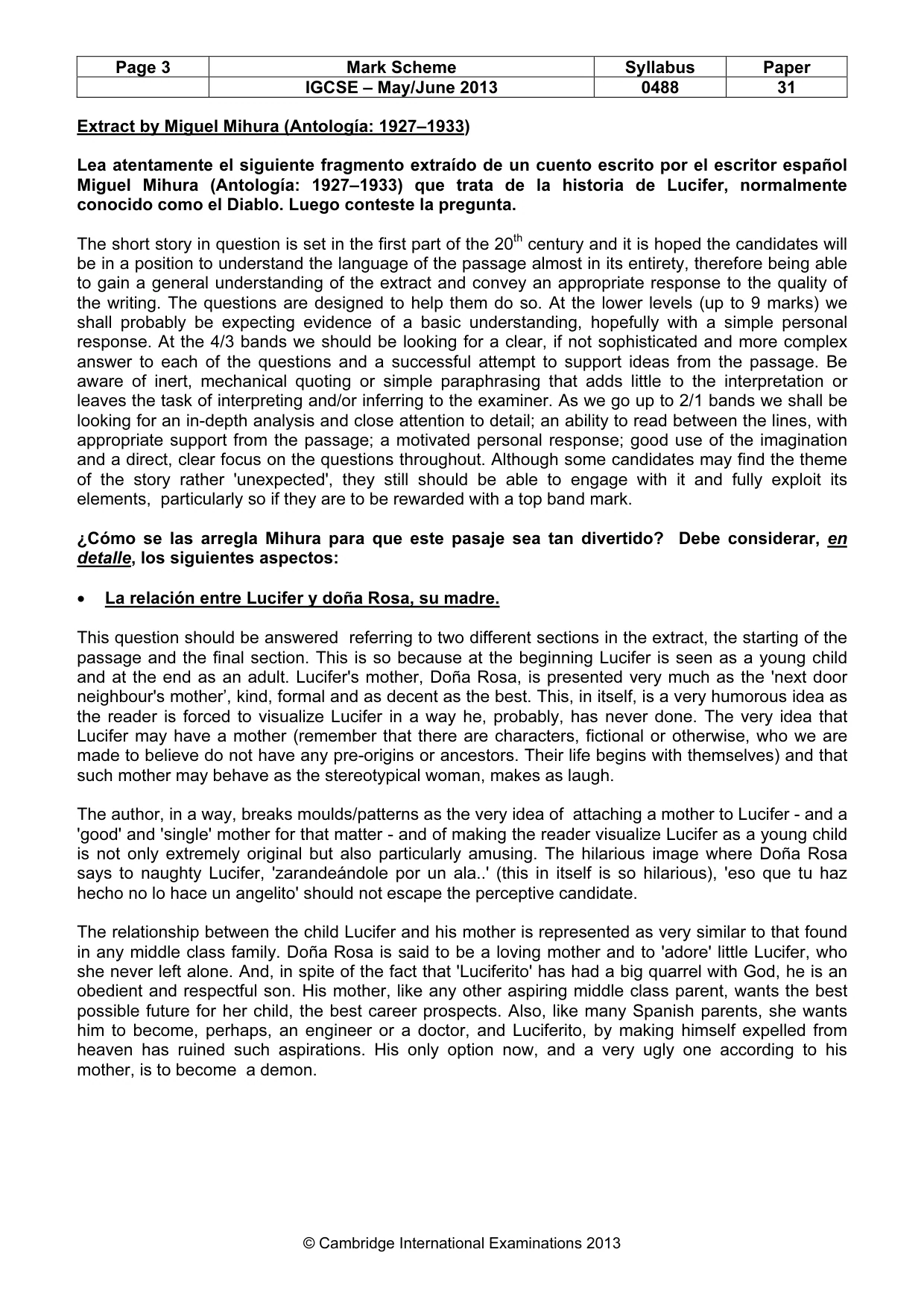
Mark scheme, page 3
Page 3 Mark Scheme Syllabus Paper IGCSE – May/June 2013 0488 31 © Cambridge International Examinations 2013 Extract by Miguel Mihura (Antología: 1927–1933) Lea atentamente el siguiente fragmento extraído de un cuento escrito por el escritor español Miguel Mihura (Antología: 1927–1933) que trata de la historia de Lucifer, normalmente conocido como el Diablo. Luego conteste la pregunta. The short story in question is set in the first part of the 20th century and it is hoped the candidates will be in a position to understand the language of the passage almost in its entirety, therefore being able to gain a general understanding of the extract and convey an appropriate response to the quality of the writing. The questions are designed to help them do so. At the lower levels (up to 9 marks) we shall probably be expecting evidence of a basic understanding, hopefully with a simple personal response. At the 4/3 bands we should be looking for a clear, if not sophisticated and more complex answer to each of the questions and a successful attempt to support ideas from the passage. Be aware of inert, mechanical quoting or simple paraphrasing that adds little to the interpretation or leaves the task of interpreting and/or inferring to the examiner. As we go up to 2/1 bands we shall be looking for an in-depth analysis and close attention to detail; an ability to read between the lines, with appropriate support from the passage; a motivated personal response; good use of the imagination and a direct, clear focus on the questions throughout. Although some candidates may find the theme of the story rather 'unexpected', they still should be able to engage with it and fully exploit its elements, particularly so if they are to be rewarded with a top band mark. ¿Cómo se las arregla Mihura para que este pasaje sea tan divertido? Debe considerar, en detalle, los siguientes aspectos: • La relación entre Lucifer y doña Rosa, su madre. This question should be answered referring to two different sections in the extract, the starting of the passage and the final section. This is so because at the beginning Lucifer is seen as a young child and at the end as an adult. Lucifer's mother, Doña Rosa, is presented very much as the 'next door neighbour's mother’, kind, formal and as decent as the best. This, in itself, is a very humorous idea as the reader is forced to visualize Lucifer in a way he, probably, has never done. The very idea that Lucifer may have a mother (remember that there are characters, fictional or otherwise, who we are made to believe do not have any pre-origins or ancestors. Their life begins with themselves) and that such mother may behave as the stereotypical woman, makes as laugh. The author, in a way, breaks moulds/patterns as the very idea of attaching a mother to Lucifer - and a 'good' and 'single' mother for that matter - and of making the reader visualize Lucifer as a young child is not only extremely original but also particularly amusing. The hilarious image where Doña Rosa says to naughty Lucifer, 'zarandeándole por un ala..' (this in itself is so hilarious), 'eso que tu haz hecho no lo hace un angelito' should not escape the perceptive candidate. The relationship between the child Lucifer and his mother is represented as very similar to that found in any middle class family. Doña Rosa is said to be a loving mother and to 'adore' little Lucifer, who she never left alone. And, in spite of the fact that 'Luciferito' has had a big quarrel with God, he is an obedient and respectful son. His mother, like any other aspiring middle class parent, wants the best possible future for her child, the best career prospects. Also, like many Spanish parents, she wants him to become, perhaps, an engineer or a doctor, and Luciferito, by making himself expelled from heaven has ruined such aspirations. His only option now, and a very ugly one according to his mother, is to become a demon.
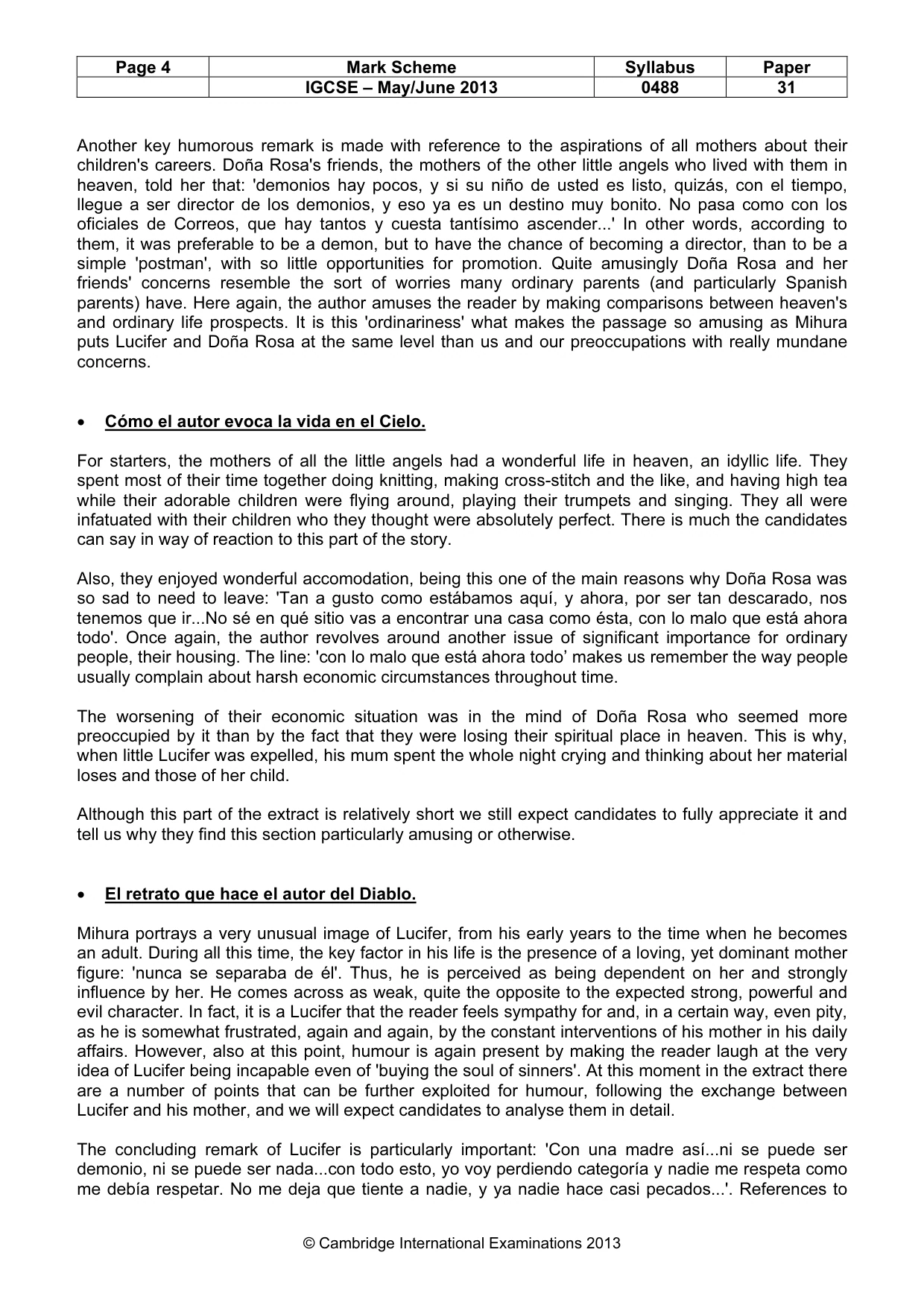
Mark scheme, page 4
Page 4 Mark Scheme Syllabus Paper IGCSE – May/June 2013 0488 31 © Cambridge International Examinations 2013 Another key humorous remark is made with reference to the aspirations of all mothers about their children's careers. Doña Rosa's friends, the mothers of the other little angels who lived with them in heaven, told her that: 'demonios hay pocos, y si su niño de usted es listo, quizás, con el tiempo, llegue a ser director de los demonios, y eso ya es un destino muy bonito. No pasa como con los oficiales de Correos, que hay tantos y cuesta tantísimo ascender...' In other words, according to them, it was preferable to be a demon, but to have the chance of becoming a director, than to be a simple 'postman', with so little opportunities for promotion. Quite amusingly Doña Rosa and her friends' concerns resemble the sort of worries many ordinary parents (and particularly Spanish parents) have. Here again, the author amuses the reader by making comparisons between heaven's and ordinary life prospects. It is this 'ordinariness' what makes the passage so amusing as Mihura puts Lucifer and Doña Rosa at the same level than us and our preoccupations with really mundane concerns. • Cómo el autor evoca la vida en el Cielo. For starters, the mothers of all the little angels had a wonderful life in heaven, an idyllic life. They spent most of their time together doing knitting, making cross-stitch and the like, and having high tea while their adorable children were flying around, playing their trumpets and singing. They all were infatuated with their children who they thought were absolutely perfect. There is much the candidates can say in way of reaction to this part of the story. Also, they enjoyed wonderful accomodation, being this one of the main reasons why Doña Rosa was so sad to need to leave: 'Tan a gusto como estábamos aquí, y ahora, por ser tan descarado, nos tenemos que ir...No sé en qué sitio vas a encontrar una casa como ésta, con lo malo que está ahora todo'. Once again, the author revolves around another issue of significant importance for ordinary people, their housing. The line: 'con lo malo que está ahora todo’ makes us remember the way people usually complain about harsh economic circumstances throughout time. The worsening of their economic situation was in the mind of Doña Rosa who seemed more preoccupied by it than by the fact that they were losing their spiritual place in heaven. This is why, when little Lucifer was expelled, his mum spent the whole night crying and thinking about her material loses and those of her child. Although this part of the extract is relatively short we still expect candidates to fully appreciate it and tell us why they find this section particularly amusing or otherwise. • El retrato que hace el autor del Diablo. Mihura portrays a very unusual image of Lucifer, from his early years to the time when he becomes an adult. During all this time, the key factor in his life is the presence of a loving, yet dominant mother figure: 'nunca se separaba de él'. Thus, he is perceived as being dependent on her and strongly influence by her. He comes across as weak, quite the opposite to the expected strong, powerful and evil character. In fact, it is a Lucifer that the reader feels sympathy for and, in a certain way, even pity, as he is somewhat frustrated, again and again, by the constant interventions of his mother in his daily affairs. However, also at this point, humour is again present by making the reader laugh at the very idea of Lucifer being incapable even of 'buying the soul of sinners'. At this moment in the extract there are a number of points that can be further exploited for humour, following the exchange between Lucifer and his mother, and we will expect candidates to analyse them in detail. The concluding remark of Lucifer is particularly important: 'Con una madre así...ni se puede ser demonio, ni se puede ser nada...con todo esto, yo voy perdiendo categoría y nadie me respeta como me debía respetar. No me deja que tiente a nadie, y ya nadie hace casi pecados...'. References to
Mark scheme, page 5
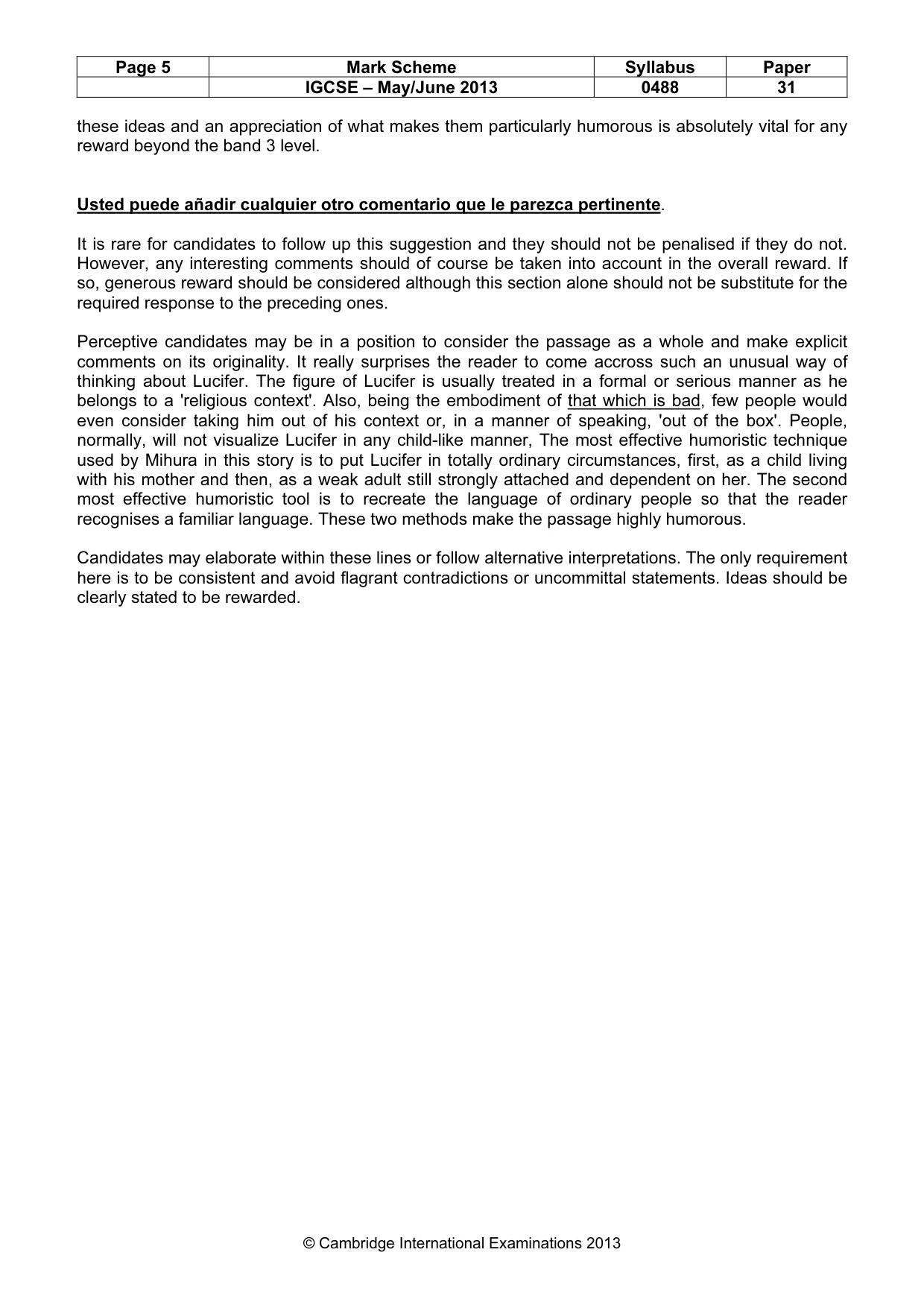
Page 5 Mark Scheme Syllabus Paper IGCSE – May/June 2013 0488 31 © Cambridge International Examinations 2013 these ideas and an appreciation of what makes them particularly humorous is absolutely vital for any reward beyond the band 3 level. Usted puede añadir cualquier otro comentario que le parezca pertinente. It is rare for candidates to follow up this suggestion and they should not be penalised if they do not. However, any interesting comments should of course be taken into account in the overall reward. If so, generous reward should be considered although this section alone should not be substitute for the required response to the preceding ones. Perceptive candidates may be in a position to consider the passage as a whole and make explicit comments on its originality. It really surprises the reader to come accross such an unusual way of thinking about Lucifer. The figure of Lucifer is usually treated in a formal or serious manner as he belongs to a 'religious context'. Also, being the embodiment of that which is bad, few people would even consider taking him out of his context or, in a manner of speaking, 'out of the box'. People, normally, will not visualize Lucifer in any child-like manner, The most effective humoristic technique used by Mihura in this story is to put Lucifer in totally ordinary circumstances, first, as a child living with his mother and then, as a weak adult still strongly attached and dependent on her. The second most effective humoristic tool is to recreate the language of ordinary people so that the reader recognises a familiar language. These two methods make the passage highly humorous. Candidates may elaborate within these lines or follow alternative interpretations. The only requirement here is to be consistent and avoid flagrant contradictions or uncommittal statements. Ideas should be clearly stated to be rewarded.
What you needed in this session
Cambridge’s own grade thresholds for 2013 May/June, Paper 3 · Variant 1. A higher threshold means an easier paper — the bar moves with how the cohort did.