Cambridge IGCSE Spanish - Foreign Language 0530 — 2024 May/June Paper 2 · Variant 2
0530/22/M/J/24 · 45 marks · ≈51 min
The question paper and its mark scheme, free to read here and free to download. This is Cambridge’s own paper, exactly as it was sat.
Question paper12 pages

Mark scheme12 pages
Answers below. Sit the paper first if you are practising.
Paper as text
Question paper, page 1
This document has 12 pages. Any blank pages are indicated. [Turn over DC (JP/FC) 335368/3 © UCLES 2024 * 9 7 7 7 3 8 2 8 5 2 * SPANISH 0530/22 Paper 2 Reading May/June 2024 1 hour You must answer on the question paper. No additional materials are needed. INSTRUCTIONS ● Answer all questions. ● Use a black or dark blue pen. ● Write your name, centre number and candidate number in the boxes at the top of the page. ● Write your answer to each question in the space provided. ● Do not use an erasable pen or correction fluid. ● Do not write on any bar codes. ● Dictionaries are not allowed. INFORMATION ● The total mark for this paper is 45. ● The number of marks for each question or part question is shown in brackets [ ]. Cambridge IGCSE™
Question paper, page 2
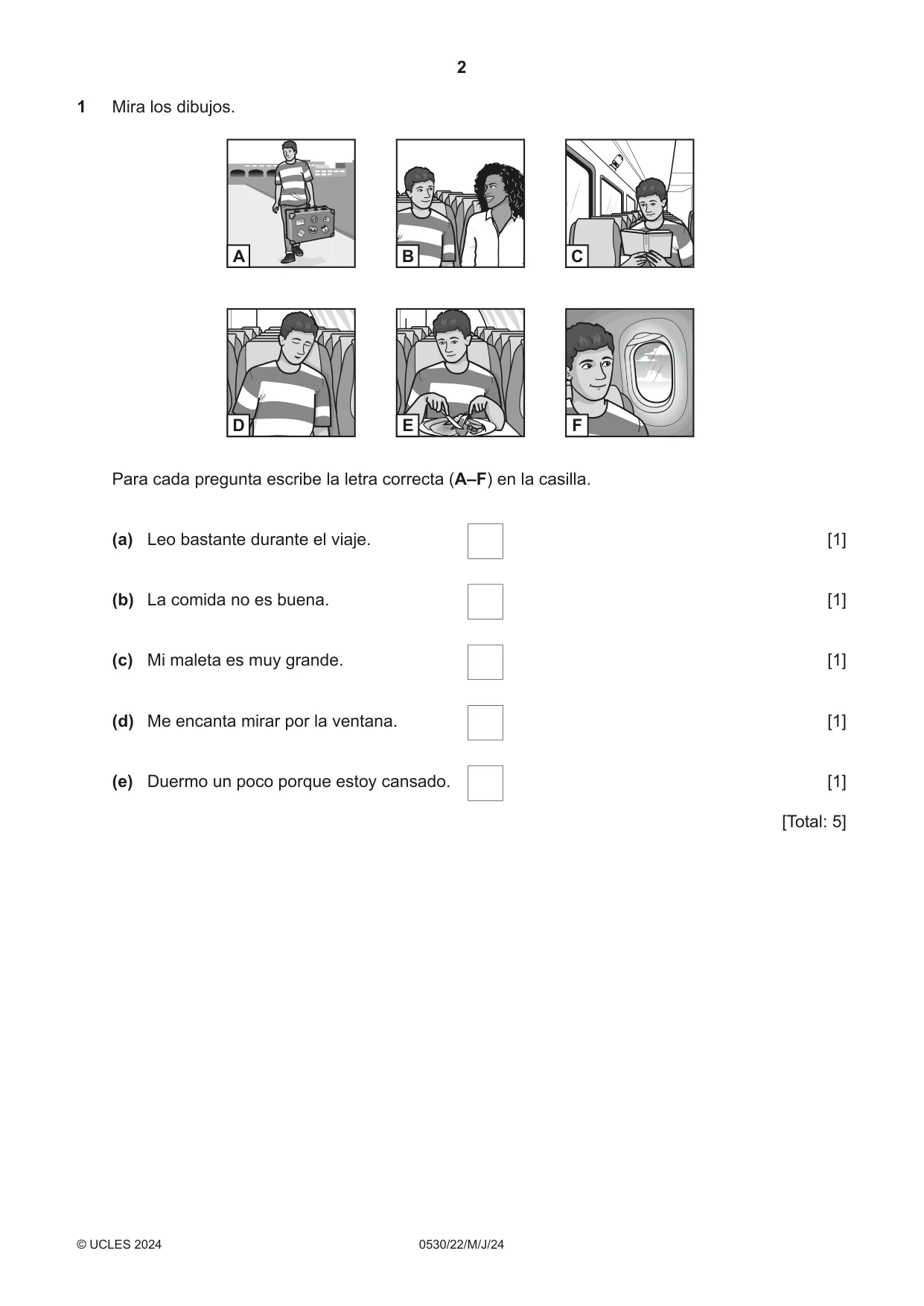
2 0530/22/ M/J/24 © UCLES 2024 1 Mira los dibujos. A B C D E F Para cada pregunta escribe la letra correcta (A–F) en la casilla. (a) Leo bastante durante el viaje. [1] (b) La comida no es buena. [1] (c) Mi maleta es muy grande. [1] (d) Me encanta mirar por la ventana. [1] (e) Duermo un poco porque estoy cansado. [1] [Total: 5]
Question paper, page 3
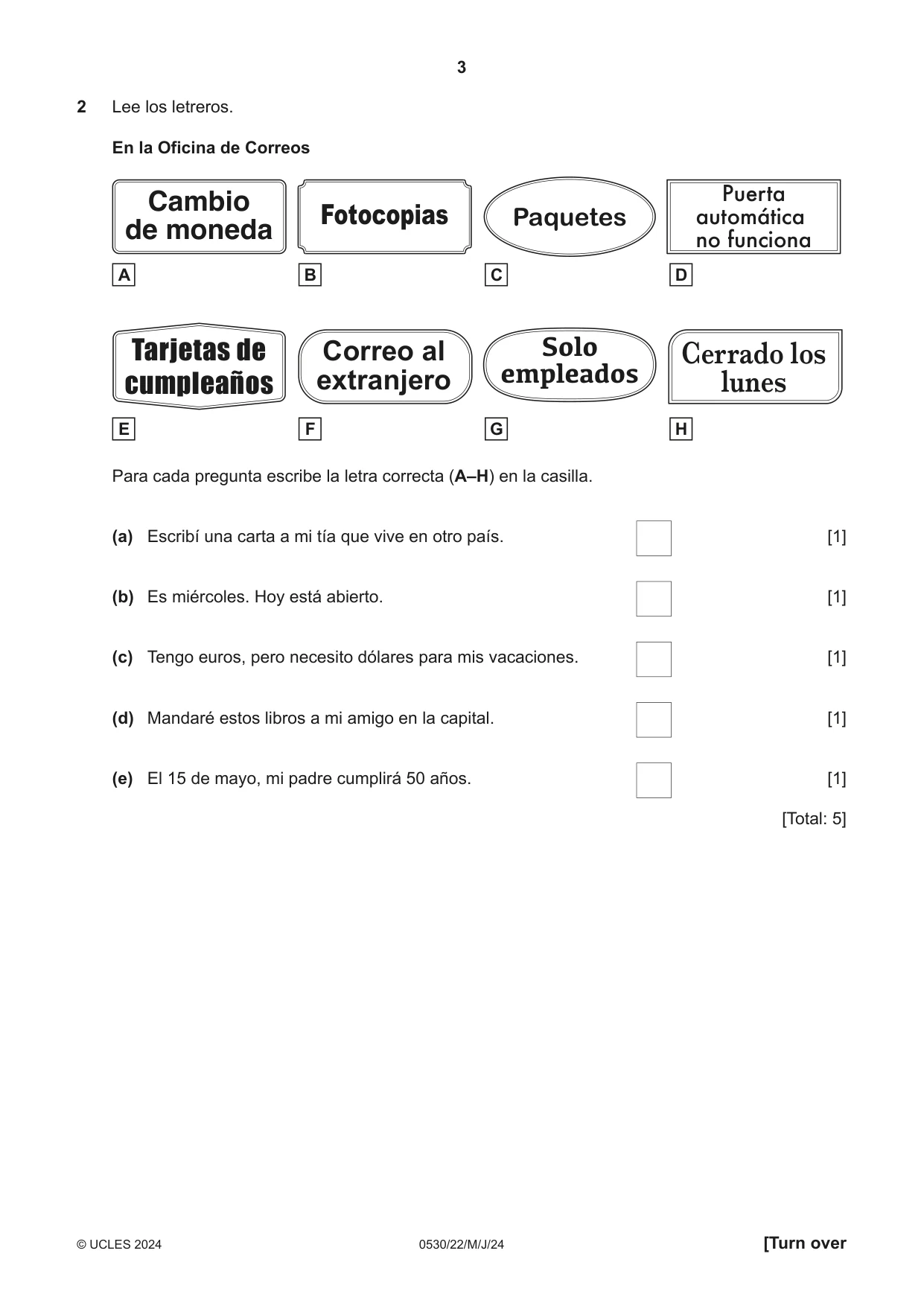
3 0530/22/M/J/24 © UCLES 2024 [Turn over 2 Lee los letreros. En la Oficina de Correos Cambio de moneda Tarjetas de cumpleaños Correo al extranjero Solo empleados Fotocopias Paquetes Puerta automática no funciona Cerrado los lunes A B C D E F G H Para cada pregunta escribe la letra correcta (A–H) en la casilla. (a) Escribí una carta a mi tía que vive en otro país. [1] (b) Es miércoles. Hoy está abierto. [1] (c) Tengo euros, pero necesito dólares para mis vacaciones. [1] (d) Mandaré estos libros a mi amigo en la capital. [1] (e) El 15 de mayo, mi padre cumplirá 50 años. [1] [Total: 5]
Question paper, page 4
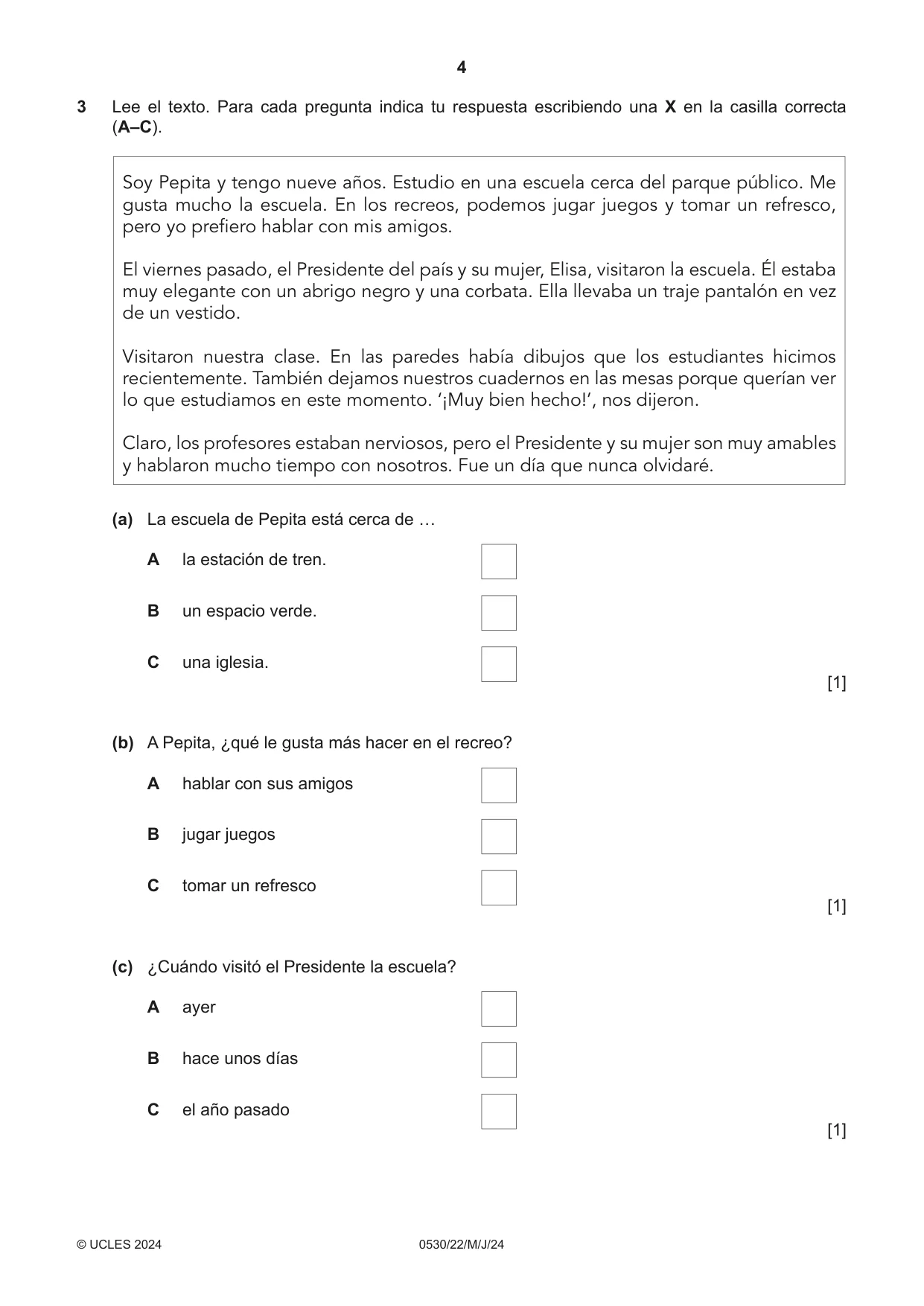
4 0530/22/M/J/24 © UCLES 2024 3 Lee el texto. Para cada pregunta indica tu respuesta escribiendo una X en la casilla correcta (A–C). Soy Pepita y tengo nueve años. Estudio en una escuela cerca del parque público. Me gusta mucho la escuela. En los recreos, podemos jugar juegos y tomar un refresco, pero yo prefiero hablar con mis amigos. El viernes pasado, el Presidente del país y su mujer, Elisa, visitaron la escuela. Él estaba muy elegante con un abrigo negro y una corbata. Ella llevaba un traje pantalón en vez de un vestido. Visitaron nuestra clase. En las paredes había dibujos que los estudiantes hicimos recientemente. También dejamos nuestros cuadernos en las mesas porque querían ver lo que estudiamos en este momento. ‘¡Muy bien hecho!’, nos dijeron. Claro, los profesores estaban nerviosos, pero el Presidente y su mujer son muy amables y hablaron mucho tiempo con nosotros. Fue un día que nunca olvidaré. (a) La escuela de Pepita está cerca de … A la estación de tren. B un espacio verde. C una iglesia. [1] (b) A Pepita, ¿qué le gusta más hacer en el recreo? A hablar con sus amigos B jugar juegos C tomar un refresco [1] (c) ¿Cuándo visitó el Presidente la escuela? A ayer B hace unos días C el año pasado [1]
Question paper, page 5
5 0530/22/M/J/24 © UCLES 2024 [Turn over (d) ¿Qué llevaba Elisa? A un abrigo B un vestido C un traje [1] (e) ¿Quién hizo los dibujos en las paredes? A los alumnos B un artista famoso C la profesora [1] (f) El Presidente y su mujer felicitaron a los alumnos por su … A talento musical. B trabajo escolar. C buen humor. [1] (g) Los profesores estaban … A organizados. B cansados. C preocupados. [1] [Total: 7]
Question paper, page 6
6 0530/22/M/J/24 © UCLES 2024 4 Lee el texto. Contesta a las preguntas en español. Soy Juana. El año pasado fui al teatro por primera vez. Habíamos estudiado textos de teatro en el instituto, pero nunca había estado en un teatro profesional. Un día unos vecinos dijeron que tenían una entrada extra y me invitaron a ir. No me interesaba especialmente, pero como no tenía otra cosa que hacer ese día, los acompañé. ¡Qué sorpresa! Primero tengo que hablar del interior del teatro. Todo es de oro – bueno, quiero decir pintado de color de oro – ¡nada en el teatro es lo que parece! Además, en el techo hay imágenes de personajes de la literatura clásica. Por suerte me había puesto una nueva falda porque el público vestía elegante y todos charlaban de forma muy educada. Mi asiento era uno de los mejores de la sala, así que se veía muy bien el espectáculo. La sala estaba llena y, cuando se apagaron las luces, yo estaba muy emocionada. Era una comedia, y el actor principal (que yo había visto en la televisión) me sorprendió. ¡Se parece mucho a mi hermano! Además, el final de la obra, con todos los actores cantando, me hizo reír un montón. Voy al cine con mis amigas, pero no es como el teatro. En el cine hay muchos efectos especiales, mientras que en el teatro el público necesita imaginación. Debe de ser más difícil para los actores también; en el cine pueden filmar una conversación muchas veces, pero en un teatro como este, tienen que hacerlo bien a la primera. (a) ¿Dónde leyó Juana algunos textos de teatro? … [1] (b) ¿Quién invitó a Juana a ir al teatro? … [1] (c) ¿Por qué aceptó Juana la invitación? … [1] (d) ¿Cómo está decorado el interior del teatro? Menciona dos cosas. 1 … [1] 2 … [1] (e) ¿Qué llevaba Juana para la visita al teatro? … [1] (f) ¿Cómo hablaba la gente en el teatro? … [1]
Question paper, page 7
7 0530/22/M/J/24 © UCLES 2024 [Turn over (g) ¿Por qué tenía Juana una buena vista en el teatro? … [1] (h) ¿Cómo se sentía Juana cuando el espectáculo iba a empezar? … [1] (i) ¿Por qué el actor principal sorprendió a Juana? … [1] (j) ¿Qué hizo Juana cuando vio el final de la obra? … [1] (k) Según Juana, ¿por qué es más fácil actuar en el cine que en el teatro? … [1] [Total: 12]
Question paper, page 8
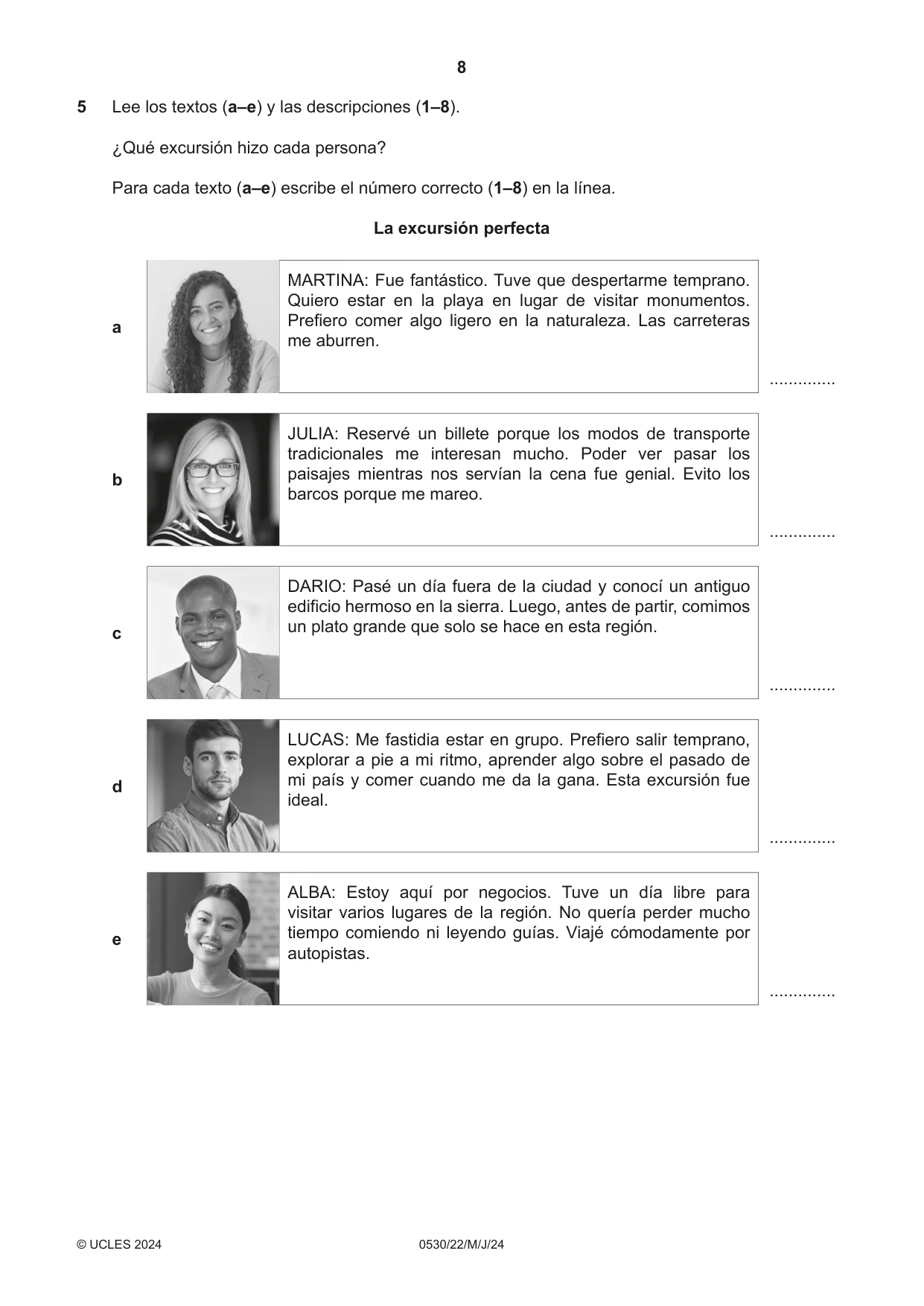
8 0530/22/M/J/24 © UCLES 2024 5 Lee los textos (a–e) y las descripciones (1–8). ¿Qué excursión hizo cada persona? Para cada texto (a–e) escribe el número correcto (1–8) en la línea. La excursión perfecta a MARTINA: Fue fantástico. Tuve que despertarme temprano. Quiero estar en la playa en lugar de visitar monumentos. Prefiero comer algo ligero en la naturaleza. Las carreteras me aburren. … b JULIA: Reservé un billete porque los modos de transporte tradicionales me interesan mucho. Poder ver pasar los paisajes mientras nos servían la cena fue genial. Evito los barcos porque me mareo. … c DARIO: Pasé un día fuera de la ciudad y conocí un antiguo edificio hermoso en la sierra. Luego, antes de partir, comimos un plato grande que solo se hace en esta región. … d LUCAS: Me fastidia estar en grupo. Prefiero salir temprano, explorar a pie a mi ritmo, aprender algo sobre el pasado de mi país y comer cuando me da la gana. Esta excursión fue ideal. … e ALBA: Estoy aquí por negocios. Tuve un día libre para visitar varios lugares de la región. No quería perder mucho tiempo comiendo ni leyendo guías. Viajé cómodamente por autopistas. …
Question paper, page 9
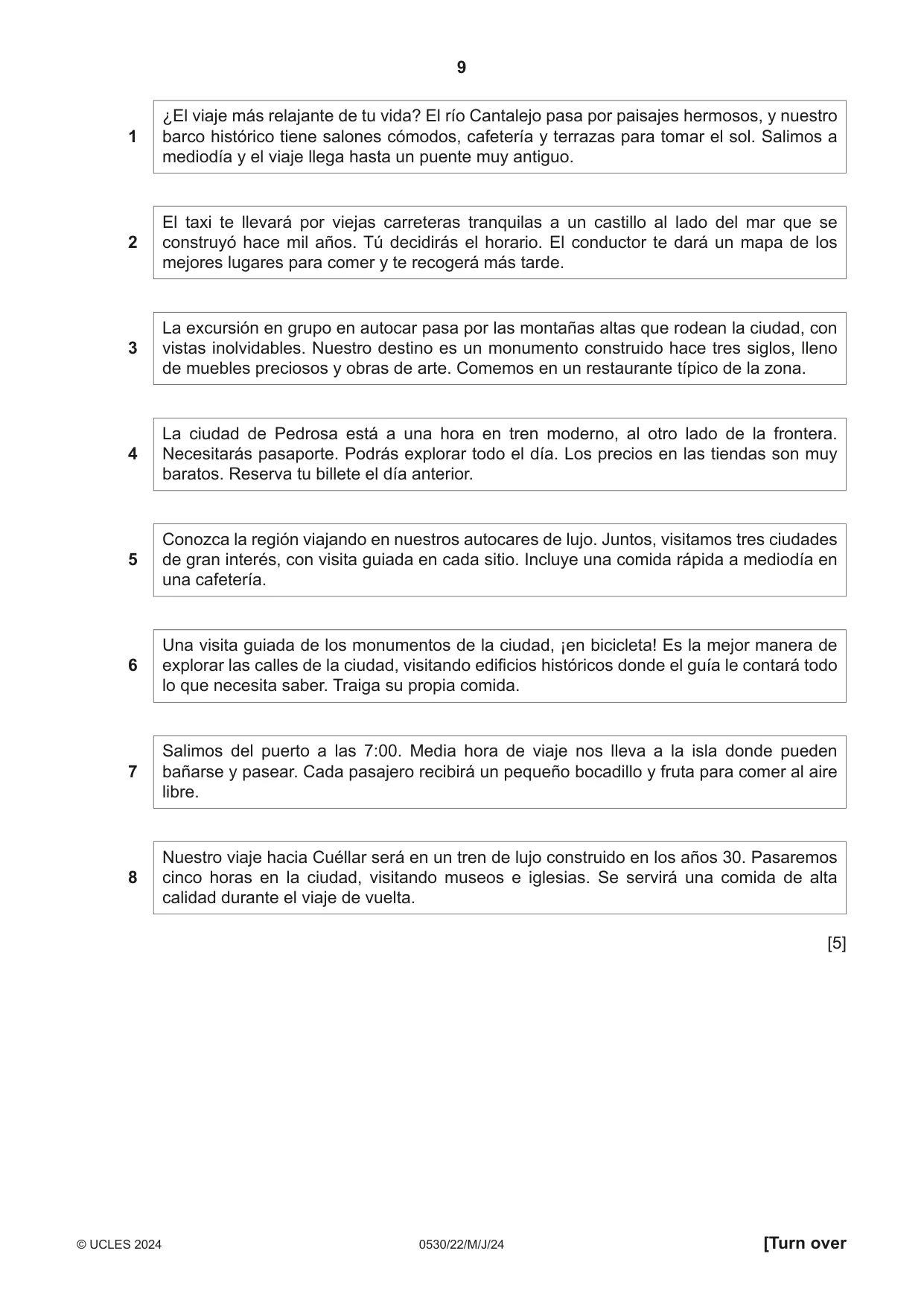
9 0530/22/M/J/24 © UCLES 2024 [Turn over 1 ¿El viaje más relajante de tu vida? El río Cantalejo pasa por paisajes hermosos, y nuestro barco histórico tiene salones cómodos, cafetería y terrazas para tomar el sol. Salimos a mediodía y el viaje llega hasta un puente muy antiguo. 2 El taxi te llevará por viejas carreteras tranquilas a un castillo al lado del mar que se construyó hace mil años. Tú decidirás el horario. El conductor te dará un mapa de los mejores lugares para comer y te recogerá más tarde. 3 La excursión en grupo en autocar pasa por las montañas altas que rodean la ciudad, con vistas inolvidables. Nuestro destino es un monumento construido hace tres siglos, lleno de muebles preciosos y obras de arte. Comemos en un restaurante típico de la zona. 4 La ciudad de Pedrosa está a una hora en tren moderno, al otro lado de la frontera. Necesitarás pasaporte. Podrás explorar todo el día. Los precios en las tiendas son muy baratos. Reserva tu billete el día anterior. 5 Conozca la región viajando en nuestros autocares de lujo. Juntos, visitamos tres ciudades de gran interés, con visita guiada en cada sitio. Incluye una comida rápida a mediodía en una cafetería. 6 Una visita guiada de los monumentos de la ciudad, ¡en bicicleta! Es la mejor manera de explorar las calles de la ciudad, visitando edificios históricos donde el guía le contará todo lo que necesita saber. Traiga su propia comida. 7 Salimos del puerto a las 7:00. Media hora de viaje nos lleva a la isla donde pueden bañarse y pasear. Cada pasajero recibirá un pequeño bocadillo y fruta para comer al aire libre. 8 Nuestro viaje hacia Cuéllar será en un tren de lujo construido en los años 30. Pasaremos cinco horas en la ciudad, visitando museos e iglesias. Se servirá una comida de alta calidad durante el viaje de vuelta. [5]
Question paper, page 10
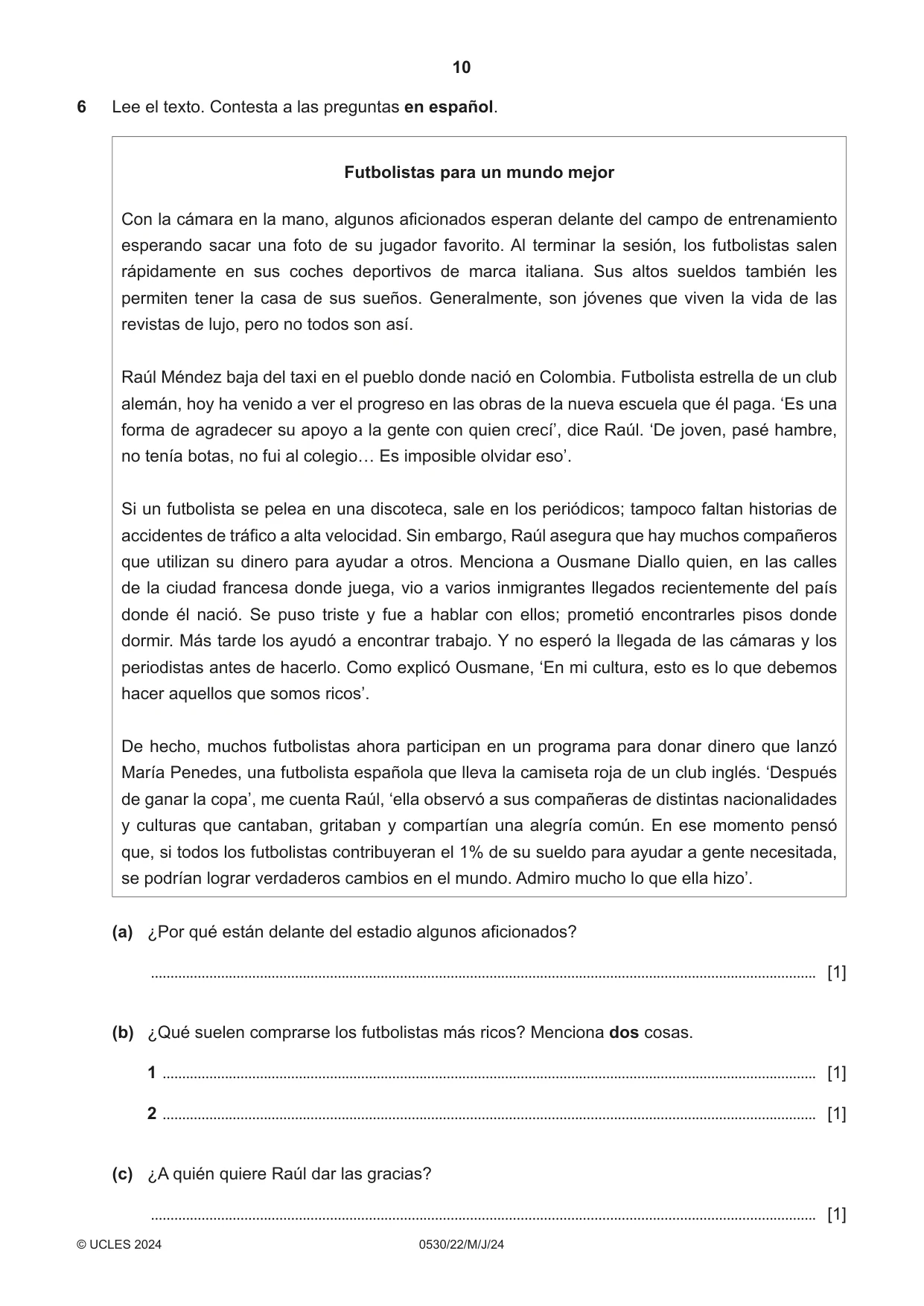
10 0530/22/M/J/24 © UCLES 2024 6 Lee el texto. Contesta a las preguntas en español. Futbolistas para un mundo mejor Con la cámara en la mano, algunos aficionados esperan delante del campo de entrenamiento esperando sacar una foto de su jugador favorito. Al terminar la sesión, los futbolistas salen rápidamente en sus coches deportivos de marca italiana. Sus altos sueldos también les permiten tener la casa de sus sueños. Generalmente, son jóvenes que viven la vida de las revistas de lujo, pero no todos son así. Raúl Méndez baja del taxi en el pueblo donde nació en Colombia. Futbolista estrella de un club alemán, hoy ha venido a ver el progreso en las obras de la nueva escuela que él paga. ‘Es una forma de agradecer su apoyo a la gente con quien crecí’, dice Raúl. ‘De joven, pasé hambre, no tenía botas, no fui al colegio… Es imposible olvidar eso’. Si un futbolista se pelea en una discoteca, sale en los periódicos; tampoco faltan historias de accidentes de tráfico a alta velocidad. Sin embargo, Raúl asegura que hay muchos compañeros que utilizan su dinero para ayudar a otros. Menciona a Ousmane Diallo quien, en las calles de la ciudad francesa donde juega, vio a varios inmigrantes llegados recientemente del país donde él nació. Se puso triste y fue a hablar con ellos; prometió encontrarles pisos donde dormir. Más tarde los ayudó a encontrar trabajo. Y no esperó la llegada de las cámaras y los periodistas antes de hacerlo. Como explicó Ousmane, ‘En mi cultura, esto es lo que debemos hacer aquellos que somos ricos’. De hecho, muchos futbolistas ahora participan en un programa para donar dinero que lanzó María Penedes, una futbolista española que lleva la camiseta roja de un club inglés. ‘Después de ganar la copa’, me cuenta Raúl, ‘ella observó a sus compañeras de distintas nacionalidades y culturas que cantaban, gritaban y compartían una alegría común. En ese momento pensó que, si todos los futbolistas contribuyeran el 1% de su sueldo para ayudar a gente necesitada, se podrían lograr verdaderos cambios en el mundo. Admiro mucho lo que ella hizo’. (a) ¿Por qué están delante del estadio algunos aficionados? … [1] (b) ¿Qué suelen comprarse los futbolistas más ricos? Menciona dos cosas. 1 … [1] 2 … [1] (c) ¿A quién quiere Raúl dar las gracias? … [1]
Question paper, page 11
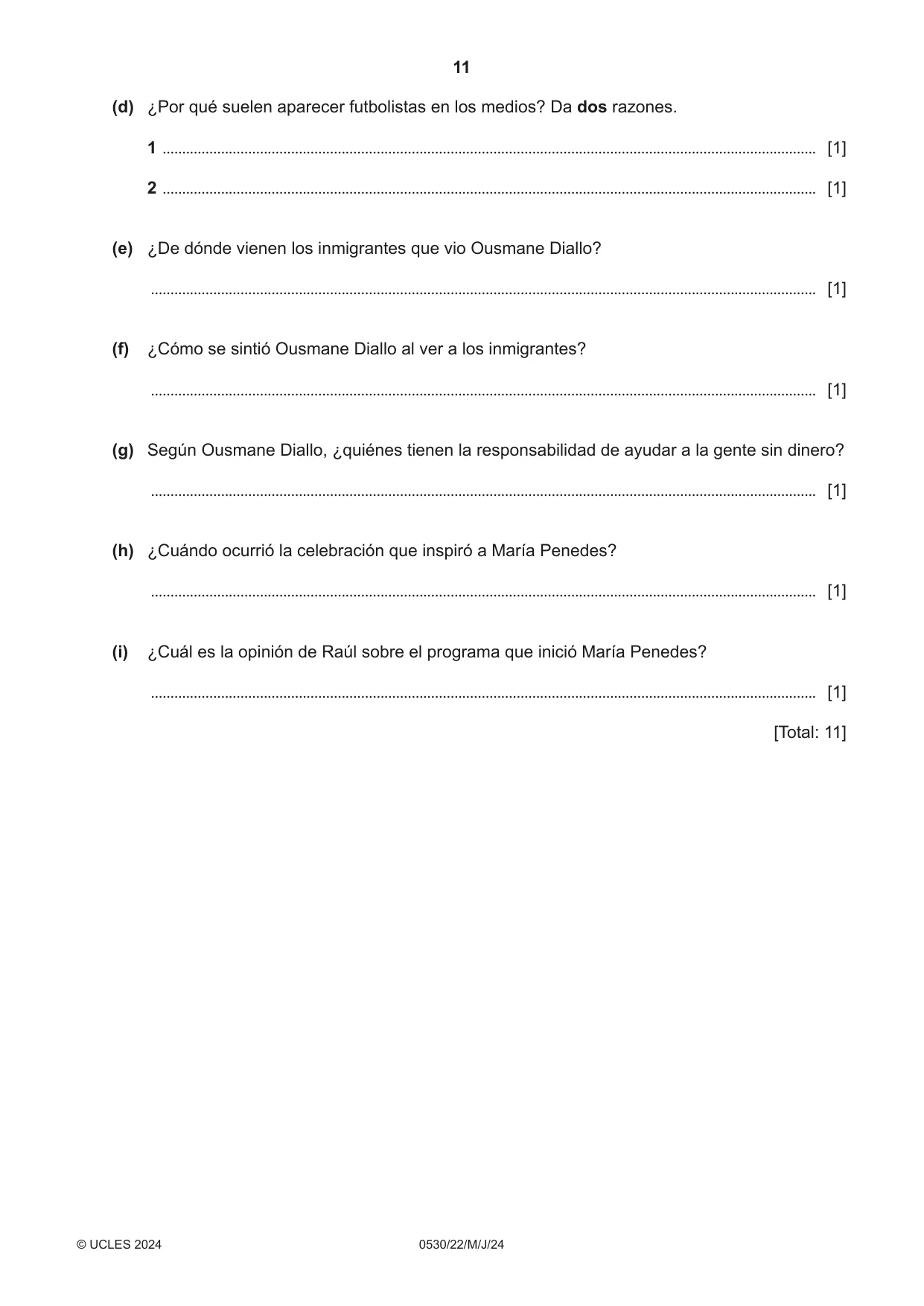
11 0530/22/M/J/24 © UCLES 2024 (d) ¿Por qué suelen aparecer futbolistas en los medios? Da dos razones. 1 … [1] 2 … [1] (e) ¿De dónde vienen los inmigrantes que vio Ousmane Diallo? … [1] (f) ¿Cómo se sintió Ousmane Diallo al ver a los inmigrantes? … [1] (g) Según Ousmane Diallo, ¿quiénes tienen la responsabilidad de ayudar a la gente sin dinero? … [1] (h) ¿Cuándo ocurrió la celebración que inspiró a María Penedes? … [1] (i) ¿Cuál es la opinión de Raúl sobre el programa que inició María Penedes? … [1] [Total: 11]
Question paper, page 12
12 0530/22/M/J/24 © UCLES 2024 Permission to reproduce items where third-party owned material protected by copyright is included has been sought and cleared where possible. Every reasonable effort has been made by the publisher (UCLES) to trace copyright holders, but if any items requiring clearance have unwittingly been included, the publisher will be pleased to make amends at the earliest possible opportunity. To avoid the issue of disclosure of answer-related information to candidates, all copyright acknowledgements are reproduced online in the Cambridge Assessment International Education Copyright Acknowledgements Booklet. This is produced for each series of examinations and is freely available to download at www.cambridgeinternational.org after the live examination series. Cambridge Assessment International Education is part of Cambridge Assessment. Cambridge Assessment is the brand name of the University of Cambridge Local Examinations Syndicate (UCLES), which is a department of the University of Cambridge. BLANK PAGE
Mark scheme, page 1
This document consists of 12 printed pages. © Cambridge University Press & Assessment 2024 [Turn over Cambridge IGCSE™ SPANISH 0530/22 Paper 2 Reading May/June 2024 MARK SCHEME Maximum Mark: 45 Published This mark scheme is published as an aid to teachers and candidates, to indicate the requirements of the examination. It shows the basis on which Examiners were instructed to award marks. It does not indicate the details of the discussions that took place at an Examiners’ meeting before marking began, which would have considered the acceptability of alternative answers. Mark schemes should be read in conjunction with the question paper and the Principal Examiner Report for Teachers. Cambridge International will not enter into discussions about these mark schemes. Cambridge International is publishing the mark schemes for the May/June 2024 series for most Cambridge IGCSE, Cambridge International A and AS Level and Cambridge Pre-U components, and some Cambridge O Level components.
Mark scheme, page 2
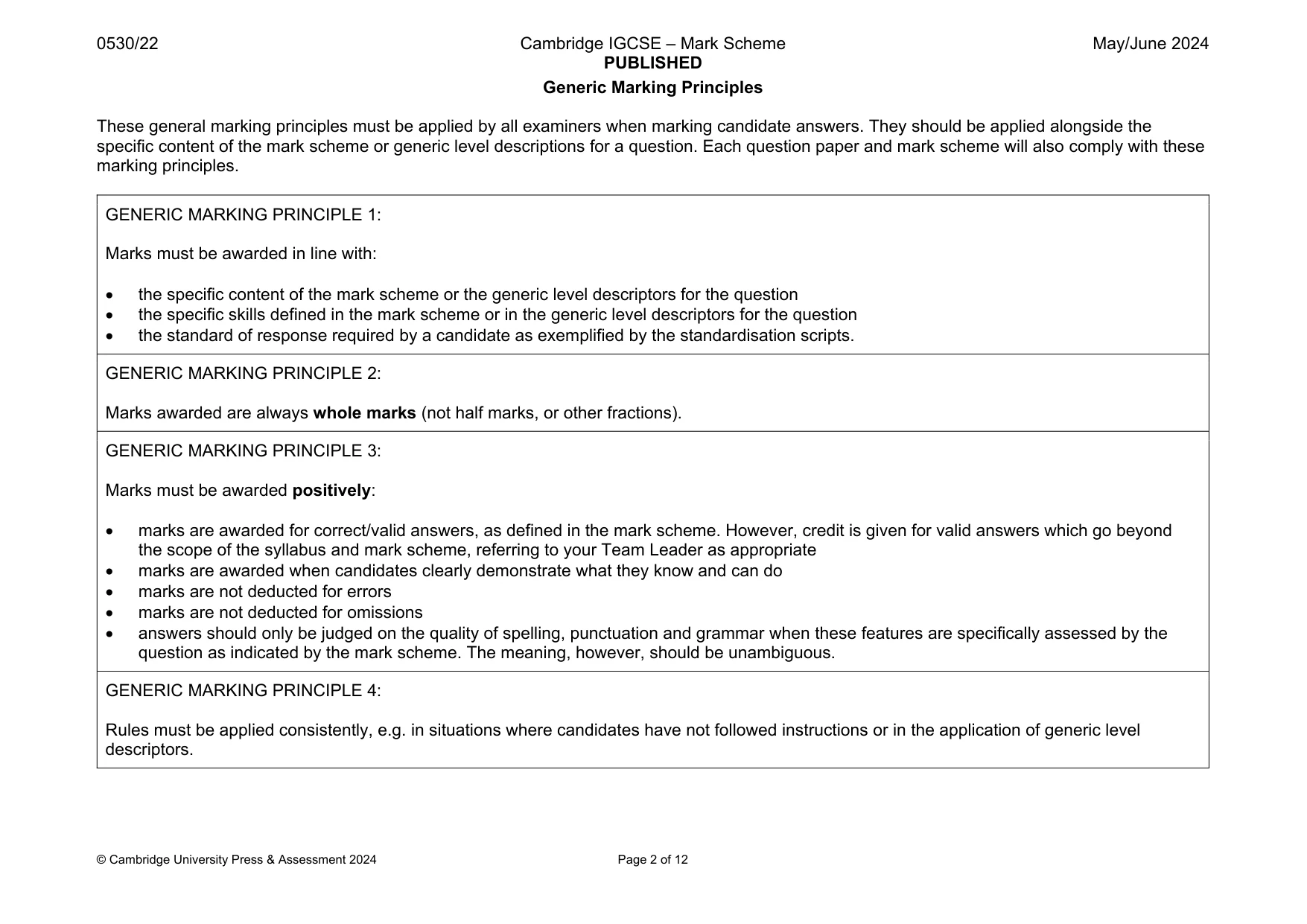
0530/22 Cambridge IGCSE – Mark Scheme PUBLISHED May/June 2024 © Cambridge University Press & Assessment 2024 Page 2 of 12 Generic Marking Principles These general marking principles must be applied by all examiners when marking candidate answers. They should be applied alongside the specific content of the mark scheme or generic level descriptions for a question. Each question paper and mark scheme will also comply with these marking principles. GENERIC MARKING PRINCIPLE 1: Marks must be awarded in line with: the specific content of the mark scheme or the generic level descriptors for the question the specific skills defined in the mark scheme or in the generic level descriptors for the question the standard of response required by a candidate as exemplified by the standardisation scripts. GENERIC MARKING PRINCIPLE 2: Marks awarded are always whole marks (not half marks, or other fractions). GENERIC MARKING PRINCIPLE 3: Marks must be awarded positively: marks are awarded for correct/valid answers, as defined in the mark scheme. However, credit is given for valid answers which go beyond the scope of the syllabus and mark scheme, referring to your Team Leader as appropriate marks are awarded when candidates clearly demonstrate what they know and can do marks are not deducted for errors marks are not deducted for omissions answers should only be judged on the quality of spelling, punctuation and grammar when these features are specifically assessed by the question as indicated by the mark scheme. The meaning, however, should be unambiguous. GENERIC MARKING PRINCIPLE 4: Rules must be applied consistently, e.g. in situations where candidates have not followed instructions or in the application of generic level descriptors.
Mark scheme, page 3
0530/22 Cambridge IGCSE – Mark Scheme PUBLISHED May/June 2024 © Cambridge University Press & Assessment 2024 Page 3 of 12 GENERIC MARKING PRINCIPLE 5: Marks should be awarded using the full range of marks defined in the mark scheme for the question (however; the use of the full mark range may be limited according to the quality of the candidate responses seen). GENERIC MARKING PRINCIPLE 6: Marks awarded are based solely on the requirements as defined in the mark scheme. Marks should not be awarded with grade thresholds or grade descriptors in mind.
Mark scheme, page 4
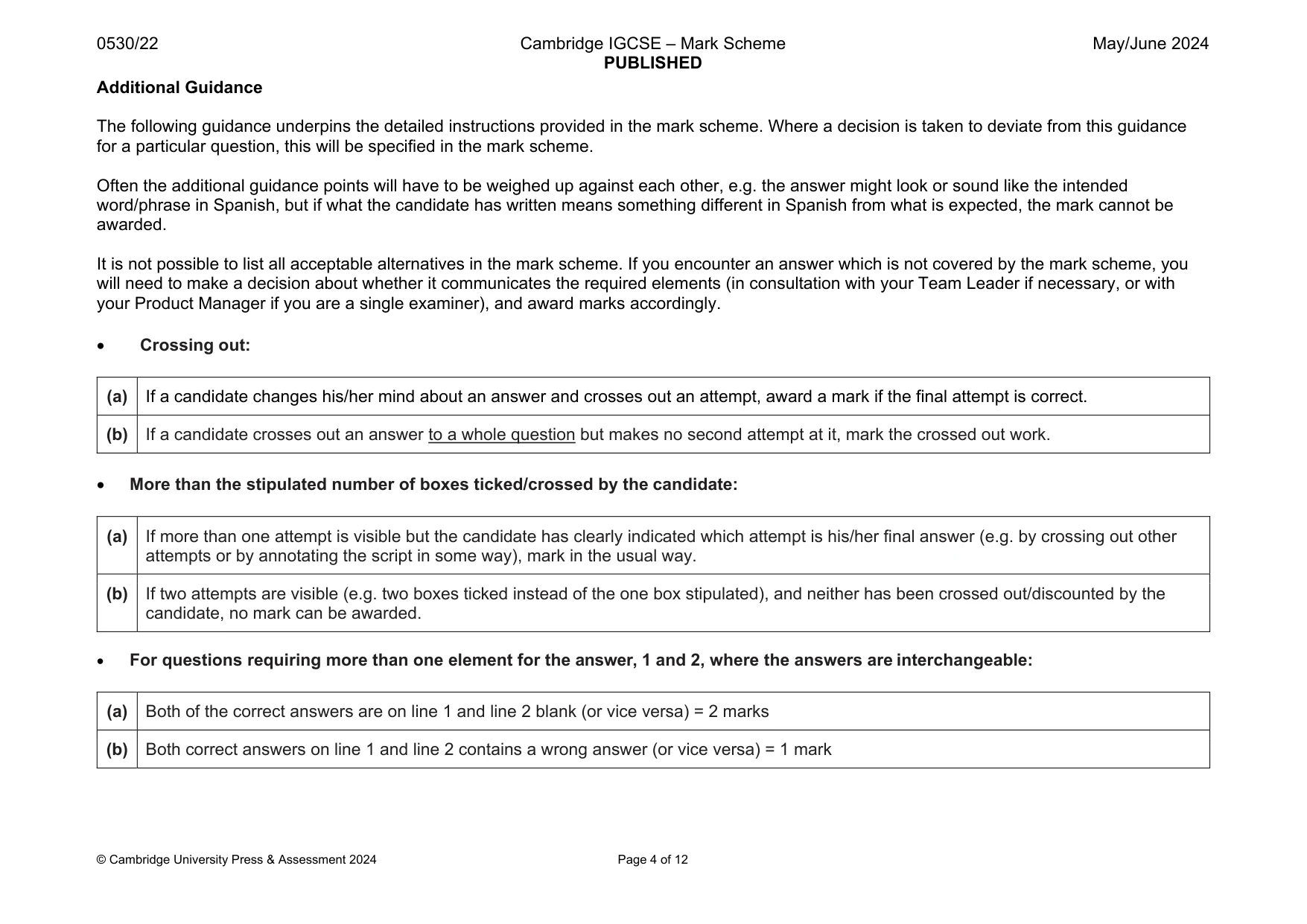
0530/22 Cambridge IGCSE – Mark Scheme PUBLISHED May/June 2024 © Cambridge University Press & Assessment 2024 Page 4 of 12 Additional Guidance The following guidance underpins the detailed instructions provided in the mark scheme. Where a decision is taken to deviate from this guidance for a particular question, this will be specified in the mark scheme. Often the additional guidance points will have to be weighed up against each other, e.g. the answer might look or sound like the intended word/phrase in Spanish, but if what the candidate has written means something different in Spanish from what is expected, the mark cannot be awarded. It is not possible to list all acceptable alternatives in the mark scheme. If you encounter an answer which is not covered by the mark scheme, you will need to make a decision about whether it communicates the required elements (in consultation with your Team Leader if necessary, or with your Product Manager if you are a single examiner), and award marks accordingly. Crossing out: (a) If a candidate changes his/her mind about an answer and crosses out an attempt, award a mark if the final attempt is correct. (b) If a candidate crosses out an answer to a whole question but makes no second attempt at it, mark the crossed out work. More than the stipulated number of boxes ticked/crossed by the candidate: (a) If more than one attempt is visible but the candidate has clearly indicated which attempt is his/her final answer (e.g. by crossing out other attempts or by annotating the script in some way), mark in the usual way. (b) If two attempts are visible (e.g. two boxes ticked instead of the one box stipulated), and neither has been crossed out/discounted by the candidate, no mark can be awarded. For questions requiring more than one element for the answer, 1 and 2, where the answers are interchangeable: (a) Both of the correct answers are on line 1 and line 2 blank (or vice versa) = 2 marks (b) Both correct answers on line 1 and line 2 contains a wrong answer (or vice versa) = 1 mark
Mark scheme, page 5
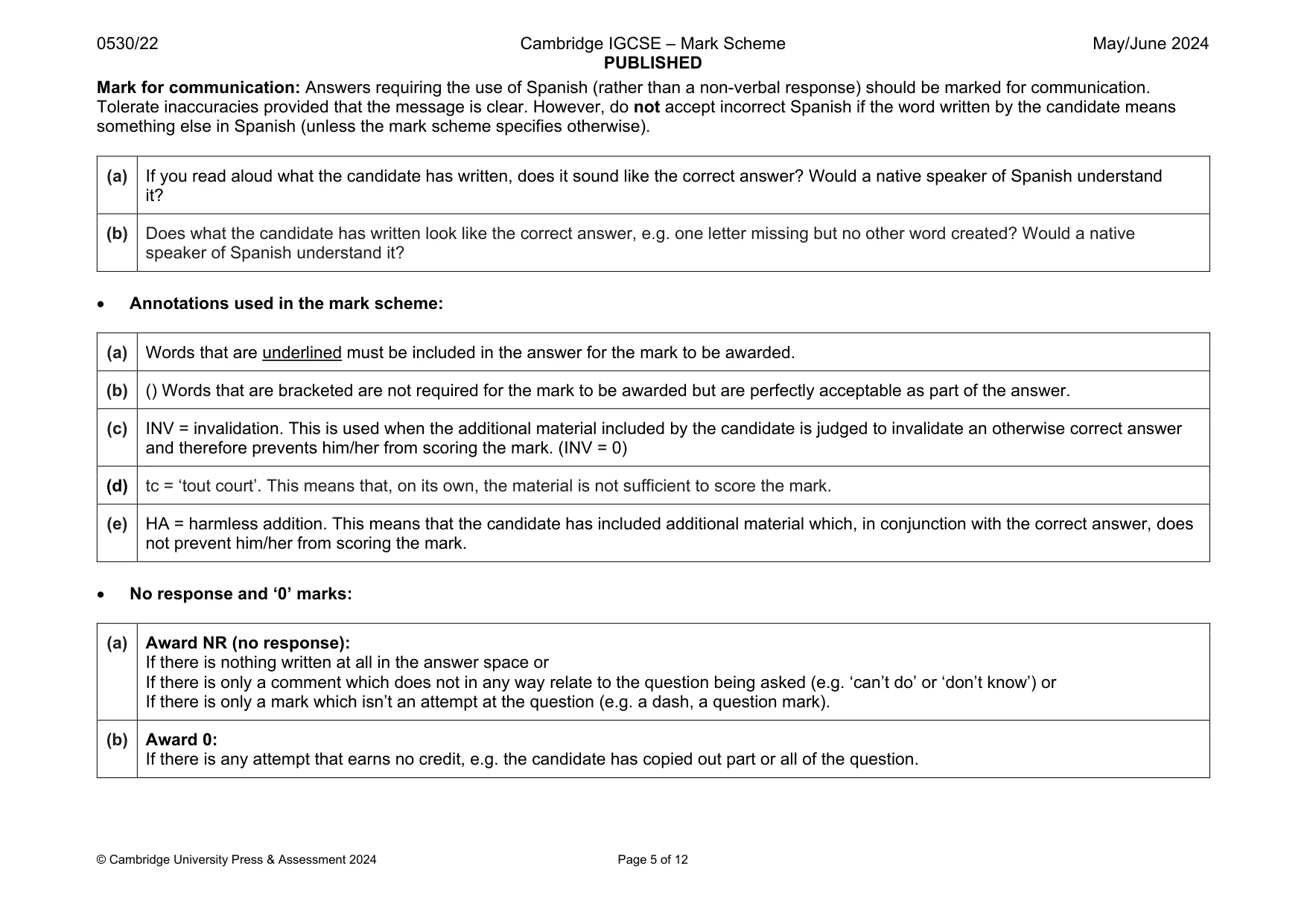
0530/22 Cambridge IGCSE – Mark Scheme PUBLISHED May/June 2024 © Cambridge University Press & Assessment 2024 Page 5 of 12 Mark for communication: Answers requiring the use of Spanish (rather than a non-verbal response) should be marked for communication. Tolerate inaccuracies provided that the message is clear. However, do not accept incorrect Spanish if the word written by the candidate means something else in Spanish (unless the mark scheme specifies otherwise). (a) If you read aloud what the candidate has written, does it sound like the correct answer? Would a native speaker of Spanish understand it? (b) Does what the candidate has written look like the correct answer, e.g. one letter missing but no other word created? Would a native speaker of Spanish understand it? Annotations used in the mark scheme: (a) Words that are underlined must be included in the answer for the mark to be awarded. (b) () Words that are bracketed are not required for the mark to be awarded but are perfectly acceptable as part of the answer. (c) INV = invalidation. This is used when the additional material included by the candidate is judged to invalidate an otherwise correct answer and therefore prevents him/her from scoring the mark. (INV = 0) (d) tc = ‘tout court’. This means that, on its own, the material is not sufficient to score the mark. (e) HA = harmless addition. This means that the candidate has included additional material which, in conjunction with the correct answer, does not prevent him/her from scoring the mark. No response and ‘0’ marks: (a) Award NR (no response): If there is nothing written at all in the answer space or If there is only a comment which does not in any way relate to the question being asked (e.g. ‘can’t do’ or ‘don’t know’) or If there is only a mark which isn’t an attempt at the question (e.g. a dash, a question mark). (b) Award 0: If there is any attempt that earns no credit, e.g. the candidate has copied out part or all of the question.
Mark scheme, page 6
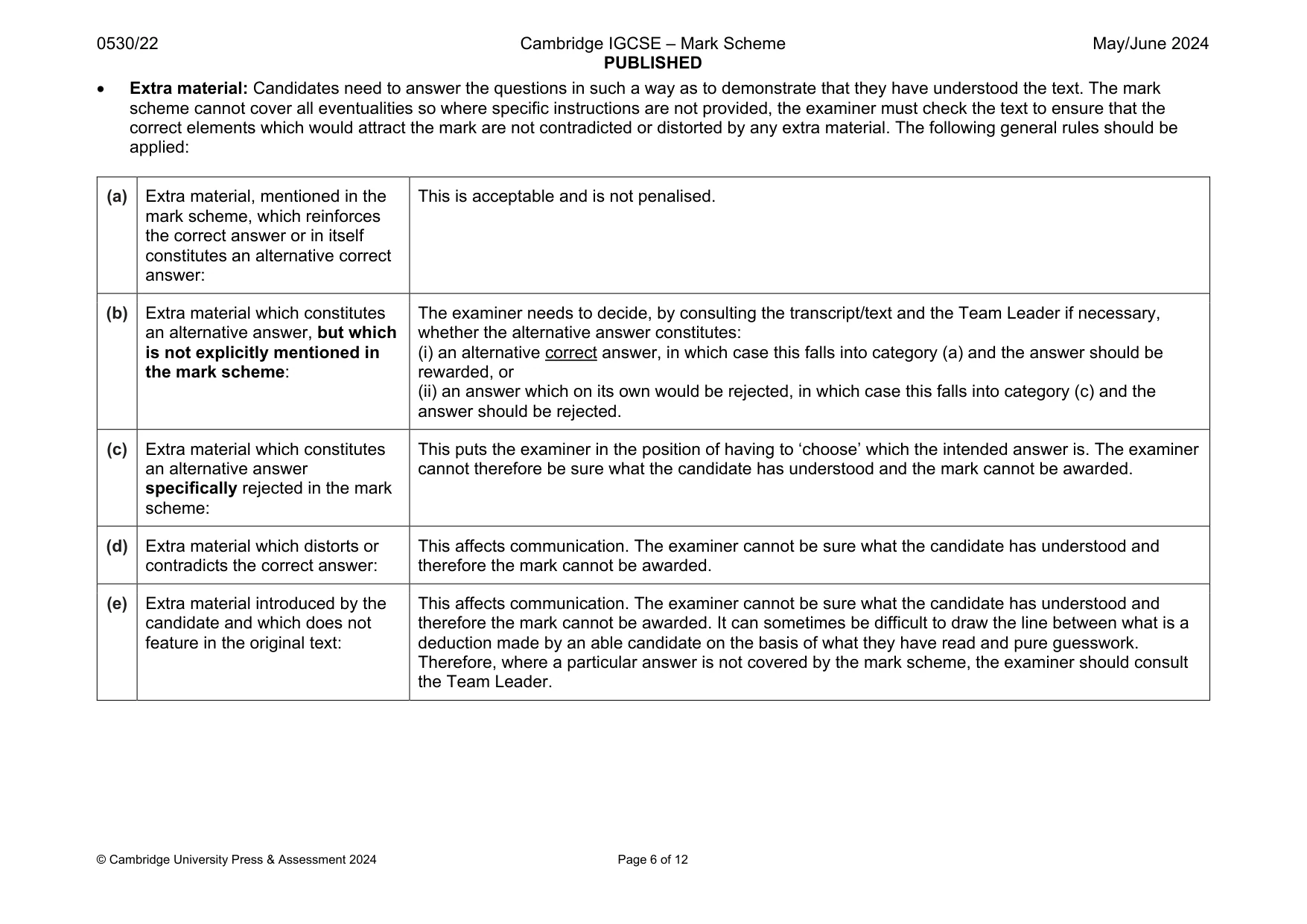
0530/22 Cambridge IGCSE – Mark Scheme PUBLISHED May/June 2024 © Cambridge University Press & Assessment 2024 Page 6 of 12 Extra material: Candidates need to answer the questions in such a way as to demonstrate that they have understood the text. The mark scheme cannot cover all eventualities so where specific instructions are not provided, the examiner must check the text to ensure that the correct elements which would attract the mark are not contradicted or distorted by any extra material. The following general rules should be applied: (a) Extra material, mentioned in the mark scheme, which reinforces the correct answer or in itself constitutes an alternative correct answer: This is acceptable and is not penalised. (b) Extra material which constitutes an alternative answer, but which is not explicitly mentioned in the mark scheme: The examiner needs to decide, by consulting the transcript/text and the Team Leader if necessary, whether the alternative answer constitutes: (i) an alternative correct answer, in which case this falls into category (a) and the answer should be rewarded, or (ii) an answer which on its own would be rejected, in which case this falls into category (c) and the answer should be rejected. (c) Extra material which constitutes an alternative answer specifically rejected in the mark scheme: This puts the examiner in the position of having to ‘choose’ which the intended answer is. The examiner cannot therefore be sure what the candidate has understood and the mark cannot be awarded. (d) Extra material which distorts or contradicts the correct answer: This affects communication. The examiner cannot be sure what the candidate has understood and therefore the mark cannot be awarded. (e) Extra material introduced by the candidate and which does not feature in the original text: This affects communication. The examiner cannot be sure what the candidate has understood and therefore the mark cannot be awarded. It can sometimes be difficult to draw the line between what is a deduction made by an able candidate on the basis of what they have read and pure guesswork. Therefore, where a particular answer is not covered by the mark scheme, the examiner should consult the Team Leader.
Mark scheme, page 7
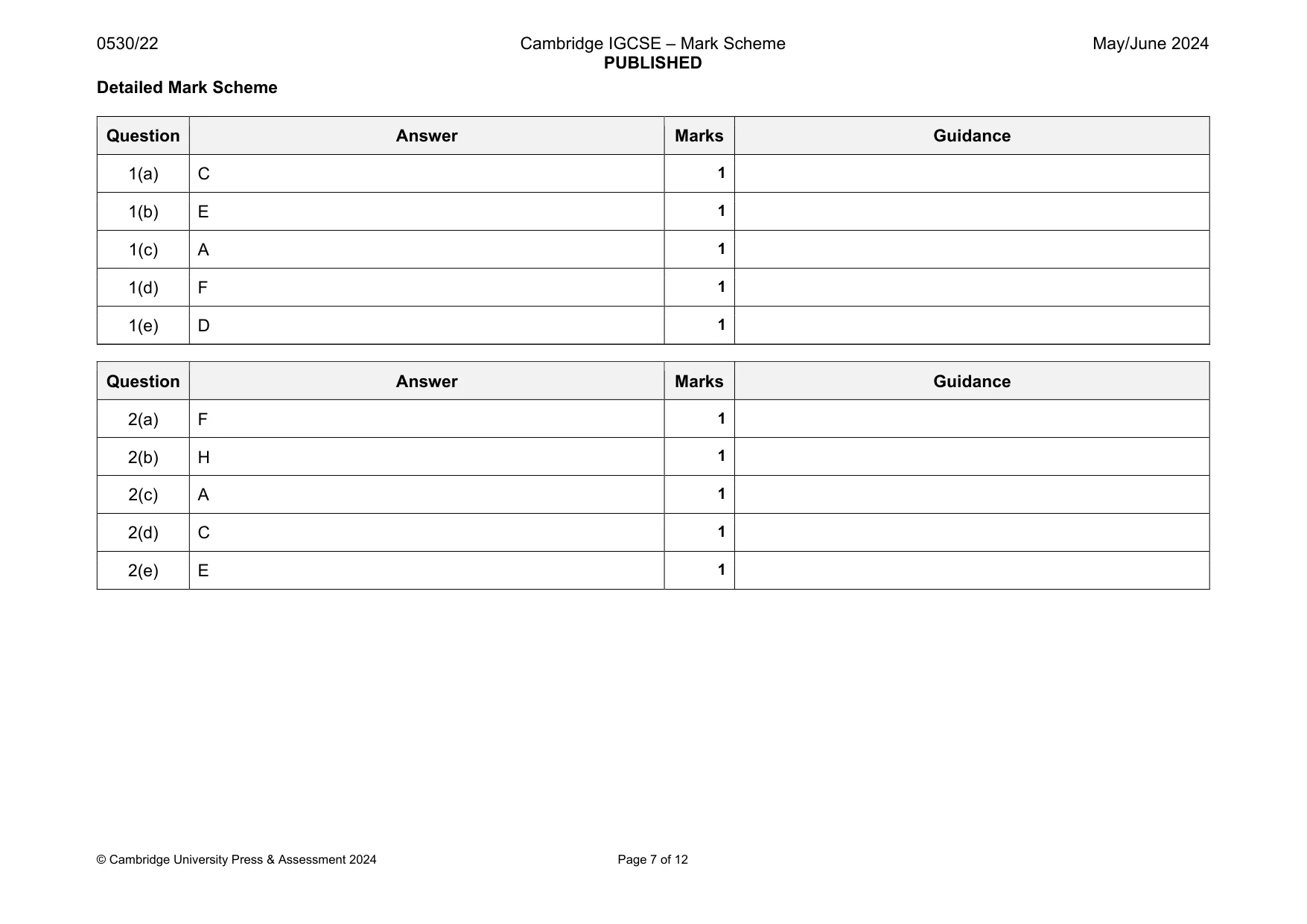
0530/22 Cambridge IGCSE – Mark Scheme PUBLISHED May/June 2024 © Cambridge University Press & Assessment 2024 Page 7 of 12 Detailed Mark Scheme Question Answer Marks Guidance 1(a) C 1 1(b) E 1 1(c) A 1 1(d) F 1 1(e) D 1 Question Answer Marks Guidance 2(a) F 1 2(b) H 1 2(c) A 1 2(d) C 1 2(e) E 1
Mark scheme, page 8
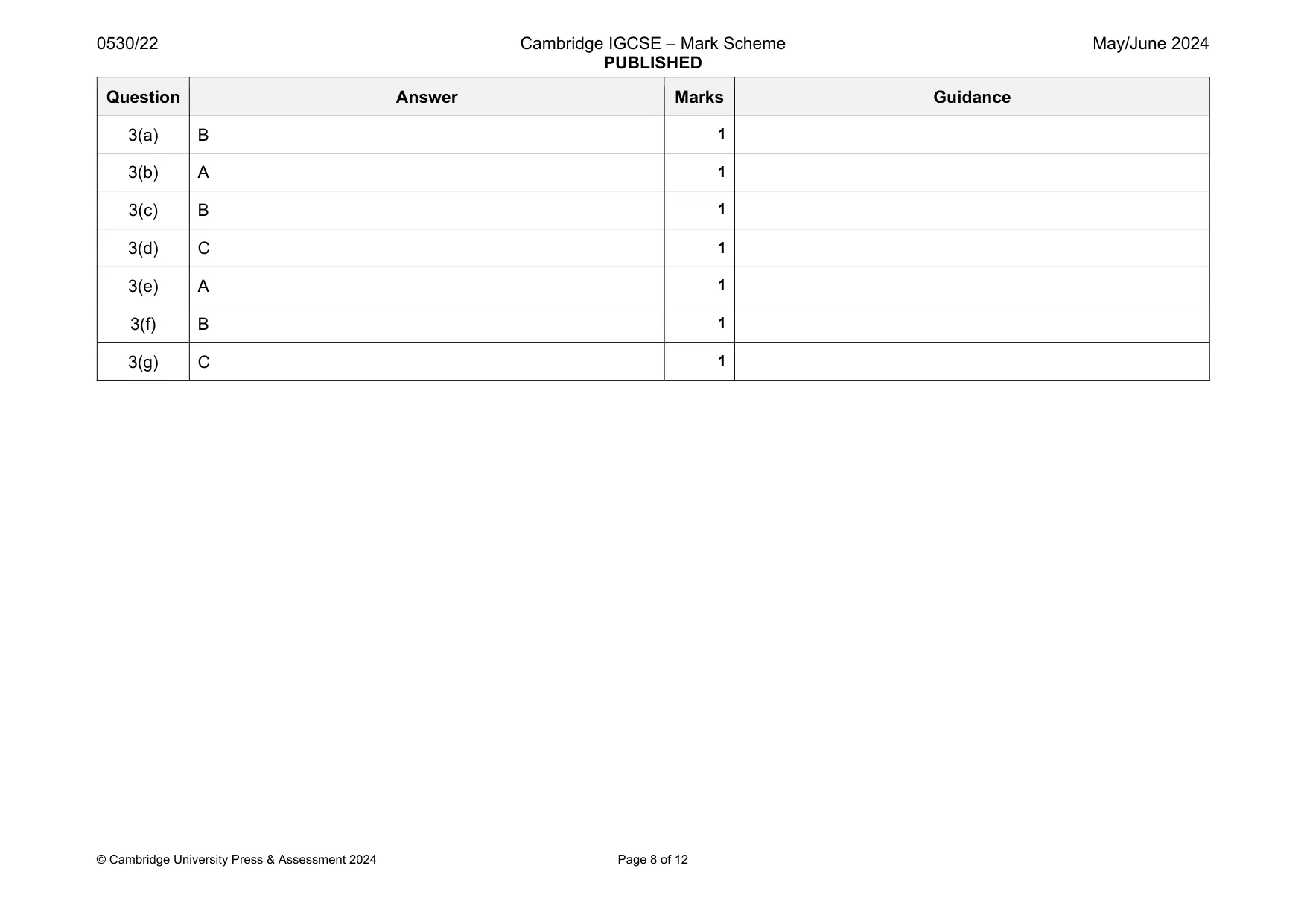
0530/22 Cambridge IGCSE – Mark Scheme PUBLISHED May/June 2024 © Cambridge University Press & Assessment 2024 Page 8 of 12 Question Answer Marks Guidance 3(a) B 1 3(b) A 1 3(c) B 1 3(d) C 1 3(e) A 1 3(f) B 1 3(g) C 1
Mark scheme, page 9
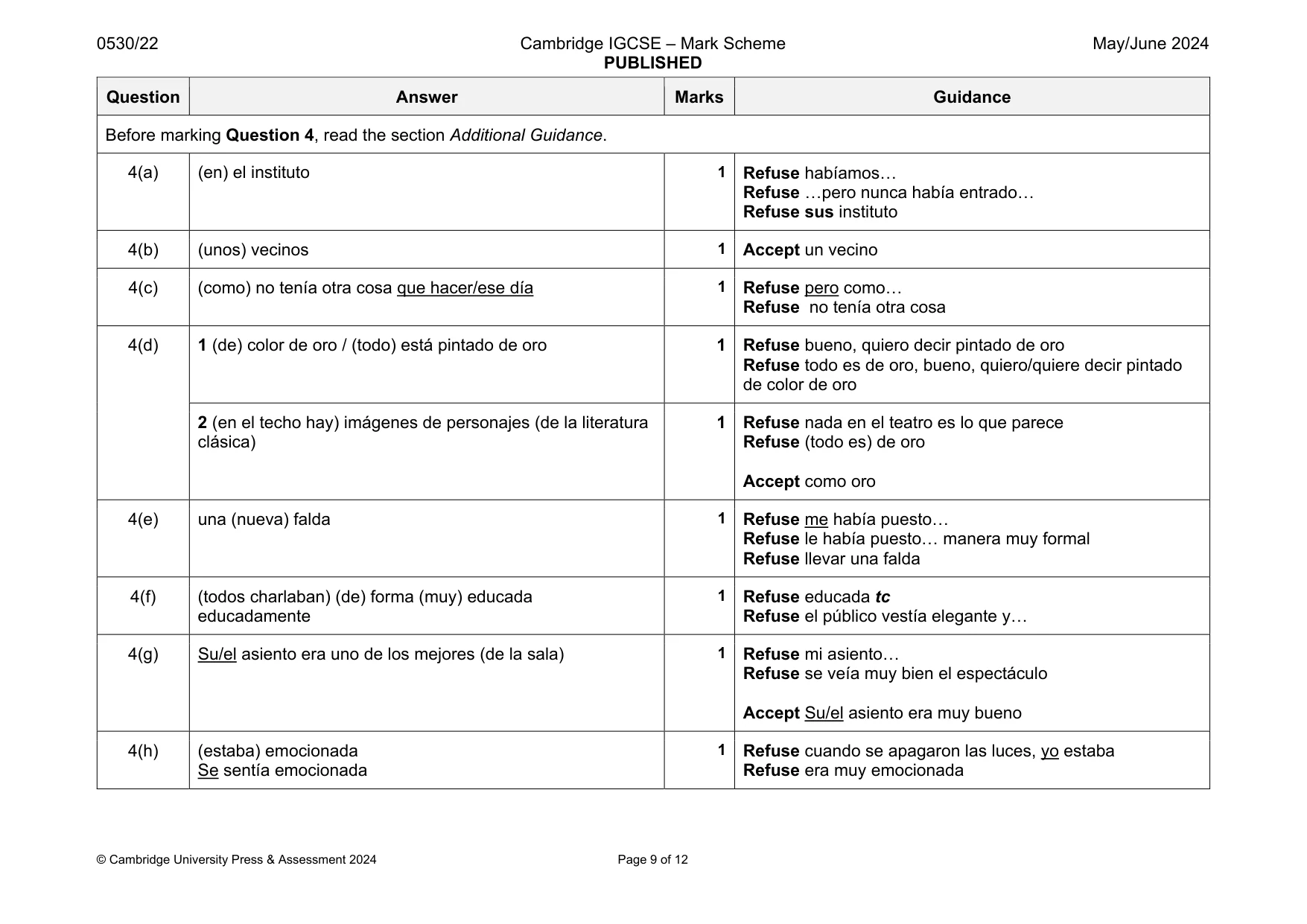
0530/22 Cambridge IGCSE – Mark Scheme PUBLISHED May/June 2024 © Cambridge University Press & Assessment 2024 Page 9 of 12 Question Answer Marks Guidance Before marking Question 4, read the section Additional Guidance. 4(a) (en) el instituto 1 Refuse habíamos… Refuse …pero nunca había entrado… Refuse sus instituto 4(b) (unos) vecinos 1 Accept un vecino 4(c) (como) no tenía otra cosa que hacer/ese día 1 Refuse pero como… Refuse no tenía otra cosa 4(d) 1 (de) color de oro / (todo) está pintado de oro 1 Refuse bueno, quiero decir pintado de oro Refuse todo es de oro, bueno, quiero/quiere decir pintado de color de oro 2 (en el techo hay) imágenes de personajes (de la literatura clásica) 1 Refuse nada en el teatro es lo que parece Refuse (todo es) de oro Accept como oro 4(e) una (nueva) falda 1 Refuse me había puesto… Refuse le había puesto… manera muy formal Refuse llevar una falda 4(f) (todos charlaban) (de) forma (muy) educada educadamente 1 Refuse educada tc Refuse el público vestía elegante y… 4(g) Su/el asiento era uno de los mejores (de la sala) 1 Refuse mi asiento… Refuse se veía muy bien el espectáculo Accept Su/el asiento era muy bueno 4(h) (estaba) emocionada Se sentía emocionada 1 Refuse cuando se apagaron las luces, yo estaba Refuse era muy emocionada
Mark scheme, page 10
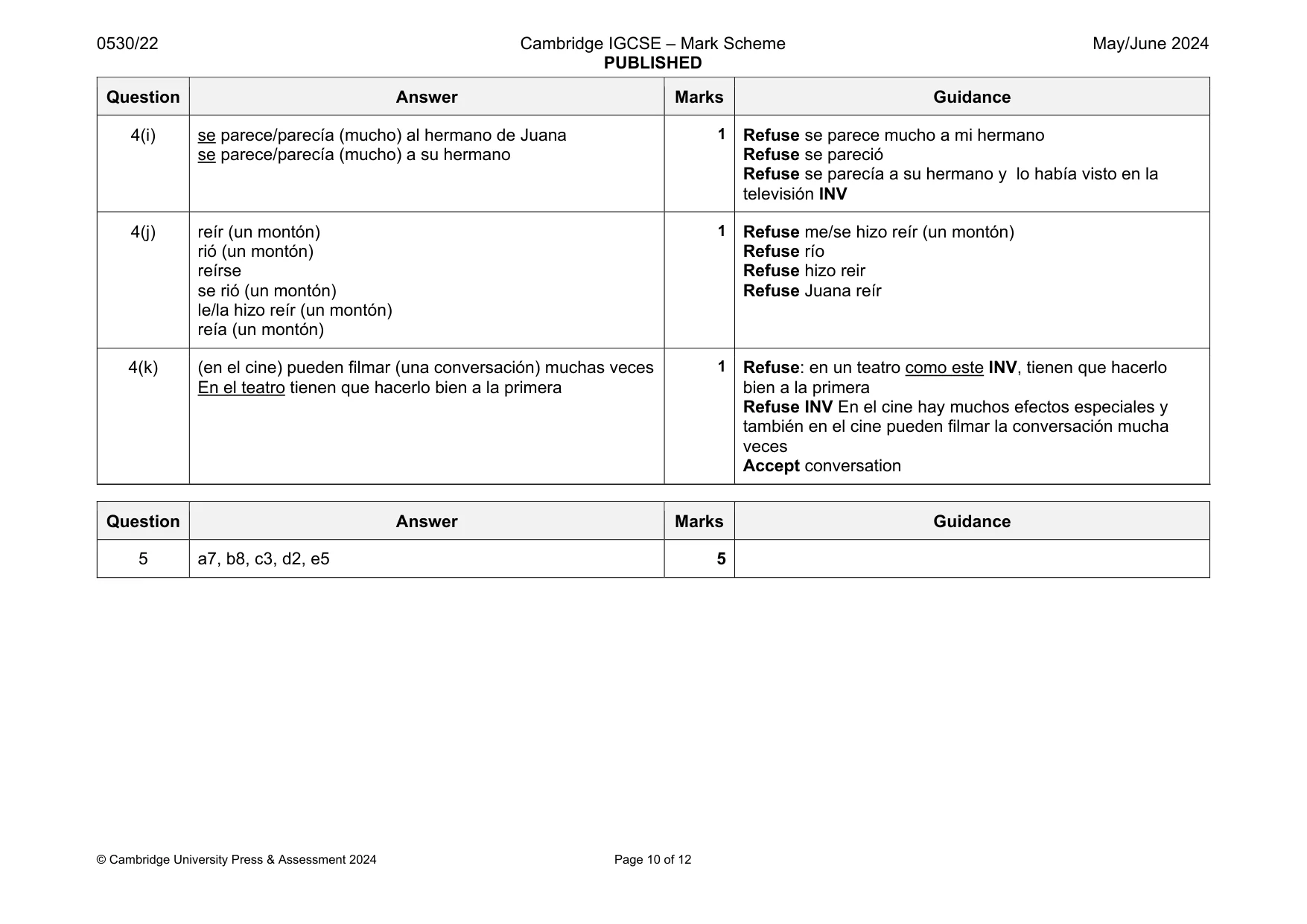
0530/22 Cambridge IGCSE – Mark Scheme PUBLISHED May/June 2024 © Cambridge University Press & Assessment 2024 Page 10 of 12 Question Answer Marks Guidance 4(i) se parece/parecía (mucho) al hermano de Juana se parece/parecía (mucho) a su hermano 1 Refuse se parece mucho a mi hermano Refuse se pareció Refuse se parecía a su hermano y lo había visto en la televisión INV 4(j) reír (un montón) rió (un montón) reírse se rió (un montón) le/la hizo reír (un montón) reía (un montón) 1 Refuse me/se hizo reír (un montón) Refuse río Refuse hizo reir Refuse Juana reír 4(k) (en el cine) pueden filmar (una conversación) muchas veces En el teatro tienen que hacerlo bien a la primera 1 Refuse: en un teatro como este INV, tienen que hacerlo bien a la primera Refuse INV En el cine hay muchos efectos especiales y también en el cine pueden filmar la conversación mucha veces Accept conversation Question Answer Marks Guidance 5 a7, b8, c3, d2, e5 5
Mark scheme, page 11
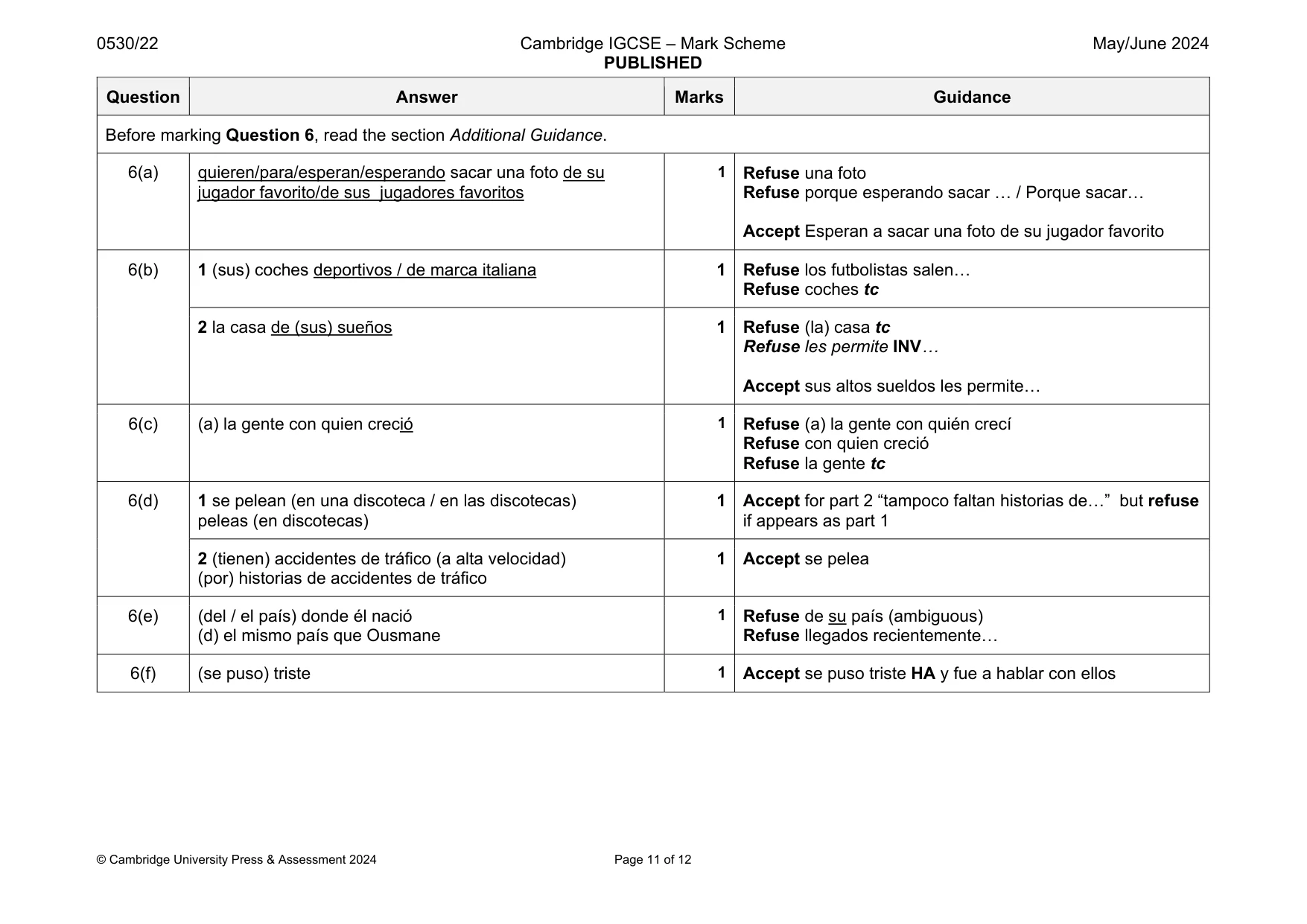
0530/22 Cambridge IGCSE – Mark Scheme PUBLISHED May/June 2024 © Cambridge University Press & Assessment 2024 Page 11 of 12 Question Answer Marks Guidance Before marking Question 6, read the section Additional Guidance. 6(a) quieren/para/esperan/esperando sacar una foto de su jugador favorito/de sus jugadores favoritos 1 Refuse una foto Refuse porque esperando sacar … / Porque sacar… Accept Esperan a sacar una foto de su jugador favorito 6(b) 1 (sus) coches deportivos / de marca italiana 1 Refuse los futbolistas salen… Refuse coches tc 2 la casa de (sus) sueños 1 Refuse (la) casa tc Refuse les permite INV… Accept sus altos sueldos les permite… 6(c) (a) la gente con quien creció 1 Refuse (a) la gente con quién crecí Refuse con quien creció Refuse la gente tc 6(d) 1 se pelean (en una discoteca / en las discotecas) peleas (en discotecas) 1 Accept for part 2 “tampoco faltan historias de…” but refuse if appears as part 1 2 (tienen) accidentes de tráfico (a alta velocidad) (por) historias de accidentes de tráfico 1 Accept se pelea 6(e) (del / el país) donde él nació (d) el mismo país que Ousmane 1 Refuse de su país (ambiguous) Refuse llegados recientemente… 6(f) (se puso) triste 1 Accept se puso triste HA y fue a hablar con ellos
Mark scheme, page 12
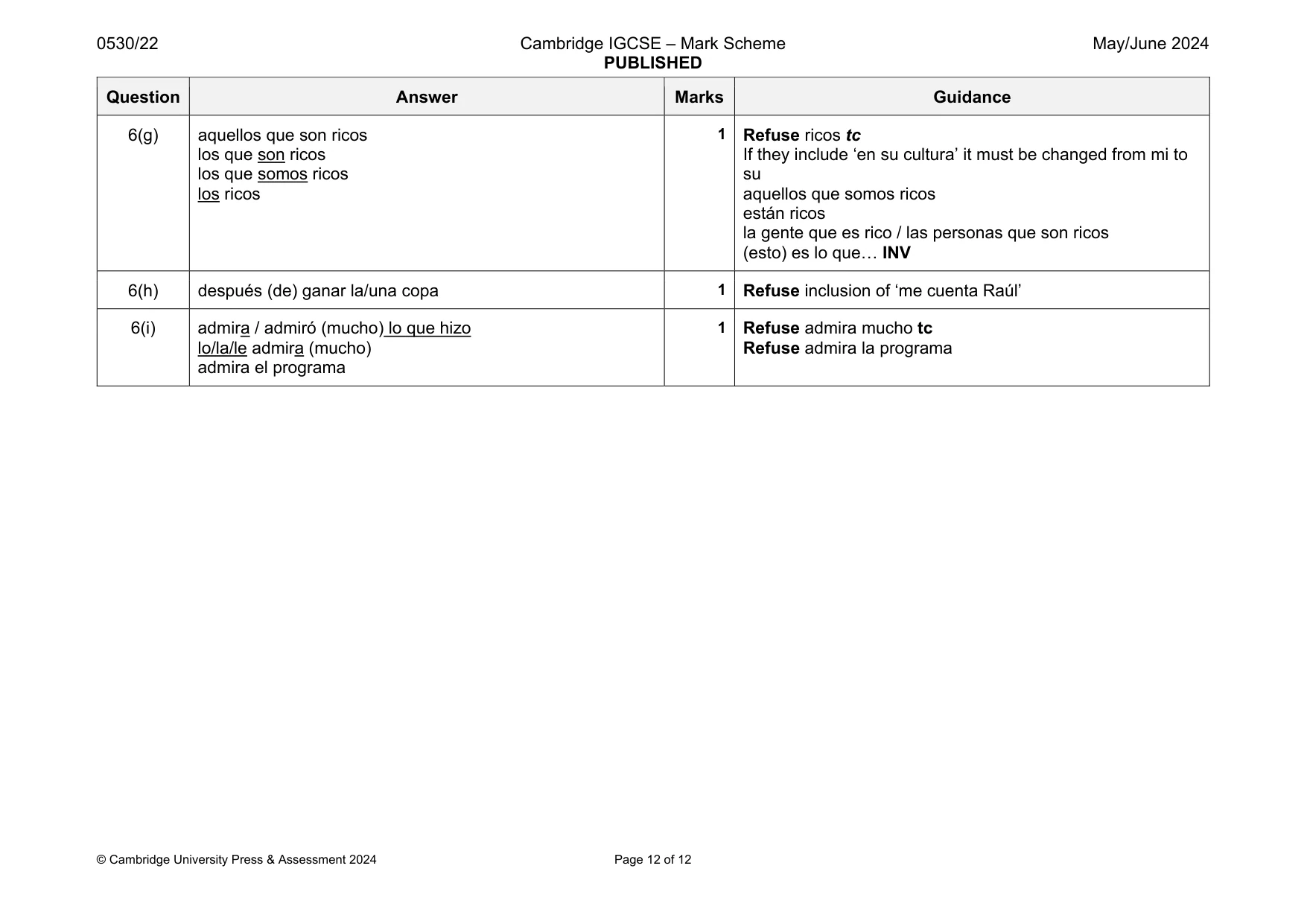
0530/22 Cambridge IGCSE – Mark Scheme PUBLISHED May/June 2024 © Cambridge University Press & Assessment 2024 Page 12 of 12 Question Answer Marks Guidance 6(g) aquellos que son ricos los que son ricos los que somos ricos los ricos 1 Refuse ricos tc If they include ‘en su cultura’ it must be changed from mi to su aquellos que somos ricos están ricos la gente que es rico / las personas que son ricos (esto) es lo que… INV 6(h) después (de) ganar la/una copa 1 Refuse inclusion of ‘me cuenta Raúl’ 6(i) admira / admiró (mucho) lo que hizo lo/la/le admira (mucho) admira el programa 1 Refuse admira mucho tc Refuse admira la programa
What you needed in this session
Cambridge’s own grade thresholds for 2024 May/June, Paper 2 · Variant 2. A higher threshold means an easier paper — the bar moves with how the cohort did.