Cambridge IGCSE Spanish - Foreign Language 0530 — 2024 Feb/March Paper 2 · Variant 2
0530/22/F/M/24 · 45 marks · ≈51 min
The question paper and its mark scheme, free to read here and free to download. This is Cambridge’s own paper, exactly as it was sat.
Question paper12 pages

Mark scheme10 pages
Answers below. Sit the paper first if you are practising.
Paper as text
Question paper, page 1
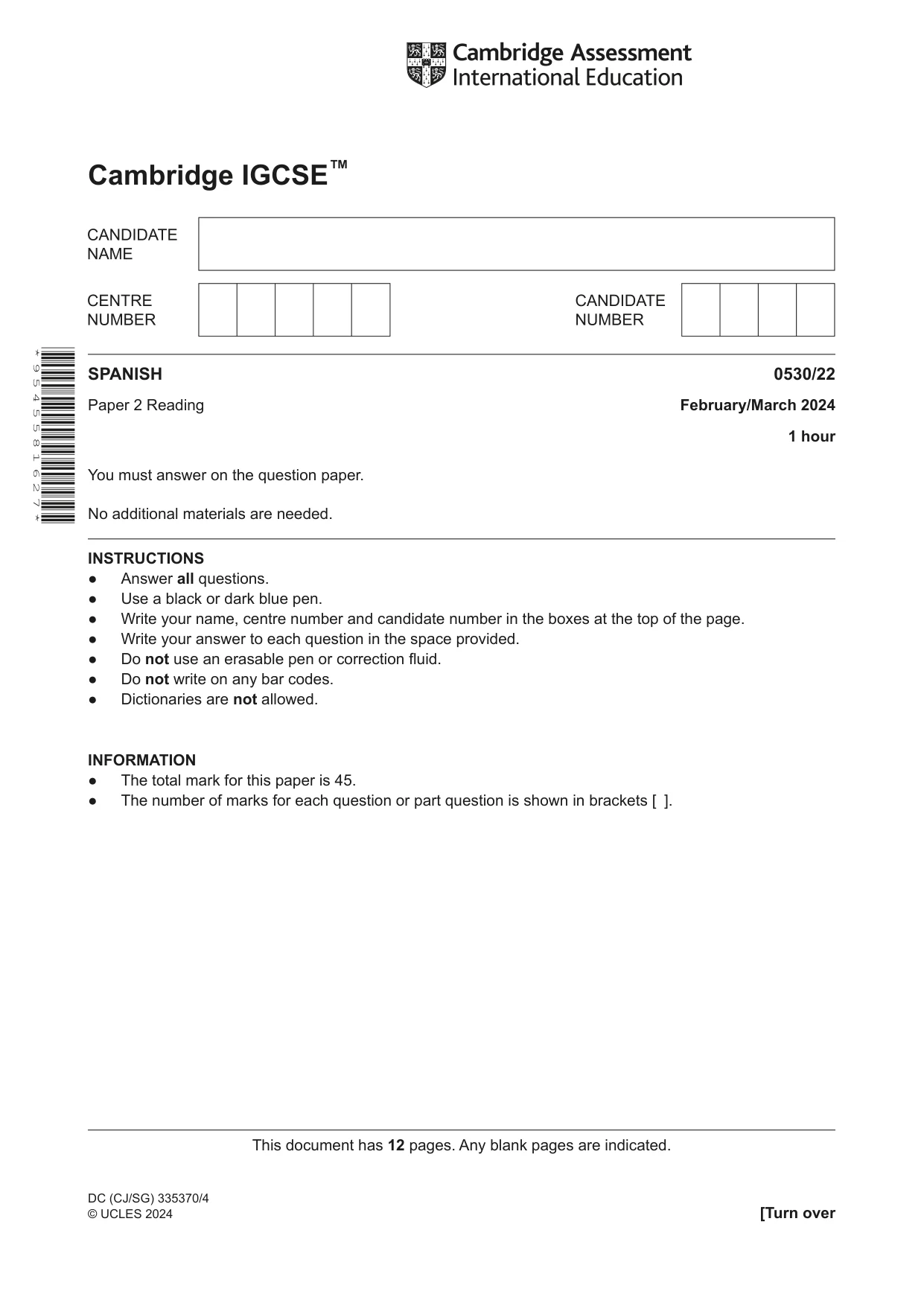
This document has 12 pages. Any blank pages are indicated. [Turn over Cambridge IGCSE™ SPANISH 0530/22 Paper 2 Reading February/March 2024 1 hour You must answer on the question paper. No additional materials are needed. INSTRUCTIONS ● Answer all questions. ● Use a black or dark blue pen. ● Write your name, centre number and candidate number in the boxes at the top of the page. ● Write your answer to each question in the space provided. ● Do not use an erasable pen or correction fluid. ● Do not write on any bar codes. ● Dictionaries are not allowed. INFORMATION ● The total mark for this paper is 45. ● The number of marks for each question or part question is shown in brackets [ ]. * 9 5 4 5 5 8 1 6 2 7 * DC (CJ/SG) 335370/4 © UCLES 2024
Question paper, page 2
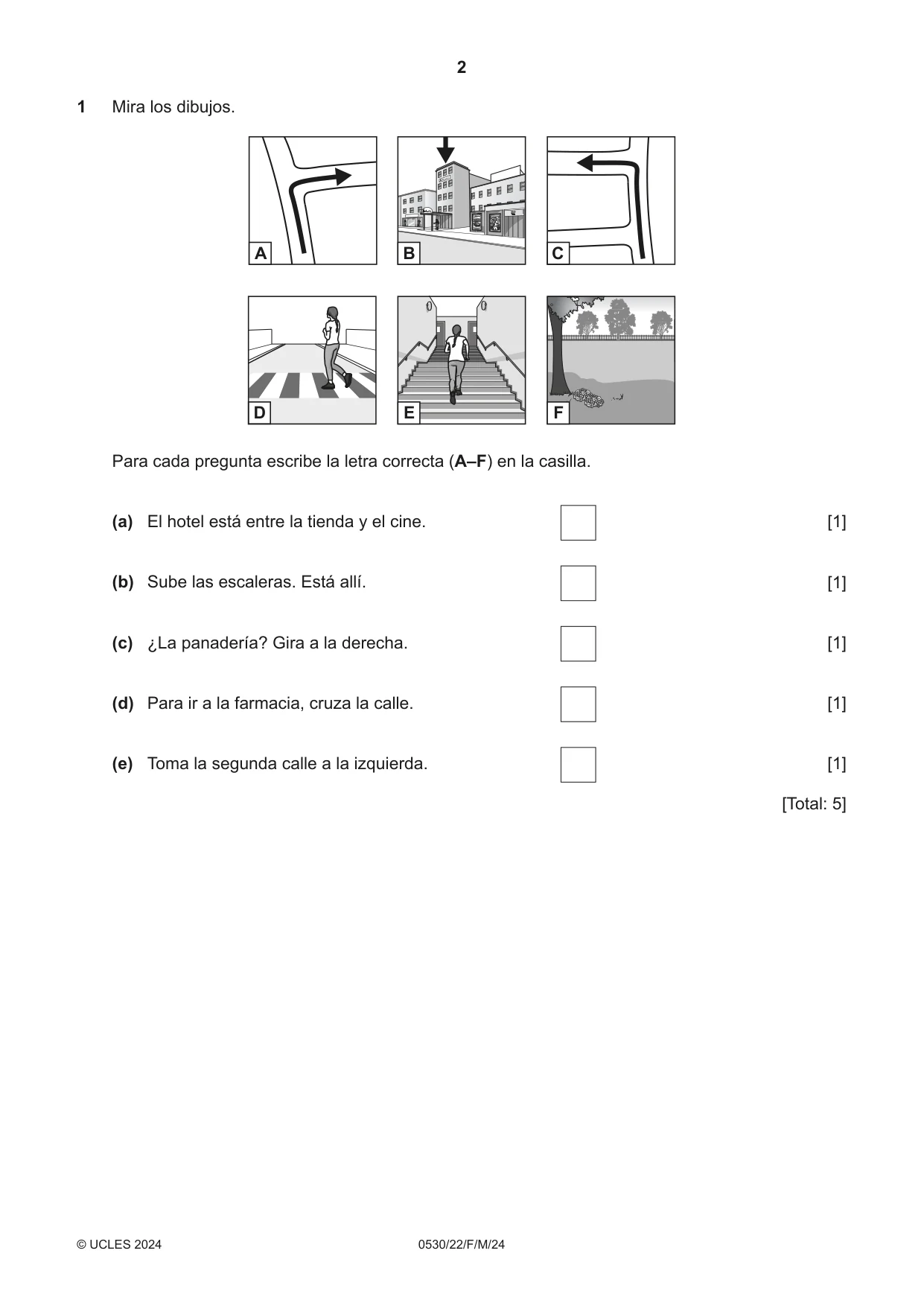
2 0530/22/F/M/24 © UCLES 2024 1 Mira los dibujos. 3 C B A E D F Para cada pregunta escribe la letra correcta (A–F) en la casilla. (a) El hotel está entre la tienda y el cine. [1] (b) Sube las escaleras. Está allí. [1] (c) ¿La panadería? Gira a la derecha. [1] (d) Para ir a la farmacia, cruza la calle. [1] (e) Toma la segunda calle a la izquierda. [1] [Total: 5]
Question paper, page 3
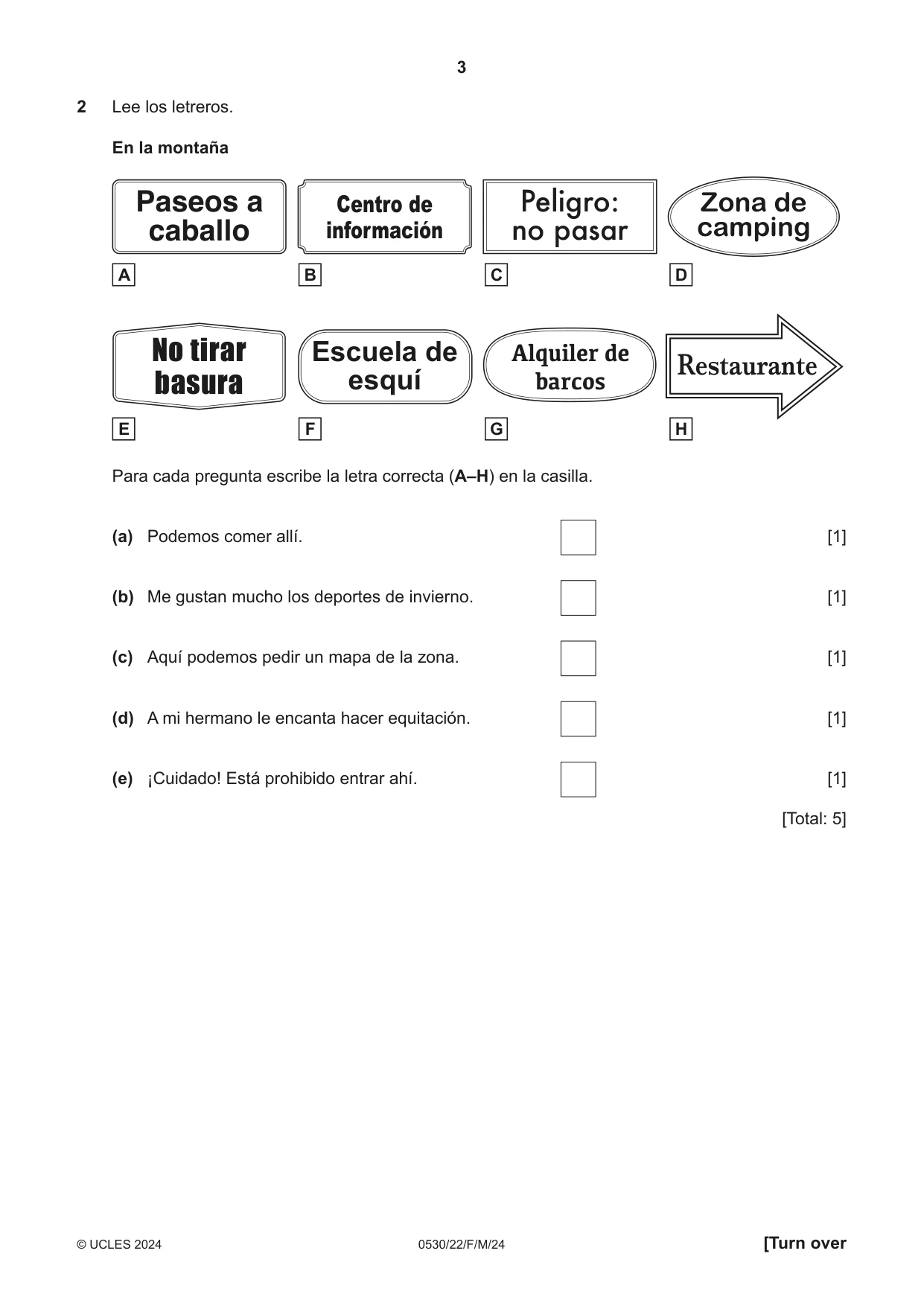
3 0530/22/F/M/24 © UCLES 2024 [Turn over 2 Lee los letreros. En la montaña Paseos a caballo No tirar basura Escuela de esquí Alquiler de barcos Centro de información Peligro: no pasar Zona de camping Restaurante A B C D E F G H Para cada pregunta escribe la letra correcta (A–H) en la casilla. (a) Podemos comer allí. [1] (b) Me gustan mucho los deportes de invierno. [1] (c) Aquí podemos pedir un mapa de la zona. [1] (d) A mi hermano le encanta hacer equitación. [1] (e) ¡Cuidado! Está prohibido entrar ahí. [1] [Total: 5]
Question paper, page 4
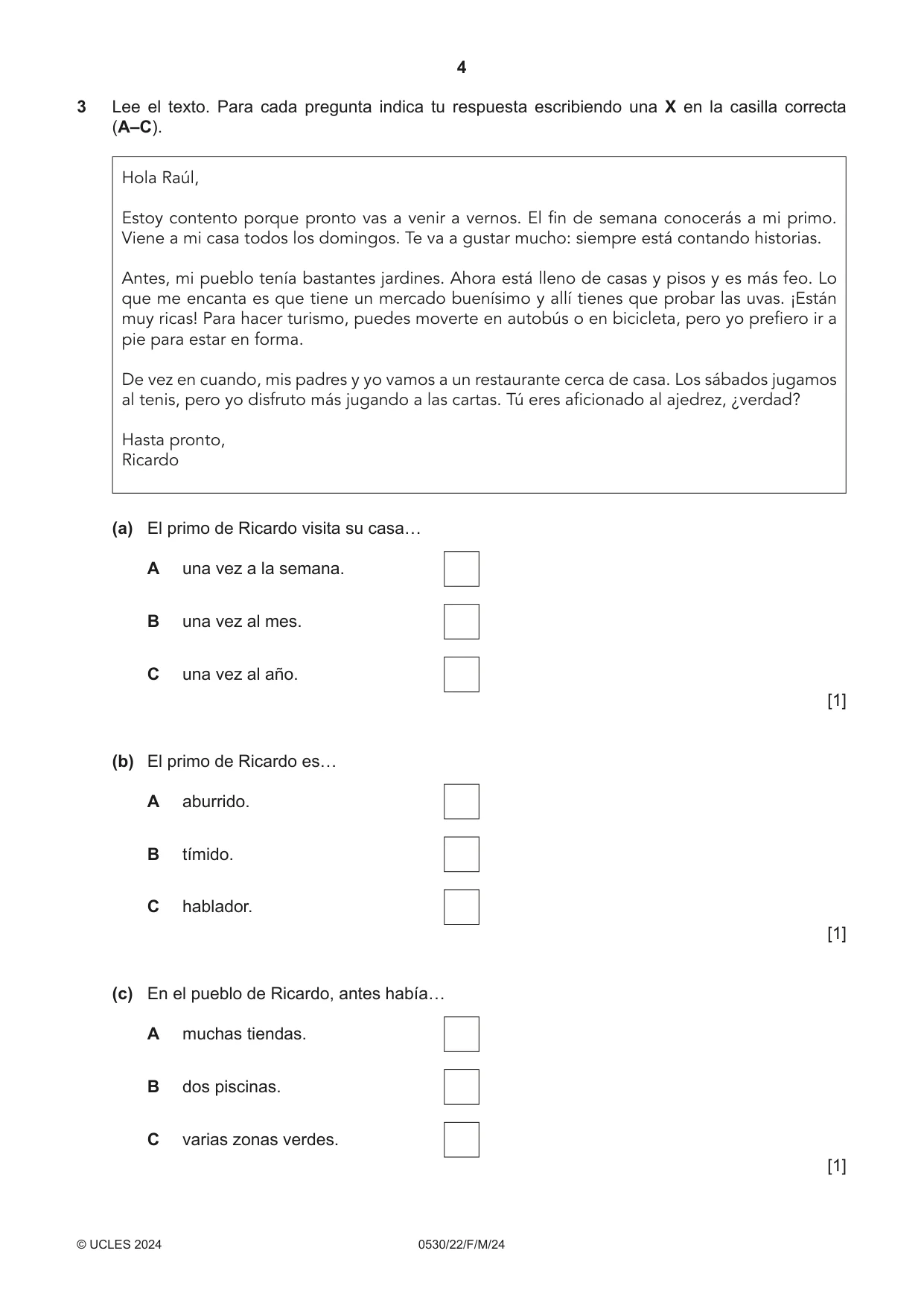
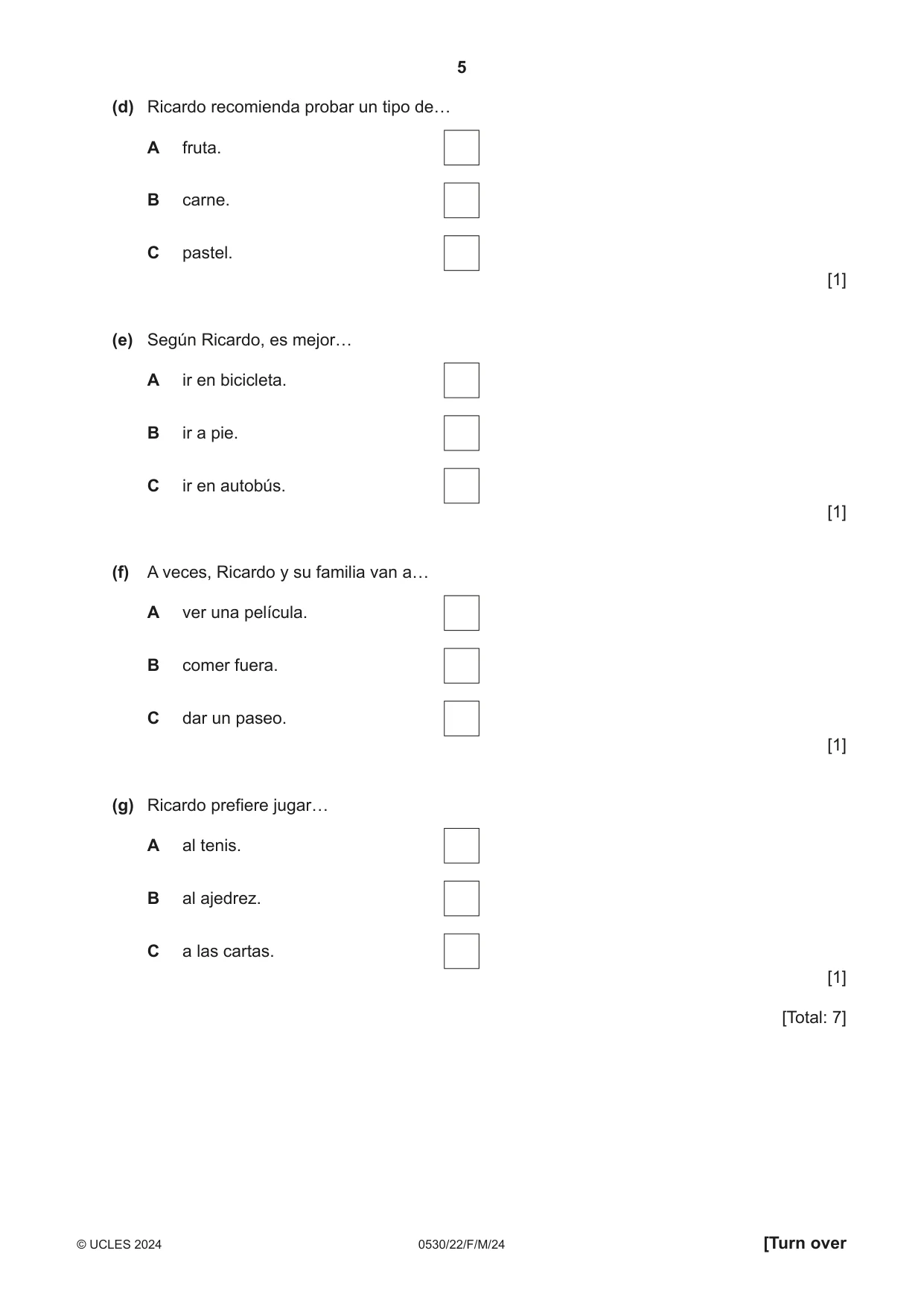
4 0530/22/F/M/24 © UCLES 2024 3 Lee el texto. Para cada pregunta indica tu respuesta escribiendo una X en la casilla correcta (A–C). Hola Raúl, Estoy contento porque pronto vas a venir a vernos. El fin de semana conocerás a mi primo. Viene a mi casa todos los domingos. Te va a gustar mucho: siempre está contando historias. Antes, mi pueblo tenía bastantes jardines. Ahora está lleno de casas y pisos y es más feo. Lo que me encanta es que tiene un mercado buenísimo y allí tienes que probar las uvas. ¡Están muy ricas! Para hacer turismo, puedes moverte en autobús o en bicicleta, pero yo prefiero ir a pie para estar en forma. De vez en cuando, mis padres y yo vamos a un restaurante cerca de casa. Los sábados jugamos al tenis, pero yo disfruto más jugando a las cartas. Tú eres aficionado al ajedrez, ¿verdad? Hasta pronto, Ricardo (a) El primo de Ricardo visita su casa… A una vez a la semana. B una vez al mes. C una vez al año. [1] (b) El primo de Ricardo es… A aburrido. B tímido. C hablador. [1] (c) En el pueblo de Ricardo, antes había… A muchas tiendas. B dos piscinas. C varias zonas verdes. [1]
Question paper, page 5
5 0530/22/F/M/24 © UCLES 2024 [Turn over (d) Ricardo recomienda probar un tipo de… A fruta. B carne. C pastel. [1] (e) Según Ricardo, es mejor… A ir en bicicleta. B ir a pie. C ir en autobús. [1] (f) A veces, Ricardo y su familia van a… A ver una película. B comer fuera. C dar un paseo. [1] (g) Ricardo prefiere jugar… A al tenis. B al ajedrez. C a las cartas. [1] [Total: 7]
Question paper, page 6
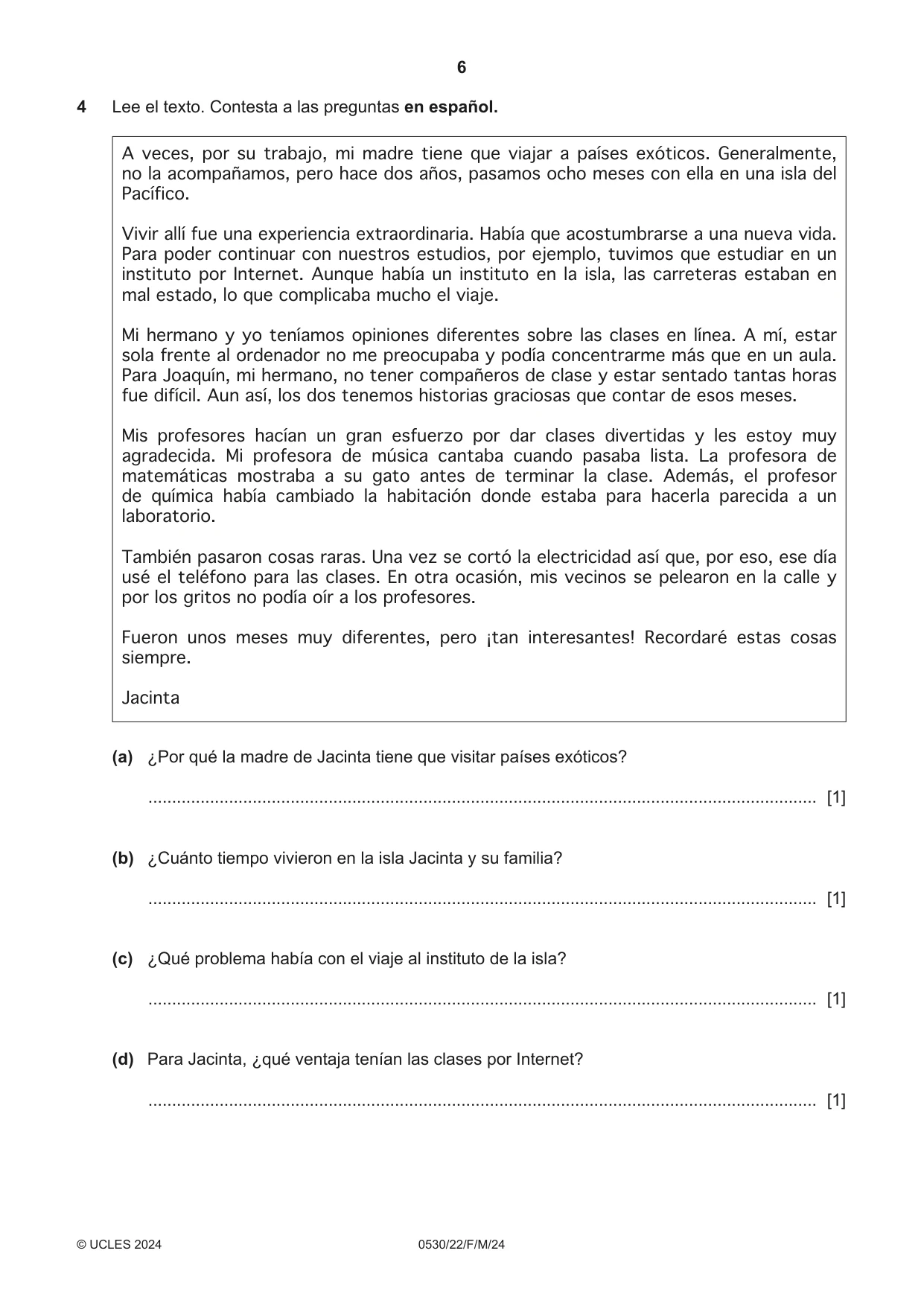
6 0530/22/F/M/24 © UCLES 2024 4 Lee el texto. Contesta a las preguntas en español. A veces, por su trabajo, mi madre tiene que viajar a países exóticos. Generalmente, no la acompañamos, pero hace dos años, pasamos ocho meses con ella en una isla del Pacífico. Vivir allí fue una experiencia extraordinaria. Había que acostumbrarse a una nueva vida. Para poder continuar con nuestros estudios, por ejemplo, tuvimos que estudiar en un instituto por Internet. Aunque había un instituto en la isla, las carreteras estaban en mal estado, lo que complicaba mucho el viaje. Mi hermano y yo teníamos opiniones diferentes sobre las clases en línea. A mí, estar sola frente al ordenador no me preocupaba y podía concentrarme más que en un aula. Para Joaquín, mi hermano, no tener compañeros de clase y estar sentado tantas horas fue difícil. Aun así, los dos tenemos historias graciosas que contar de esos meses. Mis profesores hacían un gran esfuerzo por dar clases divertidas y les estoy muy agradecida. Mi profesora de música cantaba cuando pasaba lista. La profesora de matemáticas mostraba a su gato antes de terminar la clase. Además, el profesor de química había cambiado la habitación donde estaba para hacerla parecida a un laboratorio. También pasaron cosas raras. Una vez se cortó la electricidad así que, por eso, ese día usé el teléfono para las clases. En otra ocasión, mis vecinos se pelearon en la calle y por los gritos no podía oír a los profesores. Fueron unos meses muy diferentes, pero ¡tan interesantes! Recordaré estas cosas siempre. Jacinta (a) ¿Por qué la madre de Jacinta tiene que visitar países exóticos? … [1] (b) ¿Cuánto tiempo vivieron en la isla Jacinta y su familia? … [1] (c) ¿Qué problema había con el viaje al instituto de la isla? … [1] (d) Para Jacinta, ¿qué ventaja tenían las clases por Internet? … [1]
Question paper, page 7
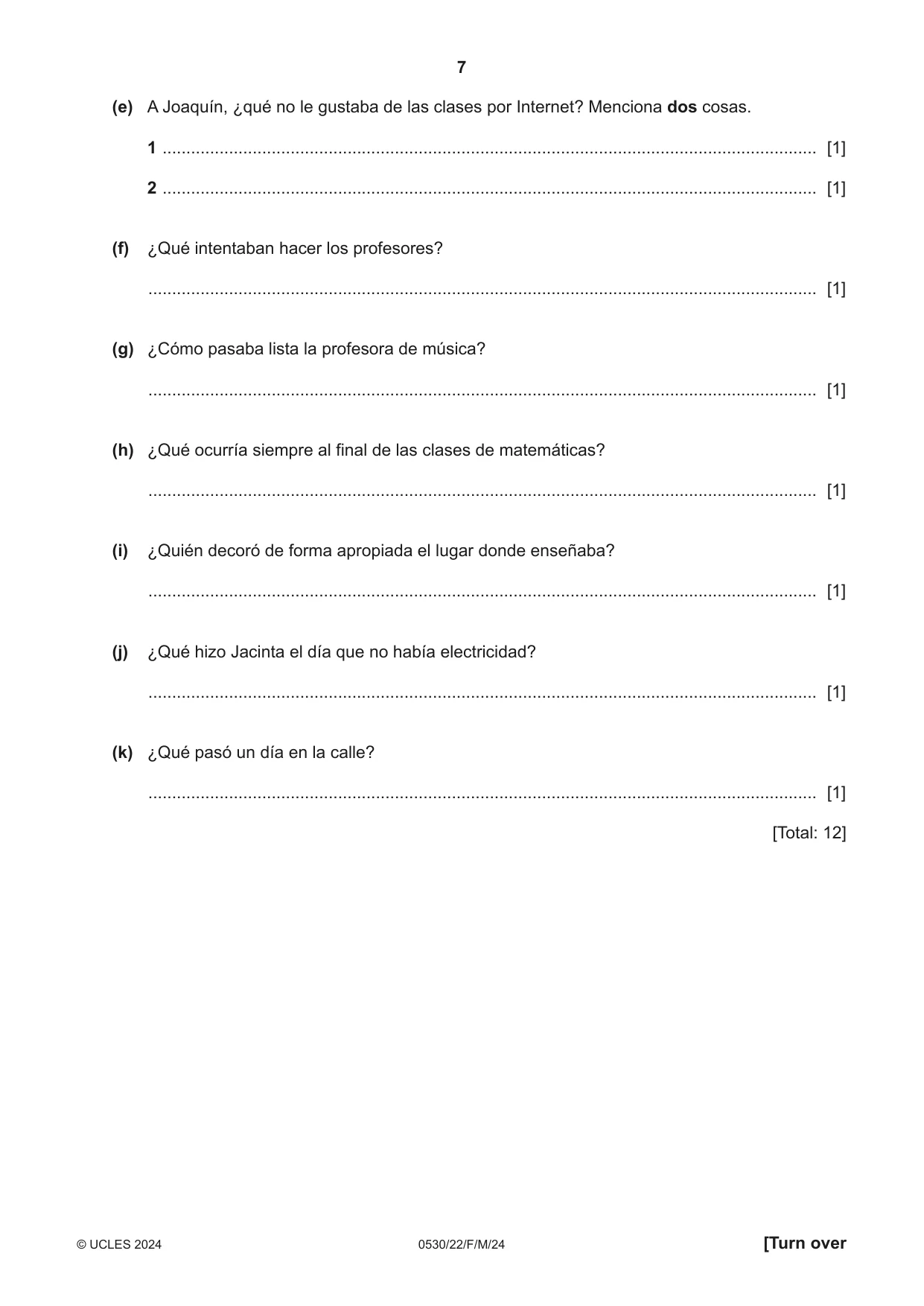
7 0530/22/F/M/24 © UCLES 2024 [Turn over (e) A Joaquín, ¿qué no le gustaba de las clases por Internet? Menciona dos cosas. 1 … [1] 2 … [1] (f) ¿Qué intentaban hacer los profesores? … [1] (g) ¿Cómo pasaba lista la profesora de música? … [1] (h) ¿Qué ocurría siempre al final de las clases de matemáticas? … [1] (i) ¿Quién decoró de forma apropiada el lugar donde enseñaba? … [1] (j) ¿Qué hizo Jacinta el día que no había electricidad? … [1] (k) ¿Qué pasó un día en la calle? … [1] [Total: 12]
Question paper, page 8
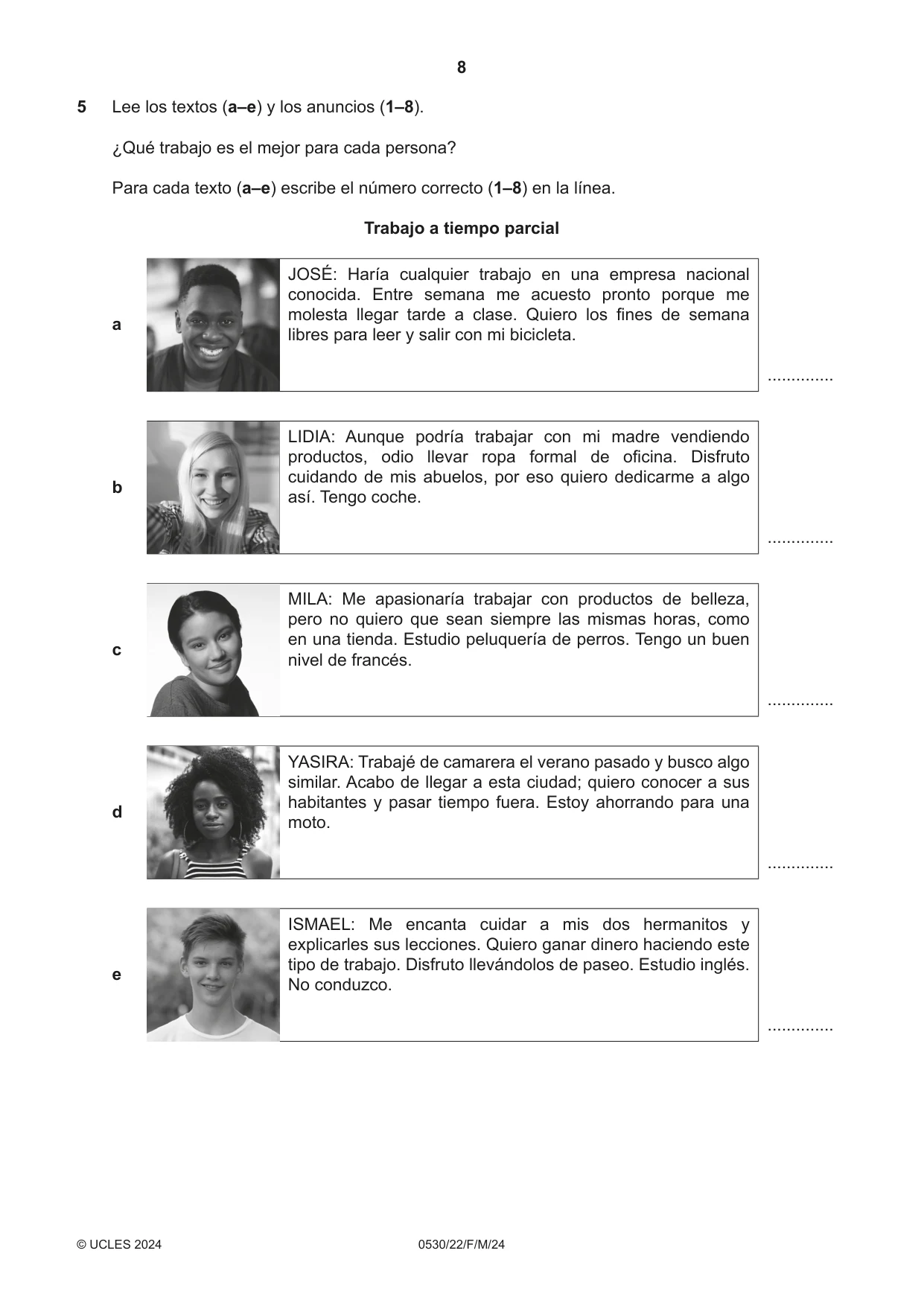
8 0530/22/F/M/24 © UCLES 2024 5 Lee los textos (a–e) y los anuncios (1–8). ¿Qué trabajo es el mejor para cada persona? Para cada texto (a–e) escribe el número correcto (1–8) en la línea. Trabajo a tiempo parcial a JOSÉ: Haría cualquier trabajo en una empresa nacional conocida. Entre semana me acuesto pronto porque me molesta llegar tarde a clase. Quiero los fines de semana libres para leer y salir con mi bicicleta. … b LIDIA: Aunque podría trabajar con mi madre vendiendo productos, odio llevar ropa formal de oficina. Disfruto cuidando de mis abuelos, por eso quiero dedicarme a algo así. Tengo coche. … c MILA: Me apasionaría trabajar con productos de belleza, pero no quiero que sean siempre las mismas horas, como en una tienda. Estudio peluquería de perros. Tengo un buen nivel de francés. … d YASIRA: Trabajé de camarera el verano pasado y busco algo similar. Acabo de llegar a esta ciudad; quiero conocer a sus habitantes y pasar tiempo fuera. Estoy ahorrando para una moto. … e ISMAEL: Me encanta cuidar a mis dos hermanitos y explicarles sus lecciones. Quiero ganar dinero haciendo este tipo de trabajo. Disfruto llevándolos de paseo. Estudio inglés. No conduzco. …
Question paper, page 9
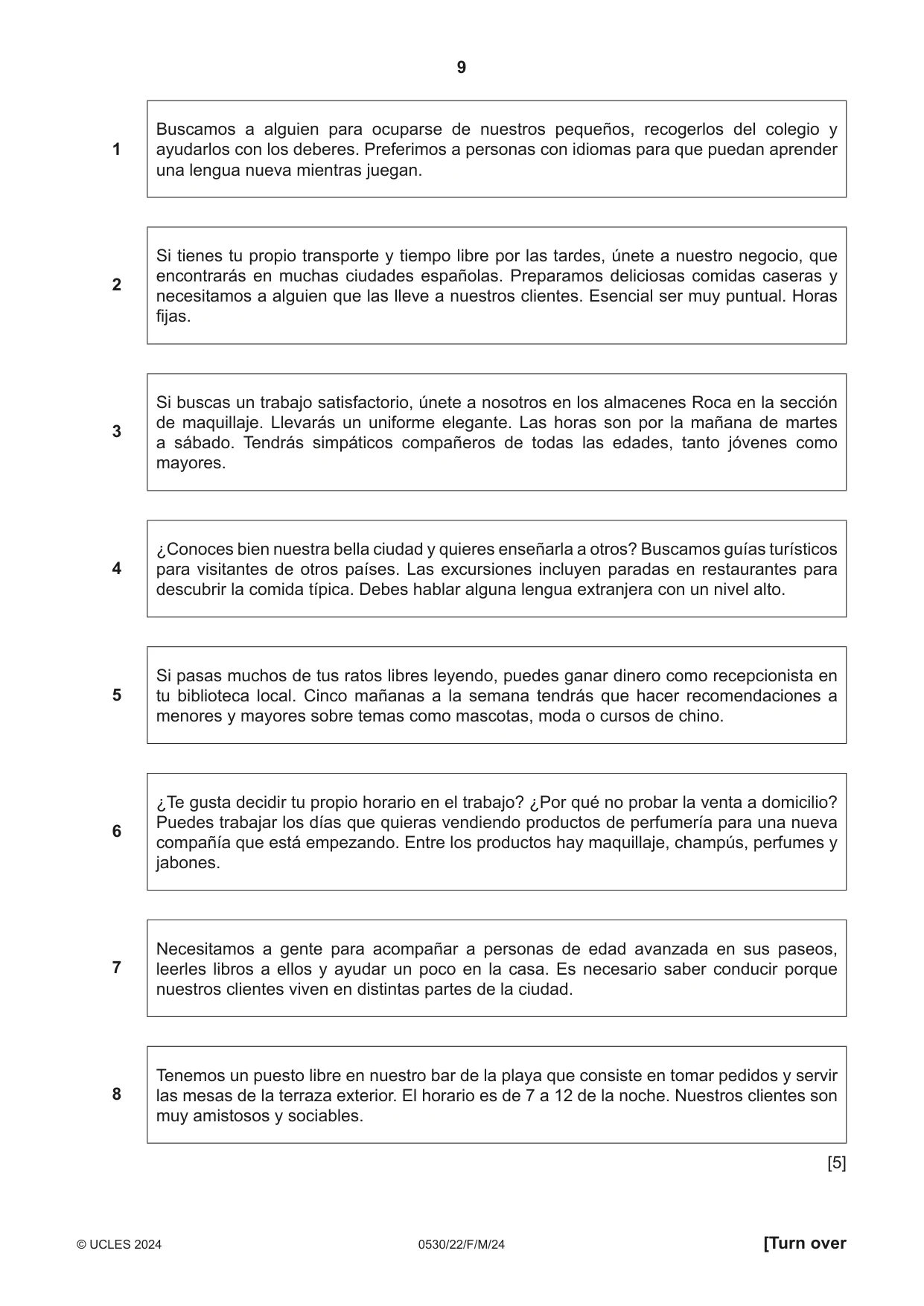
9 0530/22/F/M/24 © UCLES 2024 [Turn over 1 Buscamos a alguien para ocuparse de nuestros pequeños, recogerlos del colegio y ayudarlos con los deberes. Preferimos a personas con idiomas para que puedan aprender una lengua nueva mientras juegan. 2 Si tienes tu propio transporte y tiempo libre por las tardes, únete a nuestro negocio, que encontrarás en muchas ciudades españolas. Preparamos deliciosas comidas caseras y necesitamos a alguien que las lleve a nuestros clientes. Esencial ser muy puntual. Horas fijas. 3 Si buscas un trabajo satisfactorio, únete a nosotros en los almacenes Roca en la sección de maquillaje. Llevarás un uniforme elegante. Las horas son por la mañana de martes a sábado. Tendrás simpáticos compañeros de todas las edades, tanto jóvenes como mayores. 4 ¿Conoces bien nuestra bella ciudad y quieres enseñarla a otros? Buscamos guías turísticos para visitantes de otros países. Las excursiones incluyen paradas en restaurantes para descubrir la comida típica. Debes hablar alguna lengua extranjera con un nivel alto. 5 Si pasas muchos de tus ratos libres leyendo, puedes ganar dinero como recepcionista en tu biblioteca local. Cinco mañanas a la semana tendrás que hacer recomendaciones a menores y mayores sobre temas como mascotas, moda o cursos de chino. 6 ¿Te gusta decidir tu propio horario en el trabajo? ¿Por qué no probar la venta a domicilio? Puedes trabajar los días que quieras vendiendo productos de perfumería para una nueva compañía que está empezando. Entre los productos hay maquillaje, champús, perfumes y jabones. 7 Necesitamos a gente para acompañar a personas de edad avanzada en sus paseos, leerles libros a ellos y ayudar un poco en la casa. Es necesario saber conducir porque nuestros clientes viven en distintas partes de la ciudad. 8 Tenemos un puesto libre en nuestro bar de la playa que consiste en tomar pedidos y servir las mesas de la terraza exterior. El horario es de 7 a 12 de la noche. Nuestros clientes son muy amistosos y sociables. [5]
Question paper, page 10
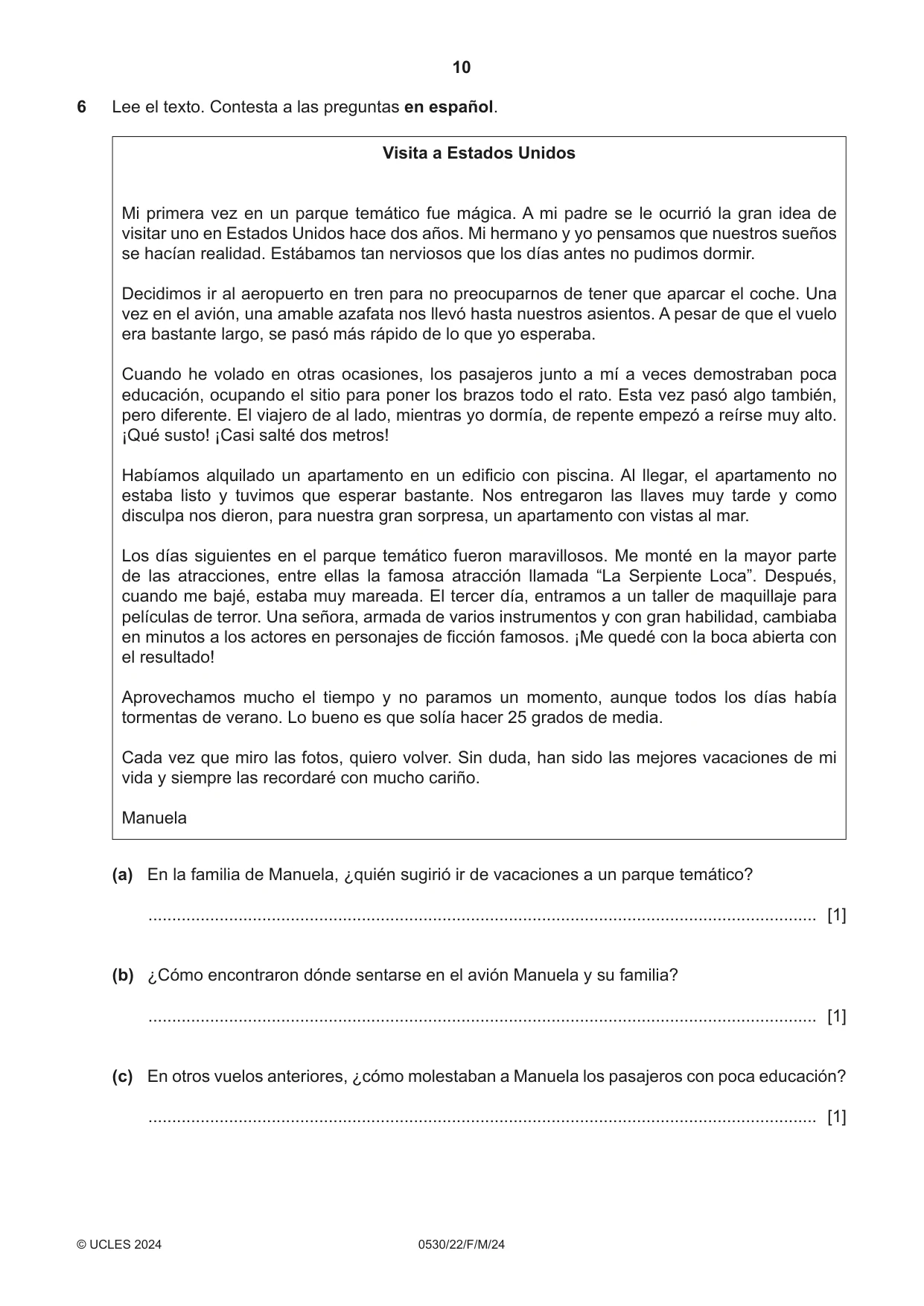
10 0530/22/F/M/24 © UCLES 2024 6 Lee el texto. Contesta a las preguntas en español. Visita a Estados Unidos Mi primera vez en un parque temático fue mágica. A mi padre se le ocurrió la gran idea de visitar uno en Estados Unidos hace dos años. Mi hermano y yo pensamos que nuestros sueños se hacían realidad. Estábamos tan nerviosos que los días antes no pudimos dormir. Decidimos ir al aeropuerto en tren para no preocuparnos de tener que aparcar el coche. Una vez en el avión, una amable azafata nos llevó hasta nuestros asientos. A pesar de que el vuelo era bastante largo, se pasó más rápido de lo que yo esperaba. Cuando he volado en otras ocasiones, los pasajeros junto a mí a veces demostraban poca educación, ocupando el sitio para poner los brazos todo el rato. Esta vez pasó algo también, pero diferente. El viajero de al lado, mientras yo dormía, de repente empezó a reírse muy alto. ¡Qué susto! ¡Casi salté dos metros! Habíamos alquilado un apartamento en un edificio con piscina. Al llegar, el apartamento no estaba listo y tuvimos que esperar bastante. Nos entregaron las llaves muy tarde y como disculpa nos dieron, para nuestra gran sorpresa, un apartamento con vistas al mar. Los días siguientes en el parque temático fueron maravillosos. Me monté en la mayor parte de las atracciones, entre ellas la famosa atracción llamada “La Serpiente Loca”. Después, cuando me bajé, estaba muy mareada. El tercer día, entramos a un taller de maquillaje para películas de terror. Una señora, armada de varios instrumentos y con gran habilidad, cambiaba en minutos a los actores en personajes de ficción famosos. ¡Me quedé con la boca abierta con el resultado! Aprovechamos mucho el tiempo y no paramos un momento, aunque todos los días había tormentas de verano. Lo bueno es que solía hacer 25 grados de media. Cada vez que miro las fotos, quiero volver. Sin duda, han sido las mejores vacaciones de mi vida y siempre las recordaré con mucho cariño. Manuela (a) En la familia de Manuela, ¿quién sugirió ir de vacaciones a un parque temático? … [1] (b) ¿Cómo encontraron dónde sentarse en el avión Manuela y su familia? … [1] (c) En otros vuelos anteriores, ¿cómo molestaban a Manuela los pasajeros con poca educación? … [1]
Question paper, page 11
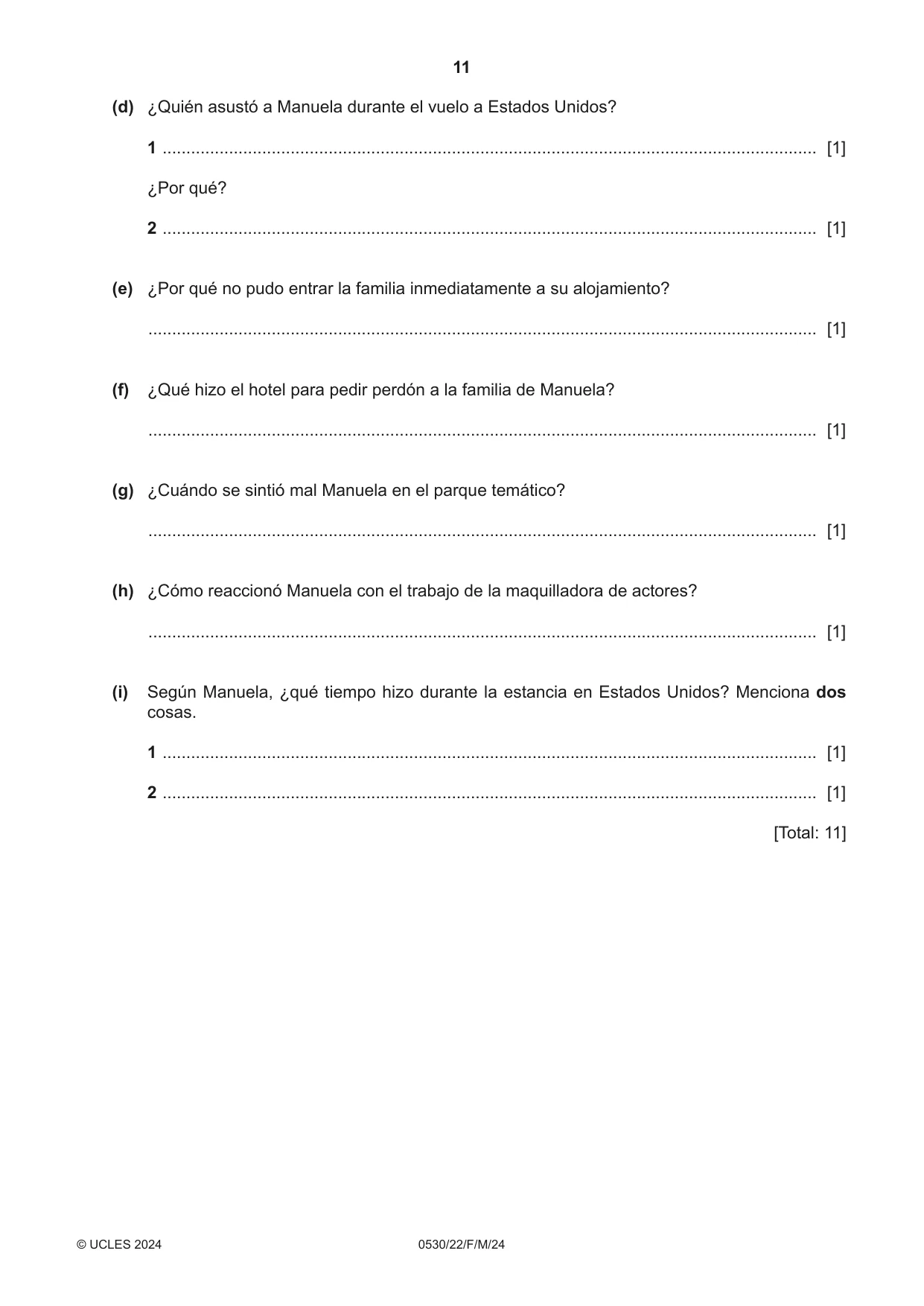
11 0530/22/F/M/24 © UCLES 2024 (d) ¿Quién asustó a Manuela durante el vuelo a Estados Unidos? 1 … [1] ¿Por qué? 2 … [1] (e) ¿Por qué no pudo entrar la familia inmediatamente a su alojamiento? … [1] (f) ¿Qué hizo el hotel para pedir perdón a la familia de Manuela? … [1] (g) ¿Cuándo se sintió mal Manuela en el parque temático? … [1] (h) ¿Cómo reaccionó Manuela con el trabajo de la maquilladora de actores? … [1] (i) Según Manuela, ¿qué tiempo hizo durante la estancia en Estados Unidos? Menciona dos cosas. 1 … [1] 2 … [1] [Total: 11]
Question paper, page 12
12 0530/22/F/M/24 © UCLES 2024 Permission to reproduce items where third-party owned material protected by copyright is included has been sought and cleared where possible. Every reasonable effort has been made by the publisher (UCLES) to trace copyright holders, but if any items requiring clearance have unwittingly been included, the publisher will be pleased to make amends at the earliest possible opportunity. To avoid the issue of disclosure of answer-related information to candidates, all copyright acknowledgements are reproduced online in the Cambridge Assessment International Education Copyright Acknowledgements Booklet. This is produced for each series of examinations and is freely available to download at www.cambridgeinternational.org after the live examination series. Cambridge Assessment International Education is part of Cambridge Assessment. Cambridge Assessment is the brand name of the University of Cambridge Local Examinations Syndicate (UCLES), which is a department of the University of Cambridge. BLANK PAGE
Mark scheme, page 1
This document consists of 10 printed pages. © Cambridge University Press & Assessment 2024 [Turn over Cambridge IGCSE™ SPANISH 0530/22 Paper 2 Reading February/March 2024 MARK SCHEME Maximum Mark: 45 Published This mark scheme is published as an aid to teachers and candidates, to indicate the requirements of the examination. It shows the basis on which Examiners were instructed to award marks. It does not indicate the details of the discussions that took place at an Examiners’ meeting before marking began, which would have considered the acceptability of alternative answers. Mark schemes should be read in conjunction with the question paper and the Principal Examiner Report for Teachers. Cambridge International will not enter into discussions about these mark schemes. Cambridge International is publishing the mark schemes for the February/March 2024 series for most Cambridge IGCSE, Cambridge International A and AS Level components, and some Cambridge O Level components.
Mark scheme, page 2
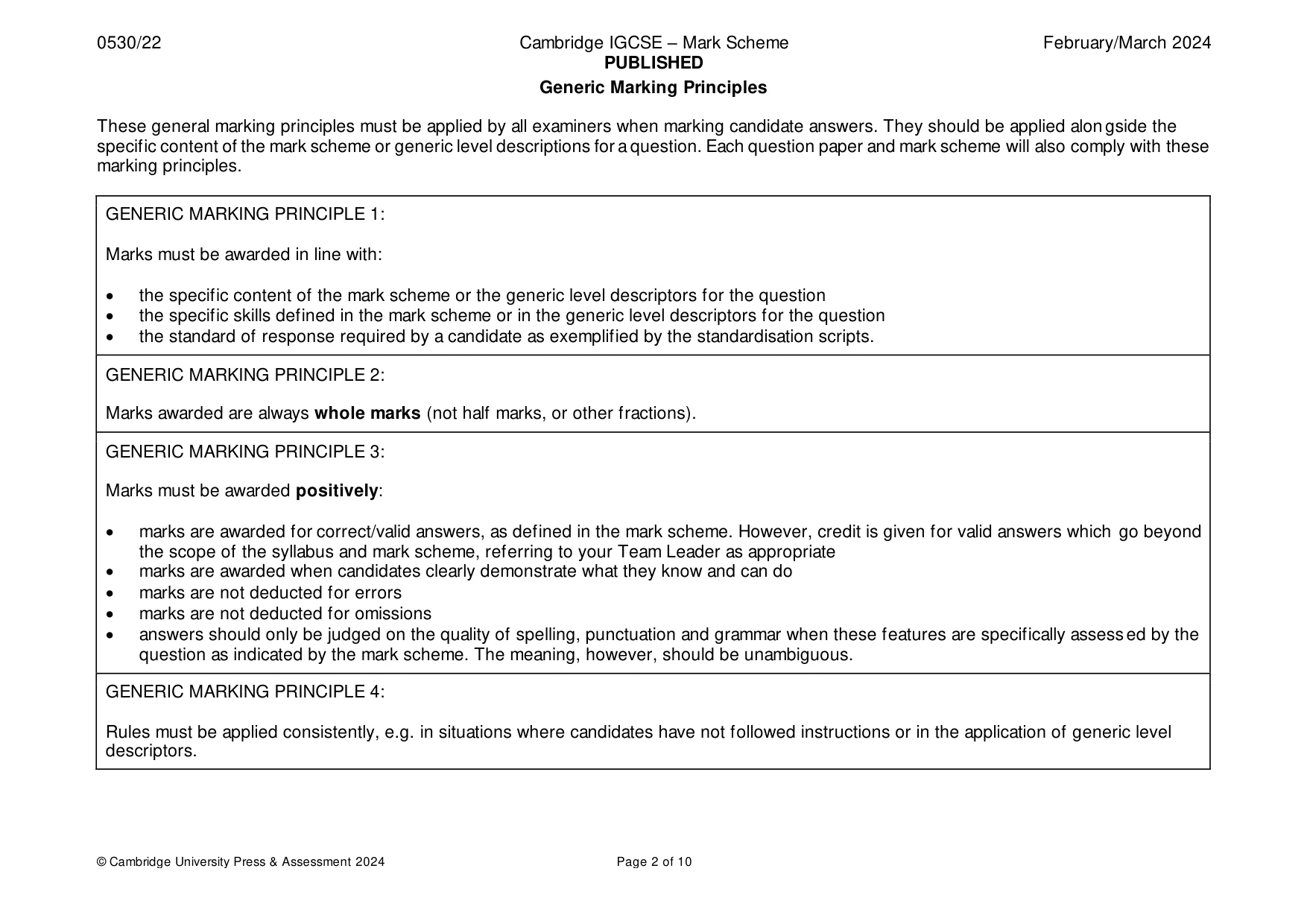
0530/22 Cambridge IGCSE – Mark Scheme PUBLISHED February/March 2024 © Cambridge University Press & Assessment 2024 Page 2 of 10 Generic Marking Principles These general marking principles must be applied by all examiners when marking candidate answers. They should be applied alon gside the specific content of the mark scheme or generic level descriptions for a question. Each question paper and mark scheme will also comply with these marking principles. GENERIC MARKING PRINCIPLE 1: Marks must be awarded in line with: • the specific content of the mark scheme or the generic level descriptors for the question • the specific skills defined in the mark scheme or in the generic level descriptors for the question • the standard of response required by a candidate as exemplified by the standardisation scripts. GENERIC MARKING PRINCIPLE 2: Marks awarded are always whole marks (not half marks, or other fractions). GENERIC MARKING PRINCIPLE 3: Marks must be awarded positively: • marks are awarded for correct/valid answers, as defined in the mark scheme. However, credit is given for valid answers which go beyond the scope of the syllabus and mark scheme, referring to your Team Leader as appropriate • marks are awarded when candidates clearly demonstrate what they know and can do • marks are not deducted for errors • marks are not deducted for omissions • answers should only be judged on the quality of spelling, punctuation and grammar when these features are specifically assessed by the question as indicated by the mark scheme. The meaning, however, should be unambiguous. GENERIC MARKING PRINCIPLE 4: Rules must be applied consistently, e.g. in situations where candidates have not followed instructions or in the application of generic level descriptors.
Mark scheme, page 3
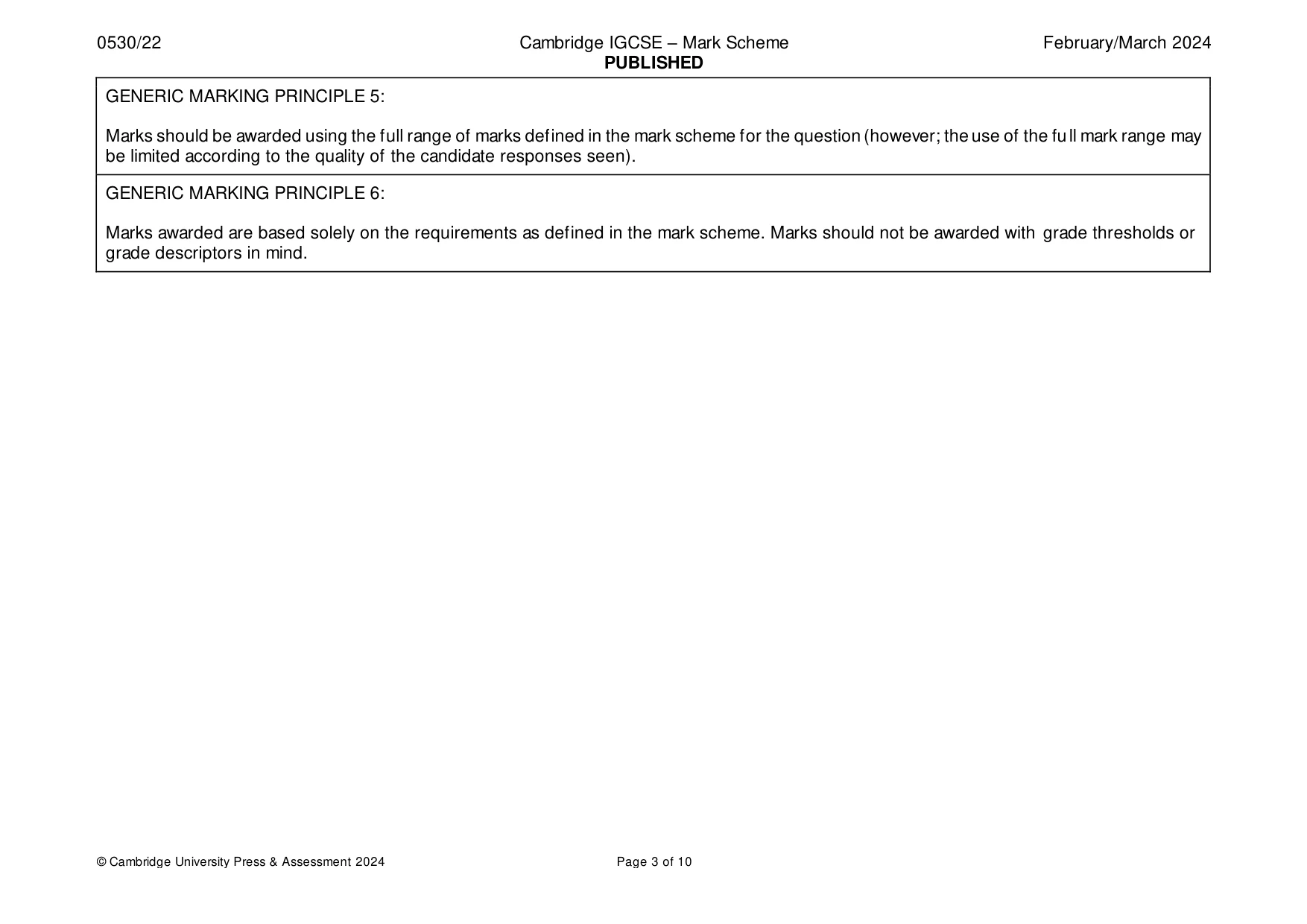
0530/22 Cambridge IGCSE – Mark Scheme PUBLISHED February/March 2024 © Cambridge University Press & Assessment 2024 Page 3 of 10 GENERIC MARKING PRINCIPLE 5: Marks should be awarded using the full range of marks defined in the mark scheme for the question (however; the use of the full mark range may be limited according to the quality of the candidate responses seen). GENERIC MARKING PRINCIPLE 6: Marks awarded are based solely on the requirements as defined in the mark scheme. Marks should not be awarded with grade thresholds or grade descriptors in mind.
Mark scheme, page 4
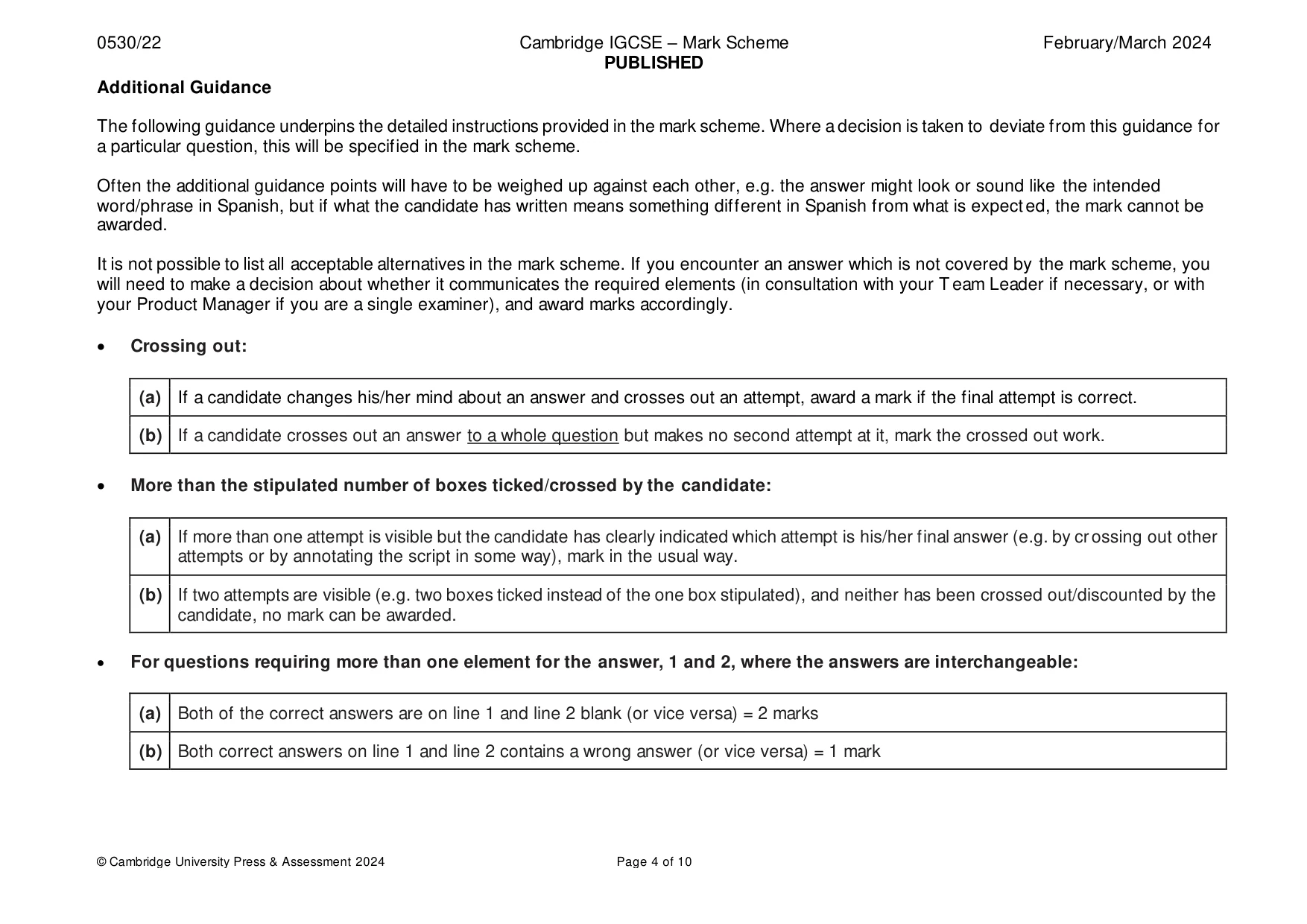
0530/22 Cambridge IGCSE – Mark Scheme PUBLISHED February/March 2024 © Cambridge University Press & Assessment 2024 Page 4 of 10 Additional Guidance The following guidance underpins the detailed instructions provided in the mark scheme. Where a decision is taken to deviate from this guidance for a particular question, this will be specified in the mark scheme. Often the additional guidance points will have to be weighed up against each other, e.g. the answer might look or sound like the intended word/phrase in Spanish, but if what the candidate has written means something different in Spanish from what is expected, the mark cannot be awarded. It is not possible to list all acceptable alternatives in the mark scheme. If you encounter an answer which is not covered by the mark scheme, you will need to make a decision about whether it communicates the required elements (in consultation with your T eam Leader if necessary, or with your Product Manager if you are a single examiner), and award marks accordingly. • Crossing out: (a) If a candidate changes his/her mind about an answer and crosses out an attempt, award a mark if the final attempt is correct. (b) If a candidate crosses out an answer to a whole question but makes no second attempt at it, mark the crossed out work. • More than the stipulated number of boxes ticked/crossed by the candidate: (a) If more than one attempt is visible but the candidate has clearly indicated which attempt is his/her final answer (e.g. by crossing out other attempts or by annotating the script in some way), mark in the usual way. (b) If two attempts are visible (e.g. two boxes ticked instead of the one box stipulated), and neither has been crossed out/discounted by the candidate, no mark can be awarded. • For questions requiring more than one element for the answer, 1 and 2, where the answers are interchangeable: (a) Both of the correct answers are on line 1 and line 2 blank (or vice versa) = 2 marks (b) Both correct answers on line 1 and line 2 contains a wrong answer (or vice versa) = 1 mark
Mark scheme, page 5
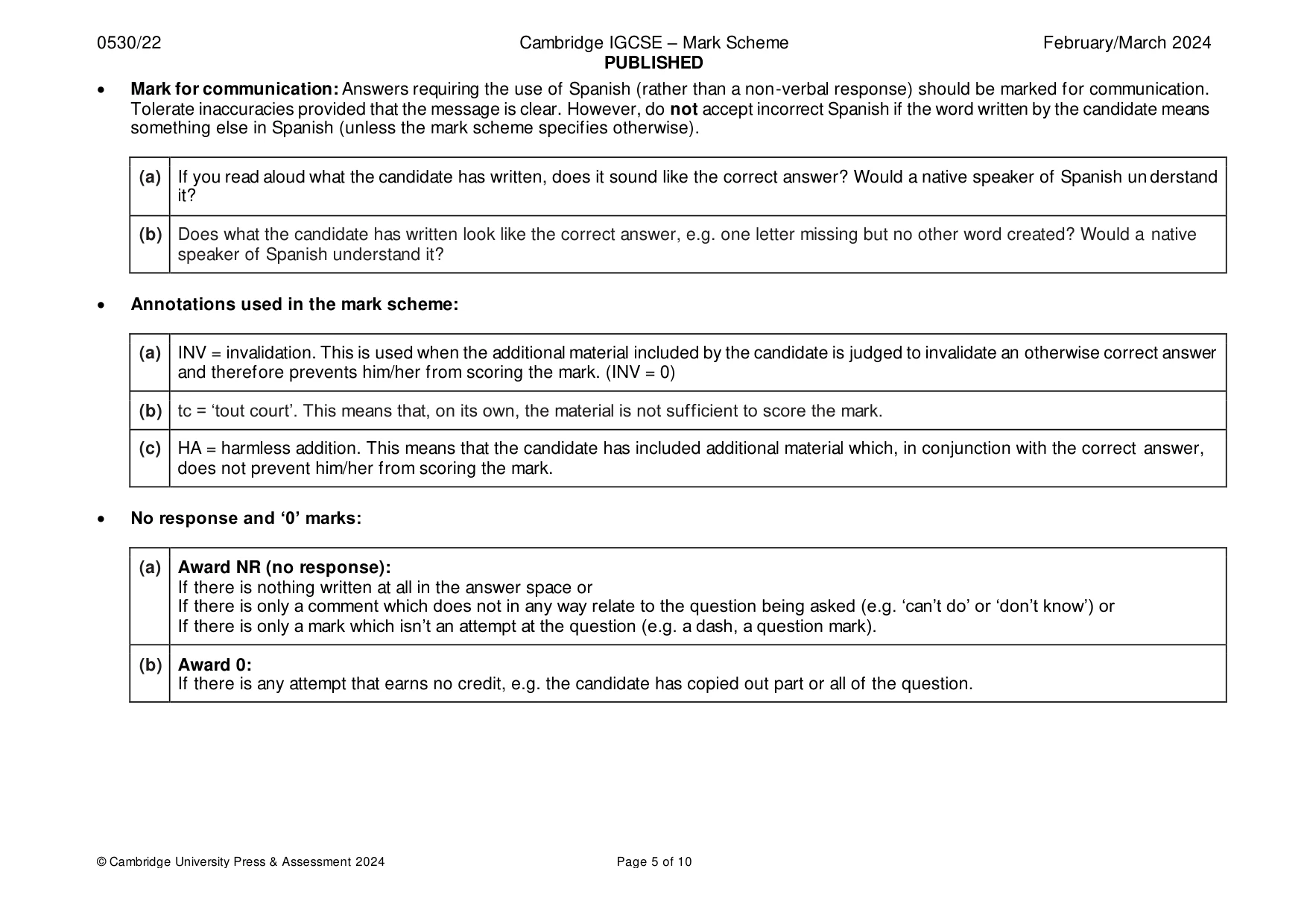
0530/22 Cambridge IGCSE – Mark Scheme PUBLISHED February/March 2024 © Cambridge University Press & Assessment 2024 Page 5 of 10 • Mark for communication: Answers requiring the use of Spanish (rather than a non-verbal response) should be marked for communication. Tolerate inaccuracies provided that the message is clear. However, do not accept incorrect Spanish if the word written by the candidate means something else in Spanish (unless the mark scheme specifies otherwise). (a) If you read aloud what the candidate has written, does it sound like the correct answer? Would a native speaker of Spanish un derstand it? (b) Does what the candidate has written look like the correct answer, e.g. one letter missing but no other word created? Would a native speaker of Spanish understand it? • Annotations used in the mark scheme: (a) INV = invalidation. This is used when the additional material included by the candidate is judged to invalidate an otherwise correct answer and therefore prevents him/her from scoring the mark. (INV = 0) (b) tc = ‘tout court’. This means that, on its own, the material is not sufficient to score the mark. (c) HA = harmless addition. This means that the candidate has included additional material which, in conjunction with the correct answer, does not prevent him/her from scoring the mark. • No response and ‘0’ marks: (a) Award NR (no response): If there is nothing written at all in the answer space or If there is only a comment which does not in any way relate to the question being asked (e.g. ‘can’t do’ or ‘don’t know’) or If there is only a mark which isn’t an attempt at the question (e.g. a dash, a question mark). (b) Award 0: If there is any attempt that earns no credit, e.g. the candidate has copied out part or all of the question.
Mark scheme, page 6
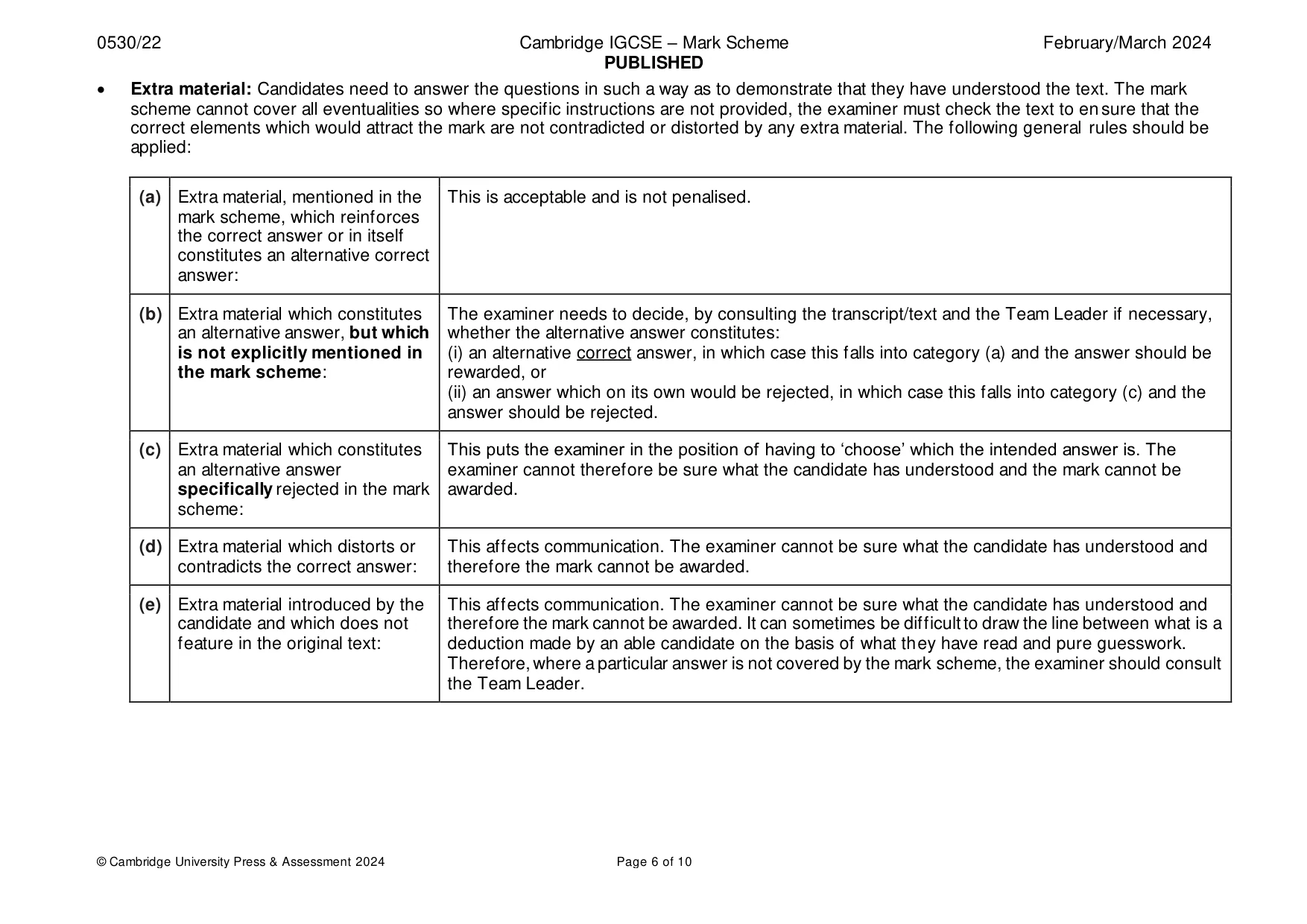
0530/22 Cambridge IGCSE – Mark Scheme PUBLISHED February/March 2024 © Cambridge University Press & Assessment 2024 Page 6 of 10 • Extra material: Candidates need to answer the questions in such a way as to demonstrate that they have understood the text. The mark scheme cannot cover all eventualities so where specific instructions are not provided, the examiner must check the text to en sure that the correct elements which would attract the mark are not contradicted or distorted by any extra material. The following general rules should be applied: (a) Extra material, mentioned in the mark scheme, which reinforces the correct answer or in itself constitutes an alternative correct answer: This is acceptable and is not penalised. (b) Extra material which constitutes an alternative answer, but which is not explicitly mentioned in the mark scheme: The examiner needs to decide, by consulting the transcript/text and the Team Leader if necessary, whether the alternative answer constitutes: (i) an alternative correct answer, in which case this falls into category (a) and the answer should be rewarded, or (ii) an answer which on its own would be rejected, in which case this falls into category (c) and the answer should be rejected. (c) Extra material which constitutes an alternative answer specifically rejected in the mark scheme: This puts the examiner in the position of having to ‘choose’ which the intended answer is. The examiner cannot therefore be sure what the candidate has understood and the mark cannot be awarded. (d) Extra material which distorts or contradicts the correct answer: This affects communication. The examiner cannot be sure what the candidate has understood and therefore the mark cannot be awarded. (e) Extra material introduced by the candidate and which does not feature in the original text: This affects communication. The examiner cannot be sure what the candidate has understood and therefore the mark cannot be awarded. It can sometimes be difficult to draw the line between what is a deduction made by an able candidate on the basis of what they have read and pure guesswork. Therefore, where a particular answer is not covered by the mark scheme, the examiner should consult the Team Leader.
Mark scheme, page 7
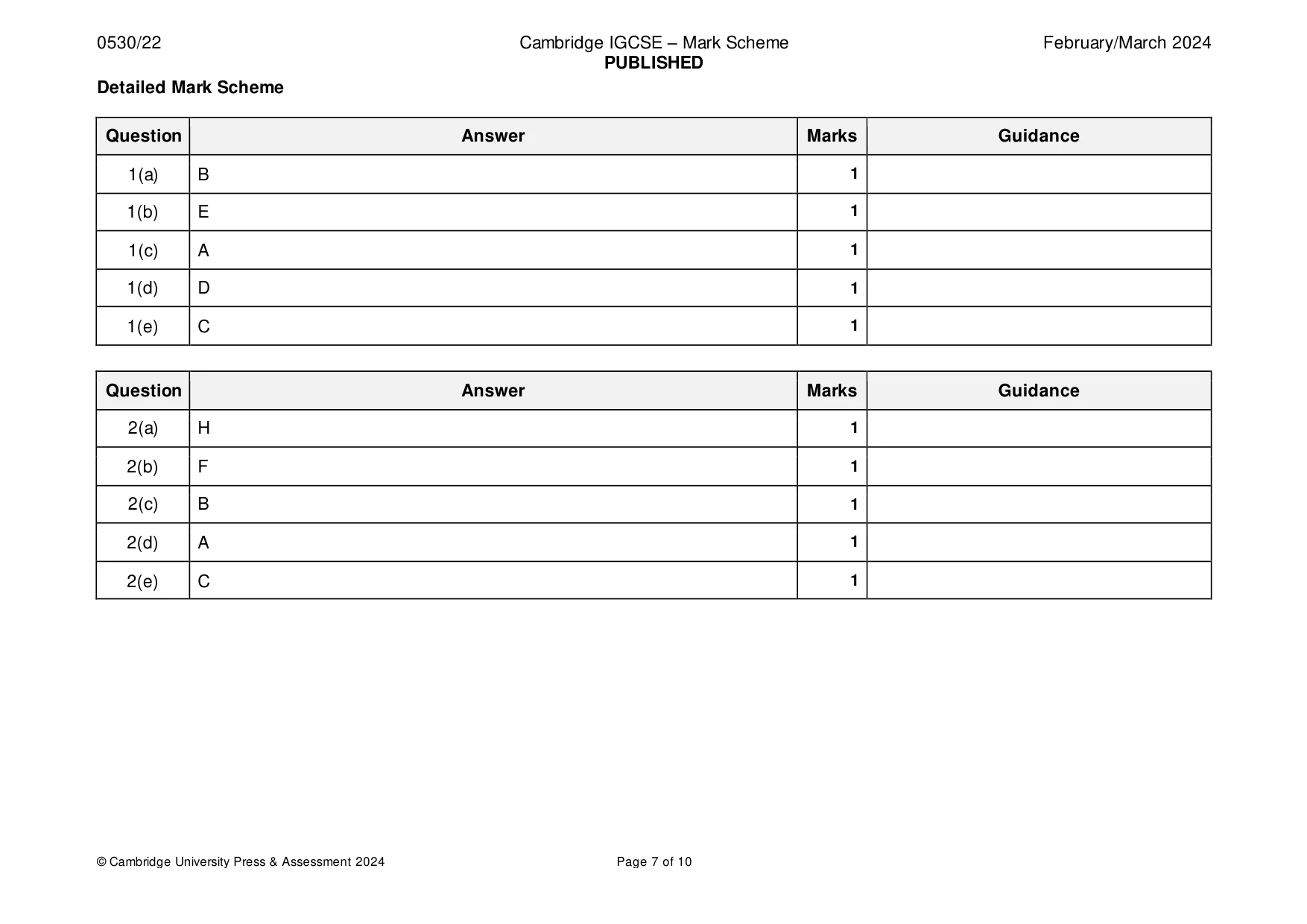
0530/22 Cambridge IGCSE – Mark Scheme PUBLISHED February/March 2024 © Cambridge University Press & Assessment 2024 Page 7 of 10 Detailed Mark Scheme Question Answer Marks Guidance 1(a) B 1 1(b) E 1 1(c) A 1 1(d) D 1 1(e) C 1 Question Answer Marks Guidance 2(a) H 1 2(b) F 1 2(c) B 1 2(d) A 1 2(e) C 1
Mark scheme, page 8
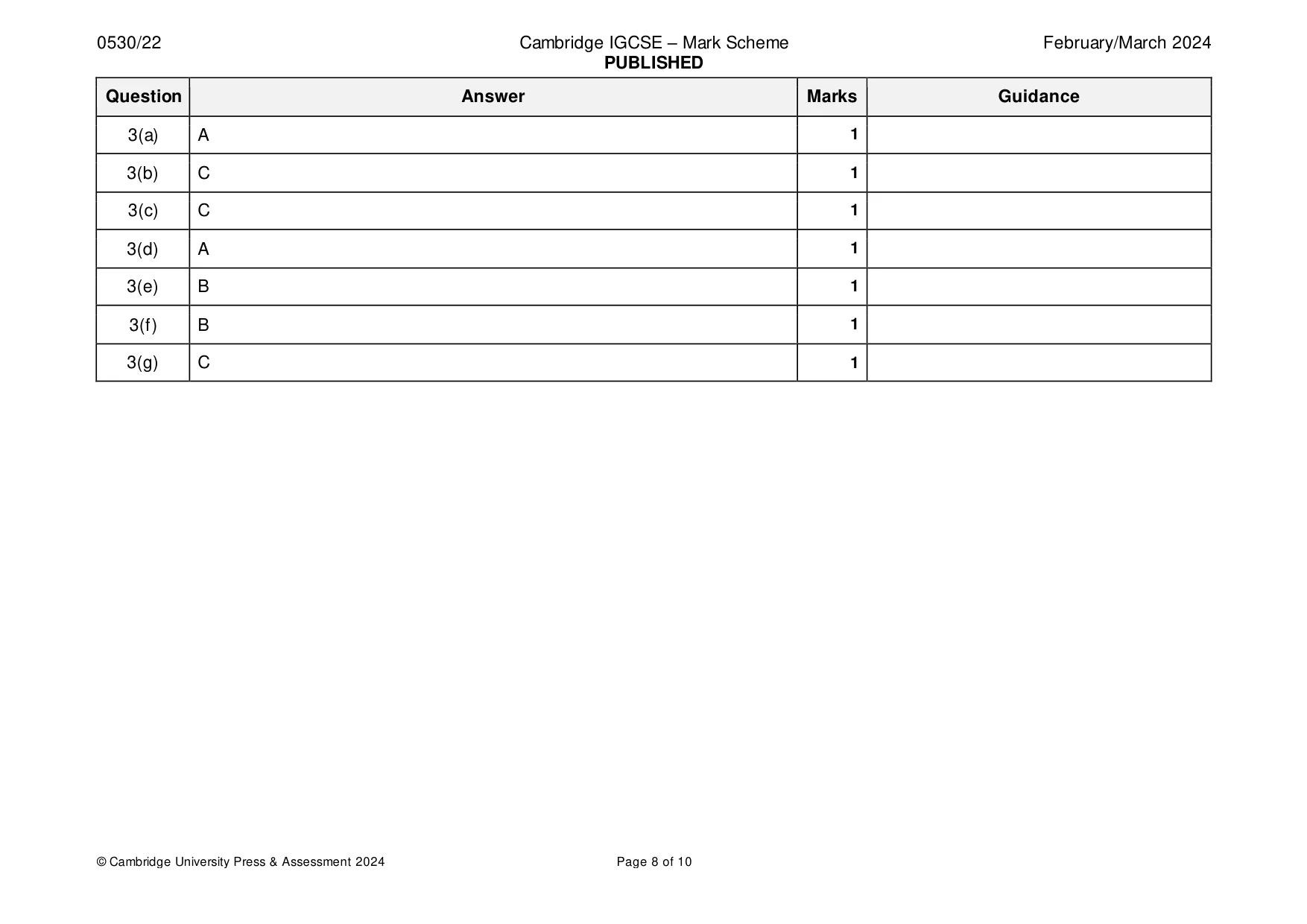
0530/22 Cambridge IGCSE – Mark Scheme PUBLISHED February/March 2024 © Cambridge University Press & Assessment 2024 Page 8 of 10 Question Answer Marks Guidance 3(a) A 1 3(b) C 1 3(c) C 1 3(d) A 1 3(e) B 1 3(f) B 1 3(g) C 1
Mark scheme, page 9
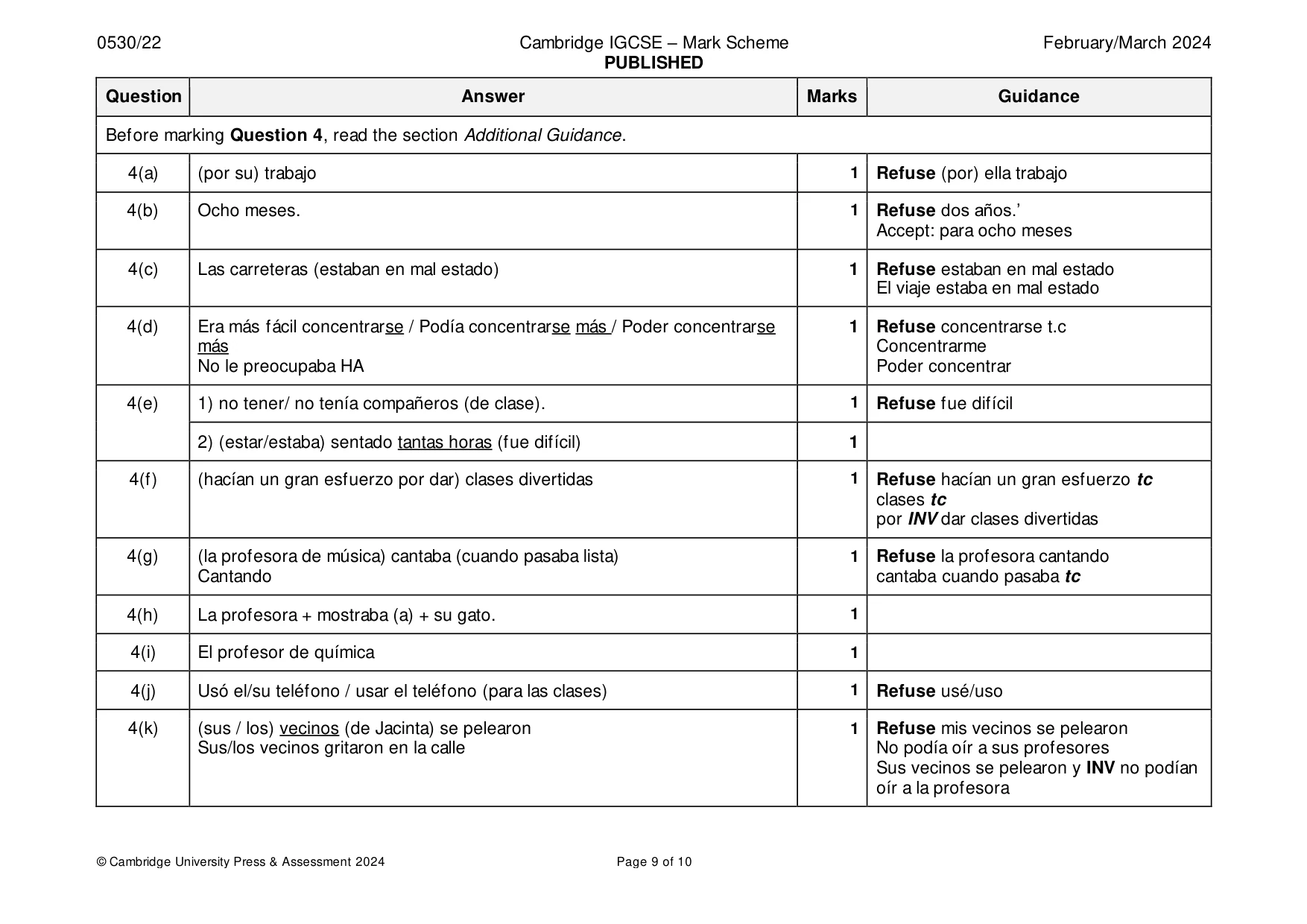
0530/22 Cambridge IGCSE – Mark Scheme PUBLISHED February/March 2024 © Cambridge University Press & Assessment 2024 Page 9 of 10 Question Answer Marks Guidance Before marking Question 4, read the section Additional Guidance. 4(a) (por su) trabajo 1 Refuse (por) ella trabajo 4(b) Ocho meses. 1 Refuse dos años.’ Accept: para ocho meses 4(c) Las carreteras (estaban en mal estado) 1 Refuse estaban en mal estado El viaje estaba en mal estado 4(d) Era más fácil concentrarse / Podía concentrarse más / Poder concentrarse más No le preocupaba HA 1 Refuse concentrarse t.c Concentrarme Poder concentrar 4(e) 1) no tener/ no tenía compañeros (de clase). 1 Refuse fue difícil 2) (estar/estaba) sentado tantas horas (fue difícil) 1 4(f) (hacían un gran esfuerzo por dar) clases divertidas 1 Refuse hacían un gran esfuerzo tc clases tc por INV dar clases divertidas 4(g) (la profesora de música) cantaba (cuando pasaba lista) Cantando 1 Refuse la profesora cantando cantaba cuando pasaba tc 4(h) La profesora + mostraba (a) + su gato. 1 4(i) El profesor de química 1 4(j) Usó el/su teléfono / usar el teléfono (para las clases) 1 Refuse usé/uso 4(k) (sus / los) vecinos (de Jacinta) se pelearon Sus/los vecinos gritaron en la calle 1 Refuse mis vecinos se pelearon No podía oír a sus profesores Sus vecinos se pelearon y INV no podían oír a la profesora
Mark scheme, page 10
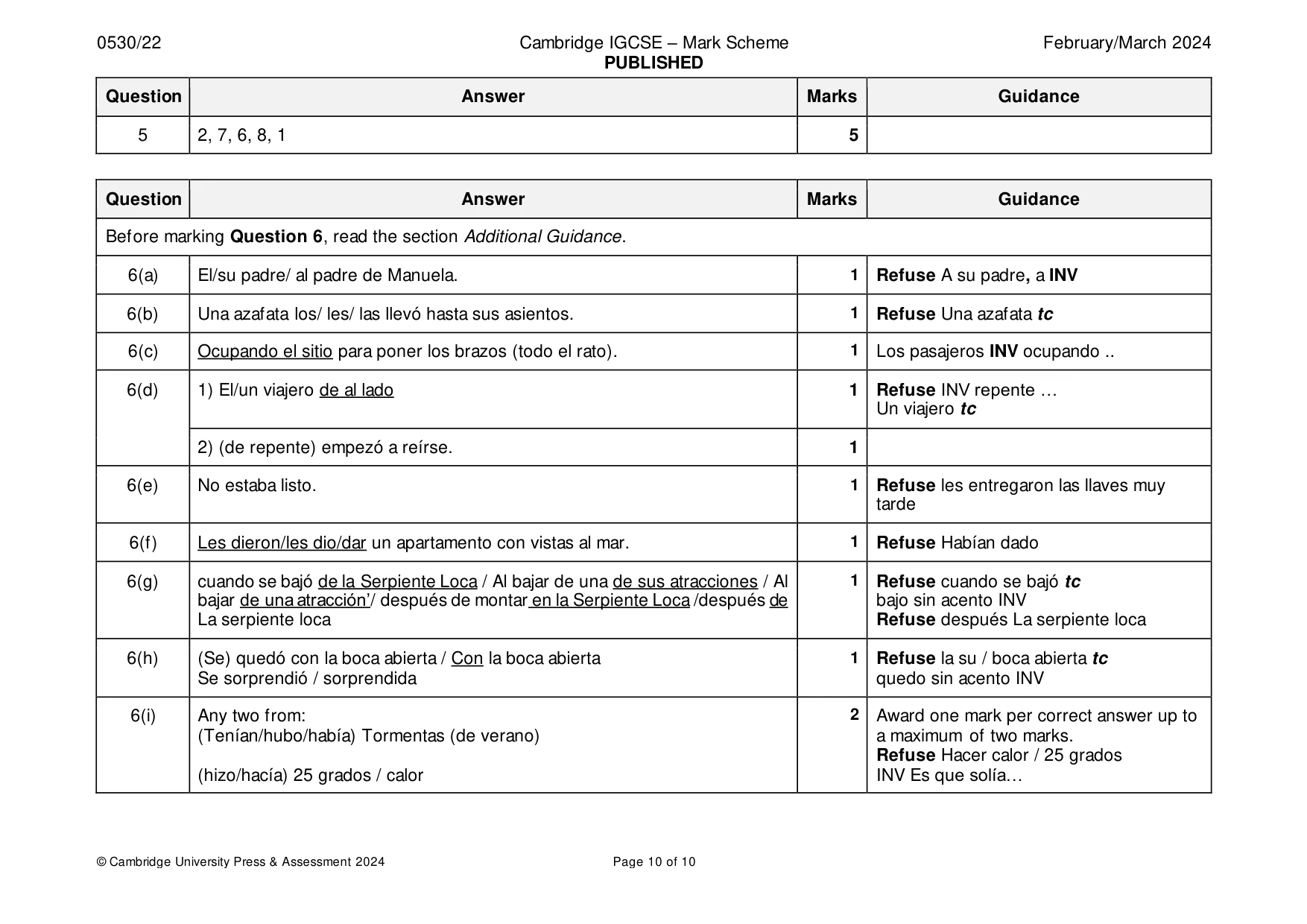
0530/22 Cambridge IGCSE – Mark Scheme PUBLISHED February/March 2024 © Cambridge University Press & Assessment 2024 Page 10 of 10 Question Answer Marks Guidance 5 2, 7, 6, 8, 1 5 Question Answer Marks Guidance Before marking Question 6, read the section Additional Guidance. 6(a) El/su padre/ al padre de Manuela. 1 Refuse A su padre, a INV 6(b) Una azafata los/ les/ las llevó hasta sus asientos. 1 Refuse Una azafata tc 6(c) Ocupando el sitio para poner los brazos (todo el rato). 1 Los pasajeros INV ocupando .. 6(d) 1) El/un viajero de al lado 1 Refuse INV repente … Un viajero tc 2) (de repente) empezó a reírse. 1 6(e) No estaba listo. 1 Refuse les entregaron las llaves muy tarde 6(f) Les dieron/les dio/dar un apartamento con vistas al mar. 1 Refuse Habían dado 6(g) cuando se bajó de la Serpiente Loca / Al bajar de una de sus atracciones / Al bajar de una atracción’/ después de montar en la Serpiente Loca /después de La serpiente loca 1 Refuse cuando se bajó tc bajo sin acento INV Refuse después La serpiente loca 6(h) (Se) quedó con la boca abierta / Con la boca abierta Se sorprendió / sorprendida 1 Refuse la su / boca abierta tc quedo sin acento INV 6(i) Any two from: (Tenían/hubo/había) Tormentas (de verano) (hizo/hacía) 25 grados / calor 2 Award one mark per correct answer up to a maximum of two marks. Refuse Hacer calor / 25 grados INV Es que solía…
What you needed in this session
Cambridge’s own grade thresholds for 2024 Feb/March, Paper 2 · Variant 2. A higher threshold means an easier paper — the bar moves with how the cohort did.