Cambridge IGCSE Spanish - Foreign Language 0530 — 2024 May/June Paper 2 · Variant 1
0530/21/M/J/24 · 45 marks · ≈51 min
The question paper and its mark scheme, free to read here and free to download. This is Cambridge’s own paper, exactly as it was sat.
Question paper12 pages

Mark scheme11 pages
Answers below. Sit the paper first if you are practising.
Paper as text
Question paper, page 1
This document has 12 pages. Any blank pages are indicated. [Turn over * 0 6 6 9 2 7 9 0 9 1 * Cambridge IGCSE™ SPANISH 0530/21 Paper 2 Reading May/June 2024 1 hour You must answer on the question paper. No additional materials are needed. INSTRUCTIONS ● Answer all questions. ● Use a black or dark blue pen. ● Write your name, centre number and candidate number in the boxes at the top of the page. ● Write your answer to each question in the space provided. ● Do not use an erasable pen or correction fluid. ● Do not write on any bar codes. ● Dictionaries are not allowed. INFORMATION ● The total mark for this paper is 45. ● The number of marks for each question or part question is shown in brackets [ ]. DC (DE/CGW) 336221/3 © UCLES 2024
Question paper, page 2
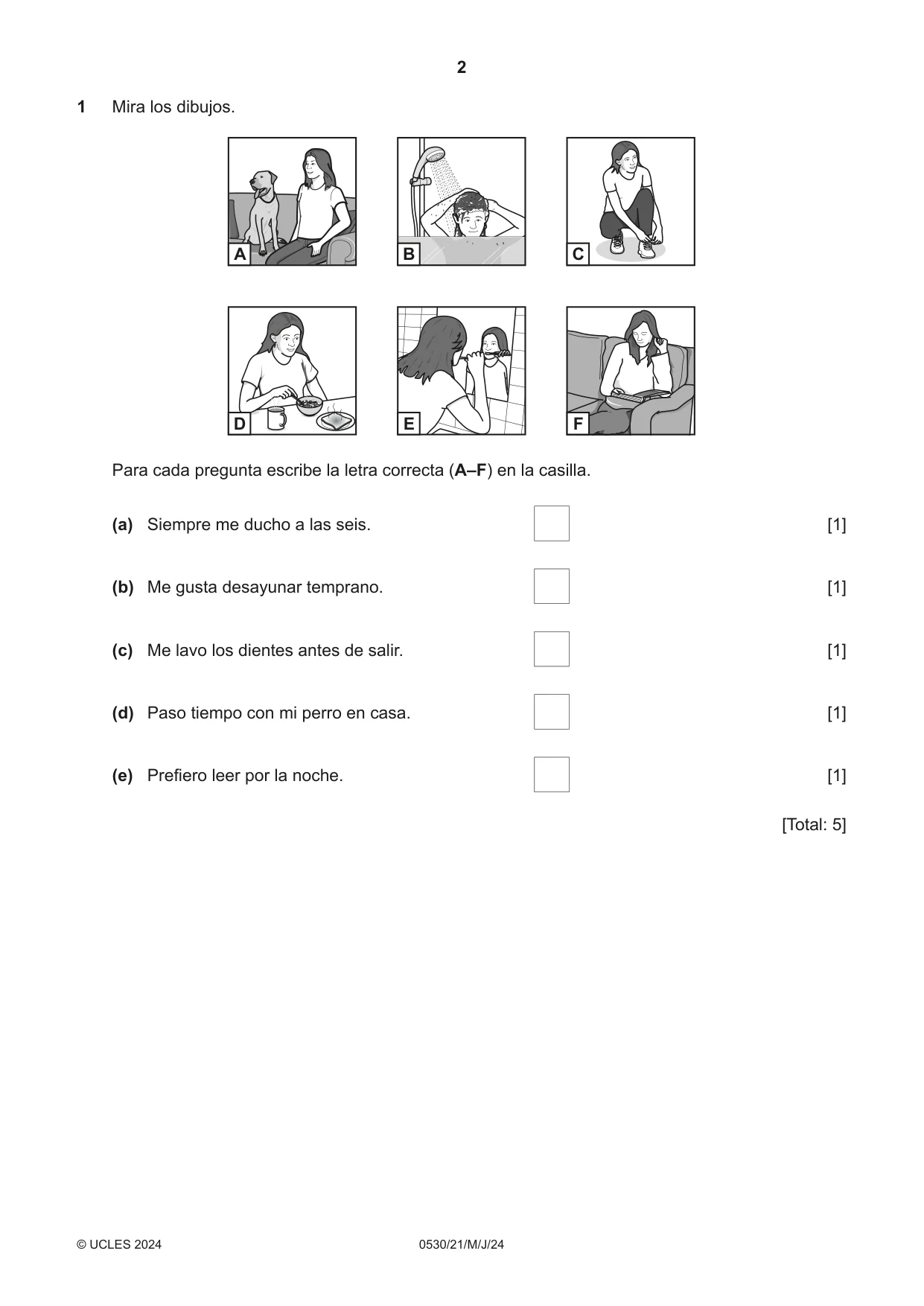
2 0530/21/M/J/24 © UCLES 2024 1 Mira los dibujos. A B C D E F Para cada pregunta escribe la letra correcta (A–F) en la casilla. (a) Siempre me ducho a las seis. [1] (b) Me gusta desayunar temprano. [1] (c) Me lavo los dientes antes de salir. [1] (d) Paso tiempo con mi perro en casa. [1] (e) Prefiero leer por la noche. [1] [Total: 5]
Question paper, page 3
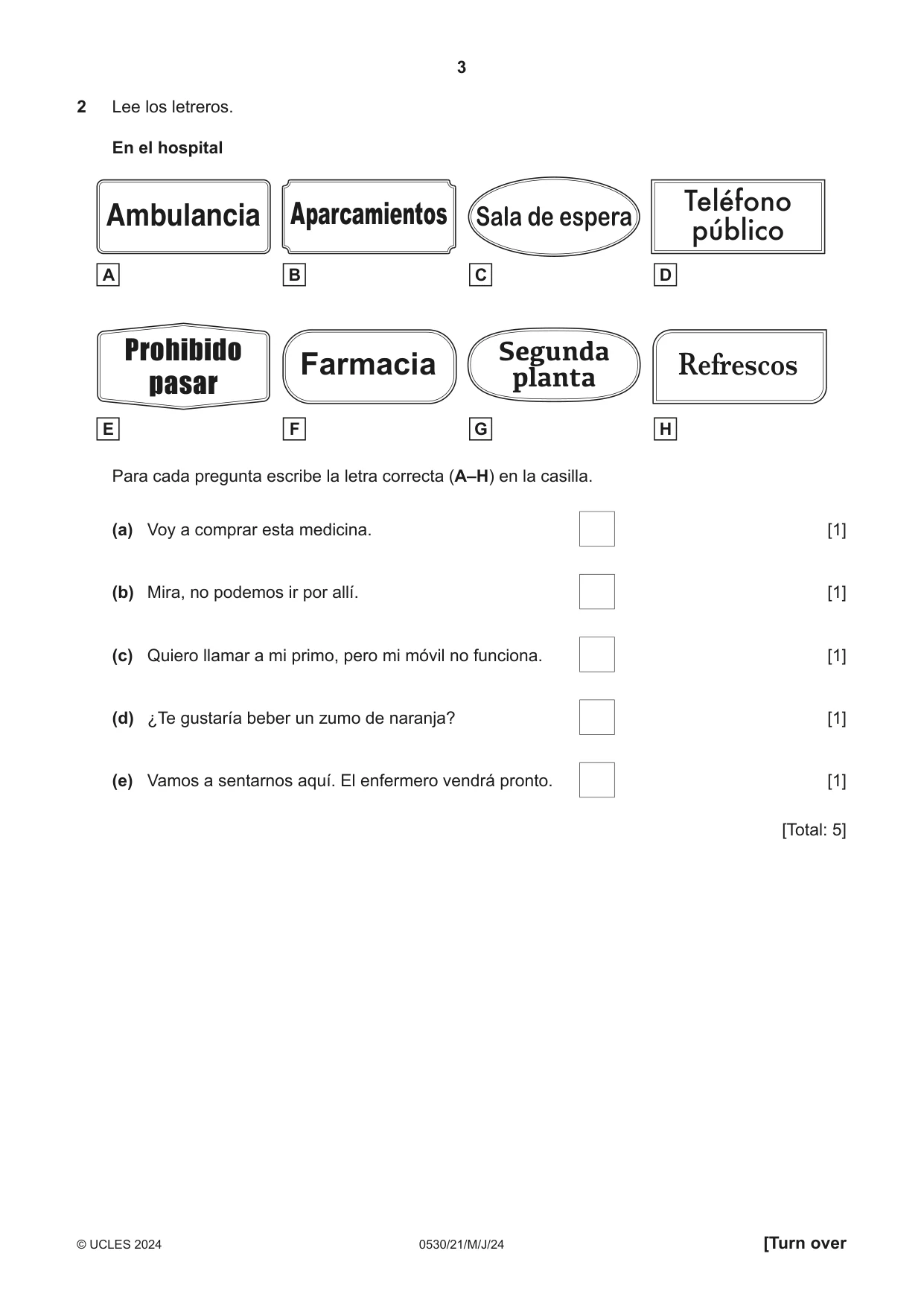
3 0530/21/M/J/24 © UCLES 2024 [Turn over 2 Lee los letreros. En el hospital Ambulancia Prohibido pasar Farmacia Segunda planta Aparcamientos Sala de espera Teléfono público Refrescos A B C D E F G H Para cada pregunta escribe la letra correcta (A–H) en la casilla. (a) Voy a comprar esta medicina. [1] (b) Mira, no podemos ir por allí. [1] (c) Quiero llamar a mi primo, pero mi móvil no funciona. [1] (d) ¿Te gustaría beber un zumo de naranja? [1] (e) Vamos a sentarnos aquí. El enfermero vendrá pronto. [1] [Total: 5]
Question paper, page 4
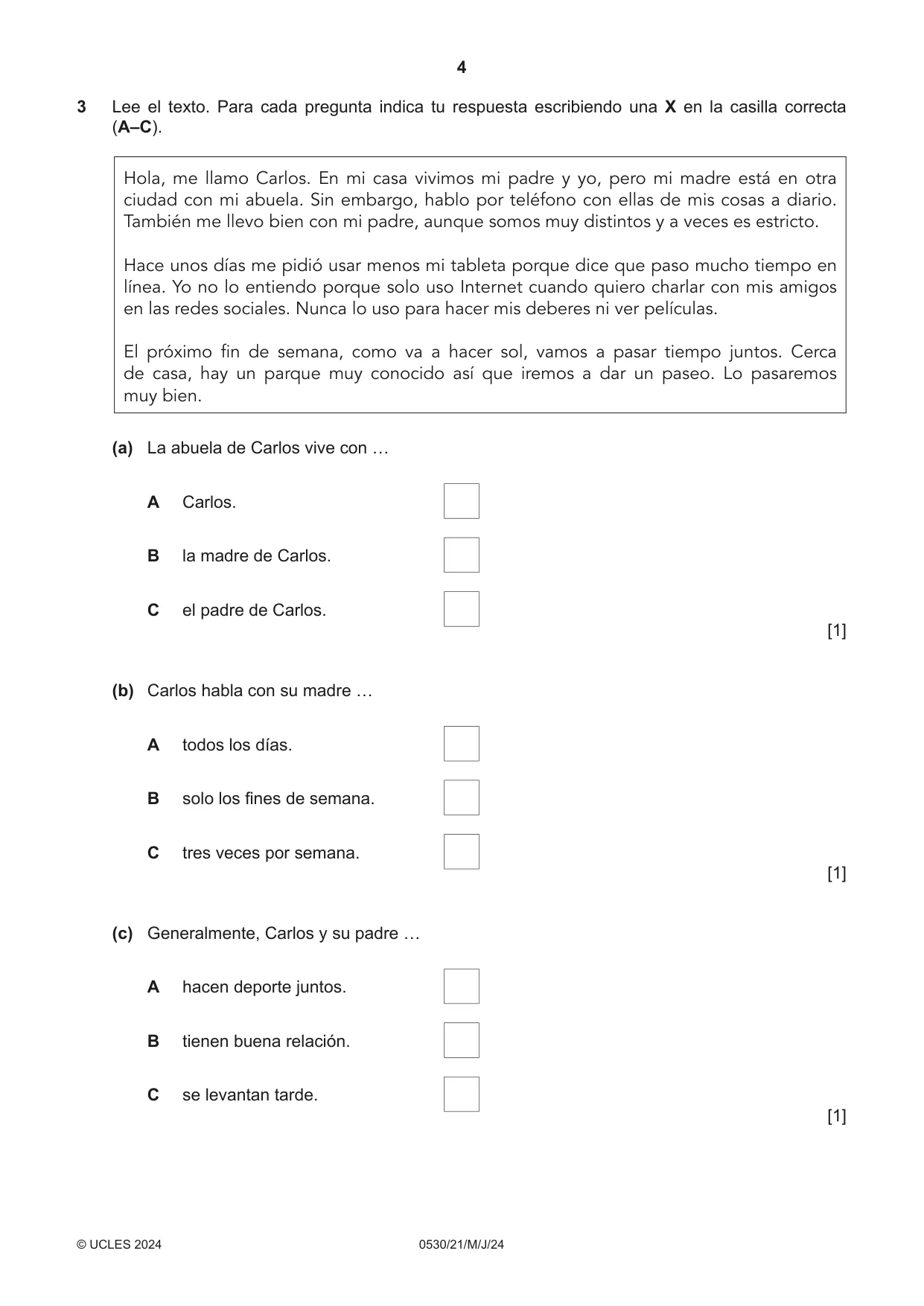
4 0530/21/M/J/24 © UCLES 2024 3 Lee el texto. Para cada pregunta indica tu respuesta escribiendo una X en la casilla correcta (A–C). Hola, me llamo Carlos. En mi casa vivimos mi padre y yo, pero mi madre está en otra ciudad con mi abuela. Sin embargo, hablo por teléfono con ellas de mis cosas a diario. También me llevo bien con mi padre, aunque somos muy distintos y a veces es estricto. Hace unos días me pidió usar menos mi tableta porque dice que paso mucho tiempo en línea. Yo no lo entiendo porque solo uso Internet cuando quiero charlar con mis amigos en las redes sociales. Nunca lo uso para hacer mis deberes ni ver películas. El próximo fin de semana, como va a hacer sol, vamos a pasar tiempo juntos. Cerca de casa, hay un parque muy conocido así que iremos a dar un paseo. Lo pasaremos muy bien. (a) La abuela de Carlos vive con … A Carlos. B la madre de Carlos. C el padre de Carlos. [1] (b) Carlos habla con su madre … A todos los días. B solo los fines de semana. C tres veces por semana. [1] (c) Generalmente, Carlos y su padre … A hacen deporte juntos. B tienen buena relación. C se levantan tarde. [1]
Question paper, page 5
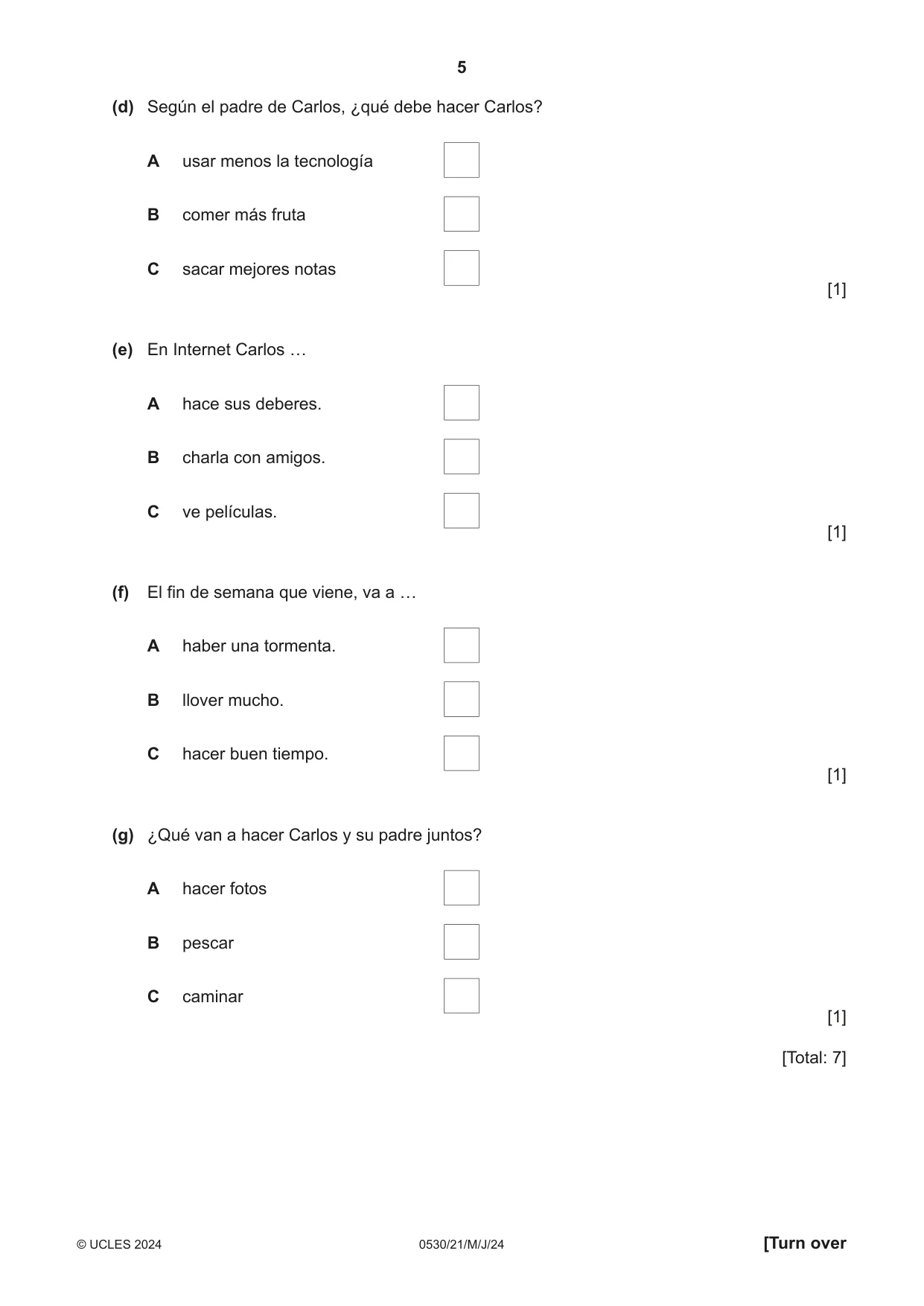
5 0530/21/M/J/24 © UCLES 2024 [Turn over (d) Según el padre de Carlos, ¿qué debe hacer Carlos? A usar menos la tecnología B comer más fruta C sacar mejores notas [1] (e) En Internet Carlos … A hace sus deberes. B charla con amigos. C ve películas. [1] (f) El fin de semana que viene, va a … A haber una tormenta. B llover mucho. C hacer buen tiempo. [1] (g) ¿Qué van a hacer Carlos y su padre juntos? A hacer fotos B pescar C caminar [1] [Total: 7]
Question paper, page 6
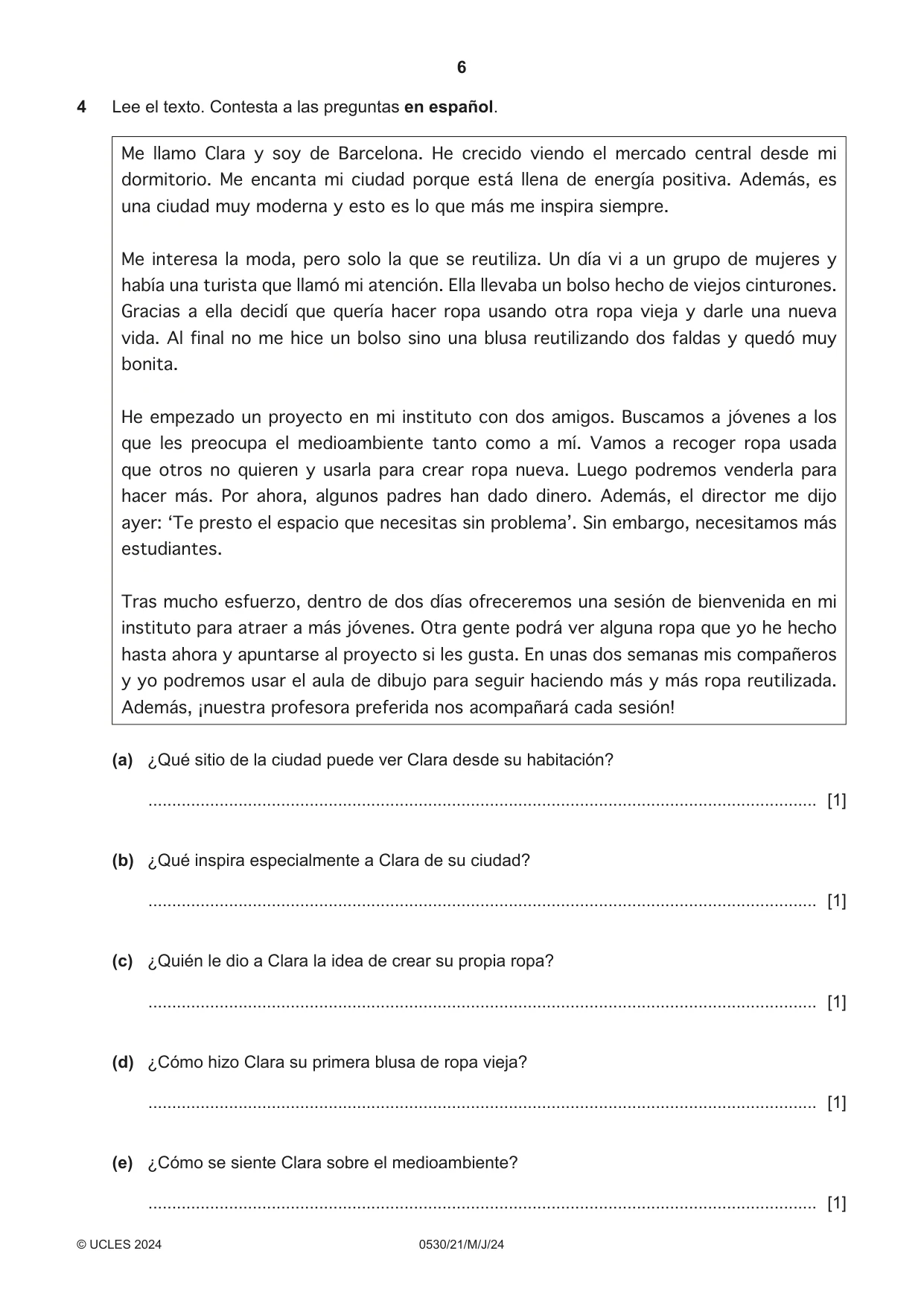
6 0530/21/M/J/24 © UCLES 2024 4 Lee el texto. Contesta a las preguntas en español. Me llamo Clara y soy de Barcelona. He crecido viendo el mercado central desde mi dormitorio. Me encanta mi ciudad porque está llena de energía positiva. Además, es una ciudad muy moderna y esto es lo que más me inspira siempre. Me interesa la moda, pero solo la que se reutiliza. Un día vi a un grupo de mujeres y había una turista que llamó mi atención. Ella llevaba un bolso hecho de viejos cinturones. Gracias a ella decidí que quería hacer ropa usando otra ropa vieja y darle una nueva vida. Al final no me hice un bolso sino una blusa reutilizando dos faldas y quedó muy bonita. He empezado un proyecto en mi instituto con dos amigos. Buscamos a jóvenes a los que les preocupa el medioambiente tanto como a mí. Vamos a recoger ropa usada que otros no quieren y usarla para crear ropa nueva. Luego podremos venderla para hacer más. Por ahora, algunos padres han dado dinero. Además, el director me dijo ayer: ‘Te presto el espacio que necesitas sin problema’. Sin embargo, necesitamos más estudiantes. Tras mucho esfuerzo, dentro de dos días ofreceremos una sesión de bienvenida en mi instituto para atraer a más jóvenes. Otra gente podrá ver alguna ropa que yo he hecho hasta ahora y apuntarse al proyecto si les gusta. En unas dos semanas mis compañeros y yo podremos usar el aula de dibujo para seguir haciendo más y más ropa reutilizada. Además, ¡nuestra profesora preferida nos acompañará cada sesión! (a) ¿Qué sitio de la ciudad puede ver Clara desde su habitación? … [1] (b) ¿Qué inspira especialmente a Clara de su ciudad? … [1] (c) ¿Quién le dio a Clara la idea de crear su propia ropa? … [1] (d) ¿Cómo hizo Clara su primera blusa de ropa vieja? … [1] (e) ¿Cómo se siente Clara sobre el medioambiente? … [1]
Question paper, page 7
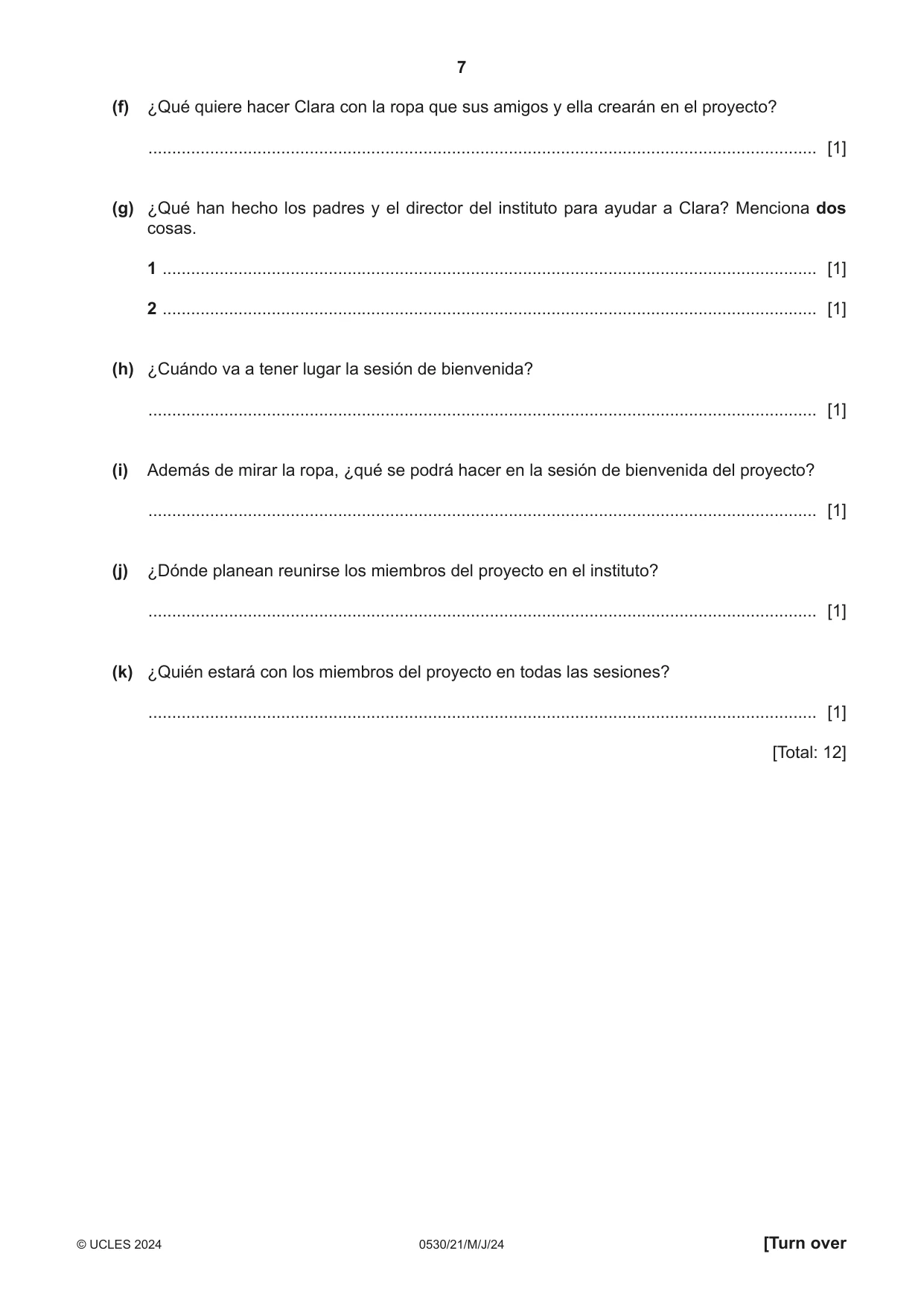
7 0530/21/M/J/24 © UCLES 2024 [Turn over (f) ¿Qué quiere hacer Clara con la ropa que sus amigos y ella crearán en el proyecto? … [1] (g) ¿Qué han hecho los padres y el director del instituto para ayudar a Clara? Menciona dos cosas. 1 … [1] 2 … [1] (h) ¿Cuándo va a tener lugar la sesión de bienvenida? … [1] (i) Además de mirar la ropa, ¿qué se podrá hacer en la sesión de bienvenida del proyecto? … [1] (j) ¿Dónde planean reunirse los miembros del proyecto en el instituto? … [1] (k) ¿Quién estará con los miembros del proyecto en todas las sesiones? … [1] [Total: 12]
Question paper, page 8
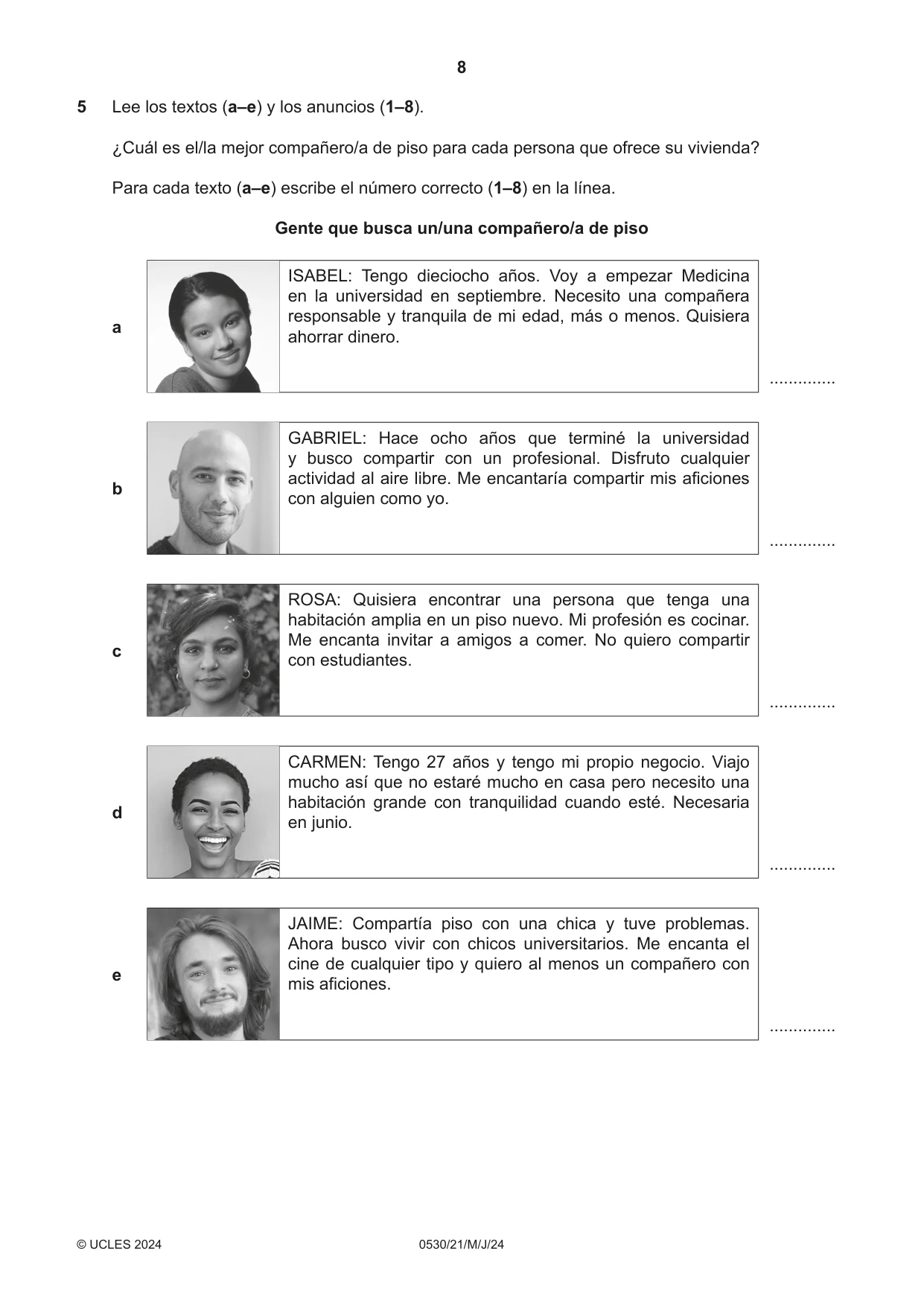
8 0530/21/M/J/24 © UCLES 2024 5 Lee los textos (a–e) y los anuncios (1–8). ¿Cuál es el/la mejor compañero/a de piso para cada persona que ofrece su vivienda? Para cada texto (a–e) escribe el número correcto (1–8) en la línea. Gente que busca un/una compañero/a de piso a ISABEL: Tengo dieciocho años. Voy a empezar Medicina en la universidad en septiembre. Necesito una compañera responsable y tranquila de mi edad, más o menos. Quisiera ahorrar dinero. … b GABRIEL: Hace ocho años que terminé la universidad y busco compartir con un profesional. Disfruto cualquier actividad al aire libre. Me encantaría compartir mis aficiones con alguien como yo. … c ROSA: Quisiera encontrar una persona que tenga una habitación amplia en un piso nuevo. Mi profesión es cocinar. Me encanta invitar a amigos a comer. No quiero compartir con estudiantes. … d CARMEN: Tengo 27 años y tengo mi propio negocio. Viajo mucho así que no estaré mucho en casa pero necesito una habitación grande con tranquilidad cuando esté. Necesaria en junio. … e JAIME: Compartía piso con una chica y tuve problemas. Ahora busco vivir con chicos universitarios. Me encanta el cine de cualquier tipo y quiero al menos un compañero con mis aficiones. …
Question paper, page 9
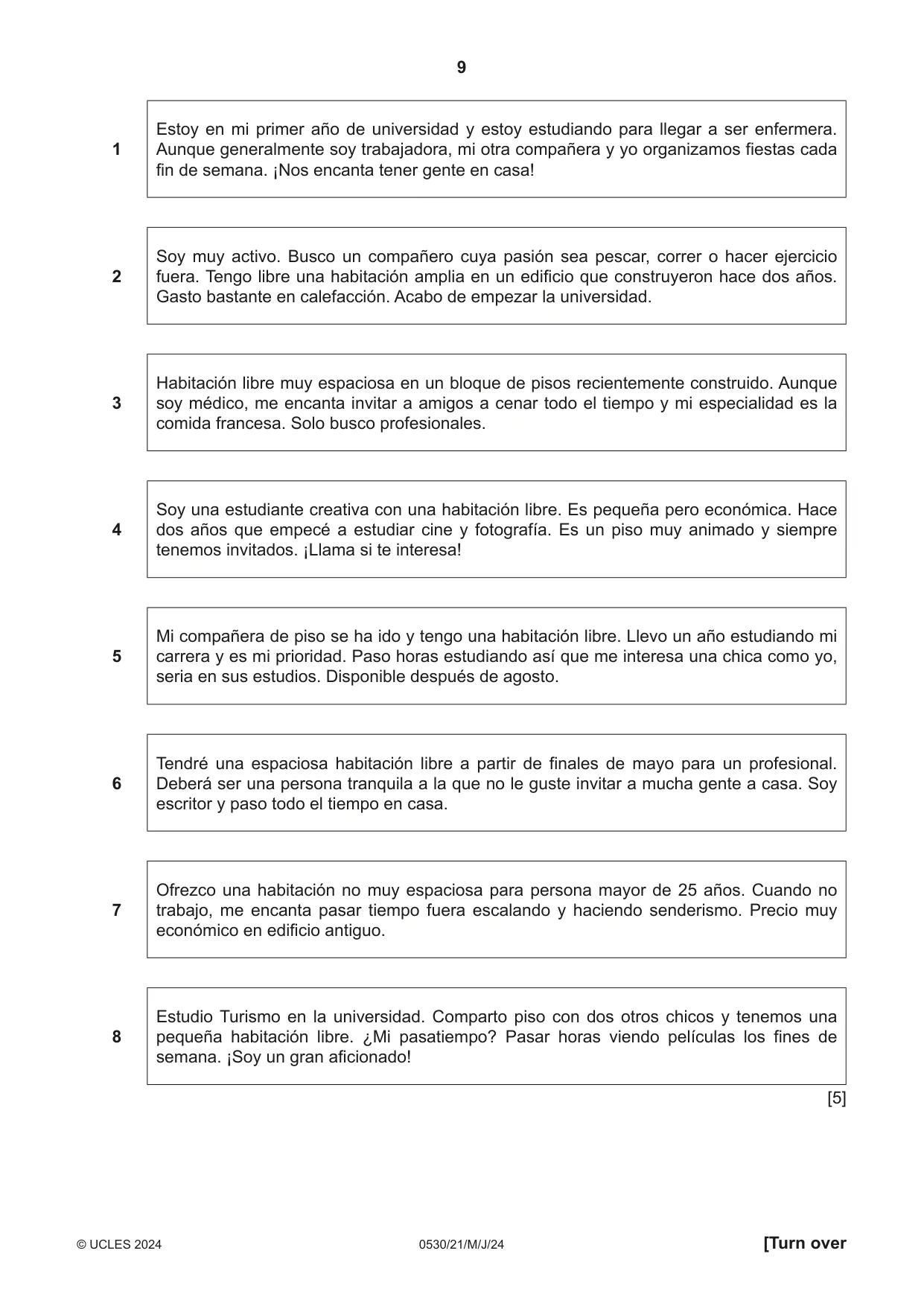
9 0530/21/M/J/24 © UCLES 2024 [Turn over 1 Estoy en mi primer año de universidad y estoy estudiando para llegar a ser enfermera. Aunque generalmente soy trabajadora, mi otra compañera y yo organizamos fiestas cada fin de semana. ¡Nos encanta tener gente en casa! 2 Soy muy activo. Busco un compañero cuya pasión sea pescar, correr o hacer ejercicio fuera. Tengo libre una habitación amplia en un edificio que construyeron hace dos años. Gasto bastante en calefacción. Acabo de empezar la universidad. 3 Habitación libre muy espaciosa en un bloque de pisos recientemente construido. Aunque soy médico, me encanta invitar a amigos a cenar todo el tiempo y mi especialidad es la comida francesa. Solo busco profesionales. 4 Soy una estudiante creativa con una habitación libre. Es pequeña pero económica. Hace dos años que empecé a estudiar cine y fotografía. Es un piso muy animado y siempre tenemos invitados. ¡Llama si te interesa! 5 Mi compañera de piso se ha ido y tengo una habitación libre. Llevo un año estudiando mi carrera y es mi prioridad. Paso horas estudiando así que me interesa una chica como yo, seria en sus estudios. Disponible después de agosto. 6 Tendré una espaciosa habitación libre a partir de finales de mayo para un profesional. Deberá ser una persona tranquila a la que no le guste invitar a mucha gente a casa. Soy escritor y paso todo el tiempo en casa. 7 Ofrezco una habitación no muy espaciosa para persona mayor de 25 años. Cuando no trabajo, me encanta pasar tiempo fuera escalando y haciendo senderismo. Precio muy económico en edificio antiguo. 8 Estudio Turismo en la universidad. Comparto piso con dos otros chicos y tenemos una pequeña habitación libre. ¿Mi pasatiempo? Pasar horas viendo películas los fines de semana. ¡Soy un gran aficionado! [5]
Question paper, page 10
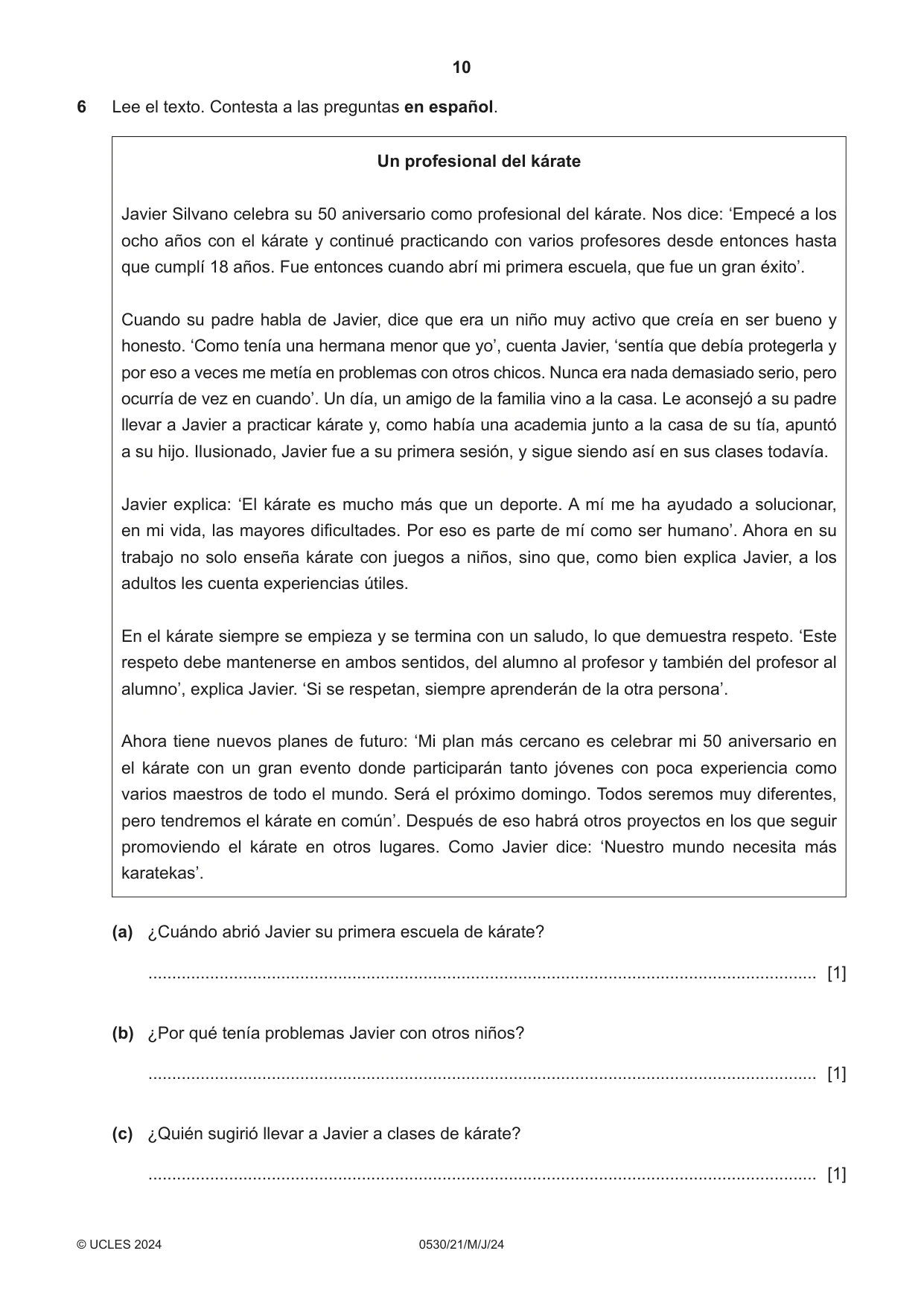
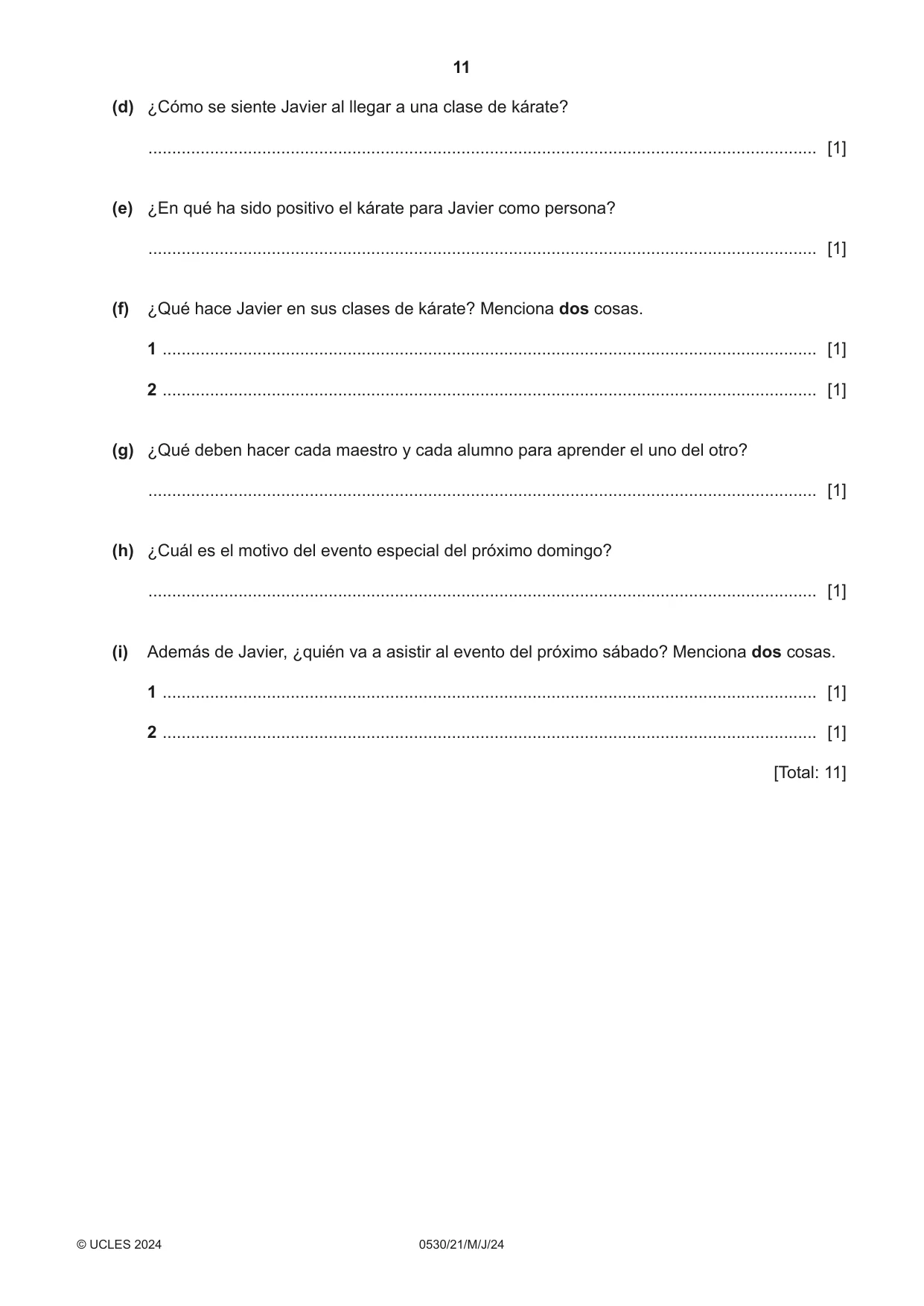
10 0530/21/M/J/24 © UCLES 2024 6 Lee el texto. Contesta a las preguntas en español. Un profesional del kárate Javier Silvano celebra su 50 aniversario como profesional del kárate. Nos dice: ‘Empecé a los ocho años con el kárate y continué practicando con varios profesores desde entonces hasta que cumplí 18 años. Fue entonces cuando abrí mi primera escuela, que fue un gran éxito’. Cuando su padre habla de Javier, dice que era un niño muy activo que creía en ser bueno y honesto. ‘Como tenía una hermana menor que yo’, cuenta Javier, ‘sentía que debía protegerla y por eso a veces me metía en problemas con otros chicos. Nunca era nada demasiado serio, pero ocurría de vez en cuando’. Un día, un amigo de la familia vino a la casa. Le aconsejó a su padre llevar a Javier a practicar kárate y, como había una academia junto a la casa de su tía, apuntó a su hijo. Ilusionado, Javier fue a su primera sesión, y sigue siendo así en sus clases todavía. Javier explica: ‘El kárate es mucho más que un deporte. A mí me ha ayudado a solucionar, en mi vida, las mayores dificultades. Por eso es parte de mí como ser humano’. Ahora en su trabajo no solo enseña kárate con juegos a niños, sino que, como bien explica Javier, a los adultos les cuenta experiencias útiles. En el kárate siempre se empieza y se termina con un saludo, lo que demuestra respeto. ‘Este respeto debe mantenerse en ambos sentidos, del alumno al profesor y también del profesor al alumno’, explica Javier. ‘Si se respetan, siempre aprenderán de la otra persona’. Ahora tiene nuevos planes de futuro: ‘Mi plan más cercano es celebrar mi 50 aniversario en el kárate con un gran evento donde participarán tanto jóvenes con poca experiencia como varios maestros de todo el mundo. Será el próximo domingo. Todos seremos muy diferentes, pero tendremos el kárate en común’. Después de eso habrá otros proyectos en los que seguir promoviendo el kárate en otros lugares. Como Javier dice: ‘Nuestro mundo necesita más karatekas’. (a) ¿Cuándo abrió Javier su primera escuela de kárate? … [1] (b) ¿Por qué tenía problemas Javier con otros niños? … [1] (c) ¿Quién sugirió llevar a Javier a clases de kárate? … [1]
Question paper, page 11
11 0530/21/M/J/24 © UCLES 2024 (d) ¿Cómo se siente Javier al llegar a una clase de kárate? … [1] (e) ¿En qué ha sido positivo el kárate para Javier como persona? … [1] (f) ¿Qué hace Javier en sus clases de kárate? Menciona dos cosas. 1 … [1] 2 … [1] (g) ¿Qué deben hacer cada maestro y cada alumno para aprender el uno del otro? … [1] (h) ¿Cuál es el motivo del evento especial del próximo domingo? … [1] (i) Además de Javier, ¿quién va a asistir al evento del próximo sábado? Menciona dos cosas. 1 … [1] 2 … [1] [Total: 11]
Question paper, page 12
12 0530/21/M/J/24 © UCLES 2024 Permission to reproduce items where third-party owned material protected by copyright is included has been sought and cleared where possible. Every reasonable effort has been made by the publisher (UCLES) to trace copyright holders, but if any items requiring clearance have unwittingly been included, the publisher will be pleased to make amends at the earliest possible opportunity. To avoid the issue of disclosure of answer-related information to candidates, all copyright acknowledgements are reproduced online in the Cambridge Assessment International Education Copyright Acknowledgements Booklet. This is produced for each series of examinations and is freely available to download at www.cambridgeinternational.org after the live examination series. Cambridge Assessment International Education is part of Cambridge Assessment. Cambridge Assessment is the brand name of the University of Cambridge Local Examinations Syndicate (UCLES), which is a department of the University of Cambridge. BLANK PAGE
Mark scheme, page 1
This document consists of 11 printed pages. © Cambridge University Press & Assessment 2024 [Turn over Cambridge IGCSE™ SPANISH 0530/21 Paper 2 Reading May/June 2024 MARK SCHEME Maximum Mark: 45 Published This mark scheme is published as an aid to teachers and candidates, to indicate the requirements of the examination. It shows the basis on which Examiners were instructed to award marks. It does not indicate the details of the discussions that took place at an Examiners’ meeting before marking began, which would have considered the acceptability of alternative answers. Mark schemes should be read in conjunction with the question paper and the Principal Examiner Report for Teachers. Cambridge International will not enter into discussions about these mark schemes. Cambridge International is publishing the mark schemes for the May/June 2024 series for most Cambridge IGCSE, Cambridge International A and AS Level and Cambridge Pre-U components, and some Cambridge O Level components.
Mark scheme, page 2
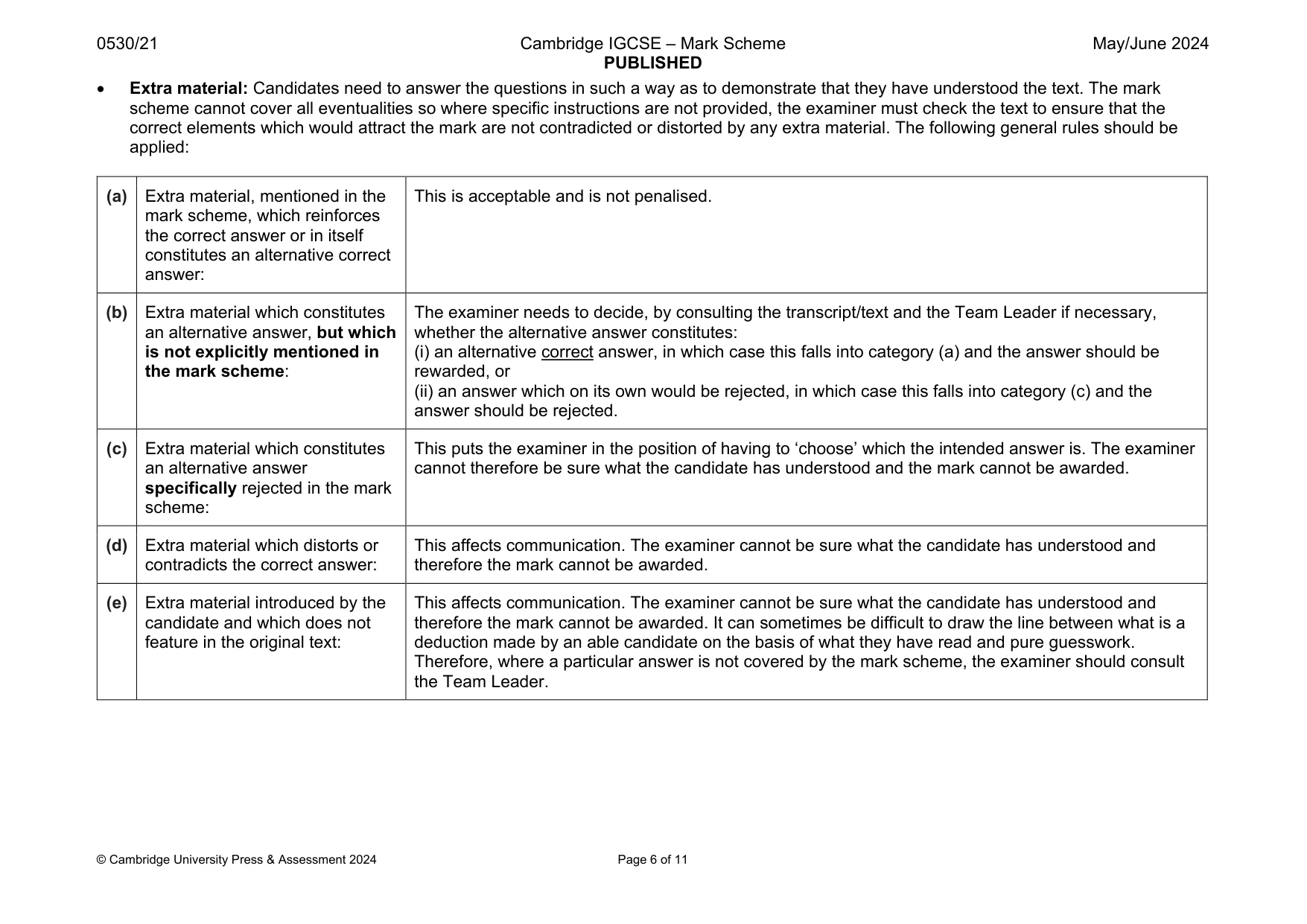
0530/21 Cambridge IGCSE – Mark Scheme PUBLISHED May/June 2024 © Cambridge University Press & Assessment 2024 Page 2 of 11 Generic Marking Principles These general marking principles must be applied by all examiners when marking candidate answers. They should be applied alongside the specific content of the mark scheme or generic level descriptions for a question. Each question paper and mark scheme will also comply with these marking principles. GENERIC MARKING PRINCIPLE 1: Marks must be awarded in line with: the specific content of the mark scheme or the generic level descriptors for the question the specific skills defined in the mark scheme or in the generic level descriptors for the question the standard of response required by a candidate as exemplified by the standardisation scripts. GENERIC MARKING PRINCIPLE 2: Marks awarded are always whole marks (not half marks, or other fractions). GENERIC MARKING PRINCIPLE 3: Marks must be awarded positively: marks are awarded for correct/valid answers, as defined in the mark scheme. However, credit is given for valid answers which go beyond the scope of the syllabus and mark scheme, referring to your Team Leader as appropriate marks are awarded when candidates clearly demonstrate what they know and can do marks are not deducted for errors marks are not deducted for omissions answers should only be judged on the quality of spelling, punctuation and grammar when these features are specifically assessed by the question as indicated by the mark scheme. The meaning, however, should be unambiguous. GENERIC MARKING PRINCIPLE 4: Rules must be applied consistently, e.g. in situations where candidates have not followed instructions or in the application of generic level descriptors.
Mark scheme, page 3
0530/21 Cambridge IGCSE – Mark Scheme PUBLISHED May/June 2024 © Cambridge University Press & Assessment 2024 Page 3 of 11 GENERIC MARKING PRINCIPLE 5: Marks should be awarded using the full range of marks defined in the mark scheme for the question (however; the use of the full mark range may be limited according to the quality of the candidate responses seen). GENERIC MARKING PRINCIPLE 6: Marks awarded are based solely on the requirements as defined in the mark scheme. Marks should not be awarded with grade thresholds or grade descriptors in mind.
Mark scheme, page 4
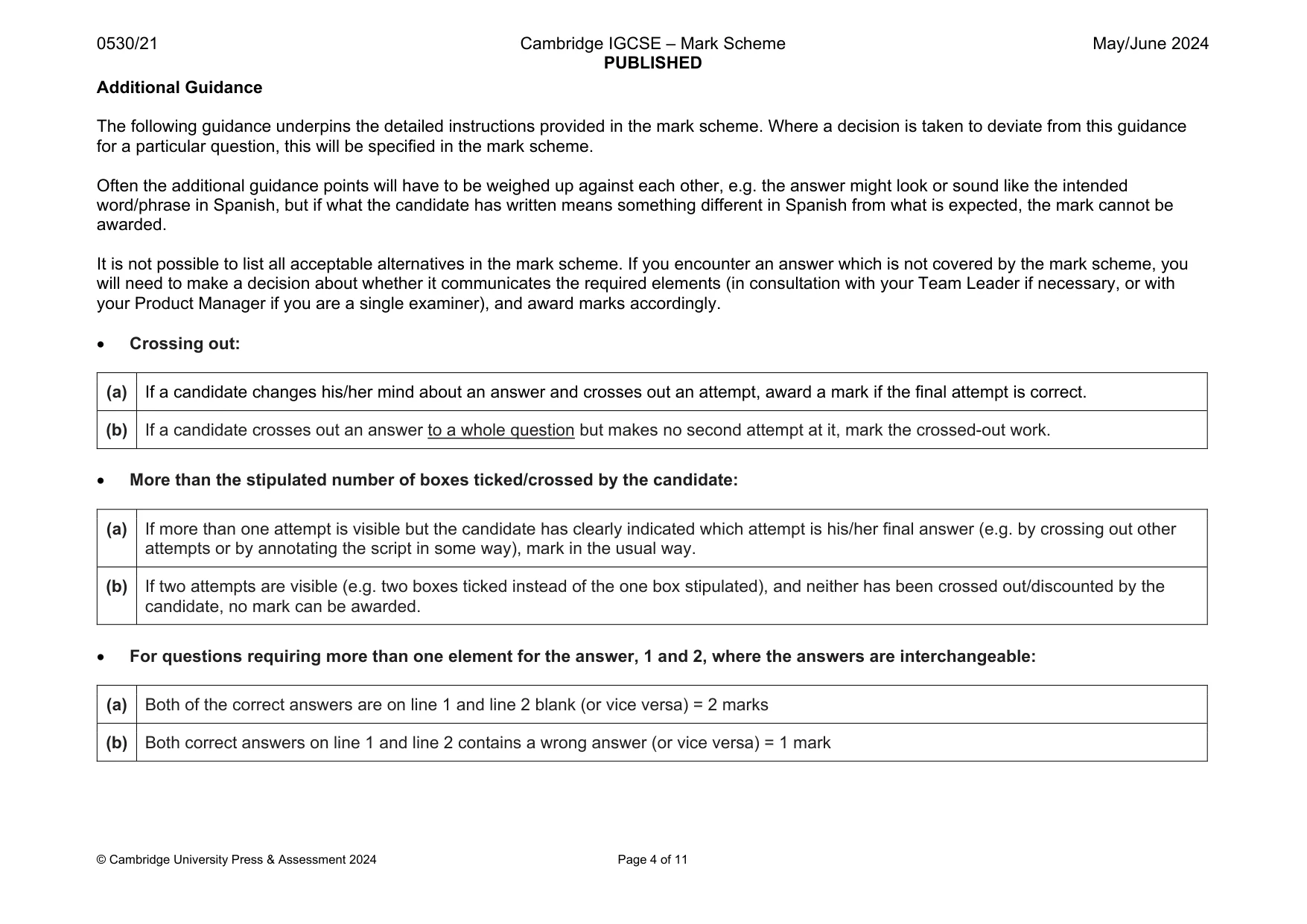
0530/21 Cambridge IGCSE – Mark Scheme PUBLISHED May/June 2024 © Cambridge University Press & Assessment 2024 Page 4 of 11 Additional Guidance The following guidance underpins the detailed instructions provided in the mark scheme. Where a decision is taken to deviate from this guidance for a particular question, this will be specified in the mark scheme. Often the additional guidance points will have to be weighed up against each other, e.g. the answer might look or sound like the intended word/phrase in Spanish, but if what the candidate has written means something different in Spanish from what is expected, the mark cannot be awarded. It is not possible to list all acceptable alternatives in the mark scheme. If you encounter an answer which is not covered by the mark scheme, you will need to make a decision about whether it communicates the required elements (in consultation with your Team Leader if necessary, or with your Product Manager if you are a single examiner), and award marks accordingly. Crossing out: (a) If a candidate changes his/her mind about an answer and crosses out an attempt, award a mark if the final attempt is correct. (b) If a candidate crosses out an answer to a whole question but makes no second attempt at it, mark the crossed-out work. More than the stipulated number of boxes ticked/crossed by the candidate: (a) If more than one attempt is visible but the candidate has clearly indicated which attempt is his/her final answer (e.g. by crossing out other attempts or by annotating the script in some way), mark in the usual way. (b) If two attempts are visible (e.g. two boxes ticked instead of the one box stipulated), and neither has been crossed out/discounted by the candidate, no mark can be awarded. For questions requiring more than one element for the answer, 1 and 2, where the answers are interchangeable: (a) Both of the correct answers are on line 1 and line 2 blank (or vice versa) = 2 marks (b) Both correct answers on line 1 and line 2 contains a wrong answer (or vice versa) = 1 mark
Mark scheme, page 5
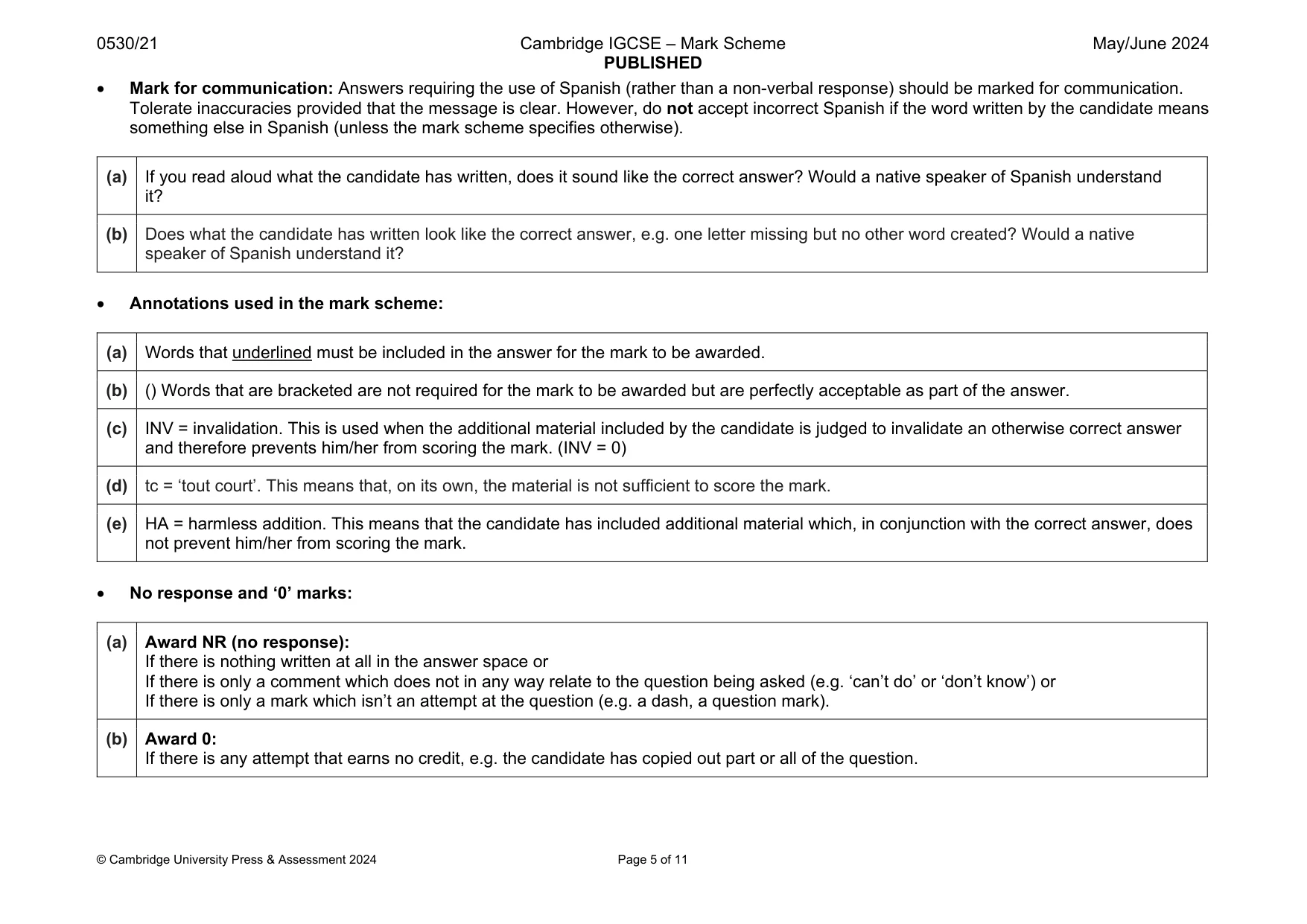
0530/21 Cambridge IGCSE – Mark Scheme PUBLISHED May/June 2024 © Cambridge University Press & Assessment 2024 Page 5 of 11 Mark for communication: Answers requiring the use of Spanish (rather than a non-verbal response) should be marked for communication. Tolerate inaccuracies provided that the message is clear. However, do not accept incorrect Spanish if the word written by the candidate means something else in Spanish (unless the mark scheme specifies otherwise). (a) If you read aloud what the candidate has written, does it sound like the correct answer? Would a native speaker of Spanish understand it? (b) Does what the candidate has written look like the correct answer, e.g. one letter missing but no other word created? Would a native speaker of Spanish understand it? Annotations used in the mark scheme: (a) Words that underlined must be included in the answer for the mark to be awarded. (b) () Words that are bracketed are not required for the mark to be awarded but are perfectly acceptable as part of the answer. (c) INV = invalidation. This is used when the additional material included by the candidate is judged to invalidate an otherwise correct answer and therefore prevents him/her from scoring the mark. (INV = 0) (d) tc = ‘tout court’. This means that, on its own, the material is not sufficient to score the mark. (e) HA = harmless addition. This means that the candidate has included additional material which, in conjunction with the correct answer, does not prevent him/her from scoring the mark. No response and ‘0’ marks: (a) Award NR (no response): If there is nothing written at all in the answer space or If there is only a comment which does not in any way relate to the question being asked (e.g. ‘can’t do’ or ‘don’t know’) or If there is only a mark which isn’t an attempt at the question (e.g. a dash, a question mark). (b) Award 0: If there is any attempt that earns no credit, e.g. the candidate has copied out part or all of the question.
Mark scheme, page 6
0530/21 Cambridge IGCSE – Mark Scheme PUBLISHED May/June 2024 © Cambridge University Press & Assessment 2024 Page 6 of 11 Extra material: Candidates need to answer the questions in such a way as to demonstrate that they have understood the text. The mark scheme cannot cover all eventualities so where specific instructions are not provided, the examiner must check the text to ensure that the correct elements which would attract the mark are not contradicted or distorted by any extra material. The following general rules should be applied: (a) Extra material, mentioned in the mark scheme, which reinforces the correct answer or in itself constitutes an alternative correct answer: This is acceptable and is not penalised. (b) Extra material which constitutes an alternative answer, but which is not explicitly mentioned in the mark scheme: The examiner needs to decide, by consulting the transcript/text and the Team Leader if necessary, whether the alternative answer constitutes: (i) an alternative correct answer, in which case this falls into category (a) and the answer should be rewarded, or (ii) an answer which on its own would be rejected, in which case this falls into category (c) and the answer should be rejected. (c) Extra material which constitutes an alternative answer specifically rejected in the mark scheme: This puts the examiner in the position of having to ‘choose’ which the intended answer is. The examiner cannot therefore be sure what the candidate has understood and the mark cannot be awarded. (d) Extra material which distorts or contradicts the correct answer: This affects communication. The examiner cannot be sure what the candidate has understood and therefore the mark cannot be awarded. (e) Extra material introduced by the candidate and which does not feature in the original text: This affects communication. The examiner cannot be sure what the candidate has understood and therefore the mark cannot be awarded. It can sometimes be difficult to draw the line between what is a deduction made by an able candidate on the basis of what they have read and pure guesswork. Therefore, where a particular answer is not covered by the mark scheme, the examiner should consult the Team Leader.
Mark scheme, page 7
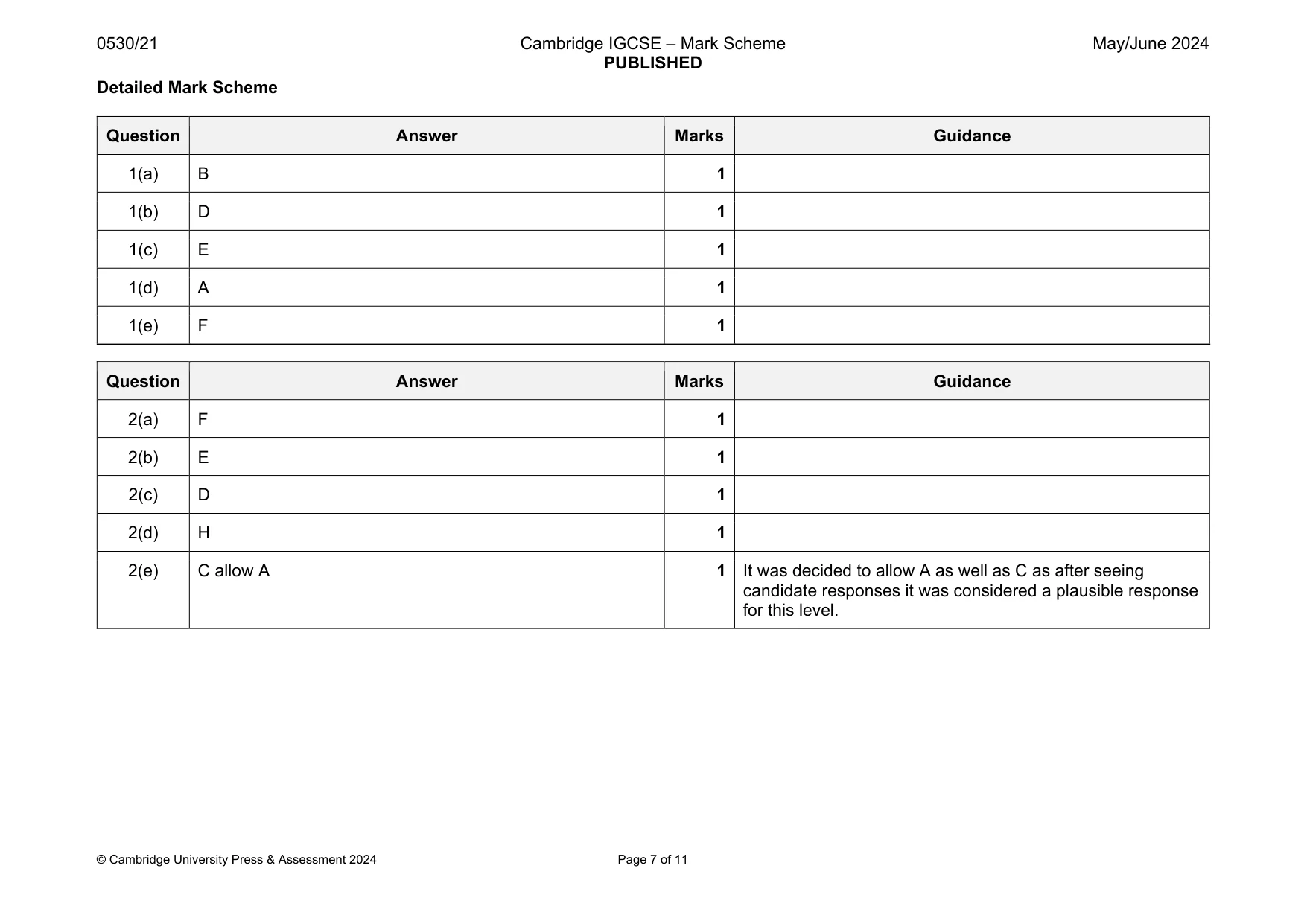
0530/21 Cambridge IGCSE – Mark Scheme PUBLISHED May/June 2024 © Cambridge University Press & Assessment 2024 Page 7 of 11 Detailed Mark Scheme Question Answer Marks Guidance 1(a) B 1 1(b) D 1 1(c) E 1 1(d) A 1 1(e) F 1 Question Answer Marks Guidance 2(a) F 1 2(b) E 1 2(c) D 1 2(d) H 1 2(e) C allow A 1 It was decided to allow A as well as C as after seeing candidate responses it was considered a plausible response for this level.
Mark scheme, page 8
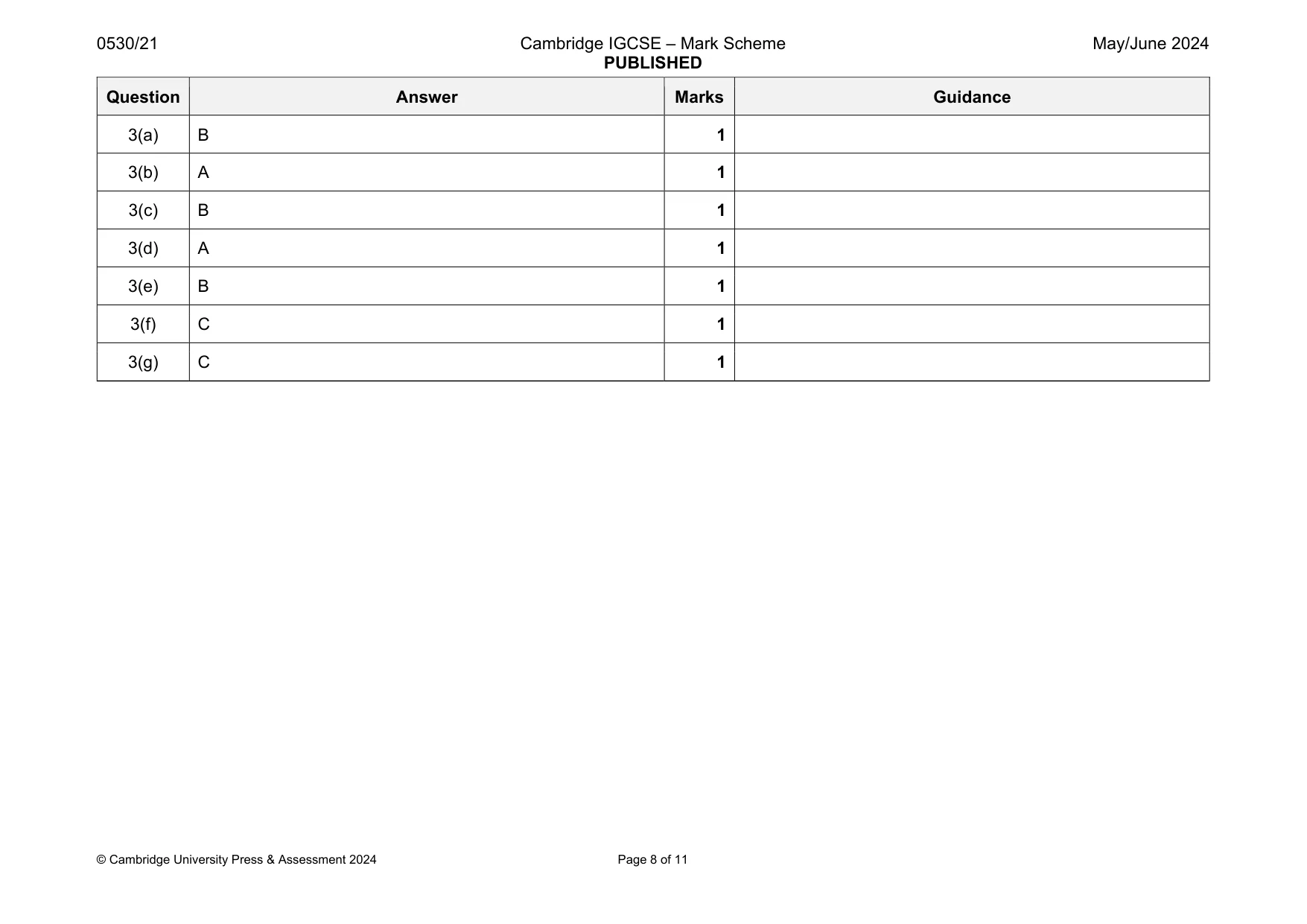
0530/21 Cambridge IGCSE – Mark Scheme PUBLISHED May/June 2024 © Cambridge University Press & Assessment 2024 Page 8 of 11 Question Answer Marks Guidance 3(a) B 1 3(b) A 1 3(c) B 1 3(d) A 1 3(e) B 1 3(f) C 1 3(g) C 1
Mark scheme, page 9
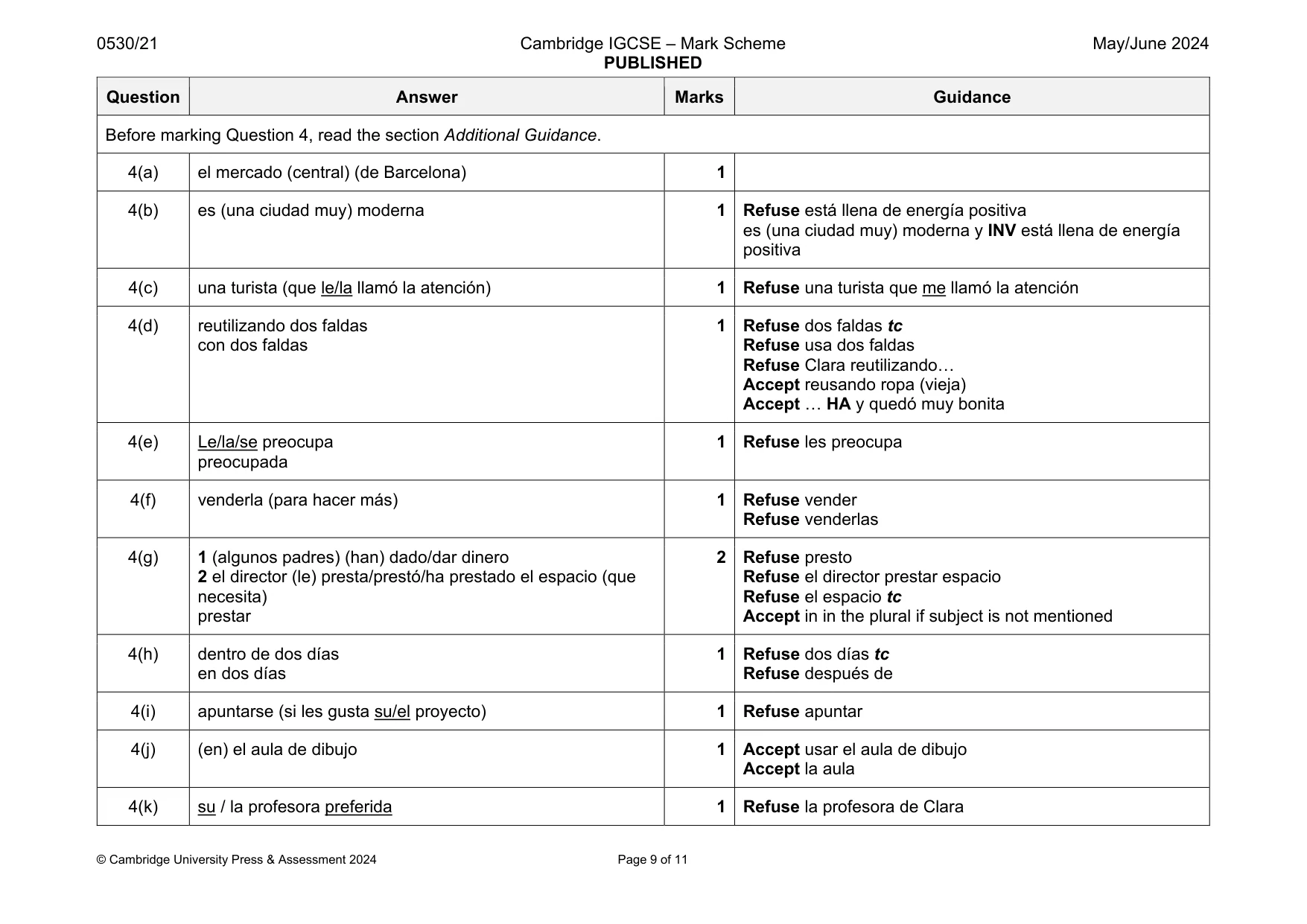
0530/21 Cambridge IGCSE – Mark Scheme PUBLISHED May/June 2024 © Cambridge University Press & Assessment 2024 Page 9 of 11 Question Answer Marks Guidance Before marking Question 4, read the section Additional Guidance. 4(a) el mercado (central) (de Barcelona) 1 4(b) es (una ciudad muy) moderna 1 Refuse está llena de energía positiva es (una ciudad muy) moderna y INV está llena de energía positiva 4(c) una turista (que le/la llamó la atención) 1 Refuse una turista que me llamó la atención 4(d) reutilizando dos faldas con dos faldas 1 Refuse dos faldas tc Refuse usa dos faldas Refuse Clara reutilizando… Accept reusando ropa (vieja) Accept … HA y quedó muy bonita 4(e) Le/la/se preocupa preocupada 1 Refuse les preocupa 4(f) venderla (para hacer más) 1 Refuse vender Refuse venderlas 4(g) 1 (algunos padres) (han) dado/dar dinero 2 el director (le) presta/prestó/ha prestado el espacio (que necesita) prestar 2 Refuse presto Refuse el director prestar espacio Refuse el espacio tc Accept in in the plural if subject is not mentioned 4(h) dentro de dos días en dos días 1 Refuse dos días tc Refuse después de 4(i) apuntarse (si les gusta su/el proyecto) 1 Refuse apuntar 4(j) (en) el aula de dibujo 1 Accept usar el aula de dibujo Accept la aula 4(k) su / la profesora preferida 1 Refuse la profesora de Clara
Mark scheme, page 10
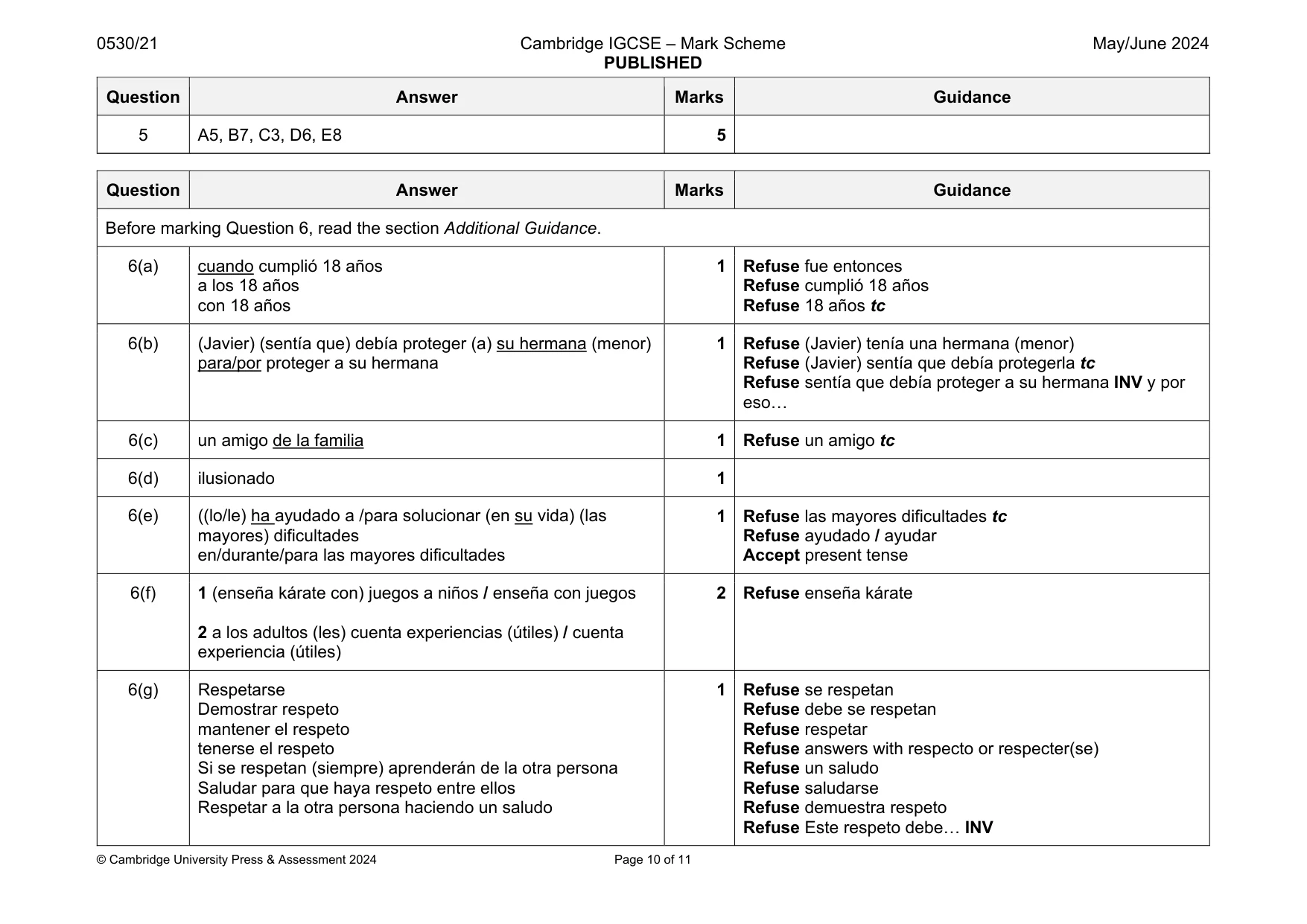
0530/21 Cambridge IGCSE – Mark Scheme PUBLISHED May/June 2024 © Cambridge University Press & Assessment 2024 Page 10 of 11 Question Answer Marks Guidance 5 A5, B7, C3, D6, E8 5 Question Answer Marks Guidance Before marking Question 6, read the section Additional Guidance. 6(a) cuando cumplió 18 años a los 18 años con 18 años 1 Refuse fue entonces Refuse cumplió 18 años Refuse 18 años tc 6(b) (Javier) (sentía que) debía proteger (a) su hermana (menor) para/por proteger a su hermana 1 Refuse (Javier) tenía una hermana (menor) Refuse (Javier) sentía que debía protegerla tc Refuse sentía que debía proteger a su hermana INV y por eso… 6(c) un amigo de la familia 1 Refuse un amigo tc 6(d) ilusionado 1 6(e) ((lo/le) ha ayudado a /para solucionar (en su vida) (las mayores) dificultades en/durante/para las mayores dificultades 1 Refuse las mayores dificultades tc Refuse ayudado / ayudar Accept present tense 6(f) 1 (enseña kárate con) juegos a niños / enseña con juegos 2 a los adultos (les) cuenta experiencias (útiles) / cuenta experiencia (útiles) 2 Refuse enseña kárate 6(g) Respetarse Demostrar respeto mantener el respeto tenerse el respeto Si se respetan (siempre) aprenderán de la otra persona Saludar para que haya respeto entre ellos Respetar a la otra persona haciendo un saludo 1 Refuse se respetan Refuse debe se respetan Refuse respetar Refuse answers with respecto or respecter(se) Refuse un saludo Refuse saludarse Refuse demuestra respeto Refuse Este respeto debe… INV
Mark scheme, page 11
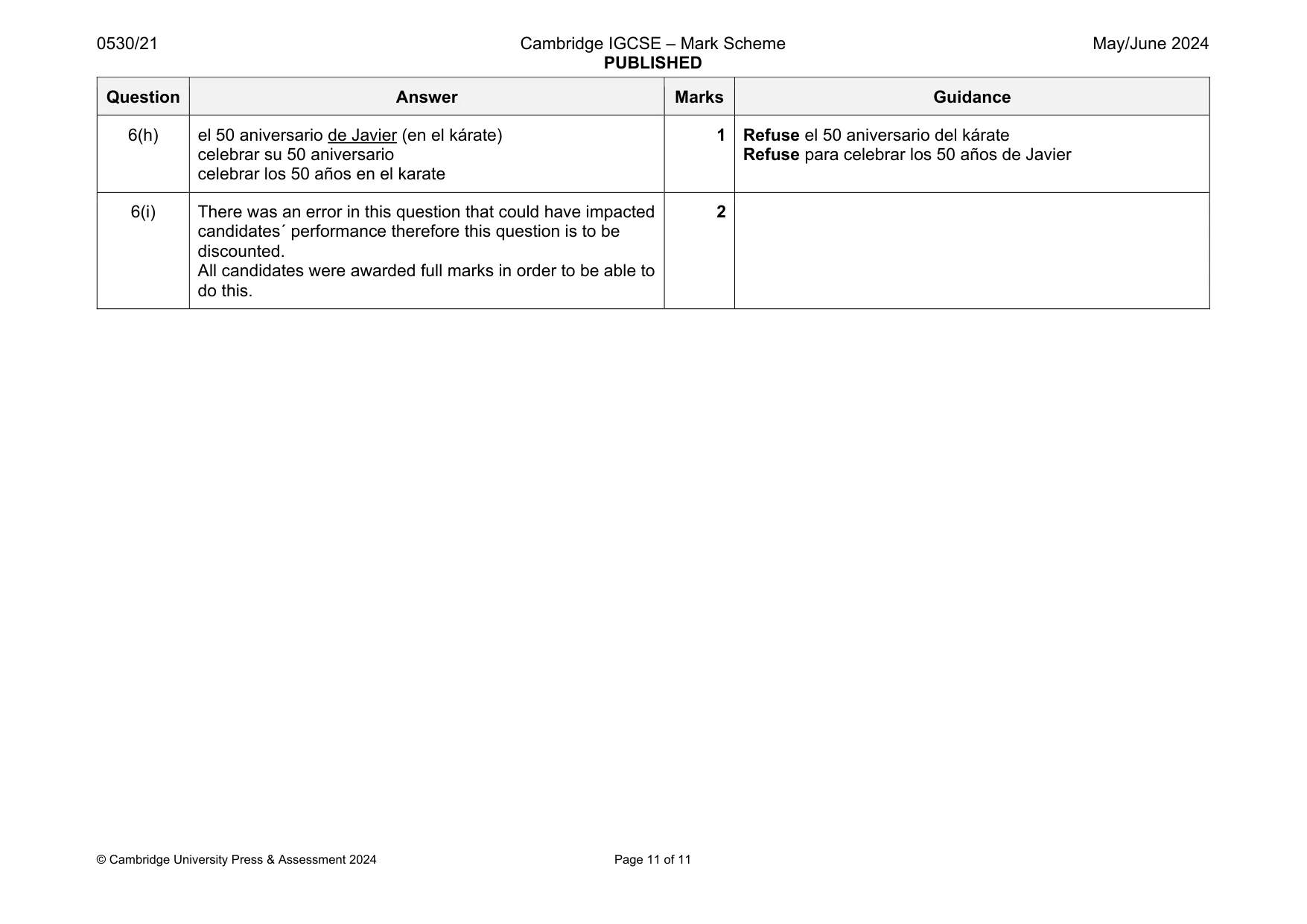
0530/21 Cambridge IGCSE – Mark Scheme PUBLISHED May/June 2024 © Cambridge University Press & Assessment 2024 Page 11 of 11 Question Answer Marks Guidance 6(h) el 50 aniversario de Javier (en el kárate) celebrar su 50 aniversario celebrar los 50 años en el karate 1 Refuse el 50 aniversario del kárate Refuse para celebrar los 50 años de Javier 6(i) There was an error in this question that could have impacted candidates´ performance therefore this question is to be discounted. All candidates were awarded full marks in order to be able to do this. 2
What you needed in this session
Cambridge’s own grade thresholds for 2024 May/June, Paper 2 · Variant 1. A higher threshold means an easier paper — the bar moves with how the cohort did.