Cambridge IGCSE Spanish - Foreign Language 0530 — 2023 Feb/March Paper 2 · Variant 2
0530/22/F/M/23
The question paper and its mark scheme, free to read here and free to download. This is Cambridge’s own paper, exactly as it was sat.
Question paper12 pages

Mark scheme12 pages
Answers below. Sit the paper first if you are practising.
Paper as text
Question paper, page 1
This document has 12 pages. Any blank pages are indicated. [Turn over Cambridge IGCSE™ * 8 1 5 3 0 4 0 4 8 4 * SPANISH 0530/22 Paper 2 Reading February/March 2023 1 hour You must answer on the question paper. No additional materials are needed. INSTRUCTIONS ● Answer all questions. ● Use a black or dark blue pen. ● Write your name, centre number and candidate number in the boxes at the top of the page. ● Write your answer to each question in the space provided. ● Do not use an erasable pen or correction fluid. ● Do not write on any bar codes. ● Dictionaries are not allowed. INFORMATION ● The total mark for this paper is 45. ● The number of marks for each question or part question is shown in brackets [ ]. DC (CE/CGW) 318152/3 © UCLES 2023
Question paper, page 2
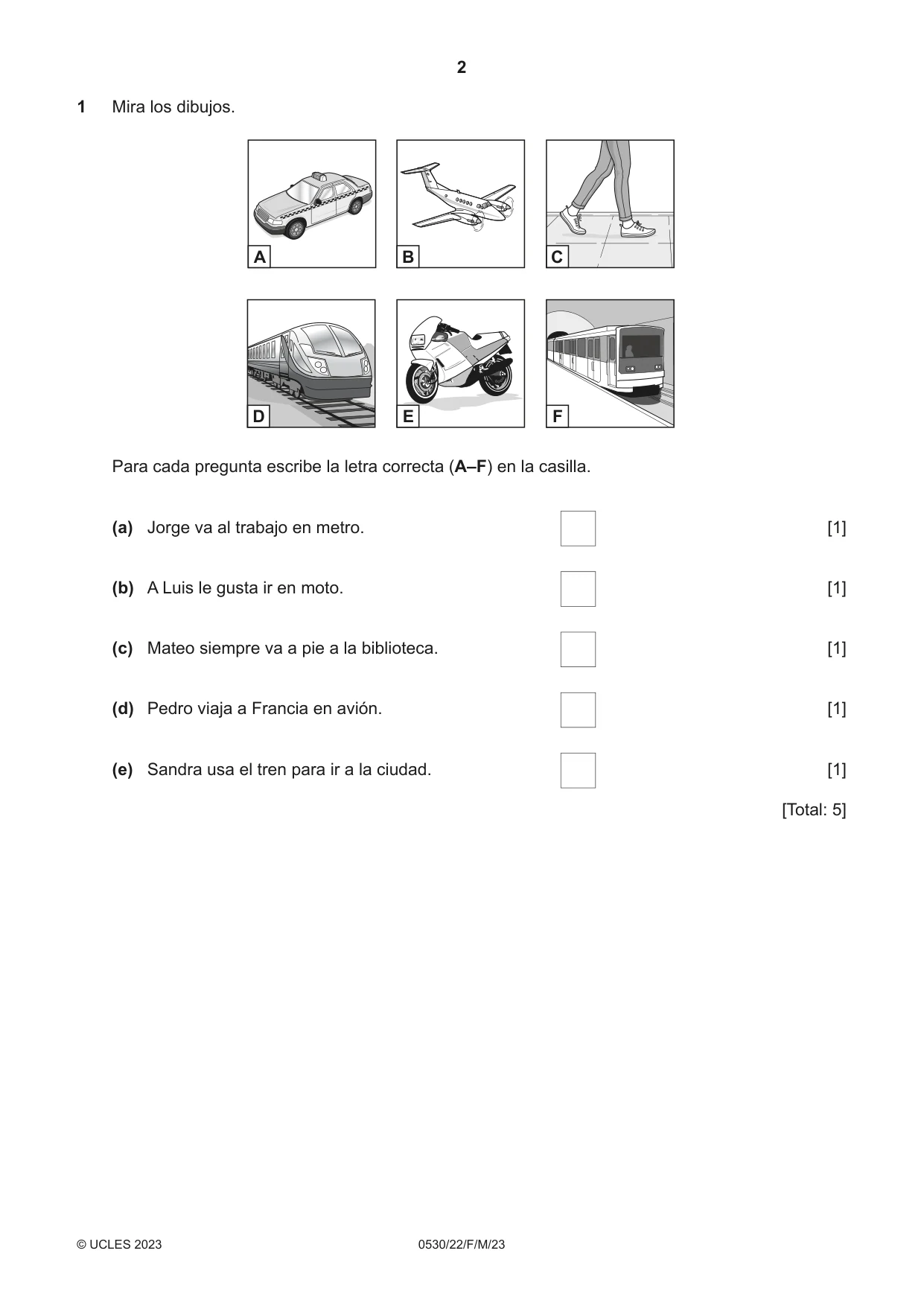
2 0530/22/F/M/23 © UCLES 2023 1 Mira los dibujos. C B A E D F Para cada pregunta escribe la letra correcta (A–F) en la casilla. (a) Jorge va al trabajo en metro. [1] (b) A Luis le gusta ir en moto. [1] (c) Mateo siempre va a pie a la biblioteca. [1] (d) Pedro viaja a Francia en avión. [1] (e) Sandra usa el tren para ir a la ciudad. [1] [Total: 5]
Question paper, page 3
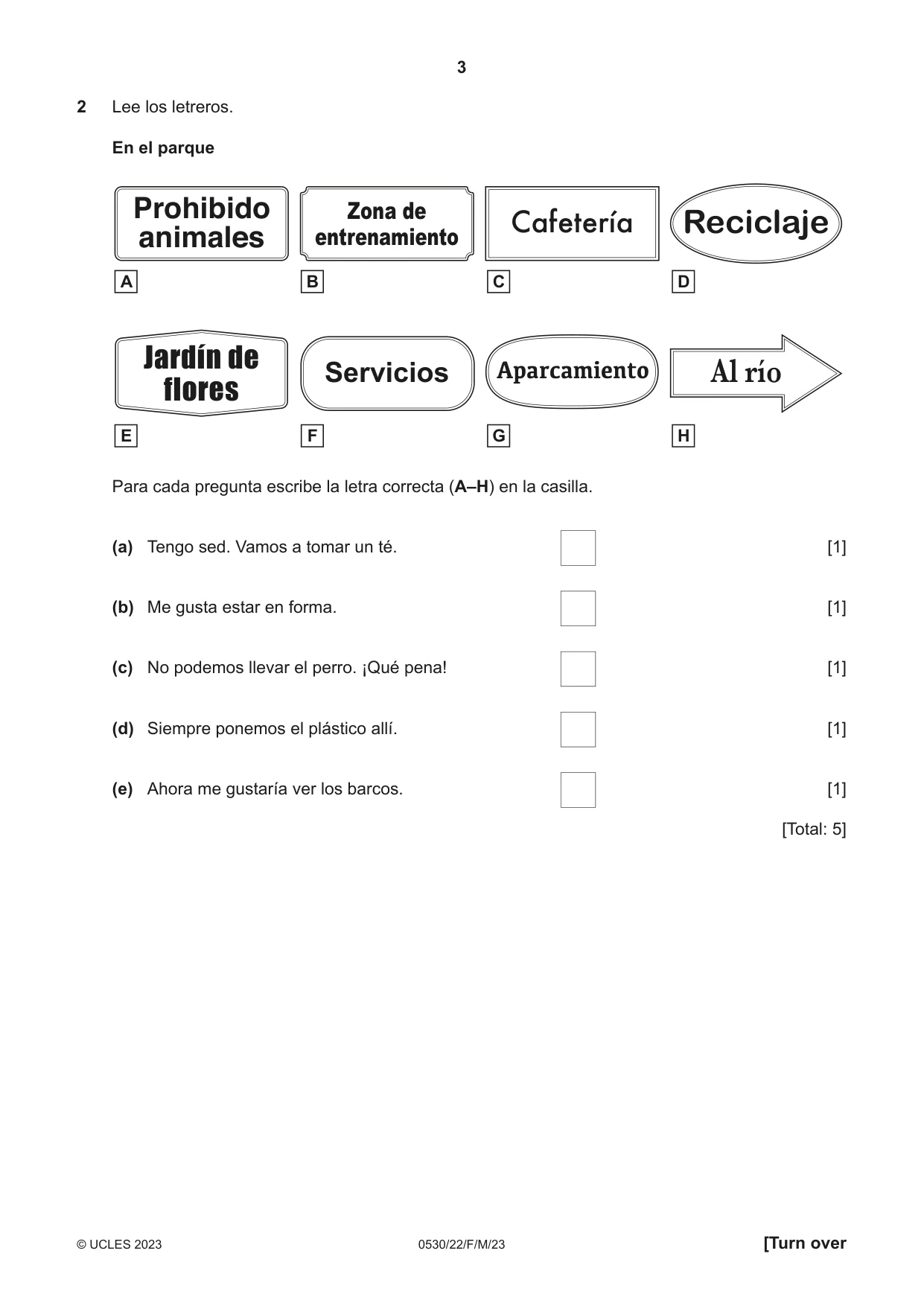
3 0530/22/F/M/23 © UCLES 2023 [Turn over 2 Lee los letreros. En el parque Prohibido animales Jardín de flores Servicios Aparcamiento Zona de entrenamiento Cafetería Reciclaje Al río A B C D E F G H Para cada pregunta escribe la letra correcta (A–H) en la casilla. (a) Tengo sed. Vamos a tomar un té. [1] (b) Me gusta estar en forma. [1] (c) No podemos llevar el perro. ¡Qué pena! [1] (d) Siempre ponemos el plástico allí. [1] (e) Ahora me gustaría ver los barcos. [1] [Total: 5]
Question paper, page 4
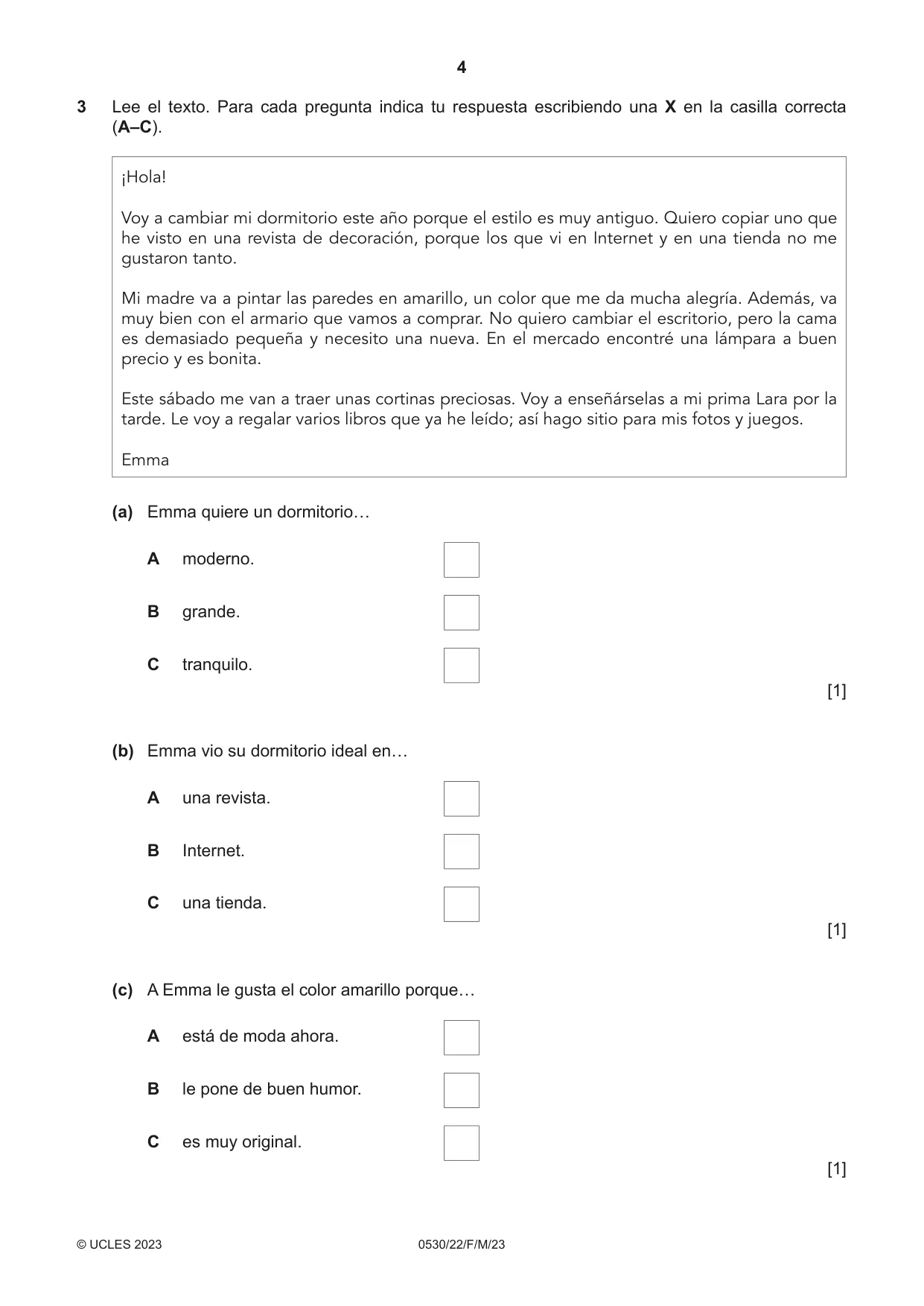
4 0530/22/F/M/23 © UCLES 2023 3 Lee el texto. Para cada pregunta indica tu respuesta escribiendo una X en la casilla correcta (A–C). ¡Hola! Voy a cambiar mi dormitorio este año porque el estilo es muy antiguo. Quiero copiar uno que he visto en una revista de decoración, porque los que vi en Internet y en una tienda no me gustaron tanto. Mi madre va a pintar las paredes en amarillo, un color que me da mucha alegría. Además, va muy bien con el armario que vamos a comprar. No quiero cambiar el escritorio, pero la cama es demasiado pequeña y necesito una nueva. En el mercado encontré una lámpara a buen precio y es bonita. Este sábado me van a traer unas cortinas preciosas. Voy a enseñárselas a mi prima Lara por la tarde. Le voy a regalar varios libros que ya he leído; así hago sitio para mis fotos y juegos. Emma (a) Emma quiere un dormitorio… A moderno. B grande. C tranquilo. [1] (b) Emma vio su dormitorio ideal en… A una revista. B Internet. C una tienda. [1] (c) A Emma le gusta el color amarillo porque… A está de moda ahora. B le pone de buen humor. C es muy original. [1]
Question paper, page 5
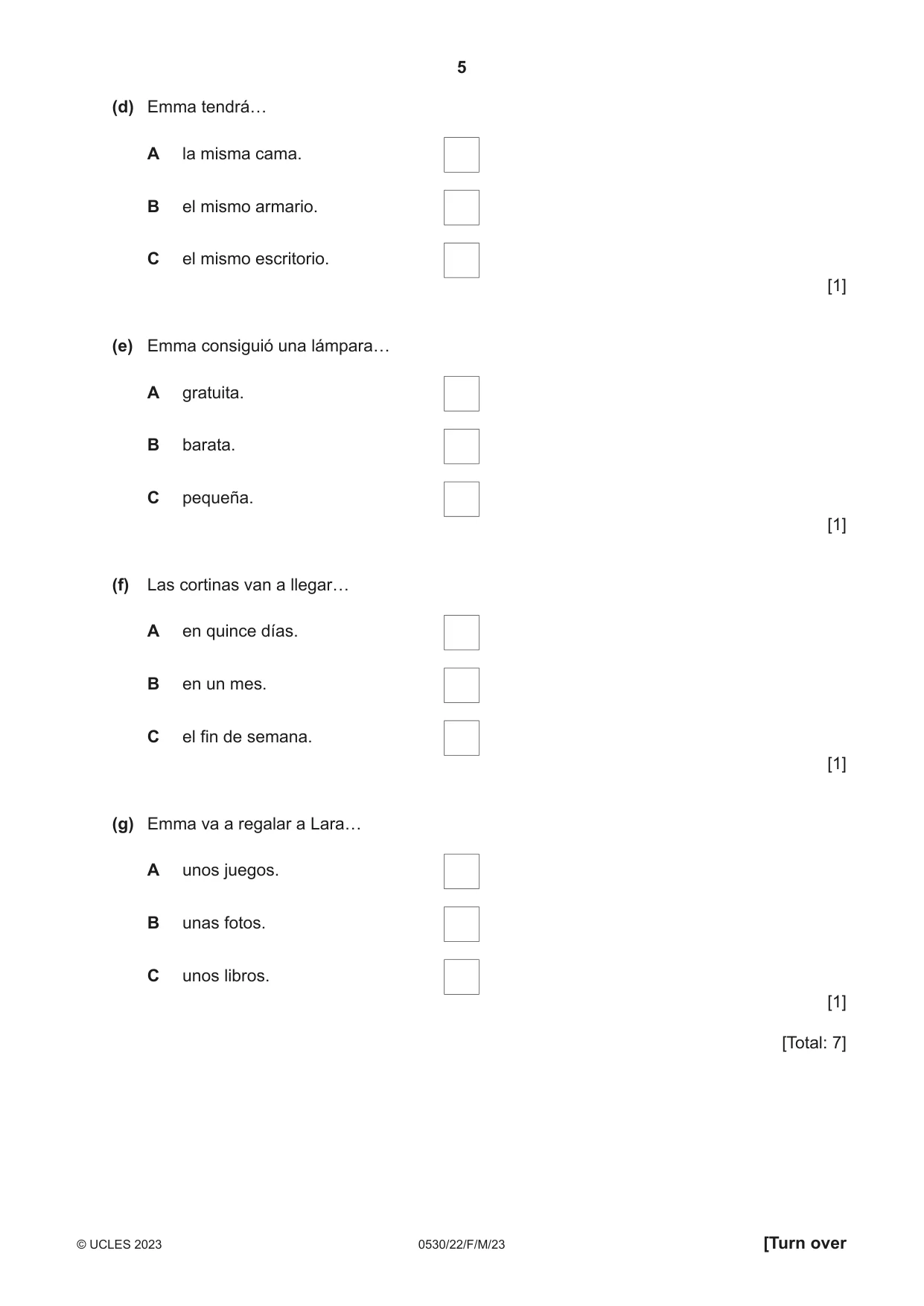
5 0530/22/F/M/23 © UCLES 2023 [Turn over (d) Emma tendrá… A la misma cama. B el mismo armario. C el mismo escritorio. [1] (e) Emma consiguió una lámpara… A gratuita. B barata. C pequeña. [1] (f) Las cortinas van a llegar… A en quince días. B en un mes. C el fin de semana. [1] (g) Emma va a regalar a Lara… A unos juegos. B unas fotos. C unos libros. [1] [Total: 7]
Question paper, page 6
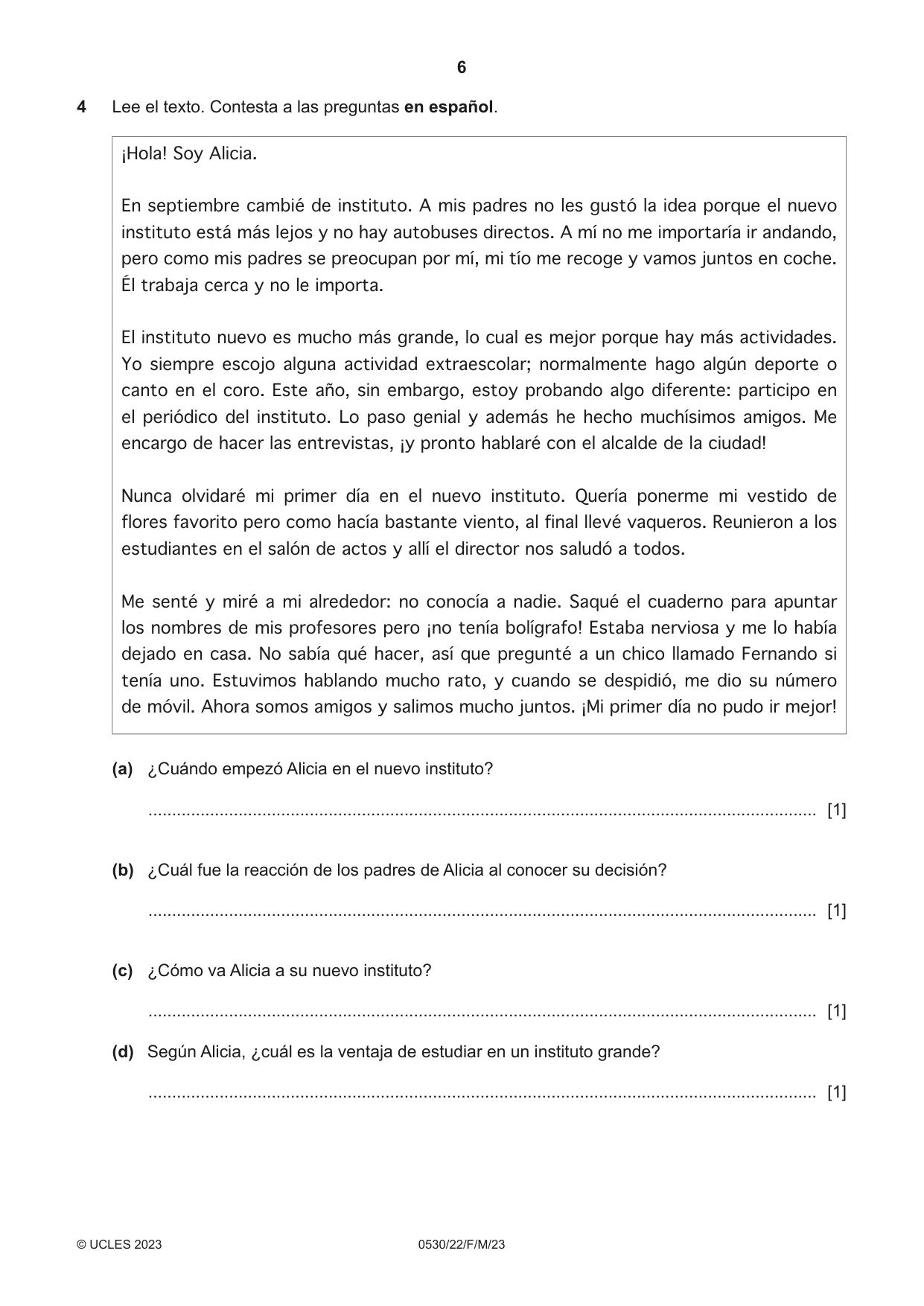
6 0530/22/F/M/23 © UCLES 2023 4 Lee el texto. Contesta a las preguntas en español. ¡Hola! Soy Alicia. En septiembre cambié de instituto. A mis padres no les gustó la idea porque el nuevo instituto está más lejos y no hay autobuses directos. A mí no me importaría ir andando, pero como mis padres se preocupan por mí, mi tío me recoge y vamos juntos en coche. Él trabaja cerca y no le importa. El instituto nuevo es mucho más grande, lo cual es mejor porque hay más actividades. Yo siempre escojo alguna actividad extraescolar; normalmente hago algún deporte o canto en el coro. Este año, sin embargo, estoy probando algo diferente: participo en el periódico del instituto. Lo paso genial y además he hecho muchísimos amigos. Me encargo de hacer las entrevistas, ¡y pronto hablaré con el alcalde de la ciudad! Nunca olvidaré mi primer día en el nuevo instituto. Quería ponerme mi vestido de flores favorito pero como hacía bastante viento, al final llevé vaqueros. Reunieron a los estudiantes en el salón de actos y allí el director nos saludó a todos. Me senté y miré a mi alrededor: no conocía a nadie. Saqué el cuaderno para apuntar los nombres de mis profesores pero ¡no tenía bolígrafo! Estaba nerviosa y me lo había dejado en casa. No sabía qué hacer, así que pregunté a un chico llamado Fernando si tenía uno. Estuvimos hablando mucho rato, y cuando se despidió, me dio su número de móvil. Ahora somos amigos y salimos mucho juntos. ¡Mi primer día no pudo ir mejor! (a) ¿Cuándo empezó Alicia en el nuevo instituto? … [1] (b) ¿Cuál fue la reacción de los padres de Alicia al conocer su decisión? … [1] (c) ¿Cómo va Alicia a su nuevo instituto? … [1] (d) Según Alicia, ¿cuál es la ventaja de estudiar en un instituto grande? … [1]
Question paper, page 7
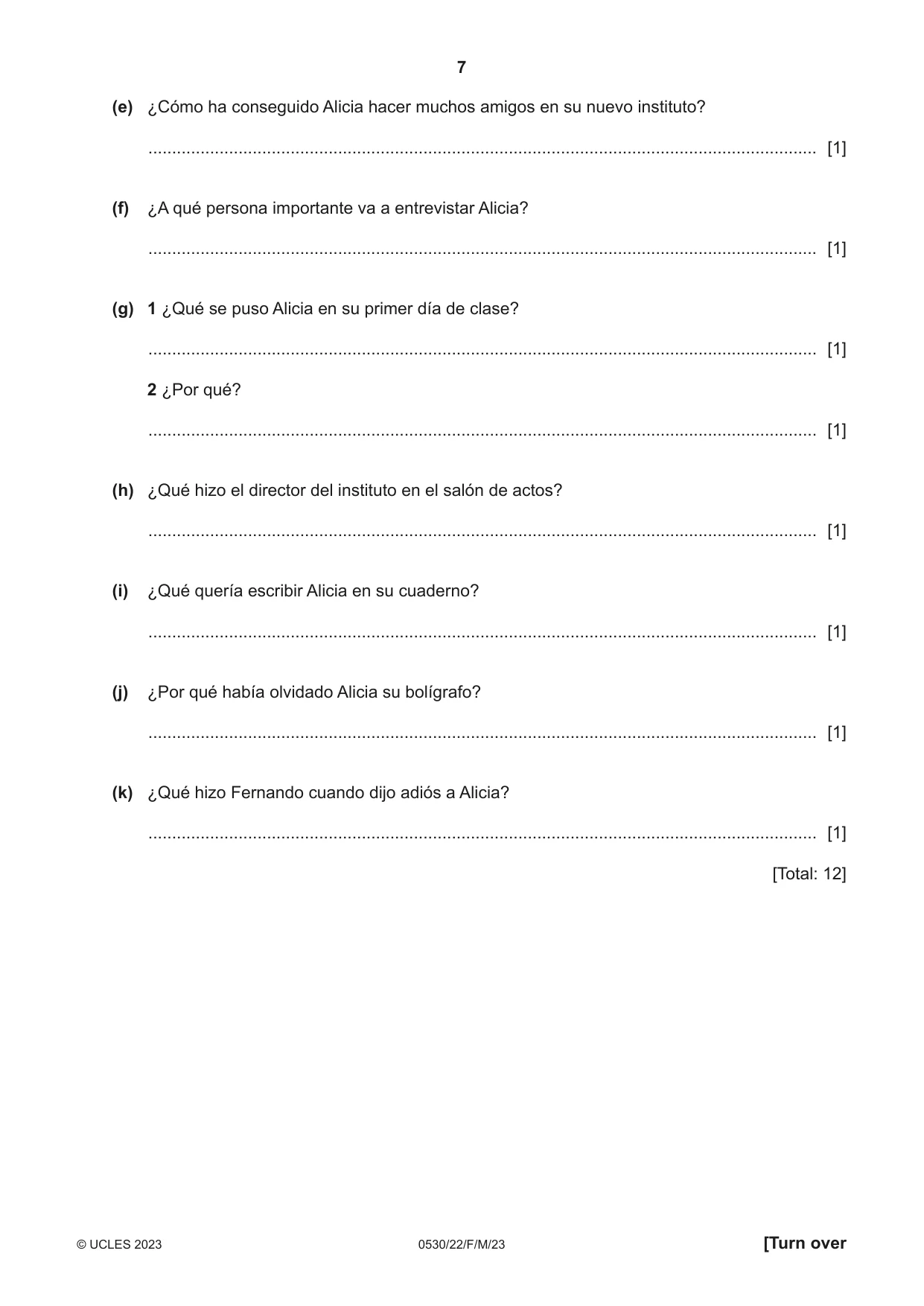
7 0530/22/F/M/23 © UCLES 2023 [Turn over (e) ¿Cómo ha conseguido Alicia hacer muchos amigos en su nuevo instituto? … [1] (f) ¿A qué persona importante va a entrevistar Alicia? … [1] (g) 1 ¿Qué se puso Alicia en su primer día de clase? … [1] 2 ¿Por qué? … [1] (h) ¿Qué hizo el director del instituto en el salón de actos? … [1] (i) ¿Qué quería escribir Alicia en su cuaderno? … [1] (j) ¿Por qué había olvidado Alicia su bolígrafo? … [1] (k) ¿Qué hizo Fernando cuando dijo adiós a Alicia? … [1] [Total: 12]
Question paper, page 8
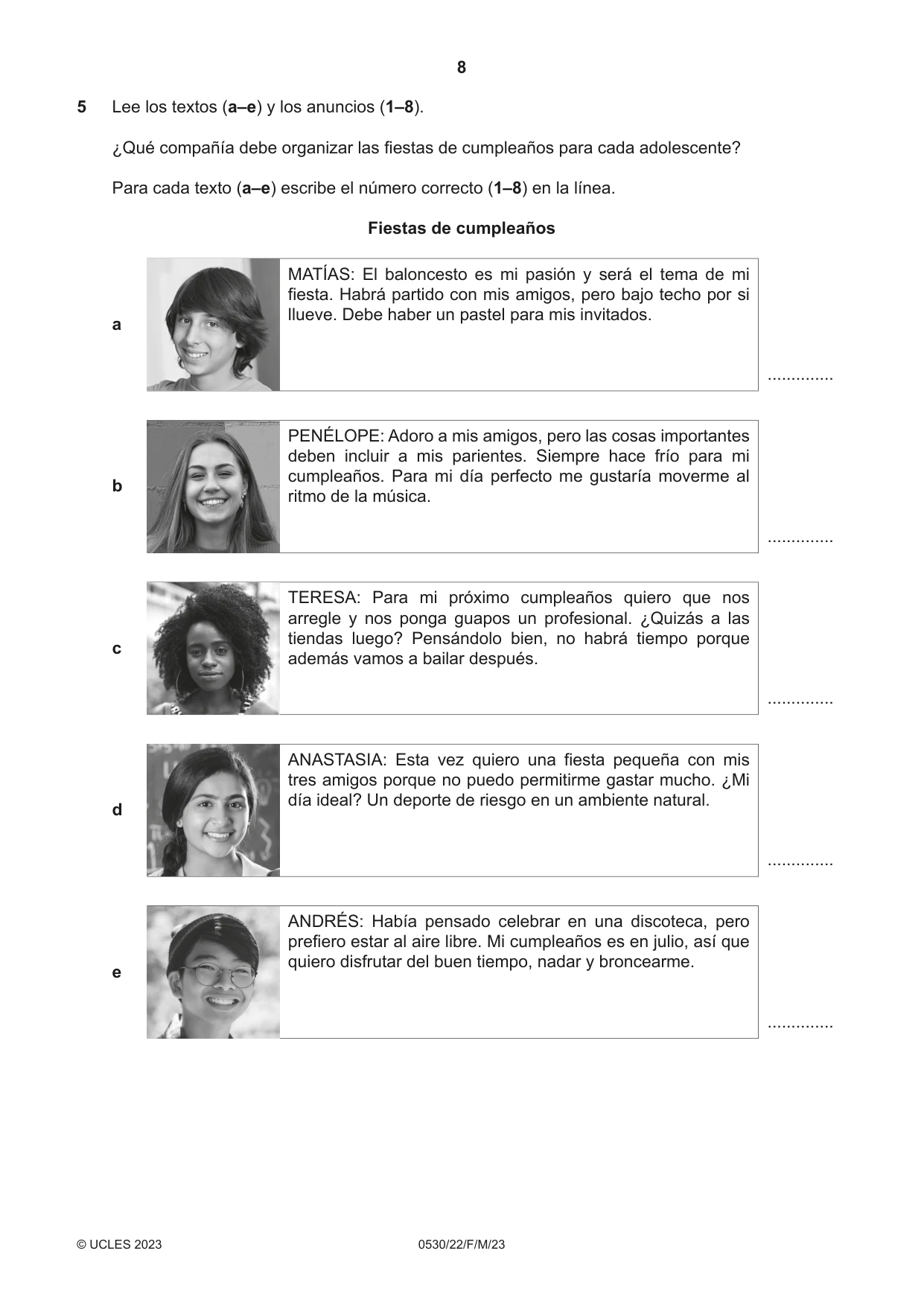
8 0530/22/F/M/23 © UCLES 2023 5 Lee los textos (a–e) y los anuncios (1–8). ¿Qué compañía debe organizar las fiestas de cumpleaños para cada adolescente? Para cada texto (a–e) escribe el número correcto (1–8) en la línea. Fiestas de cumpleaños a MATÍAS: El baloncesto es mi pasión y será el tema de mi fiesta. Habrá partido con mis amigos, pero bajo techo por si llueve. Debe haber un pastel para mis invitados. … b PENÉLOPE: Adoro a mis amigos, pero las cosas importantes deben incluir a mis parientes. Siempre hace frío para mi cumpleaños. Para mi día perfecto me gustaría moverme al ritmo de la música. … c TERESA: Para mi próximo cumpleaños quiero que nos arregle y nos ponga guapos un profesional. ¿Quizás a las tiendas luego? Pensándolo bien, no habrá tiempo porque además vamos a bailar después. … d ANASTASIA: Esta vez quiero una fiesta pequeña con mis tres amigos porque no puedo permitirme gastar mucho. ¿Mi día ideal? Un deporte de riesgo en un ambiente natural. … e ANDRÉS: Había pensado celebrar en una discoteca, pero prefiero estar al aire libre. Mi cumpleaños es en julio, así que quiero disfrutar del buen tiempo, nadar y broncearme. …
Question paper, page 9
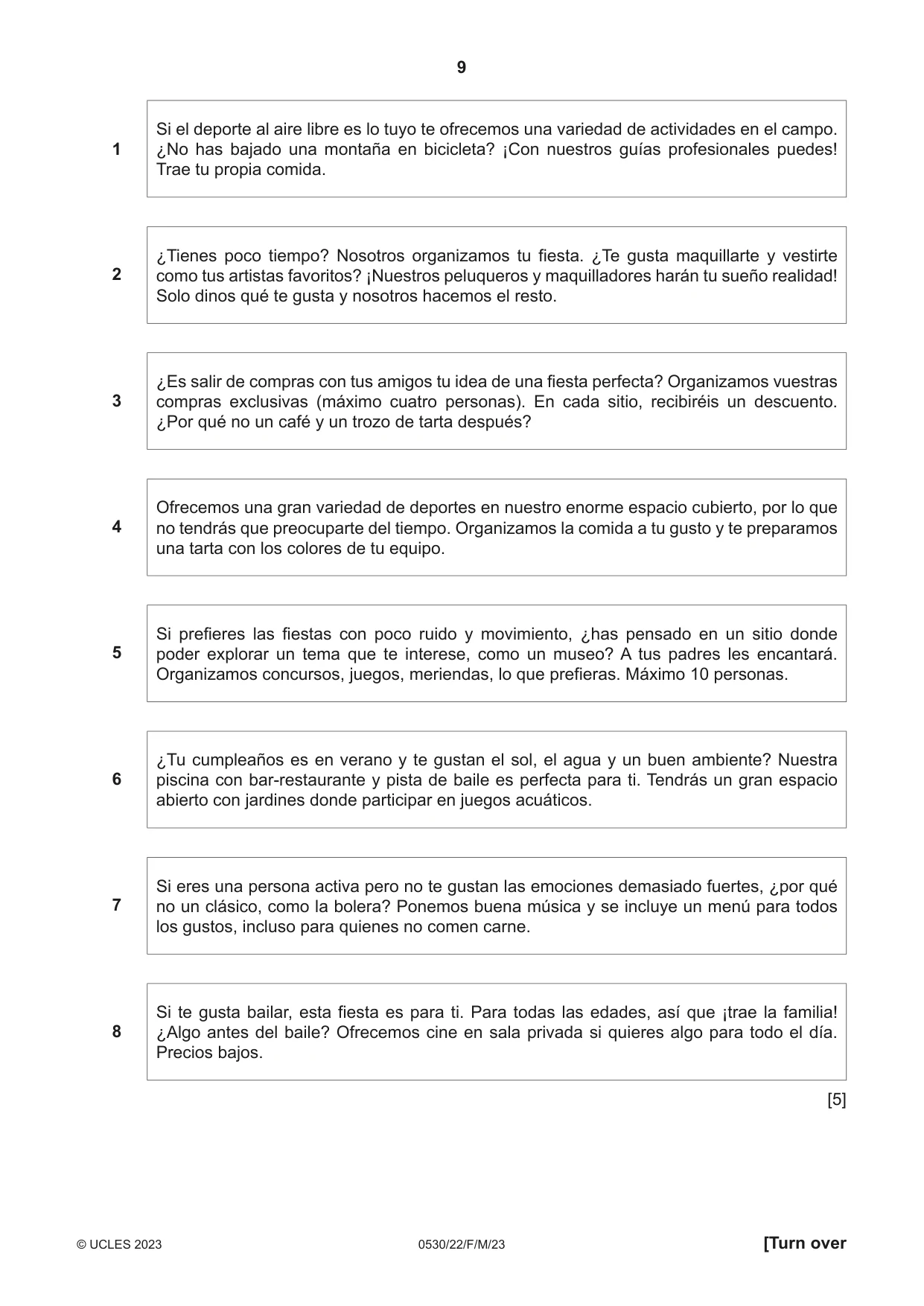
9 0530/22/F/M/23 © UCLES 2023 [Turn over 1 Si el deporte al aire libre es lo tuyo te ofrecemos una variedad de actividades en el campo. ¿No has bajado una montaña en bicicleta? ¡Con nuestros guías profesionales puedes! Trae tu propia comida. 2 ¿Tienes poco tiempo? Nosotros organizamos tu fiesta. ¿Te gusta maquillarte y vestirte como tus artistas favoritos? ¡Nuestros peluqueros y maquilladores harán tu sueño realidad! Solo dinos qué te gusta y nosotros hacemos el resto. 3 ¿Es salir de compras con tus amigos tu idea de una fiesta perfecta? Organizamos vuestras compras exclusivas (máximo cuatro personas). En cada sitio, recibiréis un descuento. ¿Por qué no un café y un trozo de tarta después? 4 Ofrecemos una gran variedad de deportes en nuestro enorme espacio cubierto, por lo que no tendrás que preocuparte del tiempo. Organizamos la comida a tu gusto y te preparamos una tarta con los colores de tu equipo. 5 Si prefieres las fiestas con poco ruido y movimiento, ¿has pensado en un sitio donde poder explorar un tema que te interese, como un museo? A tus padres les encantará. Organizamos concursos, juegos, meriendas, lo que prefieras. Máximo 10 personas. 6 ¿Tu cumpleaños es en verano y te gustan el sol, el agua y un buen ambiente? Nuestra piscina con bar-restaurante y pista de baile es perfecta para ti. Tendrás un gran espacio abierto con jardines donde participar en juegos acuáticos. 7 Si eres una persona activa pero no te gustan las emociones demasiado fuertes, ¿por qué no un clásico, como la bolera? Ponemos buena música y se incluye un menú para todos los gustos, incluso para quienes no comen carne. 8 Si te gusta bailar, esta fiesta es para ti. Para todas las edades, así que ¡trae la familia! ¿Algo antes del baile? Ofrecemos cine en sala privada si quieres algo para todo el día. Precios bajos. [5]
Question paper, page 10
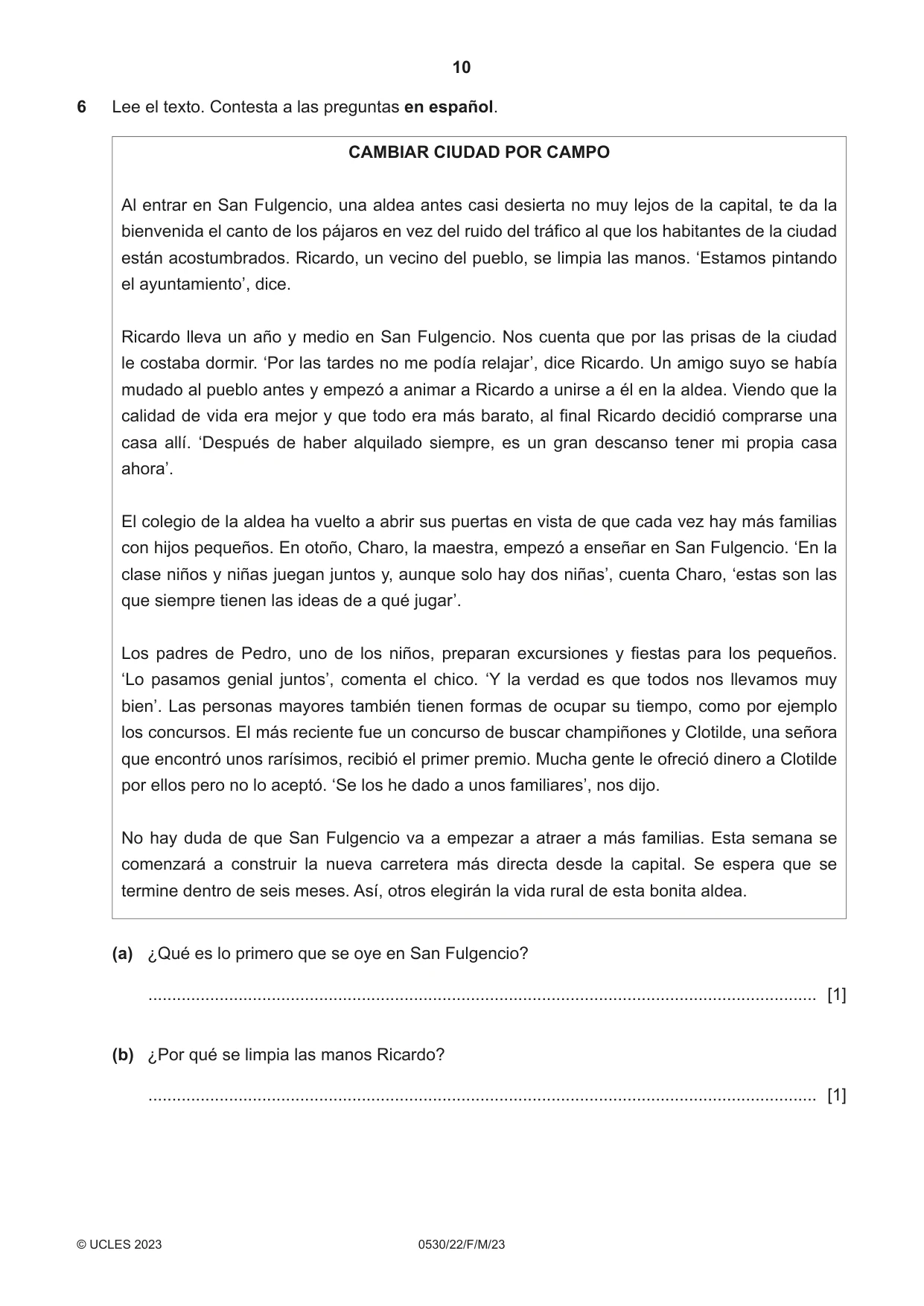
10 0530/22/F/M/23 © UCLES 2023 6 Lee el texto. Contesta a las preguntas en español. CAMBIAR CIUDAD POR CAMPO Al entrar en San Fulgencio, una aldea antes casi desierta no muy lejos de la capital, te da la bienvenida el canto de los pájaros en vez del ruido del tráfico al que los habitantes de la ciudad están acostumbrados. Ricardo, un vecino del pueblo, se limpia las manos. ‘Estamos pintando el ayuntamiento’, dice. Ricardo lleva un año y medio en San Fulgencio. Nos cuenta que por las prisas de la ciudad le costaba dormir. ‘Por las tardes no me podía relajar’, dice Ricardo. Un amigo suyo se había mudado al pueblo antes y empezó a animar a Ricardo a unirse a él en la aldea. Viendo que la calidad de vida era mejor y que todo era más barato, al final Ricardo decidió comprarse una casa allí. ‘Después de haber alquilado siempre, es un gran descanso tener mi propia casa ahora’. El colegio de la aldea ha vuelto a abrir sus puertas en vista de que cada vez hay más familias con hijos pequeños. En otoño, Charo, la maestra, empezó a enseñar en San Fulgencio. ‘En la clase niños y niñas juegan juntos y, aunque solo hay dos niñas’, cuenta Charo, ‘estas son las que siempre tienen las ideas de a qué jugar’. Los padres de Pedro, uno de los niños, preparan excursiones y fiestas para los pequeños. ‘Lo pasamos genial juntos’, comenta el chico. ‘Y la verdad es que todos nos llevamos muy bien’. Las personas mayores también tienen formas de ocupar su tiempo, como por ejemplo los concursos. El más reciente fue un concurso de buscar champiñones y Clotilde, una señora que encontró unos rarísimos, recibió el primer premio. Mucha gente le ofreció dinero a Clotilde por ellos pero no lo aceptó. ‘Se los he dado a unos familiares’, nos dijo. No hay duda de que San Fulgencio va a empezar a atraer a más familias. Esta semana se comenzará a construir la nueva carretera más directa desde la capital. Se espera que se termine dentro de seis meses. Así, otros elegirán la vida rural de esta bonita aldea. (a) ¿Qué es lo primero que se oye en San Fulgencio? … [1] (b) ¿Por qué se limpia las manos Ricardo? … [1]
Question paper, page 11
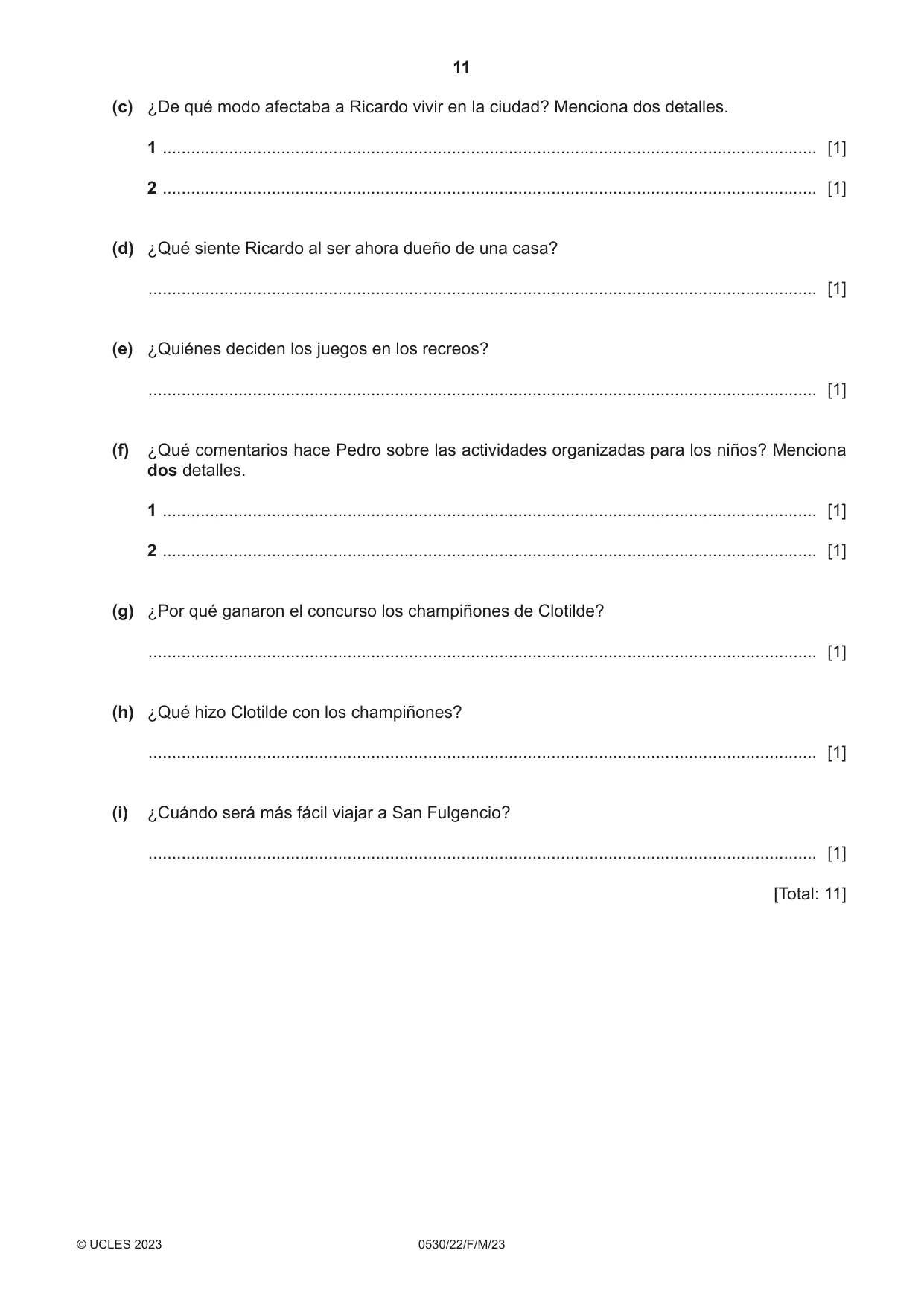
11 0530/22/F/M/23 © UCLES 2023 (c) ¿De qué modo afectaba a Ricardo vivir en la ciudad? Menciona dos detalles. 1 … [1] 2 … [1] (d) ¿Qué siente Ricardo al ser ahora dueño de una casa? … [1] (e) ¿Quiénes deciden los juegos en los recreos? … [1] (f) ¿Qué comentarios hace Pedro sobre las actividades organizadas para los niños? Menciona dos detalles. 1 … [1] 2 … [1] (g) ¿Por qué ganaron el concurso los champiñones de Clotilde? … [1] (h) ¿Qué hizo Clotilde con los champiñones? … [1] (i) ¿Cuándo será más fácil viajar a San Fulgencio? … [1] [Total: 11]
Question paper, page 12
12 0530/22/F/M/23 © UCLES 2023 Permission to reproduce items where third-party owned material protected by copyright is included has been sought and cleared where possible. Every reasonable effort has been made by the publisher (UCLES) to trace copyright holders, but if any items requiring clearance have unwittingly been included, the publisher will be pleased to make amends at the earliest possible opportunity. To avoid the issue of disclosure of answer-related information to candidates, all copyright acknowledgements are reproduced online in the Cambridge Assessment International Education Copyright Acknowledgements Booklet. This is produced for each series of examinations and is freely available to download at www.cambridgeinternational.org after the live examination series. Cambridge Assessment International Education is part of Cambridge Assessment. Cambridge Assessment is the brand name of the University of Cambridge Local Examinations Syndicate (UCLES), which is a department of the University of Cambridge. BLANK PAGE
Mark scheme, page 1
This document consists of 12 printed pages. © UCLES 2023 [Turn over Cambridge IGCSE™ SPANISH 0530/22 Paper 2 Reading February/March 2023 MARK SCHEME Maximum Mark: 45 Published This mark scheme is published as an aid to teachers and candidates, to indicate the requirements of the examination. It shows the basis on which Examiners were instructed to award marks. It does not indicate the details of the discussions that took place at an Examiners’ meeting before marking began, which would have considered the acceptability of alternative answers. Mark schemes should be read in conjunction with the question paper and the Principal Examiner Report for Teachers. Cambridge International will not enter into discussions about these mark schemes. Cambridge International is publishing the mark schemes for the February/March 2023 series for most Cambridge IGCSE™, Cambridge International A and AS Level components and some Cambridge O Level components.
Mark scheme, page 2
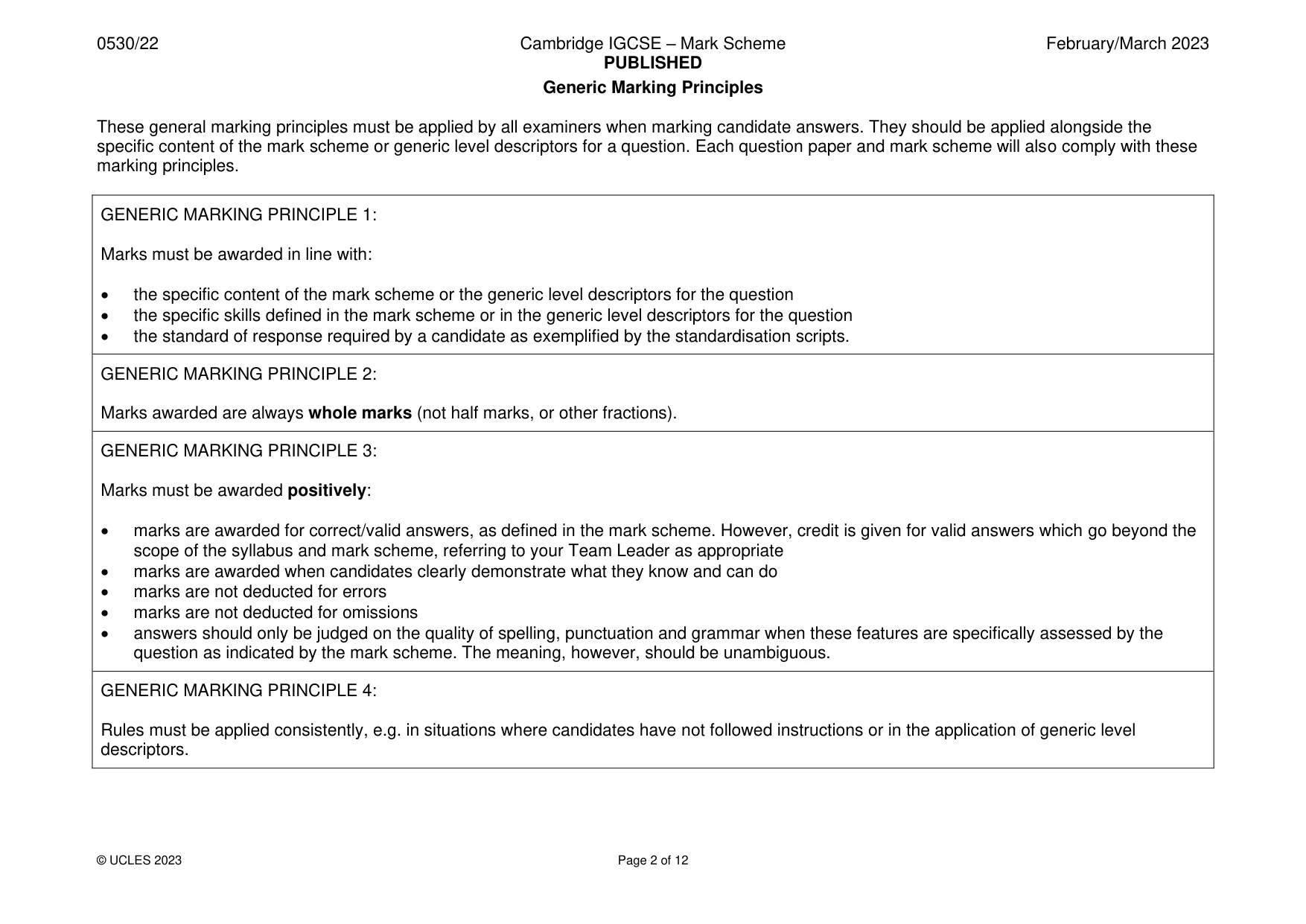
0530/22 Cambridge IGCSE – Mark Scheme PUBLISHED February/March 2023 © UCLES 2023 Page 2 of 12 Generic Marking Principles These general marking principles must be applied by all examiners when marking candidate answers. They should be applied alongside the specific content of the mark scheme or generic level descriptors for a question. Each question paper and mark scheme will also comply with these marking principles. GENERIC MARKING PRINCIPLE 1: Marks must be awarded in line with: • the specific content of the mark scheme or the generic level descriptors for the question • the specific skills defined in the mark scheme or in the generic level descriptors for the question • the standard of response required by a candidate as exemplified by the standardisation scripts. GENERIC MARKING PRINCIPLE 2: Marks awarded are always whole marks (not half marks, or other fractions). GENERIC MARKING PRINCIPLE 3: Marks must be awarded positively: • marks are awarded for correct/valid answers, as defined in the mark scheme. However, credit is given for valid answers which go beyond the scope of the syllabus and mark scheme, referring to your Team Leader as appropriate • marks are awarded when candidates clearly demonstrate what they know and can do • marks are not deducted for errors • marks are not deducted for omissions • answers should only be judged on the quality of spelling, punctuation and grammar when these features are specifically assessed by the question as indicated by the mark scheme. The meaning, however, should be unambiguous. GENERIC MARKING PRINCIPLE 4: Rules must be applied consistently, e.g. in situations where candidates have not followed instructions or in the application of generic level descriptors.
Mark scheme, page 3
0530/22 Cambridge IGCSE – Mark Scheme PUBLISHED February/March 2023 © UCLES 2023 Page 3 of 12 GENERIC MARKING PRINCIPLE 5: Marks should be awarded using the full range of marks defined in the mark scheme for the question (however; the use of the full mark range may be limited according to the quality of the candidate responses seen). GENERIC MARKING PRINCIPLE 6: Marks awarded are based solely on the requirements as defined in the mark scheme. Marks should not be awarded with grade thresholds or grade descriptors in mind.
Mark scheme, page 4
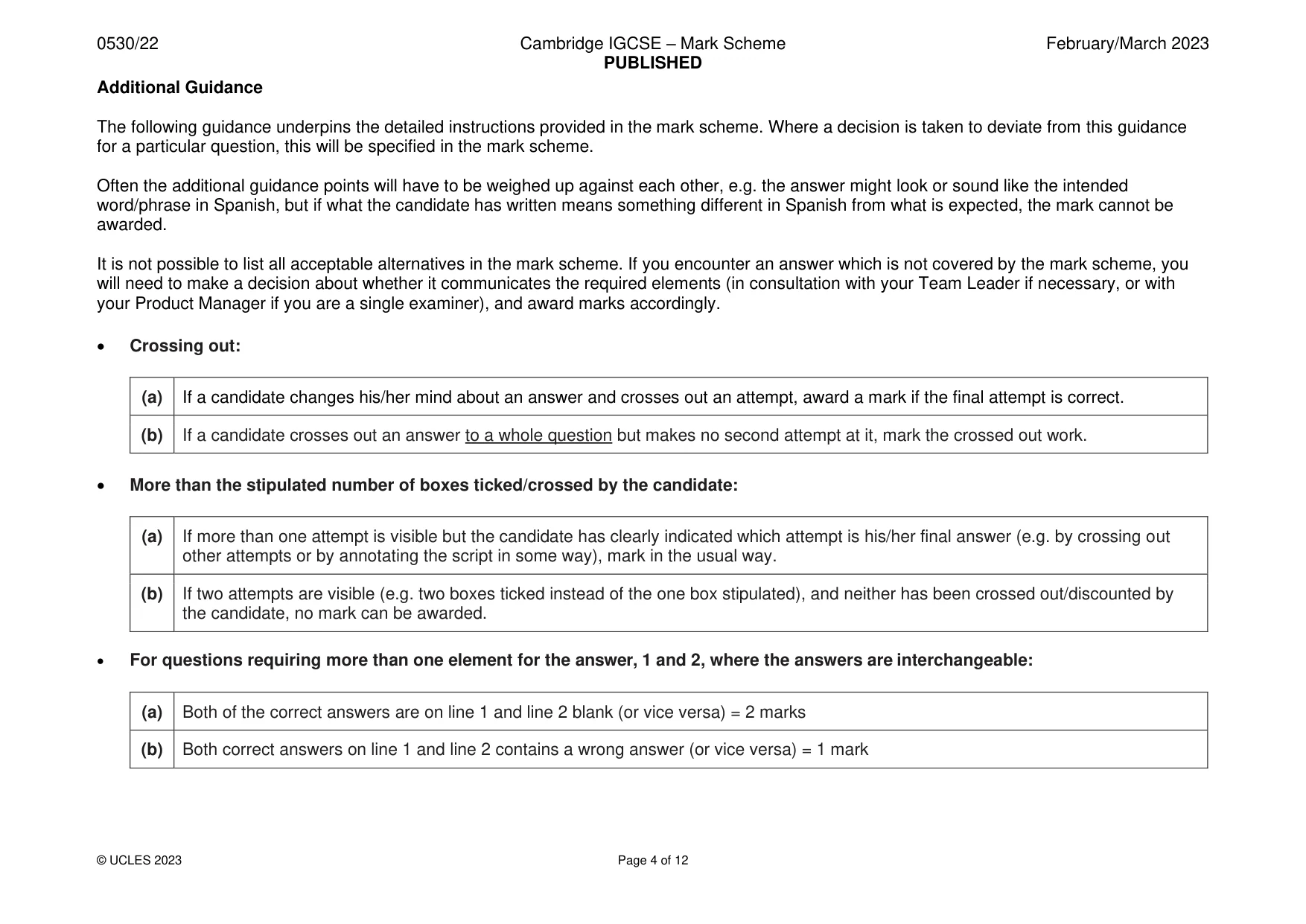
0530/22 Cambridge IGCSE – Mark Scheme PUBLISHED February/March 2023 © UCLES 2023 Page 4 of 12 Additional Guidance The following guidance underpins the detailed instructions provided in the mark scheme. Where a decision is taken to deviate from this guidance for a particular question, this will be specified in the mark scheme. Often the additional guidance points will have to be weighed up against each other, e.g. the answer might look or sound like the intended word/phrase in Spanish, but if what the candidate has written means something different in Spanish from what is expected, the mark cannot be awarded. It is not possible to list all acceptable alternatives in the mark scheme. If you encounter an answer which is not covered by the mark scheme, you will need to make a decision about whether it communicates the required elements (in consultation with your Team Leader if necessary, or with your Product Manager if you are a single examiner), and award marks accordingly. • Crossing out: (a) If a candidate changes his/her mind about an answer and crosses out an attempt, award a mark if the final attempt is correct. (b) If a candidate crosses out an answer to a whole question but makes no second attempt at it, mark the crossed out work. • More than the stipulated number of boxes ticked/crossed by the candidate: (a) If more than one attempt is visible but the candidate has clearly indicated which attempt is his/her final answer (e.g. by crossing out other attempts or by annotating the script in some way), mark in the usual way. (b) If two attempts are visible (e.g. two boxes ticked instead of the one box stipulated), and neither has been crossed out/discounted by the candidate, no mark can be awarded. • For questions requiring more than one element for the answer, 1 and 2, where the answers are interchangeable: (a) Both of the correct answers are on line 1 and line 2 blank (or vice versa) = 2 marks (b) Both correct answers on line 1 and line 2 contains a wrong answer (or vice versa) = 1 mark
Mark scheme, page 5
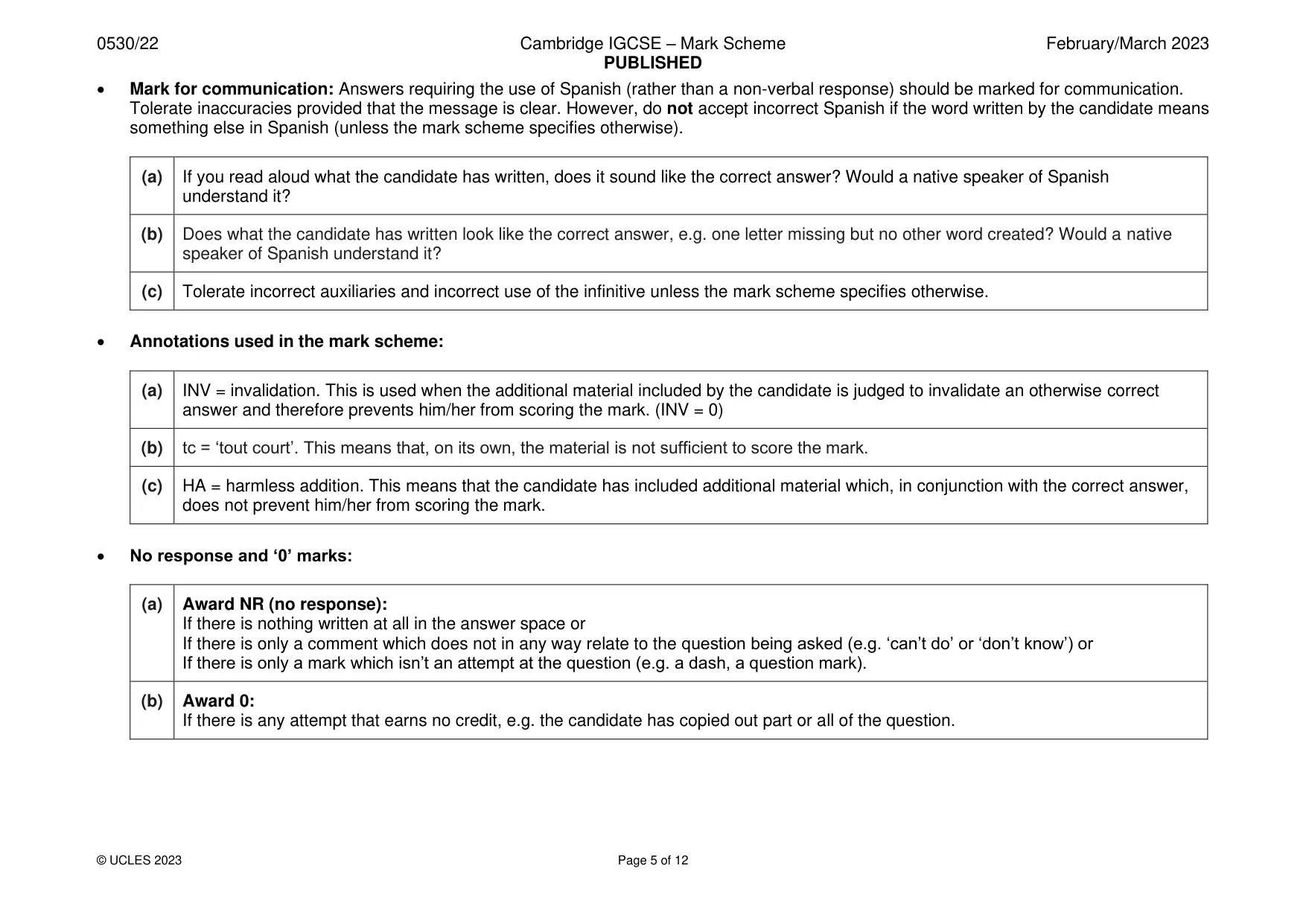
0530/22 Cambridge IGCSE – Mark Scheme PUBLISHED February/March 2023 © UCLES 2023 Page 5 of 12 • Mark for communication: Answers requiring the use of Spanish (rather than a non-verbal response) should be marked for communication. Tolerate inaccuracies provided that the message is clear. However, do not accept incorrect Spanish if the word written by the candidate means something else in Spanish (unless the mark scheme specifies otherwise). (a) If you read aloud what the candidate has written, does it sound like the correct answer? Would a native speaker of Spanish understand it? (b) Does what the candidate has written look like the correct answer, e.g. one letter missing but no other word created? Would a native speaker of Spanish understand it? (c) Tolerate incorrect auxiliaries and incorrect use of the infinitive unless the mark scheme specifies otherwise. • Annotations used in the mark scheme: (a) INV = invalidation. This is used when the additional material included by the candidate is judged to invalidate an otherwise correct answer and therefore prevents him/her from scoring the mark. (INV = 0) (b) tc = ‘tout court’. This means that, on its own, the material is not sufficient to score the mark. (c) HA = harmless addition. This means that the candidate has included additional material which, in conjunction with the correct answer, does not prevent him/her from scoring the mark. • No response and ‘0’ marks: (a) Award NR (no response): If there is nothing written at all in the answer space or If there is only a comment which does not in any way relate to the question being asked (e.g. ‘can’t do’ or ‘don’t know’) or If there is only a mark which isn’t an attempt at the question (e.g. a dash, a question mark). (b) Award 0: If there is any attempt that earns no credit, e.g. the candidate has copied out part or all of the question.
Mark scheme, page 6
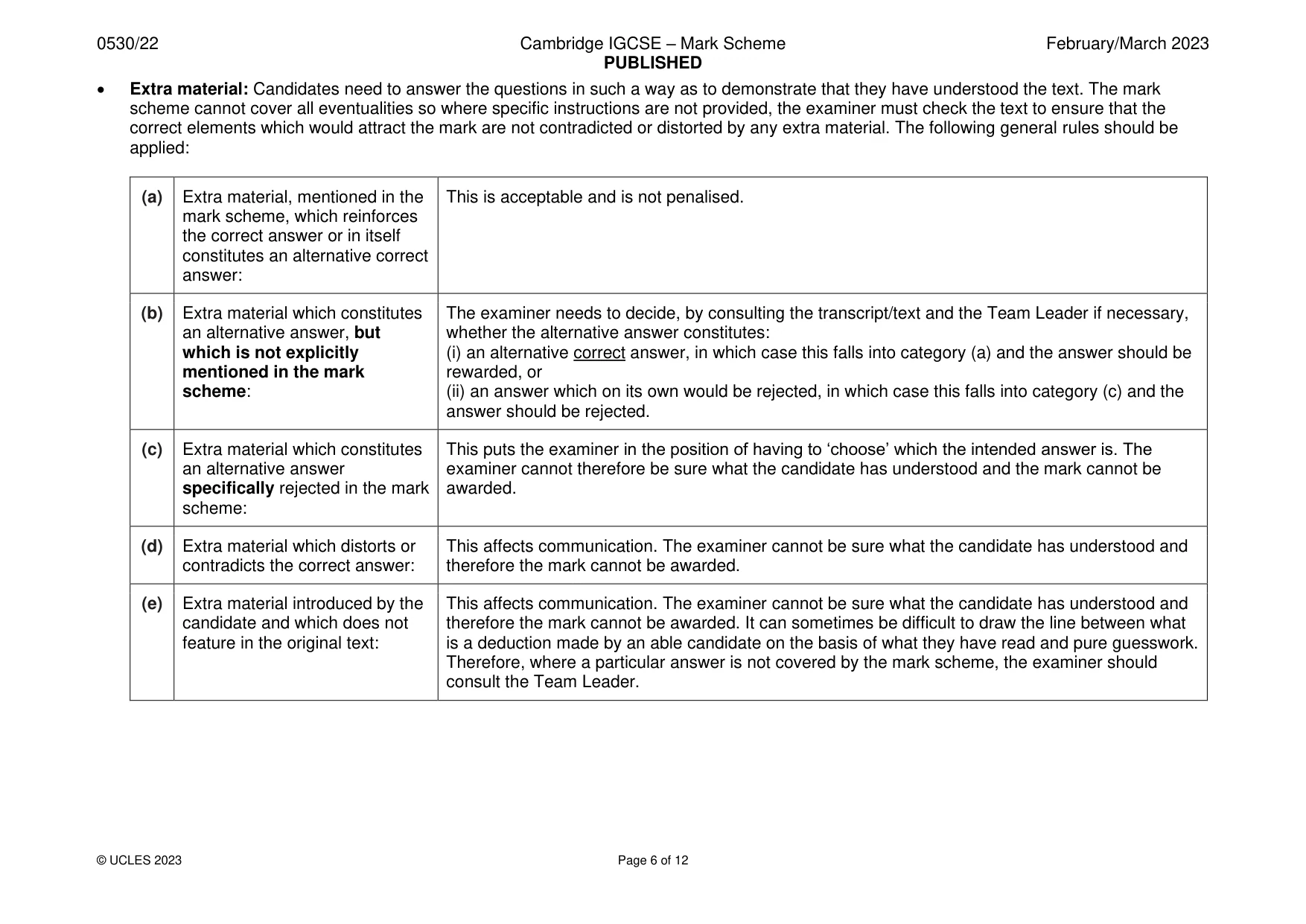
0530/22 Cambridge IGCSE – Mark Scheme PUBLISHED February/March 2023 © UCLES 2023 Page 6 of 12 • Extra material: Candidates need to answer the questions in such a way as to demonstrate that they have understood the text. The mark scheme cannot cover all eventualities so where specific instructions are not provided, the examiner must check the text to ensure that the correct elements which would attract the mark are not contradicted or distorted by any extra material. The following general rules should be applied: (a) Extra material, mentioned in the mark scheme, which reinforces the correct answer or in itself constitutes an alternative correct answer: This is acceptable and is not penalised. (b) Extra material which constitutes an alternative answer, but which is not explicitly mentioned in the mark scheme: The examiner needs to decide, by consulting the transcript/text and the Team Leader if necessary, whether the alternative answer constitutes: (i) an alternative correct answer, in which case this falls into category (a) and the answer should be rewarded, or (ii) an answer which on its own would be rejected, in which case this falls into category (c) and the answer should be rejected. (c) Extra material which constitutes an alternative answer specifically rejected in the mark scheme: This puts the examiner in the position of having to ‘choose’ which the intended answer is. The examiner cannot therefore be sure what the candidate has understood and the mark cannot be awarded. (d) Extra material which distorts or contradicts the correct answer: This affects communication. The examiner cannot be sure what the candidate has understood and therefore the mark cannot be awarded. (e) Extra material introduced by the candidate and which does not feature in the original text: This affects communication. The examiner cannot be sure what the candidate has understood and therefore the mark cannot be awarded. It can sometimes be difficult to draw the line between what is a deduction made by an able candidate on the basis of what they have read and pure guesswork. Therefore, where a particular answer is not covered by the mark scheme, the examiner should consult the Team Leader.
Mark scheme, page 7
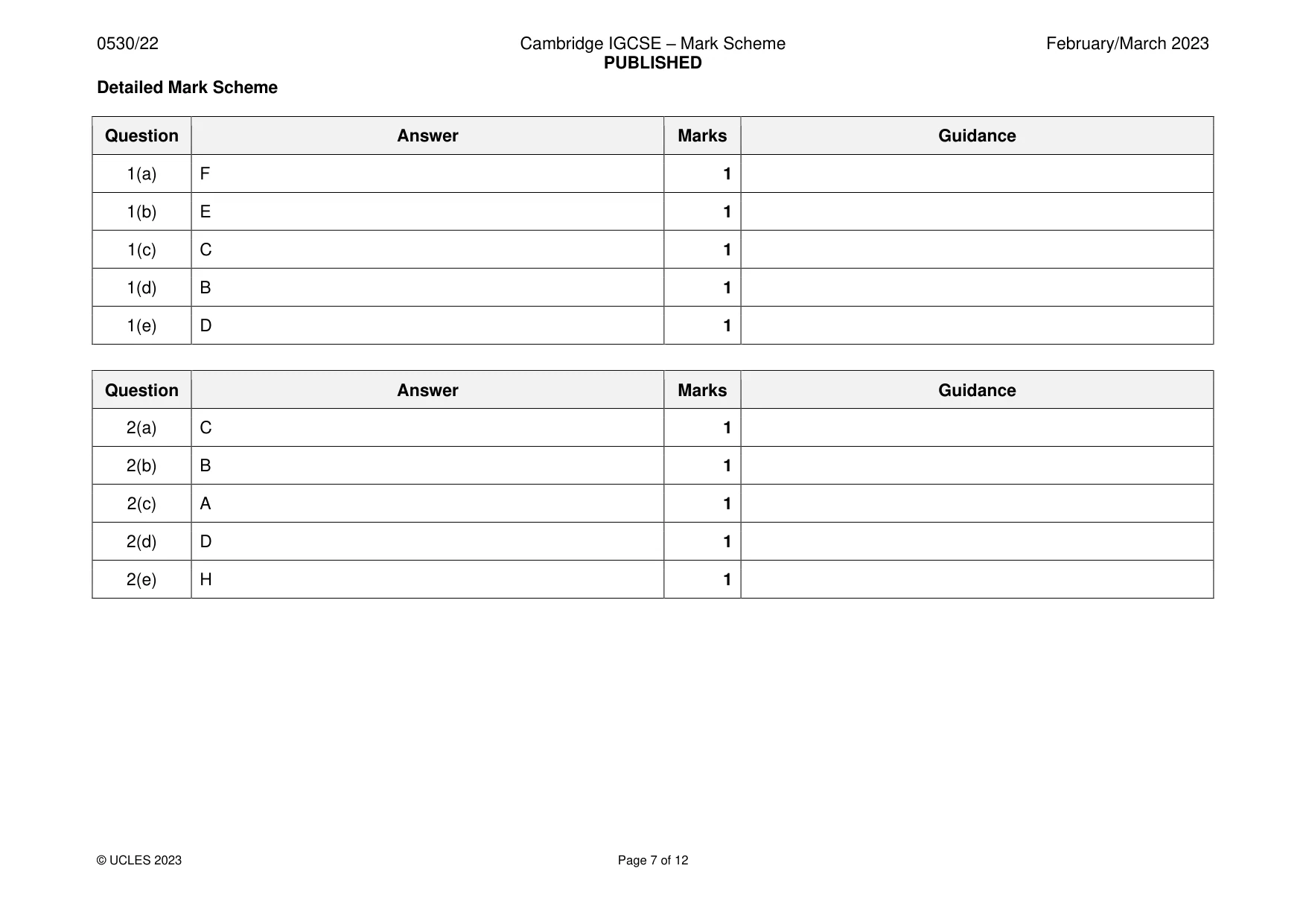
0530/22 Cambridge IGCSE – Mark Scheme PUBLISHED February/March 2023 © UCLES 2023 Page 7 of 12 Detailed Mark Scheme Question Answer Marks Guidance 1(a) F 1 1(b) E 1 1(c) C 1 1(d) B 1 1(e) D 1 Question Answer Marks Guidance 2(a) C 1 2(b) B 1 2(c) A 1 2(d) D 1 2(e) H 1
Mark scheme, page 8
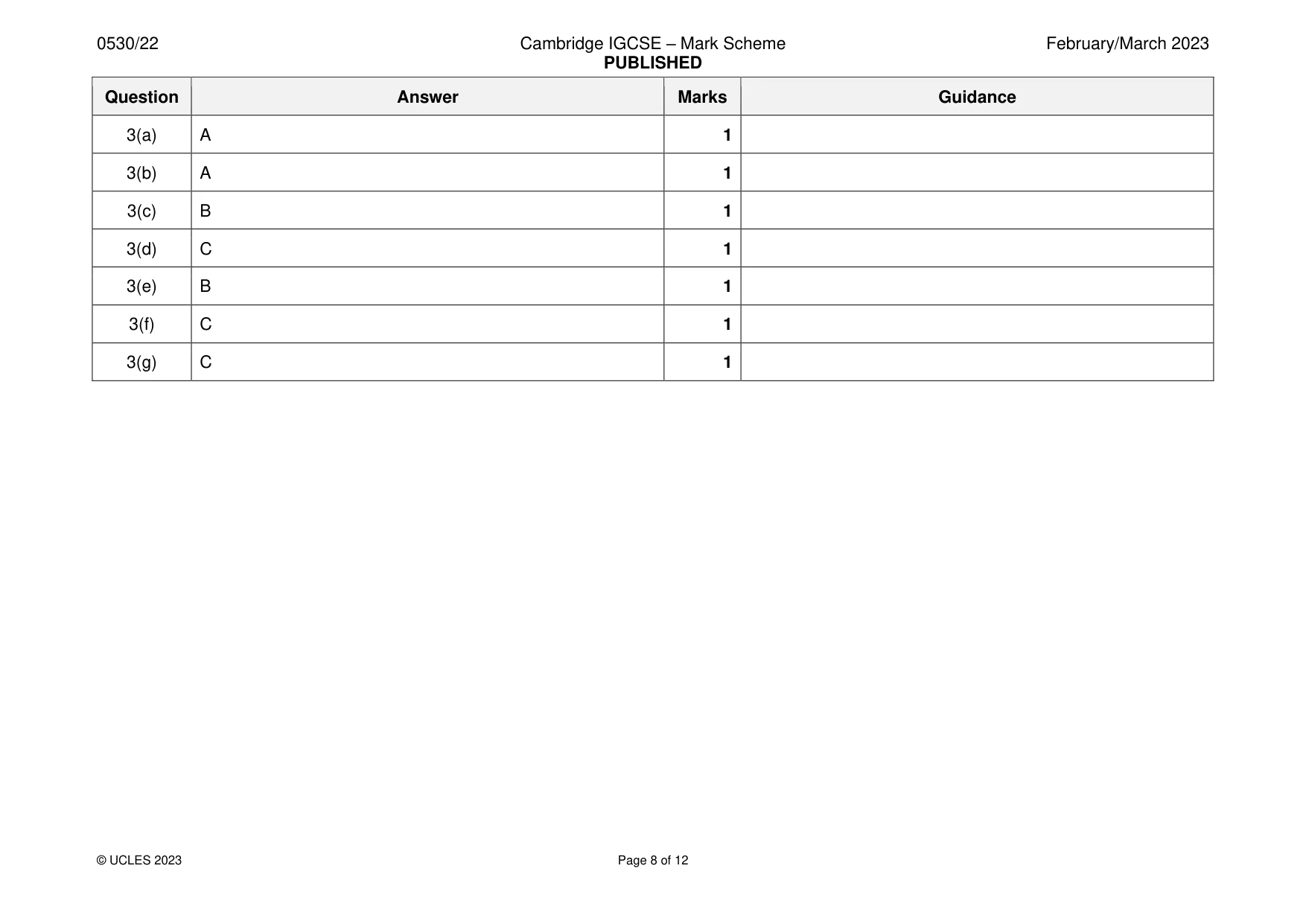
0530/22 Cambridge IGCSE – Mark Scheme PUBLISHED February/March 2023 © UCLES 2023 Page 8 of 12 Question Answer Marks Guidance 3(a) A 1 3(b) A 1 3(c) B 1 3(d) C 1 3(e) B 1 3(f) C 1 3(g) C 1
Mark scheme, page 9
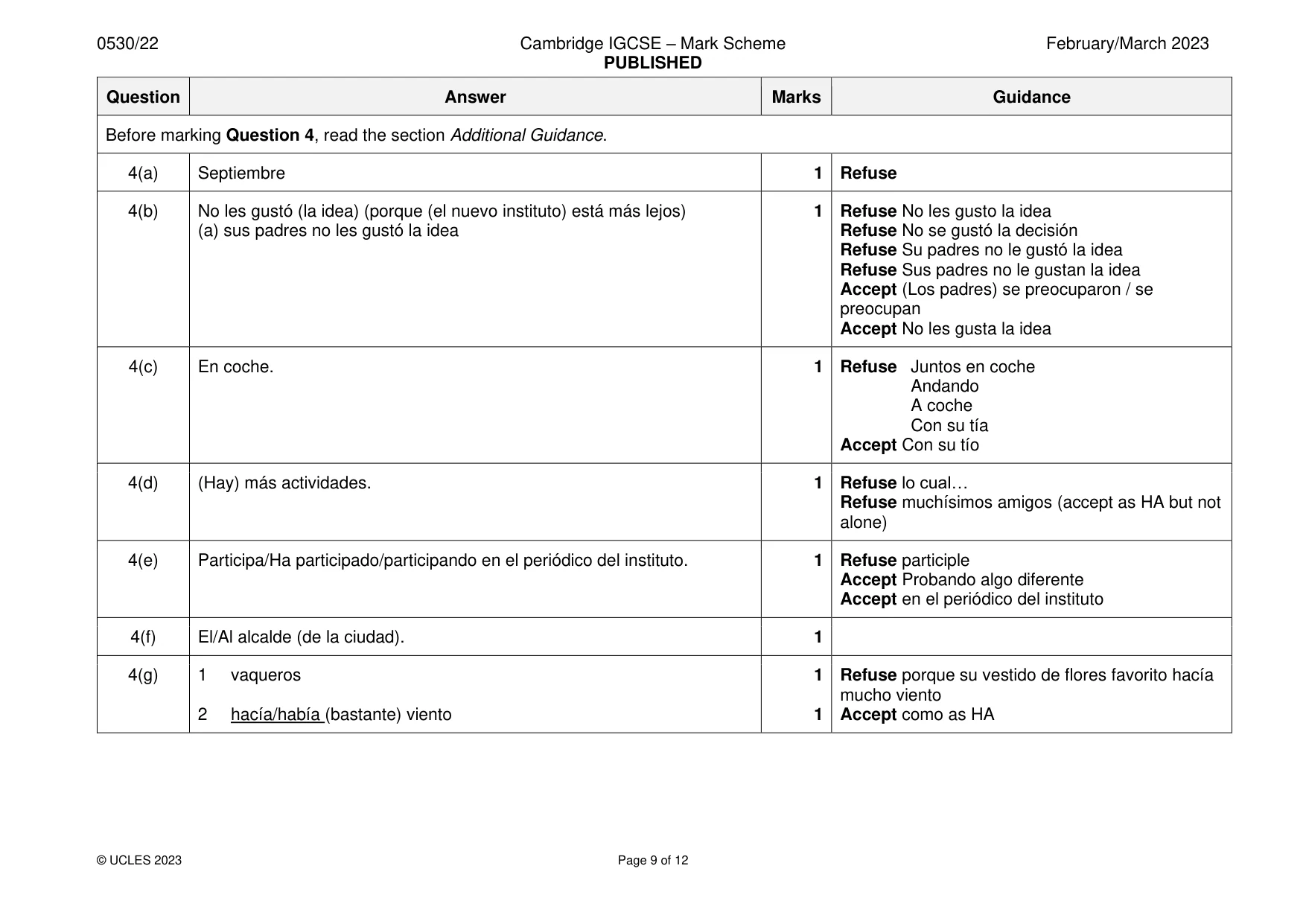
0530/22 Cambridge IGCSE – Mark Scheme PUBLISHED February/March 2023 © UCLES 2023 Page 9 of 12 Question Answer Marks Guidance Before marking Question 4, read the section Additional Guidance. 4(a) Septiembre 1 Refuse 4(b) No les gustó (la idea) (porque (el nuevo instituto) está más lejos) (a) sus padres no les gustó la idea 1 Refuse No les gusto la idea Refuse No se gustó la decisión Refuse Su padres no le gustó la idea Refuse Sus padres no le gustan la idea Accept (Los padres) se preocuparon / se preocupan Accept No les gusta la idea 4(c) En coche. 1 Refuse Juntos en coche Andando A coche Con su tía Accept Con su tío 4(d) (Hay) más actividades. 1 Refuse lo cual… Refuse muchísimos amigos (accept as HA but not alone) 4(e) Participa/Ha participado/participando en el periódico del instituto. 1 Refuse participle Accept Probando algo diferente Accept en el periódico del instituto 4(f) El/Al alcalde (de la ciudad). 1 4(g) 1 vaqueros 2 hacía/había (bastante) viento 1 1 Refuse porque su vestido de flores favorito hacía mucho viento Accept como as HA
Mark scheme, page 10
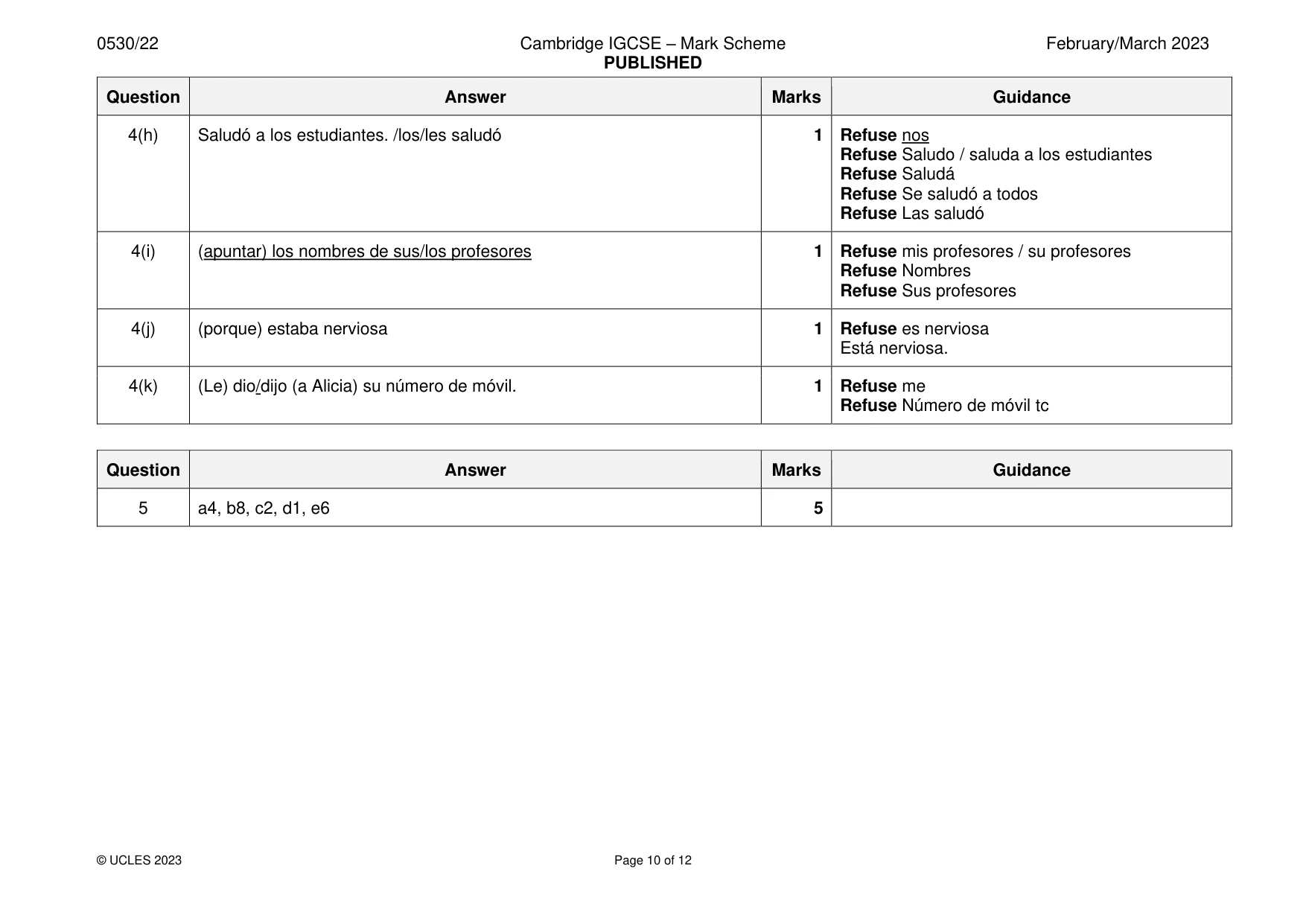
0530/22 Cambridge IGCSE – Mark Scheme PUBLISHED February/March 2023 © UCLES 2023 Page 10 of 12 Question Answer Marks Guidance 4(h) Saludó a los estudiantes. /los/les saludó 1 Refuse nos Refuse Saludo / saluda a los estudiantes Refuse Saludá Refuse Se saludó a todos Refuse Las saludó 4(i) (apuntar) los nombres de sus/los profesores 1 Refuse mis profesores / su profesores Refuse Nombres Refuse Sus profesores 4(j) (porque) estaba nerviosa 1 Refuse es nerviosa Está nerviosa. 4(k) (Le) dio/dijo (a Alicia) su número de móvil. 1 Refuse me Refuse Número de móvil tc Question Answer Marks Guidance 5 a4, b8, c2, d1, e6 5
Mark scheme, page 11
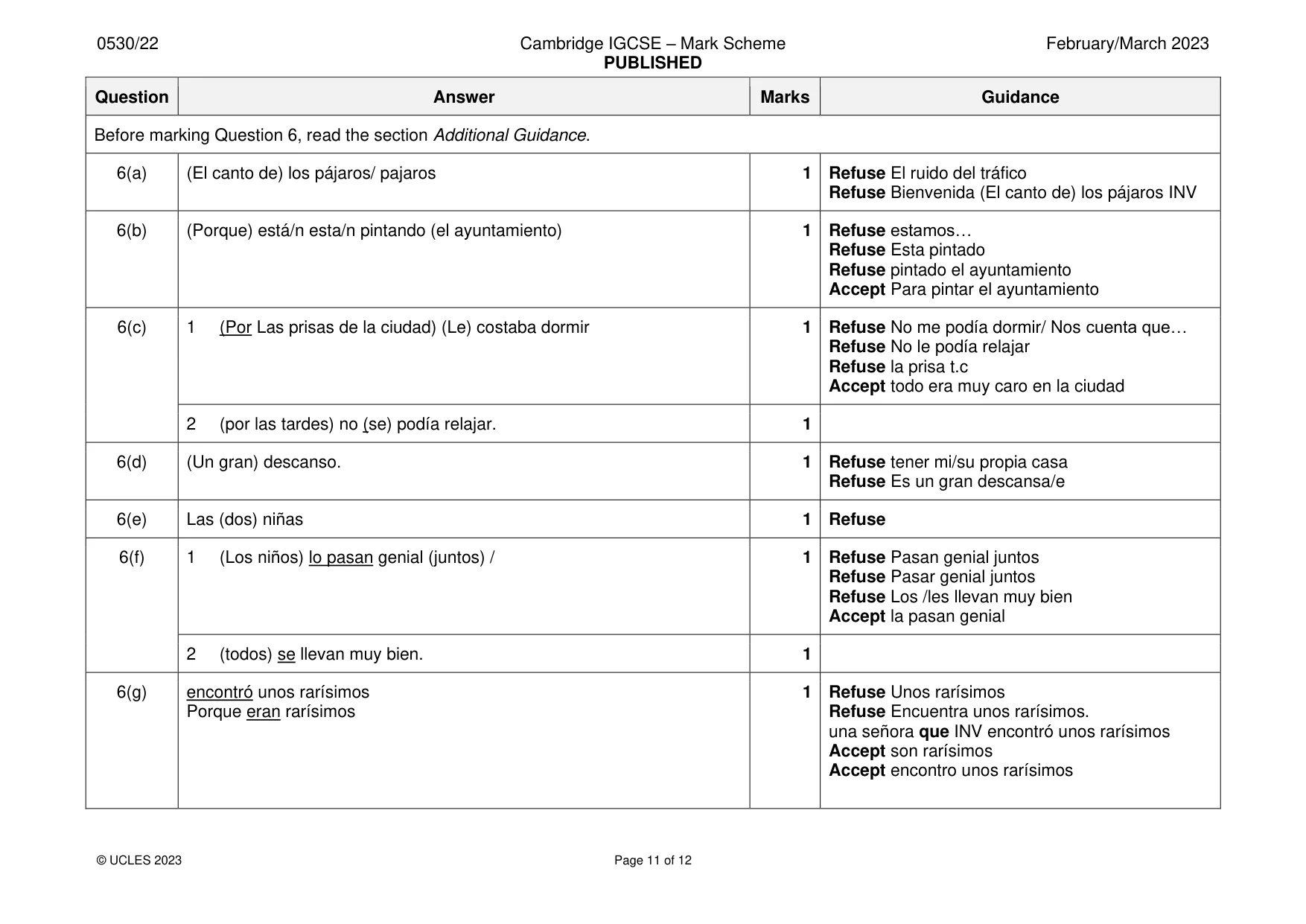
0530/22 Cambridge IGCSE – Mark Scheme PUBLISHED February/March 2023 © UCLES 2023 Page 11 of 12 Question Answer Marks Guidance Before marking Question 6, read the section Additional Guidance. 6(a) (El canto de) los pájaros/ pajaros 1 Refuse El ruido del tráfico Refuse Bienvenida (El canto de) los pájaros INV 6(b) (Porque) está/n esta/n pintando (el ayuntamiento) 1 Refuse estamos… Refuse Esta pintado Refuse pintado el ayuntamiento Accept Para pintar el ayuntamiento 6(c) 1 (Por Las prisas de la ciudad) (Le) costaba dormir 1 Refuse No me podía dormir/ Nos cuenta que… Refuse No le podía relajar Refuse la prisa t.c Accept todo era muy caro en la ciudad 2 (por las tardes) no (se) podía relajar. 1 6(d) (Un gran) descanso. 1 Refuse tener mi/su propia casa Refuse Es un gran descansa/e 6(e) Las (dos) niñas 1 Refuse 6(f) 1 (Los niños) lo pasan genial (juntos) / 1 Refuse Pasan genial juntos Refuse Pasar genial juntos Refuse Los /les llevan muy bien Accept la pasan genial 2 (todos) se llevan muy bien. 1 6(g) encontró unos rarísimos Porque eran rarísimos 1 Refuse Unos rarísimos Refuse Encuentra unos rarísimos. una señora que INV encontró unos rarísimos Accept son rarísimos Accept encontro unos rarísimos
Mark scheme, page 12
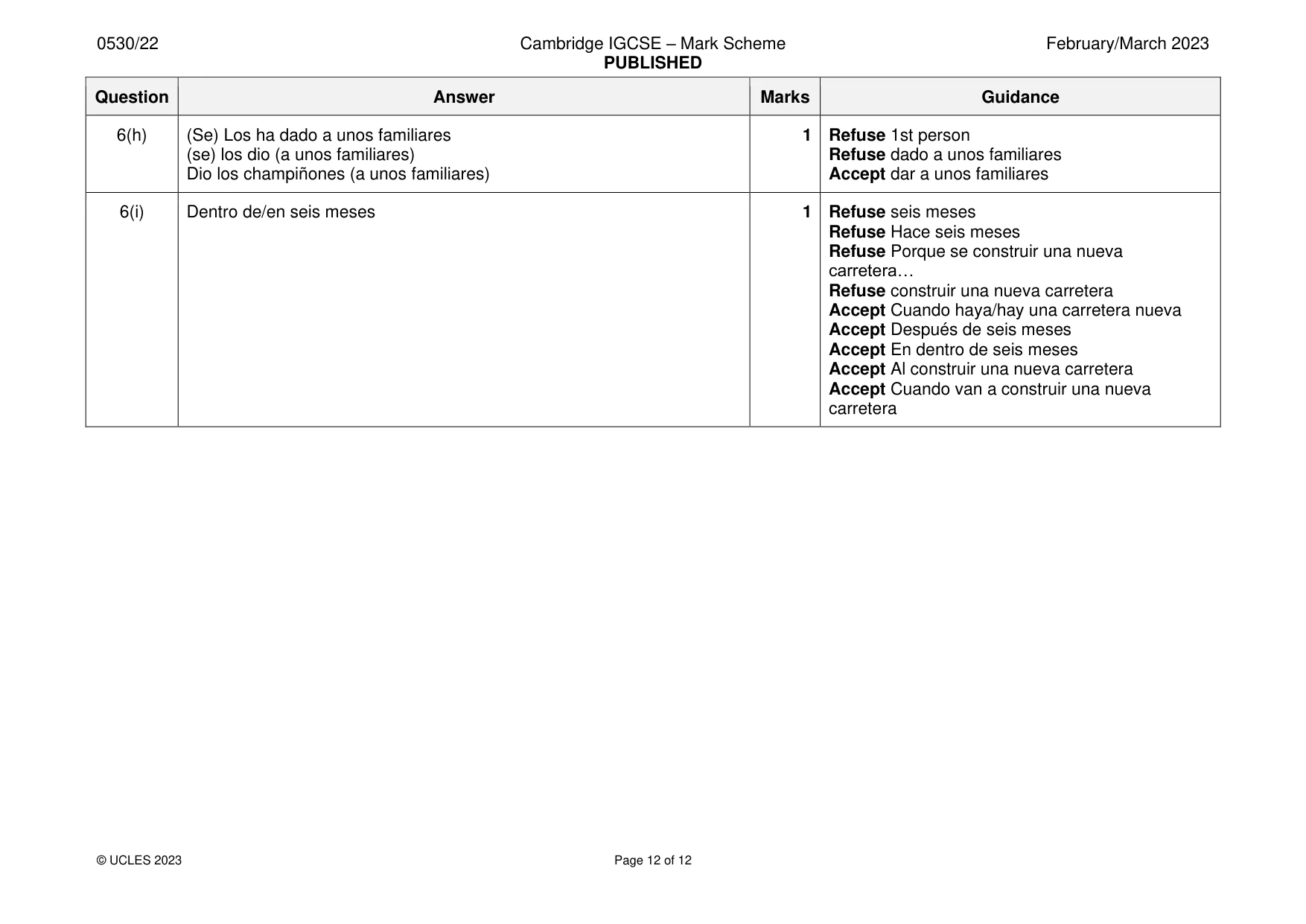
0530/22 Cambridge IGCSE – Mark Scheme PUBLISHED February/March 2023 © UCLES 2023 Page 12 of 12 Question Answer Marks Guidance 6(h) (Se) Los ha dado a unos familiares (se) los dio (a unos familiares) Dio los champiñones (a unos familiares) 1 Refuse 1st person Refuse dado a unos familiares Accept dar a unos familiares 6(i) Dentro de/en seis meses 1 Refuse seis meses Refuse Hace seis meses Refuse Porque se construir una nueva carretera… Refuse construir una nueva carretera Accept Cuando haya/hay una carretera nueva Accept Después de seis meses Accept En dentro de seis meses Accept Al construir una nueva carretera Accept Cuando van a construir una nueva carretera