Cambridge IGCSE Spanish - Foreign Language 0530 — 2023 Oct/Nov Paper 2 · Variant 2
0530/22/O/N/23 · 45 marks · ≈51 min
The question paper and its mark scheme, free to read here and free to download. This is Cambridge’s own paper, exactly as it was sat.
Question paper12 pages

Mark scheme11 pages
Answers below. Sit the paper first if you are practising.
Paper as text
Question paper, page 1
This document has 12 pages. Any blank pages are indicated. [Turn over Cambridge IGCSE™ SPANISH 0530/22 Paper 2 Reading October/November 2023 1 hour You must answer on the question paper. No additional materials are needed. INSTRUCTIONS ● Answer all questions. ● Use a black or dark blue pen. ● Write your name, centre number and candidate number in the boxes at the top of the page. ● Write your answer to each question in the space provided. ● Do not use an erasable pen or correction fluid. ● Do not write on any bar codes. ● Dictionaries are not allowed. INFORMATION ● The total mark for this paper is 45. ● The number of marks for each question or part question is shown in brackets [ ]. * 0 2 5 8 0 4 7 6 5 7 * DC (LK/FC) 316098/2 © UCLES 2023
Question paper, page 2
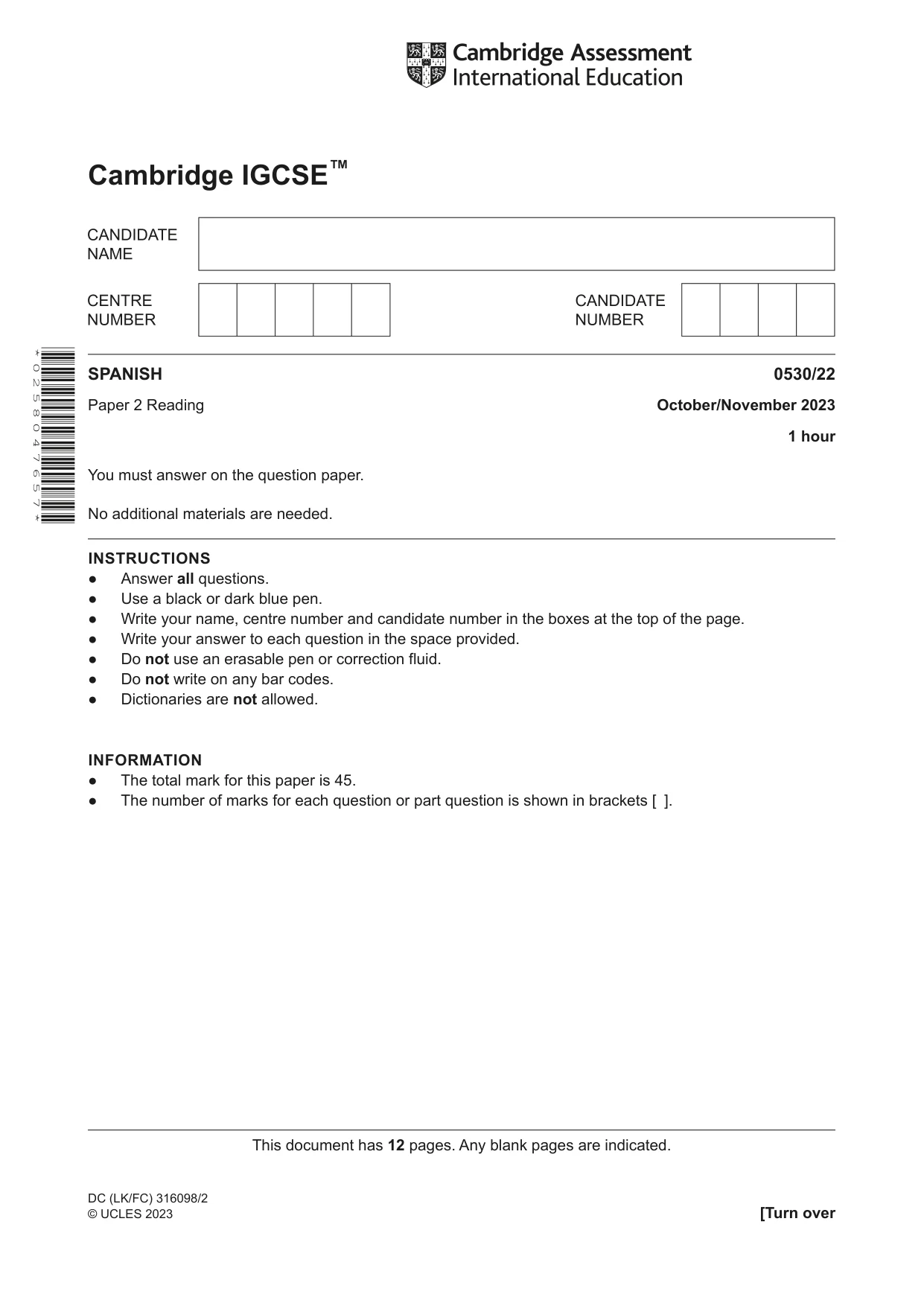
2 0530/22/O/N/23 © UCLES 2023 1 Mira los dibujos. A B C D E F Para cada pregunta escribe la letra correcta (A–F) en la casilla. (a) Necesito una goma para borrar un error. [1] (b) Me encanta este estuche para lápices. [1] (c) Las sillas de clase son un poco incómodas. [1] (d) Utilizo una calculadora para matemáticas. [1] (e) Llevo zapatillas de deporte para gimnasia. [1] [Total: 5]
Question paper, page 3
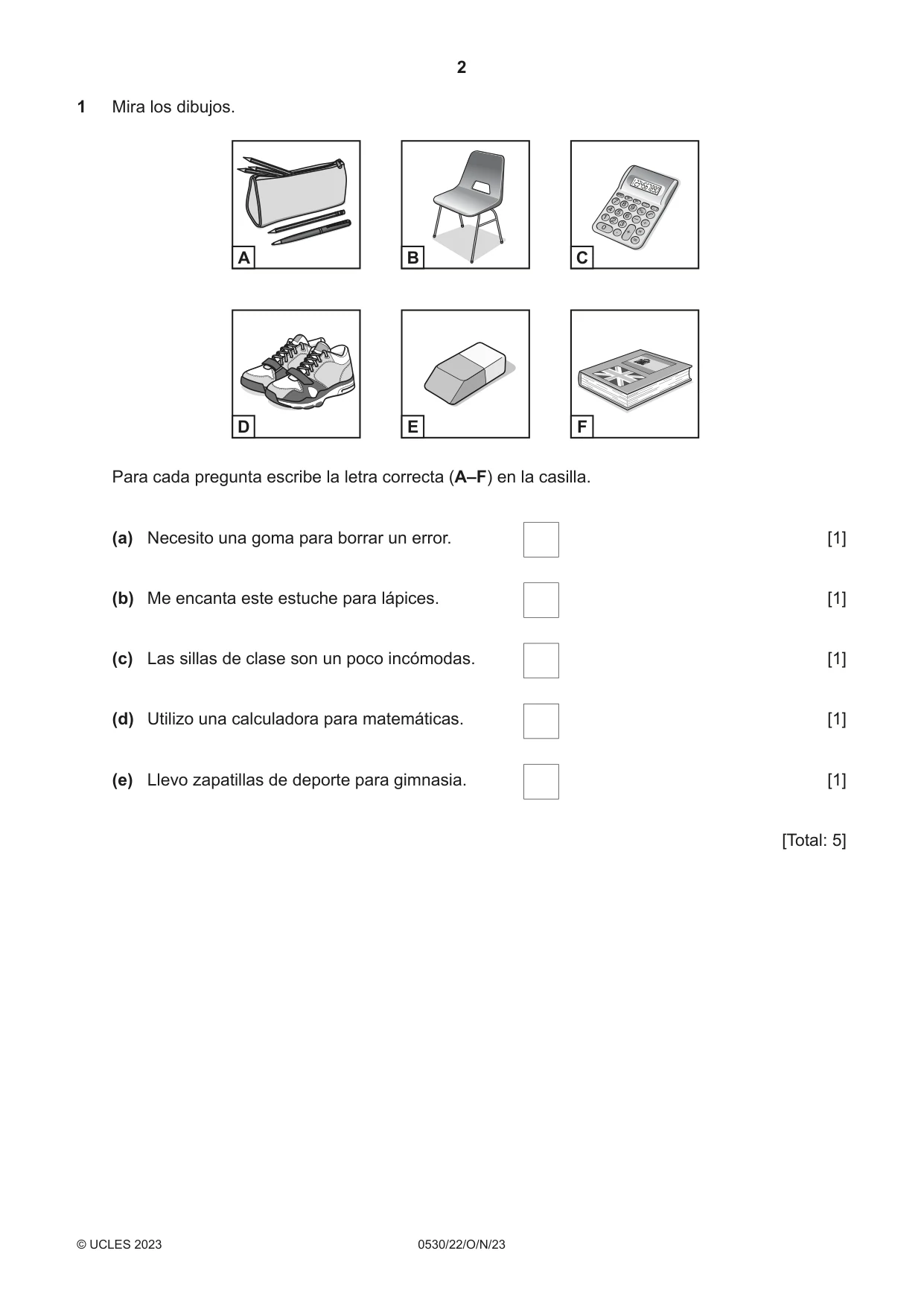
3 0530/22/O/N/23 © UCLES 2023 [Turn over 2 Lee los letreros. En el parque Alquiler de barcas Concierto: 17.00 horas Helados: fresa y piña Los jueves: yoga Clases de equitación Pájaros exóticos Pista de tenis Prohibido bicicleta o patines A B C D E F G H Para cada pregunta escribe la letra correcta (A–H) en la casilla. (a) Aquí aprendo a montar a caballo. [1] (b) Esta noche toca un grupo muy bueno. [1] (c) ¿Quieres navegar en el lago? [1] (d) Mi hermano quiere tomar algo dulce. [1] (e) Hoy voy a jugar con mi raqueta nueva. [1] [Total: 5]
Question paper, page 4
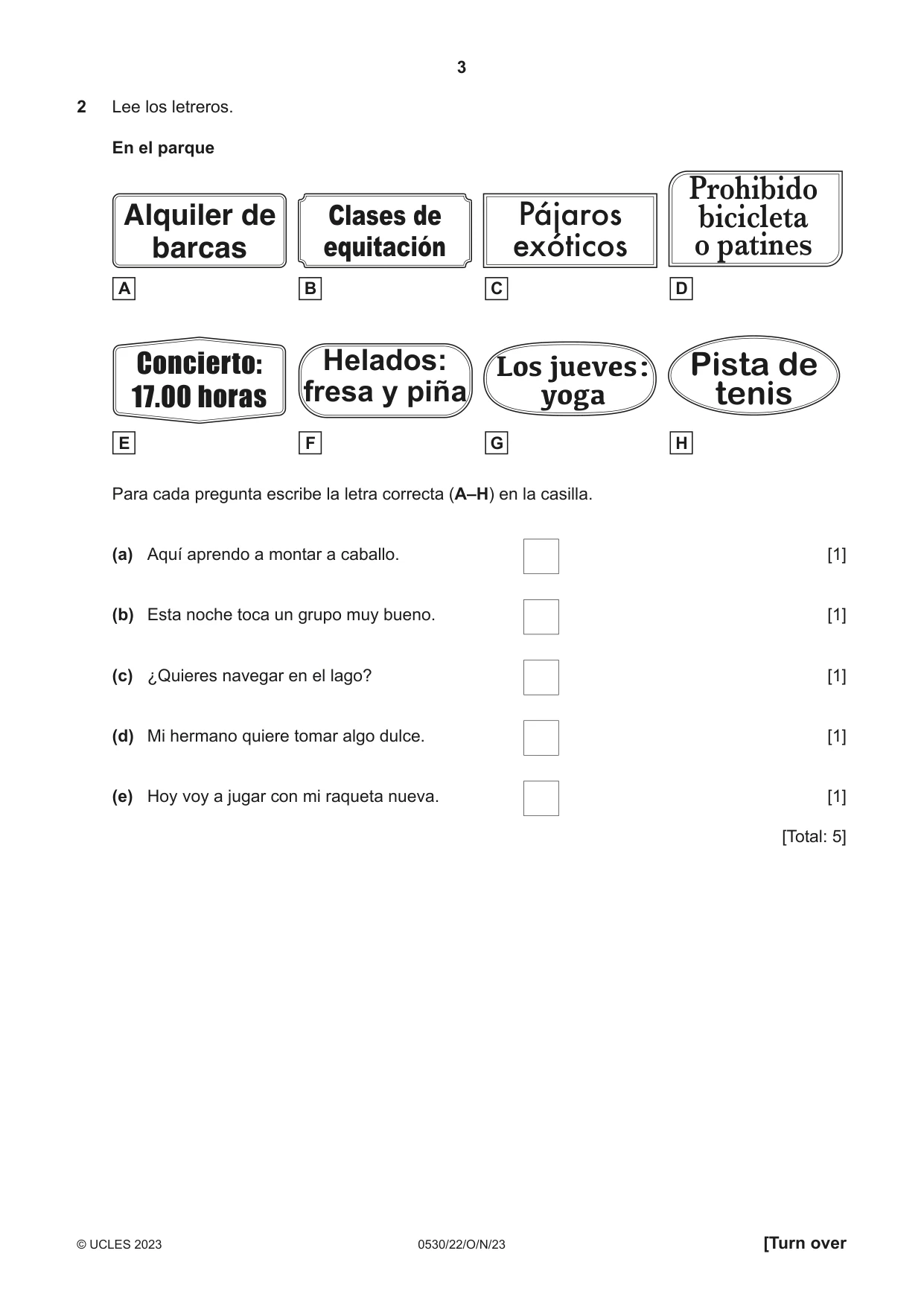
4 0530/22/O/N/23 © UCLES 2023 3 Lee el texto. Para cada pregunta indica tu respuesta escribiendo una X en la casilla correcta (A–C). ¡Hola! Ayer mis compañeros de clase y yo fuimos al museo de historia y pasamos el día allí. Normalmente, no me gusta visitar museos, pero la verdad es que ayer fue un día divertido y aprendí mucho. El edificio del museo solo tiene un año, aunque dentro todos los objetos son muy antiguos. Había muchos utensilios de cocina, platos y cientos de copas. Mi objeto preferido fue un vaso con dibujos de peces de colores. En la tienda del museo las camisetas eran demasiado caras, así que me compré unos pendientes. Cuando salimos del museo, fuimos a tomar unos pasteles. Hoy mi día será tranquilo porque no tengo que ir al instituto. No voy a salir porque quiero terminar de leer un libro. Paloma (a) Ayer, Paloma pasó el día con... A familia. B su novio. C estudiantes. [1] (b) Ayer, la visita al museo fue... A aburrida. B interesante. C corta. [1] (c) ¿Cómo es el edificio del museo? A nuevo B pequeño C alto [1]
Question paper, page 5
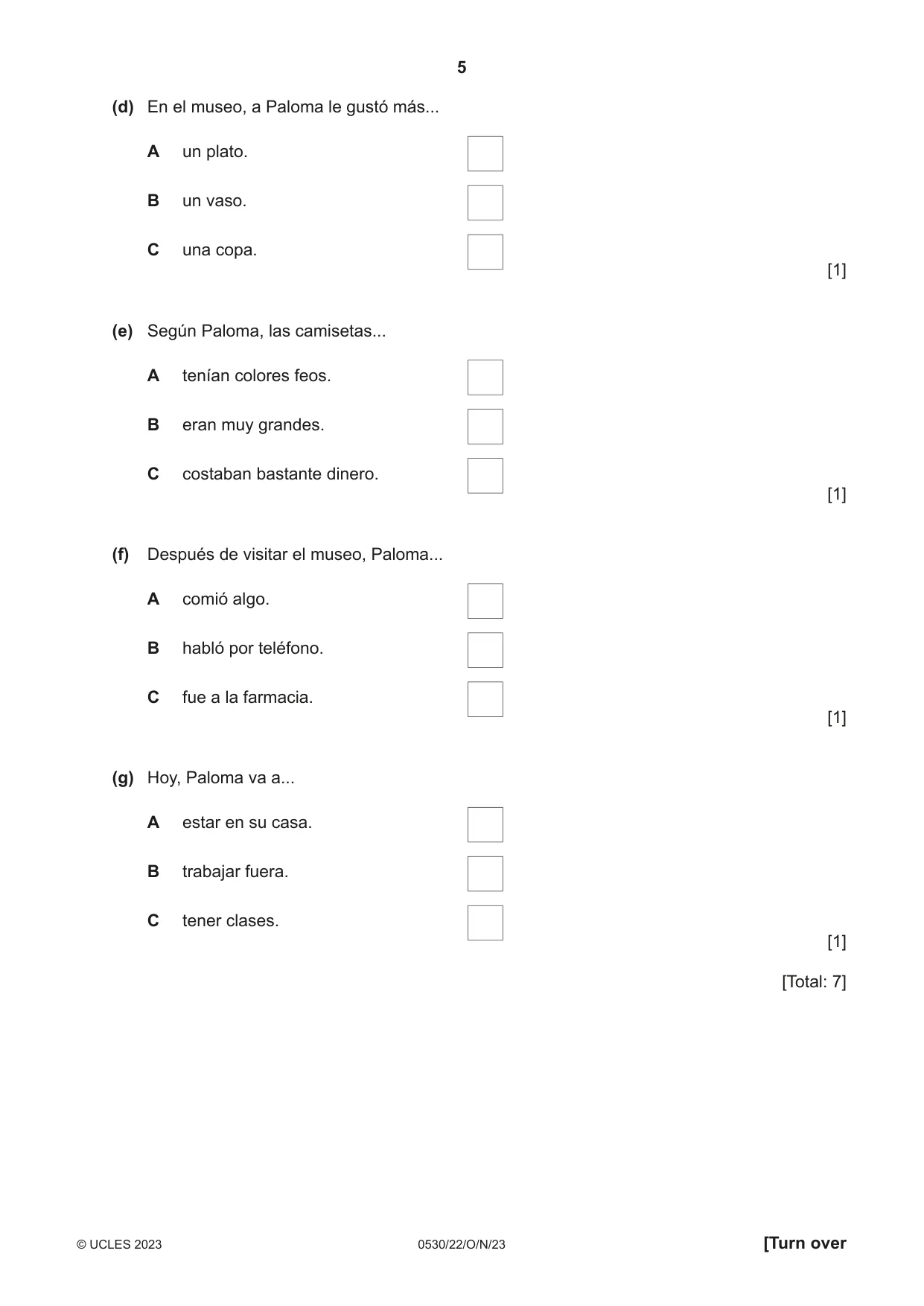
5 0530/22/O/N/23 © UCLES 2023 [Turn over (d) En el museo, a Paloma le gustó más... A un plato. B un vaso. C una copa. [1] (e) Según Paloma, las camisetas... A tenían colores feos. B eran muy grandes. C costaban bastante dinero. [1] (f) Después de visitar el museo, Paloma... A comió algo. B habló por teléfono. C fue a la farmacia. [1] (g) Hoy, Paloma va a... A estar en su casa. B trabajar fuera. C tener clases. [1] [Total: 7]
Question paper, page 6
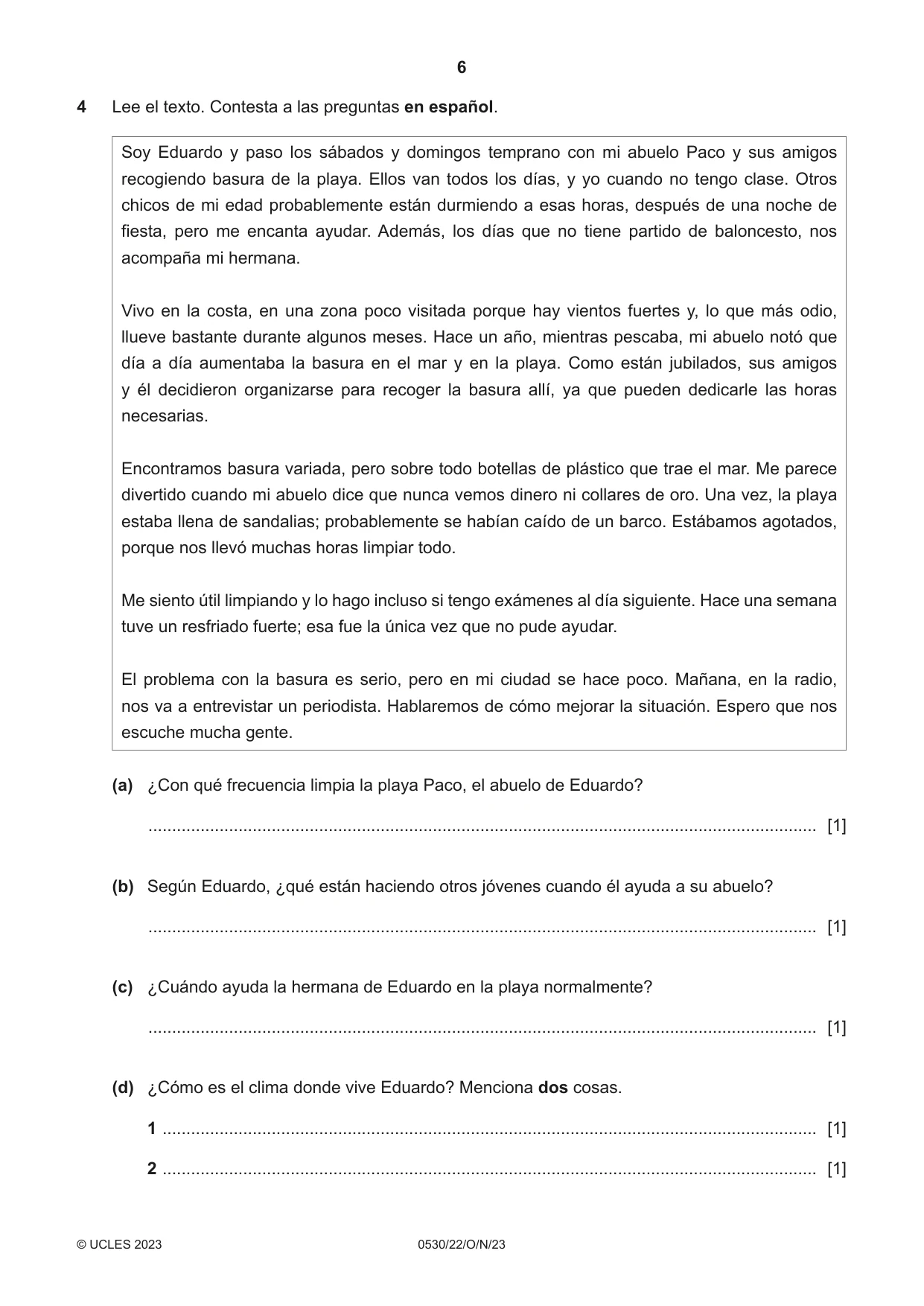
6 0530/22/O/N/23 © UCLES 2023 4 Lee el texto. Contesta a las preguntas en español. Soy Eduardo y paso los sábados y domingos temprano con mi abuelo Paco y sus amigos recogiendo basura de la playa. Ellos van todos los días, y yo cuando no tengo clase. Otros chicos de mi edad probablemente están durmiendo a esas horas, después de una noche de fiesta, pero me encanta ayudar. Además, los días que no tiene partido de baloncesto, nos acompaña mi hermana. Vivo en la costa, en una zona poco visitada porque hay vientos fuertes y, lo que más odio, llueve bastante durante algunos meses. Hace un año, mientras pescaba, mi abuelo notó que día a día aumentaba la basura en el mar y en la playa. Como están jubilados, sus amigos y él decidieron organizarse para recoger la basura allí, ya que pueden dedicarle las horas necesarias. Encontramos basura variada, pero sobre todo botellas de plástico que trae el mar. Me parece divertido cuando mi abuelo dice que nunca vemos dinero ni collares de oro. Una vez, la playa estaba llena de sandalias; probablemente se habían caído de un barco. Estábamos agotados, porque nos llevó muchas horas limpiar todo. Me siento útil limpiando y lo hago incluso si tengo exámenes al día siguiente. Hace una semana tuve un resfriado fuerte; esa fue la única vez que no pude ayudar. El problema con la basura es serio, pero en mi ciudad se hace poco. Mañana, en la radio, nos va a entrevistar un periodista. Hablaremos de cómo mejorar la situación. Espero que nos escuche mucha gente. (a) ¿Con qué frecuencia limpia la playa Paco, el abuelo de Eduardo? … [1] (b) Según Eduardo, ¿qué están haciendo otros jóvenes cuando él ayuda a su abuelo? … [1] (c) ¿Cuándo ayuda la hermana de Eduardo en la playa normalmente? … [1] (d) ¿Cómo es el clima donde vive Eduardo? Menciona dos cosas. 1 … [1] 2 … [1]
Question paper, page 7
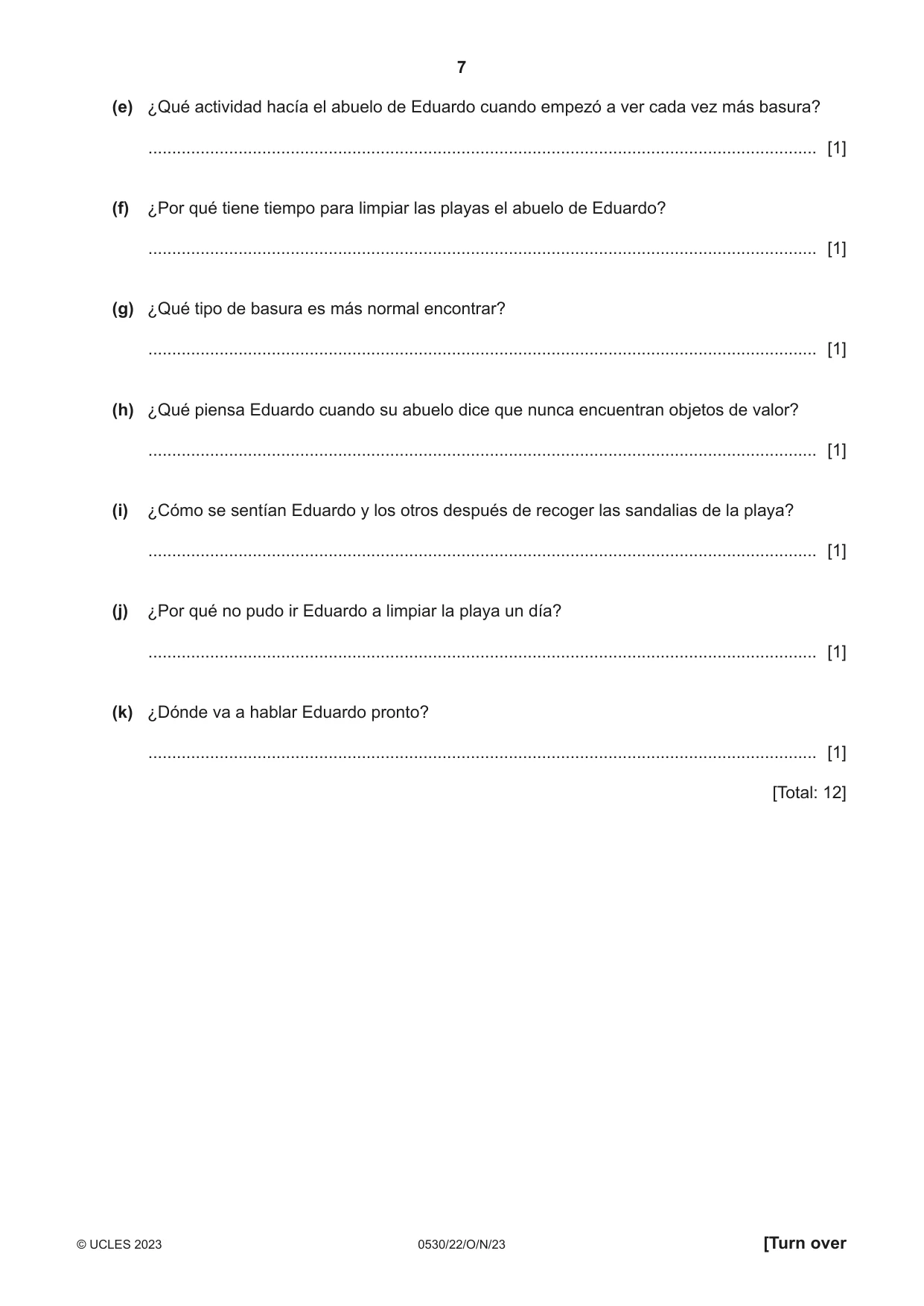
7 0530/22/O/N/23 © UCLES 2023 [Turn over (e) ¿Qué actividad hacía el abuelo de Eduardo cuando empezó a ver cada vez más basura? … [1] (f) ¿Por qué tiene tiempo para limpiar las playas el abuelo de Eduardo? … [1] (g) ¿Qué tipo de basura es más normal encontrar? … [1] (h) ¿Qué piensa Eduardo cuando su abuelo dice que nunca encuentran objetos de valor? … [1] (i) ¿Cómo se sentían Eduardo y los otros después de recoger las sandalias de la playa? … [1] (j) ¿Por qué no pudo ir Eduardo a limpiar la playa un día? … [1] (k) ¿Dónde va a hablar Eduardo pronto? … [1] [Total: 12]
Question paper, page 8
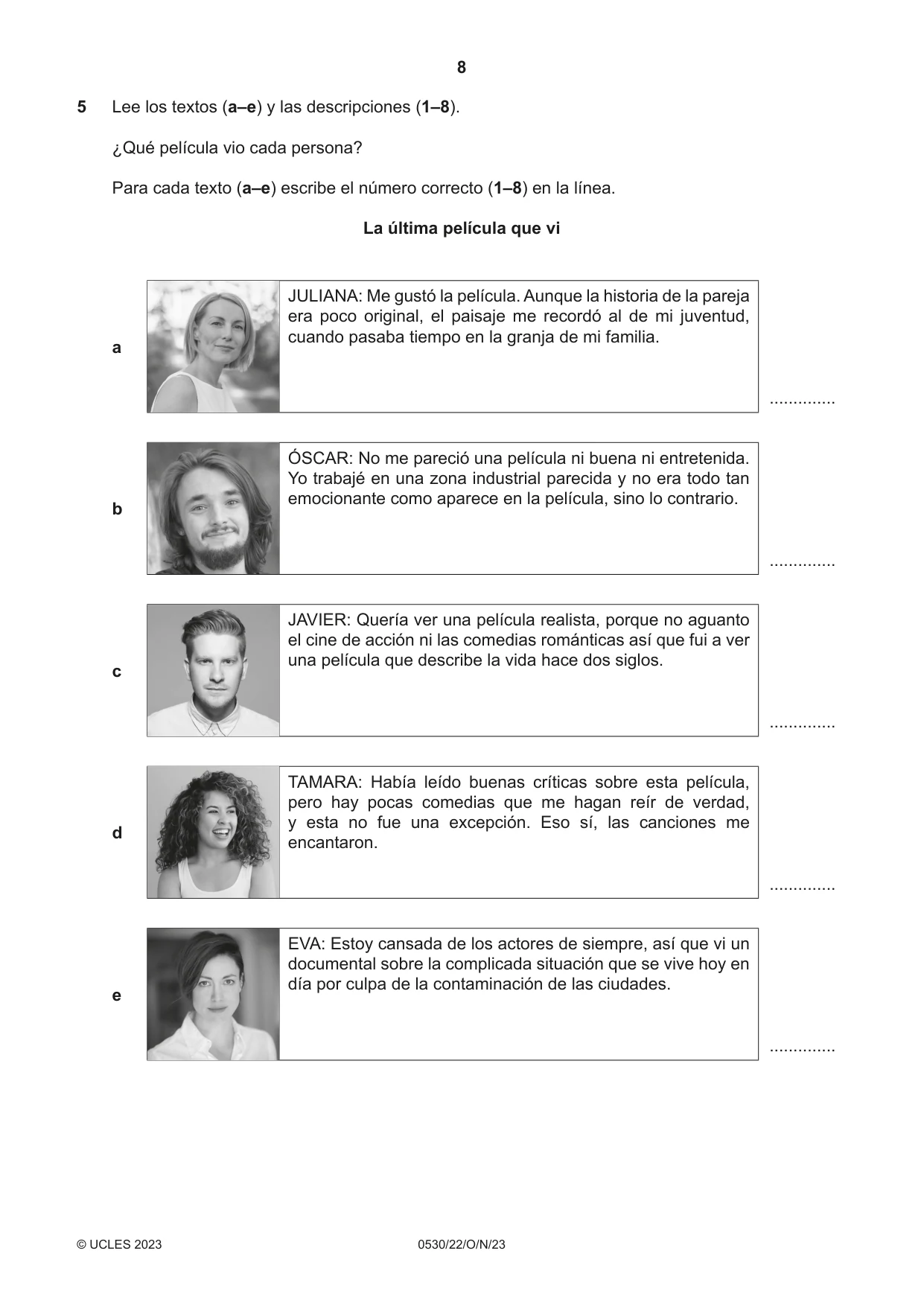
8 0530/22/O/N/23 © UCLES 2023 5 Lee los textos (a–e) y las descripciones (1–8). ¿Qué película vio cada persona? Para cada texto (a–e) escribe el número correcto (1–8) en la línea. La última película que vi a JULIANA: Me gustó la película. Aunque la historia de la pareja era poco original, el paisaje me recordó al de mi juventud, cuando pasaba tiempo en la granja de mi familia. … b ÓSCAR: No me pareció una película ni buena ni entretenida. Yo trabajé en una zona industrial parecida y no era todo tan emocionante como aparece en la película, sino lo contrario. … c JAVIER: Quería ver una película realista, porque no aguanto el cine de acción ni las comedias románticas así que fui a ver una película que describe la vida hace dos siglos. … d TAMARA: Había leído buenas críticas sobre esta película, pero hay pocas comedias que me hagan reír de verdad, y esta no fue una excepción. Eso sí, las canciones me encantaron. … e EVA: Estoy cansada de los actores de siempre, así que vi un documental sobre la complicada situación que se vive hoy en día por culpa de la contaminación de las ciudades. …
Question paper, page 9
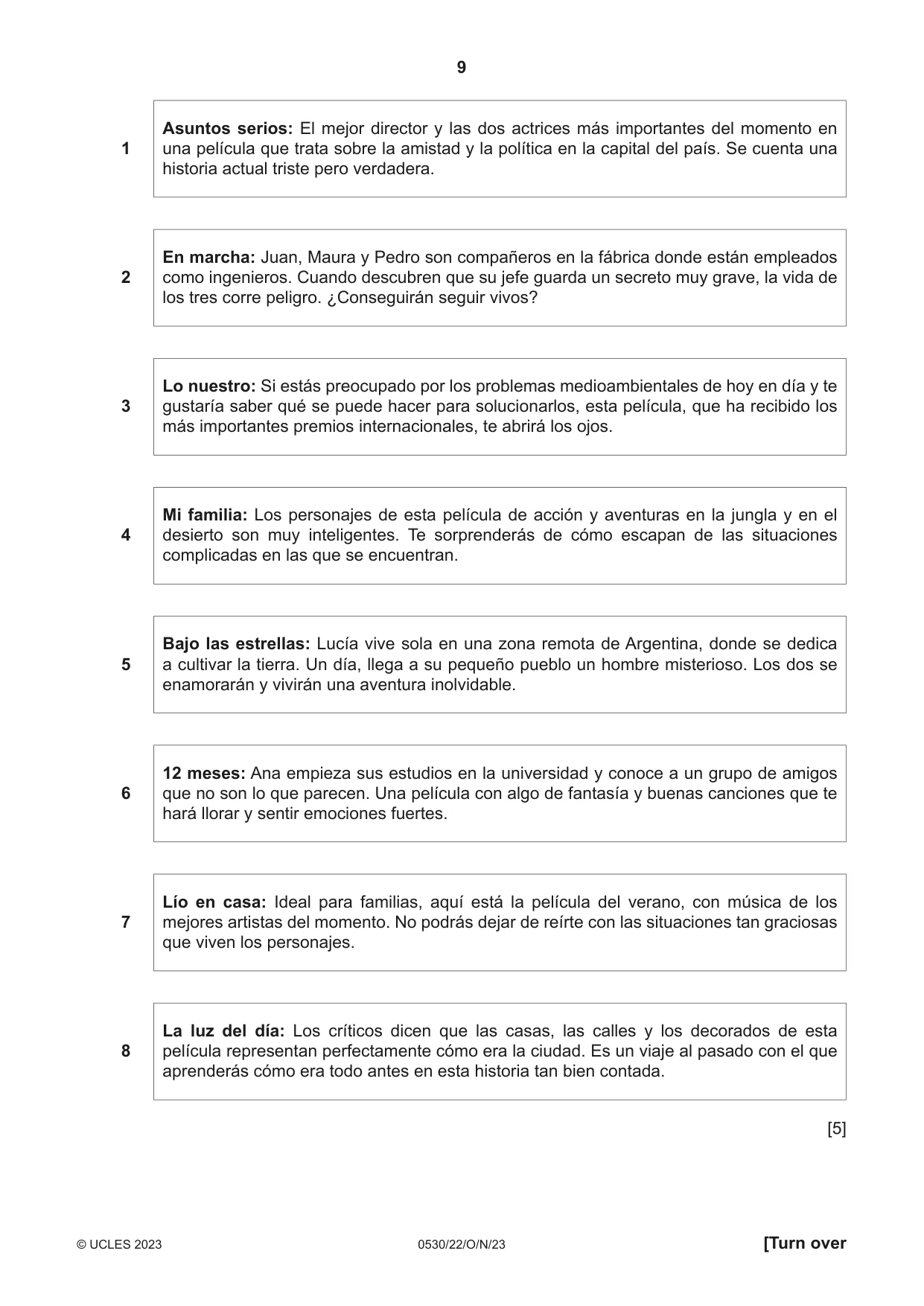
9 0530/22/O/N/23 © UCLES 2023 [Turn over 1 Asuntos serios: El mejor director y las dos actrices más importantes del momento en una película que trata sobre la amistad y la política en la capital del país. Se cuenta una historia actual triste pero verdadera. 2 En marcha: Juan, Maura y Pedro son compañeros en la fábrica donde están empleados como ingenieros. Cuando descubren que su jefe guarda un secreto muy grave, la vida de los tres corre peligro. ¿Conseguirán seguir vivos? 3 Lo nuestro: Si estás preocupado por los problemas medioambientales de hoy en día y te gustaría saber qué se puede hacer para solucionarlos, esta película, que ha recibido los más importantes premios internacionales, te abrirá los ojos. 4 Mi familia: Los personajes de esta película de acción y aventuras en la jungla y en el desierto son muy inteligentes. Te sorprenderás de cómo escapan de las situaciones complicadas en las que se encuentran. 5 Bajo las estrellas: Lucía vive sola en una zona remota de Argentina, donde se dedica a cultivar la tierra. Un día, llega a su pequeño pueblo un hombre misterioso. Los dos se enamorarán y vivirán una aventura inolvidable. 6 12 meses: Ana empieza sus estudios en la universidad y conoce a un grupo de amigos que no son lo que parecen. Una película con algo de fantasía y buenas canciones que te hará llorar y sentir emociones fuertes. 7 Lío en casa: Ideal para familias, aquí está la película del verano, con música de los mejores artistas del momento. No podrás dejar de reírte con las situaciones tan graciosas que viven los personajes. 8 La luz del día: Los críticos dicen que las casas, las calles y los decorados de esta película representan perfectamente cómo era la ciudad. Es un viaje al pasado con el que aprenderás cómo era todo antes en esta historia tan bien contada. [5]
Question paper, page 10
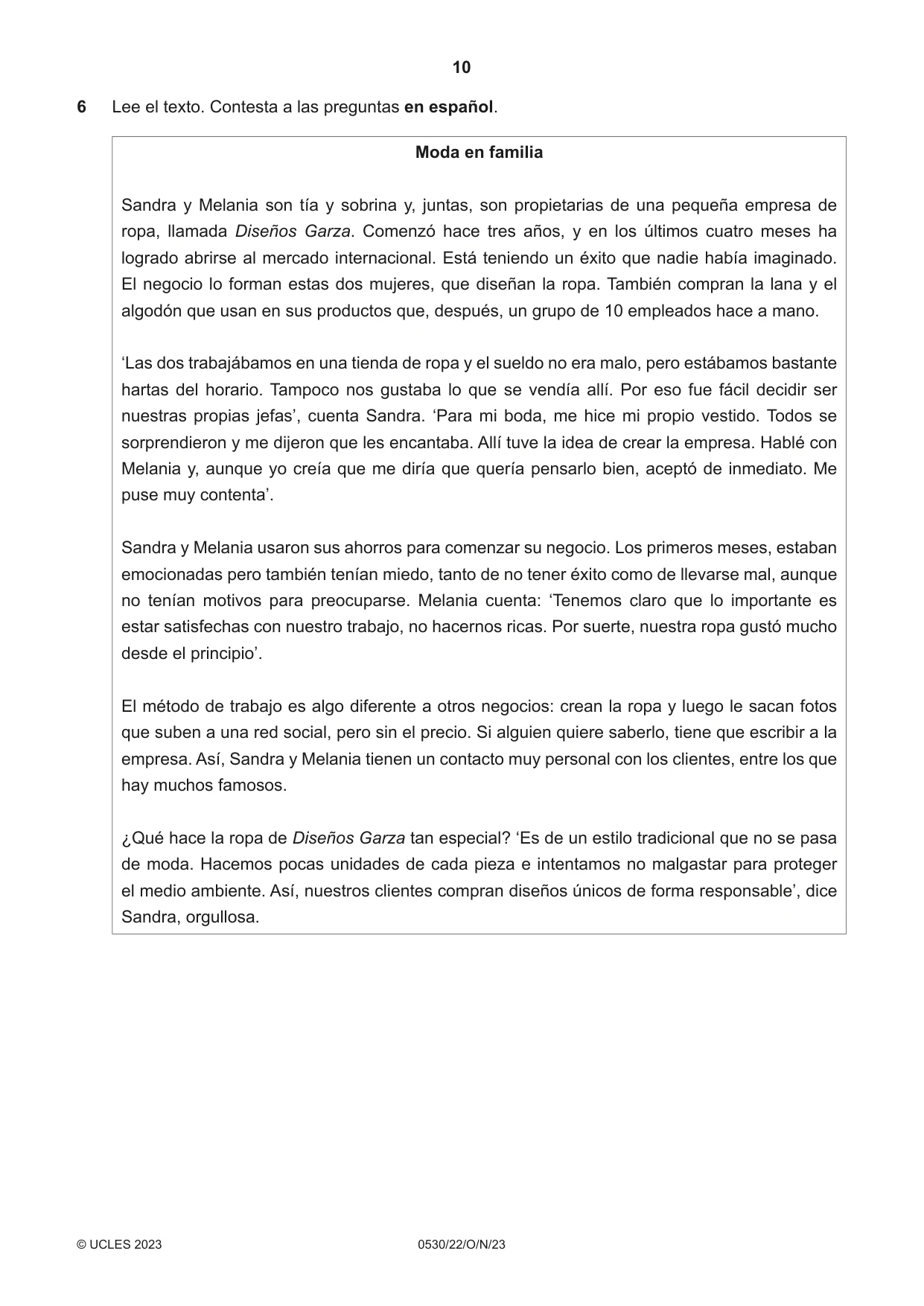
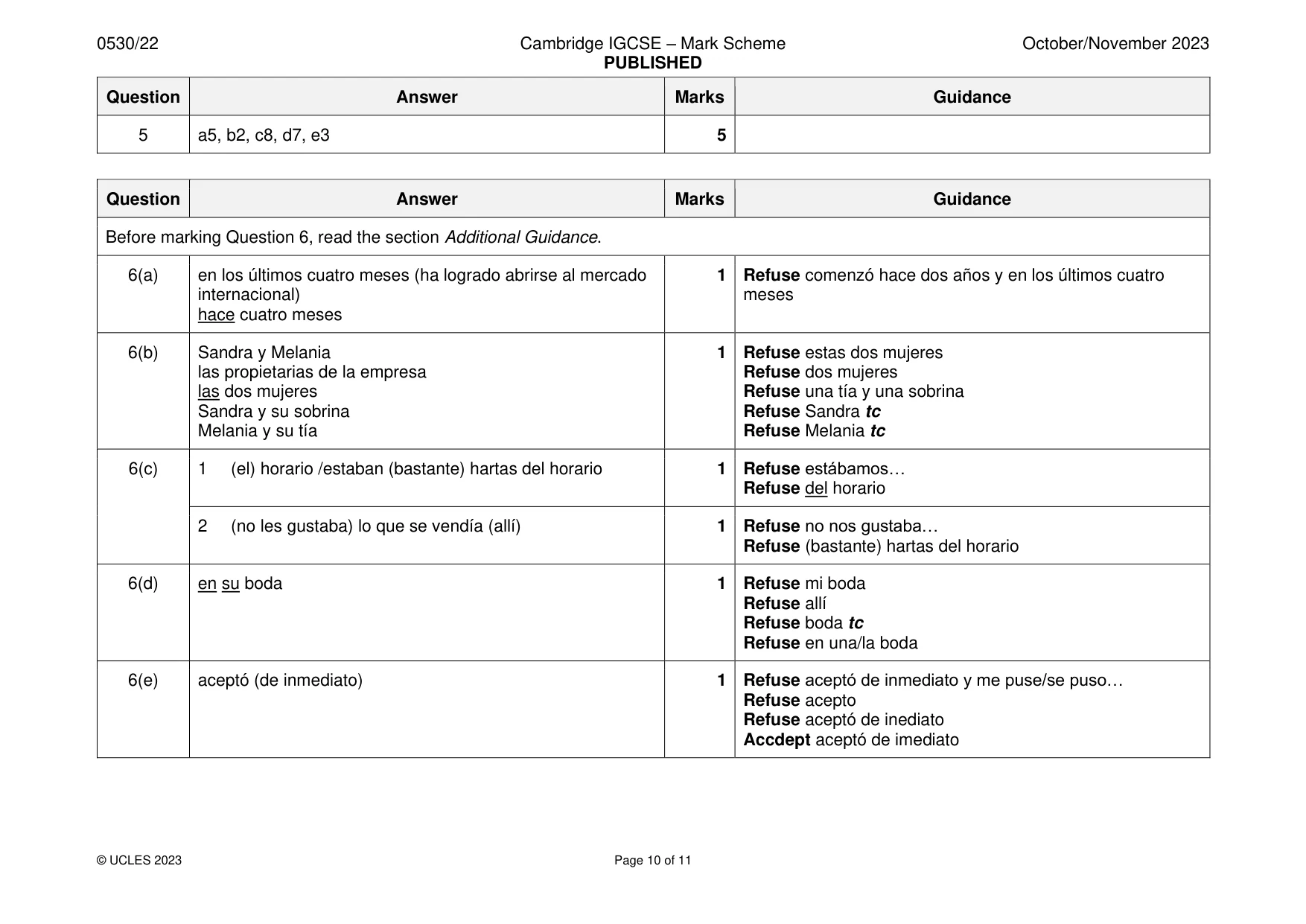
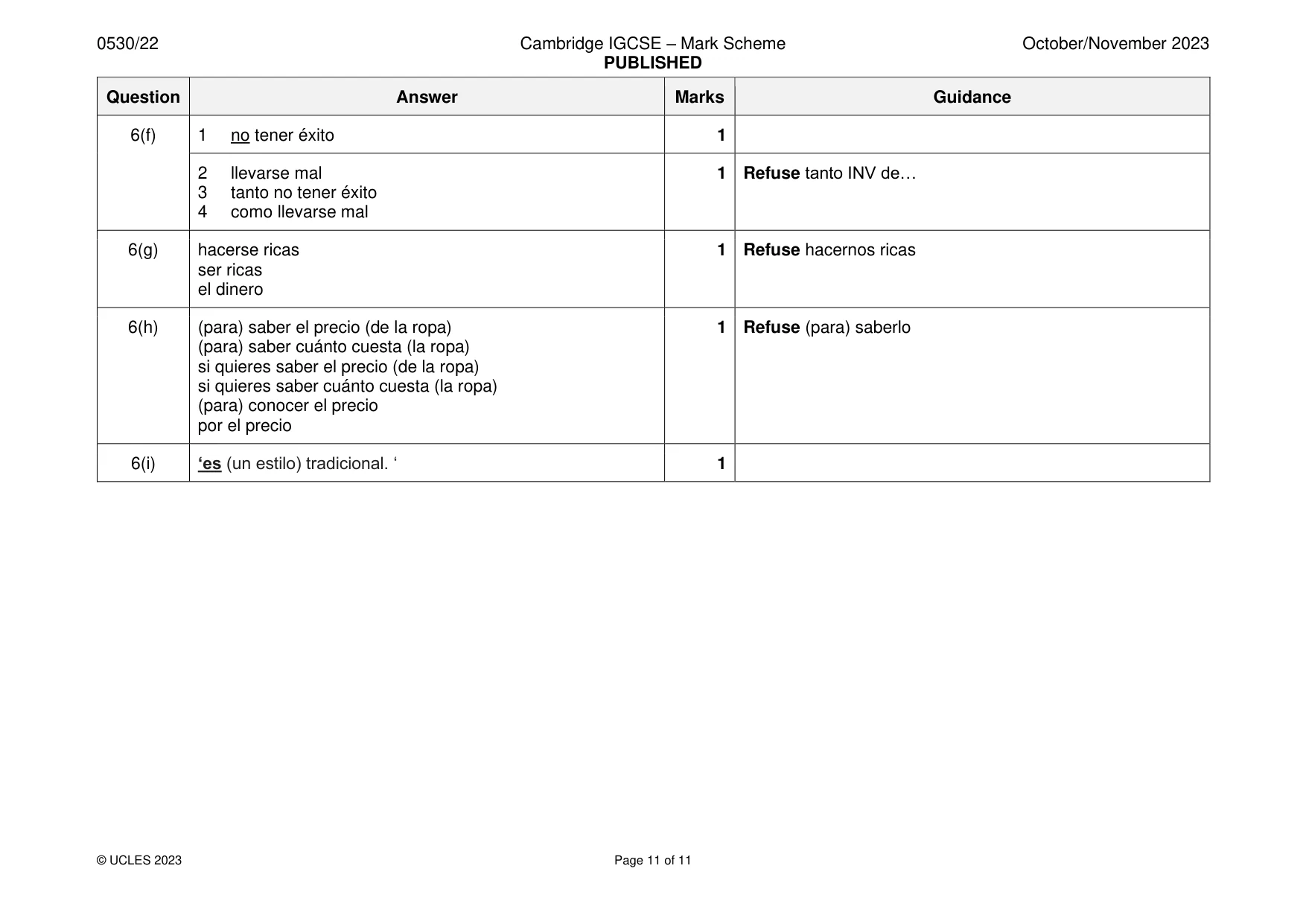
10 0530/22/O/N/23 © UCLES 2023 6 Lee el texto. Contesta a las preguntas en español. Moda en familia Sandra y Melania son tía y sobrina y, juntas, son propietarias de una pequeña empresa de ropa, llamada Diseños Garza. Comenzó hace tres años, y en los últimos cuatro meses ha logrado abrirse al mercado internacional. Está teniendo un éxito que nadie había imaginado. El negocio lo forman estas dos mujeres, que diseñan la ropa. También compran la lana y el algodón que usan en sus productos que, después, un grupo de 10 empleados hace a mano. ‘Las dos trabajábamos en una tienda de ropa y el sueldo no era malo, pero estábamos bastante hartas del horario. Tampoco nos gustaba lo que se vendía allí. Por eso fue fácil decidir ser nuestras propias jefas’, cuenta Sandra. ‘Para mi boda, me hice mi propio vestido. Todos se sorprendieron y me dijeron que les encantaba. Allí tuve la idea de crear la empresa. Hablé con Melania y, aunque yo creía que me diría que quería pensarlo bien, aceptó de inmediato. Me puse muy contenta’. Sandra y Melania usaron sus ahorros para comenzar su negocio. Los primeros meses, estaban emocionadas pero también tenían miedo, tanto de no tener éxito como de llevarse mal, aunque no tenían motivos para preocuparse. Melania cuenta: ‘Tenemos claro que lo importante es estar satisfechas con nuestro trabajo, no hacernos ricas. Por suerte, nuestra ropa gustó mucho desde el principio’. El método de trabajo es algo diferente a otros negocios: crean la ropa y luego le sacan fotos que suben a una red social, pero sin el precio. Si alguien quiere saberlo, tiene que escribir a la empresa. Así, Sandra y Melania tienen un contacto muy personal con los clientes, entre los que hay muchos famosos. ¿Qué hace la ropa de Diseños Garza tan especial? ‘Es de un estilo tradicional que no se pasa de moda. Hacemos pocas unidades de cada pieza e intentamos no malgastar para proteger el medio ambiente. Así, nuestros clientes compran diseños únicos de forma responsable’, dice Sandra, orgullosa.
Question paper, page 11
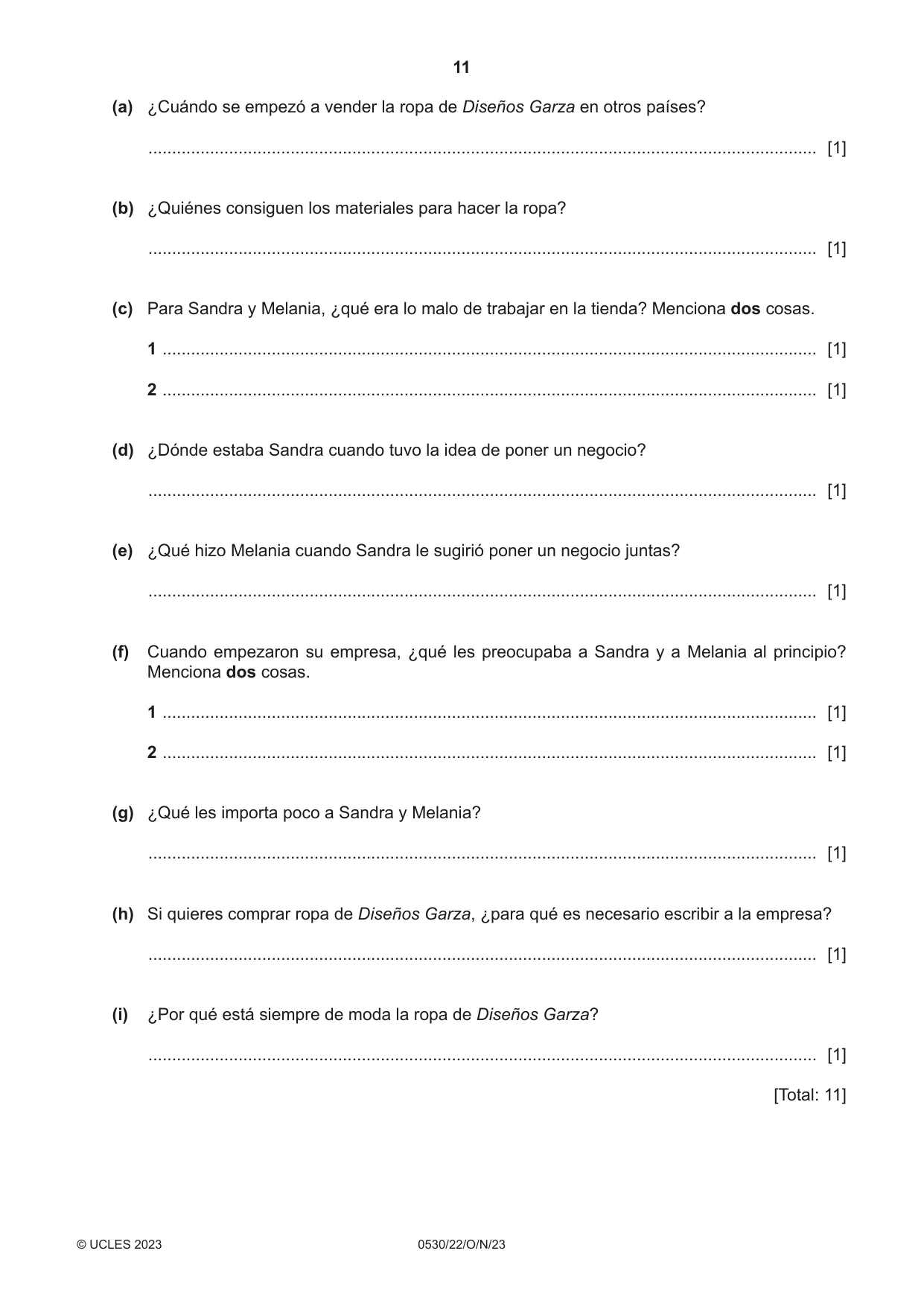
11 0530/22/O/N/23 © UCLES 2023 (a) ¿Cuándo se empezó a vender la ropa de Diseños Garza en otros países? … [1] (b) ¿Quiénes consiguen los materiales para hacer la ropa? … [1] (c) Para Sandra y Melania, ¿qué era lo malo de trabajar en la tienda? Menciona dos cosas. 1 … [1] 2 … [1] (d) ¿Dónde estaba Sandra cuando tuvo la idea de poner un negocio? … [1] (e) ¿Qué hizo Melania cuando Sandra le sugirió poner un negocio juntas? … [1] (f) Cuando empezaron su empresa, ¿qué les preocupaba a Sandra y a Melania al principio? Menciona dos cosas. 1 … [1] 2 … [1] (g) ¿Qué les importa poco a Sandra y Melania? … [1] (h) Si quieres comprar ropa de Diseños Garza, ¿para qué es necesario escribir a la empresa? … [1] (i) ¿Por qué está siempre de moda la ropa de Diseños Garza? … [1] [Total: 11]
Question paper, page 12
12 0530/22/O/N/23 © UCLES 2023 Permission to reproduce items where third-party owned material protected by copyright is included has been sought and cleared where possible. Every reasonable effort has been made by the publisher (UCLES) to trace copyright holders, but if any items requiring clearance have unwittingly been included, the publisher will be pleased to make amends at the earliest possible opportunity. To avoid the issue of disclosure of answer-related information to candidates, all copyright acknowledgements are reproduced online in the Cambridge Assessment International Education Copyright Acknowledgements Booklet. This is produced for each series of examinations and is freely available to download at www.cambridgeinternational.org after the live examination series. Cambridge Assessment International Education is part of Cambridge Assessment. Cambridge Assessment is the brand name of the University of Cambridge Local Examinations Syndicate (UCLES), which is a department of the University of Cambridge. BLANK PAGE
Mark scheme, page 1
This document consists of 11 printed pages. © UCLES 2023 [Turn over Cambridge IGCSE™ SPANISH 0530/22 Paper 2 Reading October/November 2023 MARK SCHEME Maximum Mark: 45 Published This mark scheme is published as an aid to teachers and candidates, to indicate the requirements of the examination. It shows the basis on which Examiners were instructed to award marks. It does not indicate the details of the discussions that took place at an Examiners’ meeting before marking began, which would have considered the acceptability of alternative answers. Mark schemes should be read in conjunction with the question paper and the Principal Examiner Report for Teachers. Cambridge International will not enter into discussions about these mark schemes. Cambridge International is publishing the mark schemes for the October/November 2023 series for most Cambridge IGCSE, Cambridge International A and AS Level components, and some Cambridge O Level components.
Mark scheme, page 2
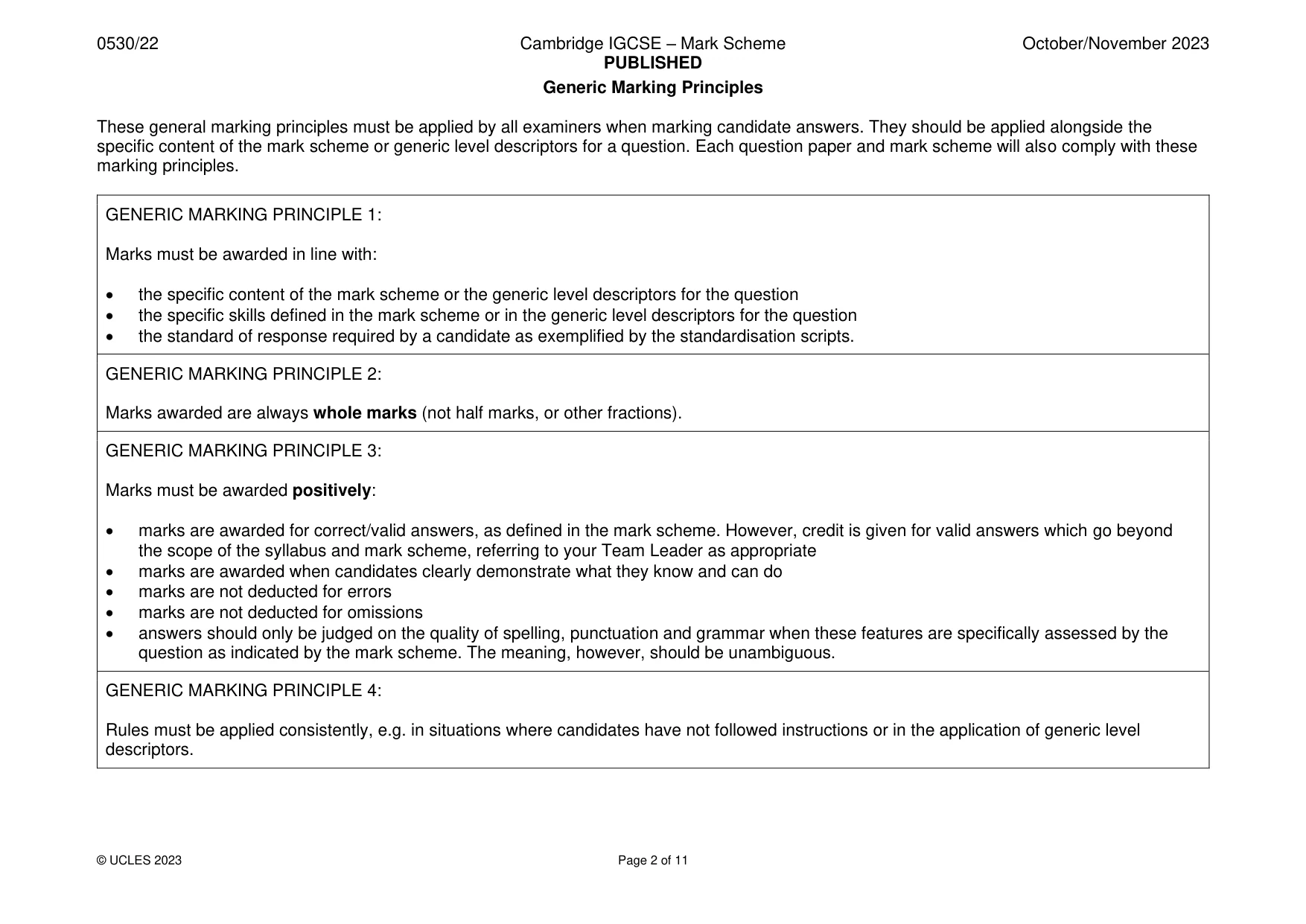
0530/22 Cambridge IGCSE – Mark Scheme PUBLISHED October/November 2023 © UCLES 2023 Page 2 of 11 Generic Marking Principles These general marking principles must be applied by all examiners when marking candidate answers. They should be applied alongside the specific content of the mark scheme or generic level descriptors for a question. Each question paper and mark scheme will also comply with these marking principles. GENERIC MARKING PRINCIPLE 1: Marks must be awarded in line with: • the specific content of the mark scheme or the generic level descriptors for the question • the specific skills defined in the mark scheme or in the generic level descriptors for the question • the standard of response required by a candidate as exemplified by the standardisation scripts. GENERIC MARKING PRINCIPLE 2: Marks awarded are always whole marks (not half marks, or other fractions). GENERIC MARKING PRINCIPLE 3: Marks must be awarded positively: • marks are awarded for correct/valid answers, as defined in the mark scheme. However, credit is given for valid answers which go beyond the scope of the syllabus and mark scheme, referring to your Team Leader as appropriate • marks are awarded when candidates clearly demonstrate what they know and can do • marks are not deducted for errors • marks are not deducted for omissions • answers should only be judged on the quality of spelling, punctuation and grammar when these features are specifically assessed by the question as indicated by the mark scheme. The meaning, however, should be unambiguous. GENERIC MARKING PRINCIPLE 4: Rules must be applied consistently, e.g. in situations where candidates have not followed instructions or in the application of generic level descriptors.
Mark scheme, page 3
0530/22 Cambridge IGCSE – Mark Scheme PUBLISHED October/November 2023 © UCLES 2023 Page 3 of 11 GENERIC MARKING PRINCIPLE 5: Marks should be awarded using the full range of marks defined in the mark scheme for the question (however; the use of the full mark range may be limited according to the quality of the candidate responses seen). GENERIC MARKING PRINCIPLE 6: Marks awarded are based solely on the requirements as defined in the mark scheme. Marks should not be awarded with grade thresholds or grade descriptors in mind.
Mark scheme, page 4
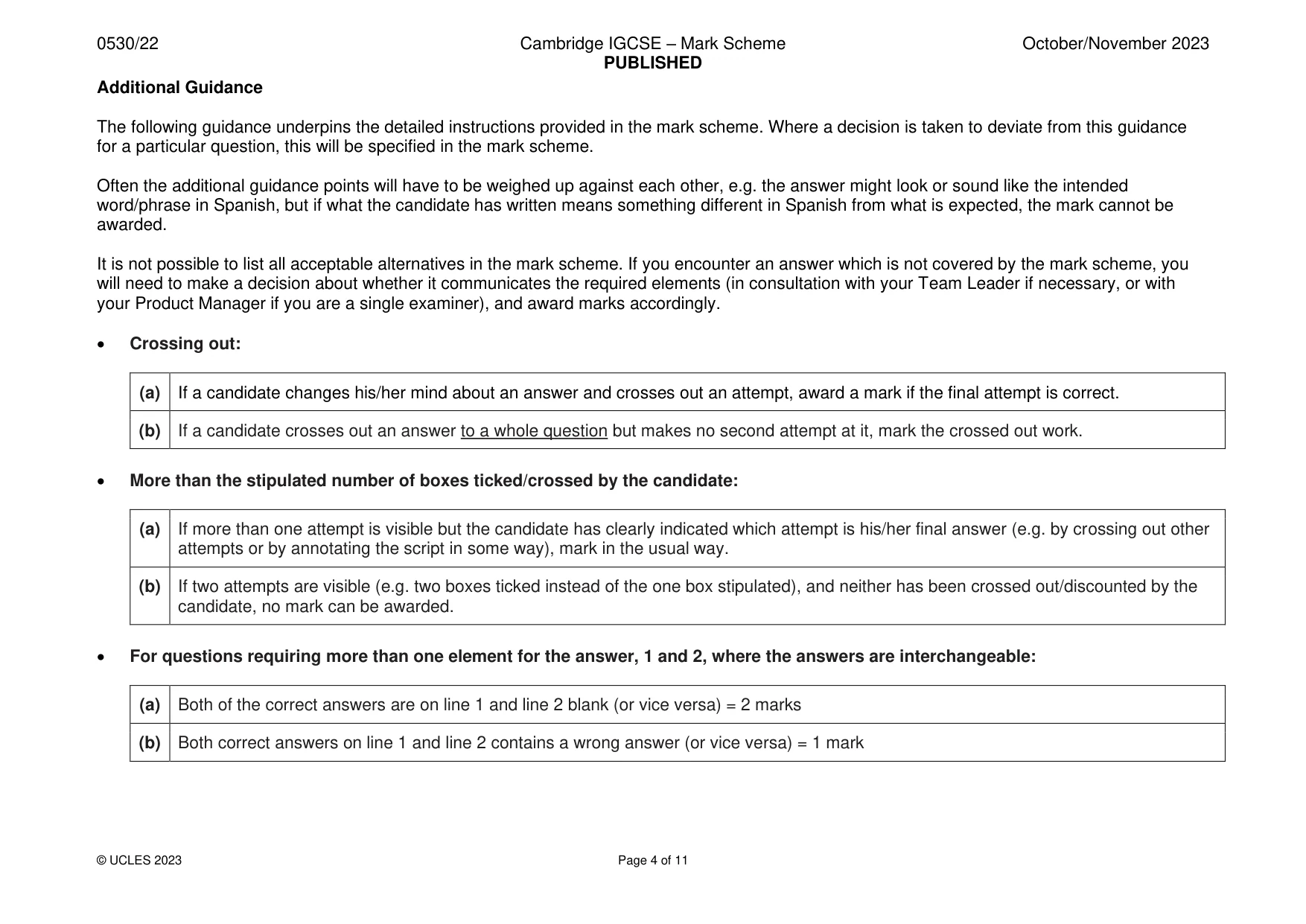
0530/22 Cambridge IGCSE – Mark Scheme PUBLISHED October/November 2023 © UCLES 2023 Page 4 of 11 Additional Guidance The following guidance underpins the detailed instructions provided in the mark scheme. Where a decision is taken to deviate from this guidance for a particular question, this will be specified in the mark scheme. Often the additional guidance points will have to be weighed up against each other, e.g. the answer might look or sound like the intended word/phrase in Spanish, but if what the candidate has written means something different in Spanish from what is expected, the mark cannot be awarded. It is not possible to list all acceptable alternatives in the mark scheme. If you encounter an answer which is not covered by the mark scheme, you will need to make a decision about whether it communicates the required elements (in consultation with your Team Leader if necessary, or with your Product Manager if you are a single examiner), and award marks accordingly. • Crossing out: (a) If a candidate changes his/her mind about an answer and crosses out an attempt, award a mark if the final attempt is correct. (b) If a candidate crosses out an answer to a whole question but makes no second attempt at it, mark the crossed out work. • More than the stipulated number of boxes ticked/crossed by the candidate: (a) If more than one attempt is visible but the candidate has clearly indicated which attempt is his/her final answer (e.g. by crossing out other attempts or by annotating the script in some way), mark in the usual way. (b) If two attempts are visible (e.g. two boxes ticked instead of the one box stipulated), and neither has been crossed out/discounted by the candidate, no mark can be awarded. • For questions requiring more than one element for the answer, 1 and 2, where the answers are interchangeable: (a) Both of the correct answers are on line 1 and line 2 blank (or vice versa) = 2 marks (b) Both correct answers on line 1 and line 2 contains a wrong answer (or vice versa) = 1 mark
Mark scheme, page 5
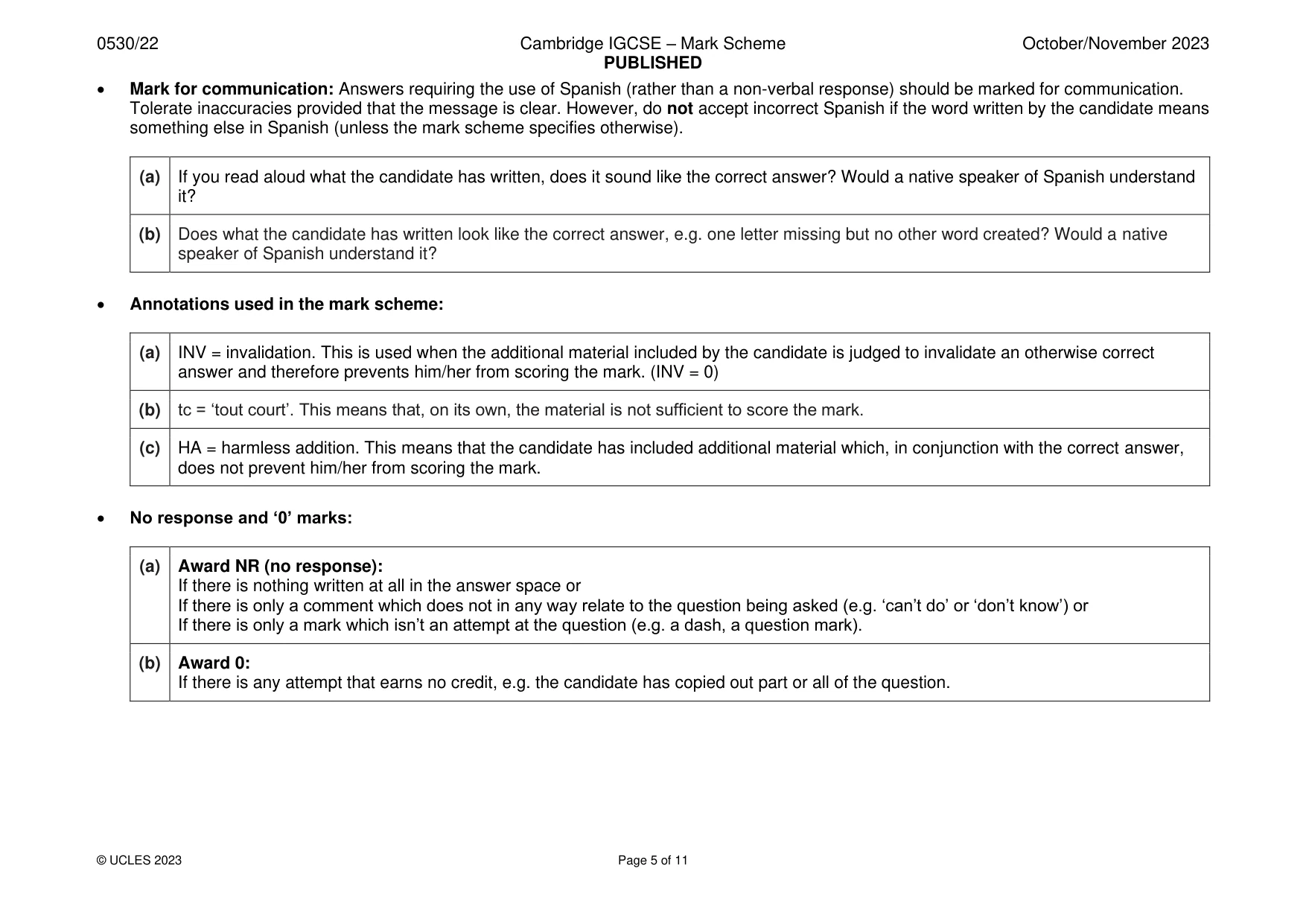
0530/22 Cambridge IGCSE – Mark Scheme PUBLISHED October/November 2023 © UCLES 2023 Page 5 of 11 • Mark for communication: Answers requiring the use of Spanish (rather than a non-verbal response) should be marked for communication. Tolerate inaccuracies provided that the message is clear. However, do not accept incorrect Spanish if the word written by the candidate means something else in Spanish (unless the mark scheme specifies otherwise). (a) If you read aloud what the candidate has written, does it sound like the correct answer? Would a native speaker of Spanish understand it? (b) Does what the candidate has written look like the correct answer, e.g. one letter missing but no other word created? Would a native speaker of Spanish understand it? • Annotations used in the mark scheme: (a) INV = invalidation. This is used when the additional material included by the candidate is judged to invalidate an otherwise correct answer and therefore prevents him/her from scoring the mark. (INV = 0) (b) tc = ‘tout court’. This means that, on its own, the material is not sufficient to score the mark. (c) HA = harmless addition. This means that the candidate has included additional material which, in conjunction with the correct answer, does not prevent him/her from scoring the mark. • No response and ‘0’ marks: (a) Award NR (no response): If there is nothing written at all in the answer space or If there is only a comment which does not in any way relate to the question being asked (e.g. ‘can’t do’ or ‘don’t know’) or If there is only a mark which isn’t an attempt at the question (e.g. a dash, a question mark). (b) Award 0: If there is any attempt that earns no credit, e.g. the candidate has copied out part or all of the question.
Mark scheme, page 6
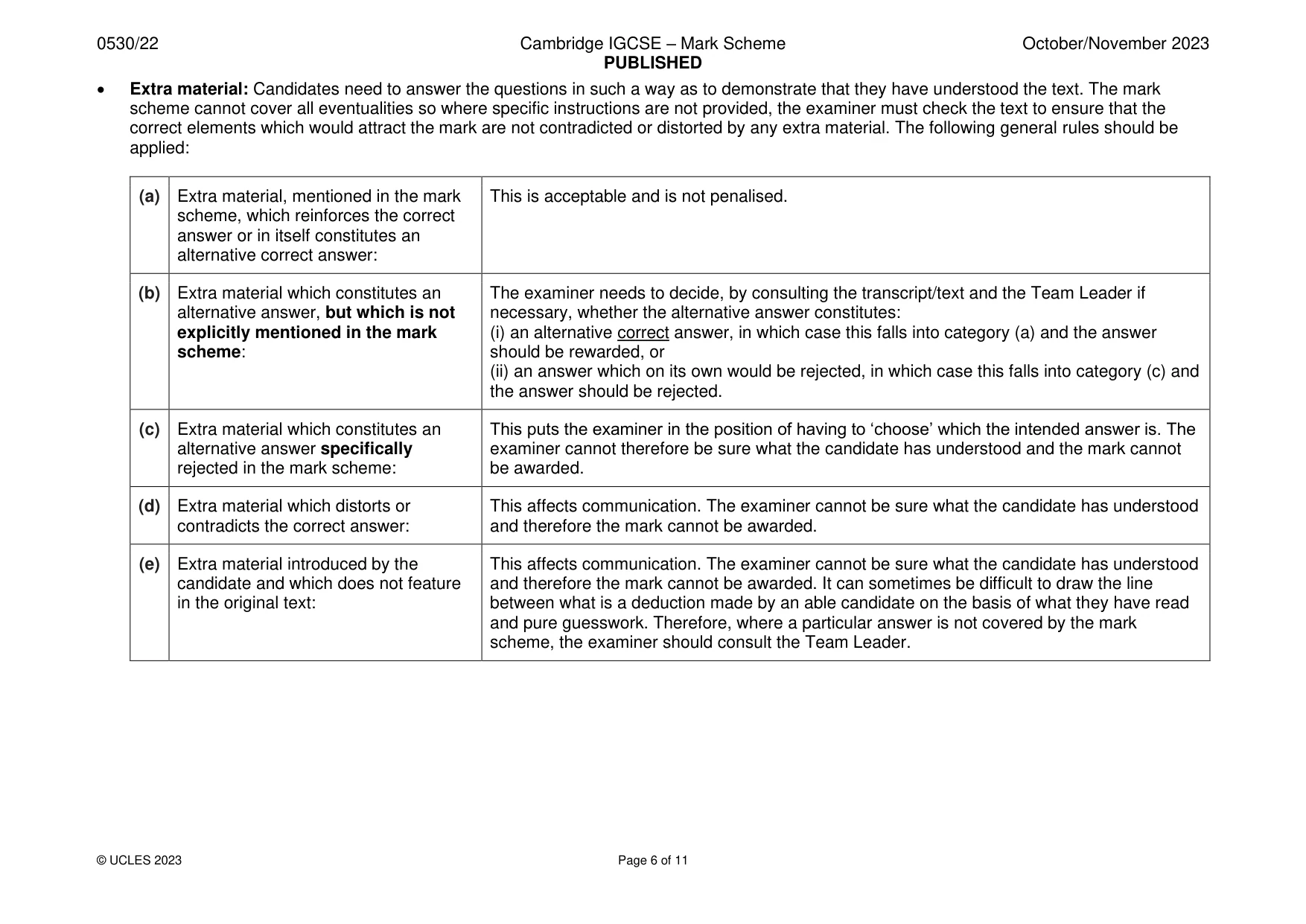
0530/22 Cambridge IGCSE – Mark Scheme PUBLISHED October/November 2023 © UCLES 2023 Page 6 of 11 • Extra material: Candidates need to answer the questions in such a way as to demonstrate that they have understood the text. The mark scheme cannot cover all eventualities so where specific instructions are not provided, the examiner must check the text to ensure that the correct elements which would attract the mark are not contradicted or distorted by any extra material. The following general rules should be applied: (a) Extra material, mentioned in the mark scheme, which reinforces the correct answer or in itself constitutes an alternative correct answer: This is acceptable and is not penalised. (b) Extra material which constitutes an alternative answer, but which is not explicitly mentioned in the mark scheme: The examiner needs to decide, by consulting the transcript/text and the Team Leader if necessary, whether the alternative answer constitutes: (i) an alternative correct answer, in which case this falls into category (a) and the answer should be rewarded, or (ii) an answer which on its own would be rejected, in which case this falls into category (c) and the answer should be rejected. (c) Extra material which constitutes an alternative answer specifically rejected in the mark scheme: This puts the examiner in the position of having to ‘choose’ which the intended answer is. The examiner cannot therefore be sure what the candidate has understood and the mark cannot be awarded. (d) Extra material which distorts or contradicts the correct answer: This affects communication. The examiner cannot be sure what the candidate has understood and therefore the mark cannot be awarded. (e) Extra material introduced by the candidate and which does not feature in the original text: This affects communication. The examiner cannot be sure what the candidate has understood and therefore the mark cannot be awarded. It can sometimes be difficult to draw the line between what is a deduction made by an able candidate on the basis of what they have read and pure guesswork. Therefore, where a particular answer is not covered by the mark scheme, the examiner should consult the Team Leader.
Mark scheme, page 7
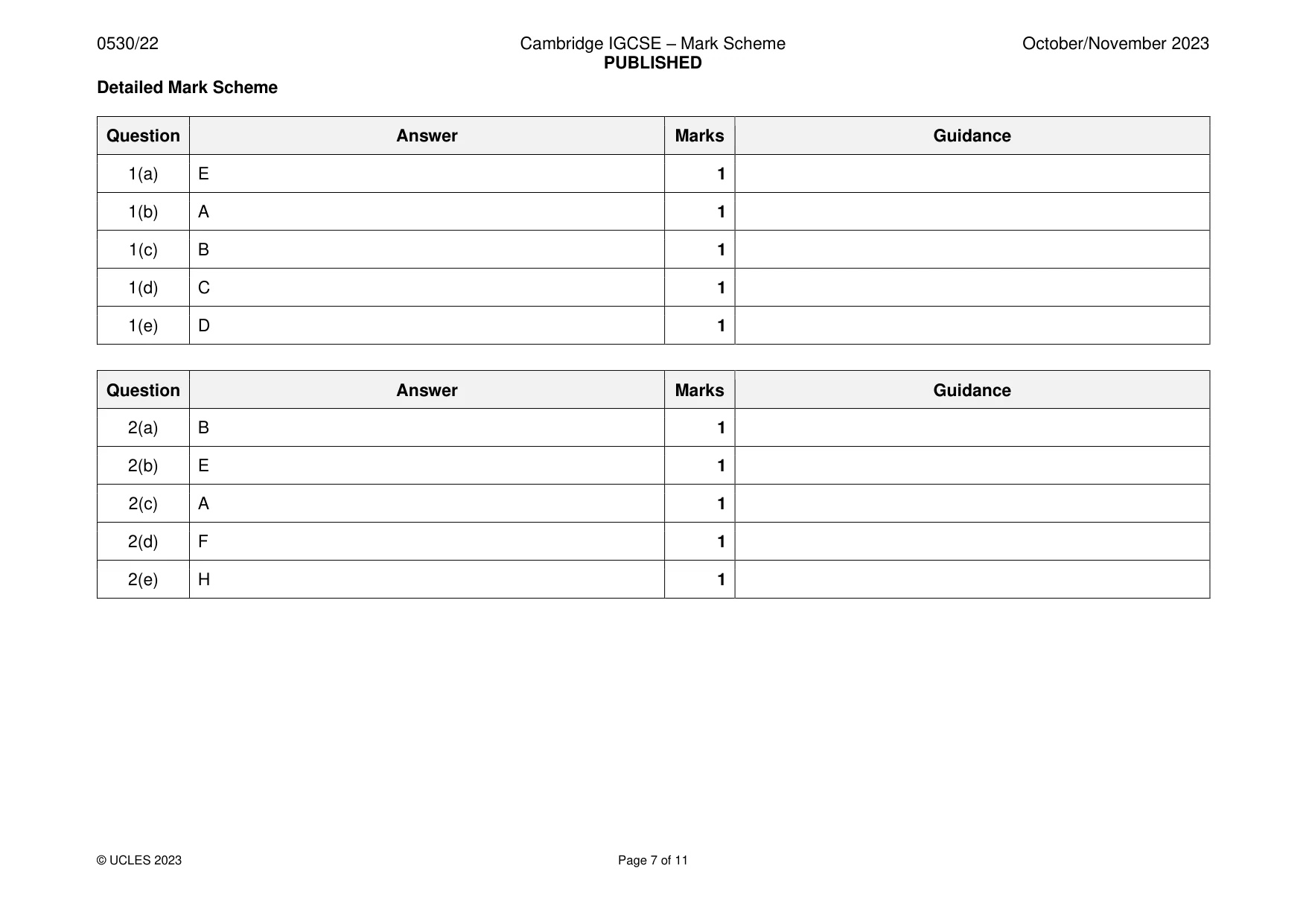
0530/22 Cambridge IGCSE – Mark Scheme PUBLISHED October/November 2023 © UCLES 2023 Page 7 of 11 Detailed Mark Scheme Question Answer Marks Guidance 1(a) E 1 1(b) A 1 1(c) B 1 1(d) C 1 1(e) D 1 Question Answer Marks Guidance 2(a) B 1 2(b) E 1 2(c) A 1 2(d) F 1 2(e) H 1
Mark scheme, page 8
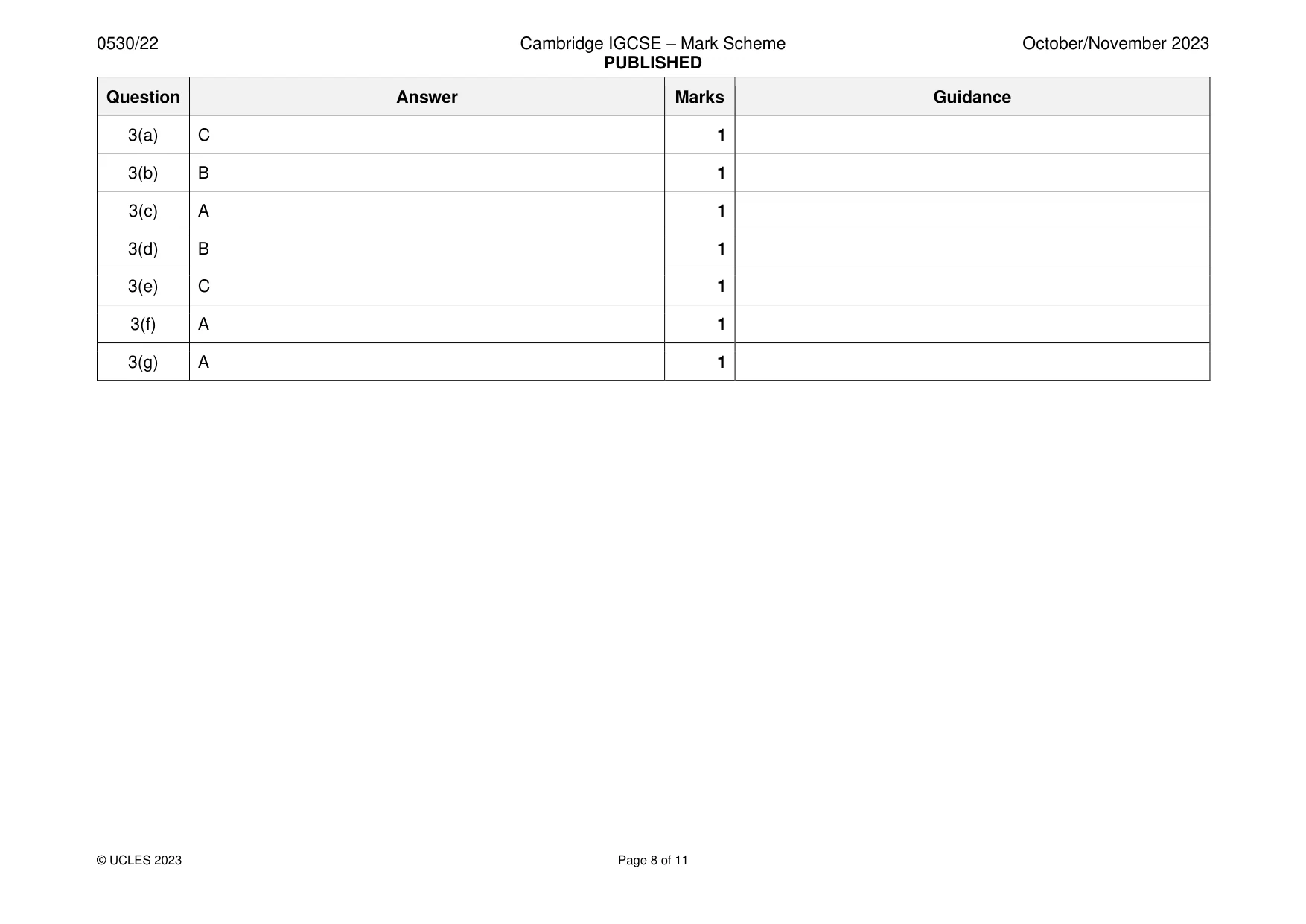
0530/22 Cambridge IGCSE – Mark Scheme PUBLISHED October/November 2023 © UCLES 2023 Page 8 of 11 Question Answer Marks Guidance 3(a) C 1 3(b) B 1 3(c) A 1 3(d) B 1 3(e) C 1 3(f) A 1 3(g) A 1
Mark scheme, page 9
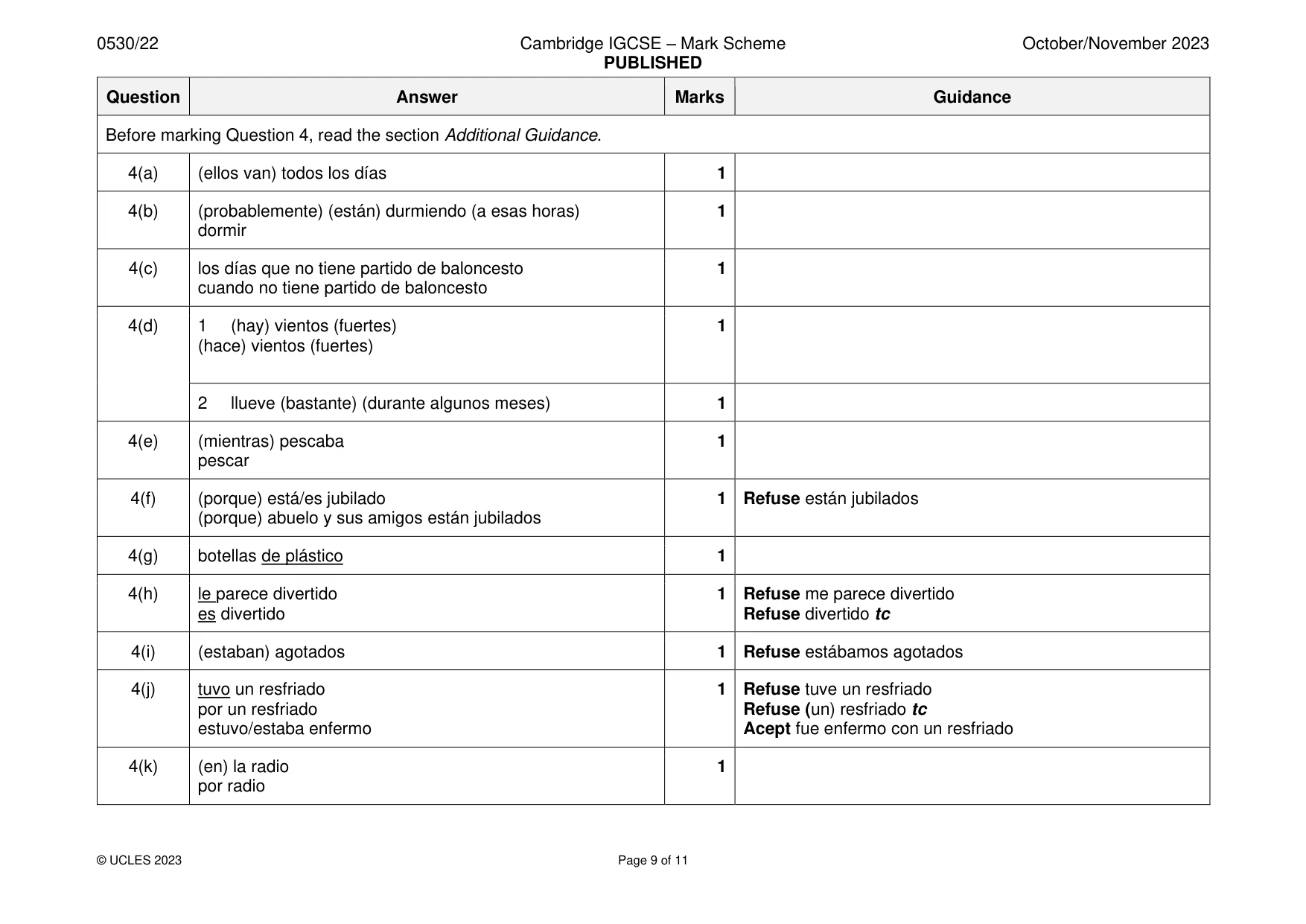
0530/22 Cambridge IGCSE – Mark Scheme PUBLISHED October/November 2023 © UCLES 2023 Page 9 of 11 Question Answer Marks Guidance Before marking Question 4, read the section Additional Guidance. 4(a) (ellos van) todos los días 1 4(b) (probablemente) (están) durmiendo (a esas horas) dormir 1 4(c) los días que no tiene partido de baloncesto cuando no tiene partido de baloncesto 1 4(d) 1 (hay) vientos (fuertes) (hace) vientos (fuertes) 1 2 llueve (bastante) (durante algunos meses) 1 4(e) (mientras) pescaba pescar 1 4(f) (porque) está/es jubilado (porque) abuelo y sus amigos están jubilados 1 Refuse están jubilados 4(g) botellas de plástico 1 4(h) le parece divertido es divertido 1 Refuse me parece divertido Refuse divertido tc 4(i) (estaban) agotados 1 Refuse estábamos agotados 4(j) tuvo un resfriado por un resfriado estuvo/estaba enfermo 1 Refuse tuve un resfriado Refuse (un) resfriado tc Acept fue enfermo con un resfriado 4(k) (en) la radio por radio 1
Mark scheme, page 10
0530/22 Cambridge IGCSE – Mark Scheme PUBLISHED October/November 2023 © UCLES 2023 Page 10 of 11 Question Answer Marks Guidance 5 a5, b2, c8, d7, e3 5 Question Answer Marks Guidance Before marking Question 6, read the section Additional Guidance. 6(a) en los últimos cuatro meses (ha logrado abrirse al mercado internacional) hace cuatro meses 1 Refuse comenzó hace dos años y en los últimos cuatro meses 6(b) Sandra y Melania las propietarias de la empresa las dos mujeres Sandra y su sobrina Melania y su tía 1 Refuse estas dos mujeres Refuse dos mujeres Refuse una tía y una sobrina Refuse Sandra tc Refuse Melania tc 6(c) 1 (el) horario /estaban (bastante) hartas del horario 1 Refuse estábamos… Refuse del horario 2 (no les gustaba) lo que se vendía (allí) 1 Refuse no nos gustaba… Refuse (bastante) hartas del horario 6(d) en su boda 1 Refuse mi boda Refuse allí Refuse boda tc Refuse en una/la boda 6(e) aceptó (de inmediato) 1 Refuse aceptó de inmediato y me puse/se puso… Refuse acepto Refuse aceptó de inediato Accdept aceptó de imediato
Mark scheme, page 11
0530/22 Cambridge IGCSE – Mark Scheme PUBLISHED October/November 2023 © UCLES 2023 Page 11 of 11 Question Answer Marks Guidance 6(f) 1 no tener éxito 1 2 llevarse mal 3 tanto no tener éxito 4 como llevarse mal 1 Refuse tanto INV de… 6(g) hacerse ricas ser ricas el dinero 1 Refuse hacernos ricas 6(h) (para) saber el precio (de la ropa) (para) saber cuánto cuesta (la ropa) si quieres saber el precio (de la ropa) si quieres saber cuánto cuesta (la ropa) (para) conocer el precio por el precio 1 Refuse (para) saberlo 6(i) ‘es (un estilo) tradicional. ‘ 1
What you needed in this session
Cambridge’s own grade thresholds for 2023 Oct/Nov, Paper 2 · Variant 2. A higher threshold means an easier paper — the bar moves with how the cohort did.