Cambridge IGCSE Spanish - Foreign Language 0530 — 2022 Oct/Nov Paper 2 · Variant 3
0530/23/O/N/22 · 45 marks · ≈51 min
The question paper and its mark scheme, free to read here and free to download. This is Cambridge’s own paper, exactly as it was sat.
Question paper12 pages

Mark scheme11 pages
Answers below. Sit the paper first if you are practising.
Paper as text
Question paper, page 1
This document has 12 pages. Any blank pages are indicated. [Turn over Cambridge IGCSE™ SPANISH 0530/23 Paper 2 Reading October/November 2022 1 hour You must answer on the question paper. No additional materials are needed. INSTRUCTIONS ● Answer all questions. ● Use a black or dark blue pen. ● Write your name, centre number and candidate number in the boxes at the top of the page. ● Write your answer to each question in the space provided. ● Do not use an erasable pen or correction fluid. ● Do not write on any bar codes. ● Dictionaries are not allowed. INFORMATION ● The total mark for this paper is 45. ● The number of marks for each question or part question is shown in brackets [ ]. * 2 8 7 0 3 5 8 7 1 1 * DC (CJ/JG) 303362/3 © UCLES 2022
Question paper, page 2
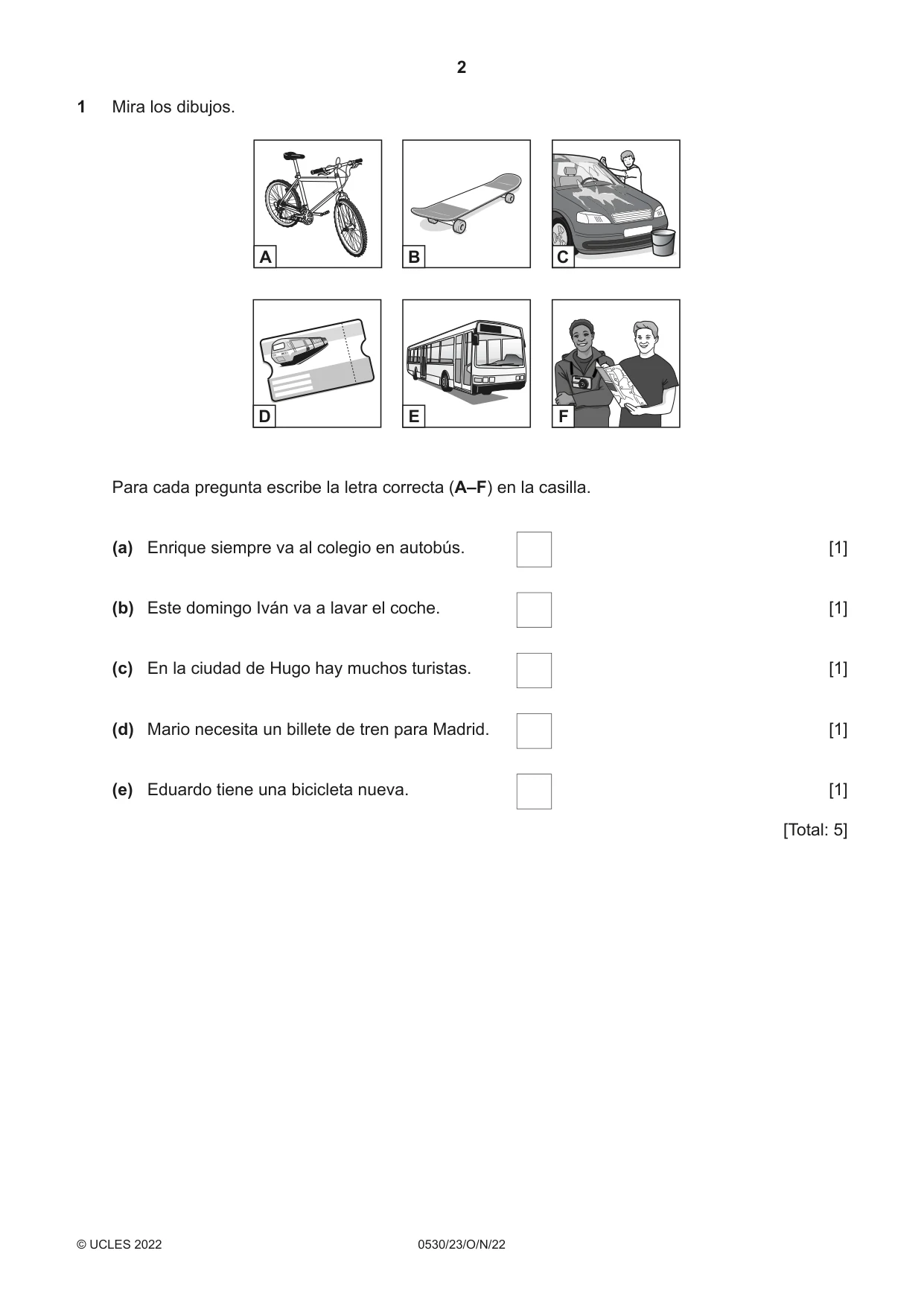
2 0530/23/ O/ N/22 © UCLES 2022 1 Mira los dibujos. C B A E D F Para cada pregunta escribe la letra correcta (A–F) en la casilla. (a) Enrique siempre va al colegio en autobús. [1] (b) Este domingo Iván va a lavar el coche. [1] (c) En la ciudad de Hugo hay muchos turistas. [1] (d) Mario necesita un billete de tren para Madrid. [1] (e) Eduardo tiene una bicicleta nueva. [1] [Total: 5]
Question paper, page 3
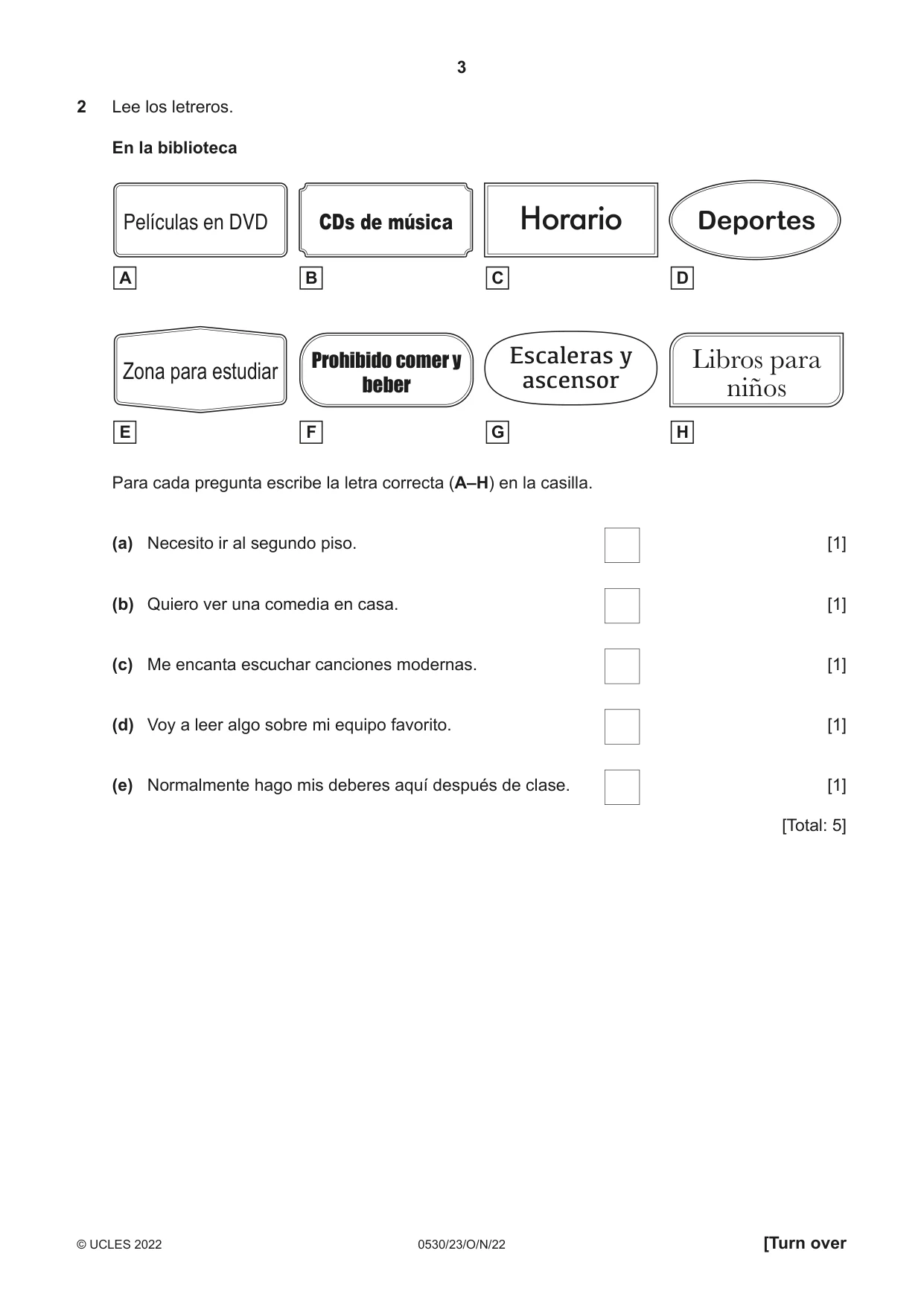
3 0530/23/O/N/22 © UCLES 2022 [Turn over 2 Lee los letreros. En la biblioteca Prohibido comer y beber Zona para estudiar Escaleras y ascensor Horario Libros para niños A B C D E F G H Películas en DVD CDs de música Deportes Para cada pregunta escribe la letra correcta (A–H) en la casilla. (a) Necesito ir al segundo piso. [1] (b) Quiero ver una comedia en casa. [1] (c) Me encanta escuchar canciones modernas. [1] (d) Voy a leer algo sobre mi equipo favorito. [1] (e) Normalmente hago mis deberes aquí después de clase. [1] [Total: 5]
Question paper, page 4
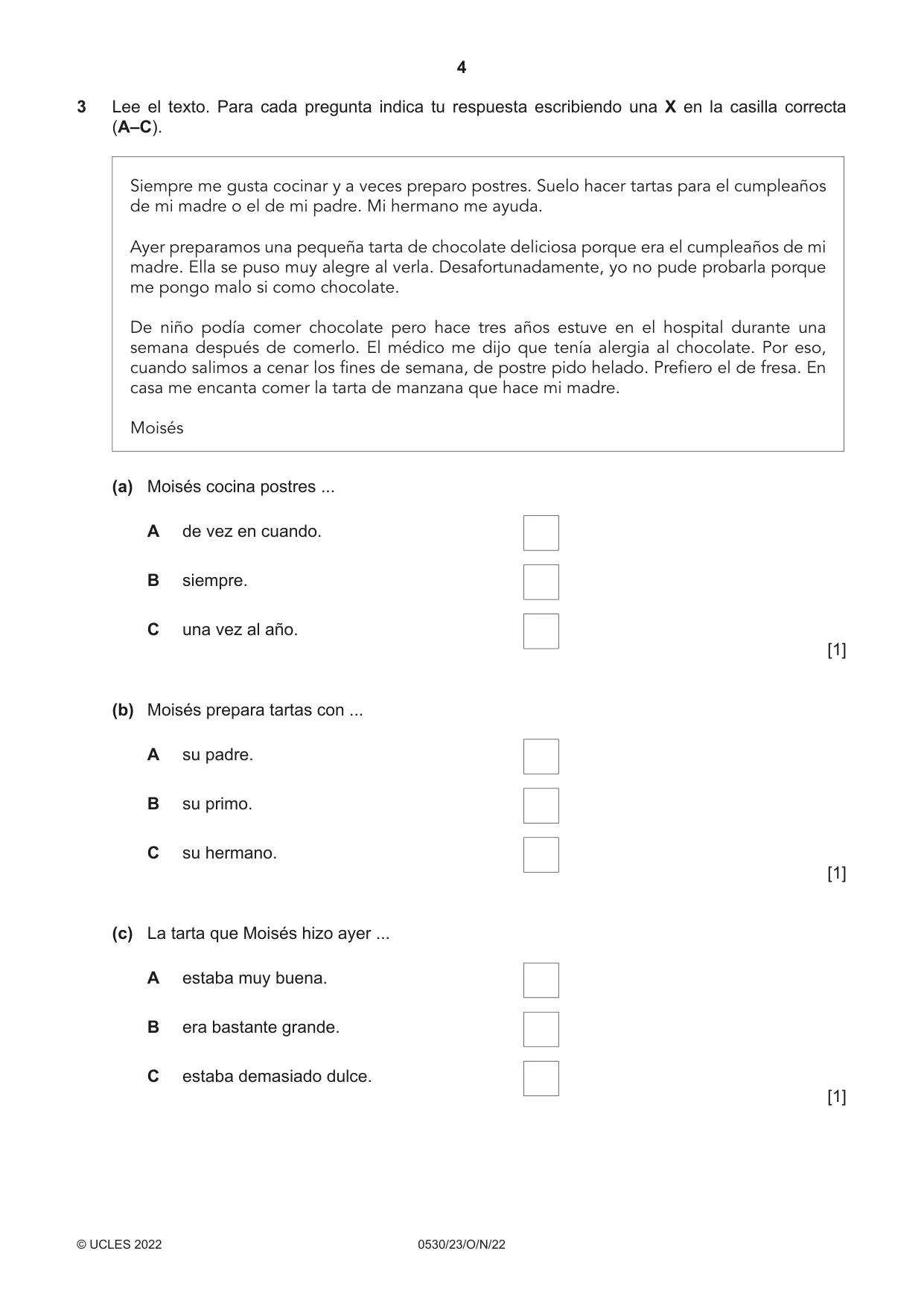
4 0530/23/O/N/22 © UCLES 2022 3 Lee el texto. Para cada pregunta indica tu respuesta escribiendo una X en la casilla correcta (A–C). Siempre me gusta cocinar y a veces preparo postres. Suelo hacer tartas para el cumpleaños de mi madre o el de mi padre. Mi hermano me ayuda. Ayer preparamos una pequeña tarta de chocolate deliciosa porque era el cumpleaños de mi madre. Ella se puso muy alegre al verla. Desafortunadamente, yo no pude probarla porque me pongo malo si como chocolate. De niño podía comer chocolate pero hace tres años estuve en el hospital durante una semana después de comerlo. El médico me dijo que tenía alergia al chocolate. Por eso, cuando salimos a cenar los fines de semana, de postre pido helado. Prefiero el de fresa. En casa me encanta comer la tarta de manzana que hace mi madre. Moisés (a) Moisés cocina postres ... A de vez en cuando. B siempre. C una vez al año. [1] (b) Moisés prepara tartas con ... A su padre. B su primo. C su hermano. [1] (c) La tarta que Moisés hizo ayer ... A estaba muy buena. B era bastante grande. C estaba demasiado dulce. [1]
Question paper, page 5
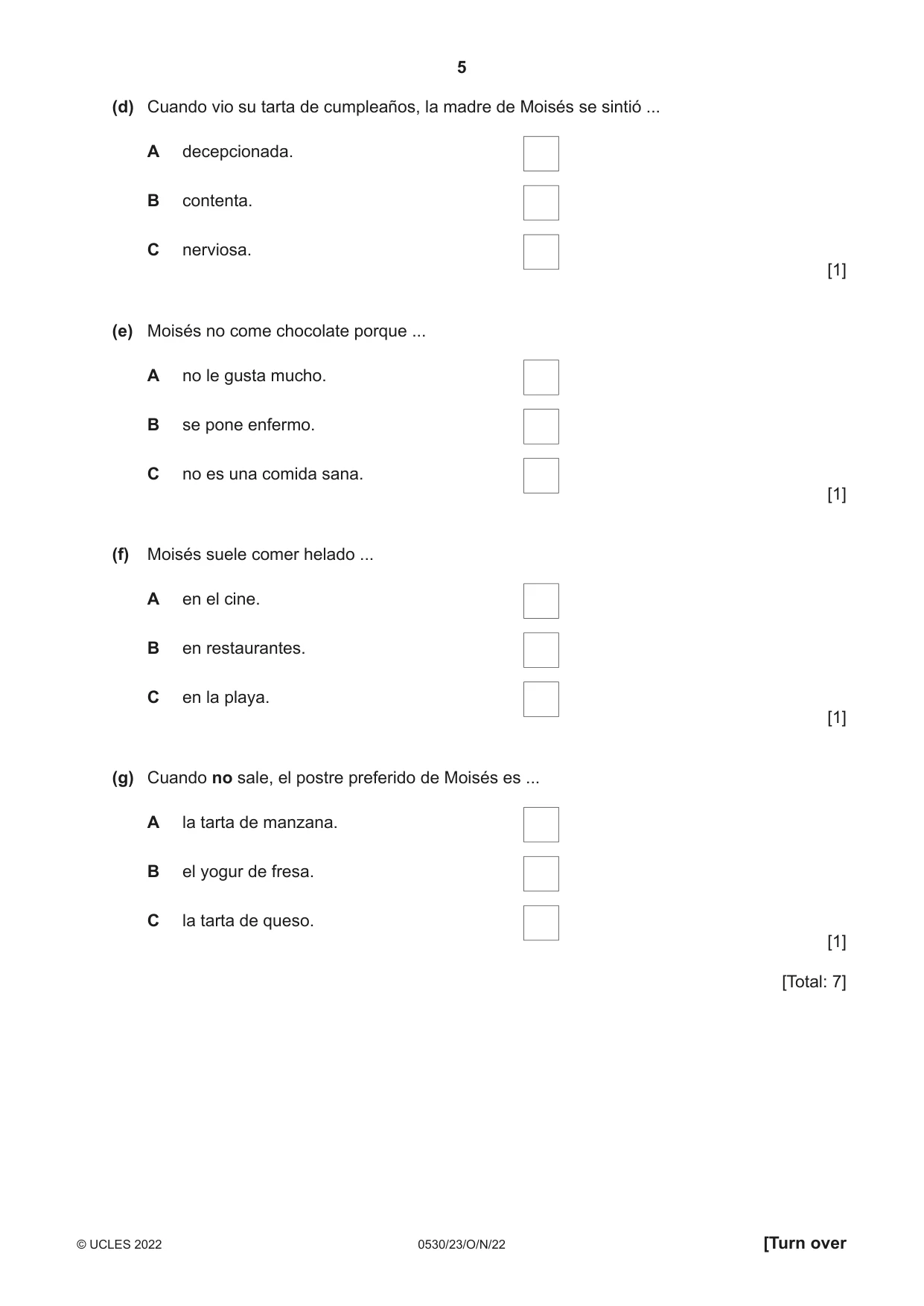
5 0530/23/O/N/22 © UCLES 2022 [Turn over (d) Cuando vio su tarta de cumpleaños, la madre de Moisés se sintió ... A decepcionada. B contenta. C nerviosa. [1] (e) Moisés no come chocolate porque ... A no le gusta mucho. B se pone enfermo. C no es una comida sana. [1] (f) Moisés suele comer helado ... A en el cine. B en restaurantes. C en la playa. [1] (g) Cuando no sale, el postre preferido de Moisés es ... A la tarta de manzana. B el yogur de fresa. C la tarta de queso. [1] [Total: 7]
Question paper, page 6
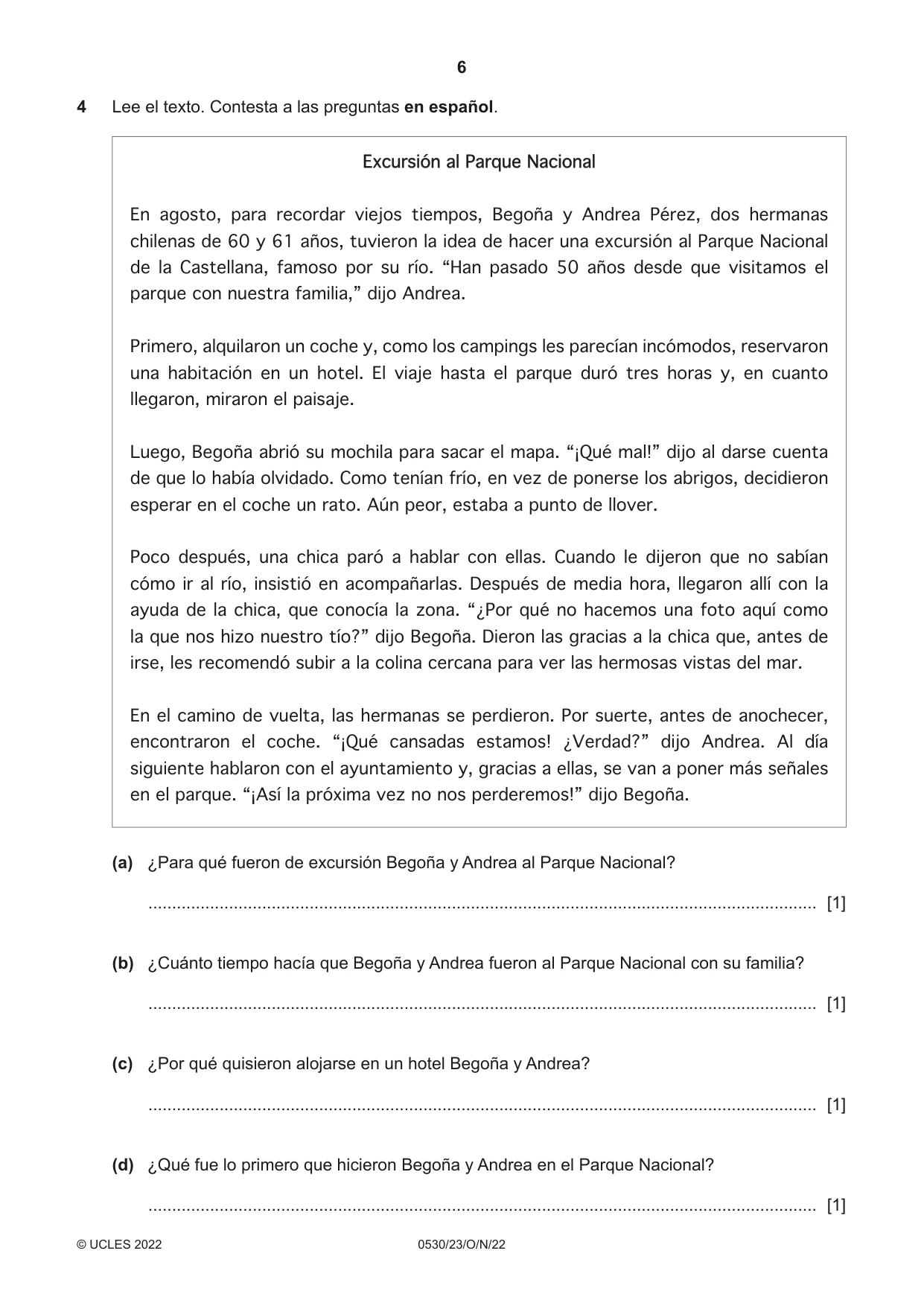
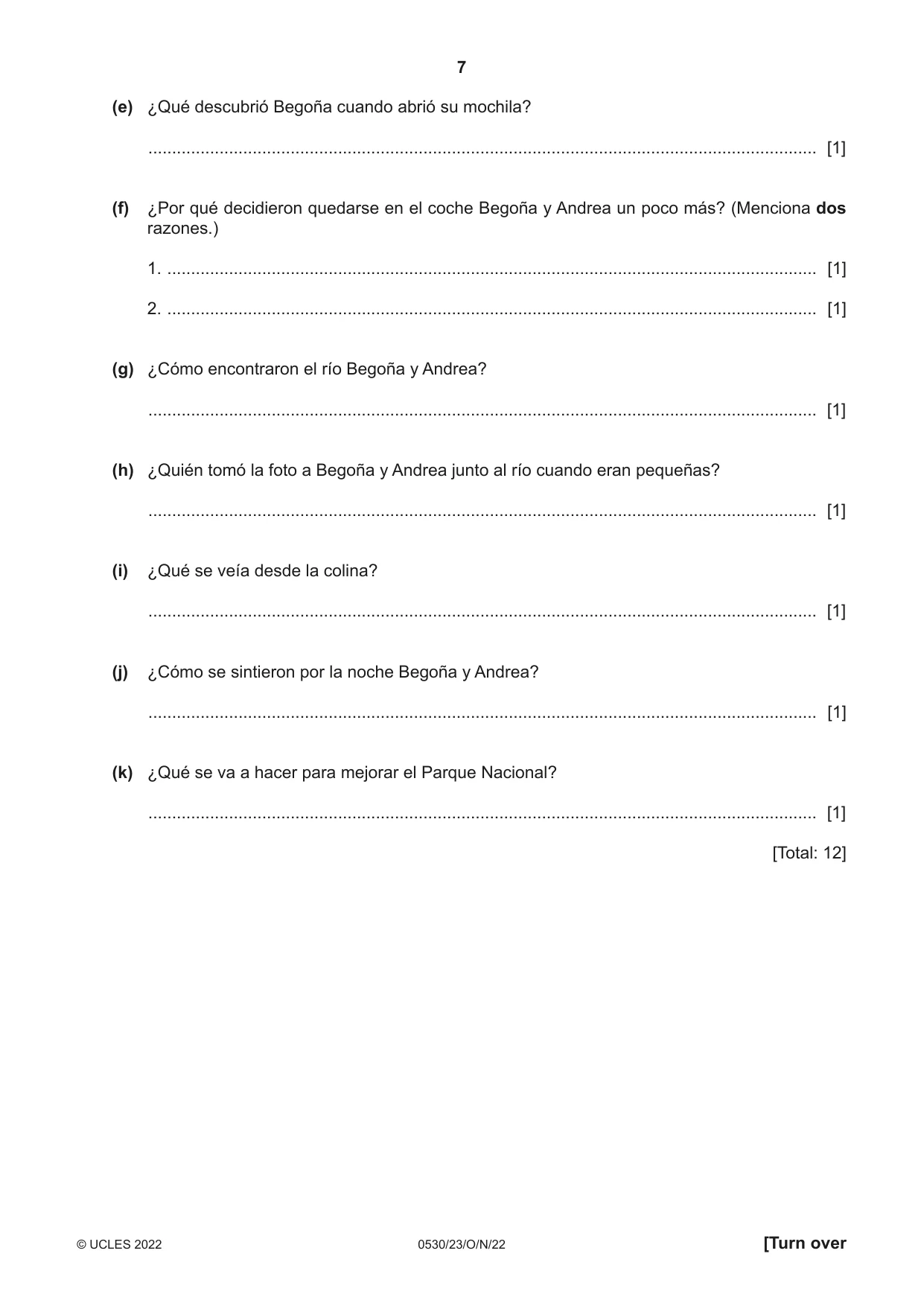
6 0530/23/O/N/22 © UCLES 2022 4 Lee el texto. Contesta a las preguntas en español. Excursión al Parque Nacional En agosto, para recordar viejos tiempos, Begoña y Andrea Pérez, dos hermanas chilenas de 60 y 61 años, tuvieron la idea de hacer una excursión al Parque Nacional de la Castellana, famoso por su río. “Han pasado 50 años desde que visitamos el parque con nuestra familia,” dijo Andrea. Primero, alquilaron un coche y, como los campings les parecían incómodos, reservaron una habitación en un hotel. El viaje hasta el parque duró tres horas y, en cuanto llegaron, miraron el paisaje. Luego, Begoña abrió su mochila para sacar el mapa. “¡Qué mal!” dijo al darse cuenta de que lo había olvidado. Como tenían frío, en vez de ponerse los abrigos, decidieron esperar en el coche un rato. Aún peor, estaba a punto de llover. Poco después, una chica paró a hablar con ellas. Cuando le dijeron que no sabían cómo ir al río, insistió en acompañarlas. Después de media hora, llegaron allí con la ayuda de la chica, que conocía la zona. “¿Por qué no hacemos una foto aquí como la que nos hizo nuestro tío?” dijo Begoña. Dieron las gracias a la chica que, antes de irse, les recomendó subir a la colina cercana para ver las hermosas vistas del mar. En el camino de vuelta, las hermanas se perdieron. Por suerte, antes de anochecer, encontraron el coche. “¡Qué cansadas estamos! ¿Verdad?” dijo Andrea. Al día siguiente hablaron con el ayuntamiento y, gracias a ellas, se van a poner más señales en el parque. “¡Así la próxima vez no nos perderemos!” dijo Begoña. (a) ¿Para qué fueron de excursión Begoña y Andrea al Parque Nacional? … [1] (b) ¿Cuánto tiempo hacía que Begoña y Andrea fueron al Parque Nacional con su familia? … [1] (c) ¿Por qué quisieron alojarse en un hotel Begoña y Andrea? … [1] (d) ¿Qué fue lo primero que hicieron Begoña y Andrea en el Parque Nacional? … [1]
Question paper, page 7
7 0530/23/O/N/22 © UCLES 2022 [Turn over (e) ¿Qué descubrió Begoña cuando abrió su mochila? … [1] (f) ¿Por qué decidieron quedarse en el coche Begoña y Andrea un poco más? (Menciona dos razones.) 1. … [1] 2. … [1] (g) ¿Cómo encontraron el río Begoña y Andrea? … [1] (h) ¿Quién tomó la foto a Begoña y Andrea junto al río cuando eran pequeñas? … [1] (i) ¿Qué se veía desde la colina? … [1] (j) ¿Cómo se sintieron por la noche Begoña y Andrea? … [1] (k) ¿Qué se va a hacer para mejorar el Parque Nacional? … [1] [Total: 12]
Question paper, page 8
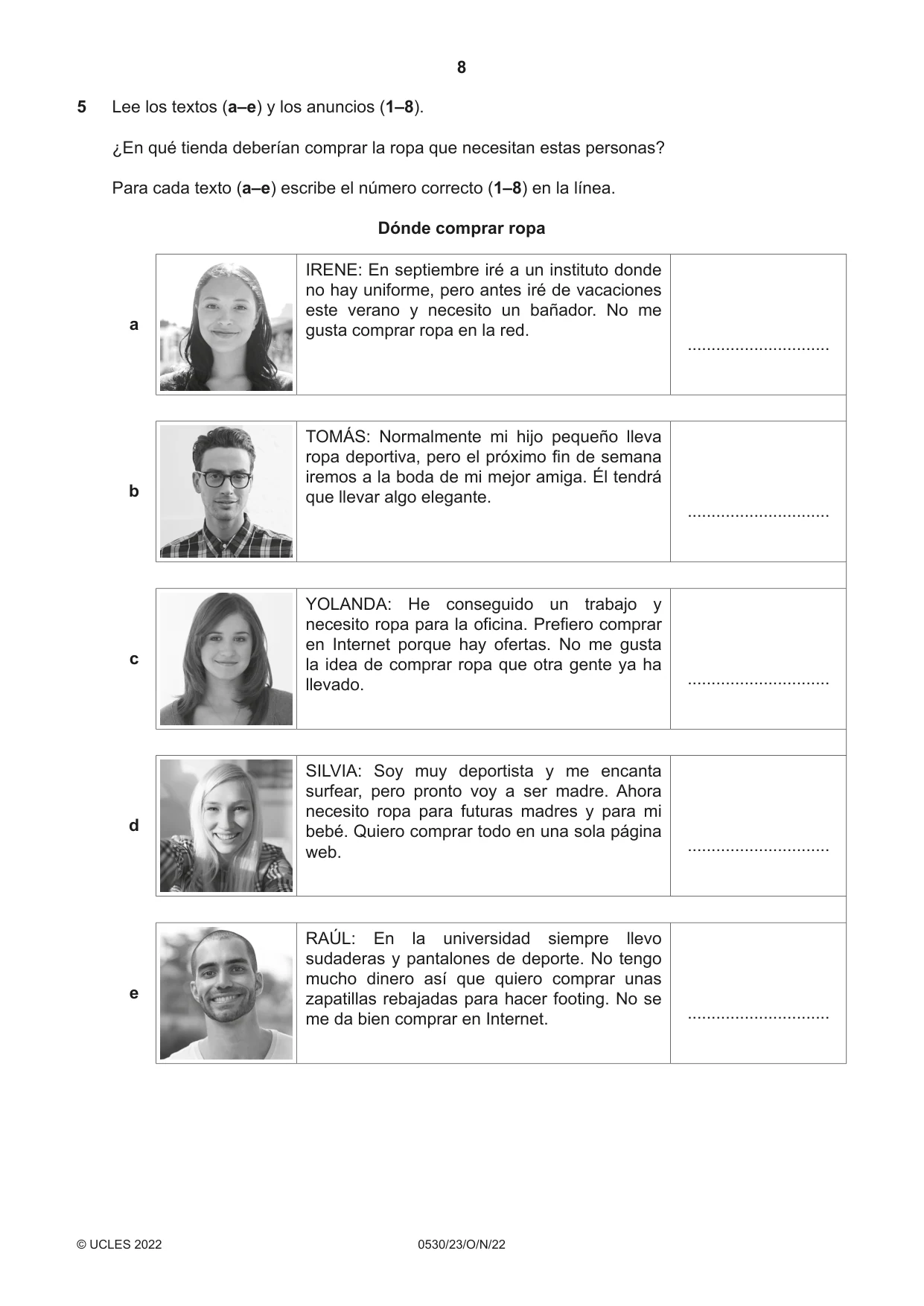
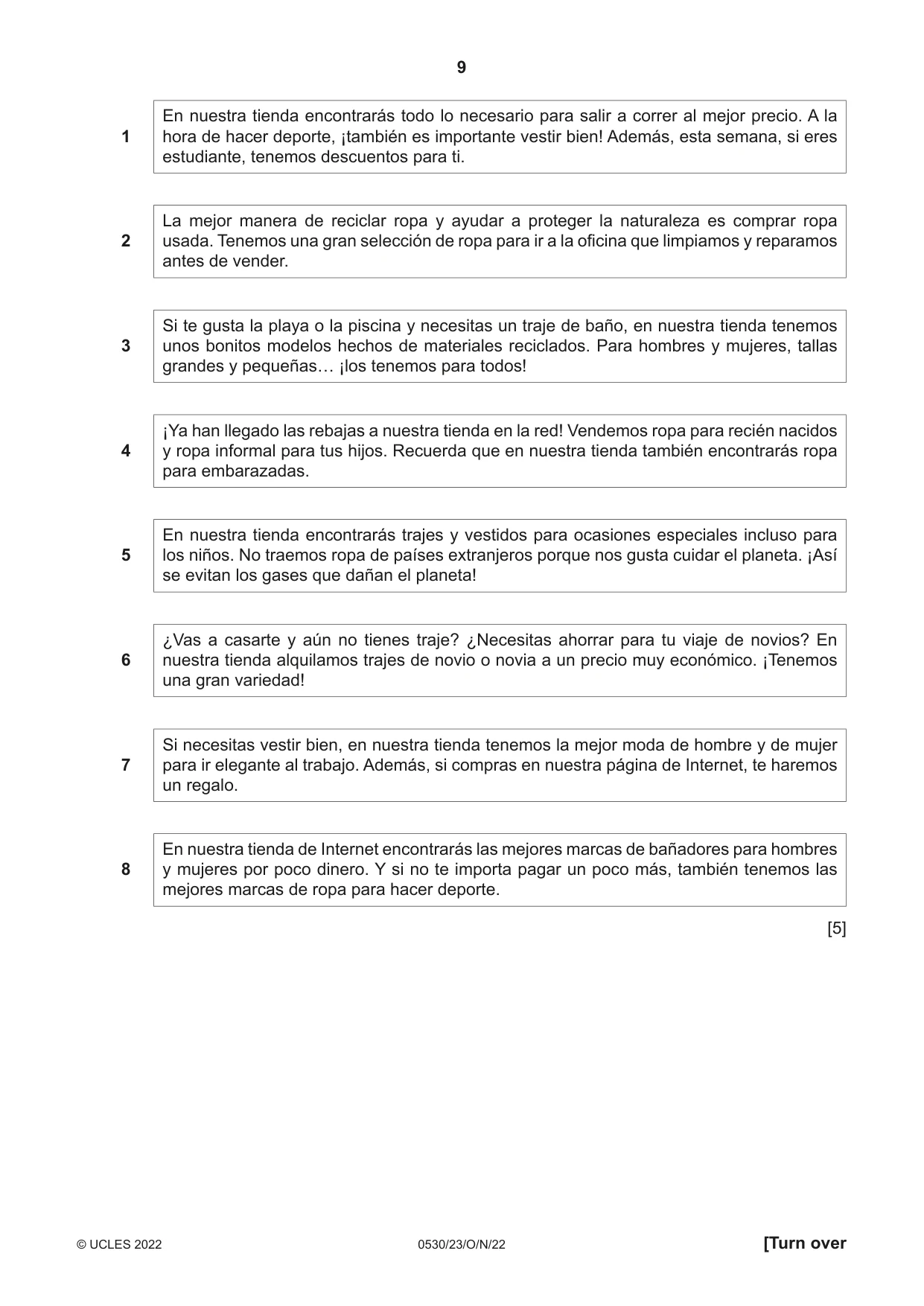
8 0530/23/O/N/22 © UCLES 2022 5 Lee los textos (a–e) y los anuncios (1–8). ¿En qué tienda deberían comprar la ropa que necesitan estas personas? Para cada texto (a–e) escribe el número correcto (1–8) en la línea. Dónde comprar ropa a IRENE: En septiembre iré a un instituto donde no hay uniforme, pero antes iré de vacaciones este verano y necesito un bañador. No me gusta comprar ropa en la red. … b TOMÁS: Normalmente mi hijo pequeño lleva ropa deportiva, pero el próximo fin de semana iremos a la boda de mi mejor amiga. Él tendrá que llevar algo elegante. … c YOLANDA: He conseguido un trabajo y necesito ropa para la oficina. Prefiero comprar en Internet porque hay ofertas. No me gusta la idea de comprar ropa que otra gente ya ha llevado. … d SILVIA: Soy muy deportista y me encanta surfear, pero pronto voy a ser madre. Ahora necesito ropa para futuras madres y para mi bebé. Quiero comprar todo en una sola página web. … e RAÚL: En la universidad siempre llevo sudaderas y pantalones de deporte. No tengo mucho dinero así que quiero comprar unas zapatillas rebajadas para hacer footing. No se me da bien comprar en Internet. …
Question paper, page 9
9 0530/23/O/N/22 © UCLES 2022 [Turn over 1 En nuestra tienda encontrarás todo lo necesario para salir a correr al mejor precio. A la hora de hacer deporte, ¡también es importante vestir bien! Además, esta semana, si eres estudiante, tenemos descuentos para ti. 2 La mejor manera de reciclar ropa y ayudar a proteger la naturaleza es comprar ropa usada. Tenemos una gran selección de ropa para ir a la oficina que limpiamos y reparamos antes de vender. 3 Si te gusta la playa o la piscina y necesitas un traje de baño, en nuestra tienda tenemos unos bonitos modelos hechos de materiales reciclados. Para hombres y mujeres, tallas grandes y pequeñas… ¡los tenemos para todos! 4 ¡Ya han llegado las rebajas a nuestra tienda en la red! Vendemos ropa para recién nacidos y ropa informal para tus hijos. Recuerda que en nuestra tienda también encontrarás ropa para embarazadas. 5 En nuestra tienda encontrarás trajes y vestidos para ocasiones especiales incluso para los niños. No traemos ropa de países extranjeros porque nos gusta cuidar el planeta. ¡Así se evitan los gases que dañan el planeta! 6 ¿Vas a casarte y aún no tienes traje? ¿Necesitas ahorrar para tu viaje de novios? En nuestra tienda alquilamos trajes de novio o novia a un precio muy económico. ¡Tenemos una gran variedad! 7 Si necesitas vestir bien, en nuestra tienda tenemos la mejor moda de hombre y de mujer para ir elegante al trabajo. Además, si compras en nuestra página de Internet, te haremos un regalo. 8 En nuestra tienda de Internet encontrarás las mejores marcas de bañadores para hombres y mujeres por poco dinero. Y si no te importa pagar un poco más, también tenemos las mejores marcas de ropa para hacer deporte. [5]
Question paper, page 10
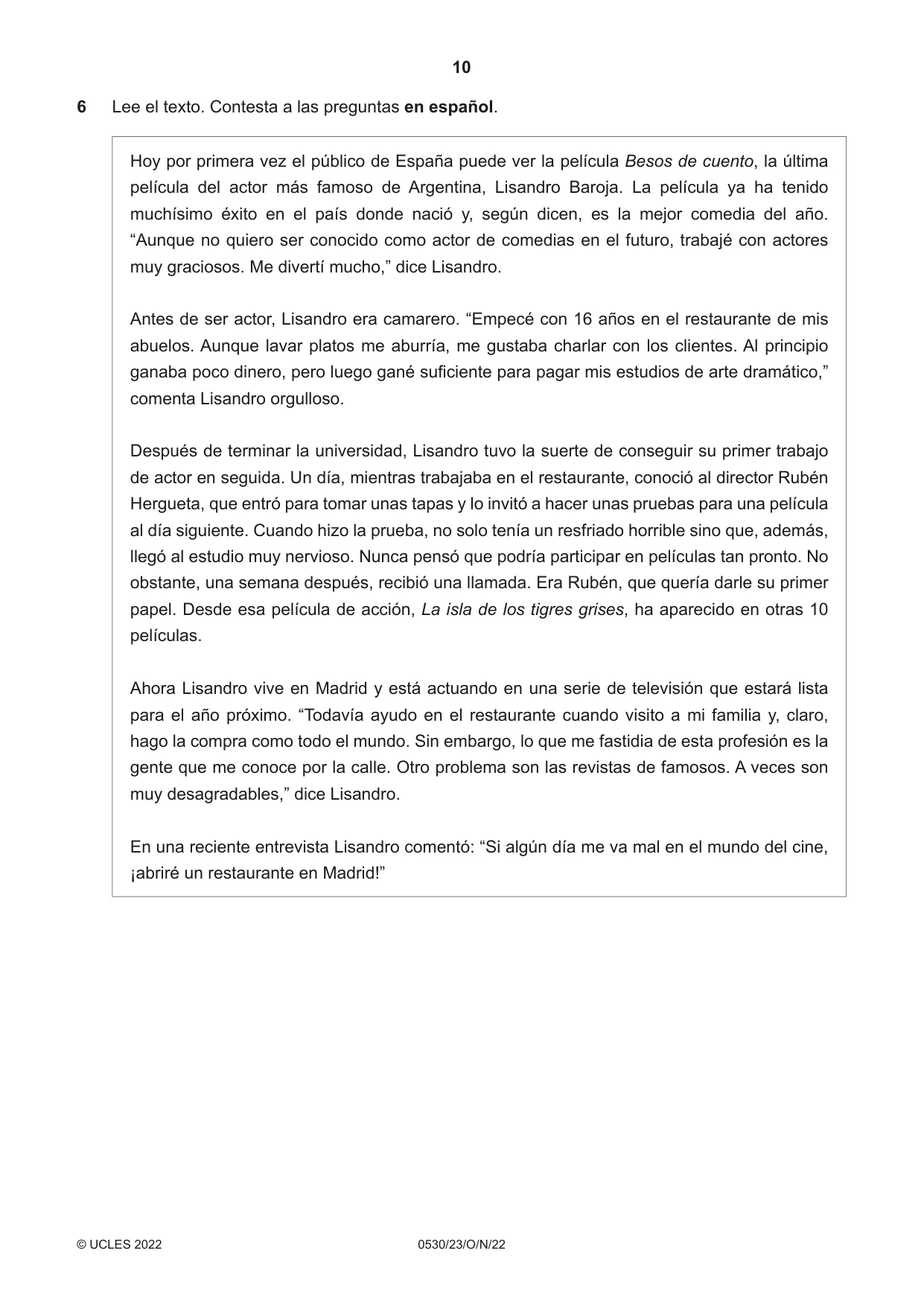
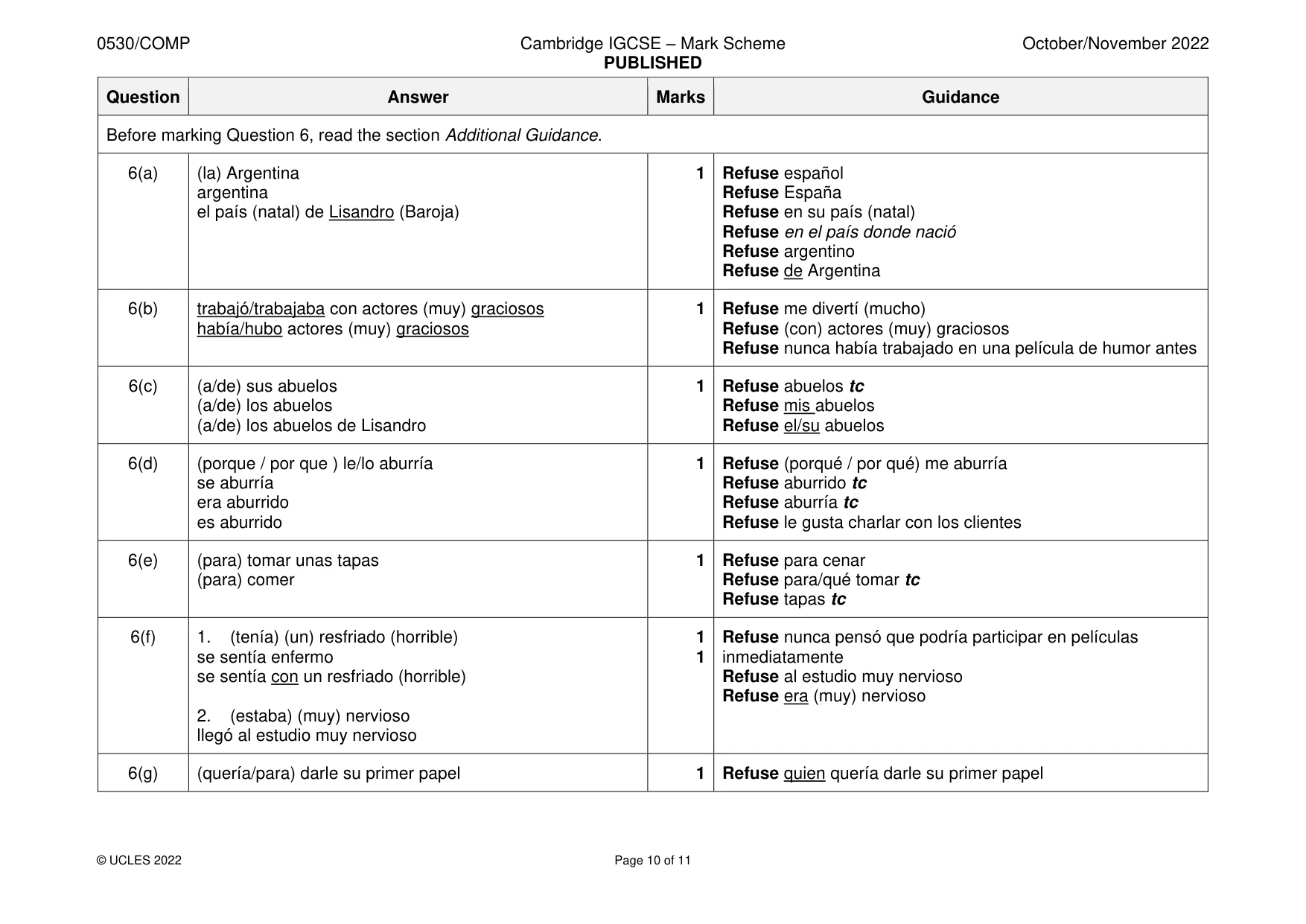
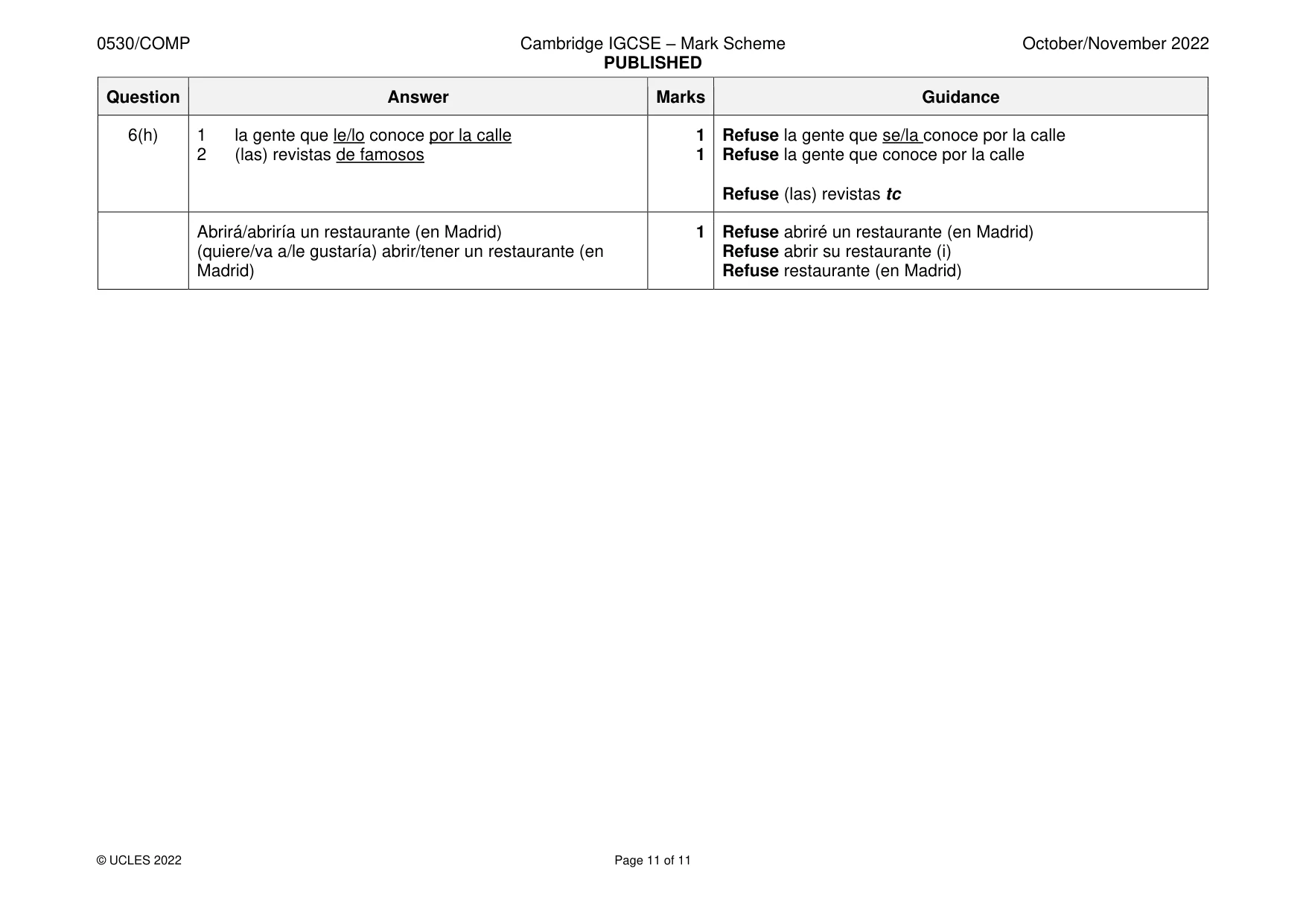
10 0530/23/O/N/22 © UCLES 2022 6 Lee el texto. Contesta a las preguntas en español. Hoy por primera vez el público de España puede ver la película Besos de cuento, la última película del actor más famoso de Argentina, Lisandro Baroja. La película ya ha tenido muchísimo éxito en el país donde nació y, según dicen, es la mejor comedia del año. “Aunque no quiero ser conocido como actor de comedias en el futuro, trabajé con actores muy graciosos. Me divertí mucho,” dice Lisandro. Antes de ser actor, Lisandro era camarero. “Empecé con 16 años en el restaurante de mis abuelos. Aunque lavar platos me aburría, me gustaba charlar con los clientes. Al principio ganaba poco dinero, pero luego gané suficiente para pagar mis estudios de arte dramático,” comenta Lisandro orgulloso. Después de terminar la universidad, Lisandro tuvo la suerte de conseguir su primer trabajo de actor en seguida. Un día, mientras trabajaba en el restaurante, conoció al director Rubén Hergueta, que entró para tomar unas tapas y lo invitó a hacer unas pruebas para una película al día siguiente. Cuando hizo la prueba, no solo tenía un resfriado horrible sino que, además, llegó al estudio muy nervioso. Nunca pensó que podría participar en películas tan pronto. No obstante, una semana después, recibió una llamada. Era Rubén, que quería darle su primer papel. Desde esa película de acción, La isla de los tigres grises, ha aparecido en otras 10 películas. Ahora Lisandro vive en Madrid y está actuando en una serie de televisión que estará lista para el año próximo. “Todavía ayudo en el restaurante cuando visito a mi familia y, claro, hago la compra como todo el mundo. Sin embargo, lo que me fastidia de esta profesión es la gente que me conoce por la calle. Otro problema son las revistas de famosos. A veces son muy desagradables,” dice Lisandro. En una reciente entrevista Lisandro comentó: “Si algún día me va mal en el mundo del cine, ¡abriré un restaurante en Madrid!”
Question paper, page 11
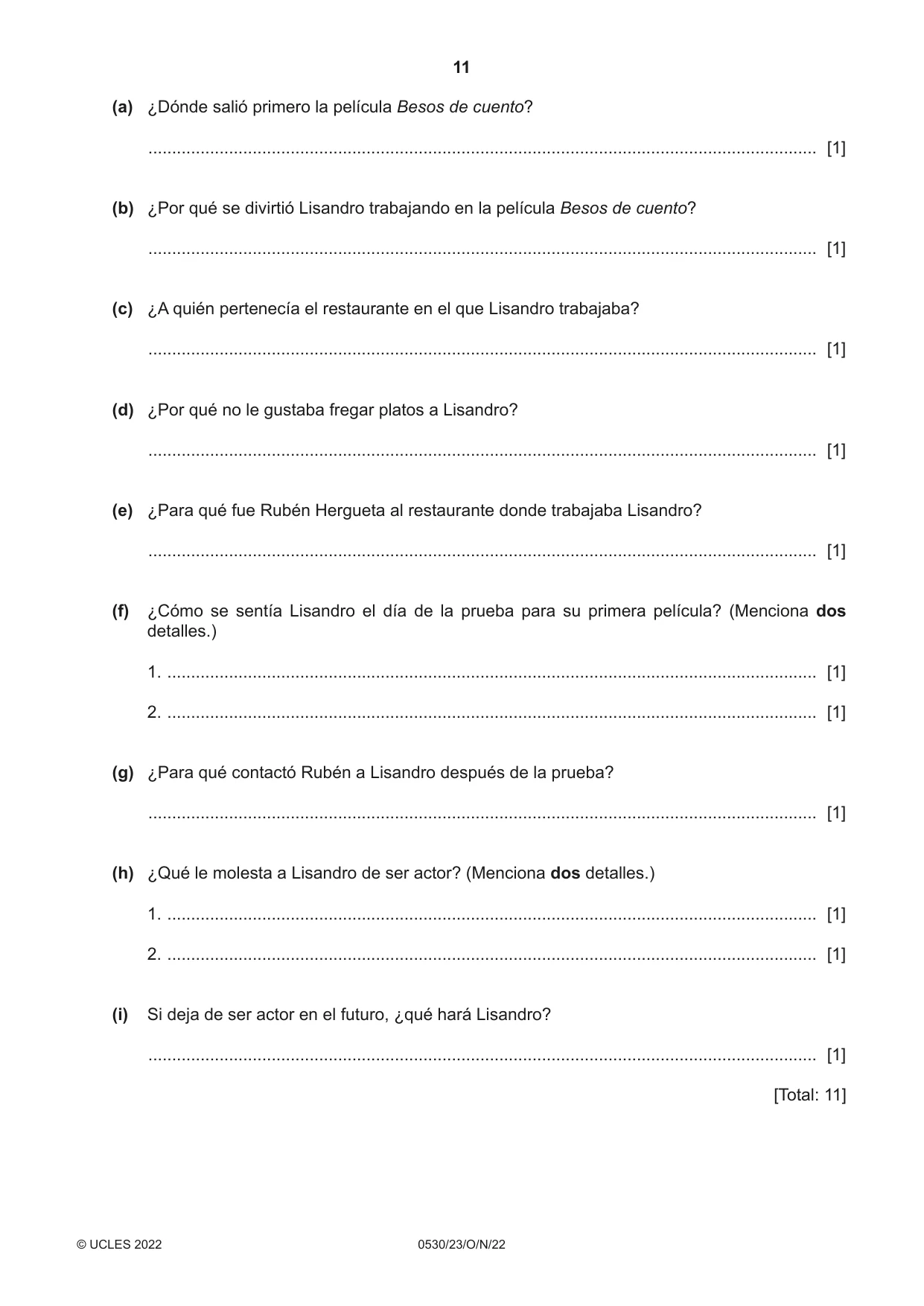
11 0530/23/O/N/22 © UCLES 2022 (a) ¿Dónde salió primero la película Besos de cuento? … [1] (b) ¿Por qué se divirtió Lisandro trabajando en la película Besos de cuento? … [1] (c) ¿A quién pertenecía el restaurante en el que Lisandro trabajaba? … [1] (d) ¿Por qué no le gustaba fregar platos a Lisandro? … [1] (e) ¿Para qué fue Rubén Hergueta al restaurante donde trabajaba Lisandro? … [1] (f) ¿Cómo se sentía Lisandro el día de la prueba para su primera película? (Menciona dos detalles.) 1. … [1] 2. … [1] (g) ¿Para qué contactó Rubén a Lisandro después de la prueba? … [1] (h) ¿Qué le molesta a Lisandro de ser actor? (Menciona dos detalles.) 1. … [1] 2. … [1] (i) Si deja de ser actor en el futuro, ¿qué hará Lisandro? … [1] [Total: 11]
Question paper, page 12
12 0530/23/O/N/22 © UCLES 2022 Permission to reproduce items where third-party owned material protected by copyright is included has been sought and cleared where possible. Every reasonable effort has been made by the publisher (UCLES) to trace copyright holders, but if any items requiring clearance have unwittingly been included, the publisher will be pleased to make amends at the earliest possible opportunity. To avoid the issue of disclosure of answer-related information to candidates, all copyright acknowledgements are reproduced online in the Cambridge Assessment International Education Copyright Acknowledgements Booklet. This is produced for each series of examinations and is freely available to download at www.cambridgeinternational.org after the live examination series. Cambridge Assessment International Education is part of Cambridge Assessment. Cambridge Assessment is the brand name of the University of Cambridge Local Examinations Syndicate (UCLES), which is a department of the University of Cambridge. BLANK PAGE
Mark scheme, page 1
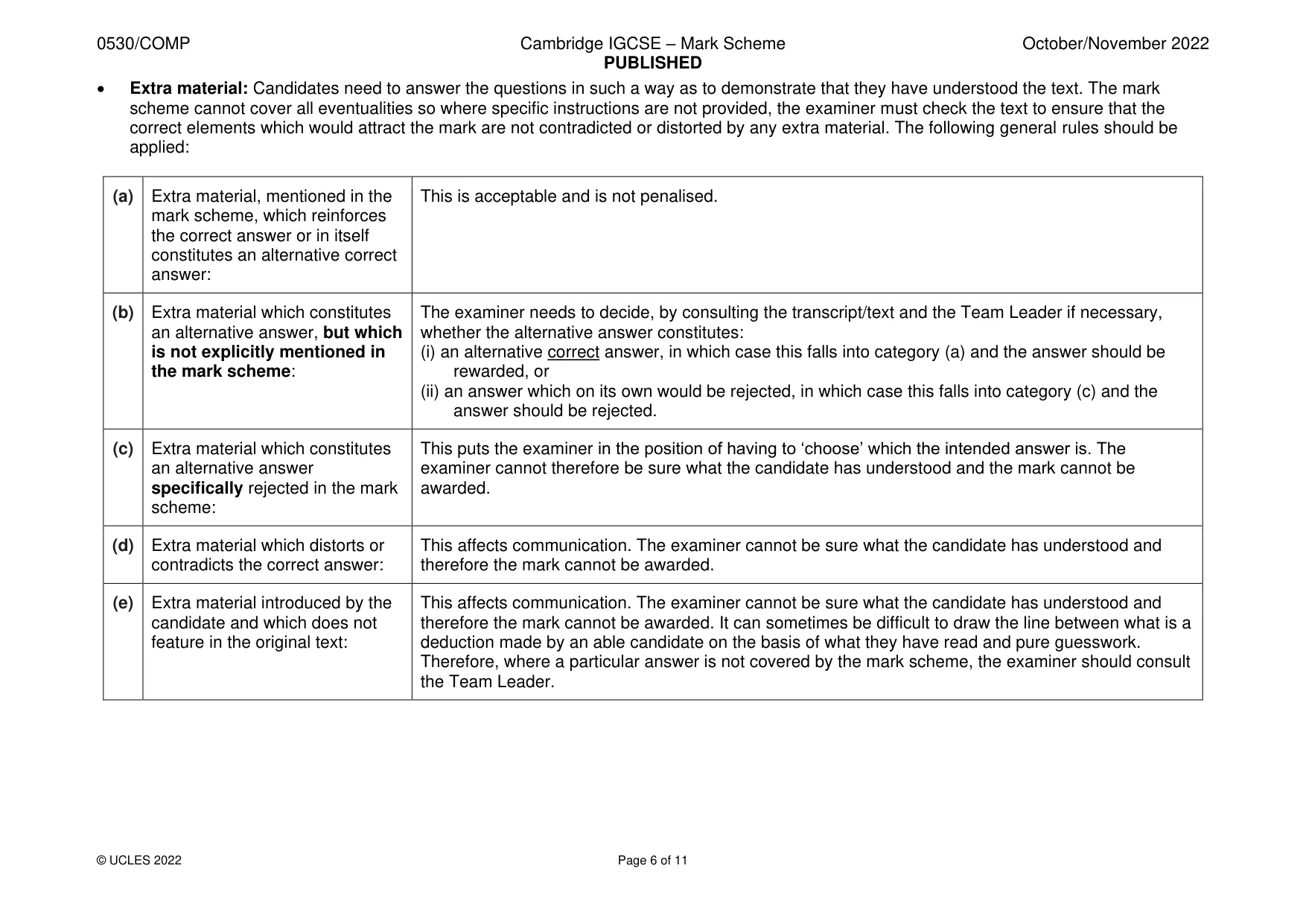
This document consists of 11 printed pages. © UCLES 2022 [Turn over Cambridge IGCSE™ SPANISH 0530/COMP Paper 2 Reading October/November 2022 MARK SCHEME Maximum Mark: 45 Published This mark scheme is published as an aid to teachers and candidates, to indicate the requirements of the examination. It shows the basis on which Examiners were instructed to award marks. It does not indicate the details of the discussions that took place at an Examiners’ meeting before marking began, which would have considered the acceptability of alternative answers. Mark schemes should be read in conjunction with the question paper and the Principal Examiner Report for Teachers. Cambridge International will not enter into discussions about these mark schemes. Cambridge International is publishing the mark schemes for the October/November 2022 series for most Cambridge IGCSE™, Cambridge International A and AS Level components and some Cambridge O Level components.
Mark scheme, page 2
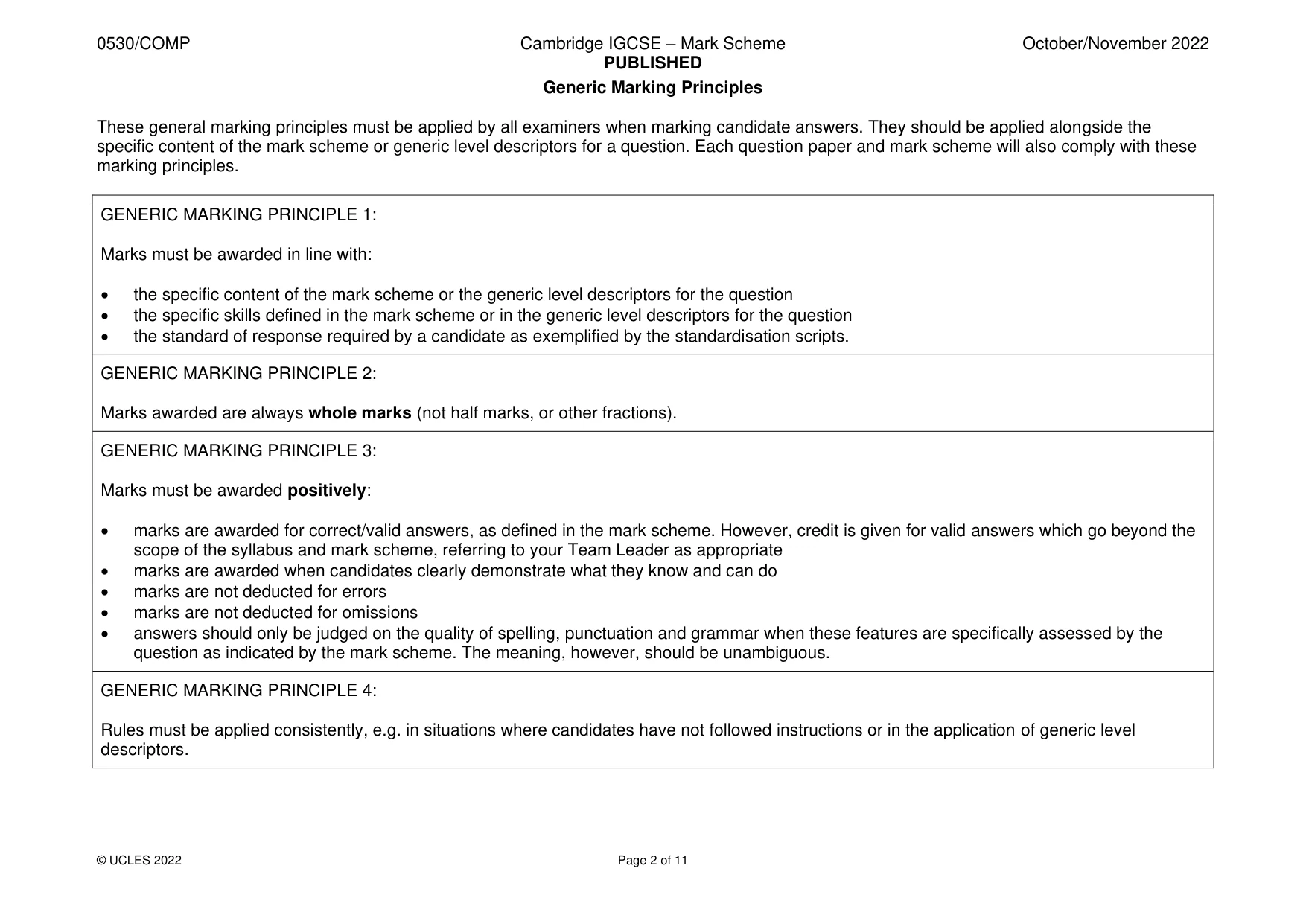
0530/COMP Cambridge IGCSE – Mark Scheme PUBLISHED October/November 2022 © UCLES 2022 Page 2 of 11 Generic Marking Principles These general marking principles must be applied by all examiners when marking candidate answers. They should be applied alongside the specific content of the mark scheme or generic level descriptors for a question. Each question paper and mark scheme will also comply with these marking principles. GENERIC MARKING PRINCIPLE 1: Marks must be awarded in line with: • the specific content of the mark scheme or the generic level descriptors for the question • the specific skills defined in the mark scheme or in the generic level descriptors for the question • the standard of response required by a candidate as exemplified by the standardisation scripts. GENERIC MARKING PRINCIPLE 2: Marks awarded are always whole marks (not half marks, or other fractions). GENERIC MARKING PRINCIPLE 3: Marks must be awarded positively: • marks are awarded for correct/valid answers, as defined in the mark scheme. However, credit is given for valid answers which go beyond the scope of the syllabus and mark scheme, referring to your Team Leader as appropriate • marks are awarded when candidates clearly demonstrate what they know and can do • marks are not deducted for errors • marks are not deducted for omissions • answers should only be judged on the quality of spelling, punctuation and grammar when these features are specifically assessed by the question as indicated by the mark scheme. The meaning, however, should be unambiguous. GENERIC MARKING PRINCIPLE 4: Rules must be applied consistently, e.g. in situations where candidates have not followed instructions or in the application of generic level descriptors.
Mark scheme, page 3
0530/COMP Cambridge IGCSE – Mark Scheme PUBLISHED October/November 2022 © UCLES 2022 Page 3 of 11 GENERIC MARKING PRINCIPLE 5: Marks should be awarded using the full range of marks defined in the mark scheme for the question (however; the use of the full mark range may be limited according to the quality of the candidate responses seen). GENERIC MARKING PRINCIPLE 6: Marks awarded are based solely on the requirements as defined in the mark scheme. Marks should not be awarded with grade thresholds or grade descriptors in mind.
Mark scheme, page 4
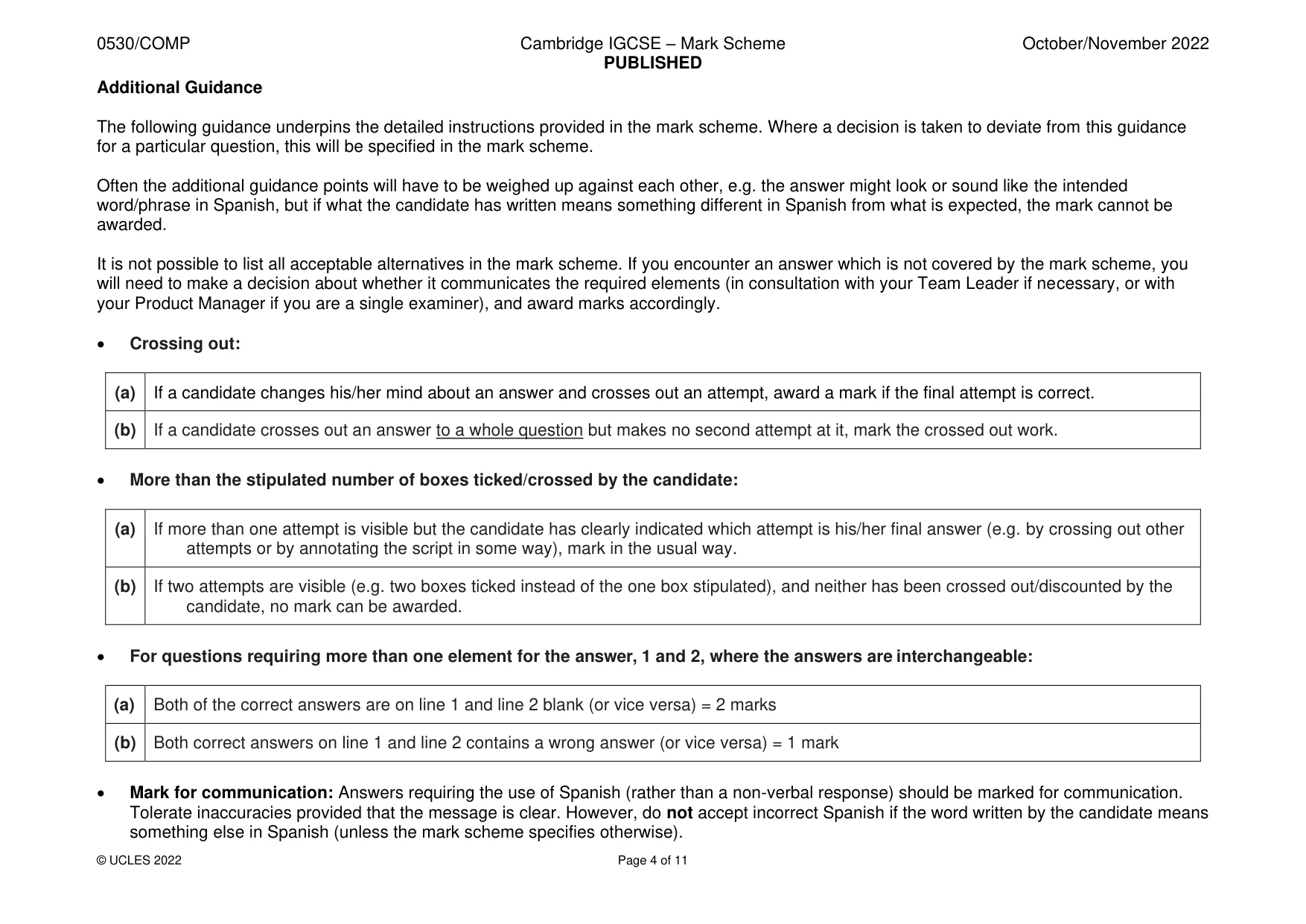
0530/COMP Cambridge IGCSE – Mark Scheme PUBLISHED October/November 2022 © UCLES 2022 Page 4 of 11 Additional Guidance The following guidance underpins the detailed instructions provided in the mark scheme. Where a decision is taken to deviate from this guidance for a particular question, this will be specified in the mark scheme. Often the additional guidance points will have to be weighed up against each other, e.g. the answer might look or sound like the intended word/phrase in Spanish, but if what the candidate has written means something different in Spanish from what is expected, the mark cannot be awarded. It is not possible to list all acceptable alternatives in the mark scheme. If you encounter an answer which is not covered by the mark scheme, you will need to make a decision about whether it communicates the required elements (in consultation with your Team Leader if necessary, or with your Product Manager if you are a single examiner), and award marks accordingly. • Crossing out: (a) If a candidate changes his/her mind about an answer and crosses out an attempt, award a mark if the final attempt is correct. (b) If a candidate crosses out an answer to a whole question but makes no second attempt at it, mark the crossed out work. • More than the stipulated number of boxes ticked/crossed by the candidate: (a) If more than one attempt is visible but the candidate has clearly indicated which attempt is his/her final answer (e.g. by crossing out other attempts or by annotating the script in some way), mark in the usual way. (b) If two attempts are visible (e.g. two boxes ticked instead of the one box stipulated), and neither has been crossed out/discounted by the candidate, no mark can be awarded. • For questions requiring more than one element for the answer, 1 and 2, where the answers are interchangeable: (a) Both of the correct answers are on line 1 and line 2 blank (or vice versa) = 2 marks (b) Both correct answers on line 1 and line 2 contains a wrong answer (or vice versa) = 1 mark • Mark for communication: Answers requiring the use of Spanish (rather than a non-verbal response) should be marked for communication. Tolerate inaccuracies provided that the message is clear. However, do not accept incorrect Spanish if the word written by the candidate means something else in Spanish (unless the mark scheme specifies otherwise).
Mark scheme, page 5
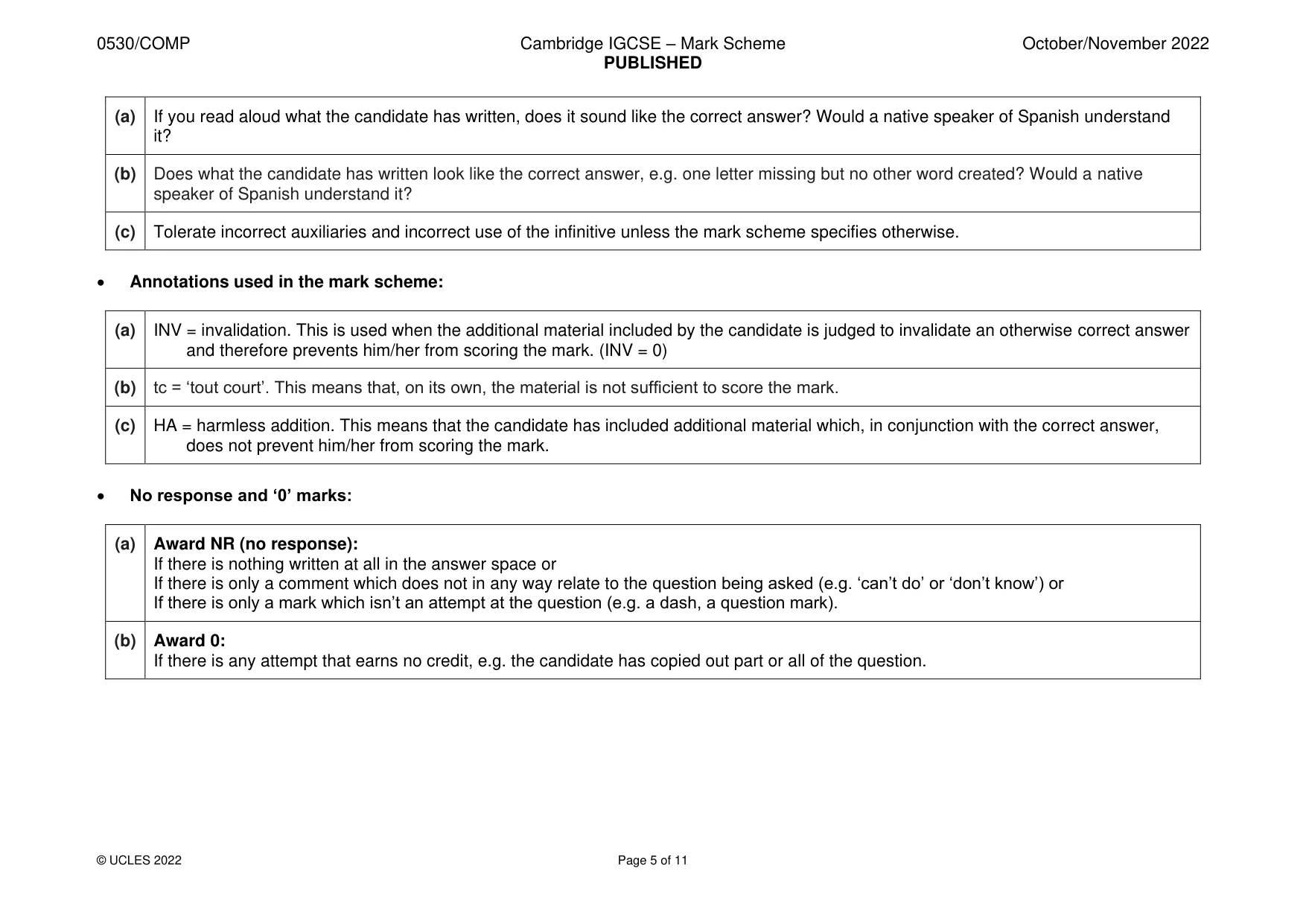
0530/COMP Cambridge IGCSE – Mark Scheme PUBLISHED October/November 2022 © UCLES 2022 Page 5 of 11 (a) If you read aloud what the candidate has written, does it sound like the correct answer? Would a native speaker of Spanish understand it? (b) Does what the candidate has written look like the correct answer, e.g. one letter missing but no other word created? Would a native speaker of Spanish understand it? (c) Tolerate incorrect auxiliaries and incorrect use of the infinitive unless the mark scheme specifies otherwise. • Annotations used in the mark scheme: (a) INV = invalidation. This is used when the additional material included by the candidate is judged to invalidate an otherwise correct answer and therefore prevents him/her from scoring the mark. (INV = 0) (b) tc = ‘tout court’. This means that, on its own, the material is not sufficient to score the mark. (c) HA = harmless addition. This means that the candidate has included additional material which, in conjunction with the correct answer, does not prevent him/her from scoring the mark. • No response and ‘0’ marks: (a) Award NR (no response): If there is nothing written at all in the answer space or If there is only a comment which does not in any way relate to the question being asked (e.g. ‘can’t do’ or ‘don’t know’) or If there is only a mark which isn’t an attempt at the question (e.g. a dash, a question mark). (b) Award 0: If there is any attempt that earns no credit, e.g. the candidate has copied out part or all of the question.
Mark scheme, page 6
0530/COMP Cambridge IGCSE – Mark Scheme PUBLISHED October/November 2022 © UCLES 2022 Page 6 of 11 • Extra material: Candidates need to answer the questions in such a way as to demonstrate that they have understood the text. The mark scheme cannot cover all eventualities so where specific instructions are not provided, the examiner must check the text to ensure that the correct elements which would attract the mark are not contradicted or distorted by any extra material. The following general rules should be applied: (a) Extra material, mentioned in the mark scheme, which reinforces the correct answer or in itself constitutes an alternative correct answer: This is acceptable and is not penalised. (b) Extra material which constitutes an alternative answer, but which is not explicitly mentioned in the mark scheme: The examiner needs to decide, by consulting the transcript/text and the Team Leader if necessary, whether the alternative answer constitutes: (i) an alternative correct answer, in which case this falls into category (a) and the answer should be rewarded, or (ii) an answer which on its own would be rejected, in which case this falls into category (c) and the answer should be rejected. (c) Extra material which constitutes an alternative answer specifically rejected in the mark scheme: This puts the examiner in the position of having to ‘choose’ which the intended answer is. The examiner cannot therefore be sure what the candidate has understood and the mark cannot be awarded. (d) Extra material which distorts or contradicts the correct answer: This affects communication. The examiner cannot be sure what the candidate has understood and therefore the mark cannot be awarded. (e) Extra material introduced by the candidate and which does not feature in the original text: This affects communication. The examiner cannot be sure what the candidate has understood and therefore the mark cannot be awarded. It can sometimes be difficult to draw the line between what is a deduction made by an able candidate on the basis of what they have read and pure guesswork. Therefore, where a particular answer is not covered by the mark scheme, the examiner should consult the Team Leader.
Mark scheme, page 7
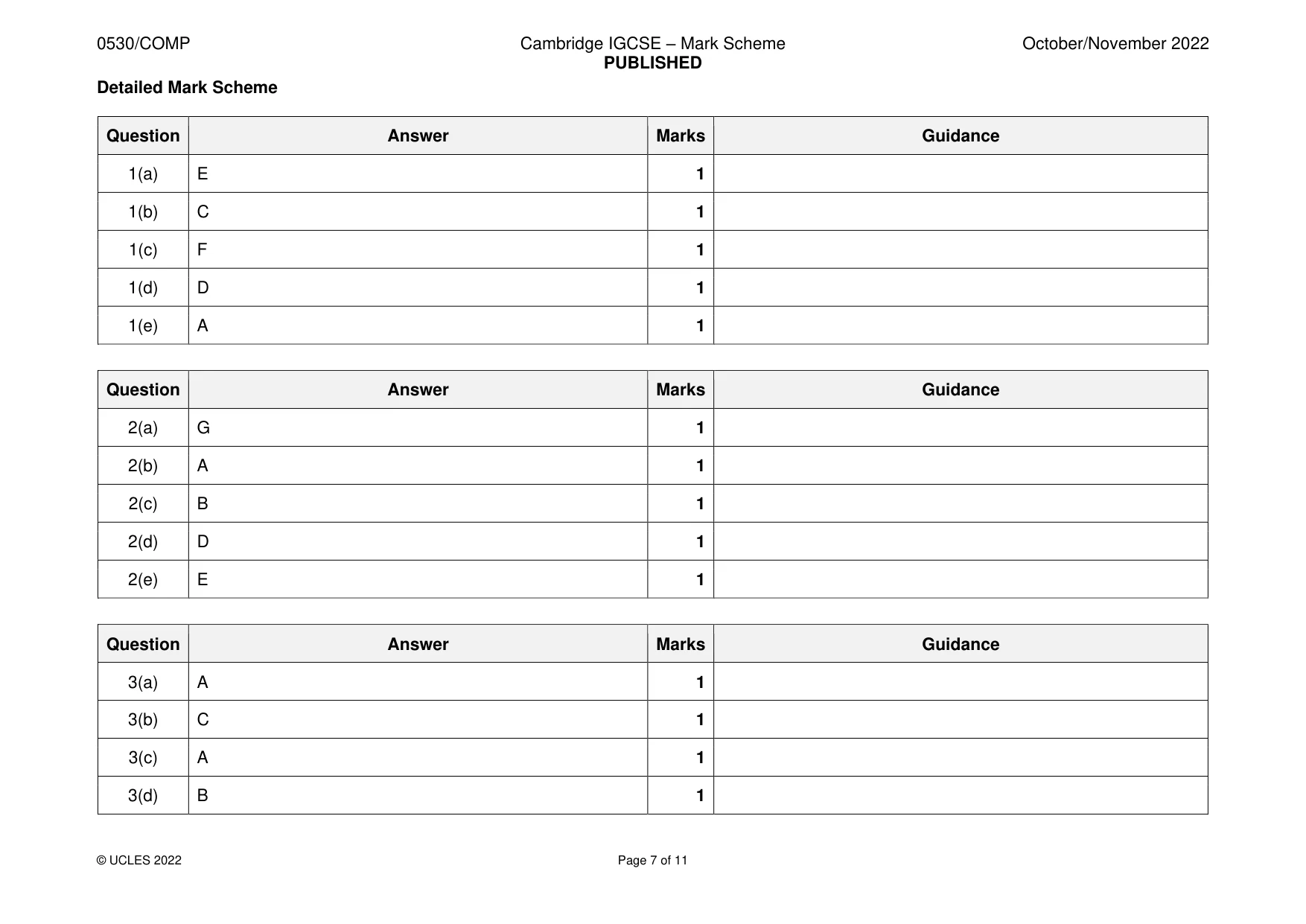
0530/COMP Cambridge IGCSE – Mark Scheme PUBLISHED October/November 2022 © UCLES 2022 Page 7 of 11 Detailed Mark Scheme Question Answer Marks Guidance 1(a) E 1 1(b) C 1 1(c) F 1 1(d) D 1 1(e) A 1 Question Answer Marks Guidance 2(a) G 1 2(b) A 1 2(c) B 1 2(d) D 1 2(e) E 1 Question Answer Marks Guidance 3(a) A 1 3(b) C 1 3(c) A 1 3(d) B 1
Mark scheme, page 8
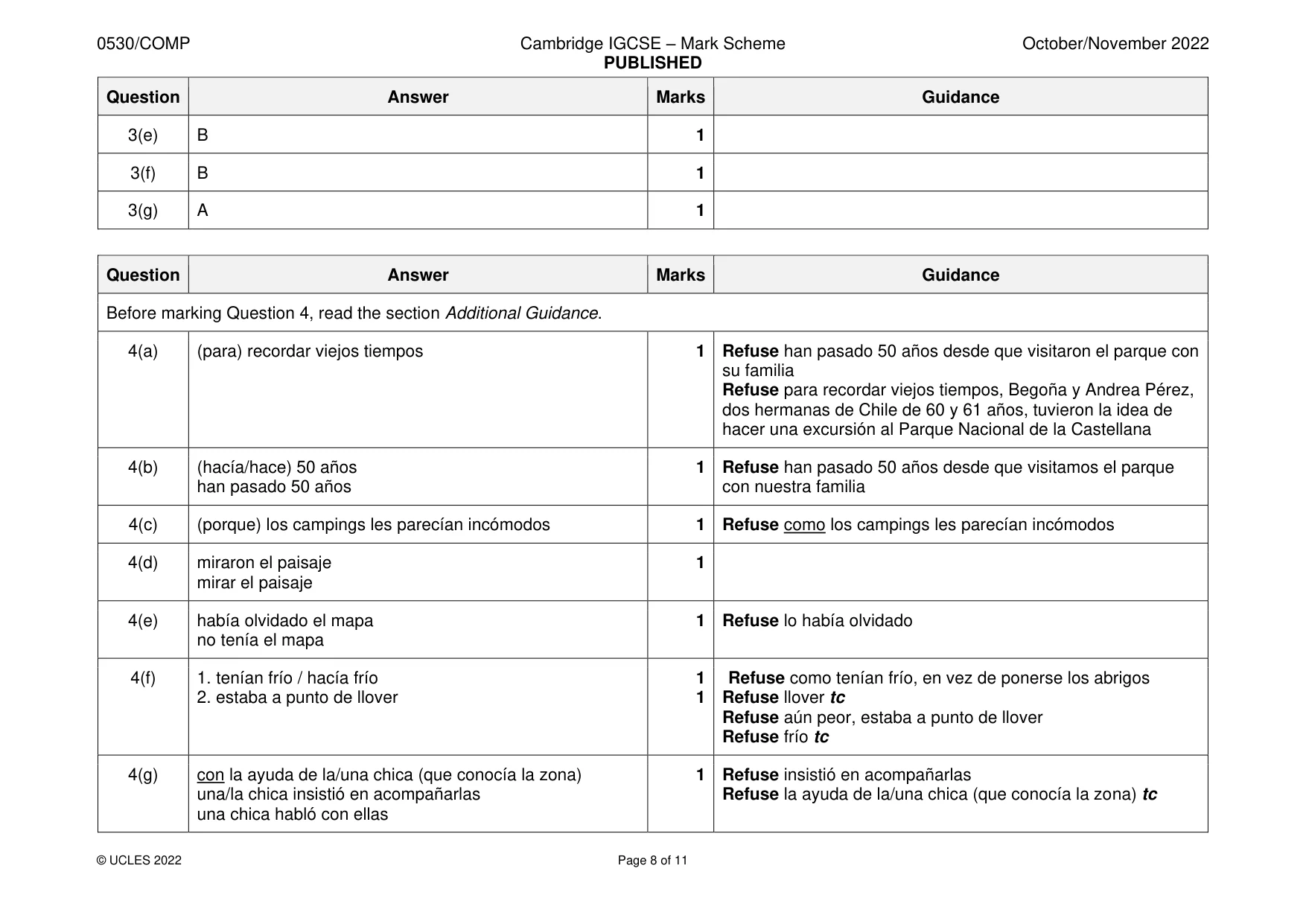
0530/COMP Cambridge IGCSE – Mark Scheme PUBLISHED October/November 2022 © UCLES 2022 Page 8 of 11 Question Answer Marks Guidance 3(e) B 1 3(f) B 1 3(g) A 1 Question Answer Marks Guidance Before marking Question 4, read the section Additional Guidance. 4(a) (para) recordar viejos tiempos 1 Refuse han pasado 50 años desde que visitaron el parque con su familia Refuse para recordar viejos tiempos, Begoña y Andrea Pérez, dos hermanas de Chile de 60 y 61 años, tuvieron la idea de hacer una excursión al Parque Nacional de la Castellana 4(b) (hacía/hace) 50 años han pasado 50 años 1 Refuse han pasado 50 años desde que visitamos el parque con nuestra familia 4(c) (porque) los campings les parecían incómodos 1 Refuse como los campings les parecían incómodos 4(d) miraron el paisaje mirar el paisaje 1 4(e) había olvidado el mapa no tenía el mapa 1 Refuse lo había olvidado 4(f) 1. tenían frío / hacía frío 2. estaba a punto de llover 1 1 Refuse como tenían frío, en vez de ponerse los abrigos Refuse llover tc Refuse aún peor, estaba a punto de llover Refuse frío tc 4(g) con la ayuda de la/una chica (que conocía la zona) una/la chica insistió en acompañarlas una chica habló con ellas 1 Refuse insistió en acompañarlas Refuse la ayuda de la/una chica (que conocía la zona) tc
Mark scheme, page 9
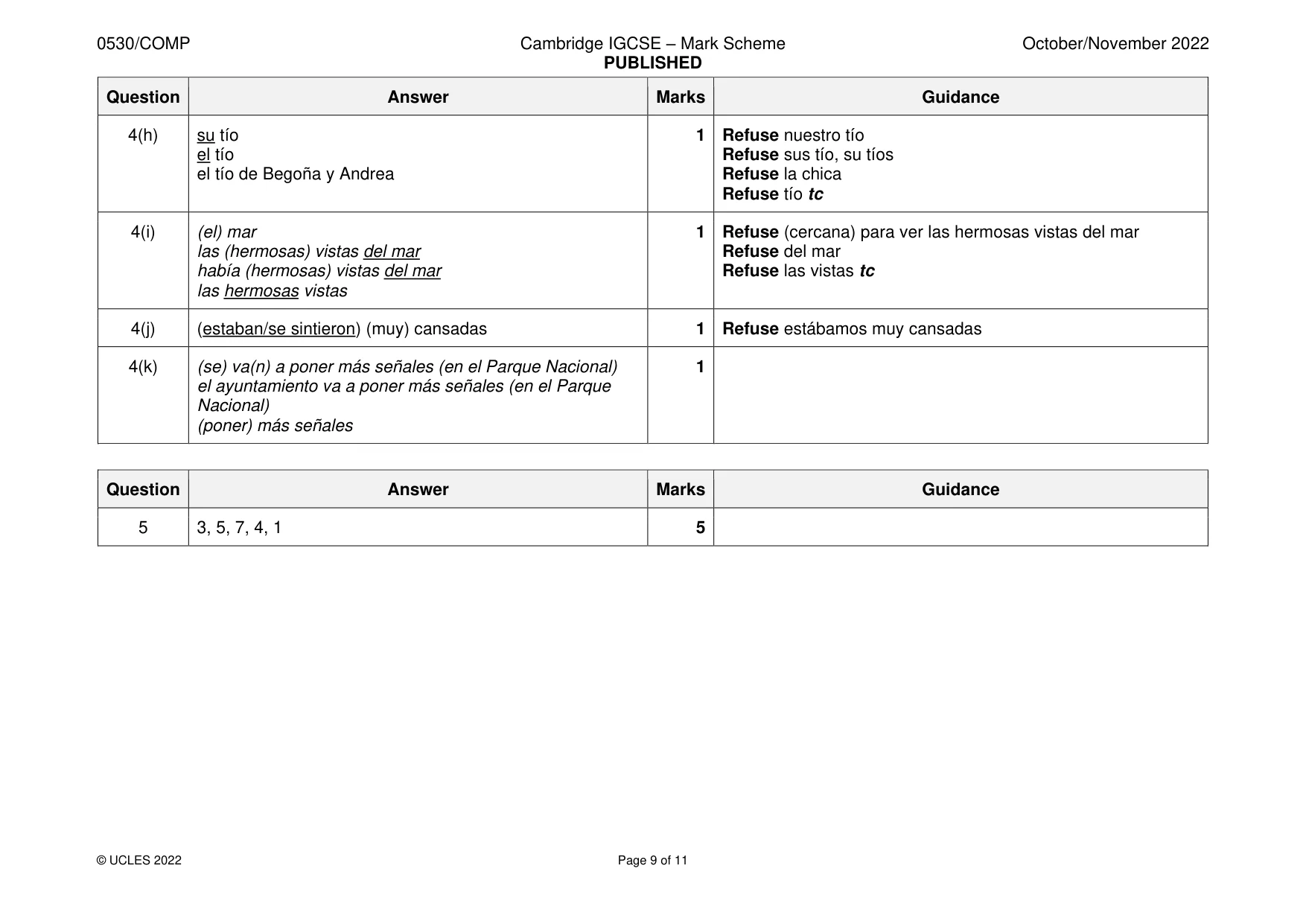
0530/COMP Cambridge IGCSE – Mark Scheme PUBLISHED October/November 2022 © UCLES 2022 Page 9 of 11 Question Answer Marks Guidance 4(h) su tío el tío el tío de Begoña y Andrea 1 Refuse nuestro tío Refuse sus tío, su tíos Refuse la chica Refuse tío tc 4(i) (el) mar las (hermosas) vistas del mar había (hermosas) vistas del mar las hermosas vistas 1 Refuse (cercana) para ver las hermosas vistas del mar Refuse del mar Refuse las vistas tc 4(j) (estaban/se sintieron) (muy) cansadas 1 Refuse estábamos muy cansadas 4(k) (se) va(n) a poner más señales (en el Parque Nacional) el ayuntamiento va a poner más señales (en el Parque Nacional) (poner) más señales 1 Question Answer Marks Guidance 5 3, 5, 7, 4, 1 5
Mark scheme, page 10
0530/COMP Cambridge IGCSE – Mark Scheme PUBLISHED October/November 2022 © UCLES 2022 Page 10 of 11 Question Answer Marks Guidance Before marking Question 6, read the section Additional Guidance. 6(a) (la) Argentina argentina el país (natal) de Lisandro (Baroja) 1 Refuse español Refuse España Refuse en su país (natal) Refuse en el país donde nació Refuse argentino Refuse de Argentina 6(b) trabajó/trabajaba con actores (muy) graciosos había/hubo actores (muy) graciosos 1 Refuse me divertí (mucho) Refuse (con) actores (muy) graciosos Refuse nunca había trabajado en una película de humor antes 6(c) (a/de) sus abuelos (a/de) los abuelos (a/de) los abuelos de Lisandro 1 Refuse abuelos tc Refuse mis abuelos Refuse el/su abuelos 6(d) (porque / por que ) le/lo aburría se aburría era aburrido es aburrido 1 Refuse (porqué / por qué) me aburría Refuse aburrido tc Refuse aburría tc Refuse le gusta charlar con los clientes 6(e) (para) tomar unas tapas (para) comer 1 Refuse para cenar Refuse para/qué tomar tc Refuse tapas tc 6(f) 1. (tenía) (un) resfriado (horrible) se sentía enfermo se sentía con un resfriado (horrible) 2. (estaba) (muy) nervioso llegó al estudio muy nervioso 1 1 Refuse nunca pensó que podría participar en películas inmediatamente Refuse al estudio muy nervioso Refuse era (muy) nervioso 6(g) (quería/para) darle su primer papel 1 Refuse quien quería darle su primer papel
Mark scheme, page 11
0530/COMP Cambridge IGCSE – Mark Scheme PUBLISHED October/November 2022 © UCLES 2022 Page 11 of 11 Question Answer Marks Guidance 6(h) 1 la gente que le/lo conoce por la calle 2 (las) revistas de famosos 1 1 Refuse la gente que se/la conoce por la calle Refuse la gente que conoce por la calle Refuse (las) revistas tc Abrirá/abriría un restaurante (en Madrid) (quiere/va a/le gustaría) abrir/tener un restaurante (en Madrid) 1 Refuse abriré un restaurante (en Madrid) Refuse abrir su restaurante (i) Refuse restaurante (en Madrid)
What you needed in this session
Cambridge’s own grade thresholds for 2022 Oct/Nov, Paper 2 · Variant 3. A higher threshold means an easier paper — the bar moves with how the cohort did.