Cambridge IGCSE Spanish - Foreign Language 0530 — 2022 Oct/Nov Paper 2 · Variant 2
0530/22/O/N/22 · 45 marks · ≈51 min
The question paper and its mark scheme, free to read here and free to download. This is Cambridge’s own paper, exactly as it was sat.
Question paper12 pages

Mark scheme10 pages
Answers below. Sit the paper first if you are practising.
Paper as text
Question paper, page 1
This document has 12 pages. Any blank pages are indicated. [Turn over Cambridge IGCSE™ DC (PQ/SG) 303356/4 © UCLES 2022 * 9 8 3 5 2 8 6 6 4 9 * SPANISH 0530/22 Paper 2 Reading October/November 2022 1 hour You must answer on the question paper. No additional materials are needed. INSTRUCTIONS ● Answer all questions. ● Use a black or dark blue pen. ● Write your name, centre number and candidate number in the boxes at the top of the page. ● Write your answer to each question in the space provided. ● Do not use an erasable pen or correction fluid. ● Do not write on any bar codes. ● Dictionaries are not allowed. INFORMATION ● The total mark for this paper is 45. ● The number of marks for each question or part question is shown in brackets [ ].
Question paper, page 2
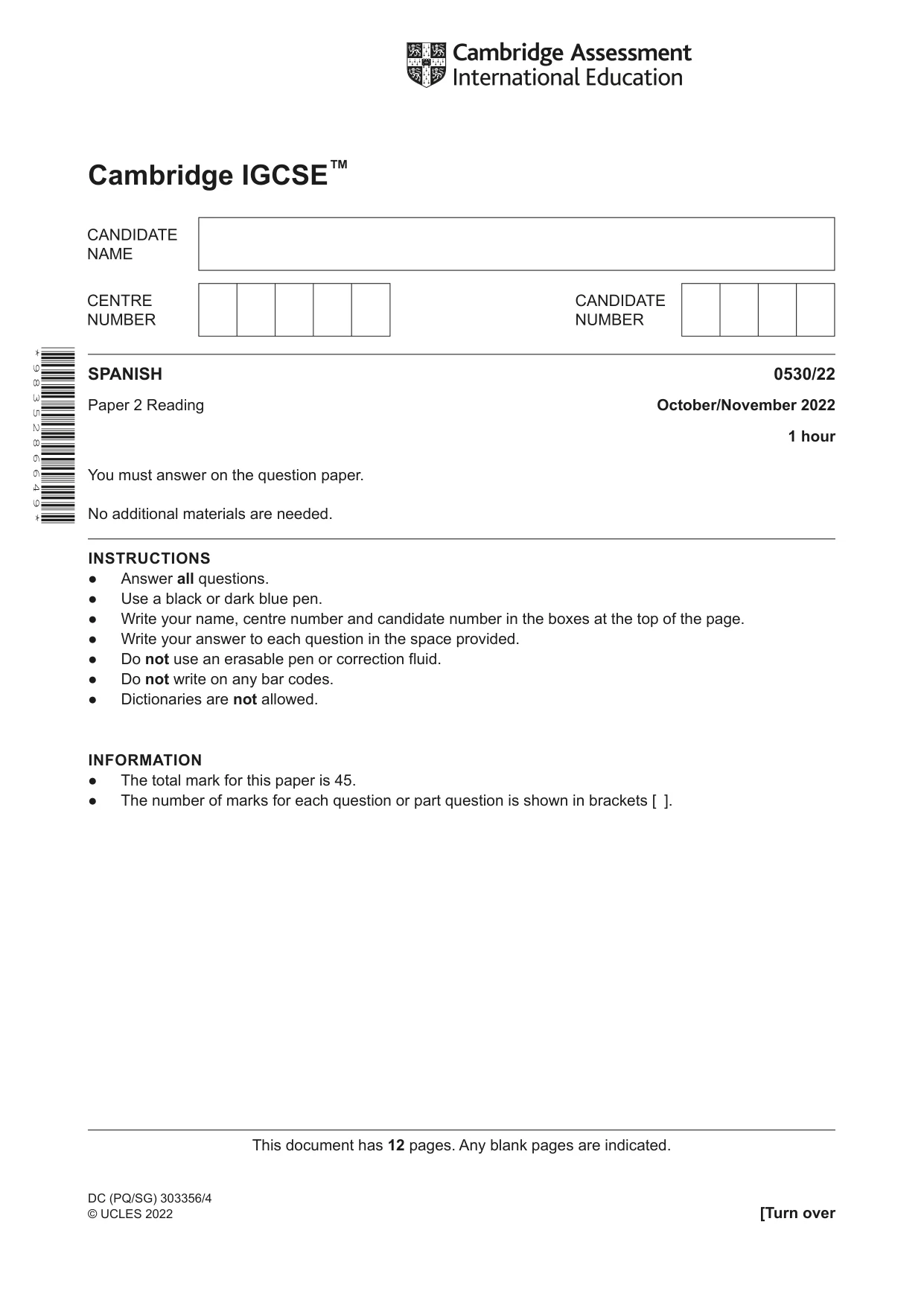
2 0530/22/ O/ N/22 © UCLES 2022 1 Mira los dibujos. C B A E D F Para cada pregunta escribe la letra correcta (A–F) en la casilla. (a) Hago clases de gimnasia todos los sábados. [1] (b) Bebo agua cuando tengo sed. [1] (c) Duermo ocho horas cada noche. [1] (d) Casi nunca compro dulces ni caramelos. [1] (e) Es importante comer muchas verduras. [1] [Total: 5]
Question paper, page 3
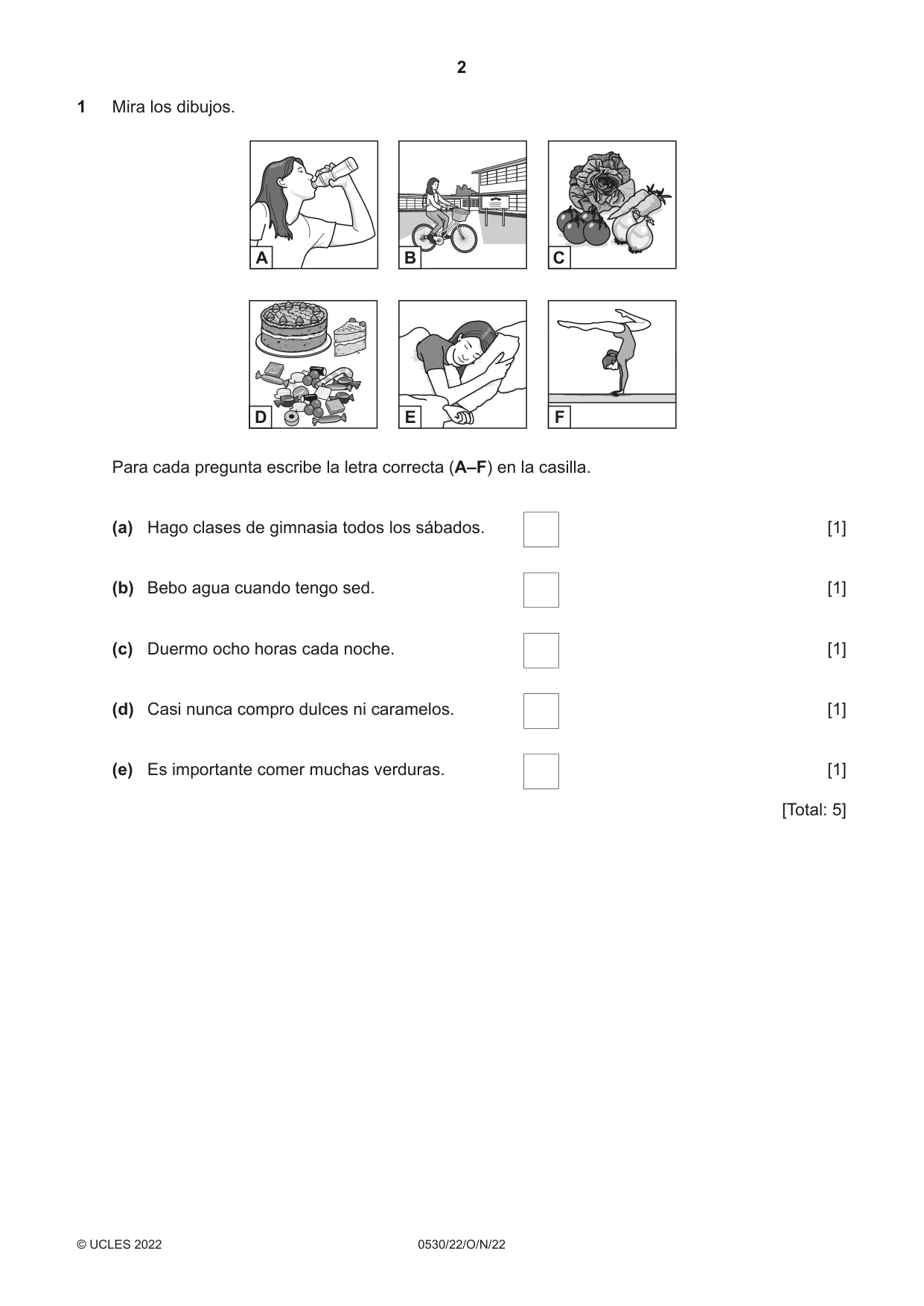
3 0530/22/O/N/22 © UCLES 2022 [Turn over 2 Lee los letreros. En el hotel RECEPCIÓN TERRAZA APARCAMIENTO TIENDA DE RECUERDOS SALA DE REUNIONES SALÓN ASCENSOR PISCINA A B C D E F G H Para cada pregunta escribe la letra correcta (A–H) en la casilla. (a) Voy a subir al octavo piso. [1] (b) Necesito un regalo para mi abuela. [1] (c) Quiero saber mi número de habitación. [1] (d) Quisiera nadar un poco antes de salir. [1] (e) Se puede dejar el coche aquí. [1] [Total: 5]
Question paper, page 4
4 0530/22/O/N/22 © UCLES 2022 3 Lee el texto. Para cada pregunta indica tu respuesta escribiendo una X en la casilla correcta (A–C). Vivo en España, pero cada año voy de vacaciones a un hotel en un país extranjero. Me gusta tomar el sol y odio las temperaturas frías. Los monumentos que mis padres visitan no me interesan nada. Lo que más me gusta es probar la comida. Me encanta comer en restaurantes típicos. Hay platos diferentes y aprendes algo sobre el estilo de vida de otras naciones. El año pasado fuimos a la India donde muchos platos son picantes. Me encantó el pescado porque lo servían el mismo día que lo pescaban. En casa intenté hacer un plato indio para mis amigos, pero no cocino bien y, según ellos, fue un desastre. Por suerte, en todos los países venden helado excelente: ¡es mi comida preferida, sobre todo el de chocolate! Isabel (a) Normalmente, para sus vacaciones, Isabel … A va a un hotel en España. B viaja a otro país. C visita varios países. [1] (b) Isabel no está contenta cuando … A hace mucho sol. B hace mucho calor. C hace mucho frío. [1] (c) Según Isabel, las visitas que hace con sus padres son … A aburridas. B interesantes. C educativas. [1]
Question paper, page 5
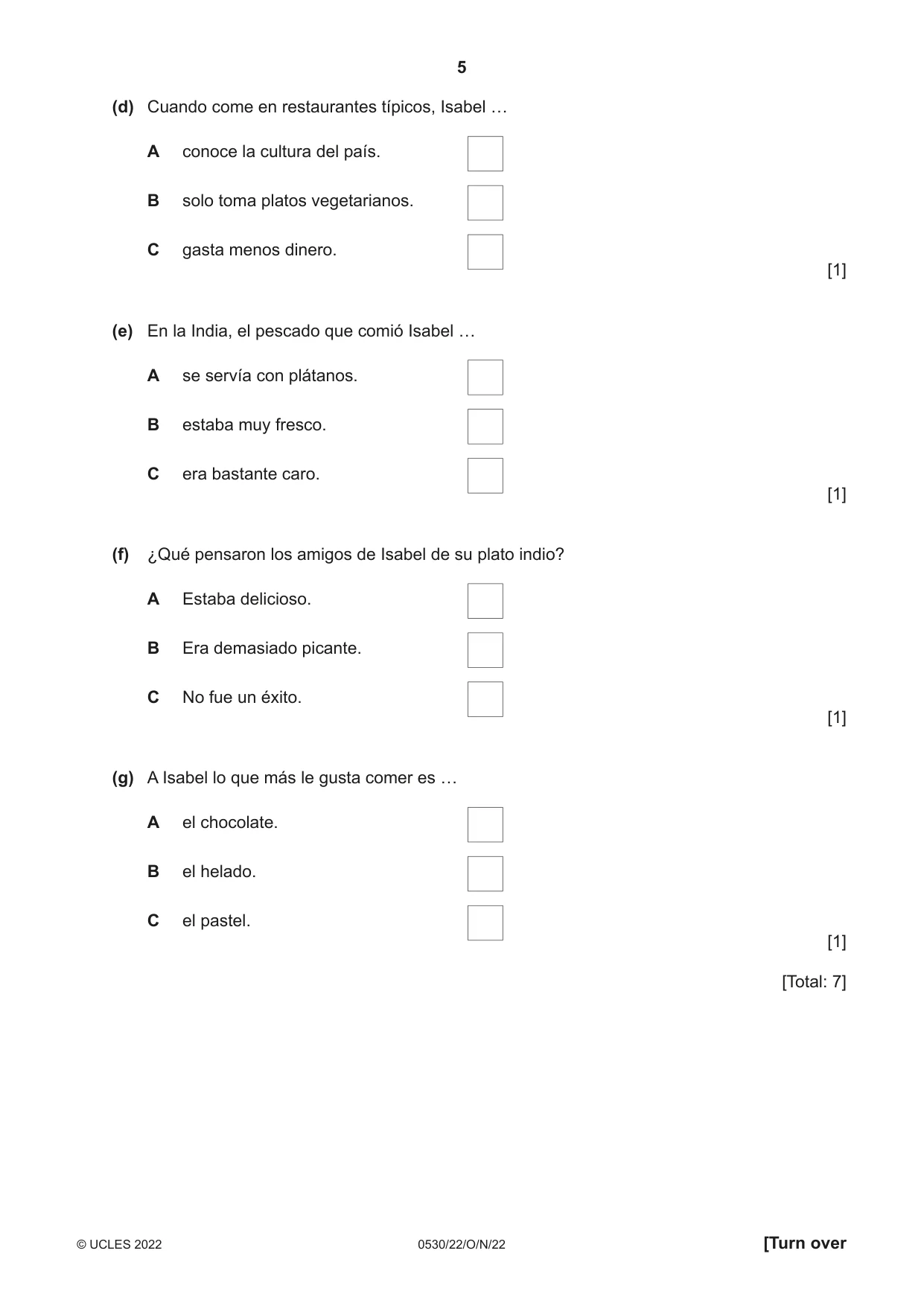
5 0530/22/O/N/22 © UCLES 2022 [Turn over (d) Cuando come en restaurantes típicos, Isabel … A conoce la cultura del país. B solo toma platos vegetarianos. C gasta menos dinero. [1] (e) En la India, el pescado que comió Isabel … A se servía con plátanos. B estaba muy fresco. C era bastante caro. [1] (f) ¿Qué pensaron los amigos de Isabel de su plato indio? A Estaba delicioso. B Era demasiado picante. C No fue un éxito. [1] (g) A Isabel lo que más le gusta comer es … A el chocolate. B el helado. C el pastel. [1] [Total: 7]
Question paper, page 6
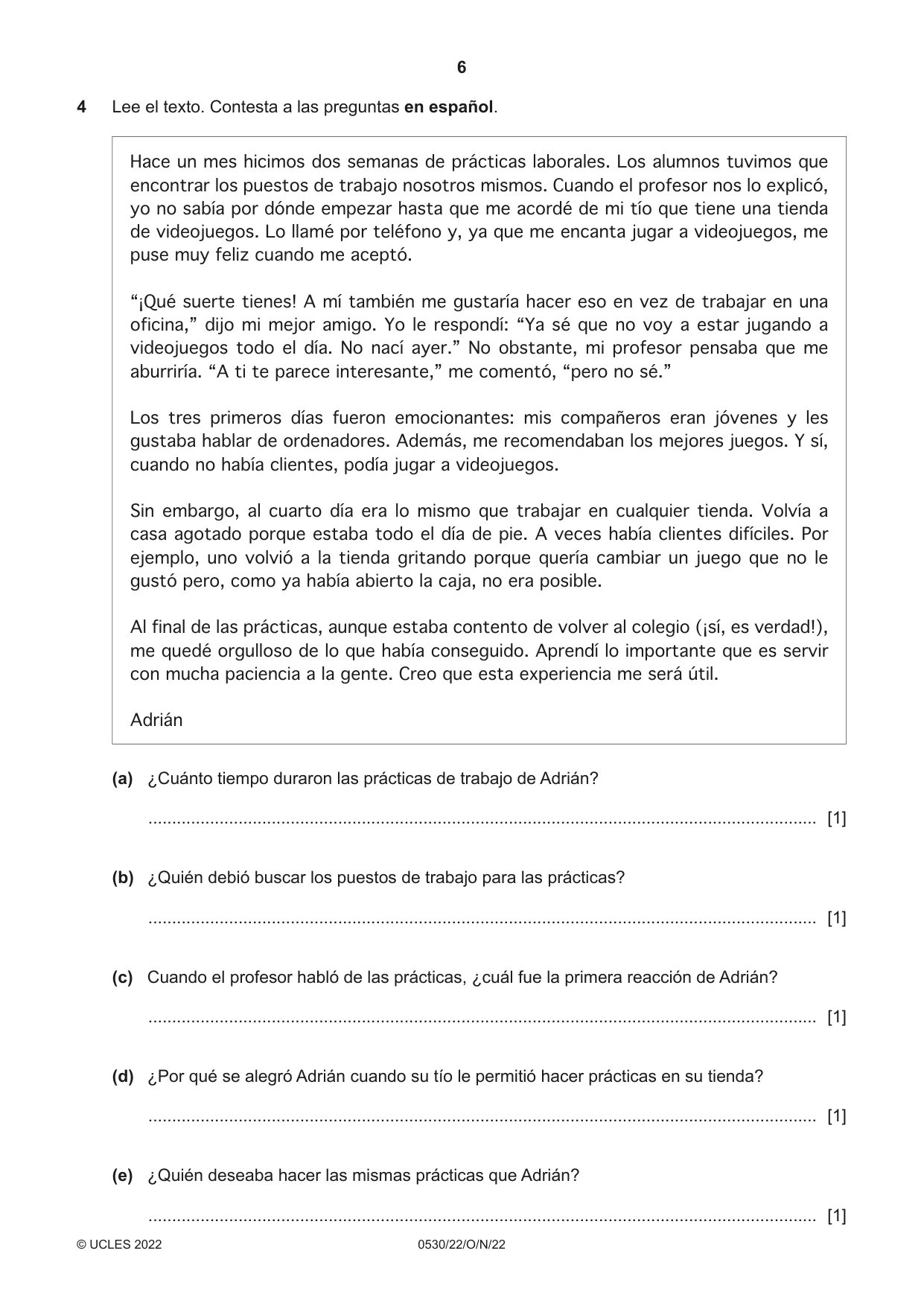
6 0530/22/O/N/22 © UCLES 2022 4 Lee el texto. Contesta a las preguntas en español. Hace un mes hicimos dos semanas de prácticas laborales. Los alumnos tuvimos que encontrar los puestos de trabajo nosotros mismos. Cuando el profesor nos lo explicó, yo no sabía por dónde empezar hasta que me acordé de mi tío que tiene una tienda de videojuegos. Lo llamé por teléfono y, ya que me encanta jugar a videojuegos, me puse muy feliz cuando me aceptó. “¡Qué suerte tienes! A mí también me gustaría hacer eso en vez de trabajar en una oficina,” dijo mi mejor amigo. Yo le respondí: “Ya sé que no voy a estar jugando a videojuegos todo el día. No nací ayer.” No obstante, mi profesor pensaba que me aburriría. “A ti te parece interesante,” me comentó, “pero no sé.” Los tres primeros días fueron emocionantes: mis compañeros eran jóvenes y les gustaba hablar de ordenadores. Además, me recomendaban los mejores juegos. Y sí, cuando no había clientes, podía jugar a videojuegos. Sin embargo, al cuarto día era lo mismo que trabajar en cualquier tienda. Volvía a casa agotado porque estaba todo el día de pie. A veces había clientes difíciles. Por ejemplo, uno volvió a la tienda gritando porque quería cambiar un juego que no le gustó pero, como ya había abierto la caja, no era posible. Al final de las prácticas, aunque estaba contento de volver al colegio (¡sí, es verdad!), me quedé orgulloso de lo que había conseguido. Aprendí lo importante que es servir con mucha paciencia a la gente. Creo que esta experiencia me será útil. Adrián (a) ¿Cuánto tiempo duraron las prácticas de trabajo de Adrián? … [1] (b) ¿Quién debió buscar los puestos de trabajo para las prácticas? … [1] (c) Cuando el profesor habló de las prácticas, ¿cuál fue la primera reacción de Adrián? … [1] (d) ¿Por qué se alegró Adrián cuando su tío le permitió hacer prácticas en su tienda? … [1] (e) ¿Quién deseaba hacer las mismas prácticas que Adrián? … [1]
Question paper, page 7
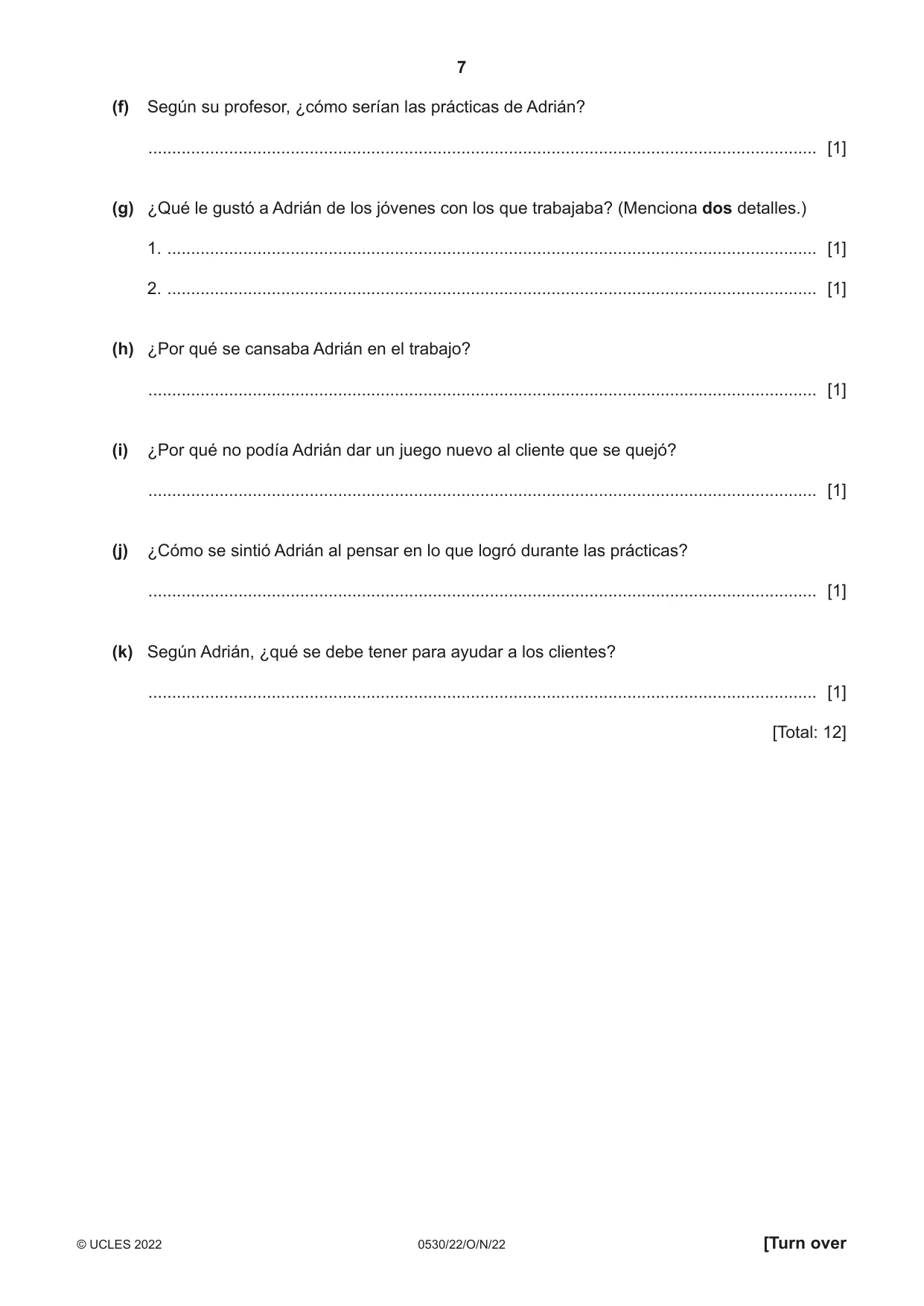
7 0530/22/O/N/22 © UCLES 2022 [Turn over (f) Según su profesor, ¿cómo serían las prácticas de Adrián? … [1] (g) ¿Qué le gustó a Adrián de los jóvenes con los que trabajaba? (Menciona dos detalles.) 1. … [1] 2. … [1] (h) ¿Por qué se cansaba Adrián en el trabajo? … [1] (i) ¿Por qué no podía Adrián dar un juego nuevo al cliente que se quejó? … [1] (j) ¿Cómo se sintió Adrián al pensar en lo que logró durante las prácticas? … [1] (k) Según Adrián, ¿qué se debe tener para ayudar a los clientes? … [1] [Total: 12]
Question paper, page 8
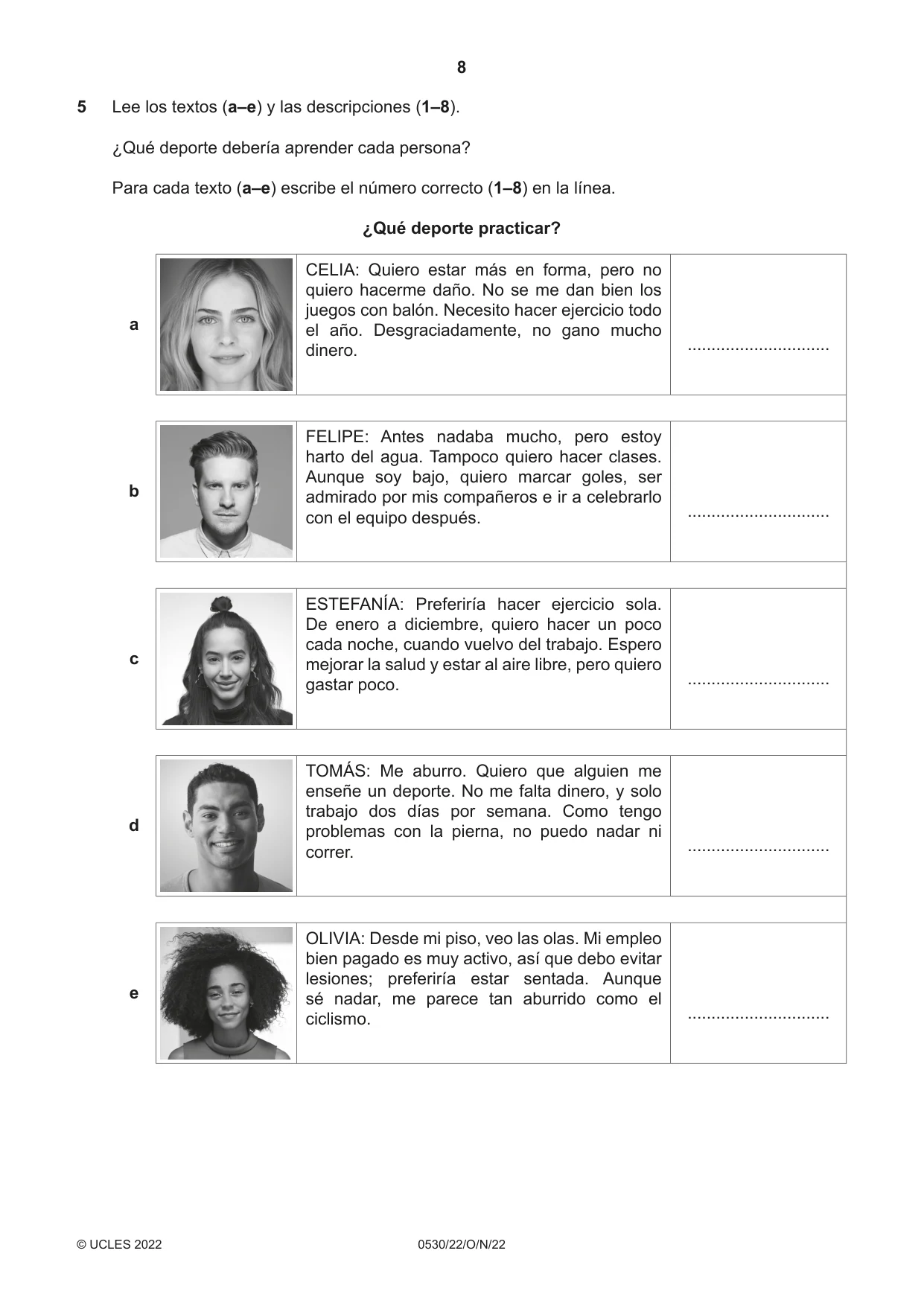
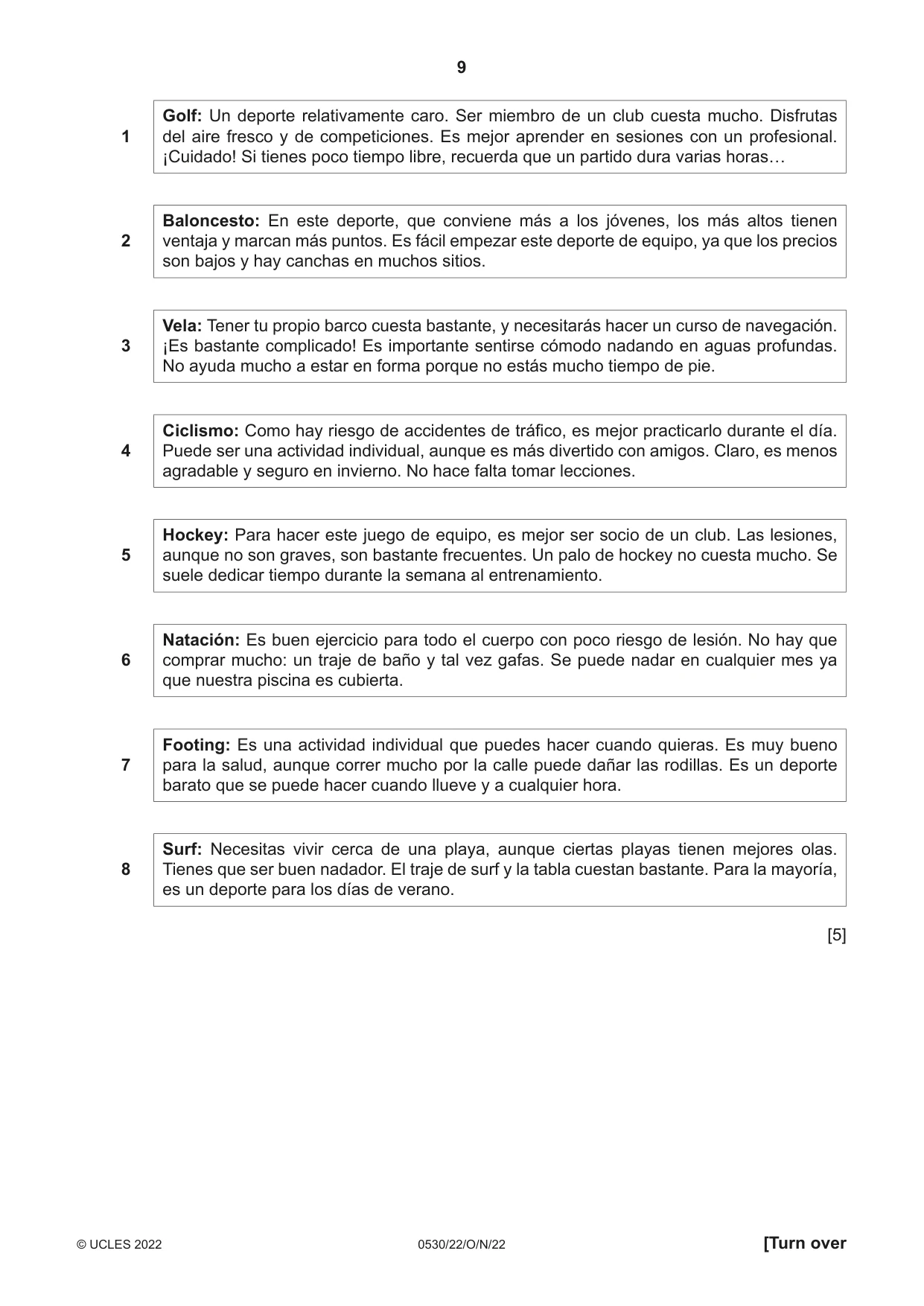
8 0530/22/O/N/22 © UCLES 2022 5 Lee los textos (a–e) y las descripciones (1–8). ¿Qué deporte debería aprender cada persona? Para cada texto (a–e) escribe el número correcto (1–8) en la línea. ¿Qué deporte practicar? a CELIA: Quiero estar más en forma, pero no quiero hacerme daño. No se me dan bien los juegos con balón. Necesito hacer ejercicio todo el año. Desgraciadamente, no gano mucho dinero. … b FELIPE: Antes nadaba mucho, pero estoy harto del agua. Tampoco quiero hacer clases. Aunque soy bajo, quiero marcar goles, ser admirado por mis compañeros e ir a celebrarlo con el equipo después. … c ESTEFANÍA: Preferiría hacer ejercicio sola. De enero a diciembre, quiero hacer un poco cada noche, cuando vuelvo del trabajo. Espero mejorar la salud y estar al aire libre, pero quiero gastar poco. … d TOMÁS: Me aburro. Quiero que alguien me enseñe un deporte. No me falta dinero, y solo trabajo dos días por semana. Como tengo problemas con la pierna, no puedo nadar ni correr. … e OLIVIA: Desde mi piso, veo las olas. Mi empleo bien pagado es muy activo, así que debo evitar lesiones; preferiría estar sentada. Aunque sé nadar, me parece tan aburrido como el ciclismo. …
Question paper, page 9
9 0530/22/O/N/22 © UCLES 2022 [Turn over 1 Golf: Un deporte relativamente caro. Ser miembro de un club cuesta mucho. Disfrutas del aire fresco y de competiciones. Es mejor aprender en sesiones con un profesional. ¡Cuidado! Si tienes poco tiempo libre, recuerda que un partido dura varias horas… 2 Baloncesto: En este deporte, que conviene más a los jóvenes, los más altos tienen ventaja y marcan más puntos. Es fácil empezar este deporte de equipo, ya que los precios son bajos y hay canchas en muchos sitios. 3 Vela: Tener tu propio barco cuesta bastante, y necesitarás hacer un curso de navegación. ¡Es bastante complicado! Es importante sentirse cómodo nadando en aguas profundas. No ayuda mucho a estar en forma porque no estás mucho tiempo de pie. 4 Ciclismo: Como hay riesgo de accidentes de tráfico, es mejor practicarlo durante el día. Puede ser una actividad individual, aunque es más divertido con amigos. Claro, es menos agradable y seguro en invierno. No hace falta tomar lecciones. 5 Hockey: Para hacer este juego de equipo, es mejor ser socio de un club. Las lesiones, aunque no son graves, son bastante frecuentes. Un palo de hockey no cuesta mucho. Se suele dedicar tiempo durante la semana al entrenamiento. 6 Natación: Es buen ejercicio para todo el cuerpo con poco riesgo de lesión. No hay que comprar mucho: un traje de baño y tal vez gafas. Se puede nadar en cualquier mes ya que nuestra piscina es cubierta. 7 Footing: Es una actividad individual que puedes hacer cuando quieras. Es muy bueno para la salud, aunque correr mucho por la calle puede dañar las rodillas. Es un deporte barato que se puede hacer cuando llueve y a cualquier hora. 8 Surf: Necesitas vivir cerca de una playa, aunque ciertas playas tienen mejores olas. Tienes que ser buen nadador. El traje de surf y la tabla cuestan bastante. Para la mayoría, es un deporte para los días de verano. [5]
Question paper, page 10
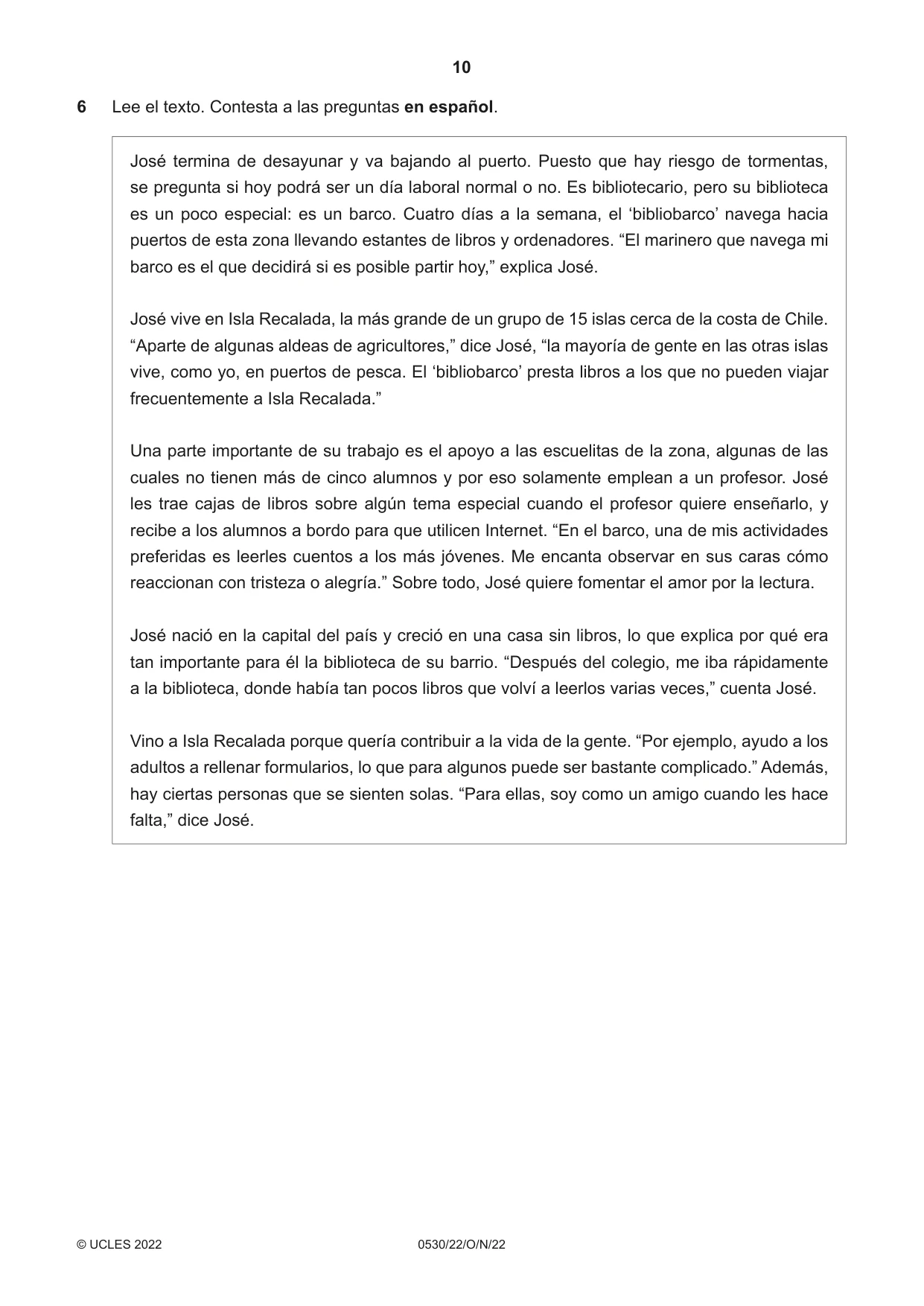
10 0530/22/O/N/22 © UCLES 2022 6 Lee el texto. Contesta a las preguntas en español. José termina de desayunar y va bajando al puerto. Puesto que hay riesgo de tormentas, se pregunta si hoy podrá ser un día laboral normal o no. Es bibliotecario, pero su biblioteca es un poco especial: es un barco. Cuatro días a la semana, el ‘bibliobarco’ navega hacia puertos de esta zona llevando estantes de libros y ordenadores. “El marinero que navega mi barco es el que decidirá si es posible partir hoy,” explica José. José vive en Isla Recalada, la más grande de un grupo de 15 islas cerca de la costa de Chile. “Aparte de algunas aldeas de agricultores,” dice José, “la mayoría de gente en las otras islas vive, como yo, en puertos de pesca. El ‘bibliobarco’ presta libros a los que no pueden viajar frecuentemente a Isla Recalada.” Una parte importante de su trabajo es el apoyo a las escuelitas de la zona, algunas de las cuales no tienen más de cinco alumnos y por eso solamente emplean a un profesor. José les trae cajas de libros sobre algún tema especial cuando el profesor quiere enseñarlo, y recibe a los alumnos a bordo para que utilicen Internet. “En el barco, una de mis actividades preferidas es leerles cuentos a los más jóvenes. Me encanta observar en sus caras cómo reaccionan con tristeza o alegría.” Sobre todo, José quiere fomentar el amor por la lectura. José nació en la capital del país y creció en una casa sin libros, lo que explica por qué era tan importante para él la biblioteca de su barrio. “Después del colegio, me iba rápidamente a la biblioteca, donde había tan pocos libros que volví a leerlos varias veces,” cuenta José. Vino a Isla Recalada porque quería contribuir a la vida de la gente. “Por ejemplo, ayudo a los adultos a rellenar formularios, lo que para algunos puede ser bastante complicado.” Además, hay ciertas personas que se sienten solas. “Para ellas, soy como un amigo cuando les hace falta,” dice José.
Question paper, page 11
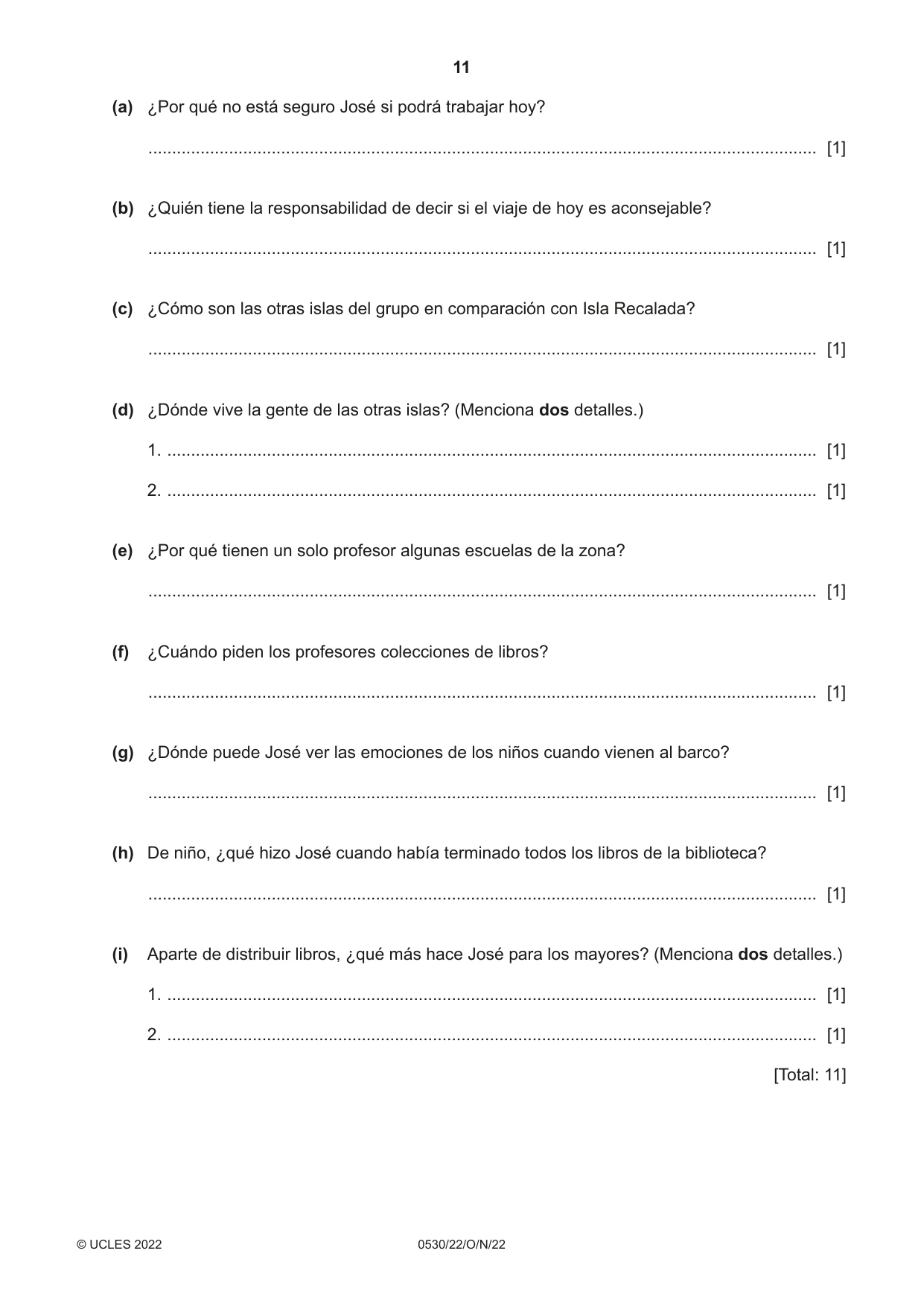
11 0530/22/O/N/22 © UCLES 2022 (a) ¿Por qué no está seguro José si podrá trabajar hoy? … [1] (b) ¿Quién tiene la responsabilidad de decir si el viaje de hoy es aconsejable? … [1] (c) ¿Cómo son las otras islas del grupo en comparación con Isla Recalada? … [1] (d) ¿Dónde vive la gente de las otras islas? (Menciona dos detalles.) 1. … [1] 2. … [1] (e) ¿Por qué tienen un solo profesor algunas escuelas de la zona? … [1] (f) ¿Cuándo piden los profesores colecciones de libros? … [1] (g) ¿Dónde puede José ver las emociones de los niños cuando vienen al barco? … [1] (h) De niño, ¿qué hizo José cuando había terminado todos los libros de la biblioteca? … [1] (i) Aparte de distribuir libros, ¿qué más hace José para los mayores? (Menciona dos detalles.) 1. … [1] 2. … [1] [Total: 11]
Question paper, page 12
12 0530/22/O/N/22 © UCLES 2022 Permission to reproduce items where third-party owned material protected by copyright is included has been sought and cleared where possible. Every reasonable effort has been made by the publisher (UCLES) to trace copyright holders, but if any items requiring clearance have unwittingly been included, the publisher will be pleased to make amends at the earliest possible opportunity. To avoid the issue of disclosure of answer-related information to candidates, all copyright acknowledgements are reproduced online in the Cambridge Assessment International Education Copyright Acknowledgements Booklet. This is produced for each series of examinations and is freely available to download at www.cambridgeinternational.org after the live examination series. Cambridge Assessment International Education is part of Cambridge Assessment. Cambridge Assessment is the brand name of the University of Cambridge Local Examinations Syndicate (UCLES), which is a department of the University of Cambridge. BLANK PAGE
Mark scheme, page 1
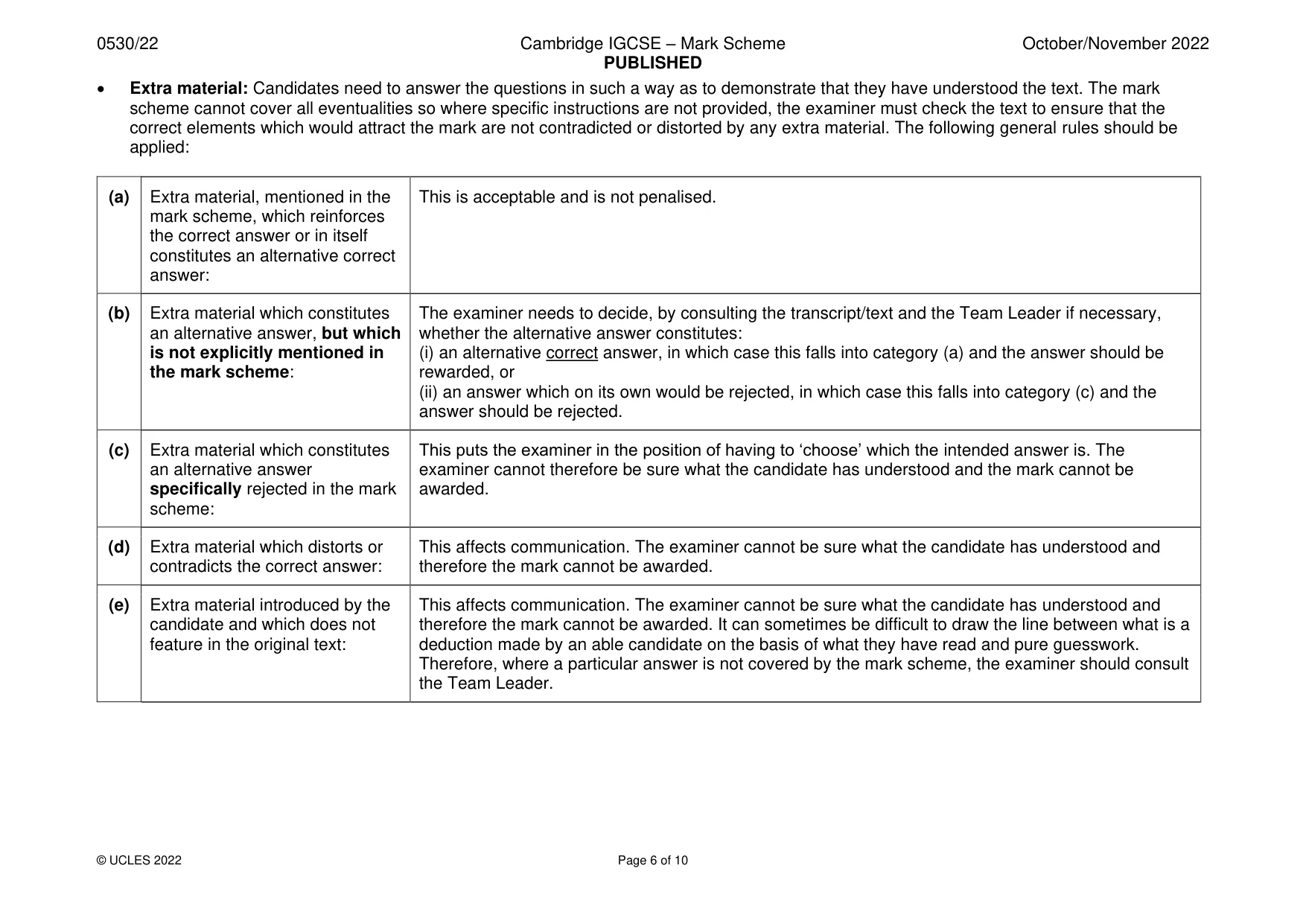
This document consists of 10 printed pages. © UCLES 2022 [Turn over Cambridge IGCSE™ SPANISH 0530/22 Paper 2 Reading October/November 2022 MARK SCHEME Maximum Mark: 45 Published This mark scheme is published as an aid to teachers and candidates, to indicate the requirements of the examination. It shows the basis on which Examiners were instructed to award marks. It does not indicate the details of the discussions that took place at an Examiners’ meeting before marking began, which would have considered the acceptability of alternative answers. Mark schemes should be read in conjunction with the question paper and the Principal Examiner Report for Teachers. Cambridge International will not enter into discussions about these mark schemes. Cambridge International is publishing the mark schemes for the October/November 2022 series for most Cambridge IGCSE™, Cambridge International A and AS Level components and some Cambridge O Level components.
Mark scheme, page 2
0530/22 Cambridge IGCSE – Mark Scheme PUBLISHED October/November 2022 © UCLES 2022 Page 2 of 10 Generic Marking Principles These general marking principles must be applied by all examiners when marking candidate answers. They should be applied alongside the specific content of the mark scheme or generic level descriptors for a question. Each question paper and mark scheme will also comply with these marking principles. GENERIC MARKING PRINCIPLE 1: Marks must be awarded in line with: • the specific content of the mark scheme or the generic level descriptors for the question • the specific skills defined in the mark scheme or in the generic level descriptors for the question • the standard of response required by a candidate as exemplified by the standardisation scripts. GENERIC MARKING PRINCIPLE 2: Marks awarded are always whole marks (not half marks, or other fractions). GENERIC MARKING PRINCIPLE 3: Marks must be awarded positively: • marks are awarded for correct/valid answers, as defined in the mark scheme. However, credit is given for valid answers which go beyond the scope of the syllabus and mark scheme, referring to your Team Leader as appropriate • marks are awarded when candidates clearly demonstrate what they know and can do • marks are not deducted for errors • marks are not deducted for omissions • answers should only be judged on the quality of spelling, punctuation and grammar when these features are specifically assessed by the question as indicated by the mark scheme. The meaning, however, should be unambiguous. GENERIC MARKING PRINCIPLE 4: Rules must be applied consistently, e.g. in situations where candidates have not followed instructions or in the application of generic level descriptors.
Mark scheme, page 3
0530/22 Cambridge IGCSE – Mark Scheme PUBLISHED October/November 2022 © UCLES 2022 Page 3 of 10 GENERIC MARKING PRINCIPLE 5: Marks should be awarded using the full range of marks defined in the mark scheme for the question (however; the use of the full mark range may be limited according to the quality of the candidate responses seen). GENERIC MARKING PRINCIPLE 6: Marks awarded are based solely on the requirements as defined in the mark scheme. Marks should not be awarded with grade thresholds or grade descriptors in mind.
Mark scheme, page 4
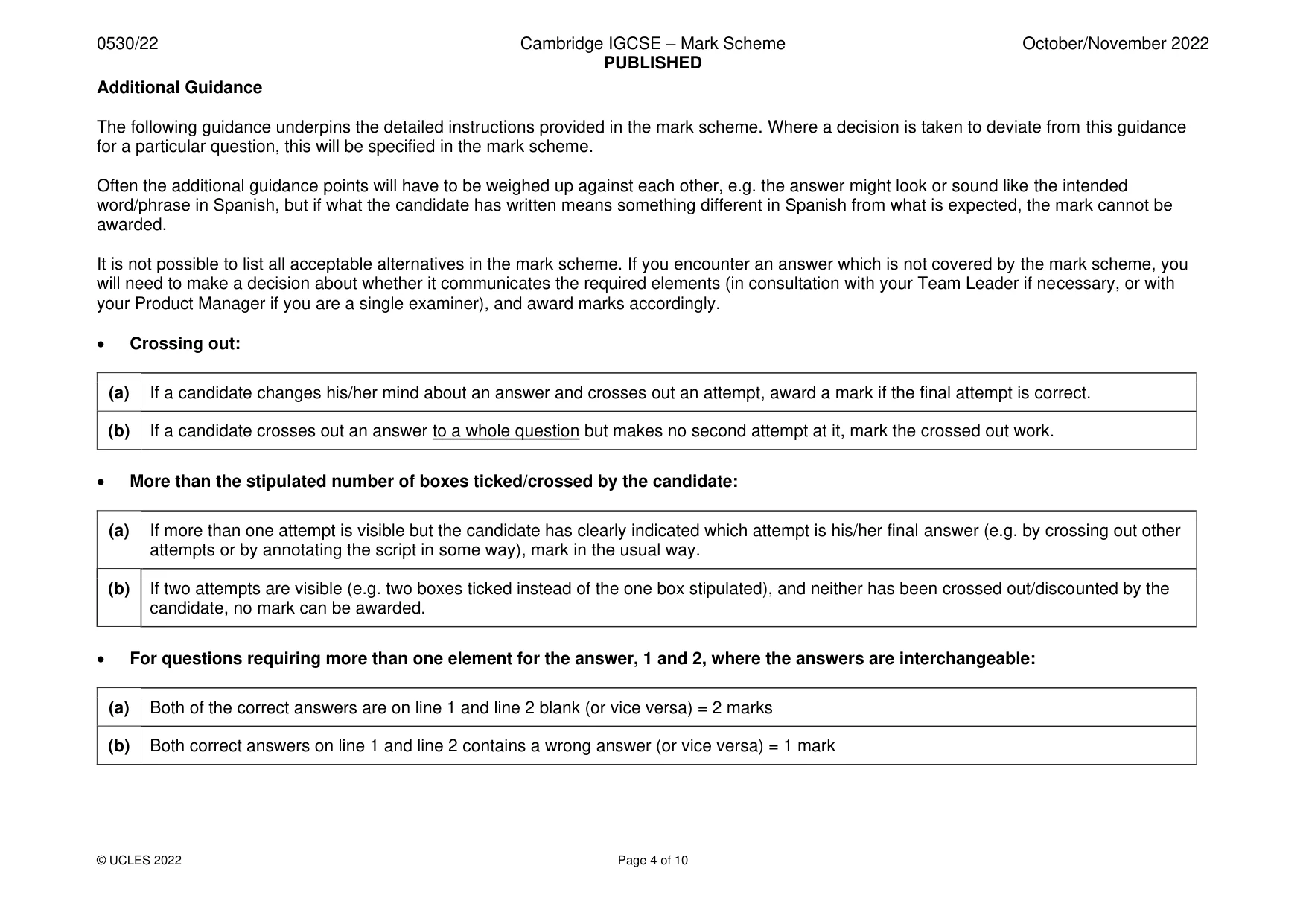
0530/22 Cambridge IGCSE – Mark Scheme PUBLISHED October/November 2022 © UCLES 2022 Page 4 of 10 Additional Guidance The following guidance underpins the detailed instructions provided in the mark scheme. Where a decision is taken to deviate from this guidance for a particular question, this will be specified in the mark scheme. Often the additional guidance points will have to be weighed up against each other, e.g. the answer might look or sound like the intended word/phrase in Spanish, but if what the candidate has written means something different in Spanish from what is expected, the mark cannot be awarded. It is not possible to list all acceptable alternatives in the mark scheme. If you encounter an answer which is not covered by the mark scheme, you will need to make a decision about whether it communicates the required elements (in consultation with your Team Leader if necessary, or with your Product Manager if you are a single examiner), and award marks accordingly. • Crossing out: (a) If a candidate changes his/her mind about an answer and crosses out an attempt, award a mark if the final attempt is correct. (b) If a candidate crosses out an answer to a whole question but makes no second attempt at it, mark the crossed out work. • More than the stipulated number of boxes ticked/crossed by the candidate: (a) If more than one attempt is visible but the candidate has clearly indicated which attempt is his/her final answer (e.g. by crossing out other attempts or by annotating the script in some way), mark in the usual way. (b) If two attempts are visible (e.g. two boxes ticked instead of the one box stipulated), and neither has been crossed out/discounted by the candidate, no mark can be awarded. • For questions requiring more than one element for the answer, 1 and 2, where the answers are interchangeable: (a) Both of the correct answers are on line 1 and line 2 blank (or vice versa) = 2 marks (b) Both correct answers on line 1 and line 2 contains a wrong answer (or vice versa) = 1 mark
Mark scheme, page 5
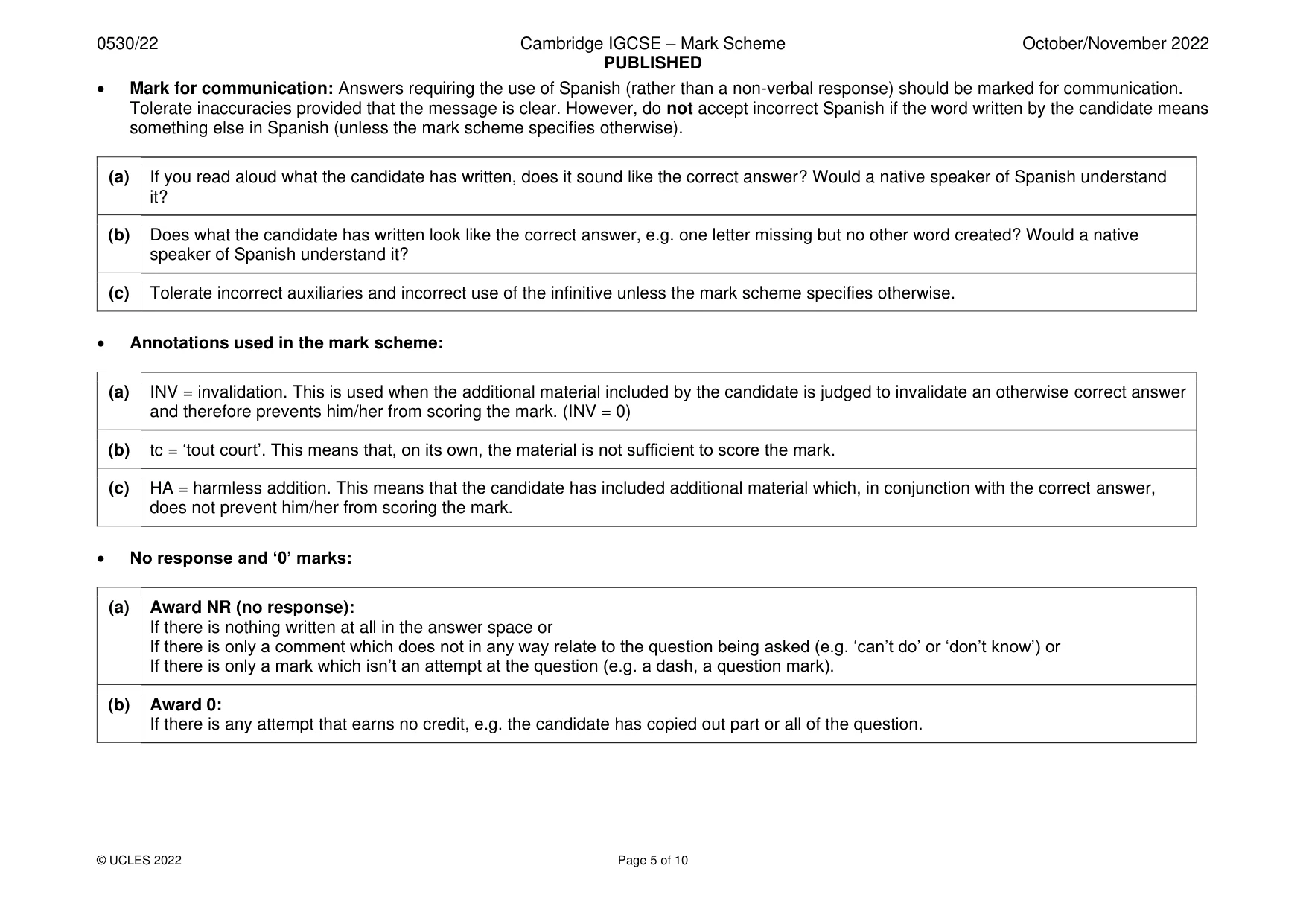
0530/22 Cambridge IGCSE – Mark Scheme PUBLISHED October/November 2022 © UCLES 2022 Page 5 of 10 • Mark for communication: Answers requiring the use of Spanish (rather than a non-verbal response) should be marked for communication. Tolerate inaccuracies provided that the message is clear. However, do not accept incorrect Spanish if the word written by the candidate means something else in Spanish (unless the mark scheme specifies otherwise). (a) If you read aloud what the candidate has written, does it sound like the correct answer? Would a native speaker of Spanish understand it? (b) Does what the candidate has written look like the correct answer, e.g. one letter missing but no other word created? Would a native speaker of Spanish understand it? (c) Tolerate incorrect auxiliaries and incorrect use of the infinitive unless the mark scheme specifies otherwise. • Annotations used in the mark scheme: (a) INV = invalidation. This is used when the additional material included by the candidate is judged to invalidate an otherwise correct answer and therefore prevents him/her from scoring the mark. (INV = 0) (b) tc = ‘tout court’. This means that, on its own, the material is not sufficient to score the mark. (c) HA = harmless addition. This means that the candidate has included additional material which, in conjunction with the correct answer, does not prevent him/her from scoring the mark. • No response and ‘0’ marks: (a) Award NR (no response): If there is nothing written at all in the answer space or If there is only a comment which does not in any way relate to the question being asked (e.g. ‘can’t do’ or ‘don’t know’) or If there is only a mark which isn’t an attempt at the question (e.g. a dash, a question mark). (b) Award 0: If there is any attempt that earns no credit, e.g. the candidate has copied out part or all of the question.
Mark scheme, page 6
0530/22 Cambridge IGCSE – Mark Scheme PUBLISHED October/November 2022 © UCLES 2022 Page 6 of 10 • Extra material: Candidates need to answer the questions in such a way as to demonstrate that they have understood the text. The mark scheme cannot cover all eventualities so where specific instructions are not provided, the examiner must check the text to ensure that the correct elements which would attract the mark are not contradicted or distorted by any extra material. The following general rules should be applied: (a) Extra material, mentioned in the mark scheme, which reinforces the correct answer or in itself constitutes an alternative correct answer: This is acceptable and is not penalised. (b) Extra material which constitutes an alternative answer, but which is not explicitly mentioned in the mark scheme: The examiner needs to decide, by consulting the transcript/text and the Team Leader if necessary, whether the alternative answer constitutes: (i) an alternative correct answer, in which case this falls into category (a) and the answer should be rewarded, or (ii) an answer which on its own would be rejected, in which case this falls into category (c) and the answer should be rejected. (c) Extra material which constitutes an alternative answer specifically rejected in the mark scheme: This puts the examiner in the position of having to ‘choose’ which the intended answer is. The examiner cannot therefore be sure what the candidate has understood and the mark cannot be awarded. (d) Extra material which distorts or contradicts the correct answer: This affects communication. The examiner cannot be sure what the candidate has understood and therefore the mark cannot be awarded. (e) Extra material introduced by the candidate and which does not feature in the original text: This affects communication. The examiner cannot be sure what the candidate has understood and therefore the mark cannot be awarded. It can sometimes be difficult to draw the line between what is a deduction made by an able candidate on the basis of what they have read and pure guesswork. Therefore, where a particular answer is not covered by the mark scheme, the examiner should consult the Team Leader.
Mark scheme, page 7
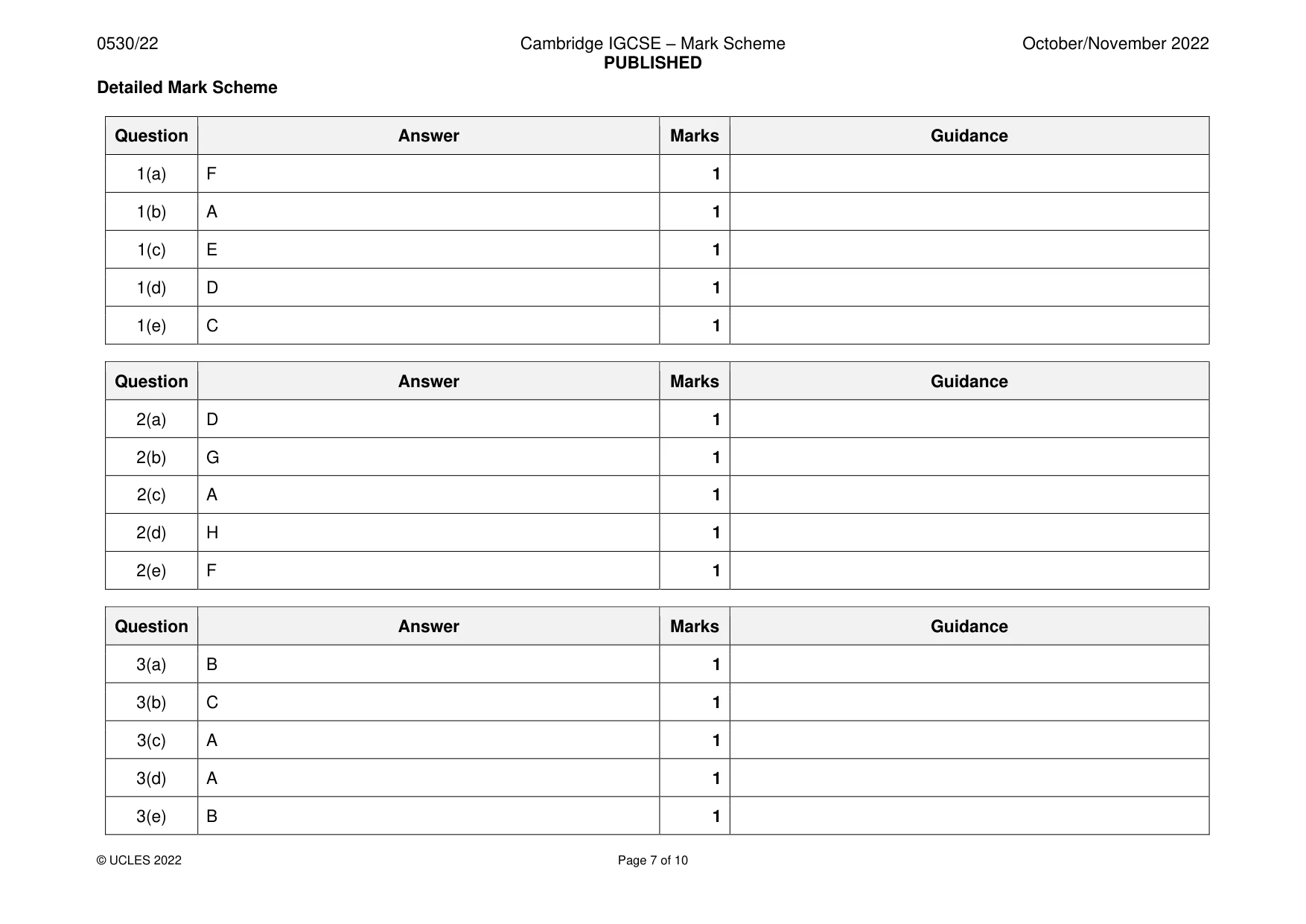
0530/22 Cambridge IGCSE – Mark Scheme PUBLISHED October/November 2022 © UCLES 2022 Page 7 of 10 Detailed Mark Scheme Question Answer Marks Guidance 1(a) F 1 1(b) A 1 1(c) E 1 1(d) D 1 1(e) C 1 Question Answer Marks Guidance 2(a) D 1 2(b) G 1 2(c) A 1 2(d) H 1 2(e) F 1 Question Answer Marks Guidance 3(a) B 1 3(b) C 1 3(c) A 1 3(d) A 1 3(e) B 1
Mark scheme, page 8
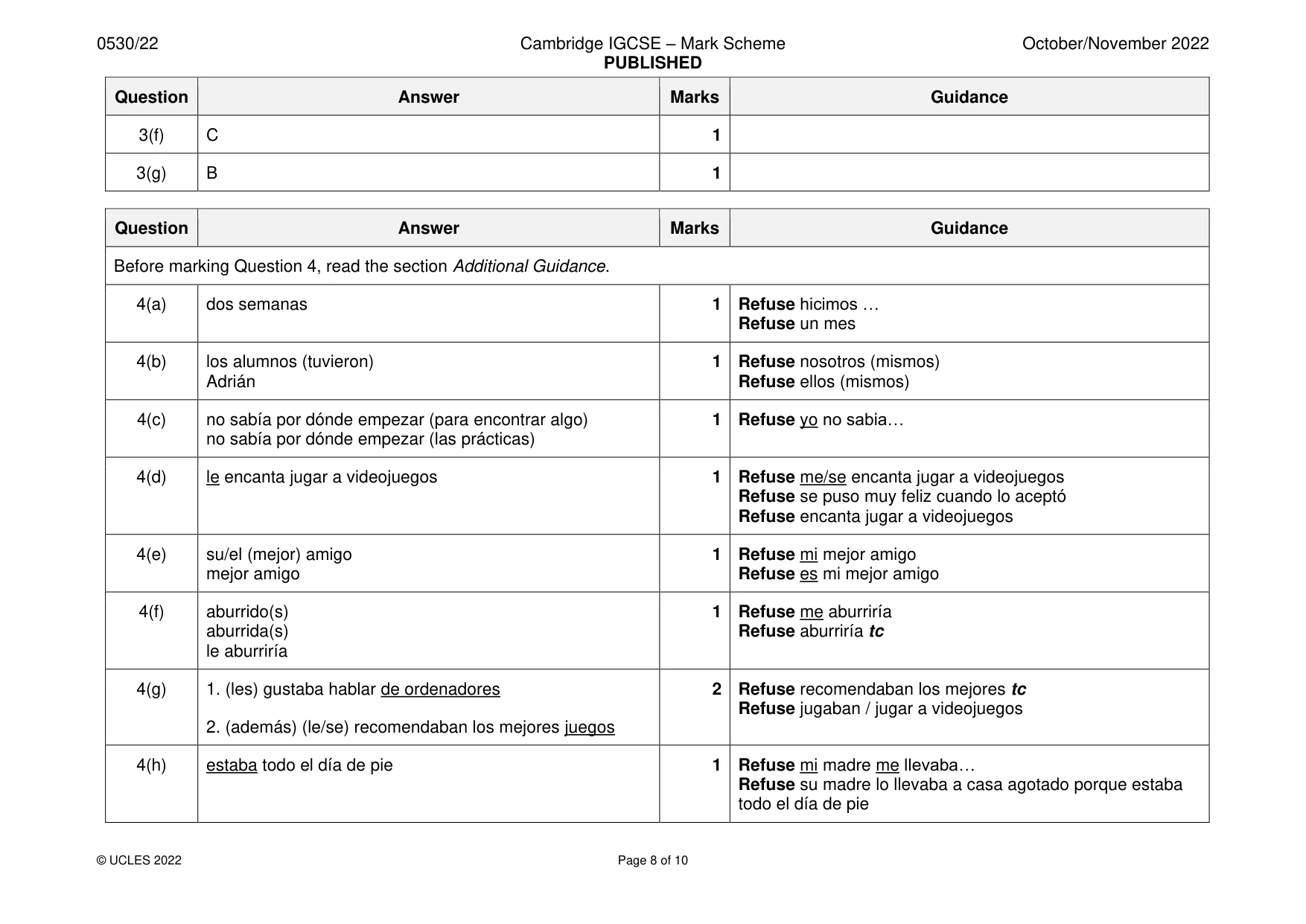
0530/22 Cambridge IGCSE – Mark Scheme PUBLISHED October/November 2022 © UCLES 2022 Page 8 of 10 Question Answer Marks Guidance 3(f) C 1 3(g) B 1 Question Answer Marks Guidance Before marking Question 4, read the section Additional Guidance. 4(a) dos semanas 1 Refuse hicimos … Refuse un mes 4(b) los alumnos (tuvieron) Adrián 1 Refuse nosotros (mismos) Refuse ellos (mismos) 4(c) no sabía por dónde empezar (para encontrar algo) no sabía por dónde empezar (las prácticas) 1 Refuse yo no sabia… 4(d) le encanta jugar a videojuegos 1 Refuse me/se encanta jugar a videojuegos Refuse se puso muy feliz cuando lo aceptó Refuse encanta jugar a videojuegos 4(e) su/el (mejor) amigo mejor amigo 1 Refuse mi mejor amigo Refuse es mi mejor amigo 4(f) aburrido(s) aburrida(s) le aburriría 1 Refuse me aburriría Refuse aburriría tc 4(g) 1. (les) gustaba hablar de ordenadores 2. (además) (le/se) recomendaban los mejores juegos 2 Refuse recomendaban los mejores tc Refuse jugaban / jugar a videojuegos 4(h) estaba todo el día de pie 1 Refuse mi madre me llevaba… Refuse su madre lo llevaba a casa agotado porque estaba todo el día de pie
Mark scheme, page 9
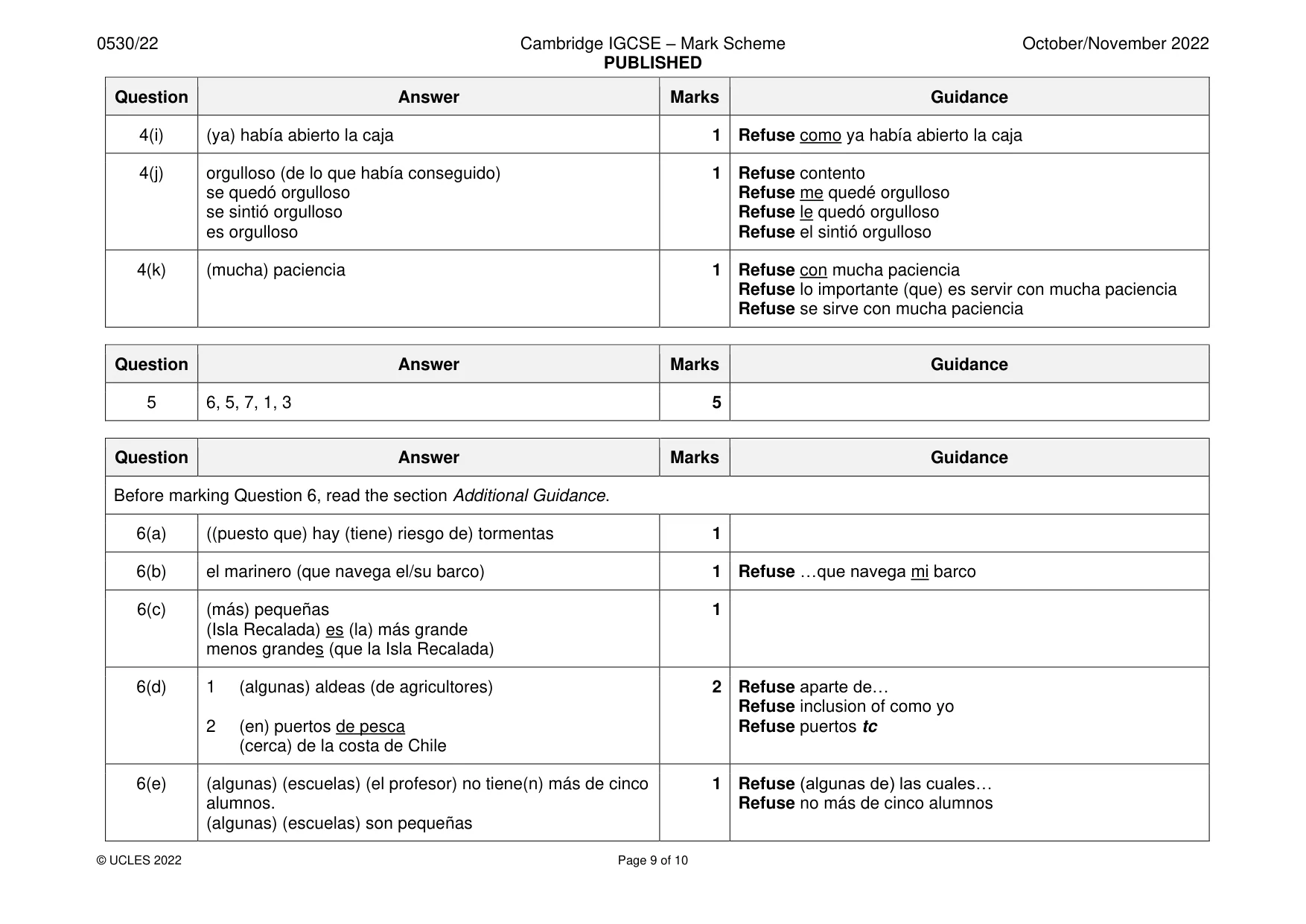
0530/22 Cambridge IGCSE – Mark Scheme PUBLISHED October/November 2022 © UCLES 2022 Page 9 of 10 Question Answer Marks Guidance 4(i) (ya) había abierto la caja 1 Refuse como ya había abierto la caja 4(j) orgulloso (de lo que había conseguido) se quedó orgulloso se sintió orgulloso es orgulloso 1 Refuse contento Refuse me quedé orgulloso Refuse le quedó orgulloso Refuse el sintió orgulloso 4(k) (mucha) paciencia 1 Refuse con mucha paciencia Refuse lo importante (que) es servir con mucha paciencia Refuse se sirve con mucha paciencia Question Answer Marks Guidance 5 6, 5, 7, 1, 3 5 Question Answer Marks Guidance Before marking Question 6, read the section Additional Guidance. 6(a) ((puesto que) hay (tiene) riesgo de) tormentas 1 6(b) el marinero (que navega el/su barco) 1 Refuse …que navega mi barco 6(c) (más) pequeñas (Isla Recalada) es (la) más grande menos grandes (que la Isla Recalada) 1 6(d) 1 (algunas) aldeas (de agricultores) 2 (en) puertos de pesca (cerca) de la costa de Chile 2 Refuse aparte de… Refuse inclusion of como yo Refuse puertos tc 6(e) (algunas) (escuelas) (el profesor) no tiene(n) más de cinco alumnos. (algunas) (escuelas) son pequeñas 1 Refuse (algunas de) las cuales… Refuse no más de cinco alumnos
Mark scheme, page 10
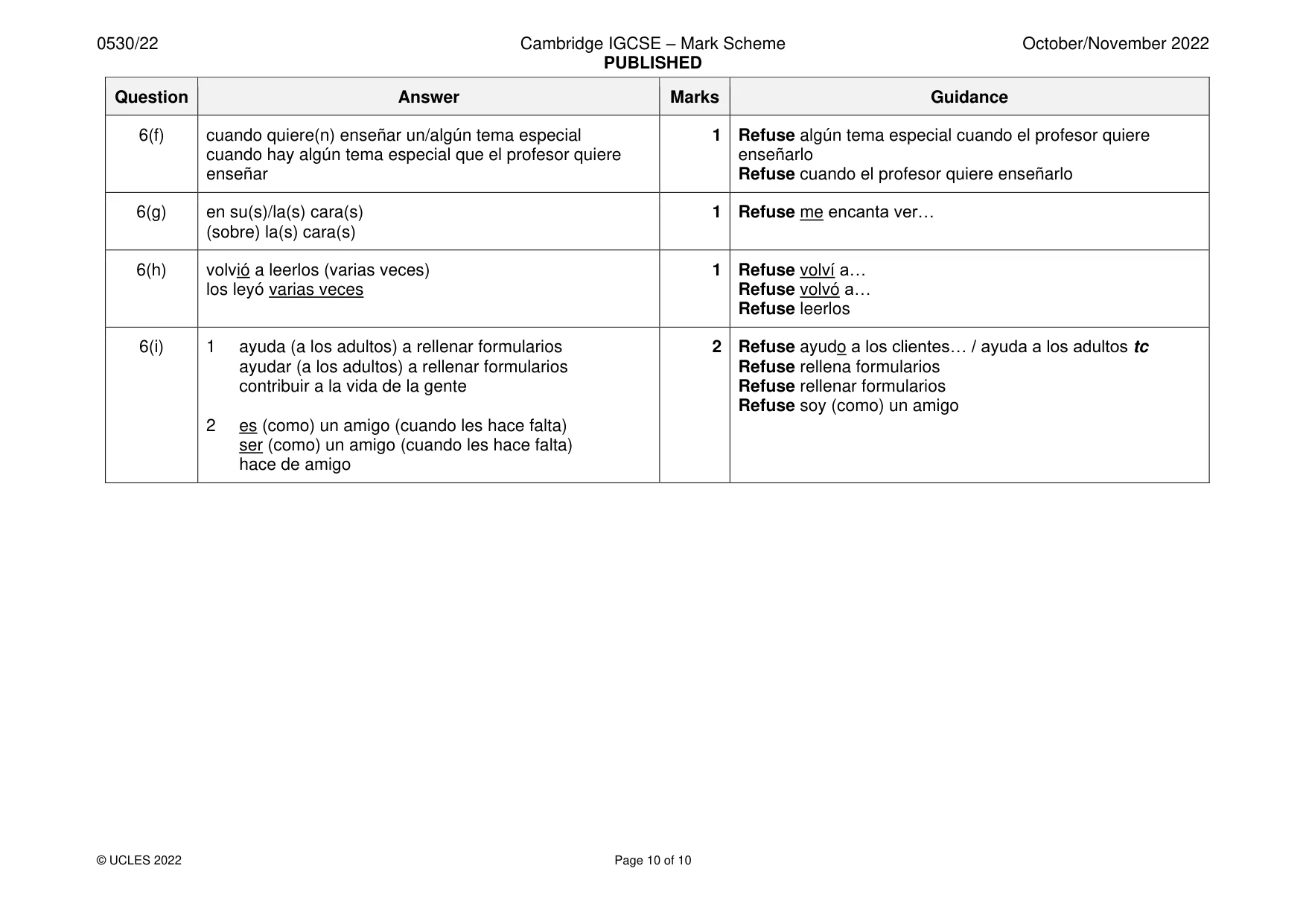
0530/22 Cambridge IGCSE – Mark Scheme PUBLISHED October/November 2022 © UCLES 2022 Page 10 of 10 Question Answer Marks Guidance 6(f) cuando quiere(n) enseñar un/algún tema especial cuando hay algún tema especial que el profesor quiere enseñar 1 Refuse algún tema especial cuando el profesor quiere enseñarlo Refuse cuando el profesor quiere enseñarlo 6(g) en su(s)/la(s) cara(s) (sobre) la(s) cara(s) 1 Refuse me encanta ver… 6(h) volvió a leerlos (varias veces) los leyó varias veces 1 Refuse volví a… Refuse volvó a… Refuse leerlos 6(i) 1 ayuda (a los adultos) a rellenar formularios ayudar (a los adultos) a rellenar formularios contribuir a la vida de la gente 2 es (como) un amigo (cuando les hace falta) ser (como) un amigo (cuando les hace falta) hace de amigo 2 Refuse ayudo a los clientes… / ayuda a los adultos tc Refuse rellena formularios Refuse rellenar formularios Refuse soy (como) un amigo
What you needed in this session
Cambridge’s own grade thresholds for 2022 Oct/Nov, Paper 2 · Variant 2. A higher threshold means an easier paper — the bar moves with how the cohort did.